Entrance test for “Teach For Kashmir” was conducted at SP College with over 100 students appearing in the exam.
“IAS topper Dr Shah Faesal and Rafiq Shah KAS also visited the centre and appreciated the efforts of the team for taking up such an initiative,” a host said.
Faesal said that such initiatives should be appreciated by the community as they will prove quite useful in encouraging and motivating students of J&K in qualifying various national level entrance tests,” the event spokesperson said.
Pertinently, Teach For Kashmir is a joint initiative undertaken by Saood Nazir, Imbesat Ahmad and Saif Khan, all of whom are pursuing their undergraduate studies at IIT Kharagpur and aspire to provide guidance for IIT JEE and various other engineering entrance examinations for 2 months,” the spokesperson added.
source: http://www.greaterkashmir.com / Greater Kashmir, Srinagar / Home> Srinagar City / GK News Network / Srinagar – May 06th, 2013
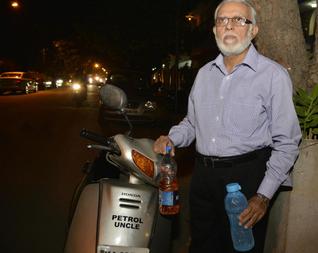
Mohammad Arif Sait helps motorists who run out of fuel at night
Kindness in a bottle:Mohammad Arif Sait sits outside the petrol outlet on Coles Road, offering desperate motorists a spot of fuel and water.— Photo: K. Murali Kumar / The Hindu
A fuel tank that reads empty at an inopportune time, especially at night with no petrol station in sight, is every motorist’s nightmare. Making sure that such desperate motorists who cross his path aren’t stranded is ‘Petrol Uncle’ Mohammad Arif Sait.
Mr. Sait sits outside a petrol outlet on Coles Road (near Fraser Town) from 11 p.m. to 12.30 a.m. every day with 10 bottles of petrol, worth at least Rs. 50 each, to help motorists who arrive after the outlet is closed at 11 p.m. He has done this for the last five years.
“There hasn’t been a single night when people haven’t come pushing their vehicle to the petrol station. I give them water to drink, and petrol to reach the nearest open pump,” he says proudly.
What goes around
It started when his scooter ran out of petrol one night. “I went in an auto and fetched petrol in a bottle from the nearest petrol outlet. I refilled the bottle and kept it with me. The same night, I saw a person pushing his vehicle on the road. He had run out of petrol. I gave him the bottle. He thanked me profusely. This prompted me to do this regularly,” Mr. Sait said.
He takes his spot every night after shutting his footwear store on Commercial Street.
He refuses to accept the money offered for the petrol by those he helps. All he asks is that the motorist fill the bottle at the nearest open fuel station and return it, so he can give it to others.
“Initially I used to spend around Rs. 1,000 a month,” he says. “The cost was nothing compared to the satisfaction I got from helping those in need. Now, I do not have to spend any money. Motorists refill the bottle return it to me.”
Mr. Sait’s family has not been able to convince him to stop this “service” even after two heart surgeries and a fractured leg. “I have made it clear I will continue this service till my last day. In fact, I feel healthier because of all the blessings.”
Recently, he was approached by a company to act in its ad films. A Kannada film director too has offered him a special appearance.
source: http://www.thehindu.com / The Hindu / Home> National> Karnataka / by Staff Reporter / Bangalore – December 17th, 2013
She broke a gender barrier by learning to drive an autorickshaw. Now, Jazeera V is taking on the might of the sand mafia in Kerala. Ankit Agrawal reports.
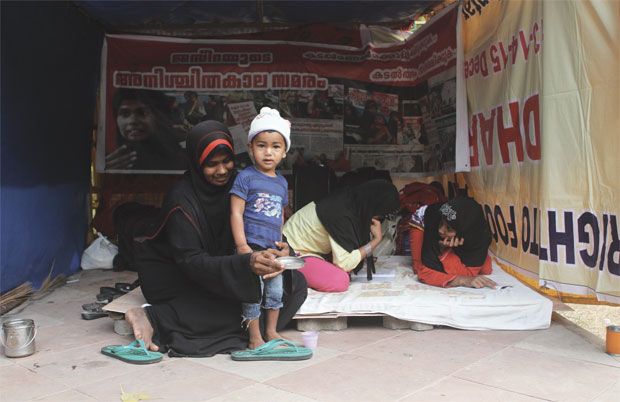
Mother courage Jazeera V with her three children at the protest site near Jantar Mantar / Photo: Ankit Agrawal
It’s 10 am and Jazeera V, a tall, burqa- clad woman, is having breakfast with her three children near Jantar Mantar in New Delhi. A 31-year-old autorickshaw driver, she has come all the way from Kerala to raise her voice against illegal sand mining on the beach near her village, Puthiyangadi, 30 km from the district headquarters of Kannur. She had seen how the rampant sand mining was causing erosion of the beach.
Sitting on a pavement in front of Kerala House, she has turned the little patch into her personal zone of dissent. She asks this reporter to wait until she finishes some daily chores: sweeping the spot where she has been doing a sit-in since 6 October, fetching water and helping her youngest child, 18-month-old Mohammad, have a bath.
Jazeera was born in a conservative family. “I was not allowed to play or read story books,” she recalls. Not one to be cowed down easily even as a child, Jazeera resisted this discrimination by going outdoors to play, just like the boys. But her family stopped sending her to school when she turned 14, and three years later, in 1999, forced her to get married.
However, three days after the wedding, she realised she could not imagine a life together with her husband. “He used to get drunk and have extra-marital affairs,” she says. “When I protested, my brothers thrashed me and locked me up in the house.” They insisted that she must protect the family’s “honour”. She said her husband, too, must fulfil his responsibilities towards her. Finally, in 2004, she shifted to Ernakulam with her elder daughter Rizwana, leaving her younger daughter Shifana with her mother.
At Ernakulam, she worked first as a domestic help and then as a saleswoman for a publishing house. Despite her family’s repeated attempts to make her return to her husband, she remained firm that that she wanted a divorce.
Later, Jazeera broke another gender barrier when she learnt to drive an autorickshaw in Kannur and bought one with financial assistance through the Prime Minister’s Rozgar Yojana. She moved to Kottayam and started working there as an autorickshaw driver. In 2011, she married Abdul Salam, a teacher at a local madrassa.
“It was in December 2011 that I first noticed the erosion of the beach near my village due to illegal sand mining that had been going on for at least four years,” she recalls. “I was expecting my third child and had come to visit my mother in Puthiyangadi.” She was shocked to learn that one of her brothers was also involved in the illegal mining . “I was pained by the damage being done to the coast. I was born there, so I took it personally,” she says. She told her brother that she would complain to the police if he didn’t end his involvement with the sand mafia . The threat worked. This was Jazeera’s first victory in what would turn out to be a long struggle.
Initially, Jazeera was the only one in her village to stand up against sand mining . The other villagers were not keen to join her as the illegal mining provided them with a source of livelihood. Moreover, several powerful people were allegedly part of the sand mafia.
Jazeera decided to carry on her struggle alone. She lodged a complaint with the local police and provided them photographs of the mining activities as evidence. No wonder the sand mafia saw her as a threat and attacked Jazeera and her children, not once but thrice.
Following her protest, the Kannur district administration set up a checkpost on a 1½ km stretch of the Neerozhukkumchal beach in the immediate vicinity of her house. That was not enough to stop the illegal digging as this was a stretch that had already been mined so intensely that there was little sand left. The mining was continuing unabated elsewhere on the beach. When Jazeera confronted the guard posted at the checkpost, he said he couldn’t do anything about what happens in other parts of the beach.
Convinced that the district administration did not really intend to stop the illegal mining, Jazeera took her fight to the state capital Thiruvananthapuram on 2 August this year, and sat in protest outside the state secretariat. On the third day of her sit-in, CM Oommen Chandy invited her for a discussion but refused to give any written assurance on steps to be taken to stop the illegal mining .
Jazeera decided to continue her protest. An NGO was allegedly roped in to take her children away from her in the name of “rescuing” them. A determined Jazeera somehow managed to thwart that attempt. Even as she is completely immersed in the struggle, she says she is taking “proper care” of her children and “they are not begging on the streets”. This reporter saw Elizabeth Philip, a documentary filmmaker, teach Jazeera’s children at the protest site in New Delhi.
“We know how much our mother cares for the beach,” chips in Rizwana, Jazeera’s 12-year-old daughter. “That’s why we are also protesting with her.”
After 64 days of the sit-in protest at Thiruvananthapuram, Jazeera took her fight to New Delhi. Several human rights organisations have come out in her support. Following media reports, on 10 October, the statutory apex human rights body, National Human Rights Commission (NHRC), issued notices to the Kerala government and the Kannur district administration. In its reply to the NHRC, the district administration claimed there was no sand mining on the Neerozhukkumchal beach. However, Jazeera has been demanding an end to illegal sand mining on the entire coastline of Kerala, not just that one beach.
The state revenue department also replied to the NHRC citing the action taken under the Kerala Protection of River Banks and Regulation of Removal of Sand Act, 2001. On 18 November, the rights body observed that this law didn’t apply to the seashores and reprimanded the department for not stating if any steps were taken to stop illegalsand mining along the coastline.
In October, Union Rural Development Minister Jairam Ramesh wrote to Chandy in support of Jazeera’s demands, but the CM is yet to reply. Social activist Medha Patkar also wrote to Chandy, reminding him of recent judgments of the Supreme Court and directives of the National Green Tribunal.
Though leaders of some political parties have shown their support for Jazeera’s cause, no party has taken a public stand yet on the issue. “Our state secretary visited her to show solidarity,” says CPI leader Annie Raja, who is also the general secretary of the National Federation of Indian Women. “Unfortunately, Jazeera is fighting alone but it is not as if we don’t care for her cause.”
F Faizi, an ecologist with the Convention for Bio-Diversity Alliance, says that sand mining is happening on a large scale in Kannur, Alappuzha, Kollam and parts of Thiruvananthapuram. Though Jazeera’s agitation has ensured that the extent of mining is somewhat reduced at the moment, the mining mafia’s clout leaves no room for complacence. Currently, Jazeera is mulling over filing a public interest petition on the issue.
While this reporter was leaving Jantar Mantar, Jazeera was talking to a family who had come to show their support. Perhaps, people like these are Jazeera’s greatest strength.
source: http://www.tehelka.com / Tehelka / Home> Current Affairs / by Ankit Agrawal ankit.agrawal@tehelka.com / Issue 50 , Vol. 10
(Published in Tehelka Magazine, Volume 10 Issue 50, Dated 14 December 2013)
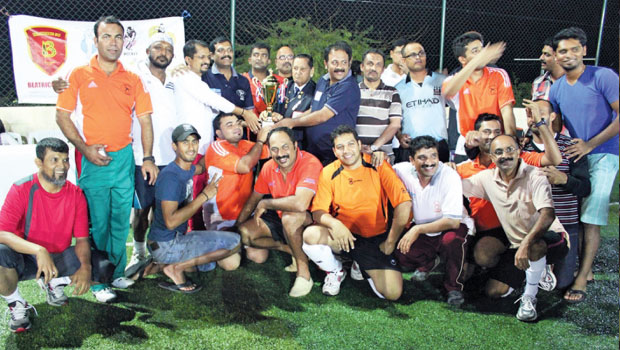
Winners Team Coorg pose for group photo after winning the final against Beatrice Dubai. – Supplied photo
Muscat:
Team Coorg lifted the Balan Master Memorial Trophy beating Beatrice Dubai 4-1 in the final. Organised by Beatrice Sports Club Muscat, the six-a-side hockey tournament was held at The Wave Stadium in the presence of former Indian hockey veteran S.A.S. Naqvi.
In an exciting final, Team Coorg showed their complete supremacy over Beatrice Dubai. Children’s football and family fun games were the sidelights of the final day.
Dr Mujeeb (Amana Polyclinic) delivered the keynote address. The tournament was organised in association with Team Coorg Muscat.
Former Oman national hockey coach K.K. Ponnacha and B. Kuttapa played an instrumental role in helping the Beatrice Sports Club Muscat to host the tournament with much fanfare.
During the concluding ceremony, the organisers of the tournament also honoured S.A.S. Naqvi, Mohammed Osama Rawat, K.K. Ponnacha and B. Kuttapa for their outstanding achievements in the field of sports.
Beatrice executive committee members Shahir, Dr Mujeeb, O.V. Feros, Feros. M, Said, Rasheed, Habib A.P.M and Zaheer thanked the audience for coming in large numbers to support the tournament.
Badr Shipping Company and Sixar Group were the sponsors.
source: http://www.timesofoman.com / Times of Oman / Home / by Times News Service / December 05th, 2013
(Pervez Bari): “The time has come for the entire Muslim world to introspect and get awakened to revisit five centuries, from 750 to 1258 AD – which is often described as the Golden Age of Islamic science — the teaching and practice of medicine in Europe was heavily influenced by the works of Al-Razi (d. 925), Al-Zahrawi (d. 1013) and Ibn Sina (d. 1037) to reinvent Islam’s image of peace, human values and service to humanity through Quranic injunction and Prophet Muhammad’s (PBUH) sayings (Hadees).
The difference between non-Muslims and Muslims is only that of service to humanity by the latter on the directives of Quran”.
The above observation was made by Mr. K. Rahman Khan Union Minister of Minority Affairs, who was the chief guest, while delivering the inaugural address of the three-day International Conference on “Revisiting Abul Qasim Al-Zahrawi’s Legacy in Medicine and Surgery” here on Friday evening at the India Islamic Cultural Centre.
Rahman Khan lamented that whole of Islamic world today is in turmoil despite it is blessed with wealth at its hand but no research is being conducted to benefit mankind. He called upon Muslims, especially youth, to emulate Al-Zahrawi, who has been called father of modern medicine and surgery, not only in medical but all other fields to serve the mankind.
The New Delhi-based Institute of Objective Studies, (IOS), in collaboration with MESCO (Muslim Educational, Social and Cultural Organisation, Hyderabad), and Maulana Azad Education Foundation, Ministry of Minority Affairs, New Delhi is organizing the three-day international conference on to mark the 1000th death anniversary of the pioneer physician and surgeon and highlight his wide-ranging contributions to medicine and surgery. The co-sponsors of the event are India Islamic Cultural Centre, New Delhi, and PARAS HEALTHCARE.
Prof. Omar Hasan Kasule, Sr. Faculty of Medicine, King Fahad Medical City, Riyadh, KSA, in his presidential address said that Islamic medicine is not specific medical procedures or therapeutic agents used in a particular place or a particular time. Islamic medicine is universal, all-embracing, flexible, and allows for growth and development of various methods of investigation and treatment of diseases within the framework described above’. The conceptual clarification from this definition opened the door to Islamization of modern scientific medicine.
Prof. Kasule Islamic Health Care Industry provides a value-added to medical care, spirituality, ibadat-friendly hospital, and Islamic ambience. The Islamic approach provides holistic care. Unlike Islamic finance, it started with professional training at faculties of medicine. All have a stake in health only a few have a stake in banking, he added.
Meanwhile, Harish Chandra Singh Rawat, Union Minister of Water Resources, in his address said that he salutes the sense of dedication and sense of inequality in Islam which Al-Zahrawi followed to serve whole humanity and not Muslims alone.
Dr. Fakhruddin Mohammad, Organising Secretary & Hony. Secretary, MESCO, Hyderabad threw light on the introduction of the theme of the international conference aptly.
Dr. Ahmad Abdul Hai, MD & Chief Consultant, Hai Medicare & Research Institute, Patna, in his key-note address said: “Islam has made a very glorious contribution to the art of healing. The basic impetus and the inspiration for this Islamic medicine came from the Noble Quran and the teachings of the Holy Prophet which took medicine away from the realm of superstation & fantasy and gave it a rational footing. This was the basis of Islamic Medicine”.
Dr. Hai quoted Dr. Ahmad Al Kadi of USA who had said: “the treatment in question may be spiritual, physical, exercises, nutritional adjustment, pharmaceuticals preparation (natural or synthetic) surgical procedures, implants, use of modern diagnostic tools (MRI & PET Scan), radiation therapy or a combination of any of these modalities”.
This definition of Islamic medicine may come as a surprise for some of us who feel that Islamic medicine is something limited to the therapy practiced by the revered old Hakeem’s, or is rooted only in natural herbs or is limited to the direct health related teachings found in the Quran & Hadith, or some faith healing manoeuvres, he added.
He said that Islamic medicine includes all the modalities of modern medicine but yet differs from it because it is rooted in divine faith & ethics. It strives for excellence. It is comprehensive, paying attention to the body, the psyche and the soul. It takes into account not only the individual patient but also the society. It is universal, utilizing all useful resources and offering its services to all mankind.
Earlier, Dr. Fakhruddin said that Abul Qasim Khalaf ibn al-Abbas al-Zahrawi (940-1013), known as Albucasis in the West, devoted his entire life, in Madinat al-Zahra, near Cordoba, in Muslim Spain, to medical research and practice. He made an outstanding and original contribution to medicine, surgery, orthopaedics, gynaecology and obstetrics, pharmacology and dentistry. He has been described as the father of modern surgery.
At the outset Maulana Abdullah Tarique recitated verses from the Holy Qur’an. Prof. M. Afzal Wani, Professor of Law, GGS IP University, Delhi, welcomed the dignitaries, guests and delegates. The inaugural session of the International Conference will be webcast live on the link http://vectraimage.com/webcast/ios/. Dr. Mohammed Iftekharuddin, Director, MESCO, Hyderabad conducted the inaugural function with aplomb.
Meanwhile, after the Maghrib prayers a plenary session was held on the theme of Islamic ethos in al-Zahrawi’s contribution to medicine and surgery which is still going at the time of going to the press. The plenary session is chaired by Maulana Dr. Saeed Al Azami Al Nadwi, Chancellor, Integral University and Chief Editor, Al Baas Al Islami, Lucknow. Prof. Hakim Syed Zillur Rahman, Founder President, Ibn Sina Academy of Medical Medicine and Sciences, Aligarh is the Co-Chairman of the session. (pervezbari@eth.net)
source: http://www.siasat.com / The Siasat Daily / Home> India / by Pervez Bari pervezbari@eth.net / Friday – December 13th, 2013
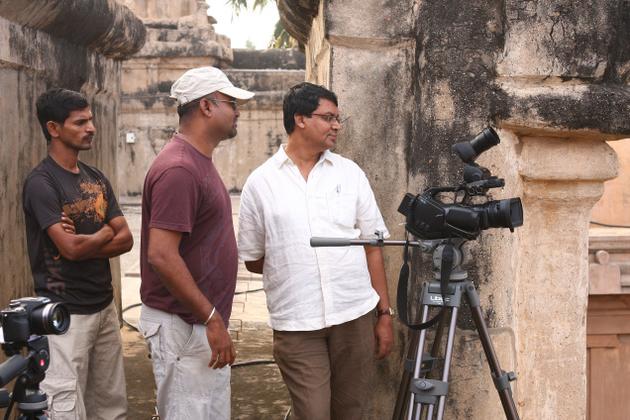
A journey within: The shooting of the documentary / by Special Arrangement / The Hindu
A documentarian sets out in search of his identity and comes up with the untold story of Tamil Muslims
“O Mankind! We created you from a single (pair) of a male and a female, and made you into nations and tribes, that ye may know each other…” Yaadhum, a documentary by the filmmaker Kombai S Anwar, opens with this quote from the Quran, and the image that follows is practically a counterpoint — the procession of Lord Ranganatha along the streets of Kombai, in the Theni district of Tamil Nadu, accompanied by traditional temple sounds from the nagaswaram and a large drum.
Then, as the procession passes the local mosque, we see the reason for this juxtaposition of word and picture: the investigation into the arrival of Islam in a place of Hindus and Tamils. In a voiceover, Anwar says, “While ‘who am I’ is never a question that bothered me during my growing-up years, it became quite important to me and to countless other Muslims, especially in these increasingly troubled times.” The documentary is labelled ‘A Tamil Muslim’s Journey In Search Of His Roots And Identity.’
Anwar told me that the idea for the film took shape from a paper he presented — Tamil Muslims: The Untold Story — at a national seminar. The paper was well received, and he was invited to give more talks on the subject. “After every presentation,” he said, “there would invariably be a few from the audience asking if a CD of the same material was available, so that they can pass it on to friends. With many such requests, and tired of the stereotyping of Muslims as well as the increasing polarisation, I thought I should make this the subject of a documentary film, so that it can reach a bigger audience.”
When he started about four years ago, he found it difficult to get funding, as Yaadhum was seen as a “religious project.” So he went ahead on his own, with money from his sister, a few friends, and his professional assignments in photography and filmmaking, which included a series of short films on the Big Temple at Thanjavur commissioned by the ASI.
Yaadhum, which loosely means “all” or “everything,” showcases the close relationship between Muslims and those from other communities. In one stretch in Madurai, we meet the Muslim family that has, for generations, been building the fence around the sacrificial pit in Puttu Koil, the site of one of the Thiruvilaiyadals of Lord Shiva. “These relationships have evolved into kinship in southern Tamil Nadu,” says Anwar, who found it difficult to get permission to shoot inside mosques and temples. To film the prayers at the Kombai mosque, for instance, he had to ask the jamaath leaders (office bearers of the mosque), who, in turn, asked the congregation during the Friday-afternoon Jumma prayer. Only after they agreed could Anwar go ahead. The officials at the temple, on the other hand, wanted some time to think about it; eventually they said he could go ahead. Later on, when they got to know him, they admitted that they were initially wary about a Muslim showing interest in the temple, so they checked with a friend from the CB-CID. Anwar told me, “It was my luck that the CB-CID asked them not to worry.”
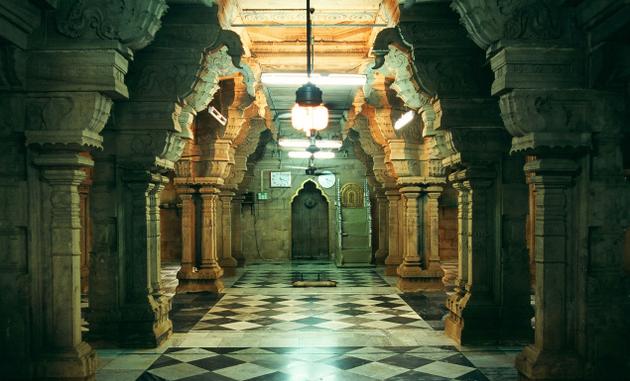
The Kilakarai Jumma Mosque / by Special Arrangement / The Hindu
It is precisely these rifts that the film intends to bridge, by showing how, once, these rifts didn’t exist at all. At the site of a dig near Kodungallur, a major port of the Chera kingdom, Prof. PJ Cherian, Director, Kerala Council for Historical Research, speaks of its “multi-cultural character 2000 years back”, and how “people belonging to different cultural groups, different belief systems, different practices, different traditions had an opportunity to come together and have interfaces. They all may have come here as traders. But you know trade doesn’t carry just goods. It brings in ideas, technology and new thinking… Multiple groups from the Mediterranean, from the Saudi Arabian region, from West Asia, from the Mesopotamian region, from the Indian Ocean rims, all were active here.”
This cultural overlap is found in Tamil Nadu too — say, in the Vaishnavite pilgrimage town of Alwar Thirunagari, where the mosque is built in the Dravidian architecture style. Dr. Raja Mohamad, Asst. Director of Museums (Retired), Govt. Museum, Chennai, says that there are no regulations with respect to Islamic architecture. “All that’s needed is a quiet place for prayer. And while building this space, the builders adopted the local architectural style.” Yaadhum is some sort of road movie, and Anwar’s stops along the way illuminate various aspects of Islam in the South and even Goa. He goes to Chola country, establishing the presence of Muslims through an inscription that refers to “Ahmed the Turk.” He goes to Kayalpattinam, which belonged to the Pandyas, and finds an almost 1000-year-old mosque to which additions have been made at different times. He narrates the history of the Tamil Muslims of Pulicat, most of whom are boat builders. He goes to Calicut, home of the Mapilla Muslims. Prof. MGS Narayanan, Director General, Centre for Heritage Studies, Dept. of Cultural Affairs, Govt. of Kerala, talks about a law which is supposed to have been passed by the Zamorin that at least one member of the fishermen families in Calicut must get converted to Islam so that there will be enough people to support naval warfare against the Portuguese who wanted to conquer Malabar in the 16th Century. (Hindus were generally reluctant to go to sea.)
We see venues, like Kottar in Nagercoil, where Tamil-Muslim literature flowered. The Arabic, Persian and Urdu influences introduced many new genres to Tamil literature — Kissa, Nama, Padaipor, and Munajaath. Among the most pleasant surprises of the film — and one that underscores the narrative crux of cultural osmosis — comes in these portions. We see a palm-leaf manuscript of Mihraj Maalai, poems written by Aali Pulavar in the 16th Century in memory of the ascent of the Prophet, and then we hear Isai Aruvi Seera Aboobacker sing these verses like a virutham (a free-style rendition, not set to a beat) in the Carnatic raga Kapi.
At the end of the film, Anwar says, “I am only halfway through my journey.” He still has many more miles to go and oceans to cross, this time in search of the Tamil Muslim Diaspora — but he has no more doubts about his roots. “I am a Tamil, a Muslim, and so many other things. In short, I am all of this —Yaadhum.”
source: http://www.thehindu.com / The Hindu / Home> Features> MetroPlus / by Baradwaj Ranjan / Chennai – November 29th, 2013
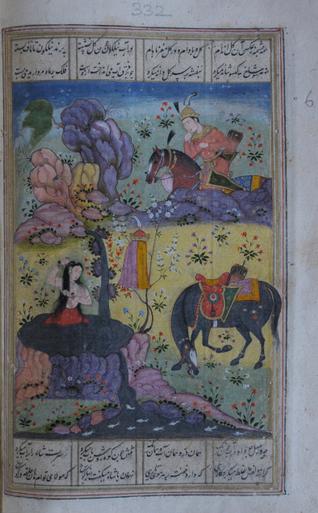
Khusrau espies Shirin bathing, a page from the ‘Khamsa-e-Nizami’ book. / Photo: Special Arrangement / The Hindu
Bearing excellent paintings, richly illuminated and gilded, the fine-bound manuscripts at Salar Jung Museum are real treasures
Salar Jung Museum contains some ‘valuable books of art’— illustrated manuscripts — of Persian and Deccani languages. Bearing excellent paintings, richly illuminated and gilded, fine-bound and owned once by royal personages the Museum’s manuscripts are real treasures.
Manuscript illustration was greatly prized by Mughal emperors, their nobles and Deccani Sultans. Akbar who had 100 artists – painters, illuminators, scribes, book binders – in his atelier had many manuscripts including Hamza Nama, Ramayana, Mahabharata illustrated. His principal noble at Ahmedabad, Khan Khanan, built up a world class library containing illustrated manuscripts. Ibrahim Quli Qutb Shah, who ruled Golconda from 1550 to 1580, had set up a studio in his palace for calligraphers, painters, gilders and book binders and had manuscripts of fine quality produced.
‘The art books’ of the royal workshops form a priceless heritage, “at times of regal splendour…. and always a joy to behold” (Karl Khandalavala).
Of Salar Jung Museum’s famous illustrated manuscripts, a description of four books is attempted here. They are: Tuhfe-e-Sami, Majalis-ul-ushshaq, Khamsa-e-nizami, and Diwan-e-sultan Muhammad Quli Qutb Shah.
1. Tuhfe-e-Sami: The author of this 229-folio Persian manuscripts is Prince Sam Mirza (1517-76), son of Shah Ismail, the founder of Safavid dynasty in Persia. Prince Sam Mirza dedicated Tuhfa containing biographies of poets, painters, calligrgaphers and other learned men to his brother Shah Tahmasp (1524-76), the ruler of Persia who, however, put ‘Sam’ to death in 1576 when he rebelled against him. The manuscript is gilded and highly ornamented. Done in Shirazi style of Persia the Thufa’s ten miniatures “are of excellent quality and very colourful with charming colour contrast’’ (Karl Khandalavala).
The manuscript scripted in fine Nastaliq bears a seal of the year of A.D. 1651 of one Mustafa Khan Lari, who was probably a Golconda noble.
2. Majalis-ul-ushshaq ( Assemblies of lovers): Purchased by Sir Salar Jung I (1829-83), ‘Majalis-ul-ushshaq’ is an account in Persian of the Sufi saints being in love with women and men. Sufi doctrines explain that to experience the beauty of the ‘unseen’ God the first step is the worldly love – love of women and men. The power and course of such love as experienced by some Sufi saints is depicted in majority of the 71 miniatures contained in the manuscript.
The book has a lot of gold used in decorating its 237 folios, headings and borders. The painting style of its miniatures is of Shirazi school of Persia.
The author of this manuscript is Mansur bin Baiqara (1469-1506) who wrote it in 1552. The script is good Nastaliq and the scribe is Amir-al-katib.
3. Khamsa-e-nizami: The Khamsa (five-piece verse collection) of the poet Nizami, a Persian poet, is one of the most famous Persian works and there are numerous illustrated copies of it in Persian and Mughal schools of painting. The Mughal style Museum’s Khamsa was purchased in 1739 for the library of Nawab Munirddoulah Wakil-us-sultan (Prime Minister). It consists of five ‘mathnavis’ (long poems) dealing with the stories of Laila-Majnun, Khusrau-Shirin, King Behraum Gaur, Sikandar and Sufism.
It contains five unwans (title pages), gilded and highly ornamented. Its 325 creamish folios are gold sprinkled. Its eleven full-page miniatures show animals, brilliantly drawn and figures, finely painted. Dated A.D.1618, the scribe of Khamsa is Fatah Muhammed bin Moulana Sahib Katib and the script is good Nastaliq.
The manuscript bears the seal of Lutfullah khan, a noble of Mughal family, who appears to have died in Golconda when Aurangazeb was engaged in conquering the fort.
4. Diwan-e-sultan Muhammad Quli Qutb Shah: Written in ‘Zubane-deccani’ by Sultan Muhammed Quli Qutb Shah who ruled from Golconda between 1581 and 1611 is regarded as the earliest poet in Deccani language(Urdu). He founded the city of Hyderabad and built the famous Charminar. His ‘Diwan’(odes) deals with subjects like sports and games, royal palaces, seasons and description of his 17 mistresses.
Dated 1595, the Diwan has eight miniatures, all gems of miniature art. It was written by Moulana Zainuddin, Khushnawis (calligrapher) of the Sultan. The paper used is gold sprinkled. The script is excellent Thulth. It has 138 handsome folios.
Deputy Keeper (Retd.), Salar Jung Museum
source: http://www.thehindu.com / The Hindu / Home> News> Cities> Hyderabad / by B. Kotaiah / September 19th, 2013
Call him the Shoban Sarkar of Karnataka or a foreword to another treasure hunt episode: A Bangalorean, who claims to have a soldier in the army of Mysore ruler Tipu Sultan in his past life, has submitted a petition to the Mandya district administration on a hidden treasure in Srirangapatna.
The place coming in his dreams is close to the place where Tipu was killed in the Fourth Mysore War (May 04, 1799). According to historical records, this place is the Hoally (Diddy) Gateway, 270 m in the north eastern direction from the Srirangapatna Fort.
Forty-four year old Mohammed Aziz Pasha, a resident of city’s Shamanna Garden, who was called by Srirangapatna police on November 29, has also identified the spot that haunts him in dream. The petition is now forwarded to the archaeology department, which has now sought expert opinion, said officials.
“We had called him and took him around. He stopped near a mantap that is beside Gangadharaswamy temple and close to the area where Tipu was killed. He pointed that the mantap was the place where the treasure was hid. However we have now forwarded the application to the archaeology department to take suitable action. They will have to decide further,” a police official with Srirangapatna told Bangalore Mirror.
The treasure
Pasha has explained in his petition that he has been getting dreams for the last 10 years in which he was among those who hid 20 trunks of diamonds and gold treasure on Tipu’s command. Pasha told Bangalore Mirror how he is haunted by dreams of being in Tipu Sultan’s army. “I have been getting dreams and when I visited the place it turned out to be the same as the one in my dreams. Gold, silver and other valuables were stuffed in about twenty safes made of iron and hid in the area. Later a structure was constructed on it. I want the state government to take the treasure. Hence I have visited the deputy commissioner and have given my petition.”
Intriguingly, Pasha unerringly took the police officials to the Gangadhareshwara temple and told them this was the spot. He claims to have never been to Srirangapatna before, in this life.
“There were about twenty soldiers and what comes in my dream always is that I was one among those. Tipu, our king, I remember, ordered us to hide these twenty safes as he sensed that British may attack us. Then all other soldiers were sent and about twenty of us, who were his confidantes were asked to hide them inside ground and construct a mantap above. We followed orders. This has been coming in my dreams for the last 10 years now.”
He was so convinced that he met the deputy commissioner of Mandya B N Krishnaiah. “He had come to me with a petition. As the matter pertained to the archaeology department, I referred it further to them and to police. It is they who have to decide on how to go about,” Krishnaiah told Bangalore Mirror.
Unlike the Shoban Sarkar case, where the Uttar Pradesh government and archeology department actually started digging based on his ”visions,” the state administration is being cautious. “A person had come and he was telling us about this treasury. As the land belongs to archaeology department, we have directed him to the concerned,” Bhushan Gulabrao Borase, superintendent of police, Mandya district said.
Pasha was confident of finding the treasure which Tipu had hid and claimed that the iron safes were covered by lime and then sand before the soil was stuffed in. ”The treasure is not very deep. It is just a few feet from the ground. All the twenty iron safes with precious stones, diamond, gold were hidden in the ground and later sand was put and then soil. That was the place coming in my dream and I could easily make out in my first visit. So I’m sure the treasure is there,” Pasha said.
Archaeology looks at options
The state archaeology department officials whose opinion is sought maintained that options are being explored on the petition.
“The police have sought our opinion. There is no point in jumping to a conclusion without proper study. So we are exploring if there are any options to study the place to know about the existence of unnatural things using an alternative method other than excavation. If anything is found in such studies without excavating land, we can go ahead. If the study finds nothing, then we can conclude at that. So at this stage we are yet to arrive at any decision,” a state archaeology department official told Bangalore Mirror.
source: http://www.bangaloremirror.com / Bangalore Mirror / Home> Bangalore> Others / by Chetan R, Bangalore Mirror Bureau / December 07th, 2013
Ibrahim Sharief, a resident of Yeshwantnagar in the taluk, who works as an assistant controller of mines with the Indian Bureau of Mines in Odisha, reportedly went missing on November 25.
Except his two-wheeler found near a private hospital, there have been no clue about his whereabouts, said the worried family members of Sharief. The 36-year-old officer, known for his uprightness, had left home for work in Bhubaneshwar, around 10 am.
When he didn’t return home for lunch, his wife Salma Begum called him on his cellphone which was switched off. Panicked, she enquired at the office where she was told that he had not come to work.
She informed her family members in Yeshwantnagar immediately and registered a complaint with the police.
During the investigation, the police found his two-wheeler abandoned in front of a hospital near his office.
His brother Subhan told Deccan Herald that even after a week since Ibrahim went ‘missing’, the family has received no information either about him or about the progress in the investigation.
He urged the Odisha government to direct the police to probe the matter at the earliest.
Ibrahim’s father Giddu Sab, with tears in his eyes, said that the last time he saw his son was when he had come home for Bakrid. He prayed for Ibrahim’s safety.
Sandur legislator E Tukaram said that he had discussed the issue with the Home minister and the DG&IGP of Karnataka, who are in touch with their counterparts in Odisha. The matter was raised in the ongoing winter session in Belgaum, he said.
Karnataka government was in touch with its Odisha about an official of Indian Bureau of Mines hailing from the state who is reported missing for the last one week, Home Minister K J George said today.
“Government will send a team there (Odisha) if need arises,” George told reporters here, when asked about Assistant Controller of Mines 34-year old Ibrahim Sharif, who is reported missing since November 25 from Bhubaneshwar.
Hailing from Karnataka, Sharif has been staying with his family at Nigam Vihar in Phase-II of Kanan Vihar under Infocity police station area in Bhubaneshwar.
Sharif’s wife Salma Begum in her FIR had said he remained untraceable since he left for office in his scooter at 10 AM on November 25. His mobile was activated only for two seconds on November 26 and located a Allahabad at that time.
Suspecting abduction of her husband, Salma Begum appealed for his safe return.
Sharif, whose nature of work made him visit mines and undertake inspection for enforcement of rules of mineral conservation and development, reportedly last visited some mines in Barbil area of Keonjhar district in Odisha in September.
source: http://www.business-standard.com / Business Standard / Home> PTI Stories > National> News / by Press Trust of India / Belgaum – December 02nd, 2013