Category Archives: Community Involvement / Social Issues

Unani regimen offers hope to mishap victim

Imran Khan, a resident of Tumkur, had been bedridden for the best part of 12 years after nearly 200 kg of steel fell on his back when he was visiting a construction site.

The 28-year-old lost all hope of walking again till he found out about Ilaj bit Tadbeer (regimental therapy), a little-known system of unani medicine involving massage, cupping and leeching using herbs. Imran underwent 14 months of continuous treatment at the National Institute of Unani Medicine (NIUM), which falls under the Ministry of Health and Family Welfare. Now, he has started walking with support.

The story of Tousif Ahmed from BTM Layout is similar to Imran’s. Tousif injured his spine in an accident in Andhra Pradesh in January 2012 in which his uncle died.

“I was told by a private hospital that I would not walk again and would be bedridden for the rest of my life. But with intervention from NIUM, I am moving in a wheelchair and also walking with crutches,” he said.

Tousif has been receiving treatment at the Institute for the past four months. He is currently shooting videos of recovering patients at NIUM in order to make a short film.

“I had wanted to set up a call-centre after getting my BCA, but the accident crippled my dream. But as I can move again, I have set a target of five months to walk out of this hospital,” he said.

Dr D A Muzzaffar Bhat, resident medical officer of NIUM, said the centre was focusing on neuro-rehabilitation. This included attending to patients who suffered from stroke, myopathy, epilepsy, motor-neuron disease, Parkinson’s disease, hemiplegia and paraplegia. He said NIUM takes up cases referred from other hospitals like NIMHANS.

He referred to the successful treatment of Mohammed Farooq, who was admitted to Victoria Hospital after meeting with an accident. He was bedridden for eight months with no sensation in his lower-back. Farooq started treatment at NIUM in January and is now walking with the help of crutches.

“No surgeries are done here and our approach is to develop cells and strengthen nerves and muscles,” Dr Bhat said .

Options for Cerebral Palsy Aditya Kholi greets you with a smile and offers a chair to those who approach him and only when he tries to walk, do people notice a problem.

Aditya is a child who was born with cerebral palsy and could hardly move his legs. His father Mahesh Kohli, an IT professional, had quit his job in Dubai to research treatment options for Aditya, when a friend told him about Ilaj bit Tadbeer.

After five months of treatment, Aditya can now sit comfortably and also fold his legs and walk.

source: http://www.newindianexpress.com / The New Indian Express / Home> Cities> Bangalore / by Mohammed Yacoob – Bangalore / November 18th, 2013

The Turkish connection

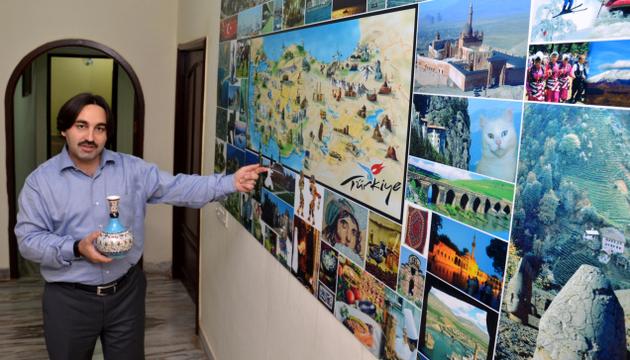
Indialogue Foundation director Osman Kayaoglu talks about the places to see in Turkey as he holds a traditional Turkish vase./  Photo: Nagara Gopal / The Hindu
Indialogue Foundation director Osman Kayaoglu talks about the places to see in Turkey as he holds a traditional Turkish vase./ Photo: Nagara Gopal / The Hindu

As the Turkish Consulate gets ready to set up office in Hyderabad, Neeraja Murthy finds a Turkey-Hyderabad connect

Enter the first floor of Learnium School on Road No. 44, Jubilee Hills and you’ll find a slice of Turkey in Hyderabad. On the walls is a Turkish Corner that displays photographs of ‘Turk folklor’, a Turkish bride, ‘Turk Lokumu’ among other things. Move around and there is a Indo-Turk Corner and photographs of famous Turkish palaces. As we soak in the pictures, we hear the booming voice of Sevim Kayaogolu calling out “Bir, iki, uch, dort… “(one, two, three four… in Turkish). She is teaching a Turkish dance to a group of young girls who are dancing to the beats of Yeni bir dunya, dressed in their traditional Turkish dresses.

Sevim (in the centre) joins a group of girls dancing to the tune of Turkish song ‘Yeni bir dunya’. / Photo: Nagara Gopal / The Hindu

“The students are presenting this Turkish dance for the Parents Day meeting,” informs Sevim. The school (will be called Iqbalia International School) run by a Trust (which also includes Turkish people) teaches Turkish language art, dance and culture to its students, in addition to its regular CBSE syllabus. Osman Kayaogolu, director of Indialogue Foundation’s second year in Hyderabad, calls the city ‘historical’. “Among the different cities in India, Hyderabad has a beautiful history,” he says and adds, “Turkey and Hyderabad share a lot in common in culture. We have given our daughters here in marriage – Princess Durru Shehvar who married Azam Jah, Princesses Esin and Esra have also come to Hyderabad after marriage.”

Osman talks about the ‘royal’ similarity between the two regions. “The Chowmahalla Palace looks like a replica of Dolmabahche palace, only the former is smaller. It is said that the Chowmahalla was built for Durru Shehvar so that she would feel at home in a place that reminds her of Turkey,” he smiles.

Indialogue Foundation, the Turkish cultural centre acts as a hub for the 15 Turkish families living in Hyderabad. “We get together here during religious ceremonies like Eid and we organise inter-faith seminars, talks, conferences and cultural programmes. We arrange business meetings between Turkish and Indian businessmen and also organise Turkish celebrations.”

Osman says the Turks enjoy their stay in the city. “The climate is nice and we enjoy eating biryani which is like our not-so-spicy Osmani pulao. We have made many friends here and people are affectionate too.”

What baffles Osman however is the way friendly Hyderabadis behave while driving on roads. “During busy traffic, they are not at all friendly and act differently,” he says with a smile. The Turkish women volunteers try to spread their art and culture in the city. Osman and his group of friends also play football every Sunday. “We don’t know about cricket, but now our children are picking up the game in Hyderabad.”

There is also good news for the Turkish families in the city with the Turkish Consulate coming up here. “The Turkish Consulate General Murat Omeroglu is in Hyderabad with his family and the work to establish the Consulate has begun. The process might take six months,” says Osman.

Osman says Turkish people in the city do miss their family and friends back home as well as Turkish food; but they have found a home away from home here.

“Hyderabad is our second home. Merhaba Hydarabad (Salaam Hyderabad),” he signs off.

Short film contest

Indialogue Foundation and Sarojini Naidu School of Arts and Communication, University of Hyderabad had organised a Indialogue Short Film Contest 2013on the theme ‘Peaceful Coexistence” which aimed to foster universally shared values among public .

The contest had two categories – YouTube award and Jury award. Emrah Alpaslan from Saritha Vidya Niketan with his short film titled Dedicated Life won the YouTube award with 2100+ views. Jhilam Chattaraj, from University of Hyderabad with her movie In Search of History was selected for the Jury award.

Both the awards carried a prize money of Rs. 35,000 each.

source: http://www.thehindu.com / The Hindu / Home> Features> MetroPlus / by Neeraja Murthy / November 19th, 2013

Azad’s views still relevant to country: D. Harinarayana

“Educating the rural girl would be a great advantage to the economy,” said the Pro Vice-Chancellor of GITAM University, at the 129 birth anniversary celebrations of Maulana Abul Kalam Azad.

Maulana Abul Kalam Azad’s views were still relevant to the country, Pro Vice-Chancellor of GITAM University, D. Harinarayana, said while participating in the 129 birth anniversary celebrations of India’s first Union Minister for Education, organised by the GITAM Institute of Science on Monday.

Educating the rural girl would be a great advantage to the economy, Prof. Harinarayana said while pointing out that there was still a lot of disparity in rural and urban literacy and that women’s education was still a neglected area.

The education system as well as quality of institutions must be strengthened and youth must be imbibed with skills so that they could compete in the global environment, he said.

Principal of GIS N. Lakshmana Das spoke on the life of Maulana Abul Kalam Azad. He regretted that in wake of the IT revolution students were not opting for science courses.

But there was scope for a lot of opportunities in science for the younger generation due to the great ‘Big Bang’ experiment, nuclear energy, space science and other areas, he pointed put.

UGC affairs Director Ch. Ramakrishna, senior professor Ramana and other faculty members participated in the meeting.

source: http://www.thehindu.com / The Hindu / Home> News> Cities> Visakhapatnam / by Special Correspondent / Visakhapatnam – November 12th, 2013

Soldier from Badami killed in freak accident

Salim Walikar, a soldier of the Indian Army and a native of Khaji Budhihal village in Badami taluk, was killed in a freak accident during weapons testing in Nagpur on Tuesday. His mortal remains will be laid to rest with full military honours at his hometown on Thursday.

Walikar, who had married four years ago, is survived by his wife Mumtaz Begum, two children and parents Fakruddin Saab and Jaibunnisa. Salim, who had joined the Army in 2002, had visited his home in August to celebrate Ramzan.

source:  http://www.deccanherald.com / Deccan Herald / Home> State / Bagalkot , DHNS / November 28th, 2013

Cocoon art in full bloom

The recently concluded Krishi Mela in Bangalore had a head-turner. Displaying bouquets of multihued flowers, garlands and greeting cards, all created out of used and damaged cocoons, the Cocoon Craft stall was stunningly attractive. Holding bunches of artificial flowers modelling tulips, dahlia and rhododendron, the stalls were swarmed by many a well-heeled women who were attracted to the novelty of the art.

CocoonMPos26nov2013

Cocoon shells, either damaged or discarded from silk reeling units, have traditionally been considered a waste product which are dumped in compost pits for their protein content. But no longer so. They are being turned into art by a growing breed of students pursuing sericulture.

The project to make art out of cocoon shells is the brainchild of Dr Fatima Sadatulla, a teacher in the Department of Sericulture at the University of Agricultural Sciences (UAS) in Bangalore. Fatima says the idea of using such an unusual material for craftwork came to her by chance. During her days as an undergraduate student at the UAS in the late 1980s, sitting amid cocoons scattered all around her, she would cut a few shells into various shapes, paint them and create artistic motifs for greeting cards. The pastime grew into a hobby, and, still later, began to take shape as an artistic skill.

Having joined the department as a teacher a few years later, she began to train her students into collecting damaged or waste cocoons from granages and cut them into various patterns, chiefly flowers. She began training students of sericulture four years ago under an entrepreneurship scheme. She would collect damaged cocoons from the Central Silk Board office in Madiwala to teach students. She would even train women farmers during her project work in sericulture farms.

The production of this craft has also been undertaken on a larger scale at the College of Sericulture in Chintamani by Vijeyendra who teaches there and was among the early trainees at the UAS. The college has even organised training camps  in several villages around Chintamani. He says two NGOs, Aadhar and Swabhimana Sangha in Chintamani and Kolar taluk respectively, have begun producing bouquets and garlands in large quantities and are selling them in shandies in the nearby towns of Andhra Pradesh and Tamil Nadu.

Several physically disabled persons too have been trained in the art. The college which received finance from the UAS towards a revolving fund, is now able to generate enough revenue to sustain its activities. Vijeyendra says the bouquets and garlands could have a shelf life of two years. But careful preservation under glass cases can ensure a life span of ten years.

The transformation of cocoon shells into such arts and crafts certainly signals the emergence of a new art form. With districts of Old Mysore being the bastion of silk farming, the new art form has unlimited prospects for expansion.

source: http://www.deccanherald.com / Deccan Herald / Home> Supplements> Spectrum / by M A Siraj / DHNS – November 26th, 2013

‘The Great Akbar’ of Independence struggle

Azad’s greatest gift was to postulate an equation between Islam and Indian nationalism on the one hand, and between Islam and the universal principles, on the other

Height about 5’ 5’’; exceptionally thin; noticeably fair; age about 33 years; has practically no hair on his face though he does not shave; long sharp face with prominent nose. This is the “official” description of Maulana Abul Kalam Azad, the golden boy of the Independence struggle. With his confidence, charm and sincerity, Azad impressed people of his age group with his sharp and swift mind. Later in years, he especially cultivated a look of venerable age to give a suitable background to his learning. His genius and method were too individual to found a school, but his writings and lectures exerted a profound influence owing to the breadth of view and patient learning. Rajaji described him as ‘The Great Akbar of Today’.

Unease with conformity

The study of Azad’s early life is, however, hampered by a deficiency of data. But there is ample evidence to indicate his discomfort with the traditional order of things. This was enough to rouse his scorn. So is his unease with taqlid or conformity. Is Islamic doctrine so rigid and dogmatic that it leaves no room for intellectual creativity? With this bent of mind, he broke off the shackles of fossilised theology, and critiqued all those elements in theology that inhibited the progress of empirical science and the unlimited process of their utilisation. His views on the spread of a materialistic way of life and the stagnation and retardation of religious life became well-known, but this phase in his life — when he “saw in religion only ignorance” — proved to be momentary. Once he regained his faith, he worked out a synthesis between the reformist and orthodox philosophies. He did not go too far in this journey, but went far enough to disturb thestatus quo.

The awakening at Aligarh’s M.A.O. College fostered ideas on reforms, interpretation, and innovation among the Muslim intelligentsia. Syed Ahmad Khan moulded young Azad’s thinking. He did his very best to read his writings and admired them. He also admired Shibli Nomani, founder of the Nadwat al-ulama in Lucknow. And when the Nadwa alim turned pan-Islamist after the European intervention in the Balkan States, Azad too stressed that the bonding with the Turks was unique insofar as they were a part of the Islamic community as well as its last political centre.

One has only to cast a glance at some of Azad’s early writings to realise that he entered the valley of doubts and uncertainties to demolish the suppositions that had guided theologians. He opposed the ‘scripturalists’ or the ‘literalists,’ because they advocated rigid adherence to the fundamentals of Islam, as literally interpreted from the Koran and the Sunna. His interest in the externals of religion, too, diminished. At the same time, he was consistent in his authentic inward piety. Just as he was ready to comprehend the whole Koran within the verses of the first Surah, so he conceived and pursued the politics of Islam within the Koran’s dimension of piety.

The Muslim communities were divided by geographical situation, by differences of dialect and custom and, in some cases, by the deeper chasm of sectarianism, but pan-Islamism inflamed their passions, a feeling that, although they had been ground down under the wheels of history, they thought of themselves as a mighty society spread worldwide. Azad, for one, was attached to the common inheritance of Islamic culture and explored the treasures of thought and emotion which belonged to the umma. He proceeded naturally from the conviction that education, liberalism and faith in progress were requisites for Muslim empowerment.

Setting a great example of moral leadership during World War I, Azad became the soul of the Congress party. He opposed Partition heart and soul, while a great body of his compatriots clamoured for a Muslim nation. He could not conceal the contempt that he felt for them, and at no stage in his public career did he stoop to compromise. The spectacle of Indians working out a new way of life and boldly defying the accumulated prejudices and animus of the past was one which aroused his interest and curiosity. Without looking around to find a mirror that might reflect radical faces, he identified pluralism to be the weapon of the strong and the weak against the British. He preferred the conviction of Dara Shikoh, the eldest Mughal prince and a victim of Aurangzeb’s conspiracy, that in the search for the ultimate Truth, mosques as well as temples validly mediate the one candle’s light.

Harmonious and creative Islam

Azad’s greatest gift was to postulate an equation between Islam and Indian nationalism on the one hand, and between Islam and the universal principles, on the other. He did so to enlarge our conception of what is possible, enrich our intellectual imagination, and diminish dogmatism which closes the mind to ijtehad. With his belief in an integrated, harmonious and creative Islam, he adumbrated the outlook of a religious humanist, very much in the line of the humanism embodied in the classical Persian Sufi poetical tradition. He envisaged an Islam not of sectarian belligerence but of confident partnership in a cultural and spiritual diversity where a strident divisiveness would be its betrayal.

Maulana Abul Kalam Azad, Minister of Education in free India and sponsor of an ‘official’ history of the 1857 Rebellion, referred to the two communities standing ‘shoulder to shoulder’ to liberate themselves from the British yoke. Why did Azad and others think that it was worth their while to make this point? Probably, to record the regret that “the British swept away and rooted out the late Mughals’ pluralistic and philosophically composite nationalism,” and to bemoan that they ensured that common action by Hindus and Muslims would in future not be accomplished easily.

Shakespeare’s view of life in one of his plays is that, “round the lonely great ones of this earth there is inevitably a conspiracy of envy and hatred, hatched by the base and common sort.” On December 30, 1941, the gates of Naini prison outside Allahabad opened for Azad; on August 9, 1942, the new gate of the old Ahmednagar Fort prison closed behind him.

Earlier, its mention would invariably bring to his mind several forgotten footprints of time and presented, page after page, six centuries of history. And yet, “in this world of thousand caprices and moods, so many doors are opened to be closed and so many are closed to be later thrown open.” Hence, between July 15 and August 5, 1942, he went around the country for consultation with the Congress leaders.

Azad spent a total of 10 years in jail. Thrown into a new world whose geography did not extend beyond a hundred yards and where the population was no more than 15 faces, he was overwhelmed by the morning sunlight and the evening darkness. Like Antonio Gramsci, Azad conceived of writing something that might absorb him and give a focus to his inner life. For this, he read a great deal. He drew the guidance and motivation from the reading of Scriptures. It is important to realise — and important particularly for the full knowledge and comprehension of times past — that internment kindled Azad’s Islam into warmth and fervour. Like Aurobindo Ghose who found God as a result of the wrath of the government, he felt comforted and serene. And like the future sage of Pondicherry, he found it impossible to explain the love of motherland or sacrifice to the thick-skinned Britons in India.

Independence came with Nehru’s ‘tryst with destiny’ speech, but Partition plunged Azad’s spirits into depression. “There is no more certain test of statesmanship,” wrote H.A.L. Fisher in his History of Europe, “than the capacity to resist the political intoxication of victory.” Though hurt and wounded by a colossal tragedy, the otherwise distraught Azad carried his tribulations with a stoical dignity and pursued his active role through stresses of inner disquiet. Ultimately, he suffered for the sake of truth. He had noted in one of his many elegant passages that, “the flowering trees whose offspring once represented beauty and grace were now lying in a heap in a corner, like burnt out bushes and trampled up grass.” The story which opened with the bright colours of the Al-Hilal and Al-Balagh closed in deep shadow.

Like the Urdu poet, Mir Taqi Mir, Azad could only voice affirmation of the historical process or protest against the iniquities of time and the suffering it caused to the sensitive mind and soul. He had indeed no small talk, and no time for it, or for little human foibles, but in his famous speech after independence at the Red Fort in Delhi, he lambasted those Muslims who threw themselves more and more deeply into the communal vortex. At the same time it must be said to his credit that, in the turmoil raging around the Muslim communities, Azad secured them the comfort of peace and security. Lesser men found conflict in the rich variety of life, but Azad was big enough not only to see the essential unity behind all that diversity but also to realise that only in this unity can there be hope for India as a whole and for those great and varied currents of national life.

(Mushirul Hasan is a historian of modern India. He has edited a book Azad’s Legacies: Islam Pluralism and Nationhood (forthcoming)

source: http://www.thehindu.com / The Hindu / Home> Opinion> Lead / by Mushirul Hasan / November 08th, 2013
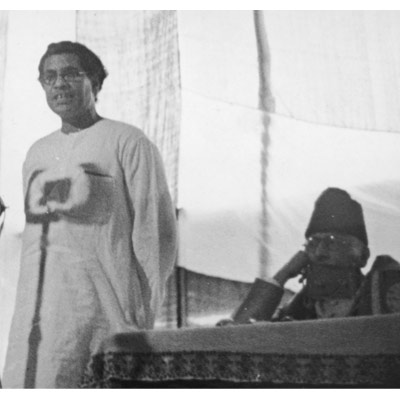
On 125th birth anniversary, Maulana Abul Kalam Azad lies a forgotten man

Bengali political theorist Manabendra Nath Roy (1887 - 1954) addresses the Indian National Congress, circa 1940. On the right is Muslim statesman Abul Kalam Azad (1888 - 1958), the President of the Congress
Bengali political theorist Manabendra Nath Roy (1887 – 1954) addresses the Indian National Congress, circa 1940. On the right is Muslim statesman Abul Kalam Azad (1888 – 1958), the President of the Congress

Its red sandstone boundary walls are defaced with posters and betel juice marks. Shopkeepers hang cases full of clothes and jewellery on them. Inside the walls the dry fountains gather dust and filth. This is the state of the maosoleum of Maulana Abul Kalam Azad, independent India’s first education minister, whose 125th birth anniversary will be observed Monday.

Situated in the heart of the bustling Meena Bazar, the garden-tomb of India’s prominent independence leader and close associate of Jawaharlal Nehru, the country’s first prime minister, the mausoleum is surrounded by numerous shops selling food, mobiles, CDs, clothes and other knick-knacks. Open sewers and a dump yard nearby tell a tale of unbelievable civic and governmental neglect.

Apart from the apathy of the authorities in maintaining the site, what stands out is that even most residents are not even aware about the mausoleum of a leader who is credited with establishing a national education system and modern institutes of higher education, including the Indian Institutes of Technology. His birth anniversary is also observed as National Education Day.

Walking down the winding by-lanes in search of the mausoleum, one is startled to learn that most of the locals are oblivious of his name, leave alone the location of the memorial. It’s indeed ironic how the man who persuaded thousands of Muslims during partition to stay back in India is now a forgotten man.

The boundary walls of his mausoleum have become billboards for local politicians, quacks and restaurants, while the temporary stalls adjacent to these walls have further damaged it by hammering nails and creating deep holes in places.

The gate has a lock, but it might as well not have one.

As you enter the small black iron-gate, a short staircase leads to a garden where people, mostly shopkeepers, are having lunch or a siesta. It is perhaps the only place offering peace and tranquillity in the midst of a maddening market and has thus become the resting place for many. That is another reason why the mausoleum is at least still maintained, though empty packets and wrappers of eatables and plastic bottles are scattered around the boundary walls.

In one corner is the mausoleum made of white marble with a patch of green grass on top. A canopy and a short boundary wall, both made of white marble, cover it from rain and sun – and more importantly, bird droppings. The fountains and pools, on the front and on the sides of the mausoleum, are empty and full of dust and filth, while the garden has patches of grass. Lichen covers the trunks of many trees.

The famous Urdu Park in front of the mausoleum, where Azad along with Sardar Patel, independent India’s first home minister and now much in the news, and C. Rajagopalachari, India’s first governor-general, delivered the historic 1942 Quit India address, is a playground for amateur cricketers during daytime and a haven for drug addicts and drunkards at night.

Sadly, it seems no one cares. For the locals, the mausoleum was just what it was – a mausoleum. “I know it’s a mazar (mausoleum) but I don’t know whose it is,” Abdul, a shopkeeper selling blankets near the boundary wall of the memorial, told IANS.

Similarly, tourists who come in droves to visit the nearby Jama Masjid and Meena Bazar, famous for affordable women’s apparel and accessories, give the memorial a miss as they are oblivious of its existence and importance.

Azad’s grandnephew Firoz Bakht Ahmed is not surprised at the neglect. “Since independence, he (Azad) never got the importance that he deserved. The government as well as the people have forgotten him. It’s a tragedy,” Ahmed told IANS. He said leaders like Azad, Patel and many more deserved much more recognition and respect. “There should be chapters in schools where students are taught about them and not just a handful of freedom fighters,” he said.

Talking about the poor maintenance of the memorial, Ahmed said that squatters should be removed from near the site and proper security arrangements put in place. “He was a freedom fighter and a nationalist leader known for his secular thoughts and was one of the few Muslim leaders who strongly opposed the partition of India. But sadly, he is not remembered now,” he added.

source: http://www.dnaindia.com / D NA  / Home> India> Report / Agency: IANS / Sunday – November 10th, 2013

Braving adversity : A tale of courage

Here’s a story of exemplary courage and determination. A story of how a young boy, who lost his hands and a leg in a mishap, braved adversities to literally guide the 

City out of chaos.

Like any other restless child, 11-year-old Salman was flying a kite atop his house when he suddenly saw the kite descending. In a bid to get hold of the kite, he ran towards the parapet wall on the terrace. He then slipped over the wall and fell straight on to a live wire. Salman lost both his arms and a leg in the process.

Today, 21 years after the incident, unable to find a job to feed his family, Salman stands at a busy junction near Miller’s Road directing traffic. He is there from 11 am to 8 pm. He has been at this spot for the last 18 years.

Salman was employed at a few places before he decided to do this. His previous employees sacked him citing silly reasons. One said he didn’t know English and couldn’t communicate well, the other said they wanted people who could run around.

“After I lost my hands and one of my limbs, I couldn’t go to school. I don’t know how to read and write and after being humiliated at several places, I thought I could help people by easing the traffic at this busy junction where there is no traffic police at any time of the day,” says Salman.

Salman is a familiar face to those living in the vicinity and this stretch where he stands, connects Miller’s Road to Benson Town.

It is a one-way but violations are aplenty and although there is a steep turning, people drive at high speed unmindful of the traffic ahead. Salman gets tipped anything between Rs 5 and Rs 20 a day.

“I don’t ask for alms but people generously give me some money and together I manage to make about Rs 200 a day. This just about covers my transport and food expenses for a day. It is better than working in a stifling environment where you are looked down upon,” he beams.

The residents say Salman’s presence has made a significant difference in easing the congestion.

Mujib, a businessman who lives across the street, says he never fails to tip Salman.
“People wait for Salman to come and motorists actually listen to him and follow his
directions. He’s doing a service that even the traffic cops don’t do with as much dedication.”

Nasir, who works with a logistic firm and lives in Benson Town, says he has been seeing Salman for the last couple of years.

“It’s a great service that he’s doing. If not for him, this narrow road would have been chaotic. We miss him on days when he’s not around,” Nasir sums up.

source: http://www.deccanherald.com / Deccan Herald / Home> Supplements> Metrolife / by Nina C. George / DHNS, November 25th, 2013

Ruins in perfect preservation

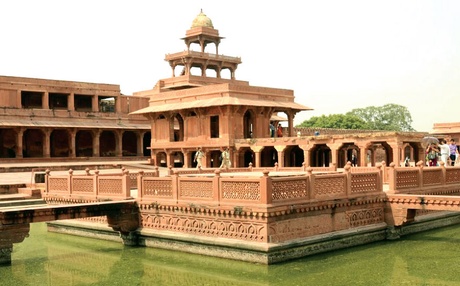
Akbar’s tribute to Sheikh Salim Chisti, Fatehpur Sikri is an abandoned city of red and white sandstone.

Fatehpur Sikri is considered the greatest Mughal city ever built and there is a fascinating story on how the idea behind its construction came about.

As Akbar grew older, his principal anxiety was the lack of a male heir. He learnt of a dervish called Sheikh Salim Chisti, the last of the many great sages in the Chisti line and journeyed to seek his blessings in the tiny town of Sikri — 23 miles west of Agra.  Sheikh recited blessings and made promises. Soon thereafter in 1569, Akbar’s Hindu wife gave birth to a son, Salim, later known as Jahangir followed by two more sons, Murad and Daniyal.

Akbar’s response to Chisti’s magic  probably ranks as one of the most outstanding examples in history of royal gratitude. He commanded that a city be built on the spot where the saint’s retreat was situated and the Sheikh was made the spiritual mentor of the entire metropolis. Almost overnight an army of labourers was mobilised to fashion the city of Akbar’s dreams and by 1570, the construction was in full swing using a kind of pre-fabrication technique.

Wrote Father Monserrate, “The house was built of stone made ready before it was brought thither so that there was neither hammer nor any tool heard in the house when it was building.”

Most of the city was completed in seven years, which was a remarkable feat considering the fact that the Taj Mahal took 22 long years to construct.

Emperor Akbar designed many of the structures himself and worked in the pits with the stonemasons cutting bricks and carving sandstone corbels. Huge battlements and a wall with nine gates appeared and a five story mosque  known as Panch Mahal was later constructed in the style of a Buddhist temple.

A huge rectangular courtyard was erected bounded by symmetrical gardens. There were three palaces, waterworks and baths, a mint for stamping coins with Akbar’s profile, a Turkish palace for his Turkish wife, a Hindu palace for his Hindu wife, a Muslim palace for his Muslim wives, an enamelled hall for the emperor to play hide and seek with all his wives, a court on which to play pachisi with human pieces, viaducts, stables, octagonal towers, domed pigeon houses and more.

There was also a seventy foot octagonal tower built in honour of a pet elephant, a girl’s school, a zoo, a sewage system and the largest gateway in the east — the Buland Darwaza — which served as a gateway to the city.

In Fatehpur Sikri, Akbar gathered the finest singers, the boldest statesmen and the wisest philosophers. His cabinet, known then as the ‘nine gems’ was reputed to hold the nine most capable men in the world.

After 15 years of life at Fatehpur Sikri, the fickle sovereign began to grow bored with his magnificent project. The harsh landscape around Sikri was not conducive to gaiety and drinking water was inaccessible (a manmade lake, dug nearby collected only brackish water).

In 1585, when a military campaign called him to Northwest India, he moved his headquarters to Lahore and abandoned Fatehpur Sikri forever.

The story that Akbar left the city to oblige Sheikh Chisti when he complained that the noise was disturbing his devotions is apocryphal, for Salim died some years before the city was abandoned.

As quickly as it had been populated, the magnificent city emptied.

A few years later, the city was described by a European as “ruinate, lying like a waste district, and very dangerous to pass through at night”.

Today, except for a small community that lives at the foot of the city and lives off the largesse of occasional tourists, the city of Fatehpur Sikri is unoccupied, a ghostly red and white necropolis of sandstone courtyards and endless silent corridors, which are all in a state of perfect preservation.

It really seems too perfect.

In fact, the ingredients of the time — resilient mortar used between the bricks have never been chemically analysed with any real success.

source: http://www.newindianexpress.com / The New Indian Express / Home> Education> Student / by Anjali Sharma – ENS / November 21st, 2013

Works from Adil Shahi era to be available in Kannada

Seven volumes of the translation are likely to be released in January

The Persian and Arabic literature dating back to the times of the Adil Shahi dynasty, that ruled Bijapur, will soon be available in Kannada, with the ambitious translation project nearing completion. The seven volumes are likely to be released in January.

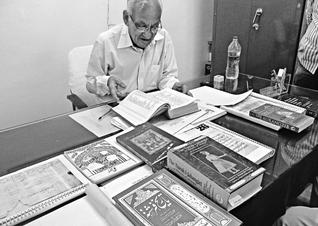
Krishna Kolhar Kulkarni, director, Adil Shahi Literature Translation Project, hopes that some misconceptions about this phase of history will be dispelled once the project is completed.— photo: RAJENDRA SINGH HAJERI / The Hindu

Krishna Kolhar Kulkarni, director, Adil Shahi Literature Translation Project, says this was the first effort of its kind and a major portion of the work had been completed. He hoped that some misconceptions about this phase of history (from 15th to 17th century) would be dispelled once the project was completed.

In English

Meanwhile, the Archaeological Survey of India (ASI) has expressed willingness to fund the translation works of these books into English. “The ASI officials said this when I was in Delhi to collect some books for translation,” said Mr. Kulkarni, adding that it will be taken up after the Kannada project.

He said in the first phase, 10 rare books of the Adil Shahi era written in Persian, have been taken up for translation into Kannada, of which the translation of six books is underway. Stating that most of the books taken up for translation were written in the 17th century, he said the project will translate some of the rarest books, some not even heard of.

Mr. Kulkarni said books include ‘Tareekh-e-Farishta’ by Mohammad Farishta and ‘Ibrahim Nama’ by Abdulla Dehelvi.

“Among them, ‘Mohammad Nama’ by Kazi Nurallah is believed to have only two copies in the world, that too are reproduced versions and not original. We have succeeded in getting a copy for translation,” he said.

Mr. Kulkarni said these books have been collected from the Salar Jung Museum, Hyderabad, the archives of Andhra Pradesh and the ASI headquarter, New Delhi.

“We are making all arrangements to get some books from London Museum for translation,” he said.

While collecting some known books, he said he came across some unknown books of the era written by several foreign authors.

Informing that the committee has meticulously selected a dozen translators, Mr. Kulkarni said that some 3,500 translated pages in seven volumes will be released in January.

He added that the committee has also collected hundreds of manuscripts, Farmans (orders), Sanads (deeds) and poetries written in Persian, which will also be translated.

source: http://www.thehindu.com / The Hindu / Home> National / by Firoz Rozindar / Biijapur – September 16th, 2013