” Britain is not fully aware of the fact that thousands of Indian soldiers were used as cannon fodder in this war and sent to various parts of the world to fight the Germans and their Turkish allies ”
“Why do hearts break
And minds bend?
Why isn’t there a stick
With only one end?
Why does day break
The sun set
And the moon wax and wane?
—For heaven’s sake
What was the debt
That Abel owed to Cain?”
From Booch Sakhat Booch (A Parsi Discourse on Stoppers) by Bachchoo
Britain has been commemorating the end of the First World War this last week. The Queen and other Royals laid wreaths at the cenotaph in Whitehall, London, marking the memory of the war dead and in the war cemeteries in Belgium. The populace buys and wears red paper poppies on their left lapels or their blouses.
This is the last ceremony of remembrance before the 100th anniversary of the war. Next year will see a tsunami of books, TV dramas, stage plays, songs and services about the First World War. I hereby confess that I’ve been commissioned to write a stage play about it — but from a slightly unexplored angle.
With the commission in hand I began to explore this angularity. The play is to be about the soldiers from Imperial India who were recruited to fight this “Sahib’s War”. Britain is not fully aware of the fact that thousands of Indian soldiers were used as cannon fodder in this war and sent to various parts of the world — the Western Front in Europe, Africa, Malaya and West Asia — to fight the Germans and their Turkish allies. What Britain can recall if it will was that several hundred of these Indian wounded were hospitalised during the war in the Brighton Pavilion, a building or folly conceived it would seem for a film set of Ali Baba. Some bright spark thought its oriental structure with domes and frills would make the Indians feel at home.
Several Indians who displayed bravery in the field were rewarded with the Victoria Cross and other decorations.
One story that sticks in my memory is what our family cook Hukam Ali told me when I was a child. When he was a teenager he used to be a ball-boy on the tennis courts of the Poona Club. A British officer took a shine to him and offered him employment in his house. Hukam Ali took it on and by his own account gave good service. The officer was then summoned with his regiment, which consisted of “native” companies and British officers to war and suggested to Hukam Ali that he enlist as an infantryman, which Hukam Ali did.
He recalled his experience in this war — a British war against other “goras”. I was too young to appreciate then which war this was or who was fighting whom, but “Hukams” said he went on a long voyage by ship and then by train and his regiment was joined by Australians and South Africans, all “goras”. The Indians were bivouacked separately from the whites for a few days.
Then the fighting began and in Hukam Ali’s words the cry went up “Kaaley ko aagey dhaklo! Kaaley ko aagey dhaklo! (Shove the blacks forward)”. At the tender age at which I heard the story I didn’t think of querying the fact that the British officers were shouting this command or slogan in Hindustani. The import of Hukams’ story was clear and the end of it tragic. He said hundreds of his regiment, thrown on the enemy lines died. He survived and must have been in his sixties when he found employment in our household which helps me date his war.
My play begins with the memory of this story. I have discovered that long before Subhas Chandra Bose’s Indian National Army fell on the tactic of recruiting Indian Prisoners of War in Japanese camps to fight for Indian Independence by siding with the Nazis and Japanese, a similar initiative was attempted in the 1914-18 War. The Germans set out to persuade Muslim soldiers of the Raj whom they had captured to switch sides.
Their argument was that Germany was allied with Turkey and the Ottoman Emperor was the Caliph, the leader of world Islam. No Muslim should be fighting him and his forces. The other argument was, of course, that the British had manifestly used Indian troops as cannon fodder and thrown badly trained, badly equipped and badly led Indians against superior German forces, which proved how little the Raj cared for Indian lives. No doubt some argument about a victorious Germany granting India its political and economic Independence was dragged in.
Though several Muslim soldiers are reported to have been persuaded to switch sides, no such force was consolidated or ever put into the field by the Germans. Perhaps there were too few of recruits to this cause or perhaps the Germans didn’t trust their conversion.
Nevertheless, my researches have thrown up a story that’s not very well known. Britain is, despite all the trumpeting about heroism, deeply ambivalent about this centenary. Yes, the British and their allies defeated Willhelm’s troops in the end but can a victory which cost both sides millions of deaths be “celebrated”? Will the centennial be dedicated to the utter futility and meaninglessness of this slaughter?
Historians repeatedly claim that they can’t conclusively say why the assassination of the Archduke of Austria by a Balkan patriot in Sarajevo should lead to millions of men fighting each other in the soggy trenches of Belgium.
Their confusion is confusing. The usual answer to the causes of the First World War is that all the participant nations were obliged by treaty to join battle with and against each other. This explanation may satisfy addicted domino players but anyone with any sense ought to know that treaties are pieces of paper.
That war was Germany’s attempt to eliminate all the other Imperial powers and become the only one. If it had succeeded, with or without the help of its Indian Muslim PoW converts, would it have ended the colonial exploitation of India — or taken it a step further?
source: http://www.asianage.com / The Asian Age / Home> Opinion> Columnist / by Farrukh Dhondy / November 16th, 2013
When it comes to philanthropy, Indians don’t share the table with the likes of Bill Gates but still there are a few who do really donate and the latest list is topped by Azim Premji of Wipro.
Close on the heels of releasing the second edition of Hurun India Rich List, China-based Hurun Report Inc launched the inaugural Hurun India Philanthropy List 2013, with IT tycoon Azim Hashim Premji emerging as the most generous Indian with a donation of Rs 8,000 crore in the past year.
Hurun Report included donations made by companies in which an individual had a significant share, by applying the percentage the individual has of the company on the donations. Education was the most important area for the Indian philanthropists with a total contribution of Rs 12,200 crore.
It was followed by social development (Rs 1,210 crore), healthcare (Rs 1,065 crore), rural development (Rs 565 crore), environmental cause (Rs 170 crore) and agriculture (Rs 40 crore).
“This list demonstrates the responsibility taken by entrepreneurs,” Rupert Hoogewerf, chairman and chief researcher of Hurun Report said. HCL group chairman Shiv Nadar is the second highest contributor in the list with a donation of Rs 3,000 crore. The Shiv Nadar Foundation, which completed 20 years in philanthropy this year, works towards educational initiatives and expansion programmes, directly benefiting 15,000 students across India.
Hurun India Philanthropy List is a ranking of 31 Indians who donated more than Rs 10 crore (equivalent to $1.6 million) in cash or cash equivalent during April 1, 2012 till March 31, 2013. GM Rao, through GMR Varalakshmi Foundation, donated Rs 740 crore for the education of underprivileged children, becoming the third biggest philanthropist in India’s corporate world. Nandan and Rohini Nilekani stand fourth in the list with a contribution of Rs 530 crore.
Ronnie Screwvala, whose initiatives are housed under the Ronnie Screwvala, whose initiatives are housed under the Swadesh Foundation (UTV group), contributed Rs 470 crore for achieving rural empowerment through the best practices and modern technology values.
“Biotech Queen” Kiran Mazumdar Shaw made a donation worth Rs 330 crore, while Ratan Tata donated Rs 310 crore to various charitable organizations for the underprivileged through the JRD Tata Trust and Sir Ratan Tata Trust.
London-based mining major Vedanta Resources chairman Anil Agarwal donated Rs 290 crore to support the cause of healthcare. PNC Menon of Sobha Developers and DLF chairman Kushal Pal Singh contributed Rs 270 crore and Rs 200 crore, respectively for programmes like adoption of villages and skill training of the youth.
The average age of the philanthropists in the list is 62 years while the average age of the top 10 donors is 64 years. Region-wise, the report said, south Indians showed the way for making contributions with a cumulative donation of Rs 10,000 crore while north Indians pitched in with contributions of Rs 4,865 crore.
The Companies Bill, 2013 mandates companies, with a net worth of more than Rs 500 crore or revenue of more than Rs 1,000 crore or net profit of more than Rs 5 crore, to earmark at least two per cent of their average net profits of the preceding three years for CSR activities.
“This amendment to the Companies Bill should provide more transparent reporting of corporate donations,” said Anas Rahman Junaid, publisher at large of Hurun Report India.
source: http://www.timesofindia.indiatimes.com / The Times of India / Home> India / by PTI / November 13th, 2013
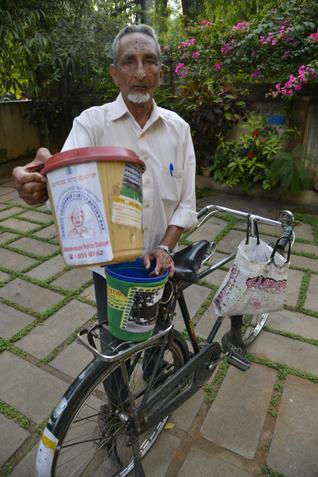
M. Sharif is supporting the police by providing 5,000 complaint boxes. Each police station will get 50 boxes which will be placed at ATM centres, hotels, schools and colleges. / Photo: K. Murali Kumar / The Hindu
The city will soon have 5,000 complaint boxes in public places to act as the eyes and ears of the police and help them maintain law and order. People can tip off the police and give information through the boxes to be installed at hotels and ATM kiosks.
Dedicated Servants of India, a city-based non-governmental organisation (NGO), led by 92-year-old retired army school teacher M. Sharif, is supporting the police by providing 5,000 such boxes.
According to Mr. Sharif, with 100 police stations in Banglaore struggling to maintain law and order, the complaint boxes would help in building local intelligence network effectively, he says.
He said many residents were apprehensive about approaching the police even to pass on information. Such information could remain suppressed. Now, they can remain anonymous and at the same time tip off the police, he said. The complaint boxes would act as deterrent and instil a sense of fear among anti-social elements, he said.
The information could be related to anything. For example, it could be a complaint against a government official or a civic representative. The police officer can pass it on to the department concerned. “Repeated complaints against an official would draw the attention of higher ups,” he said adding this would also improve accountability among officials. The letters in the complaint box would be picked up by the beat police and delivered to the station house officer for action.
Each police station would get 50 boxes which would be placed at ATM centres, hotels, schools and colleges.
The NGO with the help of philanthropists has so far collected 2,000 boxes.
Additional Commissioner of Police (Law and Order) Kamal Pant termed it a good idea of police-public partnership. “We have already started this scheme as a pilot project in some parts of the city and it is doing well. We are planning to cover the entire city soon,” he said.
source: http://www.thehindu.com / The Hindu / Home> News> Cities> Bangalore / by Imran Gowhar / Bangalore – November 13th, 2013
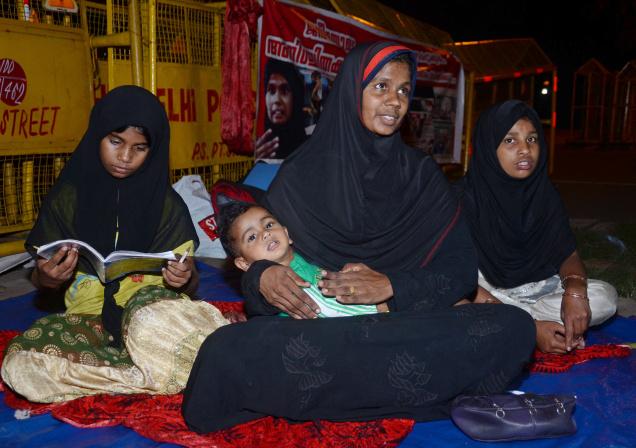
Jazeera V., with her children, peotesting against illegal sand mining in Kerala, at Jantar Mantar in New Delhi./ File Photo / The Hindu
“If there’s a nexus working that wants the blatant exploitation to thrive, it has to be met with equal force”
She calls herself a ‘daughter of the sea’. It’s not a borrowed label, but one that Jazeera Vadakkan believes in with passionate conviction. She builds literal ties to the description, “I was born at home, right on the Neerozhukkumchal Beach in Kannur (north Kerala).”
Clad in a burqa, surrounded by her three children, Jazeera makes an unlikely sight on the pavement outside Kerala House in New Delhi. As unlikely as when she was protesting outside the Secretariat in Tiruvananthapuram in her home state. But this is no home-maker accidentally caught up in the public sphere. Get closer and you will see that she is conviction personified.
Jazeera’s is a lonely battle, but she is the face of an amazingly courageous defiance against the all-powerful sand mafia that rules the coastal hamlet where she was born. Her zeal is in many ways incredible. Her battle is not built on academic research or environmental laws. It is a personal and intuitive battle. Returning to her village a short while after her marriage she found the landscape virtually unrecognisable, altered by the relentless mining of sand. “Why is it so difficult to see? If the miners can inflict so much damage on one beach in a few months, what will we have left to pass on to our children’s generations?” she asks.
The 31-year-old has been threatened countless times and even physically assaulted. But nothing seems to dent her mission to prevent even a grain of sand being shifted from ‘her’ beach. As she says, the sand being removed in tonnes to building sites has caused severe damage to Kerala’s fragile coastline.
Criticism of Jazeera, an auto driver by profession, ranges from dismissing her as a fake seeking media attention to vilifying her as an irresponsible mother and wife. She protests with her three children in tow, the youngest barely two. When Jazeera moved base from her hometown to the Kerala capital in August this year, her children came along. Her husband, Abdul Salaam, a madrassa teacher in Kochi, is not with her but is a source of support, she says.
The unending monsoon, the harsh heat wave, the criticism, the threats — nothing seems to affect Jazeera and her children. They had become permanent fixtures near the north gate of the Secretariat building. A huge demonstration organised by the Left Front had even veteran vendors a little worried because of the sheer numbers. But not Jazeera, who refused to budge. Her two girls, Rizwana and Shifana, seemed more preoccupied by their colouring books than the crowds and red flags all around.
Finally, Kerala Chief Minister Oommen Chandy met her on the third day of her protest. He promised her that action would be taken, but Jazeera wanted a written statement. When this did not happen, Jazeera went to Delhi. “There are laws that prohibit this sort of activity. But when the local people, the police, local leaders are all part of a nexus that wants the blatant exploitation to thrive, it has to be met with equal force,” she says.
None of the attempts to frighten her into going back to her hamlet have worked so far. Jazeera continues to protest, asking for a written assurance from the Kerala government to rein in the sand miners, something the authorities have strangely refused so far. Here is one woman fighting an organised mafia, but with enough courage to beat the odds.
sourceZ: http://www.thehindu.com / The Hindu / Home> Features> The Yin Thing / by Kaavya Pradeep Kumar / October 13th, 2013
In this Walk the Talk on NDTV 24X7 at his foundation’s latest initiative, the Aga Khan Academy near Hyderabad, His Highness the Aga Khan talks to The Indian Express Editor-in-Chief Shekhar Gupta about the growing Shia-Sunni tension that worries him, and the roots of the lack of understanding between the Western and Muslim world. However, he adds, most of the conflicts one sees today have little to do with faith but have a political dimension.
It’s been said about you that no human being today bridges so many divides as gracefully and as powerfully as you do. And how many divides: the East and West, Islam and Christianity, material and the spiritual and, if I may add, ancient to the medieval, the modern and the future.
Thank you very much and I’m very happy to talk with you.
And welcome to a country which is in many ways your homeland.
Yes, yes. My grandfathers… way back.
He was born in undivided India.
He was, and the place where he was born is still there. Still in the family.
And the first school set up (as part of the Aga Khan network) was in India.
In Mundra (Gujarat).
And now there are 80-90,000 students… So what’s this thing about the Aga Khans and education?
My grandfather and I have always felt that education is an essential part of a community’s life, a country’s life, an individual’s life. It is the unavoidable building block for all people all around the world. This academy (the Aga Khan Academy on the outskirts of Hyderabad) is a part of that exercise.
Education is also a healer of the mind.
It’s a healer of the mind, but it’s also a way of making rational judgments. What we need in society is rational judgment. It helps evaluate, it helps position issues…
So before we get into the more profound discussion on making rational judgments in times when all wisdom is presumed to be given, tell us a little bit about the Hyderabad academy.
Some 10 years ago we started asking ourselves, ‘Where are we? What do we need?’. We came to the conclusion that there were a number of countries where secondary education was a critical issue. We decided that instead of trying to respond on a country-by-country basis, we would try to make a network of institutions to move intelligent children from one society to another, from one language to another, so that we would try and build global capacity and bring it in at the secondary level of education, not retard it until tertiary education or career.
And an academy like this is not limited. Access is not confined to your followers or only people of one faith?
No, no, not at all.
Purely on merit?
Purely on merit and, it goes further than that, it’s ‘means blind’. So the moment a child is qualified, it’s our responsibility to find the ability to fund that.
I haven’t heard this wonderful expression before, ‘means blind’. It’s fascinating to hear it from somebody who doesn’t like the word ‘philanthropy’.
Well I think philanthropy is very close to the notion of charity. And in Islam it’s very clear — Charity is desirable, necessary, but the best form of charity is to enable an individual to manage their own destiny, to improve his or her condition of life so that they become autonomous.
I remember something you said in an interview. You said becoming an imam doesn’t mean you distance yourself, you renounce the world. It actually means engaging with your community even more, improving their quality of life and giving them protection. It doesn’t mean sanyaas, if I may use something from the Hindu way of life.
No. And it’s not just in the Hindu way of life, there are Christian schools where engaging in life is not desirable. In Islam that doesn’t exist. It’s the contrary actually. Imams are responsible for the security of their community, for the quality of life of their community — they must engage, but they have to engage ethically.
You make a very unlikely imam. You don’t look like one — as we know the stereotype now — don’t talk like one, don’t act like one. And don’t play like one — you still suffer skiing accidents.
If you look at the life of the Prophet, he led a normal life. And in a sense he showed that Islam is part of life. It’s not separated from life.
And that’s the inspiration for you.
It’s what I believe to be correct.
And that’s what should apply to all Muslims.
All Muslims, I think, live in the real world. I don’t know of many leaders who have removed themselves totally from life. It’s not part of our religious tradition.
What about the Sufis, the dervishes?
The whole domain of mysticism, as we all know, it exists in many, many, faiths. And that is an evidence of a personal search, not of an institutional search.
And religion and spirituality should be a personal exercise.
It’s both in Islam. It’s a community approach to life, there are community responsibilities, social responsibilities, but there are also personal responsibilities. Certainly, in my interpretation of Islam, the two must go hand in hand. You can’t abandon one for the other.
There’s another fascinating thing you said — there is no clash of civilisations, there’s a clash of ignorances. But that clash of ignorances — what someone called ‘scars on our mind’, in a different context, the Cold War — is now a reality. How do you deal with it?
I’ve used all the methods I thought I had to try and help bridge civilisations rather than have them continue to look at each other in ignorance and discover each other in conflict, and all the rest.
Why call it a ‘clash of ignorances’? Let me add something to that. If the stereotypes about Islam are today cast in stone, you defy all those stereotypes.
That’s very kind. I did my degree at university on Islamic history, so I should know…
And you went to Harvard.
So in that sense, I may have had a certain amount of comfort. But if I take what was the definition of an educated child in 1957 (when he became the imam) and ask you, what was the composition of the curriculum at that time, there was nothing on Asia, nothing on Islam, very little on Africa, if anything. The industrialised world was turning around on itself. And today you still see decisions taken between the industrialised world and the Muslim world that would not have been taken if they had known each other back then.
If I can take a little chance and be sort of indiscreet, in a way the Islamic world knocked at the doors of the Western world — in the form of those planes slamming into the World Trade Center buildings.
Yes…
I’m oversimplifying.
Well it would be difficult to associate what we call the Ummah — the totality of the Muslim world — with that. I don’t think that would be right.
But that stereotype did get built.
That stereotype did get built, without doubt. But I don’t think you can attribute that to the totality of the Ummah. That’s simply not correct. So the stereotype itself is massively incorrect, which then raises another question: what is the form of communication we’re living in? How can miscommunication be as acute as it has been?
What do you tell your friends in the Western world about their new stereotypes of Islam? And what do you tell your Muslim brothers and sisters and followers about their stereotypes of the Western world?
Well I would start by asking a very simple question: in 2013 — what is the definition of an educated person? The knowledge that that person requires is more and more understanding the world, not understanding little parts of it. Understanding the world is a massively complex goal, but I think that we’ve got to admit that that’s what’s necessary. It’s unavoidable. We’re more of one world than ever before.
Because your community has also suffered, it has now come to be represented by people of a certain kind. People who hog the headlines, sort of prime-time TV, and whose silhouette usually has as an AK-47 or worse. How much damage have they done to your community?
I don’t think the community is seen as a community that is in any way engaged in this sort of concept.
Because a Muslim passport at a Western airport… I’m again using a stereotype, but it is a reality.
Well I’m not sure that is really true of all Muslims. I think there are certain areas of the Muslim world which are more, let’s say, questioned than others, but I don’t think that’s universal. And that has happened in other faiths — let’s be quite clear.
Absolutely. The Muslim world, the Ummah exists in so many countries. Your own followers are all over the world, including India.
There exists right there a fundamental point. Unless you understand the plurality of the Ummah, you are not going to think correctly with regard to that part of the world. You need to have a basic understanding of its pluralism. We are, in our part of the world, as pluralistic, if not more pluralistic, than others.
source: http://www.indianexpress.com / The Indian Express / Home / by Shekhar Gupta / Tuesday – October 08th, 2013
Motilal Nehru National Institute of Technology, Allahabad (MNNIT-Allahabad), is poised to hold its 10th Annual Convocation-2013 on Thursday at the Rajiv Gandhi MP Hall Complex. The occasion will be graced by former President APJ Abdul Kalam as the chief guest while Prof VK Saraswat, chairman, Board of Governors, would preside over the function.
Speaking to newspersons on Wednesday, director, MNNIT, Prof P Chakravorty, said that during the convocation, 693 BTech, 77 MBA, 72 MCA, 9 MSc, 6 MSW, 404 MTech and 34 PhD students will be awarded degrees. For academic session 2012-13, 23 gold medals will be awarded to postgraduate students and nine to the undergraduate students.
Further, 18 sponsored gold medals are to be awarded across various academic programmes. This is in addition to the medals to be awarded to the toppers of the first, second, third and fourth years of undergraduate programs.
The coveted and prestigious Institute Gold Medal will be awarded to Shobit Srivastava of BTech (Computer Science & Engineering) for standing first amongst students of all branches of the Institute in the Final Year Examination of 2013. He will also receive a gold medal for standing First in BTech (Computer Science & Engineering) Final Year Examination 2013.
Archan Mudwel of Mechanical Engineering will be awarded the gold medal for standing first at BTech third year examination 2013, while Tanu Agrawal and Priyanshu Srivastava, both of Computer Science & Engineering, will be awarded gold medals for standing first in the second and first year examination 2013, respectively.
He said that the institute has continued to take large strides in its mission of academic excellence. In 2012, 66 new faculty members were inducted in various departments. This has taken the total faculty strength to 199, with 50 professors, 36 associate professors and 113 assistant professors.
During academic session 2013-2014, 1,485 students were admitted for various programs of BTech, MBA, MCA, MSc, MSW, MTech and Ph.D, out of which 92 students are from other countries.
In a new initiative, the institute has organized 22 Short Term Training Programs, Faculty Development Programs and Workshops during 2012-2013. Under the TEQIP II program, the Institute has been sanctioned an amount of Rs 12.5 crores towards implementation of several schemes such as innovative research, curriculum development, educational tours, training programs, networking, procurement of equipments, purchase of books, international visits and laboratory upgradation.
The Institute has maintained its excellent record of placements up to 85% during the session with ongoing placements of post graduate students also.
In terms of providing technical assistance to industries, government organizations, the institute has offered more than 290 testing and consultancy activities during the financial year 2012-2013. Altogether 40 research projects, with total sanctioned amount exceeding Rs 10.91 crores have also been sanctioned from various funding agencies, notably DRDO, DAE, ICSSR, DST, CSIR, UGC, DBT and UPPCB.
The Institute is looking at further initiatives towards renewable energy, rainwater harvesting, reusage and recycling of waste water, disaster management and energy conservation as its focus in coming years, he added.
source: http://www.articles.timesofindia.indiatimes.com / The Times of India / Home> City> Allahabad> Mnnit / TNN / October 31st, 2013
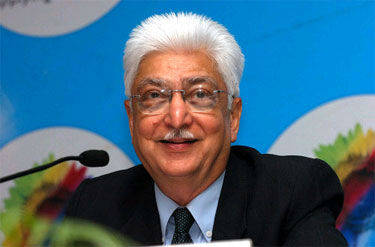
Well-known Indian IT czar and philanthropist Azim Premji has received the Asian Business Leaders Award in the UK.
“For both his business acumen and his notable contributions to Indian social causes, Mr Premji is a very well-deserved recipient of the Asian Business Leaders Award,” UK business secretary Vince Cable said in his welcome address at a ceremony yesterday.
(Well-known Indian IT czar…)
“With 40 per cent of the world’s High Growth Markets located in Asia, it is more important than ever to recognise the role of Asian businesspeople in contributing so much to the strength and breadth of the UK economy ,” he added.
The chairman of Wipro Limited joins the likes of former Tata Group chairman Ratan Tata and Lord Green, UK minister of state for trade and investment, as a recipient of the honour presented by Asia House, a non-profit pan-Asian organisation based in the UK.
The annual award recognises individuals who embody the principle of ‘Servant Leader’ – economic success and professional excellence accompanied by moral leadership and service to society.
“We are delighted to honour a business leader admired greatly by the Asia House community. Azim Premji has achieved outstanding success as a global business leader. He has demonstrated a lifetime commitment to social and education issues through both organisations and people making him a most deserving recipient of the Asian Business Leaders Award,” said Sir John Boyd , chairman of Asia House.
The award itself was presented to Premji by Britain’s Foreign Office minister, Hugo Swire.
source: http://www.articles.economictimes.indiatimes.com / The Economic Times / Home> News> News By Company / Corporate Trends / by PTI / October 15th, 2013