Category Archives: Community Involvement / Social Issues

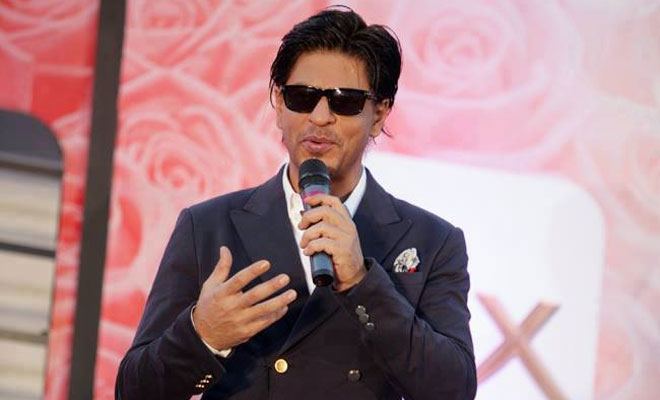
Shah Rukh Khan helps light-man’s daughter go back to school

Shah Rukh Khan sponsored a girl's education. (Photo: Facebook)
Shah Rukh Khan sponsored a girl’s education. (Photo: Facebook)

The King Khan of Bollywood, Shah Rukh Khan, believes in doing a good deed with his right hand while not letting his left hand know about it. A recent addition to his philanthropy is providing financial aid to a 5 year old daughter of a light-man.

Mohammed Azaz Shaikh has been a light-man in Bollywood for the last 12 years and also a freelancer for Balaji Telefilms till the start of 2013. Azaz is married to Zarina Parveen has two children, son Sohail, eight, and daughter Nisha, five. The family was going through a difficult time and Mohammed had to take up odd jobs as means of earning his daily bread, later things got worse and being unable to pay the fees on time, he was forced to discontinue his daughter’s education.

It was luck by chance when Zarina participated in ‘Lux Chennai Express Contest’ and was declared as the winner. Shaikh’s wife met Shah Rukh Khan on October 19, at a function held at a hotel in Mumbai. She not only got an opportunity to enact the legendary train scene with King Khan but after finding out about her family’s condition, SRK called her backstage and offered help by sponsoring her daughter’s education.

A reporter saw a person from SRK’s office take down the complete address and telephone details of the couple.

source: http://www.indianexpress.com / The Indian Express / Home / BollywoodHungamaNews Network / Mumbai, Wednesday – October 23rd, 2013

WRITE ANGLE : Who is Dara Shukoh?

Gopal Gandhi’s Dara Shukoh: A Play raises the relevance of Dara Shikoh in contemporary India.

Few men who read history in school remember Dara Shikoh, the philosopher-prince of Mughal India. He is but a fleeting figure even if an enlightened one. The spotlight is well and truly on Aurangzeb, terse, taciturn, untamed. In a world looking for convenient, even if inaccurate, summations, Dara is reduced by our historians to being a favourite son of Shah Jahan, and Aurangzeb, a fratricidal ruler who did not hesitate to put to the sword his own. That almost all kings in the years of yore did the same matters little. That Dara had a life before the fatal battle of Samugarh with Aurangzeb, that he had a life quite removed from that of any of his brothers is never pointed out. For most, Aurangzeb is a convenient villain, Dara the easy but fallible hero.

However, today as our nation faces the prospect of being ruled by revisionist politicians — ironically, they seem to be getting mixed up with their history lessons too — it is important to take some time out, and realise what we lost when Dara lost, and what we can gain if we imbibe his spirit. With such a thought, I picked up Gopal Gandhi’s Dara Shukoh: A Play. It was released some time ago and I had all but left it on the shelf with the likes of Dilip Hiro’s Baburnamah for company.

However, the events unfolding in the run-up to the general elections made me go back to it. Dara is relevant, even necessary today. The book instantly set in motion a series of conjectures: what if the heterodox Dara and not the more orthodox Aurangzeb had won the battle of brothers? If mid-17th Century India had thrown up a different victor, would the nation have been partitioned? Didn’t medieval India throw up a man who was wedded to pluralism of thought and faith much before the founding fathers of our Constitution made it a benchmark for future generations? And would Hindus and Muslims have lived here, as Sir Syed Ahmed Khan said, like the two eyes of the nation? Imagine if a Sufi had outlasted a warrior! Imagine.

The questions shall never be answered. But revisit Dara we must. Understand what he stood for, preach many of his things, and we might just end up with a nation that takes pride in its pluralist culture, a society where Hindus read both the Vedas and the Quran, the Muslims appreciate that the concept of one universal God precedes their arrival here; appreciation rather than mere tolerance of each other’s culture being the hallmark. Follow this, and the need to combat the challenge thrown up by communal elements disappears. Who can argue with a man who drinks from the common nectar of Sufis and bhakti saints?

And Gopal Gandhi, with an enviable and apt lineage for such a project, goes about demolishing many prejudices, exposing many lies. He chooses to spell him Shukoh, explaining beautifully that ‘Shikoh’ in Persian means ‘terror’ while ‘Shukoh’ stands for ‘glory’. Gandhi’s Dara is not a tragic figure; rather he is a man whose time is now. Gandhi chooses not to dwell much on a failed general — a poet is doomed to be a failure on a battlefield anyway. He stays focussed on the undercurrents of the thoughts of the man who translated the Upanishads into Persian — ideas that did not endear him to the radical elements on both sides of the religious divide. A play may not necessarily be an ideal substitute for a history textbook, but hey, did not Rajkumar Hirani’s Lage Raho Munnabhai do more for introducing Mahatma Gandhi to the bubblegum brigade than any academic book or lecture?

The best help often comes from the source least expected. A play, a film, a book, a philosopher may yet show us the way. After all, amidst all the political mudslinging and a society being rapidly polarised, we could do worse than heed Dara’s words. Remember what he said when his followers screamed, “Shuja — his brother and fellow claimant to the throne — murdabad”? Dara replied, “Let us not wish death to any one/That is base;/All of us have God’s breath in us,/In any case./We live and have our being/ With his grace.”

In this age, Dara deserves attention.

source: http://www.thehindu.com / The Hindu / Home> Books> Columns / by Ziya Us Salam / Chennai – November 22nd, 2013

Dr. S.K. Kareem Khan, the Folklore Sage of Karnataka

DrKareemKhanMPos22nov2013

It is a good fortune that Karnataka’s soil has been treaded by personalities known for their universal outlook and integrity. A melting pot for various languages, religion and culture, Karnataka had a number of persons belonging to Muslim community whose contribution to Karnataka’s secular traditions is immense. Historically we had Ibrahim Adilshah, the ruler of Bijapur whose work in Urdu, Kitab-e-Nauraspopularised Hindu music among the Muslims. Karnataka was the abode of Sufi saints like Baba Budan and Khwaja Bande Nawaz whose way of life and moral sermons inspired both Hindus and Muslims and paved way for Hindu-Muslim amity. In the 20thcentury there was another similar figure who was not only a symbol of Hindu-Muslim unity but also a freedom fighter, folklorist, singer, lyricist and a dramatist. He was the late Dr.S.K.Kareem Khan. Born in 1908 at Sakleshpur in Hassan district of Karnataka to an Afghan soldier, Abdur Rahman Khan, and his wife Jainabi, S.K.Kareem Khan studied classical Sanskrit and Kannada literature under Achangi Narayana Shastri of Sakleshpur and despite his informal education, mastered Sanskrit and Kannada.

As a Folk Singer: It was during his teens that Kareem Khan was attracted towards folk songs. His house at Sakaleshpur was a halting place for touring merchants selling brass and copper wares. After dinner they used to hum folk songs which young Kareem used to listen with rapt attention. Inspired by the call given by Mahatma Gandhi he Kareem Khan joined the freedom struggle and this took him to various places. This occasion gave him an opportunity to hear and chronicle folk songs which he came across and later he himself used folk as a medium to spread the message of the freedom. Later collecting and singing of folk songs became his life’s passion. He used to visit villages and standing under a platform or tree frequented by people used to sing folk songs. Mesmerised by his melodious voice people used to gather around him. At the end he used to urge the people to join the Congress party then involved in the country’s freedom struggle. He was jailed several times for his participation in the freedom movement. There his fellow jail inmates used to pester him to sing folk songs for them. Such was the sweet voice possessed by Kareem Khan.
Multi-faceted Personality: Kareem Khan’s was a multi-faceted personality. He penned screen play and song lyrics for Kannada films, wrote dramas, translated works from Sanskrit and Urdu to Kannada, was a researcher, essayist and a pioneer scholar in folklore studies. This apart he was fully involved in the country’s freedom struggle and Karnataka’s unification movement. During 1930s worked as an editor and sub editor of two publications Loka Mitra of Dharwad and Antharanga of Udupi. .  In the early 1960s he launched `Janapada Prakashana’, an exclusive publication dedicated to folk literature, art and music; copies of which he sold at 50 paise each. Secularist to the core he led a simple life, true to the Gandhian principles which he cherished. Though he avoided power and publicity, such was his achievements that honours came in abundance. He was conferred the Janapadashri and Karnataka Rajyothsava awards by the government of Karnataka, Nadoja award by Hampi University, honorary doctorate from Gulbarga University and numerous other honours from various institutions and organisations. Given epithets like Janapada Jangama and Janapada Bheeshma, he was the President of Karnataka Janapada and Yakshagana Academy from 1987 to 1990. He passed away in Bangalore on 29th July 2006.
Modern Shishunala Sharif: It would be surprising to know that there is a lot similarity in the life and works of Santa Shishunala Sharif and Kareem Khan. Both were known for their simplicity and integrity. Both were secular in their outlook and had good knowledge of Hindu epics, traditions and culture. While Shishunala had Govindabhatta as his guru, Kareem Khan had Narayanashastry as his guru. While Shishunala was a mystic poet, Kareem Khan was a social activist cum folklorist. The composition of both these stalwarts will be evergreen in the minds of the Kannadigas.
source: http://www.karnatakahistory.blogspot.in / Home> Dr. S.K.Karim Khan / by S. Srinivas / May 22nd

Kashmir Ki Kali: Srinagar’s famed Shalimar Bagh has been restored to what it was in Jehangir’s time — Farah Baksh

Srinagar’s famed Shalimar Bagh has been restored to what it was in Jehangir’s time — Farah Baksh, or ‘the delightful’. Now for the 15 others, writes Gargi Gupta

KashmirMPos21Nov2013

In a television interview, conductor Zubin Mehta proclaimed that despite the controversy about the concert, Kashmir now had a beautifully restored garden, fountains, flowers et al.  Many agree.

“Zubin Mehta’s concert was the best thing to happen to Shalimar Bagh,” laughs Sheikh Irfan Qadir, assistant executive engineer in the Roads & Building department of the Jammu & Kashmir government. Qadir should know — he’s been working at Shalimar Bagh since early this year, deputed by the state government in its race-against-time to restore the 17th century gardens laid out by Mughal Emperor Jahangir, in time for Mehta’s concert with the Bavarian State Orchestra held on September 7.

German ambassador in India Michael Steiner and Chief Minister of Jammu and Kashmir Omar Abdullah took close interest in the repair works, visiting the site several times in the months leading up to the concert. After all, this was a high-profile event, hosted by the German Embassy in India, attended by dignitaries and broadcast on high-definition to millions of viewers across the globe.

“When the German ambassador first came here,” says Qadir, “Shalimar Bagh was in such a bad state that he looked around and despaired at having the concert here.” Describing the state of ruin, an October 2012 report in British newspaper Daily Mail bemoaned that the ‘fountains have long stopped working and the walls are peeling at every corner’. Photographs accompanying the article, showed the water channels silted up and covered in vegetation.

Strangely, Shalimar Gardens, or any of the other 15 Mughal Gardens in Kashmir, is not protected by the Archaeological Survey of India, or its Kashmir circle. It is the floriculture department of the state government that looks after these gardens, which attracts lakhs of tourists every year.

“The last ‘sensible’ conservation effort took place in 1941,” informs M Saleem Beg, convenor of the Jammu & Kashmir chapter of Indian National Trust For Art and Cultural Heritage (INTACH), which has overseen the current restoration exercise. The committee prepared a detailed conservation plan for Shalimar Bagh in 2005. That, says Beg, came about by sheer accident. “In 2004, Jagmohan, then tourism minister, allocated Rs1 crore for reconstructing the Mughal wall in Nishat Garden. Appalled, I met him to point out how inappropriate ‘rebuilding’ a historic wall was.

He told me to come up with a conservation plan for the gardens and asked me to name the budget. I had rattled off a figure of Rs5 lakh. We ended up spending Rs9 lakh.”

Much of the work at Shalimar, says Beg, entailed undoing earlier unscientific, ill-considered conservation efforts. For instance, the water channels were covered in concrete. “We removed thousands of kilos of cement,” says Qadri. The channels, measuring 1,000 ft x26 ft, were relaid with crushed stones, then covered with lime concrete. “We had to source lime concrete, which is what the Mughals used, from Amritsar. The material takes much longer to dry than cement, but we were determined to do it the right way,” he says. “The stage for the musicians was laid out over these channels, but they did it very carefully, placing it over small metal stools so as not to leave a single mark on the grass,” says Qadir.

The stones that lined the rim along the water channels, the foot-bridges across them, niches along the walls and terraces had become loose or were displaced over time; these were carefully taken out, cleaned and refixed. The pavements too were re-laid with local devri stone. The Pink and Black Pavilions were restored with new shingle roofs and their walls covered with a 20mm coat of lime plaster. “We have not yet touched the ceilings,” says Qadir, pointing to the richly-painted panels, which are a more recent addition, probably the time of Kashmir’s Dogra rulers.

Nearly Rs3.5 crore was spent on Shalimar Bagh’s restoration. The fountains are working; the channels are clear; a Mughal-era hammam (public bath house) on the premises has been opened to public and there are better public conveniences. Of course, the problems too are visible, the most being the buildings outside that have been built too close to the Mughal-era boundary wall.

Perhaps, the only long-term hope for Kashmir’s Mughal Gardens is in securing a World Heritage Site status. Six of the better-known gardens did make it to the tentative list in December 2010. But despite several representations to the culture ministry, the elaborate dossier that is required for their final application, has not yet been prepared.

source: http://www.dnaindia.com / DNA / Home> Lifestyle> Report / by Gargi Gupta / Agency:DNA / Sunday – October 20th, 2013
Sandal Urus Shariff of Sufi Saint Hazarath Mohammed Salman Misbahi in city

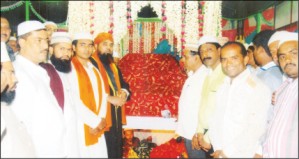
Seen in the picture are Corporator Suhail Baig, Moulana Anwar Ahmed Nizami, successor of Hazarath Mohammed Salman Misbahi, Riyaz Pasha, Ilyas Baig, Fiyaz and others at the Astana Salamaniya Dargah at Badamakan burial ground near Tipu Circle in city recently.

Mysore :

Astana-e-Salamaniya Dargah Committee, Mysore, had organised Sandal Urus Shariff of Sufi Saint Hazarath Mohammed Salman Misbahi, Founder of Azeezia Educational Trust here recently.

The Sandal Urus Shariff procession consisting of students of Arabic College, Sufi Saint, Revered Moulvis, Ulmas, Islamic Clerics, Scholars, Dharvesh of Ahala-Sunnath-wo-Jamath and devotees began from the Association Office in Lashkar Mohalla and passed through Ashoka Road, Sawday Road, Pulikeshi road, Fountain Circle to reach Astana Salamaniya Dargah at Tipu Circle on Mysore-Bangalore road. The programme was held under the supervision of Fayaz Pasha, social worker Abdul Azeez, Riyaz, Ilyaz Baig and Corporator Suhail Baig.

A lecture on ‘Azmath-e-Ahowliya Allah’ was held under the guidance of Moulana Mohammed Anwar Ahmed Nizami, successor of Sufi Saint Hazarath Mohammed Salman Misbahi, Secretary of Azeezia Educational Trust under the Presidentship of Sir Khazi of Mysore Moulana Mohammed Usman Shariff.

Moulana Asgar Ali, Khateeb-o-Imam, Jamiya Masjid on Irwin road and Moulana Mufti Sajjad Hussain Khan, Principal, Jamiya Tipu Arabic College, Srirangapatna spoke on the life of Sufi Saint.

Moulana Abdul Salam, Moulana Maqbool Nizami, Moulana Syed Imdad Ulla, Syed Fazil Ashrafi, Riyaz Pasha, Fayaz, Abdul Jabbar, Tanveer Ahmed, and others participated.

Sir Khazi of Mysore Moulana Mohammed Usman Shariff released the new 2014 Azeezia calendar on the occasion.

source: http://www.starofmysore.com / Star of Mysore / Home> General News / November 11th, 2013

237th Annual Sandal Urus Shariff of Hazarath Hyder Ali held

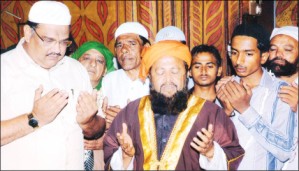
Tanveer Sait, MLA and Chairman of Tipu Sultan Wakf Estate, Srirangapatna, along with religious leaders and devotees, is seen offering prayers during the Sandal Urus Shariff of Hazarath Nawab Hyder Ali Khan Bahadur, recently.

Mysore :

The 237th annual Sandal Urus Shariff of Hazarath Nawab Hyder Ali Khan Bahadur, organised by Madarasa-e-Quvatul Islam Nawab Saheb Physical Education Management Committee Secretary Afrooz Pasha in city recently.

Sandal Urus procession along with Fukras Jamath, Syed Ahmed Baba from Bangalore began from city to reach Tipu Tomb in Srirangapatna where Masjid Aqsa Tipu Tomb Srirangapatna Khateeb Moulana Inayath ur Rehman Razvi read Fatha Khani which was held under the Presidentship of MLA and Chairman of Tipu Sultan Wakf Estate, Srirangapatna, Tanveer Sait, who paid floral tributes to the tomb.

Senior advocate M.S. Mukram, Sufi Wali, Mysore Dist. Wakf Board Advisory Committee former member Sajjad Ahmed, President of Azeez Sait Block Congress Committee Rafeeq Ahmed, social worker Ayaz Pasha and devotees participated in the programme.

Afrooz Pasha proposed a vote of thanks.

source:  http://www.starofmysore.com / Star of Mysore / Home> General News / November 11th, 2013

Husain’s ‘Bhopal’ to go under the hammer

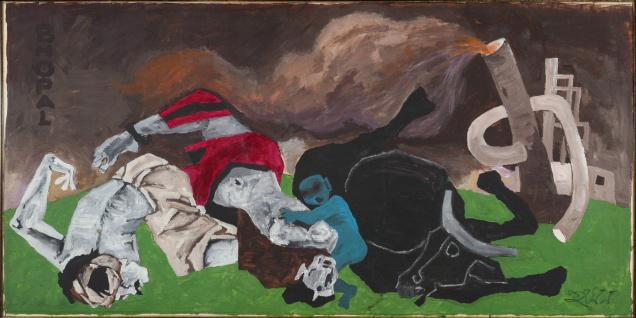
M.F. Husain’s “Bhopal”. / Photo: Special Arrangement / The Hindu

The oil on canvas has been valued at £200,000-300,000

‘Bhopal’, Maqbool Fida Husain’s anguished representation of the terrible consequences of industrial negligence in Bhopal, is to go under the hammer on October 8 at the Bonhams Auction House in London.

Husain’s framed and signed oil on canvas, with ‘Bhopal’ painted boldly on the side of the canvas — as if to leave no doubt on which disaster he is depicting — has been valued between £200,000 and 300,000, a press release from the auctioneers said.

“Just as Pablo Picasso’s passion and outrage towards the Spanish Civil War had inspired him to create ‘Guernica’ (1937), ‘Bhopal’ was the result of Husain’s horror at the long-lasting effects of the leak,” the press release said, though attributing the work’s energy to Husain’s own genius that was moulded by life around him. The Bhopal disaster occurred on December 3, 1984 when a poison gas leak from a Union Carbide factory killed around 2000 people.

Headlined by Husain’s ‘Bhopal,’ the October 8 auction of Indian and Islamic art will also auction ‘Bindu’ by Syed Haidar Raza (b.1922) that has been valued between £100,000 and 150,000, and ‘Untitled’ by Francis Newton Souza (1924-2002) valued between £40,000 and 60,000.

Raza started painting the Bindu series in the 1980s. “An act of meditation and the ‘Bindu’ is the centre of calm” the press release says.

Yet another highlight of the auction is ‘Four Figures” by Pakistani artist Sadequain (1937-1987) with an estimated valuation of £45,000-65,000.

This is not the first time that Husain’s paintings have been sold by Bonham’s, which specialises in Asian art. This April, an untitled Husain painting of horses was sold for £205,250; and in 2007, at the height of Husain’s troubles with right wing Hindu nationalist groups who hounded him for painting disrespectful and nude representations of Hindu goddesses, the same auction house sold his ‘Nude Woman’, a masterly painting of the naked female form, one that unfortunately had to find its home outside the country that inspired all his art.

source: http://www.thehindu.com / The Hindu / Home> Arts / by Parvathi Menon / London – September 20th, 2013

A Braveheart never dies

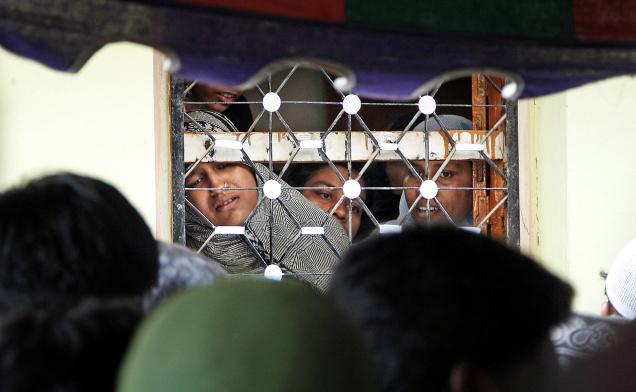
Nasreen Fatima, left, cries during the funeral ceremony of her husband Indian army soldier Firoz Khan, as she looks out from the window of her home in Hyderabad on Thursday./  Photo: AP / The Hindu
Nasreen Fatima, left, cries during the funeral ceremony of her husband Indian army soldier Firoz Khan, as she looks out from the window of her home in Hyderabad on Thursday./ Photo: AP / The Hindu

Indian Army soldier Mohd. Firoz Khan, who died in Pakistan’s shelling across the Line of Control (LoC) in Poonch district of Jammu & Kashmir on Tuesday, is given a tearful farewell and buried with military honours

The city bade a tearful adieu to martyred soldier Mohd. Firoz Khan on Thursday. Businesses and commercial establishments voluntarily shut down in the Nawab Sahab Kunta area of Old City to pay respects to the soldier who died in Pakistan’s shelling across the Line of Control (LoC) in Poonch district of Jammu & Kashmir on Tuesday.

Hundreds of people from various parts of the city converged at a local burial ground where the jawan was buried with full military honours on Thursday.

Procession

The funeral prayers were held at the ‘Masjid-e-Saliheen’ after which his body was draped in the national flag and taken out in procession led by a military band.

Onlookers raised slogans denouncing Pakistan and praising the martyr.

Women and children too participated in the procession by climbing on to the rooftops to have a final glimpse of the body of the brave soldier. Before burial, the martyr was offered a gun salute by Army personnel while Additional DCP South, K. Babu Rao offered the wreath on behalf of the State government along with other officials of the armed forces.

Labour Minister D. Nagender, YSRC president Y. S. Jaganmohan Reddy, BJP leaders Bandaru Dattatreya and G. Kishan Reddy, MIM leaders Asaduddin Owaisi, Akbaruddin Owaisi, Ahmed Pasha Quadri and Mohd Moazam Khan and Mayor Majid Hussain visited the house of the slain army man and offered condolences to the family.

The leaders demanded government to take all necessary steps to extend every possible assistance to the family and also provide adequate ex-gratia. They also called upon the Central Government to take strong measures to prevent frequent skirmishes at the LoC.

Mr. Akbaruddin Owaisi offered to take the responsibility of providing education to the three children of the slain army man.

IANS reportrs: Earleir, heart-rending scenes were witnessed at Firoz’s house. His mother Razia Begum and wife Nasreen Fatima were inconsolable.

Many were in tears after seeing his four—year—old daughter Afshin Fatima, two—year—old son Arshad Khan and eight—month—old daughter Aisha Fatima.

Firoz has been serving with the Madras Regiment for 12 years.

Firoz Khan had last visited his family on the occasion of Eid—ul—Fitr two months ago.

According to family members, he spoke to his wife over phone a couple of days ago to express his inability to come home on Eid and asked her to buy new clothes for the children.

source: http://www.thehindu.com / The Hindu / Home> News> Cities> Hyderabad / by Staff Reporter / Hyderabad – October 17th, 2013

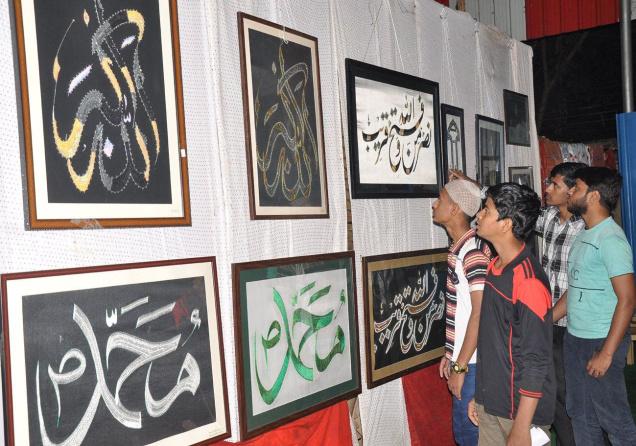
Rare works of art at calligraphy expo in Bidar

The works of 20 artists are on display at a calligraphy exhibition organised at the Barid Shahi Palace Hall in Bidar. / The Hindu

Mohammad Azmathulla goes around old monuments in Hyderabad collecting pigeon feathers lying on the ground. He comes home to clean them and fix artificial pearls at one end.

His real work starts now. He picks up his calligraphy pen to inscribe letters, names of friends and lines from Holy scriptures. “As far as I know, I am the only one who does feather calligraphy,” says the retired railway employee. He is among the 20 artists whose works are featured in the calligraphy exhibition organised in the Barid Shahi Palace function hall in Bidar.

The exhibition is organised by the Shaheen group of institutions and Siasat, the Hyderabad-based Urdu daily.

“It is very difficult to write on feathers as they are slippery. The pen gets stuck in the feathers and the letters can be distorted. That is why no one else seems to do this,” he said.

The artist has painted hundreds of names and sayings from Holy scriptures in English, Hindi and Urdu. He usually uses a single colour. But some times, he coats the feathers in a light shade of colour and uses multiple colours for the writing.

So does spot painter Abdul Lateef Farooqui. He creates stunning portraits in less than five minutes. Interestingly, he does not ask them to sit before him, but keeps observing and drawing sketches while they are doing something else. “I keep a bunch of sheets ready always, as I would be attracted to a face and feel like producing a caricature anytime,” he said. He has perfected the art of using geometrical designs in calligraphy. He also draws lines and letters on paintings of events described in the Holy Quran and other scriptures.

However, the master of the group is the 86-year-old Abdul Nayeem Saberi. He not only produces great works of calligraphy, but also trains young people in the art. He has trained more than 2,000 young people in the last 12-15 years.

Mr. Saberi also teaches young people how to make pens from bamboo shoots. He also helps women’s groups who recreate the calligraphic designs in embroidery and other craft forms.

The exhibition also displays wood work art where pieces of discarded wood pieces are joined to produce replicas of buildings or monuments.

Artists have produced copies of the original images of the house of Prophet Mohammad, the Kabah and the holy well at Makkah.

Some artists use a style that includes English letters, numbers and geometric designs. Some rearrange letters to create images of birds, animals and nature.

The Siasat trust was promoting the art of calligraphy among youth, Editor of the daily Zahid Ali Khan told The Hindu. He said their art works were showcased in exhibitions in New Delhi, Bangalore and Hyderabad. “We are training more than 300 women in various types of handicrafts and home industries. The trust also offers a total of Rs. 1 crore in scholarships to students per year,” he said.

“We are working at providing an online platform for artists to sell their wares,” said Managing Editor of the daily Zaheer Ali Khan.

Shaheen education society secretary Abdul Quadeer, spoke of plans to organise calligraphy classes for youth. The exhibition concludes today.

source: http://www.thehindu.com / The Hindu / Home> News> National> Karnataka / by Special Correspondent / Bidar – November 05th, 2013

Mumbaikar climbs rare bandwagon

Salar Jung Museum in Hyderabad and (top) the British musical clock, one of the rare clocks housed there

Hyderabad’s Salar Jung Museum plans to evaluate & tabulate its antique clock collection.

The Salar Jung Museum in Hyderabad, will begin work on evaluating and tabulating its clock collection, considered by clock enthusiasts as among the finest in India. Speaking to dnaover the phone from Hyderabad, Dr Nagender Reddy, director, Salar Jung museum said that this would be the biggest such exercise since the clocks were taken over from various private collectors in the 1960s.

“We want to do it in a scientific way, to add value to what is already a glorious collection of more than 400 of the rarest clocks in the country. It is a tedious and delicate process which includes the showcases that hold these clocks, evaluating the individual parts. All of this has to be done in such a way that no damage, whatsoever, comes to the clocks,” said Reddy. The process would be done along with the Lucknow-based National Research Laboratory for Conservation (NRLC), which is the apex body in the country for the conservation of cultural heritage.

The plan to evaluate the clock collection has already begun creating excitement among watch-lovers with Dr Reddy admitting that several people had contacted the museum to be part of the process. However, he said that it calls for a lot of formalities at various levels of the government as outsiders are not allowed to be part of these processes.

dna has learnt that among the people who have shown willingness to be part of the process is a senior railway officer from Mumbai. Saurabh Mitra, an Indian railway accounts service officer with Western Railway. Mitra, a watch enthusiast and collector, however, refused to comment.

About Salar Jung Museum
The museum was established in 1951. A major portion of the collection was acquired by Salar Jung III. In 1958, it was taken over by the Indian government. It is now run by an autonomous board chaired by the governor of Andhra Pradesh.

source: http://www.dnaindia.com / DNA / Home> Mumbai> Report / by Binoo Nair / Place: Mumbai, Agency: DNA / Friday – November 08th, 2013