Category Archives: Education

Barkat’s School

JAMMU & KASHMIR :

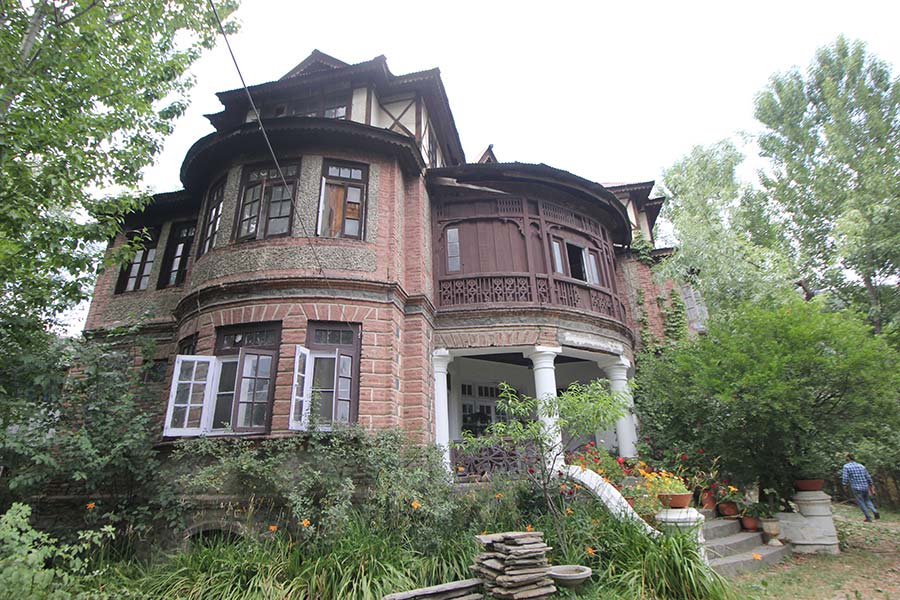
Started by a mother of seven to impart free education to underprivileged, Buchwara’s Lowood School is now a splendid piece of history. To rediscover its history, Bilal Handoo visits the school where once elite and influential British used to teach
Barkat’s-School

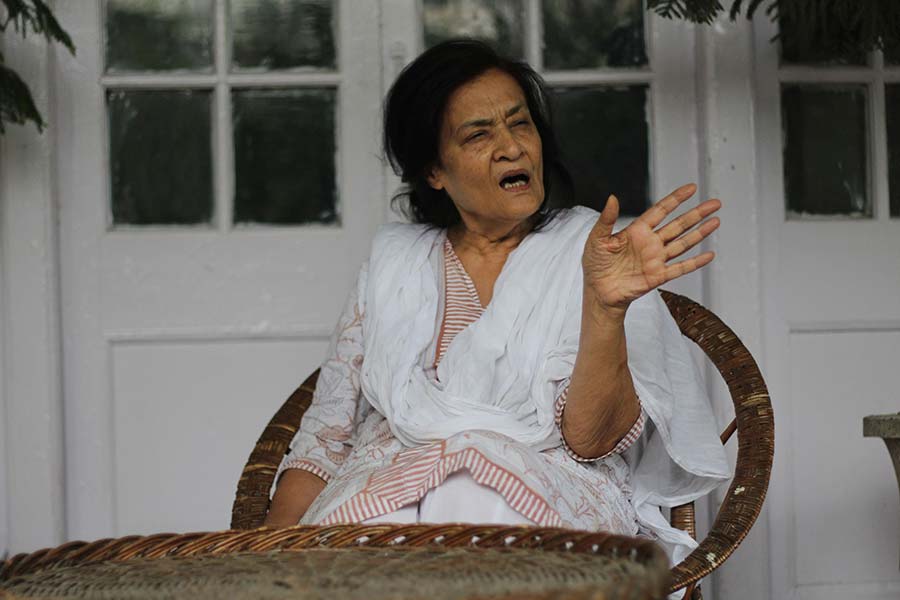
Address of the yesteryear’s educational signpost in Buchwara is a flood-torn fence and moss-filled courtyard of a rundown Dogra era building. For the moment, the structure appeared haunting: hauntingly quiet amid absence of mortals. The first sign of life came when a senile yet warm lady showed up only to recount how the school created a difference in its immediate locality.

Arjumand Zafar basked under the afternoon sun before narrating some unknown facts about the school. “Do you know,” says Arjumand, a retired deputy health director, “who used to teach here?” She rushed to solve the riddle, “the only daughter of former Prime Minister of England, Carol Thatcher.” She reclined on her seat to recall those two successive summers in later seventies when Carol Jane Thatcher (63) – an English journalist, author, and media personality arrived in Lowood School Buchwara and taught the students.

Then, the young Arjumand saw the daughter of the “Iron Lady”—Margaret Hilda Thatcher—a British stateswoman and the longest-serving British Prime Minister of the twentieth century, Prime Ministyer of the United Kingdom from 1979 to 1990,  to teach the kids with zeal. “She used to stay with us during that time,” the lady, now living in the house with her domestic help, said. “It was a different era, when foreigners used to frequent the school to prepare students over here at par with global standards.” Carol was then working for Australian Sydney Morning Herald whose relationship with Jonathan Aitken had ended in 1979. Now living with ski instructor Marco Grass in Klosters-Serneus, Switzerland, Carol travelled to the Falkland Islands and Argentina for the documentary Mummy’s War, where she got the hear: “Your mother is a war criminal!”.

But who was running this school and inviting all those high-profile foreigners back there? That person was Arjumand’s mother-in-law, the famous and respected Barkat Begum.

Also known as Begum Rehana Jalal-ud-din (Feb 13, 1913-April 13, 2002), Barkat Begum originally hailed from the remote Karen belt. Her family members distinguished themselves in various fields in valley. Her eldest brother, Nazir Ahmed Shah, was a judge. Her other brothers and sisters include, Begum Me’raj Qureshi (educator), Syed Ahmed Shah (nicknamed Shamji, a decorated member of the Kashmir Armed Forces, and founding member of the JAKLI Regiment, and later the JK Police), noted physician Dr Sayed Naseer Ahmed,, Syed Zameer Ahmed (former member of the armed forces, and an entrepreneur) and Dr Mahmuda Ali Shah, an educator.

Married to Aga Jalal-ud-din, an officer in the Maharaja Hari Singh’s Forestry Department at a young age, she continued her schooling with support from her “loving” husband. She was one of the few Muslim women from Kashmir to pursue further studies abroad, when she was awarded a scholarship to study at the University of Chicago in the 1950s. She was a mother of seven when she travelled to America for  studies.

On her return, she dedicated her life to develop school education in J&K, first as an officer in the government, and on her retirement, by founding one of the few English Medium schools in the valley, the Lowood Garden School. Her legacy of education is instilled deeply in her children, who have also excelled in their respective fields of expertise: son Syed Aga Nasser, retired as a senior member of the state judiciary; daughter Amina Gran, linguist, and broadcaster who worked with the UN; daughter Begum Khurshid Bakshi – wife of former Prime Minister Bakshi Ghulam Mohammad, educator and social worker, who retired as Director, Social Welfare son Zafar Ahmed, engineer and poet, retired as Chief Engineer Works; daughter Begum Sughra Hafeez, who retired as Principal, Government College for Women, Srinagar; son Shams Ahmed Khan, IPS, who retired as Inspector General of Police, JKP; daughter Begum Qudsiah Shah, educator who retired as Principal, Kothibagh Girls Higher Secondary School, Srinagar.

While her maiden name was Rehana, she was known and respected as Barkat Begum, a reference to her untiring efforts for the social and educational upliftment of the under-privileged. To her extended family she was known simply as Begum.

Barkat Begum worked tirelessly to promote social and educational upliftment, to the extent of refusing to accompany her husband back to Lahore after Partition as she felt that her services to promote education among women in Kashmir were more important.

Passion for education led this lady from a conservative background to travel alone to Chicago on a steamer in the 1950’s to pursue a scholarship leaving behind seven young children in the care of relatives. Uncommon even today, such an endeavour would have been unthinkable for a lesser mortal in those days.
Barkat’s-School02

After retirement Barkat Begum set up one of the finest schools in the valley – the Lowood Garden School. A dedicated core of teachers was supplemented by anyone who had something to teach. Visiting tourists and school-going grandchildren were co-opted into impromptu teaching roles. Barkat Begum was not one to be easily refused.

Many foreigners would return to take up temporary teaching assignments and school activities included stuff like performing Shakespearean plays and nature interpretation. Her family lived in a colonial bungalow on the Boulevard Road, which also housed the Lowood Garden School. The property included a huge estate with marshes, reed-beds and walnut, apple and quince-apple orchards. When Sheikh Mohammed Abdullah, then Chief Minister of Kashmir, offered Barkat Begum a permanent house in exchange for releasing the estate to build a commercial complex, she offered to release the land without any compensation if the state needed it. ‘Aap ki Jooti ki khairat’ was the term she used, translated roughly that the land meant less to her than the worth of his sandals.

The high worth of education and service for the common good as opposed to chasing wealth are values that were deeply instilled in her children and grandchildren. “I often joke that if Bill Gates were to meet my mother’s family,” says Jehangr, Barkat’s grandson, “they probably would treat him like a common shopkeeper. They don’t make them like her anymore!”

The school had a concept of mid-day meals when it was the remotest concept. They would give students a peanut butter. “The grandma was topper in Chicago examination,” says Javed Bakshi, son of Bakshi Ghulam Mohammad, who heads J&K’s State National Rural Livelihood Mission (SNRLM).  “She was part of Chicago based firm that used to supply stationery to the school.”

Eighty percent of pass-outs from Lowood School are either doctors, engineers and lawyers, Javed says. “One Khurshid Mir, pass-out of the school, now runs 20 spice shops in Germany,” he says. “His father is still selling cigarettes on Dal Lake gates. He flew all the way from Germany to be the part of my grandma’s funeral and broke down saying that today’s whatever little he achieved in life is all because of Barkat Begum.”

Begum Jallal-ud-Din not only had Master’s degree from Chicago University (USA) in 1940, but was also the first Asian to get cent percent marks in the course and later retired as Director Social Welfare here.  Her father was a forest lessee, a big business during Maharajas time in Kashmir. “Despite holding high positions, none of the siblings had a house of their own and used to stay in the custodian house,” recalls her elder son, Javid Bakshi. “The (siblings) have been brought up in lot of poverty. Her father’s family went back to Pakistan after the partition in 1947. Her mother had gone out to study in Chicago (1946-47), and due to transition period she (grand mom) couldn’t even send money to the family here as something happened with the currency those days. So the siblings living in Kashmir used to for themselves. So many times, they would not have bedding to sleep and majority of the times siblings would skip dinner.”

In 1970, in Buchwara, Mummy used to go house to house walking to motivate parents to send their daughters to Low Wood School” a middle private school, sponsored by government. This was the same school that my grandma opened up after her retirement. Now my mother was teaching after her retirement. She ensured a good number of girls in the school. Those days, the school had American style of mid-day meals. Early morning, raspberry jam, a big glass of milk, oats, eggs, were served to kids.  Students used to get free education, and the kids who couldn’t afford uniform, would get it from school. “Kids in the school were mostly from the boatmen community.”

Bashir Sidiq, a member of Kashmir Bar Association is one proud student of Barkat’s School. “We were like her sons,” Sidiq says. “Barkat Begum used to teach us in garden and prepared us for the overall development of life. She was focussing on underprivileged kids and was very health conscious.”

source: http://www.kashmirlife.com / Kashmir Life / Home / by Kashmir Life / September 28th, 2017
Eight Muslim candidates qualify for the National Defence Academy

The representation of Muslim students and aspirants might have increased in various courses and exams but when it comes to National Defence Academy and Naval Academy (NDA), there is a lot of progress to be made.

Out of the total 548 selected candidates, only eight Muslim candidates have made their way to National Defence Academy and Naval Academy. The result, which was declared yesterday, sees Affan Hussain as the highest ranked among Muslim candidates with the 91st position.

The selection of Muslim candidates in 2017 stands at 1.45%, which is rather low. In the recent past, the selection percentage of Muslim candidates was highest in 2015 when 16 candidates made to the final list with a success percentage of 3.53.

The UPSC conducts the exam for admissions to NDA twice a year and TwoCircles.net has been tracking the merit list since 2006 results for the second examination. The percentage of successful Muslim candidates has revolved around 1% during these years. Only once has it crossed over 2 percent and that was in 2010 when 17 Muslims were in the list of 742 qualifying candidates, making it 2.29 percent.

The qualified candidates will get admissions to the Army, Navy and Air Force wings of National Defence Academy for the 138th Course and also to the Naval Academy for the 100th Indian Naval Academy Course (INAC) commencing from July, 2017.

List of successful candidates can be found below :

91. 0033158 AFFAN HUSSAIN

105. 0135849 AFZAL ALI

172. 0002810 MEHTAB KAMAL

236. 0248807 ABDUL MANAN

244. 0121430 MOHAMMAD SHADAB

249. 0152591 AALIF

322. 0008336 SANOWAR AHMED

480. 0332695 ABDUL AHAD SHEIKH

source: http://www.twocircles.net / Two Circles.net / Home> Indian Muslim> Lead Story / by TwoCircles.net Staff Reporter / June 16th, 2017

Mangaluru: Deve Gowda launches Fiza Group’s welfare schemes, lauds B M Farooq

Mangaluru, KARNATAKA :

Mangaluru :

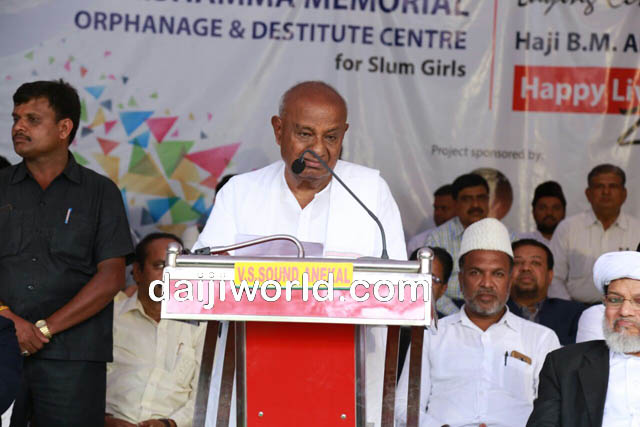
“Having worldly wealth is not everything. Only a person is rich in heart besides being rich, can think of projects like Happy Living Zone and make it happen. Social welfare measures being undertaken by Farooq in the name of his parents are close to the heart of the Almighty. The soul of his mother may experience fulfillment at the knowledge that her son has drawn up a plan of Rs 15 crore for educating poor people, in the name of his father and mother,” said JD(S) supremo and former Prime Minister H D Deve Gowda.

DevegowdaMPOs09dec2017

He was speaking after inaugurating welfare schemes being run by Fiza Group, and laying foundation stone for B M Ahmed Bava Memorial Happy Living Zone at a programme held under the aegis of Saadiya Education Foundation on Tuesday November 6.

“This is something which gives me immense satisfaction. I feel like some power is gripping me. I have come to like Faooq because of the fact that he is a man of rich heart. His schemes and projects tell us that he has a rich heart,” Gowda said, praising his party leader.

Gowda revealed that some recent developments in the country are paining him. “Effort to trample a particular community is going on a continuous basis through a conspiracy. Towards tackling this issue, all secular powers should come together. Religious leaders should teach lessons in humanity to the people of their respective religions. We have to retain humane qualities at any cost. Saadiya organization and its stalwarts are in the forefront in imparting this lesson,” Gowda said.

He said that his ardent desire is to lay foundation for a strong and united forum for secular outfits in the coming election and pledged to fight for this cause till his last breath. “I am prepared to undergo any kind of problem and crisis to make this happen,” he revealed.

The Late Ayishamma Memorial Slum Girls Education and Welfare Centre set up in the name of his mother by Farooq was inaugurated on this occasion by former chief minister, H D Kumaraswamy. He announced that if JDS rises to power in the state, it will implement Sachar Committee report for development works.

Farooq said that he used to keep close relationship with religious leaders and was serving the cause of educational and social initiatives in his own way for educational and social needs of the society. ” I have earned love and friendship of people from nooks and corners of my state. But it is not for the purpose of politics. I got unexpected entry into politics by way of filing candidature as a Rajya Sabha candidate,” said Fiza group owner, B M Farooq. Farooq said that he strongly believes that Allah will shower his mercy on those who behave sympathetically with people, and this notion drives his activities. “I am very happy with the aim of Saadiya to identify children facing maximum problems, and bringing them up academically,” he stated. He felt that children get very good parents because of good deeds they had done in the past. He recollected the assurance of the Prophet that those who serve the poor and destitute live in heaven with Him.

Farooq expressed his desire to contribute something for the society by working along side H D Deve Gowda, a purely secular leader and harbinger of development. He recalled services rendered by Deve Gowda in the capacity of Prime Minister of the cuntry and Karnataka chief minister. He expressed gratefulness for Gowda for providing four percent reservation for minority candidates in government employment, thus paving way for many Muslim officers to join government service. He also gave credit to Gowda for permanently addressing dispute on Idgah, and said he is proud to be associated with such a great personality at the very beginning of his political innings.

Maulana Shaffi Sahadi said that party affiliation is not necessary to speak about human nature and concern for others Farooq has in his heart. He hailed Farooq for offering schemes worth crores of rupees to the society towards providing education and social equality to thousands of Muslim children.He explained that Sahadiya Foundation has been providing religious and worldly education to poor and destitute students from the community since the last 14 years. “The organization has been imparting education and knowledge of religion to children of slum dwellers and to bring them to the mainstream of the society. Hundreds of students are being shaped into ideal personalities of the country by educating 5,000 students in Sahadiya Happy Living Zone from LKG to degree and also through providing training for civil services,journalism, and law eduction.

President of the organization, K S Atakoya Kumbol Tangal, speaking after presiding over the programme, felt that the organization rose in stature after it was started in small accommodation on rent, and expressed happiness at its meteoric growth which was made possible because of selfless and honest services of people like Farooq. He said that Allah’s blessings will always be where there is clean heart and pure purpose.

Mandya MP, Puttaraju, inaugurated the exhibition of Sahadiya slum children. Fauzia Farooq inaugurated computer lab for slum girls and tailoring centre.

President of All India Sunni Education Board Bengaluru, Dr S S A Khader, Jumma Masjid Trust president, Dr Anar Shariff, Kerala SYS vice president, Abdul Khader Madani Pallangod, Basheer Abdul Karim Sakhafi, SSF Bengaluru district president, Tajuddin Paliri, Dubai Bearys Cultural Forum president, Dr Yousuf Dubai, Talent Foundation founder, Abdul Rauf Puthige, Muhammed Ghayazuddin Bahrain, S Muhammedaji Sagar, Sahadiya Womens College chairman, Yousuf Sait, Mumtaz Ali Krishnapura, political leaders, Muhammed Kunji Vittal, Iqbal Ahmed of Little Flower education institute, Abhiman constructions owner,Ummer Haji and others participated.

Sub editor of Prajavani daily, B M Muhammed Hanif, presented the programme, Ismail Sahadi Kinya proposed vote of thanks.

source: http://www.daijiworld.com / DaijiWorld.com / Home> News> Top Stories / by Daijiworld Media Network – Mangaluru (SB/SP) / pics: by Stany Bela / Thursday – November 07th, 2017

Nagma Mansuri: A role model in riot hit Uttar Pradesh

Shamli , UTTAR PRADESH :

Ram Naik, Uttar Pradesh Governor and Chancellor Chaudhary Charan Singh University – formerly known as Meerut University, awarded the Gold Medal to Nagma Mansuri at a glittering ceremony held last Monday for scoring maximum marks in Physics subject. (TCN photo) source: ummid.com
Ram Naik, Uttar Pradesh Governor and Chancellor Chaudhary Charan Singh University – formerly known as Meerut University, awarded the Gold Medal to Nagma Mansuri at a glittering ceremony held last Monday for scoring maximum marks in Physics subject. (TCN photo)
source: ummid.com

Shamli  :

Nagma Mansuri, daughter of a vegetable vendor, wins Gold Medal in M.Sc Physics from Chaudhary Charan Singh University, formerly known as Meerut University. She is a student of Rashtriya Kisan Post Graduate.

Last Monday, she received Gold Medal from Ram Naik, Uttar Pradesh Governor and Chancellor of Chaudhary Charan Singh University in a grand ceremony.

Nagma’s Father, had studied till 8th standard and her mother did not even go to school. But the parents are well aware of value of education. Despite economic burden of the family, Nagma’s Father worked hard to afford for education of his children.

Tabassum Mansuri, elder sister of Nagma Mansuri, was also the topper of Meerut University in 2014. Nagma Mansuri’s youger brother is a student of computer science.

“I love teaching and want to join a college as professor”, says Nagma Mansuri.

Shamli witnessed worst kind of communal riots in 2013 when most of the parents stopped sending their girl children to school.

Farzana Mansuri, Nagma’s mother said that “Initially, people were criticizing us for sending our daughters to college. But, after the laurel they brought to the town by their astonishing success, they have become a role model for others. There are many girls in the town who want to become like them and come to our house for guidance.”

source: http://www.siasat.com / The Siasat Daily / Home> India> Top Stories / December 06th, 2017

Sultan Moiuddin bags 14 gold medals, tops Maharashtra MBBS finals

Palgar District, MAHARASHTRA :

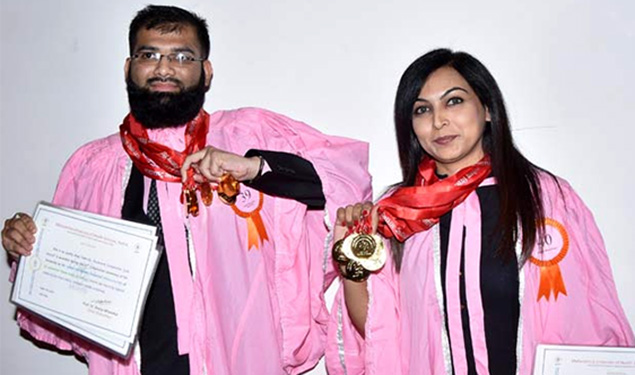
Sultan Moiuddin Shaukat Ali and Mansi Mayuri with Gold Medals at the 17th Convocation of MUHS Nashik.Photo credit Deshdoot

Nashik  :

A Muslim Student, Sultan Moiuddin Shaukat ali from Dr. Vasant Pawar Medical College Nashik topped the Maharashtra MBBS Final Exams and bagged 14 gold medals.

He bagged nine medals in various subjects of final year, while he also got five medals as a consolation prize. This is the pride moment for Dr. Vasant Pawar Medical College as their female student Mansi Mayuri Gujarati also grabbed Seven Gold medals and attained the second position.

Dr. Sultan hails from a small town Palghar adjacent to Mumbai city, he belongs to the middle-class family background. He did his schooling at Rana English High School, where he secured 93 percent marks in SSC (Secondary School Exam) and he passed intermediate from Azam Campus Pune with 94% marks.

Ever since childhood, Dr. Sultan aimed to become a doctor but due to the poor economic condition of his family, it was difficult to achieve the goal. Hence he took admission in an engineering college. But one day he called back to Palghar, where he began to chase his dreams and started the preparation for CET and passed the entrance test scoring 172 marks that pave his way to take admission at Dr. Vasant Pawar College in Nashik.

Recently, he was awarded the medals on the 17th Convocation day of MUHS. The prize was distributed by Maharashtra Medical Education Minister Girish Mahajan who was presiding over the function. And, Dr. Sultan also received a cash price of Rs.10, 000 from Johnson & Johnson Mumbai.

source: http://www.muslimmirror.com / Muslim Mirror / Home> Indian Muslim / by Admin / November 18th, 2017

Watch: Sharjah boy, 14, flies plane

Nagpur, MAHARASHTRA / Ujjain, MAHDYA PRADESH / Sharjah, UAE :

Indian expat flies solo after record time of 25 hours training

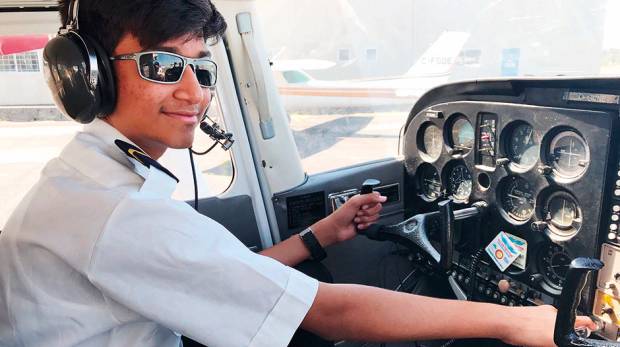
Mansoor Anis took off and landed from Langley Regional Airport in Canada to accomplish his first solo flight./ Image Credit: supplied

Sharjah:

At just 14 years old, a Sharjah teenager has become one of the youngest pilots to fly a single-engine aircraft.

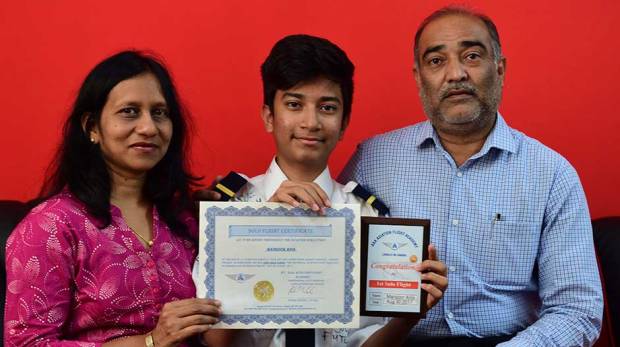
Indian expat Mansour Anis, a Grade 9 student at Delhi Private School in Sharjah, received a certificate for his first solo flight from an aviation academy in Canada last week.

Back in the UAE after his achievement, Mansour claimed that he had also set a record of being the youngest pilot to fly solo with the least number of training hours.

“He broke the previous record of a 15-year-old German pilot and a 14-year-old US pilot who took 34 hours of training. Mansour flew solo just after 25 hours of training,” Mansour’s father Ali Asgar Anis told Gulf News on Wednesday.

Summer training

Ali, a civil engineer heading the engineering department at Zulekha Hospital, said he had sent his son along with his wife Munira, a chemistry teacher with Wesgreen International School, to Canada for the training session during the summer holidays.

In some countries, like the US and UK, a person has to be at least 16 years old before taking to the air on their own. In the UAE and India, the pilot has to be at least 18 to be eligible to fly. However, in Canada, 14 is the minimum age for student pilots to join the course and try flying after meeting the requirements.

“Since he turned 14 in June, we decided to take him to Canada for setting this record,” said Munira.

Mansoor, with his parents Munira and Ali Asgar, displays the certificate he earned from an aviation academy / Image Credit: Atiq ur Rehman/Gulf News

She said her brother Qaid Faizy, a pilot with Jet Airways in Inida, has been an inspiration for Mansour since his childhood.

Fascinated about flying

“I got fascinated about flying the plane because of my uncle. He has been my inspiration and he has envisioned me to become a commercial pilot after I turn 18,” said Mansour.

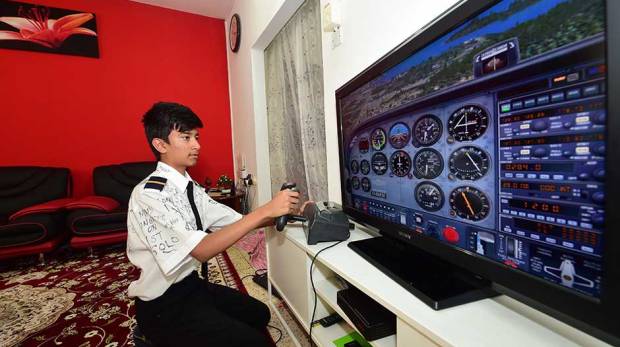
When he was about eight years, Mansour received a flight simulator as a gift from his uncle. “I learnt some basic lessons using that. My uncle has also given me and my sister the chance to visit the cockpit of an aircraft in which we flew once.”

His uncle also allowed Mansour to sit with his sister Mariya, a medicine student in Mauritius, when she once flew a Cessna aircraft at an aviation school in India, where the former used to teach, around four years ago.

Apart from the flying test, he has also passed a radio communication test / .Image Credit: Atiq ur Rehman/Gulf News

Mansour, who also flew a Cessna 152 aircraft during his solo flight, now has a student pilot permit. Apart from the flying test, he has also passed a radio communication test and scored 96 per cent in the PSTAR Test, an eligibility test for Transport Canada.

It was chief flying instructor at the AAA Academy Robert Wickins who trained Mansour during his course.

“He used to brief me about how the plane works. He taught me how to turn the aircraft. Then we went for some exercises like stall, spin, spiral dive etc. I was scared at first… but then it was fun. Also he had assured me nothing would go wrong and we can control the aircraft.”

Mansour’s solo flight was about 10-minutes long, during which he taxied the aircraft from the parking bay to the runway, took off for a flight of about five minutes and landed back.

Light aircraft

“The aircraft was really light because the instructor’s weight was not there. The plane was in the air a bit faster. I was excited and a little nervous.

“After I took off, I concentrated on flying how I did with the instructor. Everything happened very quickly,” said Mansour, who is now on cloud nine about his achievement.

“I am planning to go again to Canada next year to continue flying. If I don’t continue I will forget everything. At 16 years, I will take a recreational pilot permit. At 17, I will take private pilot license and at 18, I will take a commercial pilot license,” said the boy for whom the sky is not the limit.

source: http://www.gulfnews.com / Gulf News / Home> Society / by Sajila Saseedran, Senior Reporter / September 06th, 2017


AMU Law Faculty team brings runner up trophy

Aligarh, UTTAR PRADESH :

LawStudentsMPOs04dec2017

Noida  :

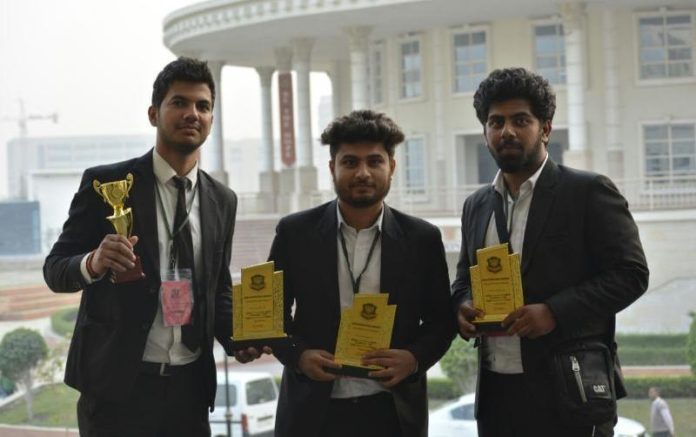
A group of three students from the Faculty of Law, Aligarh Muslim University, comprising Salman Qasmi, Joint Secretary, Law Society, Suhail Khan and Aditya Raj won the runner up position in the National Moot Court Competition 2017 held at the Noida International University.

Symbiosis Law School, Noida won the title of the competition.

Mr Shiv Kerti Singh, Former Judge, Supreme Court of India and Chairman, Telecom Disputes Settlement and Appellate Tribunal (TDSAT) gave away the trophy to the winning teams.

source: http://www.amuobanews.in / AMU OBA News / Home> AMU  / by Amuoba News / December 01st , 2017

AMU Civil Engineering faculty wins Young Scientist Award

Aligarh, UTTAR PRADESH :

DrRizwanKhanMPOs04dec2017

Aligarh :

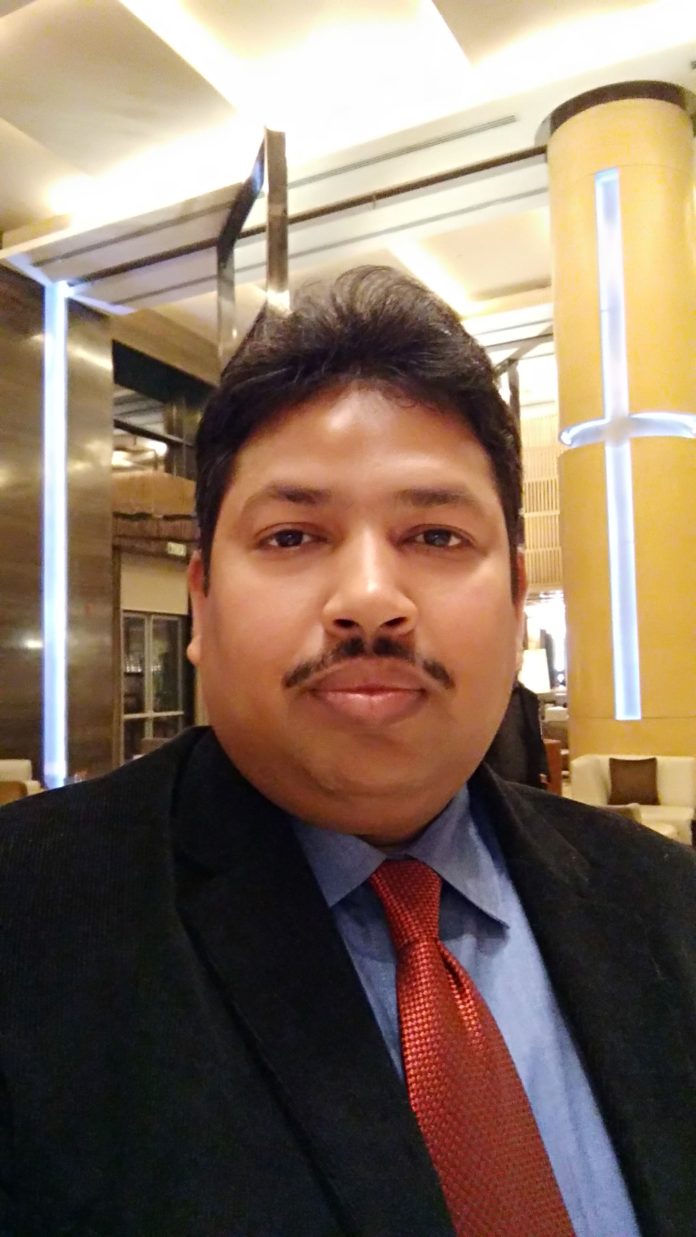
Dr Rizwan A Khan, Associate Professor, Department of Civil Engineering, Z. H College of Engineering and Technology, Aligarh Muslim University has received the “Young Scientist in Civil Engineering Award” from Venus International Foundation, Centre for Advanced Research and Design, Chennai.

The award has been given to Khan in recognition of his contributions and achievements in the field of Civil Engineering.

Khan has 60 publications in national and international journals of repute and has earlier received “Young Concrete Engineer Award” by Indian Concrete Institute in 2015.

source: http://www.amuobanews.in / AMU OBA News / Home> AMU  / by Amuoba News / December 01st , 2017

Nine AMU students qualify Bihar Judicial Services Exam

BIHAR / Aligarh, UTTAR PRADESH  :

AMUstudentMPOs4dec2017

Aligarh :

Nine students of Aligarh Muslim University (AMU) have qualified the Bihar Judicial Services (Civil Judge) Exam 2016.

They are

Ms Swati Dube (Phd student) – 28 Rank

Mr Rehan Raza (BA LLB 2009 batch) – 36 Rank

Mr Brijnath Singh (Phd student) – 42 Rank

Mr Zeeshan Mehdi (BA LLB 2015 batch) – 45 Rank

Mr Asif Nawaz Khan (BA LLB 2014 batch) – 47 Rank

Ms.Ghazala Tasneem ( XI – 1998 / Bsc 2000 batch ) – 65 Rank

Mr.Pankaj Kumar Pandey ( LLM 2013 batch) -91 Rank

Mr Md Tasneem Kauser (BA LLB 2012 batch) – 265 Rank

Mr Hamza Alam (BA LLB 2009 batch) – 268 Rank

source: http://www.amuobanews.in / AMU OBA News / Home> AMU> Bihar / by Amuoba News / December 04th, 2017

Winds of Change: Muslim Girls Embrace Education, Aim High

Katihar (Azamgarh) BIHAR / Mumbai, MAHARASHTRA / Kolkata, WEST BENGAL / Azamgarh, UTTAR PRADESH  / NEW DELHI  : 

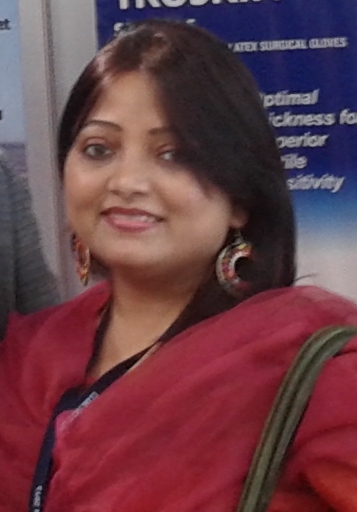
Ghazala Tasneem, a housewife and mother of two from the Katihar district in Bihar, was selected for the Bihar Judicial Services Competive Examination with a 65th rank (IANS Photo)

Katihar / Azamgarh/New Delhi :

For Ghazala Tasneem, Oct. 31 was not a normal day. It was the day her dream came true and she was rewarded for her hard struggle of three years. She was selected for the Bihar Judicial Services Competitive Examination with a 65th rank and can soon aspire to be a judge.

“Indeed, it was difficult, but thanks to Allah, due to the continuous support and motivation from my husband and other family members, I have achieved what I deserved,” says Tasneem, a housewife from the Katihar district in Bihar with two sons.

There is a general perception that Muslim women rarely pursue higher education, or go for competitive exams, and the social odds are stacked even higher once they get married and have kids. But women like Tasneem challenge such stereotypes.

India has the largest Muslim population after Indonesia, which is about 14.2 percent of its 1.34 billion population, and the 2011 census says that about half of the population of Muslim women is illiterate. But women like Tasneem think that the situation is changing fast.

“Though in areas like law and judiciary, still the number of Muslim girls is very less. But in general, the situation is changing now and there are many more Muslim girls going to school,” Tasneem said.

Zebun Nisa Khan, associate professor at the Department of Education in Aligarh Muslim University, says that situation has already changed. “The trend is not changing, but it has already changed. For the last few years, the number of Muslim girls in schools has increased massively,” Khan said.

Muslim women’s literacy rate is on the increase in Uttar Pradesh, but the situation in states like Bihar and West Bengal needs to further improve.

Moonisa Bushra Abidi teaches physics at Maharashtra College of Arts, Science and Commerce in Mumbai. She also thinks that educating the girl child is an increasing trend among Muslims and an increasing number of Muslims girls – encouraged by their parents, particularly mothers –are going for higher education.

“One can see a larger number of girls with hijab in many institutions now. In the early 1990s, when I was pursuing my M.Sc. from the University of Mumbai, I was the only girl in the entire university with a hijab,” Abidi explains.

She says that during her days in the same college, at the intermediate level, there used to be one division of girls against four of boys, but now there are four divisions of girls against one for boys. At UG and PG levels, there are hardly 8 to 10 boys in each class against 80 to 90 girls.

The college is being run under the presidentship of a woman, Fatima Zakaria, a Padma Shri awardee, journalist and academician, and mother of veteran journalist Fareed Zakaria.

“The situation is not good because the number of boys is decreasing and now our college is becoming a girls’ college,” Abidi said.

But what had been the major issues for educating Muslim girl child in India? Khan lists poverty and lack of awareness as some of the major problems in the path of girl child education.

“The major obstacles are poverty and lack of awareness. Many Muslim families are below the poverty line and they are unable to educate girls,” she explained.

Sadia Rahman, Ph.D. scholar of international relations at National Chung Hsing University in Taiwan, thinks that widespread poverty and financial constraints are the major causes that prevent Muslim girls from accessing modern education. “Also, the poor quality schools in Muslim populated areas is also responsible for it,” says Rahman who hails from Kolkata and completed an M.A. from Presidency University.

According to Islamic teaching arrangements of classes, male and female students should be separated and many people believe that it is also one of the important reasons for the low literacy rate of Muslim women in various places.

“I think the biggest obstacle for girls’ education was co-education and less availability of Muslim-management colleges. Sometimes a girl with a hijab becomes the butt of jokes, because of which religious-minded girls are hesitant to go to colleges run by non-Muslim managements,” Abidi added.

Abidi believes that Muslim girls from conservative families don’t feel comfortable in the co-education system and the community should think about opening more separate colleges for them.

“In rural areas, even Hindu girls prefer girls-only colleges and avoid co-education,” Khan pointed out.

Neyaz Ahmad Daudi, who runs Fatima Girls Inter College in Daudpur village in the Azamgarh district of eastern Uttar Pradesh, has another story to tell. Daudi, who has doctorate in psychology from Banaras Hindu University and served at Shibli National Intermediate College as principal for over a decade, says that he chose to start a girls’ college because boys can go far and there were not enough girls’ colleges at nearby villages and towns.

Non-availability of schools and colleges nearby is also one of the major obstacles and a major issue in many areas.

Daudi says that in places like Azamgarh, where most of the guardians are away in the Gulf countries or in metro cities earning a livelihood, people are cautious about the security of girls and don’t allow them to be sent too far; they also seek a safe and secure transportation system from home to school.

At 73.01 percent, Azamgarh has the highest Muslim female literacy rate in Uttar Pradesh. But being a small place, it is still difficult to gain higher education here.

“Now girls are educated but they have less opportunity for higher studies and competitive exams because usually it is available only in bigger cities,” Daudi explained.

There is another misconception that some people think that educating a girl child – especially modern education – is against the religion, but Khan believes that getting an education is a religious duty.

“The very first revelation on Prophet Mohammed was the word ‘Iqra’ which means ‘you read’ and such words are mentioned in many places in the Holy Quran. It is general guidance for both males and females,” Khan says.

“Islam and Muslims are not against education. Islam teaches one to gain knowledge from cradle to grave, but some people misinterpret Islam,” says Tasneem.

“All educational goals can be achieved being in veil. There are a number of examples in the early Islamic period where women were very much involved in education and nursing sectors,” Tasneem added.

(This feature is part of a special series that seeks to bring unique and extraordinary stories of ordinary people, groups and communities from across a diverse, plural and inclusive India, and has been made possible by a collaboration between IANS and the Frank Islam Foundation. Abu Zafar can be contacted at abuzafar@journalist.com)

source:  http://www.indiawest.com / IndiaWest / Home> Feature / by Abu Zafar, IANS – Special Series / November 18th, 2017