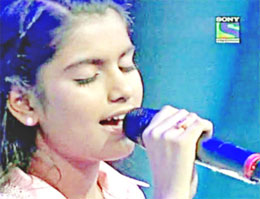
Nahid Afrin, a Borgeet student of Nrityanjali Kala Niketan, here has brought glory to the State by entering the Top Nine in the ongoing reality show programme ‘Indian Idol Junior’ telecast by Sony TV.
The elder daughter of Fatema Ansari and Anowar Ansari of Biswanath Chariali, she has already earned accolades with her melodious voice in the stages at different places of the State and can sing in different languages including Assamese, Hindi and Bengali with the same fervour.
Dr Lohit Sharma, managing director, Nrityanjali Kala Niketan informed this correspondent that Nahid had been exhibiting good performances in music since her childhood and she possesses a bright future.
Nahid, a Visharad Part 2 student in classical music under Bhatkhande Kala Kendra has been able to draw the attraction of the judges in the reality show and even Bollywood superstar Salman Khan had showered her blessings and good wishes upon her in the programme recently.
Now all she wants from the people of Assam is good wishes and votes in her favour.
source: http://www.assamtribune.com / The Assam Tribune / Home / by Hiranya Borthakur / Guwahati – July 24th, 2015
Of the total 1,099 successful candidates in the final list of the Union Public Service Commission (UPSC) examinations, 50 Muslims have made it to this year’s result, with Bilal Mohiud Din Bhat from Kashmir bagging the tenth rank. The number of Muslim candidates is higher than last few years.
In 2016, 36 Muslims had cleared the exams, while the number stood at 38 in 2015, 34 in 2014 and 30 in 2013.
Along with Bilal, nine Muslims have made it to the top 100 ranks. Those in top 50 include: Muzammil Khan (22), Sheikh Tanveer Asif (25), Hamna Mariyam (28), Zaffar Iqbal (39) and Rizwanbasha Shaikh (48). Seventeen Muslims feature in the Top 500.
The selected UPSC candidates are recommended for various government posts which include Indian Foreign Service (IFS), Indian Administrative Service (IAS), Indian Police Service (IPS) and several other allied services.
Although Muslims comprise 13.4% of total population, they are dismally represented in the top government services, often due to lack of education and unavailability of resources. They account for about 2% in the civil services.
The Union Public Service Commission (UPSC) declared the final result of the 2016 civil services examinations on Wednesday evening. Like previous years, this year too a woman, Nandani KR, has topped the exam. Others in the top five are Anmol Sher Singh, Gopala Krishna, Sauyma Pandey and Abhilash Mishra.
Successful Muslim Candidates for UPSC Result-16
S.No.
Name
Ranks
1.
BILAL MOHI UD DIN BHAT
10
2.
MUZAMMIL KHAN
22
3.
SHAIKH TANVEER ASIF
25
4.
HAMNA MARIYAM B A
28
5.
ZAFFAR IQBAL
39
6.
RIZWANBASHA SHAIK
48
7.
SHEIK ABDUL RAHAMAN S
62
8.
ARIF AHSAN
74
9.
SYEED FAKHRUDIN HAMID
86
10.
BISMA QAZI
115
11.
SUHAIL QASIM MIR
125
12.
S M QASIM ABIDI
177
13.
RAZEEM K
191
14.
GAUSH ALAM
206
15.
NAHAS ALI
359
16.
MD ADIL ASHRAF
435
17.
PATHAN ADEEB DAULAT KHAN
450
18.
SAQIB YOUSUF
472
19.
HASEEN ZAHERA RIZVI
509
20.
JABEEN FATHIMA J
525
21.
ANAM SIDDIQUI
538
22.
SHEIKH SAMI UR RAHMAN
554
23.
MOHAMMAD ARSHAD
556
24.
MINHAJ UDDIN NIZAMI
584
25.
SHAIK SHAHABAAZ HANOOR
603
26.
INABAT KHALIQ
604
27.
FAISAL JAVAID
610
28.
HARIS BIN ZAMAN
646
29.
IRAJ RAJA
674
30.
EZAZ AHMED
697
31.
EHJAS ASLAM S
704
32.
REHNA R
735
33.
MANER NASIR IQBAL
753
34.
ABDUL RAHEEM A
755
35.
NASEEF ABDUL KADER
781
36.
MUHAMMED SHABEER K
805
37.
ANAYAT ALI CHOWDHARY
808
38.
DANISH AGASTAM
814
39.
JABBAR
822
40.
TASLEEM AHMED
827
41.
SHARDUL
828
42.
MD MUSTAQUE
836
43.
RENA JAMIL
882
44.
SHUHAIB T
885
45.
SHAHANSHA K S
897
46.
MUHAMMED HANEEF
898
47.
MD SARFARAZ ALAM
904
48.
MD SARFARAJ ALAM
1028
49.
SAJAD BASHIR
1042
50.
AMIR BASHIR
1087
51.
UMMUL KHER
420
source: http://www.twocircles.net / Two Circles.net / Home> Indian Muslim> Lead Story> Youth / by Raqib Hameed Naik , TwoCircles.net / New Delhi – May 31st, 2017
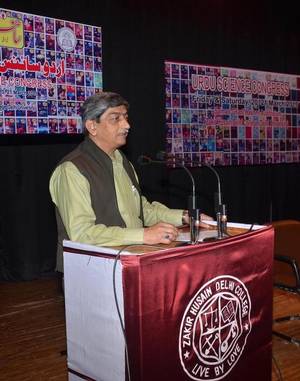
Mohammad Parvaiz at the first Urdu Science Congress in New Delhi in March 2015. Photo: Special Arrangement
A 23-year-old Urdu science magazine uses popular science to inspire progressive thought
Mohammad Aslam Parvaiz likes to describe a process that is a combination of four of his passions — botany, education, philosophy and religion. “The roots imbibe water and nutrients from the soil. The leaf photosynthesises, produces food, retains just enough for its own sustenance and sends the rest to the parts of the tree that need that food. This is the natural world’s law of diffusion — movement happens from the region of high concentration to the region of low concentration. If we see the tree as our community, that is how resources should flow too,” says Dr. Parvaiz, publisher of the magazine Urdu Science.
The first issue was launched at the World Book Fair in New Delhi in 1994. It dealt with AIDS and the myths surrounding condoms. In the last 22 years, the magazine has covered a gamut of subjects including water conservation and the need for a National Water Policy, common ailments and how to prevent them, sex determination, balding, sleep, life on Mars, and animation.
“Science is very effective in feeding the intellectual hunger of young people.Only with knowledge can they think for themselves and learn to analyse the religious scripts that they memorise. Most often it is the children of the poorest Muslims who attend madrasas. With only religious texts to lead them, and if they can read only in one language, how can you expect them to develop their personality and prosper in society?” asks the mild-mannered crusader, at present the Vice-Chancellor of Maulana Azad National Urdu University (MANUU) in Hyderabad.
In the campus, boulders display signages with scientific information and many trees carry their botanical names. “A person will absorb anything that is part of his environment,” he said to the graduate, post-graduate and doctoral students at the inauguration of an Urdu writers’ workshop. As an Urdu-medium student in a madrasa in Delhi, young Parvaiz hardly found any books or magazines in Urdu that could satiate his curiosity. In the Sunday markets of old Daryagunj, he used to find Russian books translated into Urdu, and that is how he discovered Benjamin Franklin. As a high-school student, he set up a science lab in his house. Years later, when he became the principal of Zakir Hussain College, he started a new venture in another corner of his house — Urdu Science.
“Survival depends as much on physical health as on intellectual growth, and sadly, the low potential for growth for poor students in madrasas is a problem across our subcontinent,” he says. An active member of the Modernization of Madrasa Education Project, he says that it is “ironic and tragic that clerics who lead our prayers and teach us about religion and the Koran do not have the means or the knowledge to impart a broad and progressive education. They accept that religious education is not enough, and many of them are now waiting for progressive teachers and educators to come forward and teach at madrasas.”
Having completed a PhD in botany, Dr. Parvaiz started writing in Urdu for Quami Awaz, then edited by Mohan Chirag. Noticing that most Urdu-medium students opted for the humanities, he wanted to popularise science. As a first step, he started a society called the Anjuman Farogh-e-Science, with patrons like Nobel Laureate Prof. Abdus Salam, Jamia Hamdard founder Hakeem Abdul Hameed, and Jamia Hamdard Chancellor Saiyid Hamid. The not-for-profit organisation held its first Urdu Science Congress in New Delhi in March 2015 and the second in Aligarh, this February.
“Urdu was a language of poetry and literature. People of different faiths patronised Urdu. But in those days, and even today, information in the language was very limited. And that is why I started this organisation and this magazine. My wife Shaheen helps me with proof-reading. And now I also have assistance from my colleague Dr. Tariq Nadwi.” Dr. Parvaiz is proud that the magazine has attracted enough Urdu science writers to contribute, and the magazine has so far never had to translate an article from another language. Issues from 2005 are available on the Academia.edu website.
Translation is an important key to dissemination of knowledge, agrees Parvaiz. He is on a personal mission to compile a glossary of scientific words in English, with meanings explained in Urdu. Sharing a slice of history, he says, “Delhi College was started as a madrasa by Ghaziuddin Khan. Here, mathematician Master Ramchandra and Maulvi Zakaullah translated many of the Western scientific texts into Urdu through the Vernacular Translation Society. It was there that I studied and later became the principal. I started Urdu Science when I was there. And I feel very humble that I now head MANUU, the university aiming to promote Urdu.”
A voracious reader of both religious texts and international science, Parvaiz says, “Science helps us interpret the Koran in many ways. And that is as relevant today as it was when the first issue of Urdu Science was launched.”
Mala Kumar is a children’s author, editor and freelance journalist.
source: http://www.thehindu.com / The Hindu / Home> Literary Review / October 15th, 2016
The Congress on Monday appointed Fairoz Khan, who hails from a remote village in Ramban district of Jammu & Kashmir, as the new president of the National Students Union of India (NSUI), the party’s student wing.
Congress vice-president Rahul Gandhi, who is in-charge of the frontal organisations of the party, recommended his appointment after personally interviewing those shortlisted for the post.
Speaking to Hindustan Times, the 28-year-old said, “‘I come from a village which is still devoid of electricity and proper roads.” “I come from a family with no political background. My father is a junior engineer in public health engineering department and my mother a housewife,” he adds.
Eldest among four siblings, Fairoz of Pogal Paristan shifted to Ramban for higher education and later, he did BSc from Bhaderwah Degree College and plunged into politics. He studied law from Jammu University in 2012 followed by masters in political science. Presently, he is pursuing post graduate diploma in human rights and duties education from Jammu University’s law school.
Khan, who loves soulful songs of Nusrat Fateh Ali Khan, remained NSUI national general secretary for four years from 2012. He was also the first elected national delegate of the NSUI from Jammu & Kashmir.
source: http://www.hindustantimes.com / Hindustan Times / Home> India / by Ravi Krishna Khajuria, Hindustan Times / June 12th, 2017
This 10-year-old boy has bagged 75 medals in roller skating | Mangaluru News – Times of India
Mangaluru :
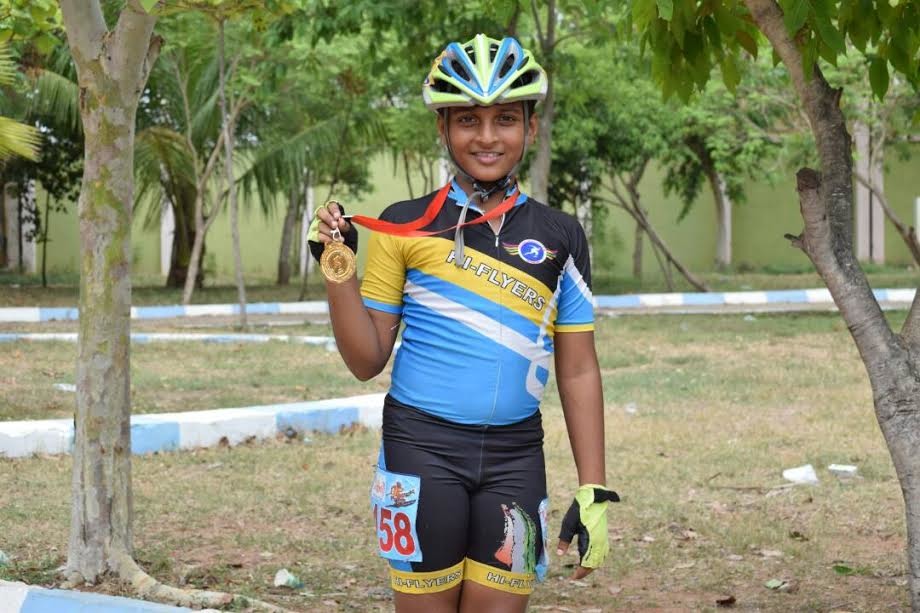
This 10-year-old Mangalurean boy is winner of 75 medals in roller skating.
Muhammad Shamil Arshad, who has bagged four gold medals in a recent national skating championship, has a total of 75 medals to his credit. Shamil has completed his 75th gold medal by securing gold medals and individual championship at the Ist All India Open Speed Skating Meet held at Puducherry.
Shamil, a class five student of The Yenepoya School, Jeppinamogaru in the city, has bagged four gold medals and individual championship at the meet.
Mangalurean skater Dashel Amanda (class six student of Cambridge School) has bagged three gold one silver and individual championship; and Thanmay Kottary (class four student of Canara CBSE School) has secured three gold and individual championship at the same meet. Children have bagged medals and championship in inline speed skating category at Puducherry. Members of Hi-Flyers Skating Club, Shamil, Dashel and Thanmay are being trained by coaches K Mohandas and Jayaraj.
Recently, Shamil also had bagged three gold medals and individual championship under 8-10 years age group at the RFSI National Championship – 54th National Speed Skating Championship 2016-17 held in Bengaluru from January 18 to 23. The event had witness participation of 45 students from 26 states.
Son of Arshad Hussain M S and Ramlath Arshad couple in the city, Shamil had bagged his first gold medal at a state level Roller Skating Championship held in Belagavi in November 2012. As many as 53 participants had taken part in the competitions. Later, he had bagged two gold medals and individual championship at a state level event held in Bengaluru in November 2013. The meet was attended by 53 participants.
Shamil’s medal tally includes 10 national medals (including seven gold, one silver and two bronze), six medals at the South Zone CBSE meets (including three gold, two silver and a bronze), 12 gold at state level, 13 district level medals and 13 medals at inter school competitions. Shamil has bagged 15 individual championships at various events.
Ramlath Arshad, mother of Shamil and a degree college lecturer, told TOI that all the three children who bagged championships in Puducherry are practicing hard to participate in international events.
source: http://www.timesofindia.indiatimes.com / The Times of India / News> City News> Mangalore News / Vinobha K T / TNN / June 16th, 2017
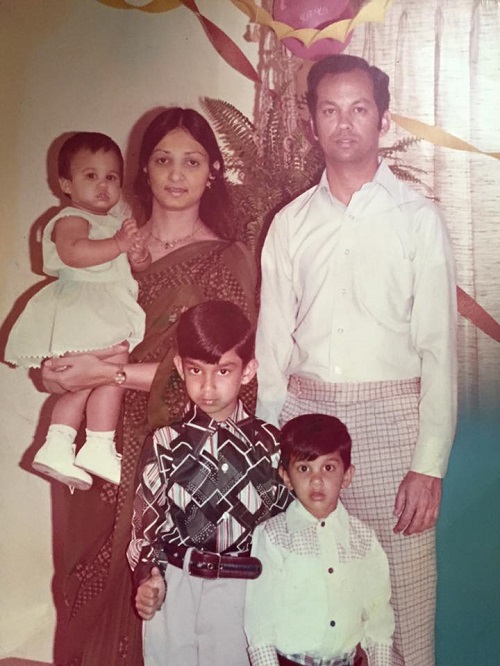
The author, his wife and three children circa late 1970s in North Dakota.
This is Day 22 of the 2017 #30Days30Writers Ramadan series – June 17, 2017
by Syed Husain
It was in the summer of 1976, following my post-doctoral assignment at Stanford Research Institute in California, I was offered a faculty position at University of North Dakota, School of Medicine. Although it was a tempting offer, leaving San Francisco and moving to Grand Forks with three small children was a difficult thing to consider.
Recalling the Persian proverb, “Mulk-e-Khuda Tang Neest, Pa-e-mera Lung Neest” (The Kingdom of God has no limits and no broken legs do I have to limit my travel), I decided to accept this offer – though I knew a Muslim community to draw on for support in North Dakota would be virtually nil.
A leap of faith indeed, but as a Muslim, I had a firm belief in my Creator and my destiny.
As we started our journey across the country, it was full of amusement and excitement. We only had ourselves to rely on – myself, my wife, and my three children, ages seven, four and one. The passage through Yosemite with tall redwoods, the majestic Grand Tetons, the enchanting Yellowstone National Park, the amazing Mount Rushmore and the Badlands was an experience to behold.
Finally, we arrived in the small college town of Grand Forks. And, we found the people of this land of Aurora Borealis, sun-dogs, snow and tumble-weed to be friendly, hospitable and compassionate.
After settling in the faculty housing, my priority was to find out how many Muslims, including students, were on campus. As the Ramadan was approaching, I wondered if they had facilities to pray and observe Ramadan. Surprisingly, I found only one another Muslim faculty and a handful of students with no place to worship. Later, I located four more families in a radius of fifty miles from Grand Forks that became the “core group” of Muslims in the area.
In this isolation, as Ramadan arrived, we made frantic calls to Chicago, Montreal, Minneapolis and Winnipeg to confirm the sighting of the moon. To determine the duration of fast and follow the fiqh ruling, we decided to follow the times in Winnipeg, the closest city with a sizable Muslim population. Those were long days — we were fasting for 19 hours a day with the sun setting around 9:45 p.m.
The University had appointed me as Muslim Faculty Adviser, and I was able to get space in the student union for our Jummah prayers and iftars. This small community had no provision for halal meat and no place to buy spices and other ingredients to prepare our food. A good Samaritan in the community located a farmer, who helped us sacrifice a heifer or a black angus.
This farmer became the source our halal meat supply for the rest of our stay (15 years) in North Dakota. Families would share the meat and drive to Winnipeg or as far as Chicago to get condiments and other supplies. The spouses in this small core group got together and started preparing meals, iftar and sahoor for their families and for students as well on weekends. We began to feel the baraka (blessings) of Ramadan in this newly formed community.
Fasting was difficult, but we managed and grew closer as a family (and as a married couple) in doing so. When we finally made it to iftar time around 9:45 p.m. and broke our fast, my wife and I (we were the only ones fasting in our family in the ‘70s) were grateful. Our children would beg us to take them to McDonald’s for ice cream after we prayed Maghreb and ate dinner, around 10:30 p.m. at night, but it was hard to get the energy to do so.
The nights we rallied and took them were very special to all of us – small treats that meant so much to our children and to us.
The summer season in North Dakota is short, sweet and very precious. It was amazing to see farmers busy harvesting crops under floodlights into the wee hours of the night. Our neighborhood on the outskirts of Grand Forks bordered a large farming field. The rumbling noise of trucks hauling beetroot and sunflower seeds were a reminder to us to get up for our sahoor.
I recalled my childhood days back in Hyderabad, India, when at sahoor time hawkers pass through Muslim neighborhoods singing local folklore, breaking the quiet of the night as these trucks did and reminding the community that sahoor time was soon to end.
Our children (and the daughter of one other Muslim family in town) were the only Muslim students in their schools. The school authorities were kind, compassionate and understanding. They were cognizant of the Islamic principles and provided our children with a private bathing facility and a place to worship. This was back in the 1980s in an educational community that probably had never seen or interacted with Muslim kids before.
Alhamdulillah, this conducive, inclusive and inter-faith understanding of the teachers and the school district authorities nurtured a healthy, positive civic atmosphere and a sense of belonging for our children. Our children use to wait eagerly for the arrival of Ramadan and for the celebration of two Eids.
These occasions were a real source of joy to these few host Muslim families and their children and to the small group of students. We celebrated Eids in a church, in an International Students’ Home on campus and in our homes.
This was our Little Mosque on the Prairie much before the celebrated television show.
This was our forging of an American-Muslim experience in a community that sometimes didn’t understand us, but developed friendships and deep relationships with us based on love, kindness and mutual respect.
In our sojourn of 15 years (1976-1991) in North Dakota, we also saw swings in the population of Muslim students and in the community due to graduations, termination of University of North Dakota’s Pilot Training programs with Gulf Airlines and Saudi Arabian Airlines and faculty transfers/retirements. In recent years, the economy of North Dakota has improved greatly due to oil exploration in Williston Basin.
The city of Fargo (one of the largest cities in North Dakota, about an hour away from Grand Forks) has seen a sizeable number of Muslim immigrants arriving. The city of Grand Forks also has its share and has seen a surge in new arrivals. We wish them all a Happy Ramadan and Eid Mubarak.
Syed Husain, Ph.D. is a retired professor of Pharmacology at the School of Medicine, University of North Dakota and a retired Scientific Review Administrator at the National Institutes of Health in Bethesda, MD. He now has eight grandchildren forging their own American-Muslim experience.
source: http://www.patheos.com / Patheos / Home> altmuslim / by Syed Asif, Guest Contributor / June 17th, 2017
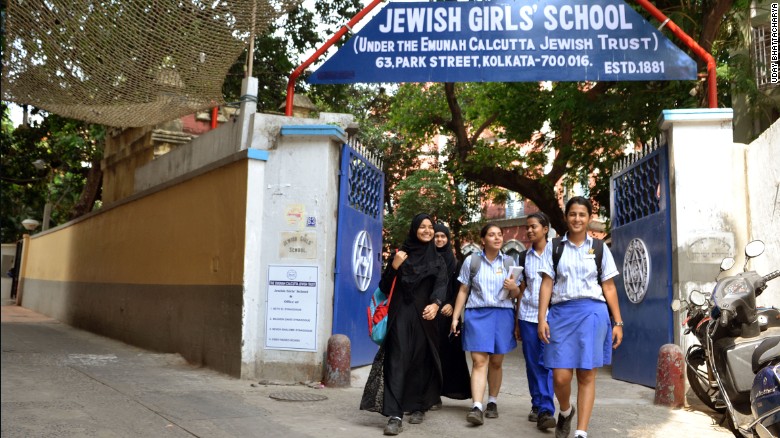
Muslim girls, some in the burqa and some in the regular uniforms, leave the Jewish Girls School in Calcutta.
Editor’s Note : Anik Basu is a Kolkata-based independent journalist.
Kolkata, India (CNN) :
When Mitana Alexander bid goodbye to Kolkata’s Jewish Girls School in 1975, she was its last Jewish student. The bulk of the others were Muslims.
But it was not the steady influx of Muslim girls in the preceding two decades that moved Alexander’s parents to take her out of the school, she says.
They were worried because she was last remaining occupant of a Jews-only dormitory, as most Jewish girls they had known had migrated to Israkel, America or Europe “with their folks.”
“They (school authorities) had to retain a matron just for me,” recalls Alexander, now aged 50. “I would be alone in the dormitory at night and my parents started panicking. Muslims had nothing to do with my leaving.”
Author-scholar Jael Silliman, whose children are settled in the US, says development in India and the outside world in the 1940s-50s led to an exodus of Jews from Calcutta.
Distinctly Kolkata
The swelling ranks of Muslim girls in the Jewish school offer a glimpse into the deep ties between Kolkata’s Muslim and once-thriving Jewish community.
More than 1,200 of the nearly 1,400 students are Muslims, as is the school’s vice principal and half the faculty.
The change began in the 1950s, when there were not enough Jewish families needing an institution set up specifically to instil Jewish values.
As Jewish enrollment petered out, the authorities decided to admit children of other faiths. The biggest response came from the Muslims of nearby areas.
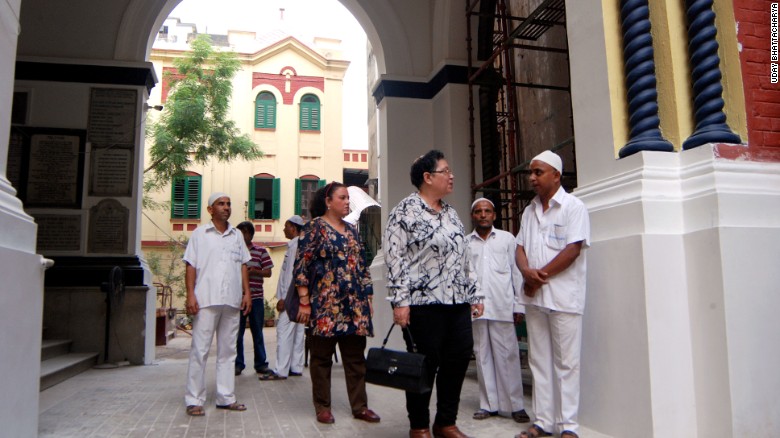
Aileen Jo Cohen (foreground) and Mitana Alexander talk to Muslim caretakers at one of Calcutta’s three synagogues.
Today, there is very little “Jewish” about the school, save for perhaps its name, the Star of David on the school gates, the school uniform and notebooks, and portraits of Jewish patrons on the walls.
Authorities have made available a “changing room” for Muslim girls whose parents frown upon their stepping out in public in school skirts.
These students leave home in the burqa, change into their uniforms once in school, and put on the burqa when leaving. “Our parents don’t like it if we bare our legs,” says senior student Zara Ahmed, 17.
“The school has come to symbolize Jewish-Muslim harmony in Kolkata,” says managing trustee Aileen “Jo” Cohen.
The harmony is visible elsewhere too; the city’s three synagogues — the smallest of which boasts of more chairs in its prayer hall than there are Jews in Kolkata — are looked after by Muslim caretakers.
Muslims also help with the dressing of bodies for Jewish burials and outside the Magen David Synagogue, Muslim bangle sellers wearing the topi (the Muslim prayer cap), have set up kiosks on the bustling footpath.
“The close ties and positive working relationships between Muslims and Jews are deeply rooted in the local context of Kolkata,” says Jael Silliman, 62, a city-born Jewish scholar and author, and a former Associate Professor of Women’s Studies at the University of Iowa.
Exiting Kolkata
The first Jew to arrive in Kolkata, on August 4, 1798, was Shalom Ha-Cohen. A native of Aleppo, Syria, Shalom was initially the court jeweler to a Muslim prince in northern India.
Shalom’s prosperity attracted other Jews from West Asia. According to community records, the population of Jews “of Arabic disposition” expanded to 600 by the 1830s. That number stood at around 4,000 when India gained independence from British rule in 1947.
However, soon after the community started emigrating en mass, beginning the end of a 200-year association with the city.
“A combination of national and global events in the ’40s and ’50s led to a very rapid dissolution of the community,” says Silliman, whose two daughters settled in the US.
With India’s independence, British settlers began returning to England, Israel came into being in May 1948, and the fledgling Indian government’s Socialist policies were perceived as not being conducive to business.
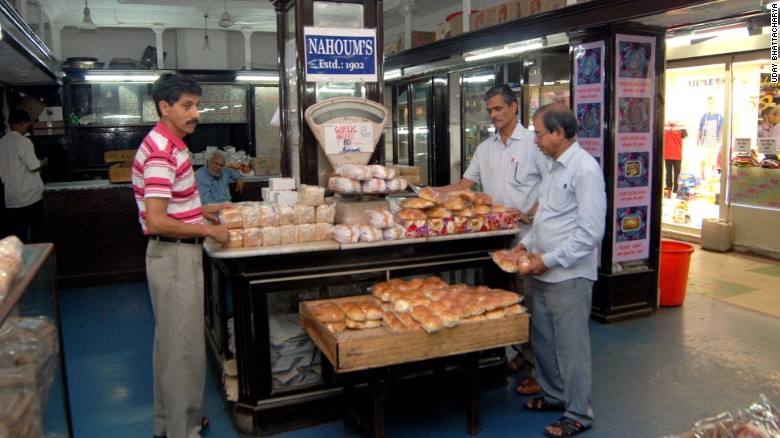
Muslim workers at the 115-year-old Nahoum’s confectionary, founded and owned by Jews, in downtown Calcutta.
Today, the number of Jews in Kolkata stands at 22, the middle-aged Alexander being probably the youngest.
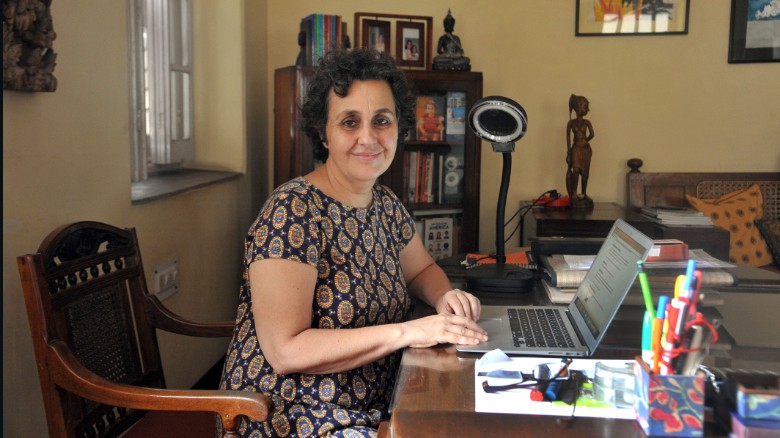
And it is left to the likes of the Jewish Girls School Vice-Principal Abeda Razeq to keep those ties alive.
Her father’s best friend at college was a Jew, whose family runs the 115-year-old confectionary store Nahoum’s, and their friendship, which continued beyond college, first exposed Razeq to Jewish culture.
The two families exchanged gift hampers during their respective festivals and Razeq learnt of the similarities and differences between kosher and halal cuisine.
She even helped out at Nahoum’s at Easter and Christmas: a Muslim girl at a Jewish bakery wrapping cakes during Christian festivals in a predominantly Hindu city.
The Nahoum family has shrunk to just one member now, who spends much of his time abroad, and the workers — many of them Muslims — run the show.
Razeq did her dissertation on Kolkata’s unique Jewish-Muslim relationship, and wishes she had the time to complete her doctorate on it.
“It’s a rich subject,” she says.
source: http://www.edition.cnn.com / CNN / Home> Region> Asia / by Anik Basu / June 16th, 2017
(From left) Zahid Husain, Alhaj A. Mohammed Ashraf, Mohamed Rifath Shaarook Raaj and Amanullah Shah | Photo Credit: special arrangement
Mohamed Rifath has just joined a physics undergraduate course at New College, but his classmates and teachers are seeing him as a star scientist. Read on and find out why
Can you imagine a fresher receiving a rousing welcome at his college, on the day of joining? When Mohamed Rifath Shaarook Raaj recently joined the B.Sc Physics stream of New College, he was being accorded a reception befitting a celebrity. Not only that, the secretary and correspondent of the college, A. Mohammed Ashraf, had waived off his fee for the undergraduate course, and also promised that the college would take care of his education till he completed his Ph.D.
Rifath, 18 years old, is the Lead Scientist of Space Kidz India (SKI), a Chennai-based organisation promoting students’ research in science and working towards making science accessible to students. Rifath is part of a team that has designed a satellite, which is expected to be launched into space on 21 June, 2017 from the NASA Wallops Space Flight Facility, Virginia, at no cost.
Major Zahid Husain, principal of the college, said that fellow students should emulate this young scientist and that it was a great honour for the college to enrol him. The student scientist has not only taken the local educationalists by storm but even the judges and directors of Colorado Space Grans Consortium were awe-struck by his experiment. Thus his satellite (supported by his team-mates) is planned to be launched into space on June 21, 2017 from NASA Wallops Space Flight Felicity, Virginia at no cost.
“NASA and I doodle Learning Inc. conducted a space challenge called ‘Cubes in Space’. Students have to design an experimental satellite which will help develop space technology. The best-designed satellite will get a sub-orbital space flight to real space on a NASA Rocket. Being a member of the NASA Kids Club, I learnt about this challenge and decided to design together with my team, an experimental satellite that will fit inside a 4cm cube and weigh 64 grams with +/- 1 gram limit (neither high nor less since it may affect the centre of gravity). Apart from creating just a payload, we wanted to design, build and launch a full satellite within a 4cm cube with a mass of 64 grams,” he explains.
Rifath, who hails from Pallapatti in Tamil Nadu, completed his schooling from Crescent Matriculation School, scoring 62.5% in the higher secondary board exams, and wants to emulate former President A.P.J. Abdul Kalam.
“It all started when I was chided for making paper rockets; so I was determined to make a real one. I participated in the first edition of Young Scientist-2013 conducted by Space Kidz India and met its director Srimathy. I participated till the third edition of Young Scientist, even though I didn’t win but she noticed my talent. Then, I joined the organisation. My initial project with SKI was making a balloon-satellite with NSLV (Near Space Launch Vehicle) which was a huge success and we got into the Limca Book of Records and became the first private company in India to launch an NSLV. After launching a balloon-satellite to near space (>40km altitude), we wanted to send a satellite or a spacecraft to true Space (>100km where the Karman line and official true space starts). At first, we concentrated on the standard one unit 10cm cube satellite of 1kg mass but as we proceeded, we realised the cost would be too high. As students we were strapped for money and therefore, reduced the size and mass of the Cube satellites (Cube Satellite itself is a Nano satellite but we wanted to reduce the size further).
“At first, we wanted to create something similar to Kicksats but they are not true satellites but just a postcard sized PCB with non-customisable electronics, which cannot work, without a big mother satellite — in other words, it’s just a Space toy. But we always wanted to create an independent full-fledged fully-customisable, scalable, low-cost satellite with new technology. Initially we designed a 125gram, 5cm cube satellite which is 1/8th of a standard cube satellite which will also reduce the cost of the launch. But later, due to NASA’s challenge guidelines we built a 3.8cm independent cube satellite. Previously, a 5cm cube satellite was the smallest satellite, but now we are about to break that record and it’s also going to be the first 3D-printed satellite to be launched into space.
“Here, we are only talking about sub-orbital spaceflight in which our satellite will go into space on a rocket, do the research and land again on surface/ocean in a capsule, so the students can get back their satellite, research more and create a better space system which can be used in orbital and interplanetary missions. Our aim is not to just send a Cube satellite, built from Off-the-shelf components previously available in space market, and launch that into space. Our invention is to create a new space platform. We are also creating a space platform where our future scientists can develop their own payloads, and, for example, we can use this kind of Femto satellite constellations as Ham Radio reflectors which we can use in disaster-like situations when all other communications may fail.
We may face solar flares which may destroy satellites outside earth’s magnetosphere (36,000 km altitude). In situations like these, these Femto satellites can be a backup; they can be quickly launched and protected by an artificial magnetosphere, since they are very small. This satellite is fully 3D-printed, other than electronics.”
source: http://www.thehindu.com / The Hindu / Home> News> Cities> Chennai / by M.O. Badsha / June 16th, 2017
Appreciating efforts: JNTU Hyderabad Vice Chancellor Venugopal Reddy interacting with students who designed the street lights control system and exhibited at Military College of Electronics and Mechanical Engineering during convocation ceremony in Hyderabad on Thursday. | Photo Credit: K.V.S. GIRI
If it were left to young engineers of Military College of Electronics and Mechanical Engineering, Country’s street lights would be auto-operated. The 91st graduating batch of the college produced a GSM connected, cell phone-operated lighting system which can be turned on and off based on requirement.
The power-saving circuit built by Noushad M.E., Ashish Kaushik, Sumit Dhanda and Akhil A.R. cost ₹ 57,200. It could be used for both civilian and defence purposes, the innovators said. The model also allows operators to operate just one or two light bulbs in a whole series. “If the operator thinks that just a few light bulbs are enough for lighting any area, they could turn off the rest by texting the details into the circuit,” said Mr. Akhil A.R. The model displayed in MCEME contained a circuit connected to six bulbs.
“The model also detects faulty operations if there are any. If a light bulb goes off, it will alert the operator,” M.E. Noushad told The Hindu. Mr. Sumit Dhanda said the project will be useful in huge military campuses which use power. “If the model is adopted by city development corporations it could cut power costs by one third,” said Mr. Dhanda. The MCEME awarded its annual best project prize to the four officers at its Convocation Ceremony on Thursday.
The MCEME passing out batch had also come up with a simple solution – a microcontroller-based automatic ventilation system – for car interiors which get heated when parked in the open. The ventilator contains a small control unit and a solar-powered exhaust fan which runs on external battery.
The microcontroller which is programmed to check the status of temperature and humidity inside the car every two seconds, triggers the exhaust fan when needed, to clear out the heat,” said an officer Vipin Jaiswal and the team leader. Other members of the project were Mukesh Thakur, M. Hariharan and M.S. Shakhavat.
Military boost
The college displayed a solar rechargeable backpack for troopers among its exhibits. The backpack with solar panels can be used as a tracking devise when soldiers go for long treks in the field, graduates said. “In any dire circumstance if the user presses a button on the backpack it sends a Save Our Souls message to control base. It will help officers to track those who are in danger during combat situation,” said Pankaj Saini who was the syndicate leader of the team which came up with the model. The other members in the team were Harmeet Singh, Sachin Yadav and Sagar.
Speaking at the convocation, A. Venugopal Reddy, Vice Chancellor of Jawaharlal Nehru Technological University asked the graduates to pay attention to new developments in cyber security and be abreast of technological innovations. “Your convocation is not like others’ passing out functions. You leave this institution to serve the motherland,” Mr. Reddy said.
source: http://www.thehindu.com / The Hindu / Home> News> Cities> Hyderabad / by Nikhila Henry / Hyderabad – June 16th, 2017
Sheikh Tanveer Asif bagged 25th rank in the civil services exams
The hard work, discipline and sacrifices that are necessary to become a member of the Union Civil Services is best exemplified by the family of Sheikh Tanveer Asif. The 24-year-old from Kalaburagi district in northern Karnataka cracked the exam in his second attempt and bagged the 25th rank.
Asif is the son of a retired police officer. After completing a course in engineering from M.S. Ramaiah Institute of Technology, he went to New Delhi to prepare for the civil services exams. During the two years he was there, his family had to manage on his father’s monthly pension of ₹14,000.
“I attribute all my success to my mother. Without completing formal education, she manages to write in two languages and speak many more. Every time I needed some money, she would mortgage her belongings to ensure that my preparations were not disturbed,” he says.
Another candidate, Naveen Y. Bhat from Mangaluru, decided to get into civil services in the final year of graduation. The graduate from Bangalore Medical College and Research Institute bagged the 37th rank. “As a doctor, I could cure patients but have a limited impact. I wanted to cure the problems of society and have a wider impact. That is why I opted for the civil services,” he says.
Movie fan
Dhyanachandra H.M., who bagged the 47th rank, watched one movie a week. Keeping abreast of current affairs by reading The Hindu every day helped the 24-year old sail through the tough UPSC exams. His father, S.L. Haleshappa, works as an assistant engineer in the Karnataka Housing Board while mother Mamata is a home-maker. He started preparing for the exams in May 2014 after completing a course in civil engineering from MIT-Manipal. “This was my second attempt. In my first attempt last year, I could not clear the prelims. But I did not lose hope,” he explained. He took Kannada as an optional paper.
“I read NCERT books and The Hindu daily. I knew when and how to study, so I could watch movies too,” he explained. His father motivated him to take up civil services. “I have given posting options as Karnataka, Telangana and Andhra Pradesh,” he said. The family is from Davanagere. Dhyanachandra says he knows the plight of farmers first-hand. “I would like to help them. I also hope to be a role model for my brother Poornachandra who has cleared his 10th standard,” he said.
source: http://www.thehindu.com / The Hindu / Home> News> Cities> Bengaluru / by Staff Reporter / May 31st, 2017