Category Archives: Education

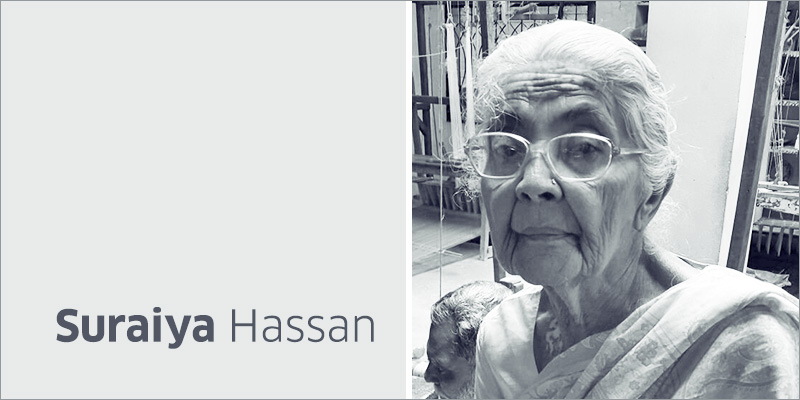
Suraiya Hassan weaves magic, wants to revive dying textile art

Hyderabad, TELANGANA :

“Mrs. Suraiya Hassan?”

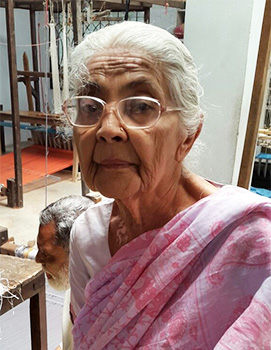
“Haan ji, bol rahi hoon. Boliye..”, the grand old lady of Indian weaving greets me into the conversation.  Engaged in revival work of four different textile forms of Aurangabad, Suraiya has a fascinating tale to narrate.
SuraiyaHassan01MPOs24apr2016

Her journey began soon after she finished her Intermediate. Suraiya joined the Cottage Industries Emporium, a government institution where she learnt the art of salesmanship and production of textiles and handicrafts. It was a great learning experience spanning well over four years, says Suraiya.

It was while working here that a professor from a foreign country, Suraiya says it would be London, came to their Emporium and she was put in charge of showing her around. “She touched and felt everything and was so impressed with me describing the importance of each and every fabric and handicraft product that she thought I was wasting my time here,” says Suraiya on a lighter note recalling her toddler steps into the weaving industry. Eventually it was this lady who introduced Suraiya to her mentor Pupul Jaykar, of the Handloom Handicrafts  Corporation of India in New Delhi.

It was a move Suraiya had not contemplated in life and it truly got her where she perhaps wanted to be. “Maine kabhi aisa socha nahi tha, lekin ye ek achchi opportunity thi, so I decided to go along,” says Suraiya (I had never thought of such a career move but when opportunity came knocking, I didn’t say no).

It helped that she had her uncle (chacha) Abid Hassan Safrani living in Delhi. He was with the Ministry of External Affairs initially and at one point was personal secretary to the legendary Netaji Subhash Chandra Bose, recalls Suraiya.
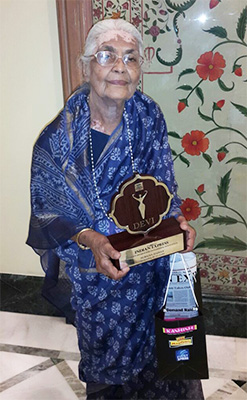
Suraiya Hasan was recently honoured with the Devi Award

Her association with Bose’s family

Suraiya was soon introduced to the Bose family through their ladies. From casual visits, the journeys


Little did she understand the importance of being married to Bose’s nephew except that Aurobindo too was a busy politician. “He was a trade union secretary with many big companies,” says Suraiya of her husband. She however, never got a chance to meet Subhash Chandra Bose.
became personal and Suraiya got to know the family from close quarters. She then got married to Aurobindo Bose, Subhas Chandra Bose’s nephew.

From Delhi back to Hyderabad

After superannuation, Abid Hassan moved to Hyderabadand bought some land there. He was the one who called Suraiya back to the Nizam’s city and asked her to set up an independent handloom production unit.

“I wasted no time and got to my hometown to set up this unit. It was an exhaustive task but I would say worth the effort,” says Suraiya. It was here that she started work on the revival of four signature Persian fabric forms native to Aurangabad – Paithani, Jamawar, Himroo and Mashru. Thus was born Suraiya’s Weaving Studio, Suraiya’s weaving unit in Hyderabad.

During my visits to Aurangabad, I had seen many artisans work tirelessly on keeping this art alive, but in a very small way, often at their own homes. I therefore decided to make this sector a little organized in the hope that this dying art will have people following it

While she concentrated on her art, her husband used to visit her in Hyderabad when he had free time on his hand.

She is still in touch with the Bose family though the visits have dwindled in number after her husband passed away.
SuraiyaHassan03MPOs24apr2016

Social enterprise

Suraiya selected a group of people to pass on her art. It was the widows, with no place to go to and children to feed that she thought would be her right target audience. “I used to sit with them for hours together and help them pick up the nuances. To train one artisan easily takes close to 3-4 months on an average and I later got an expert to help me with the training part. Doing it alone was becoming a Herculean task,” says Suraiya.

While she created an opportunity for widows to pick up the art, she helped by setting up a school in the same compound for their children. Called the Safrani Memorial High School, this institute houses classes for students from Nursery to Std 10, where children of her artisans attend school free of cost.

Aged 84 now, Suraiya says she has lots of work yet to do. When she is not supervising the work of her artisans, she goes to teach students in her school. She takes pride in the fact that they have all performed well and some have even gone abroad.

Well this love for education is not by chance, Suraiya says she would have inherited it from her father. He after all was the proud owner of Hyderabad Book Depot on Abids Road, most likely the first book store in Hyderabad which stocked foreign publications.

source: http://www.her.yourstory.com / YourStory.com / Home> Her Story> Inspiration / by Saraswati Mukherjee / January 12th, 2015
Compering was an art for poet Ahmad

Lucknow, UTTAR PRADESH :

Lucknow:

A poet, a novelist, a teacher and a champion of stylising compering into an art, Prof Malikzada Manzoor Ahmad breathed his last in the city on Friday. The 87-year-old, a well known face in the literary settings of the city was highly eulogised for creating a uniquely independent genre of ‘nizaamat’ (compering) for the thousands of poetry events he mastered with his spontaneous wit and humour.

Buried at night in the Fatehmi graveyard in Khurram Nagar on Friday, Ahmad, born in 1929, was a native of Faizabad. He had moved to Lucknow in the early ’60s as a lecturer in Lucknow University’s (LU) Urdu department from where he retired in 1989 after 30 years of service.

“Before him, compering a mushaira was just a sub-standard job. He transformed it into an art. His literary articulation and spontaneity, his wit and the way he weaved sarcasm and humour are unmatched to this date,” shared Prof Anis Ashfaq, former head of LU’s Urdu department who was also Ahmad’s student. Ashfaq also said that he was the one and the only person who exemplified compering and with him the golden period of the new art has gone.

A man who donned many hats, Ahmad also wrote poetry and several novels, including his biography ‘Raqs-e-Sharar’ wherein his narrative too was praised of bearing a uniquely creative style. “Even though my father was a man of the English language, Urdu was his passion and mission. He was a proponent of composite culture,” said Ahmad’s son Malikzada Javed.

Ahmad had served as the chairperson of the UP Urdu Akademi and Fakhruddin Ali Ahmad Urdu Memorial Committee. He also held a senior post in the All India Urdu Rabita Committee and was a receiver of the 2015 Ghalib Award for literary services to Urdu. He was condoled on his death by chief minister Akhilesh Yadav, Mulayam Singh Yadav and minister Azam Khan.

source: http://www.timesofindia.indiatimes.com / The Times of India /  News Home> City> Lucknow / by Yusra Husain / TNN / April 23rd, 2016

Celebrating Urdu

Hyderabad, TELANGANA :
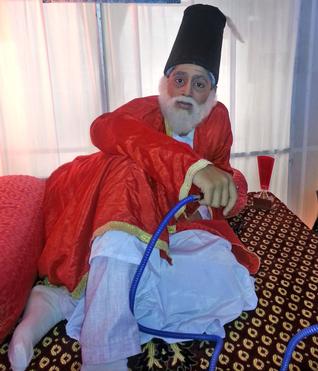
A student posing as Mirza Ghalib

It was an expo with a difference. No, it was not an art, fashion or product fair. It was all about language, something unheard of till then. The city of domes and minarets was witness to a unique celebration of Urdu. And it took school children to bring out the sweetness and magical lyricism of the Urdu language.

Titled after Daagh Dehlvi’s famous couplet ‘Urdu hai jiska naam …’, the exhibition hosted by students and teachers of Central Public High School, Khilwath, recently at the Mehboob Husain Jigar hall in Siasat daily was a runaway success. Students of different schools in the city and lovers of Urdu flocked the show necessitating extension of the expo.

Language is the road map of a culture. It tells you where its people come from and where they are headed. The expo did just that.

It not only traced the history of Urdu but gave visitors something to remember long after they left the premises. Some of the finest Urdu couplets and ‘nazms’ were on display.

What added to the appeal was the way students donned the attire and looks of the famous poets of yore. One could see the poet of East, Allama Iqbal, reclining in his trademark black suit and Mirza Ghalib with his typical cone cap and snowy beard, holding a hookah. There was also Wali Deccani, Mohd Quli Qutb Shah, Mir Taqi Mir, Hazrath Amir Khusro besides writers like Ibne Safi, Premchander.

Students waxed eloquent about the works of the poets apart from reciting their verses. Presentation of ‘Shikwa’ and ‘Jawab-e-Shikwa’, the epic poems of Allama Iqbal by students was the high point of the expo.

“We decided to present the language in all its glory as these days everyone is talking about the decline of Urdu,” said Mohd Zafarullah Faheem, Director, Central Public High School.

The limits of one’s language are the limits of one’s world. But there was no limit to the poetical appeal of the expo. Wherever one glanced one was greeted by ‘shayeri’.

Talk to a man in a language he understands, that goes to this head. And if you talk to him in his language, that goes to his heart. That’s what the Urdu expo did — it went straight to the heart.

source: http://ww.thehindu.com / The Hindu / Home> Features> MetroPlus / by J.S.Ifthekhar / Hyderabad – November 26th, 2015

Students devise ways to conserve energy

Thiruvananthapura, KERALA :

ConserveEnergyKERALA22apr2016

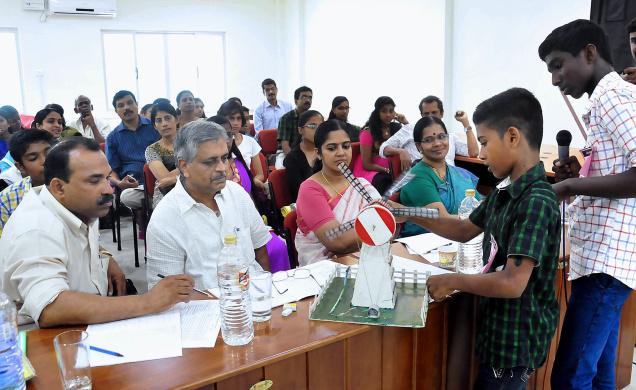
Innovative ideas developed by students for energy conservation were on display at the Kerala State Student Energy Congress 2016.

Thirty-seven teams from various districts participated in the event organised as part of the ‘Smart Energy Programme’ of the Energy Management Centre (EMC) on the centre’s premises. Hundred-odd upper primary and high school students from all over the State attended the one-day congress held as part of the EMC’s energy conservation programme.

Aparna V.S. and Kavitha K.M., students of Holy Angels School, Thiruvananthapuram, came up with an idea of converting mechanical energy into electrical energy at a low cost.

They turned a bicycle into an exercise bike which can pump water and generate electricity. Arathy Ramesh and Sreekutty Udayakumar from the Aluva educational district bagged the first prize in high school section. Ayisha and Alsa Bin Shahul Hameed from Kozhikode got the first prize in upper primary section.

S. Somanath, Director, Liquid Propulsion System Centre, gave away the prizes at a function presided over by K.M. Dharesan Unnithan, Director of EMC.

source: http://www.thehindu.com / The Hindu / Home> News> Cities> Thiruvananthapuram / A Correspondent / Thiruvananthapuram – April 21st, 2016

Seminar on understanding Islam at Manipal on Saturday

Manipal, KARNATAKA :

Manipal:

A seminar on ‘Understanding Islam’ will be organized by the Centre for Gandhian and Peace Studies, Manipal University, at 3.30pm at Old TAPMI building behind Manipal post office on Saturday.

Prof  Varadesh Hiregange, director, Centre for Gandhian and Peace Studies, Manipal University, said the seminar proposes to explore different dimensions of Islam as a religious culture with its own belief systems, philosophy, science, day-to-day practices, festivals, customs, and diversity and reforms movements.

“It is an attempt to understand Islam in its diversity as practised in different regions of the world, much against the image of a ‘stereotype’.

The seminar essentially makes an attempt to clear all the misunderstandings,” he said.

source:  http://www.timesofindia.indiatimes.com / The Times of India / News Home> City> Mangalore / TNN / April 156th, 2016

A creative learning camp

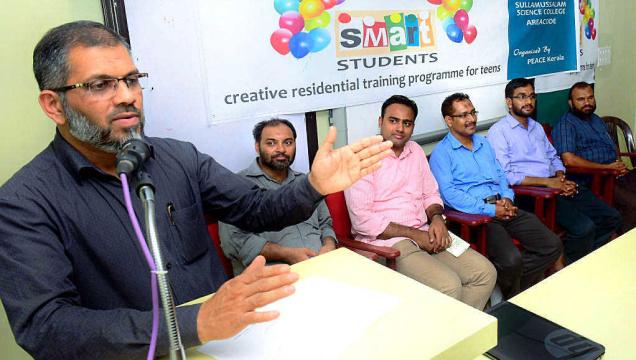
Career Enhancement:Calicut University Vice Chancellor K. Mohammed Basheer inaugurating a residential camp under the banner of the Programme on Education and Career Enhancement (PEACE) at Sullamussalam Science College, Areekode, on Thrusday.

Career Enhancement:Calicut University Vice Chancellor K. Mohammed Basheer inaugurating a residential camp under the banner of the Programme on Education and Career Enhancement (PEACE) at Sullamussalam Science College, Areekode, on Thrusday.

Malappuram, Kerala :

Ithihadu Shubbanil Mujahideen launches residential camp for students

The Ithihadu Shubbanil Mujahideen (ISM) launched a creative learning camp for students at Sullamussalam Science College, Areekode, on Thursday.

Calicut University Vice Chancellor K. Mohammed Basheer inaugurated the residential camp held under the banner of the Programme on Education and Career Enhancement (PEACE).

Dr. Basheer called upon the students to proceed to their objective with determination and enthusiasm. ISM State vice president Labeed Areekode presided over the function.

Camp director Mansoor Othayi, Social Security Mission liaison officer P.V. Ahmed Saju, Kerala Nadvathul Mujahideen vice president N.V. Abdurahman, PEACE chief executive officer Fukkar Ali, ISM leaders Ismail Kariyad, Shakkir Babu Kuniyil, Naseer Cheruvadi, Afsal Madavur, and Yunus Chengara spoke.

source:  http://www.thehindu.com / The Hindu / Home> National> Kerala / by Staff Reporter / Malappuram – April 16th, 2016

Briefly

Madikeri, Kodagu / KARNATAKA :

Madikeri :

WORLD CONSUMER DAY

The World Consumer Day was celebrated recently in Madikeri under the joint auspices of Kodagu district administration, Food and Civil Supplies Department and Kodagu District Consumer Forum.

Mir Anis Ahmed, DC of Kodagu, inaugurated and V.A. Patil, President, Kodagu District Consumer Forum, presided over the programme which was attended by more than 150 people.

C.V. Nagaraj, retired Senior Chemist, Regional Agmark Laboratory, Bengaluru, demonstrated simple tests to detect adulteration in various food items. He also spoke about the harmful effects of various types of adulteration and on the laws that exist in India against food adulteration.

Associations interested in arranging such lecture-demos can contact C.V. Nagaraj ( 2521640, 9945651990).

CULTURAL FEST

The Department of Tourism and Hospitality Management, Pooja Bhagavat Memorial Mahajana Education Centre, has organised an inter-collegiate cultural festival on April 12 and 13. For registration contact festival convener Paul Iruthayaraj on 9739824423, Faculty coordinators Gunarekha B.S. on 9480438394 or Priyadarshan Bhat on 8867204780.

source: http://www.thehindu.com / The Hindu / Home> National> Karnataka / Mysuru – April 11th, 2016

Rare plant specimens are now just a click away

Coimbatore,  TAMIL NADU / KERALA :

Coimbatore:

More than 6,000 specimens at the 105-year-old herbarium in the Institute of Forest Genetics and Tree Breeding (IFGTB) can now be accessed by the click of a mouse, as the institute plans to digitise it.

The digitisation will help preserve the fragile specimens, prone to damage due to constant physical handling.

The Fischer Herbarium, which was started in the year 1911 on the Forest Campus in R S Puram, was created as a repository to house the many collections made by British forest officer Cecil Ernest Claude Fischer. He had an extensive collection of specimens from the Nilgiris, Palanis, Coimbatore forest divisions, Seshachalam Hills and Ganjam District of Andhra Pradesh. The herbarium also houses century old collections by forest officers,T F Bourdillon and M Rama Rao from the Travancore presidency. The herbarium was brought under IFGTB’s control in 1988.

The herbarium, considered a national repository by the National Biodiversity Authority (NBA), contains 2,954 species, 254 families of plants and 1,257 genera, some of them as rare as the one by forest officer J R Drummond in 1879.

“The herbarium is visited by a lot of taxonomists and botanists. So, when they discover a unique species but have heard of similar looking species being present in a herbarium in another part of the country or world, they often have to physically visit the herbarium to cross check the facts,” said IFGTB director R S Prashanth. “But now they can cross-check with the image and data available online,” he said.

The digital herbarium, which can be accessed through the website www.frcherbarium.org, currently contains 6,231 of the total 23,000 specimens available with the IFGTB. “This digitisation was done by former librarian at the Kerala Forest and Research Institute K H Hussain,” said the head of the biodiversity division at IFGTB C Kunhikannan about the project which cost Rs 6 lakh.

“The website has uploaded the herbarium’s sheets and allows people to zoom into the image to take a closer look at the specimen and the officer’s own writings,” said Hussain. “We will be shortly applying for more funds to digitize the rest of the herbarium’s data,” said the director. The institute, however, admitted that they were yet to review all the data on the website and eliminate spelling errors that might have occurred since the data entry personnel were not taxonomists.

source: http://www.timesofindia.indiatimes.com / The Times of India / News Home> City> Coimbatore / TNN / April 13th, 2016

Forgotten histories: A library in a Guwahati mosque shares the fate of an old Assamese community

Guwahati,  ASSAM  : 

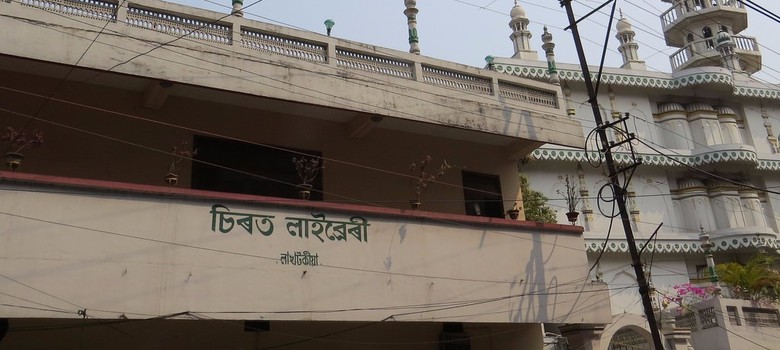
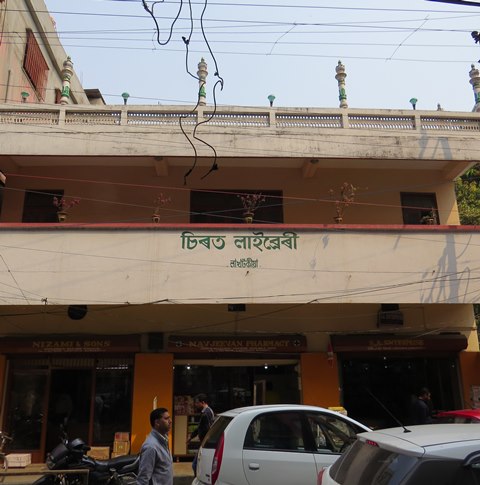
Sirat Library finds few mentions in recorded history and it is even fading from the personal histories of the Khilonjia Muslims who live around it.

Image credit: Shaheen Ahmed

Every time Assam heads into an election, the political discourse in the state invariably veers towards the issue of indigeniety. Who is an original inhabitant (and who is not) becomes a central question, with all the political parties nudging the electorate’s collective memory to recall real and imagined injustices.

With elections having kicked off in Assam again, my thoughts returned to something else, to my childhood when I would accompany my parents to a concrete structure in Guwahati’s Lakhtokia area. The structure was architecturally nondescript, but the images and the experiences of it still coalesced to form fragments of my memory. Known locally as Sirat Library – although the Assamese pronunciation Sirot often rendered the name incomprehensible – it was located within the precincts of a mosque called Lakhtokia Masjid No. 1.

I vaguely recall public meetings being held in the small library. And till the early 2000s, it moonlighted as a voting booth. For a child, it was an unusual sight to see so many people of different religions line up to cast their votes and even more unusual to see them do so in a library inside a mosque.

The structure still stands today. But the only sight that greets a visitor is of a small room bereft of books or readers. Its holdings are restricted to a small glass cupboard and a few Islamic texts in it.

Legacy of the past

The history of the library is really important to the Khilonjia Muslims or ethnic Assamese Muslims living in Guwahati. Khilonjia Muslims have been in Assam since before the Ahom invasion in the 13th century and they have always been known to relate to their ethnic, rather than their religious, identity.

Shehabuddin Talish, the official scribe of Mir Jumlah, the Nawab of Bengal who invaded Assam in 1662, described their encounter with the Muslims in Assam: “The Muslims whom we met in Assam are Assamese in their habits, and Muhammadans but in name.”

The famous colonial historian Sir Edward Gait, in his monumental work A History of Assam published in 1905, extensively employed Talish’s descriptions to map out a definitive chart of Assam’s history. Nevertheless, historical narratives of Khilonjia Muslims remain sketchy. The same fate is shared by the library in Lakhtokia.

There are no written records of when or who constructed the library. It is, however, believed that the structure is among of the oldest libraries in Guwahati, and the mosque it is a part of is among the three oldest mosques constructed in the colonial period.

The mosque finds a mention in an article in 1885 in the journal Assam Bandhu, which was edited by the Assamese intellectual Gunabhiram Barua. The land for the mosque was donated by Col. Jalnur Ali Ahmed, the father of the fifth President of India, Fakhruddin Ali Ahmed. Col. Ahmed was a distinguished Assamese of his time: he was the second Assamese associated with the Imperial Medical Services and the first Assamese to receive an M.D. degree from London.

Personal histories

Writer-lawyer Akdas Ali Mir, one of the inhabitants of the locality, points to a letter written in 1915 by AHW Benting, the then Commissioner of Assam, which is probably one of the earliest and only clues to tracing the history of the library. “Benting had issued directions in an Order Letter to shift the Makhtab (primary Islamic school) established by the British from the mosque to the present location, where the Junior Madrassa High School is in Guwahati.”

Mir continued: “We can surmise that Sirat Library is the spot where the Makhtab was and then got converted into a library.” This may be true as Sirat is an Arabic word meaning a “way of life”.

As with all public libraries in the state, Sirat Library too was awarded a monthly grant from the government for its upkeep. But the actual running was done by the area’s Assamese Muslims, with people taking turns as librarians. Renowned Assamese filmmaker Altaf Majid remembers his childhood days spent in the library reading in the quiet. “My uncle used to be the librarian for many years. Every Friday afternoon he would take me to the iconic Lawyers’ Book Stall in nearby Pan Bazaar to buy books. In fact I read the Mahabharata in Bengali in Sirat Library in the 1960s.”

Majid continued: “This library was also a repository of well-known pulp fiction of the period. They were in English, Assamese and Bengali. In fact, I also read my first English novel in this library as well as the famous Bengali Mohan Detective Series and the Assamese adventure series Pa-Phu.”

Credit: Shaheen Ahmed

Mukimuddin Ahmed, another resident, talks of the days in the late 1950s when he would act as the librarian in the evenings. “I was paid Rs 5 every month as the librarian and I worked for a year. Every afternoon after school I would go to the residences to collect the newspapers for the library. In the evenings after the readers had finished reading them I would then return them to the respective households.”

Assamese Muslim women had a strong role to play in the library’s upkeep. In the late 1960s, the only Assamese Muslim women’s social organisation, Anjumaan-E-Khawaateenein Islam, contributed Rs 10,000 to construct the new building for the library from the earlier Assam-type house construction. Noted Assamese woman writer Alimun Nessa Piyar donated furniture to the library in 1960.

As Helena Barranha and Susana S. Martins poignantly observed , “Memory has become both an intellectual challenge and a commodity for easy consumption.” This is true for contemporary India in general, and Sirat Library epitomises the trend. The erasure of the library from popular memory testifies to the erasure of cultural traditions that were once so integral to the Assamese society.

source: http://www.scroll.in / Scroll.in / Home> Memory Lane / by Shaheen Ahmed / April 05th, 2016

History Revisted : How knowledge travelled from East to West (and back again) in the early modern world

The flow of scholarly work between the Mughals and Europe involved translation, re-translation, re-interpretation and development.

Mughals&EuropeMPOs01apr072016

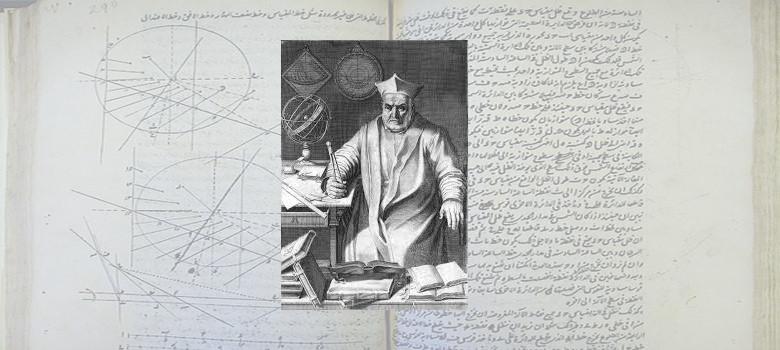
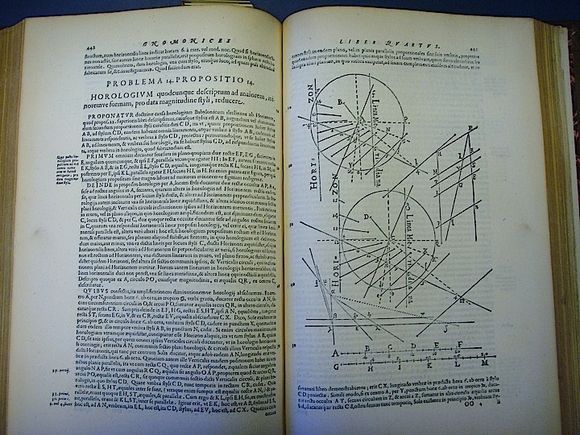
Christoph Clavius was born in Bamberg in either 1538 or 1537 (an amusing discrepancy for a scientist whose fame derives from his work on calendar reform) and was initiated into the Jesuit order by Saint Ignatius Loyola in Rome in 1555, and passed away in 1612, an eminent scholar.

Many of Clavius’ works were influenced by Latin translations of Arabic scientific works, including those of Ibn Rushd (in particular his commentary on Aristotle), the astronomers Abū Ma‘shar, al-Biṭrūjī and al-Farghānī, as well as the mathematician Thābit b. Qurra, among many other scientists writing in Arabic and Persian whose works Clavius cites.

Book 4 of Christoph Clavius, Gnomonices Libri Octo, published in Rome in 1581 (533.k.2, pp. 442-43).

Clavius is an excellent example of the many Jesuit scientists of his age who continued to teach Ptolemaic astronomy (i.e. a geocentric vision of the solar system, indeed the universe, in which the planets and stars orbited the earth in concentric circles), despite the rise of – and often despite their own familiarity with and endorsement of – Copernican astronomy.

Christoph Clavius’ Gnomonices Libri Octo, on the art of gnomonics (timekeeping through the use of a sundial), was published in 1581

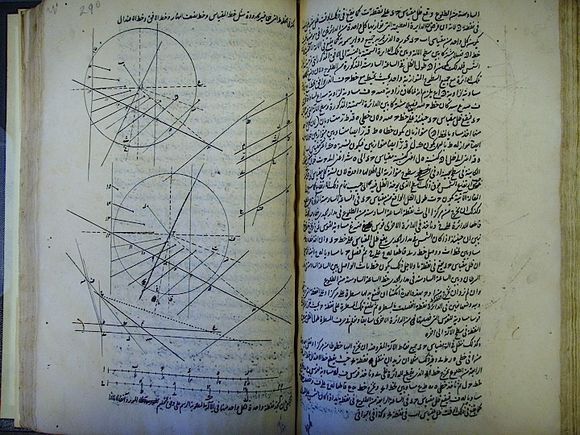
Mu‘tamid Khān's Arabic translation of the identical passage (IO Islamic 1308, ff. 289v-290).
Mu‘tamid Khān’s Arabic translation of the identical passage (IO Islamic 1308, ff. 289v-290).

Arabic version

This work also exists in a fascinating Arabic translation emanating from the Mughal empire that was purchased by Richard Johnson (1753-1807), a well-known collector of manuscripts and miniature paintings who worked for the East India Company.

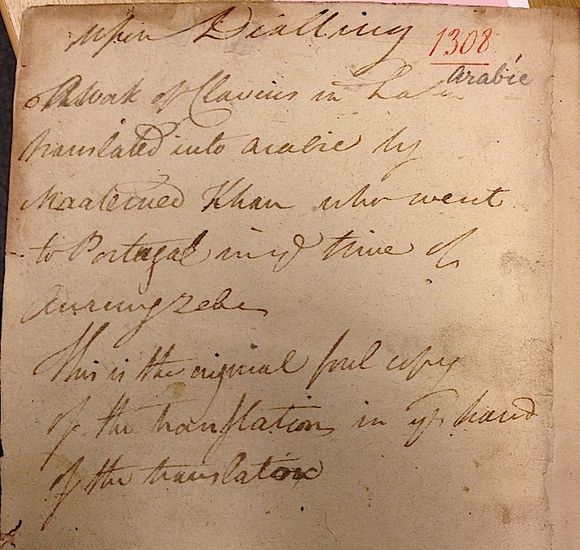
Johnson made an annotation on the flyleaf of the manuscript that the translator of Clavius’ work was sent to Portugal by Aurangzeb – presumably to study or in some diplomatic capacity.

The full note reads, “Upon Dialling. Work of Clavius in Latin translated into Arabic by Maatemed Khan who went to Portugal in the time of Aurungzebe. This is the original foul copy of the translation in the hand of the translator (i.e., the ‘foul copy’ being the first draft, in contrast to the ‘fair copy’).”

Richard Johnson's explanatory note (IO Islamic 1308).
Richard Johnson’s explanatory note (IO Islamic 1308).

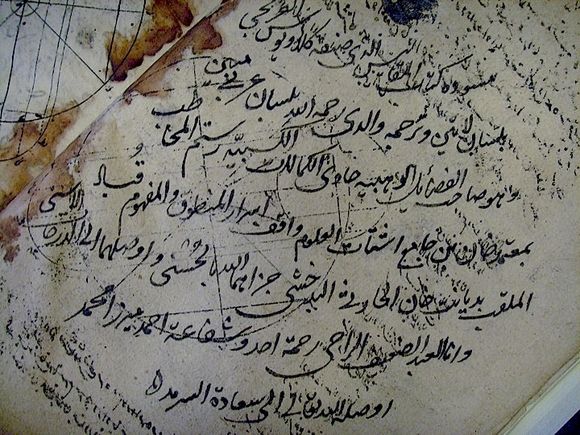
A further note, in Arabic, added by the translator’s son, reads: “Draft of the Book of Measures [Kitāb al-Maqāyīs] which was composed by Clavius the Frank [Kalāwīūs al-Firinjī] in the Latin language, and my father, God have mercy on him, translated it into the [clear – mubīn?] Arabic language, possessor of virtuous talents including the perfection of acquired knowledge,

Rustam called Mu‘tamad Khān, the son of Qubād, gatherer of proofs of knowledge, perceiving the secrets of the spoken and the tacit, given the name Diyānat Khān al-Ḥārithī al-Badakhshī, may God be fair with both of them and elevate them.

Signed: I, who am a feeble slave begging for the mercy of the One and the intercession of the Prophet, Mīrzā Muḥammad, may God cause him to attain eternal happiness”.

Note by Muʻtamad Khān's son (IO Islamic 1308, f.1v).
Note by Muʻtamad Khān’s son (IO Islamic 1308, f.1v).
 Complex process

This translation offers some fascinating possibilities.

The first is the demonstration of how knowledge circulated in the early modern world.

Clavius’ work, which responded to and was inspired by Arabic mathematicians and scientists in Latin translation, here a generation after its publication is translated back into Arabic to be read, presumably by elites at the court of Aurangzeb, where the work’s translator and his son were courtiers.

This translation demonstrates the complexity of knowledge flows – that they were synchronic as well as diachronic, and also involved a process not just of translation, but of re-translation, re-interpretation and development as they travelled.

Furthermore, the inscriptions taken in tandem, one in English made by an East India official, the other in Arabic by a Mughal courtier, open the possibility that already in Aurangzeb’s reign, Mughal elites travelled to Europe perhaps to study.

In the case of Mu‘tamid Khan, the translator of this text, he mastered the technical idiom of geometry and mathematics in Latin, and then translated it into an equally complex scholarly language, Arabic. Not an uncommon intellectual feat at the Mughal court, this process of scientific translation remains to be studied in depth.

It is also possible that the presence of the Jesuits at Goa had an influence on the production of this translation, but firm evidence remains to be found.

 This article first appeared on the British Library’s Asian and African Studies blog.

source: http://www.scroll.in / Scroll.in / Home> History Revisited / by Nur Sobers-Khan / March 30th, 2016