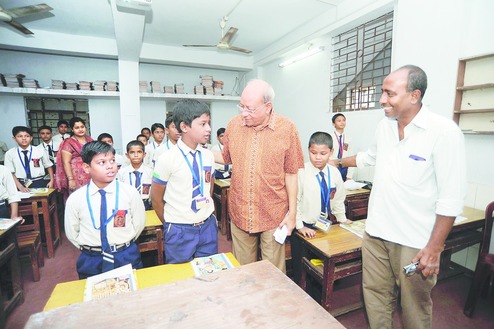
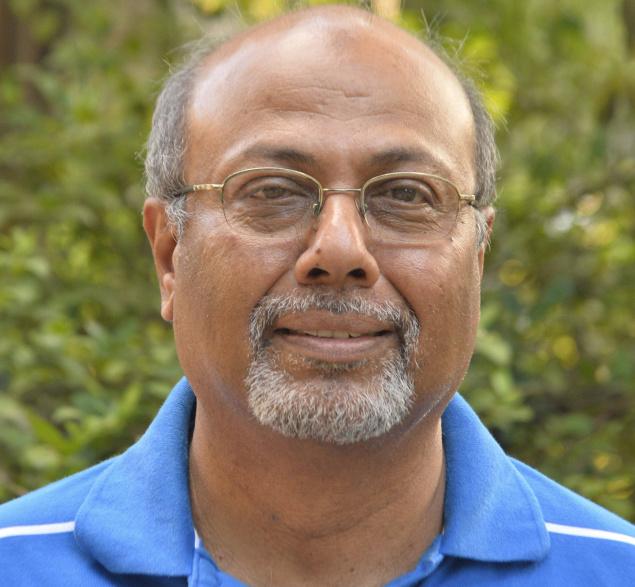
Amid protests and counter protests by students and faculty members for the past one week, the Maulana Azad National Urdu University (MANUU) finally got a regular Vice-Chancellor, Dr. Aslam Parvaiz, after nearly four months on Tuesday.
Dr Aslam, who had earlier served as principal of the Delhi-based Zakir Husain Delhi College, holds a PhD in Botany. Though he teaches science, he is well known for his command of the Urdu language.
On his first day as V-C, Dr Aslam held a meeting with the MANUU Joint Action Committee which was formed by MANUU Teachers’ Association (MANUUTA), Officers’ Association and the Employees’ Association of the university, to address issues that led to unrest on the campus. The V-C assured the faculty members and others that he would resolve their problems soon. Since the students and a group of faculty members have been making allegations and counter allegations against each other, he asked both the parties to submit written complaints.
Speaking to Express, Dr. Aslam, said, “I am not aware of a majority of the problems here. The faculty and students have brought some issues to my notice. But I need some time to look into the matters and make a plan to resolve them.”
Referring to the university’s recent restriction on girl students on the campus, he said so far, he had not received any complaint from students in this regard. However, he promised to find an appropriate solution to the issues if the students come up with formal complaints.
source: http://www.newindianexpress.com / The New Indian Express / Home> States> Telangana / by Express News Service / October 21st, 2015
KSOU has awarded Ph.D in Political Science to Shivananja for his thesis ‘Karnatakadalli Budakattu Janangada Mahileyara Sabalikaranakke Rajya Sarkarada Yojanegalu: H.D. Kotege Sambandisidanthe Ondu Vishesha Adhyayana’ submitted under the guidance of Prof. K.J. Suresh.
The JSS University has awarded Ph.D in Life Sciences to Ayesha Sulthana for her thesis ‘Studies on Wastewater Models and Anaerobic Digestion of Municipal Sludge using Lab Scale Reactor’ submitted under the guidance of Dr. S. Balasubramanian.
source: http://www.starofmysore.com / Star of Mysore / Home> In Brief / October 19th, 2015
The 23rd National Children’s Science Congress, organized by Union department of science and technology got underway at Kendriya Vidyalaya, New Cantt on Wednesday. Around 300 students from 31 KVs of the state are participating in the two day intra-regional event.
The students would discuss various weather phenomenon and climatic changes like understanding weather scenario, impact of human activities on weather & climatic changes, eco-system, their co-relation with society and culture, agriculture and health and many more such issues.
In a short but glittering inaugural ceremony, chief guest Narendra Dev University of Agriculture & Technology, Faizabad, Vice Chancellor Akhtar Haseeb reflected upon the need to develop scientific attitude among students through interesting ways and means so that they could contribute towards human welfare in the most rational way.
KV New Cantt principal Shalini Dikshit accorded warm welcome to the distinguished guests. At the end of the inaugural ceremony, vice principal Rajeev Kumar Tiwari proposed vote of thanks.
source: http://www.timesofindia.indiatimes.com / The Times of India / News Home> City> Allahabad / TNN / October 15th, 2015
MET Chairman Ashraf Peeran addressing the gathering at MICANvas 2015. Picture right shows participants of the fashion show held as part of MICANvas 2015.
Mysuru :
Mysore Institute of Commerce and Arts (MICA), managed by Mysore Educational Trust (MET), hosted its two-day annual academic and cultural fest, MICAnvas’15 on Oct. 8 and 9 at its campus on KRS Road in Metagalli here.
Praful Thachery, Entrepreneur and Co-Founder of Delyver Retail Network, a venture which is with BigBasket now, was the chief guest. Sharing his experience with the students, he said that hard work and passion in what one does would invariably lead to success.
Ashraf Peeran, Chairman, MET, who is also the strategic Director of Xerox, California, called upon the students to make best use of the technology as it has improved the connectivity and increased opportunity for the youth.
Syed Ishaq, Director, MET, in his address, pointed out that the primary objective of participation should be learning and success comes to those who make their passion their profession and vice-versa.
Amir Sadan, Secretary, Fouzen Raheel, Director – Operations and MICA Principal M.N. Ponnamma were present on the dais. The annual report on progress, activities and achievements were presented by the Principal. Siddhart Sethi from KPMG was the special guest.
Various academic activities were organised for both high school and UG students. The academic activities were followed by the cultural show which included ramp walk, solo and group dances, singing etc.
In the school category contests, JSS School won 3 prizes while Manasarovar Pushkani was the overall champion.
In the UG category, MISTocrat event was won by Devika of St. Joseph’s College, Marketing by Vidhyaashram, Finance by Vidhyaashram and HR by St. Joseph’s.
The team activities were won by Mahajana FGC.
In the cultural category, ramp walk was won by Vidhyaashram, group dance by UK crew of Mahajana and solo dance by Pooja Chengappa of Vidhyaashram.
Prizes were distributed to the winners of MI7s, MI volleyball and MI…Quiz.
source: http://www.starofmysore.com / Star of Mysore / Home> General News / Sunday – October 11th, 2015
Mamoon Akhtar (right) with Emami co-founder RS Goenka during a visit to his school in Tikiapara. Picture by Sanjoy Chattopadhyaya
Mamoon Akhtar was forced to drop out of school in Class VII because his parents couldn’t afford his tuition fees. Three decades later, the 43-year-old from Howrah is the driving force behind a school in Tikiapara with 3,000 students, most of them children of unlettered parents.
Mamoon’s extraordinary journey from victim to champion of the underprivileged started the day he decided that he wouldn’t be deprived of an education just because his family couldn’t pay for his schooling.
“My father was a labour contractor. Our family fell on bad times when his business collapsed and I had to leave school. But I started giving tuitions and continued studying on my own. I would sit for examinations as a private candidate and this continued till Class XII, beyond which I couldn’t progress because my father died and our financial condition got worse,” Mamoon recalled.
Mamoon is the youngest of six siblings, including four sisters. While one of the Akhtar girls went on to get a bachelor’s degree in arts, he is the only one among the remaining siblings to study beyond Class X.
After his father died, Mamoon took up a librarian’s job in a private school in Tikiapara, supplementing his income by giving private tuitions. Life would have gone on as usual but for what was playing at the back of his mind. Try as he might, Mamoon couldn’t get over how he was forced out of school.
In 2002, Mamoon founded a school in Tikiapara with six students. “I would take in nursery-level kids and prepare them for admission to Urdu, Bengali and Hindi-medium schools the next year,” he recounted.
While the initial expenditure on books and furniture was entirely Mamoon’s, help arrived as the queue of parents wanting to put their children in his school grew longer. Caring Friends, a group of philanthropists, came forward to fund the initiative and the aptly named Samaritan Help Mission School hasn’t looked back since.
Homemaker Tara Khatun’s son and daughter study in the school and she couldn’t be happier for the opportunity. “I pay Rs 80 as the monthly tuition fees for my two children. We couldn’t have paid for an English-medium education if this school didn’t exist,” said Tara, whose husband works at a blacksmith’s shop.
Samaritan Help Mission School is in stark contrast to its surroundings – narrow, dingy lanes lined with shanties inhabited by families for whom life is a struggle every single day. The five-storey school building on a three-cottah plot has Wi-fi enabled classrooms equipped with projectors, among other facilities.
“We use projectors for the benefit of some students with impaired vision. It is easier for them to see on the screen than strain their eyes trying to make out what is on a blackboard,” Mamoon said.
The school currently takes in students from classes I to VIII. Younger students are admitted to the Rebecca Belilious English Institution, located around a kilometre away in an area that used to be a den of crime.
The land on which the second school stands had been a garbage dump for years until Howrah City Police and the Howrah Municipal Corporation got together to create a conducive atmosphere for Mamoon to expand his initiative.
“We helped them (Mamoon and his staff) build a wall, remove encroachments and start a school there. Today, many children from poor families get free education there,” police commissioner D.P. Singh said.
Sources said Singh’s predecessor Ajey Ranade played the key role in transforming the place into a site suitable for a school.
After completing Senior KG at Rebecca Belilious English Institution, most children move to Samaritan Help Mission School, which has been adding a class every year.
“We are affiliated to the West Bengal Board of Secondary Education. When the current batch of Class VIII students is ready for promotion, we will start Class IX,” a teacher said.
Both schools run on corporate funding from companies like Chevrolet, Cognizant, Emami, Edelweiss and Tata Steel. Charity organisations like Kolkata Gives and Caring Friends continue to fund several school activities.
Last Sunday, a team of industrialists and businessmen visited the two schools to see the fruition of Mamoon’s dream. R.S. Goenka, one of the founders of the Emami Group, said: “I come here because the school and the kids here inspire me. I also get to see how people are benefiting from our funding.”
The Emami Group has financed toilets and projectors on the main campus while Rebecca Belilious English Institution has an AstroTurf funded by car manufacturer Chevrolet.
Sport is integral to Mamoon’s vision of a school. Samaritan Help Mission School recently acquired a table tennis board and two of its students, Mohammad Sharik and Sonu Rajbhar, got the opportunity to visit Manchester United Club in Old Trafford earlier this month.
“A big company sponsored the trip. The duo were selected from among kids from underprivileged families who have excelled in football,” a teacher said.
Sharik is in Class IV and Sonu is a student of Class V.
For Mamoon, it’s been a tough but satisfying ride since the days when a group of college girls he had enlisted would go around Tikiapara trying to convince people to send their children to school.
“Many people suggested that I turn my school into a Bengali, Hindi or Urdu-medium institute, but I insisted on an English-medium school. Knowing English is very important in the current scenario,” the 43-year-old said.
Scores of parents are grateful that Mamoon stuck to his plan. Sending their children to any other English-medium school in the area would have been 10 times more expensive.
Mamoon’s three daughters – seven-year-old Atifa Fatema, six-year-old Adifa Fatema and four-year-old Batul Fatema – also study at Samaritan Help Mission School. When wife Shabana readies the three girls for class every morning, he can’t help but wonder what life might have been if he weren’t asked to leave school in Class VII.
What is your message for Mamoon? Tell ttmetro@abpmail.com
source: http://www.telegraphindia.com / The Telegraph, Calcutta,India / Front Page> Calcutta> Story / by Subhajoy Roy / Wednesday – September 30th, 2015
A workshop-cum-exhibition on digitization of palm leaf manuscripts was organised at Sadakkathullah Appa College here on Tuesday.
Students from various colleges visited the exhibition which had a good number of palm leaf manuscripts on display.
Since most of the palm leaf manuscripts, carrying rare medical remedies with herbal plants for a range of human and domestic animal ailments, are so fragile, efforts are on to digitize them.
A relative of Tamil scholar U.Ve.Sa. handed over a bunch of palm leaf manuscripts to Sadakkathullah Appa College’s managing committee member Pallaakku Lebbai for the digitization project.
Palm leaf manuscript scholar Sankaranarayanan, faculty of Government Siddha Medical College, Palayamkottai, Subhash Chandran, Assistant Director of the Department of Archaeology Chandravaanan, Principal of the college Mohamed Sathik and others spoke on rare information found in the palm leaf manuscripts.
source: http://www.thehindu.com / The Hindu / Home> National> TamilNadu / by Special Correspondent / Tirunelvelli – September 30th, 2015
The University of Mysore has awarded Ph.D in Chemistry to Fazal E for his thesis ‘Synthesis Structural Studies and Biological Evaluation on Quinoline Analogues and their Metal Complexes’ submitted under the guidance of Dr. B.S. Sudha.
R. Jerry Arokyamary has been awarded Ph.D in Library and Information Science by the University of Mysore for her thesis ‘Information Communication Technology Skills among the Library Professionals of Engineering Colleges in Karnataka: An Analytical Study’ submitted under the guidance of Dr. C.P. Ramasesh.
source: http://www.starofmysore.com / Star of Mysore / Home> In Brief / September 28th, 2015
People usually hurry to reach Mina creating tremendous risk for themselves and others. It’s during this ritual that chaos is triggered.
I went for Haj pilgrimage with my wife in December-January 2006. During the journey, we noticed that the Gulf region was unstable owing to the trial of the deposed Iraqi dictator Saddam Hussein in Baghdad and emotions were running high among the Arabs. The political fever in the region also spread among Haj pilgrims. Emotions and arguments add to the atmospherics of Haj. One can imagine the energy and excitement of a pilgrimage in which millions of people from diverse linguistic, ethnic and racial backgrounds are united by religion.
Our delegation was special as we were being accompanied by former Chief Justice of India A.M. Ahmadi and other dignitaries from different parts of India. But from the beginning of the journey, I saw that arrangements on the ground were not quite right. The Saudi officials gave out instructions only in Arabic, though most of the pilgrims were unfamiliar with the language.
Countries that send the largest number of pilgrims are from South and Southeast Asia like Indonesia, Pakistan, Bangladesh, Afghanistan and India. People from this region speak many languages. Special attention is needed for the elderly, many of whom undertake foreign travel for the first time and, therefore, are quite disoriented and find it difficult to adjust to sudden orders yelled out in Arabic by policemen.
Also, the Saudi rules aim at segregation of men and women which creates a lot of problems for first-time travellers from our region. Often families which are separated by the Saudi police have to endure hardship, which is multiplied because neither the pilgrims nor the police can understand each other.
The process of Haj starts from Mina where one has to begin early after a prayer, followed by the circumambulation of the holy mosque Kaaba. The pilgrimage ends at Mina following the ritual of ‘Stoning the Shaitan.’ This last ritual at Mina needs to be completed before sunset and people usually hurry to reach Mina creating tremendous risk for themselves and others. It’s during this ritual that chaos is triggered.
On January 12, as we were returning to Mina for the last ritual of Haj, we saw the big stampede from a distance as waves of people collided. Dust and fear enveloped us. Our group stopped midway out of fear and went back to Mecca.
Next morning, we started early at 3 a.m. for the dash to Mina. On the way, we saw huge piles of shoes, clothes, and water bottles left behind by the stampede victims being loaded onto the trucks by the police. Officials informed us that around 350 people had died in the stampede and hundreds more were injured. The possessions of the pilgrims left behind made me suspicious of the official account.
The road to Mina which is where the stampedes often happen is very risky as it’s the only one for the journey to Mina and for returning to Mecca. I am told that the Saudi government has created an alternative route for the pilgrims returning to Mecca but that route is longer and many pilgrims continue to return by the old, shorter and narrow route which puts them at risk.
Year after year, stampedes have taken place on the same route near Mina, yet the Saudi authorities have failed to do anything to reduce the risk.
The occasion of Haj brings more than three million pilgrims to Mecca. A number of factors can trigger a crisis and a stampede on the ground where the crowd is united by religion and divided by political sentiments of the Arab countries. Sabotage is often suspected when such tragedies take place.
The Saudi government should also be open to learning from other countries where a large number of pilgrims congregate, for example in India’s Kumbh Melas and in the Vatican where authorities take care of the linguistic differences while managing people. There is no harm in learning from others.
Prof. Pasha teaches West Asian politics in JNU.
(As told to Kallol Bhattacherjee)
source: http://www.thehindu.com / The Hindu / Home> National / by Prof. A.K. Pasha / September 26th, 2015
Chief Minister Akhilesh Yadav honoured seven more students who cracked IIT examination this year and said that achievement of these students in adverse circumstance is praise worthy.
“These students did not have resources, but had determination to achieve their targets. Adverse conditions and poverty did not deter them and cracked IIT examination which is dream of students,” Yadav said in a felication function held here on Wednesday.
These students were given a laptop and Rs 1 lakh during a function held at 5, Kalidas Marg, the official residence of Chief Minister.
“The state government is committed to support talented students. Government’s laptop distribution is a step in this direction. The poor students will now stay connected with the world. The Government is also providing free WiFi at some places. These students can avail this facility too,” he said.
Students who cracked IIT were: Vishnu Gupta (Sultanpur), Kapoor Saroj and Shubham Yadav (Pratapgarh), Muzammil Khan and Alok Maurya (Sonebhadra), Nilesh Yadav (Amethi) and Shashank Awasthi (Rae Bareli). Despite his fading eye sight Kapoor Saroj scored fifth position among SC students while Shashank Awasthi scored 97 per cent marks in ClassXII.
Talking to The Pioneer Shubham Yadav said that his only aim was to crack IIT. “I do not have any hobby. I only used to study or sleep. In between I did nothing,” he said.
He along with Kapoor Saroj want to study in IIT Kanpur. It is the best. “I want to go to Mechancial stream, I and Saroj have the ranking to get top position,” he said.
Saroj said he has not taken any coaching. “I cracked the exam on the basis of self study,” he said. Both of them though belong to UP have studied in Navodaya Vidyalaya in Pune.
source: http://www.dailypioneer.com / The Pioneer / Home> State edition> Lucknow / by PNN, Lucknow / Thursday – June 25th, 2015
Journalist Uday Banerjee received the Lifetime Achievement Award at the 6th edition of the Journalism Awards on Sunday. Banerjee, who covered government and administration for four decades, is known for his honesty and is revered in the fraternity. Tripura governor Tathagata Roy presented him with the trophy and citation.
Consumer affairs minister Sadhan Pande presented the ‘Hall of Fame Award’ to sports journalist Debashish Dutta at the same ceremony.
Of the 18 other categories of awards, the Times of India group bagged five. Out of the total 10 journalists from TOI and 12 from Ei Samay shortlisted as finalists, three each from TOI and Ei Samay won the honours. Two TOI scribes shared the Best Journalist News (English) award while another won the Best Journalist Lifestyle & Cinema (English) award. Ei Samay picked up Best Journalist Lifestyle & Cinema (Bengali), Best Journalist Sports (Bengali) and Best Journalist Features (Bengali).
Judges included Abhijit Dasgupta, retired station director of Doordarshan and secretary of Kolkata Sukriti Foundation, Dilip Banerjee, former photo editor of Mail Today, Tapas Ganguly, former chief of bureau of The Week, Manik Banerjee, former chief of bureau of UNI, Pradipta Sankar Sen, vice-president of Calcutta Film Society and ex-resident editor of Hindustan Times, Shyam Afif Siddiqui, visiting faculty at Management Development Institute, Murshidabad.
source: http://www.timesofindia.indiatimes.com / The Times of India / News Home> City> Kolkata / TNN / August 11th, 2015