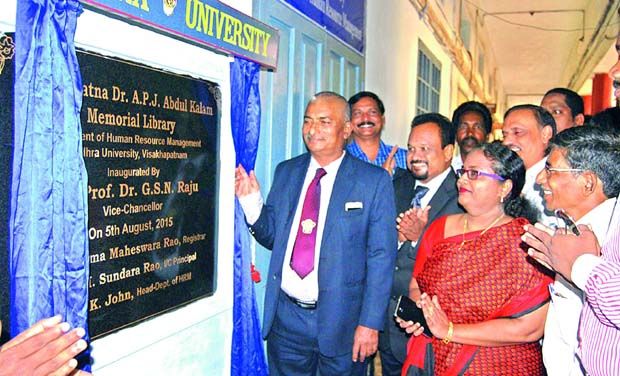
Vice-Chancellor of Andhra University Prof. G.S.N. Raju inaugurates APJ Abdul Kalam Memorial Library at Andhra University in Visakhapatnam on Wednesday. (Photo: DC)
Visakhapatnam:
Managing and making the best use of human resources is a challenging task in the society, said Prof. G.S.N. Raju, Andhra University Vice-Chancellor. He was the chief guest at the launch of the head of the department’s chamber and a new library named after former President Dr. APJ Abdul Kalam, who died recently, at AU Human Resources Management Department on Wednesday.
Speaking on the occasion, Prof. Raju hailed the efforts of Prof. K. John, head of the department of AUHRM, in establishing a useful library for the students in the name of multi-faceted Dr. Kalam. He asked all the students to improve the attitude of working hard to achieve higher goals. “Coordinating thoughts and talent is vital for success. Students should keep themselves abreast with the changing technology,” he said.
AU Registrar V. Umamaheswara Rao said that the AUHRM department has contributed to the society so much by providing valuable human resources to the society.
“Providing infrastructure facilities according to the needs of the students is appreciable and students should make the best use of it,” said Prof. M. Sundara Rao, principal, AU Arts College.
BOS chairman Subba Rayudu, new HOD Dr. Arun Kumar, Prof. Rajani, Prof K. John, students and others were present at the inaugural function.
source: http://www.deccanchronicle.com / Deccan Chronicle / Home> Nation> Current Affairs / Deccan Chronicle / August 06th, 2015
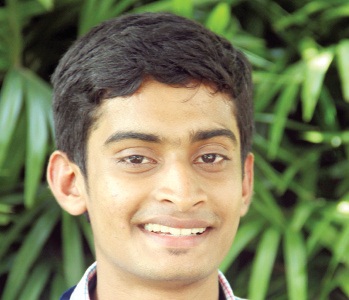
Manjeri native 17-year-old Aflah Madasseri adores Thomas Alva Edison and dreams to become like him one day. But to become an entrepreneur, his High School teacher Nasar was the inspiration. Seeing his English teacher takes his classes with his inner sight, Aflah always wanted to do something for him to help him as he was blind.
His thoughts have finally become the product, Blind Torch which got second prize in the contest held as part of the YES CAN 2015 event to find out innovative ideas.
Blind Torch is a device for guiding a blind person. The device has ultrasonic wave emitters which senses the obstacles in front of users and gives velocity information of obstacles to analyse the route and helps to walk safely.
Aflah has completed plus two from the Government School in Manjeri and wants to pursue mechanical engineering.
“Blind Torch is a device with only the size of a mobile phone. Blind people can carry it and can walk safely even without a white cane. The device can be made for Rs 500. I have applied for a patent for Blind Torch,” Aflah said.
He is also looking at funding options for the product. “I want to concentrate on entrepreneurship and studies together,” he adds.
Aflah, who came to receive the award with his father Ummer Madasseri and mother Sajida, wants to become an entrepreneur.
source: http://www.newindianexpress.com / The New Indian Express / Home> Cities> Kochi / by Express News Service / September 13th, 2015
Father of Hanjala Shafi, a boy from Begusaray district of Bihar, used to work at a shoe shop. Often he used to think if his life would go in the struggle for daily bread and butter.
Would his children have any better future?
Although his son Hanjala was a bright student, his condition was a big hurdle in making it big.
Source : Anand Kumar
A ray of hope and despair:
His father admitted him to a government school but the teachers were irregular and the school got shut down. To help in the family’s finances his Bua (paternal aunt) started working in a private school. After her persistent request she got him admitted to her school. Now things went smoothly as he did not have to worry about the school fee too.
But she got married after 3-4 years, leaving the school and the situation was bad again. He was asked to submit his fees and he couldn’t . On this, the school expelled him.
The guardian Angel and a dream:
Luckily, a teacher named Javed noticed this bright boy and assured him of fees, stating that he need not worry. Instead he should do something for which the world would look up to him.
Hanjala was relieved and immersed himself in books.
His one room home for everybody was too crowed for study, so he used to go out and study. He cleared his 10th exams and came to Patna with his mother with the dream of becoming an engineer in his eyes. He had heard much about super-30, so he wanted to get in to it. But the time was not on his side. The innocent mother and son got fooled by a similar sounding institute which asked them for fee.
His mother Yasmin sold the only jewellery she had for the fee. Soon they realized that it was not the Super-30 they were looking for. He passed 12th but could not get into engineering.
Now the bright Hanjala wished for another chance.
The second chance:
One day they reached me. With tears in her eyes her mother told the entire story. His father was earning 2800 a month and that wasn’t good enough for the family, leaving no choice for Hanjala. It melted my heart to hear his story.
I looked at the boy. He was sitting there with his head down. I felt that this bright kid needed a chance. And he was in our team. He was hard working and bright, he used to solve maths questions by different methods.
Our bond and beautiful memories:
In my batch there were only two Muslim kids. Considering them I declared holiday on Eid, and asked them to go home and celebrate it with family. Both the boys refused and said that when they had celebrated Holi, Diwali with me, we want to celebrate Eid as well. And we made ‘Sewai’ together, and enjoyed the festival.
That was a memorable ‘Eid’.
And the dream comes true:
Now came the time of test the 2013 IIT entrance exam. There was a spark in Hanjala’s eyes. Everybody was assured of his success. Hajala and his mother Yasmin had high hope in their eyes. And yes the result proved them right and he got a very good rank in the exam. Yasmin’s eyes were filled with tears when she came to me this time too, but for a very different and good reason.
A mother’s heart :
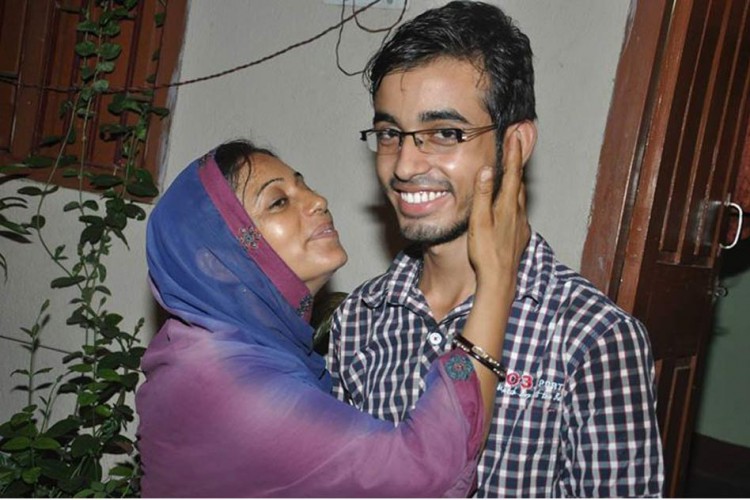
Today Hanjala is a second year student in IIT Delhi. Yasmin sometime visits us with her husband. They talk about many things, and help students here in cooking food. This mother says one Hanjala has got his dream come true and others are studying hard for the same. Hence, she never misses to take care of kitchen on their time of meal.
source: http://www.thelogicalindian.com / The Logical Indian / Home> Story Feed> Get Inspired / Anand Kumar / September 12th, 2015
Shehla Rashid Shora, the first Kashmiri girl to contest and win the Central Panel elections at the the Jawaharlal Nehru University, says that she found the political space in her state “too restricted”.
Shora, a candidate of left-backed All India Students Union (AISA), was sworn in as the JNU Students Union (JNUSU) Vice President amid shouts of “lal salaam” here yesterday.
The engineer-turned-activist polled 1,387 votes, maximum by any candidate this year. She trumped BJP youth wing ABVP’s Valentina Brahma by 234 votes.
“After studying engineering and management, I entered the corporate world only to be disillusioned by it. Turning an activist, I raised issues of juvenile justice and acid attacks in Kashmir but I found the political space there too restricted,” she said.
“At JNU, I found there is enough space to articulate your political spirit. The challenge, however, was to convince voters in favour of a Kashmir woman from a non-political background,” she added.
Asked about the issues she plans to focus on during her tenure, she listed 24X7 health centre, translation cell, reduction in minimum eligibility criteria for OBC students, more hostels and upgradation of on-campus safety.
Shora said she wants “to confront the rise of the right-wing ideology” to prevent it from changing the “real history”.
“Left has a progressive ideology and hence, a progressive understanding is needed in the society. There is a forthcoming neo-liberal attack on education, another anti-people onslaught of the BJP government, which we must resist,” she said.
Shora graduated in computer engineering from NIT, Srinagar, and studied political leadership at IIM Bangalore. At JNU, she is pursuing her MPhil in Law and Governance.
She said she is yet to take a call on pursing a career in mainstream politics. “But, I back the Left ideology and will continue to work for human rights issues, internet democracy and against privatisation of education.”
The new JNUSU panel took oath yesterday. Out of the total 22 candidates who tested their electoral fortunes for the Central Panel, Kanahiya Kumar, the nominee of CPI’ student wing All India Students’ Federation (AISF) bagged the Presidential post, opening the party’s account in the student union polls.
While the ABVP made a comeback to JNUSU after a gap of 14 years wresting the Joint Secretary post, AISA which had swept the polls during last two years, managed two seats-Vice President and General Secretary.
In the JNUSU polls held on September 11, more than 53 per cent students had exercised their franchise. 31 councillors belonging to several schools in JNU were also declared elected yesterday.
JNUSU is the representative body of the students in the varsity. The polls have been keenly contested over decades.
source: http://www.deccanherald.com / Deccan Herald / Home> National / by PTI / New Delhi – September 14th, 2015
Muslim Cosmopolitanism in the Age of Empire Seema Alavi Harvard University Press, 2015, 504 pp, Rs 1495
Muslim Cosmopolitanism in the Age of Empire is an exhilarating book encompassing broad swaths of trans-imperial history, religio-cultural geography and a stunning breadth of vision. Seema Alavi’s credentials as a historian of substance are well-established. Starting with a book on India’s military history and the Sepoys of the Company that came out of her doctoral research work in Cambridge with C A. Bayly, she later forayed into the history of indigenous medicine, producing the gem of a book, Islam and Healing with another book thrown in between—The Eighteenth Century in India. The current tome has a distinguishing feature that sets her apart from the ordinary run of historians – her multilingual scholarship, her willingness and ability to access source materials in several languages and her skill in marshalling arguments from different perspectives combined with insights drawn from literary sources to give a comprehensive, almost definitive, view of the phenomenon under discussion.
The seed of Muslim cosmopolitanism was, perhaps, sown when the Prophet had exhorted his disciples to undertake even the hazardous journey to China in quest of knowledge. Unlike some cultures, where travel across seas and mountains were proscribed for fear of losing purity/caste, Islam always put a premium on travel and trade, the Prophet himself being the best exemplar of both. When one travels one gets exposed to multiple cultures, belief systems and world-views, thus shedding one’s parochialism and embracing traits of cosmopolitanism. Baghdad (of Baitul Hikmah fame), Constantinople (current Istanbul, the seat of Ottoman empire), Cairo, Cordoba, Damascus, Bukhara, and Delhi were all Muslim cosmopolitan cities at different historical moments where scholars, statesmen, adventurers from all over the world congregated and conducted dialogue in a spirit of openness and catholicity. In the current times, when Muslims, for a variety of reasons, have become victims of insularity and ghettoisation, Alavi’s book is a potent antidote to the widespread but ill-informed media narrative about Muslim resistance to forces of modernity and globalisation.
Extraordinary journeys
Alavi’s articulation of Muslim cosmopolitanism in the 19th century is chronicled through the extraordinary biographies of five Islamic scholars from India – Sayyid Fadl, Maulvi Rahmatullah Kairanwi, Maulvi Imdadullah Makki, Siddiq Hasan Khan, and Maulvi Jafer Thanesri – who transcended their limited identity as British subjects and charted careers at the interstices of imperial borders. Taking advantage of imperial knowledge, strategies and rivalries between two great empires of the day, British and Ottoman, “they carved out a spiritual and civilisational space between the [these] Empires and projected it as their cosmopolis.”
The chapter on Sayyid Fadl brings alive the phenomenon of the ‘Indian Arab’ who hailed mostly from Hadramawt, Yemen, and whose presence was marked in Delhi, Gujarat, Deccan and Malabar. Starting his Indian career in the Malabar district of modern day Kerala, he was branded as a “fanatic” and an “outlaw” by the British government because of his alleged involvement in the anti-British Moplah uprising. But he fled from British India and then used the British and Ottoman tension and his trans-imperial connections to put himself up as the ruler of Dhofar – a semi-independent region in the southwest of Arabia . “Sayyid Fadl’s remarkable journey – born and brought up in a Malabar Sufi family of Arab descent and rising to become an independent ruler of an Arabian principality, a leader who commanded respect in both Meccan and Istanbul high society – was enabled by the connections he forged early on between British and Ottoman societies. And he established these connections using imperial networks as well as his religious and kinship ties.”
Amadeo Preziosi’s Entrance to the Golden Horn, painted c.1840-1880. Credit: Seema Alavi
Nawab Siddiq Hasan, who had a prominent position in the state of Bhopal, exerted great influence through his agents in Hijaz and Istanbul and fully exploited the potentialities of print culture to propagate a version of Islam at odds with the political interest of the British rulers in India. But the British resident in Bhopal could do little to prevent him from propagating his anti-British views. Exploiting British-Ottoman rivalries allowed him to publish his books and journals from Bhopal, Calcutta, Mecca, Madina, Istanbul and Cairo. His agents also bought books pertaining to a similar ideology and had them printed from Bhopal. “Imperial assemblages were also empires of print”, and Hasan fully exploited the possibilities of the moment to propagate his version of the Muslim cosmopolis making forays through porous imperial borders.
For the other three religious thinkers, the 1857 war of independence provided the backdrop for their political careers. They became suspects in the eyes of the British because of their alleged roles in the uprisings. Rahmatullah was one of the rebel leaders of Kairana who escaped the British noose by fleeing to Mecca, and his extensive family estate was confiscated by the colonial administration. He established the Madrasah Saulatiya in Mecca which became a hub of Muslim cosmopolitanism and produced scholars who spread out in different parts of the world, establishing similar seminaries and spreading the same message of consensus and unity among Muslims. Kairanwi wrote in Arabic, Persian and Urdu, addressing the Muslim umma across the empires, adhering largely to the Salafi intellectual tradition. Imdadullah followed Rahmatullah to Mecca and taught in his Madrasah Saulatiya. Both met Muslims from all over the world who came for hajj and discussed with them the challenges of anti-British struggles being waged in their own countries.
Challenge to colonialism
The pedagogical model evolved in Saulatiya and their ideological underpinnings shaped the broad curricular structure at the Deoband seminary in India. Thanseri who couldn’t escape was sent to the Andamans. However, he was one of those convicts who was co-opted in the colonial administration. “Unlike Kairanwi and Imdadullah Makki, he did not manage to escape to the Ottoman territories. But this did not stop him from envisaging a Muslim cosmopolis stretched across empires, and via his writings he envisaged an embracive civilisational space that spilled out of British India and challenged the colonial regime through its call for Muslim unity across the imperial assemblage.” (P. 333)
Alavi is prescient in her analysis of how print capitalism, the telegraph and the increasing ease of travel that fuelled resentment in colonised societies by upsetting the social order were also the means that helped build Muslim solidarities across a vast geographical divide. She is equally prescient in her debunking of the British paranoia of ‘Wahabism’ which the nervous officials saw everywhere. The British fear of Muslims was exacerbated by 1857 and William Hunter’s meretricious book Indian Musalman predisposed them to see the spectre of Wahabism even in innocuous reformist movements among Muslims and equate what Alavi defines as Muslim cosmopolitanism with territorial loyalty. The study reminds the reader of how intensely nationalist these Indians were even while they were trying to bring about a broad consensus among Muslims of different countries regarding contentious issues that divided them along ideological faultlines. Through her book Alavi has retrieved a segment of our national history that had been all but erased from public memory.
M Asaduddin, an award-winning author and translator, is currently Dean, Faculty of Humanities and Languages, Jamia Millia Islamia
source: http://www.thewire.in / The Wire / Home> Books / by M. Asaduddin / September 06th, 2015
For the first time in the city, a motivational programme was held for street vendors on Monday. The United Forum organized the session for the vendors as well as students and teachers of madrasas.
Motivational trainer Saeed Ahmed, who has conducted several such sessions in Maharashtra, Uttar Pradesh and Karnataka, conducted the sessions. Ahmed trained the gatherings on body language, ethics, upkeep of the outlets of street vendors, self-motivation, language and other soft skills.
Ahmed said the theme of the sessions revolved around working for one’s heart and not merely stomach. “If you make your work your hobby and passion, you are happy and content with it,” said Ahmed.
Zuber Gopalani, who had organized the event, said a quarrel he saw between a street vendor and his customer prompted him to hold the event. “Clearly, the street vendor was going to lose business,” said Gopalani.
source: http://www.timesofindia.indiatimes.com / The Times of India / News Home> City> Vadodara / TNN / September 08th, 2015
Inspiring stories of four persons who graduated from workers to educators
R. Kanakaraj and others have made it as teachers after an arduous strugglein early part of their life.
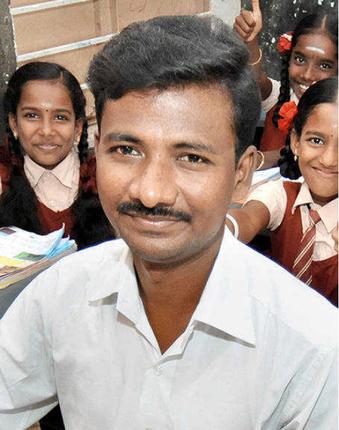
Many teachers prefer to work in schools in their home town, but R. Kanagaraj has chosen the government school for tribals in Pilloor to start his career.
He works at the Panchayat Union Middle School in Alathivachinampalayam near Karamadai, where 90 per cent of the students are Sri Lankan Tamil refugees.
“As a former child labourer, I know the difficulties of students with a poor family background. I like to work for them,” says Mr. Kanagaraj, son of a cobbler and a physically challenged mother, who used to work in cotton fields and reared cattle when he was a III standard student.
When his family’s financial condition forced him to quit school and become a child labourer, he was spotted by officials of the Labour Department and his entry into a school run under National Child Labour Project became possible. This institution prepares beneficiary children to join mainstream schools.
“In the child labour school, I acquired many skills like candle-making while pursuing education. As a teacher, I teach my students general knowledge and other subjects that will empower them,” said Mr. Kanagaraj. More than 15 former child labourers have become teachers in the State.
E. Rajeswari, head of the Panchayat Union Primary School in R.S. Mangalam in Ramanathapuram district, worked in the match industry before she was rehabilitated by Labour department. She belongs to Thiruthangal near Sattur.
“I had no electricity at my residence. My parents agreed to send me to school when officials promised that I would receive Rs. 100 per month and could learn tailoring and others skills,” says Ms. Rajeswari, adding whenever she narrated her life story, her students found it incredible. “But I could see my story was an inspiration,” she said.
Nithya is happy that she has become a teacher at one of the schools for child labourers, where she was a student once. She chose it though the salary there was comparatively low.
She studied till III standard and took up work in the beedi industry as her father who faced neurological problems could not work. “My mother eked out a livelihood as a worker and education was beyond reach in a family of five sisters,” she said.
After attending the school for child labourers, she joined the Adi Dravidar Government Higher Secondary School in Pernambut.
Even thourgh she was interested in higher education, Ms. Nithya had to take up a job to support her family. The Labour department appointed her a teacher in its school at Peranampet.
“I have to be content with what I have now,” she said.
M. Reshma and others have made it as teachers after an arduous strugglein early part of their life.
Unlike others who were school dropouts, M. Reshma, now working as a teacher at Kalaimagal Vidyalaya Matriculation, in Peranampet never attended school till she was eight. “I could not afford to attend school because of my family circumstances,” she said.
After completing the bridge course at the school for child labourers, she joined VI standard at the Government Girls Higher Secondary School. She then graduated from M.K. Jain College for Women in Vaniyambadi in English literature. Subsequently, she completed B.Ed., and got the present job.
Unfulfilled desire
“I actually wanted to pursue post-graduation in English literature. But with three elders sisters and a brother I am left with very little option, but higher education remains a passion,” she said.
source: http://www.thehindu.com / The Hindu / Home> News> Cities> Chennai / by B. Kolappan / Chennai – September 05th, 2015
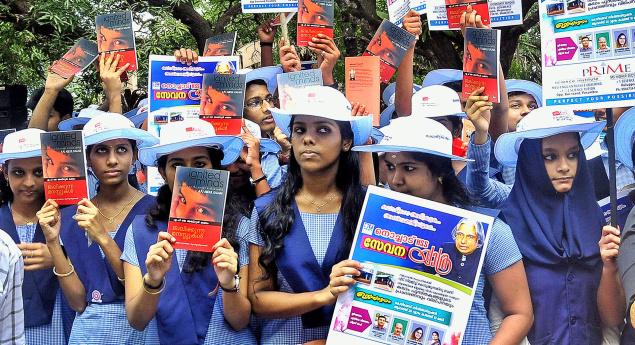
Students of Nochad HSS school plan to sell 5,000 copies of A.P.J Abdul Kalam’s books and raise money to help fellow students.— Photo: S. Ramesh Kurup
Students to sell APJ’s books to raise money for charity
A group of 150 students of the Nochad Higher Secondary School here have embarked on a journey to pay tribute to the former president of the country, A.P.J. Abdul Kalam. Flagged off by the district collector N. Prasanth at the Collectorate premises here, the group envisages selling as many as 5,000 copies of 13 select titles of Kalam in and around the city. The sum collected as donations during the trip and the profit from selling the books will be donated for building houses to deserving students from the school.
The students, who started their journey in two buses and other vehicles from the Civil Station, stopped at different points in the city and dispersed in small groups to sell the books. Receptions have been arranged under the aegis of traders’ forum and institutions at important centres such as shopping malls, hospitals and public places.
“We have already sold around 2,000 copies of the books on day 1,” said K.M. Nazeer, one of the coordinators of the journey. Agnichirakukal, Jwalikkunna Manassukal and Asadyatayile Sadhyata are the books in most demand, he said. The team that stop at different points for selling the books also performed different cultural programmes to attract the attention of the public to their charitable cause. “Some medical institutions in the city donated even Rs. 10,000 for a book considering the cause,” said Mr. Nazeer. Organisations such as the Malabar Auto Club, a collective of auto rickshaw drivers in the region also accorded a warm reception for the journey.
Many institutions and traders forum according to him provided small refreshments for the students on their way in additions to the donation. The team had been given receptions at 10 select points in the city on the first day of the journey, which will conclude at Perambra on Sunday.
source: http://www.thehindu.com / The Hindu / Home> News> Cities> Kozhikode / by Jabir Mushthar / Kozhikode – August 21st, 2015
“No clues, No clues,” came the fervent pleas from a crowd of 1,200 students from 200 schools, as they competed for a place in the finals of the Times NIE Quizomania 2015-16. It was held jointly with the State Bank of India at The Cathedral High School, Bengaluru, on Thursday.
The excitement and tension was palpable from the word go, as quizmaster Giri ‘Pickbrain’ Balasubramanium took them through 20 questions in the preliminary round, before 12 schools made it to the semifinals. Presidency School, RT Nagar, walked away with the winning trophy.
They also got an impromptu cash prize of Rs 10,116, from Vijaya Kumar, general manager-network II of SBI, St Mark’s Road.
From Viv Richards starting his cricketing career from K Chinnaswamy Stadium to RBI governor Raghuram Rajan starring in the Oscar-winning documentary ‘Inside Job’, to Fauntelroy being Donald Duck’s middle name, the students had answers to almost all the questions.
Chief general manager of SBI Rajni Mishra said: “Some of the questions bowled me over; the children know so much today. I am often asked where I see India going economically, and today I can say that India is going to be No 1 in the world soon. We will have brilliant scientists, entrepreneurs and leaders,” she said.
Isabella Simon, principal of The Cathedral High School, said quizzing is a fun way to learn and gather information. CEO of Greycaps India Pvt. Ltd Giri Balasubramanium said he was delighted to see so many girls taking to quizzing. “Girls opening up to a mind sport like quizzing is a fantastic new trend. The comfort level the youngsters have with all the information around them is also amazing,” he said.
The winners, Aymen Maqsood and Bavadharini Manohar attributed their success to the 40-minute quiz they have in school every day, and reading the newspaper. The prizes to the winners were sponsored by Vedantu.com. General manager-network I, YV Ramana Murthy was among those who gave away the prizes.
source: http://www.timesofindia.indiatimes.com / The Times of India / News Home> City> Bengaluru / by Santrupti Rajankar, TNN / August 21st, 2015
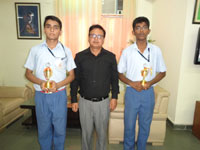
It is a proud moment for Perminder and Sadiq, the two youngsters. Following the scooping of the award by them they are getting praises from their school and others.
Principal of D.A.V. Jasola Vihar Dr. V.K. Barthawal congratulated the winners and wished them luck.
Earlier, the school announced: “Students of D.A.V. Jasola Vihar bagged third position at the Kailash Confluence that was organised by D.A.V. Kailash Hills on August 18.
The young scientist of D.A.V. Jasola Vihar competed with the students from 18 schools. With their excellent performance, the dynamic duo cleared all the three rounds enthusiastically.”
source: http://www.okhlatimes.com / Okhla Times / Home> Local> Okhla Times Reporter, Okhla / OT Aug 20th, 2015