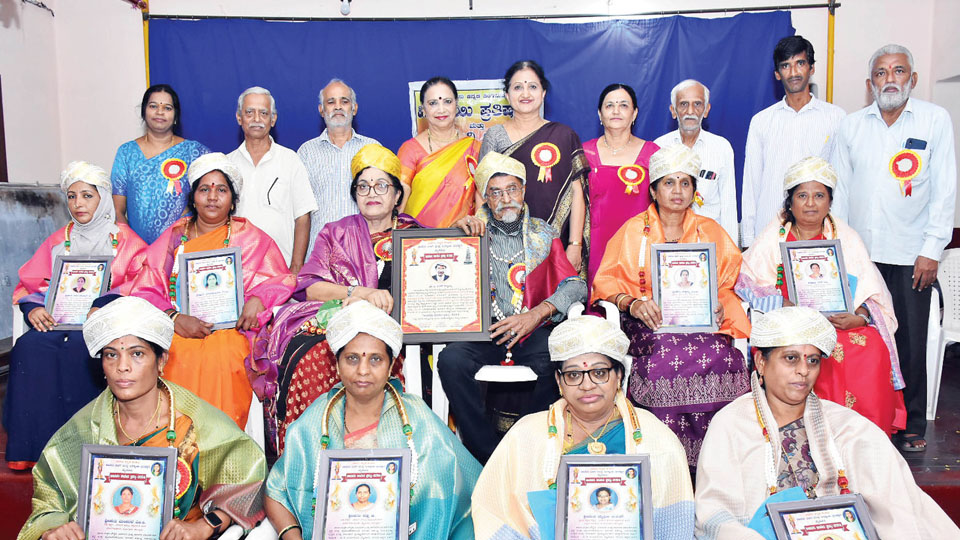
Ten teachers were felicitated and presented ‘Jeevanadi Cauvery’ awards in memory of Nambiyapanda Gowru Ponnavva at a function held in the premises of Akkana Balaga School in Agrahara in the city on Tuesday.
The award presentation function was jointly organised by Cauvery Balaga and Hiranmayi Pratishtana.
Speaking at the function, writer Bannur K. Raju said it is essential that education and health must be provided to everyone without any bias like in many developed countries.
“Unfortunately in our country, both these vital sectors are in firm grip of private organisations which has deprived both education and health to poor and middle class people,” he regretted saying it has become essential that these two sectors be nationalised in the interest of majority of people in the country.
Teachers S.N. Janaki of Alanahalli Government Lower Primary School, H.D. Kote taluk; M.P. Manjula, Hunsur Govt. Lower Primary School; K. Parveen Taj, Arenahalli Govt. Urdu Lower Primary School, Periyapatna taluk; G. Ratna, Beeregowdanahundi Government Lower Primary School, Mysuru taluk; M.T. Akkamma, Ammathi Govt. Higher Primary School, Virajpet taluk; M. Rani, Head Mistress, Bharati Sthree Samaja Higher Primary School, Yadavagiri in Mysuru; T.S. Maithili, Physical Education teacher, Government Higher Primary School, Vysarajapura, T. Narasipur taluk and M.T. Saralakumari, Head Mistress, Kajoor, Somwarpet taluk were felicitated at the function with ‘Jeevanadi Cauvery’ awards.
City’s renowned Sculptor Appaneravanda Kiran Subbaiah was given a special award.
Noted Danseuse Dr. Tulasi Ramachandra, retired teacher A. Sangappa and artist Dr. Jamuna Rani Mirle spoke at the function.
President of Cauvery Balaga and retired teacher N.K. Kaveriamma, President of Hiranmayi Pratishtana A. Sangappa, Jnana Vignana Samiti District President H.V. Muralidhar, Art teacher Manohar, Social activist Malini R. Palaksha and teacher Anupama were present.
source: http://www.starofmysore.com / Star of Mysore /Home> News / May 23rd, 2024
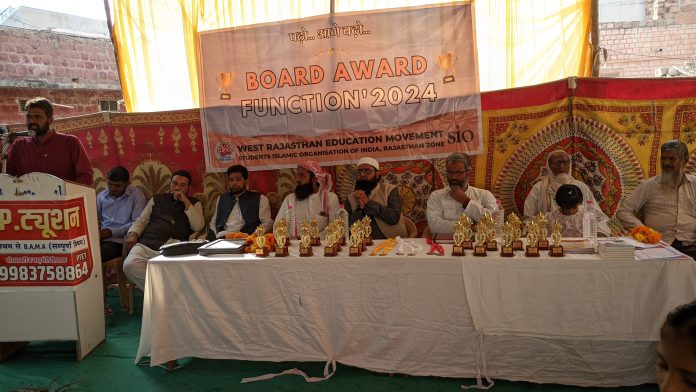
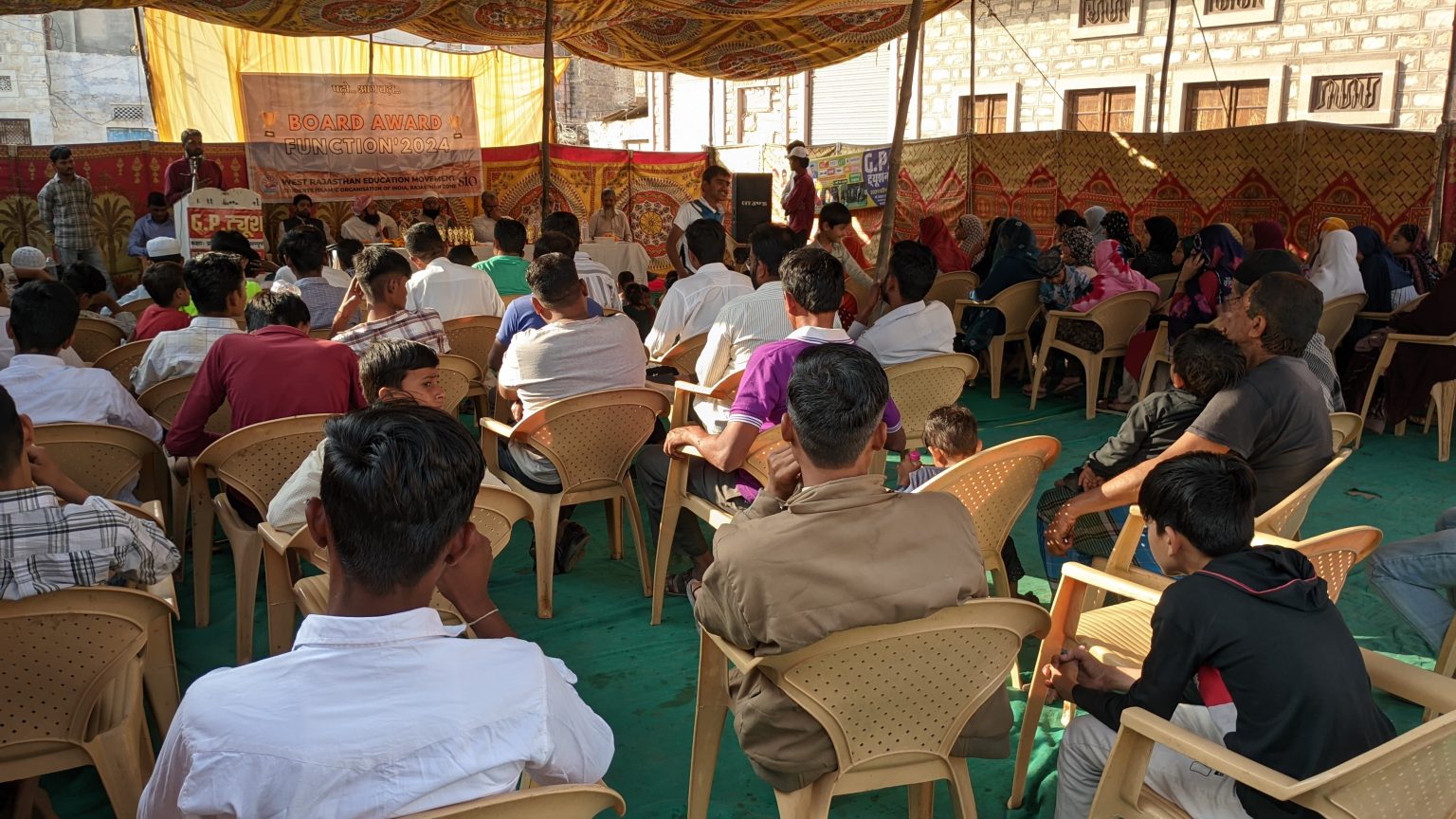
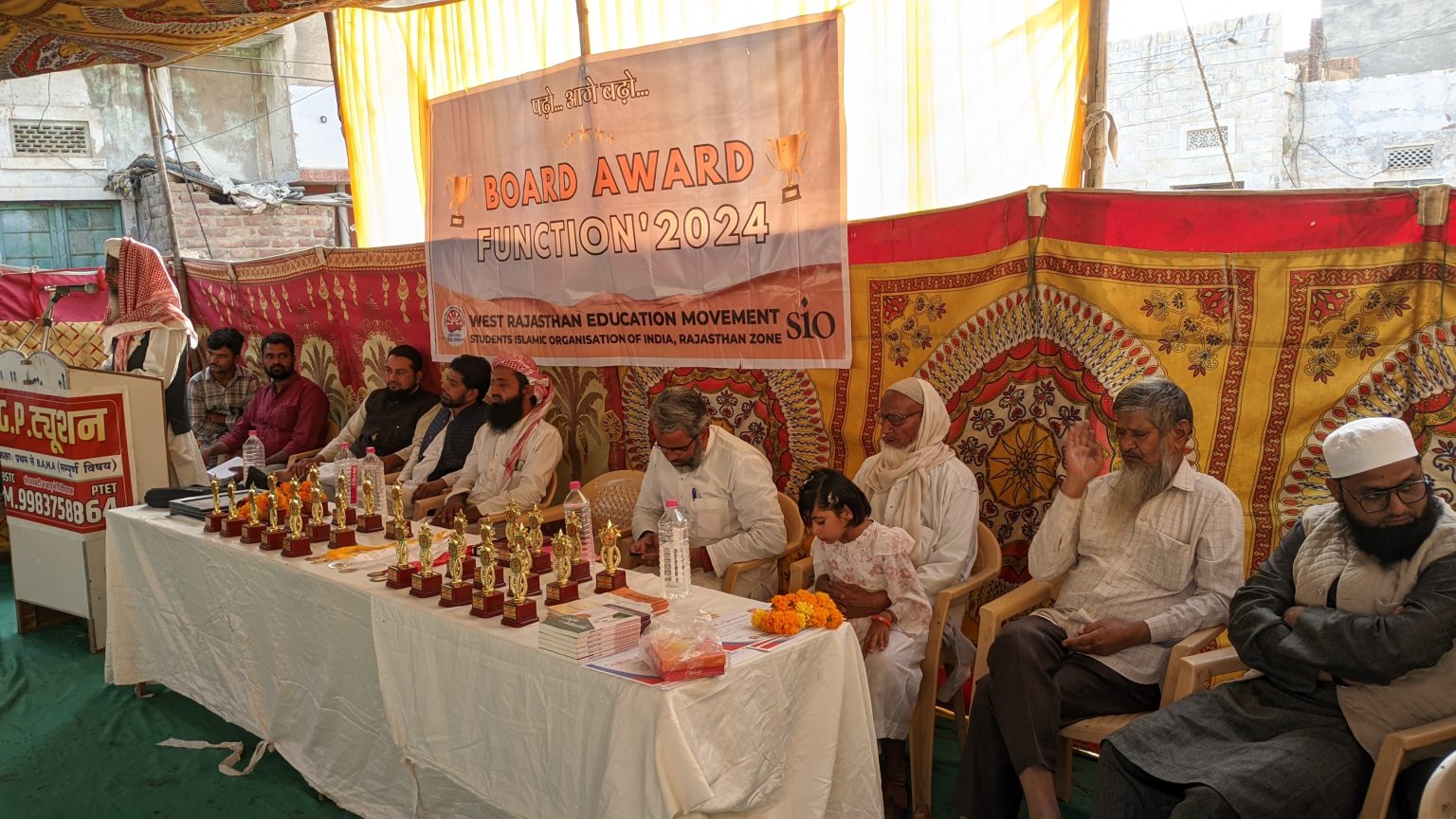
The Western Rajasthan Education Movement (WREM) held a ceremony at Teliyon ka Nyati Nohra Square here Sunday to honour students who excelled academically. Students scoring over 65% in their 10th and 12th-grade exams were recognised for their achievements.
The event began with Quran recitation by Muhammad Yunus, a student at Madrasa Imdaddiya.
In his welcome speech, Salim Akhtar introduced SIO Rajasthan and elaborated on the goals of the Western Rajasthan Education Movement, initiated in 2019 to address the region’s low literacy rates. He emphasised the movement’s objectives: promoting education’s importance, raising awareness, improving literacy rates, encouraging higher education, inculcating moral values, increasing school enrolment, supporting dropouts to resume education, and guiding students towards academic excellence.
Speaking as Chief Guest, Qari Muhammad Hanif, In-charge of Shoba-e-Taleem at Madrasa Imdaddiya, commended the WREM team for their efforts in promoting education and congratulated the students for their dedication and success. “You have proven your talent and potential to achieve your dreams,” he said.
Chairing the ceremony, Mohammad Azam Khan, former Secretary of SIO Rajasthan, highlighted the role of students in shaping society. He urged students to integrate morality into their lives and fulfil their responsibilities toward their parents, emphasising the importance of being both good students and good human beings.
The guests were warmly welcomed with garlands, with Qari Asgar Ali delivering the official welcome speech. Master Allan Noor and Qari Umar Farooq also inspired the students.
The honoured students received shields and certificates, with the top three scorers in 10th and 12th grades receiving gold, silver, and bronze medals. The event was attended by prominent citizens of Phalodi, including Master Allan Noor, Amadin Khilji, Qari Umar Farooq, Qari Asgar Ali, Haji Pir Bakhsh (Retired JN), Saddam Hussain (Director of GP Tuition), Faiz Ahmed, Mubarak Ali, Qari Muhammad Shakir, and Amit Kumar, a teacher at GP Tuition. They encouraged the students to continue their pursuit of excellence.
The ceremony concluded with Israr Ahmed reciting a heartfelt poem of prayers. Saddam Hussain, Director of GP Tuition, played a significant role in organising the event. Salim Akhtar, convener of WREM, extended a vote of thanks.
source: http://www.radiancenews.com / Radiance News / Home> Education> by Raheem Khan, Radiance News Bureau / December 02nd, 2024
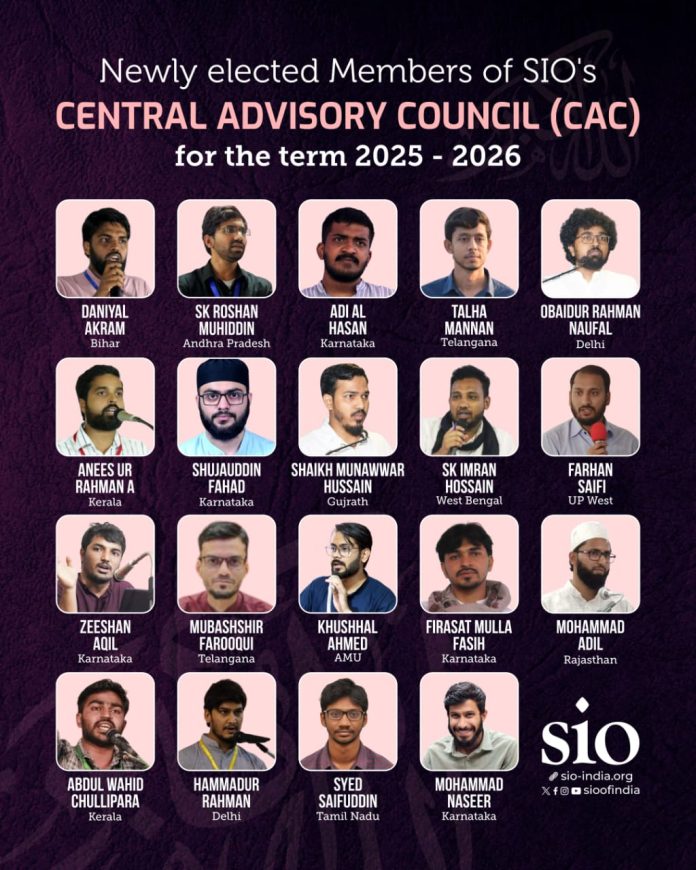
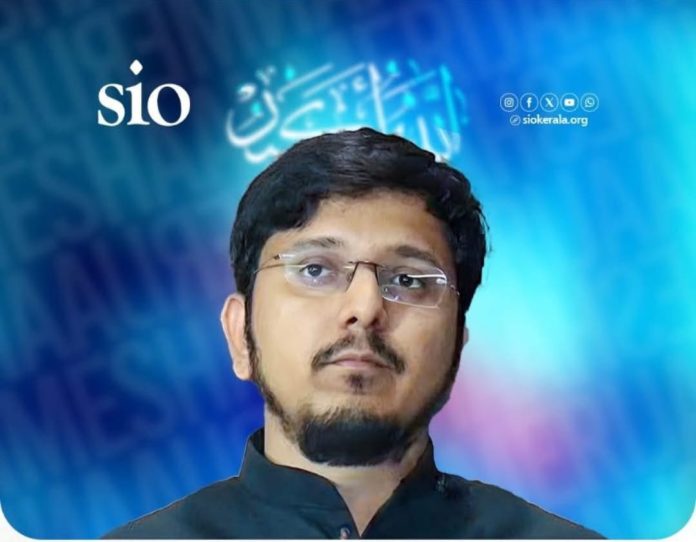
After the election of President of SIO India (Students Islamic Organisation of India) for the two-year term 2025-2026 early Saturday, the All India ZAC (Zonal Advisory Council) meet held in Udupi, Karnataka, also elected 19-member Central Advisory Council (CAC) for the next term. And, with the consultation of new CAC, the President-elect Abdul Hafeez nominated Anisur Rehman A from Kerala as General Secretary of SIO India, and seven National Secretaries namely Wasiullah (Telangana), Atesam Hami Khan (Maharashtra South), Thashreef KP (Kerala), Obaidur Rehman Naofal (Delhi), Raushan Muhiuddin (AP), Yunus Mulla (Goa), and Farhan Saifi (UP). This new team of SIO India will start functioning from 1st January 2025.
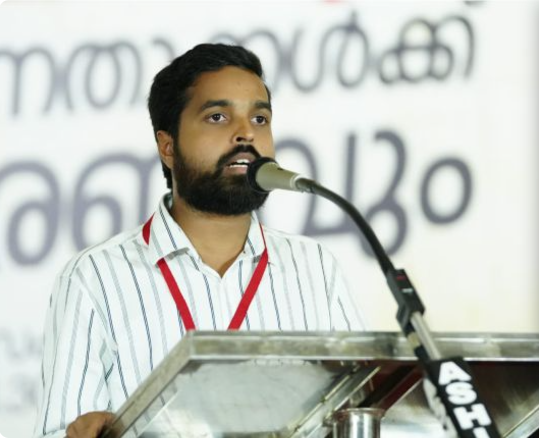
Adv. Anees Rahman (General Secretary of SIO India)
Before his current responsibilities, he was a secretariat member of the SIO Kerala Zone. He also held various organisational responsibilities, including those of Campus Secretary of SIO Delhi, Unit President of SIO DU, and Joint Secretary of SIO Kollam District.
Adv. Anees Rahman hails from Kerala. He holds a Bachelor’s degree in Sharia from Jamia Al-Islamiya Shanthapuram, a bachelor’s in English from the University of Calicut, and LLB from the University of Delhi. He was also a guest lecturer at Jamia Al-Islamiya Shantapuram.
National Secretaries of SIO India
Wasiullah
Wasiullah has previously served as the Organising Secretary of Telangana State. He has also held the position of Secretary of Deeni Madaris in Telangana SIO and has been a Division President.
Wasiullah is a graduate of Jamia Al-Islamiya Shanthapuram and is a Hafiz of the Qur’an.
Aetesam Hami Khan
Aetesam Hami has previously served as the Joint Secretary of South Maharashtra and has been the Zonal President of South Maharashtra. He has also fulfilled his responsibilities as the Unit President.
Aetesam Hami has completed his B.E. in Mechanical Engineering from Dr. Babasaheb Ambedkar Marathwada University (BAMU) and is currently pursuing MBA from BAMU.
Thashreef KP
Thashreef KP has previously served twice ZAC member Kerala. He has also held the position of Fraternity Movement State Secretary.
Tashreef KP has completed BA in Economics from Farook College, Kozhikode, Kerala. He has completed MA Public Administration from Jamia Millia Islamia, New Delhi; also did PG Diploma in Journalism and Mass Communication at Aligarh Muslim University-Malappuram Centre.
Obaidur Rahman Naufal
Obaidur Rahman Naufal, before elected CAC member this term, was also a CAC member in the previous term. He is currently serving as a National Secretary and is a member of Zonal Advisory Council (ZAC) in Delhi. He has previously served as Zonal President in AMU.
Obaidur Rahman Naufal is a Hafiz-e-Quran. He completed his Aalimiyat and Fazilat degrees from Jamiatul Falah. He completed Bachelor’s degree in History and Master’s in Political Science from AMU.
SK Roshan Muhiddin
Roshan Muhiddin served as PR secretary of SIO AP. Previously, he was a member of SIO AP’s Zonal Advisory Council (ZAC). He also held other organisational responsibilities, including that of area expansion organiser for the Prakasam district and campus secretary for SIO Andhra Pradesh.
He has completed his B.V.Sc. and AH from Pondicherry University and his M.V.Sc. from NDRI, Karnal. He is currently pursuing his PhD.
Younus Mulla
Younus Mulla has served as the Unit President of Vasco. Additionally, he has held positions such as Joint Secretary of Goa, ZAC Member of Goa, Zonal Secretary of Goa, and Zonal President of Goa.
Younus Mulla is a civil engineer and is currently a businessman.
Farhan Saifi
Farhan Saifi, before being elected CAC member this term, he had served twice in the ZAC. He has also held the positions of Zonal President in UP West Zone, Zonal Secretary for UP West Zone, and was the first SIO member to come from Sambhal. Additionally, he has served as Circle Organizer, Unit President, District Organizer, and Campus Zonal Secretary in UP West Zone.
Farhan Saifi completed his B.Sc. in Physics from Bareilly University and another Bachelor’s degree in History. He completed his MCA from AMU this year.
The following individuals are new members of the CAC:
Daniyal Akram
Daniyal Akram, before elected CAC member this term, was also a member of the CAC in the previous term. He has served the organisation in various capacities, including Zonal President of Bihar, Zonal Secretary of Bihar, Unit Secretary of Darbhanga, Unit Secretary of Indian Institute of Islamic Studies, Delhi, and National Secretary of SIO India.
Daniyal Akram has completed his Bachelor’s degree in History and has also studied at the Indian Institute of Islamic Studies.
Adi Al Hasan
Adi Al-Hasan, before elected a CAC member this term, was also a CAC member in the previous term. He has served SIO in various capacities, including City President of Karnataka, Member of Zonal Advisory Council (ZAC) in Delhi, and Member of Zonal Advisory Council (ZAC) in Karnataka. He has also served as the Editor of TheCompanion magazine and is currently its Chief Editor.
Adi Al-Hasan completed Bachelor’s from St. Joseph’s College, Bangalore, and Master’s in International Relations from Jamia Millia Islamia (JMI).
Talha Mannan
Talha Manan, before elected a CAC member this term, was also a member of the CAC in the previous term. He has served multiple times as a member of Zonal Advisory Council (ZAC). At Aligarh Muslim University (AMU), he held significant responsibilities as Zonal Secretary and Zonal President. Currently, he is serving as the Editor of Chatr Vimarsh.
Talha Manan completed Master’s in Education from AMU. He is currently pursuing Ph.D. at Maulana Azad National Urdu University, Hyderabad.
Shujauddin Fahad
Shujauddin Fahad, before elected CAC this term, was also a member of the CAC in the previous term. He has served as the Campus Secretary for Maharashtra North Zone, a ZAC member in Delhi, and a ZAC member in Karnataka. Additionally, he has served as the Unit President at Abul Fazal Enclave.
Shujauddin Fahd completed his Master’s in Islamic Psychology. Currently, he is serving as a Spiritual Psychologist at Minds and Brain Hospital in Bangalore.
Shaikh Munwwar Hussain
Munwwar Hussain has served twice as the Zonal Secretary in Gujarat and has also held the position of Campus Secretary in Gujarat. He is currently serving as a National Secretary.
Munwwar Hussain has completed his Bachelor’s and Master’s in Commerce, as well as a B.Ed. and M.Ed.
Imran Hossain
Imran Hossain, before being elected CAC member this term, was also a part of the CAC in the previous term. He has held various roles, including Block President, District Campus Secretary, three times District President, Campus Secretary in West Bengal Zone, PR Secretary in West Bengal Zone, and is currently serving as the National Campus Secretary, SIO India.
Imran Hossain completed his Bachelor’s and Master’s in English from ND College, affiliated with the University of Calcutta.
Zeeshan Aqil
Zeeshan Aqil has served as Campus Secretary and PR Secretary in Karnataka. He has been a member of ZAC three times and is currently serving as the Zonal President for Karnataka.
Zeeshan Aqil completed his Master’s degree in Electronic Media. Currently, he is serving as a Political Activist and is also a Syndicate Member at Raichur University.
Mubashshir Farooqui
Mubashshir Farooqui was also a member of CAC in the previous term. He has served as Zonal Secretary for Maharashtra South Zone and has worked as the Assistant Editor for Rafeeq Manzil.
Mubashshir Farooqui completed his Master’s degree in Sociology from Mumbai University. Currently, he is a Ph.D. scholar in Sociology at Maulana Azad National Urdu University.
Khushhal Ahmed
Khushhal Ahmed has served twice as Zonal President in AMU. He has also been a member of ZAC of AMU multiple times. Currently, he is serving as the Editor of The Companion.
Khushhal Ahmed completed his Master’s degree in Psychology from AMU. He is currently pursuing a Ph.D. in Psychology from AMU.
Firasat Mulla Fasih
Firasat Mulla Fasih, before being elected CAC member this term, was also on the CAC in the previous term. He has previously served as a ZAC member in Karnataka.
Firasat Mulla Fasih completed his degree in Civil Engineering and also holds a Master’s degree in Urban Planning.
Mohammad Adil
Mohammad Adil has served multiple times as a ZAC member in Rajasthan. He has also served as the Zonal President in Rajasthan.
Mohammad Adil is a Hafiz-e-Quran. He graduated from Al-Jamia al-Islamiya in Shantapuram. Currently, he is teaching in Rajasthan.
Abdul Wahid Chullipara
Abdul Wahid has served as State Secretary for Kerala. He was also a member of CAC in the previous term.
Abdul Wahid completed his Master’s in Journalism from Farook College, Calicut University. Currently, he is pursuing a Ph.D. in Cultural Studies from English and Foreign Languages University (EFLU).
Hamadur Rahman
Hamadur Rahman has served as a ZAC member in Delhi. He has also served as Unit President at JMI.
Hamadur Rahman completed his Aalimiyat and Fazilat from Jamiatul Falah. He completed his Bachelor’s in History and Master’s in International Relations, both from JMI. Currently, he is pursuing a Ph.D. in International Relations in JMI.
Syed Saifuddin
Syed Saifuddin has previously served as PR Secretary for Tamil Nadu and was a member of the ZAC. He has also served as an Assistant Editor for The Companion.
Syed Saifuddin has worked as a Research Scholar at the CERT. He completed his Master’s degree in Sociology from the International Islamic University Malaysia.
Mohammad Naseer
Mohammad Naseer has previously served as the Organising Secretary and PR Secretary for Karnataka. He is currently serving as Zonal Secretary.
Mohammad Naseer completed his Bachelor’s and Master’s degrees in Psychology from Bangalore University.
source: http://www.radiancenews.com / Radiance News / Home> Focus> Report / by Khan Tahir, Radiance News Bureau / December 01st, 2024
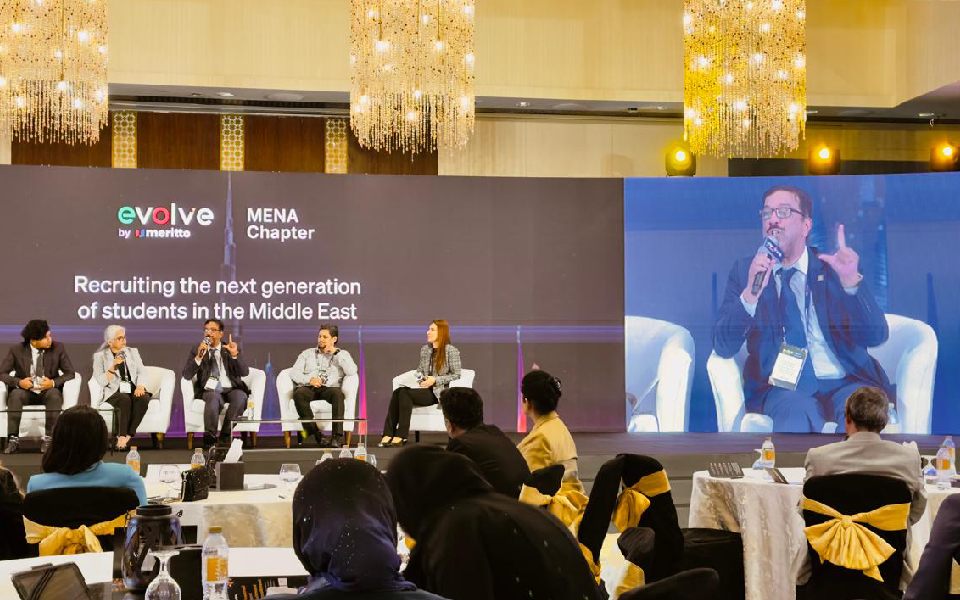
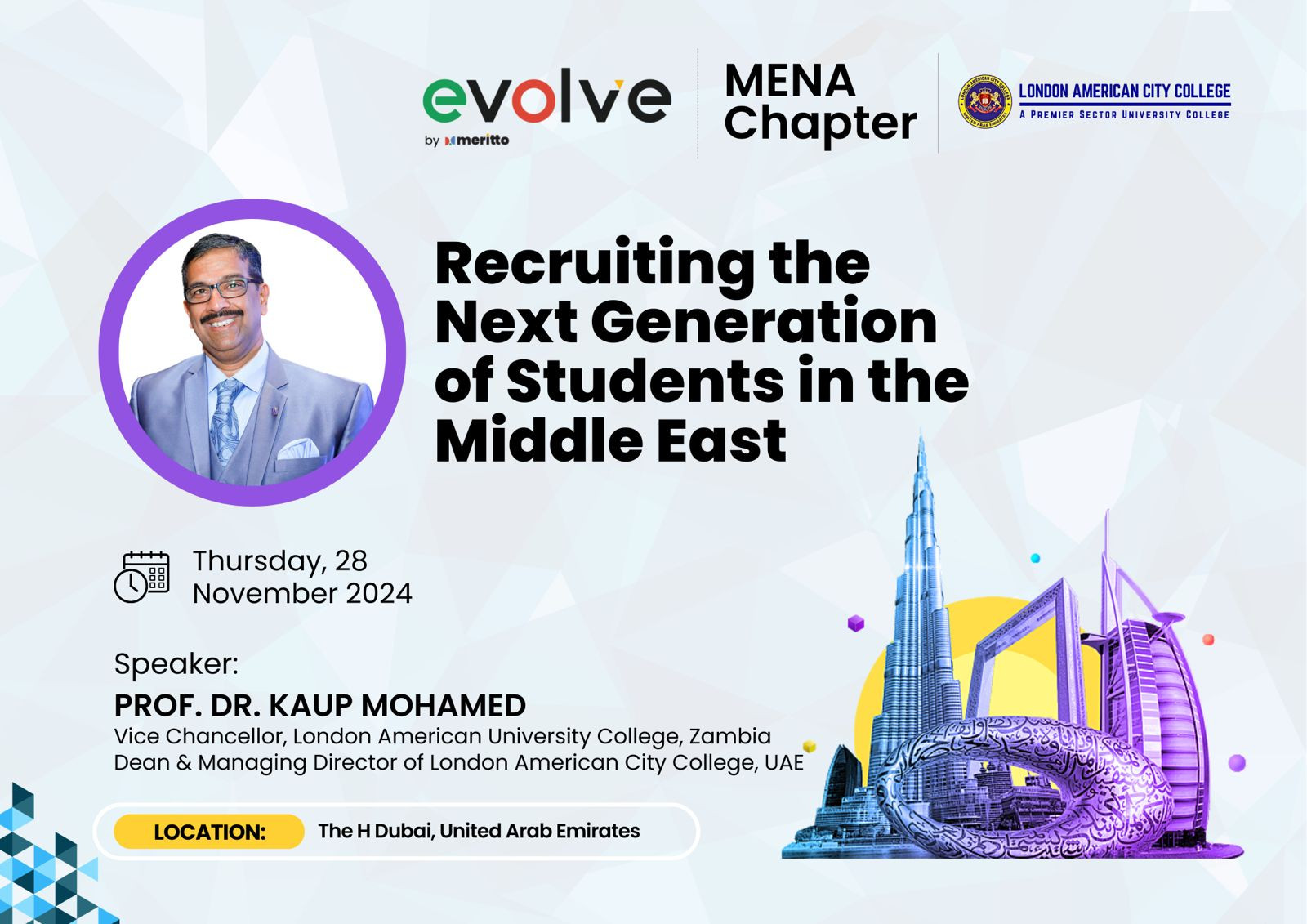
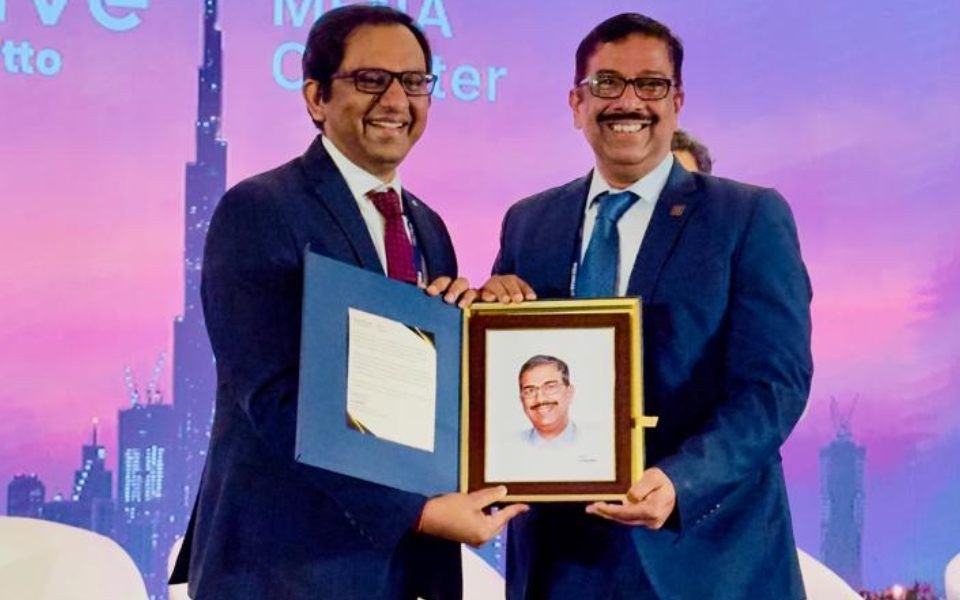
Dr. Kaup Mohamed, Dean and Managing Director of London American City College, UAE, and Vice-Chancellor of London American University College, Zambia, participated as a guest speaker at the MENA chapter of Evolve by Meritto.
Dr. Kaup took part in a panel discussion on “Recruiting the Next Generation of Students in the Middle East,” where he shared insights on strategies, trends in education, and approaches to admissions and marketing.
The event brought together educators and professionals from the education sector to discuss developments and challenges in the field. London American City College expressed appreciation for Dr. Kaup’s contribution to the discussion.
source: http://www.english.varthabharati.in / Vartha Bharati / Home> Gulf / by Vartha Bharati / November 28th, 2024
Amidst these chants, almost at 1 AM today, the Ameer-e-Jamaat and Patron of SIO Syed Sadatullah Husaini announced that the National President of Students Islamic Organisation of India (SIO) for the upcoming term 2025-26 would be Abdul Hafeez.
The announcement was made during the ongoing two-day All India ZAC (Zonal Advisory Council) Meet of the organisation held in Udupi, Karnataka on Friday and Saturday.
Many people were overjoyed, while one person burst into tears. That person was none other than the newly elected National President, Abdul Hafeez himself.
For the past 42 years, the Students Islamic Organisation of India (SIO) has been preparing students and youth to reconstruct society according to divine guidance. To ensure focused work in a specific direction, it is essential for any organisation to have a president.
This is why whenever the Prophet Muhammad ﷺ sent a group of people on a journey, he would appoint one among them as their leader (responsible person).
According to the constitution of the Students Islamic Organisation of India (SIO), it is essential for organisational office-bearers to possess the following qualities:
They should be a member of the organisation but must not aspire for any position.
They should excel in terms of religious knowledge, piety, understanding of matters, wisdom, sound judgment, adherence to the constitution, steadfastness and dedication in the path of Allah, and organisational abilities, making them overall the most suitable candidate within their electoral or appointed circle.
The SIO elections take place without any exit polls or opinion polls, and here, it is the winner who feels the greatest burden. In this system, it is not the opponents who cry, but the one who wins.
Abdul Hafeez has been engaged with SIO since his school days and was awarded with the Membership of SIO in 2012. Previously served as Regional president, City president of SIO Hyderabad, National Secretary of SIO of India, State President of SIO Telangana, and now Abdul Hafeez is newly elected President, SIO of India for the term 2025-26.
Abdul Hafeez is basically from Adilabad, later shifted to Hyderabad for education. He is a mechanical engineer by profession, graduated M.E. from Osmania University, and M.A. in Sociology from Nizam College.
May Allah give him more steadfastness, knowledge, wisdom, courage and patience to lead the students community of the beloved nation.
source: http://www.radiancenews.com / Radiance News / Home> Focus> Report / Radiance News Bureau / November 30th, 2024
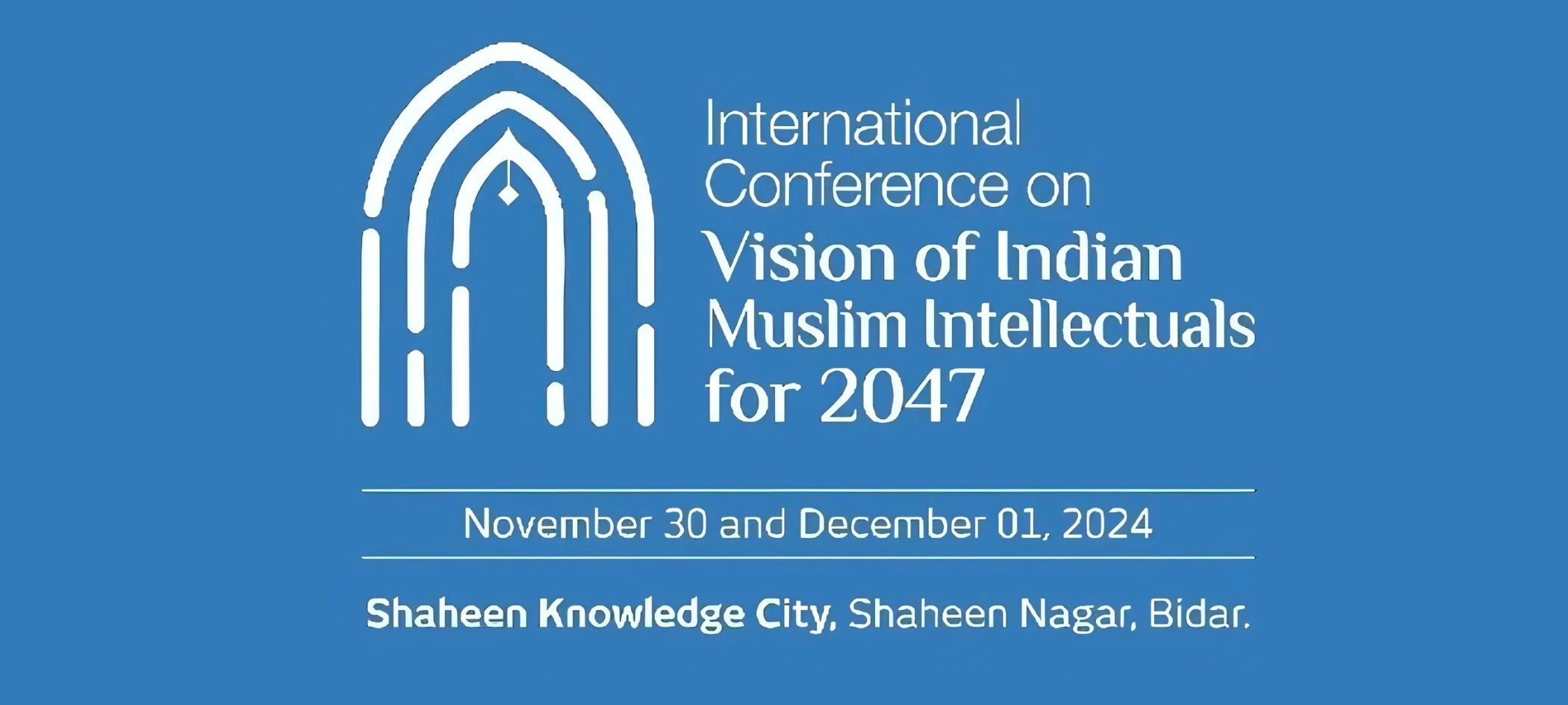
The Shaheen Group of Institutions is set to host a groundbreaking international conference on November 30 and December 1, 2024, in Bidar, Karnataka.
Touted as India’s first event of its kind, the conference aims to spotlight the contributions of Indian Muslims in critical sectors such as education, politics, media, economics, IT, social services, and madrassa education, envisioning their role in shaping a developed India by 2047, the centenary of the nation’s independence.
The conference will serve as a platform for thought leaders, intellectuals, and influencers from India and abroad to network and exchange ideas. Attendees will deliberate on the community’s potential to drive transformative change in various fields, aligning with India’s vision for growth and development.
This pioneering event highlights the Shaheen Group’s commitment to fostering dialogue and collaboration within the Indian Muslim community to contribute effectively to the nation’s progress.
source: http://www.thehindustangazette.com / The Hindustan Gazette / Home> News> Education / by Shifa (image source: shaheengroup.org) / November 27th, 2024
New battle-lines are being drawn in Parliament, and out of it, with waqf and its management at the centre of a major political slugfest.
New battle-lines are being drawn in Parliament, and out of it, with waqf and its management at the centre of a major political slugfest.
At this juncture, it is appropriate to recall the achievements of Hakeem Abdul Hameed, the founder of Jamia Hamdard, whose birth centenary was celebrated in December 2008, and the waqf he founded ~ the Hamdard (Waqf) Laboratories ~ is well into its ninth decade. Speaking during Hakeem saheb’s centenary celebrations at Jamia Hamdard, then Vice-President of India Hamid Ansari observed, “in our recent history Hakeem Abdul Hameed is probably the first, and the most successful, to resurrect the waqf concept in innovative ways so that a modern company was registered as a wakf institution whose income was to be used for public good in the areas of education, medical relief and the advancement of knowledge.
It was an important signal in the immediate aftermath of the painful Partition of India to thread together the religious element with socio-economic progress and alleviation of poverty.” The Vice-President added, “Since the 1930s and 1940s, over 25 educational research institutions were established, culminating in the Jamia Hamdard. The range is astounding ~ ranging from primary education to post-doctoral research, from Unani Medicine to Information Technology, from Islamic Studies to Business Management. Besides the university, the colleges and hospitals established for service to society, there are a set of institutions that bear testimony to his scholarly interests.
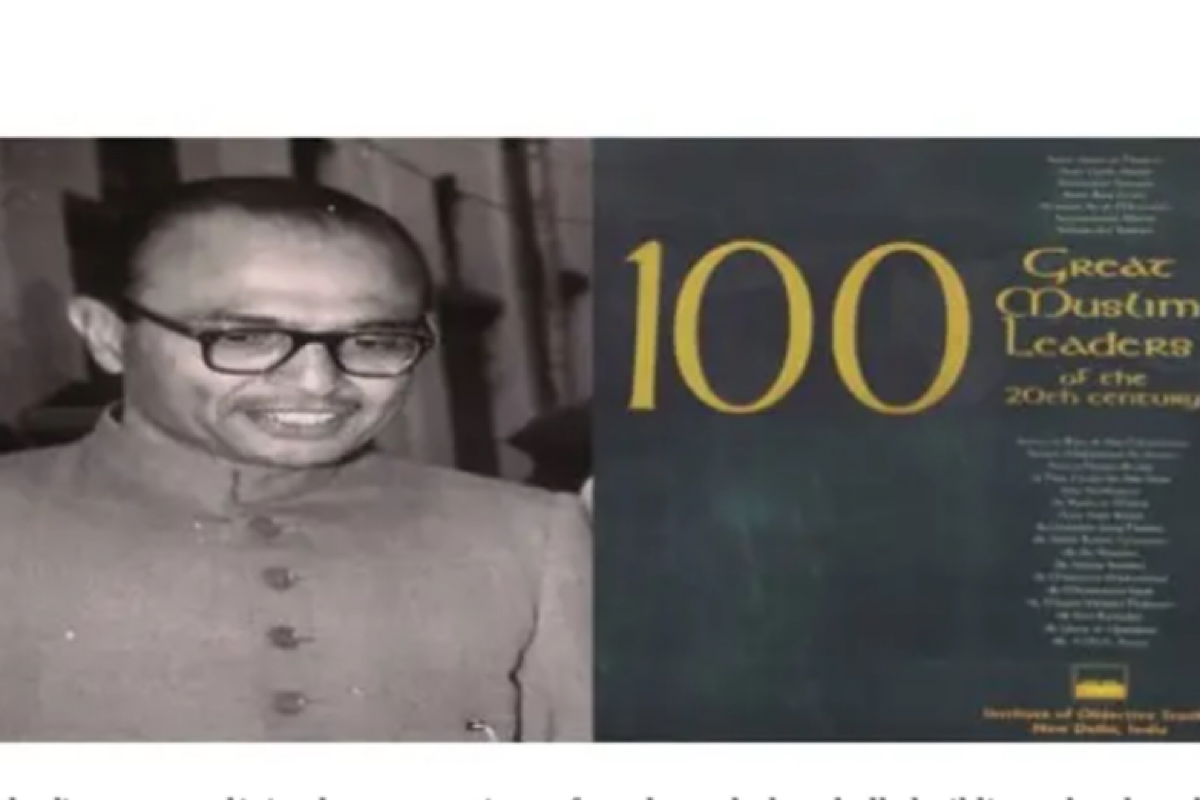
I refer to the Institute of History of Medicine, the Institute of Islamic Studies, the Ghalib Academy and the Institute of Federal Studies. Each of these has rendered significant service to scholarship.” Undoubtedly the list of achievements is long but as Hamid Ansari commented, “these achievements hold a mirror to the potential of what public-minded personalities can achieve through the institution of waqf for the socio-economic, educational and cultural betterment of the community. Future generations would behold Jamia Hamdard and Talimabad and wonder at the capacity, vision and dedication of an individual.” Truly so, for in ‘100 Great Muslim Leaders of the 20th century’, a publication of the New Delhi based Institute of Objective Studies (IOS), Dr Mohd Manzoor Alam provided a larger global context to understanding the achievements of Hakeem Abdul Hameed as an outstanding educationist and social reformer, along with his equally illustrious younger brother Hakeem Mohammad Said.
“In the face of formidable challenges which marked the lives of a selected 100 great Muslim men and women of the 20th century,” wrote Dr Alam in the preface, “their lives, struggles and contributions reflect the response of Muslims to the multiple challenges over the century…the ‘100 Great’ belonged to five continents and they came from different cultural and linguistic backgrounds, they were inspired by the eternal values and principles of Islam and the precepts of their illustrious forebears in the annals of Islamic history.” Through the tumultuous decades of the 20th century, Dr Alam observed that the ‘100 great Muslim leaders’ were unwavering in their “faith in the Holy Quran describing Muslims as ‘good people’, whose mission on earth is to help others live a meaningful life.
Even in the darkest hour the world of Islam was not plaued by a dearth of men and women who had the stature, mettle and competence to rise to the occasion. The two revered Hakim brothers ~ Hakeem Abdul Hameed and Hakeem Mohammad Said ~ who revived the Unani or Greco-Arab system of medicine and created two institutions, the Hamdard in India and its twin in Pakistan, are inspiring examples of leadership. They did not really belong to any one place. This is aggravated by Western colonial redrawing of the Muslim world map: Hakeem Abdul Hameed in India and Hakeem Mohammad Said in Pakistan were, in fact, two sides of a single sub-continental picture of Islamic excellence.”
The lifetime achievements of Hakeem Abdul Hameed were myth-busters: it had been an enduring myth of the 20th century that the Muslim world had been in deep slumber, their state of somnolence stretching back to centuries. Said Dr Manzoor Alam, “the 20th century instead turns out to be a period of extraordinary intellectual, moral and social awakening and struggle across the Muslim world with societies from Malaysia to Morocco trying hard to reform, promote and practice Islam as a living reality that could guide them through difficult times.” The Hamdard story began over a century ago when Abdul Hameed’s father, Hakeem Hafiz Abdul Majeed, established the Hamdard Dawakhana in 1906.
The vision was implicit in the name. Hamdard means ‘the sharing of pain’ and willingness to mitigate it was to be the motto of future generations as well. The vision was also to break the exclusivity of medicinal preparation of each Unani Hakim and make it available to the masses through modern laboratories along scientific lines. A traditional system of medicine was thus modernised with a nationalist inspiration and an indigenous base. “For this reason, Hakeem saheb can rightly be called a Mujaddid (or reformer) of Unani medicine,” said Ansari in the centenary speech.
Writing in ‘Muslim Mirror’, Abdul Rashid Agwan detailed the story. After Independence in 1947, Hamdard University or Jamia Hamdard has been the first institution that was established and managed on the basis of waqf income. In 1948, the manufacturing and selling unit of Hamdard Daw – akhana, Hamdard (Waqf) Laboratories, was converted into an endowment. Its deed dated 28 August 1948 provided for “Qaumi Income” (Public income) and “Khandani Income (Family income). However, the concept of family income was abolished by a declaration of the Settler/ Founder-Wakif Mutawalli in 1985, with retrospective effect from 1 January 1973. From the profits of the company, Hamdard Tibbi College was set up in 1963 in Old Delhi which later shifted to its present 90-acre campus in Tughlaqabad. In order to effectively manage and utilize the income accrued from Hamdard Waqf Laboratories for the promotion of its objective, Hamdard National Foundation was created on 12 May 1964 to disburse company profits to promote interests of society.
All profits of the company were obligated to go to the Foundation. Both Hamdard and the Foundation were registered under Section 12A of the Income Tax Act. Coinciding with the establishment of the Hamdard National Foundation in India, Hamdard Waqf Laboratories Pakistan also formed Hamdard Foundation Pakistan the same year. Its founder, Hakeem Muhammad Said, expressed the mission in these words, “Hamdard … has chosen to serve through activities for the promotion of good health and education ~ the twin pillars of progress.” Through the 1950s and 60s, when educational institutions namely, Indian Institutes of Technology, Indian Institutes of Management, AIIMS and Jawaharlal Nehru University ~ were being established with Government resources and with the focus of providing a new nation the benefit of modern science and education, Hakeem Abdul Hameed was single-handedly building schools, colleges and the university under the Jamia Hamdard banner, relying on internal resources of Hamdard Waqf Laboratories, and focused on rejuvenating the millennia-old Greco-Arab medicine which came to be simplistically known as Unani medicine. In this long process of reviving ancient knowledge, Hakeem saheb’s original contribution was the use of modern scientific methods and technology for the standardisation and manufacture of Unani medicine. “Quite early in life, when he was studying medicine at the Tibbia College, he was deeply impressed by the systematic and methodical approach of Hakeem Ajmal Khan towards the classification and standardisation of Unani medicines,” the IOS publication narrated. The Hakeem brothers travelled across Asia and Europe in the 1950s closely observing modern methods and techniques of drug making. They were convinced of the relevance and necessity of using modern technology for medical experimentation and manufacture of Unani medicines. At Hamdard Laboratories, Hamdard University, Hamdard Nursing Home and Majidia Hospital, these modern methods and technology were put into good use, ensuring the regimen of Unani system of medicine could co-exist with modern science and technology.
“This integrated, holistic approach to diagnosis and therapy is one of the most original and outstanding contributions of Hakeem Abdul Hameed,” the IOS publication stated. Eleven books on Unani medicine: Arab medicine and its relevance to modern medicine; Earth, elements and man: Search for a solid foundation of the theory and practice of medicine; and the magnum opus Qarabadin-e-Hamdard or Hamdard Pharmacopoeia are testimony to Hakeem Abdul Hameed’s medical observations, experiences and researches. In the 1980s, he initiated path breaking research on Ibn Sina’s Al-Qanun fit-Tibb or The Canon of Medicine. The 3-volume study was made available in multiple languages, including English.
Several national and global awards were bestowed on Hakeem Abdul Hameed who lived an austere life on campus till the age of 91, with a Gandhian determination to build the new nation through promotion of medicine, modern education and public charity. Like Sir Syed Ahmed Khan and Hakeem Ajmal Khan, Hakeem Abdul Hameed remains a towering personality whose contribution to modern education and medicine is second to none. It is in the domain of waqf management that Hakeem saheb gave modern India a new path for sustainable, equitable development.
(The writer is a researcher writer on history and heritage issues and a former deputy curator of Pradhanmantri Sangrahalaya)
source: http://www.thestatesman.com / The Statesman / Home> Opinion / by Raju Mansukhani, New Delhi / October 07th, 2024
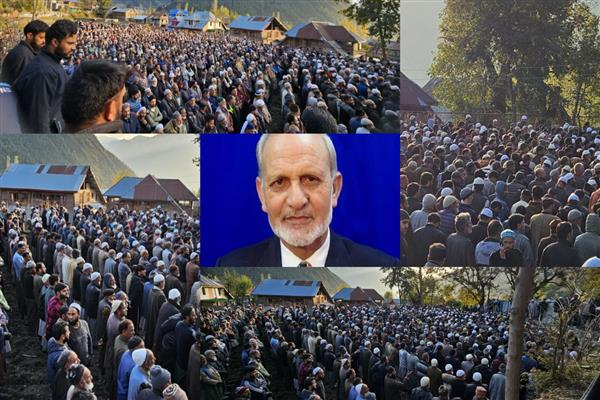
Thousands Attend Last Rites in Karnah; Ministers Sakeena Itoo, Javed Ahmad Dar, CUK, and KU Mourn Demise; Institutions Across J&K Express Grief
Thousands Attend Last Rites in Karnah; Ministers Sakeena Itoo, Javed Ahmad Dar, CUK, and KU Mourn Demise; Institutions Across J&K Express Grief
Karnah (KNS):
Professor Abdul Wahid Qureshi, a prominent scholar and former Vice-Chancellor of Kashmir University, passed away on Sunday at SKIMS Soura Srinagar.
According to KNS Correspondent Karnah, Professor Qureshi, originally from Karnah area of Kupwara, had a distinguished career in academics and administration. After completing his early education at Higher Secondary School Kandi Karnah, he pursued higher studies at SP College Srinagar and later earned his master’s and Ph.D. in Economics from Aligarh Muslim University.
In 1996, at the age of 26, he began his academic career as an Assistant Professor in the Department of Economics at Kashmir University. He later served as Vice-Chancellor of the university from 2004 to 2007, followed by a tenure as the founding Vice-Chancellor of the Central University of Kashmir from 2009 to 2012.
Professor Qureshi was known for his contributions to education and the community. He was a strong advocate for educational opportunities in his home region of Karnah and supported students through guidance and financial assistance.
He is survived by his wife and three sons, who are professionally established as a doctor, an engineer, and a college professor.
Thousands of people gathered at his Lal Bazar residence in Srinagar to pay their respects before his body was transported to his ancestral home in Karnah. He was laid to rest at his ancestral graveyard in Kandi on November 17, 2023, with a large number of mourners in attendance.
Professor Qureshi’s death is being widely mourned in the region, with many recognizing his significant contributions to education and society.
Meanwhile, Central University of Kashmir (CUKashmir) faculty members, administrative staff, research scholars and students, led by Vice-Chancellor, Prof. A Ravinder Nath, deeply condoled the demise of its founding Vice-Chancellor, Prof. Abdul Wahid Qureshi.
Prof. Abdul Wahid Qureshi was also the former Vice-Chancellor of the University of Kashmir, and an eminent Economist.
In his condolence message, Vice-Chancellor, Prof. A Ravinder Nath, said, the demise of a founding figure is a moment of profound reflection and mourning, especially when that person has contributed significantly towards the establishment and growth of the varsity.
“Prof. Qureshi was a visionary leader who laid the foundation of CUKashmir and was instrumental in the creation and growth of the institution. His unwavering dedication, passion for education, and commitment to academic excellence were the cornerstones upon which this university was built,” Prof. A Ravinder Nath said, adding that Prof. Qureshi, played a pivotal role in the academic growth of the varsity and guided the faculty members for achieving academic excellence in their respective fields. Prof.
A Ravinder Nath further said, “We will continue to honour his memory through our work, our commitment to education, and our dedication to shaping the future Prof. Qureshi so passionately envisioned.”
In his message, Dean Academic Affairs, Prof. Shahid Rasool, said, the passing away of the founding Vice-Chancellor marks not only a loss of an individual but a pivotal moment in the history of the institution itself. “Prof. Wahid Qureshi, contributed through his expertise, academic and administrative standing for the overall progress and holistic development of the university since its inception,” Prof. Shahid Rasool said.
“Prof. Qureshi’s leadership extended beyond the classroom, as he endeared himself to all with his humility, wisdom, and generosity.” “For me it is a personal loss as I have had the opportunity of working under his affectionate leadership for over two decades and a memorable association of over three decades.”
In his message, Registrar, Prof. M Afzal Zargar, said, “Prof. Qureshi’s vision for a forward-thinking, inclusive, and student-centered university continues to guide the institution today.” He said the entire CUKashmir mourns this great loss, and stands united in our commitment to uphold the vision and principles of Prof. Abdul Wahid Qureshi.
The CUKashmir faculty and staff expressed solidarity with the bereaved family and prayed for peace to the departed soul. “Our thoughts and prayers are with the bereaved family during this difficult time,” the CUKashmir employees said.
The CU Kashmir has organised Condolence meetings at all the Campuses on Monday at 3:30pm.
With profound grief and a heavy heart, the University of Kashmir is mourning the sad demise of former Vice Chancellor (VC), University of Kashmir (KU), Prof Abdul Wahid Qureshi.
Prof Qureshi passed away Sunday due to cardiac arrest at a hospital in Srinagar. A distinguished academic and senior professor, Prof Qureshi served as KU Vice Chancellor from 2004 to 2008.
In a heartfelt message, KU Vice Chancellor, Prof Nilofer Khan, expressed her deep sorrow and offered her condolences.
“Prof Abdul Wahid Qureshi’s passing is an irreplaceable loss for the academic community. His leadership and visionary contributions have left a lasting impression on the University of Kashmir,” she said, adding that Prof Qureshi’s work will be remembered by generations.
“His legacy of dedication and compassion will continue to inspire us. May Almighty Allah grant him the highest place in Jannah,” Prof Khan said in a statement issued here.
KU Registrar, Prof Naseer Iqbal, on behalf of the KU administration, extended his heartfelt sympathies to the bereaved family.
“Prof Qureshi’s profound impact on higher education in Jammu and Kashmir, his commitment to student welfare and his tireless efforts for academic advancement will remain forever in our hearts,” he said, reiterating that the region has lost a mentor and revered academician.
The university community, including faculty, students, scholars and staff, joined in collective mourning for Prof Qureshi praying for eternal peace to his soul.
Teachers and students remembered him as an inspiring figure whose contributions strengthened the foundation of the institution and enriched the lives of countless individuals.
Scholars reflected on his mentorship and expressed gratitude for his dedication to education and learning. “In this moment of grief, the University of Kashmir stands in solidarity with Prof Qureshi’s family. May Almighty Allah grant him the highest place in Jannah and bestow patience and forbearance upon his family to bear this irreparable loss,” a spokesperson said in the statement.
To pay homage to the departed soul, KU scheduled a condolence meeting on 18th November (today) at 11 am in the main campus, added the statement.
Also, Minister for Education, Social Welfare, Health & Medical Education, Sakeena Masood has condoled the sad demise of former Vice Chancellor of Kashmir University (KU) and Central University of Kashmir (CUK), Prof. Abdul Wahid Qureshi. In her condolence message, Sakeena Masood described the late Prof. Qureshi as distinguished academic leader and visionary, who dedicated his life to advancing education and fostering excellence.
She added that during his tenure as Vice Chancellor of Kashmir University, he played a pivotal role in the transformation and growth of University, bringing significant improvements in curriculum, infrastructure and faculty development. She underlined that through his acumen and vision for future, Prof. Qureshi started the entrance based exams for admissions in KU, adding that he also has been the pioneer of starting several new courses in the Varsity.
The Minister also remembered the role of Prof. Qureshi in hand holding the students of far-off areas and downtrodden communities and nurturing them to excel in education. She also said that Prof. Qureshi, as first Vice Chancellor, played a vital role in establishment of Central University of Kashmir. She added that during the infancy years of the University, Prof. Qureshi played critical role in starting various courses in different programs at the Varsity.
She further highlighted that Prof. Qureshi, because of his integrity and honesty, has served as the Chairman of J&K Bank selection committee for a considerable time. The Minister, while playing glowing tributes to former Vice Chancellor, said that Prof. Qureshi’s legacy will continue to inspire future generations and his absence will be deeply felt in the academic community. She also extended her deepest sympathies with bereaved family and prayed for highest place in Jannah for the departed soul.
Minister of Agriculture Production, Rural Development Department and Panchayati Raj, Javed Ahmad Dar, has expressed profound grief and sorrow over the demise of former Vice Chancellor of Kashmir University (KU) and Central University of Kashmir (CUK), Professor Abdul Wahid Qureshi.
The Minister described late Wahid Qureshi as a visionary academic leader who not only excelled in his field but also motivated others to strive for excellence.
Paying glowing tributes, the Minister said that Professor Wahid Qureshi was a person of par excellence, who dedicated his life towards taking education to new heights. He said that the deceased played a pivotal role in establishing both University of Kashmir and CUK as great campuses for learning and academic leadership.
Javed Dar extended sympathies to the bereaved family and prayed for eternal peace to the departed soul. He acknowledged that Prof. Qureshi’s teachings will continue to inspire students and professionals to improve educational scenario in Jammu and Kashmir. He said that late Prof. Wahid Qureshi was a beacon of knowledge and inspiration for academic world.
source: http://www.knskashmir.com / Kashmir News Service / Home> Education / by KNS Desk Srinagar / November 17th, 2024
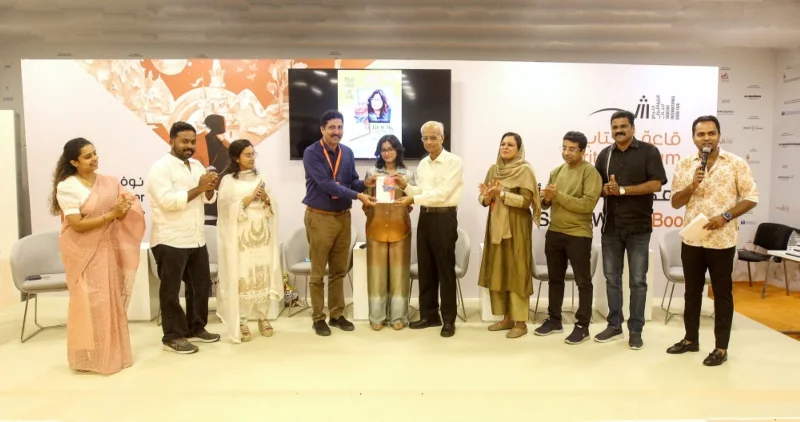
Thahaani Hashir released her 3rd book at the SIBF on Sunday afternoon. Kamal Kassim/Gulf today
Sharjah International Book Fair (SIBF) on Sunday was full of hustle and bustle. Lots of beautiful minds landed in Sharjah to regale audiences in the evening.
Celebrated Indian writer Chetan Bhagat inspired his fans, while Bollywood star Huma Qureshi mesmerised her audience. Malayalm actor, author and presenter Aswathy Sreekanth also arrived at the book fair on Sunday evening to talk about her latest book “Kaali.” She also enchanted her fans with her exciting talk.
On the other side, Writers Forum of the SIBF was swarming with school-going children in the afternoon. They were all chirping and giggling with excitement and joy. They were at the venue to cheer their young friend and classmate Thahaani Hashir. Thahaani’s journey to the world of writing is indeed incredible. Her brush with pen and paper started very early in life.
We expect a 16-year-old student to read books to develop his or her intellect, but Sharjah-based Indian student Thahaani Hashir was gracing the podium of SIBF with her third book of poetry, “Made For Love,” in the presence of a huge gathering, who were constantly clapping for this young girl. It was indeed a moment to behold.
Thahaani is an 11th grade student of Our Own English High School, Sharjah. Born and brought up in the UAE, she hails from Kollam, Kerala, India.
Thahaani made her debut at the age of 10 with her book “Through My Window Panes.” The book was released in 2018 and she became the youngest author at the SIBF. She received lots of praise for her debut book. Her second book of 30 poems “Flames That Never Died” came in 2021, while she was 13.
Talking to Gulf Today before the launch of her book, she said, “I always had the habit of writing. I must have been six years old when my class teacher noticed the talent in me. I would write short stories or something in song format. I did not know then how a poem looks like. But it was my class teacher Madhavi ma’am who saw this talent in me and she encouraged me to carry on and that’s how I got into writing.”
Thahaani’s ability to express her emotion with so much of maturity at this age is what makes her a shining star.
“Made For Love” is a compilation of 60 poems written by Thahaani Hashir and illustrated by Ashar Gandhi. Each of the 60 poems are depicted through one line illustration (entire illustration is drawn with a single continuous line, the pen is only lifted when completed). It is a rare occurrence to see all the poems in a book depicted through one line art.
Talking about her book she said, “Majority of my poetry is about love.” When asked how much time it took for her to complete her third book, she informed, “After my second book, I did not write for a good while for some reason. It could be writer’s block sort of thing. But in the last one year I could find my rhythm back and here I am with my new book.”
When asked to reveal her favourite author, she said, “Palestinian poet and author Mahmoud Darwish is my all-time favourite.”
Daughter of a civil engineer father and journalist mother, Thahaani has received several accolades.
Praising Thahaani, one of her teachers, who was present at the event said, “While she was in Grade 1, she was brilliant in all the subjects. She would always come to meet me with different ideas. Everyday she would write and show to me. I really have no words to express her talent and I am extremely happy to have been her teacher.”
The 12-day cultural extravaganza, organised by the Sharjah Book Authority, is themed “It Starts with a Book,” and has in store 1,357 activities for children and adults alike. It will come to a close on November 17 after playing host to 2,520 publishers from 112 countries.
source: http://www.gulffoday.ae / Gulf Today / Home> Culture / by Raghib Hassan, Staff Reporter / November 14th, 2024
Bihar is on top of the list of Sahitya Akademi Awardee for 2020. Three litterateurs including Anamika of Muzaffarpur figure in the coveted national list. She is the first woman in the country to receive the Sahitya Akademi Award in Hindi for her poetry collection.
The 80-year-old Kamalkant Jha, who hails from Jayanagar in Madhubani, would get the award for his story collection ‘Gachh Rusal Achhi’ published in Maithili language.
The most discussed award is that of the famous storyteller Hussain-ul-Haq of Urdu, who lives in New Karimganj. He was awarded the Sahitya Akademi Award for his novel Amavas Mein Khwab. (Dreams in dark night).
Chief Minister Nitish Kumar has congratulated Hussain-ul-Haq for getting Sahitya Academy Award. In a message to all three, the Chief Minister said it was a matter of great pride for Bihar that three of Bihar’s writers were named to receive the Sahitya Akademi Award. The entire Bihar is proud of them,” he said.
Hussain ul Haq has not been keeping good health. He returned home from Delhi where he had gone for treatment. This honour has brought cheers to the family. They shared happiness by distributing sweets.
Haq’s younger brother Dr Ain Tabish is Head of the department of English in Mirza Ghalib College, Gaya. Tabish told Awaz-the Voice, “Bhaiya receiving this honor is a big day for the family. It will inspire young writers and also make people realise that writing on social issues is relevant.”
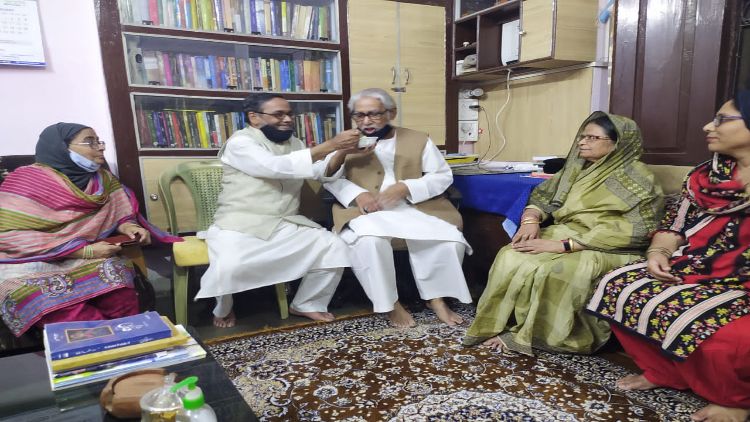
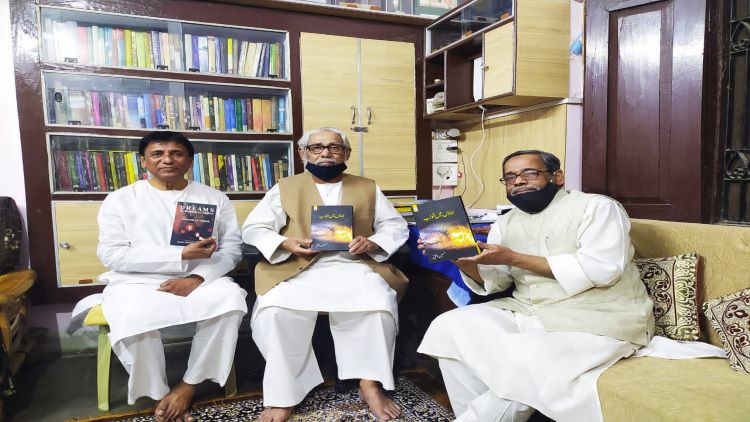
Hussain ul Haq’with family and his books
Born in Sasaram in 1949, Hussain ul Haq’s writings are mostly on human bond and the middle-class society. According to Ahmed Sagir, a young writer who is close to Haq, in 1991, Hussain ul Haq’s first novel ‘Bolo Mat Chup Raho’ (Don’t speak; keep quiet) made waves. His second novel,‘Farat’ published in 1994, got him more limelight and recognition. For some reason, Hussein-ul-Haq didn’t write for a long period. The third novel ‘Amavas Mein Khawab’ hit the stand in 2071 and it sold like hotcakes. It made a great impact in the world of Urdu literature. He has been awarded the Sahitya Akademi Award for this novel. The novel is based on a story about the changing socio-political environment in the time period between 1930 and 1950.
Hussain-ul-Haq has a deep affinity with Sufism. His family is the successor to the legacy of a great Sufi Saint and also the caretaker of his tomb – khanquah. His father, Maulana Anwarul is a well-known personality of Sasaram. Hussain ul Haq says he has imbibed the thinking and the way of understanding things from his father.
Though the family is settled in Gaya, their relationship with Sasaram remained intact. The influence of Khanqahi culture and Sufiism has played role in Haq’s focus on human bonds in his writing.
Hussain ul Haq, who retired as head of the Urdu department and proctor of Magadh University has also published eight story collections, three novels, and half a dozen other books.
After Abdul Samad, Mazhar Imam, Ilyas Ahmed Gaddi, Professor Jabir Hussain he is the fifth Urdu writer from Bihar to receive the Sahitya Akademi Award.
Hussain ul Haq’speaking at a function
Friday brought in a lot of happiness in the Haq family. In the morning, the first news came that Hussain ul Haq has been awarded the Shamim Nikhat Memorial Fiction Award in UP and he will be honored on 13 March at Lucknow. The organisation confers writers with a sum of Rs 50,000 and a memento. Haq will skip the award due to his ill health.
By the evening came the news of the Sahitya Academy Award filling the home with happiness and joy.
Ain Tabish says this award will have a big impact in the Urdu world as the message that writing based on serious issues and principles is still valued today.
Sahitya Akademi Award is the top award for Indian literature and is given away for 20 Indian languages. Among the recipients of this award are senior Congress leader and former Union Minister of Karnataka Veerappa Moily.
source: http://www.awazthevoice.in / Awaz, The Voice / Home>Story / by Seraj Anwar, Patna / March 13th, 2021