The Urdu writer was chosen for his work Fakr-E-Watan
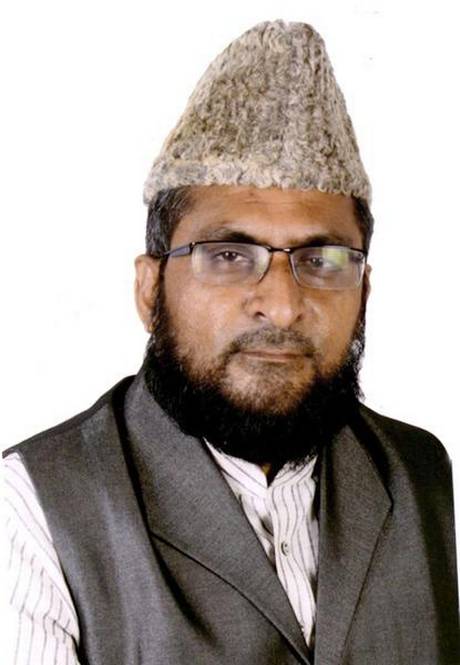
Shikaripur-based Urdu writer Hafiz Karnataki has been chosen for Sahitya Akademi’s Bal Sahitya Puraskar of 2020. He received the award for his book Fakr-E-Watan, a work on freedom fighters of India.
Mr. Karnataki, 57, began his literary career as a poet in the 1980s and later turned towards writing for children. So far, he has brought out 94 books. He has translated many vacahanas of Basavanna and Akkamahadevi and writings of Kuvempu into Urdu.
Born into a family of teachers, he developed an interest in literature at a young age. He became a teacher at a government primary school in 1987 and worked at different places before resigning from the job in 2006.
Now he looks after his educational institution, which provides education to 3,000 girls at Shikaripura. He also worked as chairman of Karnataka Urdu Academy. A couple of students have done PhDs on his literature. Considering his contribution to the field of literature, Gulbarga University honoured him with an honorary doctorate in 2013.
After the Sahitya Akademi announced the award on Friday, he received calls from different parts of the country congratulating him. “I am getting congratulatory messages from many people. First among those called me were the scholars who did study my literature for PhD,” he told The Hindu on the phone.
Mr. Karnataki wants to hit a century by bringing out six more books soon, as he has already published 94 works. “Children of the present generation are more intelligent than me. I wish to write for them on values they have to inculcate at a young age,” he said. The award carries a cash prize of ₹50,000, besides a memento.
source: http://www.thehindu.com / The Hindu / Home> News> States> Karnataka / by Special Correspondent / Hassan – March 14th, 2021
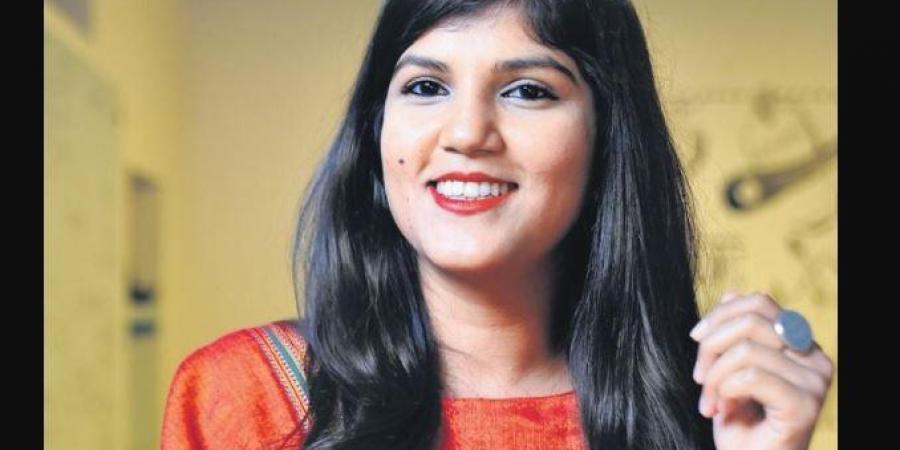
Bengaluru’s zero-waste advocate Sahar Mansoor has brought out a guide book that provides personal insights and interactive activities to help the reader transition to a more sustainable lifestyle.
Sahar Mansoor
Bengaluru :
Health and environmental issues have come to the fore in the last one year. With increasing number of people becoming conscious about their choices, the recently-released book, Bare Necessities: How to Live a Zero-Waste Life, by Sahar Mansoor and Tim de Ridder aims to provide personal insights, interactive activities and solutions that can help you transition to a more sustainable lifestyle.
”The book has taken a staged approach where the reader journeys through topics that are intimate such as personal care routines and fashion choices, to more communal areas of life such as the kitchen, home care and festival occasions. It also looks at broad aspects of life, including the community and global impacts of waste. One of the fantastic things that we have achieved is to provide a toolkit of zero-waste information and insights throughout, such as my personal stories about how to make zero-waste products such as toothpaste and food such as holige,” says Mansoor.
Published by Penguin, the guide (Rs 299) includes activity sheets to share ideas with friends and families throughout the text. “We have provided recipes, tips and tricks and other ideas to help people learn, and enjoy the zero-waste journey,” says Mansoor, who has been working in the sustainability sector since 2015, participating in areas like waste reduction and climate change.
Ridder and she began putting pen to paper in September 2019. “Unfortunately he had to work abroad from October to January last year. We had to face challenges such as scheduling meetings across time zones.
When the borders were closed in March 2020, he stayed permanently in Australia,” she says. The situation also provided them a new perspective, and prompted them to add valuable sections in the final version. “We would love the book to be used in schools, where kids can learn about the wealth of resources available in India. There are opportunities to learn how to compost, create a community garden and make sustainable gifts,” says Mansoor.
source: http://www.newindianexpress.com / The New Indian Express / Home> Cities> Bengaluru / by Express News Service / March 09th, 2021
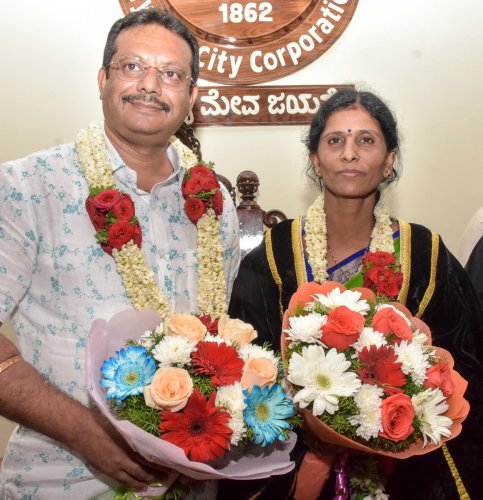
Newly elected Deputy Mayor Anwar Baig and Mayor Rukmini Madegowda in Mysuru on Wednesday. DH PHOTO
JD(S) corporator Rukmini Madegowda was elected as Mayor of Mysuru while Anwar Baig of Congress as Deputy Mayor, on Wednesday.
The election for Mayor and Deputy Mayor posts was held at Mysuru City Corporation (MCC) here. The term of the previous Mayor Tasneem of JD(S) ended on January 19.
The JD(S) and Congress alliance continued in the Mayoral poll, with slight changes. As per the agreement in 2018, the Mayor’s post was supposed to be for the Congress.
While Rukmini managed to secure 43 votes, BJP candidate Sunanda Palanetra obtained 26 votes. Similarly, Congress corporator Anwar Baig was elected as Deputy Mayor, by defeating BJP’s S Satvik.
The mayor’s post was reserved for General Category (woman) and deputy mayor was for general category. Regional Commissioner G C Prakash conducted the elections and announced the results. MCC Commissioner Shilpa Nag was present.
It has to be noted that, as per the agreement between the Congress and the JD(S) in 2018, the mayor’s post was supposed to be for the Congress, in the first and third term of the existing council. But, now the JD(S) retained the Mayor’s post, due to certain issues.
The JD(S) was not ready to continue the alliance with the Congress, due to a rift between Leader of the Opposition Siddaramaiah and JD(S) leaders. However, JD(S) corporators decided to extend support to the Congress, on a demand for the Mayor’s post.
MLA Tanveer Sait said, “We agreed to give the mayor’s post to the JD(S) this time. The mayor’s post will be reserved for the Congress for the next two terms.”
source: http://www.deccanherald.com / Deccan Herald / Home> State> Karnataka Districts / by Ranjith KV, Mysuru / February 24th, 2021
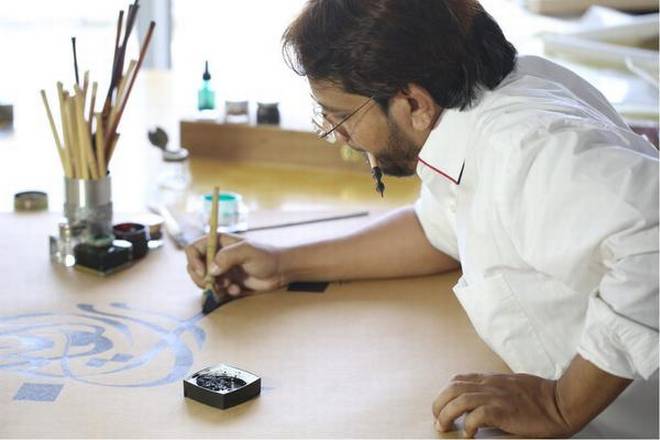
Muqtar Ahmed at work. Photo: Special Arrangement/THE HINDU
A 24-year-old with a global presence and her teacher are among a few keeping the art of Arabic calligraphy alive in India
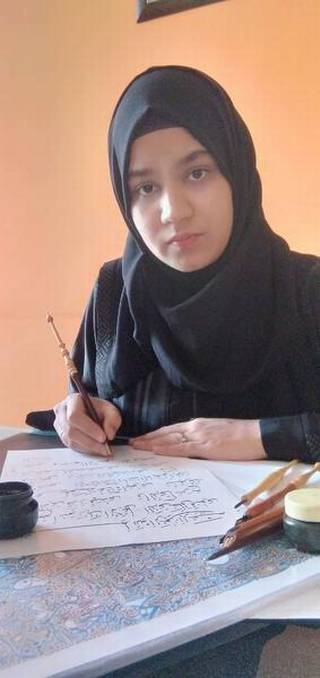
Bee Bee Laisa, a final year Engineering student in Bengaluru, has a dream. The 24-year-old wants to transcribe a copy of the Koran in Arabic. “I have always been interested in art and drawing, but it was only when I started learning English calligraphy that I was introduced to the art form in Arabic, which would help me transcribe the holy book,” says Laisa.
And so began her journey in 2016, as a student of the Institute of Indo-Islamic Art and Culture (IIAC) at Richmond Street, Bengaluru, to learn Arabic calligraphy. Also known as khat, this centuries-old art form is held in high regard by Muslims because of its association with the dissemination of the Koran before the era of printing presses.
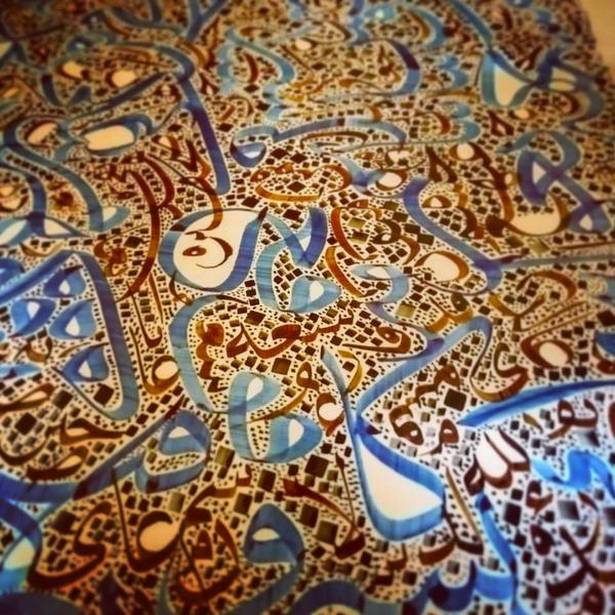
In the past five years, Laisa has mastered the decorative script thuluth considered one of the most difficult fonts, and naskh (used to write the Koran). Her talent has been recognised on several international and local platforms: her calligraphic artworks of Koranic verses and Islamic phrases have been exhibited in Japan, UAE, and Jaipur since 2017.
Calligraphy alphabet sampler by Bee Bee Laisa. Photo: Special Arrangement/THE HINDU
It is a huge leap forward for Laisa, whose father works as a banana delivery vehicle driver in Bengaluru. Laisa says calligraphy has helped improve her concentration and also use her drawing skills in her Civil Engineering classes.
“Calligraphers can’t have any dot or line out of place; this has helped me present spotless drawings for my coursework as well,” she says.
The school uses traditional materials to teach the art, including wooden or reed pens (qalam) and inks from plant-based resins. As per tradition, strands of raw silk are placed inside the inkpot (likka), to help regulate the amount of ink on the qalam tip, and also to prevent spills onto the paper.
“We use a paper called muqahar for the final version. Though it is commercially available, calligraphers also learn how to prepare their own muqahar sheets,” says Muqtar Ahmed, the principal and tutor at of the IIAC.
__________
Built to be timeless
The process of making muqahar was perfected in the 17th Century by Turkish calligraphers, and Arabic calligraphy students still learn it today.
Paper is stained with natural dyes (like tea or floral decoctions) and then coated with a tempering mixture of alum crystals dissolved in egg whites. It is then burnished to get a glossy finish.
“Muqahar paper, if made correctly, can last up to 700 years,” says Ahmed.
__________
Devoted to the art
Ahmed is the man guiding Laisa in her mission. He has the distinction of being the only Indian to have earned his Ijazah (Masters diploma) in Arabic calligraphy from the Turkey-based Research Center for Islamic History, Art and Culture (IRCICA), under the auspices of the Organisation of Islamic Cooperation (OIC). He has trained over 500 students through the school’s weekly courses, and has started online classes during lockdown.
“Calligraphy takes a long time to learn, and one only gets better with continuous practice,” says Ahmed.
His own encounter with the art form is a tribute to his tenacity. As an Intermediate school graduate in a small village in Telengana, he started learning Urdu and Arabic calligraphy and decided to make his career as a scribe for an Urdu publication in Bengaluru, in 1990.
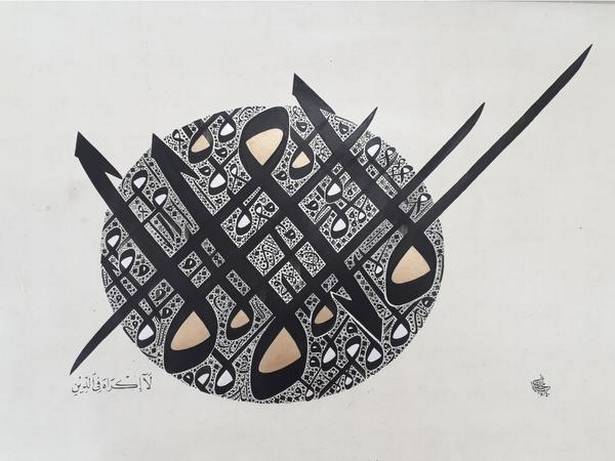
Arabic calligraphy by Muqtar Ahmed. Photo: Special Arrangement/THE HINDU
“I used to write entire pages of articles in the column style, before the computers came in,” he says.
Most of the commercial calligraphy that was done for Urdu and Arabic journals before automated printing lacked the aesthetic values of the original art form, he says.
“I’d like to revive Arabic calligraphy among young people and show them how this can not only be an art but also a way to remember the divine in our life,” Ahmed says.
When he lost his job in 1994, Ahmed decided to research how other calligraphers, especially those outside India, were sustaining their craft. He set up a small commercial press to keep his home fires burning, and kept looking out for masters in calligraphy.
“I realised that it is not a language transforming tool, but an art that has a different respect globally,” he adds.
Among the people who helped him were Washington-based Syrian font designer and calligrapher Maamoun Sakkal, and Mohamed Zakariya, the first Westerner to earn calligraphy diplomas from IRCICA in Turkey.
In what sounds like an incredible process today, Zakariya, who is based in Virginia and does not use electronic communication, tutored Ahmed over postal correspondence for three-and-a-half years.
“I used to send my completed exercises from Bengaluru, and he would reply with his comments and corrections by post. Mr Zakariya didn’t charge me any fees for the tuition, and I feel very fortunate to have been his student,” says Ahmed.
Zakariya also introduced Ahmed to his own master Hasan Chalabi from IRCICA, who invited him to Turkey in 2008. After several visits to Istanbul to learn the art, Ahmed earned his Masters degree in 2013.
Paying it forward
“My professors advised me to start teaching calligraphy in India after I graduated, so that I could rekindle the old majesty of the art. When Mr Syed Mohamed Beary [a local real estate developer] heard of this, he sponsored the establishment of the institute in Bengaluru, and put me in charge of it. I’m glad to see that though it is a very difficult field to excel in, at least 15 of our students are being recognised for their calligraphy,” says Ahmed.
Ameerul Islam and Abdul Sattar, two of his students, have set up a branch of the institute in Hyderabad. IIAC’s curriculum covers the Arabic scripts riqa (for newcomers), naskh and thuluth and nastaliq in Urdu. Learning any two scripts thoroughly is ideal for a calligrapher, says Ahmed.
Bee Bee Laisa. Photo: Special Arrangement/THE HINDU
Bee Bee Laisa’s aim of transcribing the Koran is shared by her teacher. “In fact it is the ultimate goal of every Arabic calligrapher,” says Ahmed. “But it is a huge project, because there are at least 600 pages to be transcribed. If we do something with our hands, it is priceless,” he says.
source: http://www.thehindu.com / The Hindu / Home> Society> History & Culture / by Nahla Nainar / February 19th, 2021
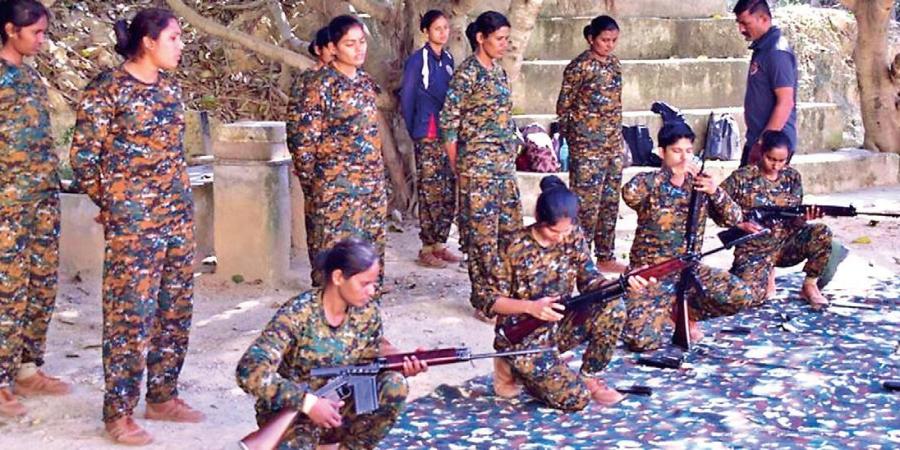
The first batch of women commandos undergoes training for Garuda, Karnataka’s anti-terror force. (Photo | EPS)
What will emerge is a lean, mean team — the first batch of the all-woman Garuda commandos of the Karnataka Police.
Bengaluru :
Seventeen young women, mostly from villages across Karnataka, are training to shoot, handle explosives, rappel, rope walk, handle terror, as they build grit and endurance, for 12 hours a day. What will emerge is a lean, mean team — the first batch of the all-woman Garuda commandos of the Karnataka Police.
The special operational team Garuda, Karnataka’s own anti-terror force, was formed in 2010, and for the first time this year, the department will be training 50 women to join the force. Pre-induction training is on at Bengaluru’s Centre for Counter Terrorism for these 17 women, under the Deputy Director, Lt Col Rohit Nayak and his team led by Superintendent of Police M L Madhura Veena.
“They will form the first all-woman commando team and are undergoing training to handle any kind of terror attack or save victims of such attacks,” said Madhura Veena, the only woman SP in the Centre for Counter Terrorism, of the Internal Security Division (ISD). The Response Counter Terrorism Team will be based in Bengaluru, and can reach any part of the city in 30 minutes. The commandos will be deployed in areas with high concentration of IT-BT companies, besides sensitive areas, including coastal Karnataka.
ADGP of ISD Bhaskar Rao has been appreciative of these youngsters coming from humble backgrounds but with enough grit to be trained into commandos with special counter-terrorism skills such as handling weapons, Improvised Explosive Devices, explosives, rope work and communication, CAD (computer aided design) and navigation, medical first aid and PIN (planning, intelligence and negotiation) etc.
“First batch of Women Garuda Commandos with 17 girls have started.
Few are enthusiastic, few want to go back. But a very strong willed SP, Madhur Veena is spending full time. The girls are amazing quick learners,” Bhaskar Rao tweeted on Saturday. However, when the girls were asked why some of them want to go back, Uma Devi, from a village in Bidar, said, “It is difficult initially. During basic training, after we clear constable post, it’s not so rigorous. Here we are trained in handling weapons, ropes, besides tackling obstacle course,” she told TNIE.
Umashree, 26, a constable with Karnataka State Industrial Security Force, added, “I was among the first two women who began training two months ago with men for the same force. In an emergency, it doesn’t matter if you are a man or woman. You have to have grit, focus and physical strength to bear all this. We motivate women who come for training.”
Rizwana agrees, saying that though her parents work in the fields in a village in Kalaburagi, she had always dreamt of joining the police force and is fascinated by the stars on the uniform. “I will make it big here, I know. I will continue with training,” she says.
After two months of training, they will have to write an examination, after which they will be inducted into the team.R
source: http://www.newindianexpress.com / The New Indian Express / Home> Good News / by Chetana Belagere, Express News Service / February 07th, 2021
Beary Chamber of Commerce and Industry (BCCI) felicitated COVID-19 warriors on Wednesday, February 3 at Hotel Ocean Pearl, Mangaluru.
The felicitation program commenced with prayer offered by Ashraf Kinara Kudroli.
Chancellor of Nitte University, N Vinay Hegde said, “When society was facing turbulent times, extending a helping hand to those in need is commendable. I have never witnessed such unprecedented times in the last 81 years of my life. People have been philanthropists on several occasions, but being one during the pandemic is a different thing altogether.”
Chairman Sri Devi Education Trust Sadananda Shetty said, “I congratulate the Beary Chamber of Commerce and Industry for felicitating COVID warriors who worked hard, faced all the difficulties, and risked their lives during the pandemic.”
President Beary Chamber of Commerce and Industry, S M Rasheed said, “The year 2020 was a tough year for all of us, as one of our active founder members lost his life due to coronavirus.”
As many as 11 COVID warriors were felicitated in the event namely: Abdul Rehman Goodinabali, Ziyauddin Ahmed, Abdul Rauf Putthige, Dr Farhan Fazal, Dr Tajuddin K, KM Asif, Abubakar Siddique, Mohammed Ilyas Bajpe, Ashraf Kinara Kudroli, Abdul Azeez and Mohammed Ashraf Kandak.
President Beary Chamber of Commerce and Industry S M Rasheed welcomed the gathering, treasurer Mansoor Ahmed proposed the vote of thanks and Abdul Razzaq compered the event.
source: http://www.daijiworld.com / DaijiWorld.com / Home> Top Stories / February 03rd, 2021
The university has issued a notification on January 28 constituting a committee for drafting the curriculum and regulations.
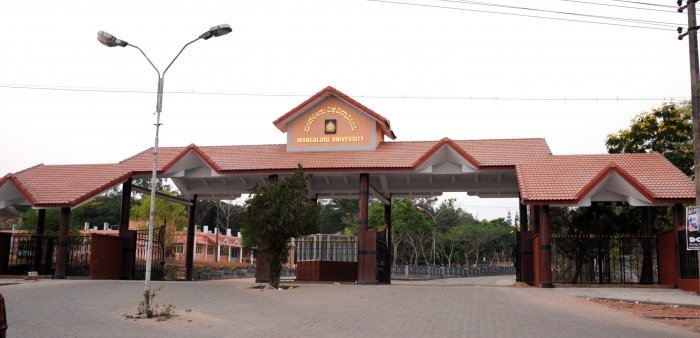
The university has issued a notification on January 28 constituting a committee for drafting the curriculum and regulations to introduce the courses in Beary art forms. The committee is headed by Prof Uday Barkur, Dean of Faculty of Arts at Mangalore University.
Karnataka Beary Sahithya Academy Chairman Rahim Ucchil said that the Academy had written to the university to introduce courses in Beary art forms like ‘Duff’, ‘Burda’, ‘Mehandi’, ‘Oppana’, and ‘Kolkali’ on September 16, 2020. The university has accepted the request and constituted a committee the draft the regulations. The introduction of the courses will help in saving the art forms and promoting it, he added.
Beary is an ethnic Muslim community, mainly concentrated in coastal Karnataka, and has its own language and culture.
The committee constituted by the university comprises organisers of Beary programmes Bashir Baikampady and Ahmed Bava Moideen, teachers Abdul Razak Ananthady, Haidarali, language expert S B Darimi, writers K M Siddique Montugoli and Mariyam Ismail, ‘Duff’ teacher Noor Mohammad, ‘Oppane’ and ‘Kolkali’ artist Rahis, artiste Zulfikar Ahmad, member coordinator Aboobakkar Siddique, Academy President Rahim Uchil said.
The courses in art forms will help in warding off the feeling of inferiority among a few people on the art forms. If it is introduced as a course, it will help in passing on the art forms to the future generation. It may be recalled that the Academy had recently introduced Beary script and numerals. Beary script has 13 vowels, 33 consonants and nine numerals. The Academy had released a calendar with all 12 months in Beary language.
The academy intends to submit a proposal on introducing Beary language as the third optional language in schools from sixth standard onwards. The Chairman said that Beary language has a history of 1,400 years and is spoken by over 20 lakh people.
source: http://www.deccanherald.com / Deccan Herald / Home> State> Karnataka Districts / by Naina J.A , DHNS / February 06th, 2021
The felicitation programme was held at Karnataka Olympic Bhawan, Kanteerava Sports Complex, on Saturday. Home Minister Basavaraj Bommai felicitated over eight former basketball players.
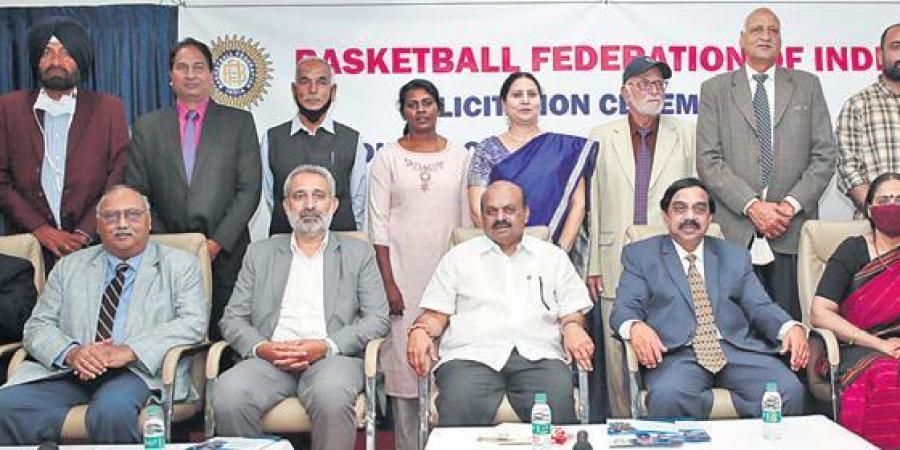
Home Minister Basavaraj Bommai (centre) with K Govindaraj, president of Basketball Federation of India (second from right) at an event to felicitate Arjuna, Padma Shree awardees. | vinod kumar t
Bengaluru :
The Basketball Federation of India felicitated sportsperson who received Arjuna, Dhyan Chand and Padma Shri Awardees between 1961 and 2019 for their contribution and achievements in basketball. The felicitation programme was held at Karnataka Olympic Bhawan, Kanteerava Sports Complex, on Saturday. Home Minister Basavaraj Bommai felicitated over eight former basketball players.
Bommai said, “It gives me immense pleasure to know that the Basketball Federation of India felicitated Padma Shri, Arjuna and Dhyan Chand Awardees. I wish good luck to all the awardees.” The Arjuna awardees included Gulam Abbas Moontasir, Arjun awardee from the 1970 batch, Hanuman Singh (1975), Ajmer Singh (1982), Suman Sharma (1983), Sajjan Singh Cheema (1999), Vishesh Bhriguvanshi (2019), Surendra Kumar Kataria (1973), Om Prakash Dhull (1979-1980).
Anitha Paul Durai got the Padma Shri award 2020 and Ram Kumar got the Dhyan Chand award (2003).
K Govindaraj, president of the Basketball Federation of India said, “Basketball is believed to be the fastest growing sport. It has immense appeal among school and college students. Almost every school and college has a basketball court on its premises.”
source: http://www.newindianexpress.com / The New Indian Express / Home> Good News / by Express News Service / February 07th, 2021
Be it heirloom dishes or new-age recipes, this cookbook, penned by Badrunissa Irfan – mother of Uzma Irfan, director, Prestige Group – dishes out something for everyone
Bengaluru :
Ever wondered what makes the food coming from your grandmother’s or mother’s kitchen yummier than even the best chef in the world?
There’s something comforting in these dishes prepared by seasoned hands sans any sort of measurement.
The recipes in Duniya-e-Ziyafat, a cookbook by Badrunissa Irfan, mother of Uzma Irfan, director, Prestige Group, dishes out some recipes that are sure to give you hunger pangs. The book was launched on Saturday at Sublime Art Galleria.
In the 184-page book, Irfan spills the secrets to some mouth watering dishes like Nalli Ka Salan, Herby Chicken among a host of others. According to Irfan, minimum spices and processes are secrets behind the taste. “The recipes that are shared in the book are simple which even beginners can follow. I always try to keep my recipes minimal so that the flavours are enhanced. With extra garam masala and red chilli powder, you tend to miss out on the delicateness of the dishes,” says Irfan, adding that the other best kept secret is a clean kitchen. “I see many people who make a mayhem in the kitchen even if they just chop a cucumber. A clean kitchen provides clarity of mind,” she adds.
The book is a compilation of recipes that Irfan had written for her daughter, Uzma, when she was in London. “In uni, there’s not enough time to prepare an elaborate meal, so you need quick ones, which also give you a taste of home,” says 62-year-old Irfan, adding that she hopes the book helps people churn out some delicious recipes even during a busy schedule.
Although there is no doubt that her meat dishes steal the show, her vegetarian dishes also have an equal number of takers. With options like Stir Fried Tofu, Herb Roasted Potato and more, the book has something for everyone. “It’s mandatory to have a veggie dish in every meal that is cooked. My husband, Irfan Razack, is man of simple taste, he enjoys any vegetarian dish,” she says, adding that there are enough dessert options too.
Family ties remain strong in this book since it also contains some recipes Irfan had learnt from her mother. “I started cooking at the age of six. Coming from a joint family, it used to be such nice way to bond,” recalls Irfan, who went on to also learn how to make pickles from her grandmother. Besides some heirloom recipes, Irfan’s cookbook also contains newer recipes which she discovered over time. The book can be pre-ordered on sublime.in
source: http://www.newindianexpress.com / The New Indian Express / Home> Cities> Bengaluru / by Monika Monalisa / Express News Service / January 19th, 2021
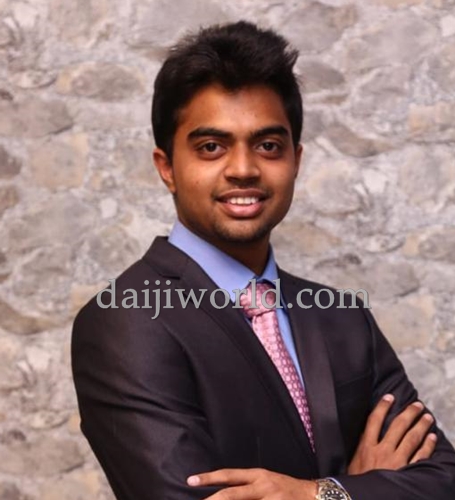
A future surgeon in the making, Syed Mohammed Adnan has done the city proud by bagging an array of gold medals and ranks in MBBS from Rajiv Gandhi University of Health Sciences.
In the recently announced results, Adnan secured the first rank in physiology, third rank in pediatrics, sixth rank in ophthalmology, and ninth rank in forensic medicine, totally four ranks in MBBS.
A former student of Expert College, Mangaluru, Adnan is the son of Dr Syed Ashraf and Nazma Tabassum Ashraf, and grandson of Syed Abubaker and the late M Azeezuddin.
pix: daijiworld.com
A brilliant, hard-working student, Adnan’s dedicated all his time and energy to following a strict study schedule while pursuing his goals.
He bagged free admission to Al-Ameen Medical College, Vijayapura along with winning a scholarship from Karnataka government for four years.
For his accomplishments, Adnan will be felicitated with a gold medal by his college on the day of convocation on February 7.
Asked about his plans for the future, the young doctor said that he wants to become a surgeon and help the underprivileged and economically weaker sections of society who do not have the means to access healthcare.
Here’s wishing Adnan all the best in his endeavours!
source: http://www.daijiworld.com / DaijiWorld / Home> Top Stories / by Daijiworld Media Network – Mangaluru / January 17th, 2021