Fashion, as we know it, is one of the most influential industries in the world.
Bengaluru :
Fashion, as we know it, is one of the most influential industries in the world. And when brands not only make top quality products but also come full circle and give back to the community through their choices, they become good influencers of fashion.
Kulsum Shadab Wahab, based in Bengaluru, is a philanthropist recognised by Chime for Change, a global campaign founded by Gucci, which features 25 women activists from around the world working to advance gender equality.
A true fashion enthusiast, she believes in altering the perception of high fashion through inclusivity. Ara Lumiere, an initiative by her Hothur Foundation, works with acid attack survivors in making avant-garde head gears. Worn by the likes of pop star Katy Perry, Ara Lumiere’s head gears have won many international awards. They have also collaborated with Shah Rukh Khan’s Meer Foundation to create awareness on skin banking.
Ara Lumiere X Dhruv Kapoor bucket hat collection
The spring summer ’21 edition of Ara Lumiere, in collaboration with ace designer Dhruv Kapoor (Ara Lumiere X Dhruv Kapoor), which was made out of diligence, love and hope by the survivors, was recently unveiled at the first-ever digital Milan Fashion Week.
Showcased through a short film, the gender neutral collection features embroidered bucket hats in sheer organzas and taffetas, handcrafted and hand embroidered by the brave acid attack survivors. All proceeds have gone into the rehabilitation of the survivors, where fashion has acted as a powerful tool in empowering these women.
The government’s leather ban in 2015 destroyed jobs for leather work artisans, mainly from marginalised communities. A fight for justice against caste and ostracised communities got artist-activist Sudheer Rajbhar to develop a new recycled material – one that is made from waste but close to leather in its texture and durability – to celebrate and conserve crafts from a banned industry. This is how Mumbai-based Chamar Studio was conceived.
Says Rajbhar, “Chamar was once used as a slur and we have tried to end that. Our brand’s promoters in Germany, the USA and France tell us the name sounds like a mix of ‘Chanel’ and ‘Shalimar’ and associate it with luxury.” These bags, which come in striking bold colours, are high on functionality, design and skilled craftsmanship and proudly stand at par with any global luxury brand. These timeless pieces are waterproof, cruelty free and vegan as well.
Brands with a cause make us believe that fashion can be something bigger, more than just a style statement. Along with creating high quality products that are recognised globally, fashion also puts out good into the world. Whether it is supporting a cause or sourcing sustainable material, these brands are definitely the game changers of fashion today.
(The writer is a lifestyle consultant and mindful fashion advocate)
source: http://www.newindianexpress.com / The New Indian Express / Home> Cities> Bengaluru / by Sarayu Hegde / Express News Service / October 01st, 2020
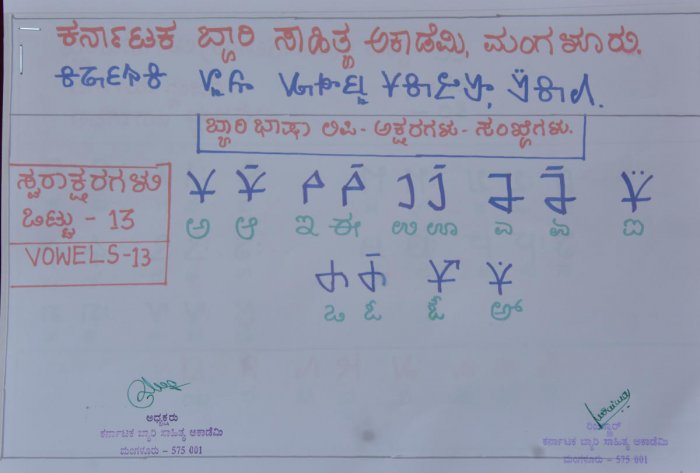
A script has been developed for the Beary language spoken mainly by a section of Muslims and others in the coastal region.
The initiative was taken by the Beary Sahithya Academy and the script was developed by nine-member Beary writers.
Academy President Rahim Ucchil launched the script and said that the script has been developed in such a way that it will sync with the Unicode.
The script is unique. There are plans to launch an app to download the script in mobile phones shortly.
The expert team who developed the script are Abdul Rasheed Zaini Kamil Sakhafi, Aboobakker Siddiq, Haider Ali, Abdul Razak Ananthady, A K Kukkila, Muhammed Fouzeed, Abdul Samad Bava, Abdul Rahiman Kuthethoor and Hamza Malar.
Speaking about the script, Ucchil said it has 13 vowels, 33 consonants, numbers, months and days. Efforts will be made to popularise the script using the online platforms.
Further, he said that the academy has submitted a proposal to introduce Beary as a third language in schools for students from class 6. Once it is approved, Beary language will also be taught in schools as a third language.
He said that Beary language is being spoken by nearly 20 lakh people across the world. It serves as a vital link for Tulu, Malayalam, Kannada, Konkani, Kodava and other languages.
The academy plans to publish Beary Calendar titled ‘Naalkanakk’ for the year 2021, he added.
source: http://www.deccanherald.com / Deccan Herald / Home> State> Mangaluru / by DHNS, Mangaluru / September 12th, 2020
A three-day workshop on research and writing, essay writing and journalism under the pen section of FikroKhabar came to an end at Alhaj Mohiddin Muniri Hall of Maulana Abul Hassan Ali Nadvi Islamic Academy.
The concluding session taught how to make journalism and the media a means of publishing the message of religion and how to work in the practical field. The meeting also decided on the strategy of the Bazm-e-Kalam, which includes the federation of the most important Muslim media. It also includes mentoring them with various workshops for those involved in the field of Bazm-e-Kalam. Bazm-e-Qalam membership forms were also distributed at the meeting, which the participants filled out and expressed their commitment to develop the sector and make it a source of Islamic da’wah . Participants in their written comments said that the establishment of such sectors is the most important need of the present era.
Among the guests on the stage, Jamia Islamia Bhatkal Superintendent Maulana Maqbool Ahmed Kobatte Nadvi said that media is a great way to get people on the right track. It can do things we can’t imagine. The same means of communication include Friday sermons, the benefits of which we can see in society today. Maulana congratulated the officials of Fakro Khabar and his entire team for organizing this workshop and also expressed his happiness to present it in a good and unique way. At the same time, the audience urged the audience to use mobile phones in the right direction.
Mr. Mohsin Shabandari, founder of Bhatkallys.com and Urdu Audio.com, the first website of Juma Bayanat, said that any news should be researched before it is made. Nowadays, it is very important to be careful about the news that is sent to WhatsApp without any research. He also expressed his desire to make the best use of mobile phones and create a platform for all media.
Maulana Ayub Barmawar Nadvi, Maulana Shoaib Nadvi, Maulana Irshad Africa Nadvi, Maulana Muhammad Ali Sharif Nadvi, Maulana Saud Nadvi, Maulana Rehmatullah Nadvi and others were present on the occasion.
source: http://www.bhatkallys.com / Bhatkallys.com / Home> Bhatkal News / by Bhatkal News Bureau / September 04th, 2020
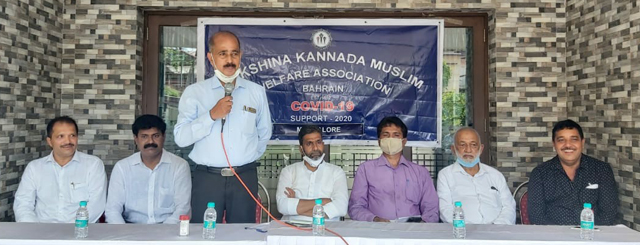
Bahrain based Dakshina Kannada Muslim welfare association distributed food kits to Covid-19 victims at Kote mansion, Valencia here on Sunday, August 30.
Karnataka NRI forum Bahrain president Leeladhar Bykampady was the chief guest for the programme. Food kits were distributed to about 100 people.
World Kannada cultural conference committee founder president K P Manjunath Sagar said that the Dakshina Kannada Muslim welfare association has been relentlessly indulged in social work since its inception.
Former MCC deputy mayor Saleem, Dakshina Kannada Muslim welfare association vice president Ummar and founder member Moidin were the guests of honor. Former MCC mayor Ashraf who presided over the programme said that the welfare association has continuously helped poor people and is a model organization.
Programme convenor Mubarak was on the dais. Port trader Mohsin Bava welcomed the gathering while author Dr Kasargod Ashok Kumar compeered the programme. Sayyed Bahrain rendered the vote of thanks.
source: http://www.daijiworld.com / DaijiWorld.com / Home> Karnataka / by Rons Bantwal / Daijiworld Media Network – Mangaluru (EP) – September 01st, 2020
The late former British secret agent Noor Inayat Khan plays a Veena.(File/AFP)
English Heritage described her as “Britain’s first Muslim war heroine in Europe”
Khan was the first female wireless operator sent to Nazi-occupied France but was captured, tortured and shot dead
London :
A woman of Indian-origin dubbed “the spy princess” on Friday gets a new memorial in Britain honoring her espionage work and refusal to betray secrets in World War II.
English Heritage is putting up a Blue Plaque honoring Noor Inayat Khan outside 4 Taviton Street in the Bloomsbury area of central London where she lived from 1942-43.
In 2012, Queen Elizabeth II’s daughter Princess Anne unveiled a bronze bust of Khan in nearby Gordon Square Gardens.
Her biographer, Shrabani Basu, said Khan, born into a princely Indian Sufi family and descended from Tipu Sultan, the 18th century ruler of Mysore, was an “unlikely spy.”
She believed in non-violence and religious harmony but gave her life in the fight against fascism when her adopted country needed her, she said. “It is fitting that Noor Inayat Khan is the first woman of Indian origin to be remembered with a Blue Plaque,” said Basu, who wrote “Spy Princess: The Life of Noor Inayat Khan.”
“As people walk by, Noor’s story will continue to inspire future generations. In today’s world, her vision of unity and freedom is more important than ever.”
Khan was the first female wireless operator sent to Nazi-occupied France but was captured, tortured and shot dead aged 30 at the Dachau concentration camp in September 1944.
English Heritage described her as “Britain’s first Muslim war heroine in Europe.” She was killed after refusing to give away secrets under repeated torture by the Gestapo.
Khan was posthumously awarded the George Cross and is one of only four women to have directly received Britain’s highest non-combat award for gallantry.
English Heritage has acknowledged that the proportion of women celebrated by its blue plaque scheme remains “unacceptably low.” It is planning to unveil tributes to the secret agent Christine Granville at a west London hotel where she lived and the sculptor Barbara Hepworth in north London.
Another is planned for the headquarters of the National Union of Women’s Suffrage Societies, which campaigned successfully for women to be allowed to vote.
source: http://www.arabnews.com / Arab News / Home> World / by AFP / August 29th, 2020
Three teachers from Karnataka have been selected to receive the prestigious President’s National Awards for Teachers 2020. In all, 47 teachers from schools across the country will receive the award instituted by the Union Ministry of Education.
From Karnataka, Chemmalar Shanmugam, headmistress, Kendriya Vidyalaya No. 2, AFS (East), Jalahalli, Bengaluru; Yakub S., teacher, Government High School Nada, Nada, Belthangady, Dakshina Kannada, and Surekha Jagannath, teacher, Government High School, Bandarwad, Afzalpur, Kalaburagi, are the recipients.
The award, instituted in 1958, is presented to recognise the unique contribution of teachers. The award would celebrate commitment and efforts of teachers in improving quality of school education and also enriching the lives of their students. Every year, the award is presented on September 5 that marks the birth anniversary of former president Dr. S. Radhakrishnan.
Selection process
This year, the Ministry’s Department of School Education and Literacy constituted a national level independent jury to select the recipients. The jury reviewed a list of 153 teachers as shortlisted by committees set up by States and Union Territories and also organisational selection committees through a videoconference.
The jury considered the applications and presentations made by all shortlisted teachers and after detailed deliberations, recommended names of 47 teachers. Ms. Chemmalar is the only teacher from Kendriya Vidyalaya Sanghatan to be selected for the award.
source: http://www.thehindu.com / The Hindu / Home> News> States> Karnataka / by Sudhindr A.B / Bengaluru – August 24th, 2020
Arbaz Ahmed is 9th rank holder in the KCET 2020 Merit List containing the names of 1,55,552 successful candidates.
Karnataka CET Result 2020:
Mohammad Arbaaz Ahmed is among the Top 10 of Karnataka CET 2020 result of which was declared by the Karnataka Examination Authority (KEA) Friday.
Accordingt to KCET 2020 result announced by KEA on Friday, Mohammad Arbaaz Ahmed secured the 9th position in the Merit List led by 10 toppers in Pharma course.
As many as 1,75,349 students out of the total 1,94,419 candidates who registered for KCET 2020 appeared for the test held on July 30 and 31, 2020. Of them, 1,53,470 students have qualified for Engineering admission.
The students qualified in other courses include – Agriculture (1,27,627), Veterinary Sciences (1,29,666), AYUSH (1,29,611) and Pharma (1,55,552).
A total of 80 students scored cent per cent marks – 60 out of 60 in Biology, 03 students scored 100% marks in Chemistry.
Rakshith M secured the 1st Rank, Shubhan R secured the 2nd spot, and M Shashank Balaji hold the 3rd position in Engineering.
In Pharma, Sai Vivek P has secured the 1st rank, Sandeepan Naskar hold the 2nd position and Pawan S Gowda bagged the 3rd rank. Arbaz Ahmed is 9th rank holder in the KCET 2020 Merit List containing the names of 1,55,552 successful candidates.
Karnataka Common Entrance Test Cell (CET) was established in the year 1994 for conducting entrance tests to determine the merit of the candidates for admission to professional courses such as Medical, Dental, Indian Systems of Medicine and Homoeopathy, Engineering / Technology and Architecture courses, Farm science, B-Pharm, Pharm-D courses.
source: http://www.ummid.com / Ummid.com / Home> Education & Careers / by ummid.com news network / August 22nd, 2020
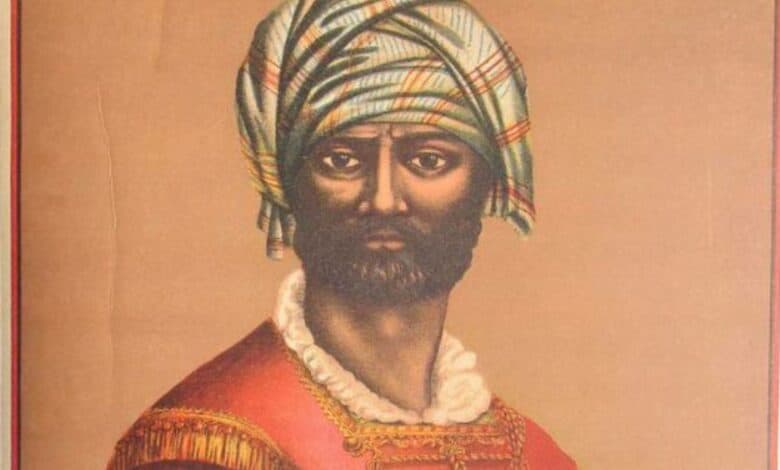
Hyder Ali, who is famously known as ‘the Nepoleon of South India’ for his relentless fighting against the conspiracies of the East India Company and its henchmen and for checkmating the British ambitions of expansion in South India, was born in 1722 at Devanahalli village, Karnataka state. His father was Fateh Mohammad Ali and mother Mujidan Begum.
Though he did not have any formal learning, he received training in martial arts. Hyder Ali was sharp in intellect, strong in will, capable of handling multiple tasks simultaneously and was brave at heart.
He had participated in Devanahalli war in 1749 as a young soldier of Mysore State. Recognizing his gallantry, Nanjaraj, the Minister of Mysore kingdom, honoured Hyder Ali with the title of ‘Khan’ and promoted him as the Chief of a battalion in the Mysore army.
They attacked Mysore several times with the help of the East India Company.
Though Hyder Ali suffered initial losses, he resisted them successfully and proved a virtual nightmare to East India Company. Even then, the British rulers provoked Hyder Ali again which led to the second Mysore war in July 1780. He went to the battlefield along with his son, Tipu Sultan.
While Hyder Ali captured the Arcot, his son Tipu defeated the East India Company troops and captured Kanjeevaram, which was about 50 miles from Madras. This sent shivers to Warren Hastings, the Governor General of East India Company.
He immediately sent additional troops from Culcutta, Madras with abundant funds under the control of his Commander General, Sir Eyre Coote. While fighting against the foreign enemy on one side, Hyder Ali and Tipu Sultan taught a befitting lesson to Malabar Nayars and chieftains, who revolted against him with the active support of Nizam of Hyderbad.
Hyder Ali, while leading his troops towards successive victories, fell ill and died in the battlefield on 7 December, 1782, near Narasingarayuni Peta village, which is now in Chitoor district of Andhra Pradesh.
source: http://www.siasat.com / The Siasat Daily / Home> Featured News / by Nihad Amani / August 22nd, 2020
A total of 19 police personnel from the state have been conferred with the President’s Police Medal on the occasion of Independence Day.
Bengaluru :
A total of 19 police personnel from the state have been conferred with the President’s Police Medal on the occasion of Independence Day.
V L N Prasanna Kumar, ASI, Criminal Investigation Department, has been honoured with the medal for distinguished service.
The others are:
R Hemanth Kumar, DySP, Special Investigation Team, Lokayukta; Parameshwar Hegde, DySP, CID; R Manjunath, DySP, ACB, Mandya; H M Shailendra, DySP, Kodagu; Arun Nagegowda, DySP, Mandya; H M Satish, ACP; H B Ramesh Kumar, DySP, intelligence, Bengaluru; Umesh, DySP (Armed), Police Training School, Mysuru; C N Diwakar, Circle Police Inspector, Kodagu; G N Rudresh, Special Reserve Police Inspector, KSRP, Bengaluru; B A Lakshminarayan, SI, City Special Branch, Bengaluru; M H Chandekar, special reserve SI, KSRP, Bengaluru; K Jayapra- kash, PSI, Mangaluru; H Nanjundaiah ASI, Chikkaballapur; Atheeq Ur Rahman, ASI, Shivamogga; Ramanjanaiah, ASI, Tumakuru, R N Balikai, ASI, Haveri, and K Honnappa, head constable, Bengaluru Rural.
source: http://www.newindianexpress.com / The New Indian Express / Home> Cities> Bengaluru / by Express News Service / August 15th, 2020
Decades before the birth of the city of Calcutta, the area that is now Tollygunge was a dense forest land called Russapugla with an abundance of mangrove trees.
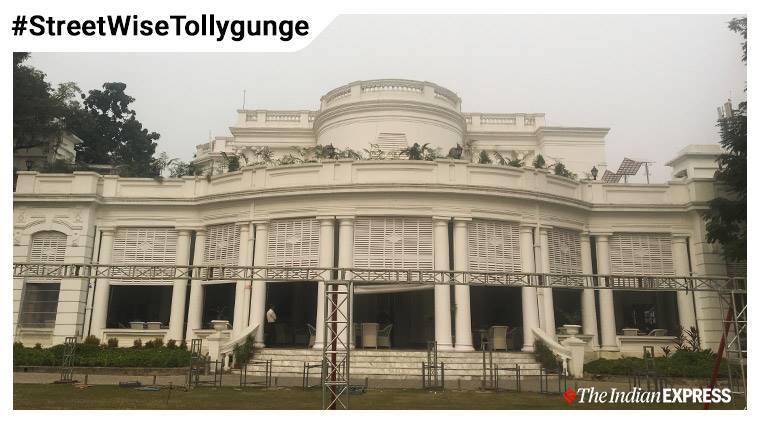
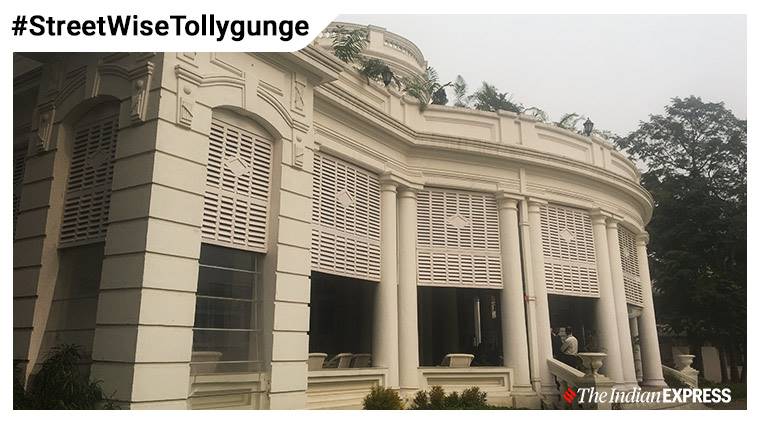
The clubhouse on the grounds of Tollygunge Club in Kolkata. The club is preparing for its New Year’s Eve party with stage equipment on its grounds. (Express photo: Neha Banka) ______________________
Most know Tollygunge as a neighbourhood in south Kolkata rather than the long stretch of road by the same name that cuts through a large swathe of the area.
Decades before the birth of the city of Calcutta, the area that is now Tollygunge was a dense forest land called Russapugla with an abundance of mangrove trees. Over the centuries, the land was cleared for settlement and urban planning but some traces of the forest can still be found in the expansive property belonging to Tollygunge Club and the Royal Calcutta Golf Club in the neighbourhood, some of the oldest social clubs in the city.
Tollygunge Club, established in 1895, derives its name from the neighbourhood of Tollygunge, that in turn got its name from William Tolly, a colonel in the British Army in 1767. Calcutta was a city of creeks, although many have been entirely or partially filled up. Today, few of those creeks remain, winding slowly across the city, trying to find their way into the Bay of Bengal, but one would have to search beneath cramped, illegal urban settlements and mounds of garbage to find them.
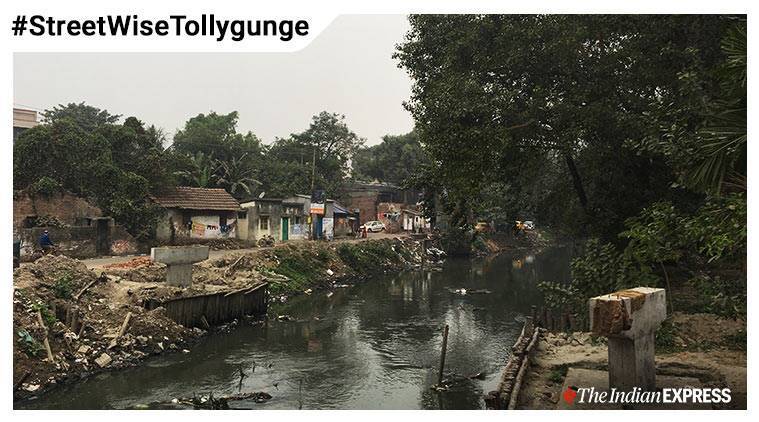
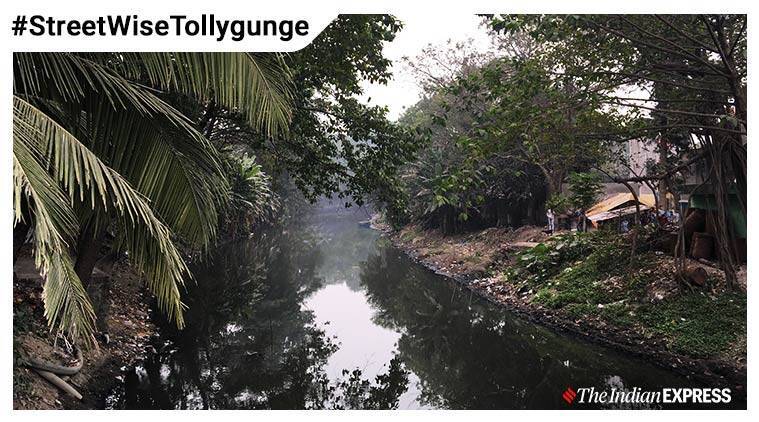
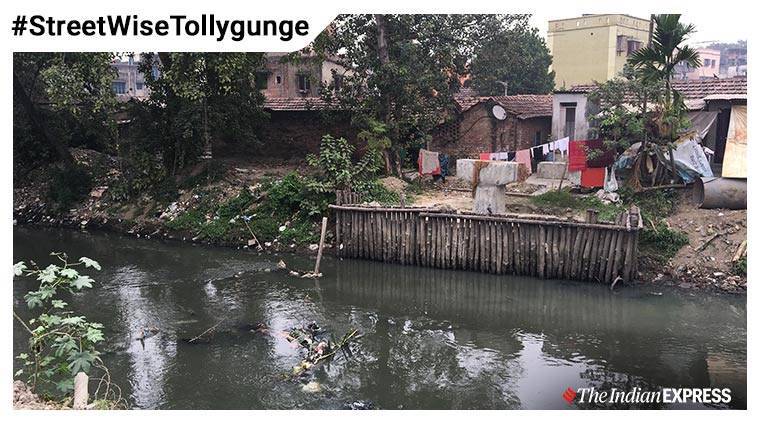
Tolly’s Nullah behind the grounds of Tollygunge Club in Kolkata. (Express photo: Neha Banka) ______________________
In the outer peripheries of the property that belongs to Tollygunge Club, a narrow creeks snakes past, as if conjoined to the boundaries of the club’s walls. On both banks of the creek, slums have developed over the years and garbage floats on the water, emanating a foul stench.
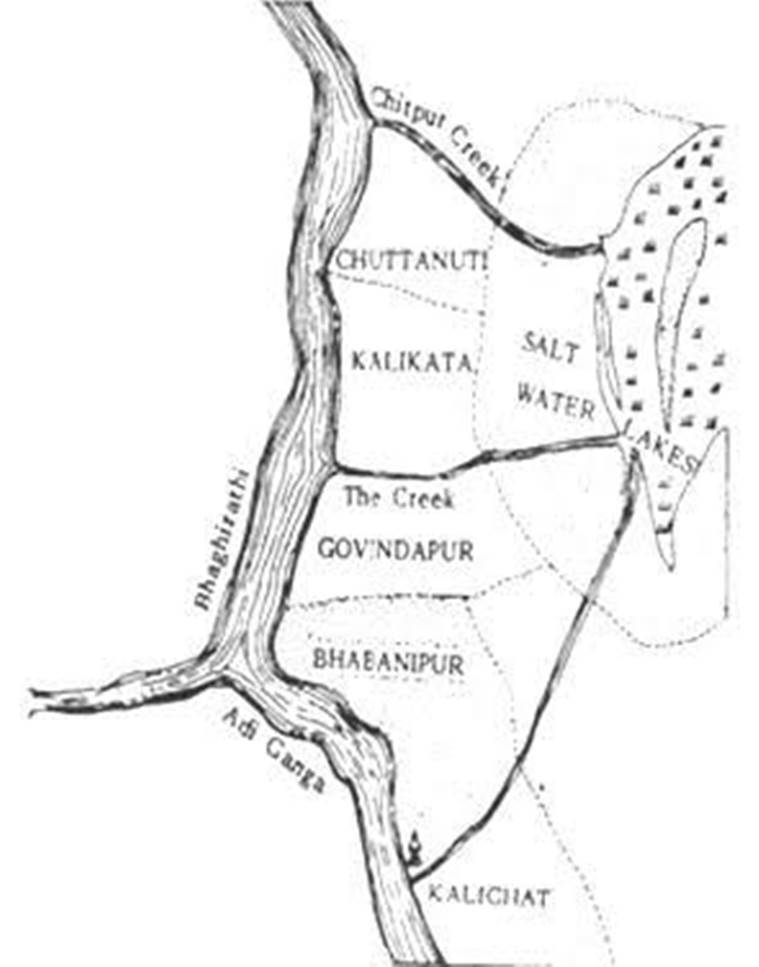
According to historian P Thankappan Nair, who has documented the city’s history extensively, this creek was originally called the Govindpur Creek. There is no historical documentation for why the creek was so named, but perhaps it acquired its name from that of the village of Govindapur, one of the three villages that went on to form the city of Calcutta. According to Nair, another name for this creek in Bengali was Adi Ganga or the original River Ganga that flows past the city.
This map is a conjecture map and shows the path of Adi Ganga. Tolly’s Canal is named ‘The Creek’ in this map and runs past Tollygunge when it was still the village of Govindapur. (Map credit: Chattopadhyay 1990/Jenia Mukherjee) ________________________
In 1775, Colonel Tolly wrote to Warren Hastings, the Governor-General of India, with a proposal of leading an excavation to connect the village of Balliaghat, now called the neighbourhood of Beliaghata, in the wetlands of the eastern fringes of the city, to the neighbourhood of Tollygunge through a waterway.
Slums have come up on both banks of Tolly’s Nullah. (Express photo: Neha Banka) ____________________
According to published letters in the Fort William-India House Correspondence Vol.7 (1773-1776), Tolly wrote to Hastings saying he can do the same on a contract with the East Indian Company or lend his services for Rs 80,000, along with a levy on tolls paid by boats passing through the creek for a period of 12 years. This plan was agreeable to the Company, and Tolly was directed to survey the land. This creek, 27 kilometres long, was then renamed Tolly’s Nullah after the colonel and opened for navigation in 1777.
After the opening of the Nullah, the neighbourhood became more developed and came to be known as Tollygunge. After Tolly’s death, his widow was unable to continue collecting the tolls and the maintenance of the waterways. The Company took over the management of the Nullah and auctioned its leasehold rights in March 1794 to an Englishman in the city, John Hooper Wilkinson. In 1804, the Bengal Government took control over the Nullah and the Collector of 24 Parganas was authorised to maintain it.
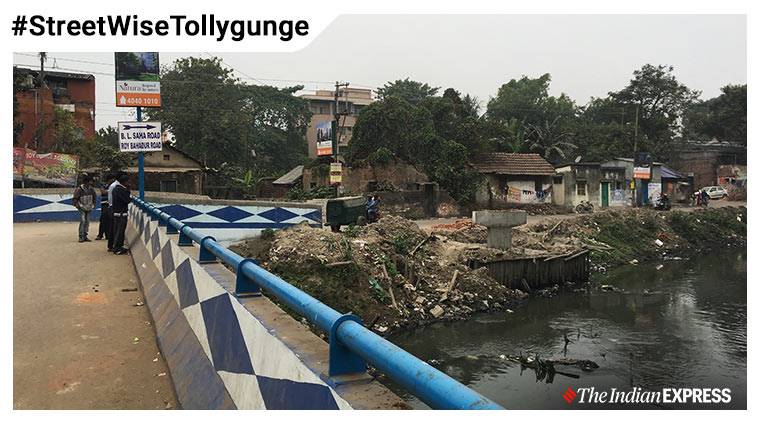
Passersby stand on a small bridge that connects the banks of Tolly’s Nullah. (Photo: Neha Banka) __________________________
There is no document to independently verify this fact, but according to the Tollygunge Club archives, the premises of the club was originally an indigo plantation home of Richard Johnson, a merchant in the East India Company, set up in 1781.
Around 1806, the British dispatched Tipu Sultan’s family to Calcutta and gave them a living allowance. Tipu Sultan’s son Ghulam Mohammed Shah purchased the plantation grounds from Johnson to be used as a residence and the family spent a considerable amount of time in the neighbourhood.
After the family’s fortunes changed, they sold some portions of the plantation and leased out other sections to William Dixon Cruickshank, a Scottish banker, who was looking to build a sports club for the British that would also allow residential facilities and provide space for the British to socialise.
After the fortunes of Tipu Sultan’s family changed, they sold some portions of the plantation and leased out other sections to William Dixon Cruickshank, who was looking to build a sports club for the British. (Express photo: Neha Banka) ___________________
Over time, Tipu Sultan’s family divested complete control of the estate and the lands came under the direct control of the Tollygunge Club, a name that the institution acquired because of the neighbourhood it was located in and because of the location of the creek that runs just behind its premises.
Over the decades, most of the open spaces in the club were converted into an 18-hole golf course and the forest land was cleared to make space for other structures and facilities inside the club premises.
Today, there are no signboards that indicate the location of the Tolly Nullah in the neighbourhood of Tollygunge. Haphazard modern construction has changed the facade of Tollygunge and to find the nullah, one would have to engage in a self-conducted walking tour using an old map of the city for guidance.
An offshoot of the main road in Tollygunge, a narrow lane, through which only one vehicle can pass at a time, is the only way to access the nullah these days. Slums occupy both banks of the waterway and an overwhelming sense of garbage permeates all around. Tollygunge Club itself has changed over the decades and its history can only be found in pockets.
Haphazard modern construction has changed the facade of Tollygunge and to find the nullah, one would have to engage in a self-conducted walking tour using an old map of the city for guidance. (Express photo: Neha Banka) ______________________
Although most of the dense forest has been cleared away over the years, jackals still roam its greens in the darkness of dusk and late into the night. On any given day, one can spot diverse species of birds on the club grounds, like kingfishers and cattle egret. Few city residents know of how the institution and its neighbourhood got its name and perhaps even fewer know of the existence of the waterway that lies beyond the high walls of the club.
source: http://www.indianexpress.com / The Indian Express / Home> Cities> Kolkata / by Neha Banka / Kolkata , December 27th, 2019