Sadiq Wasim Nargal’s candidature was approved by the Supreme Court collegium in April 2018. Four years on, the Centre is set to clear the recommendation
pix: english.mediamangalam.com
The Centre is set to approve the Supreme Court collegium’s recommendation to appoint senior advocate Sadiq Wasim Nargal as judge of the Jammu and Kashmir (J&K) High Court.
It is the oldest pending recommendation by the SC and once cleared Nargal will become the first Muslim judge from Jammu in J&K High Court.
After a four-year delay, President Ram Nath Kovind is expected to okay the appointment and the official notification is expected to be out this week, according to a report in The Hindustan Times.
The long process
Nargal name was first recommended by the High Court collegium on 24 August 2017. The candidature was okayed by the top court collegium, comprising former Chief Justice of India Dipak Misra, Justice Jasti Chelameswar and Justice Ranjan Gogoi (who became CJI in October 2018), on 6 April 2018.
However, Nargal’s elevation was left out while the government issued warrants on 3 August 2018 for the appointments of the other two lawyers, Sindhu Sharma and Rashid Ali Dar, whose names were recommended along with him.
After a few months, the Centre returned Nargal’s name along with that of sessions judge Rashid Ali Dar to the SC collegium for “reconsideration”.
According to the Memorandum of Procedure, which oversees judicial appointments, the government can send back recommendations that it deems unsuitable. It is, however, bound to accept them in case the Supreme Court collegium reiterates the names, a report in ThePrint says.
The top court authorities had made inquiries at the Ministry of Law and Justice about the reason for not accepting the recommendation but did not receive any response. According to the report, there were complaints against Nargal but the Intelligence Bureau gave him a clean chit.
The SC collegium reiterated its decision on Nargal in January 2019 and March 2021.
Now finally, four years after the first recommendation, he will get a stamp of approval from the Centre.
Nargal’s experience
Nargal resigned from his post as senior additional advocate general of the former state of Jammu and Kashmir in June 2018.
As a government counsel, he has represented security forces, including the Indian Army, Border Security Force and Central Reserve Police Force before the High Court, reports The Indian Express.
He is currently a senior advocate in Jammu and the standing counsel for the University of Kashmir.
The impact of the delay
Eleven judges were appointed to the high court after Nargal was recommended. He was 49 when his name was suggested by the Supreme Court for elevation and would have had more than 12 years as a permanent High Court judge. By the convention of seniority, he would have been a potential Chief Justice of a High Court in the country. Now, he will have a tenure of over seven years, according to The Indian Express report.
The approved strength of the J&K High Court is 17 judges. It currently has 15 judges including Chief Justice Pankaj Mithal. He is originally from the Allahabad High Court.
Have other advocates had similar experiences?
Senior advocate Amitesh Banerjee was recommended twice as a judge of the Calcutta High Court. He is the son of former Supreme Court judge, Justice UC Banerjee.
Another name rejected by the Centre despite being recommended three times by the collegium is Shakya Sen. When he was first recommended in 2017, he had not yet turned 45, the minimum age for a high court judge, reports Scroll.in.
With inputs from agencies
source: http://www.firstpost.in / Firstpost. / Home> India> India News / by Gauri Ghadi / May 31st, 2022
Shamnad was not just an expert in intellectual property rights, but a relentless crusader who worked towards ensuring diversity and representation of marginalised communities in legal practice.
The untimely and tragic death of professor Shamnad Basheer was a bolt from the blue for many of us. As I scuttled to get more information on what initially seemed impossible to believe, I realised that apart from the loss of a friend, the country had also lost one of its finest legal minds. Globally renowned for his expertise in the field of intellectual property rights (IPR), Shamnad was found dead in his car near Bababundangiri in Chikkamagaluru of Karnataka.
As news of his death spread and tributes started pouring in all over my social media timeline, there remained no doubt that his sudden demise was a great loss to the legal fraternity and academia across the globe. Shamnad was a relentless crusader, working day in and out to ensure diversity and representation of marginalised communities in the field of law and legal practice. An alumni of the National Law University, Bangalore and Oxford University, Shamnad was a man on a mission as he championed many causes ranging from internet equality, fairness in IPR, public interest litigation, judicial accountability, to the rights of sexual minorities, visually impaired and physically disabled persons.
For me, Shamnad was more a social justice warrior than a globally-known IPR expert. He was not just the force behind Increasing Diversity by Increasing Access to Legal Education (IDIA), but also Access to Legal Education for Muslims in India (ALEM India).
I first heard of him in 2009, when he wrote a blog about remarks made by then Supreme Court judge Markandey Katju. In open court, Justice Katju equated a young Muslim sporting a beard with a Taliban militant. That year, Justice Katju had rejected an appeal of a Muslim student that he should be permitted to sport a beard in his convent school. Rejecting the plea the judge had remarked that, “We don’t want to have Talibans in the country. Tomorrow a girl student may come and say that she wants to wear a burqa. Can we allow it?”
According to Shamnad, “notwithstanding the merits of the case”, Justice Katju’s comments were “callous and insensitive” and he was “unfit to be an impartial judge”. Back then, Shamnad was the HRD ministry’s professor of intellectual property law at the National University of Juridical Sciences (NUJS), Kolkata. In the conclusion of his blog, he wrote:
“The Supreme Court bench may have been right in denying admission to Salim’s SLP. However, in view of Justice Katju’s statements made in open court that equated every bearded Muslim with a Taliban, the possibility of bias against a community cannot be ruled out. And the Chief Justice must not only censure such remarks, but take immediate steps to have this case reheard before another bench. For justice must not only be done, but also be seen to be done!”
Years passed by, and I kept reading his insightful articles and commentaries in various newspapers and websites. He was prolific, writing on a range of issues related to law, policy and public good. In 2015, a common friend (Tarunabh Khaitan) connected us, asking me if I would be interested in helping Shamnad’s team at IDIA to reach out to the Muslim community. Having admired Shamnad’s writings, the opportunity to work with him was like a dream come true. I readily agreed and eventually, we became good friends.
Shamnad Basheer at a panel discussion of intellectual property rights. Photo: Flickr/World Intellectual Property Organisation CC BY NC ND 2.0
Diversifying the legal field
More than anything, he was always on the lookout for ways and means to ensure that IDIA reaches the remotest parts of the country. To contextualise the need of diversity in national law schools, let me quote a study conducted by the students of NLS Bangalore in 2016. According to the study:
“While the students are somewhat evenly divided across sexes, the income, caste and religion statistics are telling of what constitutes ‘merit’ in this country. While 15% of the students reported their family’s annual income to be above Rs 36 lakh per annum, more than 50% reported an annual income of more than Rs. 12 lakh per annum. Eighty two percent were Hindus and the next largest religious group was the wealthy Jain community (5%), which constitute less than 0.5% of India’s population. On the other hand, Muslims, who constitute 14% of India’s population, make up only 0.5% of that of NLS. The NLS also has predominantly upper-caste students at 65%, with about 27% identifying as Brahmins.”
Similarly, another report found:
“In the last 15 years i.e., from 2000 onwards, only one Dalit advocate has been designated senior by the Supreme Court, and only two from the Muslim Community. The Advocates from backward States like Uttar Pradesh, Chhattisgarh, Jharkhand or Bihar have not been designated at all. The Advocates from rural background are totally ignored. Even with regard to a progressive State like Karnataka, only one Advocate has been designated after a gap of 25 years. It is relevant to mention that in the last round of designation, out of five advocates designated, four of them belonged to one caste.”
Despite being an extremely busy person, Shamnad believed in and practiced mentoring and coaching young minds, individually and personally. Few years ago, when I visited his flat in Bangalore, he was helping two students who were staying at his house to prepare for the CLAT exam. Both belonged to an unprivileged background, a common thread among the spectrum of students whom IDIA supported. A glance at IDIA scholars, like visually impaired Najrul Islam from Siliguri, West Bengal, who studies at the National Law University, Delhi (NLU) or Meraka Mani from Srikakulam district of Andhra Pradesh, currently studying at IFIM Law College, Bangalore, Aparna Amnekar from Nagpur, Maharashtra, a student of Government Law College, Mumbai, Sonia Sabu of Ernakulam district in Kerala, studying at NLIU, Bhopal and Vinatoli of Dimapur (Nagaland), studying at NUJS Kolkata shows an incredible initiative founded and run by him, with diversity and representation at its core.
Learning from IDIA’s experiment and under the guidance of Shamnad, ALEM India was started last year. The initiative tries to ensure access for socio-economically disadvantaged Muslims and improve their representation in Indian law schools.
Personally coaching legal professionals
His objective was not just to coach students for national law schools or produce batches of successful lawyers and legal professionals. He wanted to prepare young minds who are competent yet socially committed. It is hardly a surprise that IDIA produced graduates like Yogendra Yadav, better known as Yogi. The son of a manual labourer (working in Alang, Gujarat) and a resident of Pitij village in Chhatra district of Jharkhand, Yogi graduated from the National University for Study and Research in Law (NUSRL), Ranchi in 2017. He is currently a lawyer in the Ranchi high court. He worked as a newspaper hawker in and around his village from a very early age and it is while distributing newspapers that he got to know about IDIA and CLAT.
In the recently concluded Lok Sabha elections, he contested as an independent candidate. Explaining his rationale to contest the election, Yogi told Bar & Bench, “IDIA always encouraged me to take up community causes and help as best as I could, They were training me to become a CHAMP and this is all part of that.” I clearly remember Shamnad informing us of Yogi’s inspiring story with pride. “Yogendra Yadav, our IDIA Scholar makes his Political Debut!,” read the email he had sent to some of us.
Shamnad was also keen to highlight IDIA scholars to people working in different walks of life, not just those in the law and judiciary. In 2017, got in touch with me to invite the anti-manual scavenging activist and convener of the Safai Karmachari Andolan, Bezwada Wilson, to deliver the key note address at the IDIA conference on creativity and leadership.
Bezwada Wilson. Photo: PTI
“We share the same set of ideals in terms of empowering the marginalised and building a more inclusive India,” he had written to Bezwada, copying me in the email. Bezwada’s key note, according to Shamnad was “a provocative address”. A year later, he also wrote an article on Bandicoot, a robot to replace manual scavenging. He noted:
“Bandicoot is not just a clever idea; it is a game changer, and dare I say a life saver! Putting some teeth back into India’s constitutional promise of “equality” for Dalits and other marginalized sections who’ve had to clean our crap for years. Only a few days ago, the Delhi high court ruled on a case involving the death of two manual scavengers; making the government pay for its murderous negligence!”
His latest email to me was in July this year, a heart breaker titled: “Deeply Disappointing News: 7 IDIA Scholars Still Without Committed Donors!”. “I am deeply saddened to bring you this disheartening message. Unfortunately, of the 12 IDIA scholars that gained admission to leading law schools this year, we found donor support (covering all expenses) for only 5 of our scholars. Which means 7 of our kids are left behind and it will be a struggle to put them through law school without some promise of a committed donor (or donors),” read his email. Little did I know then that this was going to be his last email to me.
Now that Shamnad is gone and we cherish his memory, our duty is to ensure that we carry forward the work he initiated, in the same spirit that he always professed. And that, I believe, would be our real tribute to him.
source: http://www.thewire.in / The Wire / Home> Law> Rights / by Mahtab Alam / August 11th, 2019
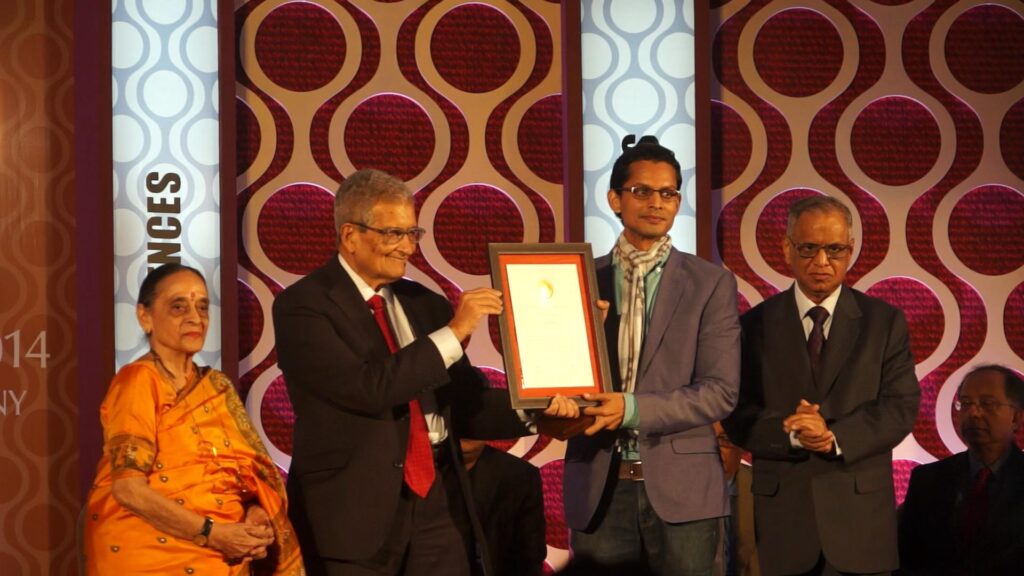
Photo of Shamnad receiving the Infosys Prize (Humanities) in 2014 from Mr. Amartya Sen / pix: shamnad.com
Bengaluru :
Indian Institute of Science (IISc) professor Jayant Haritsa and Intellectual Property (IP) academic and consultant professor Shamnad Basheer, both from Bengaluru, are among six winners of the Infosys Prize for this year.
Each prize, comprising a purse of Rs.55 lakh, a 22-carat gold medallion and a citation, is awarded by Infosys Science Foundation, a not-for-profit trust, set up by the global software major and funded by a corpus of Rs.100 crore ($16 million), contributed by the IT firm, its trustees and co-founders in 2009.
“Haritsa, computer science and automation department professor at IISc, has been awarded the prize under the Engineering and Computer Science category for his contribution to the design and optimisation of database engines,” the Foundation said in a statement here Thursday.
Haritsa also heads the supercomputer education and research centre at the institute.
Basheer, founder of SpicyIP, India, bagged the prize for his contribution to the analysis of a range of legal issues, including pharmaceutical patent injunctions and enforcement in the Humanities category.
As India’s premier blog on IP and innovation law and policy, SpicyIP does accurate reporting of IP developments across the country.
Basheer is also founder and managing trustee of Increasing Diversity by Increasing Access (IDIA) in Bengaluru.
Shubha Tole, associate professor at Mumbai-based Tata Institute of Fundamental Research (TIFR), got the prize under the Life Sciences category for her contribution to studying the hippocampus and amygdale centres of learning and memory in the brain.
“Tole’s work can lead to a better understanding of human behaviour, cognition and emotions,” the statement noted.
Tole is also a principal investigator at the TIFR’s biological sciences department.
Massachusetts Institute of Technology (MIT) adjunct professor Madhu Sudhan has been awarded the prize under the Mathematical Sciences category for his seminal contribution to probabilistically checkable proofs and error-correcting codes.
As a principal researcher at Microsoft Research in New England in the US, Sudan also heads the electrical engineering and computer sciences (EECS) department and computer science and artificial intelligence laboratory (CSASIL) at MIT in Boston.
Council of Scientific and Industrial Research (CSIR) senior scientist Srivari Chandrasekhar at the Hyderabad-based Indian Institute of Chemical Technology (IICT) has bagged the prize under the Physical Sciences category for his contribution to the synthetic organic chemistry with special focus on the synthesis of complex molecules from natural sources.
Abdul Latif Jameel Professor of Poverty Alleviation and Development Economics at MIT, Esther Duflo, got the prize under the Social Sciences category for her pioneering contribution to development economics, including the work related to India and Africa.
Duflo is also founder-director of Abdul Latif Jameel Poverty Action Lab in the US.
“The Foundation has been able to recognise some of the best researchers of our time through the prize. Their contributions are an inspiration to students and professionals and have the potential for real-time impact on individuals and society,” Infosys co-founder and Foundation president N.R. Narayana Murthy said on the occasion.
A panel of jurors, comprising renowned scientists and professors from the world over, evaluated the noted winners.
The Infosys Prize jury chairs are Pradeep Khosla, Nobel Laureate Amartya Sen, Inder Verma, Srinivasa S.R. Varadhan, Shrinivas Kulkarni and Kaushik Basu.
President Pranab Mukherjee will award the winners and felicitate them Jan 5 in Kolkata.–-IANS
www.shamnad.com
source: http://www.muslimmirror.com / Muslim Mirror / Home> Exclusive Reports> Indian Muslims> Youth / November 15th, 2014
Board chairman Moulana Sahfi Saadi said that the Wakf Board has decided to bring awareness among people of the Muslim community on the importance of getting education.
Image used for representational purposes (File | EPS)
Kalaburagi :
The Karnataka Waqf Board has decided to establish 10 degree colleges for women at 10 places across the state, including Kalaburagi, Yadgir and Raichur districts, said board chairman Moulana Sahfi Saadi on Sunday.
Addressing a press conference here, Saadi said that the Waqf Board has decided to bring awareness among people of the Muslim community on the importance of getting education.
To prepare youths from the Muslim community to face competitive examinations, including IAS and IPS, the Waqf Board is also constructing a well-equipped coaching centre for which it has acquired 30,000 sqft land near Lal Bagh in Bengaluru.
The foundation stone for the centre will be laid in June. Philanthropist Jiya Ulla Sharif has announced to donate Rs 15 crore for the centre.
“The government has sanctioned Rs 2.5 crore for the construction of a degree college and hostel in Tumakuru,” he said. To a question, he said the Waqf Board will conduct a survey of the new properties of under its purview shortly.
source: http://www.newindianexpress.com / The New Indian Express / Home> State> Karnataka / by Express News Service / May 30th, 2022
When the businessman, Yusuff Ali, paid a visit to the palace in 2012 Marthanda Varma had expressed his wish to gift the car to him. A year later Varma died (December 16, 2013) and the transfer was delayed due to many reasons.
Earlier, the German luxury carmaker Mercedes-Benz came back to Marthanda Varma with an offer of two new high-end cars, but the royal entity refused to part with his favourite vehicle. (SOURCED.)
Marthanda Varma’s favourite car — a 1955-model Benz nicknamed “Mile a Minute,”– will soon join the fleet of well-known business tycoon MA Yusuff Ali. Varma was the patriarch of the erstwhile Travancore royal family.
The royal family and Uthradam Tirunal Marthanda Varma Foundation have said the late royal figure’s announcement in 2012 in this connection will soon be fulfilled. Many vintage car collectors and businessmen have eyed the vehicle for quite some time. Even the German luxury carmaker Mercedes-Benz came back to him with an offer of two new high-end cars, but the royal entity refused to part with it.
What is amazing is that the old beauty had travelled 40 lakh miles, a rare achievement for a vehicle. People close to the royal family said he bought the car when he was 38, in 1955, and he drove a major portion of the miles it covered on his own and the rest as a passenger. Built in Stuttgart in Germany, Varma bought it for ₹12,000 and got it registered in Karnataka, CAN 42. It got its nickname “Mile a Minute” after it used to cover one mile in one minute.
When the businessman, Yusuff Ali, paid a visit to the palace in 2012 Marthanda Varma had expressed his wish to gift the car to him. A year later Varma died (December 16, 2013) and the transfer was delayed due to many reasons. Though delayed, the royal family members decided to fulfil his desire and informed the business magnate about it. He is yet to react to the royal offer.
The car is with his son Padmanabha Varma and in good road condition. Benz had presented many honours to the car and some of them are placed in front of the car and bonnet, said royal members. Palace old timers say even on his sick bed Varma used to watch his trusted companion. “He was so attached to it and looked after it as his progeny,” said one of them. A multinational businessman, Yusuff Ali, owns the Lulu group. He had a miraculous escape after his chopper crash-landed in Kochi last April.
source: http://www.hindustantimes.com / Hindustan Times / Home> Top News> India News / by HT Correspondent / April 04th, 2022
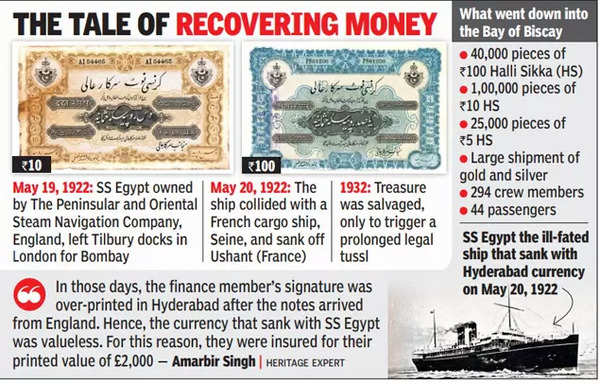
The Hyderabad currency comprised 40,000 pieces of 100 Halli Sikka (HS), 1,00,000 pieces of 10 HS, and 25,000 pieces of of 5 HS, totalling 1,65,000 pieces
After the ocean liner, SS Egypt , sank in the Celtic Sea on May 20, 1922, the events that unfolded over the next 17 years forced the Nizam VII, Mir Osman Ali Khan, to shift the printing of Hyderabad currency from England to Nashik.
On this day (May 19) 100 years ago, SS Egypt owned by The Peninsular and Oriental Steam Navigation Company, England, left Tilbury docks in London for Bombay (Mumbai). It had 44 passengers and 294 crew members, besides a large shipment of gold and silver and 1. 6 lakh pieces of Hyderabad currency, which had a face value of Rs 51,25,000.
The next day (on May 20, 1922), the ship collided with a French cargo ship and sank off Ushant in France. The Hyderabad currency shipped by Waterlow and Sons to the princely state of Hyderabad too went down into the sea. The treasure was salvaged a decade later in 1932, only to trigger a prolonged legal tussle.
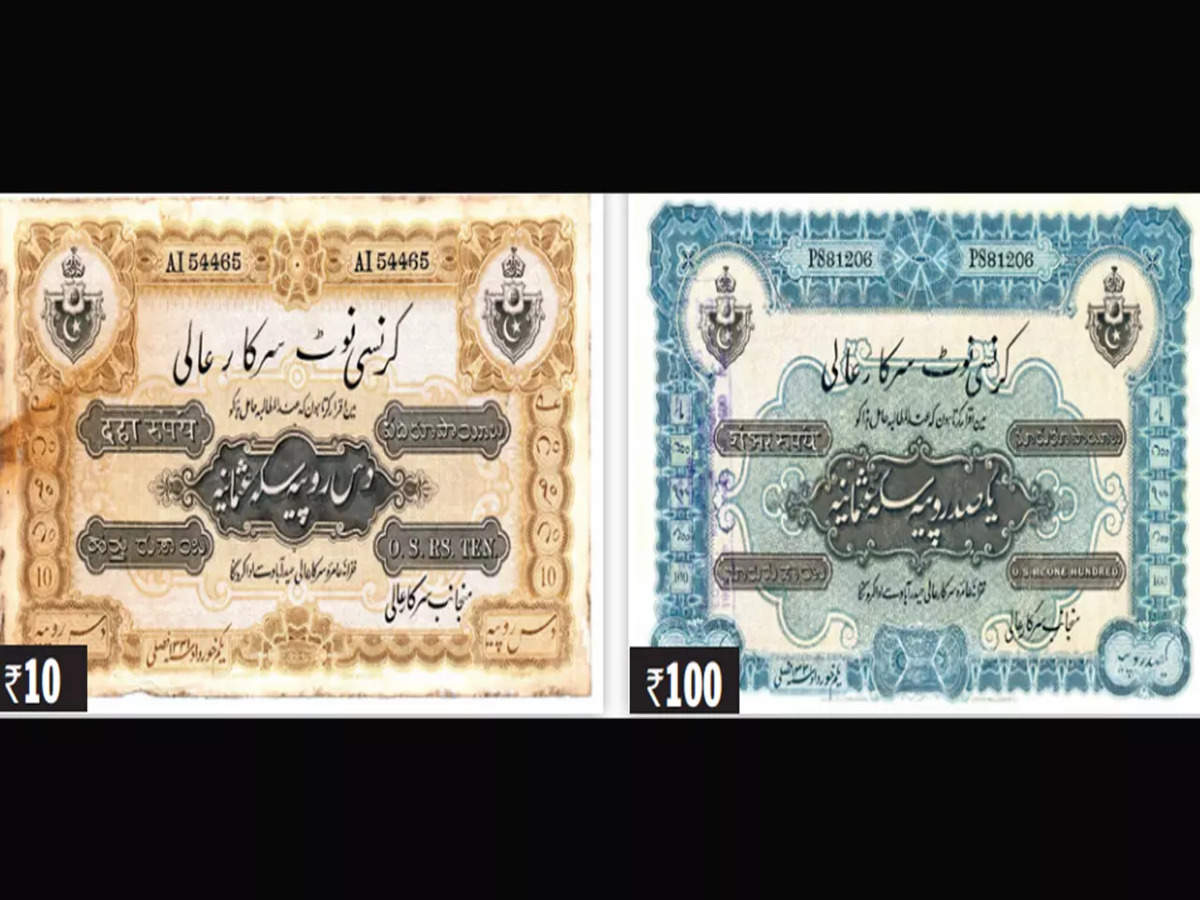
“The Hyderabad currency comprised 40,000 pieces of Rs 100 Halli Sikka (HS), 1,00,000 pieces of Rs 10 HS, and 25,000 pieces of Rs 5 HS, totalling 1,65,000 pieces. The face value was Rs 51,25,000,” eminent numismatist and heritage expert . Amarbir Singh told TOI, adding that since the currency notes were unsigned, they did not legally carry value.
“In those days, the finance member’s signature was over-printed in Hyderabad after the notes arrived from England. Hence, the currency that sank with SS Egypt was valueless. For this reason, they were insured for their printed value of £2,000,” Amarbir said.
Stating that few of the notes salvaged had made their way to Hyderabad, resulting in a spate of legal fights, Amarbir said the issue was closed 17 years after the notes were printed which entailed seven years of negotiation and litigation.
“The government of Hyderabad decided it would be safer to print currency in India. The outbreak of World War II shortly after proved it was indeed a wise decision,” Amarbir said, explaining how the princely state changed location of currency printing from England to India.
The Hyderabad government requested Waterlow to destroy the notes and ordered a replacement stock from the printers, with the same series repeated, but in a slightly different type of font used in the serial number to indicate the difference. These were received and duly circulated, and the matter was regarded as closed, he said.
source: http://www.timesofindia.indiatimes.com / The Times of India / Home> City> Hyderabad> News> City News> Hyderabad News / by Syed Akbar, TNN / May 19th, 2022
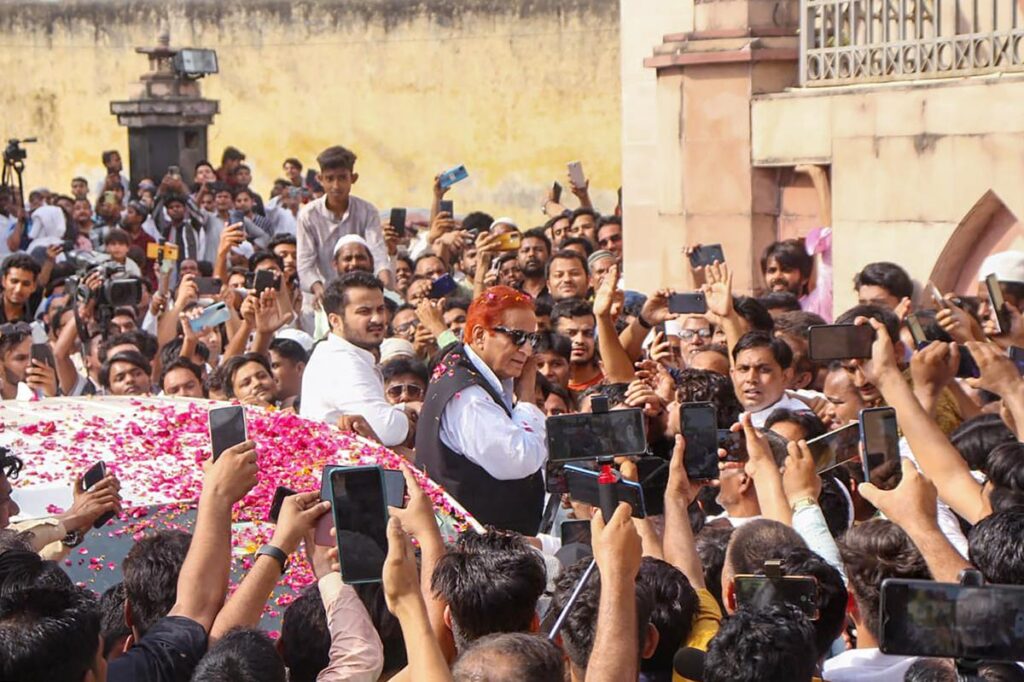
Samajwadi Party leader Azam Khan is greeted by supporters after his release from jail in Sitapur on May 20, 2022. | Photo Credit: PTI
Supreme Court had invoked Article 142 to grant him interim bail
The Uttar Pradesh police’s efforts to keep Samajwadi Party stalwart Mohd Azam Khan in custody were interrupted as the SP leader walked out of the Sitapur Jail on Friday after more than two years in custody.
While invoking its powers under Article 142 of the Constitution of India to grant him the relief, the Supreme Court had outlined the circumstances under which Khan was implicated in the 88th FIR against him.
To begin with, the court noted that even though this FIR was registered in March 2020 and a charge sheet filed, the U.P. police did not consider implicating Khan in the said case until the Supreme Court started hearing his case this year.
Moreover, the court also noted that while opposing interim bail to Khan in this case, the police had alleged that he had threatened the investigating officer of the case. However, it also pointed out the “sheer coincidence” in the timing of this threat, which was registered by the police as a General Diary entry at 3:04 a.m. on May 17, only hours before the top court was to hear the matter.
Noting that Khan was implicated in this case 1 year and 7 months after a charge sheet had been filed, the court said, “It is not as if that the allegations which are now sought to be made against the petitioner (Khan) could not have been made at that point of time.”
When Khan had approached the Supreme Court earlier this year, there were 87 criminal cases pending against him, of which he had secured bail in 84. As the top court started hearing his plea regarding the delay in bail being granted in the remaining three cases, he was further granted bail in two of them, leaving just one more case for him to get relief in as of the beginning of May.
It was at this point that the U.P. police acted to implicate Khan in the 88th case, where he was not an accused or suspect till May 5, when the police first requested to summon him in the case. As the Supreme Court was told on May 6 that the Allahabad High Court would soon deliver its judgement in the last remaining case, the Additional Chief Judicial Magistrate (Rampur) on the same day passed an order remanding Khan in custody in the 88th case.
While hearing Khan’s case last week, the Supreme Court had also noted a pattern in the police action against him, orally pointing out that the 9-time SP MLA was being arrested in a fresh case every time he was granted bail in a previous one to prolong his incarceration.
Khan, once among the most powerful ministers in the SP-led U.P. government, faced a barrage of FIRs soon after the Bharatiya Janata Party came to power in 2017, the first of which came on allegations of forging his son’s birth documents. The bulk of the FIRs (81 out of a total 88) then came in 2019, immediately before and after the Lok Sabha elections that year, all in quick succession.
As per the most recent election filing in 2022, charges have been framed against Khan in just 14 of the 88 cases.
Therefore, considering that he had been granted bail in 87 cases and the circumstances under which he was implicated in the 88th case, the Supreme Court invoked its power under Article 142 for the second time in two days to grant interim bail to him.
The top court had just a day before invoked the same powers to free Rajiv Gandhi-assassination convict A.G. Perarivalan.
Article 142 gives the Supreme Court sweeping powers to pass any such orders or decrees as it may deem fit in the interest of ensuring that “complete justice” is done in any cause or matter pending before it.
These powers are rarely invoked by the court and it has done so notably in its Ayodhya-Ram Janmabhoomi land dispute judgement in 2019, in 1989 while asking Union Carbide to pay $470 million in compensation to Bhopal gas tragedy victims, and in 2016 while banning the sale of liquor within 500 metres of state and national highways in a bid to curb driving accidents.
source: http://www.thehindu.com / The Hindu / Home> News> National> Other States / by Abhinay Lakshman / New Delhi – May 20th, 2022
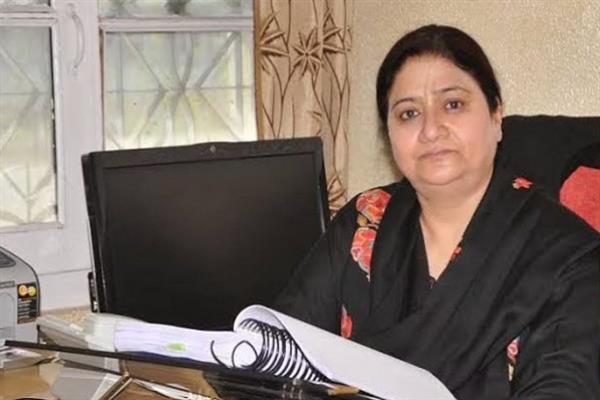
Professor (Retired) Nilofar Khan, who was yesterday appointed as new Vice Chancellor of the University of Kashmir, assumed charge of the office of VC on Friday.
Professor (Retired) Nilofar Khan, who was yesterday appointed as new Vice Chancellor of the University of Kashmir, assumed charge of the office of VC on Friday.
According to official sources, Khan assumed the charge of the office of Vice Chancellor this morning and was welcomed by the officials on her arrival at the varsity.
However, since morning a number of people have made a beeline to the office of VC, congratulating her on becoming the head of the valley’s premier institution.
Prof. Nilofer Khan was appointed as the first female Vice chancellor of Kashmir University by Lieutenant Governor, J&K, Manoj Sinha, who is also the Chancellor of the varsity, by exercising power vested in him under section 12 of Kashmir and Jammu Universities Act 1969.
source: http://www.risingkashmir.com / Rising Kashmir / Home / by RK Online Desk / May 20th, 2022
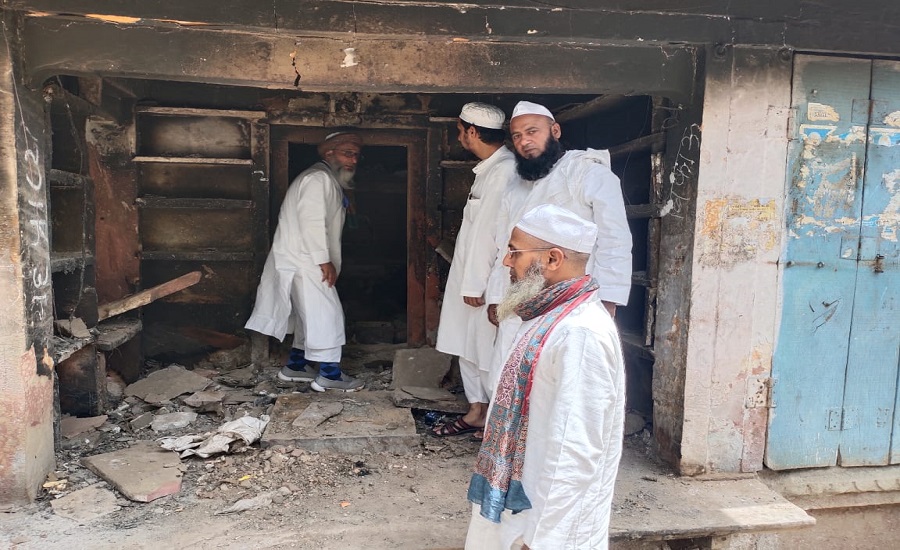
The Jamiat Ulama-i-Hind taking stock of the devastation in the aftermath communal violence in Karoli.
After visiting the riot-hit area, a delegation of the JUH held the district administration responsible for the riots saying if not for inept handling of the situation, the riots would not have taken place.
New Delhi :
A delegation of Jamiat Ulama-i-Hind (JUH) visited Karoli, Rajasthan, to take stock of the situation there in the aftermath of the devastating communal violence that took place there last month. During the visit the delegation met the victims of the riots and assured them legal assistance.
The delegation, on the direction of President of Jamiat Ulama-i-Hind Maulana Mahmood A Madani, assessed the on-going rehabilitation activities in the riot-hit area. During the riots, miscreants had burnt down 77 shops of which 67 belonged to Muslims. What’s shocking is that a large number of people belonging to the victim community have been arrested for the violence so far.
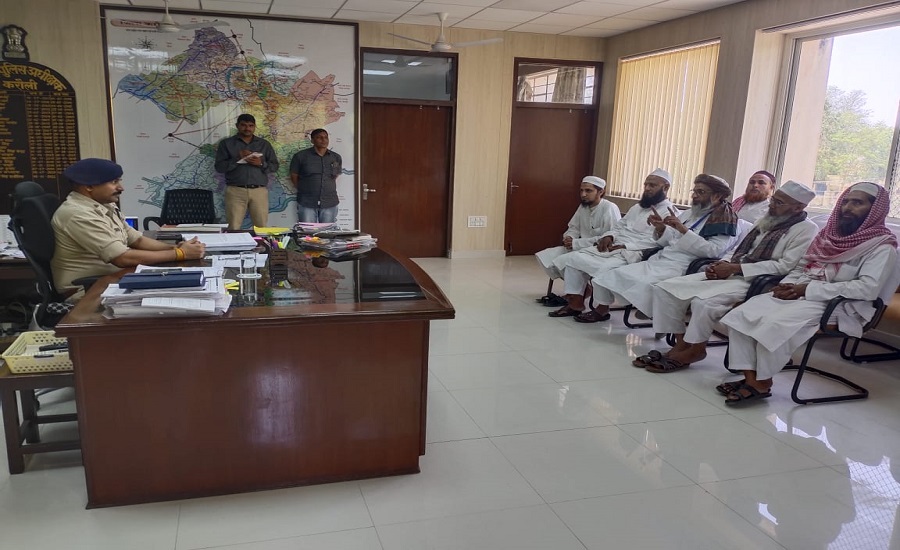
The delegation headed by Maulana Hakeemuddin Qasmi, JUH general secretary met with the district superintendent of police (SP) and district magistrate (DM) over the issue. During the visit, Maulana Hakeemuddin Qasmi noted that apart from tearing apart social fabric of the country such kind of riots adds to the woes of common man at a time when the country’s economy is going through a rough patch.
The delegation headed by Maulana Hakeemuddin Qasmi met with the district superintendent of police (SP) and district magistrate (DM) during their visit to Karoli.
He said, “No country is built in the air but it constitutes its people, houses, shops, cities and towns, trees, roads, and vehicles, harming any of them amounts to harming the nation.”
The JUH held the district administration responsible for the riots. It said if not for inept handling of the situation, the riots would not have taken place.
Maulana Hakeemuddin Qasmi asked the SP how the rally with DJ blaring hate-filled songs and slogans was allowed to pass through a sensitive area while it was banned for 20 years. The government and the administration should always be vigilant about the sensitive areas so that sectarian elements do not vitiate the atmosphere by holding such rallies.
The delegation noted that the riots were the handiwork of some vested interests who wanted to create a rift between the two communities for political gain. It demanded action against the communal outfit which engineered the riots. It said action against individuals won’t serve any purpose.
The delegation included Maulana Hakeemuddin Qasmi, Maulana Ghayyur Ahmad Qasmi, Senior Organizer of Jamiat Ulama-i-Hind, Maulana Noman, Vice-President of Jamiat Ulama-i-Rajasthan, Maulana Muhammad Younus, Maulana Anis, JUH district president Karoli, Mufti Islam, Hafiz Luqmanan, Maulana Mahboob, Hafiz Babuddin, Mufti Islam, Hafiz Liaqat, Haji Abdul Hai among others.
source: http://www.clarionindia.net / Clarion India / Home> Big Story> India / May 18th, 2022
Bihar,INDIA / North Carolina / Washington, U.S.A. :
U.S. Special Coordinator for Tibetan issues Uzra Zeya. File | Photo Credit: AFP
U.S. Special Coordinator for Tibetan issues Uzra Zeya will travel to India and Nepal this week to deepen cooperation on human rights and democratic governance goals with the two nations, the State Department has announced.
Ms. Zeya, the Under Secretary for Civilian Security, Democracy and Human Rights and an India-American, is expected to visit Dharamsala in Himachal Pradesh during her visit to India.
Dharamsala is home to the Dalai Lama and the Tibetan Government-in-exile.
“Under Secretary for Civilian Security, Democracy and Human Rights and U.S. Special Coordinator for Tibetan Issues Uzra Ms. Zeya will travel May 17–22 to India and Nepal to deepen cooperation on human rights and democratic governance goals, and to advance humanitarian priorities,” the State Department said on May 16.
“She will also discuss partnering with India and Nepal during this Year of Action for the Summit for Democracy. The delegation will include U.S.AID Deputy Assistant Administrator for Asia Anjali Kaur,” it added.
It will be the first high-level contact between the U.S. and the Tibetan leadership after Joe Biden became President in January last year.
In New Delhi, people familiar with the development said last month that Ms. Zeya will hold talks with the Dalai Lama and other senior leaders of the Tibetan Government in exile in Dharamsala, signalling the Biden administration’s commitment to the Tibetan cause.
Last month, Tibetan exile leader Penpa Tsering paid a visit to Washington D.C. and met Ms. Zeya. Tsering — the elected head of Tibet’s India-based exile Government the Central Tibetan Administration — had also met House Speaker Nancy Pelosi and other congressional leaders.
China considers the 14th Dalai Lama as a political exile who has attempted to split Tibet from China under the guise of religion.
According to the people cited above, key issues relating to the Tibetan cause are likely to figure in the talks.
As the U.S. Special Coordinator for Tibetan issues, Ms. Zeya has been coordinating the Biden administration’s policies, programmes and projects relating to the Tibetan cause.
Ms. Zeya was sworn-in as the Under Secretary for Civilian Security, Democracy, and Human Rights by Secretary of State Antony Blinken on July 14 last year.
On December 20, she was concurrently appointed as the U.S. Special Coordinator for Tibetan issues.
The U.S. has been consistently supporting the Tibetan cause notwithstanding China’s strong objection.
In 2020, the U.S. came out with legislation reaffirming the absolute right of Tibetan people to choose a successor to the Dalai Lama and the preservation of Tibet’s environment.
After the U.S. Congress passed the legislation, China had accused Washington of meddling in its internal affairs.
China has been insisting that the selection of the next Dalai Lama has to be decided within Chinese territory and that it has to have a say in the matter.
The issue of a successor to the 14th Dalai Lama, who has been living in exile in Dharamsala since 1959, gained traction as he turned 86 in July last year.
Mr. Blinken had met a representative of the Dalai Lama during his visit to New Delhi last year.
source: http://www.thehindu.com / The Hindu / Home> News> International / by PTI / Washington, May 17th, 2022