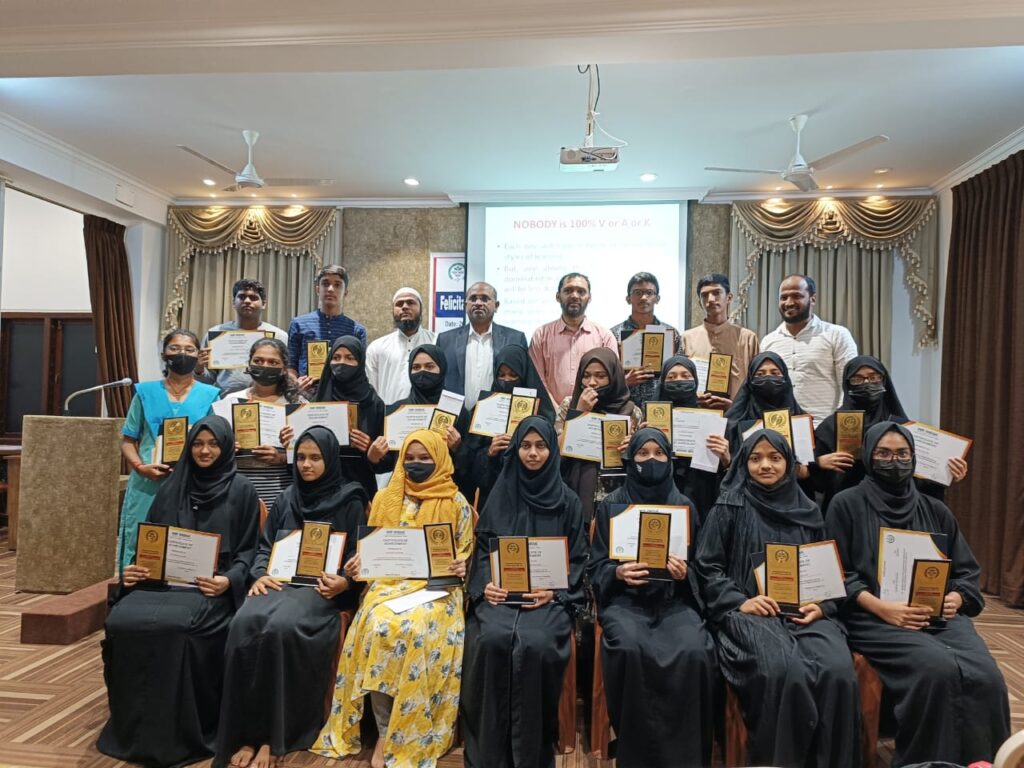
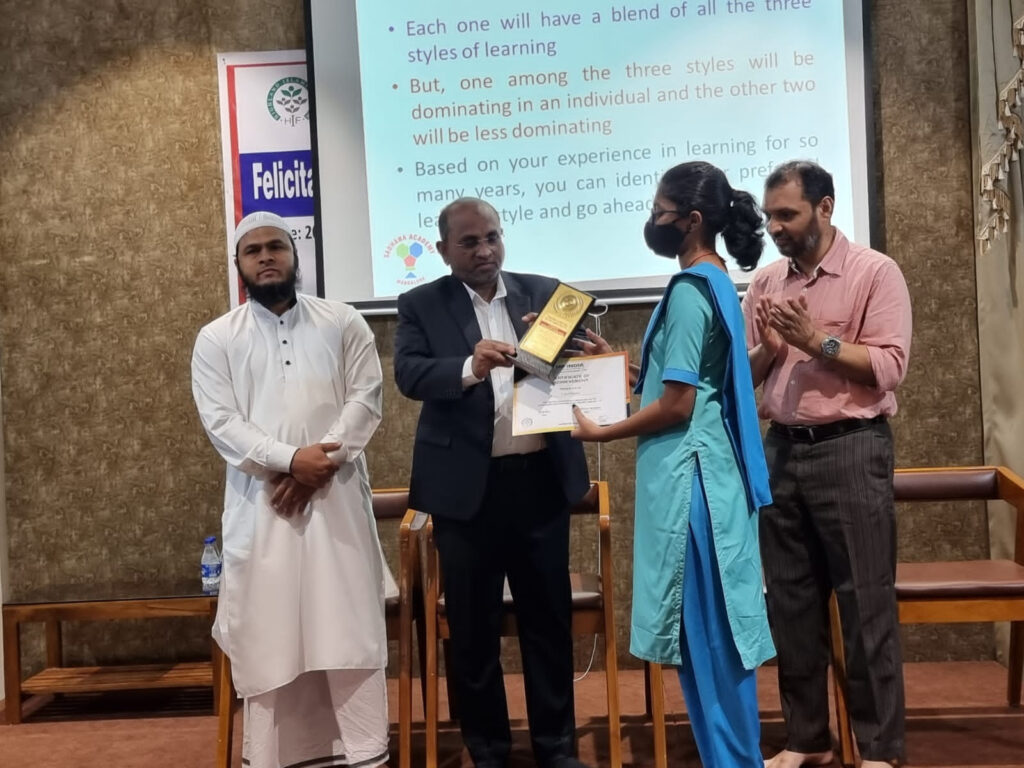
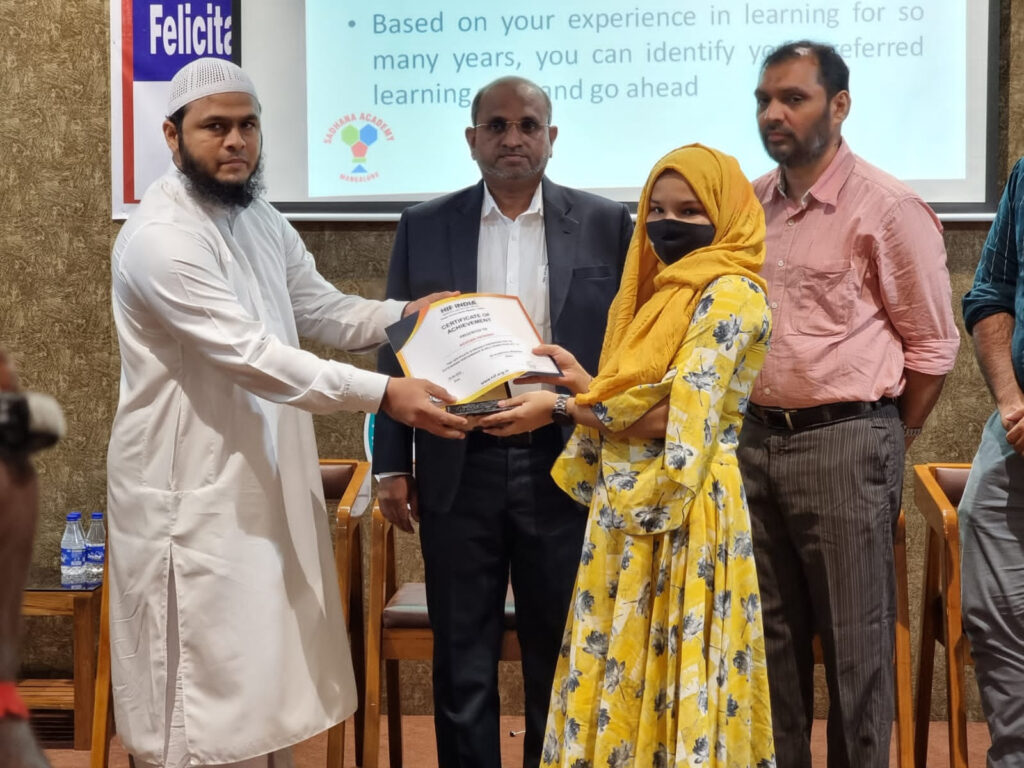
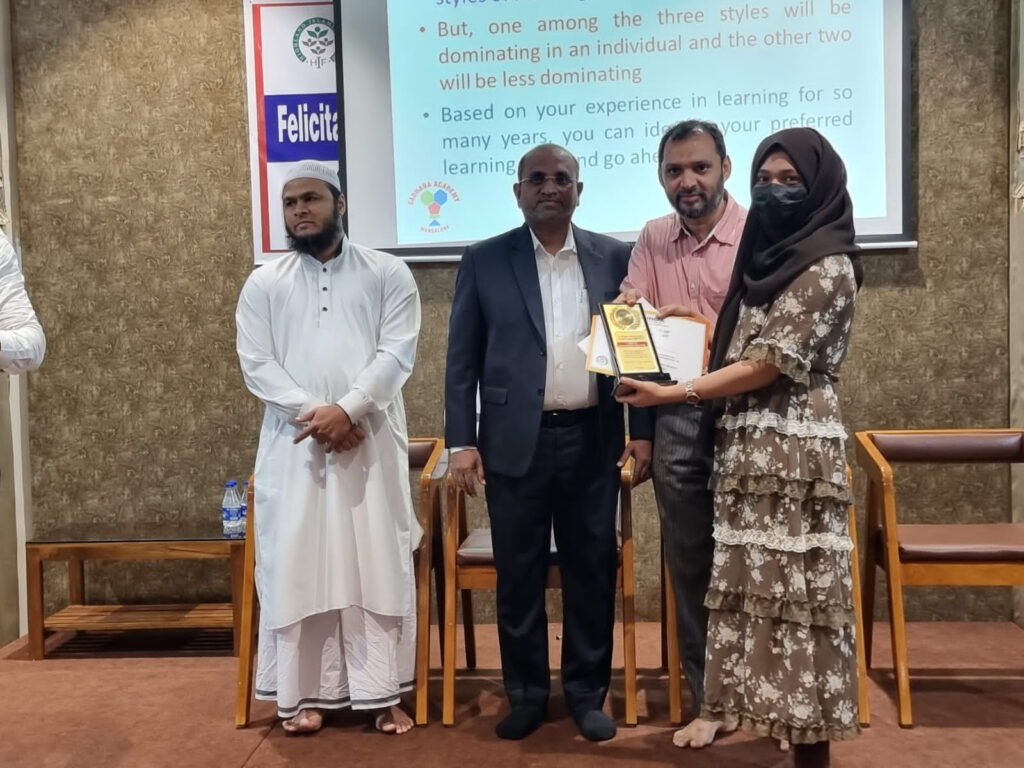
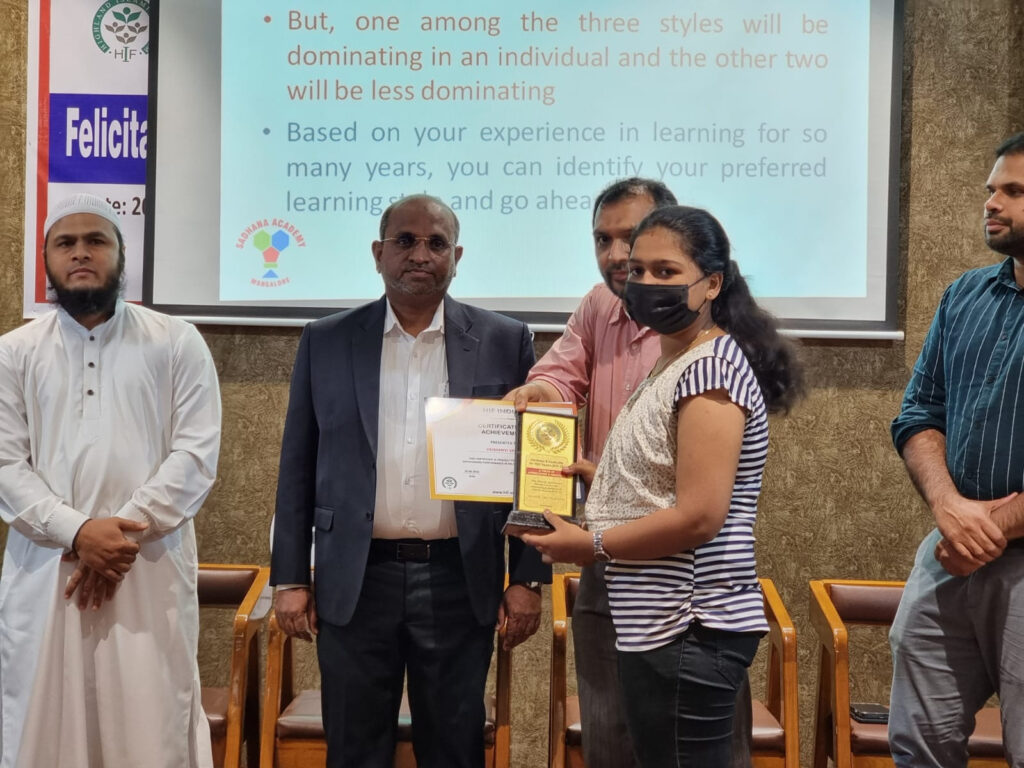
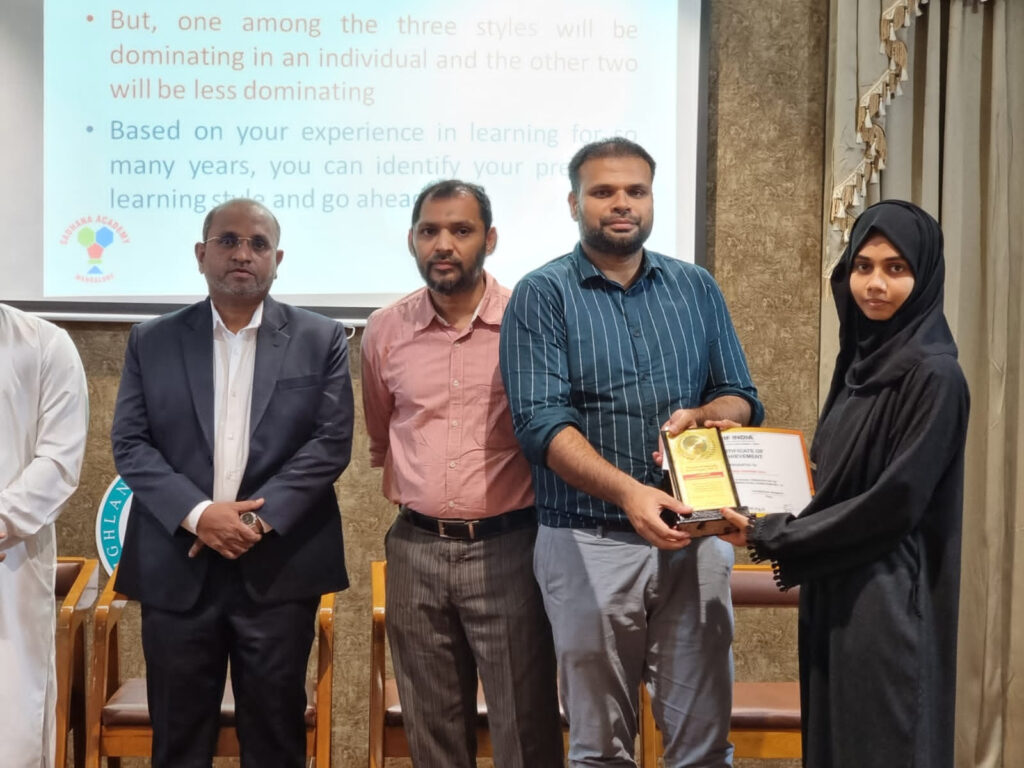
Highland Islamic Forum (HIF) on Monday organised a felicitation ceremony for the students who scored more than 90% marks in the recently announced SSLC examination results.
The forum also awarded scholarships to the students during the ceremony to honor their feat.
20 students who met the criteria were awarded scholarships for their further studies, during the event.
Dr Surfraz J Hasim, Psychologist, Mind Trainer & Coach, Principal, P.A. First Grade College, Mangalore was the Guest Speaker at the ceremony. In his address, he spoke about how students can excel by concentrating and focusing on learning while they embrace competitive life.
HECC Secretary Hanif PS was also invited to the event as a guest while Imam of Masjid-ul-Ehsaan Moulana Altaf was also present at the event.
Nazim AK, President of HIF presided over the event that was organised at the HIF auditorium here in the city.
Yusuf Hussain welcomed the guests and attendees.
Rizwan Pandeshwar compered the event and Bilal Raif delivered the vote of thanks to conclude the ceremony.
source: http://www.english.varthabharati.in / Vartha Bharati / Home> Karavali / by Vartha Bharati / June 20th, 2022
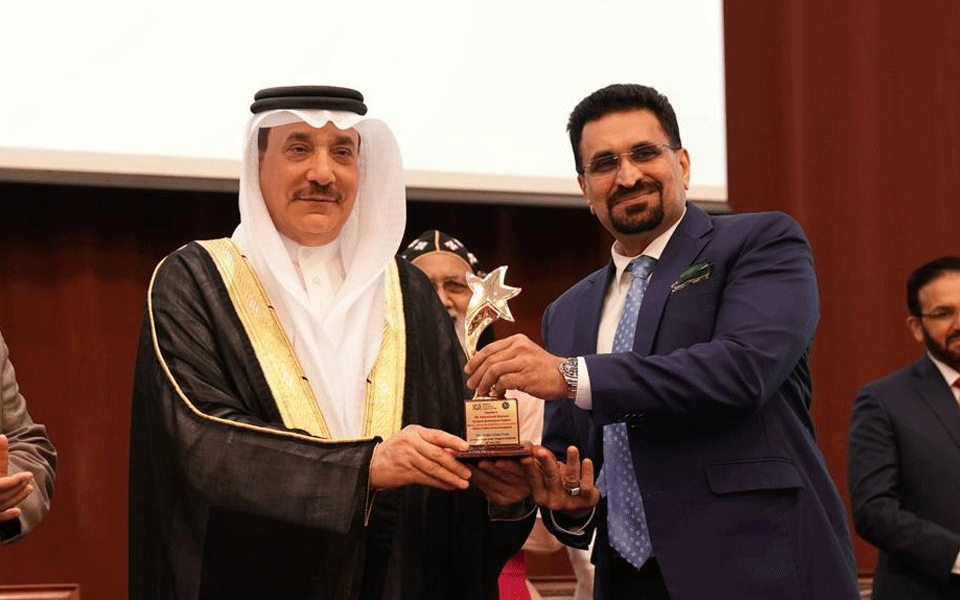
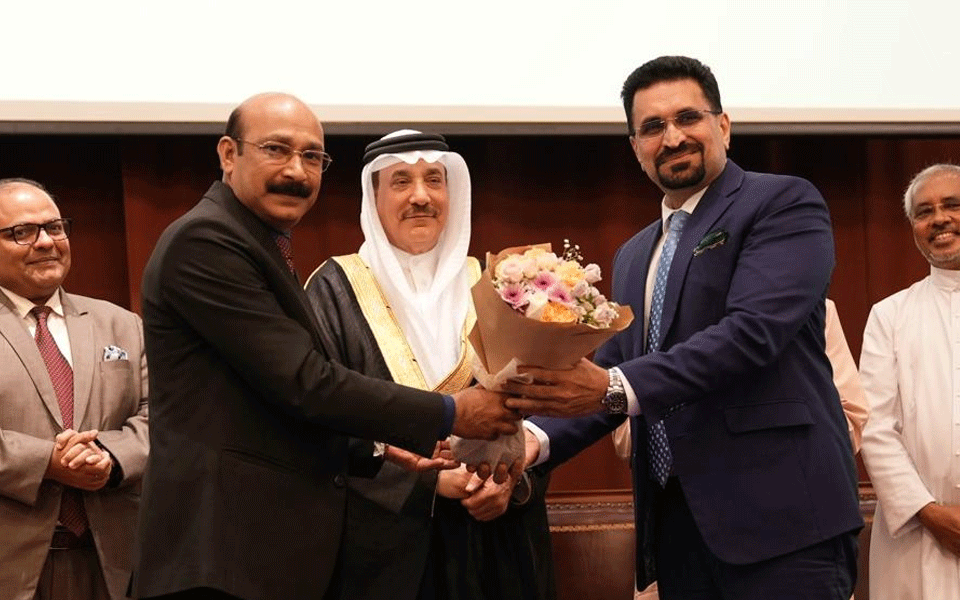
Leading Bahrain-based Indian entrepreneur, Founder and Chairman of the Saara Group, Mohammad Mansoor was honoured for his enormous contribution to sports and international relations by the one of the oldest cultural organisations in Bahrain, the – Kerala Catholics Association.
Mansoor was presented the award as presented the award by Minister of Labor and Social Development H E Jameel Bin Mohammed Ali Humaidan at a glittering gala ceremony at the Crowne Plaza hotel, in the presence of Ministers, Ambassadors, VIPs, distinguished guests and community leaders including India’s Ambassador to Bahrain, HE Piyush Srivastava, Bishop Rt. Rev. Dr. Abraham Mar Julios, Peravur MLA Adv. Sunny Joseph.
Mr Mansoor, a serial entrepreneur and venture capitalist, is the Founder & CEO of Saara Group, which has a portfolio of operations across the domains of Information Technology, Energy, Oil & Gas, Digital Media, Sports Infrastructure, Seed Capital Investments, and Social Initiatives.
The operations of the group span across the Gulf Cooperative Council (GCC), United Kingdom, United States of America, ASEAN countries and India.
As an active supporter of an array of social and cultural initiatives to empower community relations and strengthen the social fabric, he has played and played a crucial role in supporting the sports initiatives in the Kingdom of Bahrain under the patronage of His Highness Sheikh Khalid bin Hamad AI Khalifa.
As a cricket enthusiast, he was the brains behind launching the first-ever franchise-based T20 Cricket Premier League which was held under the patronage of His Highness Sheikh Khalid bin Hamad AI Khalifa in 2018. In 2021, he was appointed as the advisor to the newly revamped Bahrain Cricket Federation and was instrumental behind giving the sport a much-needed boost in Bahrain. So much so, that the women’s team has already inked its name in the record books by scoring the highest score in an T20 International.
An active supporter of Bahrain’s flagship sports media property, BRAVE Combat Federation across multiple venues around the world. He spearheaded the KHK Heroes Foundation initiative assisting the economically vulnerable communities and expatriates throughout the Kingdom of Bahrain during the Coronavirus pandemic part from being a director of KHK Venture Holding.
In 2021, he was appointed to the prestigious World Youth Group as director of the Council. The WYG has been designed by Collegiate Congress, in association with United Nations Member States, United Nations Agencies, youth and student groups; All-African Students Union (AASU), European Students Union (ESU), Young Republicans National Federation (YRNF), Young Democrats of America (YDA), higher education institutions, the private sector, and individuals from around the world.
Of the most notable among the awards that he has been conferred with is the Hind Ratan Award.
source: http://www.english.varthabharati.in / Vartha Bharati / Home> Gulf / by Vartha Bharati / June 14th, 2022
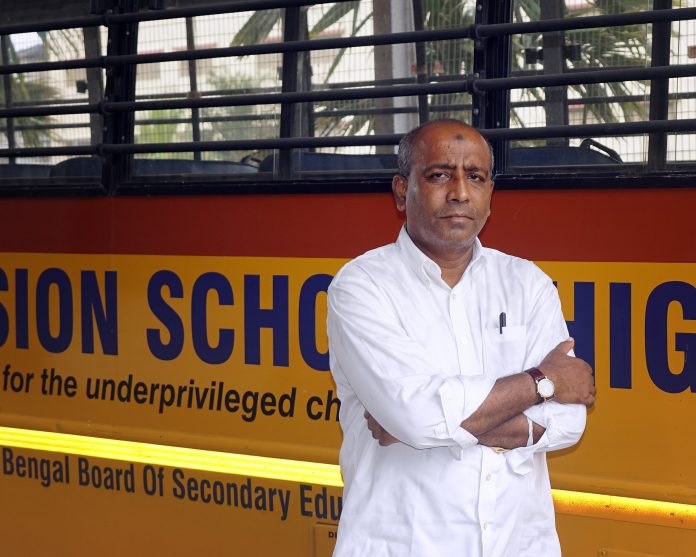
Educator and social reformer Mamoon Akhtar. | Photo by Partho Burman
More than 6000 kids from underprivileged families are benefiting from schools run by Mamoom Akhtar in West Bengal.
Kolkata :
It was the summer of 2001. Mamoon Akhtar, a slum dweller from Tikiapara, was returning home during the afternoon when a child named Ahmed, aged 7, ran up to him and pleaded with him to free his mother from a man who was forcing his mother to sell narcotics, something she despised. With the assistance of the police, he intervened to resolve the conflict. Before leaving, Akhtar inquired about Ahmed’s activities. “Sir, I want to learn,” the boy replied.
His response moved Akhtar. He recalled an incident from his school days when he was asked to leave his school for not paying his fees.Despite his traumatic childhood, Akhtar was able to finish high school.
Akhtar invited Ahmed to study at his home. He handed the young Ahmed a pencil and a notebook. On the second day, Ahmed returned with three children. On the third day, he arrived with four more.
This sparked hope in Akhtar. He asked his mother for permission to set up an informal school in a 300-square-foot room at his home and she agreed. He cleaned the room and bought a polythene sheet for the kids to sit on. “In addition, I set up a blackboard. That’s how it all started back in 2001. How a small street encounter transformed my life,” Akhtar told TwoCircles.net.
To ensure that no child is denied an education due to a lack of funds, he founded Samaritan Help Mission (SHM) in 2001, where he started providing quality education to children from economically disadvantaged families in Tikiapara, Howrah district, a neighbourhood where 80 per cent of the population is Muslim. Children, who previously did not attend school, are doing so now.
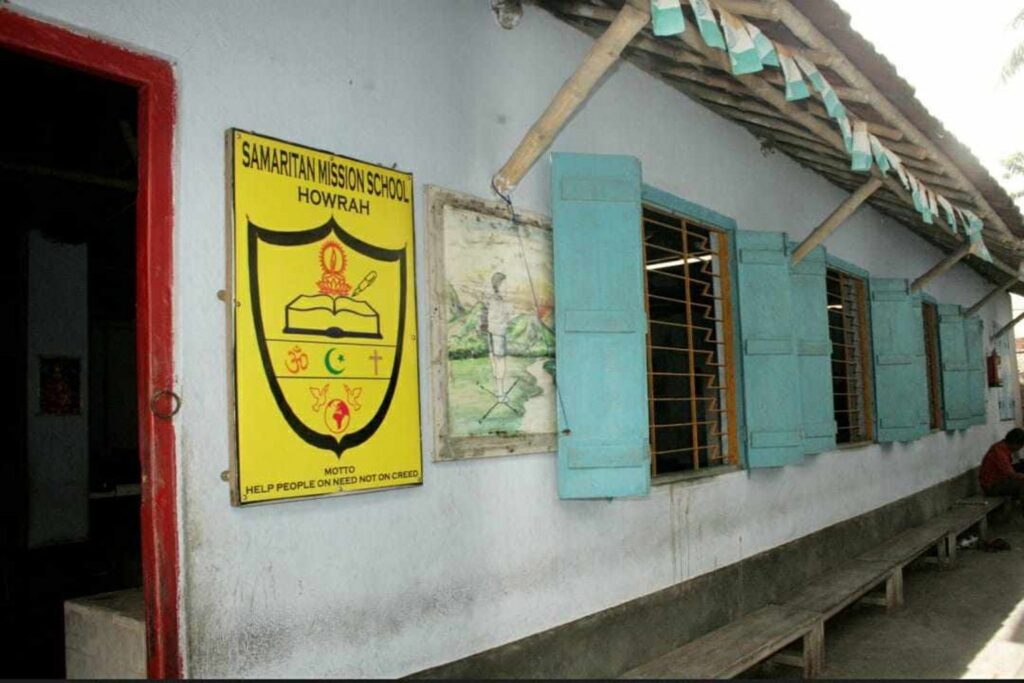
Samaritan Mission School was the first school set up by Mamoom Akhtar. | Photo by Partho Burman
Mamoon did not have a stable source of livelihood at the time, but he wanted to make sure he didn’t disappoint the children. He continued to conduct classes and began collecting newspapers and old books from his neighborhood. He sold them to raise funds for the slum pupils’ stationery. He invited several of the community’s college-going girls to join him in the classroom. He made them an offer of Rs 100 every month. He also requested his students to make a monthly contribution of Rs 5 for their education. They may bring in newspapers and old books instead of Rs 5 if they couldn’t afford it, he told them.
“I didn’t want the kids to believe they were destitute, so they are getting help. They needed to believe that their education was earned and that they deserved it. So, whether it’s Rs 1 or Rs 5, I implore them to pay,” he said.
“The school was administered by the poor for the poor,” Akhtar, who will turn 50 this year, said.
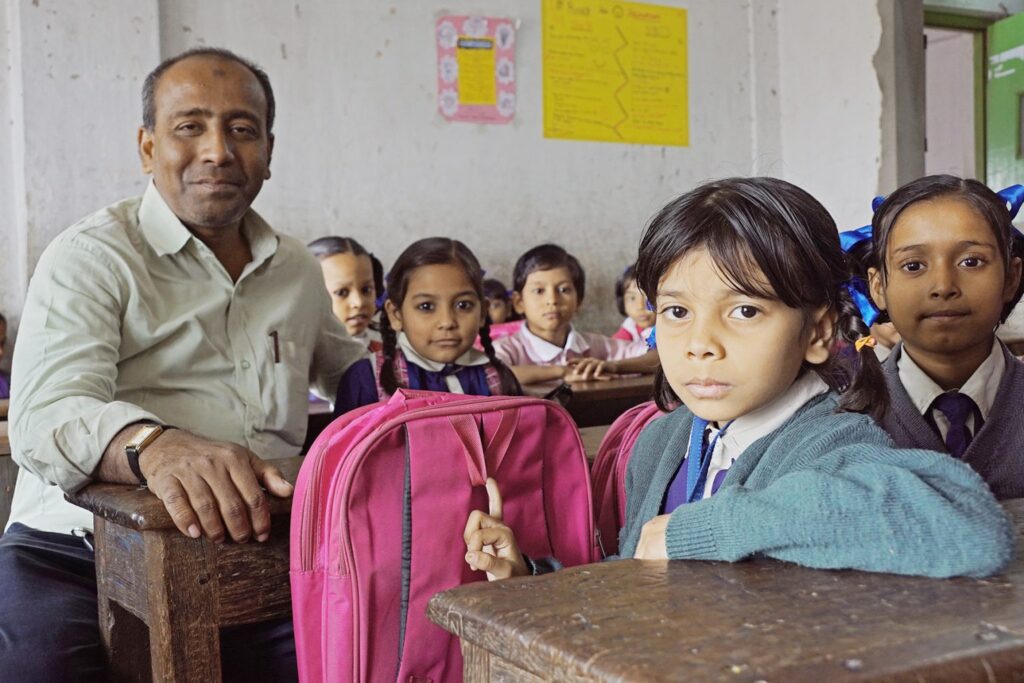
Mamoon Akhtar with the students of his school. | Photo by Partho Burman
In 2003, he came across a newspaper cutting while taking a walk. It included a photograph of a woman with some children. She was Lee Alison Sibley, an actress, social crusader and the wife of the American Consulate General in Kolkata. He sent her a letter asking for assistance. She responded with gratitude but declined to provide any assistance. Mamoon thanked her with a second letter.
Lee Alison Sibley eventually supported the cause and gave Rs 10000. “As a Muslim, I informed her that I don’t work for just Muslims. I solely work for the benefit of humanity. Because I think that hunger and poverty have no religion,” Mamoon recalled.
An article about her visit was published in a newspaper and Ramesh Kacholia, a Mumbai resident read it. He then sent his son to contribute Rs 11000 to him. For SHM, this was a watershed moment.
A co-educational English medium institution named Samaritan Mission School was founded in 2006. In 2008, the state of West Bengal granted it certification.
Akhtar told TwoCircles.net that many of the students at his school came from economically challenged backgrounds. Their fathers work as rickshaw pullers or daily labourers and some of them are in prison. “But their children are receiving a good education and performing well. I may not be able to do so for the country, but I will do all in my power to eliminate illiteracy in Tikiapara,” he said.
Three schools with 6500 students are now in operation. Samaritan Mission School High, Rebecca Belilious English Institution – a primary school and Samaritan Public School, which is located in Bankra, Howrah district, 10 kilometers from Tikiapara. Another school is coming up in the same complex at Bankra by January 2023. The total number of students is projected to reach 10,000. The exterior work on these schools has been completed.
Children receive education from nursery to grade 12. The medium of education is English, with Bengali as the secondary language. Howrah Municipal Corporation approached him to administer the inactive Tikiapara Municipal School based on his model of work. Akhtar took over the school in 2019, and in less than a year, it grew to 400 kids. It was once an Urdu-medium school, but it has since been transformed into an English-medium school.
Gradually, the social reformer broadened the scope of Samaritan Help Mission’s services to include health, sports, women’s livelihood and elderly care. 600 households get rations and medication every month from SHM. He started a vocational training programme as a source of income for widowed and divorced women. Around 400 women are employed as dressmakers.
Mamoon is the only son among five siblings and comes from a poor family. His father worked as a competent fabricator in the iron industry, while his mother took care of the family. Married with four kids, three of whom are students at his school. “I am a firm believer in the ideas of Prophet Mohammad and Swami Vivekananda. I read a lot about them,” Mamoon concluded.
www.samaritanhelpmission.org
Partho Burman is an award-winning independent journalist based in Kolkata. He writes inspirational, motivational and environmental stories. He tweets at @ParthoBurman
soure: http://www.twocircles.net / TwoCircles.net / Home> Lead Story / by Partho Burman / March 14th, 2022
Maulana Muhammed Manzoor Nomani (1905-1997), most arguably was one of the five prime most Muslims of the Indian sub-continent in the last century. He was the founding member of Jamaat-e-Islami and later got associated with Tablighi Jamaat and was also the member of founding committee of Muslim World League.
Maulana Khalil-ur-Rehman Sajjad Nomani is his son who gives every credence to his father, as that is what has made him, potentially what he is today; the most potent Muslim voice in the nation.
Sajjad Nomani’s command on Arabic, Quran, Hadith, Urdu, Hindi and English, in the same verve, depth and gravitas, apart from being an eloquent speaker, an indefatigable champion of Muslim cause, a voracious reader and a writer with an unquestionable command on the intricacies of linguistic theory and cultural praxis, are all the qualities he has embodied and imbibed from his late father.
Yours truly also did once saw Manzoor Nomani Sahab, at his Nazeerabad residence, Lucknow, as he sat on his wheel chair engrossed in an Urdu newspaper and also attended to his funeral at Aishbagh, Lucknow in 1997.
It would be worthy to recollect some of the anecdotes Sajjad Sahab shared about his late father, which all are a treasure trove to understand the ‘times’ about seventy-five years back.
He reminisced that Pakistan first Prime Minister Liaquat Ali Khan was very insistent that Manzoor Sahab visit Pakistan and become a part of Pakistan Constituent Assembly to ‘pave for the ingredients’ for Islamic Jurisprudence for the state of Pakistan, and ultimately even officially sought for it, as Manzoor Sahab was one of the most outstanding figures of Islamic Law and Jurisprudence at those times.
When India’s PM Jawahar Lal Nehru came to know of it, he communicated that though he does not want Maulana to volunteer it, yet if Maulana wanted then government of India was to facilitate it. But, there was no question of Manzoor Sahab even entertaining the idea as he was an unwavering Indian by his heart, not out of any chance but primarily for his choice, as Muslims after 1947 were to choose between India or Pakistan and Manzoor Sahab stood for India.
Maulana Khalilur Rahman Sajjad Nomani
Sajjad Sahab would also reflect that it was in 1976, when he was studying in Medina University, and had come to India on his vacations, that Manzoor Sahab kidneys collapsed all of a sudden and he went into coma. That was the time when emergency was in place. He informed that ‘intelligence inputs’ were given to PM Indira Gandhi that unless Maulana Ali Mian Nadwi, Maulana Manzoor Nomani and Qari Siddeeq Baandvi were to be arrested, Muslims were not relent to ‘vasectomy-sterilization’ and Indira Gandhi went to India’s President Fakhrudin Ali Ahmed, for his counsel on it, to which she was answered that all hell will break loose in the country in case of such an eventuality.
In the meantime, Indira Gandhi was also informed about the medical situation of Manzoor Sahab, and a chartered place to carry Maulana to Delhi was sent to Lucknow. The family members could not fathom for it, for they knew, that Maulana was be very angry once after the coma was to subside, the gesture of Indira Gandhi was hence refused, and fortunately by the midnight Maulana regained his senses, but then the next morning Indira Gandhi herself came down to Maulana’s residence. She would insist that Maulana may be flown to Delhi for his medical treatment, but all what Maulana sought from her was that she should implement justice as there was ‘tyranny’ all across the nation. He would address Indira Gandhi as his daughter and that when she played in her father’s courtyard, Maulana was to advice her father JL Nehru on critical issues.
Such has been the sense of belonging of Muslims for Manzoor Sahab , inherited too well by his son, is that while Jamshedpur raged under riots of 1979, Maulana went on to sit in a mosque for 21 days, draw into people and disbursed charity amongst the hapless Muslims, which continued for months. Maulana had an impeccable memory as Sajjad Sahab, relates, that shortly before his death, while he was searching for a Hadith, his ailing father, who was almost comatose, made him look for it on the exact page of Tirmezi- a great compendium of Hadith. Maulana Manzoor Sahab was a living authority and a luminary of Hadith-the sayings of Prophet of Islam.
Manzoor Nomani Sahab surely has left an indelible mark on Muslim civilization not across only in India but throughout the whole Muslim world. The best part however is that, it has all been very well innately translated into a relentless campaign for Muslim rights in India, by his son Sajjad Nomani, an activist always on his heels and one of the most credible voice of Muslims in the nation today. He is right now articulating the cause of Peace and Justice, a desperate call of the nation today. Sajjad Sahab is also the spokesperson of All India Muslim Personal Law Board, the Apex of Muslims in the country.
***
The writer is a former UP State Information Commissioner and writes on political issues.
source: http://www.mulimmirror.com / Muslim Mirror / Home> Muslim Scholars / by Haider Abbas / June 20th, 2022
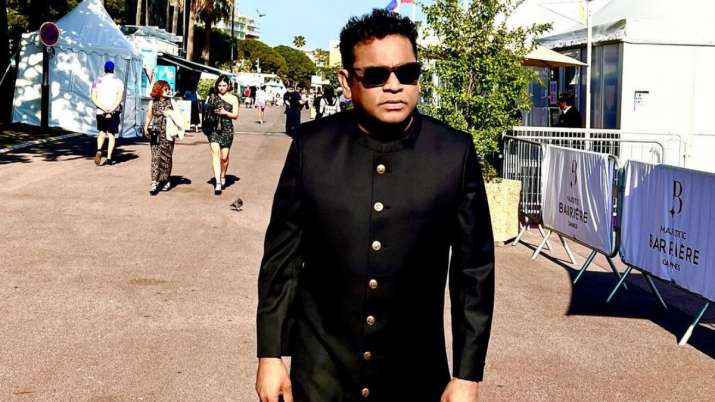
AR Rahman said as an artiste, it is a pleasure to be part of an innovative cultural program that supports creative excellence and artistic appreciation; and brings diverse audiences together.
AR Rahman named ambassador of Indo-UK culture platform / Image Source : INSTA/ARRAHMAN
Music great A R Rahman has been named the ambassador of British Council’s ‘India-UK Together Season of Culture’, which aims to boost collaboration among emerging artists. The ‘Season of Culture’ that marks the 75th anniversary of India’s independence was officially launched on Tuesday here by Britain’s Deputy High Commissioner to India Jan Thomson and Director (India) of British Council Barbara Wickham. Rahman said as an artiste, it is a pleasure to be part of an innovative cultural programme which supports creative excellence and artistic appreciation; and brings diverse audiences together.
“Today, creative expression and exchange can nurture young talent and create a global stage for fair and equitable access to arts,” he added.
Wickham said Rahman has been a significant adviser to the ‘Season of Culture’ and his work and professional journey truly embody what the ‘Season of Culture’ stands for – working together, and artistic output that captures the imagination of the world.
Over 1,400 artistes will showcase their collaborations to millions of audiences across India, Britain, Scotland, Wales and Northern Ireland, through a wide array of arts such as theatre, dance, visual arts, literature, music, architecture, design, fashion, tech-art, and new media art.
The ‘Season of Culture’ aims to build on the British Council’s work in India and strengthen India-UK collaboration in the areas of arts, English and education.
Wickham said people in both the countries will have the chance to experience innovative and exciting creative work from some of the most promising UK and Indian artists pushing the envelope of creativity and the infusion of creative tech.
source: http://www.indiatvnews.com / India TV / Home> English News> Entertainment / by PTI / New Delhi – June 08th, 2022
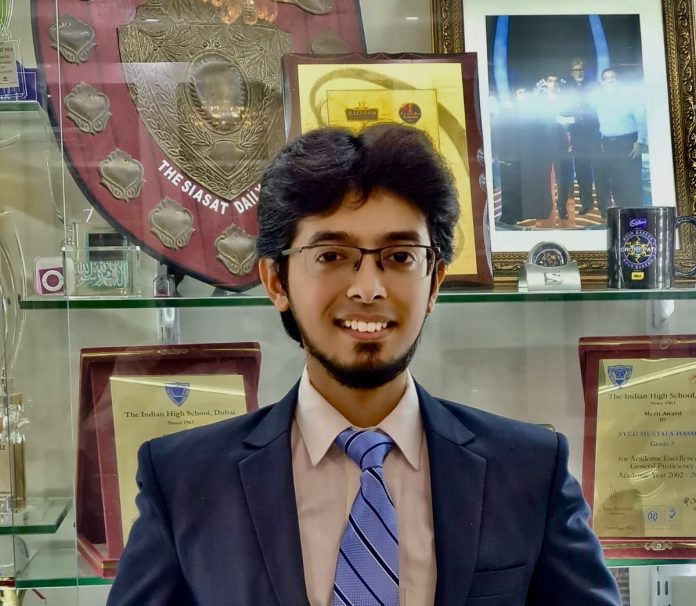
Dr Mustafa Hashmi is the only Muslim candidate from the south Indian state of Telangana making the UPSC list.
He is one among the total of 22 Muslim candidates who cracked the UPSC exams this year.
After completing his MBBS in 2016, Dr Hashmi pursued his MS degree at Osmania Medical College, Hyderabad. He graduated in 2020 and joined the district hospital, King Koti, as a surgeon. | Picture by arrangement
Hyderabad :
Of the total 685 candidates who have cracked this year’s Union Public Service Commission (UPSC) exams, only 22 are Muslim. 29-year-old Dr Mustafa Hashmi is one of them. He is the only Muslim candidate from Telangana who has cracked the prestigious UPSC, which is India’s highest civil services exam. He has bagged 162nd rank.
Talking to TwoCircles.net, Dr Hashmi, who was a practicing surgeon at Government District Hospital King Koti, Hyderabad, said that he was very happy to crack UPSC.
He said his motivation to crack UPSC came from seeing the experiences of economically backward people while accessing health care. “It dawned on me that the problems of these people are not confined to health alone and that I should do something else to ease their problems and serve the society in a much more beneficial way,” he said.
Dr Hashmi cracked UPSC exams on his fourth attempt after preparing for more than a year without attending any coaching institute.
“The first three attempts were like practice tests for me so I could get to know the pattern of the tests. I don’t have any regrets about that. It was only during my 4th attempt that I dedicated more time after my hours at the hospital,” Dr Hashmi said.
Maintaining a balance between work and studying for UPSC wasn’t easy. After an exhausting day at the hospital, where he was sometimes posted in the intensive care unit (ICU), performing surgeries and treating Covid-19 patients, he would come home and devote the remainder of his time to studies.
“I was determined and remained focused,” he said.
Dr Hashmi said that during his studies, his parents supported him by running his errands and doing his chores. “It is not just my hard work but even my parents’ put in so much to ensure that I was not disturbed while studying. They took care of every little need of mine. I owe my success to them and their upbringing,” he shared.
Born in an educated family, Dr Hashmi said that he was inclined towards science from his childhood because of his grandfather. “My grandfather was a Deputy General Manager in the Water Works Department, and used to advise me to become an administrative officer because he would say I could serve people better in that way,” he said.
After completing his MBBS in 2016, Dr Hashmi pursued his MS degree at Osmania Medical College, Hyderabad. He graduated in 2020 and joined the district hospital, King Koti, as a surgeon.
Besides excelling in academics, Dr Hashmi has memorized the entire Quran.
Eldest of the four siblings, who are also doctors, Dr Hashmi said his parents were working comfortable jobs in the Gulf before deciding to return to India. “My parents wanted me to serve the country. I am thankful to Allah for this result,” he said.
Dr Hashmi believes that after counselling, it is more likely that he will be posted in the Indian Police Service (IPS).
“Whatever is assigned to me, I will serve the people. I will be able to reach out to more people who are underprivileged and I am happy with that,” he said.
Dr Hashmi said that the youth of the country who wanted to pursue UPSC should not think of serving themselves but “serve society at large and contribute to nation-building.”
“Youth (cracking UPSC) should think about improving the lives of the less privileged in whatever way they can. Understanding the larger purpose and working hard towards that is the key to success and satisfaction,” he added.
Nikhat Fatima is a correspondent with TwoCircles.net based in Hyderabad, Telangana. She tweets at @snikhatf
source: http://www.twocircles.net / TwoCircles.net / Home> Lead Story / by Nikhat Fatima / June 02nd, 2022
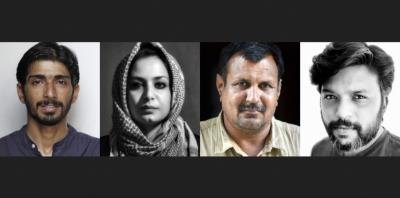
Amid the gloom, there is a whiff of fresh air. A young woman photojournalist has made Kashmir proud by winning the prestigious Pulitzer Prize this year.
Sanna Irshad Mattoo became the first Kashmiri woman photographer to win the Prize.
She is among the three from India to have won the award this year. Besides, Sanna, slain Reuters photographer Danish Siddiqui and Adnan Abidi have won the award for their images about Covid’s toll in India.
Siddiqui was killed last year in Afghanistan.
Sanna Irshad Mattoo has won the prestigious Pulitzer Prize award in the feature photography category for 2022.
“Congratulations to @adnanabidi, @mattoosanna, @AmitDav46549614, the family and friends of the late, @dansiddiqui, and @Reuters. #Pulitzer,” Pulitzer announced on Twitter.
Sanna, who holds a Master’s in Convergent Journalism from the Central University of Kashmir, has her work published in international media outlets, including Al Jazeera, TIME, and TRT World. She has also done a fellowship with the prestigious Magnum Foundation in 2021.
“Sanna Irshad Mattoo is a photojournalist and documentary photographer based in Kashmir. Ranging from groundbreaking news to in-depth storytelling, her work concentrates on depicting the tension between the seeming ordinariness of life and the stark symbols of a menacing militarised milieu of Kashmir. Her work has been published in newspapers and magazines around the world and has been screened and exhibited in various exhibitions and festivals. She presently contributes to Reuters as a Multimedia Journalist,” Sanna’s Pulitzer introduction said.
In 2020, three Jammu and Kashmir photojournalists Dar Yasin, Mukhtar Khan, and Channi Anand won the prestigious Pulitzer award. Established in 1917, Pulitzer Prize is an award for achievements in newspaper, magazine, online journalism, literature, and musical composition within the US.
source: http://www.indiatomorrow.net / India Tomorrow / Home> Featured> Inspiring Personality / by Ishfaq-ul-Hassan / May 10th, 2022
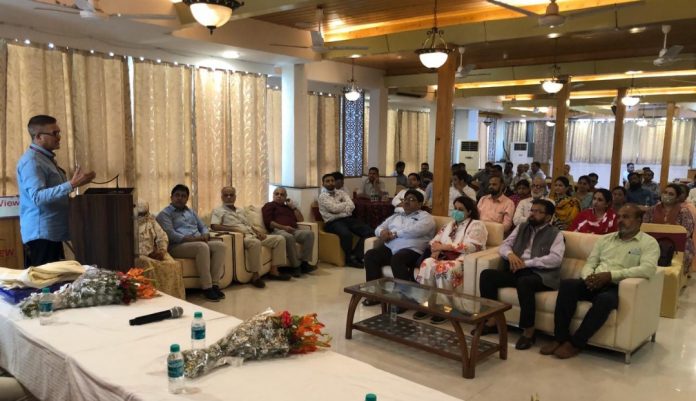
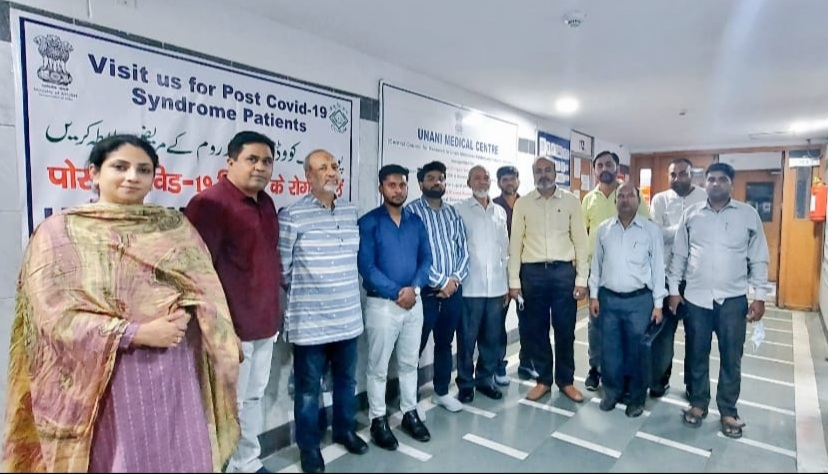
Dr. Syed Ahmad Khan, who retired on May 31, 2022 as a Deputy Director, Incharge, Unani Medical Centre at Safdarjung Hospital in New Delhi, was honoured during a farewell function hosted by the Central Council for Research in Unani Medicine (CCRUM). His contributions to the cause of Unani medicine were lauded by all who spoke. They claimed that Dr Khan’s devotion and dedication set an example for others.
The function was conducted under the dynamic leadership of Prof. Asim Ali Khan, Director General, CCRUM, Ministry of Ayush at Hotel River View, Okhla on May 30, 2022. It was organised by Dr Rahat Raza, Deputy Director In charge, RRIUM, New Delhi.
Dr. Syed Ahmad Khan served for over 30 years in CCRUM and discharged his duty at various levels from Research Officer (Unani) to Deputy Director.
He was felicitated by the senior officials. He superannuated from the service as Deputy Director Incharge of the Unani Medical Center at Safdarjung Hospital.
Prof. Khan praised Dr Syed Khan on his contributions and dedication to the Unani medical services, and wished him well in his future endeavours.
Officers and personnel from CCRUM attended the farewell party and showered Dr. Khan with praise.
Dr. Khan is the General Secretary of the All India Unani Tibbi Congress, a non-profit organisation dedicated to advancing the cause of Unani medicine and serving as a watchdog for Unani doctors. The organisation monitors the AYUSH ministry’s actions and intervenes if there is any mistreatment of Unani medicine. Since his election as general secretary, Dr Khan has been a driving force behind this organisation. By conducting seminars and conferences, the organisation has helped to popularise Unani medicine in the country and abroad.
source: http://www.muslimmirror.com / Muslim Mirror / Home> Health> Positive Story / by Special Correspondent / June 02nd, 2022
Perunthalmanna Thazekadu Village / Kalikavu (Malappuram District) KERALA :
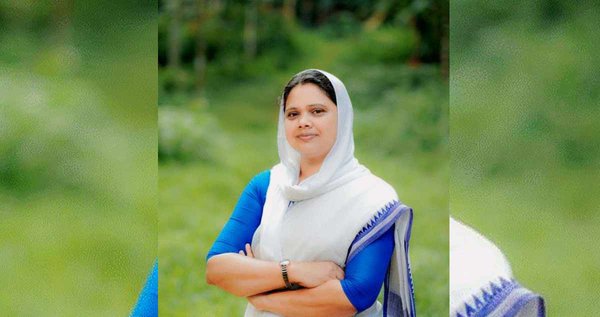
An ordinary Muslim woman from a remote village in North Kerala’s Malappuram district is today one of the general secretaries of the Congress party in Kerala.
Any woman involved in public service in Kerala, or for that matter anywhere in the country, faces several difficulties and challenges. It is all the more daunting if you are an ordinary woman and a Muslim to boot. Especially in today’s ‘New India’. Let us face the facts: unlike men, the circumstances are not conducive for a woman to enter politics in Kerala.
It is after a lot of uncertainty and dithering that the Congress party in Kerala managed to recently release a list of new office-bearers of the Pradesh Congress Committee. Though the leadership has claimed that the list is a reflection of a unified Congress – remember the local Congress has been ravaged by group rivalry for decades that had once again cost the party dearly in the recent Assembly elections in the state – it has naturally come under criticism for minimal representation for women in different committees. The AICC has co-opted five women, including three general secretaries and two executive committee members, into the KPCC leadership hierarchy. The women general secretaries are K.A. Thulsi, Alippatta Jameela and Deepthi Mary Varghese. The executive committee members are Padmaja Venugopal and P.R. Sona.
It is in this backdrop that Alipatta Jameela, the only Muslim woman general secretary of the KPCC, spoke to DoolNews Malayalam about her political journey. Asked how as a Muslim woman from Perunthalmanna Thazekadu, a village situated in the hilly terrain in Malappuram, one of the most backward districts in north Kerala till not very long ago, she rose to become a KPCC general secretary, Jameela said she had represented the KSU (Kerala Students Union, student organisation of the Congress in Kerala) in the College Union when she was studying in Mannarkkad MES (Muslim Education Society) College. She said she moved to Kalikavu, where she is settled now, after her marriage. She became active in politics after being elected president of the local Kalikavu Mandalam Congress in 2000. In 2005 she became a member of the Kalikavu panchayat after winning from Eenadi ward. In 2010 she contested from another ward and became president of the Kalikavu panchayat.
In 2015 she contested the Zilla panchayat election from Vandiyur division. In 2018 she became the district secretary of the Mahila Congress. In the 2020 panchayat elections, she successfully contested from Thenjippalam division. Currently she is a member of the Thenjippalam division and chairperson of the Public Works Department (PWD) standing committee there.
Jameela said it is significant that the party chose to select her to the PCC while she is already holding the post of general secretary of the Kerala Mahila Congress. “I consider it an honour and a sign of the party’s continuing faith in me. It is a great achievement to become one of the general secretaries of the State Congress, especially for someone hailing from the hilly terrain and living in this small town of Eranadu Kalikavu. I consider it recognition of the work I have done so far and I hope to fulfil the responsibilities bestowed on me to the full extent of my abilities,” she said.
Asked if she had a long struggle to reach the level she has, Jameela admitted that it was very difficult as a woman, especially as an ordinary woman from Malappuram, to embark on a life of public service, which is full of hazards and challenges entirely different from what men face in such circumstances. “When I contested for the panchayat in 2005, my younger child was not even a year old. The elder one was just three. To go out and campaign leaving my two children at home was very tough. This is not in my case alone. A lot of women face the same problems. Many of them are forced to give up as they fail to get enough support at home,” she said.
Jameela asserted that she could reach this level purely because of the support and encouragement she got at home. Despite that as a woman she faces many difficulties which she somehow overcomes to go forward.
On whether she belonged to a traditional Congress family and how she came into the party, she confessed that her family is basically a Muslim League one, but her late brother Nalakath Yusuf was a staunch Congress supporter and introduced her to the party’s ideology. “It was he who initiated me to the basics of politics. That was how I got involved in student politics,” Jameela said.
On the criticism over the shrinking representation of women in Congress forums, Jameela said compared to the previous jumbo KPCC (over 100) the current one has been trimmed to 51. “There are three women general secretaries and two in the executive committee. So, five of us are here. I think this is a decent number. I am myself an answer to that criticism. The fact that of the three woman general secretaries one is from Malappuram (Muslim-dominated district where League roots are deep) is in itself, in my opinion, an important signal to the changes that are sure to happen,” Jameela said.
On the new Congress leadership in Kerala vowing to end group rivalry in the state unit and whether she belongs to any group, Jameela admitted that leaders in the state Congress have grown only through these groups. “All along I have worked above these groups, but it is a fact that Thenjippalam from where I am a member belongs to the I (Indira) group. So, in a way, many see or identify me as spokesperson of the I group. But I try to be above all this and consider myself a humble worker of the Indian National Congress,” she said.
(Note for those who are not familiar with Congress politics in Kerala: For years these groups – A and I – are identified as the former aligned with senior Congress leader from the state, A K Antony, whose soulmate is former chief minister Oommen Chandy. The other group consists of followers of the late K Karunakaran who had stood with Indira Gandhi at the time she split the Congress a second time. Their current leader is former leader of the opposition Ramesh Chennithala.)
Asked whether the Congress, which is not in power either in the state or at the Centre, and is passing through perhaps the worst period in its history can make a comeback, Jameela said the country is passing through a grave crisis and is heading towards total anarchy without the Congress in power. She said the BJP is destroying India’s secular democracy by the day. “Women in particular are facing many problems in the state and the country in general. We see only such news these days. If Congress was in power these things would not have happened. In such circumstances people want the Congress to return to power. The new state Congress president and the leader of the Opposition are working for that only – to bring Congress back to its glory in the state. We will emerge victorious,” she said.
Asked what advice she would give to those women wanting to come into public life, Jameela said more and more women have started joining mainstream politics. She said it is the need of the hour as the country is passing through dangerous times. She added that she will always be there to guide women, Muslim or otherwise, who come forward to play a role in shaping the destiny of the country.
source: http://www.milligazette.com / The Milli Gazette / Home> News> Community News / by MG Correspondent / January 14th, 2022
Dr A Remla Beevi, director of medical education who bade adieu to a tumultuous stint on Tuesday, terms her last seven years as the most challenging in her 34-year career.
Thiruvananthapuram :
Dr A Remla Beevi, director of medical education who bade adieu to a tumultuous stint on Tuesday, terms her last seven years as the most challenging in her 34-year career. She had an arduous task as the DME during the Nipah and then the pandemic outbreak in the state.
When the Nipah virus outbreak was reported in Kozhikode district in 2018, like any other health professional, Dr Remla was also at sea. Even today, Thiruvananthapuram native Dr Remla remembers that once the diagnosis was reached, health authorities took steps to set up isolation facilities in a jiffy.
However, she is still upset that the state lost Lini Puthussery, the nurse who died in the first outbreak. Dr Remla recalls that the diagnosis had not come when Lini fell ill. Dr Remla gives credit to the entire health department, including then health minister K K Shailaja and former health secretary Rajiv Sadanandan, for working unitedly to contain the Nipah virus spread within Kozhikode district. In 2020, when she was busy with her administrative work at the directorate of medical education in Thiruvananthapuram, the first Covid case was reported in the state. Later, the Covid spread was declared a pandemic.
“The biggest challenge was that apart from Covid patients, people affected with other illnesses as well as pregnant ladies were thronging the Thiruvananthapuram Medical College and SAT hospitals. We had to set up separate labour rooms, operation theatres, ICUs and separate wards and divide our staff into three pools – Covid, non-Covid and reserve,” Dr Remla told TNIE.
Many a time, she missed her family – comprising husband Dr E Abdul Khadar, former professor and head of the cardiology department of Kottayam Medical College, engineer son Mohammed Farooq Husain and daughter Dr A Sumayya residing in Kottayam – when she returned home after a long and tiring day.
Dr Remla became the DME in 2015 after serving as the principal in Thrissur, Alappuzha and Kottayam government medical colleges. She joined the government service in 1988 as a lecturer at the Government Medical College in Kottayam.
Dr Remla who has specialised in radiology, fondly remembers the team work rendered by former health minister Shailaja who went out of the way by reading medical books and journals about Nipah and Covid so that these would help her “health army” to combat the deadly viruses.
source: http://www.newindianexpress.com / The New Indian Express / Home> Good News / by Cynthia Chandran, Express News Service / June 02nd, 2022