Tall marble pillars frame photos, automobiles and more, as the Bhopal royals open up their past at the Jehan Numa Palace Hotel
Over the years, the Jehan Numa Palace in Bhopal — built on the slopes of the Shyamla Hills in 1890 by General Obaidullah Khan, commander-in-chief of the Bhopal State Force, and the second son of Nawab Sultan Jehan Begum — has worn many garbs.
The white marble edifice, which melds British Colonial, Italian Renaissance and Classical Greek architectural styles with facets of Art Deco, was constructed as the general’s office, and then used as his sons’ secretariat. After Independence, it became a government hostel, and later, the offices of the Geological Survey of India.
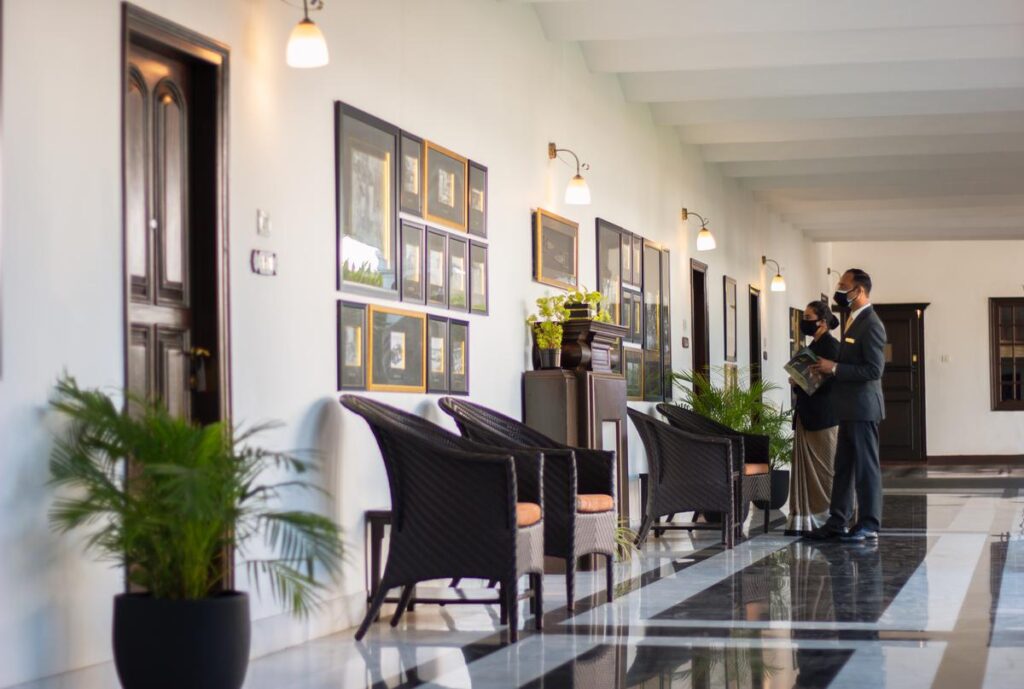
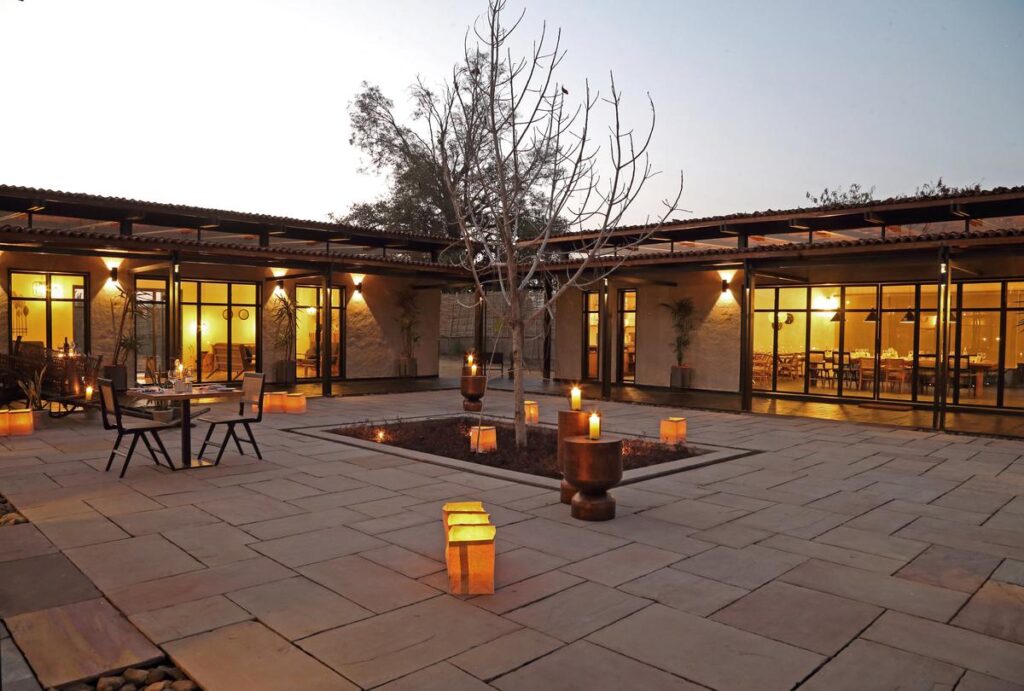
In 1983, after restoring the five-acre property, the general’s grandsons reopened it as a heritage hotel — its colonnaded corridors showcasing sepia-toned portraits, and the interiors housing rooms, four restaurants, two bars and a spa. Now, the pandemic has given it another facet: a museum, which came together almost like a “jigsaw puzzle”, says Faiz Rashid, director of the Jehan Numa Group of Hotels and a member of the Bhopal royal family.
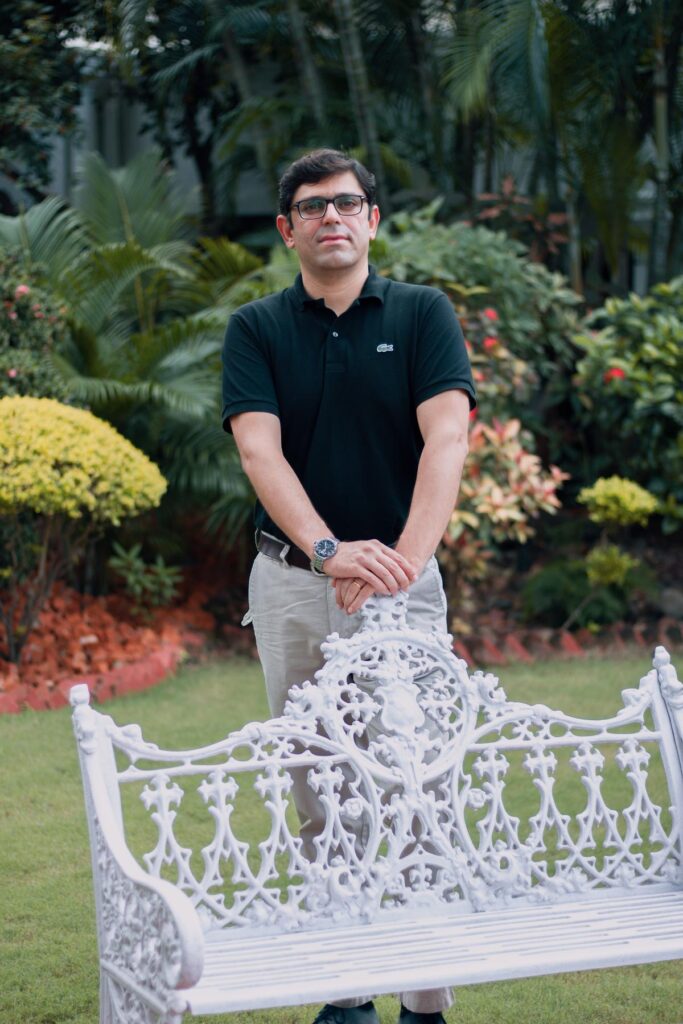
Faiz Rashid
A colonnaded showcase
“[Over the last 20-odd months] we tried to come up with innovative ways to nurture hospitality. Because of the time on hand, we started looking at family archives and thought why not share the legacy with the world,” says Rashid. He tells me about putting together memorabilia: artefacts, attire, “lovely letters in Urdu” written to his great grandfather, documents, “invoices of the cars the royal family bought [like a Ford Phantom and a customised Bentley]” — all of which are now on show at the hotel.
“General Obaidullah Khan accompanied his mother, the last begum, on her foreign trips. He was inspired by different architectural styles, and the display is a pictorial history of the hotel’s evolution from the time it was built in the 19th century,” he says.
The corridors along the central courtyard, with its famed 100-year-old mango tree, were chosen as the ideal backdrop for the display. I take a virtual tour of the elegantly-framed archives, arranged in clusters on the walls of the chequered black-and-white marble and granite corridors, zooming into the photographs, and taking in glimpses of the life and times of a pre-Independence royalty that was progressive and involved, wealthy but not flamboyant, stylish but never garish.
From letters to thoroughbreds
The family took the help of Joe Alvarez, the well-known jazz singer who has written a coffee-table book on Bhopal, to curate the memorabilia.
“We divided them into nine subjects, starting with the four begums, the last nawab, dignitary visits, nawabi sports and the outdoors, and such,” says Alvarez, who has also generated a voice-over, and added a QR code to enable a Walk-In Museum audio guide.
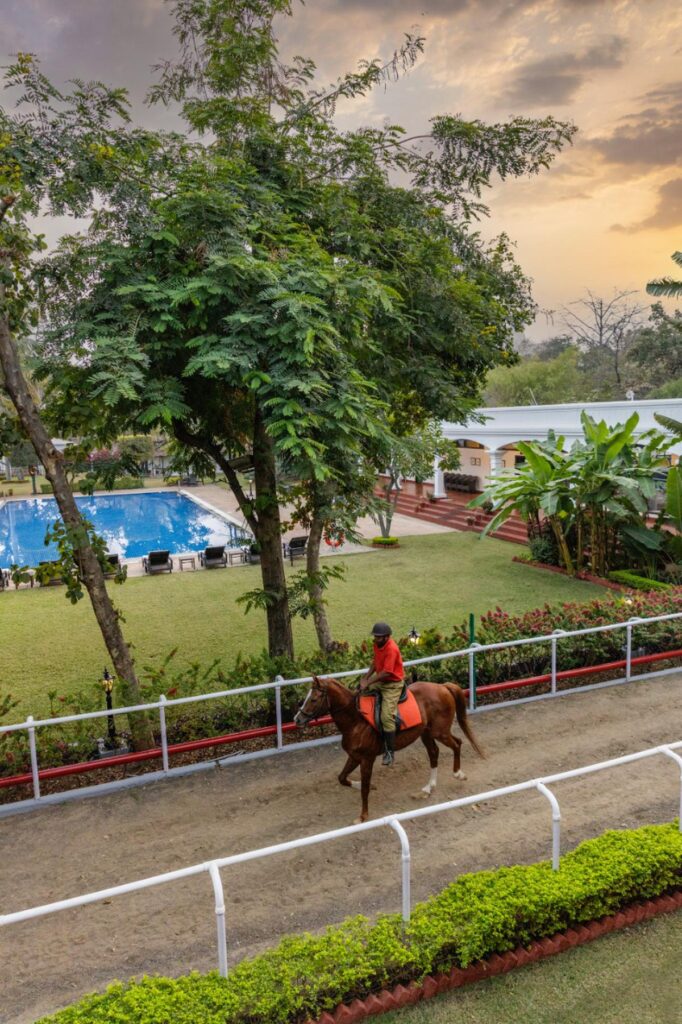
The track at the Jehan Numa Palace Hotel
He expounds about the images of a thriving stud farm, something that continues till date (a trotting track set up when the hotel opened gives visitors a peek into the royal family’s passion for breeding thoroughbreds), of custom-built automobiles, branded guns and weapons, and official visits by dignitaries.
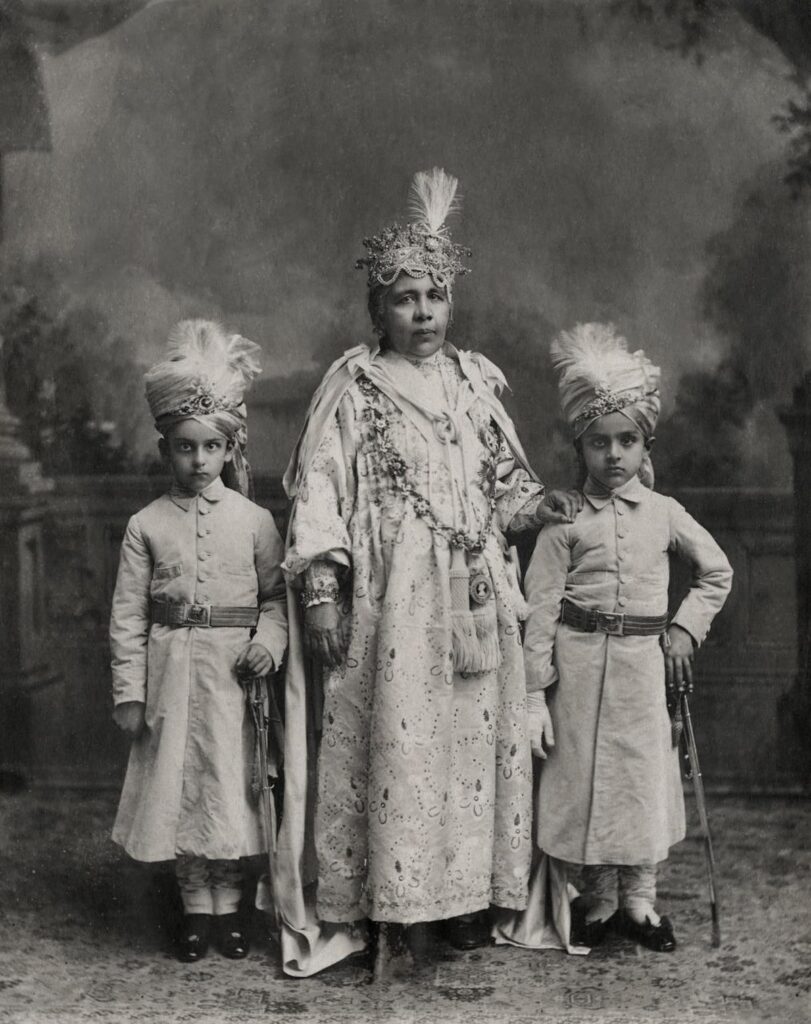
The begum’s photo from the archives
“The nawab begums of Bhopal were very dynamic and built the city differently from male rulers. They focussed on all areas, from education to women’s empowerment. We realised so much of their contribution — like building hospitals, enhancing the railways, opening schools — while putting this together,” shares Rashid, adding that, in 1889, Shah Jehan Begum funded the construction of Britain’s first purpose-built mosque at Woking. The collection is still evolving as more memorabilia makes its way to them slowly, from the extended family. A plan to restore and display the wedding dresses of the begums is also in the pipeline.
The museum is open to all. Rooms at the hotel are from ₹8,000 onwards. Details: jehannuma.com
Bori Safari Lodge
Spot the tiger at Bori Safari Lodge
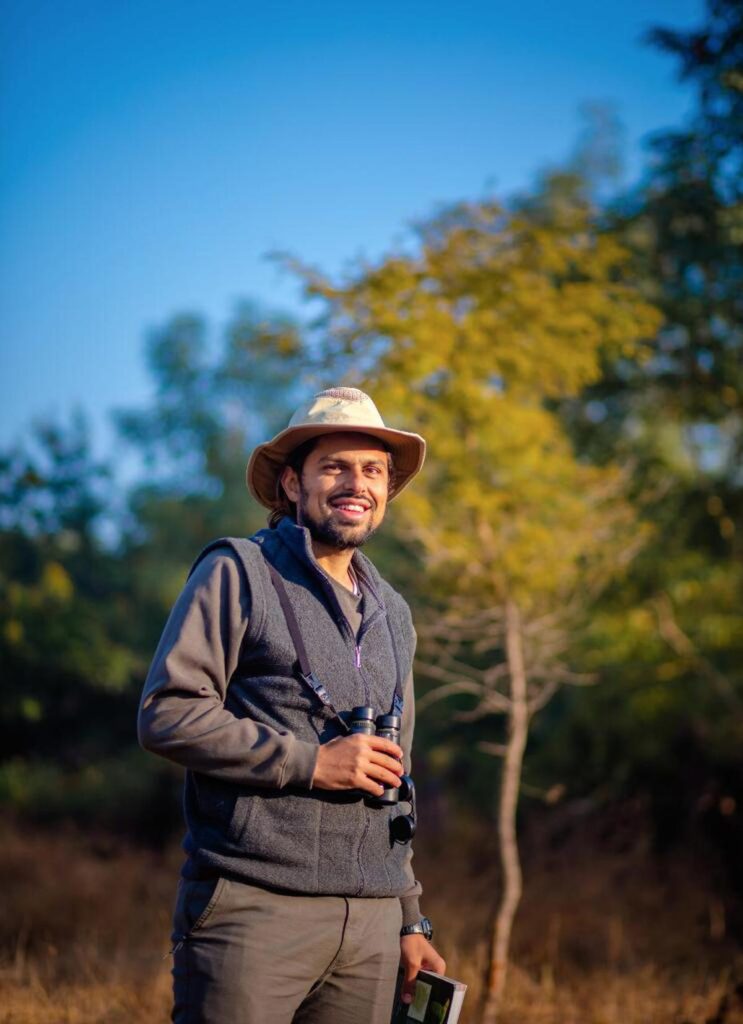
Another post-pandemic hospitality initiative is Bori Safari Lodge, an eight-room wildlife camp started by Rashid’s brother, Aly, in the Satpura Forest. “When we started the Reni Pani Jungle Lodge [a two-and-a-half hour drive away] in 2009, it was about experiencing the diversity of the forest, with river safaris, walking trails and birding. With the Bori, the tiger comes centre stage,” says the trained naturalist, who has partnered with the state tourism department.
Aly is a trained naturalist
A tiger relocation programme successfully initiated four years ago has revitalised the habitat and the local population. “The tigers have not only flourished, but have actively begun mating.” Aly — who has great memories of spending his childhood in the forests — also leads expeditions to spot snow leopards in Ladakh and seek out the red panda in the Northeast. “This [project] is a means to conserve the landscape. The alternate income for the locals will recharge the community, support conservation, and will help wildlife be seen as an asset.”
From ₹25,000 onwards (all inclusive)
source: http://www.thehindu.com / The Hindu / Home> Entertainment> Art> Weekend Travel Special 2022 / by Priyadershini S / April 15th, 2022
Komatlagudem Village (Khammam District), TELANGANA :
Apart from being Telangana’s first Muslim woman IPS officer, Saleema is also the first woman from the erstwhile Khammam district to have been appointed to the IPS.
Rachakonda DCP Shaik Saleema (Photo| EPS)
Khammam :
A festive air has gripped Komatlagudem village of Chintakani mandal in Khammam district after Shaik Saleema, who was a non-cadre Superintendents of Police (SP), was appointed to the Indian Police Service (IPS) by the Central government. She is currently posted as a DCP in the Rachakonda commissionerate.
Apart from being Telangana’s first Muslim woman IPS officer, Saleema is also the first woman from erstwhile Khammam district to have been appointed to the IPS.
Hailing from a middle-class family, Saleema’s father Lal Bahadur also served in the Police Department and retired as Sub-Inspector (SI) a few years ago. Her mother Yakubbi was a stay-at-home parent. The couple has three other children – Zareena, Munni and Khasim – and all of them are in good positions now.
After completing her schooling and graduation in Khammam, Saleema joined the Kakatiya University in Warangal for pursuing a postgraduate degree in bio-technology. After cracking the group exams, she was selected as a DSP in 2007 and got her first posting at Kagaznagar in erstwhile Adilabad district.
Later, she worked as the vice-principal of Amberpet Police Training Centre in Hyderabad. She also served as Addl DCP (Admin) in Cyberabad police commissionerate. Saleema’s sister Zareena is currently awaiting her interview after clearing the Andhra Pradesh Group-1 exam.
While her another sister Munni currently works as a vehicle inspector in Khairatabad, Hyderabad, Saleema’s brother Khasim is a doctor at Care Hospital in Hyderabad. The cop’s husband works as a software engineer.
When The New Indian Express spoke to a couple of villagers, they all expressed their happiness over Saleema’s promotion. Speaking to The New Indian Express, Saleema shared her joy and said that she has always strived to be honest in her job throughout her career.
The officer says: “More and more women should join the force. For this, one has to step out of their comfort zone and come forward. Only then, you would be able to achieve the name and fame that you dream of. I also did the same. Thanks to my family members for supporting me throughout the journey.”
Mentioning that getting a government job had always been her dream, Saleema said after receiving one, she never looked back. “My family supported me the same way they would if I received any other job. They never let me face any difficulties alone. After I got married, my husband Baji Ahmed, who works as project manager, became my spot driver,” chuckles Saleema.
Ahmed looks after both their kids, studying in Classes IX and II, without any complaints. She says her younger child still wonders as to why her picture appears in newspapers once a while. When asked if there was any incident that gave her complete satisfaction, the cop shared one such instance with The New Indian Express.
“We were given complete freedom by CP Mahesh Bhagwat to put an end to two major threats the city was facing in 2018 — sex determination in Uppal and sex trafficking in Yadagirigutta. One of those nights, I received a call with a tipoff and we had to conduct, not a raid but, a decoy operation. I saw many grave things that night. But, after successfully detecting the case and sending the victims to shelter homes, I felt complete satisfaction. Memories of that day still give me immense pleasure,” she said.
source: http://www.newindianexpress.com / The New Indian Express / Home> States> Telangana / by B Satyanarayana Reddy and Priya Rathnam / by Express News Service / December 26th, 2021
Inayat Ali Mulki, one of the promising leaders of this generation, has been appointed as the general secretary of Karnataka Pradesh Congress Committee (KPCC) under the strong leadership of D K Shivakumar.pix
Inayat Ali started his political career as a grassroot level worker, taking up the responsibility as the NSUI president for the Mulki block of Dakshina Kannada district.
He then continued to serve the Congress party as National NSUI general secretary and as the Karnataka Pradesh Youth Congress Committee general secretary, working under the guidance of the late Oscar Fernandes, Mukul Wasnik, Ashok Gehlot and Rahul Gandhi.
Inayat Ali expressed his humble gratitude for this new role in the Congress party and promised to continue his noble work for the overall betterment and the upliftment of the society.
source: http://www.daijiworld.com / Daijiworld.com / Home> Karnataka / by Media Release / April 09th, 2022
He will help organise the 44th International Chess Olympiad from July 28 to August 10
The Tamil Nadu government on Saturday appointed Darez Ahamed, Special Secretary, Health and Family Welfare Department, as Officer on Special Duty for conducting the 44 th International Chess Olympiad from July 28 to August 10.
As per rules, sanction is granted for creation of a temporary post of Officer on Special Duty, Chess Olympiad, in the Office of Sports Development Authority of Tamil Nadu in the Super Time Scale of IAS for a period of six months, a Government Order issued by Chief Secretary V. Irai Anbu said.
Dr. Ahamed, Mission Director, National Health Mission, Special Secretary to Government, Health and Family Welfare Department, will be placed in full additional charge for the post of Officer on Special Duty.
He will assist the Committee for Organising Chennai Olympiad (COCO) Society with respect to the Olympiad and undertake necessary activities in coordination with the Principal Secretary, Youth Welfare and Sports Development, and Member Secretary, Sports Development Authority of Tamil Nadu.
Dr. Ahamed will also be ex-Officio member of the COCO Society and also Member Secretary of its Executive Sub Committee.
source: http://www.thehindu.com / The Hindu / Home> News> National> Tamil Nadu / by Special Correspondent / Chennai – April 09th, 2022
Gulammohammed Sheikh: ‘What we need is an open climate within our institutions to allow artists to practise their art’
Gulammohammed Sheikh, artist (Illustration : Suvajit Dey)
Gulammohammed Sheikh speaks on the idea of multiplicity in life, art education in India, interference in institutions and how the world of art remains free of divides. This session was moderated by Vandana Kalra, Senior Assistant Editor, The Indian Express .
Vandana Kalra: In 1981, you had said that living in India means living simultaneously in several times and cultures. Do you think the relevance of your statement has only increased over time? Also, how do you look at the works that you made during that period, for example, City for Sale?
Among these works, the first one was About Waiting and Wandering, the other was Speaking Street, the third Revolving Routes and the fourth City for Sale. They relate to actual situations and are connected.
Speaking Street was a re-creation of the kind of street that I lived in during my childhood. Born in 1937, I spent about 18 years in Surendranagar, which was then a small town, before I came to Baroda to study. We lived in a little lane, which had a little mosque whose walls were painted green with enamel colours, but it didn’t have a dome. There would be people sitting on the street selling fish, or somebody pulling a little cart. In the lower half of the painting there are several events taking place simultaneously in different houses or rooms, as would happen with people living in chawls. Speaking Street also carries a personal portrait — a young boy looking out of a window. Thinking of the childhood spent in a street like that, I remember having learnt to recite the Quran in Arabic at a madarsa, while studying Sanskrit at school. It gave me the idea of multiplicity in life, connected by multiple belief systems.
This work connects with the much larger City for Sale, based in the city in which I continue to live; the city of Baroda, now Vadodara. I came to Baroda first in 1955 as a student, and after finishing my studies at the Faculty of Fine Arts, I taught there for three years. I was then in London on a scholarship for three years and returned home in 1966. When I first came to Baroda, it opened for me not just the world of art, but also the art of the world. But in 1969 this city produced another image. Some of the worst communal riots took place here between 1969 and 1970. People began to look at me with my name in mind. So, it gave me an identity which was different from the identity that I had acquired when I had reached Baroda, then — open, liberal, multifaceted. In 1969, suddenly the situation changed. These four paintings, in some ways, reflect upon the times that I had gone through. City for Sale is large and has multiple figures, so many characters. There are three men meeting on the pretext of lighting a matchstick. Would that provoke incendiary connotations? There is also a woman who has a big vegetable cart, which literally flows into the town. Then there is, in the centre, a film being shown called Silsila (1981). And on the top, the scene of a communal riot. It brought together multiple parts of a city, depicting how riots are raging in one part, but a film is being shown in another. In a way, it was confessional, it was also some kind of a release for me.
Yes, there are problems that beset our institutions. Government museums and academies are out of touch with what’s going on in the world of art, and directors are often appointed rather arbitrarily, often not from the art world at all
Vandana Kalra: In more recent years, you’ve taken this thought forward and you seem to have turned to Kabir and Mahatma Gandhi to call for peace, call for intermingling. If you could talk a bit about that.
Gandhi came to me right from the time I was in school. I read My Experiments with Truth (1927), in Gujarati it’s Satya Na Prayogo. It has remained with me ever since. During the years of 1969 and 1970, Gandhi kept coming to me, in different forms, different guises. But I didn’t know how to paint Gandhiji, I had never seen him in person. I saw lots of photographs. Then I devised something. The first painting that I made of him was of Gandhi in South Africa, in the image of a young lawyer. But the second one, which I have used twice or thrice since, was the image of Gandhi returning to India, quoted from a painting by Abanindranath Tagore.
Kabir came in a different way. I was familiar with his poetry from my school days but he began to become more and more relevant in the context of the conflicting situations that I saw around myself. I thought, perhaps, I should try to paint Kabir. But how to paint Kabir? My mentor KG Subramanyan’s mentor Benodebehari Mukherjee had painted a large mural in Santiniketan on the saint-poets of India, which included Kabir. Benode babu knew that Kabir was a weaver, so he went to the weavers’ colony to search for his image of a weaver and made his Kabir. I found a Kabir image in a late Mughal painting in the British Museum collection and devised a Kabir-like persona from that image. As Kabir began to recur in my mind, I began to read Kabir but it was difficult to find a visual equivalent. It was when I heard Kumar Gandharva singing Kabir that I thought, why can I not illustrate his poetry? Within histories of art, a great number of paintings illustrate poetry.
We have to think of a holistic way of devising a new art education system for our country. An art education system that is not standardised. It should leave room for each region, each culture in a diverse country like ours
Vandana Kalra: How do you look at the dialogue between your poetry and painting?
When I started writing poetry while I was in school, it was very traditional, using Sanskrit meters or in the form of songs. When I came to Baroda, I met a new mentor, Suresh Joshi, the writer who pioneered a modern idiom in Gujarati. He introduced us to Baudelaire, Rilke, Lorca, etc. After reading these great poets, I felt what I was writing was not worthwhile, so I threw away much of it, and began to write poetry without verse, without any meter. I felt I should use spoken language. I had to find my voice from within the spoken word. In some ways, I had to find something which was not only modern but also personal, which was mine. Similarly, in painting, I had to struggle hard. Every student feels that he is under the shadow of his teacher, so he wants to get out of that shadow. I started to look outside of Baroda. I looked at MF Husain and began using the image of a horse. But there was a difference between Husain’s horses and mine. Husain’s horses are to be regarded as timeless. Charged with energy, they were larger than life. My lonely creature came from my life experiences, perhaps it came from the tonga, the ghoda-gaadi that I knew from my childhood. This horse was harnessed and was trying to unshackle itself.
” The world of art in India is still free of divides… For us it was a mini India, a multiple India; it was not straitjacketed into the singular. Many of us found our life partners from within the Faculty we taught and studied at
Devyani Onial: What do you think about art education in India? Also, you started teaching when you were very young. Can you talk a bit about those days?
Art education should begin at school and children should be taken to art galleries and museums. I’ve seen not just in the West, but also in places like Indonesia, tiny tots are taken to museums, they have their little notebooks with them in which they write about the paintings that they see.
The Faculty of Fine Arts (MS University), set up around 1950, was the first institution in India where university education included fine arts. It offered not a diploma, but a degree.
What the pioneers visualised was an artist who was literate and educated, a new citizen of modern India, because it coincided with the independence of the country. It was a small institution, the teacher student ratio was one to 10, or one to 15. The studios were huge, they were like warehouses and were open throughout the day and night. For somebody like me, coming from a small town, it was a great experience to learn from your teachers who were working alongside you. We saw NS Bendre working, we saw our seniors like Jyoti Bhatt, Shanti Dave and GR Santosh working. Despite the fact that I had some financial difficulties, I managed to sail through those four years of under-graduation, and then even did my master’s. I got a job to teach while I was in my second-year master’s course and some of my classmates also became my students for a brief while. But art education, even to this day, is a neglected discipline. We have to think of a holistic way of devising a new art education system for our country. An art education system that is not standardised. It should leave room for each region, each culture in a diverse and multifarious country like ours.
Leena Misra: Vadodara was recently in the news because Chandra Mohan was not allowed to display his artwork. It was also in the news because they have booked the first case of interfaith marriage, which violates the freedom of religion. So what do you think went wrong in the city and why are people not speaking up? Has the space for expression, even for artists, shrunk?
It’s not that people were not speaking. Prof Shivaji Panikkar, the then in-charge Dean of the Faculty, stood firm defending the student against a controversy engineered by external elements. A spate of protests by students against the assault on the institution continued for almost a year. Several of us spoke. Ganesh Devy (literary critic) had also spoken up. But the issue that you’re talking about is larger. What we need is an open climate within our institutions of art and art education, to allow artists to practise their art. External issues have been brought to institutions, which then have been victims of unhealthy controversies and conflicts. I think artists should and would articulate their ideas through their art and there are artists who have done that. I will quote the German playwright and poet Bertolt Brecht: “Will there be singing in the dark times?” To which the answer is, “Yes, there will be singing about the dark times”.
External interferences are mostly politically motivated, we got to stand against them but while continuing to practise. If you stop practising, if you do not paint, that is more dangerous. Baroda had a liberal foundation and to an extent it still exists. The world of art and artists in India is still free of divides. Let me give you example of five of my teachers from the Faculty of Fine Arts. The first dean Markand Bhatt, a Gujarati, was married to Perin, a Parsi. NS Bendre, a Maharashtrian, married Mona, a Tamilian. Sankho Chaudhuri, a Bengali, married a Parsi fellow artist Ira, and K G Subramanyan married Sushila, a Punjabi, the last two couples had met in Santiniketan. For us it was a mini India, a multiple India; it was not straitjacketed into the singular. Many of us found our life partners from within the Faculty we taught and studied at. A Kashmiri Ratan Parimoo found Naina, a Gujarati; a Maharashtrian PD Dhumal, married Rini, who was a Bengali. So there was nothing unusual in a Gujarati like me marrying a Punjabi Nilima. That has been the culture of the Faculty of Fine Arts. We lived a life which was not just a life lived, but a life shared.
Shiny Varghese: What do you think are the values that we should support today that will determine what our future will be like tomorrow?
I would answer your question in a different way. Frankly, my own view is that contemporary Indian art is still very vibrant. We have three to four generations of artists working. We have 97-year-old Krishen Khanna, of the generation of Husain. You have my generation, and you have those that come after us, like Atul Dodiya, Sudarshan Shetty and several others. Then there is a still younger generation working. I’m not painting a rosy picture. What I am trying to say is that within art, among artists, there is still a dialogue, and they are working steadfastly. I’m also very happy that we have many women artists. We also have several couple-artists, doing different things in their own way. Like Manu and Madhvi Parekh, Arpita and Paramjit Singh, Reena and Jitish Kallat, Atul and Anju Dodiya, Bharti Kher and Subodh Gupta among others. I wonder if such a situation prevails in other countries. I am putting it in a somewhat simplistic manner but the values our artists seem to pursue are the values of a free and creative practice. Most of us are engaged in finding a visual language for contemporary issues, often referring to problematics of our times. Then, there are so many young artists. We have a young artist called BR Shailesh, who was trained in a gurukul, he speaks Sanskrit, he came to study painting, and he ventured into digital art, then into installation. He is using his gurukul background and devising a way where there is both critique as well as celebration.
Rinku Ghosh: On the one hand you say art is about hope, on the other you choose to stay away from rescuing institutions like the National Gallery of Modern Art and Lalit Kala Akademi from decay. How will young artists express themselves freely if greats like you don’t act?
It is not correct. Artists have always spoken out in one way or another. A long time back, in the 1960s, J Swaminathan published Contra (1966-67) to take on the Akademis, we (Bhupen Khakhar and I) brought out a journal called Vrishchik (1969-73) and through that, amongst other things, mounted a campaign to reform the Lalit Kala Akademi. We fought for three years, as a result of which the government appointed the Khosla Commission. Some of the reforms that we were fighting for were included. So, it’s not that artists have not driven change. Yes, there are problems that beset our institutions. Government museums and academies are out of touch with what’s going on in the wider world of art, and directors are often appointed rather arbitrarily, often not from the art world at all. Are we to become activists then? When KG Subramanyan was asked the question, he said tellingly that yes, he would, but as an artist activist, not as an activist artist. The younger generations of artists too have their own modes of articulating the need for change, their own activism.
Paromita Chakrabarti: Could you speak about the time when you met your wife? You mentioned how it was commonplace in the artistic community to find partners from other communities. In the larger city, for instance, was there the ghost of love jihad at that time, which has become so prominent now?
I have already made some remarks about the issues earlier. I have tried to answer these through the paintings that I have done, including City for Sale, which is about the city and which deals with the kind of conflicting situation you are talking about.
It is difficult to tell you the personal story, but it was, and is not uncommon among artists to get acquainted with each other, and eventually to become not only friends but partners. The pursuit of our vocation brought us together. Several of my friends and students have married outside their communities. The kind of divide, that you belong to this belief system or you belong to that belief system, or that you come from Kerala or Bihar, is denounced in our community of artists. Art actually binds, art brings us together, art gives us a new world to live in. When I say that art spells hope, what I mean is that hope is the essence of the creative act. I still believe that a creative life also makes you a slightly better human being, because it allows you to keep the divide out, it allows you to share, it allows you to meet people, it allows you to connect with as many people as possible.
Suanshu Khurana: You mentioned Kumar Gandharva and the impact his Kabir bhajans had on your work. Are there any other musicians who’ve been a significant part of your consciousness while creating your art?
I listen to a lot of music. Even now, during the pandemic, we have a little bluetooth speaker and I listen to music every morning or while working. I listen to Mallikarjun Mansur, I love Bhimsen Joshi, I enjoy Kishori Amonkar’s singing. I have not known many musicians, but I had some connection with Kumar Gandharva because of the opportunities of meeting during the programmes at Bharat Bhavan in Bhopal during the 1980s, where I would listen to him. Among the series of Kabir paintings I made, two were companion pieces: a largish painting called Ek Achambha Dekha Re Bhai has the companion piece called Heerna. It is my tribute to Heerna sung by Kumar Gandharva.
source: http://www.indianexpress.com / The Indian Express / Home> Idea Exchange / by Premium, Express News Service / April 05th, 2022
He received the award from AIIMS Director Randeep Guleria
Kozhikode
Thoracic surgeon Nasser Yusuf has bagged the prestigious A.S. Paintal-RC Jain Memorial Chest Oration Award instituted by the National College of Chest Physicians.
He received the honour from the All India Institute of Medical Sciences Director Randeep Guleria during the national conference on pulmonary diseases hosted between March 31 and April 3 in Varanasi.
source: http://www.thehindu.com / The Hindu / Home> News> National> Kerala / by Staff Reporter / April 06th, 2022
A recent collection of his radio talks point to the stellar role birds play in preserving our environment
Sálim Ali could reach out to a cross-section of society, telling them about birds and the stellar role they play in preserving our environment. (Source: Black Kite)
From busting myths about fireflies lighting up the homes of weaver birds to explaining the whys and hows of the spectacular phenomenon of bird migrations, there has been, perhaps, no one better than Sálim Ali, India’s best-known ornithologist, to demystify the avian world. To Ali’s already formidable list of works, comes another: a collection of his radio talks. Edited by Tara Gandhi, Words for Birds (Black Kite), the book shows him doing what he did best — reaching out to a cross-section of society on birds and the stellar role they play in preserving our environment.
“He was an excellent communicator. He gave a number of lectures and he communicated to people of different professions. For instance, while speaking to mountaineers, he would say — ‘since you go to great heights, to places that ornithologists are not able to go to, look out for nesting sites, for Lammergeiers, the big vultures that are seen in high altitudes. Look around and if you see any birds, let us know, take down notes’. He would talk to people to get out of their own turf or specialisation and become interested in the wider picture,” says Gandhi, who was guided by Ali for her MSc. in field ornithology shortly before he passed away in 1987, at the age of 90.
India’s birdman, Sálim Ali. (Source: Black Kite)
He was, as she says, ahead of his times in understanding the importance of involving people in conservation. “You will come across one of his talks where he tells his listeners that if you see any unusual birds on the seashore, write to us. This struck me. Nowadays, we talk about citizen science, lay people’s involvement in scientific documentation. A number of bird watchers are specially involved in citizen science — doctors, teachers and people from many other disciplines are making bird lists and sending them to be compiled. A lot of important material comes out of analysing this data . Those days, nearly 60 to 70 years ago, Sálim Ali would urge his readers and listeners to write to the Bombay Natural History Society (BNHS) to record the information.”
Ali who took over the BNHS after Independence and remained with it for decades, was key in keeping the organisation going and in initiating a systematic study of birds. “He had a vision, which was much ahead of his time and very contemporary,” says Gandhi, who has previously edited A Bird’s Eye View: The Collected Essays and Shorter Writings of Sálim Ali (II Volumes, Permanent Black, 2018) and is the author of Birds, Wild Animals and Agriculture: Conflict and Coexistence in India (The Orient Blackswan; 2015).
Tara Gandhi, who has edited ‘Words for Birds’.(Source: Black Kite)
Delivered between 1941 and 1985, Ali’s talks were recorded mainly at the All India Radio (AIR) station in Mumbai and range from one on trends in bird study to talking about bird life for a school broadcast, in conversational Hindustani titled Chand Hairat Angez Parandon aur Janwaron ke Ghar, speaking to children who didn’t speak English. In his autobiography, The Fall of a Sparrow (Oxford University Press, 1985), he recounts his days as a guide lecturer in the Natural History Section of the Prince of Wales Museum in Mumbai, where he remembers particularly enjoying “talking to pupils from the School for the Blind, because of the lively interest they showed.” Gandhi says, “He made an effort to reach out to children to make them understand more about birds and nature in an easy way.”
After his stint at the Museum, Ali spent a year in Germany, training under Erwin Stresemann at the Berlin University Zoological Museum, returning to India in 1930 and launching on a series of bird surveys across the country. Beginning at a time when ornithology, in his own words, was the “Cinderella of Indian Zoology”, Ali can be credited for taking the discipline outside museums and collections and out in the natural habitat and widening its scope. “The kind of projects he undertook later on from the ’60s onwards were extremely important and absolutely pragmatic. He took on a project on birds in the aviation sector, that is bird hazards in aviation. It was a huge project and it was entirely for saving human lives, for preventing huge losses. The study tried to find methods to avoid bird hits on aircraft — observing the time of the day, the trajectory of the birds, which species were involved and how to prevent them from congregating in the airports. Earlier, his surveys were about collections which became a valuable and permanent resource , but later, he moved away completely from the whole idea of merely collecting specimens when he became the head of BNHS,” says Gandhi.
But being dubbed India’ birdman sometimes shadowed his role as a conservationist. “He would say repeatedly that everything is interlinked in nature. It is not just the birds themselves, it is the habitat of the birds and different ecosystems in India he wanted conserved for the sake of all the flora and fauna within them. He spoke about conservation of endangered species and regretted that so many species had died out. Ali was instrumental in getting a number of national parks and protected areas established. Through his communication skills he was even able to persuade royal families to set aside their hunting reserves for conserving the species within them,” says Gandhi.
source: http://www.indianexpress.com / Indian Express / Home> Books and Literature / by Devyani Onial, New Delhi / April 03rd, 2022
Sufiya Khan began her run from the national capital on December 16, 2020
Sufiya Khan travelled the golden quadrilateral by foot.
Sufiya Khan has set a Guinness World Record for the shortest time taken to travel the ‘golden quadrilateral’ – a network of national highways connecting Delhi, Mumbai, Kolkata and Chennai – by foot. The ultra runner from Delhi completed a journey of 6,002 km in just 110 days, 23 hours and 24 minutes.
Sufiya began her run from the national capital on December 16, 2020. By April 6, 2021, she has completed the golden quadrilateral circuit. A gruelling journey, to be sure, but the 35-year-old athlete was determined to see it through.
“No, I did not think of giving up in the entire attempt,” she was quoted as saying by Guinness World Records. “Though there were very many injuries that happened during the run my full focus was on completing this attempt in minimum time.”
Sufiya was supported on her run by her husband, who drove the support car, took care of her nutrition and physiotherapy and managed her schedule. Besides this, local runners and cyclists joined her at various stretches of her journey.
“Almost all the cities where I was running through, runners and cyclists were joining and supporting us,” Sufiya said. “Most of the time in cities and small-town people were hosting me at their home for a night stay and dinner. Many times during the attempt we took hotels and couple of nights we had to sleep on roadside shelters.”
On Saturday, she was certified as the “fastest female to run along The Indian Golden Quadrilatrel Road.”
_____
Facebook.com / SufiyaSufiRunner
Sunday 27 March 2022 at 06:11
New Guinness World Records and It’s Officially Amazing!! Fastest female to run along The Indian Golden Quadrilatrel Road (6002km in 110 days 23 hours)
Glad to share it with you all who was a part of this amazing world record expedition. I am very grateful to all you amazing people who ran along for few miles to few hundreds miles, who warmly welcomed me in their city, who arranged homefood for me, who encouraged me to run when i was down, who celebrated my every success as t…See more
Sufiya describes ultra-distance running as her passion. Ultra running is any footrace longer than the traditional marathon distance of 42.195 kilometres.
“Ultra-distance running is my passion and I have left my aviation job for it so I always have time for such a journey. I train myself for long runs. This was my third expedition of long-distance running in-country,” she said.
She already holds a Guinness World Record for the fastest woman to run from Kashmir to Kanyakumari.
source: http://www.ndtv.com / NDTV / Home> OffBeat / by Sanya Jain / March 30th, 2022 (headline edited)
Hamied has successfully steered Cipla on an accelerated growth path with a focus on boosting margins, without diluting the core values it stood for.
Synopsis
“I am humbled and honoured to receive the ET’s Businesswoman of the Year Award. This recognition belongs to each and every one of our 25,000 employees who stand with Cipla, putting patients’ interests before their own and upholding our purpose of Caring for Life,” Hamied, executive vice-chairperson, Cipla, told ET.
Samina Hamied represents a rich legacy. Her grandfather, KA Hamied, a freedom fighter and nationalist, founded Cipla in 1935, making it one of India’s oldest pharmaceutical companies. Her uncle Yusuf Hamied is the doyen of Indian pharma known globally for making affordable generic AIDS drugs accessible to millions of patients in Africa and other low- and middle-income countries.
“I am humbled and honoured to receive the ET’s Businesswoman of the Year Award. This recognition belongs to each and every one of our 25,000 employees who stand with Cipla, putting patients’ interests before their own and upholding our purpose of Caring for Life,” Hamied, executive vice-chairperson, Cipla, told ET.
Hamied has successfully steered Cipla on an accelerated growth path with a focus on boosting margins, without diluting the core values it stood for.
Both as executive director from July 2015 and as executive vice-chairperson from September 2016, Hamied has been instrumental in driving the company’s transformation from a traditional low-cost drug manufacturer to one with a young professional management and an aggressive approach towards inorganic expansion. Under her, Cipla also restructured its business and has also initiated cost-optimisation measures.
She spearheaded Cipla’s entry into the US market with strategic acquisitions of two generic companies, InvaGen Pharma and Exelan Pharma, for $550 million in 2015.
From FY15 to FY21, Cipla’s US revenue grew close to five times. US business contributed one-fifth of the total revenue in FY21.
Cipla’s revenue from operations grew at a compounded annual growth rate of 7% in the last 5 years to Rs 19,160 crore in FY21. Ebitda margin and net profit rose 12% CAGR in the last 5 years to 22.5% and Rs 2,405 crore, respectively, in FY21.
During Covid, Cipla launched antivirals, antibody cocktails, testing kits, masks and sanitizers. Cipla’s India business grew 15% year-on-year to Rs 7,736 crore.
Hamied focuses on board and governance issues, furthering Cipla’s global partnerships, shaping its corporate culture and hiring the right talent.
source: http://www.economictimes.indiatimes.com / The Economic Times / Home> English edition> Business News> Industry> Healthcare-Biotech> Healthcare / by ET Bureau / March 28th, 2022
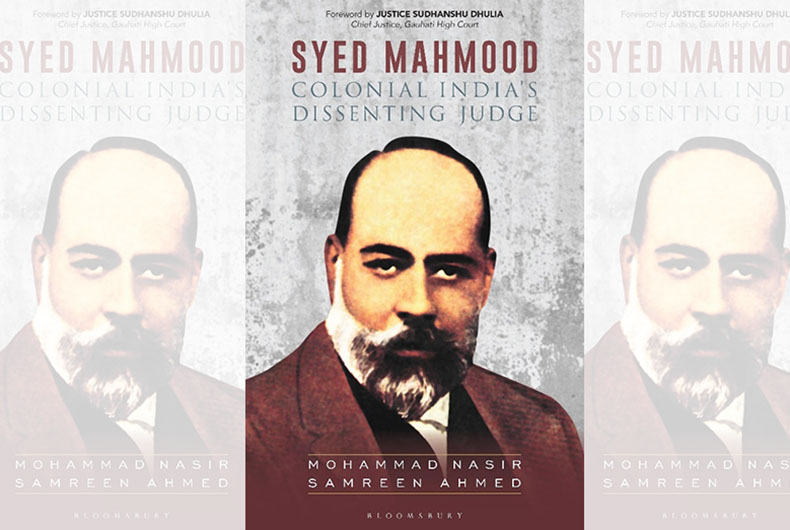
Appointed to the High Court at the remarkably young age of 32, Justice Syed Mahmood displayed during a tenure of just six years that law without conscience was merely a facade for the perpetration of injustice
New Delhi:
In the late 19th century, Justice Syed Mahmood, son of the great social reformer Sir Syed Ahmad Khan , and the first Indian judge of the Allahabad High Court, became an icon of judicial resistance to British colonialism at the apex of British power across the world.
Appointed to the High Court at the remarkably young age of 32, he displayed during a tenure of just six years that law without conscience was merely a facade for the perpetration of injustice.
A number of his dissenting judgments became a template for reference by future generations, Mohammad Nasir and Samreen Ahmed write in “Syed Mahmood: Colonial India’s Dissenting Judge” (Bloomsbury).
Outside of law, his largely invisible but wide-ranging intellectual corpus engages with questions related to colonial transformation of education and its reconciliation with Muslim identity, national integration and religious tolerance.
His role in the making of Aligarh Muslim University (AMU), presently celebrating its centenary, was notable, but survives only as a footnote in history.
This book chronicles the triumphs and tragedies of Syed Mahmood’s life, and his contribution to shaping the consciousness of modern India. It succeeds in exhuming a seminal figure from the dust of history and demonstrates how the past continues to speak in the present.
Mohammad Nasir is Assistant Professor in the Department of Law, Aligarh Muslim University (AMU). He has written on legal and socio-political issues for Hindustan Times, Indian Express, The Wire and OPEN. He co-edited the Special Centenary Issue of the Aligarh Institute Gazette, a periodical started by AMU founder Sir Syed in 1866.
Samreen Ahmed is a legal researcher and writer based at the Aligarh Muslim University. Her academic writings have been published in the Economic & Political Weekly.
source: http://www.ummid.com / Ummid.com / Home> India / by IANS / March 29th, 2022