The second wave of Covid-19 is badly hitting the entire country and over two lakhs people are being tested positive for Covid every day.
Maharashtra state is considered as the worst hit state from this pendamic in which about 60k being tested positive for Covid every day,with 607933 active cases this virus has already claimed 60824 lives.
The virus is spreading across the state.Mortality rate is increasing by each passing day ,non availability of beds in the hospitals, shortages of oxigen, ICU, ambulance and medicine has become a comon phenomenon.
Solapur district has 13,876 active cases till date and 2,077 people have succumbed to the deadly virus so far.
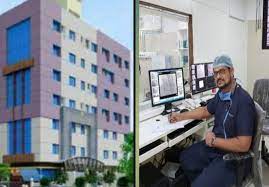
In such pathetic condition Dr.Amjad Basheer Sayed a young cardiologist from Solapur district has come forward with his newly constructed hospital (Noble Heart care and research centre) with the facility of 35 beds to curb the panicking circumstances by treating the patients who are otherwise supposed to be treated in overcrowded hospitals.
Currently over 20 doctors and paramedics are treating patients are being treated under Dr. Amjad’s supervision.
Speaking to Muslim Mirror Dr.Amjad Sayed said that “we all know very well how Covid patients are increasing and need of the hospitals is arising , how patients are suffering and crying for treatment ,how relatives of the patients are struggling to get beds in the hospital for Covid care.
“Considering the problems of Covid victims I decided to start Covid care center in my hospital. I immediately applied for the same to local authorities and got the permission.Now with the grace of Almighty 25 patients are being treated in my hospital, ” said Dr. Amjad.
An Urdu medium student Dr. Amjad Sayed, is a well-known cardiologist of the District .He is associated with five big hospitals and serving Covid patients since past 14 month tirelessly.
“This humanitarian gesture of Dr. Ajmal cannot be expressed in one sentence. it’s a huge contribution towards the humanity ” said Darshana Gaikwad, a social activist.
She further said that coming forward with the newly constructed hospital which was not even inaugurated formally is laudable. I feel proud that doctor like Amjad sir lives in my city who has pain for their countrymen and ready to save lives round the clock.
“This contribution of Dr. Amjad will always be remembered, I extended best wishes to him and his team ” added Darshana.
source: http://www.muslimmirror.com / Muslim Mirror / Home> Featured / by Imran Inamdar / April 21st, 2021
Former Bidar MLA Syed Zulfiqar Hashmi passed away due to kidney failure in the early hours of Tuesday at a Hospital in Hyderabad. He is survived by his wife, three sons and two daughters.
Syed Zulfiqar Hashmi was elected to the Vidhana Sabha from the Bidar constituency in 1994 on the Bahujan Samaj Party ticket. Hashmi was the first BSP MLA from South India.
Hashmi had been undergoing dialysis for the past four months and was admitted to Asara Hospital in Hyderabad two days ago due to deteriorating health.
source: http://www.thecongnate.com / The Cognate / Home> News / by The Cognate News Desk / April 20th, 2021
This promising artist who hails from Dabeerpura, describes her works as impressionistic, abstract and contemporary.
Bad times often bring out the best in some people. It happened with Ayesha Nazneen. When most persons found the lockdown unnerving, for her it was a godsend opportunity to indulge in her passion. No, she wouldn’t be able to travel, see waterfalls or be one with nature. But surely she could do all this with her canvas, colours, brushes and palette knife.
She did just that. She did not let the pandemic to come in the way of her creativity. Each day was a new start, a new opportunity to explore her feelings and put them on the canvas for the world to see. The other day Nazneen had her ‘Dreams Unlocked’. Her solo art exhibition gave a peep into her dreams.
While it was her first art show, it was also the first such event for the Luqma Kitchen Studio, the newly-opened women-only space at Dar-ul-Shifa. “Women in this part of the city have a lot of skills which need to be tapped,” remarked Rubina Nafees Fatima, president, Safa Society.
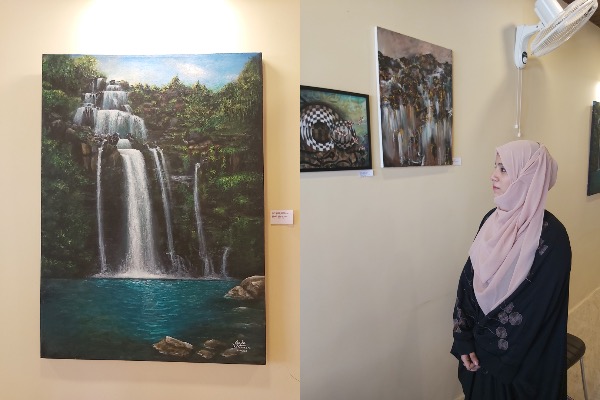
This promising artist who hails from Dabeerpura, describes her works as impressionistic, abstract and contemporary. Most of her exhibits relate to dreams of women. She makes use of circles to create an illusion of cage — to indicate how women have traditionally been confined. She also paints the theme of education as the liberating force. Judicious mix of vibrant and contrasting colours is her hallmark. Her favourite work remains the ‘Dream of Final Abode’. This acrylic on canvas depicts a milky waterfall, the artist’s perception of the luxurious life promised in Paradise.
A self-taught artist, Nazneen has been sketching right from her childhood, drawing inspiration from her artist-grandfather, Azeemuddin. An assistant professor at Shadan Women’s College of Pharmacy, she plans to explore sculpture next. Her aim is to use art to illuminate, educate and motivate people.
source: http://www.telanganatoday.com / Telangana Today / Home> Features / by J S Ifthekhar / April 12th, 2021
Of them 07 are Muslims whereas Sanchita, a student of Jamia Millia Islamia secured the topped the UPPSC PCS 2020 exam.
UPPSC PCS 2020 Exam:
A number of Muslim students once again registered success in Uttar Pradesh Public Service Commission (UPPSC) Provincial Civil Services (PCS) Examination 2020 whereas a student of the Jamia Millia Islamia topped the important exam result of which was declared on Monday.
According to the UPPSC PCS 2020 result which is now live on the UPPSC official website uppsc.up.nic.in, a total of 476 candidates from different districts of Uttar Pradesh have been recommended for as many as 487 civil services posts.
Of them 07 are Muslims whereas Sanchita, a student of the renowned university Jamia Millia Islamia secured the top rank in the merit list released by the UP Public Service Commission Monday.
UPPSC declared the PCS 2020 exams based on the written exam result of which was declared in March. The written exam was followed by personal interviews held from April 1 to 8, 2021.
The top ranked Sanchita of Jamia Millia Islamia New Delhi will join the UP state services as Deputy Collector.
Along with Sanchita, Tanveer Ahmad, Mohammad Amaan and Mohammad Amaan are 03 Muslims among the total 61 successful candidates who have been recommended for the post of Deputy Collector, as per the list of selected candidates in Combined State/Upper Subordinate Services Exam 2020 released on the website.
Other Muslims who have shined in Uttar Pradesh Public Service Commission (UPPSC) Provincial Civil Services (PCS) Examination 2020 are Rifat Malik, Salman Mairaz, Mohammed Nazre Alam and Babar Khan.
While Rifat Malik and Salman Mairaj will join the UP state services as Sr Lecturer, Mohd Nazre Alam will work as Labour Enforcement Officer (15) and Babar Khan as Child Development Project Officer.
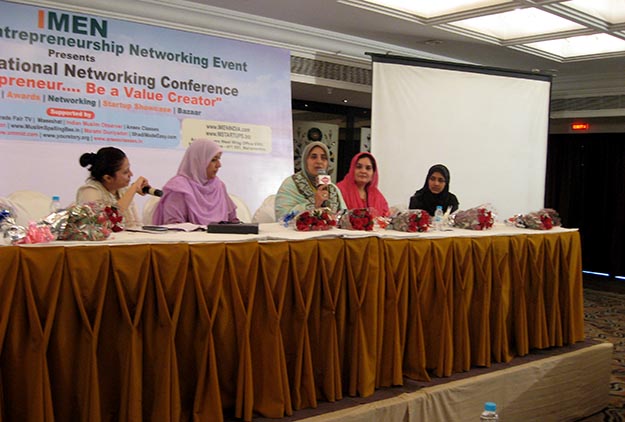
Uzma Nahid addressing the first IMEN summit and Startup Showcase held in Pune on Februray 07, 2016 (ummid.com [Uzma Nahid addressing the first IMEN summit and Startup Showcase held in Pune on Februray 07, 2016. Also seen in the photo are Architect Nafisa Kazi, Sameena Razzaq and Farah Deeba. (ummid.com photo)]photo)
Pune (Maharashtra):
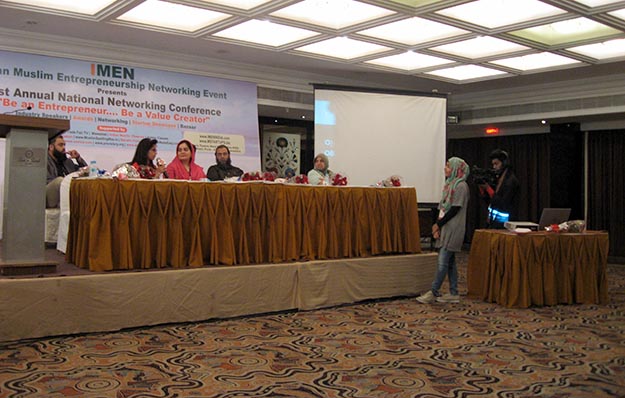
A new initiative aimed at driving Muslim involvement in India’s startup and technology economy hosted by Indian Muslim Entrepreneurs Network (IMEN) in Pune last Sunday ended in double delight when it showcased the upcoming business opportunities along with success stories of Muslim female entrepreneurs and young achievers.
The event, brainchild of Chicago based Indian American Tausif Malik, was organized in association with Pune based trainers Anees Kutty and Gaffar Asim Malik.
Started with National Anthem at about 09:00 in the morning, the event ran throughout the day before ending at 06:30pm, uncovering the inspiring stories of Muslim female entrepreneurs and achievers, and also sharing the experiences of Muslim change-makers who have dedicated them for years for the social, educational and economic empowerment of the Muslims in India.
Besides sharing their success stories, the ‘Role Models’ – as the organizers introduced them, also urged the ‘would be’ entrepreneurs to gear up and prepare to take the benefits of the ‘Start-up India Action Plan’ unveiled by Prime Minister Narendra Modi.
“This is an emergency like situation for Muslims, especially the Muslim women. In the situation when we have limited opportunities, it is high time we develop business skills in women so as to fruitfully utilize their skill and talent for the empowerment of the community”, Uzma Nahid said while participating in the panel discussion titled “Role of Women in Business & Community”.
“A huge number of Muslim men and women artisans are skilled and talented. But they are unorganized and hence are vulnerable to exploitation. We should adopt areas dominated by such people, form small groups and establish small scale and cottage industries for them”, Uzma, founder of India International Women’s Alliance (IIWA) which has more than 3000 women members, said.
The views were endorsed by Architect Nafisa Kazi, Educationist and one of the youngest Headmistress of School Farah Deeba and senior journalist Sameena Razzaq, with each one of them adding valuable inputs to the idea mooted by Uzma Nahid.
Participating in another panel discussion Managing Director of Exhicon and Executive President, Imamia Chamber Of Commerce & Industry MQ Syed appealed the young entrepreneurs to use their talent effectively to maintain quality and present innovative products of world-class quality.
“There is no discrimination if you have talent and skill, and there absolutely no challenge and competition to quality”, he said.
Highlighting the importance of business and entrepreneurship in Islam, MQ Syed said, “The Holy Quran gives 9 out of 10 marks to business and trade while discussing the livelihood. Jobs and service have the least priority for us”, Syed, who has mentored over fifty start-ups, said.
Stating that the Muslim community is wasting their energies on useless issues MQ Syed said, “We might have problems with Israel. But, instead of boycotting Pepsi to corner Israel, we should produce a product better than Pepsi.”
Mariyah Rehmani, author of e-book titled ‘The Hijab And Its Purpose: Understanding the veil’ taking the question from Maryam Asif Siddiquee, the winner of ‘Gita Champions League’. (ummid.com photo)
Detailing the key features of ‘Start-up India Action Plan’, Aleem Faizee, Chief Executive Officer (CEO) of Awaz Multimedia & Publications and Founder Secretary of Malegaon Industries & Manufacturers Association (MIMA), said if implemented properly the plan is the best suitable for Indian Muslims.
“Everyone suffered due to ‘inspector raj’, and lengthy and tiring bureaucratic procedure in India. But, Muslims were worst sufferer of this menace. The Start-up India Action Plan has many features to end this problematic and unhealthy regime”, he said while opening the Start-up showcase session.
“If implemented properly, the Start-up action plan will surely open the doors of opportunities for Muslim entrepreneurs in India”, Faizee, who is instrumental in establishing a mini Textile Park in Malegaon, said.
Irfan Pathan, founder of ‘Coffe Addict’, showcased the ‘soon to be launched’ product by giving history of coffee and elaborating on the role of Muslims in spreading the coffee drink. During the presentation, he was supported by Khan his cousin and team member.
The event was also addressed by, Managing Director of Idafa Investments Pvt. Ltd. & Rehbar, Regional Head, West India Ashraf Mohamedy, Mariyah Rehmani, teenager who authored e-book titled ‘The Hijab And Its Purpose: Understanding the veil’, Serial Entrepreneur, Mentor and Investor Altaf Rehmani and Program Facilitator UNCTAD-Empretec Program for India Nasser Mehdi.
Among the organisers, Tausif Malik, Anees Kutty and Asim Gaffar Malik detailed the objectives of the event and also shared their valuable experiences in their long careers.
At the end of the ceremony, MQ Syed was conferred ‘IMEN Businessman of the Year Award’, Mohammad Yunus, who saved more than 2000 lives during Chennai flood, was conferred ‘Shaheed Abdul Hamid Award’ and Maryam Asif Siddiquee, the winner of ‘Gita Champions League’, was conferred ‘Educational Excellence Award’.
source: http://www.ummid.com / Ummid.com / Home> Business & Economy / by Zohair Mohammad Safwan / February 13th, 2016
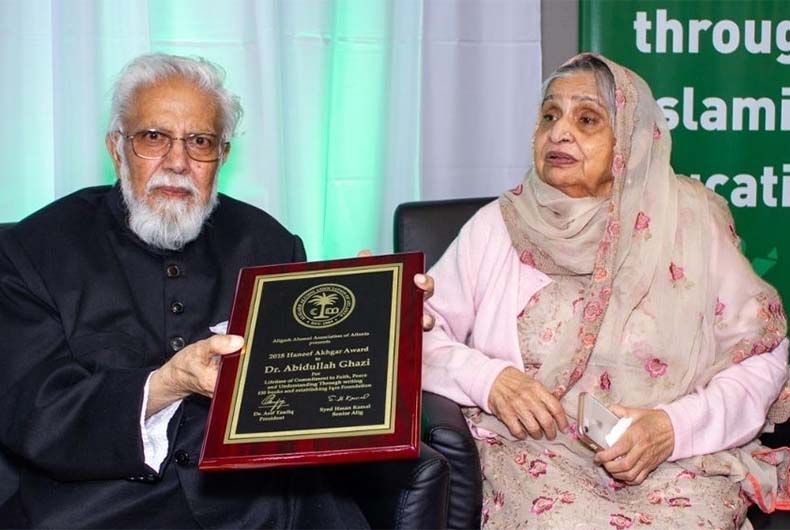
Watch Video: Dr Abidullah Ghazi laid to rest in Chicago
Ambehta (Sahranpur District),(formerly United Provinces) UTTAR PRADESH / INDIA, Chicago, U.S.A. :
Dr Abidullah Ghazi’s wife Dr Tasneem and others at the funeral ceremony held in Chicago on Monday afternoon.
The 85-year-old founder of Iqra International Educational Foundation was ailing since last few years and died on Sunday.
Chicago:
Dr Abidullah Ghazi – Scholar, Poet, Author, Philosopher and Activist, was laid to rest in the afternoon Monday April 12, 2021 in Chicago.
The 85-year-old founder of Iqra International Educational Foundation was ailing since last few years and under medication at a Chicago hospital-cum-rehab. He passed away in the wee hours of Sunday April 12, 2021.
He is survived by his wife, three sons and two daughters.
Immediate family members, including his wife Dr Tasneema Ghazi and children, were present when he was buried at Chicago cemetery on Monday.
The funeral that lasted for more than one and half hours was limited only to the immediate family members due to the Coronavirus pandemic.
Dr Abidullah Ghazi was born to Maulana Hamid Al Ansari – freedom fighter and a renowned journalist of his time, on July 6, 1936 in India. His mother had died when he was still in her early age. Under the guardianship of his grandmother, he was admitted in Jamia Millia at the age of 08.
Later he completed M A (Political Science) and BTh from Aligarh Muslim University (AMU). He went on to do M A in Economics from the London School of Economics and later wrote thesis on the revivalist views of Raja Rammohan Roy for his Ph.D. at the Ivy League, Harvard University.
Dr Ghazi also published, ‘Zikr-e-Saman Izaraan’, an anthology of Urdu poems.
After completing his education he first migrated to the United Kingdom and then to the United States where he stayed till his last breath.
Dr. Ghazi, who had also done Ph.D. in comparative religions from Harvard University, was a fixture in America’s Muslim community and a pioneer in providing quality Islamic education to our children.
Dr Ghazi was the author and editor of over 150 text and support books on Islamic syllabus designed with his wife Dr Tasneema Ghazi especially for Muslim children living in Western countries or studying in English-medium schools.
He had established Iqra Foundation in Mumbai which is run and taken care of by his younger brother Salman Ghazi and his wife Uzma Nahid.
Dr Abidullah Ghazi was named by the Royal Islamic Strategic Studies Centre as being among the 500 Most Influential Muslims in the World. Besides, Dr. Ghazi was also the recipient of numerous awards notably the Citizen’s Award, the Ronald Regan Award, Nishan-e-Imtiaz (Order of Excellence) from Pakistan, a Certificate of Welcome from the City of Los Angeles many others.
Condolences pour in
Condolences are pouring in from different circles and by prominent people who termed the demise of Dr Abidullah Ghazi a great loss not just for the Muslims in the United States but also for those living in other parts of the world, especially India.
“Dr Ghazi, a prominent alumnus, enriched cerebral legacy of Aligarh Movement. He was among a bunch of highly motivated, adventurous persons who broke barriers and went on to distinguish themselves in their chosen fields,” AMU Vice Chancellor, Prof Tariq Mansoor said.
Extending condolences to the bereaved family of the deceased, the Vice Chancellor said:
“I shared a warm personal rapport with Dr Ghazi. The AMU fraternity will always carry Dr Ghazi’s memory in hearts.”
In his condolence message, renowned literary personality Hashmat Sohail said:
“It’s hard to believe Dr. Ghazi is no longer with us. I spent many years together. He will be remembered forever in the worldwide literary community.”
Ali Khan, President and Founder of Urdu Semaj Chicago, in his condolence message said:
“He was a legend in our community and a very genuine, Urdu lover People from Chicago will especially miss the late Dr. Abid Ghazi This is a total loss for us. He was devoted and inspirational leader for the whole community.”
http://www.iqra.org
source: http://www.ummid.com / Ummid.com / Home> India>Life & Style / by ummid.com news network / April 13th, 2021
Renowned Islamic scholar, mufti and former principal of Jamia Mohammadia Mansoora, Malegaon Dr Fazlur Rahman Madani passed away Friday due to COVID-19. He was 72.
Dr Fazlur Rahman Madani breathed his last at Iqra Hospital in Malegoan at around 2 am. According to his son, the renowned scholar was admitted in a hospital after he was tested COVID positive about a month ago. Although he was discharged last week, his health, however continued to deteriorate.
Born in Balrampur District of Uttar Pradesh, Dr Fazlur Rahman Madani obtained his PhD from the Islamic University of Madinah, with a specialisation in fiqh (Islamic jurisprudence).
Dr Fazlur Rahman was survived by his three sons and three daughters. His wife passed away three years ago.
source: http://www.thecognate.com / The Cognate / Home> News / by Shaik Zakeer Hussain / March 26th, 2021
Shaikh Dr Wasiullah Abbas is a renowned Islamic scholar from India. A graduate from the Islamic University of Madinah and Umm Al Qura University in Makkah, he is a teacher of Tafsir, Principles of Tafsir, Hadith and Principles of Hadith in Umm Al Qura University, a position he has held since 1979.
He also delivers lectures on Sahih al-Bukhari and Sunan Abu Dawood in Arabic and general Islamic lectures in Masjid al-Haram in Makkah where Abdullah Ibn Abbas (RA) used to deliver his talks.
Early Life and Education
Dr Wasiullah Abbas was born in 1948 in Basti district, in a small town of Bherabhoj, renowned for producing many Islamic scholars of repute. His father’s name was Muhammad Abbas Khan, his grandfather’s name was Ahmad Khan, and his great grandfather’s name was Khushhaal Khan. Dr Wasiullah’s grandfather Ahmad Khan was the chief of his town.
Dr Wasiullah received primary education from Shaikh Muhammad Saleem, a well-known Islamic teacher who was a student of Madrasah Rahmaniyyah. He later moved to the town of Yusufpur and enrolled in Madarsa Darul Huda and did his further studies in Jamia Rahmaniyyah in Banaras.
In 1966, the Jamia Salafia, one of the largest Islamic universities was established in the city Banaras. One of the scholars, who attended the inauguration of the university was Shaikh Abd al-Aziz ibn Baz. On Shaikh ibn Baz’s direction, four students were selected from both Jamia Salafia and Jamia Rahmaniyyah to study at the Islamic University of Madinah. These four students were Dr Wasiullah Abbas, Shaikh Abdul Hameed Rahmani, Shaikh Abdus-Salam Madani and Shaikh Abdur-Rahman al-Bastawi.
Islamic University of Madinah and Umm Al Qura University
At the Islamic University of Madinah, Dr Wasiullah Abbas obtained a bachelors degree in Dawah and Ilm Usool Ad-Deen (Principles of the Religion), from the department of Tafsir and Hadith.
After successfully completing the bachelors (undergraduate) program at the Islamic University of Madinah, Dr Wasiullah Abbas travelled to Makkah for higher (post-graduate) studies.
Here, he completed his Masters and PhD (doctorate) programs in Makkah, with a specialization in Hadith. He completed his PhD (doctorate) program in the year 1981, which was the year in which Umm Al Qura University was established in Makkah. Prior to this, the structured study in Makkah – “adDirasaat al-Ulyaa” (the higher studies programs), the Faculty of Shari’ah, and the Faculty of Tarbiyyah – were under the administration of King Abdulaziz University in Jeddah.
Teaching
During his time as a PhD student, he was appointed as a teacher at the Mahad at Masjid al-Haram. He continued teaching with this position for many years, after completing his PhD. Later, he was selected as a professor in Umm Al Qura University in Makkah, where he continues to hold a teaching position in the department of “al-Kitaab (the Qur’an) and the Sunnah” in the Faculty of Da’wah and Usool-ud-Deen, lecturing on numerous subjects related to the science of Hadith.
The Shaikh also holds a teaching chair in Masjid al-Haram, with authorization attained from the “General Director of the Affairs of the Grand Mosque in Makkah and the Prophet’s Mosque in Madinah. His chair is located in the “Mataf” (the area of Tawaaf around the Kabah), between the doors of Bab al-Malik Fahad (King Fahad Gate) and Bab al-Umrah, where he continues to teach five days a week between the Maghrib and Isha prayers.
Books
Among the books Dr Wasiullah Abbas authored are as follows: “ad-Du’afaa’ wal-Matrookoon wal-Majhooloon fee Sunan an-Nasa’i” (The Weak, Abandoned, and Unknown [Narrators of the Ahadith] in Sunan an-Nasa’i). This was Shaikh’s Masters thesis.
Tahqeeq (Verification) of the book “Fadaa’il as-Sahaabah” (Virtues of the Companions [of the Prophet Muhammad (SAWS)] of al-Imaam Aboo Abdullaah Ahmad ibn Muhammad ibn Hanbal ash-Shaybaanee (RH) [d.241H]. This was Shaikh’s PhD (doctorate) thesis.
Tahqeeq of the book “al-‘Ilal wa Ma’rifatur-Rijaal” ([The Science of] Defects [in the Asaaneed of the Ahaadeeth] and [the Science] of Narrators [of the Ahaadeeth]) as narrated by al-Imaam Aboo Abdur-Rahmaan Abdullaah ibn al-Imaam Ahmad ibn Hanbal (RH).
Tahqeeq of the book “Bahrid-Dam feeman Takallama feehi al-Imaam Ahmad bi-Madh aw Dham” (The one [i.e. Narrators of Ahaadeeth] al-Imaam Ahmad [ibn Hanbal (RH)] Spoke about with Commendation or Disparagement) of al-Imaam Jamaalud-Deen Yoosuf ibn Hasan ibn Ahmad ibn Hasan ibn Abdul-Haadee as-Saalihee, well-known as Ibnul-Mibrad al-Hanbalee (RH).
Tahqeeq of the book “al-‘Ilal wa Ma’rifatur-Rijaal” ([The Science of] Defects [in the Asaaneed of the Ahaadeeth] and [the Science] of Narrators [of the Ahaadeeth]) as narrated by al-Imaam Aboo al-Fadal Saalih ibn al-Imaam Ahmad ibn Hanbal (RH).
Tahqeeq of the twelfth volume of the book “Ittihaaf al-Mahrah bil-Fawaa’id al-Mubtakarah min Atraaf al-Ashrah” of al-Imaam al-Haafidh Shihaab-ud-Deen Aboo al-Fadal Ahmad ibn Alee ibn Hajar al-Kunaanee al-Asqalaaanee (RH) [d. 852H], upon request from “Markaz Khidmatis-Sunnah was-Seerah an-Nabawiyyah”31 of Madinah, Saudi Arabia.
Tahqeeq of the fifth volume of the book “Lisaan al-Meezaan”32 of al-Imaam al-Haafidh Shihaab-ud-Deen Aboo al-Fadal Ahmad ibn Alee ibn Hajar al-Kunaanee al-Asqalaaanee (RH) [d. 852H], upon request from “Markaz Khidmatis-Sunnah was-Seerah anNabawiyyah” of Madinah, Saudi Arabia.
“al-Masjid al-Haraam: Taareekhuhu wa Ahkaamuh” (The Grand Mosque in Makkah: Its History and Its Rulings).
“Ilal al-Hadeeth wa Dawruhu fee Hifdhis-Sunnah” ([The Science of] Defects [in the Asaaneed of the Ahaadeeth] and its Role in Protecting the Sunnah).
“Tahqeeq al-Kalaam fee Wujoobil-Qiraa’ah Khalf al-Imaam” (Verification of the Speech Regarding the Obligation of Reciting [Sooratul-Faatihah] Behind the Imaam [in the Salah]) of ash-Shaykh al-Allaamah al-Muhaddith Abdur-Rahmaan al-Mubaarakpooree (RH) [d.1353H]. This book has been translated from Urdu into Arabic by the Shaykh and he has added his annotations upon it.
“Khuluq al-Muslim fee Daw’il-Kitaab was-Sunnah” (Manners of the Muslim in Light of the Qur’an and the Sunnah).
“al-Musaafahah bil-Yadil-Yumnaa” (Greeting with the Right Hand [Upon Saying Salaam]) of ash-Shaykh al-Allaamah al-Muhaddith Abdur-Rahmaan al-Mubarakpuri (RH) [d.1353H]. This book has been translated from Urdu into Arabic by the Shaikh and he has added his annotations upon it.
“Fiqh Ahlil-Hadeeth: Khasaa’isuhu wa Mumayyizaatuhu” (Jurisprudence of the People of the Hadith: Its Unique and Exclusive Aspects).
“at-Ta’reef bi-Kutub Taraajimir-Ruwaat” (The Introduction to the Books [which Contain] Biographies of the Narrators [of Ahadith]).
Family
Dr Wasiullah Abbas is married and has five sons and five daughters.
References
Biography of Allamah Dr Wasiullah Abbas by Umm-Ul-Qura Publications.
Dr Wasiullah Abbas On Social Media
source: http://www.thecognate.com / The Cognate / Home> Biography / by Shaik Zakeer Hussain / March 31st, 2021
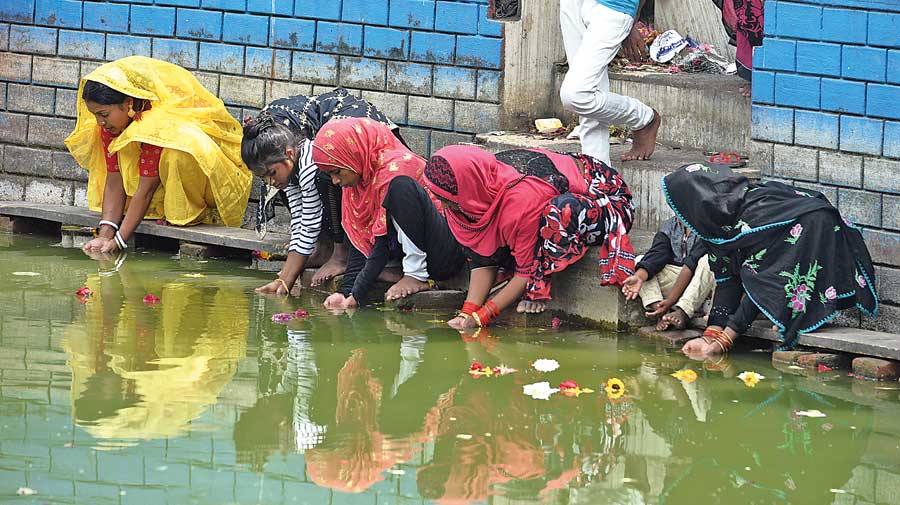
A Hindu woman (in yellow sari) prays at the pond in Ghutiari Sharif compound with Muslim women / pix: Gautam Bose
A BJP rally kept raising high-pitched “Jai Shri Ram” cries as it marched along the Baruipur-Canning Road in South 24-Parganas on Friday afternoon.
Slogans in support of the incumbent regime in Delhi were belted thick and fast and scorn was heaped on “infiltrators and termites”. It was around 12.30pm and the road was not busy. But some cars were stalled by the rally.
One of them was headed to a shrine dedicated to a Muslim saint, 35km from the heart of Calcutta and two stops before Canning, the gateway to the Sunderbans. All the occupants of the car were Hindus.
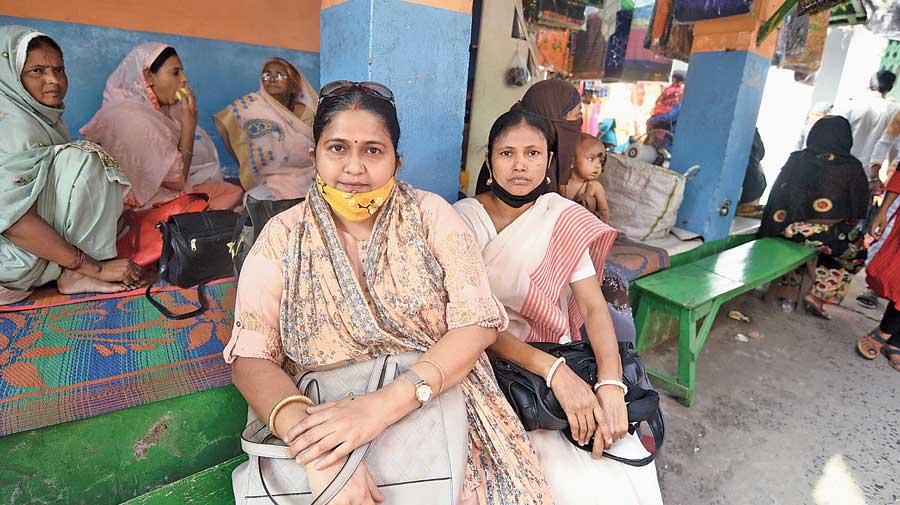
Debi Majumder (left) and Umme Habiba Laskar at the Ghutiari Sharif shrine on March 26. Majumder is a Lake Market resident . Laskar is an ayah employed by a neighbour of Majumder. The picture was taken minutes after the two dipped their palms into the pond together / pic: Gautam Bose
“I am going to Ghutiari Sharif for the first time. I have heard that if you pray sincerely, Ghazi baba answers your prayers,” said Suparna Dutta, 22, part of the group from Garia.
A suburb in South 24-Parganas, Ghutiari Sharif is known for the mazaar (resting place) of Pir Ghazi Mubarak Ali, a revered 17th century figure.
It is also a testament to the secular character of the popular devotional culture of Bengal at a time religious polarisation is the dominant narrative everywhere from political rallies to election manifestos.
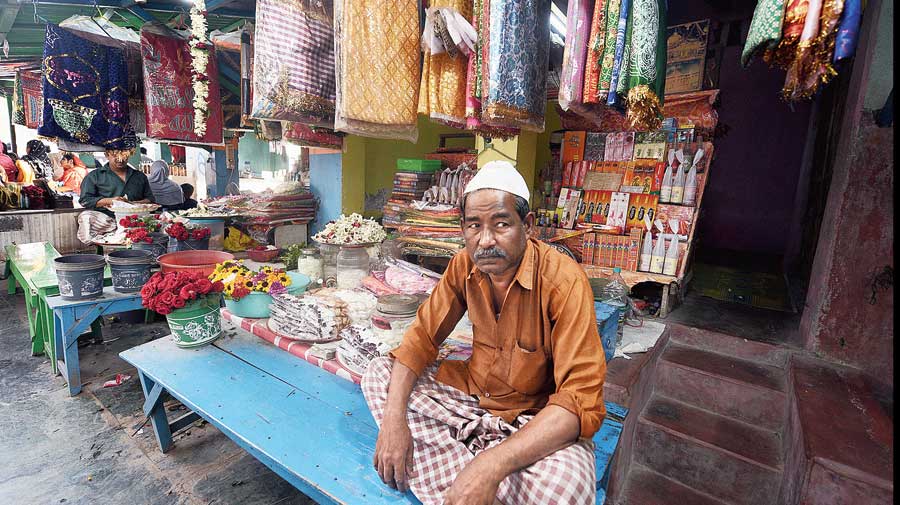
Salim Dewan, 65, who owns a store selling incense sticks, flowers, chadars and other objects offered to the Pir’s resting place / pix: Gautam Bose
Legends and folklore in Bengal are often a part of everyday life, transcending barriers of religion and caste. When this reporter visited the shrine on Friday, scores of women with sindoor-smeared foreheads were seen dipping their palms into a pond in the shrine compound, praying silently to have their wishes (manat) fulfilled.
The shrine embodied the deep-rooted syncretism in Bengal’s culture, something that social scientists said would pose a formidable challenge to any political party seeking to polarise voters.
That syncretism was perhaps best represented by an image of two women — Debi Majumder and Umme Habiba Laskar — dipping their palms together in the pond.
Majumder, a first-timer at Ghutiari Sharif, had come from her home in Lake Market. She came to know of the place from Laskar, an ayah who looks after one of Majumder’s neighbours. Laskar is a resident of Champahati, another suburb not far from Ghutiari Sharif, and has been there several times.
They had boarded a train from Ballygunge to reach the Ghutiari Sharif station on Friday. The shrine is a less than five-minute walk from the station. Around 1.30pm on Friday, the two dipped their palms into the pond together.
“I prayed at the mazaar and then made my wish at the pond. I have skipped breakfast, in keeping with the ritual,” said Majumder. Many visitors fast till they pray at the mazaar.
Suparna Naskar, who lives in Baruipur, had accompanied a Muslim friend who had come with her newborn. “She had wished for a child. Today, we have come to thank Ghazi baba for granting the wish,” said Naskar.
The shrine is a five-minute walk from the Ghutiari Sharif railway station in the Sealdah-Canning suburban section. The narrow road is dotted with shops. The resting place of the pir is at the centre of the compound. The top of the shrine has a mosaic dome with four towers.
Legend has it that the area, then part of the Sunderbans, was hit by a severe drought four centuries ago. Pir Ghazi Mubarak Ali is said to have brought rainfall to the area. He is also said to have cured a Hindu king, Madan Roy, from a severe bout of illness, after which Roy gifted him swathes of land. The mazaar stands on that land.
“Baba’s spirit still endures, taking care of this place. He did not discriminate between people. We have maintained that tradition. Around one-third of my customers are Hindus,” said Salim Dewan, 65, who owns a store selling incense sticks, flowers, chadars and other objects offered to the pir’s resting place. Dewan is a common title given to the future generations of the pir, some of whom are also part of the managing committee of the shrine.
“Many such mazaars and dargahs in Bengal are entrenched in a syncretic culture. The devotees come from all faiths, light incense sticks and offer sinni (a sweet concoction of milk, flour, bananas, raisins and other fruits, usually made during pujas in Bengali homes) and other homely food to the presiding saint,” said Epsita Halder, who teaches comparative literature at Jadavpur University and has researched on the scriptural understanding and popular devotionalism of vernacular Islam in Bengal.
“In medieval Bengal, many Islamic preachers became popular among the common people because they spoke in a simple language that everyone could connect with. They were not heavy on scriptural understanding of a religion but talked about devotion as a way of life,” Halder said.
Ghutiari Sharif falls under Canning West Assembly seat, won by Trinamul’s Shyamal Mondal in 2016. This time, the ruling party has fielded Paresh Ram Das. His main contender is Arnab Roy of the BJP.
Roy switched sides from the TMC to the saffron camp recently and his candidature has triggered protests from local BJP workers, like at so many other places of the state.
The influence of the shrine goes far beyond one constituency.
Ghutiari Sharif hosts two major fairs in a year. One is in the first week of August, commemorating the death anniversary of the pir. The other is in June, which coincides with the famous Ambubachi Mela at the Kamakhya temple in Assam. According to the local legend, King Madan Roy, a regular at the Kamakhya temple during the fair, started a similar fair near his home after being impressed by the pir.
Special trains are run during the fairs and lakhs of people, Hindus and Muslims, throng the shrine, apart from tens of thousands every week.
Those at the helm of the shrine said they kept off politics.
“We have always practised an inclusive culture and will continue doing so, irrespective of which party comes to power,” said Siraj Dewan, caretaker of the managing committee of the shrine.
Political commentator Maidul Islam said the politics of polarisation has yielded dividends in the urban middle class but suburban and rural Bengal was a different ballgame.
“The urban middle class is divided into the conservative and the liberal sections. The conservatives have already sided with the saffron brigade. There is a deep churning in a large section of the liberals. Many of them are still undecided among the Left and Trinamul. But the syncretic culture of rural and suburban Bengal is so deep-rooted that it will not be erased in the course of one election,” he said.
The resting place of Pir Ghazi Mubarak Ali. / pix: Gautam Bose
Ghutiari Sharif is not far for the Sunderbans, the land of another syncretic legend, Bon Bibi, the protector of humans and the forest, worshipped by Hindus and Muslims alike.
“All across the Sunderbans, rituals to Bon Bibi are performed by Hindus as well as Muslims. I think it is a wonderful kind of syncretism that you see there. In popular culture, in Bengal, it is incredibly mixed. These traditions, they are impossible to pick apart and say this is Hindu and this is Muslim. I think that’s what makes the popular culture of Bengal so vibrant and so interesting,” author Amitav Ghosh, who had introduced Bon Bibi to the world, said of the legend while speaking on the occasion of a literary meet in Calcutta in February.
source: http://www.telegraphindia.com / The Telegraph Online / Home> West Bengal> Calcutta / by Debraj Mitra, Calcutta / March 31st, 2021
Site of land conflict, the constituency on the outskirts of Kolkata will prove key to the future of the Opposition alliance.
Two of the three hawkers selling hard-boiled sweets and iced water tubes at the Indian Secular Front (ISF) rally at the Bhojerhat football ground in Bhangar on the last day of campaigning had decided on their choice for MLA — the Samyukta Morcha candidate, Naushad Siddique.
But their colleague remained undecided. A beneficiary of the Trinamool Congress’s welfare schemes for his daughters, he said, “I got ₹50,000 for my daughter under Kanyashree [a scheme of financial aid for girls who have studied till Class XII] and Rupashree [for a girl child’s marriage] but we were denied Amphan relief.”
Naushad Siddique at Bhangar on the last day of campaigning on April 8, 2021.
Naushad Siddique, ISF chairman, is the brother of the peer of Furfura Sharif, Abbas Siddique.
A pitch for power
As the crowd at the rally swelled to hear Abbas Siddique, a few others explained, “It is not that Didi [Trinamool chief Mamata Banerjee] has not worked, but those under her are all corrupt.”
Almost an hour before the Siddique brothers took the stage, CPI(M) State committee member Tushar Ghosh arrived with slogans like “Inquilab Zindabad” and “Bhaijaan Zindabad” renting the air.
The crowd was largely young. In fact, some people seemed too young to cast their vote but they held aloft sticks with the white, blue and green ISF flag and the red CPI(M) flags tied together.
At the Bhojerhat meeting, Abbas Siddique delivered a fiery speech. “She [Ms. Banerjee] is calling me a shaitan (devil). Am I in politics to become an MP or a Minister?” he said rhetorically. Minutes later he asked the crowd who brought the BJP to West Bengal, showing an old photograph of Ms. Banerjee with former Prime Minister Atal Bihari Vajpayee at a meeting.
It was Naushad Siddique who was instrumental in sealing the ISF’s alliance with the Left and Congress for this Assembly election.
To a question on the Trinamool’s allegation that the ISF will end up helping the BJP, Naushad Siddique said, “The Trinamool leadership can say whatever it wants, but you can see the response to the ISF here. We are against both the Trinamool and the BJP.” If elected, he said, the ISF, which has fielded candidates in 28 seats, will seek a bigger role for the party.
It is from Bhangar that Abbas Siddiqui began his political foray, making a pitch for power through his popular religious jalsas (gatherings) that continued right through the lockdown. “Bhangar is the crucible from where the ISF experiment began,” said a villager at Padmapukur.
Inner party issues
Bhangar has a predominantly Muslim population and the ISF’s spirited entry has put the Trinamool, which is battling inner party squabbles, on the backfoot. In 2016, Abdur Razzak Mollah (former Land Reforms Minister in the Left Front regime) won the seat by a margin of 18,000-odd votes on a Trinamool ticket. However, the Trinamool dropped the 75-year-old veteran this time, opting for Rezaul Karim, also a former CPI(M) member who had contested the Lok Sabha election from Birbhum in 2019. Dr. Karim was preferred over Trinamool strongman Arabul Islam, which has sparked a party feud.
Just a few days earlier, while campaigning for Dr. Karim, Mr. Islam made his discontent public. “We will ensure the victory of our candidate, even if he is from Pakistan. The previous elected representative did not visit the constituency for five years after getting elected,” he said.
The BJP’s Soumi Hati has campaigned only in the Hindu pockets for the April 10 vote, and the ISF has stayed away from them, further polarising the electorate, villagers pointed out. On whether a split in the Muslim vote would help the BJP, villagers at Kamarhait and Machi Bhanga said, “Not in this constituency. But a divide in the Muslim vote here will go against the Trinamool.”
Land movement
Bhangar, a rural and poor belt on the fringes of Kolkata’s rich suburbs of Rajarhat and New Town, was in the news over a land movement that began in 2013 when the State government acquired 13 acres from villagers for a power grid project.
From 2014, the stir against the land acquisition led to tension in the area. Things came to a head on January 17, 2017 when villagers blocked roads with uprooted trees and clashed with the police. Two protesters were shot dead, but the police denied opening fire, putting the blame on “outsiders”. The State government reached an agreement with the villagers in August 2018, said Alik Chakraborty of the CPI(ML) Red Star, one of the leaders of the movement.
The CPI(ML) Red Star has fielded Mirza Hasan, a face of the land movement. He admitted that the ISF has a hold over the villagers, who tend to listen to the peerzada (religious leader).
“Bhangar is a case study of communal politics now,” said Mr. Chakraborty. “The deep polarisation that is happening here will find an echo in other constituencies,” he added.
The CPI (ML) leadership was, until a few months ago, hopeful of support from the CPI(M) but the latter forged an alliance with the ISF. In the densely populated South Parganas district, according to the 2011 Census, there is a 35.57% minority population which will influence several of the 31 seats including Bhangar, Canning, Magrahat, Sonarpur and Metiabruz. In 2016, the Trinamool had won 29 seats and the Left Front, two.
The Trinamool, which came to power in 2011 in the State riding on the land movements of Nandigram and Singur, found itself on the wrong side of the people in Bhangar. When villagers protested against heavy-handed tactics on the ground, the government moved to make amends, promising not to acquire any land by force.
The villagers hailed the “people’s victory” but three years on, Bhangar is being asked to choose between the Furfura cleric, who holds considerable influence over the region, and the Trinamool, which claimed it had nurtured the constituency with its welfare schemes.
source: http://www.thehindu.com / The Hindu / Home> Elections> West Bengal / by Shiv Sahay Singh and Sudipta Datta / Bhangore (South 24 Paragnas) / April 09th, 2021