Category Archives: Leaders

Entrepreneur Hafeez Kudroli Has A Million-Dollar Advice For All The Entrepreneurs Out There!

Bengaluru, KARNATAKA :

In an exclusive conversation, Hafeez speaks about the vision of his company, its biggest achievements and a lot of other things about his entrepreneurial life

Hafeez Kudroli
Hafeez Kudroli

Conglomerates are changing the entire scenario in the market with having a large number of subsidiaries under it. Kudroli World is the name which has shook the entire market and the companies under it are integrated with each other. Offering services in infrastructure, real estate, apparel, broadcast media, hospitality, food, sports, entertainment and fundraising among others; the business is surely a 360-degree model giving the best of everything to the end-users.

The man behind this huge business, Hafeez Kudroli took over the family business, ‘Kudroli Builder  Infrastructures Pvt Ltd’ and in 2 years, he has completed projects worth over millions. In an exclusive conversation, Hafeez speaks about the vision of his company, its biggest achievements and a lot of other things about his entrepreneurial life.

Q: What is your main vision of Kudroli World?

A: With the company having its subsidiaries in almost each and every field, the vision of Kudroli World is to create employment opportunities for maximum Indians. By employing them, my further plan is to utilize the people and make a dream team which will help to transform all the underprivileged people of India by making the country as one of the best business hubs of the world.

Q: What are the innovations you want to bring with Kudroli World?

A: I own a company named ‘SapienHR’. It is a human resource and technology-based firm. I am aiming to bring all kinds of technologies which can be availed by the youth at an affordable rate thus fulfilling their dreams. I am very keen to integrate this company under Kudroli World and bring this innovation by this year itself.

Q: What are your thoughts of getting into E-Commerce business?

A: A business idea is never wasted. I have been considering it but till now, I have not given a thought about it. E-Commerce has seen a drastic rise in the market with the products being just a click away. As per my current works, I don’t see myself getting into the E-Commerce section anytime soon.

Q: What has been the biggest achievement of Kudroli World?

A: The biggest achievement lies in the people of the company. It is not just my company but the people’s company as well. I am the face of the company who runs it. However, some people are functioning excellently, and it is my team who is the real strength of Kudroli World. Their passion for work is what makes the company a big conglomerate. No money or power is more powerful than the passion for doing something.

Q: How do you manage to handle so many subsidiary companies under Kudroli World?

A: As I mentioned earlier, I have a good team of people who execute the plans in the best possible manner. I have shown immense trust and given the freedom to my team. With these two aspects, they have managed to handle many subsidiaries with much ease. As an entrepreneur, I understand to give employees the freedom to work by which they can easily take care of this multi-giant company.

Q: Any pro-tip for aspiring entrepreneurs?

A: If you have a plan, work towards it. If you have a dream, chase it. No force can stop your dream from to become a reality. Be as creative as you can and stand out of the box. To be the best, you need to be different from the rest. Don’t be a blind follower. Instead, create your own way and let people follow you.

source: http://www.mid-day.com / mid-day / Home>  Lifestyle News> Culture News / by Partnered Content , Mumbai / January 27th, 2020

Man who fought for Bhopal Gas Tragedy victims gets Padma Shri

Bhopal, MADHYA PRADESH :

Abdul Jabbar’s family members are very happy about him getting this honour.

Abdul Jabbar, who died on November 14 last year left behind a wife and 3 children

Abdul Jabbar of Bhopal, who fought a long battle for the victims of the Bhopal gas tragedy in 1984, has been awarded the Padma Shri. Abdul Jabbar is receiving this honour posthumously.

Abdul Jabbar’s family members are very happy about him getting this honour.

When India Today reached Abdul Jabbar’s house in the Chandbad area on the outskirts of Bhopal, we found that the condition of his house is very bad.

Abdul Jabbar, who died on November 14 last year left behind a wife and 3 children.

Abdul Jabbar’s wife Saira Banu said, “I am happy that the government is giving this honor to us but I am sad that my husband Abdul Jabbar is not with me in this moment of pride and happiness.”

Wife Saira Banu says that if Abdul Jabbar were alive, the joy of getting Padma Shri would have been doubled.

Jabbar’s wife said, Abdul Jabbar never thought about his own family. He made the gas victims his family. Abdul Jabbar’s wife expressed anguish that when her husband was ill, no one took care of him initially. At the last moment, the government approached the family but it was too late.

“He always kept thinking about the gas victims, and at the last moment he had told me not to let the gas victims fight end here but to take this fight further”, added Jabbar’s wife Saira Banu.

Speaking to India Today, Abdul Shamim, brother of Abdul Jabbar said, “When Abdul Jabbar was ill, no one from the government and gas-affected organisations took care of him. His treatment was also not taken seriously.”

Jabbar’s brother demanded a government job for Jabbar’s wife. ‘Financial condition of Jabbar’s family is very bad and sometimes children eat only once a day’, said Jabbar’s brother Shamim. According to Abdul Shamim, if his sister-in-law gets a job, she will be able to take care of her kids and her children will get a good education too’.

Abdul Jabbar’s eldest son Sahil said that he had learned to serve the poor from his father. Sahil said that ‘his father used to stay at home very rarely, he used to go out in the morning to help the gas victims and sometimes when there was no money in his pocket, he would borrow and help the gas victims. ‘I learned the same from my father’.

source:  http://www.indiatoday.in / India Today / Home> News> India / by Ravish Pal Singh, Bhopal / January 26th, 2020

Abid Hassan Safrani, freedom fighter who gave Jai Hind slogan

Hyderabad, TELANGANA :

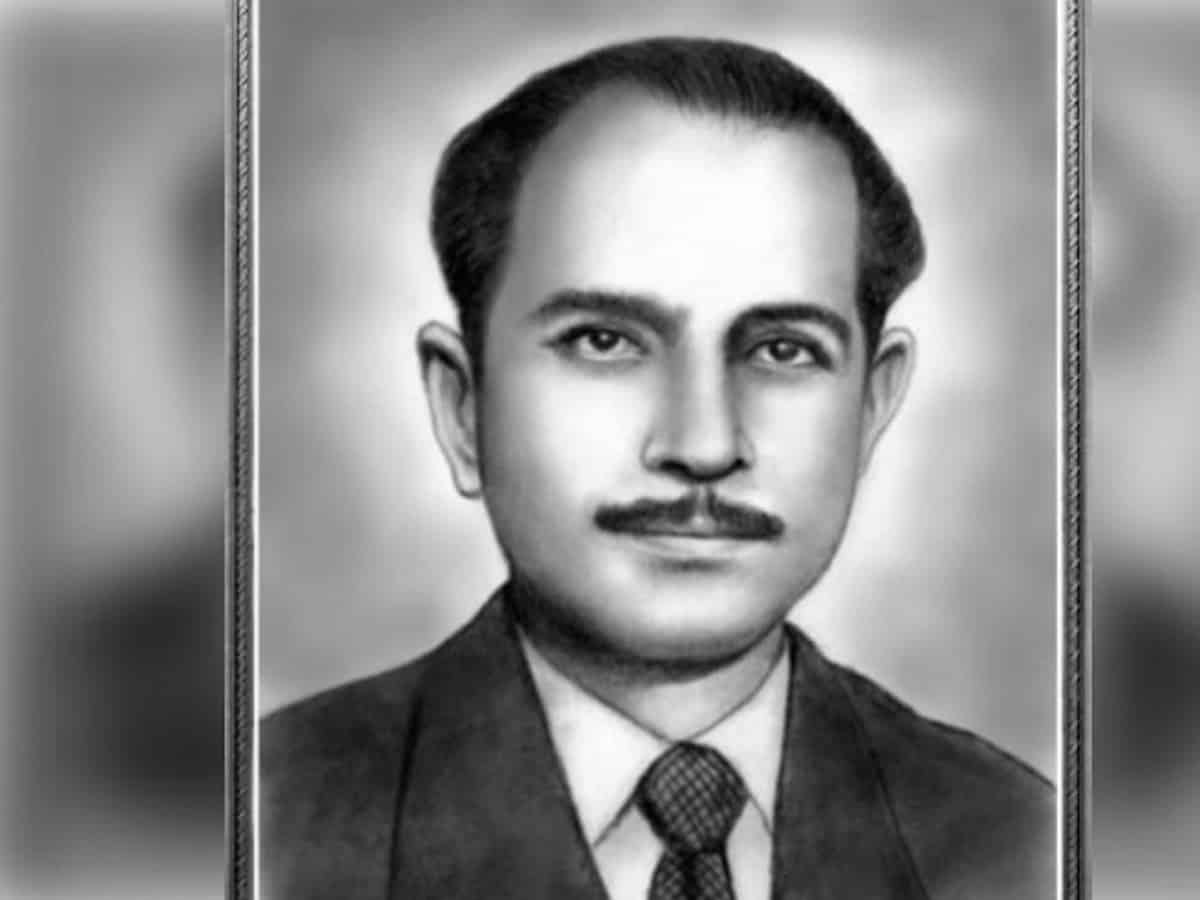
Abid Hassan, born in Hyderabad in 1912, hailed from a patriotic family.

 Abid Hasan Safrani/COURTESY INDIANMUSLIMLEGENDS.BLOGSPOT.IN
Abid Hasan Safrani/COURTESY INDIANMUSLIMLEGENDS.BLOGSPOT.IN

Hyderabad :

This is the story of Abid Hassan Safrani who, not many may know, was not just the trusted lieutenant of Netaji Subhash Chandra Bose, but the Hyderabadi who had coined the magical slogan JAI HIND.

I have had the privilege of translating into English the Telugu book on the life of Netaji Bose by the late Ch. Acharya at the behest of the Freedom Fighters Association.

The following are excerpts from the book. Kindly read on:

“JAI HIND ”. No slogan had ever cast a greater spell on the nation than this. It had welded the people of this country of diverse languages, cultures, and faiths during the freedom struggle and filled them with a strong sense of patriotism. It continues to do so even now.

The man who coined this stirring slogan was Major Abid Hassan Safrani of Hyderabad, a close aide of   Netaji Subhash Chandra Bose.

It was adopted as the national slogan at Free India Centre’s first meeting in Berlin in November 1941. Then, it became a popular form of address and greeting.

Safrani was with Bose when he undertook the death-defying undersea journey from Germany to the Far East. Safrani recalled how calm and composed was Bose when enemy ships rained bombs on the submarine. Unmindful, he dictated notes to Safrani on the future course of his action.

Sisir Kumar, the nephew of Bose, gave more details of the adventure in his book, ‘INA in India Today’.

Abid Hassan, born in Hyderabad in 1912, hailed from a patriotic family. After graduating in engineering with distinction, he went to Berlin for higher studies.

Attracted by Bose’s freedom movement, he joined the Indian National Army. Recognising his leadership qualities, Bose gave Safrani ample scope to grow to his full potential.

Safrani could fluently speak several languages like English, German, French, Arabic, Persian, Sanskrit, Hindi, Urdu, Telugu, and Punjabi. This enabled him to build excellent rapport with officers and men of the INA. Major Safrani headed the Gandhi Brigade in the INA. It consisted of men of exceptional courage and valour.

When they eventually surrendered to the British army at Imphal in North East India, top British officers could not help marvel at the bravery of Safrani and his men. He was imprisoned and put in solitary confinement with not even a window to allow light.

He mentioned this in a letter to his mother, Hassans had firm roots in nationalism. Abid’s father, Jaffer Hassan, was dean in Osmania University , and mother, Begum Amir Hassan, a staunch Gandhian. They inculcated patriotic feelings in their sons, Badrul Hassan and Abid Hassan, at a tender age.

All of them were very close to Mahatma Gandhi and used to visit his Sabarmati ashram. Fanatics threatened to kill them and throw their bodies into the Musi. Gandhi would send his secretary, Pyarelal, to railway station whenever the Hassans visited him. Badrul Hassan edited Gandhi’s “Young India” in 1925.

He remained a true Gandhian until his death in 1973. He wore khadi and led a spartan life in a small room.

Abid Hassan Safrani also imbibed these traits.

Begum Safrani was a unique personality who lived a full life(1870-1970). She gave away everything for the freedom of the country, including her paternal property. She was a close friend of Sarojini Naidu and was affectionately called ‘amma Jaan’ by Gandhi, Nehru, Netaji and Abul Kalam Azad.

“Abid Manzil”, their residence in Troop Bazaar, stands as mute testimony to the burning of foreign cloth in 1920 at the behest of Gandhi. In his book, Sisir Kumar Bose gave a graphic account of the escapades of Subhash Chandra Bose and Abid Hassan Safrani such as the submarine journey from Germany to Asia and the INA’s triumphal march through the forests of Imphal.

After the Second World War, Safrani was jailed for six years. Begum Amir Hassan, who did not expect anything in return for the services of the family, was much worried that her son might be sentenced to death in the Red Fort trial. Several INA men were shot dead for participating in the liberation movement. She met Gandhi, Nehru and Sarojini Naidu to plead for her son’s life.

Safrani got a last-minute reprieve after Prime Minister Nehru and Governor-General, Lord Mountbatten, intervened. Nehru had earlier visited a prison in Singapore where INA members were lodged. He spotted a man sitting aloof and asked if he was Safrani from Hyderabad . The man greeted him with “Jai Hind” and nodded ‘yes’.

After his release, an ailing Safrani returned to his “Dhoop Chaon” residence in Banjara Hills, Hyderabad and recuperated under the care of his loving mother and friends like Bankat Chandra, Elizabeth, and C.S. Vasu. He took up radio sales for a living, but with little success. He wrote a civil services examination and qualified for foreign service. He was personally interviewed by Jawaharlal Nehru .

He had served in Indian missions in a number of countries like Egypt, Iraq, Turkey, Senegal, Zambia, Ivory Coast. Safrani was Indian Ambassador to Iraq when Jordan King Hashmath-e-Faizal, was killed in an army coup in 1957. The government drew heavy flak in Parliament for his absence in Baghdad at the crucial movement. Nehru defended Safrani. Safrani loved agriculture and raised a horticultural farm in Golconda . It was his practice to visit Netaji’s hometown, Calcutta, in January every year carrying fruit grown on his farm.

That was his way of remembering his mentor, Netaji Subhash Chandra Bose. He used to recall with moist eyes those memorable years with Bose. He died in 1984 but immortalized himself with the soul-stirring slogan he coined: Jai Hind. It would keep the Hindus, Muslims, Sikhs and others together for centuries and strengthen national integration. He was an ideal Shia and a noble Sufi saint.

Safrani memorial school in Golconda, run by his wife, Suraya, seeks to instill in the minds of young pupils the lofty ideals, values and principles dear to her husband.

Dasu Kesava Rao is a senior journalist who worked for The Hindu, among other newspapers

source: http://www.siasat.com / The Siasat Daily / Home> Featured News / by Safoora / January 26th, 2020

Sania Mirza scripts remarkable comeback to clinch Hobart International title

Hyderabad, TELANGANA :

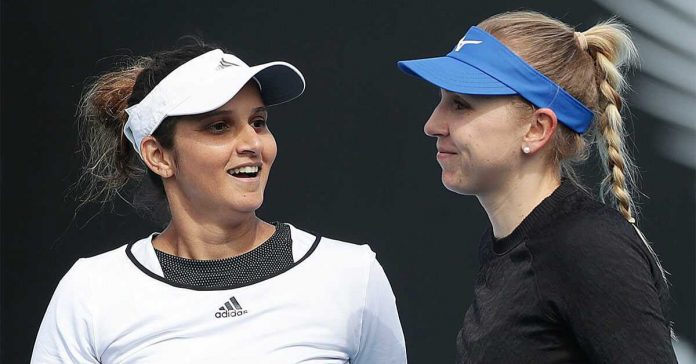
Indian tennis ace Sania Mirza made a winning return to the professional tennis circuit as she clinched her first tournament after childbirth.

SaniaMirzaMPOs21jan2020

Indian tennis ace Sania Mirza made a winning return to the professional tennis circuit as she clinched her first tournament after childbirth. Partnering Ukranian Nadiia Kichenok, the duo defeated the Chinese pair of S Zhang and S Peng in the women’s doubles finals in the Hobart International 6-4, 6-4 to kick start the year on a triumphant note.

Sania and Kichenok were hardly troubled in the summit clash, as they took the game without breaking into much of a sweat. The Indian now gears up for the Australian Open, where she will team up with Rohan Bopanna in the mixed doubles category. She was expected to play the Grand Slam with American Rajeev Ram, who has, since, pulled out of the tournament.

WTA

✔@WTA

Straight sets win 🤩

Nadiia Kichenok and @MirzaSania are your @HobartTennis Doubles Champions after defeating Peng/Zhang, 6-4, 6-4!

Embedded video

184 people are talking about this

This would also be the first time that Mirza and Bopanna would be playing mixed doubles together since they teamed up in the Rio Olympics 2016, where they had finished fourth.

Mirza, who had emerged as an inspiration to young girls in India when she forayed into the competitive world of tennis and started returning with impressive results that even saw her clinch the world number 1 ranking in the doubles circuit, had taken a break when she was at the peak of her career to have a child. Her son Izhaan was born to Mirza and Pakistani cricketer Shoaib Malik in 2018, after which the tennis star spent another year getting fit to return to the professional world.

Her fitness regime, her inspiring videos on Instagram, where she is committed to losing weight and not getting bogged down, have been a hit, and with this win, Mirza has also sent out another vocal message to the youth in India. She stands as an icon of strength, one who has not been afraid to take on the naysayers, proving them wrong with results on the field.

source: http://www.thebridge.in / The Bridge / Home> News / by Sarah Waris / January 18th, 2020

Tasneem Of JD(S) Is Mayor

Mysuru, KARNATAKA :

TasneemMayorMPOs20jan2020

C. Sridhar of Congress Deputy Mayor

Mysuru/Mysore:

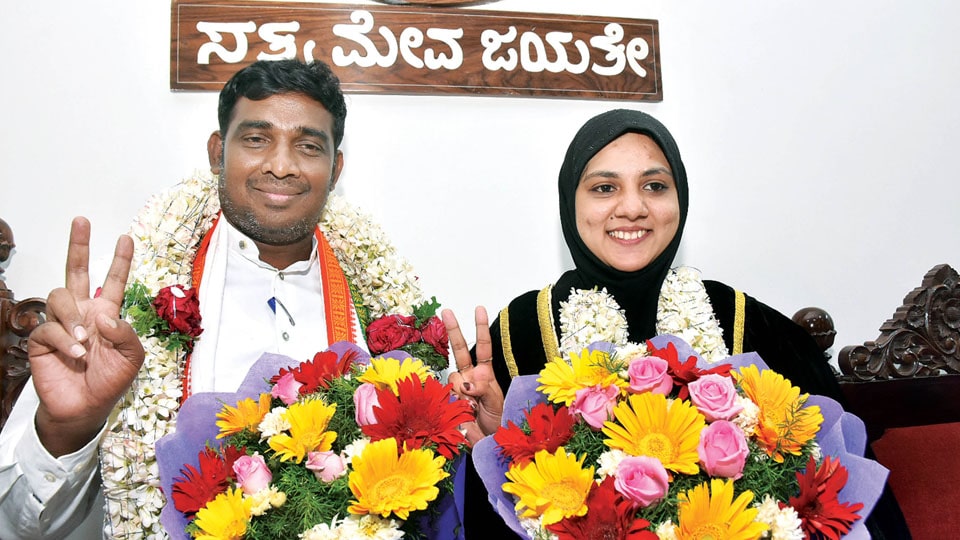
The city got its youngest Mayor when 31-year-old Tasneem of JD(S) was elected as the city’s First Citizen (Mayor) in the Mayoral election held at the MCC’s Council Hall this morning. Tasneem is the thirty-third elected Mayor.

Tasneem represents Ward 22 (Meena Bazar) in the 65-member civic body. With her election, Tasneem also earns the distinction of becoming the first-ever Muslim woman Mayor of Mysuru. The Mayor’s post for the second term of the current tenure of the MCC was reserved for BCA (Backward Class)  woman candidate.

C. Sridhar of Congress was elected as Deputy Mayor as that post was reserved for SC candidate. He represents Ward 38 (Giriyabovipalya). Both Tasneem and her deputy Sridhar bagged 47 votes, trouncing their respective BJP rivals Geethashree   Yoganand and Shanthamma Vadivelu, who could manage only 23 votes each.

The election process began with the filing of nomination papers at 7.30 am when Tasneem of the JD(S) and Geethashree Yoganand of the BJP filed their nominations. After the deadline ended at 9.30 am, the candidates were given five minutes for withdrawal of nominations. But as no nomination papers were withdrawn, the poll was held in which Tasneem bagged 47 votes out of 70, while her BJP rival managed just 23 votes.

The MCC has 73 voters, including 64 Corporators, four MLCs, four MLAs and the MP representing Mysuru. With the disqualification of Ward 18 BJP Corporator Guru Vinayak over fake caste certificate, the strength of the 65-member civic body has come down to 64. The by-poll to Ward 18 will take place on Feb. 9.

All the 64 Corporators, two MLAs — G.T. Devegowda and L. Nagendra — and all the four MLCs namely Sandesh Nagaraj, Marithibbegowda, K.T. Srikantegowda and R. Dharmasena took part in the poll process while BJP MLA S.A. Ramdas, Congress MLA Tanveer Sait and BJP MP Pratap Simha were conspicuous by their absence.

The process for electing the Deputy Mayor was similar to that of the Mayor’s election and C. Sridhar of the Congress was declared elected, defeating his rival Shanthamma Vadivelu of the BJP who secured just 23 votes which included that of 21 party Corporators, Chamaraja MLA L. Nagendra and M.V. Ramprasad, an independent Corporator. The BJP has 21 Corporators while the Congress has 19, JD(S) has 18, BSP 1 and there are 5 independents.

The newly-elected Mayor Tasneem is a two-time Corporator. She is a BA graduate from the city’s Maharani’s College and is married to Syed Samiulla, a businessman. The couple has a son and a daughter.

Deputy Mayor C. Sridhar is a resident of Kailaspuram. He is a BA graduate. His wife Anju is a home-maker and the couple has a son. Sridhar had defeated former Mayor Purushotham in the 2018 MCC polls.

Regional Commissioner Yashwanth, Additional Regional Commissioner Gayathri, outgoing Mayor Pushpalatha Jagannath and her Deputy Shafi Ahmed and other officials were present.

source: http://www.starofmysore.com / Star of Mysore / Home> News / January 18th, 2020

Ramanagara ZP CEO turns mentor for SSLC candidates

KARNATAKA :

In 2018 SSLC exams, Ramanagara district ranked first and in 2019, it was in the second place in the state with 88.49 passing percentage.

Bengaluru :

In an attempt to get better results in the coming SSLC exams, an IAS officer from Ramanagara has given a task to his officials to take responsibility of one government school each and work towards ‘’good’’ results.

Meet, Mohammed Ikramulla Shariff, an IAS officer of the 2016 batch, who is the Chief Executive Officer of Ramanagara Zilla Panchayat and was transferred to this post some seven months ago. There are more than 100 government schools where around 13,000 students are taking SSLC exams this March 2020. Shariff has asked each official from various departments in Ramanagara to ‘’adopt’’ one school where students are writing SSLC exams this year.

Speaking to The New Indian Express, Shariff said that all his officials are well qualified and many of them struggled hard and reached this place. “We have assigned one officer per school. We have chosen them in such a way that their offices are located close to their ‘adopted’ government schools. These officers work in various departments including Horticulture, Revenue, Health and Education, whose offices are located across the district. This initiative is being taken as an attempt to utilise human resources,’’ he said.

In 2018 SSLC exams, Ramanagara district ranked first and in 2019, it was in the second place in the state with 88.49 passing percentage. “These officials have to visit the schools once or twice a week till SSLC examinations. We have instructed them to interact with the candidates, their parents and teachers. These officials will listen to their woes, if any. The same has to be reported to us. They have to encourage them, in case needed, take classes too,’’ he said.

When contacted, Minister for Primary and Secondary Education Suresh Kumar said there are many CEOs from various districts including Kodagu, Mandya, Chikkaballapura and Raichur, who are encouraging officials to be involved in the education sector. These CEOs who were limited to management and holding bigger responsibility has chosen education and giving more attention which is a positive sign.

There is so much healthy competition among them. While CEO from Kodagu is writing letters to student on SSLC exams, telling them to be write exams with confidence. CEOs from Mandya, Chikkaballapur and Raichur is pushing average students to get better results. Most of these officials are young IAS officers. “I can see hope that this year’s SSLC results will be good and better than previous year,’’ he said.

source: http://www.newindianexpress.com / The New Indian Express / Home> States> Karnataka / by Ashwini M. Sripad / Express News Service / January 14th, 2020

With Muslim chief, TN village sends ‘inclusive’ message

Seriyalur Inam village (Alangadi Taluk – Pudukottai District) TAMIL NADU :

Though the village in Alangudi taluk in the Cauvery delta region has only 60 Muslim voters, only around 40 cast their votes, people’s choice transcended religion, caste and creed as they reposed their trust in 45-year-old Mohammed Jiyavudeen.

Seriyalur Inam is a Hindu-dominated village in Pudukkottai district of Tamil Nadu, but the nondescript hamlet has sent out a clear and loud message in the just concluded elections to rural bodies by electing a Muslim candidate as its panchayat president.

The election of a Muslim candidate in a Hindu dominated village comes at a time the country is facing massive protests against the controversial Citizenship (Amendment) Act and the proposed National Register of Citizens (NRC) which Opposition parties term as “anti-Muslim measures.”

Though the village in Alangudi taluk in the Cauvery delta region has only 60 Muslim voters, only around 40 cast their votes, people’s choice transcended religion, caste and creed as they reposed their trust in 45-year-old Mohammed Jiyavudeen.

Jiyavudeen, who has coordinated relief and rehabilitation efforts in the village and near-by areas after Cyclone Gaja left a trail of destruction in 2018, romped home despite elders of the village “auctioning” the panchayat president post in favour of another villager, Shankar, who lost by 17 votes.

The 45-year-old received maximum support from youngsters and women, who refused to toe the line of the village elders and voted in Jiyavudeen. He had returned to the village in 2018 after being in the UAE for over a decade.

“I see it as a recognition for the work that we as a group did in the aftermath of Cyclone Gaja. People reposed faith in me and two others from our group who contested as councillors. Through election people here have not just sent out a message on secularism but have also made it clear that they want people who work for their betterment,” Jiyavudeen told DH.

Jiyavudeen and fellow villagers, especially youth, had pooled in resources from various sources to rehabilitate people who were affected by Cyclone Gaja. “We built 10 new houses to people who lost their houses, distributed sewing machines to widowed women and wet grinders for elderly. We also disbursed interest-free loan for people in the village which have made them happy,” he added.

The new panchayat president said he takes pride in the fact that he neither spent money on distributing liquor or money for his voters.

Nimal Raghavan, a techie who had quit his job in UAE and is now involved in desilting lakes and ponds in near-by Thanjavur district, told DH that the country should follow the example set by people of Seriyalur Inam village.

“In our area, we live in complete peace and harmony. People will even print names of their friends belonging to other faith in wedding invitations. Election of Jiyavudeen is a classic example that humanity is above religion, caste and creed. His  election sends out a strong message as the country witnesses protests on CAA,” Raghavan said.

Kannan, a resident of Sethangudi village, said people should realise that humanity trumps everything including religion. “People like Jiyavudeen should come to power as they inspire the common man. He had worked with us to ensure that his villagers get proper relief during Cyclone Gaja. By electing him, people have spoken loud and clear against attempts to divide society on the basis of religion,” Kannan added.

source: http://www.deccanherald.com / Deccan Herald / Home> National> South / by ETB  Sivapriyan / DHNS Chennai / January 10th, 2020

Concern in Nawab landscape, too

WEST BENGAL :

Families associated with erstwhile rulers of Bengal decry citizenship regimen

Syed Reza Ali Meerza / (Picture sourced by The Telegraph)
Syed Reza Ali Meerza /
(Picture sourced by The Telegraph)

Descendants and associates of the Nawabs of Bengal who decided for centuries who their subjects would be are worried about their ability to prove Indian citizenship.

Since 1717, when Mughal Emperor Farrukhsiyar combined the nizamat (civil administration) and diwani (revenue administration) of the Bengal subah (subdivision) to elevate Murshid Quli Khan to the post of Nawab Nazim, the Murshidabad Nawabs of the Nasiri, Afshar and the Najafi dynasties ruled — de facto or de jure — for nearly two centuries the territories of undivided Bengal, Bihar, Jharkhand, Odisha, besides parts of Northeast and Chhattisgarh.

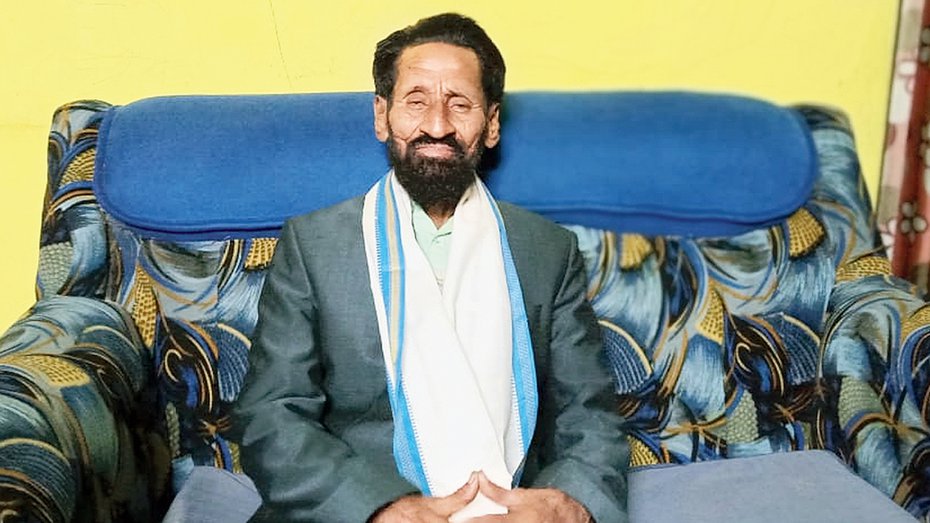
Syed Reza Ali Meerza, a 70-year-old grandson of Sayyid Sir Wasif Ali Meerza Khan Bahadur — the last Nawab Bahadur of Murshidabad recognised by the government of Independent India — said on Friday that the direct descendants of someone who had contributed to the very presence of Murshidabad in India should not be “degraded” by having to prove their citizenship.

Meerza Khan Bahadur had played a crucial role in the return of Murshidabad to India from East Pakistan after three days from August 15, 1947. He studied at Sherborne, Rugby and the Trinity College and was a resident of 85 Park Street in Calcutta towards the end of his life.

“Even if we were to forget the entire history and legacy of the Murshidabad Nawabs till 1947, at least the role played by my grandfather to ensure the return of Murshidabad to India after Partition should be remembered,” said the septuagenarian.

The former state government employee narrated the tales of how his grandfather Meerza Khan Bahadur spearheaded the initiative to ensure the return of the key district, despite being Muslim-majority, to India after the newly adopted Parcham-e Sitarah o-Hilal, the flag of Pakistan, flew atop the Hazarduari Palace for three days. The initial Radcliffe Award had placed Murshidabad in Pakistan and Khulna in India. On August 18, the two districts were exchanged.

“Now, his descendants have to stand in line on the same land to prove they are Indian,” said Meerza.

“There was a time when we — our forefathers — used to decide who were subjects and who were not. Before the British took everything from us, our family used to rule the wealthiest and industrially the most developed place in the world,” he said.

Meerza was referring to the economy of early 18th Century proto-industrialised Bengal, with its inhabitants purportedly having among the highest living standards and real wages in the world with over 10 per cent contribution to the global GDP. “Now, we have to prove that we are Indian?”

Meerza said many members of his extended family of Najafis did not have several requisite documents owing to legal reasons and were “living in fear”. “I condemn the NRC (National Register of Citizens), the CAA (Citizenship (Amendment) Act and the NPR (National Population Register) in the strongest terms,” he said.

Meerza said he had the requisite documents from the East India Company, the British Raj and the government of India, and he would not be “part of any queue” to prove he is Indian.

Other members of the extended family — who reside in the Qillah Nizamat area near Hazarduari Palace in Murshidabad — said although they had no official recognition as royals in the eyes of the state anymore, they felt demeaned even more by the prospect of being rendered stateless by the NRC.

“Our generation has not even received pension from the government, although they seized almost everything after Independence,” said Syed Mohammed Mazer Jha, who works as a nursing home employee in Murshidabad.

“Even my father did not get pension from the state. He died suddenly last year, and I am having trouble locating his papers,” he added.

Residents of the Hazarduari area said they respected members of the royal family for choosing to stay back in India. “The governments in India do not show as much respect to the descendants as groups of people in Pakistan or Bangladesh do. Still, they have stayed back,” said a resident of the area.

“The members of the royal family are by no means outsiders to this country. Rather, they have chosen not to immigrate to Pakistan or Bangladesh in spite of having lost so much property to the government of India,” said 50-year-old Mohammed Ali, a teacher at Singhi High School in Murshidabad.

source: http://www.telegraphindia.com / The Telegraph, online edition / Home> West Bengal / by Alamgir Hossain in Behrampore / January 03rd, 2020

Shamsuddin Abdullah Punekar conferred Mohsin E Millat Award for his educational services

KARNATAKA :

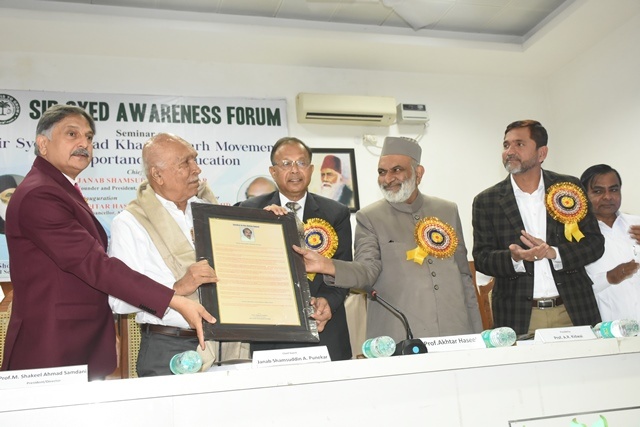
Mohsin E Millat Award being presented to Mr. Shamsuddin Punekar by Prof. Shakeel Samdani, Prof. Akhtar Hasbeeb and Prof. A.R.Kidwai

Aligarh:

“Those who are getting education from the great institution established by Sir Syed Ahmad Khan are having the blessings of Almighty on them. Had the Aligarh Muslim University (AMU) not existed, then the Indians would have remained educationally backward for a long period of time. I really admire Sir Syed Ahmad Khan that he started an educational movement and that movement gave me inspiration to do social and educational work” said edupreneur  Shamsuddin Abdullah Punekar while addressing a  seminar organized by  Sir Syed Awareness Forum (SAF) on  “Sir Syed, Aligarh Movement and Importance of Education” at Auditorium, University Polytechnic, Aligarh Muslim University, Aligarh.

Mr. Punekar was also conferred “Mohsin E Millat Award” for his services in the field of education. He is the man who established 24 educational institutions in Karnataka and running them successfully.

The award was conferred by Prof. Akhtar Haseeb, Pro Vice Chancellor, AMU and Prof. Shakeel Samdani, President of Sir Syed Awareness Forum, Aligarh..

Mr. Punekar further said that it is the duty of the old boys of this university to take inspiration from the life of Sir Syed and spare some time and money for social and educational work. He told the audience in detail about his life and struggle in establishing 24 educational institutions in Karnataka. He exhorted the audience to save our youth by guiding them on the right path. At last, he congratulated Prof. Shakeel Samdani for organizing such a wonderful seminar.

While inaugurating the seminar, Prof. Akhtar Haseeb, Pro-Vice Chancellor, AMU said that the seed of scientific education planted by Sir Syed has grown up into a tree in the form of Aligarh Muslim University and its three centres. Sir Syed always preached the ideals of tolerance, secularism and brotherhood. He, while congratulating Prof. Shakeel Samdani for successfully organizing the seminar, said that there is no substitute of hard work and those who keep on working hard will see its benefits sooner or later.  In the last he advised the audience that whatever has been transpired in the seminar should be transformed into action.

Prof. Shakeel Samdani, Director of the seminar and Dean, Faculty of Law, AMU while highlighting the objectives of the SAF, said that this forum was established 15 years ago with the mission to enlighten the ideals of Sir Syed to the students and the forum has been successful in doing so. The purpose of this forum is to make the students aware about the mission and vision of Sir Syed including constitutional ideals of secularism, tolerance, peace and harmony. Prof. Samdani furhter said that in comparison to North India, South Indian Muslims adopted Aligarh Movement and established hundreds of high qualtiy institutions. The same movement should be restarted in north India by the Muslims.

U.P. Ratan Awardee, Dr. Lokesh Sharma said that no one can repay the debt of Sir Syed Ahmad Khan. Sir Syed lost everything for the upliftment of the community. Without caring about his opposition and criticism Sir Syed continued to work for scientific education and he successfully achieved his goal.

Prof. A.R. Kidwai, Director, UGC Academic Staff Collge, AMU while delivering his presidential remarks said that, Sir Syed worked a lot for scientific education and he became a defender of scientific education. He also discussed the tour of Sir Syed to England, where he saw the lifestyle, education system, syllabus, buildings of them and tried to replicate them in AMU.

Dr. Swati Rao while addressing the gathering said that education is incomplete without proper upbringing. She further said that Urdu language is an Indian language and it can be called as the language of communal harmony. She wondered by Urdu language is not getting justice in the country.

Prof. Mohibul Haque said that Sir Syed was one who influenced the time. Sir Syed and Raja Ram Mohan Roy were the first who started socio-religious movement in India. Sir Syed launched educational movement for regeneration of Muslim community and he was the pioneer of interfaith understanding.

The notable feature of the seminar was that it was attended by 32 delegates from Karnataka, Maharashtra and Andhra Pradesh. 2 delegates came from Turkey and gave an international touch to the seminar. A large number of  academicians, faculty members and students of AMU were present in this seminar.

The seminar was moderated by Ayesha Samdani, MBBS student, at AMU. The seminar was started by the recitation of verses from the Holy Quran by Dr. Obaid Iqbal Asim, Abdullah Samdani welcomed the guests and vote of thanks was proposed by Khansa.

The seminar was made successful with the tireless efforts of Adv. Shoeb Ali, General Secretary, SAF, Dr. Haider Ali, Inchage, Mrs. Anjum Tasneem, Mohd. Nasir, Hunain Khalid, Kashif Sultan, Chitranshu, Manasvee, Samreen, Anas, Shubham, Zakia Khan, Samra Hashim, Pawan Varshney, Yusuf Iqbal, Md. Sabeeh, Sachin Varshney, Rahul Singh, Shelja, Talat Anjum, Razia Chauhan, Shreya Singh, Salman, Moiz, Adnan, Chirag and others.

source: http://www.muslimmirror.com / Muslim Mirror / Home> Education> Indian Muslim> Positive Story / by Abdullah Samdani / November 17th, 2019

Marathas, OBCs dominate, 4 Muslim MLAs get ministries

MAHARASHTRA :

After the induction of 36 ministers on Monday, the 43-member council of minsters (CoM), led by chief minister (CM) Uddhav Thackeray, has seen the Maratha community dominate the Cabinet, followed by legislators from the Other Backward Classes (OBC). Significantly, the Muslim community, represented by four ministers, has also got one of the highest representations in the Maharashtra Vikas Aghadi (MVA) Cabinet.

In terms of regions, most of the ministers are from western Maharashtra and Vidarbha.

In Thackeray’s 43-member Cabinet, there are 19 ministers from the Maratha community, with deputy chief minister Ajit Pawar, senior Congress ministers Ashok Chavan and Balasaheb Thorat, senior Nationalist Congress Party (NCP) ministers Jayant Patil, Dilip Walse-Patil and Anil Deshmukh and Shiv Sena ministers Eknath Shinde and Gulabrao Patil, being the prominent faces.

OBC community is represented by former deputy CM Chhagan Bhujbal, Dhananjay Munde, Jitendra Awhad, Vijay Wadettiwar and Sanjay Rathod.

From the Muslim community, Thackeray has inducted party legislator Abdul Sattar, as well as Hasan Mushrif and Nawab Malik from NCP, and Aslam Shaikh from the Congress.

The other caste-based representations include Nitin Raut, Varsha Gaikwad and Sanjay Bansode, who are from the Scheduled Caste (SC) community, while seven-time legislator KC Padvi is the lone tribal representative in the Cabinet.

The region-wise distribution of the ministerial berths is dictated by the number of seats each of the three parties has won in a particular region, as well as how a party has countered the Bharatiya Janata Party (BJP) in the Assembly polls.

Thirteen ministers were chosen from western Maharashtra, as the Congress and NCP gained the maximum support in the region. It was followed by Vidarbha (8), Marathwada (7), north Maharashtra (4) and Konkan (2). From the Mumbai Metropolitan Region, four ministers, including Aaditya Thackeray, are from Mumbai and two are from Thane.

“Sangli and Kolhapur have received the maximum representation from the Congress and NCP, with ministers such as Jayant Patil, Hasan Mushrif, Satej Patil, Vishwajeet Kadam along with first-time minister Rajendra Patil Yadravkar, making it to the cabinet. Satara also has been given fair representation with the induction of Balasaheb Patil. These districts had given the two parties the most number of MLAs by defeating the BJP candidates,” said a Congress leader, who did not wish to be named.

The three ruling parties have inducted Balasaheb Thorat, Prasad Tanpure and Shantaram Gadakh from Ahmednagar to limit Radhakrishna Vikhe Patil and Madhukar Pichad’s influence in the region at check. The duo had deserted the Congress and NCP to join BJP.

Congress has picked the maximum number of ministers from Vidarbha, where it had gained majorly in the Assembly polls. Congress’s Nitin Raut, Vijay Wadettiwar, Yashomati Thakur and Sunil Kedar got the Cabinet berths, while Nana Patole was elected as the speaker of the lower house after the new government came to power. From the region, NCP chose Anil Deshmukh and Rajendra Shingane, while Sena has inducted Sanjay Rathod and Bachchu Kadu. However, most of the MLA’s who won in Vidarbha are from BJP.

An NCP leader said that though the three ruling parties had decided to have better coordination in terms of representation to the region, it could not do so while finalising the names for the ministerial berths.

“For instance, Eknath Shinde (Sena) and Jitendra Awhad (NCP) both belong to Thane district, while in Sindhudurg and Ratnagiri, Sena and NCP could give only one berth despite their dominance there,” he said.

Prakash Pawar, political analyst from Kolhapur, believes that the three parties did not choose ministers on the basis of caste and region alone. “I don’t think the induction of the ministers was on the basis of caste or region. The ruling parties have tried to keep BJP, the single largest party in the Assembly, in check owing to the uncertainty over the alliance lasting for five years. This is not a natural alliance and thus it will always be under threat from BJP. By giving a fair representation to OBCs, the ruling parties have also tried to attract BJP’s traditional vote-bank of OBCs,” Pawar said.

source: http://www.hindustantimes.com / Hindustan Times / Home> Mumbai News / by Surendra P Gangan / December 31st, 2019