Category Archives: Leaders

Alumni association formed at Jamal Mohamed college

Trichy, TAMIL NADU :

A.K.Hussain of Ahamad Brothers of Tiruchy was unanimously elected as president.

Tiruchy:

Former students of Jamal Mohamed college (JMC) of Tiruchy formed an alumni association recently for which A.K.Hussain of Ahamad Brothers of Tiruchy was unanimously elected as president. In a release at Tiruchy on Tuesday, Hussain said while Abdul Aleem, founder of the Ant-Dowry Association of Koothanallur was elected as secretary, Riyaz of Tiruchy was elected as treasurer.

Basheer Ahamed and Dr. Gobinath of Tiruchy were elected as vice-presidents and Mohammed Ismail and Dhanraj of Tiruchy as joint secretaries. In addition to this, a seven member executive committee has been formed with auditor Murugan, Nazeer Ali, Padmanabhan, Senthilkumar, advocate Madhani, Akbar Ali and B.G. Naidu Balaji, he added.

Hussain said that old students working and settled abroad had already formed and were running the JMC alumni associations in various countries including at Malaysia, Singapore, Kuwait,Saudi Arabia and Chennai in TN and giving scholarships to poor students of JMC. They were also helping to improve infrastructure and construct new buildings for the college. The newly formed Tiruchy based alumni associati-on of the JMC also will follow the footprints of the existing alumni associations, he added. Secretary of the JMC Dr. Khaja Najummudeen, assistant secretary Jamal Mohamad Sahib and others greeted office bearers of the newly formed alumni association.

source: http://www.deccanchronicle.com / Deccan Chronicle / Home> Nation> In Other News / Deccan Chronicle / July 15th, 2015

IAS officers bag excellence award

Hyderabad, TELANGANA :

Several civil servants and other officers have been selected for the Telangana Excellence Awards-2018 for excellence in public administration, innovation, instituting flagship programmes, land records updation, IT initiatives in governance, solid waste management etc. in individual capacity or for working in groups.

They include Commercial Taxes Commissioner V. Anil Kumar and Principal Resident Commissioner of Telangana Bhavan at New Delhi G. Asok Kumar, Nalgonda Collector Gaurav Uppal, Buddhaprakash Jyothi, Adilabad Collector D. Divya and Adilabad DMHO Rajeev Raj, GHMC Commissioner B. Janardhan Reddy, Mancherial Collector R.V. Karnan and HMWSSB MD M. Dana Kishore, Suryapet Collector K. Surendra Mohan, Karimnagar Collector Sarfaraz Ahmed, DMHO Rajesham and Mohammed Aleem, Commissioner of Health and Family Welfare Karuna Vakati, Jagtial Collector A. Sharath, RDO Ganta Narender and Medipally Tahsildar N. Venkatesh and Peddapalli Collector Alagu Varshini, Asifabad Collector Prashanth J. Patil, Sircilla Collector D. Krishna Bhaskar.

source: http://www.thehindu.com / The Hindu / Home> News> States> Telangana / by Special Correspondent / Hyderabad – May 19th, 2018

Firoz Bakht Ahmed Appointed MANUU Chancellor

Hyderabad, TELANGANA :

Mr. Firoz Bakht Ahmed is grandnephew of Maulana Abul Kalam Azad, first Education Minister of India.

Hyderabad :

Firoz Bakht Ahmed, educationist, noted social activist and columnist has been nominated as the Chancellor of Maulana Azad National Urdu University (MANUU) for a period of 3 years, said a statement from the varsity.

According to a notification released by the registrar, MANUU today, President of India in his capacity as Visitor of the University has appointed Mr. Firoz Bakht as the fifth Chancellor of the University.

Mr. Firoz Bakht succeeds Mr. Zafar Sareshwala.

Mr. Firoz Bakht is grandnephew of Maulana Abul Kalam Azad, first Education Minister of India. The University is named after Maulana Abul Kalam Azad, a scholar par excellence, a prolific writer, an inimitable orator, a gallant freedom fighter, a visionary of the post independent Indian education system and an architect of technical and scientific education in Independent India.

He is a prolific writer and authored many books in Urdu and Hindi, especially on Children’s Literature.

He is also a freelance journalist and columnist. His columns and articles appear regularly in various widely circulated newspapers across India.

Mr. Firoz Bakht was also associated with Madrassa modernisation and Urdu medium schools upliftment.

He was appointed by the courts in various committees/enquiry committees assisting the judicial procedures for prompt justice.

He was also associated with MANUU before its inception in 1997 as foundation panel member.

Maulana Azad National Urdu University (MANUU)

Maulana Azad National Urdu University (MANUU) is a Central University, established by an Act of Parliament with all India jurisdiction in 1998. The headquarters and main campus of MANUU is in Gachibowli, Hyderabad. It is spread over 200 acres. MANUU is recognized as a major higher education service provider across the remote areas of the country for marginalized and first generation learners of Urdu medium through its regular and distance mode programs.

MANUU commenced with distance education programs in 1998 and consolidated its academic and research base in Urdu medium regular programs in 2004.

Presently, MANUU is in the process of consolidating the existing institutions, while expanding it to reach the unreached through various intervention measures. Further, to meet the rising aspirations of its youth in general and Urdu speaking community in specific, the University is making considerable progress in all fronts of academics, research and governance with specific vision, mission and objectives.

source: http://www.ndtv.com / NDTV / Home> Education> by NDTV Education Team / May 17th, 2018

Three lions and Tipu’s Tiger

KARNATAKA / London, UNITED KINGDOM  :

Could the Tiger’s position — now behind a glass case, its crank handle inaccessible to the public — be an apology for the disrespect permitted in East India House?

The artefact sitting in V&A was iconic, identifiable and far away from home

The day I saw Tipu’s Tiger behind its glass case at the Victoria and Albert Museum in London was a day of significance. That morning, after months of being cooped up in Oxford, some friends and I took the train to Marylebone and found the absence of dreaming spires refreshing to say the least. At noon, a friend from India was waiting for me on the other side of the busy Camden High Street. As we hugged amidst the crush of gliding Londoners, her muffled exclamation might have been: ‘It’s so crazy we’re meeting here of all places, so far from home.’

That phrase would be borrowed by me on two separate occasions during the day. In the evening, I stood before Julian Barnes at the Royal Institution and told him how I had read ‘A Short History of Hairdressing’ over and over again to teach myself the ‘architecture’ of a short story. I felt a potent urge then to parrot my friend. It was ‘crazy’ to see and hear Barnes in the flesh, so far from my bedroom in Kolkata, the only other place he had seemed real and, dare I say, attainable through his prose and through the material object, that is, his books in my hands, the only feasible rendezvous with the man.

I had never thought then it would happen: to have someone I studied so minutely sit before me and confess he didn’t think as highly of his short prose as I did.

Iconic meeting

The second occasion I was inclined to echo her words that day was when I stood in the South Asia section of the V&A before Tipu’s Tiger, which had always been relegated to the Did You Know section of our history books. It was not exactly like meeting an old friend or a revered author, but it bore all the characteristics of such a meeting. Like Barnes and my Kolkata friend, it was instantly iconic, identifiable from a distance, and a ready reminder of my distance from India. In fact, standing before the wooden automaton, slightly disconcerted, I addressed it and thought: ‘You are so far away from home.’

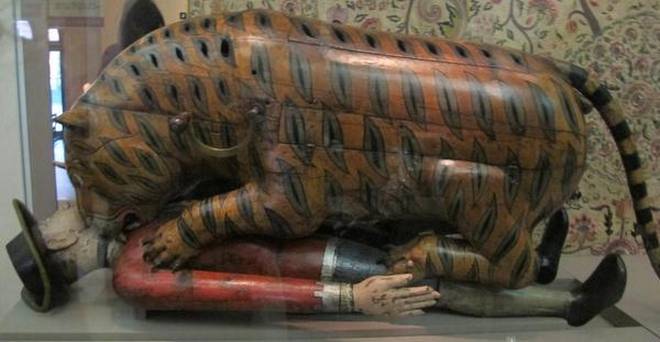
The possible inspiration for the mechanical figure seems fitting to some. Hector Munro Jr, whose father defeated Tipu’s father Hyder Ali in the Second Anglo-Mysore War in 1781, was mauled by a royal Bengal tiger at Saugor Island in 1792 and died from the injuries. This must have seemed like divine intervention to Tipu, a wrong set right. The carved and painted, almost life-size, wooden musical automaton was created for the Sultan, whose personal emblem was a tiger and whose hatred of the British was well-known.

The last laugh

With the fall, however, of Seringapatam and the execution of Tipu in the Fourth Mysore War of 1799, the Tiger travelled from the music room of Tipu’s summer palace to the Company’s East India House at Leadenhall Street in London, where the public was given access to view and play with it.

Its wooden body with a keyboard embedded in the flank was thrown open to the English masses who came in and played ‘God Save the King’ and ‘Rule, Brittania!’ upon it. If Tipu thought he had been mocking the Englishmen with the Tiger, they were now having the last laugh.

I deal with issues of empire and post-colonial anxiety almost on a daily basis, especially in a place like Oxford, especially on a course called World Literatures in English. Of course, when I first saw it, I silently demanded a restoration of the tiger to its previous owner, to its previous nation. My anger at seeing the Tiger in an English museum, so far away from home, was justifiable. The Tiger was not borrowed. Nor was it touring, as it had to New York’s MoMA in the 50s. Instead, it was a ‘permanent’ acquisition at the V&A.

Of collaborations

For every Indian schoolchild, the Tiger, just an artefact but nonetheless awe-inspiring, was not an affordable train or flight away, like Fatehpur Sikri or Sher Shah’s tomb.

For me, the Tiger’s distance from my home was a reiteration of the national and racial distinctions not only of the Anglo-Mysore variety, but also of the Jadavpur-Oxford type that I faced every day. Besides dodging questions like ‘If you’re from India, how’s your English so good?’ for the past few months, I had had to clarify to a white friend who subsisted on the chic-ideal of Zadie Smith that India has Bengalis too, and no, I did not have relatives in Brick Lane, not that I knew of anyway.

Seeing Tipu’s Tiger that day catalysed a recollection of an afternoon in 2016 in the Victoria Memorial Hall with Thomas Daniell and his nephew William. Their tranquil scenes of India, while in stark contrast to the ferocity of the Tiger, do something interesting.

The English hands of the Daniells reproduce the Indian hands of the architects behind the buildings and locations they sketch. Their canvas becomes a surface of Anglo-Indian collaboration, similar to how it is conjectured that the mechanics of the Tiger have an Indo-French history.

This recollection, and the subsequent contemplation on collaboration, made me think of several works of restoration that the V&A carried out upon the Tiger, especially after the bombing of London in World War II. Could this act of restoration be seen as an act of reparation? Could the Tiger’s position — now behind a glass case, its crank handle inaccessible to the public — be an apology for the disrespect permitted in East India House?

The Tiger, so far from home, is an icon that reminds me of a past based on plunder and pillage by the nation it sits in. Yet, its 18th century splendour has weathered war and wear so well. Do present acts of safekeeping obliterate the violent history of its, for want of a better word, theft?

I am persuaded to wonder if the Tiger is now a collaboration between Tipu’s Mysore craftsmen and its modern conservationists in England and if I should be thankful for the restoration. Are the acquisition and conservation of an Indian object in a British museum and the works of British painters displayed in a Calcutta museum an instance of transnational collaboration and exchange? But in the case of Tipu’s Tiger, this then also begs the question: how long is too long before we forget that what is ‘acquired’ is what was once ‘removed’ from its home?

The writer, a Felix Scholar, is studying World Literatures in English at Oxford

source: http://www.thehindu.com / The Hindu / Home> Society> History & Culture / by Rohit Chakraborty / May 05th, 2018
Karnataka elections 2018: Here is a list of winning Muslim candidates

KARNATAKA :

KarMuslimsMPOs17may2018

Bengaluru :

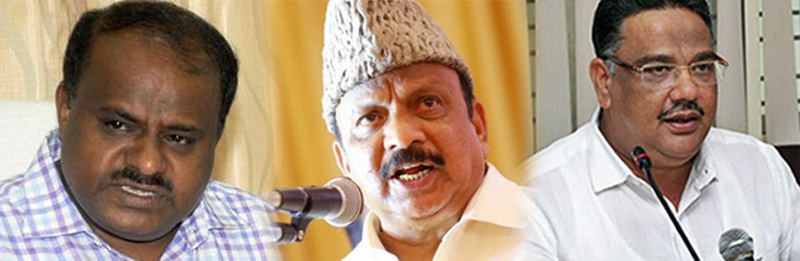
This election saw the lowest Muslim representation in Karnataka Assembly unlike the 2013 Assembly polls where number had gone up to eleven.

Only seven of the Muslim candidates won their seats and incidentally all are from Congress party. Also, five of them had won the 2013 Assembly polls on the party ticket.

Congress, the ruling party in Karnataka fielded 17 Muslim candidates, JD(S) do have Muslim candidates while the saffron party (BJP) does not have a single Muslim candidate.

Among the winners is Kaneez Fatima, the sole Muslim woman won the Gulbarga Uttar constituency by defeating Chandrakant Patil of Bhartiya Janata Party by 5,940 votes. Her husband late Qamar Ul Islam had won the seat in 2013.

Veteran politician Roshan Baig won his stronghold Shivajinagar constituency by defeating BJP leader Katta Subramanya Naidu with a margin over 15,000 votes.

UT Abdul Khader, minister for food, civil supplies and consumer affairs in the Siddaramaiah cabinet, won Mangalore constituency by 19,739 seats, defeating Santosh Kumar Rai Boliyaru of BJP by 19,737 votes. Khader won 80,813 votes while BJP’s Santosh trailed behind with 61,074.

B.Z. Zameer Ahmed Khan, former JD(S) legislator, who defected to Congress in March this year won the Chamrajpet constituency in Bangalore city by beating M Lakshminarayana of BJP with margin of 33,137 votes.

After Aziz Sait’s death, his son Tanveer Sait proved a winning horse for the party. Tanveer won the Narasimharaja constituency defeating BJP’s Sandesh Swamy by 18,127 votes. Sait is the Primary and Secondary Education Minister in the Siddaramaiah cabinet.

Mohammed Nalapad Haris or NA Haris won from Shantinagar seat with margin of 18,205 votes by defeating K Vasudevamurthy.

Rahim Khan has emerged victorious in Bidar assembly constituency with 73270 votes. The 52-year-old incumbent MLA defeated BJP’s Suryakanth Nagmarpalli who got 63025 votes.

Besides these seven winners, nine other Mulsim candidates finished at No. 2 in this poll.

Courtesy: Carvan Daily

Of the 222 assembly constituencies which went to polls on May 12, the Congress party has won in 78 seats, while the JD-S has won 37 seats. The BJP emerged as the single-largest party with 104 seats.

Interestingly, the Congress polled more votes this time (38 per cent) than in the 2013 assembly election, when got 36.76 per cent votes.

source: http://www.siasat.com / The Siasat Daily / Home> Bangalore> Breaking News> News> Politics> Real Estate> Top Stories / May 16th, 2018

Ilma Afroz, farmer’s daughter, cracks civil service exam

Moradabad, UTTAR PRADESH :

IlmaAfrozMPOs16may2018

Moradabad:

‘Where there is a will, there is a way’, this proverb was proved true by Ilma Afroz, a farmer’s daughter from Moradabad district in Uttar Pradesh. Against all odds, she has bagged 217th rank in Civil Services Examination 2017, whose result was declared on Friday evening.

She is the granddaughter of the former chairman of Kundarki Nagar Panchayat, Qazi Habeeb Ahmed. She was studious right from the childhood. Ilma attributes her success to her mother, Suhaila Parveen and brother Qazi Arfat. Ilma says that after the death of her father, her mother did not allow her to miss his absence. After initial studies in Kundarki, Ilma passed her intermediate studies from the Wilsonia Inter College in Moradabad. She did graduation in Philosophy from St. Stephen’s College in Delhi. She went to France, England and US for further studies.

Ilma bagged the IFMR and the Contemporary South Asian Studies Award. She has been Secretary in the Clinton Foundation of Hillary Clinton, wife of former US President Bill Clinton. Ilma participated in the Civil Services Examination and achieved success in her first attempt.

Ilma wishes to become an IPS officer. She will be the first IPS officer of Kundarki.

source: http://www.siasat.com / The Siasat Daily / Home> India> News> Top Stories / April 30th, 2018

Youngest woman corporator set for active politics

Lucknow, UTTAR PRADESH :

SadiaRafiqMPOs13may2018

At 23, she looks like any other student on the verge of a career and the most unlikely career for her seems to be politics. But Sadia Rafiq is now the youngest corporator from Lucknow and is all set for a career in politics.

Sadia has been elected as an independent candidate from Tilaknagar ward, defeating the BJP candidate. Her father Rafiq Ansari and brother Adil have been corporators from the same ward, but this time, the seat was reserved for women.

“I belong to a family of politicians. My father, uncle and brother are already active in politics and have contested elections too. When I expressed the desire to join politics and serve the people, there was no resistance from the family. I am well versed with the intrigues of politics and hope to move ahead without much problem,” she says.

 Sadia is presently doing her graduation in mass communication and has a keen interest in photography.

“Journalism is closest to politics and that is why I chose this field,” she explains.

In her new avatar as a corporator, Sadia plans to fight for basic amenities in her ward. “There is a problem of clean drinking water in my ward. Women have to line up for a bucket of water. The drainage system has almost collapsed. Besides, I want to empower women who have remained within the confines of their homes till now,” she says.

Sadia admits that it was her education that helped her win the elections. “When my voters came to know that I am studying, they encouraged me by choosing me. They see new hope in me and I have to live up to their expectations,” she says.

This young politician, however, is clear that she will not give up her education though politics is a full time career. “It is difficult, but not impossible. In fact, I also want to do my master’s in mass communications,” she says, adding that well educated people must join politics if they wish to make a difference.

She feels that women who join politics should also learn to take their own decisions instead of being governed by their husbands, fathers and sons.

source: http://www.sundayguardianlive.com / Sunday Guardian Live / by Our Correspondent / December 10th, 2017

Chennai-born Rehana Ameer gets candid about life as a British politician

Chennai, TAMIL NADU / London, UNITED KINGDOM :

RehannaAmeerMPOs13may2018

Chennai-born Rehana Ameer chats about how she got into British politics, and the need for youth to get into public affairs

Rehana Ameer was your quintessential Triplicane girl. Growing up, she dreamt of becoming a doctor, but life had other plans for her. She got into the IT sector and was sent to the UK, after which she kept shuffling between the two countries. In 2008, she made a decision – to relocate to the UK with her husband and children.

Today, 10 years later, Ameer is creating a name for herself in London. Apart from the business she runs, she’s also popular for being the first Indian-born woman to be elected as a councillor to a ward in the City of London. In the city for The Glassbox’s Meraki speaker series, Ameer opens up on how she got into the political arena and the need for younger people to spark a change in the system. Excerpts:

You’re doing well for yourself in the UK, but you’re no stranger to Chennai, right?

I was born and raised in Triplicane, and got married to another Chennaiite – from Royapettah. We moved to the UK and that’s where my journey began.

You are the first Indian-born woman to be elected to the City of London Corporation. Can you recall that day when you were announced winner?

I didn’t realise that it would become this big. There was a lot of pressure in the run-up to the elections; the campaigning was tough. There was a blast the day before elections. What helped me was my focus and keeping my eye on the prize.

After winning, I didn’t show my happiness. The person I defeated was active in the circuit for more than three decades and I had to show my respect. But within me, I was very happy that my hard work had paid off. Only after my son said, “Mama, you’ve won” three times, did it sink in.

How’s a day in your life looking after the win?

The role I’ve taken in my ward in the City of London is a voluntary civic responsibility role. In some wards, you have 10 councillors but in mine, there’s only me and another person… so the work is shared. I sit on three large committees in which we have regular weekly meetings; three days go into that. One good thing about London is that most things are largely scheduled and planned. I also run a business . Apart from that, I’m a mother and a wife.

What have your chief learnings been after becoming a Councillor?

Earlier, I had theoretical knowledge, but now I know how things work practically. I know the system and can try bringing some kind of a change. I’m also in a position to guide and advise people on how to go about tackling their issues. It’s a four-year term and it’s been just a year now, but I think I’ve been a fast learner.

You’ve grown rapidly in your political career. Did you have a godfather?

I had no political affiliations; it was more of an internal passion. If you have the skills and attitude, you’ll get support, irrespective of who you are. For me, politics is no different from any other profession. That sort of a mindset should come in India. My message has always been this: young people and women should get into politics. I know there are challenges but a start needs to be made somewhere.

But aren’t there a lot of differences between how politics work in India and back in the UK?

Yes, the outlook is different. But you don’t necessarily need to come into the forefront of politics to make some sort of change. There are many roles in the system that people might not be aware of; it can be policy, research or advisory. A new policy is not just the result of what one politician thinks… it is the result of many brains. You could be one of them.

Who’s that one politician that you have admired?

As a woman, I admired Jayalalithaa and her courage. The power she had to bring the masses together was amazing.

Did you dream of becoming someone like that growing up?

My father was the president of the local jewellery association and he was always looked up to as a leader. As a child, I remember wanting to be like that, but I never imagined I’d get into politics someday. A point came in my life when I started thinking what I’ve done for the betterment of my fellow beings. I realised that I had migrated from India to the UK and didn’t want to lead life like any other migrant. I wanted my children to do something for society and for that, I needed to lead by example… and that’s how politics happened.

source: http://www.thehindu.com / The Hindu / Home> Society / by Srinivasa Ramanujam / May 10th, 2018

Businessman from Assam wins ASEAN award

Hojai, ASSAM / LAO PDR  :

Guwahati :

State-based businessman Habib Mohammad Chowdhury has won the ASEAN-India Emerging Entrepreneur award in Malaysia at the ASEAN-India Conference.

To commemorate its 25th anniversary, the ASEAN-India Business Council (AIBC) organized the ASEAN-India BizTech Expo and Conference in collaboration with the Federation of the Indian Chamber of Commerce and Industry (FICCI). The conference was held in Kuala Lumpur in Malaysia with the theme ‘Bridging Borders Through Business’.

“I feel exceptionally blessed. Receiving this award has only made me more determined and motivated to accomplish my set goals,” said Chowdhury, who was born and brought up in Assam’s Hojai.

Chowdhury is now settled in Laos. He is the founder-chairman of the HSMM Group of Companies in Laos, which has emerged as the largest agarwood and agar-based product’s company in southeast Asia.

Over the years, the governments of ASEAN and India have taken concrete measures to strengthen economic relations, especially the establishment of the ASEAN-India Free Trade Area.

source: http://www.timesofindia.indiatimes.com / The Times of India / Home> News> City News> Guwahati News / by Abdul Gani  / TNN / June 20th, 2017