Category Archives: Leaders

Closed minds in Open School and one lady’s struggle for Kannada

Bengaluru, KARNATAKA :
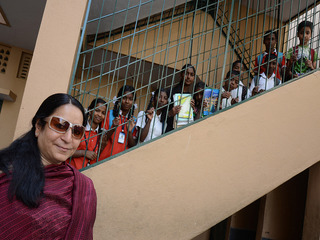
Dr Iffat Faridi, a social activist is trying to urge the government to include Kannada Language in Open School System as the poor and Kannada Medium School Children are facing difficulties in continuing their study in Open School System.

Educationist Iffat Faridi wants NIOS to alter its policy so that vulnerable students can go beyond Class 9 — the last class where they are given questions in Kannada

For students like Maya, a Std 4 dropout from a Kannada medium school, the National Institute of Open Schooling (NIOS) would seem like a Godsend.

Far removed from the rigid structure of conventional schools that require compulsory attendance, the NIOS allows for students to have access to education, with many conveniences, distance being one of them.

When Maya, who could read, write and speak fluently in Kannada, heard about the NIOS, she thought it was a dream come true. She could continue her education despite the gap and her long-cherished dream of getting a school certificate would be fulfilled. However when she decided to enroll herself in NIOS for the Std 10 exam, she realised that Kannada was not included as the medium of instruction for Std 10, although up until Std 10, it is. At the Std 10 level, students like Maya would have to choose either Hindi or English as a medium of instruction, for study material and for questions papers.

However, she was told that she could answer the question paper in Kannada since she was not fluent in Hindi or English.

The most crucial exam of a student’s life had become a battle of languages.

Fortunately, students like Maya, have in Iffat Faridi, an educationist and a resident of Bengaluru, a saviour who understands the challenges of studying in one language and being tested in quite another. And Faridi is leading the fight for giving girls like Maya the advantage of doing their Std 10 exams in a language they have fluency in.

Besides taking education to the people from underprivileged sections of society, Faridi is championing the cause to have Kannada as one of the languages of instruction in the NIOS system for Std 10.

Speaking to BM, Faridi said, “A blessing in disguise, the National Institute of Open School plays a pivotal role in the distance education system of India. It is a ray of hope for children who are not fortunate enough to join regular schools or who could not continue their schooling. Despite its obvious significant contribution to the Indian education system, NIOS has a serious issue in its system which needs to be highlighted and must be resolved,” she added.

Not just Maya…

She recounts the story of Renuka, a child of a migrant labourers from Gulbarga district, who is facing similar issues. Renuka started her schooling almost at the age of 10, after going through bridge courses based on modules developed by the Azim Premji Foundation in Kannada, Environmental studies and Math. She was admitted to a Kannada medium school, and initially enrolled in Std 1 as per rules. Later, based on performance tests conducted by the school, she was promoted to Std IV. At the moment, the 14-year-old wants to apply for Std 10 exams through NIOS and she faces the same issues as Maya. She has good command over Kannada but will have to master Hindi or English to learn the study material.

Faridi’s fight

Says Faridi, “Lack of study material in Kannada is a huge setback and injustice to the aspirations of those children who have done schooling purely in Kannada medium. Kids referred to NIOS belong to a class where parents are daily wagers. They earn very little and that too after working very hard from morning till evening. These children have taken the initiative for further education, on their own. Having travelled a fair distance on the road to being fully literate, they are facing setbacks in their path due to non-availability of study material in Kannada. They need full support from NIOS to pursue their dream of completing their education and get on a career path.”

NIOS reacts

When BM contacted Chandrashekar S, director of NIOS, Bengaluru branch, he said, “There is Kannada up to 10th. The 10th class study materials and examinations will be bi-lingual and the students can answer in Kannada. There is no problem in that. The next set of Kannada books are getting ready. Once it is released, students will be getting it.”

KDA slams the system

Reacting to the limitations for Kannada medium students in NIOS, SG Siddaramaiah, Chairman, Kannada Development Authority told BM, “What kind of unscientific methods are these? How can someone who knows only Kannada be made to read in English or Hindi and again write answers in Kannada? How is it even possible? Who is going to punish these type of people who deny access to education to Kannada medium students? This is coming to light now. What about all these years? Thousands of children have been denied education only because of this option.’’

While Faridi continues her fight with NIOS, she’s preparing her students to brace themselves for the language challenge ahead. She has already brought Hindi books from Delhi to prepare her students to learn from study materials in Hindi and English at the Std 10 level.

Why Open School?

Students who fail to qualify for regular school or are unable to pass a class despite multiple attempts have the option of completing studies through Open School. Also, mature students who wish to return to school after a break in studies or those children who have to shoulder the family’s burden pursue studies through Open School. 

Are questions set only in English or Hindi?

No. Seven other options are available apart from English and Hindi. These are Urdu, Marathi, Telugu, Gujarati, Malayalam, Odia and Tamil. Note that all South Indian languages are available except for Kannada.

Can they learn and answer in Kannada?

Yes, but only till Class 9. In Class 10, the questions are set only in Hindi or English which is highly unfair for students already struggling with the system.

How many students benefit from Open School? 

Last year, 1,64,192 students completed Secondary (equivalent to Class 10) through Open School. Around 500 students study in Kannada each year.

source: http://www.bangaloremirror.indiatimes.com / Bangalore Mirror / Home> Bangalore >Cover Story / by Kumaran P, Bangalore Mirror Bureau / March 16th, 2018
Country’s ‘tallest’ flag unfurled in Belagavi

Belagavi, KARNATAKA :

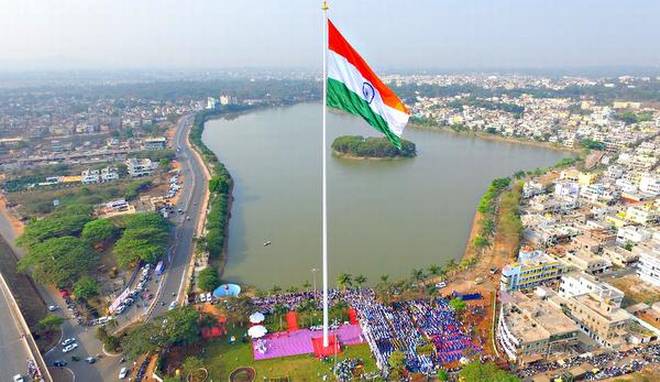
Proud moment: The 110 m tall monumental flag being inaugurated by district in-charge Ramesh Jarkiholi in Belagavi on Monday.

The 110 m tall flag post at Kote Kere is near the historic Belagavi fort

It was a joyous morning in Belagavi on Monday. Schoolchildren, NGO members, leaders and others gathered at the Kote Kere lake front to witness a unique celebration: the unfurling of what is claimed to be the country’s tallest national flag.

The 9,600 sq.ft flag on a 110 m flag pole was unfurled by Ramesh Jarkiholi, District in-charge Minister.

Religious leaders of Hindu, Muslim, Christian and Sikh institutions were present. MLA Firoz Sait, who has been pushing for the project, was present along with other district officials.

Mr. Jarkiholi said the flag was a testimony to the culture of harmony and togetherness of Belagavi. “BJP is not the sole custodian of nationalism. We are all proud Indians. We respect the principles of unity and harmony enshrined in the Constitution. India is a country of many faiths and all are equal here,” he said.

Mr. Sait observed that various religious and social and cultural groups had flags of different colours, but the national flag symbolised the cultural unity of all. He described this as a historic day and said the people of Belagavi had one more reason to be proud of their city.

Deputy Commissioner S. Ziyaullah, Police Commissioner D.C. Rajappa, ZP CEO R. Ramachandran, City Corporation Commissioner Shashidhar Kurer, Maratha Light Infantry regimental centre officers, and others were present.

The 110 m tall flag post at Kote Kere is near the historic Belagavi fort in the city. It is taller than the post in Pune (107 m) and the one at the Indo-Pak border at Attari (105 m).

“The monumental flag will be flown at all times, and will be well-lit at night. It should be seen by residents of Belagavi from afar and remain visible at all times,” Mr. Sait said.

The flag is made of weatherproof Denier polyester fabric. Two shorter poles with flood lights have been erected around the flag.

Permission granted

Following a judgment of the High Court of Bilaspur in 2010, the Union Home Ministry allows the flying of national flags beyond sunset. However, these flags are considered monumental flags and special permissions are issued on a case by case basis. The Union government has issued a permission for the Belagavi monumental flag.

The Belagavi City Corporation has completed the work under the Chief Minister’s special grant. The flag post is 2 m in diameter at the base and 0.6 m at the top. It has a three horsepower motor to raise the flag to the top.

New park

A park will come up in 1.5 acres around the flag. A committee comprising citizens, district administration, revenue, police and cantonment board officials will be formed to manage the park.

Earlier, the plan was to erect the flag post on an island in the centre of the lake. However, the soil there proved unstable for such a tall structure. Hence, it was shifted to the bank, an officer said.

Five flags

Officers are keeping five flags on standby. “Khadi fabric could not be used for the flag as looms cannot produce a flag of that size and the flag code does not allow stitching of small pieces,” a city corporation engineer working on the project, told The Hindu.

Officials have got Civil Aviation Ministry’s permission to fly the flag that within 25 km of the Sambra airport. A red light is affixed on top of the post to indicate its height to pilots.

source: http://www.thehindu.com / The Hindu / Home> News> States> Karnataka / by Special Correspondent / March 13th, 2018

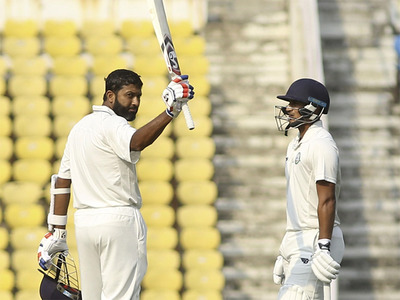
Irani Cup: At 40, Wasim Jaffer ticks off milestones during unbeaten 285

Mumbai, MAHARASHTRA :

(TOI photo)
(TOI photo)

Highlights

  • On day two of the 2018 Irani Cup, the 40-year-old, in his 242nd first-class match, went past the 18,000 mark
  • Jaffer then surpassed Murali Vijay’s 266 with an unbeaten 285 to hold the highest score in the tournament
  • This was Jaffer’s eighth score of 200 or more, and first since 2009

___________________________________________________________

New Delhi :

Former India opener and Ranji Trophy record-holder on Thursday ticked off two more milestones in his illustrious career: that of crossing 18,000 runs in first-class cricket and achieving the highest individual score in the Irani Cup.

On day two of the 2018 Irani Cup between his adopted team of Vidarbha and Rest of India(RoI), the 40-year-old, in his 242nd first-class match, went past the 18,000 mark and then surpassed Murali Vijay’s 266 with an unbeaten 285 to hold the highest score in the tournament. At stumps in Nagpur, hosts Vidarbha were sitting pretty on 598/3 against RoI, with Jaffer 285 not out from 425 balls faced and with 34 fours and a six. The total is Vidarbha’s highest ever in first-class cricket.
This was Jaffer’s eighth score of 200 or more, and first since 2009. Overall, the former India batsman has 53 first-class centuries.

The Irani Cup pits the current Ranji Trophy champions against RoI, and Jaffer was a key figure in Vidarbha winning the title with 595 runs in nine matches at an average of 54.09.

For Mumbai, his home city, Jaffer scored 10,585 runs from 130 matches before he shifted to Vidarbha as a professional a few seasons ago. In the Ranji Trophy, Jaffer is the all-time leading scorer with 10,665 runs and also the owner of the most centuries (36).

For India, Jaffer played 31 Tests form which he scored 1944 runs at 34.10 with five centuries – of which two were doubles.

source: http://www.timesofindia.indiatimes.com / The Times of India / Home> News> Sports News> Cricket News / TimesofIndia.com / March 15th, 2018

Gurgaon woman, a doctor in the making, elected sarpanch in Mewat

Garhazan Village (Bharatpur ), RAJASTHAN :

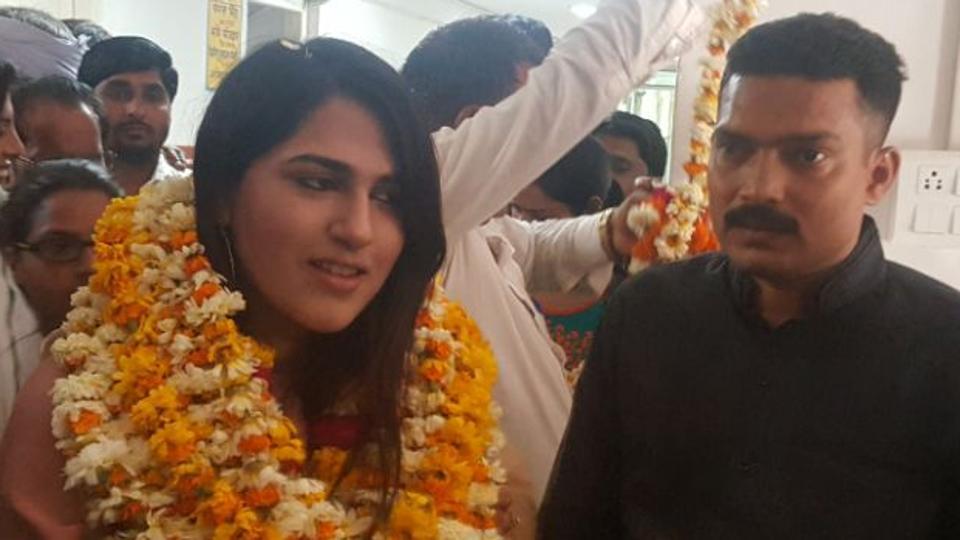
MBBS student Shahnaaz Khan after taking oath as a sarpanch in Bharatpur on Monday.(HT Photo)

The MBBS student will start her internship at Civil Hospital in Gurgaon shortly and take an entrance examination for postgraduate course in medicine later, but is confident of juggling studies and grass-roots level politics

The day the by-election for sarpanch of Garhazan village in Bharatpur was held, poll candidate Shahnaaz Khan was busy taking her MBBS fourth year practical examinations.

A few hours after polling on March 5, the bypoll results came in. Villagers had elected the 24-year-old medical student of Teerthanker Mahaveer Medical College and Research Center in Moradabad, Uttar Pradesh, as their sarpanch.

Shahnaaz is the youngest sarpanch of her village, which is in Mewat region that includes parts of Haryana and Rajasthan. She is also the most educated woman in Garhazan’s history and gets a chance to take forward her paternal grandfather’s political legacy.

“People in Mewat area don’t send their daughters to schools. I will present before them my own example to show what education can do for a woman,” Shahnaaz said after taking oath as sarpanch on Monday.

She will start her internship at Civil Hospital in Gurgaon shortly and take an entrance examination for postgraduate course in medicine later, but is confident of juggling studies and grass-roots level politics.

Shahnaaz’s was elected sarpanch after her grandfather Hanif Khan’s election in 2015 was declared null and void by a court in October last year. The court ruled Hanif Khan had forged educational qualification documents.

The Rajasthan government has made Class 10 mandatory qualification for sarpanch candidates. Hanif Khan had been sarpanch of Garhazan for 55 years.

A young and educated woman sarpanch is a change in Mewat region, which is considered among the most backward areas of Rajasthan. Mewat comprises portions of Alwar and Bharatpur districts inhabited by the Meo Muslims.

____________________________________________________

“My family is committed towards serving the people. Shahnaaz joined politics to fulfil her grandfather’s dreams. She will serve the Meo community because it is backward.”

____________________________________________________

The literacy rate in Bharatpur district is 70.1%, which is higher than the state average 66.1%, but less than the national average 74.04%. The difference in level of education of boys and girls in the district is 29.9%.

Shahnaaz said she was equipped to spread awareness about sanitation to prevent diseases in the area. “For instance, people here die of tuberculosis. The disease can be cured with a six-month course but people are unaware.”

Shahnaaz’s parents are also in politics. Her mother Zahida Khan is a former MLA from Kaman constituency in the district. Her father, Jalees Khan, was Kaman pradhan (head of block level panchayat body).

Zahida Khan said, “My family is committed towards serving the people. Shahnaaz joined politics to fulfil her grandfather’s dreams. She will serve the Meo community because it is backward.”

Shahnaaz studied in The Shri Ram School, Aravali, Gurgaon, till Class 10 and did her Class 12 from Delhi Public School, Maruti Kunj.

source: http://www.hindustantimes.com / Hindustan Times / Home> Cities> Jaipur / by  Suresh Foujdar, Hindustan Times, Bharatpur / March 13th, 2018

RJD candidate Sarfaraz Alam won from Araria Lok Sabha seat

Patna, BIHAR :

RJD candidate Sarfaraz Alam today won from Araria Lok Sabha seat by defeating his nearest rival BJP candidate Pradeep Kumar Singh by a margin of more than 50,000 votes.

State election sources said that Mr Alam defeated his nearest rival BJP candidate Pradeep Kumar Singh in Araria Lok Sabha seat.

By election to Araria Lok Sabha seat was necessitated following the death of RJD MP and former union minister Mohammed Taslimuddin, father of Mr Alam.

RJD also won Jehanabad assembly seat where party candidate Suday Yadav defeated JD (U) candidate Abhiram Sharma by a margin of 35036 votes.

On the other hand, BJP won from Bhabhua assembly seat where the party candidate Rinki Rani Pandey defeated her nearest rival Congress candidate Shambhu Singh Patel by a margin of over 16,000 votes

In the by election, Mr Alam and Mr Yadav retained Araria Lok Sabha and Jehanabad assembly seats respectively for RJD while Ms Pandey retained Bhabua assembly seat for BJP.

Jehanabad was earlier represented by RJD MLA Mundrika Singh Yadav while Bhabhua was represented by BJP MLA Anand Bhushan Pandey and by elections were held following their deaths. Suday Yadav is son of Mundrika Singh Yadav while Rinki Pandey is wife of Anand Bhushan Pandey.

UNI DH BM

— (UNI) — C-1-1-DL0214-1287968.Xml

source: http://www.news.webindia123.com / WebIndia123 / Home> News> India / Patna – March 14th, 2018

Find out what made Aamir Khan the World’s Biggest Superstar

UTTAR PRADESH / Mumbai, MAHARASHTRA :

AamirKhanMPOs14mar2018

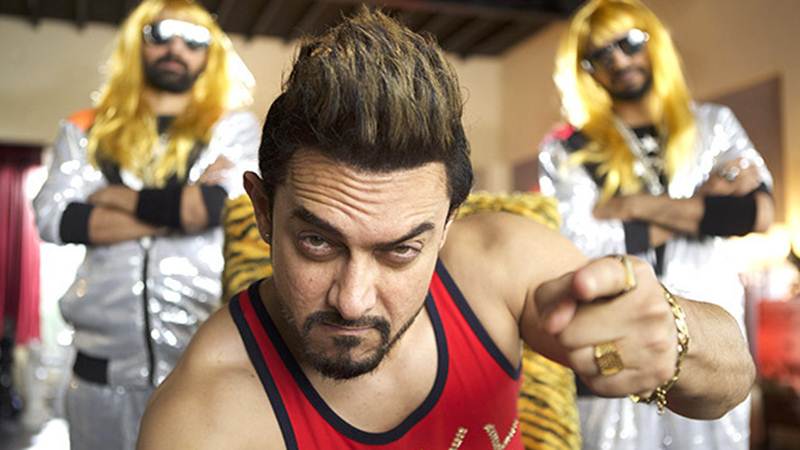
Aamir Khan’s appeal in World’s 2 major countries not only makes him the World’s Biggest Superstar, but also the most recognized face globally. The recent past has been a testimony of the mass hysteria Aamir Khan and his work generates not just in India but the world over too.
The actor is not just a Superstar in India but also China. With the population of 1.4 billion and 1.35 billion in China and India respectively, Aamir Khan is undoubtedly the biggest Superstar in the world. The record-shattering earnings of his last 3 outings make for his films PK (2014), Dangal (2016) and Secret Superstar (2017), topping the list of Top 5 all-time worldwide grossing Indian Films.
While Dangal earned a whopping 1908 crores in China while Secret Superstar raked in 874 crores at the Chinese box office, his first release in the neighbouring country opened to a thunderous response of 831 cr.
Aamir Khan emerged as the most watched non-Chinese actor in China, hence proving his stardom in the neighbouring nation. Such is the unprecedented appeal of Aamir Khan that has his work garner a huge showcase across theatres of the World along with global audience base thronging to witness his magic on celluloid.
Speaking about the tremendous love he is garnered with from the adjacent nation, Aamir Khan said, “My popularity in China happened by accident. Not many people know that it all started with 3 Idiots (2009), which reached Chinese homes through piracy. I guess they really related with the subject of the education system. Then they followed my work, including PK, and even the TV show Satyamev Jayate. When Dangal released in China, they already knew me and my work. Also, the reason why the films did such business in China is the sheer number of screens. In India, we have around 5,000 theatres, while in China there are 45,000. Even though there isn’t as much difference in the population of the two countries (approx 1.35 billion in India and 1.4 billion in China). I play a cameo in Secret Superstar, even then the film was released by the exhibitors in 11,000 theatres in China. Just imagine the scale”. Through his work Aamir Khan has brought India and China together, binding them with a common thread formed by Entertainment.
Over the years, Aamir Khan has been the only actor to have received the tremendous love and appreciation for his films in China. The actor has made it possible to resonate the mindset of the two nations, which is a rare phenomenon. With the love, acclaim and adulation from two of the most populated countries of the world, Aamir Khan enjoys a massive fandom which accounts for nearly half of the World’s population, thus making him a Global favourite!
source: http://www.freepressjournal.in / The Free Press Journal / Home> Entertainment / by FPJ Bureau / March 13th, 2018

Former RS member Begum Hamida dies at 101

UTTAR  PRADESH :

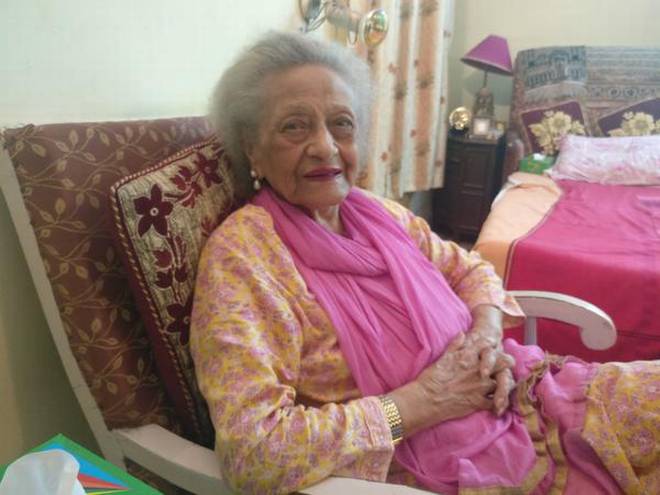
Begum Hamida Habibullah | Photo Credit: Omar Rashid

She was the founder of SEWA (Self Employed Women’s Association), which promoted self employment for women and the art of Lucknow’s famous chikankari.

Begum Hamida Habibullah, a former Rajya Sabha member and a pioneer in women empowerment, died here on Tuesday.

She was the daughter of Nawab Nazir Yar Jung Bahadur, Chief Justice Of Hyderabad High Court and wife of Major General Enaith Habibullah, who went on to become the first Commandant of the National Defence Academy.

Her grandson Saif Habibullah announced the news of her demise through his Facebook account.

Born on November 20, 1916, Hamida was 30 when India achieved independence and was a witness to modern India’s political history, stretching from the British rule to the bloody partition. She witnessed the building of new nation, glory days of the Congress Party and its subsequent decline to the present domination by the BJP.

Her son, Wajahat Habibullah, was India’s first Chief Information Commissioner of India and former Chairman, National Minority Commission.

Ms. Habibullah was known for working on women issues. She was the founder of SEWA (Self Employed Women’s Association), which promoted self employment for women and the art of Lucknow’s famous chikankari ( thread embroidery).

She joined politics with the Congress after her husband returned from the army in 1965 and went on to become an MLA from UP’s Haidergarh seat in Barabanki from 1969 to 1974. From 1971 to 1973, she was a Minister of State in the U.P. government and a Rajya Sabha member from 1976 to 1982.

She held the Social and Harijan Welfare, National Integration & Civil Defence, and Tourism ministries.

Hamida passed senior Cambridge with Distinction in 5-Subjects before going on to get a gold medal in B.A. from Osmania University.

source: http://www.thehindu.com / The Hindu / Home> News> States> Other States / by Omar Rashid / Lucknow – March 13th, 2018

The ballad of the Khan Sahib

Madurai, TAMIL NADU :

KhanSahibMPOs07mar2018

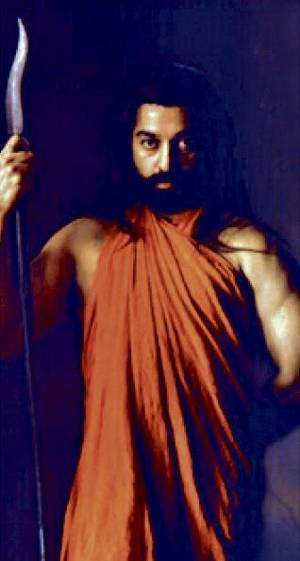
One explanation for Kamal Haasan launching his political party in Madurai was that his hero was Maruthanayagam Pillai, soldier, rebel and valiant son of the district.

It was about this hero that he wanted to make a film extraordinaire several years ago.

I was on the fringe of the project as, coining a term, the factioneer, engineering fact with fiction.

Part of the fiction is the name Maruthanayagam. More factual is the name Yusuf Khan, and it’s as Yusuf Khan he’s a military hero of mine. Much has been written about this soldier of fortune, but the Tamil ballad Khan Saibu Sandai (The War of Khan Sahib) offers much more personal detail. In it Maruthanayagam finds no mention; who it sings of is “the hero who belongs to the Alim family”. Adding, “…let me sing the story of the brave warrior of Sikkandar Sahib”.

Whatever his lineage, it is agreed he ran away from Panaiyur in the Pandya heartland and worked with Jacques Law in Pondicherry c.1744, where, possibly, he learnt his soldiering.


Then we hear of him with a troop of Nellore lances-for-hire teaming with Chanda Sahib and the French to besiege Robert Clive in 1751 at Arcot. Seeing him in action, Clive bought over the Nellore Subedar, as he called Yusuf Khan, who the next year helped Clive win at Kaveripakkam. Later, after action near Srirangam, Clive was told by a friend, “Your Nellore sepoys are glorious fellows, their Subedar as good a man as ever breathed. He is my sole dependence.”

Next, when the French besieged Nawab Wallajah and his British protectors in Trichy, Yusuf Khan lost not one food convoy from Madras over three months. Stringer Lawrence, ‘The Father of the Indian Army’, wrote, “He is an excellent partisan… brave and resolute, but cool and sensible in action – in short, a born soldier, and better of his colour I never saw … He never spares himself, but is out on all parties…” All this led to Lawrence recommending Yusuf Khan being made “Commandant of all the Sepoys” in 1754 and for a gold medal from the Company.

With the Nawab and the Company unable to collect revenue from the southern districts they had won, Khan Saheb who had been responsible for the gains was appointed Governor of Madurai.

Over the next three years, he subdued the local chieftains, collected revenue and earned a reputation for outstanding administration. But Yusuf Khan could never get away from soldiering. When Lally besieged Madras in 1758-59, he failed, because Yusuf Khan, racing up from Madurai, cut almost daily over two months Lally’s supply lines. Lally was to say, “They were like the flies, no sooner beat off from one part, they came to another.” Yusuf Khan was a master of guerilla warfare.

With such praise, Yusuf Khan began growing more ambitious. When he found revenue he collected going mostly to Wallajah from the English, he decided to rebel. He hoped for support from Hyder Ali (which never came) and from the French, who supplied a few hundred mercenaries led by a Marchand.

From August to November 1763 the English besieged Madurai, constantly shelling it, but unable to breach Yusuf Khan’s defences. They then withdrew to regroup. In February 1764, they recommenced the siege, but without significant progress. Yusuf Khan sent them a message early in April 1764: “As long as I have a drop of blood in my body I shall never render the place to nobody.”

English attack after attack was beaten back, many a British officer, once his comrades, killed. A British officer wrote: “You’ll easily form an idea of Yusuf Khan’s abilities from his being able to keep together a body of men of different nations, who with cheerfulness undergo the greatest miseries on his account; wretches who have stood two severe sieges, one assault and a blockade of many months.”

By September 1764 Yusuf Khan was prepared to negotiate surrender terms. The English insisted on unconditional surrender. And Marchand and his ilk, impatient with the negotiations (or heavily bribed), acted, arresting Yusuf Khan and surrendering Madurai on October 15, 1764.

The Company wanted Khan Saheb brought to trial in Madras, but Lawrence ordered him given to the Nawab who immediately hanged him and desecrated the body. He was buried where he was executed, two miles west of Madurai, his tomb at Samattipuram a dargah to some, a pallivasal (mosque) to others, but venerated by all in the Pandya country.

Footnote: A dissertation by Dr Asadulla Khan, then of New College, discusses Yusuf Khan’s family. It would appear that he married a Christian girl, Maza, c.1759; father, very likely Portuguese or French, her mother, possibly, a Maravar, a community which she often interceded for with Khan Saheb. They had a son, Mohammed Sultan, born c.1762. As a young man he joined Hyder Ali’s army. Mother and son, it is suggested, sought refuge in Mysore after fleeing Madurai.

The boats on the Canal

It was a lively presentation that Manohar Devadoss made recently at the Madras Literary Society on his life with books, most he’d illustrated. One striking illustration at the presentation is what I feature today; a boat in full sail on the Buckingham Canal. Mano says he saw this long country boat near Pulicat in 1966 and thought it “an artist’s delight”. His sketch became the first subject of “our heritage greeting card project,” ‘our’ being wife Mahema, who used to write the text for the illustrations he did for greeting cards they sold for charities.

Mahema concluded that year: “These boats are very picturesque, with sails billowing in the breeze. When there is no breeze, the boats are sometimes dragged by the boatmen from along the banks, their bare bodies glistening in the sun. As the boats approach the city, the sails are lowered so that they could pass under the numerous bridges. The men then punt the boats in rhythm to their melodious folk songs.” Taken up as he was with them, Mano did his first oil painting that year, based on his sketch, and several water-colours in later years, one of which I feature.

The chronicler of Madras that is Chennai tells stories of people, places, and events from the years gone by, and sometimes from today.

source: http://www.thehindu.com / The Hindu / Home> Society> Madras Miscellany – History & Culture / by S. Muthiah / March 06th, 2018

Disability rights crusader Javed Abidi dies at 53

Aligarh, UTTAR PRADESH / NEW DELHI :

JavedAbediMPOs05mar2018

New Delhi :

India’s global face of disability rights movement,  Javed Abidi , died of chest infection on Sunday. He was 53.

Abidi, who founded the Disability Rights Group (DRG), and was serving as the director of the National Centre for Promotion of Employment  for Disabled People, is survived by his mother and two siblings.
Born in Aligarh, Uttar Pradesh, he was diagnosed with spina bifida. Abidi wasn’t operated on for eight years, and as a result, suffered nerve damage. At the age of ten, he injured himself in a fall and required another operation. After this, his family moved to the United States and Javed Abidi received care at the Boston Children’s Hospital and the Rehabilitation Institute of Chicago. At the age of 15, he started using a wheelchair. Abidi, despite difficulties, studied at Wright State University , and in 1989, moved to India seeking a career in journalism.

The 1990s were marked by drastic changes in the disability sector of India through his DRG. He was instrumental in drafting the 1995 disability Act and forcing the inclusion of missing disabilities like autism, dyslexia in the new RPwD Act 2016. He was appointed the vice-chairman of the International Disability Alliance  2013.

“We have lost the most prominent voice of our sector. We have lost an international leader as he was the sole voice of the Global South. He pioneered the cross-disability movement in India and galvanized disability issues as developmental and human rights based issues. An era ends with Javed ji,” said disability rights’ activist, Dr Satendra Singh, Delhi University.

Abidi successfully led several path breaking advocacy initiatives in India, including the drafting and enactment of the Disability Act of 1995, inclusion of disability as a separate category in the Census; India’s ratification of CRPD in 2007, and setting up of a separate Department of Disability Affairs. Most recently, he led the movement towards India’s new disability rights law – the Persons with Disabilities Act 2016.

Abidi strongly believed that empowerment of persons with disabilities is connected to education, which in turn hinges on accessibility. And all three are not possible without enabling laws and policies.

“The world has lost is brightest crusader for disability rights. As an impassioned advocate of ‘Nothing About Us, Without Us’, he has given voice to an ‘invisible minority’ by catalysing path breaking changes in the policy and legislative space,” said Reeta Gupta, Abidi’s long-term friend and supporter in advocacy of disability rights in India.

Abidi started working for Sonia Gandhi in 1993, creating and building the Rajiv Gandhi Foundation’s disabilities Unit. A year later, he founded a small advocate group called the DRG and started raising awareness for the disabled people of India. A large pro-disability rights movement arose, with the goal of getting the Parliament to implement a bill of rights for the disabled.

Abidi led a protest before Parliament on December 19, 1995, that pushed Parliament into passing the Persons with Disabilities Act on December 22, 1995. In 2004, his letter to Chief Justice of India on making the polling booths accessible to persons with disabilities was converted into writ petition. Supreme Court of India then passed direction to make electoral process accessible.

source: http://www.timesofindia.indiatimes.com / The Times of India / News> India News / by Manash Pratim Gohain / TNN / March 04th, 2018

Quaide Milleth Award For Probity to Hamid Ansari and Aruna Roy

Kolkata, WEST BENGAL :

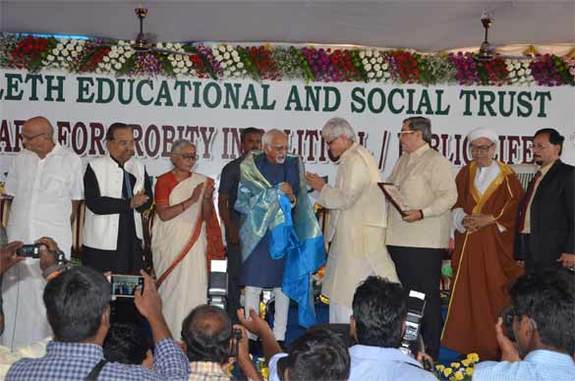
Quaide Milleth Award For Probity In Political/Public Life (2018) to Hamid Ansari and Aruna Roy

Chennai:

The Quaide Milleth Educational and social Trust instituted the Quaide Milleth Award for probity in Political\Public Life in the year 2015, to commemorate the 40th Anniversary of the Trust. This award shall be presented every year to people with exemplary track record and commitment to India’s Constitutional, Democratic, Values, Secularism, Pluralism, inclusive and service for marginalized people.

HamidAnsariMPOs03mar2018

Furtherance of the Honour taking place every year, with which this year the jury endeavoured and found the people who are thriving to serve for the Nation and being the part to make democracy strong.

Under the auspices of Alhaj. M.G. Dawood MiaKhan Sahib, The General Secretary and Correspondent of the Quaide Milleth Educational and Social Trust has bestowed  “The Quaide Milleth Award for Probity in Political/Public Life”  for this year to His Excellency Honourable Dr. Mohammad Hamid Ansari, Former Vice President of India and Smt. Aruna Roy, Social Activist & Founder of Mazdoor Kisan Shakthi Sangathan.

The Award Presentation Ceremony held at Quaide Milleth College, began with the Qiraath (Citation of Quran Verses) followed by salutation to Tamil Thai Vazhthu.

Dr. A. Rafi, Principal of the College, welcomed the gathering for the Award Ceremony. He shared the brief history of the college with the milestones it has reached by highlighting the facts that the college has achieved 89% of placement last year and heir  the NAAC certification recently. Then he marked the achievements of the dignitaries and their exertion rendered for the society.

Then, Padma Bushan Janab. Moosa Raza, I.A.S (Retd.), Former Secretary to Government of India and Chairman S.I.E.T., was called upon to preside over the Award Ceremony. In his presidential address he mentioned the Awardees as the “Children of India” who are awarded by The Quaide Milleth Educational and Social Trust.  He also added by stating that Hamid Ansari is a very humane who respect people and excellent in performing his duties. He (Hamid Ansari) has done a commendable job when he was an Indian ambassador for Saudi Arabia by bringing investments from these countries. And he added that  “The whole world will listen to him when he is silent”. Moosa Raza also brought Aruna Roy’s contribution to a broad day light. She has championed “The Right to Information Act” and “The Right to Education”

The above two recipients of the prestigious award were felicitated by Shri.Gopalakrishna Gandhi, Former Governor of West Bengal, Dr. Mufti Khazi Salhudeen Mohammed Ayub, President of QUEST, Rev. Bishop Dr. Devesagayam, Church of South India (Rtd) and T.K. Rangarajan, Rajya Sabha Member.

  • Shri.Gopalakrishna Gandhi ironically commented that at the present scenario people with Probity and Honesty are to be searched.
  • Dr. Mufti Khazi Salhudeen Mohammed Ayub went to the root of this award giving, which has been derived from the altruistic life and ideals of Quaide Milleth Sahib.
  • Rev. Bishop Dr. Devesagayam has applauded the idealism of the recipients and requested the future generation to imbibe the same.
  • T.K. Rangarajan, appreciated the leadership qualities of both the awardees.

The felicitation was followed by the citation of the award by Alhaj. M.G. Dawood MiaKhan Sahib. He emulated the values of Quaide Milleth for constituting this unique award. He reminded and compared the fact that as a politician Quaide Milleth abided the Law, respected the Constitution of the country and at the same time he remained uncompromising on his values and Policies.  But today’s politics has become the place for corruption. He added the Quaide Milleth Award is not just to Honour but also to introduce the great minds to the society and to recognise their admirable contribution to the Nation.   He also brought in the history of Quaide Milleth that he was the Leader of Masses due which he was elected as Member of Loksabha for 3 consecutive period without going to the constituency.  He requested Mohammed Hamid Ansari to resume his work as the Nation requires his service. He called Aruna Roy as “Women of Intolerant” because she is intolerant towards the fascism, against the one who oppresses and discriminates the downtrodden.

A minute of silence was observed to honour the demise of The Senior Journalist Gniani and National Herald Editor and Chief Mr. Neelabh Mishra.

Smt. Aruna Roy, proclaimed her gratitude for receiving the award in the name of Quaide Milleth – Member of Constitution to promote Secularism. She expressed that Quaide Milleth was her Ideal who taught her the Constitution. She questioned the Powers that “Why are you afraid of pluralism?” and she emphasised one Nation, one thinking, one Ideology concept is not possible in a secular country like India. She felt and interrogated that “What happened to the Nation”, nowadays people with Ideas of difference are assassinated like Bansare, Dhabolkar, kalpurki, Gouri lingesh who are the activists and journalists. She criticised the fact that 73% of India’s wealth is with just 1% of people. She explained to the crowd that “Information is power”. When the Information is open to public it will construct good governance. Today there are 60 lakh beneficiaries of RTI, she believed that it will increase the accountability of every person who is in power. She encouraged the voices against the corruption and inequality through non-violence. She concluded that “QUAIDE MILLETH AWARD 2018 FOR PROBITY IN POLITICAL\PUBLIC LIFE, is really to recognise the real Indian to speak the truth to Power”.

Dr. Mohammed Hamid Ansari expressed his humility through his discomfort rather in receiving the award than giving it. He said that “In spite of differences of manner, food and faith we are equal as citizens of India”. He cited the article “51A the Fundamental of Duties” and articulated that it was created by executive judicial body to delineate everyone’s duty. He emphasised that “The common man has given the responsibility to the politicians to make Laws, discuss public difficulties and execute accountability”. He urged to the Judiciaries to discharge their duties quickly and fearlessly. He insisted that “Our duty is to ensure that the institution created by constitution should be safe guarded and protect public property”.  He completed his speech with his humble words that “I did not do any unusual and I was taught to follow the rules”.

The 4th annals of  QUAIDE MILLETH AWARD Ceremony confined with the Vote of Thanks delivered by Janab. M.H.B. Thajudheen, EC Member, QUEST.  (Press release)

source: http://www.milligazette.com / The Milli Gazette / Home> Online News> National / March 02nd, 2018