Category Archives: Leaders

Now Frontier Gandhi’s descendant to urge Modi to stand by Pakhtunistan

Kolkata, WEST BENGAL :

Yasmin Nigar Khan will organise a rally at Shahid Minar in the heart of Kolkata’s business district after Durga puja.

Yasmin Nigar Khan is the president of All India Pashtu-Jirga-e-Hind, an organisation that is spearheading the movement for secession of Pakhtunwa area of North West Frontier Province from Pakistan.(HT Photo)

India-Pakistan relations may have more twists in store than meets the eye. Yasmin Nigar Khan, great granddaughter of Khan Abdul Gaffar Khan, better known as Frontier Gandhi, now plans to meet Indian Prime minister Narendra Modi to urge him to stand by the Pashtuns as he did in the case of Balochistan.

The Kolkata-based 45-year old leader of the Pashtuns living and working in India told HT that she also plans a rally in the city against atrocities of Pakistan on the people of North West Frontier Province (NWFP).

“We are happy that Prime Minister Narendra Modi raised the issue of Balochistan. Similar atrocities are regularly being committed by Pakistan on Pashtuns in NWFP. We want Modi to highlight the plight of Pashtuns and help in their struggle to get freedom from Pakistan. The Pashtun people are equally oppressed by Pakistan,” said Khan on Friday.

Yasmin Nigar Khan stays in Park Circus area in south Kolkata and runs a school. (HT Photo)

Yasmin Nigar Khan president of All India Pashtu-Jirga-e-Hind, an organisation based in Kolkata that has been spearheading a movement for secession of Pakhtunwa area in the North West Frontier Province (NWFP) of Pakistan and its merger with Afghanistan. The area is situated near the border of Afganistan and Pakistan.

She claimed there are about 10,000 Pashtuns living in Bengal, mostly in and around Kolkata.

“NWFP were given on lease to the British for 100 years. But more than 120 years have passed by,” she claimed, adding “NWFP has no business staying in Pakistan.”

“Our leaders are holding meetings in Kolkata to press our demand. We are planning to organise a rally against Pakistan in Kolkata after the Pujas at Shahid Minar. By the end of the year we will meet the Prime Minister,” said Khan.

The Pashtun community comprises basically the Pathans who are from Afghanistan and also from the Pakhtunwa area. In Kolkata, a section of them who have settled more than 100 years ago, are better known as Kabuliwalas (money lenders).

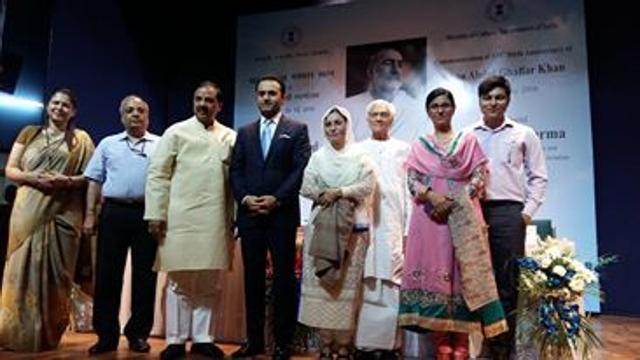
File photo of Khan (fifth from Left) attending a ministry of culture programme in Delhi to commemorate the 125th birth anniversary of Frontier Gandhi. She appealed for a university to be set up in Bengal in the name of her great grandfather. (Facebook)

Khan alleged that the condition of the Pashtuns living in NWFP is appalling and the Pakistan government is not keen on any development in the region.

“Like Balochistan, Pakhtunistan too is deliberately neglected. the Pakistan government is keeping the mass uneducated so that they do not demand their rights. The area is used for breeding terrorists Pakistan is using Taliban to spread terror in the region. We will soon hit streets over the issue,” added Khan.

Many of the Pashtuns living in Kolkata have relatives there and they worry about Taliban threats.

“We want to highlight Pakistan’s atrocities in NWFP and condemn attacks on India. Pakistan should be declared a terrorist state by the international community,” she added.

The Pashtun leader stated that during a programme at the union ministry of culture on May 20 this year (to commemorate the 125th birth anniversary of Frontier Gandhi), she appealed for a university to be set up in Bengal on the name of her great grandfather.

In 1996 after the death of her father Lala Jan Khan, Yasmin took over the mantle of the organisation that looks after the interests of Pashtuns.

source: http://www.hindustantimes.com / Hindustan Times / Home> Cities> Kolkata / by Ravik Bhattacharya, Hindustan Times / September 30th, 2016

The magic of Suraiya

PUNJAB / Mumbai (MAHARASHTRA) :

When Nawab F K Sherwani’s daughter got married, his friend the Chawalwala Nawab invited Suraiya to sing, and despite fever, one could make it to the wedding of Farhana Begum, holding on to mother’s hand. That was in the 1940s, when one was fortunate to hear the legendary singer in her prime and also see the courtesans dance the night away. That function is a fading memory now but not the screening of Anmol Ghadi, held two years later in Jaipur in a predominantly Muslim locality by Danyal Sahib. He put up the screen against the City mohalla wall, and it being a summer evening, people spread their cots to hear and see Suraiya, along with Noor Jahan, the senior of the two reigning screen beauties.

Suraiya had become a magical name by then and everybody was talking about her golden voice that could sway not only the music-loving rajas and nawabs but also the hoi polloi. “Iski zaban mein mithas hai (There’s sweetness in her voice),” commented 80-year-old Keti Baba, the ex-gardener of a nawab’s compound. Jajja Bua agreed with him as she munched her favourite bida ofpaanunder the neem tree, where she sat on a stringed cot, near the beautiful dulhan, Bilqis, while Khaleda Behn spoke or a fanciful musical duet between Saighal and Munawar Sultana. Each scene of the film drew remarks galore, and sometimes when the scenes got hetic.

Master Sahib tried to interpret them to those who kept getting puzzled by the sequence of events. Munni Bua found it difficult to control her son Karim who, like any mischievous schoolboy, kept fidgeting with his mother’s sari or tried to pull his sister’s hair. He, however, began to concentrate on the film when the fighting scene commenced. In those days films did not have “dhishum-dhishum” stuff. Here was a fight with a knife until the Pehalwan sprang up and wrested it from the villain’s hand. When the film ended people picked up their cots and went home, but they kept talking about Suraiya and Noor Jahan for a week after that, with comments on Suraiya’s dominating Nani.

More than 50 years later one had a chance to see the legendary actress again, when she came to receive the Sahitya Akademi award in 1998. That was a glimpse of a much mellowed Suraiya. But she still looked pretty though approaching 70. The wrinkles were hidden under a lavishly rouged face, the hair had been dyed, except for a straying grey one here and there, but the almond eyes were still sparkling and full of life. She conversed in a low voice and declined to sing, saying she had left “mosiqui years ago”.

Someone mentioned Dev Anand but she ignored the comment, and preferred to change the topic by remarking that it was getting late and she had to go back, the reference probably being to her Marine Drive residence, where she led the life of a recluse. What an evening of old memories it was!

Nawab Faiyaz Khan was long dead, so also his eldest daughter and her husband, S K Sherwani. The Chawalwala Nawab did not die a natural death: he had shot his begum in a fit of anger in the 1950s and was hanged on the clinching evidence of his only son.

Suraiya did not speak much about Noor Jahan (nor of Lata Mangeshkar) but from the little she said it was evident that she held her in high esteem. They were both from undivided Punjab ~ Noor Jahan from Kasur (which was to become such an issue during the Indo-Pak war of 1972) and Suraiyu from Lahore, where her uncle Zahoor, the ace villain or the silver screen in the 1930s and 40s was able to win her parents’ approval to become a child actor.

Although Suraiya did not speak about Dev Anand that December day, one still remembers the Latka (limerick): “Chhayi bahar hai / Jiya beqarar hai / Aaja mere Dev Anand,Suraiya bemar hai”. And when one reminisces of Suraiya can Noor Jahan be forgotten? When she came to India in 1980s, 35 years after leaving for Pakistan along with her husband Shauqat Hussain, one had a chance to see her at close quarters. Her name was later linked with cricketer Nazar Mohammad and then General Yahya Khan in a big scandal.

The glamour-girl of yesteryear, despite her many engagements in Delhi, found the time to visit the dargah of Hazrat Qutubuddin Bakhtiar Kaki and the shrine of Hazrat Nizamuddin Aulia. Tradition has it that one should visit Hazrat Qutubuddin’s mazar first and other shrines afterwards. Even Khwaja Moinuddin Chishti had ordained that the devotee must first pay respects to Qutub Sahib and then come to his dargah.

So Noor Jahan, accompanied by her pretty daughter, Hina and her husband, Haroon Butt, went to this mazar first. At Nizamuddin’s Dargah Noor Jahan offered a chadar and stood praying with palms open for blessings amid the aroma of joss-sticks. Perhaps the Malika-e-Tarannum prayed that her voice remain ever redolent. Or she sought the saint’s benediction on Hina and her husband ~ health, wealth and happiness. As per tradition, the actress left for Ajmer on a Friday to seek the blessings of the greatest Muslim saint of the East, without a visit to whose shrine no trip to India is complete for the true devotee.

Noor Jahan’s golden voice still resounds in the mind “in jocund or in pensive mood” ~ “Awaaj de kahan hai”, interspersed with Suraiya’s “Nuqta chin hain ghame-e-dil”, which brought out the very soul of Ghalib on her honeyed tongue. Suraiya’s last visit to Jaipur was at the initiative of music composer Naushad, who belonged to this city before making it big in Bombay. At his behest, she was the guest of the niece of the novelist lsmat Chughtai and spent a whole day at her house.

Among those who attended an evening of songs by her was Khalil Mian of Bagh Chaurniwala, a great lover of music and a friend of Nawab Faiyaz Khan. As the trees swayed in the breeze blowing from the hills surrounding the city, Suraiya too swayed in rhythm ~ and the audience with her. When she departed by the night train many of her admirers wondered whether they would hear the legend sing again in a live performance. Her death years later naturally left Jaipur sadder. That Dev Anand couldn’t marry Suraiya because of opposition by her Nani is one of tragedies of filmdom, which finds a parallel in the case or Dilip Kumar and Madhubala, whose father was opposed to their wedding proposal.

Nevertheless, Dev continued to have a soft corner for his old flame and when her favourite actor Gregory Peck made a brief stopover in Bombay, he took him to her house. It was near midnight and Suraiya was fast asleep. He woke her up to give her probably the biggest surprise of her life. Dev had eventually married Kalpana Kartik and Dilip for Sara Banu as the next best thing in their lives. But the way their marriages lasted shows that the same would have been the case had Suraiya and Madhubala become their respective wives.

Even after Suraiya passed away, a red rose was always found on her grave in the Mumbai kabristan. It was a tribute by the lover of her youthful days. All this comes to mind when one relaxes before the TV in the evening for a sundowner while one of Ghalib’s ghazals is being sung. It reminds one of Suraiya’s faultless rendition of the poet’s master-piece, “Nukta chin hain,gham-e-dil/Baath bane na bane”.

In the life of the actress the “Baath” that did not materialize was the affair with her heart throb Dev Anand of the romantic Gregory Peck type hairpuff! So that long past evening with Suraiya still extends up to now.

source: http://www.thestatesman.com / The Statesman / Home> Features / by RV Smith / New Delhi / August 25th, 2017
This professor’s Unani medicine for diabetes is all set for clinical trials

Aligarh, UTTAR PRADESH :

Professor Naeem Ahmad Khan

Four years back, Naeem Ahmad Khan,  professor  at faculty of Unani Medicine, Ajmal Khan Tibbiya College, Aligarh Muslim University, set a goal for himself– he wanted to find a cure for diabetes.

It was possible only if he could regenerate the primary function of beta islet cells of the pancreas to store and release insulin.

Four years on, he claims to have succeeded in his mission. He has developed a medicine that, he says, will not only improve the function of pancreatic cells, but also protect them. Besides, it will regenerate beta islet cells and improve their health by giving them required nutrition.

“My medicine will regenerate the natural process of the pancreas. This medicine will help diabetic respond to fluctuations in blood glucose concentrations quickly by releasing stored insulin,” says Dr Khan.

He believes that the medicine, if clears clinical trials, will be a better alternative to the existing drugs. “Modern diabetic medicines stimulate beta cells to produce and release more insulin. If a person develops diabetes at a younger age, these medicines stop working after a few years. Then the alternative before the patient is to take insulin supplement, which is an expensive as well as painful treatment,” he says.

The clinical trial  of the medicine, he believes,  will help standardise traditional medicine system in India and bring it at par with modern medicine

“Apart from  restoring the normal functioning of beta cells, I believe that this medicine will also bring down the number of pancreatitis cases in diabetes,” he says.
Khan says that his medicine has already been tested on animals and has gone through the  necessary toxicological studies to rule out any heavy metal impurities and other toxic effects. It has been passed by the Government of India’s Institutional Ethical Committee, he adds.

The drug will soon be tested clinically before it is available in the market. “We will study it in a controlled environment where we will monitor its effect on diabetes in non- insulin dependent patients.  We will also compare it with other existing popular modern drugs,” says Khan.

The clinical trial  of the medicine, he believes,  will help standardise traditional medicine system in India and bring it at par with modern medicine. “Evidence-based traditional medicine is the need of the hour. We need to exploit their potential to help people deal with various lifestyle diseases,” he says.

Khan says that this medicine has been developed from eight different medicinal plants, some of which were used by ancient Unani practitioners. “These medicines are as scientific as allopathic drugs. We need to validate their worth and that’s what I have been trying to do all these years, ” he says.

source: http://www.healthpost.in / Healthpost.in / Home / by HP Correspondent / Saturday – January 28th, 2017

Prof. Mahdi Hasan – The Man who put Lucknow on Medicinal Map

Lucknow, UTTAR PRADESH :

ProfMahdiHassanMPOs26aug2017

Prof. Mahdi Hasan was born on March 21, 1936 in a village Gadayan, Akbarpur (then in Faizabad, now in Ambedkar Nagar), in UP.

His father, Jawad Husain, was Tehsildar, posted at that time at Tehsil Mohanlalganj of the District Lucknow, and his mother was Tayyabunnisa Begun. Hasan’s father died when Hasan was four years old, and his mother, being ill, was unable to care for him. His brothers late Bakhshish Husain, a police officer, and Syed Ghulam Husain, an IAS officer, subsequently raised him.

However, this did not deter him from pursuing his life with zeal and devotion to his studies and dedication for sports. He used to study at night in the light of a kerosene lamp and play during the day in the fields of the village. He excelled in studies and was appreciated for his sporting prowess. His father wanted him to be a doctor. He himself wanted to be a teacher. Finally he became both, and a sportsman too in the bargain.

In 1950, Hasan enrolled in the Christian College at Lucknow, where he did his Intermediate. Thereafter he did his B.Sc. I year from Lucknow University and in 1952 he was selected in M.B.B.S. at King George Medical College.

After graduation, he joined the Department of Anatomy as a Demonstrator in the year 1958 and worked till early 1963. He did his post graduation in Anatomy from KGMC. Thereafter, he moved to the J.N. Medical College, Aligarh Muslim University, Aligarh, where he would spend the bulk of his career.

It was in 1958 that he got married to Abida Kazim, who was an MA in Urdu, a rare achievement at that time for a woman from a Muslim family.

His persistent endeavour was to pursue basic medical research and his main thrust was to study problems of national relevance, such as environmental pollution, pesticide and metal neurotoxicity and brain aging. His commitment and dedication to acquire and disseminate knowledge can also be judged from the fact that during the last 6 months of his life, when he was very seriously ill, he worked earnestly to complete a book on Treacher Collins Syndrome.

He would sit for long hours with swollen legs kept on stool writing the book, which he completed in December 2012, a month before his death. Fortunately, the book was published a few days before his death when he was in the intensive care unit.

Dr. Hasan, all through his illustrious academic career spanning around 55 years (1958–2013), fought a relentless battle and succeeded in giving a completely new orientation to the teaching of anatomy.

He has to his credit about five books, seven book chapters, 125 research papers in indexed journals. His research work has earned him over 600 citations including those in the prestigious Nature, Gray’s Anatomy, and NIOSH and in 38 other reference works. He was indeed a man of parts, combines excellent teaching and research capabilities with societal concerns and social commitments.

Hasan spent many years trying to establish a Brain Research facility at Aligarh.

With assistance from the German government, he succeeded in 1980 with the establishment of the first Interdisciplinary Brain Research Centre.

He has been an internationally renowned anatomist, a pioneering brain researcher and a reputed national expert of medical education and have been rewarded with a no. of awards.

A few to name are Dr. S.S. Misra Medal of National Academy of Medical Sciences (India), Dr. Dharam Narayan Gold Medal of the Anatomical Society of India (1977), Ati Vishisht Chikitsa Medal of College of Chest Physicians of India (1995), Sushruta Award of World Academy of Integrated Medicine (WAIM) 2002, Dr. Bachawat Life-Time Achievement Award of Indian Academy of Neurosciences (2004) and Dr. Tirumurti Award of Indian National Science Academy (2010).

Professor Hasan was a person who had utmost devotion, dedication and determination in acquiring, creating and disseminating knowledge. Seldom does one find a nucleus around which an institution is build, but it goes to the credit of Professor Mahdi Hasan that at least three premier medical institutions of North India will always fondly cherish his memory.

KGMC will always remember him as its illustrious student and teacher; Jawaharlal Nehru Medical College, Aligarh will always remember him as an excellent, dedicated and devoted teacher; and Era’s Lucknow Medical College, Lucknow (a medical institution founded around him) will find it difficult to overlook its founder Director-Principal and Trustee. Alas!

This renowned medical teacher breathed his last on 12 January 2013 after fighting a relentless battle against cancer of the prostrate. He had been at Imambara Gufran Ma’ab sahib. His wife, Mrs Abida Mahdi died soon after on 24 February 2013.

Many Firsts In India To The Credit Of Mahdi Hasan

  1. First in India to have obtained M.S. with Honours in Anatomy.
  2. First Anatomist of the Country to be selected by Govt. of India for German Academic Exchange Fellowship (DAAD) in 1965.
  3. First Anatomist of India to have learnt electron microscopy and published a large number of research papers using this technique from 1966 onwards.
  4. First and only Indian Anatomist to be chosen a Fellow of Alexander von-Humboldt Foundation (Germany).
  5. First to publish a new “in vivo” method of staining zinc (Experientia Switzerland) 1977.
  6. First Indian Anatomist to have earned both Ph.D. and D.Sc.
  7. First and only Indian Anatomist to be conferred both the Hari Om Ashram Alembic Award (1978) and Dr. B.C. Roy National Award (1991-92).
  8. First to establish an Interdisciplinary Brain Research Centre in India (1977).
  9. First Indian Anatomist to be appointed an Adviser in Neurotoxicology by WHO (Geneva).
  10. First Indian Anatomist who presided over the First Afro- Asian Oceana Congress of Anatomists organized by AIIMS, in September 1988 at Hotel Ashok, New Delhi.
  11. First and only Indian Anatomist to be appointed a member of the Governing Body of ICMR.
  12. First and only Indian Anatomist to be appointed chairman of the Medical Committee of the Indian Red Cross.
  13. First Indian Anatomist to be elected a Fellow of the Indian National Science Academy (INSA) and also its Senior Scientist.
  14. First in India whose academic and social contributions comprise the main theme of a Malayalam Short Story “Jeevacchavangal” (Living Cadaver) by Punathil Kunjabdullah in 1972 (translated into Hindi, Urdu, English, French and Russian language) and won the gyanpeeth puraskar for the same.
  15. First Anatomist in recognition of whose meritorious contributions to clinical anatomy, a Gold Medal Award was instituted by the Anatomical Society of India in 1990 (continues till date).
  16. First and only Indian Anatomist to be awarded Padma Shri by Government of India.

Positions held :

  • Demonstrator in Anatomy, King George’s Medical College, Lucknow (06.11.1958 to 30.04.1963)
  • Lecturer in Anatomy, King George’s Medical College, (01.05.1963 to 17.10.1963)
  • Reader in Anatomy, Jawaharlal Nehru Medical College, AMU, Aligarh (18.10.1963 to 31.03.1972)
  • Professor of Anatomy, Jawaharlal Nehru Medical College, AMU, Aligarh (1972-1996)
  • Director, Interdisciplinary Brain Research Centre, JNMC, AMU, Aligarh (1980-1993)
  • Medical Superintendent JNMCH, AMU, Aligarh (1983- 1985)
  • Principal and Chief Medical Superintendent, JNMC, AMU, Aligarh (1984-1987)
  • Dean Students Welfare, AMU, Aligarh (1988-1989) Dean, Faculty of Medicine, JNMC, Aligarh (1991-1993)
  • Guest Faculty, Department of Anatomy, KG Medical College, Lucknow University (1997-1999)
  • Emeritus Medical Scientist ICMR, New Delhi INSA Senior Scientist (2003-2006)
    (1998-2001)
  • Member of NAAC (National and Accreditation Council of Govt. of India) Feb 2010
  • INSA Hon. Scientist, Dept. Of Anatomy, CSM Medical University,Lucknow (2006-2011)

President of :

  • Indian Academy of Neurosciences -1986
  • First Afro-Asian Oceana Congress of Anatomists held at Hotel Ashoka, organized by All India Institute of Medical Sciences, New Delhi -1988
  • Association of Gerontology-India -1992 -Anatomical Society of India.

Fellow of :

  • National Academy of Medical Science (India) [FAMS] -Indian National Science Academy [FNA]
  • National Academy of Sciences, India [FNAS]

Writer a is student, an aspiring painter & calligrapher

source: http://www.lucknowobserver.com / Lucknow Observer / Home> Others / by  Akansha / January 26th, 2015 – / The Lucknow Observer, Vol.1, Issue 10 / January 05th, 2015

27-year-old Yasmeen Khan appointed as judge in Rajasthan

Sujangarh District, RAJASTHAN :

Jaipur :

27-year-old Yasmeen Khan, belonging to Sujangarh district  is the youngest female judge appointed in Rajasthan.

The Muslim girl, becomes the youngest in her category to clear the Rajasthan Judicial Services Exams and being appointed as a judicial magistrate. She obtained the 58th rank in the statewide held exams. This was the first attempt she gave to the highly-competitive examination.

Yasmeen had earlier won a gold medal in the LLB which she cleared in 2013. The law graduate has also made a name for herself in state-level sports. She has actively participated in Badminton, Singing and Beauty contests. Her father is employed in the Kendriya Vidyalaya of Bikaner.

“My success is a message to a section of the society. Those who believe that daughters are weak and end up being a burden on parents should now changed their mindset,” she was quoted as saying by Rajasthan Patrika.

Her selection is also seen as a major boost for girls hailing from the Muslim community. Yasmeen’s story has tuned into a source of inspiration for people living in Sujangarh district.

source: http://www.india.com / India.com / Home> News> India / by India.com news desk / January 17th, 2016

City girls who beat odds to crack PCS-J

Lucknow, UTTAR PRADESH :

Lucknow:

Lucknow’s Anshu Shukla bagged the first rank in PCS-J 2015, while Tahreem Khan and Shabeena Khan secured 4th and 10th ranks, respectively.

Tahreem cracked the examination in her first attempt and for Shabeena success came in the third attempt.

A law graduate from Dr Ram Manohar Lohiya National Law University, Lucknow, 24-year-old Tahreem declined her job offer to get into judicial services. “I got judicial clerkship in the Supreme Court but decided not to join. But I didn’t expect such a high rank,” she said. She comes from a judicial background. Her father Aftab Alam Khan is presently the registrar, UP State Information Commission.

For 31-year-old Shabeena who lost her father in 2012, the journey was not easy. “After his death, I started giving tuitions to support my family. I always wanted to get into judiciary so I prepared for many years hoping that one day I will succeed,” said Shabeena.

She is working currently as an excise inspector posted in Faizabad.

source: http://www.timesofindia.indiatimes.com / The Times of India / News> News Home> City> Lucknow / TNN / August 07th, 2016

Obituary – A Teacher of Teachers passes on

Gadayan, Akbarpur (earlier Faizabad (now) Ambedkar Nagar)  – Lucknow, UTTAR PRADESH :

Mahdi Hasan   (21 March 1936–12 January 2013)

Professor Mahdi Hasan (born in Gadayan village, Akbarpur, then in Faizabad, now Ambedkar Nagar, Uttar Pradesh) was Senior Honorary Scientist of the Indian National Science Academy; Honorary Professor, King George’s Medical University, Lucknow; and formerly Principal and Chief Medical Superintendent (1983– 87), Dean (1991–93) and Head of the Department of Anatomy, Jawaharlal Nehru Medical College, Aligarh. He was an internationally renowned anatomist, a pioneering brain researcher and a reputed national expert of medical education. He had many firsts to his credit: he was the first in India to have obtained an MS with honours in anatomy; the first anatomist to be selected by the Government of India for the German Academic Exchange Fellowship (DAAD) in 1965; the only Indian anatomist to be chosen Fellow of Alexander von-Humboldt Foundation (Germany); the first Indian anatomist to be elected Fellow of the Indian National Science Academy (FNA) and to be awarded the Padma Shri. Professor Hasan’s initial education was in Akbarpur (Faizabad). Life in Akbarpur was rather tough in those pre-Independence days as he had already lost his father when he was 4 years old and had been separated from his mother who was ill. However, this did not deter him from pursuing his life with zeal and devotion to his studies and dedication for sports. He used to study at night in the light of a kerosene lamp and play during the day in the fields of the village. He excelled in studies and was appreciated for his sporting prowess.

Professor Hasan did his Intermediate from Christian College, Lucknow and BSc I year from Lucknow University. In 1953, he was selected for MBBS at King George’s Medical College (KGMC), Lucknow. After graduation, Professor B.N. Sinha (then Head of Orthopaedics and also ex-president, Medical Council of India) persuaded him to join the Department of Orthopaedics. However, within a week of joining he went to Professor Sinha and told him that he wanted to teach and in this branch he would seldom get a chance to do so. Professor Sinha took him to his friend Professor Dharam Narain (Department of Anatomy). Dr Hasan joined the anatomy department as a demonstrator in 1958. The same year he got married to Abida Kazim, who was an MA in Urdu, a rare achievement at that time for a woman from a Muslim family. In 1962, he did his MS in anatomy with honours, and after briefly working as a lecturer at KGMC, Lucknow, in 1963 he moved to Aligarh as a Reader in anatomy. Continuing his pursuit of knowledge, he went to Germany in 1965. He not only learnt electron microscopy and worked on ageing with the renowned Professor (Dr) Paul Glees at the University of Gottingen, but also got an opportunity to learn German. Very few people know that he was an external examiner of the German language at Jawaharlal Nehru University, New Delhi and Aligarh Muslim University, Aligarh for almost 17 years. Although in 1972 he was offered the citizenship of Germany, he politely declined and came back to India and established India’s first Interdisciplinary Brain Research Centre (IBRC) at Aligarh in 1980.

His persistent endeavour was to pursue basic medical research and his main thrust was to study problems of national relevance, such as environmental pollution, pesticide and metal neurotoxicity and brain ageing. His commitment and dedication to acquire and disseminate knowledge can also be judged from the fact that during the last 6 months of his life, when he was very seriously ill, he worked earnestly to complete a book on Treacher Collins Syndrome. He would sit for long hours with swollen legs kept on a stool writing the book, which he completed in December 2012, a month before his death. Fortunately, the book was published a few days before his death when he was in the intensive care unit. Dr Hasan, all through his illustrious academic career spanning around 55 years (1958–2013), fought a relentless battle and succeeded in giving a completely new orientation to the teaching of anatomy. Thousands of his former students, practising modern medicine around the globe, not only adored him but also respected his genius. Hundreds of them are professors/consultants in various specialties of medicine and surgery in India and abroad. His passion for teaching did not dip even after retirement. He continued to teach and do research and write for grants. He could take classes anywhere—even in corridors. Once at Aligarh Muslim University, a student asked him for time to seek some clarifications. Then and there on the street, using a bicycle seat as support for pen and paper, he spent over two hours explaining the matter to the student under street light.

Professor Hasan was a person who had utmost devotion, dedication and determination in acquiring, creating and disseminating knowledge. Seldom does one find a nucleus around which an institution is build, but it goes to the credit of Professor Mahdi Hasan that at least three premier medical institutions of North India will always fondly cherish his memory. KGMC will always remember him as its illustrious student and teacher; Jawaharlal Nehru Medical College, Aligarh will always remember him as an excellent, dedicated and devoted teacher; and Era’s Lucknow Medical College, Lucknow (a medical institution founded around him) will find it difficult to overlook its founder Director-Principal and Trustee.

Alas! This renowned medical teacher breathed his last at 6 p.m. on 12 January 2013 after fighting a relentless battle against cancer of the prostrate. His wife, Mrs Abida Mahdi died soon after on 24 February 2013.

ABBAS ALI MAHDI*

Department of Biochemistry,  King George’s Medical University ,Lucknow, Uttar Pradesh abbasalimahdi@gmail.com

source: http://www.archive.nmji.in / Archives – The National Medical Journal of India / Vol. No.26, No.2, 2013 / by Abbas Ali Mahdi

‘To have my son captain England in India. It couldn’t get any better’

Chennai, TAMIL NADU / UNITED KINGDOM : 

AT HOME in Madras, Joe Hussain was very keen on the tour. He was a great Fred Trueman fan. He waited by the nets and asked one of the bowlers: “Is Mr Trueman here?” The great Fred had declined this particular passage to India. “Who’s Mr Trueman?” the other bowler sneered.

That memory may seem another world, another lifetime away for the smokey-haired 61-year-old who now presides over the bat-on-ball echoes of the Ilford Cricket School tucked proudly, if a touch shabbily, round the back of Beehive Lane just off the A12. But Joe Hussain has reasons for that pride.

And not just because his son, Nasser, is having a net and Joe’s young hopefuls are queuing up to bowl at the England captain.

“Cricket is so important in India,” he says. “Hockey used to be the number one sport but cricket has overtaken it by miles. Now it’s like a religion. But cricket fans are very knowledgeable and very welcoming. It’s like here,” he says, looking round the obviously mixed ethnic group on Thursday afternoon, “it brings people together.”

Cricket has been important to Joe. He scored a hundred for Madras University against Hyderabad before he came to England in 1960. Over here it helped him meet his wife, Shireen, at an Ilford game and when the couple returned to India for 10 years, cricketing memories of Joe batting for Madras at the Chepauk Stadium were among the early inspirations for the young Nasser Hussain.

“I didn’t want to over-push the boys,” says Joe, whose daughter, Benazir, trained at the Royal Ballet and is now a principal ballerina in Perth, Australia. “But cricket has been something of a passport. When Nasser had already got a maths scholarship to Forest School, our elder boy, Mel, went and scored a hundred against their first XI and Mr Foxall, the headmaster, came up at tea and said: “We must find a way to get him here too.”

All four siblings are now successes in their own field, but with cricket so ingrained in Hussain senior, it was with real angst that he faced the possible cancellation of a tour to his homeland following an England team captained by his son. “It was something quite unbelievable for me,” says Joe with a smile of the purest, most wistful paternal pleasure playing around his lips. “To have my son captain England in India. It couldn’t get any better.”

Then came September 11 and all that has followed. Joe, like everyone else, furrows his brow at the memory. “Of course the world has changed,” he says, “and no one should ever forget what happened. But life must go on. All my friends are ringing up from India saying, `Are they coming? Please tell them how welcome they will be.’ I think we just have to go. I just hope that the security arrangements are not so tight that they can’t go out and see what a wonderful country India is.”

“Besides,” he adds as the conversation is momentarily silenced by a particularly loud report from Nasser’s bat as he takes the gun to the bowling machine in the net over to the right of us, “it will be such a challenge for the lads. To bowl against Tendulkar, to bat against Kumble and Harbhajan Singh in their own country is a terrific test. No one here can imagine how big Tendulkar is in India. Far bigger than Beckham or any sportsman is over here. He and the others aren’t just stars, they’re like gods.”

Discussion of such celestial beings is delaying attendance on younger earthlings. Tom Yallop and Ricky Royds have already played for South of England Under-14s, Varun Chopra has been to an England Under-15 training course at Old Trafford and a local paper cutting on the noticeboard pictures him receiving his award as Ilford young player of the year from Nasser himself.

All three live locally, all three can see the natural progression from this elderly three-net hall to the great cricket arenas of the globe, which has already been made by the likes of Graham Gooch, John Lever, Nasser Hussain and now young James Foster.

“I took over here in 1990,” says Joe. “By then Nasser was already on his way and I promised myself I would produce another Test player. James Foster is just 21 and he’s going on the tour. I’m so proud of him.”

When Foster had that much publicised spat with Andy Flower in Zimbabwe a month ago, it was Joe who got on the phone to keep his spirits up. He would do just the same for any of the three, or indeed for the scores of boys and, more recently, girls who follow this ageing, Indian, chain- smoking Pied Piper to put cricket in their dreams. Cricket’s new money finds its way to many places infinitely less deserving than this old hall, where the outer wrapping is at so much variance to the gleaming spirit within.

On winter weekends the place is heaving, as indoor tournaments take their turn. For a while the kids were predominantly Asian, but Joe has noticed more white children coming to cricket as football’s intensity squeezes too much of the fun out of the game. But another crack from the far net reminds you that colour has nothing to do with it, and how proud we are to have England captained by an Englishman called Nasser Hussain.

So far Tom Yallop has been on tour to Taunton, Ricky Royds has been to Folkestone and Varun Chopra has done best with a school trip to Barbados.

“It was great,” says Varun, already pushing six feet at just 14 and restlessly flicking the ball around his wrist as he readied himself to bowl. “I didn’t score a lot of runs but I got among the wickets and when our keeper was injured, I had to do that too,” he said.

In truth, the three kids are not hanging too heavily on Joe’s words this afternoon. They want the chance to bowl at their hero. One day they, too, will hope to tour India and other foreign parts. In cricket it was ever thus.

Long may it remain.

source: http://www.telegraph.co.uk  / The Telegraph / Home> Sport> Cricket / by Brough Scott / November 10th, 2001

College that put poor Muslim girls in science labs turns 50

Mumbai, MAHARASHTRA :

The institution located near Nagpada in central Mumbai, has shaped four generations of Muslims

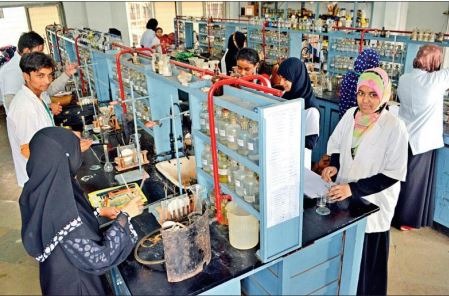
The first thing that strikes you after entering the arched gate of Maharashtra College of Arts, Science and Commerce is its happy ambience. Groups of girls, many of them in hijab, and boys animatedly chat at the ground floor hall while the seven-storey building’s two lifts are constantly busy. The well-stocked library is occupied. So are its several labs. In a nutshell, vibrancy oozes out of its every pore. So how is Maharashtra College different from so many educational institutions in the city? The difference lies in its location. In the vicinity of Kamathipura, the red-light area, and near Nagpada, the heart of Muslim neighbourhoods in the city, Maharashtra College at Central Mumbai has shaped the fortunes of four generations of Muslims, especially girls, in the area.

Started in 1968, the college will soon kick off its golden jubilee celebrations and has lined up a series of programmes aimed at debating how to further empower the locality’s youths educationally.

“But for this college, thousands in the area would have dropped out after 10th Std. Conservative parents were reluctant to send their daughters to colleges in south Mumbai and this college came as a godsend,” recalls businessman and community leader Ghulam Peshimam who graduated from here in the 1970s.

It was the sheer need of a college in the Muslim-dominated area that made its founding fathers move with a missionary zeal. Educationist and philanthropist Mohammed Ali Mitha, who had founded a series of schools, led the initiative to set up a college in the locality which had none before it. Muslim-managed colleges like Burhani and Akbar Peerbhoy came later. Mitha one day landed up at then urban development minister and Islamic scholar Dr Rafiq Zakaria’s office. “Zakaria sahab was initially reluctant to come on board but couldn’t say no once Mitha assured him of finding funds and also offered him to become the life-time president of Khairul Islam Higher Education Society which runs the college,” says septuagenarian Haji N Kalaniya, who studied and retired as a teacher from here before he was inducted as the society’s general secretary.

Kalaniya recalls that once he accompanied Mitha to Haji Ali Dargah where they saw a wealthy Good Samaritan handing out Rs 100 note to each of the beggars assembled there. “Mitha stood in the queue and asked me too to stand behind him. The Rs 200 that we received went to the college funds,” laughs Kalaniya.

Started with just 100 students, Kalania adds that many students had to be coaxed and virtually “lifted” from homes to join the college as the working class in Madanpura, Nagpada and Bhendi Bazaar then gave little importance to higher education. Today the college, its principal Dr Sirajuddin H Chougle proudly informs, has over 3,700 students in various courses, including PG and PhD, IT and journalism. It caters to mostly students from deprived families, wards of daily wagers, taxi drivers, factory workers. “Once while travelling in a taxi the driver told me that his three daughters had graduated from here. I was touched to hear that,” says M Z Shahid, who teaches political science here. “If it was not this college I don’t think I would have become a boxer,” says Hijabclad Shaikh Afifa, the college’s only woman boxer. Besides, the list of sportspersons it has produced is long: Shahid Qureishi and Zafar Ansari (basketball), Khalid Khan (boxing), Nadeem Khan (football)—to name a few.

If Mumbai has been a crucible of many Urdu poets and writers, Maharashtra College must share the credit. It is here that Urdu poets like Abduallah Kamal, Irteza Nishat, Shamim Abbas and Obaid Azam Azmi honed their skills.

“I once heard celebrated poet Faiz Ahmed Faiz here reciting his famous revolutionary poem which spoke of man’s urge for emancipation. The college has kept the city’s literary lamp alive,” says Urdu Markaz’s director Zubair Azmi. As it enters its 50thyear, the city expects the college to earn more laurels in future.

source: http://www.timesofindia.indiatimes.com / The Times of India / News> City News> Mumbai News> Schools & Colleges / by Mohammed Wajihuddin, TNN / July 30th, 2017

Maulana Mazharul Haque: A forgotten leader of Bihar

Bihar, PATNA :

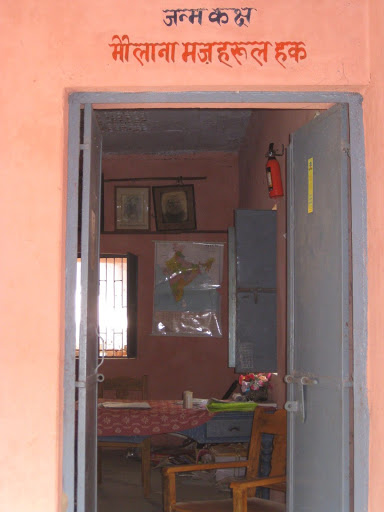
Maulana Mazharul Haque, the man who was a firm believer in complete Independence being “the birthright of every Nation”, has his birth place in office of a government run school that doubles as food storage.

Maulana Mazharul Haque was born to a rich landlord, Sheikh Ahmedullah, in Bahpura, Thana Bihta of Patna district on December 22nd, 1866. His primary education was at home by Maulvi Sajjad Hussain, but he passed his matriculation from the Patna Collegiate in 1886. He joined Canning College in Lucknow for higher studies but same year left for England to pursue a course in Law. He started legal practice in Patna after his return from England in 1891.

MazharulHaque01MPOs29jul2017

He made a significant contribution to relief efforts launched during the famine in Saran district of Bihar in 1897. Maulana Mazharul Haque’s public life actually commenced with the creation of the Bihar Provincial Conference, a move he supported as he believed in the need for the constitution of Bihar as a separate province.

In 1906 Maulana was elected Vice Chairman of Bihar Congress Committee. Mazharul Haque helped organize the Home Rule Movement in Bihar and was its President in 1916. He actively participated in the Champaran Satyagraha for which he was sentenced to 3 months imprisonment.

Subsequently, when the Non Cooperation and Khilafat Movements were launched, Mazharul Haque gave up his lucrative legal practice and his elected post as member of the Imperial Legislative Council and turned all his efforts to the freedom struggle. By now, he was a firm believer in complete Independence being “the birthright of every Nation”.

Mazharul Haque was also a fervent believer in democratic decentralization and he organized the Panchayats in Saran district towards meeting this vision. He also made many requests for better educational facilities in Bihar, especially for free and compulsory primary education.

Maulana Mazharul Haque actively participated in anti-purdah movement launched in Bihar in response to the Non-Cooperation Movement of 1920. Mahatma Gandhi sought to bring women also into mainstream politics, to strengthen the resistance against British rule as well as empower them to play a more active role in society. The purdah system espoused by Muslim and many Hindu families, especially in Bihar, meant that women remained behind men in all spheres of life.

MazharulHaque02MPOs29jul2017

In 1919, he gave up and burnt his western attire to adopt traditional Muslim attire. He was given title of “Desh Bhushan Faqir Mazharul Haque”.

1920, he donated his 16 bigha land on Patna- Danapur road for Sadaqat Ashram and Vidya Peeth which served as college for students who left government colleges in response to Non-Cooperation Movement. Sadaqat Ashram played important role in Independence movement in Bihar.

Maulana also launched his weekly magazine “The Motherland” from Sadaqat Ashram. He also jailed for his articles in this magazine. Sadaqat Ashram continues to serve as headquarters of Bihar Congress. But it is a tragedy that even Congress do not remember the person who has given so much to the party. Till few years back, even Maulana picture was now where to be seen in the ashram.

Maulana was firm believer of Hindu-Muslim unity. His famous quote sums up his conviction, “Wheather we are Hindu or Musalmaan we are in the same boat, we must sail or sink together”.

When in London, Maulana established Anjuman Islamia. This brought Indians of various religion, region and sects under one umbrella. This was also place to discuss about India’s problem. Mahatma Gandhi first met Maulana Mazharul Haque in Anjuman Islamia, London.

Person who gave everything for the country has not got due recognition. Maulana donated the house where he was born, to start Madrasa and middle school within same compound in 1926. Idea behind establishing both in one campus was to promote communal harmony.

MazharulHaque03MPOs29jul2017

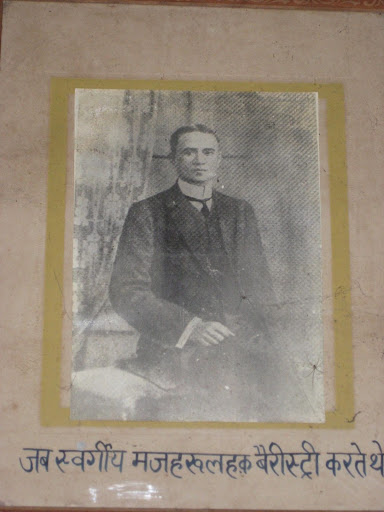
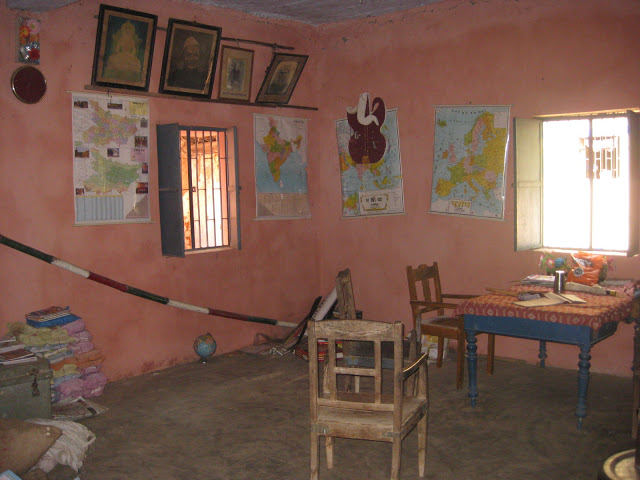
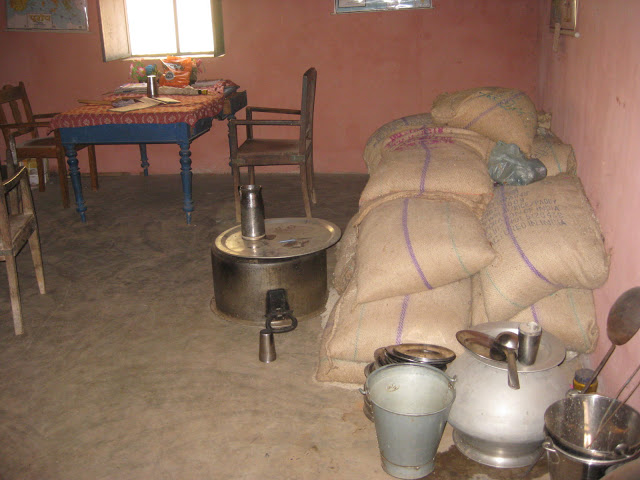
Now the very place where he was born is a principal office of government middle school. On the entrance door of principal office, a line is written in Hindi “Janam Kachh Maulana Mazharul ”(Birth place of Maulana Mazharul Haque). If you enter in the office apart from a picture of Maulana Mazharul Haque along side Dr. Rajender Prasad picture will not give any indication of place being birthplace of a person of such stature. Principal office house the ration for mid day meal scheme for the school apart from general school office stuff.

MazharulHaque04MPOs29jul2017

But this is an improvement from before. Before this school structure was build in 2004, place he was born was used as a toiler for villagers after original structure fell down. Because of the effort for few locals, this place was cleaned up and school building was build and place was marked as birth place.

MazharulHaque05MPOs29jul2017

On December 22nd politicians do come to shower words of praise on Maualana’s contributions but the pity condition of place has not moved anyone. Their promise has remained promise till date.

While talking to TwoCircles.net, Md. Yusuf Khushidi, former HOD Urdu department, Patna University said, “Locals have been demanding to build Library or Technical Institute in that place to commemorate but so far nothing has materialised.”

Yusuf Khhurshidi who belongs to Bahpura added, it is unfortunate that for a person, who sacrificed every thing for the country has been forgotten so fast. Maulana foresightedness can be judged by the fact that Maulana had emphasized on the communal harmony, democratic decentralization and education right from early stage of his life. Maulana was also in the forefront in establishing Bihar state which was carved out of Bengal.

Echoing Yusuf Khurshidi sentiments, Dananjay Yadav also demanded a memorial should be built for the one of the tallest visionary leader of Bihar.

Maulana’s family is living a struggling life in obscurity. It is disheartening to see family of a person who sacrificed everything from career to wealth for the sake of county is left high and dry.

Next birthday of Maulana Mazharul Haque is a month away. I am sure VIPs will be lining up to pay respect especially in election year. Few fascinating speeches will be delivered and few promises will be made. Politicians are known to have short term memory. So those promises will be forgotten sooner than later.

People in India too have selective memory, only very few are remembered for their part in freedom struggle and rests are still struggling to get freedom from obscurity.

source: http://www.twocircles.net / TwoCircles.net / Home> Indian Muslim / by M. Zajam, TwoCirlces.net / November 20th, 2009