Syed Ghayorul Hasan Rizvi assumed charge of the Chairman of the National Commission for Minorities in New Delhi today. After assuming the charge, Shri Rizvi said that the Commission will work for the welfare and development of minorities.
Syed Ghayorul Hasan Rizvi is a graduate in Arts and also holds Diploma in Mechanics. He served as Chairman, U.P Minority Finance Development Corporation Ltd.
Shri Rizvi has been actively participating in social service. He worked for the improvement of the basic facilities and working conditions of Beedi workers and Weaver community in Uttar Pradesh. He also worked for Communal Harmony and National Integrity.
BCK/AK
source: http://www.pib.nic.in / Press Information Bureau, Government of India, Ministry of Minority Affairs / May 26th, 2017
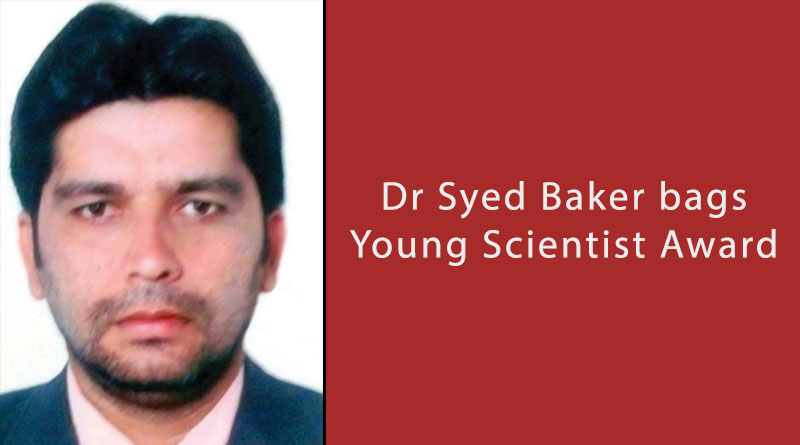
City based researcher Dr Syed Baker has been conferred with Young Scientist Award by Siberian Federal University, Russia. Dr Syed is one among the seven candidates to have been awarded across the globe and one among three Indian with only researcher from Karnataka.
He has completed Ph.D in Microbiology from University of Mysore under the supervision of Dr S Satish and was also honoured with National Post-Doctoral Fellowship from SERB Government of India under the supervision of Dr Nagendra Prasad, Department of Biotechnology and SJCE.
During his research tenure, he was also selected as exchange research for Finland in 2013 which was awarded by CIMO, Government of Finland.
He was also awarded Senior Research Fellowship and Research Associate from Indian Council of Medical Research.
During his research stay he will be working on developing smart nonmaterial towards combating drug resistant microbial pathogens.
source: http://www.citytoday.news / City Today / Home> Mysore / by Editor / June 03rd, 2016
Sayyed Sarfaraj has been elected as the new deputy chairperson of Valpoi municipal council (VMC), the polls for which were held on Wednesday. The post had fallen vacant after former sarpanch Shehnij Shaikh resigned on June 12.
In the absence of any other nomination, Sarfaraj was elected unanimously.
Shripad Arlekar was the presiding officer for the polls, while chairperson Parvin Shaikh, and councillors Akhtar Shaha, Ramdas Shirodkar, Anil Katkar, Parveen Khan, Anjali Chari, Shehnij Shaikh were among those present.
Sarfaraj said he will work with others under the guidance of health minister Vishwajit Rane.
source: http://www.timesofindia.indiatimes.com / The Times of India / News> City News> Goa News / TNN / July 07th, 2017
Co-founder of Ati Motors, Saad Nasser hopes to release his first autonomous goods vehicle prototype in the next 2 years
14-year old Saad Nasser’s start-up is building an autonomous goods vehicle
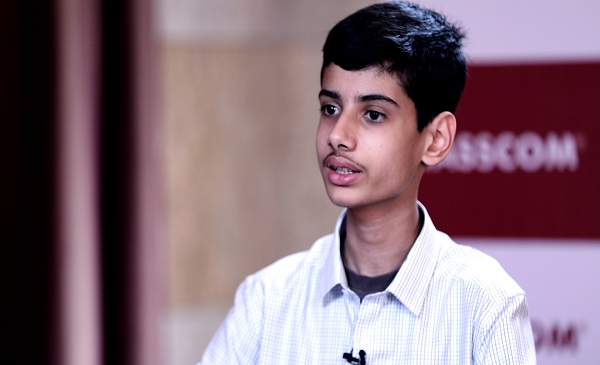
Saad Nasser, all of 14 years old, is no ordinary teen. Having read books on Java before the age of 5 and learnt C++ programming by the age of 7, Saad is a self-taught child prodigy with a lot to talk about. Saad is the co-founder of an autonomous vehicle start-up called Ati Motors, based out of Bangalore and is aiming to build the world’s first autonomous goods vehicle. But there is one more twist to this. This will be not like your regular goods vehicle but designed to offer the maneuverability of a two wheeler vehicle in order to run it on hilly areas apart from campuses.
Saad has been a winner at the Intel IRIS Science Fair 2012, 2013, 2014, 2016. His project on tiled processors won him the Sam Pitroda Award for Research and Creativeness as the best project of the fair.
BOOM caught up with Saad at the NASSCOM India Leadership Forum where we spoke to him about his entrepreneurial journey at such a young age.
source: http://www.boomlive.in / Boom / Home> Uncategorized / by Jency Jacob / February 24th, 2017
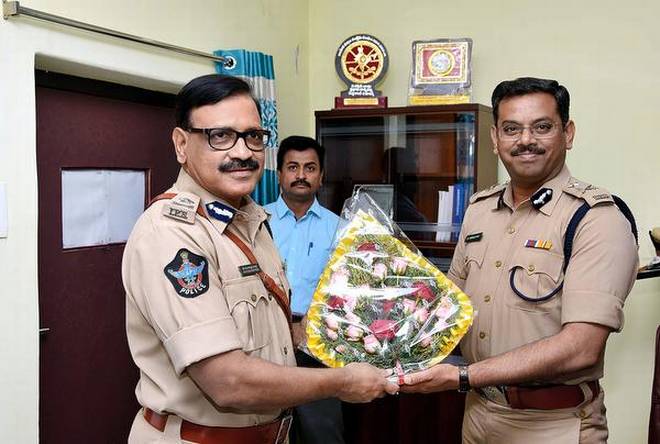
Shaik Mohammed Iqbal took charge as Inspector-General of Police, Rayalaseema, in Kurnool on Monday from N. Sridhar Rao, who has been transferred.
DIG of Anantapur Range J. Prabhakara Rao, Superintendents of Police – Gopinath Jatti (Kurnool), Rajasekhar Babu (Chittoor), Attada Babujee (Kadapa) – APSP Battalion Commandant Samuel John, Regional Vigilance and Enforcement Officer Sivakoti Babu Rao, Additional SPs P. Shaik Shavali and I. Venkatesh, Circle-Inspectors and SIs welcomed Mr. Iqbal with bouquets.
Later the officials gave a warm farewell to outgoing IG N. Sridhar Rao by felicitating him with shawls and garlands in the police guest house here.
In Tirupati, Abhishek Mohanty, a 2011 batch IPS officer, took charge as the Superintendent of Police of Tirupati Urban police district, here on Monday. Speaking to the media, he said that their focus would be on implementing the ‘rule of law’ along with basic/professional policing.
In Vizianagaram, G. Pala Raju has taken charge as Superintendent of Police from his counterpart L.K.V. Ranga Rao on Monday.
Later, talking to media persons, Mr. Raju said that he would improve community policing and other programmes that his predecessor had initiated for the welfare of people.
In Kurnool, Traffic will be streamlined in coordination with officials of the Kurnool Municipal Corporation, Roads and Buildings, National Highways, citizens and NGOs, Kurnool Superintendent of Police Gopinath Jatti has said.
source: http://www.thehindu.com / The Hindu / Home> National> Andhra Pradesh / by Special Correspondent / Kurnool – July 04th, 2017
Hyderabadi shooter Nawab Shafat Ali Khan | Photo Credit: aranged
Maharashtra :
‘Man-eater’ successfully tranquillised
Reputed hunter from the city, ‘Nawab’ Shafat Ali Khan, who used to be frequently embroiled in controversies by shooting down ‘man-eating’ tigers, has, for a change, successfully tranquillised female tiger in Maharashtra that had reportedly turned man-eater.
The three-year-old tigress was captured alive on Monday evening from the outlying territory of Tadoba National Park, near Halda village, Mr. Khan informed over phone.
The tigress, named C-1 by the Forest Department officials, was from the spill-over population of 40 adult tigers and 19 cubs that struggled for survival in the Brahmapuri Division outside the national park, thickly populated with human habitations and sparsely with prey base.
The young feline had killed two humans and injured four, besides lifting away countless cattle and goats between April and June. After it had reportedly killed a man on June 21 and partially ate his body, villagers became furious leading to her being declared a man-eater, and ordered to be shot down.
Attempts by veterinarians to tranquillise the big cat turned futile, and Mr. Khan was invited by the Maharashtra Government to hunt her down. “I had noticed that the tigress displayed abnormal behaviour. She would kill the cattle during daytime, and when resisted, attack the villagers,” Mr. Khan recalled. However, he decided to capture her alive, after noticing from camera traps that she was beautiful and young. His team, including son Asghar, faced tough opposition from the villagers who wanted her shot down.
“They even attacked us once, seeing the tranquilliser guns in our hands. We had to sit with them, and make them understand our efforts,” he said. The cattle kills became very frequent, but almost always, the tigress abandoned her kills scared by the attempts to chase her away.
Tigress that was tranquillised.
“After a futile attempt at Padmapur village on July 4, she disappeared up to July 9, only to resurface near Halda village where she was conceived by her mother. Our task became very difficult as her mother and two sisters roamed in the five square kilometre vicinity,” Mr. Khan said.
Painstakingly, the stripes on the tigress’ body were memorised, and her presence was ascertained further through her odd tendencies of abandoning her kills.
“Monday afternoon, she killed a cow and ate five kilograms of meat. We set up a ‘machan’, tied the carcass with ropes and awaited her arrival. At 5.30 p.m., she came tearing out, lifted the carcass snapping the ropes, and almost galloped away, but not before I took a very fast shot. The dart went in her neck, and she fled dropping her kill,” Mr. Khan explained. She was noticed 200 meters away, captured and brought back to the Forest Department’s camp at Ekara village.
“I visited the tigress on Tuesday morning. She was in healthy condition,” Mr. Khan informed.
source: http://www.thehindu.com / The Hindu / Home> News> Cities> Hyderabad / by Swathi Vadlamudi / Hyderabad – July 12th, 2017
Late on Tuesday evening, news broke from the BCCI that Ravi Shastri was indeed the new coach of the Indian cricket team, capping a frenzied few hours when speculation had been rife about whether or not the former India allrounder, who was team director from August 2014 to April 2016, was stepping into the shoes vacated by Anil Kumble last month.
When the confirmation came, it was no surprise. What did cause a flutter was news that former India fast bowler Zaheer Khan had been appointed bowling coach of the team, for this was not widely foreseen. Add to it the pedigree and tactual nous of Zaheer, India’s fourth most successful bowler in Tests and ODIs, and this was a major announcement. India’s pace bowling stocks has arguably never been better, with Umesh Yadav, Mohammed Shami, Bhuvneshwar Kumar, Jasprit Bumrah and Hardik Pandya all capable of clocking 140kph, and the likes of Dhawal Kulkarni, Ishant Sharma, Shardul Thakur and Jaydev Unadkat followed by the promise of youngsters such as Mohammed Siraj and Basil Thampi.
While he has no formal coaching experience, the 38-year-old Zaheer brings a vault of experience to his most high-profile role since he retired from international cricket in October 2015. He will rank as one of India’s best fast bowlers and, for two periods in his international career, was on par with the best in the world. From an Indian context, on a thin list of genuine fast bowlers, Zaheer rightly occupied a place because of his wickets and skill with a cricket ball in his hand, new and old.
The highlights reel of Zaheer’s career makes for special reading. A total of 311 wickets in 92 Test matches and 269 in ODIs over 15 years. A World Cup winner, in 2011 when he was the joint highest wicket-taker. A leading role in a rare Test victory in England, and a supporting role in India’s only two on South African soil. In between, there was success in Test wins at home and in Sri Lanka, Bangladesh, Zimbabwe, New Zealand and in the West Indies.
A tall, sturdy fast bowler with a smile to put you at ease, much was expected of him when he burst onto the scene with those yorkers to the Australians in Nairobi in 2000. Here was an Indian bowler regularly able to clock in excess of 140kph and bend the ball back in. That he was a left-arm pace bowler made him all the more appealing and exciting. This was a unique talent in the Indian scenario. Of course, comparisons with Kapil Dev and Javagal Srinath , who at the time was starting his decline, were inevitable. Thankfully, for a couple of seasons fans of Indian cricket got to see Srinath and Zaheer bowl in tandem, most effectively in the 2003 World Cup, and what a treat it was.
To watch him move the ball at Trent Bridge in the summer of 2007 and be sucked into the TV screen, to gasp at deliveries that curved away from prodding bats. To see him appeal with a clap when he was certain a batsman was lbw, eyes crinkled as a celebratory smile began to form, then slap your thigh in excitement. To throw your head back in marvel when he went through the defences of Brad Haddin and Brett Lee with successive deliveries bowled with the old ball, getting it to reverse delectably. Was there a better exponent of the old ball for India? With all due credit to Manoj Prabhakar, no. That ability to swing the old ball and new and extract reverse swing was Zaheer’s hallmark. He was a master of bringing the ball back into the right-hander and moving it away sharply from a left-hander by the name of Graeme Smith. Later in his career, Zaheer wisely understood the importance of cutting down on pace for accuracy and the results were, for the most, very satisfactory. Think 2010, and fine bowling performances in Mirpur, Mohali and Durban.
Twice in his international career Zaheer made the hard climb back to the top. First in 2006 after a stint at Worcestershire when 78 wickets propelled him back into the Indian team, and then late 2013 when he worked hard in his fitness and bowling to return for the Test tours of South Africa and New Zealand. On the occasion of his first return, Zaheer proved the perfect foil for Sreesanth in South Africa, before moving past him to reclaim his status as India’s pace spearhead with an unforgettable nine-wicket performance in Nottingham in 2007 that secure India’s fifth Test win in England.
On the second, in what proved his final chapter with India, he bowled more with his head than with pace, which was expectedly down, and with almost Zen-like poise slipped into the role of mentor to the rest of the pacers on and off the field. Five wickets in Johannesburg were testament to his craft and helped India, during South Africa’s first innings, to exhibit control over the hosts. He struggled in the second Test, but nine wickets in two Tests in New Zealand hinted at something more. In the first Test in Auckland, Zaheer was part of the attack that bowled New Zealand out for 105 in their first innings, which he termed one of the best collective Indian bowling efforts he’d been a part of.
It is that Zaheer which this Indian team, as it prepares for a full tour of Sri Lanka starting later this month, can hope to be enriched with. The BCCI’s Cricket Advisory Committee, comprising Sachin Tendulkar , Sourav Ganguly and VVS Laxman – each of whom has played a lot of cricket with Zaheer – has made a wise choice in pushing for his appointment as bowling coach.
source: http://www.timesofindia.indiatimes.com / The Times of India / News> Sports> Cricket / by Jamie Alter timesofindia.com / July 11th, 2017
Born into a family of ‘coolie Indians’, Ranjith Kally was important in documenting the role of Indians in the anti-apartheid movement
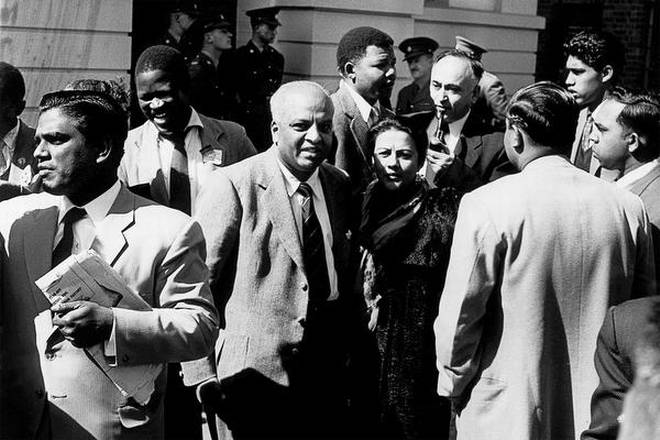
Monty Naicker, Nelson Mandela, and Yusuf Dadoo at the Treason Trial, Pretoria, 1958.
For most Indians with some awareness of the history of South Africa, India’s connection with the country begins and ends with Mohandas Karamchand Gandhi. As Nelson Mandela famously put it, India sent Mohandas to South Africa and received a ‘Mahatma’.
If the province of Natal was one of several places around the globe where the epic of Indian indentured labour was writ large, South Africa was nearly distinct as the site of an unusual and inspiring solidarity between black people and Indians in the equally epic struggle against racial oppression. Photojournalist Ranjith Kally, who died at the age of 91 in Johannesburg this June, was the great chronicler of both Indian life in Natal and the resistance to apartheid.
Kally was born near Durban in 1925 into a family of ‘coolie Indians’. His grandfather worked on a sugar plantation; his father, likewise, left for the fields early every morning. As was common in his generation, Kally was educated only up to Class VI. He worked in a shoe factory for 15 years and stumbled upon a Kodak Postcard camera at a rummage sale. In 1956, Kally procured a job as a photographer with Drum, a magazine that had been launched to give expression to the lives of black and coloured people.
Chronicling a struggle
Kally’s first photographs of anti-apartheid figures would be taken in the late 1950s. One of his favourite subjects was Monty Naicker, an Indian who trained as a doctor before turning to political activism. At a break during Pretoria’s Treason Trial in 1958, Kally captured Naicker with a young Mandela and the venerable communist leader Yusuf Dadoo in the background. Kally’s many photographs of Fatima Meer, another titanic figure in the anti-apartheid struggle, furnish insights both into how women assumed political roles in the public sphere and the little-discussed role of South African Indian Muslims in shaping secular narratives of freedom.
In one photograph, taken in the early 60s, Kally seated Meer’s daughters, Shamin, Shehnaaz and Rashid, around their buoyant-looking mother in Durban’s Botanical Gardens. The photograph was intended for Ismail, Meer’s husband, who was then indetention, as a keepsake of his family. There is no hint here of anxiety, fear, or the oppressiveness of racial terror. But Meer was also godmother to Nelson and Winnie Mandela’s children, giving them a home and hope at a time of despair.
Kally knew better than most that the story of the anti-apartheid struggle was not only one, or even mainly, of ‘great’ figures. In a rigidly racist society, the occasions for transgression were many and the outcome generally was painful for those animated by the desire for equality and social justice. The anti-miscegenation laws were severe, but, as one of Kally’s most stunning photographs shows, this did not prevent Syrub Singh and the dazzling Rose Bloom (seen emerging from a court hearing) from joining hands in matrimony.
Courting the everyday
What is striking in Kally’s large and still largely unknown body of work is his attentiveness to the quotidian life of Indians in and around Durban. Close to half a century after the end of the indentured system, the greater majority of Indians still lived below the bread line. In one photograph, an Indian woman scrubs dishes outside a group of shacks; a very young girl, clutching a toddler, stands by her side. Kally closely observed young Indian boys and girls working in the cane fields.
His 1957 photograph, ‘Children Gotta Work’, is illustrative of not only Kally’s approach to the grittiness of Indian life in Natal but of the self-reflexivity in much of his work. Four Indian children, some unmistakably teenagers, are on their way to work in the fields. Shovels are flung across their shoulders; two of them firmly grasp lunch boxes in their hands. They walk barefooted in the morning light. The photograph resonates with pictures of Partition, but there are also shades of the historic march of Indian miners from Natal to the Transvaal in 1913. Workers on the move, the daily walk, the look of determination: all this is part of the ensemble.
I didn’t know Kally well enough to say whether he was a man of sunny optimism, but his photographs nevertheless suggest an eye for the whimsical and a zest for life. The whimsical touch is nowhere better captured than in his photograph of a boy with a large tortoise on his head.
The wide grin on the boy’s face reveals the unmistakable fun he is having in ferrying his slow-moving companion. The boldest expression of this element of joie de vivre in Kally’s work is a photograph called ‘The Big Bump’. Two men, both amply endowed at the waist, are rubbing against each other. Each man seems to be saying, ‘My tummy is larger than yours, and all the better for it.’ Kally’s camera paves the way for understanding the extraordinariness of the ordinary.
That is not an inconsiderable gift.
Professor of History at UCLA, the author has the distinction of being listed among the 101 Most Dangerous Professors in America.
source: http://www.thehindu.com / The Hindu / Home> Society> Spotlight – History & Culture / by Vinay Lal / July 08th, 2017
The Adil Shahis made Bijapur (now Vijayapura) a city ahead of its time in terms of infrastructure development and security. This well-planned city had two fortifications, one around the principal Adil Shahi administrative and residential buildings, and a larger one around the rest of the city. Both were roughly circular and had moats and several gateways. To further strengthen the defence of the city walls, the Adil Shahis built many bastions and about 96 gigantic cannons were placed on them. Only a dozen of these canons exist today. Most of them are placed in the Archaeological Survey of India (ASI) museum housed in the Nagaad Khana in front of Gol Gumbaz and some of them still sit atop the surviving bastions.
First line of defence
The fortifications have crumbled due to neglect and the moats are overgrown with thorny shrubs and in some places, they are filled with sewage and garbage. The only gateway that the citadel still has is on the south. This was the principal gateway into the citadel but now wears an abandoned look. Just inside this once splendid gateway are the remains of guardrooms constructed entirely of pillars from Hindu temples mostly belonging to the Vijayanagara period.
One of the surviving bastions is the Sharza Burj or Lion Bastion which is also the largest bastion in the city. It is famous for housing the cannon Malik-i-Maidan or Lord of the Plains, which was a war trophy won after the defeat of the Vijayanagara Empire at the Battle of Talikota. The cannon is made from a special alloy and can fire not only cannon balls but also metal slugs and copper coins.
Nearby is Haidar Burj which is the highest gun platform in Vijayapura and is a very conspicuous solitary structure.
It is also called the Upri or Upli Burj by the locals. It was built in 1583 by Haidar Khan, a general during the reigns of Ali Adil Shah I and Ibrahim Adil Shah II. A spiral stairway leads to the top which houses two long cannons. The tower was most probably customised for the guns which needed to be fired from a height so that they can have a long range.
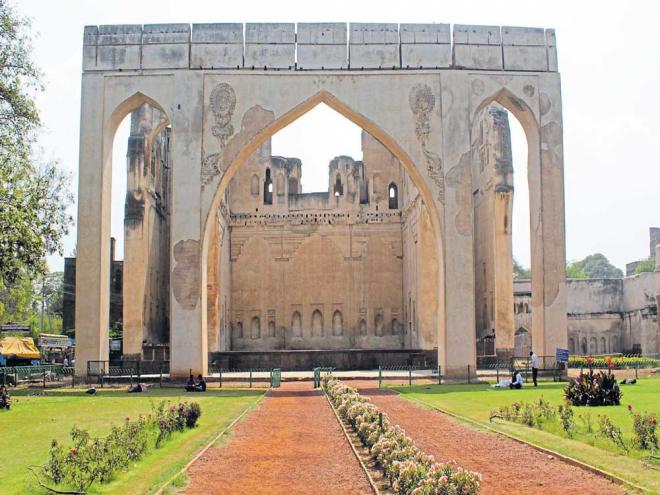
The Adil Shahis wanted to transform their capital city to match the Mughal cities in the North by building imposing courtly structures, gardens, wells, waterways and granaries. While most of the structures have fallen to ruin, some have been converted to government offices and only a handful are open to tourists. The Gagan Mahal was built by Ali Adil Shah I as a palace and an audience hall. Only its structural skeleton remains today. A short walk from the Gagan Mahal is the Sath Manzil (Seven Pavillions) or Haft Manzil built by Ibrahim II as a pleasure pavilion. Only a few storeys survive now and there is no way to go inside. Just opposite this is Jal Mahal or Water Pavilion that has been decorated exquisitely and is crowned by a dome. It is set in the middle of a square pool which is now dry and filled with garbage. Again, there is no way to go inside.
Reservoirs & stepwells
Water was and is a precious resource for Vijayapura and the Adil Shahis built a complex hydraulic system to bring water from distant sources into the city and supplemented this with reservoirs and stepwells. Only a few stepwells and reservoirs survive today and the system of aqueducts and horizontal wells are lost. The Taj Baoli is the biggest stepwell in Vijayapura and was built by Malik Sandal, a Persian architect, in honour of Taj Sultana, the wife of Ibrahim Adil Shah II. Sadly the well, its gateway and the gallery around it are in a very bad state. It won’t survive for long if no action is taken immediately.
Another well-known stepwell present here is the Chand Baoli. The stepwell was built by Ali Adil Shah I in honour of his wife Chand Bibi and it served as the model for Taj Baoli. Chand Bibi is best known for courageously defending Ahmednagar and Bijapur against the attacks of the Mughal Emperor Akbar. She was the regent of both Ahmednagar and Bijapur and was known to be a good warrior, musician, linguist and artist. The structure is now completely cordoned off from the public. One can only see it through the grill gate.
Present-day Vijayapura would have benefited if the administration had preserved the hydraulic system of the Adil Shahis and used the many stepwells and reservoirs instead of letting them turn into garbage dumps. Waking up to this, the Minister for Water Resources, M B Patil announced in April that starting with Taj Baoli, around 20 wells in Vijayapura will be rejuvenated at the cost of Rs 4.25 crore. As a part of the rejuvenation process, the dirty water present in the wells is being pumped out, the garbage is being removed, and the well is being desilted. Additionally, there are plans to repair the structures around them. When fresh water accumulates, it will be pumped and stored in tanks, from which people can collect water for domestic purposes apart from drinking. This will ease the water scarcity the city is facing to a certain extent.
Unless people surrounding these monuments understand their historical importance and realise that a clean baoli can help face water scarcity, all efforts to revive the heritage structures will be futile.
source: http://www.deccanherald.com / Deccan Herald / Home> Supplements> Spectrum / by Rijutha Jagannathan / July 04th, 2017
“Do you know I can read and write Telugu fluently? I can write the script as good as anyone else. I had a tuition teacher for my Telugu language,’’ Azharuddin said.
Hyderabad:
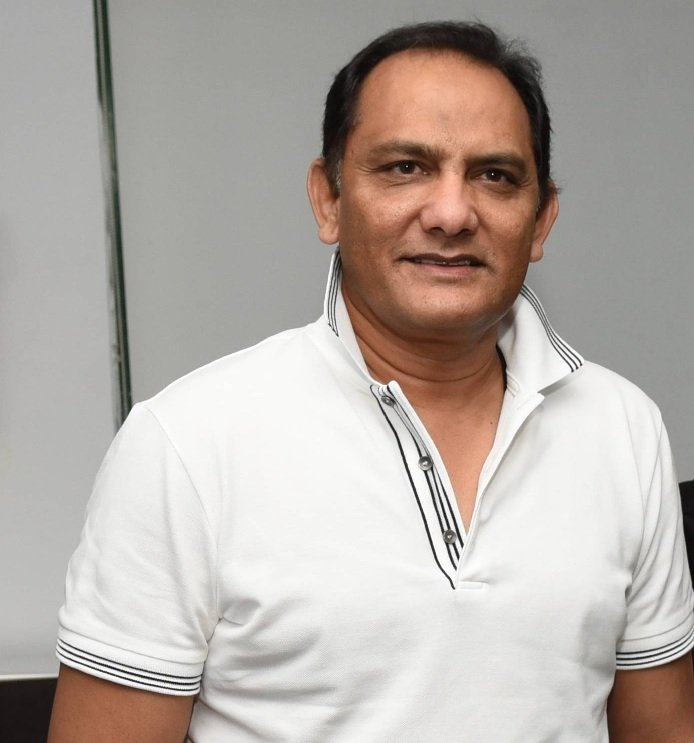
The magic, mystery and awe were unmistakable as Mohammad Azharuddin strolled into the Telangana Today newsroom on Tuesday evening. The white T-shirt with the collar up and light blue denims marked the legend’s customary style well-known to his lakhs of fans. Many journalists — some with generous amount of grey and some others much younger — greeted him with eager enthusiasm, bringing alive memories of his incredible batting many years ago.
The former Indian cricket team skipper went down memory lane with the effortless ease which he displayed in the wrist-flicks in his prime. Reminiscing his Vittawaldi days, he recalled those glorious times as an upcoming cricketer. “Do you know I can read and write Telugu fluently? I can write the script as good as anyone else. I had a tuition teacher for my Telugu language,’’ he said.
Azharuddin continued: “I miss those golden days. The roads were empty. It was easy to drive. But, now the traffic is so chaotic. Basically, the people are not disciplined. If told, they would disagree with you.’’
The former stylish cricketer said there could have been a better planning while constructing the metro rail. “It is in the middle of the road and the pillars are very dangerous. If you see in other countries, the metros are positioned to a side, away from the motor roads. It looks scary here.’’
He also revealed his love for the bikes. “I always liked ‘Jawa’, particularly the red ones. It had a royal look. We had a few in and around our streets in Himmayatnagar. Those days owning a Jawa or Yezdi was a big thing.’’
Going to his younger days as cricketer, he said he first played for Deccan Club. “I think I joined in 1977. I remember playing on the bumpy outfields of Parade grounds. It was horrific. We usually played without helmets. But it was enjoyable and there was a lot of camaraderie. I learnt my game from this ground. At times, it was challenging.’’
Azhar said he always enjoyed fielding. ”Somehow, fielding came naturally to me. I would attack the ball. We should be focused and should not shy away from the ball. You know, if a fielder is scared, the ball will chase you. I never flinched from hard work and I used to make it a point to put in extra hours in my training session for fielding.’’
In a lighter vein, he even cited the example of Indian women fielding better than their male counterparts. “In Champions Trophy, our fielders missed some easy run outs while the women ran out six batters in the World Cup,’’ he made a tongue-in-cheek statement.
source: http://www.telanganatoday.com/ Telangana Today / Home> Sport / by N Jagannath Das / July 05th, 2017