Category Archives: Leaders

While my veena gently weeps

Alwar, RAJASTHAN / NEW DELHI :

First impression: a small, wiry man with a gigantic string instrument.

Second impression: Once the frail man starts plucking the strings of the gigantic instrument and the melodious notes start flowing, you understand why Ustad Asad Ali Khan stands tall among today’s music maestros.

The only known living exponent of the rudra veena, Khansaab is probably one of the last of the musicians who combine traditional been techniques with an in-depth knowledge of the raagas.

“The rudra veena can execute all the subtleties of the human voice. Unlike the sitar and the sarod, it does not have tarap or resonance strings. Their absence allows the musicians to play shrutis or microtones, which are considered the ultimate in classical music. Iska awaz sabse buland hai.”

The Ustad should know. Trained by his father Ustad Sadiq Ali Khan, court musician of Alwar, Khansaab represents the legendary Jaipur beenkar gharana and traces his genius to his great grandfather Ustad Rajab Ali Khan. Being from the seventh generation of rudra veena players in the family, Ustad Asad Ali Khan’s relationship with this instrument of the gods is a passionate one. He challenges those who term the rudra veena as inflexible and a museum piece.

“These are excuses that people use to cover up their own inadequacies. Yes, it is a difficult instrument to play. But that is true of all classical music. It is not filmi music which you can learn in a few days,” he says emphatically.

Defending the rudra veena, Khan says, “The veena stands at the pinnacle of all stringed instruments. It is believed that the rudra veena was created by Lord Shiva who was inspired by Goddess Parvati. It was born out of his urge to create something that he could use to measure swaras and shrutis.”

But it is the man on this earth who has labelled this instrument “difficult”. “Isn’t the sitar difficult to play? Does not the sarod require years to master? Today’s musicians want the accolades easily without the hard work. It is they who have badmouthed the rudra veena,” he fumes.

For mastering the rudra veena you have to play by the rules, and Khan is unwilling to bend the rules. “The first requirement is to sit in the yogic vajrasana position. Unless you sit in that position, place the veena on the shoulder and use your breath as a modulator for notes, you cannot have the desired impact. The nuances of the notes will be lost if you change your posture. How many young people today can sit in that position for hours together?” he asks.

Raagas Mian ki malhar and Darbari Kanhada bring out the best from the rudra veena, feels the Ustad, who plays dhrupad in the Kandarbani style, which is one of the four ancient styles of Indian music.

Ustad Asad Ali is also against fusion music, which is seen as a way out to revive flagging interest in classical music. “Yeh hamaare shaan ki khilaaf hai. Fusion is not our job. We are not meant to compete with filmstars. In the drive to become commercially successful, we should not lose sight of our tradition and culture. Classical music and film/popular music have different positions in the world of music and that is the way to be,” he says.

Of course step-motherly treatment by the powers-that-be has also contributed to the decline of the rudra veena. “None of the five universities of music in the country teaches the rudra veena. Sadly, even I have taught the sitar in the Faculty of Music and Fine Arts in Delhi University for 17 years. The rudra veena is not taught there. Ultimately, the musician has to survive, and without a certificate, a rudra veena exponent will not get a job in any university,” he points out and laments, “Soon, we will have only foreigners playing the veena.” Currently, apart from a couple of Indian students, most of Khan’s disciples are from the West. His nephew Zaki Haider is also training under him, hoping to carry on the legacy.

“The government has to do more to preserve the fading tradition of the rudra veena. I have suggested that the recordings of Ustad Sadiq Ali Khan and other stalwarts lying with the Sangeet Natak Akademi should be marketed. I do not want any royalty, just make those recordings available before those tapes get destroyed. It may not mint millions, but millions of Indians will get to know their heritage,” he says. Carrying forward the task of telling the world about the instrument, the ustad is currently working on a book on the rudra veena, under a two-year fellowship given by the Ministry of Culture.

Unfortunately, it’s not just the rudra veena, but also the ustad who seems to have been forgotten by many. Despite being acclaimed for his musical virtuosity and for probably being the most well-known rudra veena player in the world, the country’s civilian honours have passed him by. “I do not want to lobby for such awards,” he says, but it can’t stop himself from adding that even harmonium players are feted by the public today while the rudra veena and rudra veena players are forgotten.

Gourds, frets and strings attached

SO we know that the rudra veena is rarely heard on the concert stage these days. That’s sad. But let’s get the vital statistics of this ornate instrument before it is forgotten. Musicians believe that the rudra veena is the ideal instrument for a dhrupad rendition because its sound has the same richness of overtones that the voice acquires with the practice of Nada Yoga.

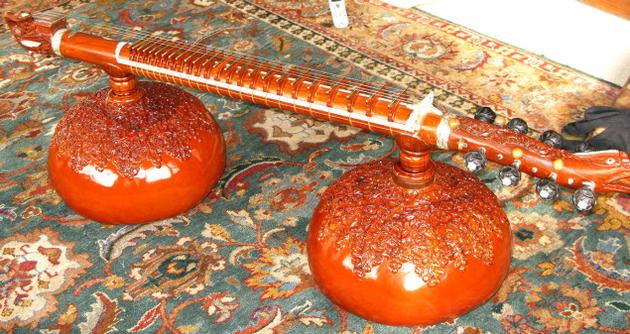
This string instrument is different from the Saraswati veena in the way it is placed. The former rests against the shoulder while the latter is placed on the lap of the performer. Its basic structure is a bamboo mounted on two gourds with 19-24 frets fixed with bee’s wax. Additionally, there are four main and three side strings having a range of four to four and a half octaves. The gigantic dimensions also make it one of the heaviest instruments. At 10 kg, you can at best hope to balance the weight while sitting in the yogic vajrasana position.

If you want to be the proud owner of a rudra veena, you are going to be lighter by at least Rs 75,000. And you’ll also have to be patient. It takes at least a year to make a good rudra veena.

source: http://www.archive.financialexpress.com / The Financial Express / Home> Art & Enterainment / October 01st, 2006
Mastering the king of instruments


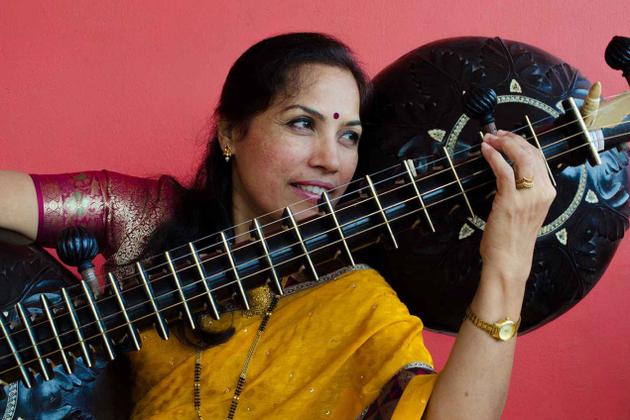
Jyoti Hegde. Photo Special Arrangement

Jyoti Hegde, India’s only woman rudraveena artist, talks to Sowjanya Peddi about conquering the unconventional rudraveena and storming a male bastion

On a quiet farm away from the glitz of the urban art world, in a village near Sirsi about 125 km from Dharwad in Northern Karnataka, lives a young woman with her husband. Her name is Jyoti Hegde and she might not be splashed on newspapers but she is the first woman performing artist of the rudraveena in India. Rudraveena is a world heritage instrument, protected and promoted by the UNESCO. Jyoti follows the Khandarbani school of Dhrupad and her guru is the illustrious Ustad Asad Ali Khan.

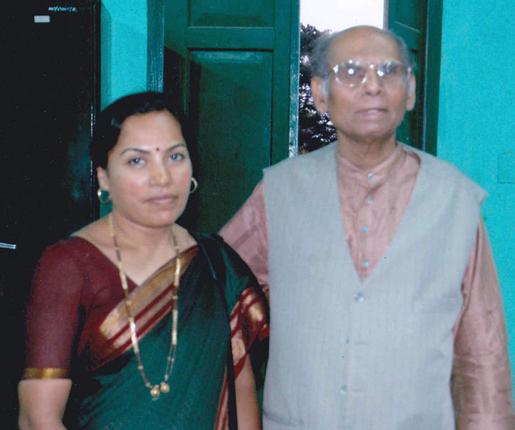
Jyoti Hegde with Ustad Asad Ali Khan. Photo: Special Arrangement

In the rustic peace and unpretentious but generous hospitality of her home, she talks about her life and her views on Dhrupad and the rudraveena with Sowjanya Peddi. Here are the translated excerpts.

I was born in Dharwad, Karnataka, where my father was a range forest officer. I grew up in Belgaum and Sirsi. I liked dance and was particularly talented in drawing. I might have become a painter if a chance encounter with the rudraveena had not transformed my life. I was learning the sitar from my first guru Dr. Bindu Madhav Pathak and in a lec-dem one day, he played the rudraveena. The sound of the instrument haunted me. The gambhirta (sonorous resonant sound) of its tones was very different from the chanchalata (playfulness) of the sitar. I requested Pathakji to teach me, but he refused, saying it is not a woman’s domain. I persisted. I told my father about my wish. Initially, Pathakji refused my father too, but later he relented and said that “playing the rudraveena is not a woman’s forte but since she is so insistent, let us give her an old rudraveena that is lying at my house. Once she plays it for a while, she will give up the idea of her own accord”. This was like a secret pact between my father and him, unknown to me. But when Pathakji saw my commitment and determination, he eventually advised my father to get me a new rudraveena, at the age of 16, which I continue to play even today. I would go to Pathakji’s house by 7 a.m so that he could set me an exercise for the day.

He would return at 5.30 p.m. The entire day I would practise the single phrase he had taught me that morningI was so focussed that he once said I had gained the expertise of 10 years within a year. Within a year I won the first prize for rudraveena in the Akhil Bharatiya Akashvani Sangeeth Spardha in 1981-82. I was also enrolled as a regular artist at All India Radio. I also won the first prize in the Karnataka Youth Festival for three consecutive years from 1981 to 1983.

My gurus chronicle my journey from Khayal to Dhrupad. I learnt from Pathakji in the Khayal tradition. He used to compliment me, saying “she knows how to get knowledge from me”. Now after many years of teaching, I understand this was the biggest compliment. An early review commented that “the artist did not spare enough time for bandish rendition with sat sangat (jointly) on pakhawaj”. I felt the most prominent attribute of the rudraveena is its capability for nadopasana through alap. Playing with the accompanist is less important. I understood then that this instrument is not best supported by the Khayal. I discovered a book on Dhrupad by Thomas Marcotti titled The Way-Music: How to conjure with sounds? The book had a 90-minute music cassette attached to it. I was transfixed by the depth and richness of the notes and its emphasis on slow measured movement. I was drawn to Dhrupad from then on. Whenever an artist performs in the Dhrupad ang, whether sitar, surbahar or rudraveena, it will entail more emphasis on alap than on bandish.

I studied with Pt. Indudhar Nirodi for three years, who gave me a deeper understanding of Dhrupad through vocal training and taught me the subtleties of Dhrupad. After he left Dharwad, I approached Ustad Asad Ali Khan where I learnt for five years.

RurdraveenaBF26nov2015

Rudraveena is known as the king of instruments. All string instruments are shaped after it. According to Hindu mythology, Shiva is said to have taken inspiration from Parvati’s form and created this instrument. Shiva was the first to play this instrument and he taught it to Parvati who in turn taught it to Saraswati. It was restricted initially to the dev loka and was used for aradhana (devotion) alone. Later, Narad learnt it from Saraswati and brought it down to earth. In earlier times, it was used as accompaniment for veda mantra pathan (vedic recital) and with the yaga yagna (vedic rituals) of the rishi munis (sages). It held a place of reverence equivalent to that of the shank (conch) or jagate (circular plate/gong used in temples) that produce sounds during worship rituals but are not specifically used for producing music. It was treated with the same sanctity accorded to the sacred idol. Only select people were allowed to touch it and that only after purifying themselves.

Rudraveena is considered a measure to weigh the principles and grammar of the Dhrupad style of music. As Dhrupad evolved out of Sama veda chanting, the rudraveena also came to be considered the instrument to accompany Dhrupad. The shift must have been sharp and swift, as the music left temples and entered the Mughal courts. This brought a change in lyrics, tempo and style of playing. Dhrupad lyrics were chiefly based on the varnanas (description) of deities following the earlier devotional context. In the new context, more preference was given to prakriti varnana (nature description), shringar ras (romantic feelings) and songs praising the emperor/royalty. Both the rudraveena and Dhrupad rose to popularity from the 8th to the 15th and 16th centuries. This is the golden period for rudraveena, which produced artists such as Swami Haridas, Miya Tansen, Baiju Bawra, Gopal Nayak, Nayak Bakshu and Nayak Charju among others.

In Akbar’s times the instrument was very popular and prevalent. The rise of Khayal can be seen as a development of the above context. With Khayal, the sitar emerged as a more apt accompanying instrument its playful and rapid explorations. The rudraveena receded from the scene.

The rudraveena is a large and heavy instrument. Its strings are thick and plucking them requires strength. In addition, the original posture requires keeping the instrument on the body, which means carrying 3.5 kg to 5 kg for two or three hours in one sitting. Also, the sacred context of the instrument conventionally permitted only select classes of men to play or even touch it. It was a superstition that if women played it they will not be able to conceive children. One reason could be that the Vajrasan posture might have been considered harmful for the uterus. When my mother heard this she asked me to stop playing, but I was already so much in love with it that I could not think of leaving it. Eventually I got married and conceived a son. But some controversies persist. I could not play in the Vajrasan posture during my pregnancy and adopted the Sukhasan posture. After delivery, I continue to play in Sukhasan. I don’t believe earlier restrictions on women are valid in present times. The measure of what is sacred and pure is redefined in every era. We should interpret cultural norms and injunctions as indicative of demanding inner purity from the artist.

We live a quiet life on our farm. I get much support from my husband, son and daughter- in-law who help me with modern technology to take my art forward. I relish the peace and rhythm of farm life; it brings depth and anubhav (experience) to my music.

Dhrupad is the foundation for Hindustani classical music. Unless young people take it up, it will be lost to us. The rudraveena is also disappearing because no new generation is passionate enough to learn this demanding skill. They find it difficult to support themselves [financially]…. they look for quick fame. But the foundation of our newness should be based on our own culture. If we just rush into modernity that is not our own, it will be meaningless.

The instrument

The rudraveena cannot be bought off the shelf. Its making is unique, as it is connected to the player’s body. For instance, its length should be 11 times the hand span of the player. The tuning can be completed only after it is placed on the body. The playing is connected to the player’s breathing rhythm. Traditionally, it was played only in the vajrasan pose.

One tumba (gourd) is kept on the right thigh and one on the shoulder, the right hand plucks the strings going over the right tumba and the left holds the strings with the left ear touching the left tumba. Khanji used to associate this posture with the sacred Swastika.

The instrument’s centre falls between the navel and the heart. The vibrations circulate in our inner body with the sound of ‘om’ entering the left ear from the left tumba. The right tumba’s vibrations go through the lower body through the right thigh. These vibrations produce inner well-being and tune us to the universal nada (sound). The instrument is itself a tool of pranayam and yoga. For those who have not mastered breathing, it is a difficult instrument to learn.

source: http://www.thehindu.com / The Hindu / Home> Features> Friday Review> Music / Sowjanya Peddi / November 26th, 2015

Netaji’s driver becomes oldest human alive at 116 years

Azamgarh, UTTAR PRADESH :

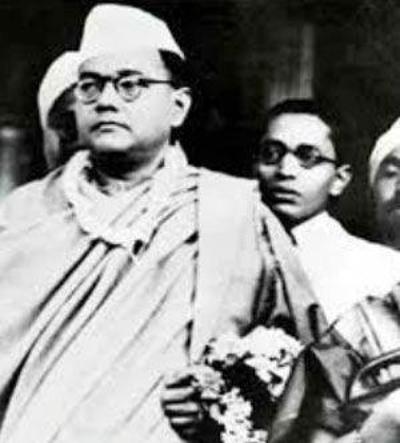
File photo of Netaji Subhash Chandra Bose.

Azamgarh :

With rumors amuck of late freedom fighter Subhash Chandra Bose making an appearance as the mysterious godman Gumnami Baba, Netaji’s driver Colonel Nizamuddin is now set to make headlines by opening a bank account at the ripe old age of 116-years.

According to Colonel Nizamuddin alias Saifuddin’s voter identity card and passport, which he produced as proof of identity before the State bank of India for opening the account, he was born in 1900.

In February this year, a Japanese man, who was believed to be the oldest man alive, passed away at the age of 114.

That way, Colonel Nizamuddin is the oldest human being alive on the planet right now as he completes 116-years 3 months and 14 days on Sunday.

Another startling aspect is that Colonel Nizamuddin’s wife, Ajbunisha, is 107 years old and the couple have opened a joint account with SBI.

Locals and the district administration were delighted to know about Colonel Nizamuddin amazing feat of being the oldest man alive. They are, infact, proud of the fact that such an elderly person is part of their neighbourhood.

source:  http://www.timesofindia.indiatimes.com / The Times of India / News Home> India / ANI / April 17th, 2016

Temple tragedy: Mamootty’s act of compassion

Kollam, KERALA :

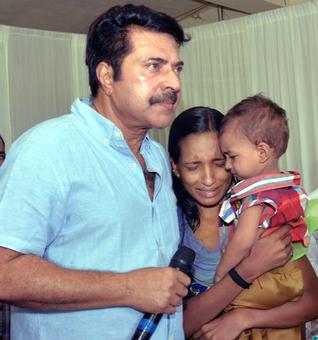
REACHING OUT:Actor Mammootty consoles Surumi who lost her husband in the Puttingal fireworks tragedy.— Photo: C. Suresh Kumar

Heartrending scenes were witnessed when the actor hugged siblings Krishna and Kishore who lost their parents in the disaster.

Film actor Mammootty undertook one of his most poignant roles in real life when he arrived at Paravur on Tuesday to comfort the traumatised victims of the Puttingal fireworks tragedy.

As he addressed the victims at the Kottapuram LP School hall in the township, Mammootty even whimpered and that had a relay effect on the audience, especially the victims.

The actor, who arrived there shortly after noon, spent more than an hour with the victims.

The gathering was jointly organised by the Puttingal Nagar Residents Association, the Mammootty Fans Association and the Patanjali Herbal Exports Private Limited.

Heartrending scenes were witnessed at the venue when the actor hugged the siblings Krishna and Kishore who had lost their parents in the tragedy.

He was seen comforting 21-year-old Surumi who had lost her husband Vishnu in the tragedy. Carrying her one-and-a-half-year-old son, she burst into tears as the cine star approached her.

The actor said comforting the victims was a herculean task. Still, if his presence there could make a little contribution, it would be precious to him, he said.

“The tragedy at Puttingal has no comparison.”

The thrust now should be the rehabilitation of the victims, especially helping them overcome their mental shock. “This is one tragedy in which the living victims cannot be comforted by mere words alone,” he said

Fireworks are a dangerous entertainment which should always be enjoyed from a safe distance, he added.

source: http://www.thehindu.com / The Hindu / Home> National> Kerala / by Special Correspondent / Kollam – April 20th, 2016

Mysuru ZP set to get First Muslim President

Mysuru, KARNATAKA :

Poll to take place on May 7

 Naeema Sultana
Naeema Sultana

Mysuru :

Mysuru Zilla Panchayat (ZP) is all set to get first Muslim Woman President, with Mysuru Regional Commissioner A.M. Kunjappa announcing the date for the ZP Presidential Polls.

The election to Presidential posts of Mysuru ZP, which threw up a hung verdict in the Feb. elections, will take place on May 7.

The Mysuru ZP President post has been reserved for BC(A) woman candidate, while the Vice-President’s post has been reserved for General category candidate.

With no party having an absolute majority in Mysuru ZP, the JD(S) and BJP are likely to have a tie up in order to take control of the ZP, with Naeema Sultana of the JD(S), who won from Annur ZP seat in H.D. Kote taluk, likely to become the President. As the JD(S) and BJP, which are likely to forge an alliance to wrest control of the ZP, have no other woman candidate belonging to BC(A), fortune seems to be smiling on the face of Naeema Sultana.

Although the Congress has the largest number of seats (23) in the 49-member Mysuru ZP, it has fallen short of majority. The JD(S) won 18 seats while the BJP 8.

Meanwhile, former PM and JD(S) Supremo, H.D. Deve Gowda, is said to have given nod to the K.R. Nagar JD(S) MLA S.R. Mahesh’s proposal to forge a tie up with the BJP and thus make a Muslim woman as the Mysuru ZP President for the first time.

Although the JD(S) party’s intention is to keep the Congress away from power wherever possible, the party top brass has given powers to local leadership to strike a deal for gaining control of ZPs across the State and accordingly, the JD(S) leadership is learnt to have given nod for forging an alliance with the BJP.

As far as other ZPs are concerned, the election to Presidential polls of Kodagu ZP, where the BJP has an absolute majority, is scheduled to take place on April 29, while that of Chamarajanagar ZP where the Congress has majority will take place on April 30, that of Mandya ZP, where the JD(S) has majority, on May 2 and Hassan ZP, where the JD(S) has absolute majority, on May 5.

source:  http://www.starofmysore.com / Star of Mysore / Home> General News / Monday – April 18th, 2016

Briefly

Madikeri, Kodagu / KARNATAKA :

Madikeri :

WORLD CONSUMER DAY

The World Consumer Day was celebrated recently in Madikeri under the joint auspices of Kodagu district administration, Food and Civil Supplies Department and Kodagu District Consumer Forum.

Mir Anis Ahmed, DC of Kodagu, inaugurated and V.A. Patil, President, Kodagu District Consumer Forum, presided over the programme which was attended by more than 150 people.

C.V. Nagaraj, retired Senior Chemist, Regional Agmark Laboratory, Bengaluru, demonstrated simple tests to detect adulteration in various food items. He also spoke about the harmful effects of various types of adulteration and on the laws that exist in India against food adulteration.

Associations interested in arranging such lecture-demos can contact C.V. Nagaraj ( 2521640, 9945651990).

CULTURAL FEST

The Department of Tourism and Hospitality Management, Pooja Bhagavat Memorial Mahajana Education Centre, has organised an inter-collegiate cultural festival on April 12 and 13. For registration contact festival convener Paul Iruthayaraj on 9739824423, Faculty coordinators Gunarekha B.S. on 9480438394 or Priyadarshan Bhat on 8867204780.

source: http://www.thehindu.com / The Hindu / Home> National> Karnataka / Mysuru – April 11th, 2016

Rare memorabilia of Meena Kumari on display

Meena Kumari
Meena Kumari

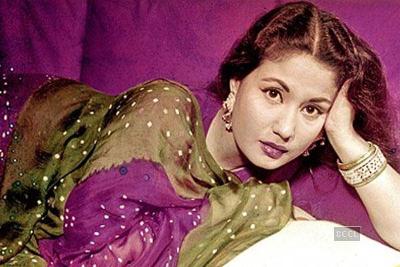
Iconic Bollywood actress Meena Kumari’s original publicity material and memorabilia, including paintings and portraits of her films, will be on the display at the Womanhood Festival here.

At the event, paintings of 1972 ‘Pakeezah’ and the 1953 classic ‘Daera’, co-starring Nasir Khan will be showcased. Portraits of Dilip Kumar-Meena Kumari starrer ‘Kohinoor’ and ‘Benazir’, co-starring Ashok Kumar and Shashi Kapoor, will be on the display at an event scheduled tomorrow at Osianama Liberty as part of the ongoing festival. Besides, posters of ‘Meena Kumari ki Amar Kahani’,  ‘Phool Aur Pathar’ and images of  ‘Sahib Bibi Aur Ghulam’ will also be featured.

The actress’ films like ‘Pakeezah’, ‘Parineeta’ and ‘Daayra’ will also be screened at the event. “She is a true icon for Womanhood & Cinema, absorbing all, breaking all, in the search to be herself… Along with Nargis and Madhubala, she represents the feminine iconicity just as ‘Mother India’, ‘Mughal-E-Azam’ and ”Pakeezah’ represents a different trinity of Indian cinema,”Neville Tuli, chairman, Osian’s Group said in a statement. Meena Kumari aka Mahjabeen Bano, starred in over 90 films in her career spanning nearly 30 years.

Listen to the songs of Meena Kumari on gaana.com

http://gaana.com/album/meena-kumari-hits

WATCH: Chalte Chalte Yunhi Koi Mil Gaya Tha – Meena Kumari – Pakeezah – Ghulam Mohammed – Old Hindi Song

https://www.youtube.com/watch?time_continue=5&v=hbkg1qapQ68

source: http://www.timesofindia.indiatimes.com / The Times of India / News Home> Entertainment> Hindi> Bollywood / PTI / February 04th, 2016

Seminar to know Kalam the poet

Chennai, TAMIL NADU :

Lucknow:

Hindi-urdu Sahitya Award Committee, Uttar Pradesh is organising an International Literary Seminar on the poetic contribution of the former Indian President APJ Abdul Kalam to literature.

The seminar is part of the annual celebrations of the committee which will be held on April 9 at Rai Umanath Bali Auditorium in Qaiserbagh.

Getting together people from both Hindi and Urdu backgrounds, the seminar will have writer and poet Ganga Prasad Vimal, Irtiza Karim, chairperson National Council for Promotion of Urdu Language, Yogendra Narayan and Qazi OR Hashmi, Jamia Millia Islamia among other academicians and poets.

source: http://www.timesofindia.indiatimes.com / The Times of India / News Home> City> Lucknow / TNN / April 08th, 2016

Women Icons – Before Sanjukta Parashar, there was another gritty female cop from Assam

The media may not remember Yamin Hazarika, but for many she is still an Assamese icon.

Yamin01MPOs09apr2016

Guwahati, ASSAM :

Since last week, there has been a flurry of news items in social and mainstream media about Sanjukta Parashar, the superintendent of police in Assam’s Sonitpur district. They gave instances of her bravado, heaped richly-deserved praises on her, and many of them described her as the “first female IPS officer from Assam”.

Sadly for me, the articles were a reminder that popular history, both in Assam and the rest of India, has forgotten all about Yamin Hazarika. That petite lady wore a heavy mantle at a time when women were still defining their roles in India. She was selected in 1979 for the state police services DANIPS (Delhi Andaman Nicobar Islands Police Services) and made it to Indira Gandhi’s security team. While it’s unclear whether she was later promoted to the Indian Police Services, most people in Assam saw Hazarika as no less than an IPS officer and a trailblazer in every way.

To those growing up in Guwahati in the ’90s, Hazarika was one of the few modern female Assamese icons. I met her only twice in my school years but she left a lasting impression on my young mind. She belonged to the Assamese Muslim community, from which few women icons had emerged until then. That impression stayed with me. So last week, when the news reports on Parashar began appearing, I decided to learn more about Hazarika. Who was she truly? To find out, I met her 80-year-old mother and her younger brother Yusuf Hazarika at their home in Guwahati.

Breaking barriers

Yamin Hazarika was born in the late 1950s in Lakhtokia, Guwahati, to Shameem Hazarika and Mohammed Serajul Hazarika. She was the second of five siblings.

Lakhtokia is one of the oldest pockets in Guwahati city that was designed by the British and houses some of the most elite and accomplished Assamese Muslims. Former Indian President Fakhruddin Ali Ahmed too was from Lakhtokia, and as my conversation with Hazarika’s brother revealed, their family is related to the late president.

Yamin02MPOs09apr2016

Her grandfather Ikram Rasul was the superintendent of excise in colonial times and was posted in Sylhet. Due to his involvement in the freedom movement, the family said, he was sacked from the job. Hazarika’s mother Shameem was one of the first female car drivers in Guwahati.

Hazarika started her schooling at St Mary’s Convent in Guwahati and passed her senior Cambridge examinations from Pine Mount Convent in Shillong. After that, she left for Delhi to read history at IP College. “She was a bright and studious girl who was always into her books and was completely no-nonsense,” recalled her brother.

After graduation, Hazarika pursued law in Guwahati and appeared for the UPSC examinations twice – first in 1977-78 and then in 1978-79 – clearing both times. She finished her police training at the Maharaj Ranjit Singh Punjab Police Academy in Phillaur, Punjab, where she met her future husband, Rajeev Sagar, who was an IPS officer from the Haryana cadre.

Yamin03MPOs09apr2016

“The results were delayed by over a year when she appeared the first time,” said Yusuf. “Those came out in 1979. By then she had already cracked her second attempt and qualified for the DANIPS [Delhi Andaman Nicobar Islands Police Services] and was part of Indira Gandhi’s security team.”

Does DANIPS qualify as part of the IPS system? One serving IPS officer said a DANIPS official is on par with an IPS officer since DANIPS is a feeder cadre for the IPS. “Yamin was indeed the first Assamese woman to be an IPS officer,” the serving officer insisted, though Scroll could not independently verify this claim. A query to the Ministry of Home Affairs revealed that DANIPS officials get promoted to IPS after certain years’ service. Either way, Hazarika went on to serve in important positions.

Hazarika was posted as  assistant commissioner of police in Chanakyapuri, Delhi, and after some time she was promoted to the position of deputy commissioner of police (crimes against women cell) in the capital. In 1998, she was sent to Bosnia as part of the UN peacekeeping force for three months. It was there that she was diagnosed with leukaemia and she had to return to India. Hazarika received treatment at the Tata Memorial Centre in Mumbai and at Delhi’s All India Institute of Medical Sciences, but she succumbed to cancer on July 25, 1999. She was only 43.

Strong but mild-mannered

The few articles on the web on Hazarika describe how she oversaw stringent measures to cut down sexual harassment of women on the capital’s streets. Yet, despite her strong cop persona, Yamin was mild-mannered. “Innu was a very simple and soft spoken lady,” said her brother. “She would hardly raise her voice or be rude.”

Her daughter Huma Hazarika Sharma added: “She was a strong person. Though she was a strict disciplinarian, she was also a fun-loving person. Everyone in the police force who interacted with her still has incredible things to say.”

An officer at the Hauz Khas police station in Delhi, where Hazarika was posted, spoke at length of the time when he served under her. “She was a very tough lady and even today I will salute her,” he said. “I learned so much from her. I cried a lot the day she died.”

Yamin Hazarika may have faded from the media’s memory, but she is still the first female Assamese icon for many. That includes me.

Shaheen Ahmed is a research scholar at the Jawaharlal Nehru University, Delhi, and a former journalist.

source: http://www.scroll.in / Scroll.in / Home> Women Icons / by Shaheen Ahmed / June 17th, 2015

HIDDEN HISTORIES – In Aziz Ul Mulk’s Garden

Madras (now Chennai),  TAMIL NADU :

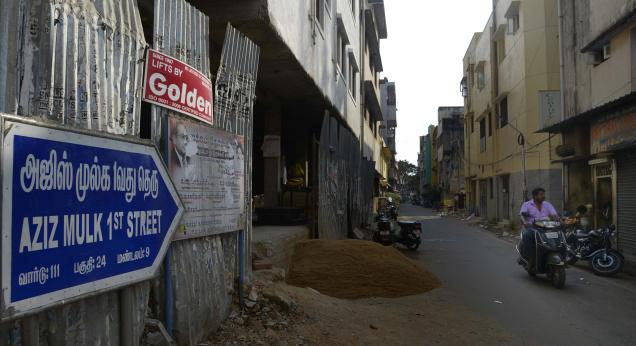
A view of Aziz Mulk Street off Model School Road. / Photo: V. Ganesan

Just beyond the Gemini flyover, Model School Road, Anna Salai and Graeme’s Road enclose a perfect rabbit’s warren of streets. There are nine of them, and they all take their name from Aziz Ul Mulk, a Muslim nobleman who once owned the entire area.

This was known as Aziz Baugh till the early 20th Century and was most likely more of a garden than the residence of the owner. When Sir William Thomas Denison, Governor of Madras, was leaving the city in 1866, he, his wife and daughter were invited for a farewell hosted by the Muslims at the ‘Gardens of Azeez Ool Moolk Bahadoor, Graemes Road, at 7 1/2 pm, on Saturday, the 24th of March’.

‘An evening entertainment in the gardens of a man bearing such a name!’ enthused Denison in his diary. He expected something out of the Arabian Nights and was not disappointed. The first family alighted in front of a wide, open verandah that was brilliantly lit, the brightness being enhanced by ‘suspended globular mirrors’. The hosts, all clad in white but sporting red turbans and sashes, stood on either side of the steps and ushered the guests to sofas at the rear of the verandah. A formal address was presented.

Dinner was in a shamiana to the side of this pavilion and ‘old Azeez Ool Moolk’ led Lady Denison to it, while the Governor was escorted by Nazim Jung, his son ‘who is an active intriguing man, a sort of politician in his way, and the presiding genius of the present entertainment’. Dinner was served in European style and described as a ‘tedious affair’ in which the English found much to their amazement that the hosts ate nothing but a ‘biscuit and some fruit’. Thereafter, the group moved to another shamiana where a nautch was presented.

‘Eight dancing girls, all dressed alike, stood in the centre of the apartment, each holding one of a cluster of eight ropes, which were suspended from the ceiling; and then with a slow and graceful movement passed to and fro, in and out, in such a manner as, by this movement only, to twist the eight ropes into a regular plait through their whole length, and then to untwist them, the whole being done by the dance only, without the application of the hands’. We would recognise this today as pinnal kolattam.

All this gaiety hid the fact that Aziz Ul Mulk was heavily indebted, mortgaging much of his valuables with the bank of Girdar Das Vallaba Das. Like the aristocrat in Satyajit Ray’s Jalsaghar, he was clearly spending his money on entertainment he could ill afford. Aziz Ul Mulk’s death is not recorded, but by 1868, the intriguing son — Sumsaum Ud Dowlah Bahadur aka Nazim Jung — was dead. The family finances must have declined thereafter, for, by 1902, we find the area recognised as a slum. Certainly, there is no trace of the garden where a Governor once dined.

source:  http://www.thehindu.com / The Hindu / Home> Features> MetroPlus> Hidden Histories / by Sriram V / Chennai – April 08th, 2016