Two Chinese have come to the land of Zamorin to find the final resting place of the Chinese explorer who conquered seas through willpower.
The goal of these researchers is to find the grave and the trading points of Zheng He, the explorer who landed in Kozhikode seven times on ships .
They are professor Haiyun Ma, a Chinese descendant who teaches history at Frostburg State University in the US, and Dr Shaojin Chai, a senior researcher at the UAE’s culture ministry .
Zheng He is a hero in China, where students learn about his adventures. They only know that he died in Kozhikode due to sudden illness. Chinese researchers have come to find out if there is anything in Kozhikode that reminds of him .
A Chinese had been buried at Cheenedath mosque in Valiyangadi. Though the team visited the mosque, they could not find anything specific. Haiyun Ma and Shaojin came to Kozhikode with the help of Abbas Panakkal, a fellow at Griffith University, Australia.
english.manoramonline.com
The man who brought Ma Huan
Zheng He, born in 1371, began his travel at the age of 28. He landed in Kozhikode in 1430 with Chinese silk, vessels, jars and fishing nets. He was received by the Zamorin. He returned to China with spices and other goods many times. Over the period, he brought 2,800 Chinese to Kozhikode. One among them was Ma Huan, a historian. It is said that Zheng He even took elephants and horses from here. It is not clear whether Zheng He, a Muslim, was buried on land or at sea .
source: http://www.english.manoramaonline.com / OnManorama / Home> News> Kerala / by Lenin Chandran / Saturday – January 09th, 2015
Javeed Ahmed, a 1984 batch Indian Police Service officer, was appointed DGP after Jagmohan Yadav retired on December 31. (Photo: @ANI_news Twitter handle)
Lucknow, UTTAR PRADESH / Patna, BIHAR :
Javeed Ahmed, a 1984 batch Indian Police Service officer, was on Friday appointed as the director general of police by the Uttar Pradesh government.
Ahmed, who had earlier served as the joint director of the Central Bureau of Investigation during central deputation, was serving as the director general (railways). The post fell vacant after Jagmohan Yadav retired on Thursday.
State principal secretary (home) Debashish Panda said Ahmed will take the charge on Friday.
There was a race among IPS officers for the top post after Yadav’s retirement. The officers played all the cards – caste, religion, loyalty to the ruling party, experience as well as closeness to the family members of the ruling Yadav family – to outdo each other for the coveted post.
No consensus could be reached even after several rounds of meetings. Suspense continued till late on Thursday night as home department officers remained in the office awaiting finalisation of the new DGP.
Sources said since chief minister Akhilesh Yadav was at his native village Safai, it was decided that the name of the new DGP will be announced on Friday.
source: http://www.hindustantimes.com / Hindustan Times / HT Correspondent, Lucknow / January 01st, 2015
Repository of the ancient wisdom of Unani medicine, 110 year-old Syed Mohammed Sharfuddin Quadri lives a Spartan and frugal life that has worked wonders for him, as Partha Mukherjee discovers
Almost 55 years ago, while I was journeying through a field in a cart, I caught sight of an old towering neem tree, immersed in soundless symphony with a swarm of fireflies. Barely five years old then, I didn’t know that the silhouette of a tree in hushed twilight silence would be a metaphor for a man around whom the sparkle of life never dims, even when ‘night’ tiptoes into his life.
Syed Mohammed Sharfuddin Quadri is famous for treating India’s first president Rajendra Prasad in Gaya in 1942-43 for breathlessness. Fondly known as Hakim saab, he has a photographic memory, sense of humour, never-say-die spirit and, above all, energy that never runs out. On 25 December 2011, he will turn 110. Yet he works for 17 hours at a stretch, preparing concoctions from dry fruits, herbs and roots and advising close to 100 patients (free of cost) every day. At 5 pm, every day through the year, Hakim saab attends to his patients at his Wellesley Square clinic in central Kolkata as well as those in the US. “Abba has patients all over America,” says his 40 year-old son Mohammed Sadique, who assists Quadri in his clinic. “He gives instructions to them over email or through a video conference. Earlier, he used to go to California, Los Angeles and New York, but now he’s restricted because of his gout.”
Sharfuddin Quadri answers all questions, except those about his achievements. Founder of the Unani Medical College and Hospital in Kolkata, Quadri published a magazine titled Hikmat-e-Bangala (Hikmat means Unani medicine) in 1959, which folded up soon for lack of funds. “Success means how much one has been able to help others,” he says, adding that he does honour the Padma Bhushan he was awarded by the President in 2007. He brings out the medal attached to his pocket by a silk ribbon. “I carry it to show my respect to the recognition of Unani treatment. Though I would be happier if I were given a grant so I could at least cover the place with a shed where my patients wait.” Indeed, patients wait for him for hours, sometimes till midnight, even in the rains. “There is no help from the government to collect herbs at a reasonable price,” adds Mohammed Sadique, Quadri’s youngest son (he has six siblings) who assists his father. “Sometime Abba is so frustrated that he thinks of giving up. If medicines aren’t available what is the use of continuing the treatment?”
From a family of hakim in the remote village of Kumrava in Nawada district of Bihar, Quadri trained in Unani treatment from Shafakhana Darsgah Tibbia (Gaya) in 1930. After immersing himself in the freedom movement, he started his practice in Calcutta where his family shifted in 1935-36. “Herbal medicines have a magical effect on our body; besides they have no side-effects,” he says sipping neem juice. If diagnosed, every disease responds to Unani treatment, Quadri claims, adding that with medication one must strictly follow instructions on diet and lifestyle as well. “During the diagnosis, one has to study the dam [blood], balgham [phlegm], safra[yellow bile], and sauda [black bile] of the patient [just like kapha, vata and pitta, the three dosha in Ayurveda], as they are the roots of all diseases,” he explains. “Anyone with any sort of ailment definitely has an abnormality in one of these.”
As for his own frugal diet—neem juice and half a piece of bread—he says, “The less you eat the more you live; the more you eat, the more you court ailments and health hazards. And to lead a healthy life you should have a healthy mind. My father lived to be 122 and never allowed any ignoble thought to cross his mind.”
How does he keep himself so physically fit even at 110? “I never sleep at night; I read books on Unani medicine when others are fast asleep. In the calm of the night, I try to explore things I don’t know about and let them melt into my inner self.” Unani medicine, he says, actually has its roots in Greece following extensive research by Hippocrates (460-377 BC). “It was he who laid the foundation of clinical medicine based on diet and symptoms.” He adds that a number of Greek scholars after Hippocrates—Galen (131-200 AD) followed by Arab physicians Rhazes (850-932 AD) and Avicenna (980-1037 AD)—enriched the system considerably. Rhazes and Avicenna authored Al-Hawi and Al-Qanun respectively, which were later translated into Latin and other European languages and taught in medieval European universities. They are said to have influenced western medical thought.
Unani medicine disappeared from the country of its origin, but found roots in India through Arab traders long before the Mughals. The Khiljis, Tughlaqs and Mughal emperors provided state patronage to Unani scholars and employed many as court physicians. The British imposed strict restrictions on every form of treatment but allopathy. Despite suspension of aid to Unani institutions, the system survived owing to the commitment ofhakim like Ajmal Khan, who served as the president of Indian National Congress in 1921—the Unani physician and scholar founded the Ayurvedic and Unani Medical College in Delhi.
Quadri reads till 4 am, when the city wakes up to fight for the day. “After my daily ablutions, I go to the mosque for namaz which involves many a yogic mudra—I do each of them,” he shares. “I walk back home at 5 am and sleep till 9, after which I go to my clinic. There’s no time to waste till 5 pm, when I go to the clinic, which I believe is the key to my fitness.”
Sharfuddin Quadri thanks his health for having been witness to an eventful century. The Dandi March with Mahatma Gandhi, confinement in Cuttack Jail and a memorable encounter with Maulana Abul Kalam Azad. “In 1943-44, in Ramgarh—then in Hazaribagh and now in Jharkhand—Maulana Azad was addressing the people and suddenly the skies opened up in a heavy downpur making everyone rush for sheds. Azad roared, ‘You are so scared of raindrops, what will happen when the British will rain bombs and bullets on you?’ And then no one moved even an inch.”
Finding his shadow lengthen by the day, Sharfuddin Quadri remembers Rabindranath Tagore through his lines and a brief meeting in 1912: Moron jedin diner seshe asbe tomar duare/sedin tumi kee dhan debe uhare?(When Death will knock at your door at the end of the day/What will you offer him as a gift?) “I wonder what I will be ready with to welcome the inevitable,” he signs off.
Featured in Harmony – Celebrate Age Magazine
July 2011
source: http://www.harmonyindia.org / Harmony India.org / Home> H People> Diary 100 / Featured in Harmony – Celebrate Age magazine, July 2011
RSRTC Chairperson Umrao Salodiya at press confrence where announced his decision to convert to Islam and apply for VRS from service, in Jaipur on Thursday. Photo: Rohit Jain Paras / The Hindu
After being denied the promotion that would make him the State’s Chief Secretary, senior IAS officer Umrao Salodia, a 1978 batch IAS officer from the Dalit community, on Thursday, appealed to Chief Minister Vasundhara Raje for Voluntary Retirement. Mr. Salodia, who alleged the Raje government of “victimising him on the basis of caste” also converted to Islam, on Thursday.
In a letter addressed to Ms. Raje, Mr. Salodia wrote: “For the first time after independence of the country, myself, an IAS officer from the SC/ST category would have been appointed today [on Thursday] as Chief Secretary [of Rajasthan] on the basis of seniority.”
In the letter, Mr. Salodia alleged that the current Chief Secretary C.S. Rajan was given a three-month extension, till March next year, to deny him the opportunity of becoming Rajasthan’s Chief Secretary.
“I hereby apply for Voluntary Retirement by giving a three-month notice under the All India Service Rules,” Mr. Salodia stated in the letter, adding that he must be granted the Voluntary Retirement as he did not wish to work under a junior officer.
In another drastic step, Mr. Salodia converted to Islam, on Thursday. While addressing the media he said that he believed in the equality that Islam, unlike Hinduism which discriminates on the basis of caste, offered to all its followers. “After conversion my name is Umrao Khan,” he said.
BJP dismisses claims
Rajasthan Parliamentary Affairs Minister Rajendra Rathore dismissed Mr Salodia’s claims. Addressing the media, on Thursday, Mr Rathore said that Mr Salodia had acted in violation of the law as he spoke against the government. “Mr Salodia’s allegations are baseless. Had the government discriminated on the basis of caste, the Rajasthan Assembly Speaker [Kailash Meghwal] would not be from the SC/ST community.”
“The government will get the matter investigated and will take a disciplinary action against Mr Salodia based on the results of the investigation,” Mr. Rathore said.
Congress condemns BJP govt
Condemning the Bharatiya Janata Party government in Rajasthan for “acts of discrimination against the Dalits”, Rajasthan Pradesh Congress Committee president Sachin Pilot said, “Mr Salodia’s appeal for Voluntary Retirement has put the working of the BJP government [in Rajasthan] under question. Also, it is tragic that the indifference of the BJP government led the senior officer to convert to Islam.”
Mr. Pilot added that Mr Salodia’s reaction is an expression of the increasing acts of discrimination against the Dalits in the State.
Mr Salodia, a 1978 batch IAS officer from Rajasthan cadre, is the Chairman of Rajasthan State Road Transport Corporation (RSRTC).
source: http://www.thehindu.com / The Hindu / Home> National> Other States / by Kavita Upadhayay / Jaipur – December 31st, 2015
He accompanied Mahatma Gandhi on his Dandi March and later spent several days with him in a prison in Cuttack. In 2007, he was conferred with the Padma Bhushan for his fight against the British in the freedom movement.
Late on Monday night, Syed Mohammad Sharfuddin Quadri, who was affectionately referred to as hakim sahab, passed away three days after celebrating his 114th birthday. His family had moved to `Calcutta’ in the mid-1930s.
Quadri, a renowned Unani practitioner, who was instrumental in founding the Unani Medical College and Hospital in Abdul Halim Lane in central Kolkata, was born on December 25, in 1901 when Kolkata was still the capital of the country and Mahatma Gandhi had not returned to India.
“My father was imprisoned with Gandhiji by the British in Cuttack. He would accompany him everywhere during the Civil Disobedi ence Movement,” said son Manzar Sadique in the family’s home in 849 Rippon Street. “In October, abba had travelled to Lucknow where he was the chief guest at a conference of Unani practitioners. Chief minister Ak hilesh Yadav had invited him over to his house,” in forms Sadique.
Hakimji He began his day with Fajar (the morning namaaz) at the break of dawn followed by his visit to his chamber, Swadeshi dawakhana on Haji Mohammed Mohsin Square, where patients would already be waiting for him. He would examine more than 100 patients everyday at free of cost, says son Sadique.
The centurion who specialized in treating infertility would never miss his customary walk after work. “He suffered from arthritis which is why he took special care of his fitness,” said Quadri’s son.
Hakim told his followers that he learned the secret to remain fit from his father who lived till 121.
source: http://www.timesofindia.indiatimes.com / The Times of India / News Home> City> Kolkata / by Zeeshan Javed, TNN / December 31st, 2015
East African Asian society was complex and contradictory as any truly multicultural society needs to be, and perhaps as only Indians can make it
Toronto, CANADA :
It is amusing to contemplate that if an Indian man, one afternoon in March 1498, had been able to swim, he would have escaped capture by Vasco da Gama off the Mozambique coast, and the world might have been different. The Indian, whose companions had managed to swim away, was called “Davane” by his captors; he was from the Gujarati city of Khambat (Cambay). Davane gave advice to da Gama on local matters and even assisted him in outwitting the local sultan, so that the Portuguese ships eventually anchored safely in Malindi, up north in present-day Kenya. Here he took a pilot, who was possibly a Gujarati, and reached the Malabar coast.
Portuguese sailors plying the Indian Ocean thereafter often wrote about the presence of Indians and Indian ships in Kilwa, Mombasa, and Malindi. Around 1500, Captain Duarte Barbosa observed, “These ships of Cambay are so many and so large, and with so much merchandise, that it is terrible to think of so great an expenditure of cotton stuffs as they bring.” The trading connection between India and East Africa is actually even older, as the carving of a giraffe on a wall of the Konark sun temple indicates.
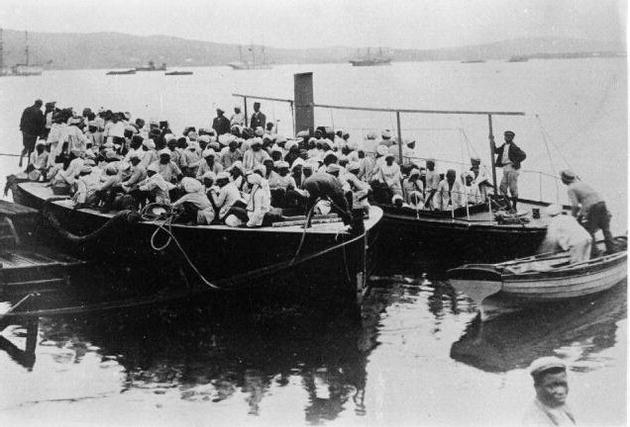
The arrival of Indians in South Africa by boat. / The Hindu Archives
It was in the nineteenth century, however, that Indians began arriving in numbers to trade and settle in Zanzibar, which was by then a major metropolis in the Indian Ocean with international connections, and home to the ruling Omani sultans. The more enterprising men ventured off to the small towns dotting the mainland coast. Most Indians arrived penniless from their drought-prone villages in Kathiawad and Kutch, and remained modest traders, but a few of them went on to become veritable merchant princes with spectacular wealth. Among them were Jairam Sewji, Ladha Damji, and Tharia Topan, to whose firms the sultans farmed out their customs collection and to whom they were often in debt.
Generation of tycoons
With the advent of British and German colonialism in the early twentieth century, Zanzibar’s commercial power and political influence waned, while the interior of East Africa opened up with new infrastructure and increasing trade. As a result, the Indians spread out all over the mainland, which now consisted of the three colonies of Kenya, Uganda, and Tanganyika. (In 1964 Tanganyika and Zanzibar joined to form Tanzania. The Indians went on to be called “Asians”.) The new generation of tycoons included Sewa HajiParoo, whose caravans went from Bagamoyo (near Dar es Salaam) all the way north to the Kilimanjaro region. His apprentice, Allidina Visram, topped him to become “the uncrowned king of Mombasa,” supplying the dukas (shops) that had sprung up from Mombasa to Uganda, and further in eastern Congo and southern Sudan. In 1890 A.M. Jeevanjee, a Bohra from Karachi, arrived in Mombasa and made his fortune supplying goods (and workers) to the Uganda Railway. Much of early wood-and-iron Nairobi was constructed by his firm; the city’s Jeevanjee Gardens was his donation.
By the mid-twentieth century every small town in East Africa had the characteristic Indian strip of shops, and in even the smallest village you would find an Indian family branch running the solitary Indian shop. The Asian population totalled 366,000, with the highest number, 176,000, in Kenya with its total population of around 9 million. Unlike elsewhere, Indians had settled in East Africa as communities; there were Bhatias and Khojas, Jains, Shahs, Patels, Lohanas, Sikhs, Bohras, Memons, Kumbhads, and others. In the cities, the larger communities like the Khojas had their own primary and secondary schools for girls and boys, hospitals, dispensaries, and community halls. Dar es Salaam, with roughly 100,000 people at the end of the 1950s, had at least five Asian cricket teams. Abject poverty was rare, and even the most straitened household could afford three simple meals a day. For us growing up in East Africa, it was India that was poor and backward, as revealed to us in the newsreels and Indian films of the period.
Complex and multicultural
East African Asian society was complex and contradictory as any truly multicultural society needs to be (and perhaps as only Indians can make it). Asians tended to live close to their own communities; caste discrimination persisted, as did Muslims sectarian differences. Yet by the standards we see today in the world, East Africans were largely tolerant. It was understood that you did your thing. The azaan would go off in the mosques, the Khoja ginans would blare out over loudspeakers from their jamat khanas, a temple procession would block a road, the Diwali fatakdas would explode in the Hindu sections (and elsewhere). There was hardly any inter-communal violence, and nothing to compare remotely with the communal and caste slaughter that seems so routine in India.
Undoubtedly the Asians were racist — looking up to the “Europeans” and down on the Africans, by whom, as middlemen, they were often resented. Intermarriage between communities and races was a taboo that was just beginning to yield as I emerged from my teen years. Because the poorest people were among the Africans, it has been broadly claimed and often in Shylockian language that Asians were their exploiters. Asian liberals like to wallow in self-guilt. I have often retorted that my widowed mother worked from eight in the morning to ten at night, running her small shop, barely making ends meet while raising five children; whom did she exploit? Today many Tanzanian African women run small businesses similar to my mother’s. We often forget the wealthy and sophisticated African peoples who owned land and cattle; and while many Africans had homes in their villages, most Asians in Africa did not. If Asians did not marry Africans, the Africans, with ancient traditions of their own, had their own taboos; to imply that they panted to lay hands on Asian women is itself racist.
At the end of the 1960s
Be that as it may, around East Africa’s independence, in the early 1960s, there was a thriving community of Asians who saw themselves as Africans. In Tanzania most would speak two Indian languages plus Swahili and English. Among the elite there was excited talk of the “new African Asian” identity. There were Asian politicians and budding writers — Wole Soyinka’s Poems of Black Africa (1975) includes, significantly, three young Asian poets from Kenya; Africa’s most influential and exciting literary magazine of the 1960s, Transition, was founded and edited by Rajat Neogy of Kampala; and Amir Jamal, Tanzania’s beloved minister of finance for many years, was elected in African constituencies. At the end of the 1960s, there was no doubt in my generation that Africa was our home and we were in the vanguard.
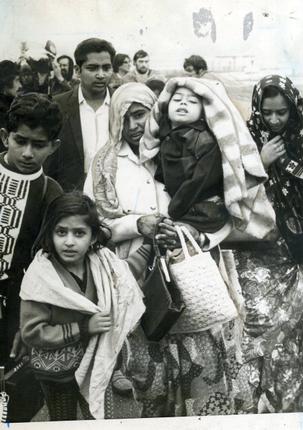
The first set of Ugandan refugees to arrive at Stansted Airport near London after then Ugandan President Idi Amin ordered them on September 18, 1972 to leave the country. / The Hindu Archives
And yet in the 1970s it all fell apart. Kenya’s Asians who had not renounced their British citizenships in time had to leave en masse. In Uganda, Idi Amin had a dream and expelled all the Asians in another “Asian exodus”. In Tanzania, in spite of Nyerere’s enlightened policies, his socialism, combined with the Idi Amin scare, drove out many Asians. What remains of the Asians today is a somewhat insecure and aggrieved population, though most appear dedicated to where they live. Racism of the old sort is gone; intermarriages do happen. At crowded kabab and bhajia restaurants in Dar es Salaam, it is truly pleasing to see Indians and Africans squeezed together at the tables. Indian cuisine has made a big headway especially in Tanzania; country bus stops often have a stand making chapatis; “pilau,” “biriyani” and “sambusa” are Swahili words. What thwarts complete integration is the Asians’ distinct features and cultures, often reinforced by their religious traditions.
A new crop of young Indians has started to arrive. When I see them, they seem foreign and lost. At times I get xenophobic — what are they doing here? do they even speak the language? — when I myself am now Canadian, but also an African Asian.
(M.G. Vassanji is the author of A Place Within: Rediscovering India, and most recently, of And Home Was Kariakoo: A Memoir of East Africa. He lives in Toronto. www.mgvassanji.com)
source: http://www.thehindu.com / The Hindu / Home> Opinion / by M. G. Vassanji / December 27th, 2015
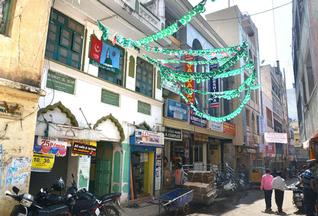
The Sangeen Jame Masjid at Taramandalpet in Bengaluru.— Photo: Bhagya Prakash k
Bengaluru, KARNATAKA :
In the congested old market area of the city, where vehicles and pedestrians jostle for space on narrow lanes, lies a tale of Tipu Sultan’s ingenuity that time seems to have forgotten.
It is in this small clearing, now flanked by a sprawling masjid, that thousands of workers had gathered nearly 300 years ago to cut metal, roll gunpowder into barrels and attach sharp metallic pieces to make the once-feared ‘Bangalore Rockets’.
All that remains now of this ingenious machinery that sustained Tipu Sultan through four wars against the British is the name assumed by the few buildings in the area — Taramandalpet , or roughly, the market of the constellation of stars, a name that refers to the pattern of mid-air explosions of these rockets that then rained shrapnel on an unsuspecting enemy.
Residents — primarily shopkeepers and staff of the masjid and madrassa — seem unaware of the place’s rich history that once fuelled Indian rocketry.
“Workers would prepare these rockets that proved very effective against the British. This would then be transported to the armoury at K.R. Market, which still exists,” says Suresh Moona, a historian.
The entire street was a sort of military laboratory, a fact seen in the unearthing of two cannons during the metro construction work between 2012 and 2015.
Much of these signs, however, have disappeared. Activists point out this irony: while the government announced celebrations of the Mysuru King’s birth anniversary — which ended in violent protests — recently, symbols of the Sultan in Bengaluru and even his birthplace near the swanky International Airport on the outskirts continue to fade away.
Syed Shafiullah, vice-president of the Tipu Sultan Publicity Committee, says: “One armoury that we saw is now just piles of thrash and shops. It is a shame that all of it is going. We have been persuading the government to preserve these areas, or at least, to highlight it. It should be a pride that the technology of the British army came from Karnataka,” he says.
source: http://www.thehindu.com / The Hindu / Home> National / by Staff Reporter / Bengaluru – December 27th, 2015
The announcement to honour Bollywood veterans Kumar, Amitabh Bachchan and a few others with the prestigious Padma Vibhushan award was made by the government on the eve of Republic Day on January 25, 2015.
Saira Bano, Dilip Kumar, and Rajnath Singh Image courtesy: ANI Twitter handle
Legendary actor Dilip Kumar was on Sunday presented the Padma Vibhushan by Union Home Minister Rajnath Singh at the thespian’s residence in suburban Bandra.
The 93-year-old legend was presented a medal, a certificate and a shawl by Singh, in the presence of the actor’s wife Saira Bano.
Maharashtra Governor C Vidyasagar Rao, Chief Minister Devendra Fadnavis, were among other dignitaries present at the actor’s home when he received the award.
The announcement to honour Bollywoodveterans Kumar, Amitabh Bachchan and a few others with the prestigious Padma Vibhushan award was made by the government on the eve of Republic Day on January 25, 2015.
However, Kumar, due to ill-health, could not attend the special function held at the Rashtrapati Bhavan in April when other Padma awardees were honoured by President Pranab Mukherjee.
Born as Muhammad Yousuf Khan in Peshawar, Kumar made his debut as an actor in the film Jwar Bhata in 1944 produced by Bombay Talkies.
In a career spanned over six decades, he starred in films of a variety of genres such as the romantic Andaz (1949), the swashbuckling Aan (1952), the dramatic Devdas (1955), the comical Azaad (1955), the historical Mughal-e-Azam (1960) and the social Ganga Jamuna (1961).
Called as the ‘tragedy king of Bollywood’, he also did films like Kranti (1981), Shakti (1982),Karma (1986) and Saudagar (1991) and others. His last film was Qila (1998).
The Government of India honoured him with the Padma Bhushan award in 1991, the Dadasaheb Phalke Award in 1994 and the Padma Vibhushan earlier this year, for his exceptional and distinguished contribution to the Indian cinema.
source: http://www.dnaindia.com / DNA / DNA Analysis> Home> Entertainment / Place: Mumbai, Agency:PTI / Sunday – December 13th, 2015
Amitabh Bachchan has hero-worshipped Dilip Kumar from the time he decided to become an actor. We can see traces of the Tragedy King’s style in the Bachchan’s early performances in Saat Hindustani, Anand and Parwaana. Later in Ramesh Sippy’s historic Shakti, he got an opportunity to share screen space with his idol. In a chat with Firstpost, Bachchan talks about the actor who influenced him the most:
Dilip Saab turns 93. Your thoughts?
I wish him glorious health. I wish him peace of mind. I wish him this days’ celebration, countless years ahead.
You’ve never concealed our admiration for Dilip Kumar. What makes him a role model for you and generations of other actors?
I have admired his performances, for to me they have remained beyond any fault. I have admired his intellect, and the way he has translated that into his work. And I have admired his clarity of speech in whichever language he speaks. Clarity in speech is to me the greatest acumen for an actor. You cannot have clarity of speech without the understanding of its graph and tenor. You cannot be a great actor without the benefit of these two elements in your expression – graph and tenor !
Amitabh Bachchan and Dilip Kumar. Image from IBN Live.
Which of your performances, scenes, have been most directly inspired by Dilip Saab?
None. That would be a sacrilege! I should be inspired by ‘the person’, to inspire me to perform or deliver what is asked of me professionally.
Please tell us about your first meeting with him
Our first shooting scene in Shakti was in a jail sequence, where the police official, but also my Father in film, comes to visit me and tries to convince me that I was taking a wrong path in life and I disagree. It was tough to stand in front of one whom you have admired for ages, and disagree with. But it was a job I had to do.
What were you thoughts when Ramesh Sippy offered you a chance to work with him in Shakti?
It was not Ramesh ji that offered me the chance to work with him; it was Salim-Javed who thought up the idea and the story.
What was the experience like? Did the two of you hit it off instantaneously? How easy/difficult was it fir you to adapt yourself to his method of working?
For me it was a moment of disbelief, until professional exigencies took over. He is a considerate colleague and senior, and never failed in those attributes when we worked together. I would one day share the same screen space with this tremendous talent that would explode in front of me. Never. And it still remains a illusion in my life to have actually been a part of a project which was headed by this thespian. God has been kind, very kind .
You did only one film with him. Any regrets about that?
We seek a moment of Godliness often in our life; it seldom comes, but when it does, you cherish it and remain in gratitude and satisfaction.
Which are your favourite films of Dilip Saab? And why?
All. And why? That would be insolent.
Many of his admirers feel he didn’t do enough work, that he retired too early. Your comments?
Describe ‘enough’. Can you ? No one has the ability to describe it for another. Our individual capacity gives us the liberty to describe it for ourselves. We need to respect that.
If you had the chance to do one of Yusuf Saab’s roles which one would it be?
I would never dare to even think of doing that .
source: http://www.firstpost.com / FirstPost.com / Home> F. Entertainment> Latest News> Bollywood News / by Subhash K Jha / December 11th, 2015
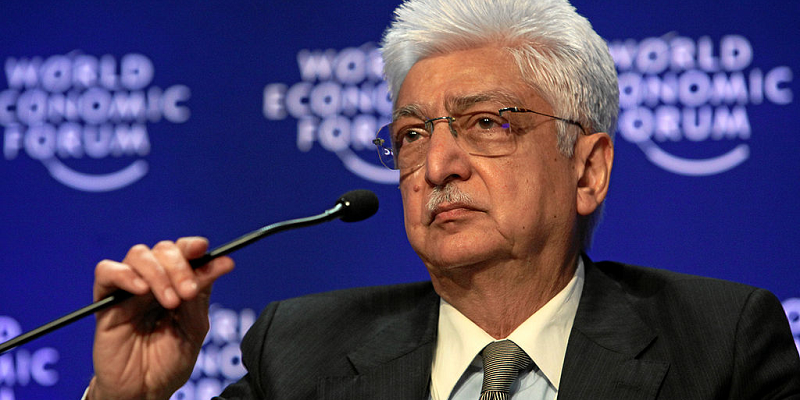
Is there such a thing as the art of giving? Apparently there is. Ask Mark Zuckerberg, who recently pledged 99 percent of his wealth to charity during his lifetime, or Warren Buffett, the guru of philanthropy, or Bill Gates. And closer home, Azim Premji, and maybe a handful of other corporate leaders.
Azim Premji believes charity begins at home.
Philanthropy is suddenly attracting a lot of attention. Though traditionally Indians have always donated to charity in their own little ways, it is usually the big billion dollar charities that get talked about. And who better to demystify philanthropy than Azim Premji who started his philanthropic initiatives systematically in 1999 when he set up the Azim Premji Foundation. He donated 40 percent of his shares of Wipro to not-for-profit philanthropic trust which forms the corpus of Rs 52 thousand crores or $8.5 billion. In the last two years, he has been leading an informal effort with like-minded peers to promote philanthropy.
Premji feels there are two reasons why wealthy Indians don’t give as much as Americans. “One is their families are much larger in terms of wealth sharing. Two, a majority of Indians who are wealthy believe that they must leave their entire money as an inheritance to their children.”
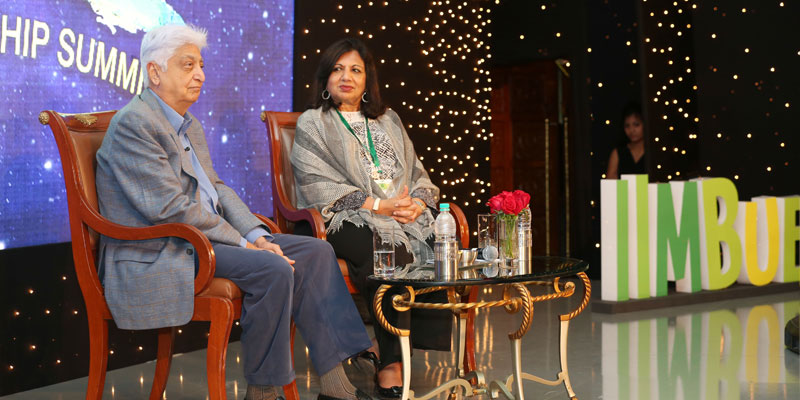
At the first IIM Bangalore Alumni meet, IIMBUE, in Bengaluru on Saturday, Kiran Mazumdar Shaw said if she had to write Premji’s biography, she would call it, ‘Giving it all.’
Here are the excerpts from the engaging fireside chat between Kiran Mazumdar Shaw and Azim Premji.
Azim Premji and Kiran Majumdar Shaw during the fireside chat at IIMBUE.
Kiran Mazumdar Shaw: What is it that influenced you to be so philanthropic? Was it something that was influenced from childhood?
Azim Premji: My greatest influence that encouraged me to go towards philanthropy was my mother. She was a doctor but never practiced medicine. She founded a children’s orthopedic hospital in Bombay (now Mumbai) for polio-stricken children, and children with cerebral palsy. She worked as the chairperson of that hospital from the age of 27 to almost 77. She devoted her whole life to raising money to run this hospital because the hospital depended on government grants which never came on time.
KMS: You have always been someone who has been careful with money. Someone who has avoided staying at five-star hotels and driving expensive cars. In fact, you are known to shun all status symbols. Was there an inflection point in your life that made you take to philanthropy in such a big way?
AP: The reason I give it (money) away is because it is the right thing to do. There is so much poverty, and misappropriation of funds and so many people are majorly disadvantaged.
KMS: There is a great saying that wealth and knowledge must be shared. It is about how we invest in society. How do you send this message to society and ingrain it in people?
AP: My biggest regret is I started too late. It was 14, 15 years back that I started in a small way in education in government schools in villages of India. We’ve really begun to scale in these past four years primarily because we saw such a strong need to uplift the quality of education in government schools. The reality is we started small and we started much later.
In a country like India, sharing your wealth with the unfortunate goes a long way. (Image credit: Getty Images)
KMS: I would like to take you to another part of your philanthropy which is the philanthropic initiative you have started with Bill Gates. And I must say I’m highly impressed by the time you devote to sensitising others in the corporate world about the concept of giving. Why do you think people need to be told and more importantly, why do you think people are so self-consumed and selfish about their wealth?
AP: (a moment’s silence) I think those are very loaded statements (laughter from the audience). You know I don’t think people need to be told. Most people know what their social responsibilities are. The reason I think the wealthy Indians don’t give as much as Americans — in fact, Americans are actually leaders in this – one is their families are much larger in terms of wealth sharing. Two, a majority of Indians who are wealthy believe that they must leave their entire money as an inheritance to their children.That acts as a deterrent. It is more prevalent in certain parts of India than in other parts of India. I think the more generous part of India is South India.
KMS: We are here with the present and future generation of wealth generators. How do you get the message across that they need to give some of their wealth to philanthropy?
AP: I think the present generation of the wealthy and the semi-wealthy demonstrate much more generosity. They either contribute time, effort, or money to philanthropy. So far the older generation is concerned one has to give examples to them. Keep on persuading them and hopefully, we’ll make a breakthrough. Actually, the people you’ve got to convince are the wives (laughter from the audience). Wives are socially more sensible and have more time at their disposal to lead initiatives of philanthropy. The husbands are much too busy making money (loud cheering and laughter from the audience).
Volunteering one’s time and effort to social causes are a good start towards philanthropy. (Image credit: Getty Images)
KMS: I think this is a great testimony to women and wives. You are here at the leadership summit of IIMB…so talking about giving back to alma mater. Is it important to give back to alma mater? Of course, it is a ridiculous question to ask because it is indefensible as an argument. But should one feel guilty about not giving back to the alma mater?
AP: No. I have not given back to my alma mater (loud cheer from the audience). I think the priority of our society far outweighs those of our alma mater. I think it is a matter of individual priority. But most wonderful universities of the world are significantly financed by their alumni.
KMS: But I am sure if your school or college reached out to you for help, you will not say no.
AP: They reach out to me all the time (laughter from audience).
KMS: So why do you say no?
AP: I just want to prioritise my funds to things which are more relevant to our country (applause from the audience).
KMS: I don’t like the applause that you got, Azim (laughter from the audience). Because I do believe that this has to become a part of our giving back to our alma mater. Because I believe that institutions are responsible for making us who we are today (cheer and applause from the audience).
AP: You got a louder applause (laughter from the audience).
KMS: I hope they mean it. Another question I wanted to ask you is when one looks at global business leaders, one associates philanthropy with entrepreneurial wealth whether it is Bill Gates, Elon Musk, Warren Buffet, or Mark Zuckerberg. Yet one sees a lot of other wealth creators in the corporate world like people in banks and hedge funds with huge salaries and stock options, isn’t that wealth creation as well, and shouldn’t they also be philanthropic? Because you don’t hear about that kind of philanthropy being articulated…the salaried class and employees. How do you create that kind of culture?
AP: I don’t know whether they are giving or not giving. I would be hesitant to make a harsh judgment. It just doesn’t get attention or get publicity.
(Image credit: Getty Images)
KMS: I think it is extremely important for media to cover stories of philanthropy from the salaried people.
Talking about philanthropic philosophy, how can businesses institutionalize it? Can we actually introduce a course on philanthropy in business schools?
AP: Oh! yes…and they can make you a professor (laughter from the audience). This kind of a course can generate a spark…
(After the Fireside Chat, Kiran Mazumdar Shaw opened it up to the audience to ask Azim Premji questions. Here are some excerpts.)
To a question on challenges he faced while giving away his money, Premji said, “The biggest challenge we faced is the size of the problem, the scope of the problem, and the depth of the problem. There was a high sense of frustration. However large an organization setup you are there is frustration that you do not have the bandwidth. We do rely on government machinery in what we do, and you have to keep at it, and keep at it.”
Interestingly, to a question on why he is not in politics, Premji replied, “Because it will kill me in a couple of years. I think you need to cultivate a sense of insensitivity to be in politics.”
But the session ended with the most profound thought from him which was an answer to a question on how does one decide when one should start giving.
“We had a meeting of our philanthropic initiative last week, and one of the panel members, whose family has been active in philanthropy, was telling us that as kids whenever they got money as gifts, they were required to give 25 percent of that to charity. And this was inculcated since he was two years old. That’s how you cultivate philanthropy.”