West Bengal State Music Academy will confer this year’s Allauddin Purashkar on sitar maestro Pandit Budhaditya Mukherjee.
The award, instituted in the name of legendary classical musician Ustad Allauddin Khan in 1987, carries a citation and a cash prize of Rs 25,000. Previous recipients of the award include Pandit Buddhadev Dasgupta, Pandit Manilal Nag and Manna De.
Mukherjee, who earlier won the Allauddin Khan Memorial Fellowship offered by the Madhya Pradesh government, plays sitar and surbahar in the Imdadkhani tradition of Etawah. Speaking to TOI, he said, “I am pleasantly surprised and honoured that the state government considered my name for this award.”
Academy’s member secretary and deputy director of information and cultural affairs department Malabasri Das said, “We will also honour dancer Vidushi Rani Karnaa with Uday Shankar Purashkar, tabla maestro Pandit Gobinda Bose with Jnan Prakash Ghosh Purashkar and Agra gharana vocalist Subhra Guha with Girija Shankar Purashkar for their contribution to various forms of performing arts.”
“I was born in Sindh in Pakistan. But Kolkata has been my second home for the last 40 years. It is great to see that the Bengal government has selected me for this honour,” said Karnaa, a disciple of Odissi legend Guru Kelucharan Mohapatra.
Chief minister Mamata Banerjee will hand over the awards to the maestros at an event at Nazrul Mancha on Tuesday.
source: http://www.timesofindia.indiatimes.com / The Times of India / Home> City> Kolkata / TNN / May 26th, 2015
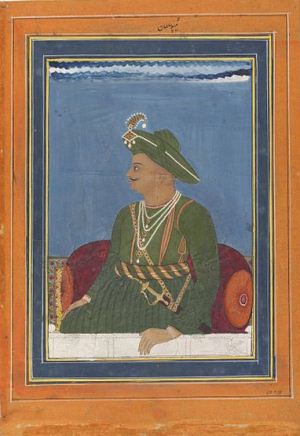
The Indian ruler and resister of the East India Company was killed by the British on May 4th, 1799.
Tipu Sultan, ruler of Mysore from 1782 to 1799
Tipu Sultan, the Tiger of Mysore, or Tippoo Sahib as the British called him, was the Indian ruler who resisted the East India Company’s conquest of southern India. Public opinion in England considered him a vicious tyrant, while modern Indian nationalists have hailed him as a freedom fighter, but both views are the products of wishful thinking. A small, plump man with a round face and black moustache, who wore clothes glittering with jewels, Tipu was vigorous, forceful, brave, warlike and cruel; a devout Muslim ruling a mainly Hindu population. He had inherited the throne from his father Haidar Ali, who had driven out the previous Hindu dynasty.
Tipu used to say it was better to live for two days like a tiger than drag out an existence like a sheep for two hundred years. He had a special reverence for tigers. He kept six in his fortress-city of Seringapatam (now Sriringapatna), 200 miles west of Madras, where his throne was shaped and striped like a tiger. His elite troops wore tiger badges, the hilt of his sword was in the form of a snarling tiger, and his favourite toy was a mechanical tiger straddling a British officer while the victim squealed in terror (it is now in the Victoria & Albert Museum). Tipu was determined to build a rich and powerful state and he was feared with reason by his subjects, his neighbours and other Indian princes, who joined forces with the British against him. He tried to build up an alliance to drive the British – ‘those oppressors of the human race’ – out of India and intrigued with the French in Paris and Mauritius. In dealings with them Tipu improbably donned a cap of liberty and expressed his sympathy with French Revolutionary ideals.
The British feared an invasion of India by Napoleon, and Lord Mornington, arriving in Calcutta as British Governor-General in 1798, decided to settle accounts with Citoyen Tipu. An army of East India Company sepoys and cavalry was assembled in Madras under General Harris with a contingent from the Nizam of Hyderabad, and the British Thirty-Third Regiment of Foot under Mornington’s younger brother, Colonel Arthur Wellesley (the future Duke of Wellington). In February 1799 the order to invade Mysore came, and the motley array toiled across the border accompanied by elephants and camels, thousands of baggage bullocks and flocks of sheep and goats to provide meat for the officers, as well as hordes of camp followers and a travelling market selling food and drink for the soldiery. Officers took along cooks, grooms, laundrymen and cleaning wallahs, and senior officers like Wellesley, who brought his silver-plated tableware with him, had thirty or more servants in their train. Moving ponderously in the burning heat, the army covered an area of eighteen square miles and on a good day managed to advance ten miles.
Tipu’s initial resistance was pushed aside and the British army sat down around the limewashed walls of Seringapatam which bristled with cannon. Soldiers captured by the sultan’s men were taken into the fortress and killed. Nails were driven into their heads or they were strangled by Tipu’s jettis, professional strongmen–executioners. Tipu sent placatory messages to the enemy commanders, hoping to delay matters until the monsoon arrived, but they continued with their siege works and cannonades.
When the morning of May 4th came, Tipu was told that the omens were not propitious. He tried to ward off misfortune by presenting the Hindu priests and Brahmins with a purse of gold, an elephant, a black bullock and two buffalo, a black nanny goat and a black coat and hat, but in vain.
The assault was launched soon after one o’clock by troops equipped with bamboo ladders for scaling the walls. Within minutes a British flag was planted in the breach as the defenders fled. Tipu himself fought bravely, dressed in his finest, loading and firing muskets handed him by his servants as if he was at a sporting shoot, but the odds were too great. He was wounded and his staff tried to hurry him away in a palanquin, but he was killed for his jewellery by an unidentified British soldier. As night was falling a British party found the sultan’s body under a heap of corpses. He was given honourable burial in his family mausoleum in the city.
The news of Tipu’s defeat and death caused excitement in England and his treasure-hoard provided ample prize money for the British senior officers. Harris was given a peerage and Mornington was made Marquess Wellesley. Arthur Wellesley was put in charge in Mysore and moved into Tipu’s palace, while the throne was bestowed on an infant member of the previous Hindu dynasty. The tigers were shot.
source: http://www.historytoday.com / History Today / Home> The Archive> India – Empire / by Richard Cavendish / Published in History Today – Volume 49, Issue 5 – May 1999
This photograph was taken in 1984 when the renowned Kannada poet, Prof KS Nisar Ahmed, was the president of Karnataka Sahitya Academy. A felicitation function had been arranged for Masthi Venkatesha Iyengar, the Kannada writer who had bagged the prestigious ‘Jnanapeetha Award’ for that year.
It was a memorable function in which many prominent writers had participated. After the function, some of the close friends of Nisar Ahmed, including myself, gathered to congratulate him on arranging the function in a fitting manner. It was then that this photograph was taken.
Nisar Ahmed had started writing poetry in Kannada when he was studying MSc in Geology at the Central College in the fifties. His poetry had caught the attention of his teacher and Kannada scholar GP Rajarathnam. He happened to read and correct his poetry and got it printed in the magazine of the Kannada Sangha of Central College. Later, poetry became his forte and he brought out one poetry collection after another.
He wrote prose too and translated two of Shakespeare’s plays. But he is recognised as a poet mainly as he has been writing poetry through all the literary movements of Kannada.Though his mother tongue is not Kannada, he has been writing in Kannada only.
Nisar Ahmed had also told the literary critics that he does not need any concession just because his mother tongue is not Kannada. He is also known as ‘Nithyostava Poet because his lyrics appeared in the first cassette of modern Kannada poetry under the same title. Since then, Nisar Ahmed has been a household name as one of the most popular among contemporary Kannada poets.
He was the president of the Karnataka Sahitya Academy between 1984 and 1987 and launched several programmes to take literature to the common people. In order to encourage young writers, many workshops were organised and lectures by eminent writers were arranged. He also organised a literary programme in every district and taluk head quarters and involved the local writers and the people in creating awareness about the current literary trends. He started the English edition of the Academy’s quarterly journal ‘Aniketana’.
It was devoted to the English translation of Kannada literary pieces. Thus, it enabled the non-Kannada readers also to get an understanding of Kannada literature through translations. I remember that he had organised a seminar as the president of the Academy in Kanakapura of Bangalore Rural District in 1986 on the last quarter century of modern Kannada poetry in which stalwarts of Kannada literary world including Prof M Gopala Krishna Adiga, Prof LS Seshagiri Rao, Dr Ramachandra Sharma, Dr Kamala Hampana had participated.
In the evening, there was a poets’ meet under the chairmanship of poet Dr Pu Thi Narasimhachar. It is worth mentioning that the seminar was attended by the people of Kanakapura in large numbers and actively participated in the interaction with the speakers of the seminar.
This photograph assumes importance for another reason. Two writers of yesteryears, namely the late Prof VM Inamdar and Prof Venugopala Soraba, are present in it.
source: http://www.deccanherald.com / Deccan Herald / Home> Supplements> MetroLife / by Prof. M S Raghunath / DHNS – April 06th, 2015
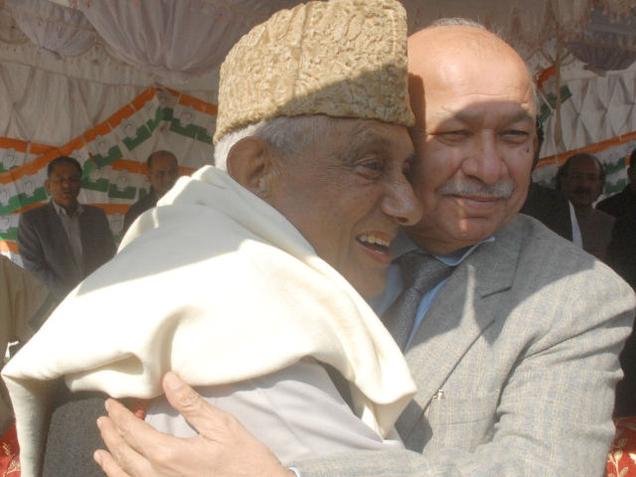
Former union minister Sushil Kumar Shinde (right) with veteran Congress leader Ghulam Rasool Kar at a rally. File photo / The Hindu
Kar became a member of the Jammu and Kashmir Constituent Assembly in 1951.
Veteran Congress leader and former minister Ghulam Rasool Kar, who was a member of the Constituent Assembly in 1951, died here on Friday after brief illness. He was 96.
A noted Parliamentarian, Kar, who hails from Sopore town in North Kashmir, breathed his last at SKIMS Hospital, his family said. He is survived by his second wife, two sons and two daughters.
Kar became a member of the Jammu and Kashmir Constituent Assembly in 1951 and the Jammu and Kashmir Legislative Assembly in 1957.
He served as a minister in the state government from 1965 to 1971 and 1972 to 1975. He was nominated as a member of Rajya Sabha in 1984 and elected to the Lok Sabha from North Kashmir Baramulla constituency in 1996.
He has also served as Jammu and Kashmir Pradesh Congress Committee President.
Senior National Conference leaders Farooq Abdullah and Omar Abdullah expressed grief over the death of the veteran leader.
source: http://www.thehindu.com / The Hindu / Home> News> National> Other States / PTI / Srinagar – April 10th, 2015
The State Legislative Council Friday condoled the demise of veteran politician of the State Ghulam Rasool Kar who passed away in the wee hours today.
According to an official statement, Minister for Education Naeem Akthar moved the resolution to mourn the death of senior Political leader Ghulam Rasool Kar. Various members of the House including Ghulam Nabi Monga, Zaffar Iqbal Manhas, Sajad Ahmad Kichloo, Muzaffar Ahmad Parray and Dr. Bashir Ahmad Veeri spoke and shed light on the political career of Mr. Kar. They also expressed solidarity with the bereaved family and prayed for eternal peace to the departed to the soul.
Acting Chairman, Legislative Council, Jahangir Hussain Mir described late Kar as one of the tallest political leaders of the State who was responsible in transforming the political thought in the past years, the statement informed. The Legislators said that it was due to tireless efforts of people like Mr. Kar that masses of the Valley generated interest in politics and political activities of the State.
The House also observed 2 minute silence as a mark of respect to the departed leader, it added.
source: http://www.kashmirlife.net / Kashmir Life / Home> Latest News / KL Report / Friday – April 10th, 2015
Like pacemaker, a Bionic Pancreas device for diabetics by 2017
Mysuru :
Former President Dr. A.P.J. Abdul Kalam said that a permanent cure would be found to diabetes in three years.
Speaking at the recently held valedictory of Sri Jayachamarajendra College of Engineering (SJCE) Golden Jubilee celebrations here, the former President hailed the stem cell research by Harvard University which led to the production of insulin secreting beta cells in the pancreas.
He said it was one of the breakthroughs in modern day science.
Dr. Kalam said that scientists had successfully managed to produce insulin generating beta cell, which could provide permanent cure for diabetes that has troubled majority of population across the world.
He also added that studies were still on to know the reasons for the pancreatic cells to stop producing insulin.
Types of Diabetes
Type 1 diabetes (formerly called juvenile-onset or insulin-dependent diabetes), accounts for 5 to 10 out of 100 people who have diabetes. In type 1 diabetes, the body’s immune system destroys the cells that release insulin, eventually eliminating insulin production from the body. Without insulin, cells cannot absorb sugar (glucose), which they need to produce energy.
Type 2 diabetes (formerly called adult-onset or non-insulin-dependent diabetes) can develop at any age. It most commonly becomes apparent during adulthood. But type 2 diabetes in children is rising.
Type 2 diabetes accounts for the vast majority of people who have diabetes — 90 to 95 out of 100 people. In type 2 diabetes, the body isn’t able to use insulin the right way. This is called insulin resistance. As type 2 diabetes gets worse, the pancreas may make less and less insulin. This is called insulin deficiency.
US device to overcome diabetes
Ed Damiano, a professor of biomedical engineering at Boston University, has made it his mission to build a portable, wearable Bionic Pancreas, a device he hopes to have on the market as early as 2017, when David, his son, is set to go off to college.
David was diagnosed for Type 1 diabetes when he was two-months-old by Dr. Toby Milgrome, his mother.
source: http://www.starofmysore.com / Star of Mysore / Home> General News / Friday – April 03rd, 2015
The Entrepreneurship Cell of IIT-Kanpur organised TEDx on Saturday. In this event, seven visionaries and performers from different fields narrated their stories before the audience both from IIT-Kanpur and the city.
The event started with a formal inauguration by IIT-K director Indranil Manna and Prof B V Phani. The first talk was given by Ad-man Abhijit Avasthi, followed by Amit Deshpal, a graduate from IIT-Madras in 2008 and joined the private equity arm of World Bank. Inspired by Tagore’s and Tolstoy’s thoughts on education, he quit his job a year later to start a learning space for children.
He spent nearly three years travelling around the country learning from different places and tried to understand meaning of education beyond formal schooling.
Talks were also delivered by renowned pantomime artist Padma Shri Niranjan Goswami and Anand Patwardhan, a critically acclaimed and socio-political documentary film-maker and activist. Other speakers were Irfan Alam, a social entrepreneur based in Patna working towards organising and empowering rickshaw-pullers through his organisation Sammaan, Aabid Surti, National Award winning author, artist and playwright-turned-environmentalist, Dipendra Manocha, founder of Saksham Trust that works towards developing communication devices for the visually impaired. The organisers of TEDx said that these talks may seed the notion of entrepreneurial zeal in individuals to think differently and act smartly. Many entrepreneurs and well-known people of the city attended the programme.
source: http://www.timesofindia.indiatimes.com / The Times of India / Home> City> Kanpur / TNN / March 29th, 2015
Agra is a home to around 100 centrally protected monuments. Most tourists, however, visit only the Taj Mahal, Agra Fort and the nearby Fathehpur Sikri. Union minister of state in the Human Resources Ministry and Agra MP Ramshankar Katheria has now sought that the Centre take steps to promote Agra’s less popular tourist destinations, so that those arriving in the city are also encouraged to stay longer.
Among the lesser known monuments are the tomb of Mariam-uz-Jamani, Rajput princess who married Mughal emperor Akbar and mother of Jahangir. The structure in which the tomb was laid was built originally by Sikandar Lodi in the late 15th century; the tomb was laid in it by 1623, and a crypt was made below the central compartment by the Mughals, who substantially remodelled the structure.
The Roman Catholic cemetery in the Civil Lines area, considered among the oldest Christian cemeteries in north India, is also a little-visited spot of tourist interest. Many early European adventurers and travellers have been laid to rest here. Many of the gravestones date back to the 17th century.
Chini ka Rauza (chini refers to the colourful tiles; rauza is a funerary monument) is the tomb of Allama Afzal Khan Mullah, who served as prime minister in the court of Shah Jahan. It dates back to the year 1635. The building represents a milestone in Indo-Persian architecture, and is the first building in India to have the glazed tiles that give it its name.
Kanch Mahal at Sikandra, near Akbar’s tomb, was used, some historians say, as a hunting lodge by Jahangir. This monument too is not very well known to visitors to the city.
Just five km from the Taj is Ram Bagh, the oldest of Mughal gardens in India – laid by the founder of the dynasty, Babur. This garden too does not see as many visitors as it might, if it were better promoted.
Mehtab Bagh, an integral part of the gardens around the Taj, also sees few visitors. The Chhatri of Raja Jaswant Singh – which some claim is the only monument built by a Hindu in Agra in the time of Mughal rule – is also a neglected monument.
Katheria pointed out that the website of the Archaeological Survey of India (ASI) does not offer descriptions of the lesser known monuments. Information and photographs of these too should be uploaded, the minister said, in a letter to Union tourism minister Mahesh Sharma.
Sources said Katheria was raising this issue as Mahesh Sharma is set to visit Agra on April 8.
Rajiv Tiwari, president of the Federation of Travel Agencies, said, “Many less known monuments are dilapidated, many have become a den for anti-social activities. Travel agents cannot risk allowing guests to include them in their itinerary.”
source: http://www.timesofindia.indiatimes.com / The Times of India / Home> City> Agra / by Aditya Dev, TNN / April 04th, 2015
The Nizam was one of the principal donors to the school prior to Independence, and it continues to have a house named after the city
One Prime Minister, several Chief Ministers and prominent politicians, exponents in art, drama, film and literature, sporting icons and top bureaucrats and militarymen – The Doon School has all of them and more on its list of alumni.
Interestingly, the prestigious Dehradun-based school has a Hyderabad connection. The Nizam was one of the principal donors to the school prior to Independence, and the school continues to have one its houses named after Hyderabad.
Students from Hyderabad were a prominent presence till the 1960s, while now the school has only a dozen students who hail from the city.
However, Doon is now trying to reconnect with students from the Telugu-speaking States. “We find that students from AP and Telangana flourish and thrive with us intellectually, creatively and sportingly and we want to further strengthen it,” the school’s headmaster Peter Mclaughlin told The Hindu .
Headmaster Peter Mclauchlin says the prestigious school is trying to reconnect to students from theTelugu-speaking States.– Photo: Special Arrangement
Dr. Maclaughlin, who was in Hyderabad to speak to parents and students on the education Doon offered, said efforts had been made to make the school more democratic and meritocratic.
“The educational landscape is changing dramatically in India, and historic schools cannot sit on past glory. Such an attitude is a great enemy,” he said, revealing that school has students from diverse social and economic background.
To maintain such diversity, the school has consciously made efforts to admit meritorious children from economically backward sections of society. Around 40 per cent students get some scholarship, including a 100 per cent concession on fee. After the Central Government discontinued its scholarship scheme, it is the school’s alumni who are supporting such students.
‘An all-India school’
Dr. Maclaughlin reminds that India is fractured by regional, religious and ethnic mindset.
“They take pride in their identity, but are rooted to their Indianess. An all-India school like ours offers precisely such an atmosphere, where students thrive on learning from each other and respect other’s values.”
Dr. Maclaughlin felt students from southern India gravitate more towards science and math, while those from the north have interests in commerce and economics. Southern students also show a keen interest in creative arts like music and dance. They are more focussed too, he said.
source: http://www.thehindu.com / The Hindu / Home> News> Cities> Hyderabad / by R. Ravikanth Reddy / Hyderabad – April 06th, 2015
Pallavaram Municipality to use defunct school building for it
The dilapidated building that once housed the Parali Su. Nellaiyappar Municipal Primary School in Chromepet will soon be developed as an integrated skill development centre for differently-abled and aged persons.
Pallavaram Municipality has allocated Rs. 1 crore from its education fund for the purpose. Announcing this at a recent meeting, municipal chairman, K.M.R. Nissar Ahmed said the centre would impart skills to differently-abled and senior citizens.
The land was donated by freedom fighter-writer-poet, Parali Su. Nellaiyapper, who lived in Chromepet from 1950s till his death in 1971. The philanthropist was awarded 3.16 acres of land by the State Government in 1954 from which he donated about 5000 square feet for starting a primary school in 1968.
After several years of its existence the school lost its sheen and was closed more than a decade ago.
“After several representations, the municipality felt the importance of such a donation and allocated Rs. 1 crore for the development of a training centre. The purpose of donation by the late poet should be preserved and if expedited it will be a boon to the downtrodden,” said PMK councillor J.M. Sekar.
Residents recalled that the school was functioning well, but patronage dwindled after the proliferation of private schools. The municipality decided to close down the school after enrolment dipped, they said. Some years ago when the civic body wanted to use the premises for performing birth control surgeries on community dogs, residents protested, stating that a building in the memory of a freedom fighter should be put to use for better purposes.
source: http://www.thehindu.com / The Hindu / Home> News> Cities> Chennai / by T. Madhavan / Chennai – April 06th, 2015