Oscar-winning sound designer Resul Pookutty of Slumdog Millionaire fame says musical elements define his idea of space and time.
He wanted to be a physicist and win the Nobel Prize. Instead, he became a sound designer and won an Oscar. “Not a mean achievement for a boy who walked miles to school in Kerala and studied under a kerosene lamp. Maybe superconductivity was not really for me,” says the 43-year-old Resul Pookutty, who along with Richard Pryke and Ian Tapp, won the Academy Award for Best Sound Mixing for Slumdog Millionaire in 2009.
Pookutty, who has co-produced and designed sound for the Hindi film, Nanak Shah Fakir, based on the life of Guru Nanak Dev, insists that the experience of working for the movie was nothing short of spiritual. “Before signing, I saw 40 minutes of the footage and was spellbound. It was sheer visual poetry. Nothing like that has ever been attempted in mainstream cinema before. When I met the director, Harwinder Sikka, a man who had no experience in the film industry but was guided by a dream to make this film, I instantly decided to become a part of his journey,” says the sound designer, who received the Padma Shri honour in 2010.
Pookutty, who shot to fame after designing the sound for Sanjay Leela Bhansali’s Black, says little or no importance is given to sound designing in India. “We are a 5000-year-old civilisation. As a culture, we have transferred knowledge through memory and not just the written texts. Sound was knowledge. Is it not surprising that we still underestimate the power and magic of sound,” says Pookutty. He recorded the sound of vacuum and Shimla’s ambient sounds in a shankh, then extracted out living elements to produce what you heard in Black.
A Film and Television Institute of India (FTII), Pune graduate, who failed the interview round the first time he appeared for it, Pookutty believes that formal training in arts is indispensable to broaden an artiste’s horizons. “You become organised. Then begins the process of personal reinvention influenced by exposure to works of masters and thought processes of fellow students. One is taught the history of the art form, which not only helps in the understanding of the art’s evolution but also, aids your own,” he says. Looking 14 years back, when the industry did not use even good microphones, Pookutty, who has been making a ‘sound library’ for more than a decade now, says, “I could have settled and worked in the anywhere in Europe, but the whole metaphor of my art is right here and I have always striven to make sound as realistic as possible, and also showcase that at times silence can be most deafening.”
Attributing his success to wife Shadia, who, he says, keeps him sane and has always allowed him to follow his dreams, the sound designer, who suggested A.R. Rahman’s name to director Danny Boyle for Slumdog Millionaire, is always open to working in the regional industry including Punjabi. “I don’t see the script in terms of the language but the magic it is capable of producing. I was supposed to work on the 3-D Punjabi animation film Chaar Sahibzaade but could not because of time constraints. Give me something that will completely bowl me over, and I am in,” he says.
source: http://www.indiatoday.intoday.in / IndiaToday.in / Home> News> Archive> Supplements> Simply Punjabi / / by Sukunt Deepak – May 01st, 2015 / May 11th, 2015
A sharp shooter from Masinagudi village in the Nilgiris returned home after successfully managing to drive a rogue elephant back to forest area in Jharkhand last week despite orders from the Bihar government to shoot it. The tusker killed eight people in Bhagalpur area in Bihar in a span of four days in the first week of June.
Nawab Shafath Ali Khan, a shooter from Hyderabad, is currently a resident of Masinagudi.
An authorized tranquilizer of wildlife, Khan was called by the Bihar forest department on June 5 as a rogue tusker had strayed into Bihar from the adjoining forests of Jharkhand. “While I was capturing blue bulls in forests around Delhi, I received a call from the Bihar forest department,” Khan told TOI.
Khan has trained forest officers and veterinarians of Karnataka, Telengana, Madhya Pradesh, Andhra Pradesh, Bihar and Himachal Pradesh.
The rogue tusker, aged about 20, had entered the town of Bhagalpur in Bihar on June 4 and in a span of four days it killed eight people, including three women and a child, who came in its way.
Khan was summoned to kill the elephant and he flew to Patna from Delhi and from there he was flown to Bhagalpur by the chief minister’s special aircraft. Armed with his 470 double barrel rifle he took charge as designated chief of ‘Operation Rogue Elephant’ and over 100 forest officials were in the operation team to assist him.
Khan said he didn’t want to kill the elephant as it was very young and instead strategically made the pachyderm follow him to the nearest forest which was 12km away in Jharkhand.
“I am happy that during the operation neither the animal nor any human was harmed,” he said.
Khan returned home a couple of days ago after being applauded by the chief minister of Bihar Nitish Kumar for his efforts.
source: http://www.timesofindia.indiatimes.com / The Times of India / Home> City> Coimbatore / by Shantha Thiagarajan, TNN / June 15th, 2015
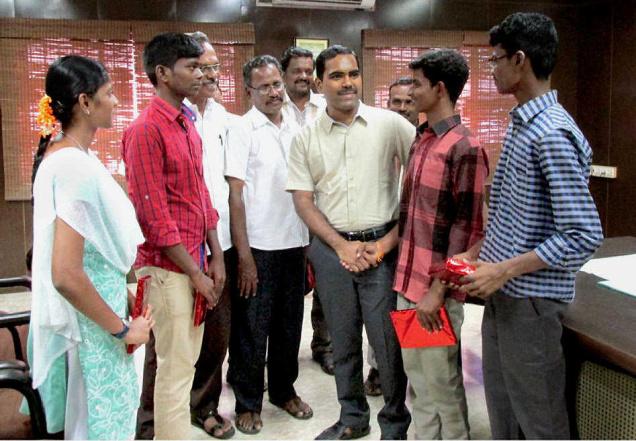
Collector (in-charge) Madhusoodhan Reddy congratulating the ‘Super 30’ group students who have been allotted seats in medical colleges, in Perambalur on Saturday.
Standing on the threshold of realising his childhood dream of becoming a doctor, B.Prasanth, an Arunthathiyar student from a poor family of agricultural labourers from Irur in Perambalur district, is not sure whether his mother would be able to raise the fee for the course.
He is one of the three Dalit students who have secured MBBS admission from a group of 57 students who were handpicked from government schools of the district for special coaching in Plus-Two under the ‘Super 30’ initiative of the district administration. A Dalit girl has bagged a BDS seat, bringing acclaim to the district and the special initiative.
With a Plus-Two score of 1,108 marks and a cut-off of 193.25, Prasanth has been allotted a seat in the Chenglepet Government Medical College. Prasanth is supported by his mother, a farm hand. His father, also a farm worker, spends most of his earnings on liquor.
“I have to pay a fee of Rs.11,000 now. My mother is trying to raise the money and officials have promised to arrange for a loan. But I am not sure whether these will materialise. I am looking for sponsors,” he said speaking to The Hindu over phone.
P.Prakash of Ladapuram, with 1,140 marks in Plus-Two, and T.Aravindaraj of Kolathur, with a score of 1,119, have been allotted seats in the Stanley Government Medical College and Tuticorin Medical College, respectively. M.Manjula of Nattarmangalam, with a cut-off of 191.75, has been allotted a BDS seat in the Chennai Government Dental College and stands a chance of getting a MBBS seat as she is on the wait list. Inspired by District Collector Darez Ahamed, Prakash wants to enter the Civil Services after MBBS.
All the four students belong to poor families of agricultural labourers, says N.Jayaraman, district coordinator, ‘Super 30’. There are about 15-20 other students from the group with good engineering cut-off marks and are hopeful of getting BE seats, he said. A brainchild of Mr.Darez Ahamed, the ‘Super 30’ idea is being implemented over the past couple of years in the district.
All are from poor agricultural families and need assistance to pursue studies
source: http://www.thehindu.com / The Hindu / Home> News> National> Tamil Nadu / by S. Ganesan / Perambalur – June 28th, 2015
The pathos of Princess Jahanara’s life is reflected in her grave too
Jahanara Begum led a life of hardships and now more than 300 years after death her agony continues as her grave lies neglected with the Archaeological Survey of India (ASI) and the Nizamuddin Dargah Committee washing their hands off the matter. The ASI says guards are there only to protect the tomb from vandals while the Nizami family, trustees of the shrine of Hazrat Nizamuddin, contend that the ASI is the caretaker since the grave comes under the Ancient Monuments Preservation Act. As it cannot circumvent this it is just a helpless onlooker. But the fact remains that the grave needs repairs and clearing of waste left behind by pilgrims to the adjacent shrine, most of whom don’t even know who Jahanara was!
Illustration by Vinay Kumar
It’s not so much grass that grows on Jahanara Begum’s grave these days as shrubs. Her wish to be buried in a “kuccha” grave was duly fulfilled though a sarcophagus protects it from the elements, open as it is to the sky but situated in an enclosed chamber with perforated marble screens, south of the Dargah of Hazrat Nizamuddin Auliya. Still, when one sees it, one is reminded of the Persian poet Sadi’s poignant lines :
“I saw some handful of the rose in bloom with bands of grass suspended from a dome/I said, ‘What means this worthless grass that it should in the rose’s fairy circle sit?”/Then wept the grass and said, ‘Be still and know the kind their old associates ne’er forgo/Mine is no beauty here or fragrance-true. But in the garden of the Lord I grew.” No wonder grass springs up like hope eternal even on old forgotten monuments, where no roses may bloom. Grass is never a deserter. That was why Shah Jahan’s eldest daughter wanted it to grow on her grave.
Forced spinsterhood found an outlet in poetry and both Jahanara and her sister Roshanara gave vent to their feelings in verse. Persian was the language employed, as Urdu was considered the camp language and was yet to take over its predominant position. Persian similes and metaphors, like the jam (wine cup), the shama (lamp), the moth, the mythical mountain Kohkaf and the bulbul were hardly considered alien at a time when the ambience at the Mughal court was the same as that of Persia, Arabia or Turkey. As a matter of fact, even present day Urdu poetry waxes eloquent on them – and who doesn’t enjoy this escape to a romantic past, so far removed from the mundane image of the modern age when Kohkaf has been identified as the Caucasus mountain?
Even such a selfless person as Jahanara must have no doubt yearned for someone, who could be the master of her heart. Her emotions are portrayed in her poetry, which is that of a pious woman deeply attached to her Maker. She was also a great lover of gardens and laid the Begum Bagh in Delhi, in which was also situated the Begum Sarai. Outside the bagh was the Chandni Chowk, which was also her creation. After Aurangzeb came to power Jahanara preferred to stay with her father, who was held captive in the Agra Fort for seven years until his death on 16th January, 1666. She became a recluse after that and patronized mystics and mendicants until her own death. As per her wishes, she was buried in the tomb she had built for herself in 1681, next to the shrine of the saint she held in high regard.
The hollow sarcophagus is the receptacle, in which the grass grows in accordance with her epitaph. “Let naught cover my grave save the green grass, for grass will suffice as covering for the lowly.” And yet she was the one, who was once the virtual ruler of Hindustan and whose “pandan kharch” (betel leaf expenses literally but pin-money in this case) which was met by the revenue of two flourishing ports of the Mughal empire. Sleep well, gentle princess!
When Rudyard Kipling visited her grave in the 19th Century he couldn’t help comparing her to Christina Georgina Rossetti, the celebrated sister of Dante Gabriel Rossetti (1828-1882) writer of the famous poem “The Blessed Damozel”. Christina too died a spinster in 1894 when the last of the Mughal princess were still alive in the Mori Gate. Hence Kipling’s poignant comparison of the green grass growing over their lowly graves, with Christina’s words ringing in his ears; “Be the green grass above me/With showers and dewdrops wet…/I shall not hear the nightingale/Sing on as if in pain/And dreaming through the twilight/That doth not rise nor set/Haply I may remember/And haply may forget.” Few indeed forget Christina Rossetti after visiting her last resting place! The same is true of Jahanara.
source: http://www.thehindu.com / The Hindu / Home> Features> MetroPlus / by R. V. Smith / June 21st, 2015
Tasneem Fathima Khaleel has had a successful career in academia. However, quite remarkably, she came back to where she started – teaching. M A Siraj reports.
Few people end their careers where they first began; Professor Tasneem Fathima Khaleel is among those few. “I am excited about the opportunity to finish my career in the classroom. And, with a little help, I will be teaching in a new state-of-the-art facility,” says Tasneem, the first-ever woman to have obtained a doctorate in the State of Mysore in 1970. Prior to returning as a professor of Botany, she served as the dean of faculty at College of Arts & Sciences for a decade at the Montana State University at Billings (MUSB).
Paving a new path
Tasneem has been teaching Botany in the United States for over 40 years and has received many awards for her teaching and research. She has headed, or has been a member on as many as 23 different academic bodies or advisory councils in the US. For her contribution to research, with nearly 50 research publications on subjects ranging from cyto-embriology to plant reproduction, she was awarded the ‘Outstanding Research Award’ in 1995 by the Montana Research Academy and has also won the Faculty Excellence Award five times.
The year 2014 was a special year for Tasneem – she had the rare honour of an award being named after her, for mentoring at the MUSB. Reno Charette, director for American-Indian Education, was adjudged the winner of the first ‘Prof Tasneem Fathima Khaleel Award for Mentoring’.
Tasneem studied in Bengaluru, before heading to the US in 1975 after marriage. An alumna of Central College, Bengaluru, she has coveted every opportunity to visit her ‘City of Gardens’ – which she ruefully admits is more a part of nostalgia rather than reality.
A passionate researcher, she recalls that very few women could be seen in higher studies in those days. Only a couple of them were pursuing PhD while she was registered in Bangalore University as well as teaching biology as an assistant professor at the University of Agricultural Sciences at Hebbal between 1968 and 1975. Her study of ‘Flora at the GKVK Campus’ and ‘Weeds in Karnataka’ are still quoted as seminal works.
Writing her own destiny
Tasneem had finished her BSc and MSc by the time she was barely 19 years old. Wanting to be a teacher, she had put in her application, but was rejected, as the dean told her, “You look like a school girl, how would the students take you
seriously?”
Instead, he directed her to register for a PhD programme, which had just been started in the Bangalore University. The Doctorate took longer than usual to complete because there was lack of guidance and direction, and the programme had several fits and starts.
Finally, at 26 when she got her her doctorate, she was being looked as ‘a confirmed spinster’ in her own cultural surroundings. Marriage was nowhere on her mental radar. It took her brother several sittings to convince her of getting married.
Tasneem travelled a long and twisted path – one shaped by her culture and her drive to excel, to become the distinguished professor that she is today. For most Americans who had only preliminary idea of Islam, a woman with covered head and such drive for excellence and perseverance was a combination of incongruities. “Women have rights in Islam. Muslim women didn’t even have to fight for those rights. The religion has given them those rights,” she says.
Dr Stn Waitr, her successor, says, “Dean Khaleel has raised the level of rigour, excellence and success in the College of Arts & Sciences to a standard that should serve as a model for the entire institution.” Interestingly, Tasneem even built a herbarium at the MUSB, which has around 17,000 specimens and is currently engaged in digitising it. She recalls with pride that she was the most productive member on the faculty of science at the MSU, which has nearly 22,000 students today in two campuses. Tasneem’s most significant discovery was the finding of mammalian steroids in plants, which she says, are responsible for sex expression in plants.
Author of four books, 10 external and 17 internal grants at the MSUB, Tasneem is excited about beginning her teaching career once again. “It had never ended. I had maintained a room in my department building, even while I headed the faculty,” she says.
source: http://www.deccanherald.com / Deccan Herald / Home> Supplements > She / by M.A. Siraj, DHNS / June 27th, 2015
In a “historic” decision, the Samajwadi Party government has renamed the Lucknow Prani Udyan, popularly known as Lucknow zoo, as “Nawab Wajid Ali Shah Prani Udyan, Lucknow,” making it the first official move-since Independence – to name a monument after a Nawab of Oudh, or Avadh (roughly corresponding with Central Uttar Pradesh ). Nawab Wajid Ali Shah was the last Nawab of Oudh before the province was annexed by the British under the policy of Doctrine of Lapse in 1856. He was banished to Matia Burj in Bengal.
Bird sanctuary too renamed
Another first was the decision to rename the Nawabganj Bird Sanctuary in Unnao district after revolutionary freedom fighter Chandra Shekhar Azad. The bird sanctuary will now be known as “Shaheed Chandra Shekhar Azad Pakshi Vihar, Nawabganj.”
Though Chandra Shekhar Azad was born in Alirajpur district in Madhya Pradesh (July 23, 1906), his father, Sitaram Tiwari, belonged to Badarka village in Unnao district. It was on account of his parental ties with Unnao district that the bird sanctuary has been named after him.
These decisions were taken at a Cabinet meeting presided over by Uttar Pradesh Chief Minister, Akhilesh Yadav on Tuesday.
The Lucknow Zoo was established in 1921 and was named after England’s Prince of Wales as “Prince of Wales Zoological Gardens.” It was renamed as Lucknow Prani Udyan on June 4, 2001.
The State Cabinet further approved the cancellation of the agreement for handing over the power distribution in Kanpur city to Messrs. Torrent Power Limited, Ahmedabad. An official spokesman said the deal was called off through mutual understanding.
Laptops for bright students
The proposal to distribute laptops to meritorious students of high school and Intermediate examinations conducted by UP Madhyamik Shiksha Parishad, Central Board of Secondary Education and the Indian Council of Secondary Education in the year 2015 was also approved by the Cabinet.
Another important Cabinet decision pertained to the demolition of three temporary structures on the service road near bungalow Number 13 in Mall Avenue (former Chief Minister Mayawati’s official bungalow).
source: http://www.thehindu.com / The Hindu / Home> National> Other States / by Atiq Khan / Lucknow – June 24th, 2015
Nurses feted with Florence Nightingale, Seva Ratna Awards; Govt. assures to fulfill nurses’ demands soon
The Florence Nightingale and Seva Ratna Award winners seen with Health and Family Welfare Minister U. T. Khader, MLA M. K. Somashekar, Zilla Panchayat President Dr. Pushpa B. Amarnath and others at the function organised on the occasion of the Nurses’ Festival and 7th Florence Nightingale Awards ceremony at Platinum Jubilee Hall in J. K. Grounds in city yesterday under the auspices of Karnataka State Government Nurses’ Association, Mysuru branch.
Mysuru :
The Karnataka Government will institute State-level Awards in memory of Florence Nightingale (also known as the ‘Lady with the Lamp’), the nurse who took care of the sick and wounded and a role model for the present day nursing community and Aruna Shanbaug, the nurse who was sexually assaulted and died recently after spending over 40 years in coma, announced Health and Family Welfare Minister U.T. Khader here yesterday.
He was speaking on the occasion of the Nurses’ Festival and 7th Florence Nightingale Awards function held at the Platinum Jubilee Hall in J. K. Grounds under the auspices of Karnataka State Government Nurses’ Association, Mysuru branch.
A State-level function, similar to the one held in Mysuru, will be organised for the Nursing community soon at the Vidhana Soudha Banquet Hall in Bengaluru, Khader said and added that the Florence Nightingale and Aruna Shanbaug Awards will be presented on the occasion.
Assurance to nurses: Khader assured the nurses that all their demands including the risk and night shift allowances would be fulfilled in phases by the Government. The nurses should serve the people sincerely and be an example for others in society, he added.
He pointed out that the Government Hospitals across the State were successful in extending health services to nearly 80 percent of the population.
C. M. Gangamma, Gopalamma, Mahadevi M. Hegde, K. Y. Jayalakshmi and K. G. Uma of K. R. Hospital, Jayamma of Cheluvamba Hospital, Annapurna of ESI Hospital, Pushpa Mahale of P.K.T.B. Hospital, Shailaja of Ayurveda Hospital, Kaveri of S.M.T. Hospital, Jayalakshmi of Periyapatna General Hospital and Malini of Hunsur General Hospital were felicitated with Florence Nightingale Awards by MLA M. K. Somashekar.
Zilla Panchayat President Dr. Pushpa B. Amarnath presented the Seva Ratna Awards to Alakananda, T. G. Nirmala, H.M. Amrutha, Meerabai, M. M. Rathi and K. Mamatha of K. R. Hospital, Hemavathi and B. S. Jayanthi of P.K.T. B. Hospital and Afroz Begum of Cheluvamba Hospital.
Mysore Medical College and Research Institute Director Dr. B. Krishnamurthy, Administrative Officer Mahadeva Naik, District Health and Family Welfare Officer Dr. Padma Raj, K. R. Hospital Medical Superintendent Dr. B. G. Sagar, P.K.T. B. & C.D. Hospital Medical Superintendent Dr. H. M. Virupaksha, Cheluvamba Hospital Medical Superintendent Dr. S. Radhamani, ESI Hospital Medical Superintendent Ramesh Jevur, Govt. Ayurveda Mahavidyalaya Principal Dr. Sathyanarayan Bhat, President of State Government Employees Association, Mysuru branch, H. K. Ramu, Karnataka State Government Nurses’ Association President B. S. Bhyramma, General Secretary Vijaya Naik, Mysuru District branch President Shivamma and General Secretary Ratnamma were present among others.
source: http://www.starofmysore.com / Star of Mysore / Home> General News / Saturday – June 13th, 2015
When Zafar Iqbal speaks about hockey, you have to listen closely. The former national captain and coach, who led India at the 1984 Los Angeles Olympics and who was part of the 1980 team that won the last Olympic gold medal for the country, spoke to TOI Sports on the state of the sport, the reason why Indian hockey has not matched its past glory, the differences from when he was a player and more.
“When I first went to Argentina I did not know that hockey was that big there. There were 75 men’s clubs just in Buenos Aires! Before we went to Moscow for the 1980 Olympics,” said Zafar Iqbal. (TOI Photo)
Excerpts:
Star Sports has been running a catchy advertisement on TV in the build-up to the Hockey World League. Do you think more of the same can act as a boost to the team and create awareness?
Definitely, it would do a lot of good. Earlier, there was a lot of coverage of Indian hockey, during my playing career. Nowadays, there is hardly any if you were to compare. In my days, if there was any tournament played in the country, all the newspapers covered it. The Beighton Cup, Gold Cup, Agha Khan, Obaidullah Gold Cup, MCC and what not. But today there is hardly any coverage. Its more commercialised. So its good to see TV commercials showcasing the achievements of the current team. It will do a lot of good. People will go through the present hockey situation and naturally they will divert their minds towards hockey rather than purely cricket or a few other games.
What impact do you think sponsorship such as that of Hero MotoCorp and other companies would have had on Indian hockey during your time?
There was no need for sponsorship in the 1970s, ’80s or prior to that because hockey was very popular. People were following it deeply, in the sense that what was happening to the team when it went to tour Europe, Australia and the like. As I said, there was a lot of coverage back then. But for the last 20-odd years there has hardly been any coverage. That has had an impact, I would say. It has also killed this game.
That said, you have to be competitive with other sports. If you want to live upto the expectations of people, you have to perform. Slowly, over time, we could not do much as desired with the people of our country. Earlier, we were winning a lot and we never started focusing when he started losing in international hockey, such as in ’62 or ’72. We never bothered. We felt that ‘okay, we will recover’.
At the same time, the other countries have progressed like anything. They concentrated on everything, they encouraged different levels of hockey. Look at Holland, Germany, Spain, Argentina. I don’t think we planned our game in a manner that we should have, just going and playing without any game plan prior to a tournament. In the 1978 World Cup in Buenos Aires, I remember though we were defending champions, there was hardly any planning. Our coach, Mr RS Gentle, never bothered. Players were going here and there. Just before a match we would assemble and the coach would say ‘okay, you are playing and you are not’ and that was it. You cannot survive that way in such big competitions. That was a big blunder on our part. We never focused on how to improve our game when we started losing. Be it ’68 or ’72, we won bronze medals but never thought that we have to bounce back or looked at what was wrong with our system. This is my reading for the last 40 years.
Now we are focusing and planning and the team is playing much better. We didn’t to that. It was like ‘okay, we’re playing against Spain? No problem, chak de fattey sher de putter! Bharat maata ki jai!‘. That was our attitude, instead of looking at what we should be planning for. There wasjosh but no proper planning.
And what if there had been proper planning?
Then we would have performed much better! Lose or win, a team should have planning that is inserted in the minds of players, that this is how we should play against Germany, this is their weak point and strong point, this is how we should defend. We would go out and do it, but not in the manner in which our opponents were planning.
You say that today there is planning, so what is lacking in our hockey?
There are many reasons. Funding, development, a proper system, lack of enough quality players. We have talent, of course. We have some fine players. Sometimes there is an open goal that is missed, a pass is deflected, a pass is not good enough. You can look at it in many ways. There is no doubt that our players are getting more confident, though they may not as good as an Ashok Kumar, Dhyan Chand or Ajit Pal Singh, BP Govinda….
Or a Zafar Iqbal….
(Laughs) It may not just be about individuals. Game-wise, they are doing pretty well. Overall the structure needs working, which will take time.
Are foreign coaches making a difference?
There is an impact, there are some good strategies, but not as much as we would like. Maybe its because of a lack of quality players. We are lacking a big talent pool. If you compare us to Australia, Germany, Holland or England, even Argentina, they have many quality players. Of course we have world class players too, but not as many.
Initially, I was very much in favour of foreign coaches. The feeling was that they should come here and teach us some strategy and game plans. But for whatever reason, I have not been impressed with the last three of four coaches. Jose Brasa was okay, Michael Nobbs had some good ideas. Paul Van Ass was a good player in his time and will give his best. But whether they have enough quality players is also a question that must be asked.
Which reflects on the system….
Yes, and many changes have taken place to international hockey. In my opinion, it will take time. Competitions like the WHL and such will have an impact. But at the same time, in general people are not very enthusiastic about hockey. We need more reporting, more awareness. Hockey’s progress in our country is not very fast. It is growing slowly. Aisa nahin hai ki you can capture world hockey in the next five years. There is a big gap between us and the top teams. We are bad at some basics, such as trapping. Our base is lopsided, its not systematic.
You know, when I first went to Argentina I did not know that hockey was that big there. There were 75 men’s clubs just in Buenos Aires! Before we went to Moscow for the 1980 Olympics, we were at the NIS Patiala where we were told that the surfaces there were very fast. One day, the authorities there shaved off all the grass and then ran a roller over the turf, and then put cow dung all over. Their logic was that the surfaces in Moscow would be something like this! Then we landed in Moscow and saw synthetic Poligrass surfaces and were stunned.
It has been said that Indian hockey failed to adapt to the changes, such as the more aggressive, fast European style of play as well as to the turf variations. Do you agree?
It is a wrong perception. If you are a quality player, you will do well anywhere. That is the hallmark of a very good player. I saw the Pakistan team which like us had no experience playing on astro turf, do so well. The fund distribution system has not helped. The government gives Rs 150 crore to hockey, which SAI then has to distribute between so many federations. Some of the federations don’t get much out of this stock. Hockey India has had to drop tours because of a lack of funding.
That said, the Hockey India League has helped. Our youngsters get to play with good foreign players. They are finding themselves playing with and against someone like Jamie Dwyer. That pushes them.
Which of the current lot excites you?
We have good players. Rupinder Pal Singh is good, so is Gurbraj Singh. When I was a selector for three years, Gurbraj was not playing for the country. He was removed but I kept insisting that this boy be selected. He is very confident. Then he came back and has been playing for the last four years. Sardar Singh is slowing down, but he is a good player. We need quality players in the front line.
Do we have enough goal scorers?
Not like before, when you could easily identity scorers. But this team is playing good hockey.
There seems to a perceived weakness in the mind, particularly when it comes to final moments. It seems like the team starts to get the jitters….
Nothing like that. We have strong players, physically and mentally. Their defence is okay, they are sustaining the pressure.
What are your expectations of the team at the 2016 Rio Olympics?
For us, the WHL is only a test of where we stand. Just to qualify doesn’t mean you have won the gold. In 2012 right here in Delhi, when we won the final of the Olympic qualifiers, I was asked whether we could win an Olympic gold. My response was that this is just a small wall, and that we must jump much higher walls in London. The Olympics is a different level. Looking at Rio 2016, I think India will finish somewhere between sixth and tenth. I’m not saying we cannot do something special, but that is a realistic expectation. Of course, we can do something special and reach the semi-finals. It is possible, but the team needs a very positive outlook. They must play fearlessly.
Which Indian who you played with most impressed you?
Mohammed Shahid was a great player. It was largely because of him that we won that 1980 Olympic gold. If he hadn’t played so well we would have lost. Opponents used to put two men to mark him, he was that good. Nobody could stop him. He would leave the Australians in a tizzy. Shahid had jugglery. By nature, he was like that. If I want to play like that, I cannot. He had that exceptional advantage. That was his flair. He would suddenly break and opponents would fall here and there and he would zoom past them. That was his class.
source: http://www.timesofindia.indiatimes.com / The Times of India / Home> Sports> Hockey / by Jamie Alter, TNN / June 19th, 2015
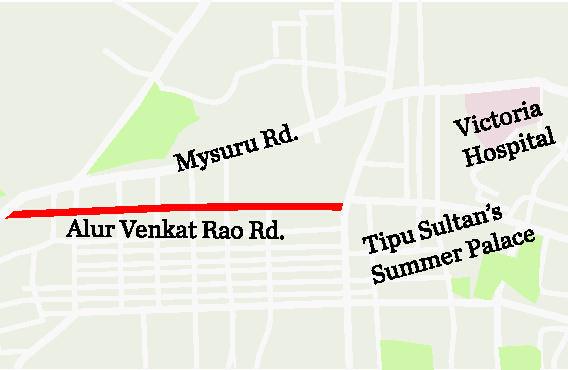
Is it Albert Victor Road or Alur Venkat Rao Road? Whatever the name, there now is a proposal to rename this road as Tipu Sultan Palace Road.
The main road in Chamarajpet is in the midst of a renaming storm. While the BJP-Karnataka unit has opposed the proposal to rename the road again, the Bruhat Bangalore Mahanagara Palike (BBMP) is now wondering when the road was renamed as Alur Venkat Rao Road in the first place.
It so happens that neither the BBMP nor the Department of Posts have any records that show when the road was named after Alur Venkat Rao.
Noted city historian Suresh Moona said that the road was popularly known as A.V. Road. “The initials A.V. stand for both Albert Victor and Alur Venkat Rao. The road was named after Prince of Wales Albert Victor to commemorate his visit to the city to inaugurate the Glass House in Lalbagh. It was probably renamed in the late 1960s and early 1970s when a number of roads that had Colonial names were rechristened,” he pointed out.
On Monday, a delegation from BJP, including MP P.C. Mohan, MLC Ashwathnarayan, city MLAs S. Suresh Kumar, B.N. Vijaykumar and Jagadeesh Kumar, submitted a memorandum to BBMP administrator T.M. Vijaybhaskar and urged him to drop the proposal to rename the road. Their contention was that renaming the road would be an “insult” to Alur Venkat Rao, who led the Karnataka unification movement.
Conceding that the BJP-led BBMP council that passed the resolution to rename the road had not followed the protocol, Mr. Suresh Kumar told The Hindu that the BBMP should examine all proposals closely before clearing them. “
N.R. Ramesh, former Ruling Party Leader who proposed the renaming, said that during the last meeting of the BBMP council, over 30 road renaming proposals were approved by the council. The proposal to rename the main road in Chamarajpet was not in the agenda initially. “It was proposed based on a letter submitted by a private organisation. The letter did not mention that the renaming was for the Alur Venkat Rao Road,” he said.
Who is Alur Venkat Rao?
Bengaluru: Alur Venkat Rao, who is known as Karnataka Kulapurohita, was the leading figure of the Karnataka unification movement. He was also an eminent historian, a dedicated writer and journalist. He made use of the press to achieve the cause of Karnataka. When he started editing and publishing the newspaper ‘Jaya Karnataka’, he declared in its very first edition that the sole aim of the newspaper was to strive for Karnataka’s statehood.
Protocol for renaming roads
Bengaluru: Every time a road or an area is renamed, questions are raised over the procedure and logic behind the process. Names can be mooted by anyone, either the public or the BBMP council. The proposal for renaming is then published in newspapers and objections are invited. On receiving objections, they are discussed in the council for approval. In the absence of a council, the administrator takes a decision. The approved resolution is moved to Urban Development Department, Government of Karnataka which renames places in the city, an official said. After this, an intimation about the same is sent to the Department of Posts.
Previous cases of controversy
S.K. Karim Khan Road: Indiranagar 100 ft Road was renamed after the Kannada folklorist S.K. Karim Khan in 2014, even though a resolution about the same was taken in 2006.
Narasimha Raju Road: Though a road in Palace Guttahalli was named after the actor, another road (from ISKCON to Mahalakshmi Layout Swimming Pool) was named after him.
source: http://www.thehindu.com / The Hindu / Home> News> Cities> Bengaluru> by Chitra V. Raman / Bengaluru – June 02nd, 2015
N.R. Constituency MLA Tanveer Sait today launched the long-pending Jodi Tenginamara Road works from Highway Circle to the junction behind JSS Dental College.
The MLA, who was accompanied by MCC officials, conducted survey by taking measurements for the widening works.
Speaking to SOM, he said that the works would be taken up in two phases with works pertaining to construction of drains, removal of old soil and putting new soil for laying of the new road in the first phase covering 760 mts at a cost of Rs. 2.9 crore.
He further said that in the second phase works on 1,100 mts of this stretch would be taken up and added that the Pourakarmika Colony would be demolished and the residents of the Colony would be accommodated in the houses built by the Slum Board under JnNURM scheme.
The MLA said that the works in the second phase would be taken up at a cost of Rs. 5.5 crore and added that a separate road for heavy vehicles to ply is also being taken up jointly by the MCC, MUDA and the Railways.
He further said that only asphalting the stretch of road would be unscientific as the road is very low and during rains, the road is flooded besides damaging it again and hence the road would be heightened and asphalted.
He said that before taking up asphalting, new sewage pipeline with bigger pipes would be laid.
As the density of traffic on this road is high, the road would be widened, he said and added that measures would be taken to prevent heavy vehicles such as lorries, fuel tankers from entering this stretch as separate road is being laid for them to join the Ring Road.
Former Corporator N.B. Tiwari, Railway Goods Shed Lorry Owners Association President Abdul Khader Shahid, Mahadevaprasad, MCC officials and others were present.
source: http://www.starofmysore.com / Star of Mysore / Home> General News / Wednesday – May 27th, 2015