Category Archives: Leaders

Natl. Seminar on Tribal Education begins at CIIL

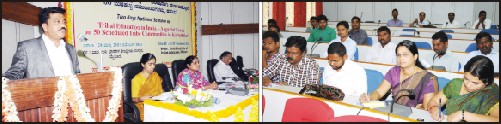
Prof. T.T. Basavanagouda, Director, Karnataka State Tribal Research Institute, Mysuru, is seen addressing the gathering. S. Prathibha, Research Officer, Karnataka State Tribal Research Institute, Mysuru, Kumuda. B. Susheelappa, AEE and Writer, 110 KV Sub Station, Jog Sagara Taluk, Shivamogga district and Prof. C. G. Hussain Khan, Retired Professor, Dept. of Anthropology, Karnatak University, Dharwad are seen on the dias. Picture right shows a section of participants.

Mysuru :

A two-day National Seminar on ‘Tribal Education in India – A Special Focus on 50 Scheduled Tribe Communities in Karnataka’ organised by Karnataka State Tribal Research Institute, Mysuru began at Central Institute of Indian Languages (CIIL) on Hunsur Road in city this morning.

The major theme of the workshop is ‘Socio-Economic and educational aspects of Scheduled Tribes in Karnataka.’ The seminar is being attended by Students, Research Scholars, Lecturers and Professors of Departments of Ancient History and Departments of Anthropology of various Universities.

The programme was inaugurated by Kumuda. B. Susheelappa, Assistant Executive Engineer and Writer, 110 KV Sub Station, Jog Sagara Taluk, Shivamogga district.

Kumuda, in her inaugural address said “Nowadays, most of the youth in India are following Western culture which is not a good sign. We should respect and follow our Indian culture rather than following the culture of Western countries.”

Prof. T.T. Basavanagouda, Director, Karnataka State Tribal Research Institute, Mysuru who presided over the function said, “There are 43 lakh tribal people in Karnataka, out of which 20 lakh tribals stay in forests.” He regretted that these tribal people are illiterate and uneducated. “There are various schemes and funds available from Central and State Governments for the welfare of Tribal people. But awareness has to be created among the tribal people to utilise these funds,” he added.

Prof. C. G. Hussain Khan, Retired Professor, Department of Anthropology, Karnatak University, Dharwad, in his keynote address said “Karnataka has 4.1% of the country’s scheduled tribes.” He regretted that most of the tribal children are malnourished. He also spoke about female foeticide and urged the government to take strict action against those who indulge in female foeticide. “Education is the most important social input for the economic development of any society. But low educational status of tribal community adversely affects the socio-economic condition of tribal people.” he added.

Valedictory function

The valedictory function will be held tomorrow at 4 pm at the same venue. Prof. T.T. Basavanagouda will preside and Prof. C. Basavaraju, Registrar, UoM will deliver valedictory address.

source: http://www.starofmysore.com / Star of Mysore / Home>  General  News  /  Friday , November 28th, 2014
Remembering Obaid – One Year Later

Without Abstract

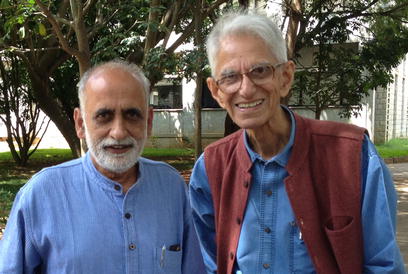
Obaid Siddiqi passed away on July 26, 2013, succumbing to injuries from an accident in Bangalore.

In more than half a century of work in India, Obaid built institutions and inspired many young minds. The Department of Biological Sciences  (DBS) at the Tata Institute of Fundamental Research (TIFR), Mumbai, and the National Centre for Biological Sciences  (NCBS), Bangalore, stand today as the finest examples of his vision and approach to science. In the process, he became the tallest (literally as well) Indian biologist of his generation, yet he remained modest, friendly and scientifically intense in his association with his peers and students.

At the DBS, TIFR, then known as the Molecular Biology Unit, Obaid pioneered the study of neurogenetics in India using the fruit fly, Drosophila melanogaster, as a model organism. Obaid was closely connected to the stars of bacterial and phage genetics. Returning from a sabbatical with one of them, Seymour Benzer at Caltech, he pushed the transformation of the Molecular Biology Unit into a new area. Drosophilaneurogenetics as a field was born in the 1970s with the idea of identifying mutants that affected neural function and behaviour. Obaid took up the challenge of using the fruit fly as a genetic system to understand chemosensory behaviour. Using elegant behavioural and electrophysiological assays, his group identified the very first set of taste and olfactory mutants in Drosophila, which have subsequently helped understand the complexity of chemosensory perception in insects. In NCBS he went on to develop a group that studied learning and memory in the context of olfactory behaviour. These studies in a relatively simple organism have implications for understanding brain function at all levels.

When we decided to organize this Special Section of the Journal of Biosciences for Obaid’s first death anniversary, many of his friends readily agreed despite earlier contributions to the Journal of Neurosciencesissue in 2012 on Obaid’s 80th birthday. The collection of articles is indeed impressive and a testament to his science and his popularity with people across generations.

We start with Maurice Fox’s brief “Commentary” on how biology came to TIFR, and follow this with temperature-sensitive paralytic mutants (Ganetzy and Wu), odorant receptors (Ray et al.), taste neuron projections (Kwon et al.), air-puff-stimulated flight circuit (Sadaf and Hasan), Pdf clock mutant (Seki and Tanimura), and Drosophila-derived insights into brain development and disease (Reichert).

Obaid was a mentor and an inspiration for the three of us, either directly or indirectly. He showed us how science is done without shouting from rooftops, and his death remains a personal loss to each of us.

ObaidMPOs04dec2014

During the last days of this Special Section, Obaid’s long-time associate and a friend to the three of us, KS Krishnan, also passed away suddenly. But KSK contributed to this tribute by reading all invited articles and providing his comments. He did this on the weekend prior to his death. We owe our gratitude to KSK and mourn this loss to the Indian biologist community. So long, dear friend. We hope the reader will enjoy this labour of love.

By:  Shahid Jameel1, 2  , Utpal Banerjee3 and K VijayRaghavan1, 4

(1)

New Delhi, India
(2)

Hyderabad, India
(3)

Los Angeles, CA, USA
(4)

Bangalore, India
source:  http://www.link.springer.com / Springer Link / Journal of Biosciences – Published by Indian Academy of Sciences / Published Online / July 26th, 2014

Maverick Antulay was a tough administrator

Education minister Vinod Tawde (centre) comes out of Breach Candy Hospital where former chief minister AR Antulay passed away on Tuesday Vinamra Acharekar DNA

The stormy petrel of Maharashtra’s politics and its only Muslim chief minister, Barrister Abdul Rehman Antulay, passed away on Tuesday. The hardcore Indira and Sanjay Gandhi loyalist played a major role in the formation of the Congress (I) and was Chief Minister from 1980 to 1982 when he promised to bring back warrior-king Chhatrapati Shivaji Maharaj’s legendary ‘Bhavani’ sword back from the UK. He had to resign after a controversy over grant of cement quotas.

The outspoken Antulay, 85, was known to be a tough administrator and aka Abbasid Caliph Harun al Rashid went around Mumbai at night incognito with Shiv Sena leader Pramod Navalkar and police officials to monitor the law and order situation. He resigned as the chief minister after falling foul of the powerful Maratha lobby, which controls the levers of power in Maharashtra.

During his tenure, Antulay, a Barrister from London’s Lincoln’s Inn, changed the uniform of the police from the previous half pants to a full pant and created new districts like Latur and renamed Kulaba as Raigad. Antulay, a former Union minister, who had kidney ailments, passed away at Breach Candy Hospital of old age.

Born to Abdul Gaffar and Zohrabi at Ambet in Raigad, “Antulay saheb” was one of the few Maharashtrian and Konkani Muslims to make their mark in the state’s politics. Antulay was educated at Ismael Yusuf College. Elder brother Ataullah, who worked in Africa and later, Ghulam Muhammed Kardane “Nawabsaheb” from Srivardhan, helped his education.

Antulay lost the 1957 assembly elections and headed the Youth Congress from 1960 to 1962, when he defeated freedom fighter Nanasaheb Purohit from Srivardhan. An MLA till 1976, he had a base even in local Brahmins. Antulay was a minister of state and later a minister from 1969 to 1976 and his associates recall his strict demeanour with the state’s entrenched officialdom.

Antulay was a Rajya Sabha MP when Indira picked him as the chief minister to cut Maratha leaders down to size. He was supported by close friend Shiv Sena chief  Bal Thackeray  in the assembly by-polls from Srivardhan.

As the chief minister, Antulay put up Shivaji Maharaj’s portrait in Mantralaya and his promises regarding the Bhavani sword were seen as attempts to woo the Maratha lobby. The maverick, who had excellent command over Marathi, Hindi, Urdu, English and Arabic, had to step down in 1982 after allegations of favouring donors to the Indira Gandhi Pratibha Prathisthan in grant of cement quotas.

Other controversies involving Antulay were his altercation with the police at Vadkhal naka and his reference to former deputy prime minister Yashwantrao Chavan as a “kalank” (blot) on Maharashtra.

He penned a scathing indictment of the Mahajan report which overrode Maharashtra’s claims on Marathi speaking areas of Karnataka like Belgaum. Antulay was a four term Lok Sabha MP from Raigad and lost once from Aurangabad. He was the health minister under PV Narasimha Rao and the minority welfare minister under Manmohan Singh in UPA-I when he kicked up a storm by alluding to the role of Hindu fundamentalists in the death of ATS chief Hemant Karkare in the 26/11 terror attacks. Antulay’s 2009 defeat from Raigad- Ratnagiri by Shiv Sena’s  Anant Geete marked the end of his political career.

Former associate and BJP leader Habib Fakih remembers Antulay as “a highly secular man and devotee of Chatrapati Shivaji Maharaj,” and noted how he pushed for Marathi to be taught in Urdu schools to mainstream Muslims.

However, at the end of his career, Antulay sounded bitter towards the Congress, and had supported the PWP’s Ramesh Kadam against estranged disciple Sunil Tatkare (NCP) for the Lok Sabha after his traditional constituency was surrendered to the NCP by the Congress. Speaking to dna, Antulay had called Congress vice-president Rahul Gandhi “immature” and attacked the Congress, which was formed in his Delhi bungalow, as a party of “ungrateful” people.

source: http://www.dnaindia.com / DNA India / Home> News> India> Mumbai / by Dhaval Kulkarni, Agency: DNA / Wednesday – December 03rd, 2014

Veteran Congressman A R Antulay dies

Antulay02MPOs03dec2014

Veteran Congressman Abdul Rehman Antulay, a former Maharashtra chief minister and Union minister, passed away on Tuesday at the age of 85 after prolonged illness.

Popularly called A R Antulay or Barrister Antulay, the Congressman was known for his deep understanding of issues, no-nonsense attitude, fast decision making and efficient administration. Antulay was a man who drew respect from all political parties.

The former chief minister is survived by his wife Nargis, son Naved and daughters Neelam, Shabnam and Mubina. He died at the Breach Candy Hospital, where he was admitted and being treated for kidney ailments.

Antulay ‘s son-in-law Mushtaq Antulay said a funeral would take place at his native village of Ambet in the Raigad district of the coastal Konkan region. He was the state’s first and only Muslim chief minister between June 1980 and January 1982 and was considered close to then prime minister Indira Gandhi. Antulay, however, had to resign from his post on allegations of corruption.Â

The Bombay High Court convicted him, but later the Supreme Court cleared him of all the charges. It was alleged that he collected donations from builders for the Indira Gandhi Pratishthan, one of several trust funds he had established and controlled, in exchange for receiving more cement than the quota allotted to them by the government.

He served as Union minister in 1995 and later in the UPA-I government of former prime minister Manmohan Singh, where he headed the Minority Affairs Ministry.

Antulay was respected by late Shiv Sena supremo Bal Thackeray, who often consulted and discussed with him the vexed Maharashtra-Karnataka boundary dispute.

Born on February 9, 1929, he was a barrister from Lincoln’s Inn, London.Between 1962 and 1976, Antulay was a member of the Maharashtra Assembly from the Srivardhan constituency in Raigad, serving as Minister of State and Cabinet minister.

During this time, he held several portfolios, including Law and Judiciary, Ports and Fisheries and Housing. Thereafter, he was a member of the Rajya Sabha from 1976 to 1980, before becoming chief minister of Maharashtra.

Antulay got re-elected in 1985 to the Assembly and remained there until 1989, when he was elected to the 9th Lok Sabha from Kolaba, the now Raigad seat. He was re-elected to the 10th Lok Sabha in 1991.

From June 1995 to May 1996, he was Union minister of health and family welfare, and from February to May 1996 he was had additional charge of Water Resources.

source : http://www.deccanherald.com / Deccan Herald / Home> National / Mumbai – DHNS,  December 02nd, 2014

He was sensitive to minorities’ concerns

AntulayMPOs03dec2014

Congress leader Abdul Rahman Antulay, who died at 85 on Tuesday, would relate with deep bitterness his fall off the perch in 1982, embroiled in a corruption scandal that is still among the top on any list of Indian scandals – the ‘cement scam.’

His way of helping the poor through trusts to which industrialists were forced to donate money in lieu of cement allocation that he had discretion over was indeed a big mistake and misuse of political power.

Mr. Antulay was the Chief Minister of Maharashtra between 1980 and 1982. He believed it was a conspiracy that did him in, and there is an element of truth in it, as late journalist Dom Moraes writes in a 1992 book.

In 2004, the Congress resurrected him from oblivion and appointed him the Minister of Minority Affairs, a newly created portfolio.

Mr. Antulay displayed a sense of mass politics and aloofness simultaneously, was scholarly and populist at the same time, and never gave up the old world adherence to courtesies that he showed even to his worst critics. “He was an affable man, who had in his short tenure as CM made an excellent impression on most people,” wrote Mr. Moraes.

He was a confidant of Indira Gandhi and his rehabilitation in 2004 by Sonia Gandhi was seen as a reward for his loyalty. One of the trusts that landed in controversy was called Indira Gandhi Pratishthan.

As Minority Affairs Minister between 2004 and 2009, which was the evening stretch of his political career that started in 1962 as a member of the Maharashtra Legislative Assembly, Mr. Antulay oversaw the functioning of the Justice Rajinder Sachar committee that did a comprehensive study of the social, economical and educational conditions of Muslims.

But Mr. Antulay demonstrated understanding of, and sensitivity towards, the concerns of all minorities – religious and linguistic. He did not restrict the mandate of his ministry to Muslims.

His career concluded on a controversial note as he suggested that senior police officer Hemant Karkare’s death in the 2008 Mumbai terror attack may have something to do with his investigations into the terror groups of the Hindu right. The Congress disowned the comments and he lost the 2009 Lok Sabha elections.

He became the first Minister of Minority Affairs in 2004

source: http://www.thehindu.com / The Hindu / Home> National / by Varghese K. George / New Delhi – December 03rd, 2014

Rehana Banu takes over as Zoo Authority Chief

Rehana Banu, who took charge as Zoo Authority Chairperson in city yesterday, being greeted by Zoo Deputy Director Dr. Suresh as Rafiq Ahmed, Syed Akram Pasha and Zoo Member-Secretary R.S. Suresh look on

Mysuru, (ACP,SBD&RNN) :

Former MCC Ward 40 Corporator Rehana Banu yesterday took over as the Chairperson of Zoo Authority of Karnataka (ZAK) at its office inside the Zoo premises in city.

Rehana Banu, who arrived at the Zoo at about 7.20 pm, was greeted by Zoo Deputy Director Dr. Suresh, who offered a bouquet to the new Chairperson. Immediately after taking charge, Rehana met MLAs Vasu, Tanveer Sait and M.K. Somashekar and thanked them.

Zoo AEE Nagendrappa, Superintendent Jayaram, Congress leader Rafiq Ahmed, Corporator Suhail Baig and others also greeted Rehana on her nomination as Chairperson of ZAK.

Meanwhile, Sundar Das, Senior Congress leader from H.D. Kote, yesterday took charge as Chairman of Karnataka Seeds Corporation from Managing Director Vishakanta at its office in Hebbal, Bengaluru.

Narayan, Ananthu, S.E. Basavaraj take charge

It is learnt that former Mysuru Mayor Narayan today took charge as Chairman of Karnataka Safai Karmachari Commission at its office in Sampangiramanagar in Bengaluru.

R. Ananthu: Former Mysuru Mayor R. Ananthu, who has been nominated as Chairman of Mysore Paints and Varnishes (Mylac) has told SOM that he would take charge later today after meeting Chief Minister Siddharamaiah.

S.E.Basavaraj: Former Mysuru ZP President S.E. Basavaraj, who has been nominated as Chairman of Karnataka Maharshi Valmiki Scheduled Tribes Development Corporation Ltd. today took charge at its office in Vasanthanagar, Bengaluru.

K.R.Mohan Kumar and C. Dasegowda await orders

It is learnt that former Dry Land Development Board Chairman K.R. Mohan Kumar, who is tipped to become the Chairman of Mysuru Urban Development Authority (MUDA) and Mysuru City Congress President C. Dasegowda, who has reportedly been nominated as Chairman of Command Area Development Authority (CADA) are yet to receive official orders and the same are likely to be issued today, according to sources.

source: http://www.starofmysore.com / Star of Mysore / Home>  General  News  / Wednesday , November 26th, 2014

Former UP advocate general SMA Kazmi killed in road accident

Pratapgarh  (UP):

Former Uttar Pradesh advocate general S M A Kazmi was today killed and three others were injured when the car they were travelling in rammed into a tree in Hatigawan area, a senior police officer said here.

According to deputy Superintendent of Police S P Tomar, the driver lost control while he swerved the car to avoid hitting a motorcyclist and rammed into the tree near Bhadri this afternoon.

He said that three more car occupants — Shakeel Ahmad, Shakir Ahmad and Syed Iqbal — were injured in the accident and have been referred to a hospital in Allahabad.

The accident took place when Kazmi was returning to Lucknow from Allahabad.

source: http://www.timesofindia.indiatimes.com / The Times of India / Home> City> Lucknow / PTI / November 25th, 2014

LU to honour famous alumni on foundation day

Lucknow  :

Lucknow University’s 94th foundation day on November 25 will be homecoming for its alumni. To mark the day, LU alumni society will felicitate illustrious alumni who have made a mark in their life and brought laurels to their alma mater. Jharkhand Governor Syed Ali Naqi is likely to be conferred with the lifetime achievement award. Naqi completed his MA from LU.

Those who will be felicitated this year include Khan Masood Ahmed, the vice-chancellor of Khwaja Moinuddin Chisti Urdu, Arabi-Farsi University, DJ Narain, the director of Film and Television Institute of India, SWA Naqvi, the director of the National Institute of Oceanography, Rachna Govil, the executive director of Sports Authority of India and NK Verma, the managing director of ONGC Videsh Ltd, Justice Ashwani Kumar Singh, judge, Lucknoew bench of Allahabad High Court.

Masood Ahmed did his BSc (statistics, mathematics and physics) from Lucknow University in 1971 and then MA in economics with advanced statistics and econometrics in 1973.

A 1990 batch of Indian Information Service, DJ Narain is an alumnus of IIT-Kanpur. He was a lecturer of monetary economics at Lucknow University.

Working on the biogeochemistry of the oceans, Naqvi did his BSc in physics, chemistry and mathematics from LU in 1972 and then MSc with specialization in physical chemistry in 1974.

NK Verma joined ONGC in 1980 after completing MSc in applied geology from LU. In 1986, he obtained an MTech degree in petroleum exploration from Indian School of Mines, Dhanbad.

Justice Ashwani Kumar Singh graduated in law from LU in 1978. He was enrolled as an advocate in December 1979 and he practiced mainly on criminal side at Lucknow bench of Allahabad High Court. He took oath as a permanent judge in December 2010.

Established in 1920, LU is one of the oldest universities in the state. In the past, the university has honoured some distinguished alumni such as Justice AS Anand, former Chief Justice of India, senior journalist Vinod Mehta, former Union ministers NKP Salve and Harish Rawat and renowned cardiothoracic surgeon Padma Shri Dr Naresh Trehan.

Rajnath to grace occasion

Union home minister Rajnath Singh will grace Lucknow University’s convocation scheduled on January 19. The home ministry has accepted university’s invitation. The university’s degree committee has proposed four names for honoris causa. The names include Chief Justice, Allahabad High Court, Dhananjaya Y Chadrachud; film actor Amitabh Bachchan; singer Anup Jalota and IAS of Gujarat cadre Jayanti Ravi. The committee will finalise one out of these four names.

source: http://www.timesofindia.indiatimes.com / The Times of India / Home> City> Lucknow / TNN / November 18th, 2014

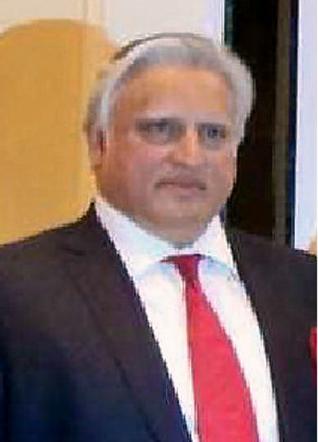
International honour for Rose Society president


Ahmed Alam Khan
Ahmed Alam Khan
President of Hyderabad Rose Society Ahmed Alam Khan has been elected vice-president (Central Asia) of the World Federation of Rose Societies, at 16th World Rose Convention held at Sandton City, South Africa, a press release informed on Wednesday.

In yet another achievement, five members of the Society have been elected to the Indian Rose Federation. They include Vijay Kant, A. Veerbhadra Rao, Khader Alam Khan, and Mohd. Minhajul Hussain, apart from Mr. Khan, the press release informed.

source: http://www.thehindu.com / The Hindu / Home> National> Andhra Pradesh / by Staff Reporter / Hyderabad – February 07th, 2013

Fitting tribute to city footballers

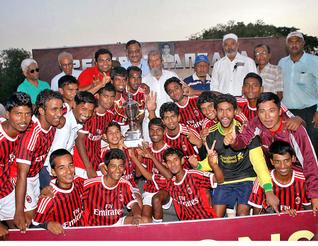
Winning team:Johnson Football Club emerged champions at the Peter Thangaraj Memorial Football Tournament with a 3-1 win via penalty shoot-out over Hyderabad Sporting, at Gymkhana Grounds.

It was a fitting tribute to one of the finest footballers from the city who donned the national colours when the District Sports Authority of Hyderabad organised the Peter Thangaraj Memorial Football Tournament at Gymkhana Grounds.

In a way, it also demonstrated the efficacy of having a District Sports Development Officer in Aleem Khan who himself was a former national player. “We thought it the best way to give the young talent a platform to showcase their skills,” insists Aleem who is largely responsible in football activity revived in a big way at the venue which was one of the major centres for the then famous Rahim League championship.

Those were the days when stalwarts of yesteryears including Noor Mohammad, Yusuf Khan, Azizuddin used to make it a point to watch football action.

But with the APFA still in a limbo thanks to the legal disputes it got entangled, it was left to the individuals like Aleem Khan and Tony of Shastri Soccer Club to keep the sport alive.

With another seasoned campaigner and enthusiastic E. Shyam of State Bank of Hyderabad always making it a point to be involved in the organizational aspects, the event was again another success story, despite the ugly behavior in the final phase of the tournament which saw the tournament committee ban two teams from further participation.

But, it was more because of the alleged players’ unruly attitude than a reflection on the organizational skills.

For the record, Johnson Football Club emerged champions with a 3-1 win via penalty shoot-out over Hyderabad Sporting in the final and also won Rs. 10,000 as cash incentive.

The teams locked goalless at the end of regulation time, primarily because of Johnson custodian Rahul’s impressive display.

In the shoot-out, Louise, Teja and Srikanth were on target for the winners while only Zubair scored for the loser.

Special prizes

Special prizes were given to Rahul of Johnson FC (best goalkeeper) by Olympian Zulfiquaruddin, Sumeer of Red Hills (best defender) by Olympian S. S. Hameed, Anju of Johnson FC (best midfielder) by Arjuna Awardee Md Habib, Talha of Hyderabad Sporting (best striker) by former Asian Games gold medallist Mohd Afzal.

In a welcome gesture, Mr. M. K.Bhattacharya,, DGM, SBH (Secunderabad Zone), felicitated former internationals Bhir Bahadur, Victor Amalraj and M.A. Sayeed at the valedictory function.

source: http://www.thehindu.com / The Hindu / Home> Features> DownTown / by V. V.S / May 24th, 2012