Category Archives: Leaders

Statues of Akbar’s ‘navratnas’ to come up in Fatehpur Sikri fort

Agra:

The nine gems of Akbar’s court will soon adorn Fatehpur Sikri Fort, with Agra Development Authority (ADA) and Uttar Pradesh tourism planning to install their statues in the premises of the monument.

Despite his illiteracy, Mughal ruler Akbar appreciated the presence of artists and intellectuals. His passion for knowledge and interest in learning from great minds meant that men of great intellect received patronage from the emperor. Such men went on to constitute the nine courtiers, also known as ‘navratnas’, of Akbar’s kingdom. The navratnas are Abul Fazl, Abdul Rahim Khan-I-Khana, Birbal, Mulla Do-Piyaza Faizi, Raja Man Singh, Raja Todar Mal, Fakir Aziao-Din and Tansen.

According to ASI, Mughal institutions such as the ‘Ibadat-Khanah’, ‘Din-i-Ilahi’, ‘Tarikh-i-Ilahi’ , Jharokha-Darshan, the doctrine of Sulh-i-Kul and policy of liberal patronage to indigenous arts and literatures, were founded here.

Under the plan, the statues of the nine courtiers would be built at a cost of Rs 10 lakh and will be set up in the interpretation centre coming up in the Fort complex. Fatehpur Sikri was the capital of Mughal Emperor Akbar for 13 years, from 1572 to 1585. The complex of monuments was declared a UNESCO world heritage site in 1986.

Dinesh Kumar, regional tourist officer, said, “We plan to install the statues the way Akbar used to hold court meetings with them. Tourists will also be provided information about them in detail. Although the place for their installation has not been finalized yet, we are trying to get it done in the interpretation centre. A meeting with the divisional commissioner will soon be held to get his permission.”

The interpretation centre will provide a glimpse of history and culture of the Mughal era as well as facilitate tourists’ visit to the Fort. Its construction work is likely to be completed by next month, Kumar added.

Perhaps the most famous of the ‘navratnas’ is Birbal, a Brahmin advisor in the court of Akbar. He is mostly remembered in folk tales that focus on his wit.

In 1586, he led an army to crush an unrest in the north-west Indian subcontinent, which failed tragically when he was killed along with many soldiers in an ambush by the rebel tribe.

Towards the end of Akbar’s reign, local folk tales emerged involving his interactions with Akbar, portraying him as extremely clever and witty. Birbal’s defeat was one of biggest military setbacks during Akbar’s reign and his death is said to have caused the Mughal emperor much grief.

In the folk tales, Birbal is mostly shown as being younger than Akbar, religious and surrounded by envious Muslim courtiers. These tales involve him outsmarting them and sometimes even Akbar, using only his intelligence and cunning, often by giving witty and humorous responses and impressing Akbar.

Mulla Do-Piyaza is a character from a series of folk tales featuring the Mughal emperor Akbar and his witty courtier Birbal. Mulla Do-Piyaza, also portrayed as witty, is Birbal’s rival. Even though these folk tales originated at the end of Akbar’s reign (1556-1605), Mulla Do-Piyaza began to appear later, popularized by writers in the late 19th century. Most scholars consider him to be completely fictional.

The next most heard of navratna was perhaps Tansen, a prominent Hindustani classical music composer, musician and vocalist, known for a large number of compositions. He was also an instrumentalist who popularized and improved the plucked rabab (of Central Asian origin). Akbar gave him the title Mian, an honorific, meaning learned man.

Abul Fazal was the vizier of the Mughal emperor and author of the Akbarnama, the official history of Akbar’s reign in three volumes, (the third volume is known as the Ain-i-Akbari). He was the brother of Faizi, the poet laureate of Akbar.

Abdul Rahim Khan-e-Khana, another ‘navratna’ was a poet known for his Hindi couplets and his books on astrology. The village of Khankhana, which is named after him, is located in the Nawanshahr district of Punjab.

A poet and scholar of late medieval India, Shaikh Abu al-Faiz ibn Mubarak was popularly known by his pen-name, Faizi. In 1588, he became the Malik-ush-Shu’ara (poet laureate) of Akbar’s Court. He was the elder brother of Akbar’s historian Abul Fazl. Akbar recognized the genius in him and appointed him tutor for his sons and gave place to him among his decorative ‘navaratnas’.

Man Singh, the Rajput Raja of Amber, a state later known as Jaipur in Rajputana, was a trusted general of the Mughal emperor Akbar, while Todar Mal rose to become the finance minister in Akbar’s darbar. He was born in Laharpur, Uttar Pradesh in a Hindu family.

Faqir Aziao-Din was a mystic and a chief advisor in emperor Akbar’s court. Akbar regarded his advice on religious matters in high esteem.

source: http://www.timesofindia.indiatimes.com / The Times of India / Home> City> Agra / by Aditya Dev, TNN / December 14th, 2014
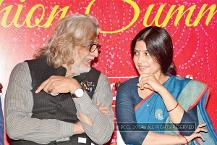
Muzzafar Ali and Dimple Yadav attend Oudh Fashion Summit in Lucknow

Pehnawa – The Oudh Fashion Summit-2014, was organized by CII-Yi, Lucknow Chapter, in the city recently. 

Muzzafar Ali and Dimple Yadav

Muzzafar Ali, who was the guest of honour for the event, earned many wah-wahs for his lines on Lucknow: “Nazakat aur nafasat tujhe virasat mein mili hai, naaz hai humein tujhpe pe ae Lucknow.”

The chief guest on the occasion, MP Dimple Yadav took note of the suggestions made by panelists to improve the work conditions for craftsmen working in the fashion industry, and promised to bring them to her husband and UP CM Akhilesh Yadav’s notice. “Work has already started on courses to train workers in chikankari,” she said.

source: http://www.timesofindia.indiatimes.com / The Times of India / Home> City> Lucknow / by Akash Wadhwa, TNN / December 14th, 2014

Usmani paves way for new Collectorate building

Varanasi :

UP Revenue Board chairman Javed Usmani’s Thursday visit paved the way for long pending project for replacing 195 years old Collectorate building by a multi-storied building.

For this already sanctioned project of Rs 17.47 crore, the first installment of Rs 3.5 crore will reach here within two days, said Usmani during a chat with reporters. District magistrate Pranjal Yadav said that with the arrival of first installment of sanctioned budget, the construction work will start in phases as demolishing the old buildings and court on the Collectorate premises together is not possible.

Built in 1820, the Collectorate building is now in a dilapidated state. Proposals to renovate and also replace the building have come up in the past and the building was declared unfit for use through a government order (no. 285/1-5-09-165/08 revenue section-5 issued on January 30, 2009).

The idea of replacement was floated during the last Samajwadi Party government when the building was found in a dilapidated state and then a government order was issued, declaring the building unfit for use. But, before the issuance of this GO, the then SP government had taken the decision to replace the old Collectorate building by a new one. In May 2006, the then officials had forwarded a proposal Rs 8.71 crore to the Revenue Board and state government in this regard. However, even after sanctioning of the project, its funds were diverted to west UP district by the then SP government.

In December 2010, another proposal was sent to the state government when the Revenue Board revised the budget of the project to Rs 7.25 crore. Instead of going with this proposal, the government initially engaged the construction and designing section (CNDS) of UP Jal Nigam to re-examine the project and prepare a new detailed project report (DPR) by keeping the actual requirements of the Collectorate in view.

After CNDS prepared new DPR of Rs 18.18 crore by proposing a multi-storied building, the Revenue Board decided to engage Rajkiya Nirman Nigam (RNN) to handle the project by revising the budget to Rs 17.47 crore.

After these developments, the RNN in 2011 decided for shifting the offices and courts from the Collectorate to the Cultural Complex to start construction work by demolishing all old buildings. But, before this process could be started, model code of conduct was promulgated in view of 2012 assembly election. After returning to power, the SP did not show interest in this project. The local authorities maintained correspondence with revenue board but officials did not show interest in ensuring that the project is seeing the light of the day.

But, the announcement of Usmani made it very clear that now this project will not linger. The DM said that “in the initial phase of construction, the offices and courts of ACMs will be demolished followed by pulling down of ADMs offices and court and also the Rifle Club”.

With the construction of new buildings at these places, the offices of the main Collectorate building would be shifted there, said Yadav adding, the new multi-storied Collectorate building will also have parking facility in its basement.

source: http://www.timesofindia.indiatimes.com / The Times of India / Home> City> Varanasi / TNN / December 12th, 2014

Fire services department shifts to Vijayawada

Vijayawada :

The fire services department will be Andhra Pradesh’s first department to move out of Hyderabad. The newly-built complex of the AP fire services will be inaugurated by chief minister N Chandrababu Naidu here on Friday.

The new fire services headquarters has been built near the police control room in the city. Although the complex was initially designed to locate regional offices, it was later decided to make it the headquarters of the fire department after the bifurcation of the state. The new complex will house nearly 50 officials of various cadres, from director-general of fire services to field officers. The complex also has space for parking six fire-fighting vehicles.

Fire services DG Nanduri Sambasiva Rao said the work on the complex was completed in a record six months time. The DG, along with district collector M Raghunandan Rao and DCP Taqseer Iqbal visited the complex and inspected the arrangements for the CM’s visit late on Thursday night. Naidu will visit the Ungutur assembly constituency in West Godavari district in the morning and will reach Vijayawada by evening.

source: http://www.timesofindia.indiatimes.com / The Times of India / Home> City> Hyderabad / TNN / December 12th, 2014

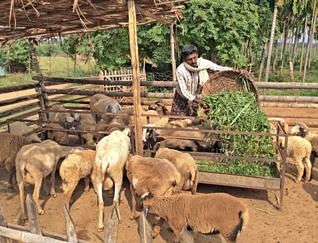
Counting sheep, literally

A farmer tending to the ‘Nari-Suvarna’ breed of sheep at Veerapura in Tumakuru district of Karnataka.

Sheep farmers in Tumakuru have agri-scientists in Maharashtra to thank for a breed that has, quite literally, doubled their profits.

The new breed, developed by scientists at Nimbkar Agricultural Research Institute, Phaltan, called ‘Nari-Suvarna’ has turned out to be a boon for farmers. While the local breed of sheep gives birth to one lamb at a time, the new breed gives birth to two or three.

Cost of the sheep

The State government is trying to promote the Nari-Suvarna breed. It plans to offer subsidy to purchase the sheep, which costs Rs. 8,000 each, in the future. The local breed in Tumakuru —both Hassan and Bellary breeds — cost Rs. 6,000 per sheep.

With the guidance of the Karnataka Sheep and Wool Development Corporation (KSWDC), a farmer in Sira taluk in Tumakuru district has bought 10 sheep and they have given birth to 23 lambs. Farmers at Sidlaghatta in Chickballapur district and Chitradurga district are now eager to follow suit.

The new breed, according to the Agriculture Department, is a combination of three Indian breeds – Deccani and Madgyal breeds of Karnataka and Garole of West Bengal.

Doddaraju of Veerapura in Sira taluk, who bought the 10 sheep, told The Hindu that people in his village were making advance payments for Nari-Suvarna sheep. He said the sheep had adjusted to the climate and environment of his village and could be reared along with the local breed.

Mirza Basheer, Assistant Director, KSWDC, Tumakuru, said the new breed would help meet the demand for meat and would be beneficial to farmers. Nagaraja G.M., Assistant Director, Special Livestock Breeding Programme, Tumakuru, said the government would identify farmers in Belagavi, Vijayapura and Kolar districts and would introduce them to the new breed.

Scientists have developed a new breed of sheep, Nari-Suvarna, that gives birth to two or three lambs at a time

source: http://www.thehindu.com / The Hindu / Home> National> Andhra Pradesh / by S. Bhuvaneshwari / Tumakuru – December 14th, 2014

Winning matters

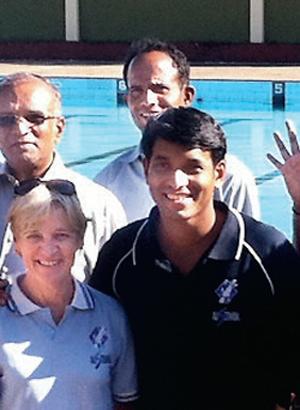
Partha Varanashi from Puttur becomes first Austswim presenter, aims to boost standards

Partha02BF13dec2014

Partha Varanashi, a 29-year-old from the state, has become India’s first Austswim presenter for swimming and water safety.

With this accreditation under his belt, Partha can coach swimmers in India, instead of a representative from Australia visiting the country. This achievement is part of an initiative by former Indian Olympian Hakimuddin Shabbir Habibulla to improve swimming training standards .

Under the programme Winning Matters, Austwim, Australia’s national organisation for the teaching of swimming and water safety provided professional and systematic training to swimming teachers from across India.

Ceri Weeks, a representative from Austswim, conducted the courses in Mumbai, Bengaluru and Mangaluru.

“With Austswim making its presence felt in India, swimming training is expected to get a whole new dimension. Training is going to be holistic and systematic with a strong foundation. The curriculum is vast, which includes child psychology, behaviour patterns and safety and candidates have to under go online tests. There is a 200page manual and there is an option to interact online,” said Partha, who has received a soft copy of the accreditation and will travel to Australia for the actual presentation.

Partha who trains about 40 budding competitive swimmers at the Balavana swimming pool in Puttur and who was responsible to teach 900 students of a swim school in South Australia before returning to India two years ago, said this was just the first lap.

“Since I worked in Australia, I know the standards. The journey has just begun. In India, the focus is only on competitions, while Austswim focuses on technique. The change will not happen overnight. It may take years like it did in Australia, but I am confident that Austswim will bring in changes in swimming standards of India,” he said.

Partha was the Mangalore University’s champion swimmer for three years (20032005). He was also a threetime national Indian swimming finalist, South Australian Masters Swimming record holder (2009) and has over ten gold medals won in Aussie Masters, SA event in the year 2009 and 2010 and coached and trained over 900 swimmers in Australia.

source: http://www.bangaloremirror.com / Bangalore Mirror / Home> Sport> Others / by Deepthi Sanjiv, Bangalore Mirror Bureau / November 26th, 2014

Arts College turns 95, not 75!

Last week, the media was abuzz with reportage on the launch of ‘Platinum Jubilee’ celebrations of the Arts College of Osmania University. Deans, heads of departments, faculty and students and several former principals and alumni of the college participated in the event to mark the 75th year of the Arts College. But the fact is that Arts College completed 95 years of its existence on 28th August this year itself. This prestigious institution would be completing its centenary in 2019, just a year after the centenary of Osmania University.

The seventh Nizam of Hyderabad, Mir Osman Ali Khan, had issued a firman for the establishment of Osmania University on 26th April 1917 for offering higher education through Urdu medium in the erstwhile Hyderabad State. The University became functional in 1918. Under the aegis of the University, the Arts College was inaugurated on 28th August 1919 and it was temporarily housed in eight rented buildings in Gunfoundry area in the city.

A faculty of 25 lecturers was recruited and 225 students were admitted in Intermediate first class in the first academic year of the college. Incidentally, Sir Ross Masood, grandson of Sir Syed Ahmed Khan and founder of Aligarh Muslim University, was the first principal of Arts College. Degree and postgraduate courses were started in 1925 and PhD programme in several disciplines in 1938.

The government acquired a vast extent of land (about 2,000 acres) at Adikmet for development of the campus of Osmania University in 1928. Engineer Ali Nawaz Jung and Architect Zain Yar Jung were sent abroad to study and suggest a model plan for the campus. Monsieur Jasper, a Belgian architect, prepared the detailed plans for the campus buildings. The Nizam laid the foundation for the Arts College building on 5th July 1934. The imposing building, in Indo-Saracenic style of architecture, was built in a record time of 5 years. The Arts College building was inaugurated by the Nizam on 4th December 1939.

The majestic and elegant edifice in pink granite stone retains much of it charm even today, though it has seen vicissitudes of fortune over the last 75 years. The college, being 20 years older than the building, has been witness to many more changes. While departments in modern disciplines as well as classical and Indian languages were opened, the medium of instruction was changed from Urdu to English, soon after police action in erstwhile Nizam State in September 1948. The Arts College made its name all over the globe for its academic excellence by producing eminent alumni and employing renowned academicians.

In 1973, degree courses were discontinued in Arts College and it became an exclusively postgraduate college, offering PG and advanced diploma courses and research studies in various disciplines. Though it was the hotbed of Telangana movement during 1968-71 and several Mulki agitations earlier, Arts College scaled new heights in the 1970s and 1980s. The college made its mark in both arts and social sciences, including economics, history, geography, political science, public administration, psychology, sociology, English and other foreign languages, classical and Indian languages and communication & journalism, linguistics, Islamic Studies and philosophy.

Those who studied in the Arts College or served on its faculty brought laurels. The alumni include not only great academicians but also bureaucrats, political leaders and educational administrators. Many of the erstwhile faculty or alumni of the college went on to become vice-chancellors of eminent universities in the state as well as other prominent universities across the country. Some made their mark abroad. Apart from its alumni in many other disciplines, the Arts College also produced many eminent media persons who studied at its department of communication and journalism.

Yet, after the mushrooming of colleges offering professional courses such as Engineering, MBA, MCA, B.Ed etc, there has been a marked drop in the students seeking postgraduate courses in social sciences and arts subjects. The severe financial crunch due to inadequate funding of the university through block grants by the government has led to a situation where the Arts College is forced to discontinue some courses or to keep several posts of faculty vacant. This is having its own impact on the academic excellence of the college. In the last few years, Osmania University campus witnessed intense agitation by students for separate Telangana State. Now, Telangana is a reality and it is time to strive hard to win back fame and pristine glory for Arts College before it celebrates its centenary in 2019.

(The writer is an MLC and a journalist)

source: http://www.timesofindia.indiatimes.com / The Times of India / Home> City> Hyderabad / by Syed Amin Jafri, TNN / December 08th, 2014

Sports makes on physically fit : Dr. Saleem

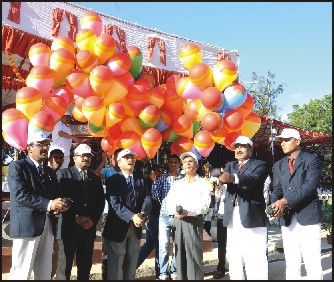
City Police Commissioner Dr. M.A. Saleem is seen releasing pigeons along with Prof. M.G. Krishnan, Vice-Chancellor, KSOU and other dignitaries to mark the launch of Annual Police Sports Meet

Mysuru :

The city police battled it out with each other at the annual sports meet that began here yesterday. Their lathis were replaced with javelins, while the heavy rifles with shot-puts, at the Police Parade grounds, the venue of the meet.

The cops were in a sportive mood on the first day of the three-day Annual Sports Meet -2014 organized by Mysore City Police. Speaking at the inaugural, KSOU Vice-Chancellor Prof. M.G. Krishnan said, “All sports should be treated equally but unfortunately this is not happening in India.” He said that cricket was the only sport that was getting more prominence in the country compared to others. Vice-Chancellor wished the Police personnel who were participating in the meet to show their best performance.

City Police Commissioner, Dr. M.A. Saleem said “Sports activities play a vital role in keeping policemen fit and healthy. So every year sports meet was being organised.” He advised police to develop sportsmanship and competitiveness even while carrying out their duties that would improve the health of the society.

Law and Order DCP A.N. Rajanna, Crime and Traffic DCP M.M. Mahadevaiah, Armed Reserve DCP Shivanna, Mounted Police Commandant Janardhan were present.

The event will see police personnel taking part in race, tennis ball throw, discus throw, passing the ball, shot-put, lemon-spoon race, tug-of-war, table tennis, shuttle badminton, long jump, javelin throw, etc.

Valedictory: The valedictory will be held on Dec. 7 at 4 pm. Retd. ADGP Kempaiah will be present on the occasion.

Results of the first day Men’s category

Javelin throw : Satyavelu (first), S. Manjunath (second), Shivakumar (third).

Shot put : Arogyaraj (I), H.R. Shivakumar (II), Lokesh (III)

Long jump: Jayakumar (I), Mylari (II), Vijaya Kumar (III)

200 m running: Mylari (I), Vijaya Kumar (II), Amarnath (III)

Women’s category

200 m running: Asha Rani (I), Rekha (II), Vani (III)

Javelin throw : Shylaja (I), J. Rekha (II), Zareena Taj (III)

Shot put : Shylaja (I), Rekha (II), Zareena Taj (III)

Long jump : M. Vani (I) Siddamma (II), Asha Rani (III)

source: http://www.starofmysore.com / Star of Mysore / Home> Sports News  /  Saturday , December 06th, 2014

Coffee Board blends co-op subsidies into coffee kettle

In an effort to enhance the production of robusta and arabica coffees, the Coffee Board has proposed higher allocation for replanting and expansion, Coffee Board Chairman Jawaid Akhtar said on Thursday.

Under the 12th Plan subsidy rates have been proposed at 40 per cent for up to 2 hectares, 30 per cent for 2-10 hectares and 25 per cent for holdings of above 10 hectares.

Inaugurating the United Planters Association of Southern India (UPASI) and Karnataka Planters Association (KPA) coffee conference on Thursday, Akhtar said, “Coffee Board has proposed to increase the unit cost by 75 per cent to Rs 1,75,000 per hectare.”
For the first time, the Board has included corporates and co-operatives to avail of the subsidy.

Besides, the Board has also introduced subsidy for eco-certification at 50 per cent of the certification cost at a ceiling of Rs 50,000 per beneficiary. It has also enhanced subsidy for quality upgradation to Rs 2.50 lakh for up to 20 hectares.

UPASI President Vijayan Rajes said the coffee committee of UPASI will submit a proposal to the Coffee Board to forward it to the Centre to release funds for producing two new robusta clones and one robusta seedling. This will be in collaboration with Incaper, Brazil’s premium research organisation for conillon robusta.

“We are planning to have a new proposal to get India-specific arabica plants with know-how from Brazil,” Rajes added. “This will help us have 10 million clones supplied to coffee growers in the first four years; and, from the fifth year, the share of Indian robusta will be increased by 50 per cent,” Rajes said.

B M Mahesh Kumar, a coffee planter from Hosathota Estate, Ballupet, spoke on ‘Achieving High Productivity of Black Pepper through Water, Shade and Nutrition Management’. He said, “Disease control can be effected by following judicious Good Agricultural Practices (GAP) and Integrated Pest Management (IPM).”

“Many people are taking up mono pepper cultivation at the cost of arabica coffee which is not a good sign,” Kumar said, adding that farmers should adopt innovative methods to multiply pepper vines for higher production.

Indian Vanilla Enterprise Pvt Ltd and Indian Vanilla Initiative Pvt Ltd, Pollachi, Chairman R Mahendran speaking on ‘Cocoa Cultivation, Processing and Management’, said that the opportunity of cultivating cocoa as another inter-crop for coconut, arecanut and oil palm in select regions of Karnataka holds promise.

Ease of cultivation and management make cocoa an attractive income generator, Mahendran added.

UPASI-TRF (Tea Research Foundation) Valparai, Quality Assurance Assistant Director N Palani stressed the importance of maintaining organic matter in the soil for preserving the physical, chemical and biological properties of soil.

Palani added that since the top soil is rich in humus, it has to be safeguarded from erosion for which soild and water conservation measures, depending on the slope of the terrain, must be taken.

source: http://www.deccanherald.com / Deccan Herald / Home> Business / DHNS – Bengaluru, November 14th, 2014

Karanji Park gets Orchidarium

Wildlife photo expo inaugurated; Great Indian Rhinos released for public viewing at Zoo

Mysuru, Karnataka  :

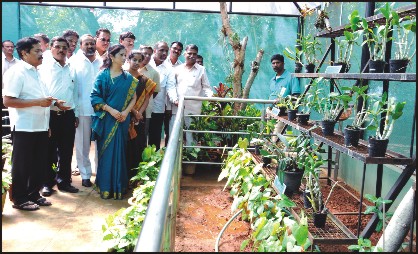
Adding to the existing attractions at Karanji Lake Nature Park, an Orchidarium with 98 Orchid plants of various varieties was inaugurated by Rehana Banu, Chairperson, Zoo Authority of Karnataka (ZAK), at the Park premises on Lalitha Mahal Road in city this morning.

RehanaBanuMPOs10dec20134

Orchidarium is an indoor enclosure for keeping and cultivating plants and observing them under natural conditions, especially for the cultivation of various types of Orchids.

Orchidarium is an area that provides the desired environmental conditions for different varieties of Orchids grown abundantly for cultivation and conservation of Orchids both endangered and otherwise.

It is provided with optimum lighting conditions for the plants while protecting them from direct and harsh sunlight. The structure is covered with mesh with a roof to protect the plants from direct sunlight.

Prior to the inauguration of the Orchidarium, the Wildlife Photography exhibition was inaugurated at the Zoo Library by MLA M.K. Somashekar.

The expo, which is being held in two categories like Zoo Animals and Wildlife Photography has a total of 220 pictures clicked by both amateur and professional photographers.

In the Zoo Animals category, pictures of Hippo and its baby, playful bear cubs, tiger and its cubs playing and other pictures of Zoo animals are on display.

In the Wildlife Photography category, prize winning photos of World Wildlife Day contest clicked by photographers S.R. Madhusudhan, G.S. Ravishankar, M.K. Sapthagirish and others has been put on display.

A pair of Great Indian Rhinos, three-year-old Virat and one-year-old Bablee, brought to Mysuru Zoo from Patna’s Sanjay Gandhi Biological Park about two months ago, were released for public viewing by Mayor R. Lingappa and MLA M.K. Somashekar at an enclosure made for them at the Zoo premises.

Zoo Executive Director B.P. Ravi, Manager Shivanna, Zoo Veterinarian Dr. Suresh, RFO Girish and others were present.

source: http://www.starofmysore.com / Star of Mysore / Home> General News  /  Thursday , December 04th, 2014