Category Archives: Leaders

Dr. Syed Akheel Ahmed of Mysore to head KPSC

Bangalore :

Dr. Syed Akheel Ahmed, Dean of the Faculty of Science and Technology at the University of Mysore, is likely to be appointed as the next Chairman of the Karnataka Public Service Commission (KPSC) by Chief Minister Siddharamaiah.

Sources said that an official order in this regard would be sent to him shortly.

Dr. Syed Akheel Ahmed, who is also the former VC of Yenepoya University, if appointed, will be the first minority representative to head the KPSC. Earlier, the CM had appointed his confidant C. M. Ibrahim as Deputy Chairman of State Planning Board.

The KPSC had remained headless after the previous Chairman Gonal Bimappa’s term ended last year. Presently, there are six members in the panel, including the suspended Mangala Sridhar. The total strength of the KPSC is 10, including the Chairman.

source: http://www.starofmysore.com / Star of Mysore / Home> General News  / Tuesday ,  October 21st, 2014

Khadi Utsav 2014 begins

KhadiMPOs27oct2014

Mysore :

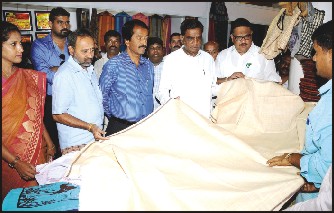
District in-Charge Minister V. Sreenivasa Prasad inaugurated Khadi Utsav-2014 organised by Department of Industry and Commerce and Karnataka State Khadi & Village Industries Board at Nanjaraja Bahadur Choultry yesterday.

A total of 62 stalls have been erected at the Khadi Utsav which will be held till Nov. 3. Apart from our State, Khadi and Village Industries Board has given opportunity to khadi organisations from other States and NGOs to participate in the Utsav. The stalls are open from 10 am to 7 pm every day.

MLAs Tanveer Sait and Vasu, ZP President Dr. B. Pushpa Amarnath, Mayor R. Lingappa, Karnataka State Khadi & Village Industries Board Development Officer K. Sampath Kumar, District Khadi & Village Industries Officer H.S. Kamathraj and others were present.

‘Don’t you have other work?’: District Minister Sreenivasa Prasad got furious over a senior citizen’s request to close the potholes on road in the city. Reacting to the request, Prasad questioned the senior citizen saying he had asked a wrong question at a wrong place.

“We have given Rs. 10 crore for closure of potholes in city. What more do you expect us to do. Don’t you have any other work to do? Wherever we go the same question is asked,” the Minister said.

source: http://www.starofmysore.com / Star of Mysore / Home> General News  / Tuesday ,  October 21st, 2014

Workshop on ‘ Innovation Management & Intellectual Property Rights ’ at BPBIM


V. Raghu Ram, Consultant- Corporates, Academic and Research Institute, is seen addressing the gathering at BPBIM in city this morning.

Mysore :

Bhavan’s Priyamvada Birla Institute of Management (BPBIM), Bharatiya Vidya Bhavan (BVB), Mysore, in association with Vishvesvaraya Trade Promotion Centre (VTPC), Government of Karnataka, had organised a day-long workshop and sensitization programme on ‘Innovation Management and Intellectual Property Rights’ this morning at BPBIM Auditorium in Vijayanagar here.

N. Ramanuja, Chairman, Bharatiya Vidya Bhavan (BVB), Bangalore, in his inaugural speech, said: “The library of BPBIM, Mysore, is open to MBA students of all colleges of Mysore. We have around 18,000 books in our library and students can make use of the library.”

The chief guests were Dr. Rama Murthy, Professor, Jain University, Bangalore and V. Raghu Ram, Consultant-Corporates, Academic and Research Institute.

The guest of honour Shariff, Deputy Director, VTPC, Bangalore, who spoke about Export Business, invited the students to his office in Bangalore and said: “VTPC will provide financial assistance to the students for attending International exhibitions and trade fairs.”  Raghu Ram, who gave a presentation on ‘Innovation Management,’ said: “Innovation is the transformation of knowledge to money.” A large number of students took part in the workshop and sensitization programme.

A.V. Narasimhamurthy, Chairman, BVB, Mysore, Sampath Iyengar, President-Emeritus, NIE Group of Institutions, Prof. B.M. Shankar, BPBIM and others were present.

source: http://www.starofmysore.com / Star of Mysore / Home> General News  / Monday ,  October 20th, 2014

‘Maulana Azad Bhavan’ to come up at all District HQs

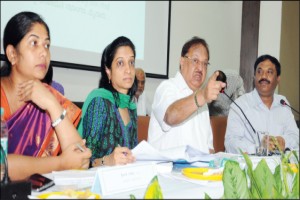
Dr. Qamar Ul Islam, Minister for Municipal Administration, Public Enterprises, Minorities Welfare and Wakf, is seen addressing a meeting in city this morning as (from left) DC Shikha, Municipal Administration Secretary Manjula and Minorities Welfare Department Secretary Akram Pasha look on.

Mysore :

“The State Government has proposed to house all District Minorities Welfare Departments under one roof to be named after Maulana Azad,” said Dr. Qamar Ul Islam, Minister for Municipal Administration, Public Enterprises, Minorities Welfare and Wakf.

Chairing a progress review meeting of the Minorities Welfare, Wakf, Municipal Administration and Public Enterprises departments of Mysore Revenue Division at the ZP Hall here this morning, the Minister said that ‘Maulana Azad Bhavan’ will be constructed at all District Head Quarters of the State to facilitate housing of all departments concerned with minorities welfare under one roof, for which the Government has already released Rs. 50 lakh for Mysore.

Dr. Qamar Ul Islam sought details of minority student-scholarship scheme, when the Minister was told that the Minorities Welfare Department in Mysore had received 10 lakh applications (2014-15) this year as compared to the previous year’s (2013-14) number of 7.56 lakh.

The Minister was told that the applications were received only through online, in order to remit the scholarship amount directly to the beneficiary student’s account.

The Minister was also briefed on the functioning of Minorities’ student hostels in districts coming under Mysore region.

source: http://www.starofmysore.com / Star of Mysore / Home> General News  / Monday ,  October 20th, 2014

Saleem holds traffic grievances meet

SaleemBF24oct2014

Mysore :

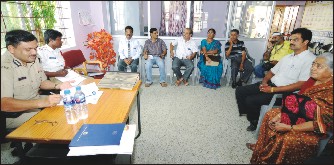
City Police Commissioner Dr. M.A. Saleem conducted monthly traffic grievances meeting at V.V. Puram Traffic Police Station along with Traffic Inspector Susheela this morning.

Around 20 citizens residing at V.V. Puram, Vontikoppal and surrounding areas who participated at that meeting complained about traffic problems being faced near Surya Bakery Circle in Hebbal, lack of walkways for pedestrians and parking facilities near Mathrumandali Circle at V V Puram, rash and negligent driving by KSRTC drivers, cattle menace on roads and other issues.

After listening to the complaints, Dr. Saleem said that the City Police were enforcing strict traffic rules and regulations to prevent violations in city. He said that the department had booked 3.12 lakh cases last year and collected Rs. 3.95 crore as fine amount and this Rs. 5 crore had been collected from 5 lakh cases booked so far this year.

The Government of India has also proposed to amend Motor Vehicle Act which will increase the fine amount to a minimum of Rs. 500 which will help in reducing the traffic offences.

Today’s meeting lacked the presence of local corporators who play a major role in educating the local residence and business establishments to co-operate with the City Police in enforcing the traffic rules and regulations.

He also said that City Police Department would be installing eight additional traffic signals which is sponsored by Infosys. Dr. Saleem added that traffic signals would be installed at Metagalli Police Station junction, Surya Bakery junction in Hebbal, Bharath Hospital & Institute Of Oncology junction in Hebbla, Infosys junction, Rane Madras junction and other three junctions which are yet to be identified. Similar grievances meetings were held at various Traffic Police Stations across the city this morning.

source: http://www.starofmysore.com / Star of Mysore / Home> General News / Saturday ,  October 18th, 2014

Ghostly grandeur of Fatehpur Sikri

Fatehpur Sikri :  Revisiting Akbar’s Masterpiece
Lucy Peck , Roli Books, 2014, pp 145, Rs 795

As I flip through the pages of this handy hardcover with its lacy jharokha artwork that recalls the rosy orange sandstone elegance of its subject, my mind rewinds to my own Fatehpur Sikri experience, years back — the ghostly vacant expanse of a Mughal city, a beautiful haunting, desolate oasis of huge stables, green gardens, a musically serene marble mausoleum to a Sufi saint, as well as the high and mighty Buland Darwaza off whose walls boys jumped, for a few paise, into a baoli stepwell all the way below. So it’s been a pleasure to revisit this masterpiece from the 16th century, a period of Renaissance under the relatively benign Mughal, Akbar.

In this new book, architect, conservationist, Mughal-India specialist author Lucy Peck attempts to dispel popular myths that accompany this well-preserved piece of history, the abandoned city of Fatehpur Sikri. The very first page sports an exquisite ‘company’-style painting from 1836, depicting the marble dargah of Sheikh Salim al-Din Chisti, the saint who satisfied Emperor Akbar with the happy prediction of a long-awaited heir (PrinSalim, later to become King Jahangir), and two more to boot. Ironically, this city of victory, an enigmatic, silent, solid, spectator from the past, owes its own birth to the progeny-predicting powers of a Sufi sheikh.

The remaining 130-odd pages are equally satisfactory, glossy and replete with well-researched text, conjectures and surmises, interesting trivia, paintings, maps and excellent photographs, old and new, overall perspectives, as well as close-ups of the designs that grace lintels, awnings, and all the minutiae of mahals adorning a geometrically designed Indo-Persian city.

Peck is on sure ground as she collates information from diverse sources — the skeptical yet informative Muslim cleric Bada’uni, the official biographer Abu’l-Fazl with his Akbarnama and Ain-i-Akbari, Latin memoirist Monserrate — people who lived in Akbar’s court during his reign. Peck also quotes from a few 17th-century European travellers — like Peter Mundy and William Finch. She simultaneously reveals that many travellers’ tales and court records have not survived the centuries.

Unlike historian John Keay, who refers to Fatehpur Sikri as Akbar’s ‘wildest extravaganza and weirdest folly’, Peck is kinder to Akbar. She talks of the ‘romantic enigma’ that was Fatehpur Sikri, a city that was planned and built quickly from 1571 to 1585, and then equally promptly abandoned, as per general belief. Yet, Peck believes ‘that the fable of Fatehpur Sikri’s desertion is misleading’.

The king and his courtiers left, but some ladies of the royal family (including Akbar’s mother) lived on for decades, as did members and descendants of Sheikh Salim Chishti’s family, a few of whom became powerful members of the royal court. In subsequent years, a few became unofficial guides to gullible international travellers who furthered the spread of myths about the city. Lucy Peck attempts to deflate a commonly held myth about water shortage leading to Fatehpur Sikri’s abandonment. She points to the presence of numerous baolis (stepwells), taals and hammams (royal and common baths), as well as the historical reality of later Mughal construction continuing in and around Sikri village that strides a ridge plateau beside a lake (now farmland) formed by the Yamuna basin.
The author transports the reader through Akbar’s world and his times, delineates his character and philosophy personified in his syncretic sect, the Din-i-Ilahi, which was the very touchstone of his own and the new city’s existence. Through his years at Fatehpur Sikri, Akbar became less and less Islamic, more all-encompassing and secular, filling his court with people of diverse faiths.

The visual delight that is Fatehpur Sikri — with its unique architectural specialties like a single central-columned Diwan-i-Khas, the multi-gated three-sided wall, the lesser-known, interestingly named buildings like Samosa Mahal and Tansen’s Biradari — cannot blind one to an important truth: that this city continues to be a holistic experience, traversing the centuries, still speaking to us. And Lucy Peck’s book helps greatly in this process.

source: http://www.deccanherald.com / Deccan Herald / Home> Supplements> Sunday Herald Books / by Lalitha Subramanian / October 19th, 2014
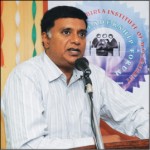
Johny Lukos bags Madhyamasree award

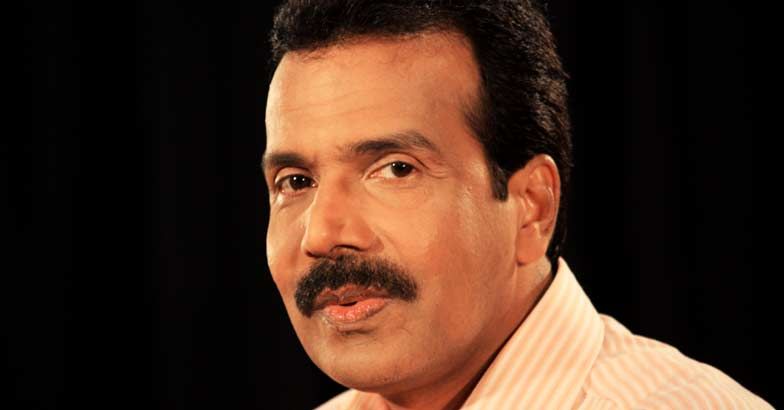
Johny Lukos, news director, Manorama News channel

New York:

Johny Lukos, news director, Manorama News channel bagged the Madhyamasree Award instituted by India Press Club of North America (IPCNA). M.G. Radhakrishnan, Editor, Asianet News has also won the award.

The award has been conferred in view of his outstanding contribution to contemporary journalism. The award will be presented on November 8 at a ceremony to be held in New York, India Press Club president Taj Mathew informed.

The awardees will share a cash prize of Rs 1.5 lakh among them. The winners were announced after the shortlisted candidates were evaluated by Malayalam film actor, Mohanlal.

source: http://www.english.manoramaonline.com / On Manorama / by The Correspondent / Saturday – October 18th, 2014

Ismail Ali Khan to Head TSERC

Hyderabad :

Ismail Ali Khan has been  appointed as the chairman of the newly created Electricity Regulatory Commission of Telangana state here on Tuesday. L Manohar Reddy and H Srinivasulu have been made other members of the ERC.

Ali Khan, who hails from Asifabad in Adilabad district, is presently member of the Bihar State Electricity Regulatory Commission. He earlier worked as member of the Planning Commission.

source: http://www.newindianexpress.com / The New Indian Express / Home> States> Telangana / by Express News Service / October 22nd, 2014

Book to renew Kolkata’s tie with Wajid Ali Shah

Kolkata :

“It’s the only book I’ve read twice. And my favourite line is ‘life can’t be divided into chapters’,” mused Shahanshah Mirza, great-great-grandson of Wajid Ali Shah, referring to ‘The Last King in India’ by Rosie Llewellyn-Jones. The British historian has made waves by compiling facts about the legendary nawab whose memory still divides opinion.

Rosie smiled: “Thanks for helping me investigate the mind of the last king. The British opposed him because they wanted to take his kingdom. Mirza nodded: “You’ve dealt with his seclusion rather well.” He thought the agony associated with the annexation of Awadh is well portrayed in the book.

Rosie begins with a chapter following this act, when the nawab’s mother travels to petition Queen Victoria for justice. Unknown to her, the Queen had no power to return Awadh. The bleak start sets the tone for the book — the British duplicity, with the king caught between forces over which he had no control.

For inputs, Rosie has watched ‘Shatranj Ke Khilari’ “several times”. “Ray did a lot of research,” said Rosie. “When Ray met my father in 1978, he was asked if it was easy getting Amjad Khan into Wajid’s skin. He had said ‘Amjad was blinking a lot. When a ruler is angry, he doesn’t blink. His eyes are wide open’,”
said Mirza.

Rosie’s Kolkata connect goes a long way — since she found Mirza on the royal family website in 2004. “I came here and we did a lot of research together,” she said. The cover is a painting of the nawab which belongs to Mirza’s relative Sultan Ali Sadiq.

Rosie pointed out: “In nearly all his pictures, the king has his left breast exposed.” Mirza explained: “I guess the poet in the nawab wanted to show that his heart was always open.”

The book will be unveiled for the third time on Sunday after a London launch in June followed by another such ceremony in the nawab’s very own Lucknow last month. “Now it is Kolkata’s turn and we had to have Shahanshah,” said Rosie. Mirza has given Rosie inputs on the king settling down in Metiabruz (or Metiaburj, which literally means a clay tower). An old watchtower had once stood there, guarding the Hooghly river bend, giving the place its name.

“The book shows that even 127 years after his death,
Wajid Ali Shah, who himself authored 117 books (Rosie found some of them at the London Library), is still a subject of interest.”

The king contributed greatly to Kolkata’s culture. Kathak and kite-flying were introduced by him. He opened a menagerie which attracted a lot of visitors. According to Rosie, the king tried, within his limited resources (he had to live off a pension given to him by the British), to recreate a miniature Lucknow in Garden Reach-Metiabruz where he lived his last 31 years. He brought with him the music, the poetry, the cuisine, the adab that had made Lucknow under him the byword of culture and etiquette.

“His Calcutta stay changed many aspects of its social life. The British failed to fathom (deliberately) the love that he enjoyed from his subjects,” said his great-great-grandson.

The British, who deposed him to Calcutta in 1856, could hardly accept a ruler who believed that his subjects singing his songs was enough guarantee that he was seen as a good ruler. “Do Queen Victoria’s subjects sing her songs?” Satyajit Ray makes Wajid ask his chief minister in ‘Shatranj Ke Khilari’, thus capturing the differing notions of kingship.

source: http://www.timesofindia.indiatimes.com / The Times of India / Home> City> Kolkata / by Ajanta Chakraborty, TNN / October 12th, 2014

Mammootty’s ‘My Tree Challenge’ a Hit Abroad, Accepted by Australian Mayor

Kochi :

The ‘My Tree Challenge’ campaign, launched by actor Mammootty recently for planting trees, has crossed the oceans and reached other continents, with an Australian mayor accepting the challenge.

Stuart Slade, Mayor of the Glenorchy City Council, has planted a gumtree at the Tolosa park in the capital of Tasmania, an  island city in Australia.

The mayor, who named the tree ‘Gandhi’ as  an honour to Mahatma Gandhi, has also challenged the mayors of Melbourne, New York, Paris and London to plant trees.

Slade thanked Mammootty for the concept, while acknowledging it as a solace to the  planet that is fast becoming polluted. He also invited Mammootty to Tasmania, and urged him to pay respect to the Gandhi tree.

The Mayor, who is an enthusiast of India and the country’s development, came to know about the My Tree Challenge from Sajini Sumar, chairperson of the Multi-cultural Women’s Council of Tasmanaia.

The My Tree Challenge, a campaign involving planting of saplings and challenging others to do so, was launched by Mammootty on August 30 – inspired by the ‘Ice Bucket Challenge’. He had asked Bollywood actor Shah Rukh Khan and Tamil actors Vijay and Suriya to take up the challenge.

Mammootty had also planted a tamarind tree on the premises of Grand Hyatt Hotel, Dubai.

source: http://www.newindianexpress.com / The New Indian Express / Home> States> Kerala / by Express News Service / October 21st, 2014