Category Archives: Leaders

Moolika Dasara series-3

Eat Mango – Keep your Heart Healthy

by Dr. Sathyanarayana Bhat , Principal, Government Ayurveda Medical College, Mysore

It is Dasara season. How can we remember Mango now? Don’t get surprised. I have seen at Cairns, Australia, a tree full of ripen mangoes during Dasara. Incidentally, Southern hemisphere mango trees yield fruits now. Further more, do you know a mango variety called dusseri!

Let us know more about cardio-protective effects of this divine fruit. Mangifera indica, the indigenous fruit of India, was found wild at Himalayas. Now, it is cultivated world over. In the list of heart tonic medicinal plants, mango occupies first place.

The ripen fruits are not only attractive to look but also good to eat. Amrapali, is a Buddhist site, where mango cultivation was prominent. Kalidasa describes mango flowering and fruiting in his many works. Moghul King Akbar planted over one lakh mango saplings at Lakhibagh, Dhrabanga, North Bihar. Mavalli at Bangalore was mango grove of Hyder Ali times. Even Mysore Wadiyar Dynasty has planted mango trees during Nalvadi Krishnaraja, in pre Independence era.

Every part of this tree is medicinal. Flowers, young leaf, tender, unripe and ripen fruit is used in different forms both for culinary and medicinal uses. Kernel is best in bleeding disorders and diarrhoea. Many diabetics are hesitant in using mango. Ayurveda texts encourage use of mango tree bark and seed kernel to reduce sugar levels in Diabetes. Mangiferin, an active ingredient in mango leaf is a very effective antiviral drug. Particularly it is very effective against herpes, both locally and orally. Regular use of the ripe mango can keep away chronic constipation, both in diabetic as well as cardiac patients.

Anti oxidant properties of mango is evident. Therefore regular use of the fruit can keep you and your heart young.

[Dr. Sathyanarayana Bhat can be contacted on Ph:0821-2444701 or Mob:91-09448081005 or email:sathyanarayana.bhat@gmail.com]

NOTE: Moolika Dasara Expo is being held at Chandravana, a garden of medicinal plants maintained by Government Ayurveda Medical College and Hospital, Mysore, near Kukkarahalli Lake on Bogadi Road. It will be open to public till Sept. 30 between 9 am and 6.30 pm.

source: http://www.starofmysore.com / Star of Mysore / Home> Feature Articles  / Saturday  , September 27th,  2014

In Black & White : An orphaned school

schoolMPOs03oct2014

by Vikram Muthanna

While we speak of how our city’s infrastructure suffers due to the nexus of contractors and leaders, it affects even our children. Recently, I had been to a Government School adopted by Star of Mysore. A few blocks away was another Government School and I dropped in to see how they were doing. It was shocking.

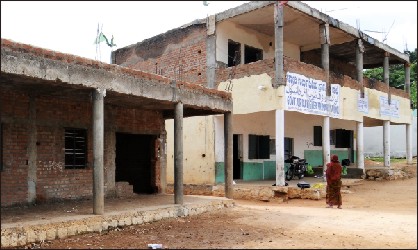
The Haleem Nagar Urdu and Kannada School was started in 2010 by the Government on a generous piece of land donated by the Haleem Nagar Mosque.

After giving land, the mosque allowed the government to use an existing structure with 6 very tiny rooms as classrooms till the government built proper classrooms in the vacant land. Soon a contractor was given the contract to build and construction began. Two new classrooms were built. The money from the government was fully utilised but…

Here is the shocker. Only two of the 7 classrooms built are useable. The two classrooms built on the first floor are not only incomplete but the school better have Jack and his bean stalk as one of its students for there are no stairs to reach them! Yes, the contractor built classrooms on the first floor but no stairs ! To add, the other three unfinished classrooms have no windows, doors and one has a wall missing! And this school has 118 students from class 1 to 7! So how do they manage?

Now that’s another shocker. I saw the first standard and second standard students cramped in one classroom. One teacher teaches both the classes two different subjects and in the same period! How does she do it ? The first half hour she gives some written assignment to the second standard students while she teaches the first standard students.

When done, she gives them a written assignment and turns her attention to the second standard students who can now stop writing and start listening. This is the case even with third and fourth standard students. Only the 5th, 6th and 7th standard students don’t have a problem because they are fewer in number and can manage in the tiny classrooms! And all the 118 students from class 1 to 7 are taught all subjects by 5 teachers.

Now, the construction was in the hands of the Head Mistress, committee member and the contractor. But only the Head Mistress has been suspended; the committee member roams free and the contractor reportedly claims he could not finish his work as the government did not pay him! Who suffers? The children.

Government School construction is always a money-making scheme. That is why the government now tries to tie-up with concerned citizens and social clubs to complete school buildings by providing matching grants.

In another case of bad construction and political callousness, last year the previous MP had released Rs. 3 lakh for building a classroom at a school in Sathagalli. The MP’s office themselves chose the contractor. A few months later the structure was up, they informed. What was the structure? The contractor had built four pillars and a roof but there were no walls! At best it was not even a car shed. Yet the contractor had the gal, or should we say shamelessness, to paint “Donated by Honourable ……. MP.” It was an insult to the MP and a great disservice to the children who were eager to have a classroom.

Finally, the walls were put up after threat of media frenzy and after the school itself supplied windows and doors. Now, MLA Tanveer Sait has promised the school a classroom next to this one.

Now, this MP was considered to be “intellectually” inclined. If such a leader can be so callous and insensitive to a children’s cause, what can we expect from contractors who are walking a tight rope between giving a cut and constructing as per plan.

As far as this particular Haleem Nagar School is concerned, the biggest photograph in the front office, which doubles as HM’s chamber, is that of late Azeez Sait, the father of that area’s MLA Tanveer Sait. In fact it is bigger than Mahatma Gandhi’s and Nehru’s and former President Fakhruddin Ali Ahmed’s put together. May be, MLA Tanveer Sait is unaware about the state of this school for, if he did, he surely would have taken action, for the school is an insult to the memory of his popular father. Also since he is the one who is helping the Sathagalli School, we are sure he will do the same for this school which also is in his constituency.

Also, the other aspect of the school is that it is an Urdu school. I spoke to a few children and noticed that they knew some Kannada and no English at all. Now, Urdu is a fabulous and a poetic language, but how will it help these kids fare in this rapidly globalising India? They will be left in the lurch unable to participate in the new economy. May be the MLA can provide for a full time English teacher or at least request organisations like Pratham for assistance.

We are sure there are many such schools that are in dilapidated condition that need help. May be one of the many social organisations in city can help Haleem Nagar School to get a staircase, a wall and a few windows so the poor students can study in a good school and in a congenial atmosphere.

Our government may be deaf, but it doesn’t mean we have to be too; our government may be blind, but we need not be; our government is heartless, but we cannot be, we still have a conscience. So we must pitch in.

Who knows, there may be a gem among these 118 students in Haleem Nagar school or any other such schools, who one day may change our Nation’s fortune. We can make sure it’s for our good, or we can ignore it and wait for something bad to happen and then the society will be as much to blame as the incompetent leaders, conscience-less teachers and greedy contractors.

e-mail:vikram@starofmysore.com

source: http://www.starofmysore.com / Star of Mysore / Home> Feature Articles  / Saturday  , September 27th,  2014

Industrialist P.K. Mohamed dead

P.K. Mohamed
P.K. Mohamed

People from all walks of life paid tributes to industrialist P.K. Mohamed, 73, who died here on Monday. He was the managing director (MD) of Western India Plywoods Ltd. (WIP).

He had been recuperating at his residence at Thana here after a recent cardiac surgery. The body was taken to Thalassery for burial at Elangol Juma Masjid, Chettamkunnu.

Early years

He followed his father, A.K. Kaderkutty, into the industry. After college education in Chennai, Mohamed went to Germany for extensive training in wood technology.

He joined WIP as production manager in 1962. He was made MD in 1993.

He was involved in the modernisation and diversification of the company.

He had functioned as office-bearer of the North Malabar Chamber of Commerce and was a sports organiser. He was a member of various industry organisations and was actively involved in the social sphere.

He is survived by wife and four sons. Political leaders including Rural Development Minister K.C. Joseph and E. Ahamed paid their last respects.

source: http://www.thehindu.com / The Hindu / Home> News> National> Kerala / by Special Correspondent / Kannur – October 01st, 2014

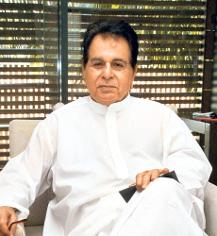
When actor Dilip Kumar turned ‘Gandhiwala’ in jail

Veteran Bollywood actor Dilip Kumar was once arrested by police for his ‘anti-British’ views and spent a night on hunger-strike along with other ‘Gandhiwalas’ lodged in a prison cell.

In his recent autobiography ‘Dilip Kumar: The Substance and Shadow’, the legendary actor recounts how his patriotic eloquence met a fate he had never imagined!

In pre-independent India, during his stay at Poona (as Pune was known then), Dilip Kumar worked at a canteen in Air Force cantonment when one day, at the behest of a senior colleague, he made a speech about India’s superiority as nation a nation of hard-working, truthful and non-violent people.

Dilip Kumar
Dilip Kumar

“My speech evoked genuine applause and I felt elated but the enjoyment of my success was short-lived. To my surprise, a bunch of police officers had arrived on the scene and handcuffed me, saying I had to be arrested for my anti-British views.

“I was taken away to the Yerwada Jail and locked up in a cell with some decent-looking men, who I was told were satyagrahis (followers of Mahatma Gandhi who offered passive resistance). On my arrival the jailor referred to me as a ‘Gandhiwala'” Kumar recalls.

The actor said, “I could not figure out why he was using this term for me till I heard the policemen refer to all the inmates of the cell as Gandhiwalas. It was their way of herding us together as followers of Gandhiji.”

The young Dilip Kumar, who went on to become an acting legend, came to know that freedom fighter Sardar Vallabhbhai Patel was also lodged in one of the cells of the same prison and they all were on a hunger strike with him.

“I don’t know why, but I too felt I should fast with them. So I refused the food that was that was brought for me in an unclean plate. The night was long and pangs of hunger kept me awake till dawn,” Kumar recalls.

An army major got Kumar released the next morning from the and after reaching his workplace he narrated the happenings to everyone there.

“As I sat alone in my room that night, I kept hearing the jailor’s words in my subconscious and a sense of pride built up within me that I had spent a night in jail with Gandhiji’s followers and, even if it was for a few fleeting moments, I was unafraid of expressing my pride about my country and my compatriots,” Kumar records in the book.

source: http://www.timesofindia.indiatimes.com / The Times of India / Home> Entertainment> Hindi> Bollywood / PTI / October 02nd, 2014

Blowing From Guns Sepoy Revolt Of 1857

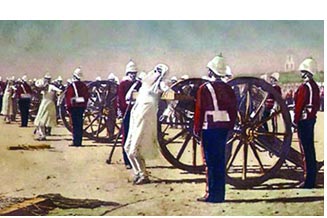
Blowing from Guns in British India (1884) by Vasily Vereshchagin. This painting depicts events of 1857 with soldiers wearing (then current) uniforms of the 1880s.-http://www.vokrugsveta.ru
SepoyMPOs01oct2014

[Picture printed above and commentary was forwarded to me.  Someone with more interest in history asked about the picture, associated story and procedure of blowing up from canon as punishment.  Others have previously asked about capital punishment in seventeenth & eighteenth century India.  Only for those interested in history of the Raj.]

“Lets salute the first martyred journalist in the Independence movement against the British back in 1857.

Moulvi Mohammed Baqir editor of ‘Urdu Akhbar Dehli’ was the first journalist to be martyred by the British army through Taliban-e-Pakistan style execution.

He was tied with canon and blown up for his ‘seditious’ writing against British colonial rule in the First War of Independence 1857.

Unfortunately the brave martyr hardly got any recognition in the history books.

The photograph below shows how the “benevolent” and “humane” British army blew up these unarmed captured Muslim civilians with cannon. This even beats the “humanity” of the Taliban-e-Pakistan.

Share as much as you can, if you want his legacy to live on.”

My Comments

“The very ink with which history is written is merely fluid prejudice”.  Mark Twain

Few things should be kept in mind as a backgrounder.  There is a narrative of the victor and a completely different one by the vanquished.  Facts are interpreted in different ways and that is fine.  Selective use of facts to support one’s point of view is also common especially in post 1947 India and Pakistan (the fact that Bengal army that was two third Hindu Brahmin revolted and came to Delhi to fight under the Mughal flag will never be acknowledged by the right wing of both India & Pakistan as it does not fit into their respective narrative).  However, sometimes folklore is mixed with facts and this adds to the confusion rather than bringing clarity.  Few basics; It is a painting and not a photograph and this painting has nothing to do with the story narrated above.  It is simply a folklore and not based on any historical event.  Below is the copy of the print of the original painting (from Library of Congress collection) and my explanation.

Blowing from guns in British India (Library of Congress)

This painting is by a Russian painter Vassili Verestchagin (1842-1904).  He visited India in 1874-76.  He painted many scenes of India and Central Asia.  This is artist’s imagination of how the sentence was carried out and probably not based on any individual case or any eyewitness portrayal by the painter.  This was painted in late 1870s when this practice had been abandoned.  The uniform of British soldiers standing next to guns is of late 1800 era and not 1857.  Vassili like many artists abhorred war and painted many works showing horrors of war.  In fact, at one time German and Austrian military high command banned their officers to visit Vassili’s exhibitions of paintings as they viewed his work as anti-war.

I have my own theory about this particular painting.  One of last incident of large scale blowing up from canons occurred in January 1872 in the small princely state of Malerkotla in Punjab.  A small sect of Sikhs called Namdharis is very strict against cow killing and there were incidences where they attacked slaughterhouses and killed butchers.  An ox was slaughtered in the presence of a Namdhari.  He narrated the incident to his kin and a band of about 200 Namdharis attacked Malerkotla and in the ensuing firefight fifteen people were killed and some arms looted.  Remaining Namdharis escaped to neighboring Patiala state.  Nawab of Malerkotla Ibrahim Ali Khan was a minor and Superintendent of Council of Administration Mr. Heath was administering the state under the supervision of Deputy Commissioner of Ludhiana L. Cowan.  Cowan rushed to the scene and many Namdharis who had escaped were brought back to Malerkotla from Patiala.  Cowan interpreting this act as rebellion summarily executed sixty six Namdharis by blowing them from canons (brought from neighboring Patiala and Jind states) over two days time period without trial.  Later, when this act was denounced, Punjab government fully supported Cowan but Government of India disapproved. Cowan was sacked while Commissioner of Ambala division Forsyth transferred to Awadh.

This incident occurred in January 1872 close to the time of Vassili’s visit to India in 1874-76.  He may be referring to this recent incident of Namdharis in his painting.  The only person clearly visible in painting is the first gentleman tied to the canon in the front.  He has white beard, all white clothing and wearing a turban.  The remainders three tied to the guns are also wearing white clothes.  Namdharis wear white home spun cotton clothes and tie their turbans horizontally different from other Sikhs.  It is not likely that Vassili painted this based on an eyewitness account (he didn’t mention any such incident in his autobiography) as to the best of my knowledge; there was no incident of blowing from canons for mutiny at the time of Vassili’s visit to India in the time period of 1874-76.  It is quite possible that the gentlemen in the painting are all Muslims as from clothing one can guess that they are not Hindus.  Vassili may have painted 1857 incidents when he became aware of this during his visit.

Maulvi Muhammad Baqar Ali (1810-1857) was a Shia intellectual of Delhi.  He was educated at Ghaziuddin Madrassah that later became famous Delhi College.  Baqar owned a printing press and published first Urdu weekly newspaper called Dehli Urdu Akhbar in northern India in 1836 (in July 1857, it was renamed Akhbar al Zafar).  His paper mainly covered social and literary activities of only Delhi.  He also published many works translated from English.  In 1857, he continued to publish his newspaper after the fall of Delhi to rebels.  He praised the cause of rebels and supported last Mughal emperor Bahadur Shah Zafar.

Baqar was arrested on September 15, which was the second day of assault when Delhi was not yet secured by British.  His son Muhammad Hussain after putting rest of the family on a journey out of Delhi came back to Delhi to look for his father.  A Sikh general who was friend of Baqar helped Hussain to stay under his protection.  This Sikh fellow took Hussain to the field on September 17 where prisoners were awaiting their trial and execution.  Father and son just looked at each other before Baqar was hanged (This is described in detail by Darlymple in his excellent account of the time period in The Last Mughal).  During British assault on Delhi, majority of people were killed by swords, bayonets and firearms.  Later, after securing the city, summary executions were carried out mostly by hanging.

Baqar was supporter of the rebel cause and Zafar.  However, near the end of July when things started to deteriorate and doubts were raised about victory of rebels, many residents of Delhi now had second thoughts.  A number of residents including members of royal family opened up communication with British camp through intermediaries in contact with British (Hakim Ahsanullah Khan, Maulvi Rajab Ali etc.).  Many wrote intelligence reports giving information about happenings in the city.  Baqar also sent a report to the Ridge (Translation of a letter from Munshee Mahomed Bakar, July 1857 at Delhi Commissioner’s Office Archives quoted in Darlymple’s The Last Mughal) and its text gives an idea of feeling among Delhi inhabitants.  He wrote, “We, the respectable portion of the inhabitants are reduced to the last extremity by the violence of the sepoys, and have no hope of escaping with our lives. The General Bakht Khan’s spies dog me wherever I go.  There are sentries over the house of Mufti Sadruddin Khan and all exit and entrances prohibited.  Through Zinat Mahal I suggested to the King to open the gates and invite the English to come and seize the city, telling him that if he could destroy the mutineers it would be great advantage to himself and his children.”

Somewhere in my own humble collection of materials on military history of the Raj, I have a note where someone named Hobson then present at the Ridge during the siege mentioning that it has been communicated to Baqar to publish in his paper that if the city surrenders it will be spared destruction and also to encourage people to leave the city at once.  He mentions that if Baqar publishes this notice then his life may be spared.  Unfortunately, I do not have reference for this anecdote.

Residents of Delhi were in a very precarious situation and self preservation demanded careful maneuvering.  Ordinary folks could stay neutral but those well known or wealthy had to declare openly.  Some may have genuinely believed that old order was gone and they had to profess loyalty to Bahadur Shah to stay on the right side of the power.  Even those not sure about the change, silence on their part could label them as sympathetic to British cause and hence punishment from rebels (many were killed by rebels and same happened to some unfortunate native souls at the Ridge where they were accused of in sympathy with rebels and killed by British).  Delhi inhabitants were at the mercy of rebels in control of the city but after two months, they were not sure about victory of rebels.  Baqar tried to balance this by supporting rebels in the editorials of his papers while also keeping channels open with British at the Ridge to safeguard his life in case of return of the British.  The chaos of assault, vengeance on part of British soldiers and hatred of Sikh, Punjabi Muslim and Pathan allies of British meant that even the lives of friends of British were not safe in Delhi.  Many who provided valuable information to British about Delhi during the siege were killed by the victorious British army and its Indian allies.  All able bodied males were summarily executed and whole city was turned out.  Thousands perished from extremities of weather and starvation all around Delhi.

Baqar’s son Muhammad Hussain Azad survived the mutiny despite writing a poem praising rebels in his father’s newspaper.  He left Delhi with twenty two members of his family.  His one year old daughter was killed by a stray bullet.  After wandering for four years through Madras, Niligiri hills and Lucknow, Azad later settled in Lahore and under the patronage of great Orientalist Gottlieb W. Leitner became celebrated Urdu literature critic.

“History will be kind to me, if I intend to write it”.  Winston Chuchill

Top Dum – Execution by Blowing Up from Canon

Throughout human history various methods of execution have been used.  Execution by blowing up from canon was used during Mughal times but it was limited to those guilty of armed rebellion and used very rarely.  Beheading, hanging and later firearms were more common methods.  In fact, these were considered more humane methods of execution compared to slow and torturing death by other means.  Cutting off limbs, flaying and skinning alive, crushing by elephants, tying all four limbs to four horses and whipping them to run in opposite directions thus dismembering the victim and throwing the victim from the top of a building were more gruesome methods used against enemies.  A particularly cruel method was amputating one limb at a time but pouring boiling oil on the wound that not only caused severe pain but also had a cauterizing effect on blood vessels that prevented quicker death from blood loss.  The purpose of these tortuous and painful deaths was not only to punish the culprit but also to instill fear among general population.

East India Company used occasionally the method of blowing up from canons only in cases of mutiny.  The last case of blowing up from canons prior to 1857 was in late 1820s.  In 1857 rebellion, this method was used on large scale for a variety of reasons.  The main reason was a deterrent effect on general population.  There was no preference for any particular ethnic or religious group.  This method was used more in areas where rebellion was large scale and affected civilian population like Delhi and its surrounding areas and Rohilkhand (majority Muslims) and Central India (majority Hindus).   In individual cases, a variety of factors were at play when decision was made to use this method of execution.

The method included lowering the muzzle of the gun to about three feet from the ground.  The condemned man was then tied to the muzzle of the canon where small of the back touched the muzzle of the gun (in some cases, victim faced the gun where his stomach was touching the muzzle). Hands were tied to the wheels of the gun and in some cases legs were secured by tying ropes to tent pegs driven in ground near victim’s feet.  About a quarter of the powder was used in cartridge shell; double charged in case of more than one person tied to the muzzle.  The gunners stayed behind a back board to light the charge to avoid being sprayed with the blood and flesh of the dying man.  Most of the time, one man was tied to the gun for each shot but in some cases four to six were tied together.  Torso was disintegrated by the blast while head and limbs scattered over a wide area.

In May 1857, 55th Bengal Native Infantry (BNI) was stationed at Nowshehra with one detachment in Mardan on the frontier.  55th BNI mutinied and sepoys ran away with their weapons (their heart broken commanding officer Colonel Henry Spottiswood committed suicide).  Legendry John Nicholson chased the mutinous 55th with the help of his Pathan allies killing and capturing many.  Forty men of 55th BNI were brought to Peshawar and blown away from canons.  In June 1857, ten sepoys of 5th BNI were blown from guns in Umbala.  In Bengal, Colonel George Sherer of 73rd BNI got hold of three ringleaders of sedition in his regiment and executed them by blowing from canon.   In June 1858, 300 captured rebel soldiers were executed at Kirwee by this method.  In view of large numbers condemned to die by this method, six were tied to each muzzle at a time.

The main reason for using this punishment during mutiny was a salutary effect on other soldiers and civilian population as sight was terrible.  Another reason was to instill the fear of eternal damnation among both Hindu and Muslim sepoys.  Among Hindus, proper disposal of ashes after cremation is an important step while for Muslims burial after appropriate rites is considered important for eternal bliss.  Blowing up bodies to pieces where remains could not be collected and disposed off with religious rites was a terrible thought.  Usually, all soldiers of the station as well as native population was invited to witness this horrible scene which suggests that the main purpose of this punishment was to instill fear among spectators.

In some cases opposite was true where blowing up from canon was considered a better option and in some cases as a favor to the condemned man.  Hangmen were usually ‘untouchables’ and for a Brahmin to be hanged by an untouchable was a terrible thought.  Any other method was preferable than coming in contact with an untouchable on the final journey from the world.  Two sepoys of 35th BNI were arrested on charges of sedition and awarded death sentence.  Brigadier Neville Chamberlain addressed the assembled soldiers and told them that “these men have been blown from a gun and not hung, because they were Brahmins, and I wished to save them from the pollution of hangman’s (sweeper) touch, and thus prove to you that the British government does not wish to injure your caste and religion”.

In Central India, Commander-in-Chief and Commandant of Artillery of the deposed Raja of Satara were arrested on charges of sedition.  They were awarded death sentence.  One of the condemned prisoners was told that he will be hanged.  Fearful of being polluted by the touch of a low caste hangman, he requested that instead he should be blown away from a canon but his request was denied.  In Ferozpur, fourteen sepoys of 45th BNI were sentenced to death.  Two low caste men were hanged while twelve Muslims and Brahmins were blow from canons.

Almost all eyewitness accounts of this punishment give grudging tribute to the behavior of the victims.  They never showed any sign of fear or panic and faced their end with remarkable courage. In one case, when few ready to be blown complained and asked for mercy, their fellow soldiers waiting for their own turn rebuked them with comments that ‘you have fought for your religion’ and ‘die like a man not like a coward’.  In another case, a group of soldiers of a mutinous regiment were sentenced to be blown from canons.  Soldiers of the Grenadier company of the regiment requested that as they are always on the right side of the regiment during the battle and go forward first, therefore they should be given the honor to be placed on the right side and blown first.  Many tried to explain this behavior in various terms such as passivity, native fortitude, stoic demeanor, acceptance of fate and belief in the righteousness of their cause.

In the immediate aftermath of the mutiny, defeated soldiers and civilians faced the brunt of retribution.  Summary court martial and special civilian commissioners with powers of life and death were instituted.  This was a mere formality as no proper trials were conducted and sentences were passed summarily.  Death sentence was the rule rather than exception (although there are cases where British acted with extreme restraint such as in case of 45th BNI in Ferozpur.  Over 200 rebel sepoys were arrested and their trial lasted for a month.  One hundred were convicted but only fourteen were awarded death sentence).  Most common method was hanging followed by use of firing squads and the least common blowing up from canons.  There were no specific laid down procedures for capital punishment and the method of execution was decided by the presiding officer.  In some cases, when large number were condemned to death at the same time, it was not unusual to have gallows set up on one side of the ground, a firing party to the other side while canons on another.  Condemned men were sent in batches to different sites of execution; some hanged, some facing a firing squad while others blown from canons.

Notes:

*          Vassili Verestchagin . Autobiographical Sketches (London: Richard Bentley & Son, 1887)

*  George Dodd.  The History of the Indian Revolt and of the Expeditions to Persia, China and Japan 1856-7-8 (London: W and R Chambers, 1859)

*          Charles John Griffiths.  A Narrative of the Siege of Delhi (London: John Murray, 1910)

*   Sir George Forrest.  The Life of Field Marshall Sir Neville Chamberlain (London: William Blackwood & Son, 1909)

*          William Darlymple.  The Last Mughal (New York: Borzoi Books, 2006)

*          Christopher Hibbert.  The Great Mutiny (New York: Viking Press, 1978)

*          Anna Bigelow.  Punjab’s Muslims: The History and Significance of Malerkotla,

*          http://www.global.ucsb.edu/punjab /journal_12_1/4_bigelow.pdf

*          http://www.expressindia.com /news/fullstory.php?newsid=50074

Hamid Hussain

coeusconsultant@optonline.net

source: http://www.bdj.com.bd / Bangladesh Defence Journal / by Hamid Hussain / Home> Facts & Fiction
Iqbals’s Hindu relations

THIS ABOVE ALL – Khushwant Singh

IqbalMPOs01oct2014

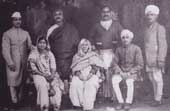
I am beholden to P.V. Rawal of Jammu for sending me a photograph of Allama Iqbal’s Kashmiri Brahmin family taken in Sialkot in 1931. At this time Iqbal was in his mid-fifties. He had already risen to the top as the greatest Urdu poet, at par with Mirza Asadullah Khan Ghalib. Although he was proud of his Brahmin descent, he had nothing to say about his Hindu relations. In this picture, the elderly lady seated in the middle is his grandmother, Indirani Sapru, nicknamed Poshi, wife of Pandit Kanhaya Lal Sapru. The man standing on the left in a shawl is Iqbal’s cousin, Amarnath Sapru; note the close resemblance to the poet.

The family traces its origin to one Birbal. They lived in the village of Saprain (hence, the surname Sapru) on Shopian-Kulgam road. Then the family moved to Srinagar where Iqbal and most of his cousins were born. Birbal had five sons and a daughter. The third one, Kanhaya Lal, and his wife, Indirani, had three sons and five daughters. Kanhaya Lal was Iqbal’s grandfather. His son, Rattan Lal, converted to Islam and was given the name Nur Mohammad. He married a Muslim woman — Imam Bibi. The Saprus disowned Rattan Lal and severed all connections with him. There are different versions of Rattan Lal’s conversion. The one given to me by Syeda Hameed, who has translated some of Iqbal’s poetry into English, maintains that Rattan Lal was the revenue collector of the Afghan governor of Kashmir. He was caught embezzling money. The governor offered him a choice: he should either convert to Islam or be hanged. Rattan Lal chose to stay alive. When the Afghan governor fled from Kashmir to escape its takeover by the Sikhs, Rattan Lal migrated to Sialkot. Imam Bibi was evidently a Sialkoti Punjabi. Iqbal was born in Sialkot on November 9, 1877. As often happens, the first generation of converts are morekattar than others. Iqbal thus grew up to be a devout Muslim. It is believed that once he called on his Hindu grandmother, then living in Amritsar. But there is no hard evidence of their meeting and of what passed between them; Iqbal did not write about it. Though he had many Hindu and Sikh friends and admirers, he felt that the future of Indian Muslims lay in having a separate state of their own. Iqbal was the principal ideologue of what later become Pakistan. Iqbal’s mother-tongue was Punjabi but he never wrote in it. He used only Persian and Urdu, as did many Urdu poets before him.

There are many aspects of Iqbal’s personal life which have not been fully researched by his biographers. We know he married two or three times and that his favourite son was Javed, who became a judge of the Lahore high court. Iqbal’s affair with Atia Faizi of Bombay when they met in London is well-known. There must have been some correspondence between them to show the kind of relationship they had. When in Heidelberg, he was taken up by his young German tutor, Emma Veganast. This secret was divulged by the mayor of Heidelberg in a speech in which he named a part of the bank of the river Neckar after him — Iqbal Weg. The Pakistani ambassador to Germany had the mayor’s speech mentioning the girl’s name suppressed. Iqbal and Emma continued to write to each other till the end of his life. The correspondence should be available in archives in Lahore and Heidelberg. Lovers of Iqbal, among whom I count myself, deserve to be presented with a fuller picture of their idol. We have biographies of Rabindranath Tagore revealing all his love affairs but none of the Allama telling us of the kind of man he was.

Cleansing the system

A couple of lines by Guru Nanak which I often recite to myself to preserve my mental balance run as follows:

Haumain deerag rog hai

Daaroo bhee iss maahen

Ego is a foul disease

Its cure also lies in itself.

I agree with every word of the Guru’s advice. Egoism or self-esteem is a disease like cancer. If not nipped in the bud, it infects other parts of the body and ultimately makes a person a deadly bore who loves talking about himself and wants others to praise him. Every one of us is prone to catch it and must evolve his own methods of fighting it.

Since I get more than my share of flattery from men and women who want me to write about them in my columns, I have to battle against them in different ways. Most tell me how they have read everything I have written and how much they liked it. I know it is not true; so I try to put it out of my mind. Others lay it on thick, that is, makkhan lagoing, when they come to see me. I do my best to change the subject. Despite that some of it sticks because later I find I am pleased with myself. I have found a more effective antidote: it is to make fun of myself. I narrate incidents in which I have made an ass of myself. I did that so many times. Everyone has a hearty laugh at my expense and thinks I must be the kind of fool I make out myself to be. It has a cathartic effect. It purges a lot of ego-poison out of my system.

Try out this purgative

Recently, I had to undergo an endoscopy to clear or confirm cancer in my belly. Needless to say, I wanted everyone to show concern for my health. It is another form of feeding one’s ego. As I had calculated, I got exaggerated shows of affection for me. After it was over, I felt I should restore my ego-balance to its earlier level. I wrote about it in lurid detail. Since I had to use a lot of indelicate vocabulary, which I feared publishers of my columns would find unacceptable, I sent the copy to Vinod Mehta, editor of Outlook. He is the only man I know who would understand what I wanted to say without censuring how I said it. In that piece I have written in detail about the humiliation and loss of esteem an endoscopy entails. Writing about it did cleanse my system of the false notions I had about myself. I felt much better.

source: http://www.telegraphindia.com / The Telegraph, Calcutta / Front Page> Opinion> Story / Saturday – June 30th, 2007

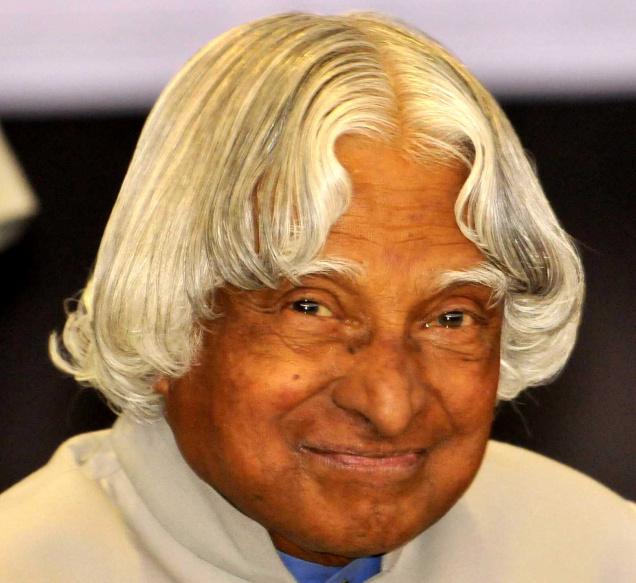
Failed in my dream of becoming pilot: Abdul Kalam in new book

Former President Abdul Kalam says that true nation building is not made by political rhetoric alone but should be backed “by the power of sacrifice, toil and virtue”. File photo: K. Ramesh Babu / The Hindu

For former President A.P.J. Abdul Kalam, becoming a fighter pilot was a “dearest dream” but he failed to realise it by a whisker as he bagged the ninth position when only eight slots were available in the IAF.

In his new book “My Journey: Transforming Dreams into Actions”, published by Rupa, Mr. Kalam, who specialised in aeronautical engineering from Madras Institute of Technology, says he was desperate to pursue a career in flying.

“Over the years I had nurtured the hope to be able to fly to handle a machine as it rose higher and higher in the stratosphere was my dearest dream,” he writes.

Out of the two interview calls Mr. Kalam got, one was from the Indian Air Force in Dehradun and the other from the Directorate of Technical Development and Production (DTDP) at the Ministry of Defence in Delhi.

While the interview at DTDP was “easy” he recounted that for the Air Force Selection Board, he realised that along with qualifications and engineering knowledge, they were also looking for a certain kind of “smartness” in the candidate.

Mr. Kalam bagged the ninth position out of 25 candidates and was not recruited as only eight slots were available.

“I had failed to realise my dream of becoming an air force pilot,” he writes.

He says he “walked around for a while till I reached the edge of a cliff” before deciding to go to Rishikesh and “seek a new way forward.”

“It is only when we are faced with failure do we realise that these resources were always there within us. We only need to find them and move on with our lives,” says Mr. Kalam who went on to put his “heart and soul” at his job as the senior scientific assistant at DTDP.

The book is filled with stories of “innumerable challenges and learning” in his years as the scientific adviser when India conducted its second nuclear test, his retirement and dedication to teaching thereafter and his years as President.

Mr. Kalam has compiled life’s learnings, anecdotes and profiles of key moments and people who inspired him profoundly in the book, which will hits the stands on August 20.

He recounts “staring into the pit of despair” when he failed to make it as an IAF pilot and how he pulled himself up and rose to become the man who headed India’s missile programme and occupy highest office in the country.

While the 82-year-old, popularly known as the Missile Man for his contribution to the development of ballistic missile technology, had in 1999 brought out his autobiography “Wings of Fire” and followed it with “Turning Points”, a journey through challenges” in 2012 that details his political career and challenges, the latest book talks about the people who left a deep impression on him as he was growing up.

In the 147-page book, Mr. Kalam writes about his experience of watching his father build a boat, his early working life as a newspaper boy at the age of eight and even his first-hand experience of the way in their religious elders settled a religious matter in his school.

In a chapter “A brush with fire”, Mr. Kalam recounts the 1999 January 11 incident involving two aircraft which took off from Bangalore towards the Arakkonam-Chennai coastline and crashed, killing 8 men on board.

While Mr. Kalam immediately flew to Bangalore from Delhi and met the bereaved families, he says the grief of the devastated parents and the wailing of the infants remained with him even after years of the incident even after he moved from his office at South Block to Rashtrapati Bhavan.

The former President says that true nation building is not made by political rhetoric alone but should be backed “by the power of sacrifice, toil and virtue”.

“When grand plans for scientific and defence technologies are made, do the people in power think about the sacrifices the people in the laboratories and fields have to make?” he writes.

The book also contains a chapter detailing Mr. Kalam’s favourite books “which have always been close companions” who “were like friends” guiding him through life. Lilian Eishler Watson’s “Light from Many Lamps,” the “Thirukural”, Nobel Laureate Alex Carrel’s “Man the Unknown” have been listed.

Poetry says Mr. Kalam has been “one of his first loves” and poems by T.S. Elliot, Lewis Carroll and William Butler Yeats has “played out in my over and over again”.

In conclusion, Mr. Kalam writes his life can be summed up as “Love poured to the child… struggle… more struggle… bitter tears… then sweet tears… and finally a life as beautiful and fulfilling as seeing the birth of the full moon.

“I hope these stories will help all my readers understand their dreams and compel them to work on these dreams that keep them awake,” he writes.

source: http://www.thehindu.com / The Hindu / Home> Books> Authors / PTI / New Delhi – August 18th, 2013

Sir Syed Day 2014 in San Francisco Bay Area

San Francisco:

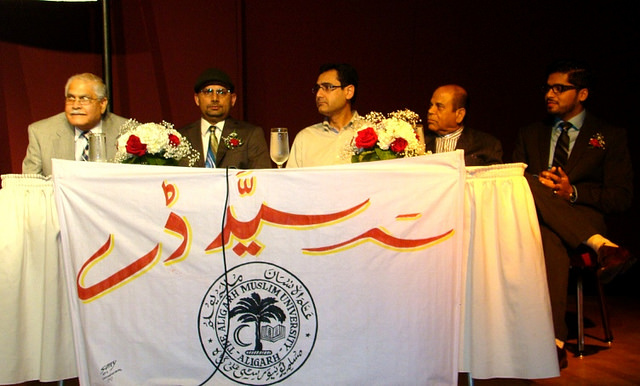
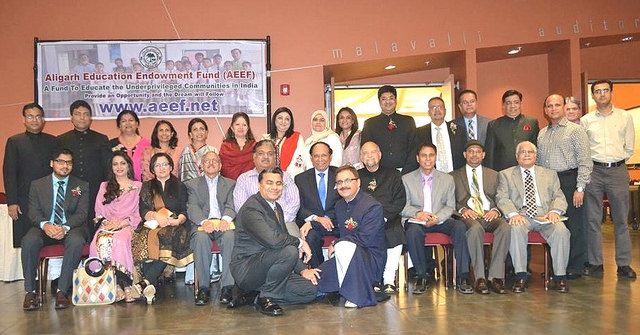
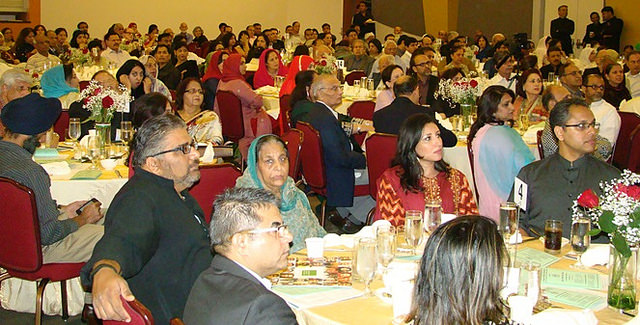
The Aligarh Muslim University Alumni Association of Northern California carried on its annual tradition of holding Sir Syed Day in the San Francisco Bay Area with a fine evening of cultural expression, reflection and entertainment at the ICC in Milpitas on Saturday, September 20th.

Funds were also collected on the occasion for the Aligarh Education Endowment Fund (AEEF) which supports those whose path to education is impacted by lack of funds or social mobility. Both children and youth are assisted through this AEEF vehicle and one can commend Aligarh Muslim University (AMU) alumni for making their annual homage to Sir Syed Ahmad Khan, the founder of their Alma Mater an added purpose.

SirSyed1MPOs30sept2014

After a fine dinner of Mughlai cuisine the formalities began with the traditional recitation from the Holy Qur’an by Mohammed Nadeem. Emcee for the evening Dr. Shaheer Khan made the necessary introductions. He said that everyone here needs to be thanked for their dedication, because the hall tonight is full to its maximum capacity and people unfortunately had to be turned away. He added that the Mushaira or Urdu poetry recital held here attracts many people but it is the cause which is the prime reason for this gathering, which is Sir Syed and AMU. He said that Aligarh was and is a movement and not just a place. He also took the opportunity to thank the sponsors and supporters along with the ICC for making this event possible. He also recognized local South Asians who are running for positions in the upcoming elections (Mohammed Nadeem running for Santa Clara City Council and Moina Shaiq running for Fremont School Board were here. Congressional candidate Ro Khanna was to arrive later).

Next was the President’s Welcome which this year was given by the new head of the AMU Alumni Association of Northern California, Mr. Shachindra Nath. In his short speech Shachindra Sahib welcomed everyone and took the opportunity to share his familial connection with Aligarh Muslim University (AMU) which his father also had the good fortune to attend. He pointed out the mutual respect and tolerance which he found at AMU. “I am so proud to be an Aligarian,” he said. Shachindra Sahib has been a dedicated member of the AMU Alumni Association for several years and it should come as no surprise that today he is the President of this organization.

The Sir Syed Day keynote address this year was presented by Ambassador Islam A. Siddiqui. Dr. Siddiqui till recently served as Chief Agricultural Negotiator in the Office of the U.S. Trade Representative and has now joined a think tank, the Center for Strategic and International Studies (CSIS) as a senior adviser in its Global Food Security Project in Washington DC. He is also a very familiar face to many of us in northern California because of his many years working for the State of California in Sacramento and for his long-time community activism; he is one of the founders of UMA and has been the President of the Downtown Sacramento Muslim Mosque. Although not an alumni of AMU, Dr. Siddiqui said that he was forever indebted to the campus because that is where he met his wife over 40 years ago!

“When I think of Sir Syed Ahmad Khan’s contributions to India and the world at large, it is about Education, Economic Empowerment and Moderation,” said Siddiqui. Giving the audience a backdrop of British-Indian history, and the poor state of Muslims after the 1857 revolt (the first attempt by Indians to gain independence) which failed, Sir Syed’s unique role was highlighted. “Here came a thinker and a visionary, who had worked for the British East India Company, had studied the causes of the Indian revolt, published a commentary on the Bible and was even instrumental in establishing The Scientific Society of Aligarh,” he said. He added that Sir Syed was fighting for the educational, social and economic uplift of Indian Muslims about the same time as President Abraham Lincoln was fighting for the cause of African Americans to abolish slavery in the United States.

He said that today the situation of the Muslim masses in India is not great and cited some relevant statistics from the Sachar Committee Report of 2006 which concluded that “When it comes to education the situation of Indian Muslims is indeed depressing as compared to other socio-religious communities and the problem is more acute among girls and women”. Siddiqui remained hopeful that as India’s economy grows, economic opportunities for all Indians will expand. “As the saying goes: A rising tide lifts all boats,” he said. He also reinforced the charter of the AEEF and its fundraising activity by saying that it is our moral obligation to give back to the under-privileged in the community and country that made it possible for us to reach where we are today.

SirSyed2MPOs30sept2014

Dr. Shaheer Khan returned to present an AEEF Update. The Aligarh Education Endowment Fund needs about $100,000 for 2014-2015 academic year to fund its projects which include the sponsorship of excellence in education through scholarships, Aligarh Modern School, Hamara School Aligarh, Faizabad Public school (Faizabad), Faiz-e Aam Muslim Inter College (Faizabad), Hira Public School (Ambedkar Nagar), J.A.B.I.C. Bhadarsa (Ambedkar Nagar), J.D.J.B. Anand P.G. College (Faizabad), M.I. Girls Inter College (Faizabad), Rishiraz Singh Maha Vidyalya (Faizabad), and many others.

It is also supporting Saiema Mansoor Public School (Hathras), vocational training for women, a mentorship program and students at premier institutions in India. A short fundraising appeal was made with a target of $60,000 in mind. And in the process, just before the entertainment, the Aligarh Tarana or anthem was enthusiastically played and sung by some of the alumni of AMU present.

The second part of Sir Syed Day is the “International Mushaira” which brings together some of the finest poets or practitioners of Urdu language poetry from around the globe (mainly from where it is used most, India and Pakistan). Countries can be partitioned but one cannot do that with a language. Urdu’s birthplace is in India where AMU is physically located too, but Urdu ironically is the national language of Pakistan. Where borders and governments divide, language-culture and family unite. I did get an opportunity at this event to meet the Consul of India in San Francisco and air the trials and tribulations of getting a visa for India for a person of Pakistani origin!

This year the list of poets was “Pakistan heavy” for the lack of a better term. The Mezban or host poets in order of appearance were Shahid Siddiqi (Canada), Misum Samer (Bay Area), Faisal Azeem (Canada), and Ahmar Shehwaar and Tashie Zaheer (both from the Bay Area). The Mehman or guest poets were Ambareen Haseeb ‘Amber’ (Pakistan), Nusrat Mehdi (India), Abbas Tabish (Pakistan) and Sarfraz Shahid (Pakistan). Two new aspects were noted in this year’s Mushaira. One the Nizamat was done by a young lady (Amber) and two the Sadarat and closing poet (Sarfraz) was the one who provided comic relief (possibly designed so that people went home in a good mood).

It would take another full article here just to cover the Mushaira segment of the evening. But just to highlight some of the activity here, senior poet Abbas Tabish aptly described the entire Mezbaan Shayir group (locals) as amongst the most talented that he has ever seen. All of them were worthy and it was good to see young Faisal Azeem back in this area. I just had to thank Tashie Bhai personally for his one line that made us proud. In a nutshell none of the local “amateur” poets were less than professional!

SirSyed3MPOs30sept2014

Amongst the four Mehman Shayir’s (guests) Ambareen was extremely entertaining both as a poet and in her “Tum Bhi Naa” and in her Nizamat role. Nusrat Mehdi was the feminist voice of the evening and she was amazing in Tarannum especially with her “Mein Bhi to Hoon”. Abbas Tabish was his usual pensive self with his “Intizar ke Lamhe” and his ode to mothers everywhere. And last but not least Sarfraz Shahid who in his Sadarat role provided enough comic relief to us that many had smiles on our faces as we made our way out of the door. His take on “Maulana and Hoorain”, romance in Cricket “Musalman mard ko char hi run ki Ijazat Hai” and his political cutlery were all very well received.

The Annual Sir Syed Day Aligarh magazine was also released on this occasion. The magazine is dedicated to Hali and Shibli. This year marks the 100th death anniversary of Maulana Altaf Husain Hali and Maulana Shibli Nomani, two pivotal members of the team of Sir Syed’s ‘Rufaqaa’ in the establishment of the MAO College.

In conclusion we did not stay for the doosra daur (round two) of the poetry but it was already quite a rewarding and satisfying event for us. The Aligarh Alumni Association of Northern California once again needs to be congratulated for holding this gathering where everyone enjoyed the food, revisited Sir Syed’s vison and participated in quality entertainment.

source: http://www.twocircles.net / TwoCircles.net / Home> News / by Ras H. Siddiqui, TwoCircles.net / September 30th, 2014

Madras miscellany: The Father of Indian Botany

The news that the Schmidt Memorial on Elliot’s Beach was being restored and the area around it landscaped is welcome indeed. But while this memorial has kept alive for several decades memories of the courage of a young Danish mercantile executive (Miscellany, September 23, 2013), there have been at least two other persons with Danish connections in the city’s past who deserve commemoration for significant contributions they made to Madras — and even to India.

John Goldingham was of Danish descent but was more British than Dane. He was the first official head of the oldest modern observatory in the country and of the oldest modern technical school in Asia, both surviving to this day. But better remembered is what was considered his patron Lord Edward Clive’s folly — or entertainment space. Built by Goldingham to host the Governor’s Council, this Assembly Hall became better known as Banqueting Hall (and should I say ‘Ballroom’?) but today languishes as Rajaji Hall. Making me wonder how this splendid building can be revived and given new life.

Goldingham’s contributions may be remembered by a few, but very, very few outside the scientific community are likely to remember a German who made Denmark his home and later contributed significantly to India. Dr. Johann Gerhard König was a Danish-trained physician who served the Madras Government in the late 18th Century but became better known as ‘The Father of Indian Botany’, with scientific botany in India emerging through his efforts.

Born in what is now Latvia, König moved to Denmark in 1748 to study and became a private pupil of Linnaeus at Uppsala University from 1757. He lived and worked in Denmark till he came out to Tranquebar in 1768 to serve the Danish Halle Mission as its medical officer. Simultaneously, he worked with the Nawab of Arcot as his Naturalist and travelled throughout his domain (virtually what became the Madras Presidency) and Ceylon. In 1778, he was appointed the East India Company’s first Natural Historian /Naturalist/ Botanist and served in that capacity till his death near Vizagapatam in 1785. Amongst those who benefitted from his training them as naturalists were the Rev. Christoph John and Rev. Johann Rottler in Tranquebar and William Roxburgh in Madras. It was Roxburgh who treated him during his last days in what is now Andhra Pradesh when dysentery was felling him. J. König, a name to reckon with in Indian botanical terminology, was responsible for South India being the earliest centre for botanical and zoological research in the country.

Until König came along, plants found in India by the ‘greens’ were sent to Europe to be classified and described by scientists like Linnaeus and others. König introduced the Linnaean rules in India and was soon followed by others. Many of these students of Indian vegetation in the Peninsula and Ceylon, like James Anderson, Francis Hamilton-Buchanan, Roxburgh, Rottler, and John and a few others formed a society to promote botanical studies, exchanged specimens and information on new species collected, and, acting in concert as a society, named them. But as they became more confident of their botanical knowledge, some of them began naming their finds themselves without consultation. All this information was sent by them to European botanists who published the information under the names sent to them or under names they had changed the originals to. Later authors of botanical information, like Edward Balfour and Robert Wight, tended to use the names in general use at the time, but also offered the synonyms that had been earlier used. One of the names listed is Murraya Königii, a species of curry leaves.

Footnote: Searching for material for this column constantly throws up new leads to follow. And while writing today’s piece I came across the name of Dr. Francis Appavoo. Here was an Indian who, as early as the 1860s, was in charge of the Conservator of Forests’ office in Madras. I wonder if anyone can tell me more about him.

source: http://www.thehindu.com / The Hindu / Home> Features> MetroPlus / by S. Muthiah / September 28th, 2014

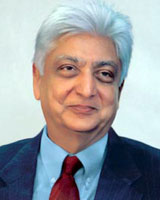
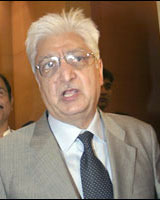
Azim Premji

A personality revered by all the software professionals and an icon to the aspiring youth of the country, Azim Premji besides being the Chairman of Wipro Technologies, is a good human being who has never failed to inspire the young entrepreneurs. Initially starting with cooking oil to household goods to software, the company under the flag of his leadership never failed to deliver its best.

Early Genesis

AzimPremjiMPOS29SEPT2014
Azim Premji was born in the year 1945 in Mumbai in a Gujarat Muslim family. He studied electrical engineering at Stanford University, US when he had to come back to India to take care of his family business because of the sudden demise of his father. He took control of ‘Wipro’ the company that dealt in the business of vegetable oil at the age of 21 and his success that followed afterwards is history. Azim Premji is happily married to Yasmin Premji with two children, Rishad and Tariq.

A devoted professional and hard worker, Azim Premji took ‘Wipro’ to an admirable height. Eventually ‘Wipro’ grew into a 3,500 Crore empire. Today ‘Wipro’ is included among the top hundred technological companies in the world and Azim Premji holds the position of the richest man in country his property amounting to around 17.1 billion US dollars. Azim has taken his company to the height from where it operates with the major IT companies of the world namely Nokia, Cisco, Nortel, Alcatel and General Electric company. Under Azim Premji the company has spread its wings in the fields of IT, R & D Services and BPO. The largest outsourcing company in India and research and service provider, ‘Wipro’ has ventured into the areas which nobody could think of.

Other Achievements
For his stupendous contribution to the field of software technology Azim Premji has received several awards and accolades. He has been titled ‘Businessman of the year 2000’ by Business India, ‘Business leader of the year 2004’ by Economic Times, one of the ‘100 most influential people in the world’ by the Financial Times in the year 2004, ‘One of the 25 most powerful business leaders outside the USA’ by Fortune in the year 2003 and “power to effect change” by Forbes in the year 2003. He has also been facilitated and honored by the title of doctorate by the Indian Institute of Technology,Roorkee and Manipal Academy of Higher Education. He is the first person in India who received the ‘Faraday Medal’ in the year 2005. He has been given the title of ‘Padmabhushana’ by the government of India.

The Other side of him

AzimPremji2MPOS29SEPT2014

Azim Premji has contributed a lot to the development of the country. He has started an organization known by the name of ‘Azim Premji Foundation’ which works with the sole motto of providing primary education to every single child of the country. Having around 17,000 schools operating under the organization, Premji finances for all its requirements.

A man of principles and ethics, Azim Premji has never compromised with the quality and level of commitment to his work. He is informed of all the officials working for his company who respect and revere their employer for the strength of his character. ‘Don’t do anything that you’re unwilling to have published in tomorrow’s newspaper with your photograph next to it’ -is the slogan of his company with which it has reached the zenith of success and fame.

source: http://www.headlines.mapsofindia.com / Headlines India / Home> LifeStyle> Man’s Word