Kerala Governor Sikander Bakht, who died here tonight, was BJP’s best known Muslim face after having played a long innings in the Congress.
Born and brought up in Delhi, Bakht, epitomising the culture and charm of the old world of the Indian capital, was a seasoned politician adept at devising the right strategy in complex situations.
Leader of the opposition in Rajya Sabha for seven years, 85-yer-old Bakht joined BJP after long association with Congress and a brief stint with Janata Party.
He was a member of the Congress till the 1969 split when he threw his lot with the Congress (O) and was in the party’s working committee between 1969 and 1977.
Having suffered imprisonment for 18 months during the 1975-77 Emergency, Bakht became one of the founder-members of Janata Party.
Elected to the Lok Sabha in 1977, Bakht joined the Morarji Desai Cabinet as Minister for Works, Housing, Supply, Rehabilitation and Wakf.
When Janata Party split after the fall of the Morarji Government, Bakht joined BJP, a party with which he had been associated since then as one of its tallest leaders from the minority community.
In 1980-82, he was BJP general secretary and from 1982 to 1993 the party’s vice president.
Bakht was assigned the key External Affairs portfolio in the first A B Vajpayee Governmnent which lasted only 13 days in 1996. He was there again in 1998-99 Vajpayee Government holding the charge of Industry.
Bakht had served as the opposition leader in the Rajya Sabha from 1992 to 1998 and leader of the house in 1998-99. He was sworn in as Kerala Governor on April 18, 2002.
A skilled parliamentarian and astute debator, Bakht led several parliamentary committees and delegations abroad.
Bakht had also served as chairman of the Parliamentary Committee on Commerce from 1999 to 2002 and headed the Joint Parliamentary Committee on Wakf Board during the same period.
He had led the Indian delegation to Indian Infrastructure summit in Washington in 1998, Indo-Bearus inter-governmental commission to Minsk in 1998 and Destination India programme, in Tokyo in 1998.
A graduate from Delhi university, Bakht had been an ardent fan of Indian classical music and a keen student of Urdu poetry and had special interest in sports.
source: http://www.outlookindia.com / Outlook / Home> News / PTI / Thiruvananthapuram – February 23rd, 2004
At 93 years of age, MF Husain could have been forgiven for calling it a day. But when he sought exile from India in 2006—on account of the vandalisation of his works and the stress of presenting himself in small-town courts all over India, where cases of obscenity had been filed to harass him for having had the temerity to paint goddesses in the nude—he sought not retirement but revalidation.
And that came easily for, arguably, India’s most popular artist. In spite of his advanced age, the royal family of Qatar commissioned him to paint an epic series on the Arabic civilisation for the Museum of Islamic Art in Doha. And in London, the Mittal family—which had gifted the city the controversial ArcelorMittal Orbit ahead of the Olympic Games—seized the opportunity to ask him to paint a tribute to Indian civilisation.
That should have been enough to keep most artists busy, but Husain, missing familiar places and faces in India, was known to have painted extempore at the homes and offices of a large number of Indian families, demanding nothing more than affection and a home-cooked meal in exchange for a hastily improvised drawing or painting. He would appear at the doughty Dorchester, where the staff invoiced him for scribbling figures on its pristine damask napkins. In Mayfair, where he had a studio, the white-haired and often barefoot artist became a familiar sight for Londoners bemused that he should carry a large paintbrush with him as an indication of his profession. At the venerable Victoria & Albert Museum, like scores of art students on any given day, he could be seen sketching on his pad at the Ironwork Gallery, unaware of the chuckles he inspired among visitors ignorant of his fame but conscious only of his age.
It is from this phase of his life, spent in Doha, Dubai and, in particular, London, that a number of ‘last’ works by the artist are gaining currency.
Most, understandably, are not for sale; they are the legacy of families who befriended him in an alien city and extended warmth and hospitality. Though Husain was wealthy—if his collection of sports cars and bikes is any indication, he was extremely rich—money was something he rarely carried on him, so his art became the currency of exchange for favours rendered. The right-wing parties that had hounded him in India enjoy the support of many non-resident Indians, but in London Husain seemed not so much offensive as vulnerable. Secretly, they clamoured for his works, so even though prices were falling back home—or, at least, they were failing to keep pace with modernists SH Raza, FN Souza, Tyeb Mehta and VS Gaitonde—his popularity never waned. Because he still had a large inventory of unsold canvases, he was not required to paint to eke out an existence, however luxurious. The sale of those works—this writer is privy to some of them—now afforded him the comfort to paint in a manner and style of his choosing.
Some of these ‘last’ works, the ones commissioned by Usha Mittal, will now go to the V&A’s gallery 38A for a viewing as ‘Master of Modern Indian Painting’ from May 28 to July 27. According to a spokesperson, even though Husain is “not very well-known” in London, “this exhibition will rectify that”. The V&A had been in conference with the Mittals about a number of projects, and it was natural that the First Family of Steel should suggest the Husain exhibits as a starting point for that venture.
Husain wanted to paint 31 triptychs or 93 panels to express his vision of India, a country that he referred to as “a museum without walls”. Among the peers of the Progressive Artists’ Group, Husain alone, among the founding members, chose to paint a holistic view of Indian society from the vantage of the street, often portraying myths from the Ramayana and the Mahabharata, but also singers, dancers, musicians in a manner that some described as expressionistic while others dubbed it primitive impressionism. Wrongly called ‘the Picasso of India’—that sobriquet better suiting Souza—Husain was maverick, manipulative, marketable, as popular for his remarkable talent as his ability to command the media. He mocked the press, made films with popular film stars, and was quick with repartee, a one-man act that became the face and form of modern art in India from the 1950s till his death in London in 2011.
Critics and collectors claim his best works were done in the early decades, but Husain continued to reinvent and surprise himself and everyone else. Identified for his paintings of horses, he is equally well regarded for his works on Mother Teresa. He courted controversy during the Emergency, when he painted Indira Gandhi in the form of Durga riding a tiger, but was a member of the Rajya Sabha in the eighties.
An observant artist, his eye for detail livens up the Mittal canvases, even though he was at an advanced age when they were painted. Husain completed eight of the 31 triptychs before he died, each painting consisting of three 12ft x 6ft panels (or 12ft x 18ft for the triptych), and it is this unfinished collection that offers a glimpse into his thinking.
Not only did he refuse to create a linear historicity, his insistence on providing glimpses of the life and culture of India in the manner that he experienced it became the context from which he visualised the whole project. The exhibition, therefore, begins with an invocation to Ganesh, the beloved elephant-headed god who is considered a remover of obstacles, the only single panel or painting in the exhibition. The eight triptychs, which form part of his vision of India from Mohenjodaro to Mahatma Gandhi, span “mythology, architecture and popular culture”, according to Usha Mittal, who was privileged to see the artist work on the series in London.
However sure he might have been, Husain pored over books, journals and tomes to ensure that he chose the correct nuances for the triptychs.
Which other artist would have picked something as banal as Indian Households as a subject for one of those triptychs? Yet, in his hands, it becomes a comment on the co-existence of religions and faith in India with its unique syncretism. The first panel of the painting depicts a Muslim household, where the old man with the hookah could be an allegory for his grandfather, and the little boy playing under the charpoy may be autobiographical. The second panel peeps into an educated Hindu household from the south—witness the head of the family immersed in The Hindu—while the familiar image of the umbrella, another leit-motif for his grandfather, links it to the previous panel. The third panel depicts a warrior Sikh family, but not without its middle-class nuances, captured through the table clock and Singer sewing machine, voyeuristic glimpses of middle class lives in India.
It is these delightful insights that make up the rest of the triptychs. In ‘Indian Dance Forms’, the sage Bharata holds forth on the Natya Shastra, while the other two panels depict bharatnatyam and kathakali. The ‘Hindu Triad’ has, of course, Brahma, Vishnu and Shiva in their roles as protector, preserver and destroyer, while in ‘Three Dynasties’ he picks the Mauryan, the Mughal and the British Raj for their abiding influence. In ‘Tale of Three Cities’, he opts for Delhi for its historicity, Varanasi for its spirituality and Kolkata for its culture, and in ‘Indian Festivals’ he chooses Holi, Tulsi Pooja and Poornima—all Hindu festivals, the right-wingers will be glad to know—while ‘Language of Stone’ highlights the country’s—again, Hindu—sculptural tradition alongside poet-laureate Rabindranath Tagore’s poetry.
Handwritten notes describe each panel and their importance, something he discussed at length with Usha Mittal as part of a venture that, had it been completed, would have changed the visual perspective of India as well as that of its artist.
Let it be said: Husain was its most enthusiastic votary.
Image: Dave M.Benett / Getty Images Steel magnate Lakshmi Mittal with wife Usha and MF Husain
The Commission
Usha Mittal was principally responsible for the patronage the family extended to MF Husain when he began work on the project in 2008 in London. In this email interview, Usha Mittal shares the shaping of the series and her interactions with the artist.
Why did you choose Husain for painting this series?
Husain Sahib had a profound understanding of Indian history and culture and was knowledgeable about many aspects of life in the subcontinent, from mythology and religious beliefs to architecture, poetry, music and the visual arts. On seeing Husain’s series on the Hindi film Mughal-e-Azam, I suggested to him that he should capture the history of the Indian civilisation on canvas. The conversation led to a major commission, which the artist started working on during the final years of his life.
Why pick on the Indian civilisation as the series theme?
The Indian civilisation is rich in culture and diversity, and spans thousands of years. Aspects of Indian civilisation have been represented in Husain’s paintings from the start, whether folk images, rural life, dance, mythology or history. With his immense understanding of India and her culture, I felt that Husain Sahib was uniquely endowed to execute such a commission.
Did he discuss the panels with you before painting them?
He was very inspired by this project. Every time I would meet him, he would talk only about the next panel, and would ask for my opinion. In fact, he was talking and dreaming about the forthcoming panels on his last day.
Which are the other Indian artists in your collection?
Apart from Husain, I very much admire the works of Ram Kumar, Tyeb Mehta and SH Raza.
Can you share incidents
of your interactions with Husain while he was working on this series in London?
I saw him paint on several occasions. When he painted, he was totally submerged in the paintings. He had a childlike enthusiasm, and happily painted while listening to music. He had a great sense of humour, and his knowledge of Indian culture, customs and traditions was commendable. Before he started painting the history of India, he read several books on Indian history, and spent several weeks analysing and determining what he wanted to paint and how. He decided he wanted to paint 31 triptychs, but unfortunately could complete only eight. I always admired his qualities as a painter.
Husain’s worth, or the worth of a Husain
Despite a fall from grace, he cared about his legacy
Image: Amit Verma / A Husain (left) and a Souza displayed on the same wall at the Christie’s auction in Mumbai last December
That he was prolific has never been in doubt, and observers have speculated about the number of paintings he painted in his lifetime: Variously between 20,000 and 40,000 works, which record has a parallel with that other equally productive artist, Pablo Picasso.
Husain was always conscious of his value, using it as a benchmark of his talent as well as his popularity. Early in his career, he would sulk if Raza’s prices at an exhibition were marked higher than his, removing his own works on one such occasion. He did see Raza’s prices, as well as those of Souza’s and Tyeb Mehta’s, best his own in his lifetime, by which time he was concentrating harder on his painting, knowing that time was now against him as he raced to complete commissions that would result in a unique legacy of art.
Even so, for decades he enjoyed the distinction of being India’s most expensive artist, and the movement of Husain’s works in galleries and at auctions has always been brisk. With his most iconic works in museums and in collections that are unlikely to sell, it is only those works in the market that determine his benchmark.
For now, his top canvases do command prices in the region of Rs 2–5 crore. Since uniqueness and provenance adds value to an artist’s worth, his triptychs for the Mittals could be among the more expensive of his works, though Usha Mittal has refrained from commenting on the commission’s value, only commenting that it was “a private matter between Husain Sahib and myself”.
source: http://www.forbesindia.com / Forbes India / Home> Life/Special / by Kishore Singh / May 13th, 2014
This Muslim woman worked for the French resistance in WW2. Hear her remarkable story
By any standards, Noor Inayat Khan led an unusual life. Born in Moscow in 1914, she was a direct descendent of an 18th century Indian Muslim ruler, later becoming an accomplished musician and children’s author. But then the Second World War broke out, and she was recruited by British spies to help the French resistance. Documentary maker Alex Kronemer has been telling her remarkable story.
Former Goa governor Mohammed Fazal and economist passed away at his residence in Allahabad, Uttar Pradesh, on Thursday. He was 92.
He was educated at the university of Allahabad and then at London school of economics. He was a senior member of the Planning Commission during 1980-85. In 1999, he was appointed governor of Goa and later as Maharashtra governor in 2002 and held the office till 2004.
Deputy chief minister and acting chief minster Francis D’Souza has expressed deep grief on the demise of Fazal.
In a condolence message, the D’Souza recalled his contribution to public life and prayed that the Almighty rest the departed soul in eternal peace and grant courage and strength to the bereaved family to bear the irreparable loss with fortitude.
Governor Mridula Sinha, has expressed deep grief over the sad demise of Mohammed Fazal, former governor of Goa and Maharashtra.
The governor has conveyed her heartfelt condolences and sympathy to the bereaved family.
Condoling the death of Fazal, the Goa Pradesh Congress committee in a statement said, “It was an honour to have known such a great person as he served Goa with utmost dignity,” adding that, “our heartfelt sympathies go out to his family”.
source: http://www.timesofindia.indiatimes.com / The Times of India / Hoem> City> Goa / TNN / September 05th, 2014
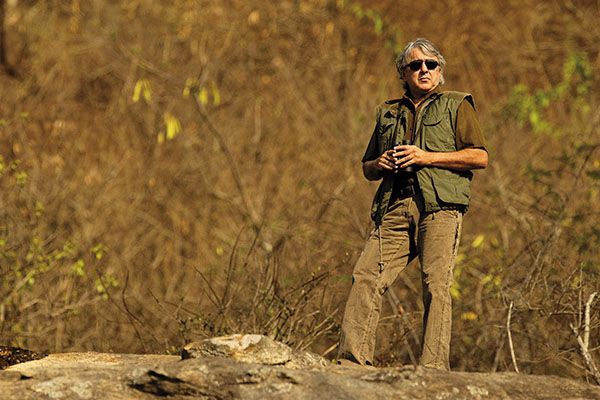
At Saad Bin Jung’s luxury eco-tourism lodge in Kabini, Karnataka, villagers and tribals work together to conserve the forest and the big cats that inhabit it
Image: Shaaz Jung A new calling: Saad Jung believes in eco-tourism that conserves more than animals
As the last rays of sunlight filter through the leaves, a shadow slinks out of the thick foliage with an unmistakable feline elegance. “There,” whispers 27-year-old Shaaz Jung from his perch atop a jeep. Immediately, seven pairs of eyes turn to the clearing ahead. Under the rapt gaze of the tourists, a male leopard emerges from the foliage. A flurry of clicks from SLR cameras breaks the silence of the waning dusk. But the leopard makes an indifferent model. He was aware of the jeep the moment the vehicle entered his territory, deep in the jungles of Karnataka. For the tourists, however, this sighting is a privilege. The shy animal deigned to make an appearance on the last of the five game drives organised by Bison Wildlife Resort near Kabini Lake, Karnataka. The resort, started by Shaaz’s father, 53-year-old Saad Bin Jung, lies between two national parks, Nagarhole and Bandipur, and is a two-hour drive from Mysore. It is also a labour of love, one in which villagers and tribals work with the Jungs to conserve and preserve this ecologically vibrant zone.
Though the eco-resort opened five years ago, it took over a decade to come to fruition. Consider its back story.
Like his uncle Mansur Ali Khan—the late nawab who is remembered by his moniker ‘Tiger’ Pataudi—Saad Jung started his career as a cricketer. A descendant of the royal Pataudi family of Bhopal and the Paigahs of Hyderabad, he acknowledges and accepts the popular portrayal of Indian nobility as hunters. “I now realise the mistakes we made while addressing wildlife conservation within the forests that belonged to our family,” says Jung. “The rulers, to a large extent, permitted community usage of forest produce. Locals were asked to manage forest land, but were banned from hunting. That was the sole prerogative of the royals. There was control, but there was also inclusion.”
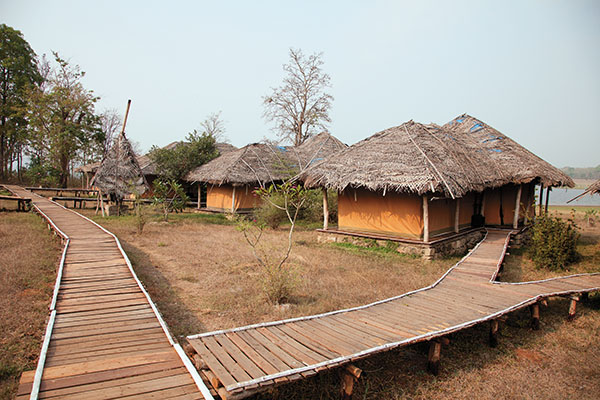
Image: Prasad Gori for Forbes Life India The village: The resort maintains a rustic look and feel, although it houses luxurious facilities
Saad began taking an active interest in conservation in 1986. He started with Bush Betta Resort at Bandipur and an angling camp on the Kaveri river soon after. In 1997, he acquired patta (registered) land outside the protected forest area and worked with locals to build a luxury resort, one that doesn’t intrude on or disturb the ecologically sensitive zone. The Bison Resort, made up of African lodge-style stilted, elaborate tents and decks that overlook the forest and Kabini lake, is the result. Most of the building material for it was sourced locally. Rather than alienating tribals and villagers from the land, Saad brokered a symbiotic relationship between resort and village.
The Bison, which opened in 2009, has succeeded because it combines luxury with inclusive growth. Saad and Shaaz, who is the resort manager, create a rustic yet opulent experience. From sunken showers in bathrooms to bars that overlook the lake, the resort delivers a unique kind of grandeur—one that typically costs more than Rs 10,000 a night for Indians and Rs 24,240 ($400) a night for foreign nationals. Most employees are locals and their intimate knowledge of the land heightens a visitor’s experience.
source: http://www.forbesindia.com / Forbes India / Home> Forbes India/Live / by Shravan Bhat / August 16th, 2014
Saifuddin Choudhury former CPM MP died on Sunday at a hospital at Delhi. Choudhury was an eminent parliamentarian who will be remembered for his fiery speeches. He was 62 and was suffering from throat cancer for the last few years.
Saifuddin Choudhury. (Picture courtesy Party for Democratic Socialism, India’s official website http://www.pdsindia.org/)
He became an MP from Katwa in Burdwan in 1980. However, there was growing discontent between him and CPM top leadership for which he left the party in 2000 on ideological grounds. He later floated PDS and remained its state head. Saifuddin Choudhury was close to the grass roots and had raised several fundamental questions while Jyoti Basu was the CM in Bengal. He was a student leader but also argued for the farmers and had raised questions how CPM was being drifted away from the farmers.
Choudhury was a logical speaker and had always wanted to form a Left unity forum though he had even delivered speeches from Mamata Banerjee’s platform while Mamata was on her 26-day hunger strike. Choudhury would often criticize CPM leaders for their involvement in unethical practices and he refused to accept them as his party comrade and for which he snapped ties with CPM.
There were proposals to bring him back to CPM, but ultimately that did not happen.
He will be cremated at Memari, his village in Burdwan on Tuesday.
source: http://www.timesofindia.indiatimes.com / The Times of India / Home> India / by Debashis Konar, TNN / September 15th, 2014
The thronging thousands gathered for the last deedaar of their Syedna did not leave, despite the gates being shut after 2:30 AM. 18 lost their lives in the stampede that followed.
“Bade mullaaji gujar gaye, deedaar karne jaanaa betaa,” was the first thing my mother-in-law, largely home bound because of poor health, said to me. When the news of demise of ‘The 52nd Dai al-Mutlaq of the world-wide Dawoodi Bohra community, His Holiness Dr. Syedna Mohammed Burhanuddin,’ was announced, the ripples were evident in the community. Before anybody could plan or understand the real magnitude of his demise, crowds—as if on auto cue—had started making their way to Saifee Mahal at Malabar hill, where Syedna breathed his last and the body was kept for deedaar (last glimpse). Although he had passed away in the morning, it was after early evening that crowds had started gathering. Women, children, old people, sick people—all of them—wanted to pay their tribute to the man they had been worshipping for the past 50 years. The hour of the night, lack of transport or sheer difficulty in holding on to each other, did not matter, not even to the women and children. Everyone from our family, including the old and the elderly, also tried to go—some were successful and some had to return midway because of the crowd.
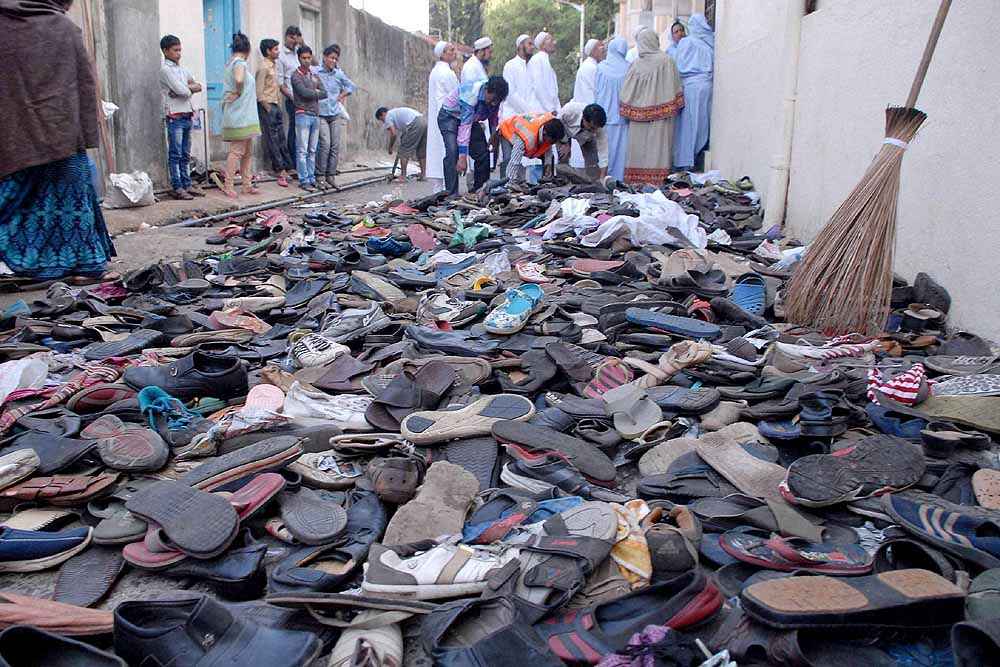
The gates at Saifee Mahal, spread on a huge area in plush south Mumbai Malabar Hills, had to be closed after 2.30 a.m. due to over-crowding but that did not deter thousands and thousands who were pressing against the gate. People did not leave. 18 lost their lives in the stampede that followed, most of them, including a child, dying of suffocation. More than 40 were injured with multiple fractures.
After the stampede
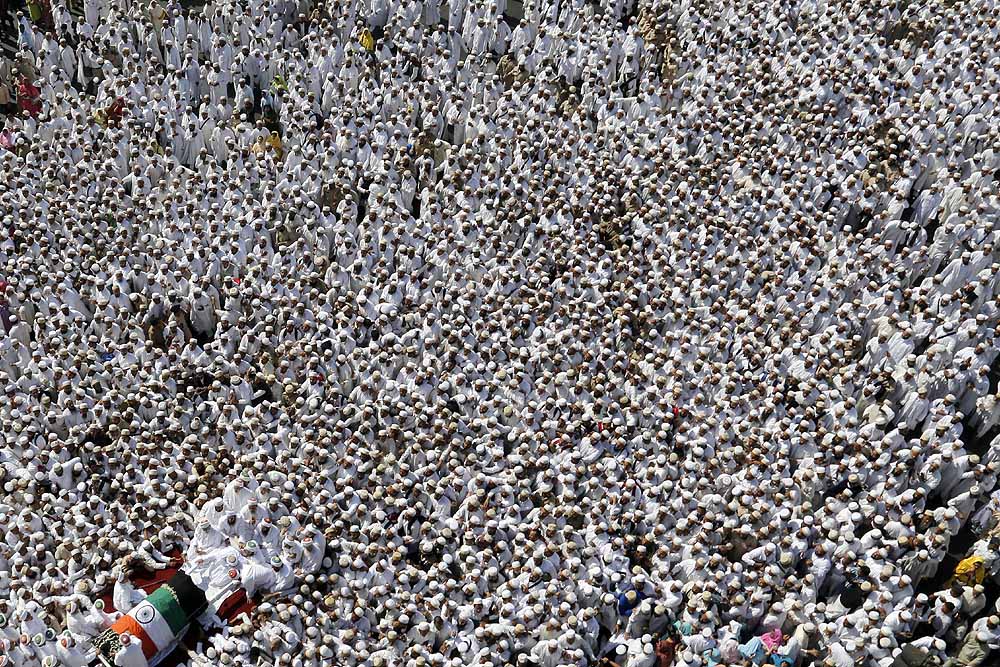
However, the following day, just as many gathered for the funeral procession from Saifee Mahal to Raudat Tahera, where he would be buried later in the day. With the tri-colour on the coffin, thousands, perhaps lakhs (strangely reminiscent of Bal Thackeray’s funeral) walked in the procession, along with Mumbai Police and Rapid Action Force to the exquisite Raudat Tahera mausoleum. His father, 51st Syedna also rests here.
. (AP Photo/Rajanish Kakade)
Apart from his obvious and tangible contributions such as the Saifee Hospital or the on-going Bhendi Bazar cluster redevelopment project, Syedna’s influence seems absolute and unquestionable on most Bohris.
He propagated and provided for education, health care and facilities at mosques such as Jamat cards for all members. Large donations and funds were made available from all across the world at Syedna’s beck and call. It has had the right impact on the million-strong followers—a largely happy, seemingly more modern (because of relatively higher education and colourful ridas/burqas perhaps) and practical people that Bohri business families are.
With popularity among all political leaders—PM Manmohan Singh had inaugurated Saifee Hospital, Narendra Modi tweeted effusive praise for Syedna on his demise—his policies or politics were rarely questioned. Except for reformist Asghar Ali Engineer who fought against absolute authority of Syedna and practice of social boycott and an unidentified Bohri woman who started an online petition against practice of khatna for girls (genital mutilation), there were rarely any voices of dissent.
For most he remains the messenger of Allah who set up grand beautiful modernised mosques (with impeccable audio-visuals for sermons to be telecast), elaborate ceremonies, hospitals and who has brought hope to thousands of poor families in Bhendi Bazar who live in pathetic conditions.
People have cancelled wedding ceremonies, taken off whatsapp profile pictures, downed shop shutters, as per instructions from the mosque officials. They have also cracked jokes about becoming “chunda” (type of pickle) in the crowd. A family friend, who barely managed to come out unscathed from yesterday’s deedaar, was already on her way to the local mosque to see the live telecast funeral procession. “Jaaana toh padegaaa na. abhii khaanaa piinaa sab udhar hi milega. Abhii kuchchh din sirf mullaji ki duaa padhenge,” she said matter-of-factly.
In 2011, Syedna had proclaimed Nass (investiture) upon his second son Syedna Mufaddal Saifuddin in London. The present 53rd Dai al-Mutlaq Syedna Mufaddal Saifuddin led the Namaz-e-Janaza of the late Syedna at Saifee Masjid at Bhendi Bazaar before he was laid to rest at Raudat Tahera mausoleum in Mumbai.
And no, I did not get the last glimpse of bade mullaji but the glimpses of his followers weeping and performing maatam in the sea of humans will stay with me for long. Hope Syedna gives strength to the families of the victims of stampede.
www.outlookindia.com / Outlook / Home> National/Opinion / by Prachi Pinglay -Plumber / Mumbai – Web, January 18th, 2014
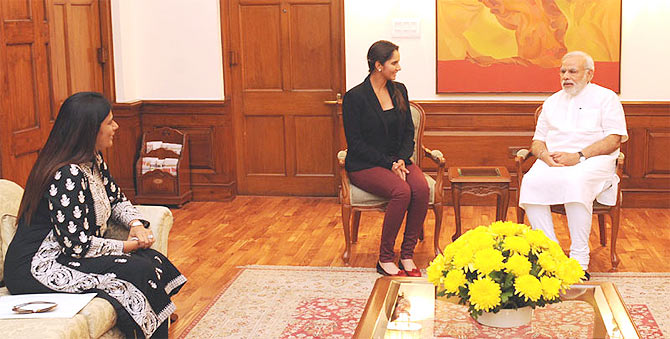
Sania Mirza speaks with Prime Minister Narendra Modi, while her mother, Naseema, looks on, during a courtesy visit on Friday. Photograph: PIB
Indian tennis star Sania Mirza called on Prime Minister Narendra Modi on Friday after her victory in the US Open mixed doubles last week.
Sania met the Prime Minister in a courtesy visit. She was accompanied by her mother Naseema Mirza.
“Indian tennis player and winner of the 2014 US Open Mixed Doubles Event, Ms Sania Mirza, called on the Prime Minister, Shri Narendra Modi, today,” a PIB release said.
Partnering Bruno Soares of Brazil, Sania clinched her third mixed doubles Grand Slam title last week.
Modi had also congratulated Sania just after her victory.
“Congratulations to Sania Mirza for the victory in the US Open Mixed Doubles Finals. We are very proud of the achievement @MirzaSania,” the PMO had tweeted.
On Wednesday, Sania met Telangana Chief Minister K Chandrasekhar Rao in Hyderabad. She is the brand ambassador of the newly-formed state.
In these days of gender-equality, achieved after defying the much loathed gender-discrimination, our city seems to pioneer a new trend beginning this Dasara with an All-Women Team, except for some space for men too, well geared to conduct this year’s Dasara and the District administration as well. Here is how and why.—Ed
Women power will be at the helm of affairs this Dasara as they will share the responsibility of organising and monitoring the Dasara events that begins in city from Sept.25.
The officers in-charge are Deputy Commissioner C. Shikha, who is also the Dasara Special Officer, Mysore In-charge Secretary and Principal Secretary to Government, Department of Women and Child Development and Empowerment of Differently-Abled and Senior Citizens Dr. Amita Prasad, Regional Commissioner Rashmi V. Mahesh, Additional Deputy Commissioner M.S. Archana, Assistant Commissioner Syeda Ayesha, ACP (K.R. Sub-Division) B.T. Kavitha. This apart, ZP President Dr. B. Pushpa Amarnath and Mayor N.M. Rajeshwari Somu will also be an integral part of the Dasara celebrations.
DC Shikha, who has the experience of organising Dasara 2013, is expected to conduct this year’s festival with ease. Shikha was also lauded by the general public for successful conduct of 2013 Assembly Elections and 2014 General Elections in Mysore. She previously worked as Managing Director of CESC in Mysore.
Deputy Commissioner Shikha being the Special Officer for the Dasara celebrations will have the responsibility of co-ordinating with various committees and Ministers while planning this year’s festivities.
It is not only her; Shikha will have the guidance of senior IAS officer Dr. Amita Prasad, who is currently the Mysore In-charge Secretary. Having held the post for five years, Amita Prasad has been lending her valuable suggestions to the officials on conducting Dasara activities. Another officer who would be a part of Dasara festivities is Regional Commissioner Rashmi V. Mahesh. A 1996 batch IAS officer, Rashmi passed her IAS examination at the age of 22 years. She has the previous experience of working as Assistant Commissioner in Hassan, Mysore ZP CEO, Bangalore Urban Deputy Commissioner, Joint Commissioner of Excise Department, Secretary, Department of Rural Development and Panchayat Raj and also in Department of Medical Education. She has now replaced M.V. Jayanthi as the Regional Commissioner of Mysore Division.
This apart, Deputy Commissioner C. Shikha will be supported by Additional Deputy Commissioner M.S. Archana and Assistant Commissioner Syeda Ayesha, both native of Mysore. While, the officers take charge of the overall activities, ACP (K.R. Sub-Division) B.T. Kavitha, will be in-charge of monitoring the security while the Dasara events take place at various venues.
Adding to the list of women who will be at the helm of affairs this Dasara will be Mysore Zilla Panchayat President Dr. B. Pushpa Amarnath, who has been given the charge of organising Raitha Dasara and Grameena Dasara. This apart, she will also be leading the green campaign during Dasara festivities. Chief Minister Siddharamaiah considering her suggestion has banned the use of flowers and bouquets to welcome the guests during the 10-day festival. Instead, the guests would be greeted with saplings.
Mayor N.M. Rajeshwari Somu will also play a vital role in Dasara, being a member of the Dasara Reception Sub-Committee. Dasara being the festival that revolves around Goddess Chamundeshwari and women being entrusted the job of organising the 10-day extravaganza, this year’s Dasara is all set to celebrate the women in power.
source: http://www.starofmysore.com / Star of Mysore / Home> General News / September 09th, 2014
Hundreds of thousands of students, alumni, and well-wishers of Aligarh Muslim University (one of the oldest and famous seats of learning in Asia) around the world will celebrate Founder’s Day, popularly known as ‘Sir Syed Day’ around this time of the year. In Bay area this event is organized by Aligarh Alumni Association of Northern California on September 20th at India Community Center in Milpitas, CA
Ambassador Islam A. Siddiqui, Senior advisor at the Center for Strategic and International Studies (Former Chief Agriculture Negotiator in the office of the U.S Trade Representative in Obama Administration) will give keynote addresses at the 17th annual Sir Syed Day.
Sir Syed Ahmad Khan
Sir Syed Ahmed Khan, the founder of AMU was born on October 17, 1817. Sir Syed, the famous 19th century scholar, historian and social reformer spent most of his time on promotion of social, economic and educational conditions of Indian Muslims.
Today, AMU symbolizes on the one hand the secular ideals of the Republic of India and on the other the aspirations of more than 150 million Muslims in India. The AMU, which Sir Syed planted as a sapling in British India, has now grown into a blossoming tree.
The Aligarh alumni are spread in large numbers all over the world with the majority being in the sub-continent. Prominent personalities in all walks of life including statesmen such as Dr. Zakir Husain – former president of India, Ayub Khan – former president of Pakistan, and M. Hamid Ansari – current vice president of India.
Dr. Islam Siddiqui
Dr. Shaheer Khan, one of the organizers of the event said, “The Aligarh alumni and present students are proud inheritors of Sir Syed’s legacy of open hearted tolerance, modern enlightened thinking, a love for scholarship, peaceful coexistence and above all a rational approach to our beliefs and our problems.” More than ever, it is time that the ‘Sir Syed Model’ gains wider currency in the Muslim World, Dr. Khan added.
This year’s event will also include the Annual International Mushaira. Many famous Urdu poets from India and Pakistan, along with poets from North America are expected to participate. AMUAA’s annual Mushairas are well recognized and widely acclaimed as the most sophisticated and popular in North America and attract almost 400-500 enthusiasts and admirers of Urdu poetry in the Bay Area.