Former Billiards and Snooker Federation of India (BSFI) vice-president Haji Jaffer died here Sunday, according to a press release from the Karnataka Billiards and Snooker Association (KBSA).
Jaffer, a widower and an advocate by profession, was 88 and is survived by two daughters and a son.
“During his tenure as the BSFI vice-president, Jaffer moved a resolution to include cue sport in the Asian Games and it was thanks to his efforts that India won 15 medals, including five gold, four silver and six bronze medals,” said BSFI secretary S. Balasubramaniam.
Cue sports made its Asian Games debut in 1998 Bangkok and was part of the quadrennial event until 2010 after which it was dropped from the programme.
Associated with cue sports since 1952, Jaffer played a key role in the KSBA securing its own premises that also houses a club house and guest rooms besides billiards tables.
Jaffer was also instrumental in shifting the venue of the National Championship from Kolkata, then the headquarters of the BSFI, to other parts of India on a rotation basis.
At Jaffer’s insistence, the BSFI agreed to introduce a National Championship for Women and the inaugural event was conducted by the KSBA in 1989.
source: http://www.business-standard.com / Business Standard / Home> Sports> IANS / Bangalore – September 21st, 2014
Veteran sports administrator and patron Haji Jaffer passed away here on Sunday.
He was 88.
Jaffer, an advocate by profession, was associated with cue sports and racing in a big way in Bangalore. He played a key role in the development of the Karnataka State Billiards Association and was its patron from 1991.
He also served the Bangalore Turf Club as the assistant judge and as first judge, besides making his mark as a commentator. Billiards fraternity benefitted immensely from the presence of Jaffer, who after joining the brigade of M Chenniappan, the founder of the KSBA, worked tirelessly to promote the sport.
It was Jaffer who mooted the idea of Women’s Nationals, successfully conducting the first edition in 1989. Jaffer, who was also the vice-president of the Billiards and Snooker Federation of India, also worked for the inclusion of cue sports in the Asian Games.
He leaves behind two daughters and a son. The KSBA has condoled his demise.
Mir Osman Ali Khan receives Prime Minister Lal Bahadur Shastri at Begumpet airport. Responding to Shastri’s appeal, the Nizam donated 5000 kg of gold to the National Defence Fund
OF POWER AND POISON
British Residents in Hyderabad spoke of the mutual antipathy that apparently existed between the Nizam’s eldest wife Dulhan Pasha and her sons Prince Azam Jah and Prince Moazzam Jah.
The mother of the two Sahebzadas was keen to marry them to her nieces, described by the Resident, Lt. Col. T.H. Keyes, as “two half-starved little Hyderabadi girls”. She had even been involved in a public slanging match with the Nizam on the issue of her sons’ marriage, and was supposed by British officials to be not fond of her sons.
To illustrate the discord between the mother and sons, Keyes recalled what Prince Moazzam Jah used to reveal to his guests. The younger Sahebzada claimed that his mother wanted to become the regent on the Nizam’s death. “When someone takes the cue and asks how she could be regent when his brother and he are of age, he replies: ‘We won’t be here. Mother is always experimenting with poisons, and there are no cats left in King Kothi’.”
…The rumours of poisoning in 1932 also led to revival of allegations that Sir Salar Jung I had been poisoned by the Nizam’s zenana as he had been insisting on Mahbub Ali Pasha being sent to Europe for education.
TONNES OF GOLD FOR WAR EFFORT
Mir Osman Ali Khan, Nizam VII, may have delayed his decision on merging Hyderabad State with the Indian Union after Britain left the country in August 1947, but he created a record when he responded to the call of Prime Minister Lal Bahadur Shastri in 1965. The PM visited Hyderabad and requested the Nizam to contribute generously to the National Defence Fund, set up in the wake of the Indo-Chinese skirmish. Without a second thought, Mir Osman Ali announced that he would contribute five tonnes of gold to augment the war fund. In monetary terms, the Nizam’s contribution was about Rs 75 lakh, or about three-fourth of the annual Privy Purse he received from the Centre. In terms of today’s gold price in the international market, this donation translates to a whopping Rs 1,500 crore.
The Nizam’s donation of 5,000 kg of gold to the National Defence Fund in 1965 was the biggest ever contribution by any individual or organisation in India and remains unsurpassed till today.
However, known for his wit and frugality, Mir Osman Ali Khan did not hesitate to seek the return of the empty iron boxes once the gold coins and bars were offloaded in Delhi. “I am donating the gold and not the iron boxes. Do not forget to return them,” the Nizam told the officials even as his son-in-law and confidant Ali Pasha carried trays of gold coins from the Nazri Bagh Palace. The empty boxes were duly returned.
ALBERT ABID AND THE SILK SOCKS
Hyderabad’s history is full of fables about foreigners who gave Hyderabad a new meaning and purpose. Albert Abid Evans, a Jew from Armenia, gave Hyderabadis their first department store and a new name to an otherwise abandoned locality.
Abid’s, one of the busiest business centres of Hyderabad, owes its name to Albert Abid, who set up a shop that served the needs of Hyderabadis from needle to grains and stationery to clothes.
…As a valet of the Nizam, Abid looked after Mir Mahbub Ali Khan’s wardrobe, the biggest of its kind in the world. It is rumoured that Nizam VI did not like to repeat his silk socks and the enterprising Abid would put the used socks back in the packet they came in and recycle them while his trusting master kept paying for new socks! If rumours are to be believed Abid also helped himself to the rings from his ruler’s fingers when his ruler was in a stupor and promptly thanked the Nizam very profusely the next morning for gifting him the jewellery.
AN UNHAPPY PRINCESS
Niloufer Khanum Sultana, who was called the world’s most beautiful woman, was pained by the fact that she was unable to produce an heir and felt that she had failed in her duty as a princess. It was especially upsetting for her that her cousin Princess Durru Shehvar had given birth to two lovely boys, Prince Mukarram Jah and Prince Muffakham Jah.
On a particular occasion, when Princess Niloufer was in England in response to her mother’s distress call about her financial and social health, Prince Moazzam Jah decided to let everyone know that it was not he who was responsible for their childless marriage. He brought a lady of doubtful repute into his home, and was apparently able to demonstrate his virility. Princess Niloufer returned from England to learn of this treachery and never shared a room with her husband again.
Her husband’s betrayal was not the only fact that pained her. She also returned to find that her personal maid, of whom she was very fond, had died in childbirth. This moved her to open a hospital for children and women. The Niloufer Hospital is still a sought-after medical institution today.
This gesture of the childless princess earned her a place in the hearts of Hyderabadis.
BORN TO RULE
Prince Mukarram Jah had the best of education — Doon, Harrow, Cambridge and LSE. He also trained at the Sandhurst Military Academy in England. …During a visit to Hyderabad, his first wife Princess Esra said he was a bright young man when she married him but was overwhelmed by the fast-paced political developments at home.
In 1969, the Indira Gandhi government decided to discontinue the annual purse to descendants of former rulers of princely states, who numbered around 600. The land bank vanished with the Land Ceiling Act. Mukarram found himself at a complete loss when he lost his privy purse and was compelled to sell off his assets. He would dispose invaluable jewellery to meet his immediate needs without verifying the value of the gems he offered for sale. Not surprisingly, he was taken for a ride by everyone, while the list of those dependent on him kept expanding. This list had grown to include the legion of relatives (14,792), servants (14,000), grandfather’s concubines (42) and children (hundreds of them).
Despairing of the circumstances he found himself in after the demise of his grandfather, this last true blue Nizam protested, “I was taught to be a soldier, not an administrator.”
Given the title of the eighth Nizam and brought up as an imperial prince of the Ottoman Empire, he was not wrong when he once confessed, “I was born to rule. That was the only thing I was prepared for.” Some believe it was the burden of having to deal with so many trusts and their beneficiaries that caused Mukarram Jah to leave for Australia.
3,000 WIVES?
In June 1936, the India Office received a letter from one Irene Cowen from Sheffield, asking how many wives the Nizam had and how many children. “A Hyderabadi had given a lecture on the Nizam’s government and in that had mentioned that the Nizam had over 3,000 wives, but he did not know the exact number, and had described him as having ‘a good many children’,” she wrote. …The Foreign Office sent Miss Cowen this reply: “The statement made by your lecturer is, on (the) face of it, incredible. Nor is any record of the kind suggested maintained in this office.”
The Nizam, however, did have over 100 women in his zenana and was even accused of kidnapping some. As for his progeny, it is claimed that Osman Ali Pasha sired over 147 children. A more modest estimate puts this figure at 28 daughters and 44 sons. However, like most stories about the Nizam, this claim is often exaggerated.
According to his daughter Basheerunissa Begum, it was impossible even for the family to keep track of everyone in the palace as each wife of the Nizam and her children had separate living quarters within the palace and had numbered badges to help the palace guards keep track of their security and identity.
source: http://www.deccanchronicle.com / Deccan Chronicle / Home> Lifestyle> Offbeat / DC Correspondent / June 01st, 2014
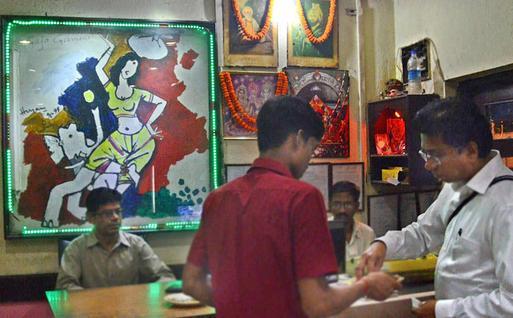
The wall of the Azad Hind Dhaba in Kolkata adorned with M.F. Husain’s Gaja Gamini. Photo: SUSHANTA PATRONOBISH
The now-famous painting, titled Gaja Gamini (one with a walk like an elephant), depicts a dancing woman, in a bright red background, while a white elephant looks on with its trunk held aloft
The memory of seeing M.F. Husain colouring one of his sketches back in 1999 is still fresh in the mind of Madan Sharma, one of the owners of Azad Hind Dhaba, a popular eatery in south Kolkata.
One fine afternoon years back, Mr. Husain walked into the dhaba, which he frequented during his visits here, and all of a sudden started adding colour to the black and white sketch on the wall that he had drawn three years before.
“The experience made me speechless,” Mr. Sharma said, on the eve of the 99th birth anniversary of the iconic painter.
The now-famous painting, titled Gaja Gamini (one with a walk like an elephant), depicts a dancing woman, in a bright red background, while a white elephant looks on with its trunk held aloft. Mr. Husain arranged a private show of his film Gaja Gamini at Azad Hind in 1999.
Sitting at the cash counter with the painting behind him, Mr. Sharma fondly recalled his memories of the famous artist. He remembers Mr. Husain as a “moody and humble person” who would come to the restaurant and sit quietly in one corner sipping his favourite “kadak chai [strong tea].”
“He did not talk much. But sometimes told me what kind of food he wants,” Mr. Sharma said. He was initially apprehensive of talking to an artist of Mr. Husain’s calibre, but eventually they became friends. “Mr. Husain could mingle with adults and children with equal ease. He was totally devoid of arrogance.” Whenever schoolchildren spotted him at the eatery, they flocked to him and asked for autographs. The world-famous painter complied with their demands with a smile and even drew them impromptu sketches.
When asked about the controversy that erupted in 2006 over Mr. Husain’s depiction of Hindu gods and goddesses, Mr. Sharma said the thought of removing the painting never entered his mind. “Nobody asked me to remove the painting even when the controversy erupted.”
Mr. Husain eventually had to leave the country under pressure from Hindu nationalist forces. He passed away in London in August 2011.
Meanwhile, the dancing woman with an elephant walk lives on happily on the central wall of Azad Hind Dhaba, in the company of numerous Hindu gods and goddesses.
source: http://www.thehindu.com / The Hindu / Home> Features> Friday Review> Art / by Soumya Das / Kolkata – September 17th, 2014
Book: The Substance and the Shadow: An Autobiography Author: Dilip Kumar Publisher: Hay House Pages: 450 Price: Rs 699
In 1998, soon after he had received the Nishan-e-Imtiaz award from Pakistan, I managed to see Dilip Kumar in person for the first time.
There were demonstrations outside his house by the Shiv Sena, which was protesting the award. He was the soul of charm. I had gone to propose a book about his films. He was not ready to commit but he did talk about his early life in Peshawar, coming to Bombay, his sojourn away from his family to make a living in Pune, where he succeeded in amassing a small fortune of Rs 5,000 by saving his profits.
All that is recorded in this book, besides much more.
At the time, no one could imagine that the man, so open in private conversation about himself but so reticent in public, would ever write his autobiography. But now we have the authentic thing, and it is a treasure trove. It is Dilip Kumar’s voice, faithfully recorded by Udayatara Nayar, who has done a great job.
The first few chapters tell us of his childhood in Peshawar. He was a lonely child and fell back then, as ever since, on his inner resources. The large joint family with his grandmother, parents and uncles is depicted well in the book as is Peshawar of the 1920s and 1930s. Soon after, the family moved to Bombay.
Dilip Kumar tells us about his school and college days, his fondness for football and how his friend Raj Kapoor told him he could make it in films, as he (Kapoor) was going to. But Dilip Kumar showed no aptitude for acting. Chance took him to Bombay Talkies and Devika Rani. The rest is history. He was helped along by Ashok Kumar and Shashadhar Mukherjee, who were pillars of Bombay Talkies.
There is a lot here about how Dilip Kumar learnt to act. Nitin Bose tells him early on in his career that acting in films is about emoting, often without dialogue. He tells us he never followed “method” acting. But for each part, he went deep into the persona of the character he was playing, and tried to become that person.
Dilip Kumar has played urban and rural roles, tragedies and comedies. He also grew as an actor from role to role. Take three films in which he plays a villager : Mela (1948), Naya Daur (1957) and Ganga Jamuna (1961) and you see the depth and range of emotions growing, until the death scene in Ganga Jamuna, one of the best in Hindi cinema.
The tragic roles in his early career drove him to depression. He decided to consult a Harley Street specialist and was advised to switch to sunnier roles. So he took on positive roles such as Azaad (1955). He still had to do Devdas (1955) for Bimal Roy which has the classic tragic hero.
The autobiography also tells us about Saira Banu, a determined young woman, who wanted to marry him and succeeded. Saira Banu has been a key to his longevity. If he is still with us (and long may he be so) while his contemporaries have gone, it is thanks to the care and attention he has received from Saira Banu. There are many stars, but there is only one actor — Dilip Kumar.
Meghnad Desai is an MP, House of Lords
source: http://www.indianexpress.com / The Indian Express / Home> LifeStyle> Books> Book Review / by Meghnad Desai / August 23rd, 2014
Noted advocate of Hyderabad orator and writer Alhaj Mohammed Osman Shaheed advocate will be felicitated on the occasion of completion of 42 years of his service and his remarkable success in two major cases.
The felicitation function will be held on September 26, after Maghrib prayers, at Urdu Ghar, Moghalpura. Nawab Zahed Ali Khan editor Siasat will preside over. Later Osman Shaheed will be weighed against coins. A mushaira will also be conducted.
Siasat news
source: http://www.siasat.com / The Siasat Daily / Home> Hyderabad / Saturday – September 20th, 2014
Mehmood Khan, Unilever’s global innovation head, goes back to his native village with a plan to turn it around.
Nai Nangla in Haryana’s Mewat district could be just another Indian village, ridden with the usual problems of a people trapped in poverty: Lack of healthcare and clean water, low productivity, high unemployment and illiteracy. But Haji Siddiq Ahmed, a local farmer in his late 60s, sees a different vision. “I want this village to be an adarsh (model) village. Others should look up to this village — that this is what an ideal village should be like,” he says.
The image Ahmed sees is actually taking shape in this quiet village with a majority Muslim population. What’s more surprising is the way the change is taking hold. It may be difficult to imagine the humble folk of Nai Nangla as business executives, but the cool concepts reviving the economy of the village are no less professional.
Take dairy farming, which engages nearly 80 percent of the villagers. Earlier, all they could get was Rs. 12 for a litre of milk; today they can get as much as Rs. 25. Three years ago, female literacy was at 2 percent; today, almost 85 percent of the female population can sign their names and 86 percent of the children in the district are enrolled in schools. Some women are also learning to sew and are setting up their own tailoring units. Companies like insurance provider Aviva, ICICI Bank and Larsen & Toubro are beginning to look at Mewat both as a market and as a field for recruitment. They have hired locals, offering dramatically higher incomes.
Image: Amit Verma / CHARGING UP: Memhood Khan’s plans changed Ramzaan’s life for the better. The young man treats Khan to a ride on his new motorcycle
The man behind these changes is a Nai Nangla native, someone who left the village nearly 40 years ago in search of an education and a career. His name is Mehmood Khan. Now 54, he is Unilever’s innovation head.
Now, thanks to him an experiment in introducing market economy is taking shape at Nai Nangla and the district of Mewat. An impossible feat for an outsider, but something the people of Nai Nangla have welcomed from one of their own. “Focus on education and use enterprise to bring change by leveraging resources in villages,” he says.
Khan has worked and lived in many countries over the years, making London his home for the last nine. But his link to his roots always remained alive; he would visit his village two or three times a year. He still remembers trudging a couple of kilometres to school everyday and taking cattle out to graze.
“I somehow landed a seat in university and then got into IIM-Ahmedabad. I was ejected by the system,” he says.
For the last five years, Khan has been hard at work to change “the system”.
He is converting a local resource, livestock, into a productive enterprise. He roped in the National Dairy Development Board’s Mother Dairy to spur Nai Nangla’s milk output and break the stranglehold that milk vendors had on local dairy farmers. At one time, these vendors — middlemen really — would lend money to farmers to buy milch animals.
In return, they would demand milk supply at low fixed prices until the loans were repaid. For most farmers, their income was too low to enable them to repay the debt. The result: They remained trapped in debt.
Khan was troubled by this age-old exploitation. He spoke to Mother Dairy and ushered in a new system to break this debt trap. Debt-laden farmers were given loans from institutions so they could repay the vendor and start selling direct to Mother Dairy. “Almost 25 people got loans to buy cattle, without having to pay any bribes,” says Ahmed.
Others who could repay on their own, did so and started selling to Mother Dairy for a better price. This competition forced the milk vendors to match market prices. Overall, incomes improved.
In July 2008, Mother Dairy set up milk collection centres in Nai Nangla and six other villages. In the first week, it got 70 litres of milk. Today, Nai Nangla alone gets 250 litres a day. “Gross income from agriculture has gone up from Rs. 80 lakh to Rs. 1.2 crore,” says Khan. “Milk (has become) a constant income source in a village which has seasonal income due to Kharif and Rabi crops.”
source: http://www.forbesindia.com / Forbes India / Home> Features – Beyond Business / by Neelima Mahajan-Bansal / June 05th, 2009
She broke the glass ceiling many a time, from being the first woman to enter any Class-I civil service to becoming the first IRS officer to be appointed as a UPSC member, to being the only woman to have worked in the Central Narcotics Department.
After donning multiple hats during her long career, it was another proud moment for Parveen Talha, when she was conferred the Padma Shri award on Saturday for her contribution to the Civil Services.But the road to success wasn’t easy for Talha and her biggest hurdle was to overcome the anti-women mindset of her bosses at the initial stages of her career.”It is indeed a proud moment for me but I am grateful to my bosses too. Though I had to initially deal with their anti-women mindset when I joined services 45 years ago, after a few years I was able to prove that I could handle the tricky jobs as efficiently as my male colleagues,” Talha told PTI.
70-year-old Talha joined the Indian Revenue Service (Customs and Central Excise) in 1969 where she worked for 35 years and was then picked up as a member of the Union Public Service Commission (UPSC) in 2004.
“Once my bosses began to trust in my capabilities, I started getting challenging assignments including posting as Deputy Narcotics Commissioner in Uttar Pradesh,” she said.
“There was a large-scale leakage of opium going on in UP then. While I tried my best to play a stringent officer dealing with certain illegal channels, poppy cultivators were surprised too because they had never seen a woman at that level,” she added.
By halting for days in the cultivation areas and delving deep into the processes of poppy cultivation from sowing to lancing and harvesting, she gathered foolproof intelligence which was put to good use by her hand-picked preventive parties.
During her posting in UP and Bihar in 1990s, she attached illegally acquired property worth millions of rupees belonging to smugglers and drug traffickers, risking her life.
While she was posted as the Director General Training in 2002, Talha provided strategic vision to the Department of Customs and Central Excise in evolving comprehensive packages of programmers for technical capacity building of all cadres and service providers.
Talha, who was honoured with the President Award for “Specially Distinguished Record of Service” in 2000, also has a penchant for writing.
She has written ‘Fida-e-Lucknow’, a collection of 22 short stories, besides writing the script for the serial ‘Husn-e-Jana’ directed by Muzaffar Ali.
“I find there are stories in every nook and corner that are waiting to be told. So I will pursue my passion for writing now that I am a retired person,” she said.
source: http://www.outlookindia.com / Outlook / Home> News / New Delhi – April 27th, 2014
In one of the nicest ironies in Shiv Sena supremo and `Hindutva’ champion Bal Thackeray’s life, the doctor who treated him for the past five years and was with him in his last hours was a Muslim.
Dr Jalil Parkar, well known Pulmonologist from Lilavati hospital who had been Thackeray’s trusted physician for the last five years, made the announcement of Sena chief’s death last evening with tears in his eyes before the crowd of party workers and mediapersons here.
Dr Parkar, a Muslim, earned the faith of Thackeray family after he successfully treated the Sena patriarch’s chronic obstructive pulmonary disease (COPD), a lung disease that makes breathing difficult, some years ago.
From thereon, everytime Thackeray developed health complications, Dr Parkar was called in. He became so close to the family that in the recent years he was spotted on the dais with other VIPs at the annual Dussehra rally of Shiv Sena.
Dr Parkar is credited with saving Thackeray’s life five times in five years. When senior Thackeray needed a second heart intervention in 2009 (the first was needed in 1996), it was Dr Parkar who prescribed the treatment which was readily accepted by the Sena chief.
When Uddhav Thackeray, his son and Shiv Sena executive president, needed a heart surgery some months ago, it was again Dr Parkar who led the medical team which treated him.
Though there was some commentary in political circles about Thackeray’s personal doctor being a Muslim, Dr Parkar never commented on this aspect. All he would say was the Sena Chief had been very kind to him.
source: http://www.outlookindia.com / Outlook / Home> Mumbai – November 18th, 2012