Category Archives: Leaders

Abdul Khayum Khan appointed head of Andhra Pradesh Anti-Corruption Bureau

Picture for representational purposes only.

Hyderabad:

Abdul Khayum Khan, an IPS officer of the 1981 batch, has been appointed as Director General of the Andhra Pradesh Anti-Corruption Bureau (ACB).

Currently Vice-Chairman and Managing Director (VC&MD) of the Andhra Pradesh State Road Transport Corporation (APSRTC), he had also held additional charge as ACB Director General (DG) for the past few days, after the appointment of B. Prasada Rao as Andhra Pradesh’s Director General of Police.

In a minor exercise on Thursday, the government appointed Khan as the regular DG of the ACB and posted 1988 batch IPS officer J. Purnachandra Rao as VC&MD of APSRTC. Chief Secretary P. K. Mohanty issued an order to this effect on Thursday evening.

source: http://www.deccanchronicle.com / Deccan Chronicle / Home> News> Current Affairs / by Sijihaya / November 28th, 2013

Tally Solution strengthens enterprise solutions portfolio

Tally Solutions celebrates the success of ‘Tally.Server 9′-an enterprise offering providing existing Tally.ERP 9 multi users the extra power for their growing business needs. This server based offering has been thoughtfully designed to provide better data management, higher administrative control and improved security of data to mid and large sized enterprises. In just 7 months, 575enterprise houses worldwide have recognized the value of running their businesses with Tally.Server 9 and embraced it with widespread interest and enthusiasm.

Tally.ERP 9, this product also makes life easy for its growing “Enterprise Customers” who have been avidly loyal to the brand for decades. Tally.Server 9-the powerful enterprise product is meant for businesses who have seen growth both in terms of the number of system users, as well as the amount of data stored and accessed by the business. Tally.Server 9 is ready to take the performance of these growing businesses to the next level, while simultaneously accommodating an increasing number of users onto their network.

Shoaib Ahmed,  President, Tally Solutions
Shoaib Ahmed, President, Tally Solutions

Shoaib Ahmed, president, Tally Solutions commented, “Tally.Server 9 uses path breaking technology to optimize functional operations for all business sectors. It is an extremely simple-to-deploy product that enhances usability experience, while also providing much better administrative control and user security. This is truly what the magic of Tally’s ‘Power of Simplicity’ brings in today to the enterprise business community.”

See more at: http://www.dqweek.com / The DQ Week / Home> South / by DQW News Bureau / August 08th, 2013

A gem of a story

The man dealing with treasures at the world’s premium auction house spills the beans on some famous sparkles

David Warren International Director ofJewellery, Christie’s

As the man in charge of organising auctions of exquisite diamonds, jewellery and artworks, David Warren is always on the lookout for treasures from private collections, estates and individuals. As a child, he would help out in his mother’s antique shop in Scotland. “I appreciated beautiful things even as a child and now, I see and handle some of the world’s most exquisite jewels every day,” he says. He tells us the stories behind the some of the famous baubles he has worked with.

» “I love the story behind the ruby ring from the sale of Elizabeth Taylor’s jewellery collection in 2011. Richard Burton was looking for the perfect ruby, and wrote in fluent French (not bad for the son of a Welsh miner) to Pierre Arpels of the jewellery house about it. Years later, they found the world’s perfect ruby, which was then set in a ring he presented to Elizabeth Taylor in her Christmas stocking. At first, she left the small package inside the sock, believing it to be a walnut. Burton had to make her look again and that’s when she picked up the ring.

» In the late 1980s, an elderly lady in Scotland would tell me she had gemstones of national importance. I didn’t really believe her. One day she invited me to lunch and showed me a light pink cushion-shaped diamond. I traced its history and found that it originally came from India in 1526 — it was the Agra Diamond, that Emperor Babur wore in his turban. It was later passed down among the Mughal emperors. In the late 19th century, the stone was smuggled out of India by an English officer and reached London. It was sold to an American railroad engineer Louis Winans, who built trains in Russia. He enjoyed collecting gemstones and this became one of his treasured pieces. The old lady was a relative of his and when he died, her sisters each received tin boxes with precious jewels inside. During World War II, she dug a hole in the ground and kept the box there for safety. Later, she moved it to a safe at the bank. When we finally sold the Agra, it made $ 7 million — a world record price for any coloured diamond in 1990.

» In November this year, Christie’s held an auction of the Orange diamond. It is the largest fancy vivid diamond (14.82 carats) ever offered at auction. It sold for $35,540,612 at Christie’s Geneva, setting a world record price for an orange diamond. I can’t disclose the name of the buyer but the stone is described as a ‘miracle of nature’. I don’t think I’ll ever see another like it in my lifetime.”

source: http://www.bangaloremirror.com / Bangalore Mirror / Home> Columns> Work / by Bangalore Mirror Bureau / by Jayanthi Madhukar / November 28th, 2013

Azad’s views still relevant to country: D. Harinarayana

“Educating the rural girl would be a great advantage to the economy,” said the Pro Vice-Chancellor of GITAM University, at the 129 birth anniversary celebrations of Maulana Abul Kalam Azad.

Maulana Abul Kalam Azad’s views were still relevant to the country, Pro Vice-Chancellor of GITAM University, D. Harinarayana, said while participating in the 129 birth anniversary celebrations of India’s first Union Minister for Education, organised by the GITAM Institute of Science on Monday.

Educating the rural girl would be a great advantage to the economy, Prof. Harinarayana said while pointing out that there was still a lot of disparity in rural and urban literacy and that women’s education was still a neglected area.

The education system as well as quality of institutions must be strengthened and youth must be imbibed with skills so that they could compete in the global environment, he said.

Principal of GIS N. Lakshmana Das spoke on the life of Maulana Abul Kalam Azad. He regretted that in wake of the IT revolution students were not opting for science courses.

But there was scope for a lot of opportunities in science for the younger generation due to the great ‘Big Bang’ experiment, nuclear energy, space science and other areas, he pointed put.

UGC affairs Director Ch. Ramakrishna, senior professor Ramana and other faculty members participated in the meeting.

source: http://www.thehindu.com / The Hindu / Home> News> Cities> Visakhapatnam / by Special Correspondent / Visakhapatnam – November 12th, 2013

Amitabh Bachchan congratulates Salman Khan!

Shehanshah of Bollywood Mr Amitabh Bachchan congratulated Dabangg superstar Salman Khan  who recently completed 25 glorious years in the industry.

Mr Bachchan and Salman have worked together in films like Baghban, Baabul and were last seen together onscreen five years ago in God Tussi Great Ho.

While the two stars have not shared screen space as often but they both have always maintained cordial relationship. So when we caught hold of Mr. Bachchan at Kaun Banega Crorepati press conference, he didn’t shy away from acknowledging Sallu’s achievement.

“My best wishes to him. 25 years in Bollywood is not a small thing. Today he is one of the top male actors in the industry. So congratulations to him” said the superstar.

source: http://www.timesofindia.indiatimes.com / The Times of India / Home> Entertainment> Bollywood> News & Interviews / by ANI / August 26th, 2013

‘The Great Akbar’ of Independence struggle

Azad’s greatest gift was to postulate an equation between Islam and Indian nationalism on the one hand, and between Islam and the universal principles, on the other

Height about 5’ 5’’; exceptionally thin; noticeably fair; age about 33 years; has practically no hair on his face though he does not shave; long sharp face with prominent nose. This is the “official” description of Maulana Abul Kalam Azad, the golden boy of the Independence struggle. With his confidence, charm and sincerity, Azad impressed people of his age group with his sharp and swift mind. Later in years, he especially cultivated a look of venerable age to give a suitable background to his learning. His genius and method were too individual to found a school, but his writings and lectures exerted a profound influence owing to the breadth of view and patient learning. Rajaji described him as ‘The Great Akbar of Today’.

Unease with conformity

The study of Azad’s early life is, however, hampered by a deficiency of data. But there is ample evidence to indicate his discomfort with the traditional order of things. This was enough to rouse his scorn. So is his unease with taqlid or conformity. Is Islamic doctrine so rigid and dogmatic that it leaves no room for intellectual creativity? With this bent of mind, he broke off the shackles of fossilised theology, and critiqued all those elements in theology that inhibited the progress of empirical science and the unlimited process of their utilisation. His views on the spread of a materialistic way of life and the stagnation and retardation of religious life became well-known, but this phase in his life — when he “saw in religion only ignorance” — proved to be momentary. Once he regained his faith, he worked out a synthesis between the reformist and orthodox philosophies. He did not go too far in this journey, but went far enough to disturb thestatus quo.

The awakening at Aligarh’s M.A.O. College fostered ideas on reforms, interpretation, and innovation among the Muslim intelligentsia. Syed Ahmad Khan moulded young Azad’s thinking. He did his very best to read his writings and admired them. He also admired Shibli Nomani, founder of the Nadwat al-ulama in Lucknow. And when the Nadwa alim turned pan-Islamist after the European intervention in the Balkan States, Azad too stressed that the bonding with the Turks was unique insofar as they were a part of the Islamic community as well as its last political centre.

One has only to cast a glance at some of Azad’s early writings to realise that he entered the valley of doubts and uncertainties to demolish the suppositions that had guided theologians. He opposed the ‘scripturalists’ or the ‘literalists,’ because they advocated rigid adherence to the fundamentals of Islam, as literally interpreted from the Koran and the Sunna. His interest in the externals of religion, too, diminished. At the same time, he was consistent in his authentic inward piety. Just as he was ready to comprehend the whole Koran within the verses of the first Surah, so he conceived and pursued the politics of Islam within the Koran’s dimension of piety.

The Muslim communities were divided by geographical situation, by differences of dialect and custom and, in some cases, by the deeper chasm of sectarianism, but pan-Islamism inflamed their passions, a feeling that, although they had been ground down under the wheels of history, they thought of themselves as a mighty society spread worldwide. Azad, for one, was attached to the common inheritance of Islamic culture and explored the treasures of thought and emotion which belonged to the umma. He proceeded naturally from the conviction that education, liberalism and faith in progress were requisites for Muslim empowerment.

Setting a great example of moral leadership during World War I, Azad became the soul of the Congress party. He opposed Partition heart and soul, while a great body of his compatriots clamoured for a Muslim nation. He could not conceal the contempt that he felt for them, and at no stage in his public career did he stoop to compromise. The spectacle of Indians working out a new way of life and boldly defying the accumulated prejudices and animus of the past was one which aroused his interest and curiosity. Without looking around to find a mirror that might reflect radical faces, he identified pluralism to be the weapon of the strong and the weak against the British. He preferred the conviction of Dara Shikoh, the eldest Mughal prince and a victim of Aurangzeb’s conspiracy, that in the search for the ultimate Truth, mosques as well as temples validly mediate the one candle’s light.

Harmonious and creative Islam

Azad’s greatest gift was to postulate an equation between Islam and Indian nationalism on the one hand, and between Islam and the universal principles, on the other. He did so to enlarge our conception of what is possible, enrich our intellectual imagination, and diminish dogmatism which closes the mind to ijtehad. With his belief in an integrated, harmonious and creative Islam, he adumbrated the outlook of a religious humanist, very much in the line of the humanism embodied in the classical Persian Sufi poetical tradition. He envisaged an Islam not of sectarian belligerence but of confident partnership in a cultural and spiritual diversity where a strident divisiveness would be its betrayal.

Maulana Abul Kalam Azad, Minister of Education in free India and sponsor of an ‘official’ history of the 1857 Rebellion, referred to the two communities standing ‘shoulder to shoulder’ to liberate themselves from the British yoke. Why did Azad and others think that it was worth their while to make this point? Probably, to record the regret that “the British swept away and rooted out the late Mughals’ pluralistic and philosophically composite nationalism,” and to bemoan that they ensured that common action by Hindus and Muslims would in future not be accomplished easily.

Shakespeare’s view of life in one of his plays is that, “round the lonely great ones of this earth there is inevitably a conspiracy of envy and hatred, hatched by the base and common sort.” On December 30, 1941, the gates of Naini prison outside Allahabad opened for Azad; on August 9, 1942, the new gate of the old Ahmednagar Fort prison closed behind him.

Earlier, its mention would invariably bring to his mind several forgotten footprints of time and presented, page after page, six centuries of history. And yet, “in this world of thousand caprices and moods, so many doors are opened to be closed and so many are closed to be later thrown open.” Hence, between July 15 and August 5, 1942, he went around the country for consultation with the Congress leaders.

Azad spent a total of 10 years in jail. Thrown into a new world whose geography did not extend beyond a hundred yards and where the population was no more than 15 faces, he was overwhelmed by the morning sunlight and the evening darkness. Like Antonio Gramsci, Azad conceived of writing something that might absorb him and give a focus to his inner life. For this, he read a great deal. He drew the guidance and motivation from the reading of Scriptures. It is important to realise — and important particularly for the full knowledge and comprehension of times past — that internment kindled Azad’s Islam into warmth and fervour. Like Aurobindo Ghose who found God as a result of the wrath of the government, he felt comforted and serene. And like the future sage of Pondicherry, he found it impossible to explain the love of motherland or sacrifice to the thick-skinned Britons in India.

Independence came with Nehru’s ‘tryst with destiny’ speech, but Partition plunged Azad’s spirits into depression. “There is no more certain test of statesmanship,” wrote H.A.L. Fisher in his History of Europe, “than the capacity to resist the political intoxication of victory.” Though hurt and wounded by a colossal tragedy, the otherwise distraught Azad carried his tribulations with a stoical dignity and pursued his active role through stresses of inner disquiet. Ultimately, he suffered for the sake of truth. He had noted in one of his many elegant passages that, “the flowering trees whose offspring once represented beauty and grace were now lying in a heap in a corner, like burnt out bushes and trampled up grass.” The story which opened with the bright colours of the Al-Hilal and Al-Balagh closed in deep shadow.

Like the Urdu poet, Mir Taqi Mir, Azad could only voice affirmation of the historical process or protest against the iniquities of time and the suffering it caused to the sensitive mind and soul. He had indeed no small talk, and no time for it, or for little human foibles, but in his famous speech after independence at the Red Fort in Delhi, he lambasted those Muslims who threw themselves more and more deeply into the communal vortex. At the same time it must be said to his credit that, in the turmoil raging around the Muslim communities, Azad secured them the comfort of peace and security. Lesser men found conflict in the rich variety of life, but Azad was big enough not only to see the essential unity behind all that diversity but also to realise that only in this unity can there be hope for India as a whole and for those great and varied currents of national life.

(Mushirul Hasan is a historian of modern India. He has edited a book Azad’s Legacies: Islam Pluralism and Nationhood (forthcoming)

source: http://www.thehindu.com / The Hindu / Home> Opinion> Lead / by Mushirul Hasan / November 08th, 2013

On 125th birth anniversary, Maulana Abul Kalam Azad lies a forgotten man

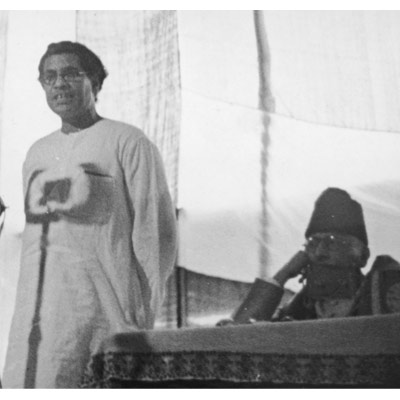
Bengali political theorist Manabendra Nath Roy (1887 - 1954) addresses the Indian National Congress, circa 1940. On the right is Muslim statesman Abul Kalam Azad (1888 - 1958), the President of the Congress
Bengali political theorist Manabendra Nath Roy (1887 – 1954) addresses the Indian National Congress, circa 1940. On the right is Muslim statesman Abul Kalam Azad (1888 – 1958), the President of the Congress

Its red sandstone boundary walls are defaced with posters and betel juice marks. Shopkeepers hang cases full of clothes and jewellery on them. Inside the walls the dry fountains gather dust and filth. This is the state of the maosoleum of Maulana Abul Kalam Azad, independent India’s first education minister, whose 125th birth anniversary will be observed Monday.

Situated in the heart of the bustling Meena Bazar, the garden-tomb of India’s prominent independence leader and close associate of Jawaharlal Nehru, the country’s first prime minister, the mausoleum is surrounded by numerous shops selling food, mobiles, CDs, clothes and other knick-knacks. Open sewers and a dump yard nearby tell a tale of unbelievable civic and governmental neglect.

Apart from the apathy of the authorities in maintaining the site, what stands out is that even most residents are not even aware about the mausoleum of a leader who is credited with establishing a national education system and modern institutes of higher education, including the Indian Institutes of Technology. His birth anniversary is also observed as National Education Day.

Walking down the winding by-lanes in search of the mausoleum, one is startled to learn that most of the locals are oblivious of his name, leave alone the location of the memorial. It’s indeed ironic how the man who persuaded thousands of Muslims during partition to stay back in India is now a forgotten man.

The boundary walls of his mausoleum have become billboards for local politicians, quacks and restaurants, while the temporary stalls adjacent to these walls have further damaged it by hammering nails and creating deep holes in places.

The gate has a lock, but it might as well not have one.

As you enter the small black iron-gate, a short staircase leads to a garden where people, mostly shopkeepers, are having lunch or a siesta. It is perhaps the only place offering peace and tranquillity in the midst of a maddening market and has thus become the resting place for many. That is another reason why the mausoleum is at least still maintained, though empty packets and wrappers of eatables and plastic bottles are scattered around the boundary walls.

In one corner is the mausoleum made of white marble with a patch of green grass on top. A canopy and a short boundary wall, both made of white marble, cover it from rain and sun – and more importantly, bird droppings. The fountains and pools, on the front and on the sides of the mausoleum, are empty and full of dust and filth, while the garden has patches of grass. Lichen covers the trunks of many trees.

The famous Urdu Park in front of the mausoleum, where Azad along with Sardar Patel, independent India’s first home minister and now much in the news, and C. Rajagopalachari, India’s first governor-general, delivered the historic 1942 Quit India address, is a playground for amateur cricketers during daytime and a haven for drug addicts and drunkards at night.

Sadly, it seems no one cares. For the locals, the mausoleum was just what it was – a mausoleum. “I know it’s a mazar (mausoleum) but I don’t know whose it is,” Abdul, a shopkeeper selling blankets near the boundary wall of the memorial, told IANS.

Similarly, tourists who come in droves to visit the nearby Jama Masjid and Meena Bazar, famous for affordable women’s apparel and accessories, give the memorial a miss as they are oblivious of its existence and importance.

Azad’s grandnephew Firoz Bakht Ahmed is not surprised at the neglect. “Since independence, he (Azad) never got the importance that he deserved. The government as well as the people have forgotten him. It’s a tragedy,” Ahmed told IANS. He said leaders like Azad, Patel and many more deserved much more recognition and respect. “There should be chapters in schools where students are taught about them and not just a handful of freedom fighters,” he said.

Talking about the poor maintenance of the memorial, Ahmed said that squatters should be removed from near the site and proper security arrangements put in place. “He was a freedom fighter and a nationalist leader known for his secular thoughts and was one of the few Muslim leaders who strongly opposed the partition of India. But sadly, he is not remembered now,” he added.

source: http://www.dnaindia.com / D NA  / Home> India> Report / Agency: IANS / Sunday – November 10th, 2013

Rare self-portraits by MF Husain on display in Dubai

Dubai : 

An exhibition containing 25 rare self-portraits by MF Hussain, in commemoration of his birth centenary has been put on display here.

Husain, who died in 2011, spent a number of years in the city, is being honoured with the exhibition titled ‘Maqbool’, to mark his 100th birthday. The exhibition, curated by Dadiba Pundole, will run until December 12 at the Sovereign Art Gallery .

Six other art works by Husain are also on display at the same venue. The self-portraits show various stages of his life participating in different activities.

The exhibition also showcases the vast range of mediums that Husain used in his work — pencil sketches, oil paintings on canvas, and several mixed-mediums including the use of Arabic calligraphy.

source:  http://www.timesofindia.indiatimes.com / The Times of India / Home> India / PTI / November 25th, 2013

Ruins in perfect preservation

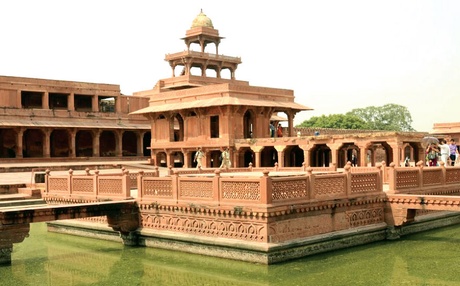
Akbar’s tribute to Sheikh Salim Chisti, Fatehpur Sikri is an abandoned city of red and white sandstone.

Fatehpur Sikri is considered the greatest Mughal city ever built and there is a fascinating story on how the idea behind its construction came about.

As Akbar grew older, his principal anxiety was the lack of a male heir. He learnt of a dervish called Sheikh Salim Chisti, the last of the many great sages in the Chisti line and journeyed to seek his blessings in the tiny town of Sikri — 23 miles west of Agra.  Sheikh recited blessings and made promises. Soon thereafter in 1569, Akbar’s Hindu wife gave birth to a son, Salim, later known as Jahangir followed by two more sons, Murad and Daniyal.

Akbar’s response to Chisti’s magic  probably ranks as one of the most outstanding examples in history of royal gratitude. He commanded that a city be built on the spot where the saint’s retreat was situated and the Sheikh was made the spiritual mentor of the entire metropolis. Almost overnight an army of labourers was mobilised to fashion the city of Akbar’s dreams and by 1570, the construction was in full swing using a kind of pre-fabrication technique.

Wrote Father Monserrate, “The house was built of stone made ready before it was brought thither so that there was neither hammer nor any tool heard in the house when it was building.”

Most of the city was completed in seven years, which was a remarkable feat considering the fact that the Taj Mahal took 22 long years to construct.

Emperor Akbar designed many of the structures himself and worked in the pits with the stonemasons cutting bricks and carving sandstone corbels. Huge battlements and a wall with nine gates appeared and a five story mosque  known as Panch Mahal was later constructed in the style of a Buddhist temple.

A huge rectangular courtyard was erected bounded by symmetrical gardens. There were three palaces, waterworks and baths, a mint for stamping coins with Akbar’s profile, a Turkish palace for his Turkish wife, a Hindu palace for his Hindu wife, a Muslim palace for his Muslim wives, an enamelled hall for the emperor to play hide and seek with all his wives, a court on which to play pachisi with human pieces, viaducts, stables, octagonal towers, domed pigeon houses and more.

There was also a seventy foot octagonal tower built in honour of a pet elephant, a girl’s school, a zoo, a sewage system and the largest gateway in the east — the Buland Darwaza — which served as a gateway to the city.

In Fatehpur Sikri, Akbar gathered the finest singers, the boldest statesmen and the wisest philosophers. His cabinet, known then as the ‘nine gems’ was reputed to hold the nine most capable men in the world.

After 15 years of life at Fatehpur Sikri, the fickle sovereign began to grow bored with his magnificent project. The harsh landscape around Sikri was not conducive to gaiety and drinking water was inaccessible (a manmade lake, dug nearby collected only brackish water).

In 1585, when a military campaign called him to Northwest India, he moved his headquarters to Lahore and abandoned Fatehpur Sikri forever.

The story that Akbar left the city to oblige Sheikh Chisti when he complained that the noise was disturbing his devotions is apocryphal, for Salim died some years before the city was abandoned.

As quickly as it had been populated, the magnificent city emptied.

A few years later, the city was described by a European as “ruinate, lying like a waste district, and very dangerous to pass through at night”.

Today, except for a small community that lives at the foot of the city and lives off the largesse of occasional tourists, the city of Fatehpur Sikri is unoccupied, a ghostly red and white necropolis of sandstone courtyards and endless silent corridors, which are all in a state of perfect preservation.

It really seems too perfect.

In fact, the ingredients of the time — resilient mortar used between the bricks have never been chemically analysed with any real success.

source: http://www.newindianexpress.com / The New Indian Express / Home> Education> Student / by Anjali Sharma – ENS / November 21st, 2013

Idea of Taj Mahal was born here

Ahmedabad :

The Moghul great Shah Jahan, who built the greatest monument for love anywhere in the world — the  Taj Mahal  — had his early training in Ahmedabad. The great builder was inspired by the architectural marvels of Gujarat and honed his skills as a builder in Ahmedabad. Also giving him company was Mumtaz Mahal who stayed with him in Ahmedabad around 1618 when he was serving as governor of Gujarat for his father Emperor Jehangir.

Today, Shahibaug in Ahmedabad is named after him and the present Sardar Patel Smarak was built by him to give employment to locals during a famine. Shah Jahan had not built any monuments before coming to Ahmedabad. Then, he was known as prince Khurram. If historian James Douglas  is to be believed, Ahmedabad’s  picturesque architecture, which was already two centuries old then, inspired Shah Jahan to erect great architectural marvels later in Agra.

Douglas notes in his book ‘Western India’ published in 1893 that the Moghul king acquired a taste for architecture and cultivated it during his stay in this city. He writes, “Shah Jahan in Ahmedabad was watching the flecked light as it fall on panement of marble or alabastar; alone and silent , observing, measuring, comparing, digesting, perhaps copying, drinking in all wisdom, deftness of hand, cunning craft and workmanship, beauty of colour, harmony of form.

Shah Jahan, who ruled as an emperor from 1627 to 1658, also got the Azamkhan Sarai built near the Bhadra fort. Taj Mahal, which was completed in 1653, sent Shah Jahan’s earlier construction into oblivion. But a connoisseur like Douglas was quick to recognise the roots of the architectural revolution in India . He paid the ultimate tribute to the city: “The bud was here: The blossom and fruit to be in Agra? Everything has a beginning, Greece  before Rome, Damacus before Cairo , Agra follows Ahmedabad.”

He further wrote: “Ten of Ahmedabad’s mosques were built before Columbus discovered America…It was here the master builder drank in the elements of his taste which was to display such glorious results elsewhere.”

source: http://www.articles.timesofindia.indiatimes.com / The Times of India / Home> City> Ahmedabad / by Ashish Vashi , TNN / November 22nd, 2013