Category Archives: Leaders

WRITE ANGLE : Aurangzeb, revisited

Two works provide a peek into Mughal emperor Aurangzeb’s life

Aurangzeb, the convenient bigot of history, is finally getting a fresh coat of paint. Long projected as the bad guy for students who are told history is just a bout between heroes and villains, the tide could well be turning for the Mughal emperor who ruled Hindustan for half a century. No, he has suddenly not become a knight in gleaming armour. But, attempts are being made to look at him from a fresh perspective.

Around a year ago, William Dalrymple co-edited Princes and Painters in Mughal Delhi, 1707-1857 wherein he talked briefly of scholars taking a fresh look at Aurangzeb. Some even tried to redress the balance, which has forever been loaded in favour of Akbar. It always seemed that if Akbar was the greatest Mughal ruler, there had to be the worst one too. If Akbar was secular, brave and wise, there had to be an emperor who was bigoted, cruel and stubborn. In short, history never allowed Aurangzeb any redeeming qualities; the only exception being a mention of his simple lifestyle.

Though brief and almost fleeting in nature, William’s essay was more than a little footnote, because, all along, students had been taught that Aurangzeb was a man who banished all forms of arts from his court. Then, Dalrymple, who with the skills of a raconteur has done more for history than many seasoned academics, told us that scholars have now shown that Aurangzeb was “a pragmatic ruler who frequently patronised Hindu institutions, whose reign was less orthodox, less tyrannical and centralised than previously thought”.

The book even has a few paintings, attributable to Hunhar, Hashim and Bhawanidas, depicting a majestic looking Aurangzeb in a shaft of light in his durbar, or having confabulations with his courtiers. Some paintings were from the early years of Aurangzeb’s reign, others from the last few. Together, they put to rest all assumptions about the emperor banning painters and paintings.

Now at a completely different level comes Rajmohan Gandhi with Punjab: A History from Aurangzeb to Mountbatten. Gandhi, erudite and insightful, does not come anywhere near holding a brief for Aurangzeb. In fact, at many places, he reinforces some age-old assertions about him. Why, at a couple of places, even his possibly human reactions are projected as only a little short of dramatic. For instance, while talking of Dara’s death, Gandhi quotes: “His body was exhibited on an elephant to the populace, while his head was brought to Aurangzeb, who had it wiped and washed in his presence, and being satisfied of its identity, shed tears.”

But there are also those comments that show the more positive side of the emperor. “Diligent in religious observance, Aurangzeb was a tenacious fighter as well. The empire under Aurangzeb’s long rule increased in area. New territories annexed included Little Tibet beyond Kashmir in the north, Chittagong beyond Dhaka in the east, and, in the south, the Muslim kingdoms of Golconda and Bijapur.”

Soon, the emperor’s simplicity, which has often been talked about in textbooks, is given space. Gandhi happily reiterates, “‘Of small stature, with a long nose, a round beard and an olive skin’, Aurangzeb, ‘usually wore plain white muslin’ and ‘applied himself assiduously to business’. At times he was seen with ‘a cheerful, smiling countenance….Under him the Mughal empire reached its greatest limits’.” Then come the emperor’s words of atonement. Gandhi reproduces Aurangzeb’s words written to his favourite Kam Baksh, “Son of my soul…Now I am going alone. I grieve for your helplessness. But what is the use? I have greatly sinned, and I know not what torment awaits me…Let not Muslims be slain and reproach fall on my useless head. I am sore troubled.” Aurangzeb and guilt? Aurangzeb and art? The two disparate works may not help overhaul the emperor’s image — nor do they intend to do so — but they help give a hitherto unseen little peek into Aurangzeb’s life. They may not bring about a storm of fresh discussions on him, but the winds of change are blowing. Ever so gently.

source: http://www.thehindu.com / The Hindu / Home> Books> Columns / by Ziya Us Salam / Chennai – August 02nd, 2013
WRITE ANGLE : Who is Dara Shukoh?

Gopal Gandhi’s Dara Shukoh: A Play raises the relevance of Dara Shikoh in contemporary India.

Few men who read history in school remember Dara Shikoh, the philosopher-prince of Mughal India. He is but a fleeting figure even if an enlightened one. The spotlight is well and truly on Aurangzeb, terse, taciturn, untamed. In a world looking for convenient, even if inaccurate, summations, Dara is reduced by our historians to being a favourite son of Shah Jahan, and Aurangzeb, a fratricidal ruler who did not hesitate to put to the sword his own. That almost all kings in the years of yore did the same matters little. That Dara had a life before the fatal battle of Samugarh with Aurangzeb, that he had a life quite removed from that of any of his brothers is never pointed out. For most, Aurangzeb is a convenient villain, Dara the easy but fallible hero.

However, today as our nation faces the prospect of being ruled by revisionist politicians — ironically, they seem to be getting mixed up with their history lessons too — it is important to take some time out, and realise what we lost when Dara lost, and what we can gain if we imbibe his spirit. With such a thought, I picked up Gopal Gandhi’s Dara Shukoh: A Play. It was released some time ago and I had all but left it on the shelf with the likes of Dilip Hiro’s Baburnamah for company.

However, the events unfolding in the run-up to the general elections made me go back to it. Dara is relevant, even necessary today. The book instantly set in motion a series of conjectures: what if the heterodox Dara and not the more orthodox Aurangzeb had won the battle of brothers? If mid-17th Century India had thrown up a different victor, would the nation have been partitioned? Didn’t medieval India throw up a man who was wedded to pluralism of thought and faith much before the founding fathers of our Constitution made it a benchmark for future generations? And would Hindus and Muslims have lived here, as Sir Syed Ahmed Khan said, like the two eyes of the nation? Imagine if a Sufi had outlasted a warrior! Imagine.

The questions shall never be answered. But revisit Dara we must. Understand what he stood for, preach many of his things, and we might just end up with a nation that takes pride in its pluralist culture, a society where Hindus read both the Vedas and the Quran, the Muslims appreciate that the concept of one universal God precedes their arrival here; appreciation rather than mere tolerance of each other’s culture being the hallmark. Follow this, and the need to combat the challenge thrown up by communal elements disappears. Who can argue with a man who drinks from the common nectar of Sufis and bhakti saints?

And Gopal Gandhi, with an enviable and apt lineage for such a project, goes about demolishing many prejudices, exposing many lies. He chooses to spell him Shukoh, explaining beautifully that ‘Shikoh’ in Persian means ‘terror’ while ‘Shukoh’ stands for ‘glory’. Gandhi’s Dara is not a tragic figure; rather he is a man whose time is now. Gandhi chooses not to dwell much on a failed general — a poet is doomed to be a failure on a battlefield anyway. He stays focussed on the undercurrents of the thoughts of the man who translated the Upanishads into Persian — ideas that did not endear him to the radical elements on both sides of the religious divide. A play may not necessarily be an ideal substitute for a history textbook, but hey, did not Rajkumar Hirani’s Lage Raho Munnabhai do more for introducing Mahatma Gandhi to the bubblegum brigade than any academic book or lecture?

The best help often comes from the source least expected. A play, a film, a book, a philosopher may yet show us the way. After all, amidst all the political mudslinging and a society being rapidly polarised, we could do worse than heed Dara’s words. Remember what he said when his followers screamed, “Shuja — his brother and fellow claimant to the throne — murdabad”? Dara replied, “Let us not wish death to any one/That is base;/All of us have God’s breath in us,/In any case./We live and have our being/ With his grace.”

In this age, Dara deserves attention.

source: http://www.thehindu.com / The Hindu / Home> Books> Columns / by Ziya Us Salam / Chennai – November 22nd, 2013

Sepia notes: Harbinger of change

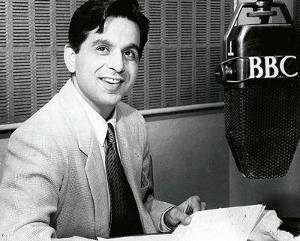
DilipKumarMPos23nov2013

Dilip Kumar takes part at a special broadcast of BBC Indian Service during his visit to London in April 1953.

Born to a dry fruit merchant in December 11,1922, Yusuf Khan started his career as a manager at Bombay Army Canteen. But fate had other plans for him. A chance encounter with Devika Rani of Bombay Talkies landed this shy and debonair young man in Tinsel Town.

Of this Ashok Raj in his book Hero wrote: The Silent Era to Dilip Kumar says: “Devika Rani had gone out for shopping to a local market. At one fruit shop, she looked keenly at the young man engrossed at selling his merchandise. It was by mere chance that the shy shopkeeper had only replaced his father that day. Devika Rani found this young man with a sensitive face and expressive eyes quite unusual. She gave him her visiting card and asked him to meet her at the studio.”

Bombay Talkies not only changed his destiny but also his name — Yusuf Khan became Dilip Kumar and made his debut in Tinsel Town with Jwar Bhata (1944).

It has been 70 long years since Yusuf was ‘spotted’ and today he is considered as the ‘first modern Indian actor’ who freed himself from the theatrical mannerisms and developed a more natural and distinctive style, which stressed on silent pauses and hand gestures and films like Andaz, Jogan, Daag, Baabul, Aan, Daag, Foot Path, Madhumati, Devdas, Naya Daur and Ganga Jumna stand testimony to his versatility.

source: http://www.mumbaimirror.com / Mumbai Mirror / Home> Entertainment> Bollywood / by Mumbai Mirror / October 19th, 2013

The documentary proves it: Tipu was a secular human being

The portrayal of Tipu Sulthan as a religious bigot is often disputed at many levels and several sources suggest that he embraced religious pluralism.

It is in this context that Abbas Panakkal and his crew have conceived their major documentary project ‘Misery of History,’ that deals with Tipu’s seventh generation and how society handles them today.

Much light is thrown to convey the ‘truth’ that the Tiger of Mysore was a secular human being. Abbas Panakkal, a visiting research fellow at Graffiti University, Australia, says that it is his passion for the history pages as such that compelled him to throw light into this sensitive historic issue.

In the historical journey he was accompanied by his best pals Ajeeb and Akhil, who served behind the lens for ‘Misery of History.’

The trio had together brought out several short films and documentaries about a panorama of topics across the globe.

“Much has been told and cited in our own records referring to Tipu Sulthan as a successful Islamic ruler who never hesitated to massacre the Hindu population. But in my research I found that he was  a generous ruler who allowed grants to temples. Solid records are also available which highlight the correspondence between his court and temples, and he having donated jewellery and valuable gifts for temples. There are further records which show that Tipu’s army had many Hindus and people from other religions too. His relation with the Sringeri temple was much hailed. It was in this background that ‘Misery of History’ was carved out,” explains the curator.

The 30-minute documentary was shot in Sreerangapatnam, Kolkata, Mysore and London. “This was a project that required much research. We were assisted by four historians- Dr B Sheikh Ali, Dr Sebastian, Prof K K N Kurup and Dr Hussain Randathani – in this task. They helped us track several places and various important historical moments in the Sulthan’s reign and life. It was during such travels to these places that we got to know more about this subject,” says Ajeeb.

The film has thrown light into Tipu’s seventh generation descendants who are living a less charming life in Anwar Shah street in Kolkata. Most of them earn their living by pulling rickshaws on the streets. ‘Misery of History’ opens with such a middle-aged man who is believed to be one of those living descendants of the majestic ruler. “They live a miserable life there and some migrants from other states exploit them left and right. These people even prevented us from shooting at those places with these people,” says Abbas Panakkal, who had also carved important documentaries for Tripunithura Hill Palace, philately of Indian Postal Department, the chaos in Palestine, to name a few.

Apart from local sources, the crew had also travelled up to Victoria Albert Museum in London for more materials.

“We also had fetched references from the much-hailed work ‘Tipu’s Tiger’ by Susan Stronge. She had shared many important discussions with us for this subject, giving us more reference materials from their collections,” he says.

The multilingual documentary was screened in Kozhikode the other day. The curators are further planning to screen the documentary for several colleges in the state as well.

source: http://www.newindianexpress.com / The New Indian Express / Home> Cities> Thiruvananthapuram / by Sivalakshmi Roshith, Thiruvananthapuram / November 22nd, 2013

Dr. S.K. Kareem Khan, the Folklore Sage of Karnataka

DrKareemKhanMPos22nov2013

It is a good fortune that Karnataka’s soil has been treaded by personalities known for their universal outlook and integrity. A melting pot for various languages, religion and culture, Karnataka had a number of persons belonging to Muslim community whose contribution to Karnataka’s secular traditions is immense. Historically we had Ibrahim Adilshah, the ruler of Bijapur whose work in Urdu, Kitab-e-Nauraspopularised Hindu music among the Muslims. Karnataka was the abode of Sufi saints like Baba Budan and Khwaja Bande Nawaz whose way of life and moral sermons inspired both Hindus and Muslims and paved way for Hindu-Muslim amity. In the 20thcentury there was another similar figure who was not only a symbol of Hindu-Muslim unity but also a freedom fighter, folklorist, singer, lyricist and a dramatist. He was the late Dr.S.K.Kareem Khan. Born in 1908 at Sakleshpur in Hassan district of Karnataka to an Afghan soldier, Abdur Rahman Khan, and his wife Jainabi, S.K.Kareem Khan studied classical Sanskrit and Kannada literature under Achangi Narayana Shastri of Sakleshpur and despite his informal education, mastered Sanskrit and Kannada.

As a Folk Singer: It was during his teens that Kareem Khan was attracted towards folk songs. His house at Sakaleshpur was a halting place for touring merchants selling brass and copper wares. After dinner they used to hum folk songs which young Kareem used to listen with rapt attention. Inspired by the call given by Mahatma Gandhi he Kareem Khan joined the freedom struggle and this took him to various places. This occasion gave him an opportunity to hear and chronicle folk songs which he came across and later he himself used folk as a medium to spread the message of the freedom. Later collecting and singing of folk songs became his life’s passion. He used to visit villages and standing under a platform or tree frequented by people used to sing folk songs. Mesmerised by his melodious voice people used to gather around him. At the end he used to urge the people to join the Congress party then involved in the country’s freedom struggle. He was jailed several times for his participation in the freedom movement. There his fellow jail inmates used to pester him to sing folk songs for them. Such was the sweet voice possessed by Kareem Khan.
Multi-faceted Personality: Kareem Khan’s was a multi-faceted personality. He penned screen play and song lyrics for Kannada films, wrote dramas, translated works from Sanskrit and Urdu to Kannada, was a researcher, essayist and a pioneer scholar in folklore studies. This apart he was fully involved in the country’s freedom struggle and Karnataka’s unification movement. During 1930s worked as an editor and sub editor of two publications Loka Mitra of Dharwad and Antharanga of Udupi. .  In the early 1960s he launched `Janapada Prakashana’, an exclusive publication dedicated to folk literature, art and music; copies of which he sold at 50 paise each. Secularist to the core he led a simple life, true to the Gandhian principles which he cherished. Though he avoided power and publicity, such was his achievements that honours came in abundance. He was conferred the Janapadashri and Karnataka Rajyothsava awards by the government of Karnataka, Nadoja award by Hampi University, honorary doctorate from Gulbarga University and numerous other honours from various institutions and organisations. Given epithets like Janapada Jangama and Janapada Bheeshma, he was the President of Karnataka Janapada and Yakshagana Academy from 1987 to 1990. He passed away in Bangalore on 29th July 2006.
Modern Shishunala Sharif: It would be surprising to know that there is a lot similarity in the life and works of Santa Shishunala Sharif and Kareem Khan. Both were known for their simplicity and integrity. Both were secular in their outlook and had good knowledge of Hindu epics, traditions and culture. While Shishunala had Govindabhatta as his guru, Kareem Khan had Narayanashastry as his guru. While Shishunala was a mystic poet, Kareem Khan was a social activist cum folklorist. The composition of both these stalwarts will be evergreen in the minds of the Kannadigas.
source: http://www.karnatakahistory.blogspot.in / Home> Dr. S.K.Karim Khan / by S. Srinivas / May 22nd

It’s Atalji versus Dr Khan on 100-ft road

The secular vs saffron tussle over naming the 100-ft road in Indiranagar after noted folklorist and freedom fighter Dr S K Karim Khan has gained new life, with his family knocking on the doors of the BBMP to implement a 2006 resolution on the issue.

In 2010, the BJP, which is the ruling party in the BBMP, created a ruckus and demanded that the same road be named after former Prime Minister Atal Behari Vajpayee. Result: BBMP officials and representatives are “inconclusive” over implementing the resolution.

The family points out that Khan’s contribution to Kannada folklore and culture has been immense, resulting in several awards. He single handedly collected thousands of oral epics and ballads and recorded them.

Though a follower of Islam, Khan had profound respect and deep understanding of local mythology and was best remembered for his devotional songs in Kannada which even won state and several other awards. He lived the life of an ascetic as he spent considerable years of his life in a hotel room in Basavanagudi.

Khan’s grand nephew Tanveer Ahmed told Bangalore Mirror, “It has been six years since his death. Yet, posthumous recognition for the literatteur has remained elusive. This is not the way to treat a person who devoted all his life for the language and culture. Not the just folklore, but he was the first to chronicle the history of Bangalore’s founder Kempe Gowda and wrote three books on the life of Kempe Gowda. His song Natawara Gangadhara… won state award. He was presented with the Nadoja award along with Jnanpeeth Awardee Dr Shivarama Karanth. But still nobody knows about his contribution in Bangalore. Should it take six years to name a street after him?”

‘No Personal Interest ‘ 
Ahmed pointed out that the family members neither have any personal interest nor benefit from the move. “We only hope that a kind gesture by BBMP would help future generations remember a man who did great work for Kannada and culture of the land.”

The state government, which promised several things upon his death, is also yet to deliver on its promises. “During the final rites of Khan, then home minister M P Prakash announced a trust in Khan’s name. Further, the then CM H D Kumaraswamy responded positively. This also has not happened,” Ahmed said.

Khan was born to parents with Afghan-Arab lineage. Despite being a high school dropout, Khan mastered Kannada and Sanskrit and developed indepth knowledge about Hindu mythology and Sanskrit texts. “In fact his works on Kempe Gowda served as major evidence for the union government to rename the BIAL as Kempe Gowda International Airport,” he added.

The family wants the Kannada Development Authority to profile Khan’s life and works and bring it out in the form of a compendium accessible to all. They also suggest a state award to foster communal harmony in Khan’s name.

source: http://www.bangaloremirror.com / Bangalore Mirror / Home> Bangalore> Civic / by Niranjan Kaggere, Bangalore Mirror Bureau / November 22nd, 2013

Archaeological Survey of India to touch up Tipu’s summer palace

Tipu Sultan's Summer Palace / The Hindu
Tipu Sultan’s Summer Palace / The Hindu

Paintings will be cleaned using chemicals, and scribbles on the walls will be covered by patch plastering work

Years of dust and smoke that have masked the paintings on the walls and ceiling of Tipu Sultan’s summer palace in Bangalore may finally be cleaned up, while portions of the wall vandalised with graffiti could also receive much-needed attention.

The Archaeological Survey of India (ASI), which protects the 18th Century monument, will take up chemical cleaning of the paintings. The scribbles on the walls will be covered by patch plastering work.

Protected monument

Located in the busy Kalasipalya area, the wooden edifice built in Indo-Islamic style, is a protected monument along with the nearby fort and dungeon.

The chemical wash is expected to brighten the paintings at the palace, most of which are vivid floral designs in water and vegetable colour.

Conservation wing

The process will be done by the ASI’s Mysore-based chemical conservation wing.

“Chemical wash was conducted on a small test area about five years ago. The painting has not changed much since then,” a senior ASI official said. He explained that it was a slow process that was dependent on humidity and dust, among other factors.

Besides, structural conservation work has to be completed before chemical wash is taken up.

TipuPalaceAbodeMPos19nov2013

An eyesore

However, this will do little to address the damage to paintings from scribbles and scratches.

“If the graffiti has to be removed, restoration of paintings has to be taken up. This is nearly impossible. It is difficult to maintain the same quality of painting and sourcing raw materials is highly impossible,” the ASI source said.

Instead, patch plastering work could be taken up to remove the eyesore in some spots.

“We will attempt to fill the scribbled portions with the patch work.”

Public office

The official claimed: “The palace was a public office before it was handed over to us in the 1950s. Much of the graffiti is from that period.” It was this sort of vandalism that had led the ASI to hire private security guards at the palace.

“We do not encourage visitors to stay on the palace premises for long,” another official said.

Colour washing of pillars with a protective coating and replacing some wooded portions that have been damaged by the elements too are on the agenda.

source: http://www.thehindu.com / The Hindu / Home> News> National> Karnataka / by Sharath S. Srivatsa / Bangalore – November 19th, 2013

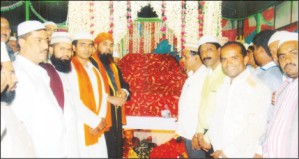
Sandal Urus Shariff of Sufi Saint Hazarath Mohammed Salman Misbahi in city

Seen in the picture are Corporator Suhail Baig, Moulana Anwar Ahmed Nizami, successor of Hazarath Mohammed Salman Misbahi, Riyaz Pasha, Ilyas Baig, Fiyaz and others at the Astana Salamaniya Dargah at Badamakan burial ground near Tipu Circle in city recently.

Mysore :

Astana-e-Salamaniya Dargah Committee, Mysore, had organised Sandal Urus Shariff of Sufi Saint Hazarath Mohammed Salman Misbahi, Founder of Azeezia Educational Trust here recently.

The Sandal Urus Shariff procession consisting of students of Arabic College, Sufi Saint, Revered Moulvis, Ulmas, Islamic Clerics, Scholars, Dharvesh of Ahala-Sunnath-wo-Jamath and devotees began from the Association Office in Lashkar Mohalla and passed through Ashoka Road, Sawday Road, Pulikeshi road, Fountain Circle to reach Astana Salamaniya Dargah at Tipu Circle on Mysore-Bangalore road. The programme was held under the supervision of Fayaz Pasha, social worker Abdul Azeez, Riyaz, Ilyaz Baig and Corporator Suhail Baig.

A lecture on ‘Azmath-e-Ahowliya Allah’ was held under the guidance of Moulana Mohammed Anwar Ahmed Nizami, successor of Sufi Saint Hazarath Mohammed Salman Misbahi, Secretary of Azeezia Educational Trust under the Presidentship of Sir Khazi of Mysore Moulana Mohammed Usman Shariff.

Moulana Asgar Ali, Khateeb-o-Imam, Jamiya Masjid on Irwin road and Moulana Mufti Sajjad Hussain Khan, Principal, Jamiya Tipu Arabic College, Srirangapatna spoke on the life of Sufi Saint.

Moulana Abdul Salam, Moulana Maqbool Nizami, Moulana Syed Imdad Ulla, Syed Fazil Ashrafi, Riyaz Pasha, Fayaz, Abdul Jabbar, Tanveer Ahmed, and others participated.

Sir Khazi of Mysore Moulana Mohammed Usman Shariff released the new 2014 Azeezia calendar on the occasion.

source: http://www.starofmysore.com / Star of Mysore / Home> General News / November 11th, 2013

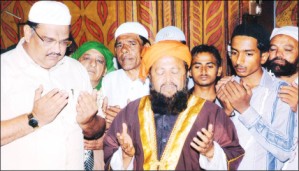
237th Annual Sandal Urus Shariff of Hazarath Hyder Ali held

Tanveer Sait, MLA and Chairman of Tipu Sultan Wakf Estate, Srirangapatna, along with religious leaders and devotees, is seen offering prayers during the Sandal Urus Shariff of Hazarath Nawab Hyder Ali Khan Bahadur, recently.

Mysore :

The 237th annual Sandal Urus Shariff of Hazarath Nawab Hyder Ali Khan Bahadur, organised by Madarasa-e-Quvatul Islam Nawab Saheb Physical Education Management Committee Secretary Afrooz Pasha in city recently.

Sandal Urus procession along with Fukras Jamath, Syed Ahmed Baba from Bangalore began from city to reach Tipu Tomb in Srirangapatna where Masjid Aqsa Tipu Tomb Srirangapatna Khateeb Moulana Inayath ur Rehman Razvi read Fatha Khani which was held under the Presidentship of MLA and Chairman of Tipu Sultan Wakf Estate, Srirangapatna, Tanveer Sait, who paid floral tributes to the tomb.

Senior advocate M.S. Mukram, Sufi Wali, Mysore Dist. Wakf Board Advisory Committee former member Sajjad Ahmed, President of Azeez Sait Block Congress Committee Rafeeq Ahmed, social worker Ayaz Pasha and devotees participated in the programme.

Afrooz Pasha proposed a vote of thanks.

source:  http://www.starofmysore.com / Star of Mysore / Home> General News / November 11th, 2013

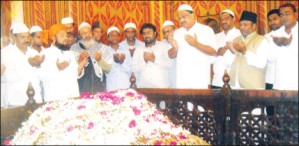
Tipu birth anniversary at S’Patna

Chairman of Tipu Sultan Wakf Estate and MLA Tanveer Sait along with Islamic scholars and religious heads seen offering prayers to the tomb of Tipu Sultan at Srirangapatna yesterday.
Chairman of Tipu Sultan Wakf Estate and MLA Tanveer Sait along with Islamic scholars and
religious heads seen offering prayers to the tomb of Tipu Sultan at Srirangapatna yesterday.

Srirangapatna :

The 263rd birth anniversary of Tipu Sultan was celebrated in a grand manner at Srirangapatna yesterday.

Chairman of Tipu Sultan Wakf Estate and MLA Tanveer Sait along with Moulana Sajjadin of Jamia Masjid and other dignitaries offered prayers to Tipu tomb.

Speaking to SOM, Sait said that the Government should celebrate the birth anniversary of Tipu Sultan on the lines of Basavanna, Valmiki and other Jayanthis and added that there was no need for a holiday which was put forth by some organisations, but instead remember the day as the day of those who laid down their lives fighting for the country.

The MLA welcomed the announcement of Shadhi Bhagya by the government to the minorities and added that this scheme should be extended to the poor people of all communities.

Stating that there were plans to open a residential school on the lines of Moraji and Kittur Rani Chennamma Residential Schools, he said a proposal in this regard would be given to the Government soon.

A rally was taken out from Ganjam Circle to Tipu tomb.

source: http://www.starofmysore.com / Star of Mysore / Home> General News / November 11th, 2013