Category Archives: NRI’s / PIO’s

School dropout Asif Sheikh’s UK company has Rs 5 crore turnover

Srinagar, JAMMU & KASHMIR /Manchester, U.K. :
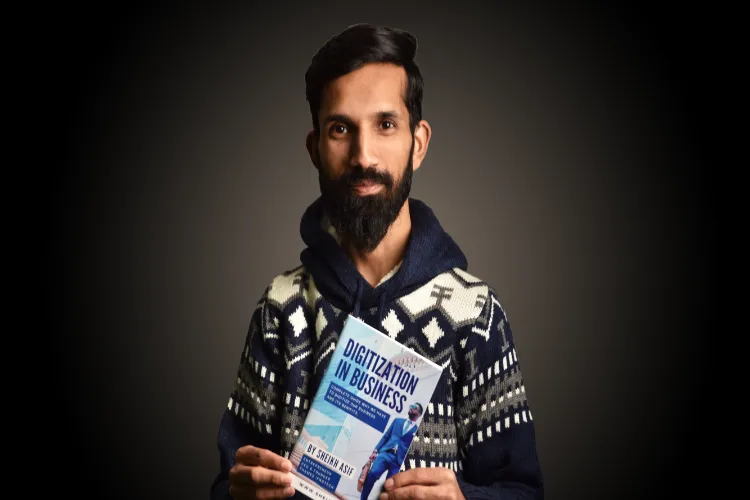
Sheikh Asif, founder, Thames Infotech, holding one of his books

Breaking the stereotype of a company chief, Srinagar’s Asif Sheikh, a school dropout, is the CEO and founder of Thames Infotech, a Manchester-based company with a turnover of Rs 5 crore! He has just turned 28.

“I believe that a person who works hard, with dedication and honesty is always successful; he can never give up even when many a time one loses the courage to carry on. There were setbacks and at the time I did seem to lose courage, but I did not give up,” Sheikh Asif told Awaz-the Voice in a telephonic interview.

Asif’s success is extraordinary given his poor educational background and reaching a position that many persons with degrees from top-end colleges aspire to.

Besides being a successful entrepreneur, Asif is also a professional web designer, developer, graphic designer, digital marketer, and writer. He also gives back to society by giving free tuition to students from all over the world.

Sheikh Asif’s work profile is interesting: he worked with a tour and travel company, sold medical equipment for a company, and with telecom companies like Airtel, Vodafone, and Aircel.
awazthevoice
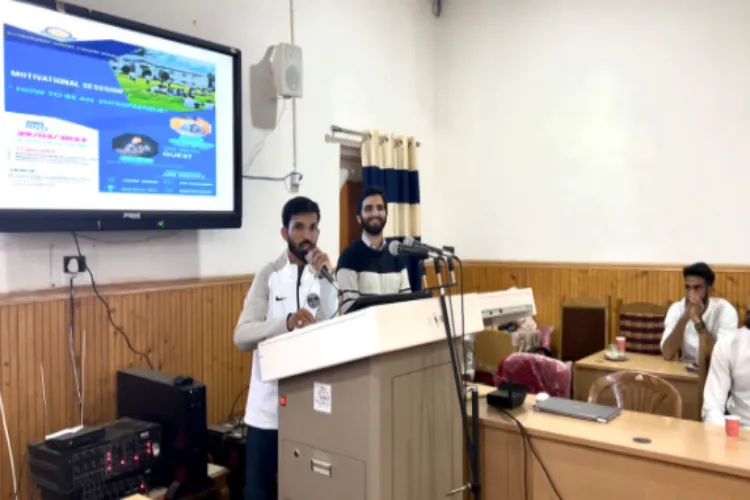
Sheikh Asif deliving a talk on business

In the year 2000, Sheikh Asif was 8 years old when his father’s health deteriorated. His father was a head constable. Due to his father’s illness, the family was reduced to penury. Sheikh Asif says that his father’s illness remains a mystery as the family consulted experts and eminent doctors but nobody could diagnose it.

Sheikh Asif told Awaz-the Voice that his mother sold most of the household assets and took loans to pay for his father’s treatment.

Recalling those days, Asif says that he can never forget one particular day when he was studying in the eighth grade and was to write his exam, but he had no pen. “I was leaving for the examination hall and was worried. My mother came to know the reason for my worry, she sold a copper dish from her kitchen to buy me a pen.”

He says that his mother often sold household goods for the family, especially to meet the needs of the children.

The conditions at home were not conducive for Sheikh Asif to continue his studies. He left school and started working to support his family.

“I went against my mother’s wishes, as she wanted me to become a doctor most parents in Kashmir do, but I gave up my studies to support my financially broke family,” said. He was 15 years old in 2008 when he started earning for his family by doing odd jobs.
awazthevoice
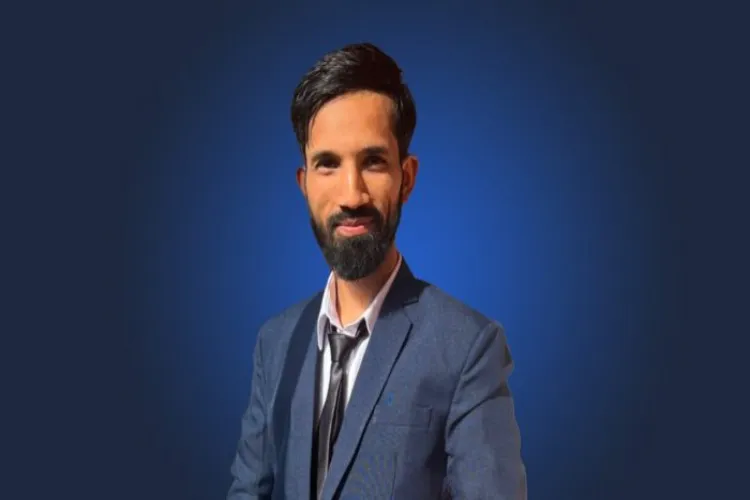
Sheikh Asif

Sheikh Asif was always fascinated by computers and spent a lot of time on them. Due to this, he got his first job as a data entry operator with a local tour and travel company at the age of 16. He earned a salary of Rs 1500.

Sheikh Asif said seeing his interest his father took a loan from a bank to buy him a computer. The turning point in his life came as he watched an interview with Microsoft founder Bill Gates on BBC.

He took full advantage of his computer and yet the challenge was the lack of a high-speed broadband facility in Kashmir. While the rest of the world was running 4G internet, in his locality only 2G internet was available.

He left his first job within two months and started working in a local shop as a salesman for four years. Here he honed his skills and learned all the basics including graphics designing, web designing, etc.

Again there was a rough patch in his life as in the 2014 Kashmir floods, his house was washed away. He used all his savings in rebuilding his house. The family had to start from scratch as all their household belonging had got damaged and washed away.

In the year 2014, he quit his job and started his business, but it turned out to be a year full of troubles for him.
awazthevoice
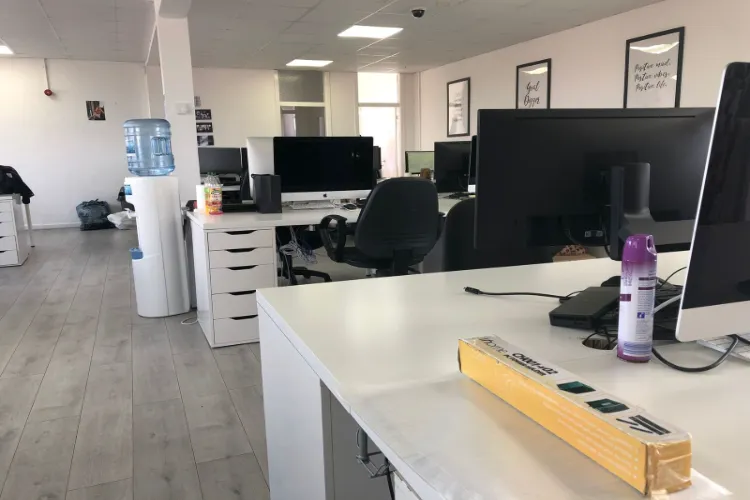
Sheikh Asif’s Srinagar office

However, fortunately, the next year Asif got an opportunity to work in Delhi, and the exposure there opened his mind to a bigger canvas.

“The 2014 flood severely damaged our house and we had to repair or renovate it periodically for four consecutive years after the flood and finally had to sell the house in 2018,” he said.

In the meantime, he worked with OLX from April 2015, and from there he was offered a job at Trimax Printing and Graphics, a UK-based company owned by Tajinder Singh. He was working for the company Hayes Harlington. The company runs an online general store and it had no element of graphic designing till then.

Sheikh Asif told Awaz-The Voice: “I worked for Chanda Trimax Printings & Graphics. Meanwhile, the killing of a militant in Kashmir saw the valley under lockdown for nearly three months. For this reason, I left for Delhi.”

When he met Tajinder Singh in Delhi, the latter was facing issues with his business. His business was suffering due to low sales. Having seen his latent, Tajinder Singh offered him a job at Hayes, Harlington, UK, where Tajinder’s brothers were already working.

Sheikh Asif says he consulted his mother before picking the UKL job. He signed an agreement to work for 18 months and an assured return flight ticket to India.

“They told me that they had changed the name of Trimax Printings & Graphics to Thames Infotech on June 6, 2016,” Asif said.

He set foot on foreign soil for the first time in the first week of November 2016. However, the business did not show positive results there either, thus Tajinder’s brother advised him to find a part-time job in the UK to meet his expenses.

“When I was looking for a part-time job, I met Rizwan, a Kashmiri man originally from Baramulla district in North Kashmir, who came to Manchester in 2000 and now runs a restaurant, Riz Spices.

Sheikh Rizwan offered him a space in his restaurant to set up a part-time business. “Two months later I met another man, Hamza Salim, a senior software engineer at Google, who asked me to build a website for his tech company, on the condition that only if he liked my work I would be paid,” he said.

After approving his website design, Hamza Salim offered him 50 percent equity in his firm.

pix05

During this time, Asif meet many people including natives and others, and kept looking for opportunities.

One such person was Rudrigo Ruiz Karvajal, who frequented the restaurant. He offered me a place that was quite conveniently located. He told me that his father had started his business from there.

“I got my first order for a logo for which I was paid 500 pounds and I was only expecting 30-40 pounds. They gave me another order to build a website for which I was paid 7000 pounds.”

 “I was wondering if it’s a dream. Never expected such high remuneration. This order was from the largest food chain in London called Zabka.”

On June 9, 2016, Asif took over the Thames Infotech Manchester UK company which has a current turnover of Rs 5 crore.

It has an office at Advent Colony in Naugam, Srinagar, Kashmir. He employs 35 locals including 32 in UK and 3 in Kashmir for website designing and development, digital marketing, graphics designing, personal branding, social media handling, etc.

Sheikh Asif told Awaz-The Voice that our company is a leading web designing company and has won the 2017, 2018, 2019, and 2020 awards as the Three Best Rated UK, and Best IT Service Provider Award 2018, 2019 organized by Top Developers USA, he claims.

Sheikh Asif said that he received the first award in the year 2003, less than one year after his launching of his company.

So far, Asif has trained around 1000 students, helped 40 businesses through the Covid-19 pandemic, and has published three books – Digitization In Business, Online Business Idea, and Start a Business.

Sheikh Asif was named Entrepreneur of the year 2022 by The Fireboxx. There he was honored by Google as a Digital Marketing Expert in 2018.

To the youth, Sheikh Asif says they must never lose hope and always keep their focus on business. Secondly, they must avoid drugs. They shouldn’t waste their lives by getting immersed in romantic liaison and heartbreaks; these are temporary phases of life and not a goal. “Your personality is your work,” he says.

source: http://www.awazthevoice.in / Awaz, The Voice / Home> Youth / by Shah Imran Hasan, New Delhi / December 17th, 2022

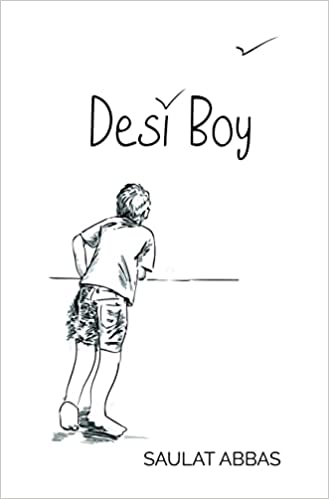
Saulat Abbas’s memoir: An authentic journey of a life from a UP village to Europe and Saudi Arabia

Bulandshahr, UTTAR PRADESH / SAUDI ARABIA :

Abbas said he wrote the memoir to enable his children to know their father better.

Saulat Abbas.

In a letter to his friend Thomas Poole, Coleridge wrote that any life, however insignificant, would if truthfully told, be of interest. There are two important points in Coleridge’s observation. One, that it is not important whether the subject of a memoir, biography or autobiography has lived a very eventful life and achieved great success, as any life can be a good enough subject for a book. Two, truthfulness in reporting events of life is an essential feature of a book chronicling a life. And because a memoir lies somewhere between history and literature, the element of selection, omission, foregrounding, and downplaying of events of life can all be part of a memoir.

An ordinary life

Saulat Abbas’s memoir Desi Boy starts with his modest admission about his ordinariness. He states that his purpose in writing his memoir is to let his children know him if ever they decide to know about their father. “Given all the uncertainties of life, if god decides to take me away before my kids are mature enough to care about who their father is, this book, I believe, will satisfy their curiosity.” While Abbas, whose two marriages did not last long, lives in Saudi Arabia alone, alternating between the gulf countries and his motherland India, his teen-aged son lives in Taiwan with his mother, and his daughter in Malaysia with her mother.

Abbas’s truthfulness in reporting various events of his childhood, adolescence and youth, some even projecting him in a very bad light if seen from some established ethical principles, is the most important feature of his memoir. It certainly must have been an important decision for him to decide which incidents should or should not be included in his memoir. Thus indoctrinated to believe that the punishment for theft is chopping off hands, he almost chopped off the hand of Khajya, his young playmate, with an axe for stealing marbles, injuring him badly enough to leave a cut on his hand.

There is certainly interesting material in his ordinary life: a Muslim boy living in an eastern UP village in a patriarchal set-up struggling with his education; his family moving to western UP town of Bulandshahr where his anglophile father taught English in a postgraduate college; his student days at Aligarh Muslim University; his dreams and his aimlessness finally taking him to Saudi Arabia and Europe where he feels that he has made it. More than the external events, it is his intellectual and spiritual development and his struggle with some ethical principles that make the book eminently readable.

Undoubtedly the most authentic portion of the book is his account of his early childhood in his mother’s village where he was exposed to village superstitions, rural-agricultural practices, Tom Sawyer-like antics of stealing hens and the rigidity of caste structure where, contrary to their religion, Muslim landowners maintained caste hierarchy very ruthlessly. The author narrates how he and his cousins caused a big scandal in his family when they attended a Dalit wedding to watch a nautanki. “As far as I can remember, perhaps, it was the first time that the Sayeds were going to attend a Dalit marriage ceremony, and all because of the fun of the nautanki.” The punishment for this transgression from the elders in the family was fierce: “we could not sit after the caning.”

The villagers believed in black magic, witchcraft and often consulted a mulla, rather than a doctor, when taken ill. Formal education in this set-up was a rarity, often available in a madrasa, and was the prerogative of landowners’ sons as the poor villagers were kept away from learning. “If they became literate, who would do the farming?,” Abbas wryly asks. Writing was done on a wooden board, a takhti, which needed the application of a film of fine clay called multani mitti. For the author the whole process of preparing his wooden board for writing and making reed pens with a sharp tip “was more interesting than writing or learning so we did it as slowly as possible,” till his teacher lost his temper.

Life in the village

Many characters in his account of village life stick in memory. The foul-mouthed, amoral, “ever-giggly-jiggly” Okida, who gives many “arse-spreading ideas” to the author, is also a woman full of practical wisdom. Harcharan, a farm worker in his sixties, not only narrates tales of his sexual exploits, he also gave the author lessons in little thefts like stealing milk right from “the cows’ udders.” The lower caste, good looking Sudhua, who was probably fathered by a zamindar for whom his mother worked, taught him lessons in farming and agriculture as also in the exploitative and unjust social order in his village.

“If any member of Sudhua’s community ever combed his hair or wore sandals or slippers, he would be castigated. In physical care and style they were not supposed to “emulate’ the zamindar.” Shammu Khan, the private tutor known for his strictness, also taught the author lessons in morality and power structure in the family. Granny Iqfa who came from Calcutta not only has many tales behind her but her writing of poems in Urdu and Persian when women hardly had any education, makes her even more interesting.

The break in his idyllic existence and a brief experience of uprootedness informs his description of his life in Bulandshahr, where his family moves. Up to his High School days, he describes, how his lack of interest in studies and attending school made him one of the slowest learners in his class. His teachers had unshaken belief in corporal punishment which he learnt the hard way and his classmates smelled of curry, putting him off from studies further. “In my mind, school had become synonymous with the Nazi concentration camps…teachers looked like demons.” The ruins of houses left behind by people who migrated to Pakistan after the partition became his hideouts where he would spend time with city urchins, learning bad language, playing marbles and smoking bidi. He also specialised in committing petty thefts with friends to finance his passionate love for Hindi films.

An important part of his growing-up years in the college premises where his father worked was his mingling with his Hindu neighbours. Religion was never an issue in his friendships, rather “we learned about one another’s faith, and learned stories that were at the foundation of our religious beliefs.”

One particular incident about hierarchical system of education stands out. As he became more serious about his career, he thought of exploring the possibility of getting admission in St Stephen’s College, New Delhi. However, so mesmerised and scared was he to see the dress, language and confidence of students and staff in the College, that he could not even gather courage to even talk to anyone in the College: “I returned to the bus station, got back home, and never told anyone how heroically the villager was defeated on his first trip to a real city.”

There are a plenty of interesting, funny, and humorous situations in the book which are enlivened by the author’s self-deprecating humour. Thus in watching Hindi films he and his friends felt aroused by Helen, Aruna Irani, or Jayshree, but “respected our heroines…and never cast a lascivious look at them. We thought our heroes had exclusive rights on those women.” He relates how his father’s application for a job in a university in Saudi Arabia and his own application for admission to a course were mixed up by the person handling them in Saudi Arabia because he had learnt to copy his father’s handwriting perfectly. When his father received a letter that he could not get admission to the said course he did not know “that his job prospects in Saudi Arabia were screwed up by his brilliant son.”

There appears a little bit of drama in the narrative when a boy from a lower-class family in his village who had left for Lucknow and later Bombay comes back to his village in style after making it big. It turns out that Rasheed, who made people believe that he was part of the author’s family, to gain respectability and social status, was an underworld don on the run, and the author’s house was the safest place to hide. Obviously the elders in his family had to do a lot of explaining to the police officers who followed Rasheed in the village.

Reproduction of village life, especially some rural Hindi slangs and swear words entailed problems of their translation in English. He uses expressions like “arse spreading remedy” to translate a familiar swear word in Hindi. The author’s wit makes the book very readable. The common practice in his village of keeping the heads of children shaved meant that “five or six little neo-Nazis of similar age, size, and shape often roamed the orchard. Abbas’s style of writing includes allusions to many literary works, often reflecting his study of English literature. Thus nights are dark “like Iago”, and a deserted house, called Chhaouni in the village, reminds him of the atmosphere in The Duchess of Malfi and The Fall of the House of Usher. His uses similes very liberally all through his texts, many of them are very original.

Memory has a very important role in a memoir. It can sometimes play tricks and at other times it can be put to selective uses. The author does not always mention dates or years in reporting many incidents of his life. An aware Indian reader can draw an inference about the time of the incidents but for others the author leaves a lot of work to do. Thus if the author saw Sholay 25 times, one can make out that he is talking about the year 1975. It would also have helped if he had used the names of schools he attended. His account of Aligarh Muslim University could have been longer. The elaborate rituals attending a death in the family and various forms of the expression of griefs are rites of passage for him. However, the description of Moharram, its significance in his formative years and description of many events in Islamic history take something away from the main narrative of the memoir.

All through the memoir the narrator uses a royal “we” to narrate events and experiences which, since it is a plural subject, sometimes feels awkward in the narrative, that is, “We brought a two-page long essay back to my father. He made millions of corrections and trimmed it well, and we memorised it by writing it many times to make sure we were not going to make a mistake on our exam.” In the same way the author uses a common Indianism “beef” to refer to buffalo meat, which in the present context is a very problematic expression. It should have been replaced either by buff or simply buffalo meat, the common Hindi expression for which is “bade ka ghosht.”

In all, Desi Boy is truly an authentic and interesting account of a life because it is truthfully rendered by Saulat Abbas.

Desi Boy, Saulat Abbas, StoryMirror.

source: http://www.scroll.in / Scroll.in / Home> Book Review / by Mohammad Asim Siddiqui / December 10th, 2022

Billionaires in Africa, Maha tycoons follow father, feed thousands in hometown

Yavatmal , MAHARASHTRA / CONGO (formerly Zaire) :

Billionaires in Africa, Maha tycoons follow father, feed thousands in hometown

Yavatmal :

Decades ago, a humble Maharashtra State Road Transport Corporation (MSRTC) district driver Abdul Narsinghani had a strange habit before going off to work.

Every morning he would instruct his wife Fatima to pack a few ‘rotis’, he put them in his pocket and at various stops of his ST bus en route, would distribute them among a few poor people he encountered.

His young kids — sons Aman, Aslam and daughter Farida — closely watched all this but often wondered at their father’s undue concern for others when they themselves eked out a bare existence in a 200 square feet slum tenement in Yavatmal.

Years later, Aman, 45, and Aslam, 43 are successful business magnates in Congo, (formerly Zaire), Africa, and Farida I. Budhwani is a housewife in Mumbai, but now they warmly cherish their simple father’s small acts of charity for fellow beings.

“We brothers completed our high secondary school (Class XII) and got jobs in Uganda, so we went there in 1998. In just three years (2000), we got an offer to start a pharmaceutical business in the adjoining country, Congo, and we grabbed the opportunity,” Aman told IANS.

That was the turning point for the Narsinghani brothers, and they became the first Indians to start a business in Congo, and their venture is named Sara Pharmaceuticals.

“Many Africans have a fetish to pop in medicines for everything… We imported various types of medicines from India or China and then sold them there… Slowly, that tiny business has grown into a pharma-cum-electronics empire with a turnover of over Rs 1,200 crore per annum,” said Aman.

On their frequent trips back home from Africa, they never forgot their father’s daily habit of donating ‘rotis’ or his wise advice – ‘Let nobody go empty handed from my door’ – and decided to do something to take it forward.

“From 2009, we have launched a community kitchen that feeds around 750 people for lunch and some 250 for dinner daily… 98 per cent of the beneficiaries are the local poor people, irrespective of religion or status, all are equally welcome…” said Aman.

The daily offering through ‘Khidmat-E-Khalk’ (Selfless Service) is either good quality rice-vegetables, lip-smacking vegetable or chicken biryanis and other foodstuff as the people may desire, and distributed at a couple of locations in Yavatmal, 365 days a year.

It was during the Covid-19 pandemic (2020-2021) lockdown that the small kitchen proved its true worth and utility for lakhs of deprived people, especially the migrant folks stranded far from home.

“In the first six months of the stringent lockdown, we fed over 1.50 crore people. We also distributed food-kits of around 25 kg rations worth Rs 2 crore to the helpless people who had lost their jobs,” said Aslam.

After the lockdown eased a bit from October 2020 onwards, the Narsinghani brothers shifted their attention to the local Shri Vasantrao Naik Government Medical College & Hospital, where they served free food to all the patients for over one year.

As the pharma business of the siblings flourished in Central Africa, the duo also progressed, upgrading from their humble 200-sq.ft. slum abode to a palatial 10,000 sq.ft mansion in Yavatmal, where they rank among the most esteemed citizens.

The devout Khoja Muslim, Abdul Narsinghani, who gave his children an invaluable lesson to care for fellow humans, witnessed everything with joy and pride. He passed away peacefully in 2015, while his widow Fatima, 71, continues to guide and support her two sons in all their ventures.

Doing business in Africa is not everybody’s cup tea, given the political turmoil in many countries there, plus the social, cultural and language barriers, but the Narsinghani brothers managed to learn Swahili in just a couple of years and were accepted with open arms in Uganda, Congo and other countries in Central African region.

“Though we have seen a lot of social-cultural-political upheavals there in the past 25 years, but luckily, the Indian community there does not face problems from any quarter and we are probably treated as ‘more than equals’ among the rest,” Aman smiled.

The pharma business has gradually expanded within Africa, and lately the duo diversified into electronics trading which is picking up hugely through their several retail outlets.

“The Almighty has been magnanimous and benevolent to us and coupled with what our parents bequeathed us, we are trying in our own little way, to repay all the blessings,” acknowledge the Narsinghanis. — IANS

source: http://www.muslimmirror.com / Muslim Mirror / Home> Culture> Indian Muslims / by IANS / December 04th, 2022

Mechanical Engineering Alumni of Iowa State University, Najeeb Kuzhiyil publishes novel: ‘Spirit of Engineering’

Kochi, KERALA / Texas, USA :

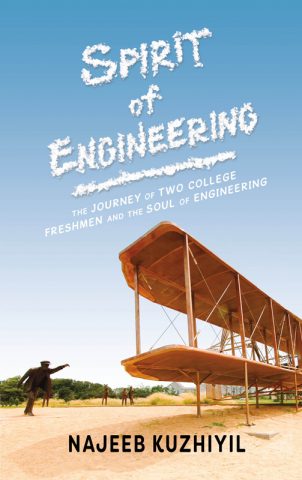
Spirit of Engineering, published by ME alum Najeeb Kuzhiyil in December 2017, tells the story of two freshman college students and their journey to discover what engineering is. Image courtesy of Najeeb Kuzhiyil

A novel penned by a mechanical engineering alum tells the story of two freshmen college students and their journey to discover what engineering is.

Najeeb Kuzhiyil, who graduated with a PhD in ME in 2013, recently published his first novel: Spirit of Engineering: The Journey of Two College Freshmen and the Soul of Engineering. The idea to write the book, which was published in December 2017, first came to Kuzhiyil while he was a student at Iowa State.

“So I thought before you begin your undergrad studies, you should understand what engineering is in simple terms,” said Kuzhiyil. “I really wanted to write a book that was simple enough for high school students.”

The book took about a year and a half to write and started out as separate essays covering four pillars of engineering: methodical approach, practical skills, abstraction, and creativity.

“One morning I was lying in my bed and I thought why don’t I tell this as a story. I can include all of these concepts and wind them into a nice plot,” Kuzhiyil said.

The target audience for the book is high school students or perhaps even freshmen in college. The plot is set in modern times and follows around two main characters who are both first year engineering students at an unnamed Midwestern college: Matt from northern Iowa and Maya from India.

Matt and Maya come across a presentation about the Wright Brothers which piques their interest to the point that they decide to travel to the Wright Brothers museum in Dayton, Ohio in an attempt to better understand what engineering really is. During their travels they meet an experienced, middle-aged engineer who helps them understand how math, physics, and other natural phenomena apply to engineering.

Kuzhiyil said that his PhD advisor Robert C Brown, Anson Marston Distinguished Professor in Engineering, was a major influence on him personally and with his writing style specifically.

“He’s a wonderful engineer and he’s a great writer because we as engineers aren’t always great writers,” said Kuzhiyil. “Before coming to Iowa State I never paid attention to my English but Dr. Brown told us ‘You might be great engineers but you also have to learn how to write well. It’s very important to be able to express your ideas.’”

Brown, who also serves as director of the Bioeconomy Institute at Iowa State, wrote the foreword of the book. He said he thinks the book can be helpful for the next generation of engineers.

“I would have benefited from this book when I was in high school, at the time having no clear idea of the engineering profession. Even today despite the emphasis on STEM education, engineers are rarely portrayed in popular culture except for the occasional less than flattering role of bumbling technocrat. Najeeb’s book helps to overcome this stereotype,” Brown said.

Kuzhiyil cited Brown, whose research focuses on biorenewable resources, as a major reason why he chose Iowa State to pursue his PhD. Kuzhiyil is originally from the state of Kerala in southern India. He attended school in the city of Kochi and began developing an interest in chemical engineering in high school. He attributed his interest in engineering to his older brother, Dr. Abdul Kader, who studied chemistry and worked at a fertilizer manufacturing company.

“I didn’t know anything about chemical engineering, but as a kid I thought it would be cool to learn about it,” he said, adding there was a large petroleum refinery close to home that always fascinated him.

Kuzhiyil graduated with a bachelor of technology in chemical engineering from the University of Calicut and went on to work as a tech service engineer for Indian Oil Corporation.

After a decade in industry, Kuzhiyil decided to pursue an advanced degree. In graduate school his interest shifted from chemical engineering to renewable energy. He graduated with a MS in Combustion and Energy from the University of Leeds in England in 2005.

Kuzhiyil came to Iowa State in 2008 and was involved in various groups outside of his engineering studies, including serving as president of the Indian Students Association from 2009 to 2010. Despite spending just three years in Ames, Kuzhiyil said he made friends and memories that will last a lifetime.

“There were so many moments I really enjoyed at Iowa State,” said Kuzhiyil. “Our research group was so big we had people from all over the world. We had people from India, China, Europe, Africa, from all over and we had discussions on science, on politics, on life, on love, on everything. They were all great for me because different viewpoints and perspectives on different things were really insightful. I really had a blast and enjoyed every moment of my PhD.”

Kuzhiyil added that he loved the beauty of Iowa State’s campus, especially during the spring bloom, and that he enjoyed participating in the International Food Festival during the annual VEISHEA celebration.

After completing his PhD, he worked as a fuels and lubricants technologist at General Electric for six years. In November 2017, he was hired as a staff engineer in synthetic lubricants at ExxonMobil Corporation. His current work focuses on engine oils and gear oils and how it relates to fuel economy.

“By using synthetic lubricants we can improve fuel and the energy efficiency. Synthetics are more of a move toward a sustainable future,” Kuzhiyil said, adding that the job has been a nice marriage between his interests in chemical engineering and renewable energy.

During his career, Kuzhiyil has studied or worked on three different continents. He said that these diverse experiences have contributed to his professional development and have been helpful when approaching challenges.

“In engineering most of the problems we deal with are open-ended. There’s no single answer to many of the problems. You can design things in different ways so the engineer’s job is to design a product or a process or whatever, within the constraints of resources, environment, culture and weather. All of those factors play into the engineering,” said Kuzhiyil.

“Because I come from India, and I lived in Europe and the U.S., all of these places are different if you look at the available resources, the weather, the philosophy, etcetera. I really got a lot of examples of how the same product can be different on these three different continents and I think that’s been helpful in getting me to where I am today.”

source: http://www.news.engineering.iastate.edu / Iowa State University, College of Engineering / by Nick Fetty (headline edited) / April 02nd, 2018

GMU: The biggest success story in private health education space marks completion of 24 years

Mangaluru, KARNATAKA /Ajman, U.A.E :

Ajman :

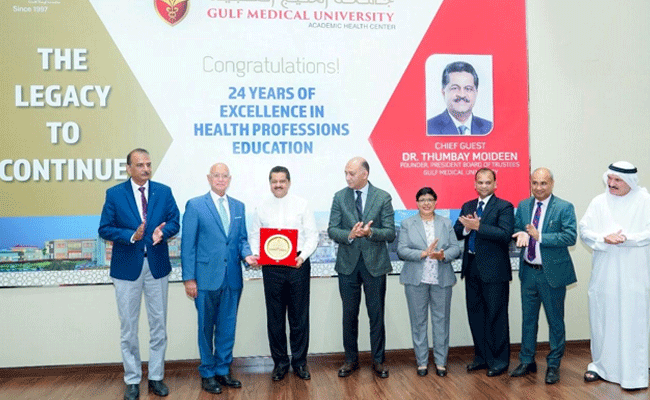
Gulf Medical University (GMU), Ajman, the biggest private medical university in the Middle East region celebrated its 24th anniversary, with a special ceremony attended by Dr. Thumbay Moideen – Founder, President Board of Trustees GMU, Prof. Hossam Hamdy – Chancellor of GMU, Mr. Akbar Moideen Thumbay – Vice President of the Healthcare Division of Thumbay Group, and Deans of the colleges of the University as well as other staff and students.

The celebration was an occasion to reflect GMU’s achievements till date, at the same time reaffirming its commitment to foster continued evolution of Gulf Medical University as an international powerhouse of health professions education, research and innovation.

Highlighting the evolution and development of the Gulf Medical University in terms of buildings, staff, students and scientific and educational degrees, Dr. Thumbay Moideen said, “From humble beginnings as the region’s first private medical University, today GMU is a testament of along and distinguished success story of being the region’s only private Academic Health System- delivering futuristic medical education at the same time playing an important role in providing state-of-the-art healthcare and promoting innovative research.

Our progress over the last 24 years has been driven by the dedication of our staff, students and partners, in addition to GMU’s philosophy of constant innovation and above all, the Grace of the Almighty. We have also received excellent support from the government throughout this journey. 

Prof. Hossam Hamdy said that GMU has developed a unique model in the form of the Gulf Medical University Academic Health System, showcasing on a global front that the future of medical education is ‘systems’ linking education, healthcare and research. “The shared philosophies of the six colleges under Gulf Medical University, its teaching hospital and the passion for supporting all-round excellence has helped in making many distinctive contributions to the overall community over the last two decades. In addition, our response to the COVID-19 pandemic has demonstrated the great value of our academic community and the strengths of our basic, convergent and translational science.”

Recently, the ‘Academic Team’ at Gulf Medical University unveiled a long-term strategic growth plan of doubling its capacity in the next three to four years, aligning to future requirements and strategic direction of education policies laid down by the United Arab Emirates and thereby creating an Emirati healthcare workforce to serve the region

Gulf Medical University and Thumbay network of academic hospitals daycare, Labs, Pharmacies and clinics together train around 20 percent of the doctors and approximately 60 percent of the healthcare professionals in the country, creating a significant impact on the healthcare sector of the country and the region.

Moreover, students benefit with adequate opportunities to showcase their achievements through student activities, Interprofessional skills, sporting and cultural events that train them to be multi-disciplinary experts.

Other benefits provided to the students include: Clinical training sites of unmatched quality at 8 hospitals, 10 clinics, 5 labs and 48 pharmacies and a total of 700 beds; tie-ups with other local entities as clinical training sites with over 400 qualified faculty, doctors and adjunct faculty who provide one-on-one clinical training to students and quality care to the patients of UAE; access to technological platforms and an outstanding infrastructure for research on imaging, functional genomics, sequencing with NGS facility. 

In terms of advancing healthcare in the UAE and globally, GMU has launched the establishment of the first liquid biopsy facility in the region, the zebra fish and a platform for drug discovery and development. This has led to achieving its position as a leader in research in medical education in UAE and the entire region with 70% of all papers published in medical education in the UAE coming from GMU. 

Since its inception, around 2000 students have graduated from GMU, advancing their career and securing successful positions including CEOs, COOs, Medical Directors and Heads of Departments in the healthcare and research across the Middle East, Africa, South Asia, Europe, North America and Australia.

Moreover, the university’s academic and research tie-ups with over 70 international universities and research institutions has ensured global recognition and employability for GMU graduates.

To name a few, GMU’s collaboration with International Federation of Red Cross and Red Crescent Societies (IFRC) has led to humanitarian learning in healthcare to create a model youth force in the country that will be equipped with all the basic skills and knowledge to fight any emergency crisis as per international standards.

Likewise, the ‘Future Scientist program’ has been an innovative educational enrichment internship program for Male/ Female Emirati talent who are motivated to nurture their interest in biomedical and drug discovery research. The program helps in preparing them for an exciting career as research scientists.

Recently, GMU has also achieved international accreditation by the Quality Assurance Agency (QAA)-the agency responsible for accrediting higher education institutions in the UK utilizing european standards and guidelines for Quality assurance.

Besides, Gulf Medical University has won several global recognitions such as Forbes, Dubai Quality Award, QS Awards, QS Reimagine WRC Leaders and Ranking from QS University Rankings, Times Higher Education, placing placed the university among top health professions education institutions in the region and globally.

source: http://ww.english.varthabharati.in / Vartha Bharati / Home / by press release / November 21st, 2022

Successful Event Jashn-e-Noor Amrohvi celebrated to honor Dr. Noor Amrohvi for the first time in history in the Parliament of London

INDIA / Dallas, Texas , U.S.A:

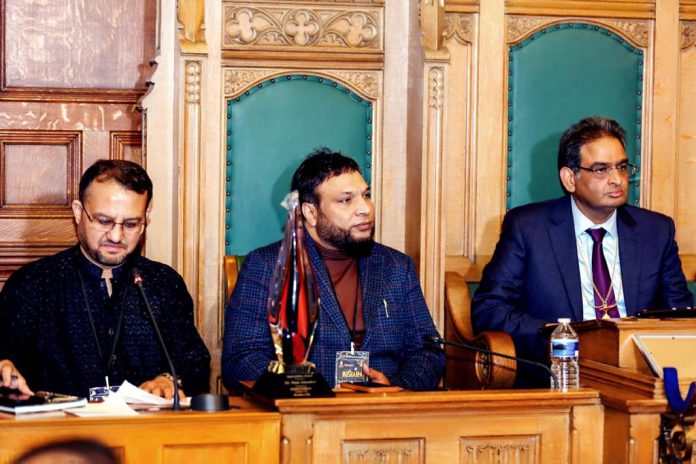
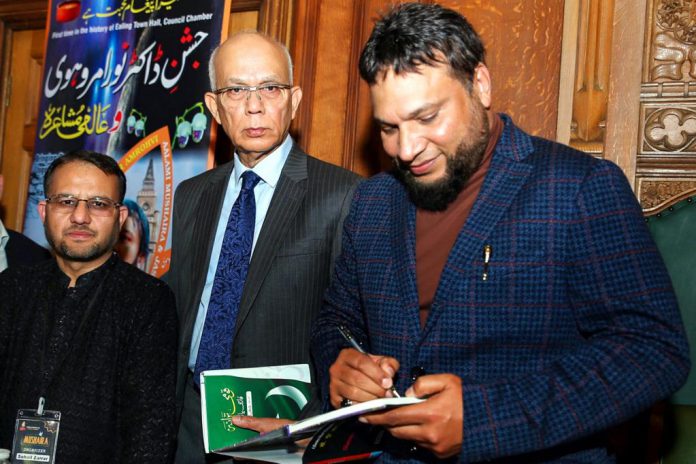
The evening of 4th November 2022 became immortal for the lovers of Urdu and Dr. Noor Amrohvi. For the first time in British history, the first ever international conference and celebration of Dr. Noor Amrohvi regarding Urdu was held at the prestigious, magnificent, and historic Ealing Town Hall in London.

Ealing Town Hall was inaugurated on 15 December 1888 by the then Prince of Wales Edward. It was Prince Edward who went on to be called King Edward VII.

For the first time in this historic town hall, hosted and chaired by the Honorable Munir Ahmed, Mayor of Ealing London, fans of Shama Urdu gathered here from all over the world

For the first time in this historic town hall, hosted and chaired by the Honorable Munir Ahmed, Mayor of Ealing London, fans of Shama Urdu gathered here from all over the world.

The mayors, councillors, literary and social journalist personalities of different boroughs of London as well as precious personalities who love Urdu participated in this celebration.

Professor Aqeel Danish, patron of Bazm-e-Sukhan Britain, thanked the guests and explained the history and achievements of Bazm-e-Sukhan, and the Mayor of Ealing London, Muneer Ahmed gave the welcome speech, while Ehsan Shahid, the leader of Bazm-e-Sukhan, recited his poems for the participants. Welcoming the guests who came to join the celebration.

Dr Noor Giving Autograph

Ms. Shazia Khan, General Secretary of Al Noor International and founder of Stardom, came specially from America, highlighted Dr. Noor Amrohvi’s services to Urdu literature and his community. Dr. Shamsa Qureshi, the managing director of Al-Noor International and a well-known poet, could not come from America, but she expressed her good wishes over the phone from there and said that this honor can only be given to Dr. Noor Amrohvi. He is the most celebrated person for whom we Americans are proud.

Dr. Gabriela, a special representative of the Romanian Embassy and a literary figure, also participated in this speech ceremony for the first time and expressed his views.

Dr. Noor Amrohvi was awarded a certificate by the Mayor of Ealing London for his social and literary services and an award from Bizm-e-Sukhan Great Britain and it was acknowledged that the name of Dr. Noor Amrohvi is also London. It will also be written in golden letters in the literary history that he became the first representative of Urdu who took Urdu and his culture to such a high position and reached the London Parliament which was unimaginable. That’s why he was welcomed not only by all the audience, but also by all the assembly workers and mayors, and a standing ovation was given to Dr. Noor Amrohvi.

Chief organizer Mr Sohail Zarrar- Dr Noor Amrohvi

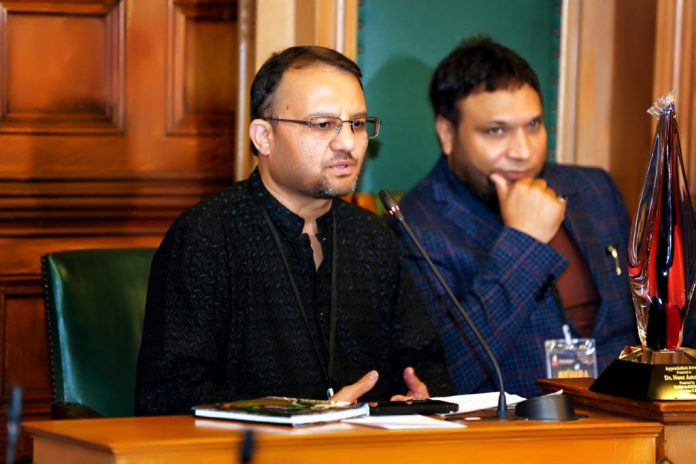
The program was moderated by Sohail Zarar Khalish, a spirited person from Great Britain. And thanked all the friends for organizing this wonderful event

The great poets of the Urdu world Syed Salman Geelani, Qaiser Wajdi, Aftab Alam Qureshi, Irfana Amar Ambrin Qureshi and Syed Shan Kanpuri captivated the hearts of the participants with their words.

In the end, the celebrant Dr. Noor Amrohvi took the seat and thanked Bazm for organizing the event. He said that Muneer Ahmed Sahib and Bazm-e-Sukhan may have made history today, after that there may be thousands of mushairas here, but whenever there is an event related to Urdu, this mushaira will always be remembered as the first mushaira. He will always be remembered.

Standing ovation to Dr Noor Amrohvi

Dr. Noor Amrohvi lit up the gathering with his wonderful words and beautiful speech and won the hearts of Londoners. A sumptuous dinner was given at the end of this long-remembered event.

source: http://www.millattimes.com / Millat Times / Home> World / by Millat Times Staff / November 13th, 2022

UAE: Meet the Guinness record-holding Indian father-daughter duo at Sharjah book fair

Kozhikode, KERALA / Dubai, UAE:

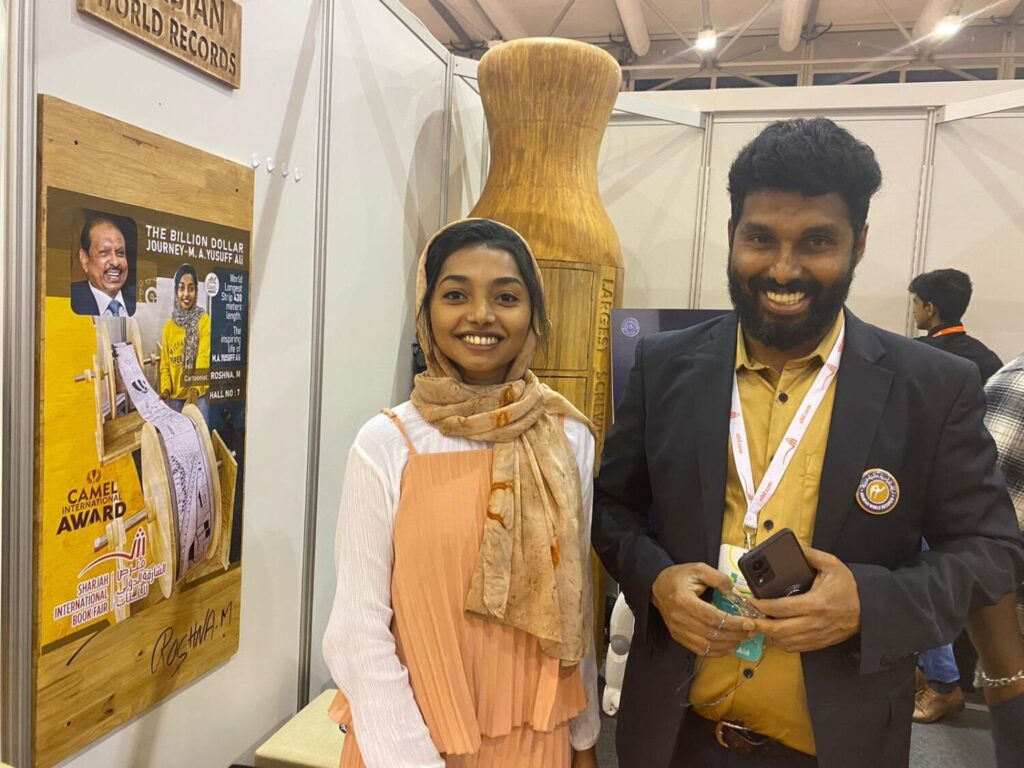
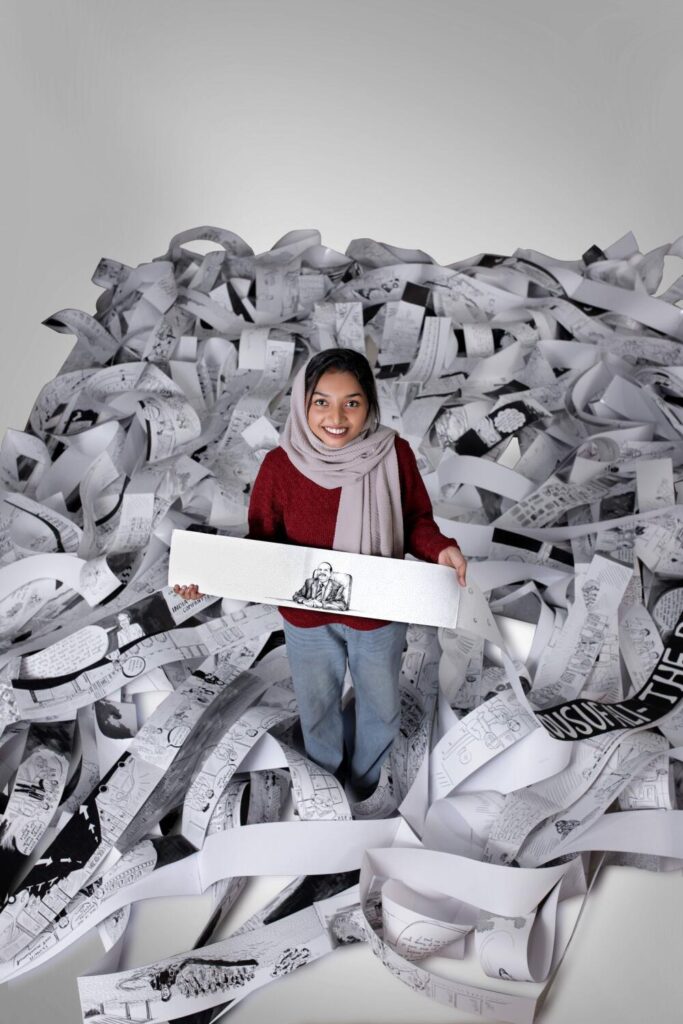
20-year-old Roshna created the longest cartoon strip measuring 430m, titled ‘The Billion Dollar Journey’ honouring businessman MA Yusuff Ali

Father and daughter duo M Dileef and Roshna M. Photo: Nasreen Abdulla

The ongoing Sharjah International Book Fair (SIBF) houses two record-breaking installations — tucked away in Hall 7, the world’s largest screwdriver is displayed and right next to it is the world’s longest cartoon strip depicting the inspirational story of UAE-based businessman MA Yusuff Ali.

Both of these Guinness world record-holding creations have been made by Indian expat father-daughter duo M Dileef and Roshna M. “It feels great to be exhibiting here,” said 20-year-old Roshna, who broke her own record for the longest cartoon strip established in 2021 with her latest creation. Measuring 430m, the new strip titled ‘The Billion Dollar Journey’ is stretched across two wheels and can be read by rotating the hand.

On Sunday, the illustrious Indian businessman from Kerala, MA Yusuff Ali, visited the stall and commended Roshan’s efforts.

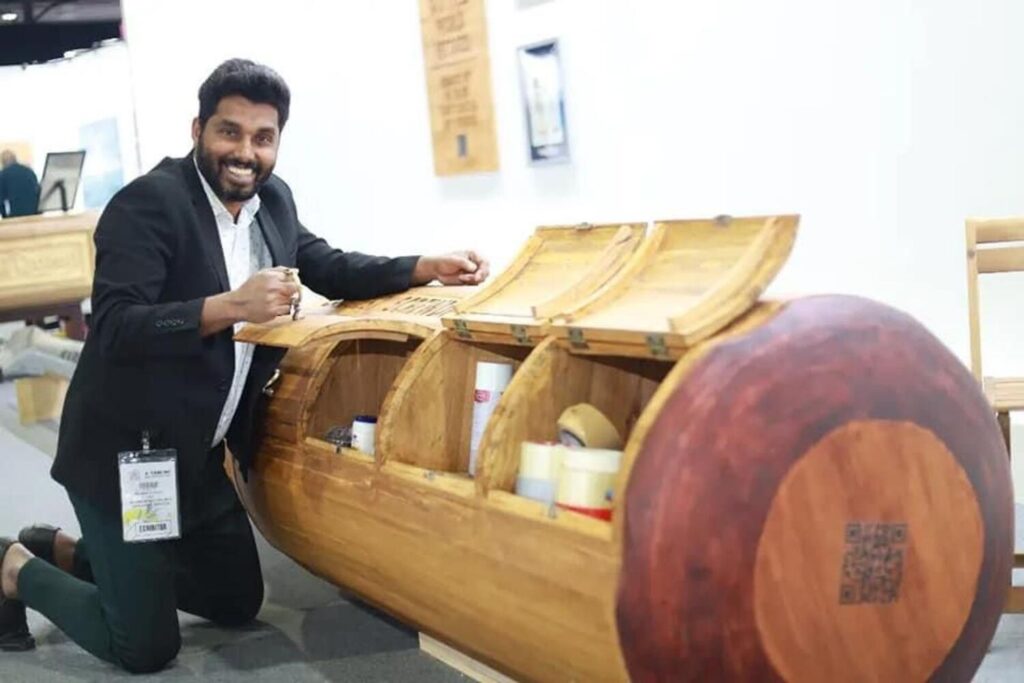
Roshna’s father, M Dileef, a seasoned record-setter, said this is his third Guinness World Record. “Due to space constraints, I could only put the head of the screwdriver on display,” he said. Completed in March, the tool measures a whooping 6.6m in length. The artist was recently granted a Golden Visa in the UAE.

The longest cartoon strip

The cartoon strip charts the journey of businessman MA Yusuff Ali, from his childhood in a village in Kerala to his meteoric rise as one of the most influential businessmen in the world.

“I have always looked up to him,” she said. “I want to be an entrepreneur; he is my role model, so I wanted to make something to honour him.”

It was in 2021 that Roshna set her first world record with a cartoon strip measuring 404 metres in collaboration with Global Village. This year, she has broken that record. According to the youngster, who recently graduated with a bachelor’s in fine arts, making this strip took her 8 months, five months of which was just for research.

“I had a team of six classmates,” she said. “We had decided that we wanted to do something to make our mark, and this is the idea we came up with. They helped me in the entire research process and aided me when drawing the cartoon strip as well.”

The graduate now dreams of pursuing a master’s degree in Europe and hopes to raise funds for her education with her artwork.

Largest screwdriver

The masterpiece by Dileef was first displayed at World Art Dubai in March of this year. “I wanted to pay tribute to the working-class population in the city,” he said. “No other country has honoured and valued the contribution of the working class like the UAE has. So many lives were transformed because of Dubai. This piece was a homage to that.”

Made out of mahagony wood and mild steel, the screwdriver was constructed in Dubai. The handle, which has a diameter of 70cm, also has storage space for knickknacks.

Dileef has earlier set two world records- one for curating the world’s longest Quran and another for the largest badminton racket.

www.dileefartgallery.com

source: http://www.khaleejtimes.com / Khaleej Times / Home> UAE / by Nasreen Abdulla / November 06th, 2022

23-yr-old Indian American Muslim woman wins US mid-term elections

INDIA / U.S.A. :

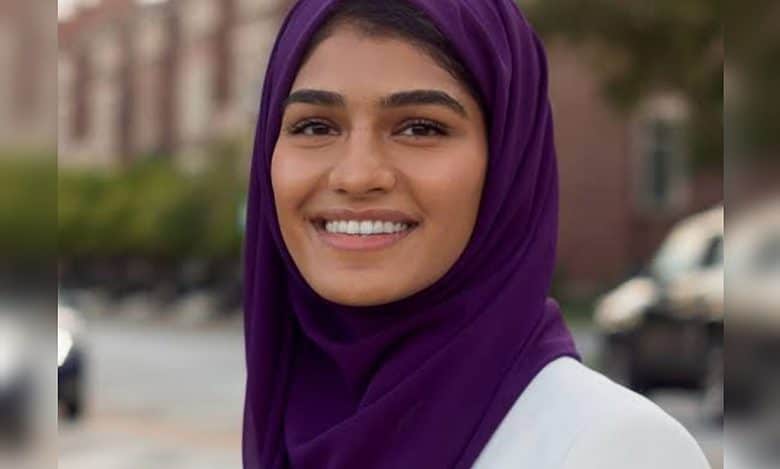
“My name is Nabeela Syed. I’m a 23-year old Muslim, Indian-American woman. We just flipped a Republican-held suburban district,” she tweeted.

 Nabeela Syed (Photo: Instagram)

A 23-year-old Indian-American Muslim woman Nabeela Syed, the candidate of the Democratic Party, has won a significant victory in the United States (US) mid-term elections.

Nabeela has written history as the youngest representative to have won the election for the 51st House district of the Illinois state legislature in US.

On Wednesday, Nabeela took to Twitter and shared her happiness of being elected to the General Assembly as a representative of the Democratic party.

“My name is Nabeela Syed. I’m a 23-year old Muslim, Indian-American woman. We just flipped a Republican-held suburban district,” she tweeted.

She further wrote, I will be the youngest member of the Illinois General Assembly.

Nabeela took to Instagram and wrote, “When I announced for State Representative, I made it a mission to genuinely engage in conversation with people – to give them a reason to get involved in our democracy and hope for better leadership that represents their values. We won this race because we engaged in that conversation.”

“We talked to seniors about the rising cost of prescription drugs. We talked to working families about the growing burden of property taxes. We talked to women, pledging that I would protect their right to reproductive healthcare. We spoke with parents about their desire to strengthen commonsense gun safety laws,” she adds.

Nabeela continues, “We won this race because the people of the 51st District want a representative who is ready to fight for them and their families.”

“I knocked every door in this district. Tomorrow, I start knocking them again to thank them for placing their trust in me. I’m ready to get to work,” she added.

In June 2022, Nabeela Syed had won the Democratic primary and has now flipped a Republican district against incumbent Chris Bos.

Syed, who becomes the first South Asian in the Illinois state legislature, will also be the youngest member of the state assembly.

Born and raised in Illinois, Nabeela Syed graduated from the University of California with a degree in Political Science.

In her election manifesto, Nabeela Syed has promised to consider and address public issues such as equal rights, health care, education and taxation.

According to her website, Syed is running “to build a better Illinois for residents today and tomorrow – an Illinois with a strong economy, sustainable infrastructure, and affordable healthcare, and higher education.”

Syed currently works for a non-profit, helping them in digital strategy and supporting a myriad of civic engagement initiatives, for example, mobilising voters, curbing sexual assault on college campuses, and enhancing gender equity, according to her official website.

Having graduated from the University of California, Berkeley, with a degree in Political Science and Business, she served as the president of a pro-bono consulting organisation that helped local businesses.

Syed is active in her religious community at the Islamic Society of Northwest Suburbs and advocates interfaith dialogue and aims to empower young Muslim women to lead.

source: http://www.siasat.com / The Siasat Daily / Home> News> India / by Sakina Fatima / November 10th, 2022

How Andhra boy athlete won one million riyals, gold medal in first Saudi Games

Nellore, ANDHRA PRADESH / Kozhikode, KERALA / SAUDI ARABIA:

Mehad performed Umrah along with his parents immediately after winning the Gold Medal.

 Mohammed Mehad Shah

Jeddah: 

The juvenile Andhra badminton player made a strong impact at the ongoing Saudi Games, the prestigious national games of oil rich Saudi Arabia known for its passion for football.

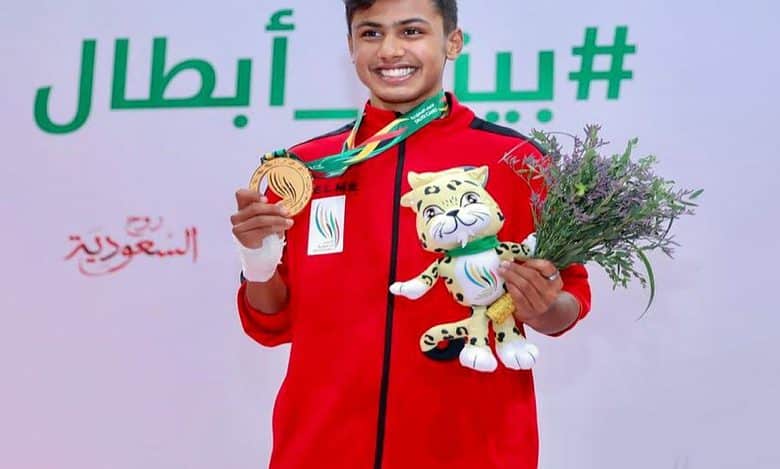
Mohammed Mehad Shah, a native of Nellore in Andhra Pradesh has won a gold medal and one million Riyals in the men’s single category in badminton competition as part of the first edition of the Saudi Games, the largest national sports event of its kind, took place on Friday at King Fahd Stadium in Riyadh in the presence of Prince Faisal bin Bandar bin Abdulaziz, Governor of the Riyadh region, as well as the Saudi public in a grand ceremony filled with lights, fire, and music.

Mehad Sha along with other winners were honored by Prince Fahd bin Jalawi bin Abdulaziz bin Musaed, vice president of the Saudi Olympic Committee and director of the Saudi Games. He was also greeted by Muqrin Al-Muqrin, chairman of the Saudi Badminton Federation, and Mai Obaid Al-Rasheed, vice president of the Saudi Badminton Federation.

Participants competing for a grand total of more than SR200 million: Gold-medal winners to receive SR1 million, and silver-medal winners awarded SR300,000 and SR100,000 respectively. This is the highest prize money dedicated to the sports sector in the history of the region.

The 17-years old native of Nellore district in Andhra Pradesh, who was born and brought up in Riyadh and a student of 11th class at New Middle East International School, has told this correspondent that his aim is to win medals for Saudi Arabia in Olympics and other international tournaments.

Mehad Shah said that the coaching which he takes at Gopichand Badminton Academy in Hyderabad is helpful to achieve success. Gopichand is known as Dronacharya of Indian Badminton. He also expressed his gratitude towards his school principal and PT and Tah, Ralf –both Philippine nationals- coaches who trained him.

Excited Mehad who performed Umrah along with his parents immediately after winning the Gold Medal also thanked his school sports director and trainers.

“When I was receiving the gold medal from Prince Fahd, I remember the days when I was struggling to find a partner to play with me in the badminton court”, he said.

He has been playing the game from 5th standard and his elder brother Faisal Sha also used to play the sport in Riyadh. Faisal is now pursuing medicine in India. Mehad’s sister Khateeja is also studying medicine back home in India. Mehad Sha’s parents, Shahid and Shakera Begum both are engineers.

Muzzamil Shaikh, coordinator of APNRT, AP state government body to look after NRI affairs in Saudi Arabia and noted social worker, has congratulated Mehad.

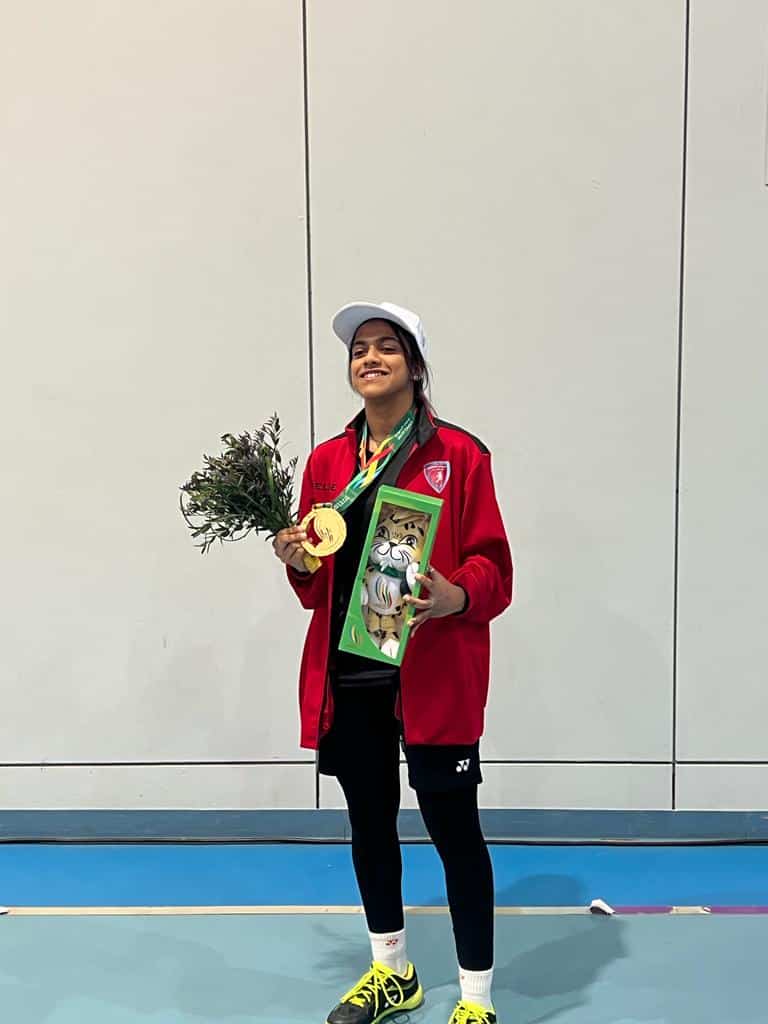
The only other Indian winner is Kadeeja Kothoor, who also won the gold medal and a million-riyal prize money in women’s single category of badminton. She is also 17 years old and studying in the same school as Mehad.

Kadeeja, native of Calicut in Kerala also born and brought up in Riyadh in a family of full badminton athletes. Sinmar Badminton Academy and Indian Academy- set up by a group of NRIs including her father Latheef – trained her. Coaches Sanjay, Shahin and Wahid shaped her gaming skills.

When she started playing at the age of eight years everyone was expecting that she would make a difference in the game one day which she did, said Latheef, father, who himself is a badminton player. Kadeeja’s other siblings are also badminton players. Her brother Mohammed Nzami is Kerala champion and 6th ranker in All India rating under 13 category; while sister Raya Fatima is Calicut’s St. Joseph Devagiri college team member of badminton team.

“My wife, Shanitha, has encouraged all children into sports” said Latheef.

source: http://www.siasat.com / The Siasat Daily / Home> News> Andhra Pradesh / by Irfan Mohammed / posted by Sameer Khan / November 07th, 2022

A Hyderabad woman went to Oxford in the 1930s. It wasn’t the most remarkable part of her story

Hyderabad / BRITAIN:

A Hyderabad woman went to Oxford in the 1930s. It wasnt the most remarkable part of her story

Muhammadi Begum was a student of Osmania University, Hyderabad, where she topped the Bachelor’s examination in 1932.

Highlights

  • Having received a scholarship from the Nizam for higher education, Muhammedi Begum, a young woman from Hyderabad, travelled to Oxford University in 1934.
  • What makes her story even more remarkable is that she maintained an extensive record of her four years abroad.
  • Her diary has been translated from Urdu into English, and published, by her daughters

In 1934, a young woman from Hyderabad travelled to Oxford University in England to study, accompanied by her husband. She had received a scholarship from the Nizam of Hyderabad to pursue her higher education (for which she studied French, Arabic and English). During the nearly four years she spent in the UK, she had two children, travelled around Europe and established a pattern of living that would hold her in good stead her entire life.

The young woman was Muhammadi Begum, student of Osmania University, Hyderabad, where she topped the Bachelor’s examination in 1932. She was married to Delhi-born, Syed Jamil Husian, an alumnus of the Aligarh Muslim University.

Those days, women travelling abroad to pursue education was a rarity; although what made Muhammadi Begum’s story remarkable is a diary that she maintained at Oxford which recounted everything from her day-to-day concerns to reflections on the state of society.

Muhammadi Begum’s diary remained under a shroud till the year of her passing, in 1990. The little note-book, where she detailed her daily life as she lived across continents, was eventually a precious find. It went to her cousin first and meandered in the family, till it caught the attention of her eldest daughter towards the end of the decade.

“I was pleasantly surprised and was taken aback by it,” said Zehra Ahmad, Muhammadi Begum’s eldest daughter. “I came across the diary after she passed away. I would’ve asked her many questions if I knew about its existence.”

What followed over the years was translation (as Muhammadi wrote in Urdu), editing, followed by COVID-induced delays in publishing, before A Long Way from Hyderabad saw the light of the day in 2022. Zehra translated the book along with her sister Zainab Masud.

Translating the diary was no mean feat, as Muhammadi Begum made detailed records, even writing in the margins. The sisters read it multiple times, transcribed it, and then translated it – all of it laborious and time consuming.

Kulsoom Husein, her youngest, who came out of retirement to edit and rework her mother’s diary said, “The tone of the diary is true to her experience. It was a new experience for her to travel to England as few women did so in those days.”

Muhammadi and her husband Jamil. Photo courtesy Husain Family Archives

Charting new paths

Muhammadi Begum belonged to a well-known family of writers. Her mother, Qaiseri Begum, was the granddaughter of famous writer Moulvi Nazeer Ahmed, who’s work Mirat-ul-aroos is often dubbed as Urdu’s first novel. Qaiseri Begum, herself was a prolific writer whose memoirs Kitab-i-Zindagi details changes in Indian social history from the 1880s to the 1960s.

The diary successfully encapsulates the journey of a young couple making their way in the London of 1930s. Her observations are detailed, precise and provide an invaluable peek into the world at the time – be it shopping at Harrod’s, visiting the Victoria and Albert Museum, eating ice-cream at a restaurant in Elliston & Cavell or taking walks in University Parks in Oxford, it paints vivid vignettes of pre-World war- II London.

The diary, according to Ahmad, who also spoke for her other sister and co-translator Zainab, brought her mother alive. “Everything she wrote was an accurate account of herself; her worries for her baby or exams, her management of the household and juggling her studies with a baby. She was on the move all the time and led a full and active life,” said she.

The writing is assured and confident. It stays true to what it is intended to be — a record of its keeper’s time in a foreign land. It comments on the English way of life (an interesting nugget is the usage of blackcurrant jam to treat colds), the trials of learning French and the easy camaraderie between students from India. Her letters to her mother Qaisari Begum were even published in a Hyderabad Urdu daily, Ismat.

It also showcases Muhammadi Begum as an independent woman with agency. Travelling in Europe along with a toddler can be a daunting task at any time, but she managed it with a remarkable spirit. It is in fact this spirit that would hold her in good stead later in life, when at 42 she lost her husband and had to look after many children.

A Long Way from Hyderabad can be nostalgic. It’s all about an era gone by, of Urdu publications in Hyderabad which have long ceased to exist (Rahbar and Tehzeeb) or local traditions like Kalzana, a medicine made from chalk and calcium, and given to pregnant women.

What she wrote holds relevance even today, as her struggles (with food, culture and money) are similar to ones faced by many students studying abroad. The diary also strikes a balance between everyday details of life, reflections of the time and personal observations.

Pages from Muhammadi Begums diary in original Urdu script. Photo by Daniel Majchrowicz

A record of the time

Records of women travellers are rare. The few accounts which exist are those of Sikandar Begum, the ruler of Bhopal who wrote of her pilgrimage to Mecca in 1869, Maimuna Sultan who wrote an account of London in 1911 and Atiya Fyzee who published her travel writings in Zamana-I Tehsil in 1921. Typically, the women who published at the time were queens, politicians or activists; Muhammadi Begum was none of them and hence her account stands out because of its simplicity and honest rendition of her life.

Her writing is as much a record of her own life as it is of the times she lived in. The Independence movement was on in full throttle and she along with her husband eagerly took part in discussions with friends. She actively participated in cultural exchanges even though she was reluctant to lend her sarees to curious British women.

“My mother was very stirred by the experiences she had. Technology, in the form of planes and ship liners, was just coming up and when she visited the science museum she was struck by the difference in Indian and British kids. While rote learning was accepted in India, the children there were curious to explore scientific apparatus and experiments. She makes a mention of all these in her daily jottings,” observed Husein.

Indeed, the travel account shows that concerns have not changed much between 1935 and 2022. The author lamented the state of Indian museums on a visit to the V and A Museum and was entranced by a Buddha statue. She worried about land prices shooting up in Hyderabad and wondered if the family could afford to buy a house — valid concerns even after a century.

She throws light on the comfortable relationship between her and her husband. Muhammadi Begum’s husband, Jamil, took leave of absence from his work as a civil servant in Hyderabad to travel with his wife. According to Ahmad, her father was a hands-on parent. “He looked after the baby with her, which was unusual for the time. Also, they shared an equitable relationship,” she said. “He was an admirer of Gandhi and she looked up to Iqbal, which led to many discussions around each. They both liked exploring places and had a wide circle of friends.”

The years in Oxford had a lasting impact on her, as throughout her life she remained fond of open air, long strolls and staying independent. In fact, later in life, she took in paying guests in Lahore when she retired from her job and needed to supplement her income.

(L) Book cover by ClayPotStudio, featured photo courtesy Syed Jamil Husain. (R) Begum. Photo from Husain Family Archives.

A nod to the past

In producing the book, Muhammadi Begum’s daughters became closer, as Husein noted, “We exchanged information about relatives mentioned and forgotten. My elder sisters have translated and I reworked the text — so it was a collaborative effort. My daughter, Amena, helped with research on key figures who were at Oxford at that time, such as educationist Sir Michael Sadler and GM Sufi, a retired University of Delhi registrar and historian, and Miss Bharti Sarabhai, who hailed from a prominent Indian civil rights activist family.”

With an account of food, state of women, culture, feelings and a life well lived, A Long Way from Hyderabad, is a perfect addition to the archives of writing from pre-Independent India. It provides a reliable record of the times gone by. It also shows the lasting impact of the written word and its ability to transcend time.

source: http://www.news9live.com / News Nine / Home> Arts & Culture / by Mallik Thatipalli / June 03rd, 2022