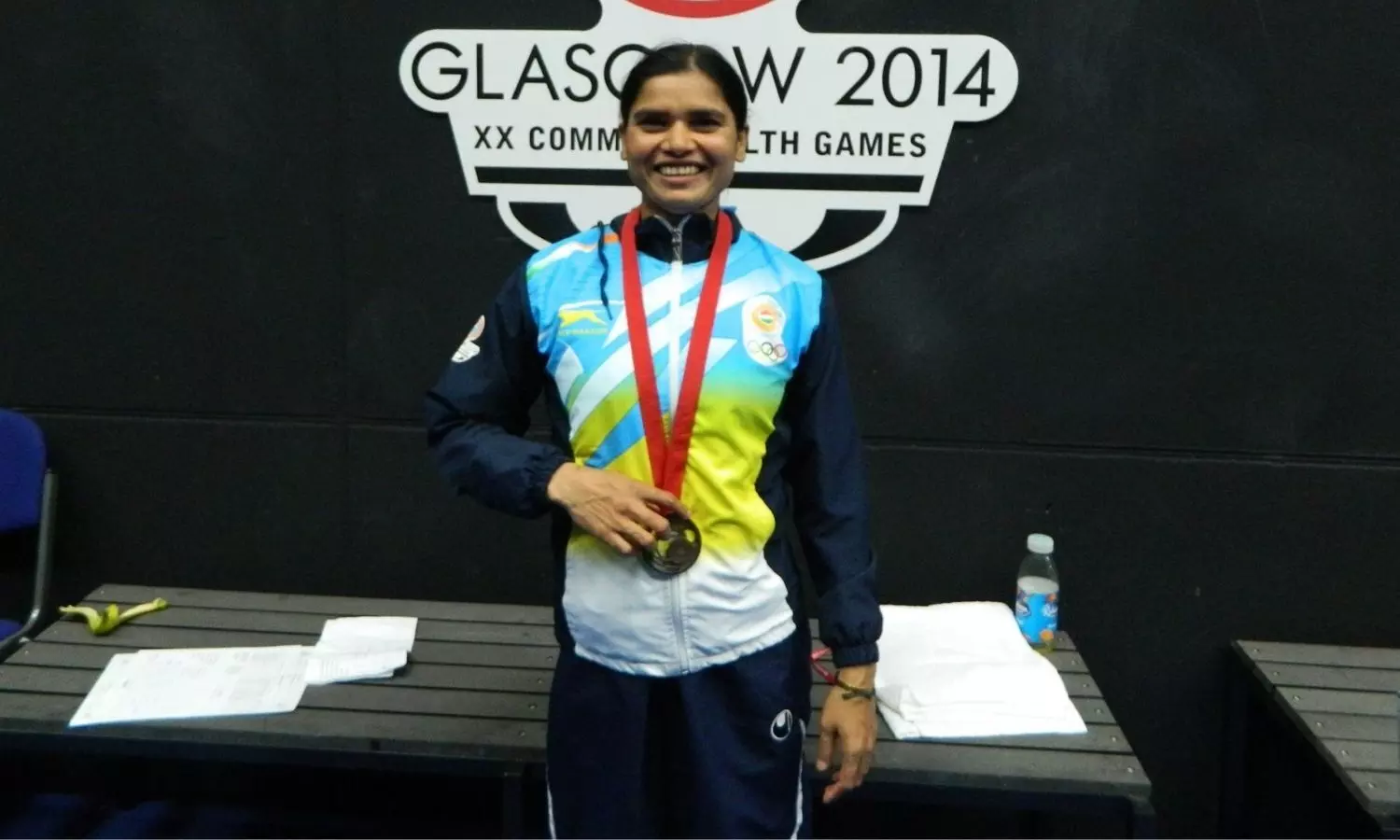
India’s only woman powerlifter at Tokyo Paralympics, Sakina Khatun finishes in fifth position in the final of the women’s 50kg powerlifting.
Para Powerlifter Sakina Khatun / thebridge.in
Indian para powerlifter Sakina Katun finishes fifth in the women’s 50kg powerlifting event on Friday at the Tokyo Paralympics. Participating in her maiden Paralympic Games, Sakina lifted 90kg in her first attempt, followed by an unsuccessful lift of 93kg in second. In her third attempt, Sakina successfully lifted 93 kg to finish 5th. Egyptian Reha Ahmed a best of 120kg to win the gold medal, followed by China’s Hu Dandan, who lifted 112kg to win the silver medal and Great Britain’s Olivia Broome lifted 107kg to win the bronze medal.
Sakina made the country proud by winning a silver in the Para Powerlifting World Cup in Dubai in the up to 45kg category with a lift of 80kg. Sakina Khatun is the only female para-athlete in Indian history to win a medal at the Commonwealth Games. Hailing from Bengaluru, Sakina’s father worked as a marginal farmer and her family faced many financial problems. Despite all of this, Sakina survived Polio as a child and she had to undergo four surgeries to survive the deadly disease.
source: http://www.thebridge.in / The Bridge / Home> Tokyo 2020 Paralympics / by The Bridge Desk / August 27th, 2021
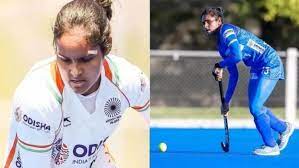
Nisha Warsi, the only Muslim player in the Indian national hockey team that reached the semi-inals in Tokyo and lost a well-fought game against the English team, will get an award of Rs 50 lakh from the State government of Haryana as the Chief Minister Manohar Lal Khattar announced the policy of rewards for Olympians.
He said the State will give Rs 50 lakh to each player of the Indian women’s hockey team from the state and the same amount to those who ranked fourth in the Olympics events from the state.
It’s not clear if Nisha is entitled to double award of being the Olympian and winning the fourth place in international Hockey at Tokyo. In that happens she is entitled to Rs one crore.
Khattar tweeted, “We give Rs 6 crore to Gold medal winners, Rs 4 crore to Silver medal winners, and Rs 2.5 crore to Bronze medal winners. For the first time, we have decided to give Rs 50 lakh each to the players who finished fourth.”
Apart from this, he further announced to give Rs 10 lakh each to all the players who participated in Olympics from Haryana.
source: http://www.awazthevoice.in / Awaz / Home> Women / August 07th, 2021
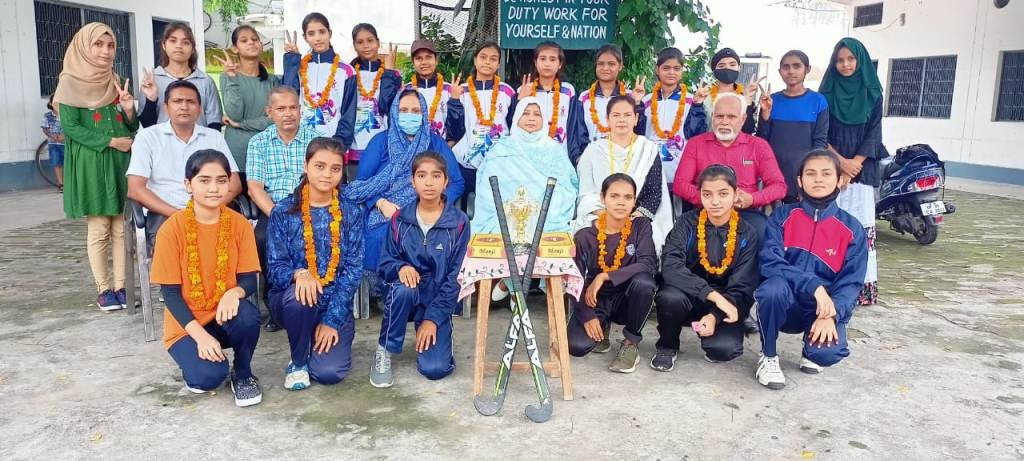
The undeniable girl power of Aligarh Muslim University (AMU) in sports came to the fore in Hockey as a team of AMU ABK High School-Girls clinched a decisive win in the final of the National Hockey Tournament in Goa to bag the Gold Medal.
Team members Aliya Rashid, Simran Shakeel, Rabia Khatoon, Shafiya Shakeel, Amreen Malik, Zenab Mohsin, Saniya, Shaby and others were felicitated in a special function at the school on their return.
Congratulating the team members, Dr Samina (Principal) said that the School hockey team has not only capped an excellent performance in the tournament, but also inspired other girls to take up sport and bring laurels.
Wishing the team more success in the future, Dr Saba Hasan (Vice Principal) said that the team’s performance shows that dreams can come true as long as you work hard.
School teachers, Mr Nadeem Ahmad, Mrs Shaheen Khan, Mr Mahtab Ahmed, Mr Najmur Rahman Faridi, Mr Shamshad Nisar (Sports teacher) and Md Imran Khan (Coach) delivered motivating speeches to encourage the hockey team for more success.
source: http://www.amu.ac.in / Aligarh Muslim University / AMU Public Relations Office / August 24th, 2021
Anisa Mohammed is the interim captain as Stafanie Taylor is unavailable for the T20I series due to serving a period of isolation in Antigua
Anisa Mohammed to lead West Indies team as Stafanie Taylor in isolation.
St John’s (Antigua):
A 13-member West Indies women’s squad led by interim skipper Anisa Mohammed for the opening T20 International against South Africa Women at the Sir Vivian Richards Cricket Ground on Wednesday (IST) was announced by the Cricket West Indies (CWI) Women’s Selection Panel on Tuesday.
Anisa Mohammed is the interim captain as Stafanie Taylor is unavailable for the T20I series due to serving a period of isolation in Antigua, after being identified as a primary contact of a COVID-19 positive case in Jamaica.
The women’s chief selector, Ann Browne-John said in a statement:
“The T20I and ODI series against South Africa gives another opportunity for the team to play international matches ahead of the upcoming ICC World Cup qualifiers (In March-April next year in New Zealand). It is unfortunate that Stafanie will not be available for this series but there are a number of experienced players who we would be looking to, to fill any void.
“The young player Qiana Joseph brings another left-hand batter option as well as left arm orthodox bowling which has been lacking in the team. This will be a good test coming out of the recent Pakistan series, since South Africa is one of the higher ranked teams.”
The West Indies women’s team returns to the field after a successful double series win over Pakistan women, where they took the T20I series 3-0 and the ODI series 3-2. The West Indies women’s squad has been preparing in a high-performance camp in Antigua prior to the upcoming series.
The second and third T20Is will take place at the Sir Vivian Richards Cricket Ground on September 2 and September 4 respectively. The five ODIs will be played from September 7 to 19, with the first three matches being played at the Coolidge Cricket Ground (CCG) and the last two at the Sir Vivian Richards Cricket Ground.
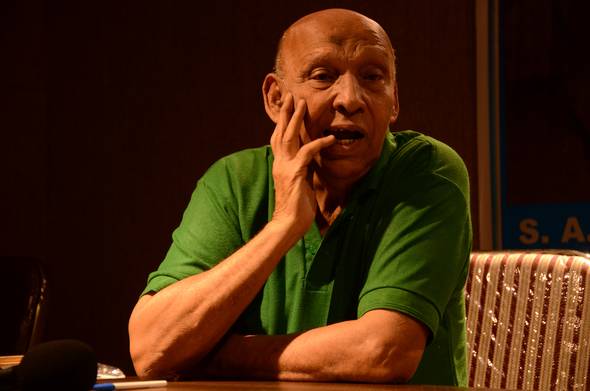
Hakim had represented India in the 1960 Olympics and is the son of the legendary football coach S.A. Rahim.
File image of Syed Shahid Hakim.
Former Olympic footballer and ex-national football coach Syed Shahid Hakim passed away in a private hospital in Gulbarga on Sunday morning. He was 82 and survived by his wife and two daughters.
“He suffered a cardiac arrest at 8 am today and passed away at 8.30 am. He has been getting treatment after he was admitted to the hospital two days ago following the first stroke,” Sadia Syeda, wife of Hakim, informed Sportstar from Gulbarga.
Hakim, son of the legendary football coach S.A. Rahim, was part of the Indian squad for the 1960 Rome Olympics.
The former SAI national coach successfully battled COVID-19 last year in a private hospital in Hyderabad.
Only last week, he was among the many former internationals who were felicitated in Hyderabad.
A vocal critic, Hakim was known for his frank views on contemporary topics in Indian football.
“I was not in the starting XI. The team was packed with heavyweights; only in case of an injury to some of the big names, players like me had a chance in the Rome Olympics,” said Hakim in a recent interview to Sportstar, recapping those experiences.
Hakim became only the second footballer to win the prestigious Dhyan Chand Award for Life Time Achievement in Sports and Games in 2017 and served as the Chief Project Director at Sports Authority of India (SAI).
Hakim, besides playing for nearly 25 years, was also a qualified FIFA referee. He officiated in 33 international games, including the 1988 AFC Asian Cup in Qatar.
At the domestic level, he was part of the triumphant Services’ Santosh Trophy squad in 1960. He was also part of the squad from 1960-66. At the club level, he played for City College Old Boys (Hyderabad) and Indian Air Force.
A former assistant coach of the Indian National team, he also coached Mahindra and Mahindra in 1998-99 and guided it to victory in the Durand Cup in 1998. He also coached Salgaocar SC, Hindustan FC, and Bengal Mumbai Club.
Former India captains Victor Amalraj, Shabbir Ali, Telangana Football Association secretary G.P. Palguna were among those who expressed condolences to the family members.
source: http://www.sportstar.thehindu.com / Sportstar / Home> Football / by V V Subrahmanyam / August 22nd, 2021
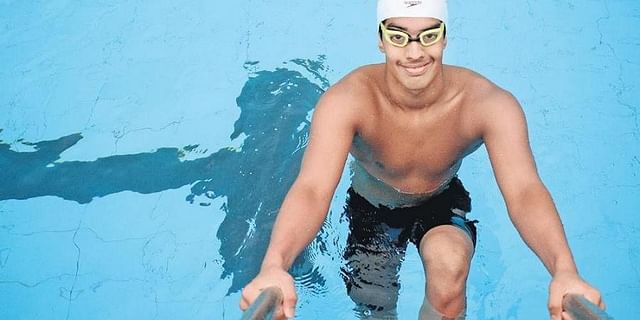
Olympaid swimmer Srihari Nataraj’s coach, Nihar Ameen in a candid chat with CE, shares why Tokyo Olympics 2020 was the toughest mission for him
Bengaluru :
He may not have won a medal at the recently-concluded Tokyo Olympics 2020. But swimmer Srihari Nataraj’s coach, Nihar Ameen, is proud of his student who has faced several lows during the last one-and-a-half years as he prepared for the biggest sporting event. During a tete-a-tete with the coach on a weekday afternoon, Ameen shows no sense of disappointment at his ‘shishya’ not bringing home a medal. Instead, following Nataraj’s elimination at the Olympics, Ameen has got down to business immediately. He’s working on Nataraj’s performance who he feels needs to be stronger and fitter. “We are just waiting for the 2022 calendar to come out and we have already started the preparations for the Asian Games. We have got three years now to set everything right and we will come back with a medal from Paris in 2024,” says Ameen, a Dronacharya awardee.
Along the course of the conversation, Ameen, who has been a trainer for nearly four decades, confides that this has been the toughest mission for him so far.While the fear of Covid-19 remained on one side, the task to prepare Nataraj for the Olympics to “start from scratch” was another. Following the lockdown in India during 2020, a lot of sports arenas and training centres were shutdown. Swimming pools were no different. Ameen believes that the closure of swimming pools did take a severe toll on training. “In India, pools were completely shut for seven-eight months. Srihari got no training whatsoever. If at all the lockdown was relaxed and swimming centres opened early in 2020, Nataraj’s results would be different. I am confident that he would have reached the finals,” says Ameen, who had little time to get Nataraj to the top 16 in the world.
The inconsistent training periods also proved to be a major challenge for the coach. “Sportspersons become very rusty if there is no consistent training. I had to bring Nataraj from zero because he was not in the best of shapes. Although Nataraj is tough mentally, however, we had to build the natural processes. Being out of water for so long, he also suffered a shoulder injury during an event in Dubai,” says Ameen, adding that Nataraj had just 10 days to come to his best ahead of the competition at Tokyo Olympics.
From a very festive departure in New Delhi to a very subdued welcome at Tokyo, Ameen admits he was shocked and surprised at the “dead atmosphere” that shadowed the world’s most important sporting event. After landing in Tokyo, the team was made to wait for over six hours due to the strict health protocols enforced at the airport. “This wait too, affected the minds of participants,” feels Ameen.
The rapport between Ameen and Nataraj is like any other case study of a guru and his disciple. Ameen believes that with the right nurturing, Nataraj will go places. “He is a self-motivated person, and is a national asset who needs to be nurtured well,” Ameen adds. The two often sit together and plan the training programme. “Once he gets down to do what he is supposed to do, I am there to supervise. We don’t have any verbal communication after that,”says Ameen.
source: http://www.newindianexpress.com / The New Indian Express / Home> Cities> Bengaluru / by Sanath Prasad, Express News Service / August 12th, 2021
Khandra Village (near Panipat) / Panchkula (Ambala Dist. of Haryana), UT of CHANDIGARH :
Once a chubby kid with his notebook, Chopra now has an Olympic gold
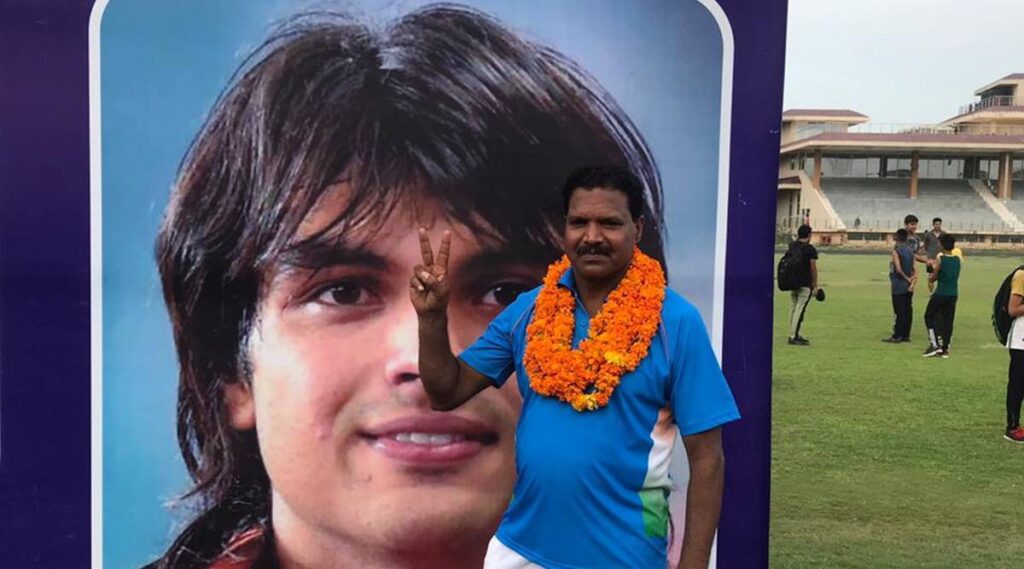
Nassem Ahmad starting coaching Olympic gold medallist Neeraj Chopra in 2011. (Express Photo: Nitin Sharma)
Javelin coach Naseem Ahmad remembers the day in 2011 when a chubby 13-year-old named Neeraj Chopra came to the Tau Devi Lal Sports Complex in Panchkula. The teenager travelled over four hours from his native, Khandra village, near Panipat, to enquire about the process of getting admission at the sports academy that had one of the only two synthetic tracks available in Haryana at the time.
That was a big step for the youngster to take in his budding athletics career. An even bigger one, the biggest yet, came on Saturday, when he launched a javelin 87.58 metres at the Tokyo Olympic Stadium to become only the second individual gold medallist at the Olympics from the country.
It’s an achievement that has created memories, and one that has brought back quite a few for Ahmad.
“I still remember how Neeraj would watch his seniors training at the nursery,” recalls an emotional Ahmad.
“He’d sit with his notebook and take tips from them. He would never shy away from training and would always set targets of winning each day’s round with the group. To see him win the gold medal today on the biggest stage is the greatest joy for us. And I am sure he will be spending time with the javelin throwers from the other countries just like he did here with his seniors and friends post training or competition.” shares an emotional Ahmad.
Chopra first learnt the art of javelin throwing from coach Jaiveer Singh in Panipat. In Panchkula he trained from 2011 till early 2016. But it wasn’t just the field event Ahmad would make him train for. At the stadium near the foothills of the Shivalik Range, Chopra’s morning sessions would be followed by him training with the long-distance runners, and then the javelin event again in the evening.
Staying at the hostel also meant that the 23-year-old would remain under Ahmad’s strict watch. But he doesn’t recall Chopra going astray – most of the youngster’s free time was spent reading books about his event, or pestering seniors to show him videos of old javelin events from Olympics past. At the same time, he started to perfect his craft in practice as well.
“His basics were always strong since he trained with a lot of seniors since when he was in Panipat. But since javelin throw requires a lot of stamina and strength, we first made an athletics training programme for him and it meant that he would also train with long-distance runners at the stadium,” the coach explains.
“Some months later, we would spend time on improving his technique. As he made throws with cross legs and had a wide last stride, it gave him the required momentum for the final jerk for smooth throws. Starting from throwing with two strides to three strides and five strides, we would progress to a full run-up each day and it helped him master the landing technique too. While he now falls after his throw in competitions, it was never the case in training here.”
Staying at the hostel in Panchkula with him were also a few friends who used to train with him in Panipat. They weren’t bereft of Chopra’s constant questioning about the sport either. Narender Ranbir, a Paralympian from London 2012 and Rio 2016, and silver medallist at the 2014 Para Asian Games, shared a room with Chopra when they were in Panipat.
“Neeraj would always come to us for advice about various javelin techniques,” recalls the 31-year-old.
“We all pooled in money and bought three local-made Crown javelins that the whole group trained with. At the time Neeraj threw around 25-30m. But once we moved to Panchkula, we borrowed foreign-made javelins from the seniors.
“Neeraj was also cooked a vegetable pulao dish that would make five-star chefs jealous. Wohi banane ko bolenge once he comes back with his gold medal (we’ll tell him to make us that once he comes back with the gold medal.”
In 2011, Chopra set a new junior national record of 68.40m in the junior nationals in Lucknow. In the senior category, Chopra would first cross the 70m mark in 2014 with a throw of 70.19m before he crossed the 80m mark with a throw of 81.04m, a world junior record, in the All India Inter-University Athletics Meet in 2015. The next year he threw 82.23m at the South Asian Games (SAFF) in Guwahati. But a month after the qualification process ended for the Rio Olympics, Chopra went on to throw 86.48m for a new junior world record in the IAAF World U-20 Athletics Championship at Poland.
The last five years have seen Chopra training under various coaches at the national camp. He’d also keep breaking the records – often his own – at regular intervals. Ahmad remembers the youngster writing about each throw in his notebook.
“Initially when he came here, he was touching the 55m mark. He would be throwing close to 50 throws three days a week, apart from 18-20 throws in a simulated competition with seniors and his age-group throwers twice a week,” the coach adds.
“Every time he crossed 60m, 70m, 80m, he would always write it down. Today he wrote his name in the history books, what more can I say.”
source: http://www.indianexpress.com / The Indian Express / Home> Olympics / by Nitin Sharma, Panchkula / August 08th, 2021
Riders from Bengaluru, spearheaded by reigning champion Hemanth Muddappa, swept the honours in the first round of the MMSC fmsci Indian National Motorcycle Drag Racing Championship which concluded at the MMRT, here on Sunday amidst Covid-19 safety protocols.
Muddappa, 31, astride his Suzuki Hayabusa, was the quickest of all riders, clocking 07.882 seconds over 302-metres strip while winning the featured Super Sport Above 1051cc category ahead of fellow-Bengalureans Hafizullah Khan (08.116) and Harish Naik (08.538).
Despite the comfortable win, Muddappa said due to the high track temperature, the timing was a tad slower than he wanted. “The track temperature affected all the riders and we all posted slower timings. We were much quicker in January during the final round of the 2020 championship,” said Muddappa.
Another Bengalurean, Mohd Riyaz (08.026) topped the time sheets in the Super Sport 851-1050cc class, followed by Muddappa (08.116), who was a bit slow off the mark, and debutant NV Satyanarayana Raju (08.191) from Hyderabad.
On Saturday, Chennai riders swept the podium spots in the Girls (4-stroke, up to 165cc) category with Lani Zena Fernandez, Nivetha Jessica and Soundari Sindy finishing in that order.
Super Sport Indian – 361-550cc: 1. Aiyaz Rem (Bengaluru) (12.568); 2.Zuheeb Ahmed (Bengaluru) (12.860); 3. D Annish Samson (Speed Up Racing, Bengaluru) (12.942).
226-360cc: 1. Bharath Raj (Rockers Racing, Chennai) (12.602); 2. Yogeshwaran (Speed Up Racing, Chennai) (12.798); 3. D Annish Samson (Speed Up Racing, Bengaluru) (13.050).
Up to 165cc: 1. Kevin Kannan (RACR Castro Power, Chennai) (14.573); 2. Anand R (Chennai) (14.824); 3. Chandrashekar (Bengaluru) (14.910).
Aligarh, UTTAR PRADESH / NEW DELHI / Ghazibad District (U.P) :
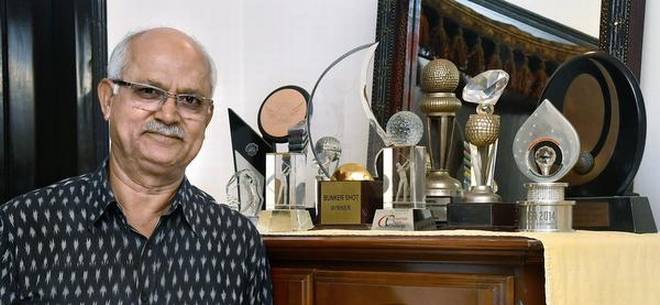
Hockey Olympian Zafar Iqbal on how his life has unfolded, from being the son of an academician to his days spent on the golf course today
The general impression of a hockey player in India is that of a talented sportsperson from the hinterland, modestly educated, and fighting poverty and lack of resources in the stuggle to reach the top. Zafar Iqbal breaks the mould in more ways than one.
The former Executive Director (Properties and Facilities) with the erstwhile Indian Airlines is one of the few in the sport to have managed a life outside hockey post-retirement. He credits his parents and upbringing for helping him get the balance right all through, in his articulate, but gentle manner.
“My father never stopped me from playing sports, but he was quite strict when it came to studies as well. He knew there was fame and popularity in sport; money, not so much, and so wanted us to be self-sufficient enough to manage our lives even after our sporting days were over. I am glad I listened to him,” says the 63-year old, who says he has worked enough in his life to be able to sit back and enjoy retirement.
How the world knows him
One half of the famous Shahid-Zafar pair that tormented teams’ defences for years, the talented left winger would set up the legendary Mohammed Shahid for his stylish goals. They needed little or no communication to know exactly what needed to be done.
The subtle stickwork, though, was always backed with a strong understanding of physics, thanks to his degree in civil engineering from Aligarh Muslim University and an even stronger realisation that the sport would always be his passion, but not something that would help him lead a life of comfort in the long run.
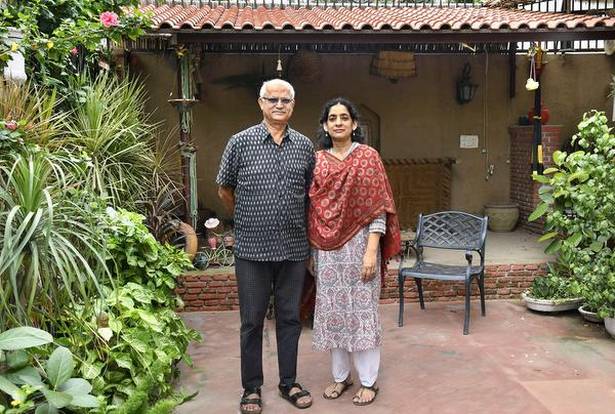
A resident of Vaishali in Ghaziabad – he moved to the house once he had retired – Iqbal’s major commitment through the day now is to golf. “I started learning golf a few years before retiring and I am still not satisfied with my game. I wake up around 4.30 in the morning and from 5.15 to almost 11.30-12, I am at the golf course. It’s the best part of my day,” he says, laughing.
As the son of Prof. Shahbuddin, dean of the science department at Aligarh Muslim University, Iqbal did not lack resources or an atmosphere of learning at home. Today, he’s surrounded by books on history that he enjoys, and has read the texts of all the major religions, including the four Vedas.
Having made his national debut in 1977, and getting his degree in 1978 – the same year he joined Indian Airlines – he was finally free to pursue hockey full-time. “That was also at my father’s insistence. I had job offers from the Indian Railways and Uttar Pradesh State Electricity Board, but he advised me to join the airlines, saying that I might not get immediate rewards but would surely be successful in the future. I realised he was right when I was finally appointed ED,” Iqbal recalls.
Players off the field
He talks about how he tried to push his teammates as well to have a life outside the sport. “I used to tell them to continue with their studies and office work after active sports, because not everyone can be a coach or administrator for life. Unfortunately, there were many, much bigger players who could not rise to a senior post. I told them it might be tough initially, but office work is no rocket science. Also, as players we are used to quick decisions on field, so it is easier for us to make the switch. They didn’t listen to me, though,” he rues.
It was in 1977 that he moved to Delhi and decided to make it his home. “For me, coming from a small town like Aligarh, Delhi was this huge, fast place where everything was big and far. In AMU everything was available at your doorstep; here, I had to travel 16 km by bus, every day, from the Indian Airlines Colony in Vasant Vihar for training at the stadium. But when I see it now, I feel it was so laid-back then,” he exclaims.
It wasn’t just the distance that awed the 22-year-old. His training camps with Indian Airlines at the National Stadium were equally overwhelming. “Players like Ashok Kumar, Aslam Sher Khan, B.P. Govinda – whose photographs we kept in our rooms and pockets – were suddenly our teammates. Inam-ur-Rehman, my idol, was the coach. He was a disciplinarian, treating everyone equally, regardless of his achievements on the field. That helped inculcate respect for the game and discipline on the field,” Iqbal admits.
The presence of other sportspeople also helped. The National Stadium, he explains, used to be a multipurpose venue with a track for athletics and no turf in the main arena. It had the likes of the legendary athlete Sriram Singh training there. “The hockey field was on the left and cricket on the right, with Bishan Singh Bedi and many more practising. It was all open and we used to interact,” he says.
Old ways
Empty roads, few vehicles, no paranoia about hygienic food or water, the absence of pollution – the Delhi he remembers is restricted to nostalgia now. Even the most secure areas of the city – in and around Parliament, which he had to cross to reach National Stadium – had easy access, including Race Course Road, which he recalls used to be open to the public back then.
“I sometimes wonder what progress we have actually made. Everyone seems to be running all the time and everyone is addicted to mobiles. We seem to have become breathing mechanical bodies,” he says.
The discipline of a sportsperson, though, continues to guide his life. Iqbal is a member of two golf courses in NCR – Army Golf Club and the Noida Golf Course – but also visits the one at Hindon. On a week-long break to Chennai to visit his son, Yasir, an assistant professor of physics at IIT, he still managed to find people who would help him play his daily round, at the Cosmopolitan Club. He hasn’t the same luck in Mumbai though, when he visits his daughter, Samia, who moved to the city for her work as a copywriter.
For the rest, he is happy to accompany wife Fauzia (who also retired from the commercial department of what was Vayudoot and consequently Air India) around or spend time occasionally with his friends.
As a member of the governing body of the Sports Authority of India, as well as consultant with the University Grants Commission in the sports curriculum committee, he has stayed in touch with sports administration, pushing the agenda of games as an essential part of the development of a person.
As a former India coach (1993-94), selector (over three tenures), and government observer for many years, he has given back to the sport that helped him become an Olympic champion. But in his pursuit of golfing excellence, Zafar Iqbal continues to live a sporting life.
This ends our 10-part series on former sportspeople who are based in Delhi.
source: http://www.thehindu.com / The Hindu / Home> News> Cities> Delhi – Now & Then / by Uthra Ganesan / September 04th, 2019
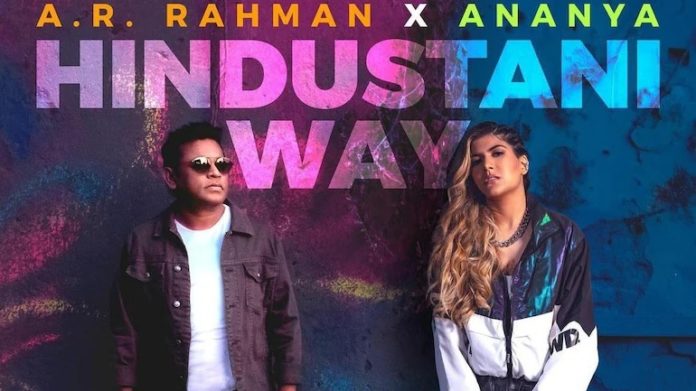
Tokyo Olympics: Anurag Thakur to launch official Team India Cheer song for Tokyo Games created by A R Rahman, Ananya Birla [Pic credits: India Today]
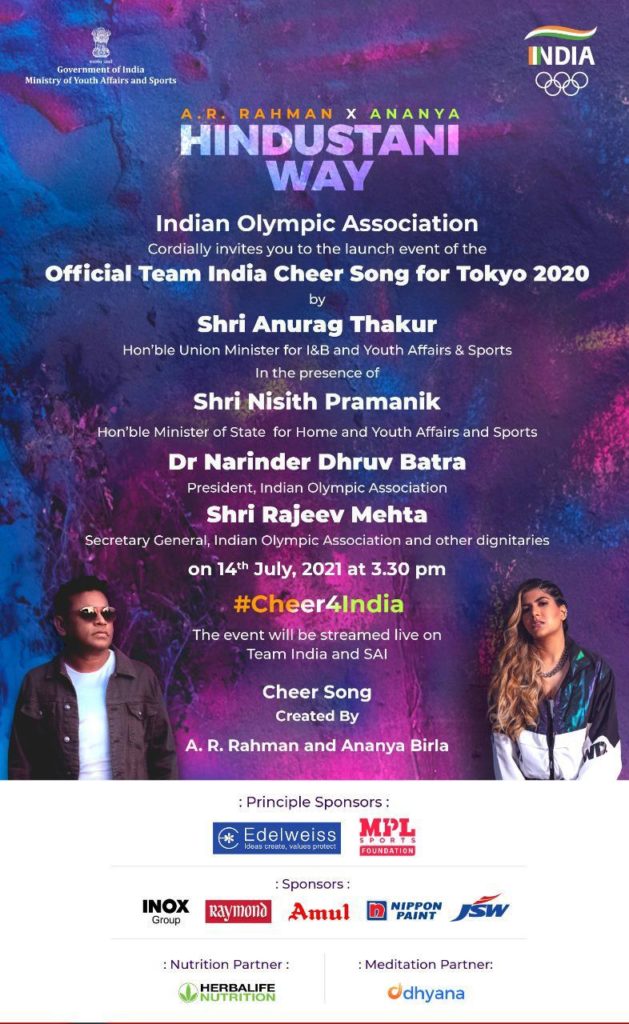
Tokyo Olympics: Anurag Thakur to launch official Team India Cheer song for Tokyo Games created by A R Rahman and Ananya Birla – The Indian Olympic Association will launch the official l Team India Cheer song for Tokyo Games created by A R Rahman and Ananya Birla on Wednesday at 3.30 PM. Sports Minister Anurag Thakur (Union Minister of I&B and Youth affairs, Sports Minister) will launch the official song in presence of IOA President Narinder Batra, Rajeev Mehta (IOA secretary) and MoS for home, Youth affairs and Sports Nisith Pramanik. The event will live stream on Team India and SAI.
Music maestro AR Rahman has teamed up with young singer Ananya Birla to work on ‘Hindustani Way’, a song that aims to boost the morale of Indian players who are all set to participate in Tokyo Olympics 2020.
“All of us are really excited to have made this special song and hope our athletes can feel the entire nation rooting for them, the Hindustani way, when they hear it. It was a pleasure working with Ananya on this project and we hope to convey all our support and best wishes to Team India through it! Jai Hind,” Rahman, who has composed the track, said.
Tokyo Olympics: Anurag Thakur to launch official Team India Cheer song for Tokyo Games created by A R Rahman and Ananya Birla
The track is jointly written by Ananya, Nirmika Singh, and Shishir Samant.
Expressing happiness on singing such an inspiring song, Ananya said, “It is a true honour to write and sing a song to cheer our Indian Olympic contingent at Tokyo 2020. The grit and fortitude of the Indian Olympic team in the face of such a challenging year is inspiring.”
“It was surreal to have had the opportunity to collaborate with my role model, AR sir on such a prestigious project, from whom I have learnt so much. We are here cheering, the Hindustani Way,” she added.
The Tokyo Olympics will be held from July 23 to August 8. The event was slated to be held last year, but it had to be postponed due to the COVID-19 pandemic.
#Cheer4India | Launch of The Official Team India Cheer Song for Tokyo 2020
(with ANI inputs)
source: http://www.insidesports.co / Inside Sport / Home> Latest Sports News / by James Kuanal / July 13th, 2021