Category Archives: Travel & Tourism

Kayaking team goes on eco-drive in Gulf of Mannar

Tuticorin :

A five-member team, including a woman, that has been paddling their fibre kayaks for six days on the scenic Gulf of Mannar Sea completed their expedition here on Sunday, doing so with the satisfaction that they have been able to educate at least some coastal communities on the need to keep beaches free of pollution and littering.

Jehan Driver, Arjun Motha, Rizwan Gani, John Suganth and Charmine Pereira from Quest Expeditions and Aqua Outback had set off from Kuntakal near Rameswaram in Ramanathapuram district on Tuesday, flagged off by Ramanathapuram district collector, K Nandakumar. They were received here by Coastal Security Group (Marine Police). The team paddled for 49km a day and camped in some beach at night. “We stopped at coastal villages and talked with local people. We told them how important it was to keep their coastal environment clean and protect their resources for sustained living,” said Rizwan Gani. Jehan Driver, who led the team, explained that the objective of the expedition was to create awareness about the vast natural reserves Tamil Nadu has to offer and the sustainable practices that will keep it pristine. The expedition also aimed to promote Kayaking as a sport and let people know the importance of preserving the natural environment of the marine biosphere to encourage other sportsmen and sportswomen to practice and enjoy their non-motorised sports.

“Gulf of Mannar is a marine eco-system in the country that has remained clean till now and it should be protected. We could share this message among the people we met in the coast during our paddling. We collected more information on the beaches, besides watching pristine islets to check if there are any poaching activities. We could see that marine life is still flourishing in the region and we should protect them together,” Driver said. The team also expressed their concern about untreated sewage mixing in Gulf of Mannar waters. Based on their findings, they will prepare a report which they will submit to concerned government agencies, they said. Government agencies like Indian Coast Guard and Coastal Security Group and additional director general of police, C Sylendra Babu were of great help, they said. Having succeeded in their first venture, they plan to turn this into an annual event to keep the tradition alive.

source: http://www.timesofindia.indiatimes.com / The Times of India / Home> City> Madurai / TNN / March 30th, 2015

No monkeying around with history

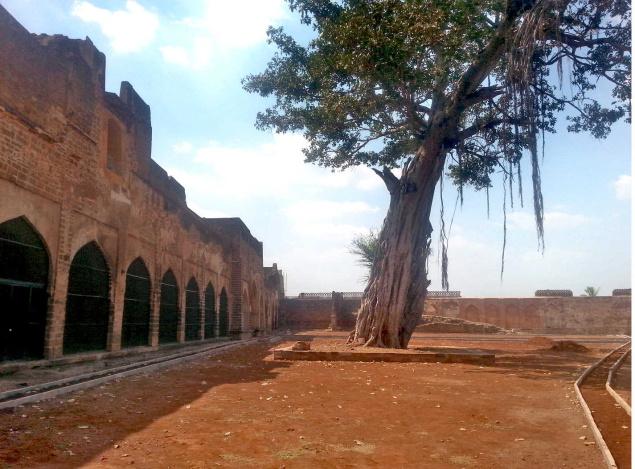
The historical banyan tree inside the Bidar fort.

Campaign by Team Yuva saves a huge old banyan tree from the axe at Bidar fort

Campaigns to save trees are aplenty, but the one taken up by a group of youngsters in Bidar is unique because it is linked to history and a particularly quirky detail of history at that. At the centre of a campaign by Team Yuva is a banyan tree inside the Bidar fort, in front of the Rangeen Mahal. The Archaeological Survey of India (AIS) is rethinking its proposal to cut the tree thanks to this campaign.

The historical importance of the tree dates back to the time of Nawab Nasir Ud Daula Bahadur, the Governor of Bidar appointed by the Hyderabad Nizam. He had created a “department of monkeys” and appointed “monkey inspectors” (Daroga-E-Bandaran). They were supposed to keep a count of the langurs and feed them. Every day at noon, the guards fed the monkeys rotis, fruits and jaggery. This unusual ritual often happened under this tree, says Ghulam Yazdani in the book ‘Bidar: Its History and Monuments’.

The grants given by the Nizam for this purpose, started in early 19th century, continued till Independence.

“Losing the tree is like losing a part of our heritage. We have petitioned the State government, district administration and the ASI,” said Vinay Malge, secretary of Team Yuva. The team has asked ASI to include the tree in their landscaping plans.

Mouneshwar Kuruvatti, Conservation Assistant of ASI at Bidar, said they had asked the Forest Department to assess the health of the tree as it was old and could fall on tourists. “We will take steps to preserve the tree, after consultation,” he said.

Deputy Conservator of Forests S. Dhananjay said the ASI had earlier submitted a requisition to cut down the tree.

“However, we will assess the condition of the tree to see if it poses danger to passersby or nearby buildings. If it can be saved by pruning or by supporting, we will take those steps,” he said.

source: http://www.thehindu.com / The Hindu / Home> News> National> Telangana / by Rishikesh Bahadur Desai / Bidar – March 30th, 2015

Of ‘Shab Deg’, Home-Reared Roosters and Grandma’s Magic

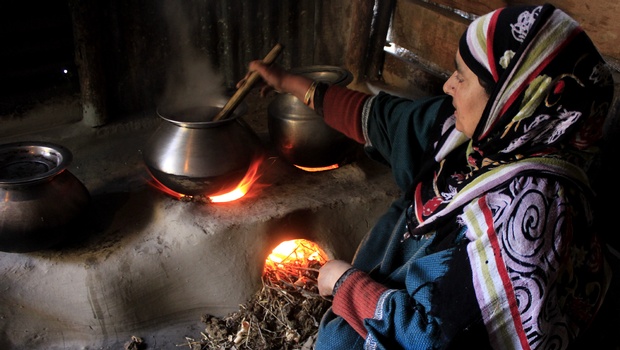
|Kashmiri woman preparing Shab Deg| IANS|
|Kashmiri woman preparing Shab Deg| IANS|

Srinagar :

Hardly anyone among the younger generation of Kashmiris would know what is a ‘Shab Deg’ and yet the mere mention of the word triggers nostalgia and tickles the taste buds of middle and elderly people even today.

‘Shab’ means night and ‘Deg’ means a large cooking vessel. In local parlance, ‘Shab Deg’ means a special dish that is cooked through the night to bring it to the right flavour and thickness. In not very olden times, when Kashmiris still cooked food on firewood-lit hearths, ‘Shab Deg’ was a winter specialty.

Fatima Begum, 75, who lives in north Kashmir’s Haripora village in Ganderbal district, does not only remember the way the specialty was cooked but also recalls the memories of her youth and childhood associated with the dish.

“A heavy, fat rooster of ripe age is feathered carefully so that its skin remains intact. The bird is then cut into pieces depending upon the number of guests or the family members,” Fatima Begum told IANS, adding: “For large families and more guests, two birds weighing around three kilograms each were chosen in my youth when nuclear families had not come into existence.”

“Turnips stored underground for the winter months and called ‘ghoh gogji’ are washed and cut into small pieces. The bird and the turnips are lightly fried in mustard oil and then mixed with red chillies, cardamom, fennel seeds, garlic, onion scales, turmeric powder and salt.

“A little quantity of previously boiled mustard oil is also added with a sufficient quantity of water in the ‘Deg’ before it is sealed with dough. The dish is cooked over a simmering fire through the long winter night. The experience of the grandmother or the well-trained daughter would alone tell when the dish had achieved the right flavour and thickness so that its lid could be removed,” Fatima Begum added.

Haji Muhammad Sidiq, 78, living in Chanduna village of the same district still remembers the special occasions when his mother would cook the ‘Shab Deg’ – when all village roads remained blocked due to heavy snowfall and the only light the villagers of those times knew were oil lamps or kerosene lanterns.

“Mother would call the entire family to the kitchen, which had a cooking and eating space. Beaming with confidence, she would carefully remove the lid of the vessel as all of us held our breath to see if her nightlong toil had produced the desired result.

“The flavour of the dish would fill the entire kitchen and that would prompt us to line up for the feast. It still kindles memories of my youth and childhood,” Sidiq told IANS.

He, however lamented that today’s housewives “have neither the time nor the inclination to take such pains. Plus, where is the traditional hearth and the right heat of the firewood that is needed to make the ‘Shab Deg’ in addition to the heavy, fat, homegrown rooster?” Sidiq wondered.

Interestingly, Kashmiri homes used to have a small poultry farm of their own in those days. Mustard oil was locally available as villagers grew oilseeds in plenty.

“Dependence on markets, the growing tendency of eating out on weekends or dining out with friends and the habit of grabbing fast food on an impulse have made home-cooked food more of a formality and compulsion than an occasion to get together and identify with each other in a joint family system as it used to be in the past,” Farah Qayoom, who teaches sociology in the University of Kashmir, told IANS.

Whichever way one looks at it, unless delicacies like the ‘Shab Deg’ are re-introduced to the younger generation of Kashmiris, feasts like these would become extinct without anyone even batting an eyelid about what has been lost to fast food, cooking gas and microwave ovens.

source: http://www.newindianexpress.com / The New Indian Express /  Home> LifeStyle> food / by IANS / March 26th, 2015

Kerala students steam up world’s longest puttu

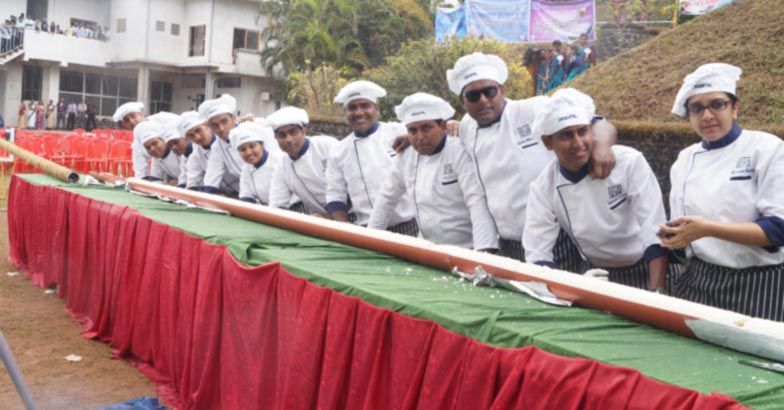
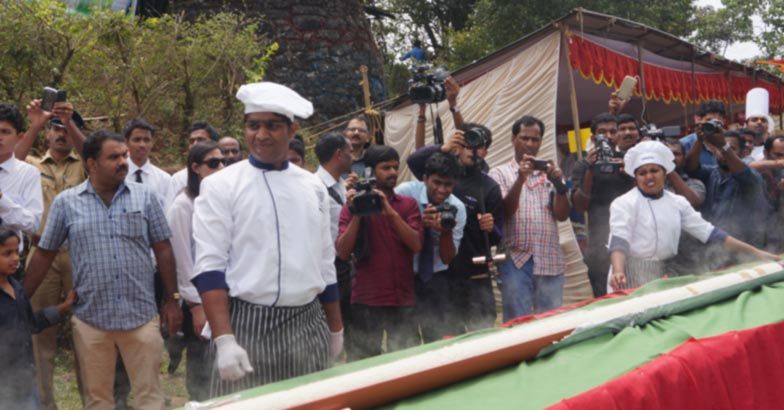
The twelve final year students of Oriental School of Hotel Management in Kerala who made the longest puttu.

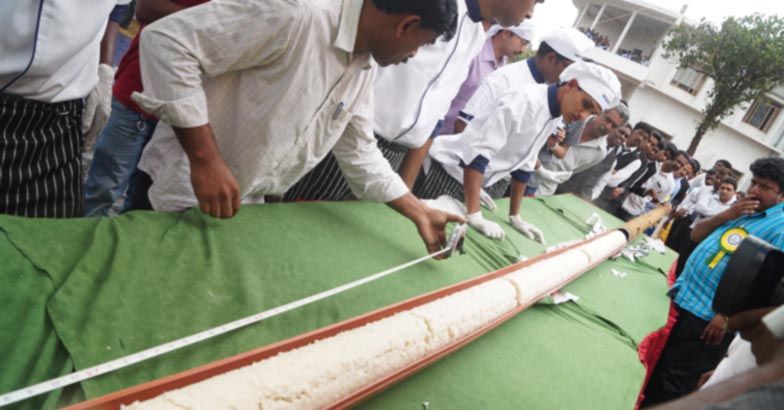
A world record was achieved by making the longest puttu in the world of 18.2 feet, by twelve final year students of Oriental School of Hotel Management, Lakkidi, Wayanad, Kerala. It was held on March 16th, 2015 at 3.00 pm in the campus of the institution. The longest puttu was made as per the guidelines and specifications of the Guinness World Records.

Students standing next to their creation, the longest puttu in the history of puttu in Kerala.

The twelve final year students who etched their names in the World Record attempt are Ms. Syama. M, Ms. Kavya Varghese, Mr. Akhil. B, Mr. Sivajith. S, Mr. Akshay Jain, Mr. Nithin George, Mr. Yadav Gurunathan, Mr. Jobu Ebin, Mr. Ebin Albert, Mr. Umesh. R. Nair, Mr. Jishnu. P. R and Mr. Mohammed Saif, all final year Hospitality Management students under the able guidance of Mr. K. C. Robbins, Principal of Oriental School of Hotel Management.

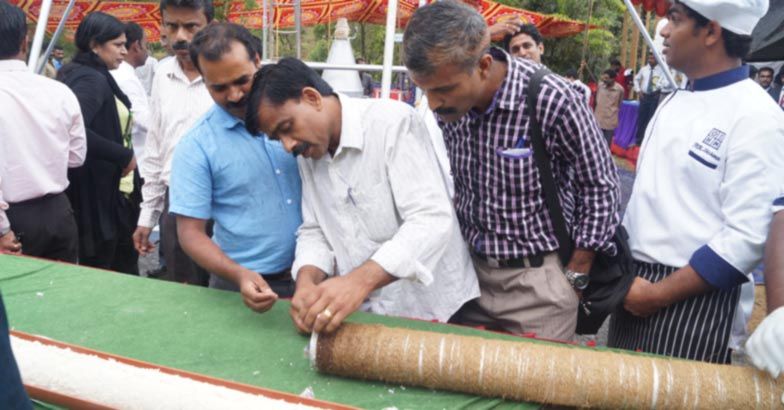
Puttu is an authentic Kerala breakfast dish of steamed cylinders of ground rice layered and blended with grated coconut. The ingredients for making the longest Puttu were 20 kg of ground rice flour, 15 grated coconuts, 15lts of water, salt, and a special equipment mould of aluminum was meticulously designed by the institution to prepare the longest puttu for the record breaking event. The longest puttu weighted 31.87kg.

Twelve final year students of Oriental School of Hotel Management in Kerala have managed to set a new Guinness World Record by steaming up the longest puttu.

 The students took an hour and 15 minutes to prepare the world’s longest puttu and this is the result of days of relentless hard work and detailed planning. The Oriental School of Hotel Management is managed and owned by Malabar Hotel Management and Catering Promotion Trust—a charitable Institution founded by the visionary and social icon—Dr. N. K. Mohammed, the guiding force and inspiration behind the challenging event.

Earlier in 2006, the students of this institution had made a ten feet long puttu by using 10 coconuts and 26 kg of powdered rice in a specially designed 12-foot-long aluminum mould which took one-and-a-half hours to be cooked. (Refer: Wikipedia- http://en.wikipedia.org/wiki/Puttu).

The world's longest puttu being examined at the Oriental School of Hotel Management in Kerala.
The world’s longest puttu being examined at the Oriental School of Hotel Management in Kerala.

 The world record attempt by the students of the institution has surpassed their own previous record, and will be appropriately certified and documented by the Guinness World Records. All the documents and supporting evidence have been sent to the Guinness World Records for appropriate verification and certification.

source: http://www.food.manoramaonline.com / On Manorama / by Correspondent, On Manorama / Home> Food> Foodie / Monday – March 16th, 2015

ASI-protected 14th century tomb gets a whitewash

Defaced- Tomb of Khan Shahid, located inside the Mehrauli Archaeological Park. (TOI photo by Rajesh Mehta)

New Delhi  :

A 14th century monument, Tomb of Khan Shahid, located inside the Mehrauli Archaeological Park was defaced and whitewashed some days ago. The monument, protected by the Archaeological Survey of India, used to be brown in colour. Now it has been painted white. Other smaller monuments in the park have also been encroached upon.

“This monument was notified as ‘protected’ in 2008-09,” said an official with INTACH.

Khan Shahid was the son of Ghiyas-ud-din Balban, the ninth Sultan of the Mamluk dynasty during the Delhi Sultanat period. There are around 60 monuments in the Mehrauli Park, spread over 200 acres. The park’s land is owned by Delhi Development Authority but officials say their responsibility is only to maintain the park. “These monuments are ASI’s responsibility, not ours,” a DDA spokesperson said.

ASI officials were not aware of the monument’s status. “We don’t know whether ASI, Delhi Wakf Board or DDA is responsible for it,” said Deepak Bhardwaj, a surveyor with ASI Delhi.

The tomb could well become a cause of contention between different institutions. As per ASI, DDA is the land-owning agency and even outside the park DDA boards have been put up. However, on the freshly white-painted walls, one could see Delhi Wakf Board written in black.

“We didn’t send any painter to this site. But if it is Delhi Wakf Board property then we have the right over it and repair work can be carried out,” said Rana Siddique, chairperson, Delhi Wakf Board.

The tomb is supported on 12 Delhi quartzite columns and is covered with a vaulted roof of brick and plaster. The enclosure measures 4.85m by 3.85m. Hidden by thick vegetation, it isn’t easily accessible. It is easy to miss the turn leading to the tomb as the small plants market on Anuvrat Marg has encroached upon the pavements and the road leading to it.

The structure had undergone conservation work in 1998 as a part of the INTACH Delhi Chapter under the project on 20 monuments within the area. The columns have engraved capitals and the ceiling has inscriptions, geometric and floral motifs in plaster. All this is now hidden under the white coat of paint. Even the tomb is in shambles and needs immediate repair.

“Last week it came to our notice that the tomb and other small monuments in the enclosure are all painted white. It isn’t even maintained well,” the INTACH official said.

There is a mosque and a graveyard in the same compound. One could see people drying clothes on the roof of another small monument next to the mosque. Some people also live inside the mosque. “We are living here for some years now,” said one of them. The encroachers confirmed that last week two painters came and daubed it in white.

source: http://www.timesofindia.indiatimes.com / The Times of India / Home> City> Delhi / by Maria Akram, TNN / March 17th, 2015

DOWN MEMORY LANE – Talk about a tomb

SafdarJungMPOs16mar2015

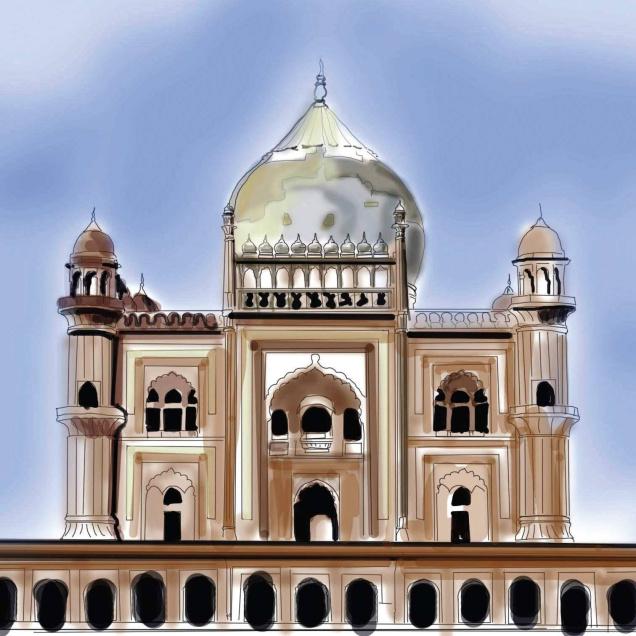
Nawab Safdarjang’s tomb used to be a place of halt for the Tazia procession from the Walled City before it ended at the Karbala in present-day Jorbagh

Many have admired Safdarjang Tomb as the last flickering lamp of Mughal architecture but it was left to Dulcie Hamilton, a passing-by travel writer from Melbourne, to remark that it was like “an inverted lotus, just the opposite of the latter-day Baha’i Lotus Temple” (in an age when the Lotus symbol is politically abloom). Both the structures incidentally have an Iranian link as the founders of the Baha’i faith, the “Bab” and Bahaullah belonged to Iran while Nawab Safdarjang also had Iranian antecedents. For this reason, his last resting place occupied pride of place in Jorbagh, the Shia cemetery that extended up to it at one time and was second in importance only to the (Hazrat Ali) Qadam Sharif shrine set up by Qudsia Begum, the wife of Mohammad Shah in the 18th Century. Safdarjang was the Vazir at her husband’s court and later that of her son. It should be no surprise, therefore, that the tomb took pride of place during the Moharrum mourning for Imam Hussain.

The tazia processions that came from the Walled City made their first halt at the palace of Mahabat Khan, behind his contemporary Abdun Nabi’s masjid in the present ITO area and the next one at Safdarjang’s Tomb before finally ending at the Karbala. Mahabat Khan’s mahal does not exist now but his grave is there in Jorbagh.

Another interesting fact that few know about is that Safdarjang’s first Urs or death anniversary saw many Shia divines arriving in Delhi from Oudh and surprisingly enough, a qawwali was also held at the behest of his son and successor, Nawab Shujauddaulah who was reputed to have the longest moustaches in the Mughal empire. He aided Ahmed Shah Abdali in the third Battle of Panipat in which the Maratha confederacy led by the imperious Sadashiv Rao “Bhau” lost. After that Shujauddaulah’s clout in the Mughal durbar increased with the arrival in Delhi from Allahabad of Shah Alam (designated emperor by Abdali).

Safdarjang’s mausoleum, designed on the pattern of Humayun’s Tomb, is a poor imitation. The three-storey tomb in fawn-coloured stone also bears a faint resemblance to Akbar’s mausoleum at Sikandra, but lacks the magnificence of the latter. Even so it is an interesting monument, situated amidst a garden of 300 square yards, and enclosed by a wall at the corners of which stand octagonal towers and a central dome, rising above a 16-sided drum.

Arcaded pavilions, named Moti Mahal, Badshah Prasad and Jangli Mahal, have been, constructed on the northern, southern and eastern sides, like the pavilions in the outer quadrangle of the Taj. It is believed that these were meant for the accommodation of nobles who visited the mausoleum. The tomb has a carved cenotaph in the central chamber within which is another chamber containing two unmarked graves, both with earthen mounds above them. In it lie buried Mirza Muquin, Abul Mansoor Khan Safdarjang, and his wife Banu Begum. The monument was built by Shujauddaulah at a cost of Rs.3 lakhs with a lot of marble and other material being pinched from the mausoleum of the Khan-e-Khanan and other Mughal buildings.

Safdarjang was the head of the Shia Irani Party at the court of Ahmed Shah (1748-1754). His opponents were the leaders of the Sunni Turani party headed by Imtiaz-uddaulah and Imadad-ul-Mulk. Safdarjang, who had succeeded Burhan-ul-Mulk as Nawab of Oudh, died at Faizabad in 1754 and his body was brought to Delhi, for though he had to leave the Mughal court in disgrace after trying to play kingmaker, he nevertheless pined for his days of grandeur in the Capital and desired to be laid to rest there. His mausoleum has a mix of Mughal, Rajput, Iranian and Egyptian architectural patterns jostling for space.

Even so, it attracts a lot of tourists but these days, the water channels – a notable feature – are dry which is a turn-off. The renovation work has been done only on some portions with others are still badly in need of repairs. When one visited the tomb recently under overcast skies, one wondered if yesteryear music ‘mehfils’ could be revived and tazia processions made to converge on it either at Moharrum or Chhelum for the halim dish break that used to replenish the fatigued ‘Akharas’ or sword and lathi-wielding squads in the past. One thing that Safdarjang couldn’t have dreamt about is that 261 years after death his memory would be enshrined not only in the Maqbara but also in the airport, road, hospital and enclave named after him by a generous posterity which only has a nodding acquaintanceship with him.

The author is a veteran chronicler of Delhi.

source: http://www.thehindu.com / The Hindu / Home> Features> MetroPlus / by R.V. Smith / March 15th, 2015

How he built a biryani empire

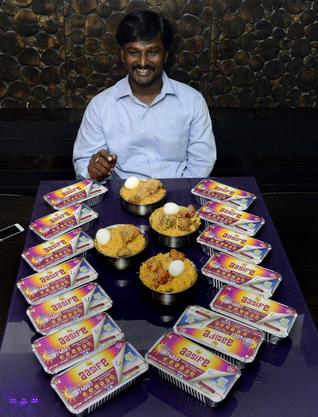
Y. Aasife Ahmed, managing director of Aasife Biryani. Photo: M. Vedhan / The Hindu

From a pushcart to a chain of plush restaurants…the author gets a whiff of Y. Aasife Ahmed’s success

Y. Aasife Ahmed was not much for bookish learning. “I knew what I was passionate about, and I set about pursuing my dream,” he says. And so at 18, he apprenticed with a biryani cook and later started his own wedding catering business.

Even then, he had his eye set on something much bigger, something he hardly dared to dream of, but he set about working towards it anyway.

What started with five kg of biryani on a thallu vandi (pushcart) on Butt Road in St. Thomas Mount 15 years ago has now grown to 500 kg of biryani per day, served out of four Aasife Biryani Centre outlets all around the city, the latest one being on Anna Salai.

“From the pushcart we moved to a hole-in-the-wall. We still serve take away from that shop. We then expanded across the road,” says Aasife, seated in the well-appointed lobby of the Alandur branch one evening.

I tell him I have fond memories of cycling down the road on my pink Ladybird to pick up biryani and kothu barotta for lunch.

His face lights up as he says, “You must have seen me there then; I was always behind the counter! It is good to meet old customers. In fact, there is one person who has been a regular from the beginning, and he still dines at our outlet frequently. It is the most satisfying feeling.”

While the shop was established as Aasife and Brothers, they have now parted ways. “My two brothers have diversified into other businesses. They do not share the same love for biryani or the potential I see here,” he shrugs, gesturing to the restaurant filled with chattering diners and customers waiting for their take-away orders.

He has hired the same architect and design firm to work on all his upcoming restaurants. They open in Kilpauk this month and in Nungambakkam the next.

But his pet project is the one on OMR. The 39-year-old’s soft-spoken and calm demeanour is replaced by a palpable excitement when he talks about it: “We have five floors, each with a different concept. The kitchen will take up an entire floor, and another will have a floating restaurant. There will also be a large play area for children. I want it to be the biggest restaurant in the country when we launch in May or June this year.”

Aasife’s mantra for both his cooking and his business is quality. “The ingredients should be of the best quality; even if one ingredient is not good, it will ruin the taste. Also, diners want to see a well-maintained restaurant. They care about the ambience, and so my staff are trained to ensure that every nook and corner is cleaned throughout the day. I am lucky to have such a great team of managers who know exactly what my expectations are and carry it out to perfection,” he says.

It is a good thing his favourite food is biryani, mutton in particular, and although he does not cook as much as he used to when he started the business, he does several taste tests a day.

“I go to the gym for an hour every morning. After that I visit the centralised kitchen in Guindy, and each of the outlets. I ask for whatever negative feedback has been received, and we set about rectifying them as quickly as possible,” he says.

Walking around the Anna Salai branch just before opening time on a weekday afternoon, Aasife draws my attention to the wall.

“Our speciality is that we use wood fire to make our biryani. As a tribute to that, we cut up our firewood logs and incorporated that into our decor,” he says proudly, running a hand over the now varnished wood.

“Although this is the newest branch, I feel like I have arrived on the scene with this restaurant. It is just the beginning for me.”

Apart from biryani, Aasife’s other love is cars. “Right now, I drive an Elantra. I would love to get some of the best and fastest cars available,” he says with a grin. But those can wait: right now, his plan is to take over the Chennai biryani market by 2016.

He does, of course, talk of his three children — a girl and two boys — with a lot of tenderness.

“I hope that one day they will take over what I have started here. I want this to be my legacy to them. Although it is my passion, I am doing this for their future as well.”

source: http://www.thehindu.com / The Hindu / Home> Features> MetroPlus / by Susanna Myrtle Lazarus / March 08th, 2015

Biriyani that Royalty relishes

Created at Sri Kanteerava Narasimharaja Wadiyar Sports Club, Mysuru

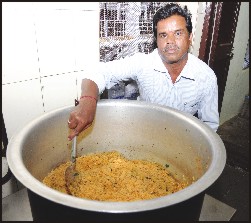
Narayan is seen preparing the famous mutton Biryani at Mysore Sports Club

by S.N. Venkatnag Sobers

In his recent interview to The Sunday Times, Yaduveer Krishnadatta Chamaraja Wadiyar, who has been adopted to the Mysore Royal Family of Wadiyars, when asked about his favourite food said, ‘‘I cannot say I have a favourite. But, if cornered, I would probably have to go with the famous Biryani from the Mysore Sports Club.”

In fact, he is not alone. Thousands of Mysoreans have been relishing the famous mouth-watering mutton biryani at the Mysore Sports Club over the past few decades.

The man behind the famous mutton biryani is Narayan, who has been working at the Mysore Sports Club for the past 32 years. Wanting to discover the man who created a Biryani that satiated the royal palate, Star of Mysore went to Sports Club to talk to this master chef. He is Narayan.

Speaking to Star of Mysore, Narayan said that members of the Royal Family including late Srikanta Datta Narasimharaja Wadiyar, Chaduranga Kantharaj Urs, Gayathri Devi, Yaduveer Krishnadatta Chamaraja Wadiyar and others were fond of the biryani cooked by him.

Mysore Sports Club introduced Mutton Biryani to its guests in 1989 and since then, it has been relished by many. Earlier to this, cooks from outside were invited to prepare biryani during events organised at the club.

Narayan said that he learnt the art cooking biryani through his guru Abdul Sattar, who lived in Mandi Mohalla.

“When I joined the Sports Club as a kitchen assistant, the then Secretaries B.A. Nanaiah and Dr. N.M. Srinivas encouraged me to learn the art of cooking biryani and since then, I have been cooking the delicacy,” he said.

Speaking about his cooking style, Narayan said that he starts preparing for biryani at around 12 noon by marinating mutton and adding necessary masala. Once the mutton is cooked, the half cooked basmati rice is added to mutton and is kept for blending for about one-and-a-half hours. Later, the hot biryani is served to the guests at the Club from 7.15 pm.

Everyday around 15-20 kg mutton biryani is prepared at Mysore Sports Club and not bit of it remains in the end. In fact, the biryani is so famous that even the non-members of Mysore Sports Club do not miss out a chance tickling their taste buds whenever they get an opportunity to visit the club. In fact most of the non-members demand the club members not to book them rooms at the Club but for a parcel of mutton biryani.

Given an opportunity, one must visit the Mysore Sports Club to savour this gastronomic delight.

source:http://www.starofmysore.com / Star of Mysore / Home> Feature Articles / Thursday – March 05th, 2015

Now, a women’s sport too

Women, who participated in the kite flying training programme on Sunday on Kozhikode beach, trying to control a kite.— Photo: K. Ragesh

It takes eight to 10 men to control the 1,000-kg circular kite of the One India Kite team. Founder of the team Abdulla Maliyekkal was quite apprehensive when he gave the reins of the kite to a group of women . His apprehension was not misplaced considering how the women struggled with it initially, but it gave way to happiness watching the first professional all-women kite team in the country take form.

The team named ‘Incredible India’ was launched on the Kozhikode beach on Sunday, on the occasion of International Women’s Day.

Training in style

Supported by their parent group One India Kite Team, the women who have undergone training in the nuances of kite flying, took off in style flying the Circular kite and the Kathakali kite amidst the curious Sunday crowd on the beach. “This is the most relaxing experience I have ever had. Controlling a kite is not child’s play. It takes great coordination and team work. Hence while flying the kites, we forget everything else,” said Mini Nair, team captain.

The team now plans to take part in kite festivals across the country and abroad where they plan to present some kites of their own.

As part of the launch of the women’s team, the One India Kite Team, in association with the women’s wing of Junior Chamber International, Calicut, had organised a kite-flying training programme for women, which was attended by 25 women. “The training was given by expert kite flyers Abdulla Maliyekkal, Hashim Kadakkalakam and Shyam Padman.

source: http:// www.thehindu.com / The Hindu / Home> News> National> Kerala / by Aabha Anoop / March 09th, 2015

Sommer House: Tales from the jazz age

SommerHouseBF09mar2015

Bengaluru: 

Back in the 1950s, when Bangalore was like something out of a F. Scott Fitzgerald bok, Whitefield was a small township on the outskirts of the city. On arriving at the railway station, one took a horse-drawn carriage home through the small, winding streets. It wasn’t long, however, before development put paid to much of that old world charm.

The Sommer House, a colonial bungalow that has been restored to its former beauty by long-time resident Sulaiman Jamal, aims to recreate some of that old world charm. Thrown open to the public on Monday evening, as a community center that gives senior citizens and retired army officials that long lost society whirl, Jamal, whose association with the area began when he set up his factory there said: “We have lived in Whitefield for ten years now, but when I first visited, it was a pretty wild place,  Every six months, another bungalow would be torn down.”

The two-bedroom gabled roof Sommer House, bought two years ago by Jamal, replete with antique furniture, is home to a piano that belonged, back in the day, to the Defence Services Cinema. The cottage, sits surrounded by a garden, with restored vintage cars dotting the property.

Jamal would like the House to host programmes like piano nights, dancing, catered dinners and plays. Most importantly, it will also have a free catered dinner every month for senior citizens.
Beth Chapman, Pre­sident, Overseas Women’s Club, has helped put Sulaiman’s ideas in motion.

“I’m always looking for old bungalows and the stories that surround them,” she said.
“The house is opposite Forum Value Mall and people expected a superstructure here,” Sulaiman explained. “They wonder what the catch is, but there is none. We want the people of Whitefield to feel a sense of belonging with what is now a community center.”

source: http://www.deccanchronicle.com / Deccan Chronicle / Home> News> Current Affairs / DC / Darshana Ramdev / June 18th, 2013