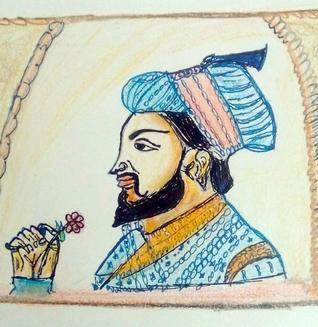
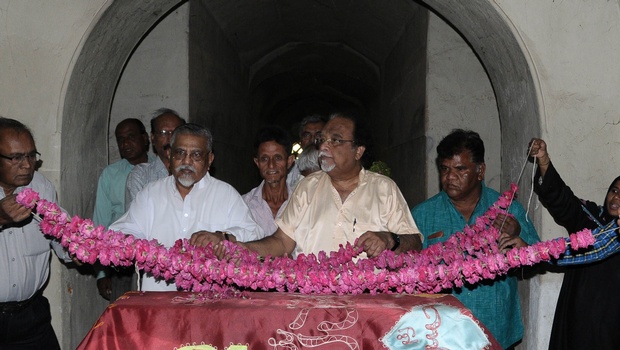
In a “historic” decision, the Samajwadi Party government has renamed the Lucknow Prani Udyan, popularly known as Lucknow zoo, as “Nawab Wajid Ali Shah Prani Udyan, Lucknow,” making it the first official move-since Independence – to name a monument after a Nawab of Oudh, or Avadh (roughly corresponding with Central Uttar Pradesh ). Nawab Wajid Ali Shah was the last Nawab of Oudh before the province was annexed by the British under the policy of Doctrine of Lapse in 1856. He was banished to Matia Burj in Bengal.
Bird sanctuary too renamed
Another first was the decision to rename the Nawabganj Bird Sanctuary in Unnao district after revolutionary freedom fighter Chandra Shekhar Azad. The bird sanctuary will now be known as “Shaheed Chandra Shekhar Azad Pakshi Vihar, Nawabganj.”
Though Chandra Shekhar Azad was born in Alirajpur district in Madhya Pradesh (July 23, 1906), his father, Sitaram Tiwari, belonged to Badarka village in Unnao district. It was on account of his parental ties with Unnao district that the bird sanctuary has been named after him.
These decisions were taken at a Cabinet meeting presided over by Uttar Pradesh Chief Minister, Akhilesh Yadav on Tuesday.
The Lucknow Zoo was established in 1921 and was named after England’s Prince of Wales as “Prince of Wales Zoological Gardens.” It was renamed as Lucknow Prani Udyan on June 4, 2001.
The State Cabinet further approved the cancellation of the agreement for handing over the power distribution in Kanpur city to Messrs. Torrent Power Limited, Ahmedabad. An official spokesman said the deal was called off through mutual understanding.
Laptops for bright students
The proposal to distribute laptops to meritorious students of high school and Intermediate examinations conducted by UP Madhyamik Shiksha Parishad, Central Board of Secondary Education and the Indian Council of Secondary Education in the year 2015 was also approved by the Cabinet.
Another important Cabinet decision pertained to the demolition of three temporary structures on the service road near bungalow Number 13 in Mall Avenue (former Chief Minister Mayawati’s official bungalow).
source: http://www.thehindu.com / The Hindu / Home> National> Other States / by Atiq Khan / Lucknow – June 24th, 2015
If Malappuram’s collective heart beats for anything, it is for football — a sport that has grown to conquer the land like no other. And with Copa America, the oldest international continental football competition, already under way in Chile since Friday, it is no wonder that soccer-crazy fans in Malappuram are a restless lot.
Unable to find contentment in just watching the tournament on television, football aficionados in Therattammal — a rural Malappuram village which has moulded several national players like U Sharafali, Sakker Ahammed and K Jaseer — are gearing up for a local version of Copa America.
Starting next week, 12 teams from neighbouring villages in the region would represent the teams participating in the South American tournament and the winners would take home a cup designed just like the one for Copa America.
Besides, football clubs and fans associations across the district are busy organizing small tournaments, hoisting banners and erecting flex boards. Flags and jerseys of prominent teams are also up for sale at Manjeri, Malappuram, Tirur, Perinthalmana, Kondotty, Areekode and Nilambur towns. The flags of Brazil and Argentina, the most popular teams in Malappuram, can be seen fluttering in the streets. Close on their heels are other favourites Chile, Uruguay and Mexico.
Musthafa, a native of Cherumuku near Tirurangadi and a die-hard Brazil supporter, said Brazil fans’ association is already campaigning hard for their team. “We are sure that Brazil will perform well to compensate the defeat against Germany in the semi-final match of the World Cup,” he said.
“Villages and towns here are in a festive mood, organizing various activities in support of their favourite teams,” said Muhammed Saleem, secretary of Malappuram district football association. With ardent supporters of non-playing teams like Germany, France, Spain and Italy also joining the celebrations, the excitement of fans has reached a crescendo.
Local clubs had set up big screens and televisions at several spots where enthusiasts of all ages gathered in the early hours of each day to watch matches.
It, however, remains to be seen if the monsoon showers or Ramzan fasting would dampen the prevailing high spirits.
source: http://www.timesofindia.indiatimes.com / The Times of India / Home> City> Thiruvananthapuram / by T.P. Nijeesh, TNN / June 14th, 2015
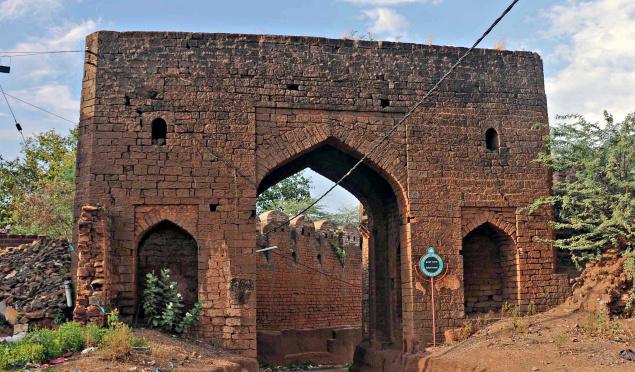
While the eastern gate of Bidar fort has long been called ‘Dulhan Darwaja’ (Bride’s Gate), scholars say it is ‘Dalhan Darwaja’ (Bullock Cart Gate).
This is the curious case of how the pronunciation of a word can lead to the creation of parallel historical narratives. Stories spun around an ancient door in Bidar are testimony to this.
The eastern gate of the Bidar fort that leads to Ashtoor village — the royal necropolis of the Behmani kings — has long been called ‘Dulhan Darwaja’ (Bride’s Gate). Dark and gory stories have been passed down through the ages of a cruel king called Sabbal Barid, who claimed every bride in the city for himself on her wedding day. The brides chosen by the king came in through this door. Scholars, however, have demystified the legend arguing that the name of the gate is ‘Dalhan Darwaja’ (Bullock Cart Gate). They say it got its name simply because it was only large enough to allow a bullock cart to pass through, and not a chariot or elephants.
“The confusion must have started with the translation of the book Tareek-e-Firishtah (History by Firishtah) by the court historian of Bijapur, Adilshahi Kingdom, written in the 16th Century,” said Abdul Samad Bharati, a Persian scholar.
“Some portions of his book were translated into Urdu by Sheikh Mohammad, and in English by John Briggs. The Persian book seems to have used the letters ‘u’ and ‘a’ interchangeably. But the British author used ‘u’ instead of ‘a’,” he said. The trend seems to have continued in Urdu too, says Mohammad Shafi, a poet. Though the stories about Sabbal are widely circulated, there is no proof that there was indeed a king by that name, adds Mr. Bharati. Ghulam Yazdani, in his seminar work ‘Bidar: Its history and monuments’ refers to this gate in detail and states it has nothing to do with any bride.
While the eastern gate of Bidar fort has long been called ‘Dulhan Darwaja’ (Bride’s Gate), scholars say it is ‘Dalhan Darwaja’ (Bullock Cart Gate)
source: http://www.thehindu.com / The Hindu / Home> News> National> Karnataka / by Rishikesh Bahadur Desai / Bidar – June 18th, 2015
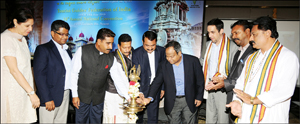
Soheb Samad, Regional Director, Southern Region of India Tourism (fourth from right ), is seen inaugurating the two-day Convention of Tourist Guides organised by the Tourist Guides Federation of India (TGFI) at Hotel Radisson Blu in city this morning. Others seen are (from left) former TGFI Vice President Anahita Tarapore, S. Mahalingaiah, President of Indian Association of Tour Operators, TGFI President Narendra Singh Rathore, Executive Committee member Sudhakar Embar, General Secretary Dr. Ajay K. Singh, Mikael Delafuente, Regional Director, Alliance Francaise de Bengaluru, Dr. Arun Raj, Superintendent of ASI, Bengaluru and Ramakrishna Aithal, President, Tourist Guides’ Association of India
Mysuru :
The two-day 18th annual National Convention of Tourist Guides organised by the Tourist Guides Federation of India (TGFI) began at Hotel Radisson Blu Plaza in city today.
Inaugurating the convention, Soheb Samad, Regional Director, Southern Region of India Tourism, said that 7.02 million foreign tourists visited India, thus giving a boost to the tourism industry. India Tourism has launched Athiti Devobava programme to attract more tourists from abroad, he added.
Stressing the role of tourist guides and stakeholders in tourism industry, Soheb Samad said Yoga and Medical Tourism had put Mysuru and Karnataka on the world tourist map. The tourism industry has generated 9 percent employment in the country, he added.
Samad said the tourist guides should give correct information and image of the country when explaining to tourists and added that the Ministry of Tourism has been imparting training for the tourist guides to enhance their language and knowledge.
Pointing out that learning is a continuous process in tourism industry, he said that the Ministry would consider the protection and welfare of tourist guides on priority basis. The tourist guides should aim at providing quality service to the tourists, he added.
Speaking on the occasion, Dr. Arun Raj, Superintendent of Archaeological Survey of India (ASI), Bengaluru, said that the tourist guides were the ‘Real Ambassadors’ of India, adding they should update their knowledge by attending refresher courses in tourism. ‘Every tourist guide should know the tangible and intangible history of the land.’
As many as 170 tourist guides from all over India are participating in the two-day National Convention. TGFI President Narendra Singh Rathore, former Vice President Anahita Tarapore, Vice President K. Monikantan, General Secretary Dr. Ajay K. Singh, Mikael Delafuente, Regional Director, Alliance Francaise de Bengaluru and others were present.
source: http://www.starofmysore.com / Star of Mysore / Home> General News / Saturday – June 13th, 2015
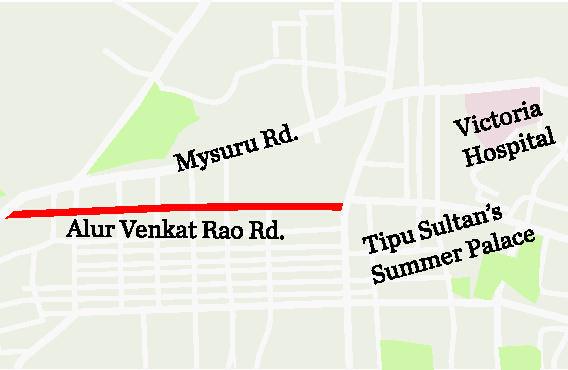
Is it Albert Victor Road or Alur Venkat Rao Road? Whatever the name, there now is a proposal to rename this road as Tipu Sultan Palace Road.
The main road in Chamarajpet is in the midst of a renaming storm. While the BJP-Karnataka unit has opposed the proposal to rename the road again, the Bruhat Bangalore Mahanagara Palike (BBMP) is now wondering when the road was renamed as Alur Venkat Rao Road in the first place.
It so happens that neither the BBMP nor the Department of Posts have any records that show when the road was named after Alur Venkat Rao.
Noted city historian Suresh Moona said that the road was popularly known as A.V. Road. “The initials A.V. stand for both Albert Victor and Alur Venkat Rao. The road was named after Prince of Wales Albert Victor to commemorate his visit to the city to inaugurate the Glass House in Lalbagh. It was probably renamed in the late 1960s and early 1970s when a number of roads that had Colonial names were rechristened,” he pointed out.
On Monday, a delegation from BJP, including MP P.C. Mohan, MLC Ashwathnarayan, city MLAs S. Suresh Kumar, B.N. Vijaykumar and Jagadeesh Kumar, submitted a memorandum to BBMP administrator T.M. Vijaybhaskar and urged him to drop the proposal to rename the road. Their contention was that renaming the road would be an “insult” to Alur Venkat Rao, who led the Karnataka unification movement.
Conceding that the BJP-led BBMP council that passed the resolution to rename the road had not followed the protocol, Mr. Suresh Kumar told The Hindu that the BBMP should examine all proposals closely before clearing them. “
N.R. Ramesh, former Ruling Party Leader who proposed the renaming, said that during the last meeting of the BBMP council, over 30 road renaming proposals were approved by the council. The proposal to rename the main road in Chamarajpet was not in the agenda initially. “It was proposed based on a letter submitted by a private organisation. The letter did not mention that the renaming was for the Alur Venkat Rao Road,” he said.
Who is Alur Venkat Rao?
Bengaluru: Alur Venkat Rao, who is known as Karnataka Kulapurohita, was the leading figure of the Karnataka unification movement. He was also an eminent historian, a dedicated writer and journalist. He made use of the press to achieve the cause of Karnataka. When he started editing and publishing the newspaper ‘Jaya Karnataka’, he declared in its very first edition that the sole aim of the newspaper was to strive for Karnataka’s statehood.
Protocol for renaming roads
Bengaluru: Every time a road or an area is renamed, questions are raised over the procedure and logic behind the process. Names can be mooted by anyone, either the public or the BBMP council. The proposal for renaming is then published in newspapers and objections are invited. On receiving objections, they are discussed in the council for approval. In the absence of a council, the administrator takes a decision. The approved resolution is moved to Urban Development Department, Government of Karnataka which renames places in the city, an official said. After this, an intimation about the same is sent to the Department of Posts.
Previous cases of controversy
S.K. Karim Khan Road: Indiranagar 100 ft Road was renamed after the Kannada folklorist S.K. Karim Khan in 2014, even though a resolution about the same was taken in 2006.
Narasimha Raju Road: Though a road in Palace Guttahalli was named after the actor, another road (from ISKCON to Mahalakshmi Layout Swimming Pool) was named after him.
source: http://www.thehindu.com / The Hindu / Home> News> Cities> Bengaluru> by Chitra V. Raman / Bengaluru – June 02nd, 2015
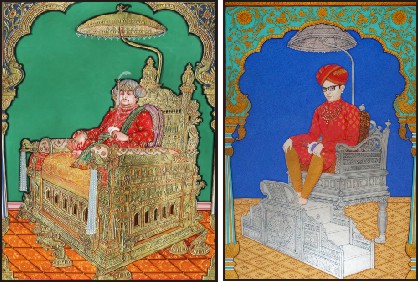
1) Mysore style portrait painting of Srikanta Datta Narasimharaja Wadiyar seated on the Golden Throne based on the 2013 Khas Darbar. Artist: K.S. Shreehari, 2014. Size: 41×51 cms. Collection: Ramsons Kala Pratishtana, Mysore. 2) Portrait painting of Yaduveer Krishnadatta Chamaraja Wadiyar seated on the silver Bhadrasana. Artist: Manish Verma, 2015. Size: 37×51 cms. Gouache on paper. Collection: RKP, Mysore.
by R.G. Singh, Secretary, Ramsons Kala Pratishtana, Mysore
Peacock pavilion of the Mysore Palace is where the coronation of the new Scion of the Mysore Royal family is scheduled to be held tomorrow. In the hall adjacent to this pavilion is the portrait gallery that has on its walls the official portraits of several Wadiyar rulers along with their family members. It is here that one begins to realise the importance that a royal portrait played in private and public life of the nobility.
Nalwadi Krishnaraja Wadiyar IV
But it was also special events that were to be immortalised on canvas or photographed or painted. The Daly Memorial Hall of the Mythic Society in Bengaluru greets the visitor with a portrait officially commissioned of Nalwadi Krishnaraja Wadiyar IV on the him being conferred the honour of Knight Grand Commander Star of India on January 1, 1907.
The oil on canvas portrait shows the king partly in profile. The Honour is pinned to a sash. The bejewelled necklace covering the neck of sherwani only adds to the richness of the attire. The fluted and feathered plume with a jewelled brooch holding it in place to the turban also adds to the portrait’s grandeur.
11-year-old Krishnaraja Wadiyar IV
Royal portraits have hidden sutras embedded in them that takes the viewer back in time. The Official Coronation portrait of the 11-year-old Krishnaraja Wadiyar IV is one such portrait.
This is a stylised photographic portrait and has several artfully placed emblems; the jacquard seat of the chair, the three-legged table with a curved triangular holder, a clock and some leather covered folders. The young prince is shown resting one hand on them while the other is on his hip. A Beagle stands motionless under the table.
Photographer Buranuddin of Mysore has used all possible elements that signify royalty in composing this photograph.
Nalwadi Krishnaraja Wadiyar
The autographed official photograph of Nalwadi Krishnaraja Wadiyar to mark the Silver Jubilee of his coronation in 1927 shows the then King dressed sombrely resting one hand on the back of a chair. The single-row bejewelled necklace and the chain and fob in the upper coat pocket add a touch of elegance. Even the Mysore peta is unembellished. The photograph was printed in Germany on water-marked archival paper.
Chamaraja Wadiyar
Another painting at the Jaganmohan Palace is the coronation scene of Maharaja Chamaraja Wadiyar. The painting was created by the artist Venkata Subbu in 1868.
There is an official portrait of Chamaraja Wadiyar on being conferred with the Knight Grand Commander of the Order of the Star of India in 1892. The above photograph reproduced here was ‘clicked’ by the famous Raja Deen Dayal of Hyderabad.
While the English royalty painters used pastoral themes their Indian counterparts used the very ‘Indianness’ of such public events of those days to display their virtuosity.
For instance, the 1927 Silver Jubilee of Nalwadi’s coronation has been commemorated with a beautiful portrait done by artist Keshavaiah; this masterpiece is on display at the Banquet Hall of the Vidhana Soudha. Interestingly, the advent of photography did not deal a death knell to the art of portrait paintings. Instead it led to another innovation – the painted photograph.
Jayachamaraja Wadiyar
By the time Jayachamaraja Wadiyar ascended the throne, both photography and painted photographs were very much in vogue. But such was the ingenuity of the Indian photographers that their photographs of the Royalty was a marriage of these several stylisations. Thus you have photographs of Jayachamaraja Wadiyar shown in what was supposed to be a candid form. At various times you had special photographs of Jayachamaraja Wadiyar ‘clicked’ by the then well-known City Studios like Star Studio, Palace Studio and Raj Studio. The variation was of course the painted photograph of Jayachamaraja Wadiyar by M.N. Murthy.
The photograph taken by the unknown photographer of Palace Studios of Jayachamaraja Wadiyar in 1940 to commemorate the king’s coronation has been replicated as a painted photograph by artist M.N. Murthy and is now in the RKP collection. But at no stage did photographs or painted photographs replace the portrait painter.
The tradition of painting historical events continues to this day. The last scion of the Royal House of Mysore, the late Srikanta Datta Narasimharaja Wadiyar along with his sisters and their husbands have been painted as several individual portraits by M. Ramanarsayya, the former Superintendent of Jaganmohan Palace.
Keeping the art of Painted Portraits alive
Ramsons Kala Pratishtana, in its efforts to keep alive the art of painted portraits, first commissioned artist K.S. Shreehari in 2014 to paint a classical portrait of Srikanta Datta Narasimharaja Wadiyar in the Mysore style (see pic. top right) based on photographs of 2013 Navaratri Khas Darbar.
This was followed by commissioning artist Manish Verma to recreate a Mysore style painting using a photograph of the Yaduveer Krishnadatta Chamaraja Wadiyar. This classic Mysore style portraiture shows the young scion accoutred in his royal vestments and Mysore peta adorning his head while his posture follows the classic from that can be seen in many of the older Wadiyar portraits. He is seated on the silver Bhadrasana which suggests that he has just been invested with the (symbolic) royal authority of Mysore Kingdom.
source: http://www.starofmysore.com / Star of Mysore / Home> General News / Wednesday – June 02nd, 2015
The observance of the death anniversary of Shah Jahan and Mumtaz Mahal still fascinates people
The 360th Urs or death anniversary of Shah Jahan was observed at the Taj Mahal last week, but there were ripples of it in Delhi too with a busload of people reaching there to pay homage to the Emperor. Mohammad Saquib of Suiwalan was one of them. He has been attending the Urs for years as one of his ancestors was among the artisans who worked on the inlay work at the mausoleum, or so he claims. Another interested visitor was Shahnawaz Khan of Basti Nizamuddin who went for the first time to offer fateha in observance of a vow. Earlier Khan Abdul Haye Khan was a regular Delhiwallah who never missed the Urs. Abdul Haye was a Pathan who was very fond of fishing. One remembers that in 1966 during the monsoon he sat down on the rear side of Etmad-ud-Daulah to fish in the Yamuna, which was in flood and whose waters were beating against the mausoleum where rests the father of Nur Jahan and grandfather of Mumtaz Mahal. A rohu caught by Abdul Haye was so big that it sufficed for dinner for the whole family when cooked in Matia Mahal.
Shah Jahan like the unlucky Mohammad bin Tughlak was fond of Yamuna fish and so also presumably Mumtaz Mahal, but he did not drink wine till the age of 23 when he was persuaded by his father, Jahangir to do so. He however, never drank after the death of Mumtaz at Burhanpur on 16th June 1631. Accordingto Dr Ishwari Prasad, Shah Jahan died in January 1666 aged 74. Why his Urs was celebrated in mid-May is not understandable unless the date is fixed according to its proximity to Mumtaz Mahal’s death or some lunar calculation or as per the convenience of the khadims (caretakers). One remembers attending an Urs in 1958 when among those who prayed for the Emperor’s soul was Nawabzada Farouqur Rehman Khan of Datoli. Earlier the Nawab of Chhatarhi, Chief Scout of India and Freemason Grandmaster, had offered his obeisance. The first Urs of Shah Jahan, a year after his death, was presided over by Prince Muezzim, eldest son of Aurangzeb, who came from Delhi partly on horseback and partly in a horse-driven carriage, past Akbar’s Tomb at Sikandra, where he dismounted to offer fateha at the grave of his great-great grandfather. Aurangzeb came a month later. The same thing happened at the first Urs of Mumtaz Mahal at the Taj after Shah Jahan’s death.
A special feature of the Urs of Shah Jahan, which was later merged with the Urs of Mumtaz Mahal, is the laying of a gigantic multi-coloured Hindustani Chadar at the grave. This was offered on Friday May 17, with the Urs continuing on the subsequent Saturday and Sunday. Entry to the Taj was free from the afternoon of Friday (which is usually a closed day for visitors). The shehnai was played, along with the naqarra drum, at the top of the main entrance to the monument and on the following days the big kettle drums were beaten to mark the occasion, as in Mughal times when Shah Jahan is believed to have once remarked to Mumtaz: “Naqqare tumhari amadh ka ailan karenge aur tum Manno Malika kehlaugi” (The drums will announce your arrival and you dear will be called Emperess). Not much information is available of the first Urs of Shah Jahan but the one for Mumtaz Mahal is recorded, as follows, by father in his 1977 memoirs: “The celebrations traditionally begin with the washing of the tombs of the Emperor and his wife with rose water and the lighting of ‘agarbattis’. Prayers are offered with and flowers and cloth ‘chadars’ — one of them on behalf of the Department of Archaeology — are placed on the graves.
Occasionally a visitor whose prayers have been heard sends a ‘chadar’ as a token of thanksgiving. Atop the gate facing the mausoleum sit shehnai players and as evening advances, qawwalis in praise of the dead couple attract a big audience from neighbouring Tajganj, where reside the descendants of the builders of the monument. In keeping with tradition, food is distributed to the poor. The entire cost of the Urs is borne by the khadims from offerings made at the tombs. The first Urs of Mumtaz Mahal was performed by Shah Jahan himself in 1631. The Emperor wore a white dress and the nobles were in mourning habit. A covering with strings of pearls worth several lakhs of rupees was spread over the tomb. Prayers were offered for the soul of the queen and fateha was performed. Asif Khan, father of Mumtaz Mahal, was assigned a prominent place at the ceremony. A lakh of rupees was sanctioned for the ceremony, Rs 50,000 of it was given in alms to the poor.”
This time the Urs followed the recent earthquake which did not have any significant effect on the monument, except Sahilion-ki-Burj. Believe it or not, Mufti Ehsan Sahib of Mehrauli thinks Shah Jahan and Mumtaz Mahal always protect those who come to offer homage to them.
source: http://www.thehindu.com / The Hindu / Home> Features> MetroPlus> Society> Down Memory Lane / by R.V. Smith / May 24th, 2015
One-of-its-kind silver ‘zarih’ is being made in Lucknow to commemorate the ‘wiladat’ (birth anniversary) of Bibi Sakina, great grand daughter of Prophet Muhammad and daughter of Imam Hussain, the martyr of Karbala, celebrated on 19 Rajab, falling this year on May 9. Zarih is lattice work, often gilded, that encloses an Islamic tomb. Handcrafted by 10 skilled artisans for past six months, it is replica of the original zarih in Syria.
The estimated cost of the lattice made of 25kg pure silver is Rs 15 lakh, an amount collected from donation at Hazrat Abbas dargah. It is 3 feet wide, 4.5 long and 3.5 feet high and has Quran verses and story of Bibi Sakina’s pilgrimage carved on it in Arabic.
Once construction work is complete the existing zarih made of plain iron will be replaced with the silver one to enclose the holy shrine of Bibi Sakina situated on the premises of Dargah Hazrat Abbas in Rustam Nagar.
One of the most revered shrines in Lucknow built in 1819 this Dargah is perhaps the oldest shrine of the Shia Muslims in the city, popular among non-Muslims too.
Speaking to TOI, member Hazrat Abbas Dargah committee Arif Hasan said, “Donation was received from members of all communities.”
Artisan Nisar Hussain said, “Though original zarih in Syria is placed on a stone we will be installing the zari on a wooden platform.”
Plan is to make a 100gram gold crown embellished with multicolored semi-precious stones to be placed next to the zarih.
source: http://www.timesofindia.indiatimes.com / The Times of India / Home> City> Lucknow / by Uzma Talha, TNN / May 01st, 2015
Agra is a home to around 100 centrally protected monuments. Most tourists, however, visit only the Taj Mahal, Agra Fort and the nearby Fathehpur Sikri. Union minister of state in the Human Resources Ministry and Agra MP Ramshankar Katheria has now sought that the Centre take steps to promote Agra’s less popular tourist destinations, so that those arriving in the city are also encouraged to stay longer.
Among the lesser known monuments are the tomb of Mariam-uz-Jamani, Rajput princess who married Mughal emperor Akbar and mother of Jahangir. The structure in which the tomb was laid was built originally by Sikandar Lodi in the late 15th century; the tomb was laid in it by 1623, and a crypt was made below the central compartment by the Mughals, who substantially remodelled the structure.
The Roman Catholic cemetery in the Civil Lines area, considered among the oldest Christian cemeteries in north India, is also a little-visited spot of tourist interest. Many early European adventurers and travellers have been laid to rest here. Many of the gravestones date back to the 17th century.
Chini ka Rauza (chini refers to the colourful tiles; rauza is a funerary monument) is the tomb of Allama Afzal Khan Mullah, who served as prime minister in the court of Shah Jahan. It dates back to the year 1635. The building represents a milestone in Indo-Persian architecture, and is the first building in India to have the glazed tiles that give it its name.
Kanch Mahal at Sikandra, near Akbar’s tomb, was used, some historians say, as a hunting lodge by Jahangir. This monument too is not very well known to visitors to the city.
Just five km from the Taj is Ram Bagh, the oldest of Mughal gardens in India – laid by the founder of the dynasty, Babur. This garden too does not see as many visitors as it might, if it were better promoted.
Mehtab Bagh, an integral part of the gardens around the Taj, also sees few visitors. The Chhatri of Raja Jaswant Singh – which some claim is the only monument built by a Hindu in Agra in the time of Mughal rule – is also a neglected monument.
Katheria pointed out that the website of the Archaeological Survey of India (ASI) does not offer descriptions of the lesser known monuments. Information and photographs of these too should be uploaded, the minister said, in a letter to Union tourism minister Mahesh Sharma.
Sources said Katheria was raising this issue as Mahesh Sharma is set to visit Agra on April 8.
Rajiv Tiwari, president of the Federation of Travel Agencies, said, “Many less known monuments are dilapidated, many have become a den for anti-social activities. Travel agents cannot risk allowing guests to include them in their itinerary.”
source: http://www.timesofindia.indiatimes.com / The Times of India / Home> City> Agra / by Aditya Dev, TNN / April 04th, 2015
Voice of Telangana president L Panduranga Reddy and Hyderabad Deccan Democratic Alliance K Chiranjeevi and others paying tributes to Muhammad Quli Qutub Shah at 7 tombs in Hyderabad on Saturday | RVK RAO
Hyderabad :
Fondly remembering Quli Qutb Shah, the founder of Hyderabad City, on his 449th birth anniversary here on Saturday, several organisations have demanded the state government to give him the due respect he commanded.
“On his birth anniversary, we appeal to the government to build a bronze statue of the ruler at one of the prominent locations in Hyderabad,” K Chiranjeevi, convener of Hyderabad Deccan Democratic Alliance, said.
The members of the organisation also requested the government to declare his birthday as a state festival, to create awareness among the people about the accomplished ruler.
‘’Since the government is planning to change the syllabus of schools from next year, the government should ensure that the achievements of Quli Qutb Shah are also included in the syallabus,” L Panduranga Reddy, president, Voice of Telangana, said.
Organisations such as Voice of Telangana, Hyderabad Deccan Democratic Alliance, 1969 Telangana Movement Forum etc have paid tributes to Quli Qutb Shah at his tombs on the occasion. Remembering the erstwhile ruler, Captain Chiranjeevi said that his period of rule was considered the golden period of Qutub Shahi dynasty.
He modelled Hyderabad on the lines of the then legendary city of Esfahan, Persia.
“He was one of the most secular leaders of the times. His style of ruling attracted great leaders like Akbar who sent their men to his embassy,” he said, further adding, “He took special interest in sketching the design of Hyderabad and also, built Charminar when people started dying of plague.”
Speaking of his poetic skills, Panduranga Reddy of the Voice of Telangana said, “He was an accomplished poet who wrote verses in Urdu, Persian and Telugu under the pen name Mani. His poetry is complied in a book under the name Kuliyat Kuli,” he said.
source: http://www.newindianexpress.com / The New Indian Express / Home> States> Telangana / by Express News Service / April 05th, 2015