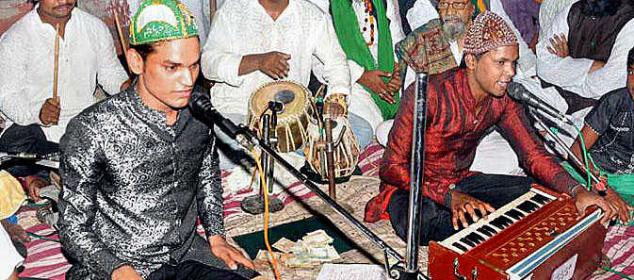
Zameer Shahsadha of Bangalore and his troupe rendering Sufi music (qawwali) in Vijayawada.
City’s Muslim brethren, for six-long-hours until the break of the dawn on Wednesday, were in for an all-new experience as they enjoyed the pristine qawwali, a traditional Sufi music, commemorating the Urs celebrations of the 400-year old Hazarat Syed Hussain Shahkhadri Dargah near Prakasam barrage.
The second day of the celebrations saw Bangalore-based popular qawwali singer Zameer Shahasadha and his troupe enthralling the devotees with his music, an expression of devotion to God. The troupe consisted of lead singer and a chorus (four men) who repeated the verses by clapping their hands. Artistes on harmonium, tabla (two), electronic pads, banjo (bulbultarang) and dholak added sheen to the qawwali repertoire rendered primarily in Urdu and Punjabi.
State Muslim Welfare Association general secretary Altaf Raza said that after deeparadhana , special prayers and poor feeding, the singers took over the proceedings churning out several devotional numbers. Several noted personalities like Muttavalli Khaza Mohiuddhin, West MLA Jaleel Khanand other community elders visited the dargah.
source: http://www.thehindu.com / The Hindu / Home> News> Cities> Vijayawada / by J. R. Shridharan / Vijayawada – February 19th, 2015
The four-day long UP’s first Travel Mart, which would begin on February 22 is likely to witness participation of as many as 79 tour operators from 27 countries. This also includes 25 tour operators from India. Director general of tourism Amrit Abhijat said that the Travel Mart would be inaugurated by chief minister Akhilesh Yadav, and would be held at La Martiniere Boys College ground.
He further stated that earlier the event used to be held in Jaipur under the name of ‘great Indian Travel Bazaar’, but under an agreement between FICCI and UP Tourism, the event has been slated for Lucknow, and for the next five years, it would be held in Lucknow.
“The Travel Mart would prove to be useful both for domestic and international tour operators, and at the same time, it would add another dimension to the different tourist places of the state,” Abhijat said, and added that it will also help the foreign tour operators to design better tour packages keeping in mind the historical monuments of the state.
A meeting was also held recently to formalise the preparations of the Travel Mart. The meeting was attended by Amit Gupta (of FICCI), ASI director PK Mishra, head of Heritage Hotel Association PND Singh and Salim Ali and Tariq Khan (of Roomi Foundation). A meeting was also held under the chairmanship of Mahesh Kumar Gupta, divisional commissioner of Lucknow, which was also attended by Amrit Abhijat and other senior officials.
The meeting which is jointly organised by FICCI and UP Tourism is likely to see maximum participation of 8 tour operators from United Kingdom, followed by 7 each from China and Australia, 6 each from Germany and Thailand, and 5 from the USA.
source: http://www.timesofindia.indiatimes.com / The Times of India / Home> City> Lucknow / by Arunav Sinha, TNN / February 17th, 2015
Two alumni of the Aligarh Muslim University (AMU), SM Javed, former principal of Yasin Meo Degree College in Haryana, and his wife Imam Bano, professor at the JN Medical College in the city, have donated their personal collection of historical artifacts – which includes some rare coins dating to the times of Akbar and Jahangir — to their alma mater. The collection, which the academic couple said had been in their family for many generations, contains 58 coins and medals along with documents of the Mughal court known as parwanas. Among the pride of the collection are silver and copper coins minted during the reign of emperors Akbar, Jahangir, Aurangzeb and Shah Alam, believed to be worth a few lakh rupees.
Elaborating on the reasons behind their decision to donate these family heirlooms, Javed, who passed out of AMU in 1968, said, “We could have easily got a tidy sum if we chose to sell these coins at online auction portals. But we decided that we would rather have these priceless items exhibited at the university museum where more people can see and appreciate them.”
A particularly interesting coin in the collection is a chau gosha or four-cornered coin minted in Akbar’s reign. “Akbar was an emperor who experimented consistently with the shape of his coins. Consequently, coins during his reign came in various shapes -round, square as well as hexagonal,” said Javed. The chau gosha bears the emperor’s full name ‘Jalaluddin Akbar’ and also has the names of the four caliphs inscribed on it.
Another unique coin has the words – Zarb-Zafar Urdu inscribed on it, indicating that it was a coin minted for the use of the army during military expeditions. “Urdu was a term used to denote a lashkar or military camp during Mughal times. Imperial marching armies were like moving cities and they needed their own currency while at war,” said Javed.
The collection also includes coins from the time of Queen Victoria, East India Company, King Edward VII and King George V. Besides, there are gallantry medals of World War II. “My uncles were in the British Army during the war. The medals that they won are also a part of the collection,” said Javed.
source: http://www.timesofindia.indiatimes.com / The Times of India / Home> City> Agra / by Eram Agha, TNN / February 11th, 2015
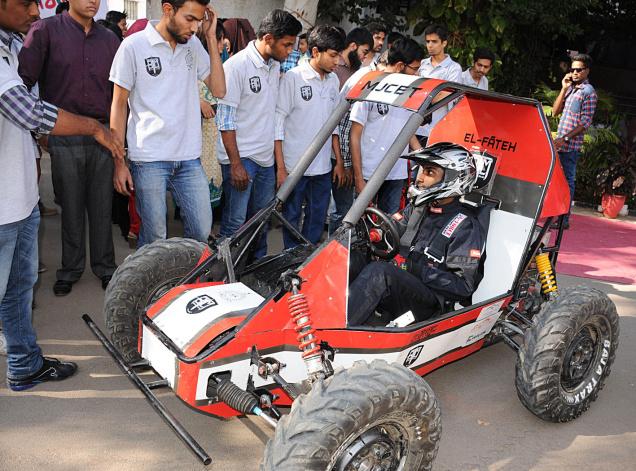
Students showcase the All Terrain Vehicle, made using a 305cc Briggs and Stratton engine, at the Muffakkam Jah College of Engineering and Technology on Monday. Photo: P.V. Sivakumar
The All Terrain Vehicle, engineered by 25 students of Muffakkam Jah College of Engineering and Technology, will now compete on an international platform
In all of three months, 25 students of a city engineering college toiled to come up with a fine product. Their All Terrain Vehicle, named El-Fateh, will now compete on an international platform and vie for top honours.
Crafted by students of mechanical and production engineering students at Muffakkam Jah College of Engineering and Technology (MJCET), the ATV has been selected for Mahindra BAJA SAIENDIA, which will be held in Indore later this month.
Weighing about 270 kg, the ATV can cover 100 feet in 4.03 seconds and has a top speed of 52 km/hr. It uses a 305cc Briggs and Stratton engine, producing a torque of 19.5Nm, which is mated to an Alfa Mahindra transmission. Students involved in the project say the vehicle also has a first-of-its-kind mechanical paddle shifting mechanism, which is aimed at smoother shifts and ease of driving.
“This is a great practical experience for the students and they did a good job. We are confident of doing well in the event,” said Mohd. Viquar Mohiuddin, faculty advisor to the project.
“We spent 14 to 16 hours in the college every day for the last few months. There were times when we even slept in the college premises to complete the deadline of building the vehicle,” said Abdullah Zakria, a final-year mechanical engineering student.
Outlining the vehicle’s strong points, the team’s captain Mohd. Abdul Haq said, “One of the eligibility requirements was that the vehicle has to climb an inclination of 27 degrees but we managed to drive it over step sand boulders with about 40 degrees inclination.”
Cost Rs.4 lakh
The vehicle costs, which amounted to around Rs.4 lakh, and other expenses were borne by the college and private sponsors.
source: http://www.thehindu.com / The Hindu / Home> News> Cities> Hyderabad / by Staff Reporter / Hyderabad – February 17th, 2015
India always fascinated foreigners who were smitten by its monuments, beauty, culture and much more
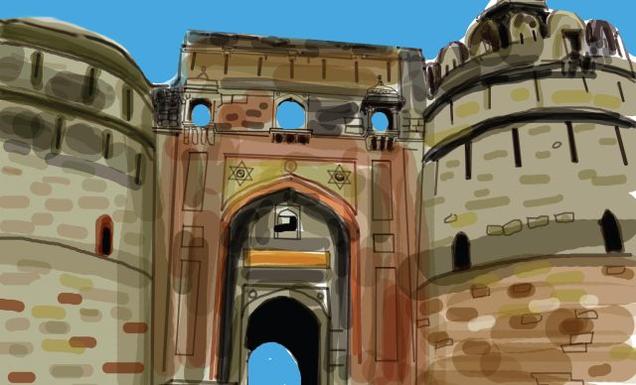
We are always curious to know what others think about us! About 118 years before President Obama came calling to Delhi, compatriot Mark Twain had observed: “So far as I am concerned India is the only foreign land I ever daydream about or deeply long to see again.” Fifty years later John Wohlfarth, after serving in India, recorded in his diary: “The world needs India intact! Tear down Roman ruins if you will, level Cyclopean walls, build bridges with stones of gothic abbeys and feudal fortresses but lay no hand on the glory and grandeur of India.” Both US visitors were among those who looked at the country without prejudice, unlike the British. Twain was fascinated by the monuments of Delhi and Wohlfarth too while sitting under the Qutub Minar, wandering in the Purana Quila and the Red Fort or while viewing the sublime beauty of the Taj Mahal. These impressions are among many recorded by Pran Nevile during research in the US Library of Congress which gave birth to the treatise, “India Through American Eyes” (Primus Books).
In 1833, while Akbar Shah-II was on the throne, American ice was introduced into the Mughal empire. It replaced mountain ice brought from the Himalayas since the time of Akbar the Great in bullock carts and stored in wells to last through the summer. In Shah Jahan’s reign there were ice-fields near Turkman Gate where ice made in winter was stored for use when the weather turned beastly hot. The credit for bringing the first ice-ships to Calcutta, Bombay and Madras goes to Frederick Tudor, who as a result became a very rich man and the ice-fields of Turkman Gate slowly disappeared.
There is a fascinating account of Elehu Yale (after whom Yale University is named) who as Governor of Madras received a female Mughal emissary (from Delhi) reported to be of “majestic form and the magnificence of whose pearls and diamonds were beyond description”. There was also a report about a nawab’s wife, published in 1743 (Mohammed Shah’s reign), whose “glittering costume, elaborate sophisticated make-up and exotic jewellery, which adorned her from head to toe”, was enchanting. The refreshments served on “gold plates, with guests being entertained to 60 dishes” were among the amazing accounts of Mughal hospitality.
Bayard Taylor, who came in 1853 (four years before the First War of Independence) as correspondent of New York Tribune, was fascinated by a ride in a palanquin. After going about in it in the Capital, he took a horse-drawn Dak buggy and travelled from Delhi to Meerut, Agra, Mussoorie, Kanpur, Lucknow, Allahabad, Benaras and Calcutta. About the Taj, he observed: “Did you ever build a castle in the air? Here is one brought down to earth… when seen from a distance, so like a fabric of mist and sunbeams.” In 1871, the Rev William Butler said “that a flute played gently in the vaults below where the remains of the Emperor and his consort repose, produces a sound, which is perhaps the finest to be heard as it were from heaven and breathed by angels”.
Gertrude Emerson, who visited Delhi, Agra and Lahore in 1923, says, “Here were lavishly scattered the great red sandstone forts and gates of Akbar, the marble palaces and pearl mosques of Jahangir, Shah Jahan and Aurangzeb and the magnificent tombs they constructed”. She goes on to say: “I sat alone for a long time once at the top of one of the four minarets surrounding the Taj Mahal. It was a night of a full November moon, and silver mists clung to the Jumna, flowing silently past the great marble platform from which the Taj rises with ineffable grace. I had had my first view of this far-famed ‘Crown of Palaces’ from the Jasmine Tower at Agra Fort, whence Shah Jahan, an old man and a prisoner, fallen upon evil days, must often have looked out mournfully at the beautiful mausoleum he had erected many years before, in honour of Mumtaz Mahal, his queen… Suddenly in the moonlight it was like the breast of a lovely woman.” According to Percy Brown, it was the magic of Indo-Persian architecture blended by rulers originally from beyond the Oxus.
As for dance and music, Lily Strickland Anderson, a prolific composer of music, writer and painter, was captivated by the performance of two nautch girls invited from Delhi to perform at a Raja’s party in Bombay. They were obviously from Chawri Bazar and akin to midsummer night fairies. Some other Americans were struck by the soulful singing in the fields and village streets “and the many sorts of (rural) work done to the lilt of a song”. All in all, an amazing saga of a medieval and emerging modern scene. Such was the milieu that produced Esther Sherman (Ragini Devi), her daughter, Indrani Rehman and granddaughter Sukanya.
source:http://www.thehindu.com / The Hindu / Home> Features> MetroPlus / by R.V. Smitha / February 15th, 2015
When the Tanjore king Achuthappa Naik (1560-1614) was bedridden after he suffered a paralytic stroke, many believed it was due to some black magic. The matter was informed to a visiting saint who eventually restored the king to health. Whether one believes in miracles or not, Nagore still thrives on it.
“Nagore is known for its religious harmony for more than 500 years. It is all because of the saint Qadir Wali who is enshrined there in a place widely known as Nagore dargah to which people of all religions throng with faith and problems. The miracle has been happening since 16th century and it still continues,” said A S Mohamed Rafee, author of the recently released book, “The Ocean of Miracles: Life of Qadir Wali”.
Qadir Wali travelled to many parts of the world and stayed in Mecca, Medina, Turkey and Palestine for many years before he came to Nagore where he lived for 28 years. “At a time when the world is facing serious threats in the name of religion, it’s remarkable that Nagore still survives on harmony, a reason why more sandal smeared heads are seen in the Sufi dargah. Wali served the people of all religions with his miraculous powers,” said Rafee, who is associate professor at the Mazharul Uloom College, Ambur.
Qadir Wali was born in 1504 in Manikkappur, a town established by Firoz Sha Tughluq in Uttar Pradesh, some 60 km from today’s Ayodhya. His parents, Hasan Guddus and Fatima, were descendants in the lineage of Prophet Muhammad and Abdul Qadir of Jilan, a great saint of the 12th century in Iraq.
Nagore dargah was built on land donated by king Achuthappa Naik. Many important parts of the dargah were built by the generous donation of non-Muslims, a reason cited why it’s a symbol of religious harmony. “The dargah has five minarets and the tallest one is called Periya Minar. It is 131 feet high with ten storeys. It was built by king Pratap Sing of Tanjore (1739-17633) after his wish for a son was fulfilled by praying to Wali 200 years after his passing away. The Peer Mandapam was built by the Dutch.
source: http://www.timesofindia.indiatimes.com / The Times of Ibdia / Home> City> Chennai / by M T Saju, TNN / February 09th, 2015
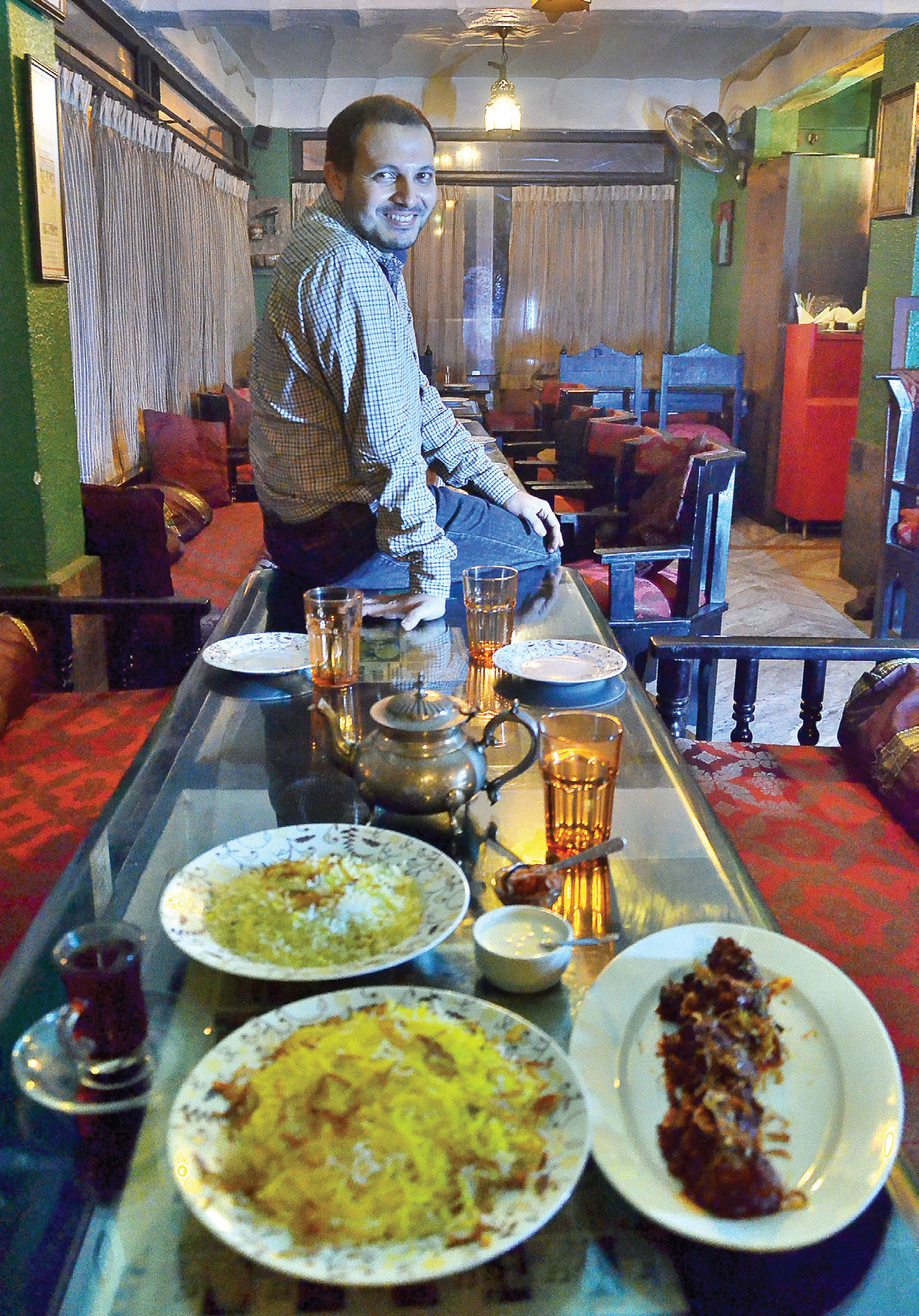
Ali Baba, a small cosy eating place in Frazer Town, Bengaluru, is where you get some Persian and Arabian food at reasonable prices. But what its USP is that its young and handsome owner, Shaad Hassan Damudi, is a Bhatkali Muslim and serves up some authentic Bhatkali food. Bhatkal is a small town in Southern Karwar district of Karnataka and has a rich and relatively unknown cultural and culinary history. The Muslims there are called Navayaths or new people. The Navayaths speak a dialect called Navayathi which is a fusion of Sanskrit, Persian, Arabic, Marathi, Hindustani with Konkani as its base.
Traders from the Persian Gulf—namely Yemen, Iran and Iraq—who traded mainly in horses, textiles, timber, gemstones and spices, eventually settled on the Konkan coast and contributed to the cuisine that is a ménage of Indian, Persian and Arabic cultures.
The most famous dish has got to be the delightful Bhatkali Biryani, half-cooked in steam. Damudi uses Sella basmati rice which is an aged rice and is exported to the Middle East and hence not available in India. “We use a lot of browned onions and tomatoes, and a red chilli paste which add colour. Our food is moderately spicy and whole garam masala is added to biryani which is layered with rice and then the onion, tomato, ginger garlic and garam masala mixture,” says Damudi.
Popular TV foodies—Rocky and Mayur of Highway on my Plate fame—recently visited Ali Baba and gorged on the Bhatkali food and featured it on one of their shows.
The kadang fry is a must-try for vegetarians, its sweet potatoes with the ubiquitous red chilli paste, an interesting blend of sweet and spicy flavours. The boneless chicken tikka cooked on a barbeque does remind me of tandoori chicken but the red chilli paste gives it that distinctly Bhatkali flavour. The people here use vinegar made from sugarcane which is used in salads as well as in finely cut onions as an accompaniment. The predominant flavour of the Chicken Khurma at Ali Baba is sweet.
True to its Indo-Persian origins, this dish is creamy and smooth, thickened and enriched with cashew nut paste. However, the addition of one quintessentially coastal south Indian ingredient—coconut milk—not only sweetens it, but also stamps it as a Navayathi.
Gawa Shaiyo was a pleasant surprise. It is wheat vermicelli with mutton in it. The mutton is amazingly tender, delicately spiced, and enhanced by the nutty flavour of fried wheat vermicelli. For those who thought vermicelli was used only in vegetarian dishes and to make kheer, this should come as a delicious revelation.
The piece de resistance is the vermicelli chicken biryani which is simply mouth-watering, surprisingly light and does not need any accompanying gravy or burhani or raita. “This biryani is best when made with chicken and not mutton,” says Damudi. The prawn fry is pretty crunchy being deep fried with a bit of cornflour added, along with the red chilli paste. Surprisingly, hardly any coconut is used in Bhatkali cuisine.
Tausha sherbat is made with grated cucumbers to which a wee bit of sugar is added. The cucumber releases its own water and this delightfully and refreshing simple drink is ideal on a hot summer’s day. All you need is a spoon to dig into it.
The desserts are pretty exotic. One made from, hold your breath, dill leaves with condensed milk and eggs reminds one of good old caramel custard. It is steamed and very tasty, except for its light green colour!
The ambience is exotic with doors and other accessories from old homes in Bhatkal innovatively used as table tops and decorative pieces. Pricing is reasonable and portions pretty generous.
source: http://www.newindianexpress.com / The New Indian Express / Home> LifeStyle> Food / by Sangeeta Cavale Radhakrishna / February 07th, 2015
RTO Padma Prasad (fourth from right), his wife Shobha and BJP leader Yashaswini Somashekar are seen launching the logo of Mysore City (West) Used Car Dealers Association as City Police Commissioner Dr. M.A. Saleem, Industrialist B.K. Gangesh, Malnad Ali Shariff and others look on
Mysuru :
“Owners should ensure that the vehicle they have sold is registered in the name of the buyer. Just signing Forms 28 and 29 is not enough. If anything goes wrong, then the person under whose name the vehicle is registered will be held responsible,” said City Police Commissioner Dr. M.A. Saleem.
He was speaking after inaugurating the Mysore City (West) Used Car Dealers Association at a function organised at a private hotel at Yadavagiri in city on Saturday.
Citing examples, the Commissioner said that thirteen years after the death of former Minister Azeez Sait, he was issued a traffic violation notice last year. The notice was served based on the CCTV footage which showed his four wheeler violating traffic rules.
He said that Sait’s vehicle was sold without the vehicle being registered under the name of the new owner, hence the notice was issued.
Citing another example, Dr. Saleem said that a woman in Bengaluru was asked last week to pay fine for violating traffic rules in Mysuru, but the woman had lodged a complaint regarding her missing two-wheeler and added that the woman had received the notice as the vehicle was registered in her name.
Citing these examples, the Commissioner advised vehicle owners to exercise caution while selling their vehicles besides asking them to follow rules while selling their vehicle.
Dr. Saleem said that the Police were facing a lot of problem due to improper transfer of vehicles and added that in hit-and-run cases, when the cops contact the vehicle owner it leads them to the previous owner which is resulting in the actual victim’s family being not traced.
He further said that based on these incidents, the Police have decided to take a serious note of the problem and added that in future, the vehicle owner would be held responsible for any problem.
During the occasion, Association’s logo was launched and identity cards were distributed to the members of the Association.
BJP leader Yashaswini Somashekar, RTO Padma Prasad, Industrialist B.K. Gangesh, Malnad Ali Shariff, Association Vice-President Syed Riyaz, General Secretary B.S. Pradeep Kumar, Treasurer M. Satish, Organising Secretaries B. Suresh and Murugesh, Convener Ravindrakumar and others were present.
source: http://www.starofmysore.com / Star of Mysore / Home> General News / Monday, February 02nd, 2015
Unlike the Congress functionaries who did not fail to spew venom against the last Nizam Mir Osman Ali Khan whenever they got an opportunity, Telangana CM, K Chandrasekhar Rao, has been underscoring the developmental work done by the late Nizam. At the inauguration of Numaish on January 1, the CM once again highlighted the ways in which the Nizam tried to make Hyderabad a modern city. Among other things, he also spoke about the farsightedness of the Nizam in leasing out land for the Exhibition Society some 75 years ago. One of the things that KCR can do on a priority basis to restore the glorious heritage of the formerly Hyderabad state is to bring back the marvellous jewellery of the Nizams that is locked up in the RBI vaults for several years. This can be done amicably with little bit of cooperation between the Centre and Telangana governments.
Australian writer John Zubrzycki who has written two books on the Nizams, said sometime ago that Hyderabad was the natural choice for keeping the jewellery, and not the vaults of RBI.
Mir Osman Ali Khan after merging his state with the Indian Union in 1948, created over 50 trusts in 1951 to safeguard his own interest and that of his progeny. One of the most reputed among these trusts was the one that dealt with the jewellery. HEH the Nizam’s Jewellery Trust became the proud owner of 173 pieces of jewellery, 22 pieces of unset emeralds and the famous 184.5 carat Jacob diamond. According to observers of the Royal dealings, what became part of the trust was only a fraction of the wealth of the Nizam who was declared the richest man in the world in 1937. At the time of the formation of the trust there were 42 beneficiaries with Nawab Mukarram Jah holding the largest share. After the Nizam’s death in 1967 the trustees wanted to sell the jewellery as they felt that the family of the Nizam had fallen on bad times. Following enquiries, the trustees felt that the jewellery would fetch about Rs 10,000 crore if it was sold in the international market. But the Government of India (GoI) did not like the ideas as it felt that the jewellery was part of the national heritage. A long legal battle ensued between the government and the trustees. Finally, accepting the arbitration of A K Sen the trustees agreed to sell the jewellery to the government for Rs 206.49 crore. After tax deduction, the trustees were given Rs 165.5 crore in 1995.
The GoI organised a successful exhibition of the fabulous jewellery in Delhi followed by one at Salar Jung Museum in Hyderabad in 2001-2002 which drew about 2 lakh visitors including a large number of foreigners. The show was put up again in 2005 and 2007 when the number of visitors touched nearly 3 lakh. The government of united AP during the times of N Chandrababu Naidu as well as Y S Rajasekhara Reddy wrote many letters to the Centre to shift the jewellery to Hyderabad. They said that the GoI could retain the ownership but should allow the state government to put the jewels on display, since they formed part of the heritage of Hyderabad. A list of possible locations was drawn up subsequently that included Chowmahalla Palace, State Museum in Public Gardens, Jawahar Bal Bhavan in Public Gardens, Kela Bazaar land adjacent to SJM and the SJM itself. None of these locations were acceptable for some reason or the other.
Finally in 2009 the state government agreed to hand over the old municipal corporation headquarters where the Quli Qutb Shah Urban Development Authority is located to the tourism department for the construction of a new building to host the Nizams’ Jewellery gallery. The state government also agreed to bear the cost of construction as well as the recurring cost of maintaining security at the jewellery exhibition. Though all disagreements between the two governments were resolved the project did not move forward. No explanation has ever been offered on why it was stalled though.
This matter should be raked up by KCR now, given that he already has a well prepared plan (drawn up in the past). All he has to do is exercise his authority to ask the tourism department to begin construction of the gallery and ask the Centre to fulfil its promise of shifting the jewellery.
The Hyderabadis hope that KCR will prove his sincerity towards the city he always praises by expediting the return of the Nizams’ jewellery.
source: http://www.thehindu.com / The Hindu / Home> City> Hyderabad / by Mir Ayoob Ali Khan / January 25th, 2015
If I say the idli was brought to southern India by Arab settlers, it could raise hackles, especially among South Indians. But the truth cannot be suppressed. References to the modern way of making the idli appear in Indian works only after 1250 CE.
K.T. Acharya, the food historian, speculates that the modern idli might have originated in the region that is now Indonesia, which has had a long tradition of fermented food. According to him, cooks employed by the Hindu kings of the local kingdom may have invented the steamed idli there, and brought the recipe to India during the period 800-1200 CE. But this theory is being questioned by modern food historians such as Lizzie Collingham, Kristen Gremillion, Raymond Grew, Makhdoom Al-Salaqi (Syria), Zahiruddin Afiyaab (Lebanon). References available at the Al-Azhar University Library in Cairo also suggest that Arab traders in the southern belt brought in the idli when they married and settled down in those parts. Now the question is: how did that happen? It is known that Arab traders used to come to the southern coast for trade, and that pre-dated even the advent of Islam. The first mosque outside the Arab peninsula was erected by Arab settlers who came here as traders.
The Arab settlers were strict in their dietary preferences; many of them came here when Mohammed was still alive and they were neo-converts to Islam from Paganism. They insisted on halaal food, and Indian food was quite alien to their palate. To avoid all such confusion regarding what is halaal orharaam in food, they began to make rice balls as it was easy to make and was the safest option available. After making the rice balls, they would slightly flatten them and eat with bland coconut paste (Encyclopaedia of Food History, edited by Collingham and Gordon Ramsay of Britain, Oxford University Press, and Seed to Civilisation, The Story of Food, by Heiser Charles B, Harvard University Press, 1990). Later it was improved upon, and from the 8th century onwards, the idli in its modernavatar came into existence.
sumitmaclean@hotmail.com
source: http://www.thehindu.com / The Hindu / Home> Opinion> Open Page / by Sumit Paul / February 01st, 2015