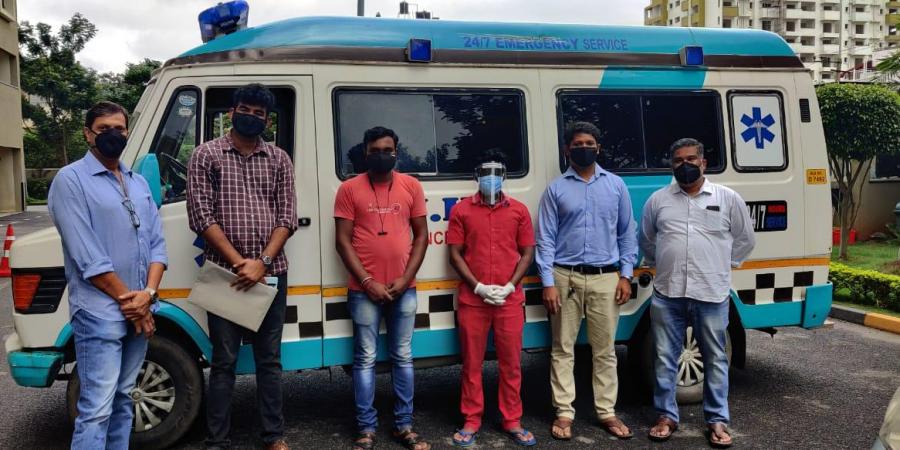
A popular ambulance service the group ran during the COVID outbreak last year to cater to its residents, which stopped two months ago owing to a dip in cases, will be revived again in a week’s time.
Changemakers of Kanakapura Road plan to revive its ambulance service for residents which was launched during the first COVID wave and later stopped (Photo | Special arrangement)
Bengaluru :
In light of the hardships experienced by the public to get taxis as well as ambulances during the ongoing pandemic, an umbrella organisation of over 60 resident welfare organisations in Kanakapura Road has decided to come to the rescue of residents. It will offer a car free of cost to help residents reach anywhere for treatment as well as revive the popular ambulance service it ran when the pandemic broke last year.
Speaking to The New Indian Express, Abdul Aleem, president of ‘Changemakers of Kanakapura Road’ said, “With COVID cases rising, we want to help out the nearly 30,000 residents who are our members. We facilitated arrangement of an Innova car through Sathya Sai Tourist service. Our group will bear the diesel and driver charges.”
Explaining the rationale behind it, Aleem said when members of the public use their own car to ferry their family members affected by COVID-19, there is a big risk to others using it. “We want to offer this alternative to them. We will be maintaining the vehicle in a fully sanitised condition so that it is safe for all to travel,” he said.
A popular ambulance service the group ran during the COVID outbreak last year to cater to its residents, which stopped two months ago owing to a dip in cases, will be revived again in a week’s time. “It costs us around Rs 2.4 lakh to maintain the vehicle supplied by J K Ambulance. We had collected Rs 60 per family to sustain the fuel and driver costs last time and plan to repeat it. We have three medical staff available 24×7 and 2 drivers to run the service,” he said.
A ventilator, suction apparatus, cardiac monitor, oxygen cylinder and infusion pumps are among the equipment in the ambulance.
There is a back-up arrangement with the provider so that if there is an emergency and someone has booked this ambulance, another would be supplied, he added.
source: http://www.newindianexpress.com / The New Indian Express / Home> Good News / by S Lalitha , Express News Service / May 13th, 2021
Iqtidar Alam Khan’s Latest Books on India’s Medieval History Unearth Hidden Secrets
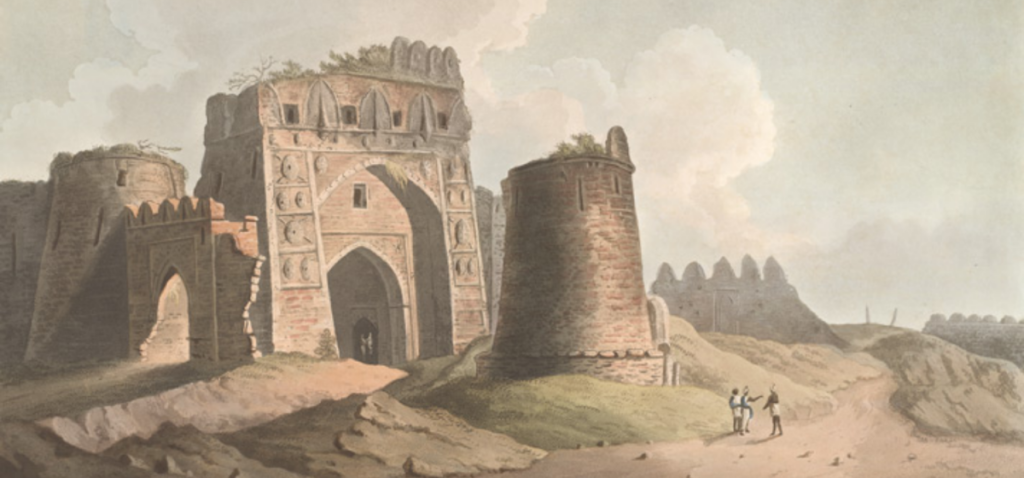
A painting of west gate of Firozabad fort, near Delhi. This fort was built by Feroz Shah Tughlaq in the 1350s, but destroyed by later dynasties. Photo: Wikipedia/Public domain
Iqtidar Alam Khan’s first slim book, a biography of Humayun’s brother Mirza Kamran was published in 1964; his latest book, slightly bulkier than the first, has been published in early 2021 when he is nearing 90, with nearly a dozen authored and edited volumes in-between. Quite an emphatic comment on how prolific he has been in his distinguished career as a historian of medieval India! Add a very distinct quality of the huge range of themes and the empirical solidity of his researches and one begins to appreciate the indelible imprint on the study of medieval Indian history he has left for his own and future students.
Professor Iqtidar Alam Khan was an alumnus and later faculty of the department of history at Aligarh Muslim University when it shone like the pole star in the study of medieval Indian history under the leadership of frontline scholars like Professors Mohammad Habib, Nurul Hasan, K. A. Nizami and Irfan Habib; he himself added to its lustre, evident in his extensive explorations of different facets of his discipline. This, when he always avoided drawing attention to himself.
The range of his explorations is amazing: biographies of two Mughal nobles, “Turko-Mongol theory of kingship” which had a decisive influence on Mughal notion of sovereignty, the system of revenue assignment of Akbar.
The classic essay on “Akbar’s nobility and the evolution of his religious policy”, which was a sort of watershed intervention in 1968 in that it set new terms for the study of the Mughal “religious policy” and has stood the test of time, some feeble recent challenges notwithstanding, the pioneering studies of gunpowder, guns and artillery and not least the bringing to attention some Persian language texts. However, all this work pertained to the Mughal period of Indian history.
Attention to detail
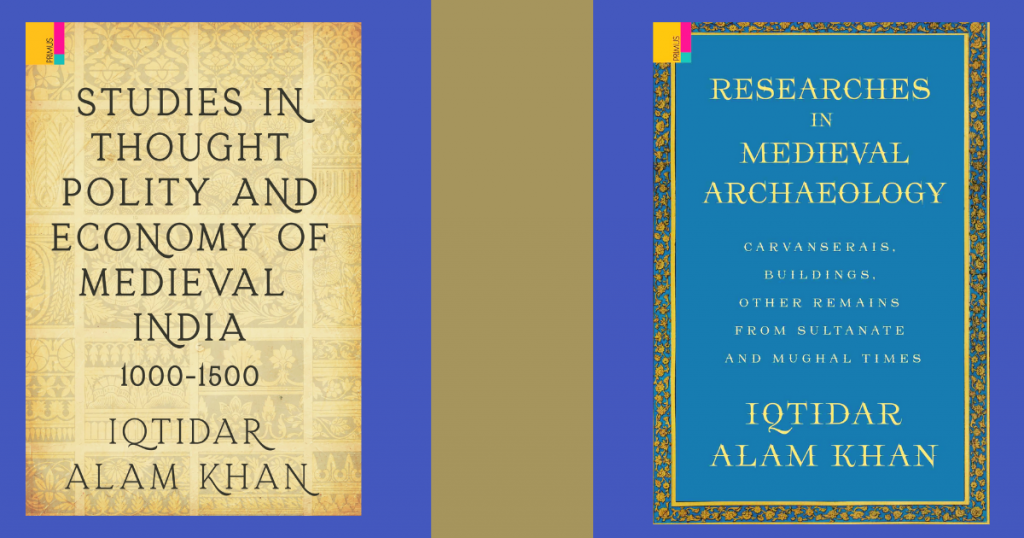
This current year has, however, revealed two hitherto unknown facets of his scholarship with the publication of two books in quick succession, both by the venerable publishers, Primus: Studies in Thought, Polity and Economy of Medieval India 1000-1500 and, hard to believe, Researches in Medieval Archaeology.
The first brings to us his mastery of various themes from the Delhi Sultanate era with the same eye for empirical soundness of every detail as his works on the Mughal period, though still tied to the Court and its outliers except for a revisit to Alberuni’s ‘concept of India’.
It is the second work that takes us literally to the ground level, taking us through the dust and grime of small buildings, remains of centuries-old Sarais (inns), waterworks, indigo vats, dykes and fascinatingly the ‘city’ built by Sultan Muhammad bin Tughlaq which he had named Swargduari, Gateway to Heaven, in district Etah in present day Uttar Pradesh.
Traveling in ramshackle vehicles for nearly two decades, Professor Khan along with his team, dedicated himself to recovering and recording the remains of small, virtually forgotten buildings of various kinds – calling them monuments would be grandiose – in every little detail of location, dimensions, recoverable history from texts and from folklore. It was remarkable labour of love where his age and family’s pleas could not hold him back.
The introduction, besides bringing the reader up to date on the theoretical backdrop of archeological study makes the valuable plea that one should embark on field exploration only after running through all the relevant textual material available for imparting completeness to the exploration.
While for all the sites studied included in the book have almost every kind of technical detail have been recorded, the last and longest chapter, dealing with Sarais is the most fascinating in that it opens up a number of windows to the social history of the period. It reveals that the state took upon itself the task of promoting travel as well trade, and at a certain stage postal service, by constructing inns and rest houses all along the trade routes. The task of constructing inns starts as early as Asoka’s time, for it is mentioned in one of his edicts, but later history on the theme is obscure.
In medieval India, references to these, along with milestones, kos minars resume from Sher Shah’s time and continue into the 18th century. The title Sarai is scattered all over the land with prefixes like Ber Sarai, Arab ki Sarai, Katwaria Sarai, Sarai Kale Khan and numerous others in Delhi itself, not to forget the Mughal Sarai, its history now erased through political diktat.
The very spread of these is suggestive of both the extent of travel and trade and state’s assumption of responsibility for providing security and patronage for it. The lodging and boarding at Sarais were often complementary and at times chargeable.
Luckily for the historian, the travelers at times left some graffiti on the walls noting their identity, several of which have been copied in the book. Where boarding was provided, separate kitchens were run for the Hindu and the Muslim travelers, suggesting that they came from both communities and shared the space but maintained differences in food, which was recognised and accepted by the state.
It also suggests that the difference did not turn into hostility. The book reproduces one graffiti in Devnagari on the wall of a mosque by one Kishan Das wald (son of) Maha Nand Kambu of Agra; he had obviously found shelter at least for a night at the mosque which he appears to have gratefully recorded; this reminds Professor Khan of Goswami Tulsi Das’ reference to “sleeping at a mosque”!
These two books, the second one, in particular, is a delightful revelation of an attractive aspect of an extremely reticent scholar of great eminence: dedication without seeking recompense in the form of the fanfare of recognition, but pure dedication to the unearthing of history’s hidden secrets without a trace of prejudice or preference. Dedication that cuts across compartmentalisation of Delhi Sultanate versus Mughal Empire, economic history versus political history, archeology versus textual narratives and so forth. A dedication that does not tire with age.
We are grateful to Professor Ali Nadeem Rezavi, who as head of the department of history and in-charge of its section of archeology persisted with Iqtidar Alam Khan to collect all his scattered data and reproductions of photographs of remains and graphs prepared to put together in a book; we owe a big debt to him for succeeding in the effort.
Harbans Mukhia taught medieval history at JNU.
source: http://www.thewire.in / The Wire / Home> Analysis> Books> History / by Harbans Mukhia / May 11th, 2021
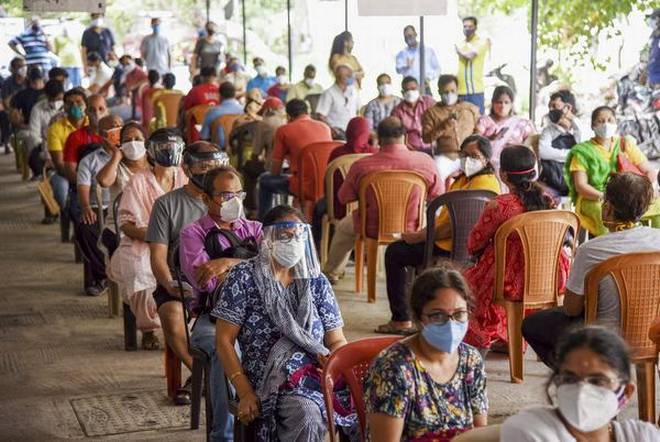
Citizens stand in a queue as they wait to receive a dose of COVID-19 vaccine, at ESIS Hospital in Navi Mumbai, on May 13, 2021. | Photo Credit: PTI
‘We have been providing free services with the aim of keeping humanitarian spirit alive,’ they say
Pune district has been the worst-hit in not only the State but also the country during the first and second waves of COVID-19. The district currently has nearly 95,000 active cases and is reporting nearly 15,000 deaths since March last year.
As the virus continues to wreak havoc and instil fear, there have been several cases in which relatives have refused to perform funerals of their kin or even help take the body to the ambulance.
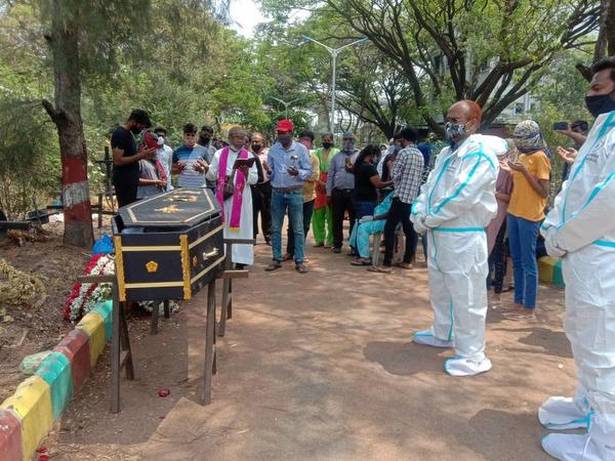
In such cases, city-based activist Anjum Inamdar and his outfit, Mulnivasi Muslim Manch, have been performing yeoman service to ensure that these ‘orphaned’ bodies receive a proper funeral. Since last year, the Manch has performed the last rites of more than 1,300 COVID-19 victims, cutting across castes and communities.
With material support from the Pune Municipal Corporation (PMC), which has supported the group by supplying Personal Protection Equipment (PPE) kits, Mr. Inamdar and his 18-member team have transcended communal barriers with their exemplary service.
“As the deaths started mounting in Pune in late March-early April, our outfit was one of the first to respond to the then PMC Commissioner Shekhar Gaikwad’s call to NGOs to come forward and aid authorities in relief work… In many cases, funerals could not be performed as entire families had tested positive. It is in such cases that our outfit helped perform the last rites as per the tradition of a particular caste or community…We have even helped in the funeral of non-Covid victims,” Mr. Inamdar said.
Mulnivasi Muslim Manch founder Anjum Inamdar (centre, in PPE kit) helping with last rites of a Christian person in Pune.
Manch acitivists have performed the last rites of Hindus – be they Brahmins, Lingayats, Telugus – as well as Sikhs, Christians and members of other communities as per their respective customs, much to the satisfaction of the relatives of the deceased.
“Our activists have fanned out across the State, working in Lonavla, Shirur, Jejuri, Lonand, as well as Satara, Navi Mumbai, Panvel, Raigad and other districts in the Marathwada region. We have also helped with the final rites of constables, health workers, doctors, journalists and notables like Maharashtra hockey player William D’Souza,” Mr. Inamdar said.
Their volunteers also facilitate online training of workers from different social outfits engaged in relief works across the State.
“We have been providing free services with the aim of keeping the humanitarian spirit alive and ensuring dignity even in death,” says Mr. Inamdar.
Helping hand
The Sikh community has time and again proved itself when it comes to opening up their hearts and purses for relief work. The Supreme Council Navi Mumbai Gurudwaras (SCNMG) is an umbrella organisation governing nine gurdwaras. Many of these gurdwaras are providing free rations and cooking gas to the needy, by collaborating with different trusts as well as using donations from individuals.
“We provide cooking gas and rations for a week or two from our gurdwaras in Panvel, Kharghar, CBD-Belapur, Nerul, and Airoli. Whoever needs rations can go there and they get what they need,” said Mehar Singh Randhawa, general secretary of the SCNMG. Last year too, these gurdwaras had ensured delivery of rations to the needy.
“This is public money and going back to the public. Our job is to deliver to the needy without discrimination,” he said. The SCNMG also provides cooking gas cylinder to the Covid-affected.
“Come with the Covid report and Aadhaar card. While a small cylinder is for free, we take a deposit for a big cylinder. The money is refunded when the cylinder is returned,” he said. When asked how many people have benefited, Mr. Randhawa modestly said the job was not for the purpose of keeping count and no record has been maintained.
Relief in kind
Not all relief work is about offering food, though. Anjumane Shiateali, an organisation that manages matters of the Dawoodi Bohra community in Mumbai, is providing service of a different kind. It has recently set up a Covid war room in Mumbai’s Bhendi Bazar area as part of its Project Rise initiative.
Taizun Bearingwala, a volunteer/coordinator at the war room, said they offer medical counselling, consoling and guide people to appropriate medical service. “We get calls from different parts of the country. We also have over 60 doctors who offer consultations,” he said. The war room has designed a medical form which is filled after talking to the caller.
The Anjumane Shiateali has been serving food to migrants workers and has undertaken other relief efforts under Project Rise initiative since the last 12 months.
Samajwadi Party MLA Rais Sheikh said that the Project Rise work is commendable. “The callers get advise on whether they need oxygen or ICU bed or home quarantine,” he said, adding that earlier the calls were from patients, but now the number of those seeking guidance on vaccination has seen an increase.
Not just in Mumbai, Project Rise has a presence in other cities of Maharashtra and the country.
They have converted a community school in Indore into a Covid care centre providing hospital beds, oxygen cylinders and day care. So far, over 500 patients have received treatment.
With the help of local authorities and agencies, Project Rise volunteers are supplying extra beds, medicine, oxygen supply in all six Primary Healthcare Centers (PHCs) and one Covid care centre in economically backward areas of Karjat. They are also providing protective gear such as masks, gloves, PPE kits and sanitisers for all medical staff and frontline workers. This is for a combined population of over 2.5 lakh people.
Their volunteers in Coimbatore and Chennai have been serving cooked meals to patients’ families, slum dwellers, at orphanage and old age homes since the last 51 weeks.
Financial and medical support is also being provided in Nagpur and Nashik in Maharashtra and small towns like Taloda and Mahuva in Gujarat, and Thandla in Madhya Pradesh. Villages in Mokhada, Maharashtra, are being supplied with daily water tankers, covering a population of over 1,650 people
“As part of the initiative, Project Rise volunteers across different parts of the country are mobilising a range of facilities from healthcare and oxygen cylinders to serving food, water and dry rations to vulnerable sections of society,” said Ammar Tyebkhan, member, Project Rise.
Space for vaccination
St Michael’s Church at Mahim, on the other hand, offered much needed space for vaccination. “There is palpable panic among people since the second wave struck. We can help people, but there is a need to instil confidence. This confidence will come only through vaccination,” said Father Lancy Pinto.
“As we realised the need for vaccination, we offered three options to our ward officer along with the local corporator. We offered the church’s premises till November this year to set up vaccination centre. It has a capacity to vaccinate 1,200 people a day,” he added.
Father Pinto said the church offered space knowing that vaccination would be a long process and would not get over in one or two months. “Therefore, we chose a spot which will not disrupt the activities of the church and the school,” he said.
Mumbai’s Siddhivinayak Trust, on the other hand, extended monetary help to the State government to fight the pandemic and also to provide aid.
“We have donated ₹5 crore to the Chief Minister’s Covid relief fund. In addition, we also donated ₹5 crore towards the Shiv bhojan scheme of the State government where free meals are given to the needy,” said Aadesh Bandekar, president of the trust.
He said further relief measures would be be announced after a meeting of office-bearers of the trust.
Recognising another gap, Lalbaugcha Raja, one of the most popular public Ganesh mandals in Mumbai, has been running its dialysis centre throughout the Covid period.
Balasaheb Kamble, president, Lalbaugcha Raja, said, “We ensured that the centre continues to run throughout the pandemic. While medical services are busy and loaded with work treating COVID patients, those requiring dialysis can come here.”
It has also held blood donation camps where over 15,000 bottles of blood were collected. “We also gave a call for plasma donation, through which we helped around 245 patients,” he said.
(With inputs from Shoumojit Banerjee, Alok Deshpande and Lalatendu Mishra)
source: http://www.thehindu.com / The Hindu / Home> News> States> Other States / by Mumbai Bureau / Mumbai – May 13th, 2021
Since Ramzan began, this team of volunteers has been heading out every morning at 3am to feed 500 others before they sit down for their own sehri.
Irfan Ahamad Z and Saddam Baig
Bengaluru :
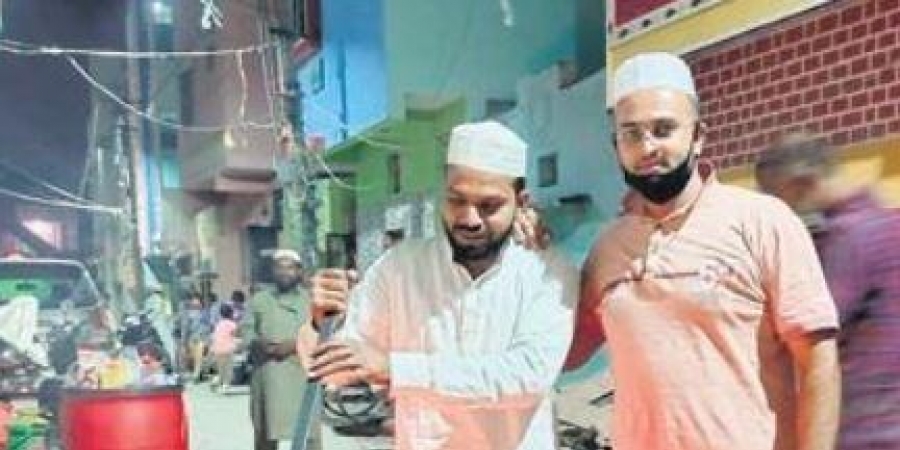
While many start to hit the sack at 11.30pm is when Saddam Baig jumps into action. Since Ramadan began, the advocate has been volunteering to distribute food for sehri (a meal consumed early in the morning before Muslims begin fasting during the holy month) to over 500 people in Padarayanapura.
A resident of the area himself, Baig says, “There are many slums around and the daily wage workers are struggling to get food these days. Baig took part in this initiative last year too, but then, there were more groups catering to different areas of the city such as Koramangala and RT Nagar as well.
Not wanting to give up the good deed this year, the 28-year-old decided to take it up again. The initiative has been started by Aayina Trust, a charitable organisation, but includes volunteers both from the trust and outside. Every day, the team has been packing food for those in need, with funds coming from their own pockets and through donations.
“We’ve had many people show their goodwill at this time. For example, our cooking team has three people, wherein the main chef takes only Rs 1,000 per day to prepare 100kg of rice, one type of chakna and one gravy,” says Baig, who is a trustee of Aayina Trust. Once the food is prepared by 11.30pm, the team gets to work with packing it and then heads out to distribute the meals at 3am, without catching a wink of sleep in between.
“I don’t sleep before because I know there are people depending on us. One day, we were 10-15 minutes late but when we reached, some of the families were waiting and they had tears in their eyes. They thought they wouldn’t be able to get a meal that day,” recalls Baig, adding that the team only sits down for their own sehri after the distribution to others in need is done. “I sleep less these days but it’s peaceful slumber. And helping others gives me energy to deal with the fatigue,” he adds.
Irfan Ahamad Z, who is the chairman of the trust, says they don’t want to keep the initiative limited to just Ramzan. “If the lockdown continues, we want to help during that time as well,” he says.
Baig adds, “So far, we haven’t faced any trouble despite the restrictions in place. Even the police personnel in our area are aware of our work and don’t mind us stepping out for it. We divide ourselves into teams of two and make sure not to disturb anyone.”
source: http://www.newindianexpress.com / The New Indian Express / Home> Good News / by Simran Ahuja , Express News Service / May 08th, 2021
Sahitya Akademi awardee and former PCS officer, Mohd Idrees Amber Bahraichi (71), died of Covid-19 complicat ..
He was the husband of All India Muslim Women Personal Law Board (AIMWPLB) president Shaista Amber.
Both Mohd Idrees Amber and Shaista Amber had tested negative for Covid-19 in their RT-PCR report which came out on April .
“Both my parents gave their samples on April 25 and tested negative. They were both at home. When my mother’s oxygen saturation level started dipping, I got a CT scan done for my parents which confirmed both of them had coronavirus infection,” said their daughter Aaisha Sumbul.
“My mother is currently on oxygen support at home and is not very stable and needs prayers,” she said
“My father was fine and all his other vitals were getting better too. Suddenly, he had a heart attack and a stroke and left us on Friday,” Aaisha said.
source: http://www.timesofindia.indiatimes.com / The Times of India / Home> News> City News / by TNN / May 09th, 2021
‘Doctors for Humanity’ is the medical wing of the Jamaat-e- Islami Hind to keep young Muslims engaged in social service
Hubballi :
‘Doctors for Humanity’ started out with around 50 doctors. These doctors were assisted in their efforts by around 600 volunteers from ‘Humanitarian Relief Society’.
Most of the doctors and volunteers were from the Muslim community.
It was an initiative aimed at providing round-the-clock aid to Covid-19 patients and their families across the state — while doctors who are part of the initiative have been tending to patients struggling to receiving treatment, volunteers equipped with skills to deal with both natural and man-made disasters, lent invaluable support to the members of patients’ families, right up till helping them with the final rites.
Impressed with their selfless service, doctors and volunteers, from other communities, have flocked to join the group, and offering their services for those in this hour of crisis.
‘Doctors for Humanity’ is the medical wing of the Jamaat-e-Islami Hind to keep young Muslims engaged in social service.
Director Humanitarian Relief Society KM Ashraf said that the volunteers had thus far reached out to more than 1.86 lakh people , cutting across lines of caste and creed.
“They have provided ration kits, food and lending even financial support to the tune of Rs 5.3 crore when the lockdown was enforced last year. We revived the Covid-19 helpline in mid-April this year, and the doctors have been seeing around 100 cases a day. We have distributed food packets around 5,000 people, and performed the last rites of 84,” Ashraf told TOI.
Coordinator of Doctors for Humanity Dr Asifa Nisar said that the outfit counted professionals based out of Bengaluru, Ballari, Kalaburagi , Vijayapura and other districts.
“Many of them are engaged in counselling those calling for help. At least ten doctors are available round-the-clock. We are approached by at least 100 patients, on average, daily. Doctors and volunteers have dedicated numbers. Our volunteers have helped 393 patients get oxygen, and arranged beds for 132 more,” said Dr Asifa, adding that she had data only up till the end of April.
She pointed out that the Humanitarian Relief Society had been instituted to come to the aid of society in times of calamity – natural and man-made.
“All our volunteers are trained to handle emergencies. Since March last year, however, we have dedicated all our resources to the fight against Covid-19. We have been strictly following the government-issued guidelines. I am very pleased that members from other communities are also joining us in various districts,” Dr Asifa added.
source: http://www.timesofindia.indiatimes.com / The Times of India / Home> News> City News > Hubballi News / by Sangamesh Menasinakai, TNN / May 09th, 2021
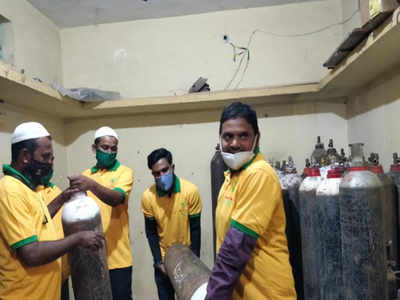
As people gasp for oxygen at hospitals in Aravalli and Sabarkantha districts, a Muslim youth group, in collaboration with a local trust, has established a 30-bed COVID-19 Care Centre in Modasa town.
With cases rising at an alarming rate and all government as well as private hospitals at full occupancy, the centre has been started by Muslim Yuva Group and Maqdoom Education Trust of Modasa to cater to COVID-19 patients.
All beds have been equipped with oxygen support and senior physicians and other medical professionals have also been roped in to run the operation.
Set up with the sole objective of providing timely treatment to people, the centre will cater to patients irrespective of their caste and community, Naeem Meghraji of Maqdoom Education Trust told First India.
Trained medical professionals and paramedics will assist patients round-the-clock along with a team of physicians led by Dr Jamil Khan.
All patients admitted to the centre will be provided free medical treatment including medication and food for the duration of their stay, he added.
source: http://www.firstindia.co.in / First India / Home> Gujarat / by Bhavesh Barot / May 08th, 2021
Dean of Faculty of Law at Aligarh Muslim University (AMU), Prof Shakil Ahmed Samdani, died on Saturday at Jawaharlal Nehru Medical College Hospital where he was undergoing treatment for coronavirus, an official said.
AMU spokesperson Rahat Abrar said 59-year-old Samdani was admitted to the hospital in the varsity 10 days ago after he tested positive for COVID-19.
He initially seemed to have recovered but his condition suddenly deteriorated a few days back, the official said.
The teaching staff at the AMU has lost 17 members during the past 18 days. All of them were either suffering from COVID-19 or displaying COVID-19 like symptoms, the spokesperson said.
Professor Rafiqul Zaman Khan (55), till recently the chairman of the Department Computer Science, passed away on Friday at the medical college hospital due to COVID-19.
Two days ago, former dean of the Law Department, Prof Mohamed Shabbir Ahmad (70), died of COVID-like symptoms.
He was the founder-head of the Ambedkar Chair in the Department of Law and had also served as the acting vice-chancellor of AMU, the spokesperson said.(PTI)
source: http://www.firstindia.co.in / First India / Home> India / by First India / May 08th, 2021
Yasmin Zaidi’s new artworks reflect on the COVID pandemic, isolation and grief
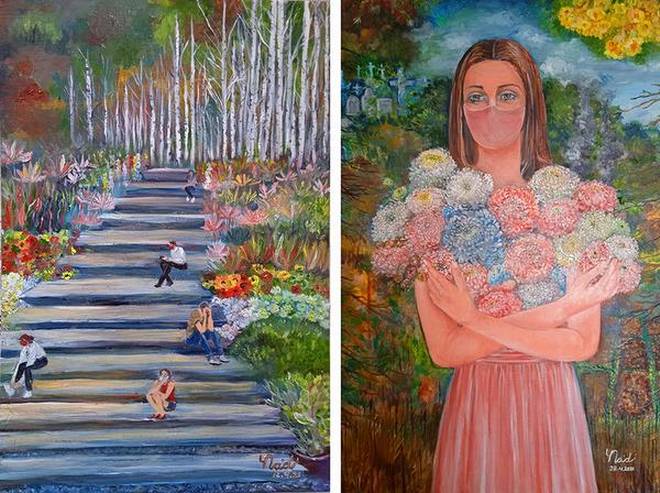
Yasmin Zaidi has begun to paint grief. It comes through in her two new works: one shows a young woman holding chrysanthemums in her arms, with graves behind; another has masked, socially distant people along a stairway (to heaven?).
She asked her family what to name them, and got a number of replies: Viral Apartheid 2021, Loveliness and Loneliness. “I realised that everyone is feeling personally involved during this pandemic… They will give their own names to the paintings,” says the 70-year-old artist who paints flowers and people.
Zaidi has lived across India — Firozpur Jhirka (in Haryana), JK Puram and JK Gram (in Rajasthan), Delhi and many more — where she worked as an educationalist through her life, mostly in administrative positions, though she trained as an English and Social Studies teacher. “I taught art sometimes because I was just able to,” says the hobbyist, whose home, when growing up, was filled with letters and pictures. Her father, Syed Ali Jawad Zaidi, was an Urdu poet and scholar, and her grandfather dabbled in art.
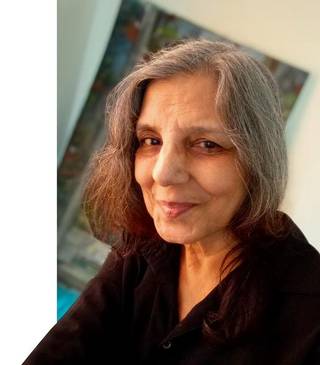
Yasmin Zaidi | Photo Credit: Special arrangement
She draws from the various elements of Nature she has encountered through life: The stairway in her current oil on canvas leads towards birch trees she retrieved from mental images of Kashmir. The red bottle brush and yellow tecoma in the ‘girl with chrysanthemums’ are from her ground floor flat in Mumbai, where she has a little garden. “My mother was very fond of gardening,” she remembers.
This time though, flowers have been used as a metaphor for the departed. Urdu poet Afzal Ahmed Syed’s Hamein Bahut Sare Phool Chahiye, which seems to allude to war and talks about how we need a lot of flowers to cover our dead, played in her head as she painted.
“When I paint, personal things come in — a book by Annie (her daughter, a writer), but the whole world was becoming personal,” she says of the shock waves that seemed to have affected everyone.
She hasn’t thought of selling: “I hardly think of the paintings as belonging to me.” She adds she wouldn’t know how to, and even if she did, it would go to COVID relief.
Right now, she’s recovering from a gall bladder surgery and is with her son in Pune. “I want to paint more, but I have run out of canvas, and it’s difficult to get it right now,” she says.
source: http://www.thehindu.com / The Hindu / Home> Entertainment> Art / by Sunalini Mathew / May 04th, 2021
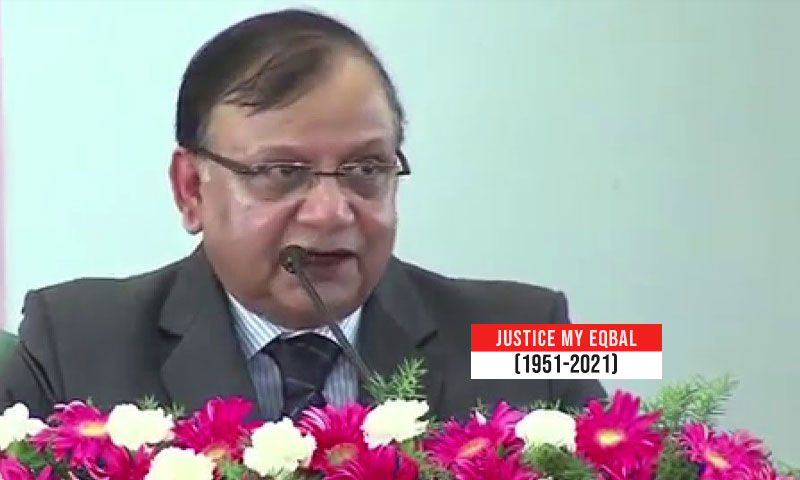
Former Supreme Court Judge Justice MY Eqbal passed away today morning at New Delhi.
He was a judge of the Supreme Court from 24 December 2012 – 12 February 2016.
Before that, he was the Chief Justice of the Madras High Court.
Chief Justice of India (CJI) N V Ramana has condoled the passing away of former Supreme Court judge M Y Eqbal before commencing the day’s judicial proceedings.
Justice N V Ramana, Hon’ble the Chief Justice of India expressed deep sorrow at the passing away of former Judge of Supreme Court Justice M.Y. Eqbal. Recalling his association with Justice Eqbal, Justice Ramana described Justice Eqbal as a conscientious professional who stood for humane values. He offered condolences to the bereaved family. When the Bench assembled in Court No. 1 this morning, Hon’ble the Chief Justice made a reference in this regard and offered condolences on behalf of the Supreme Court of India. Justice Eqbal passed away at a private hospital in Gurugram
Justice Eqbal was born on 13 February, 1951, passed B.Sc. from Ranchi University in 1970 and obtained LL.B. Degree in 1974 with distinction winning Gold Medal.
He started his career in Ranchi as an advocate in 1975 practising exclusively in civil side. He was appointed as a Government Pleader in the Ranchi Bench of Patna High Court in 1990. Later, he was appointed as a permanent Judge of the Patna High Court on 9 May, 1996 and then became the Judge of the Jharkhand High Court on 14 November, 2000.
Justice Eqbal, who was also associated with the Jharkhand Legal Services Authority, is the first Judge from Jharkhand to be elevated as a Chief Justice of any High Court in the country.
source: http://www.livelaw.in / Live Law / Home> Top Stories / Live Law News Network / May 07th, 2021
.webp)