Justice Kureshi has succeeded Chief Justice Sanjoy Karol, who has been appointed as Chief Justice of the High Court of Patna.
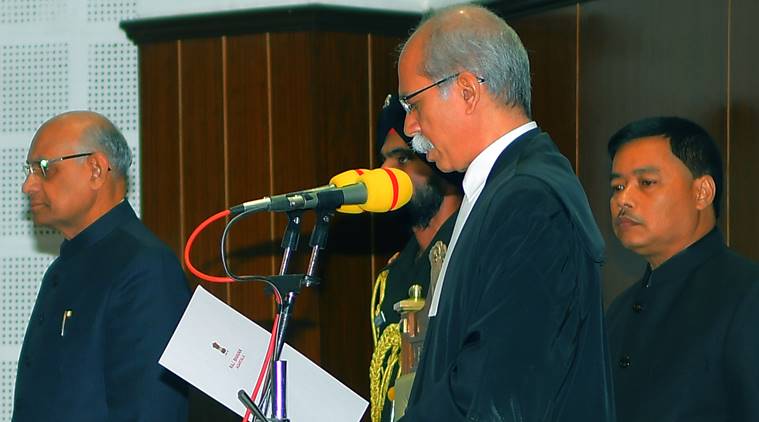
Newly appointed Chief Justice of the High Court of Tripura, Justice Akil Abdulhamid Kureshi being administered the oath of office and secrecy by Governor Ramesh Bais during at ‘Durbar Hall’ of Old Raj Bhawan in Agartala on Saturday. (ANI Photo)
Justice Akil Abdulhamid Kureshi was sworn in as the new Chief Justice of the High Court of Tripura on Saturday. He was previously serving with the Gujarat High Court.
Governor Ramesh Bais administered the oath of office and secrecy to Kureshi at Old Raj Bhawan in Agartala. He has assumed office as the 5th Chief Justice of Tripura High Court. The oath-taking ceremony was held at 11 AM in the presence of Chief Minister Biplab Kumar Deb, Deputy Chief Minister Jishnu Devvarman, cabinet ministers, Tripura High Court Justices Subhashish Talapatra, Arindam Lodh and others.
Justice Kureshi has succeeded Chief Justice Sanjoy Karol, who was has been appointed as Chief Justice of the High Court of Patna.
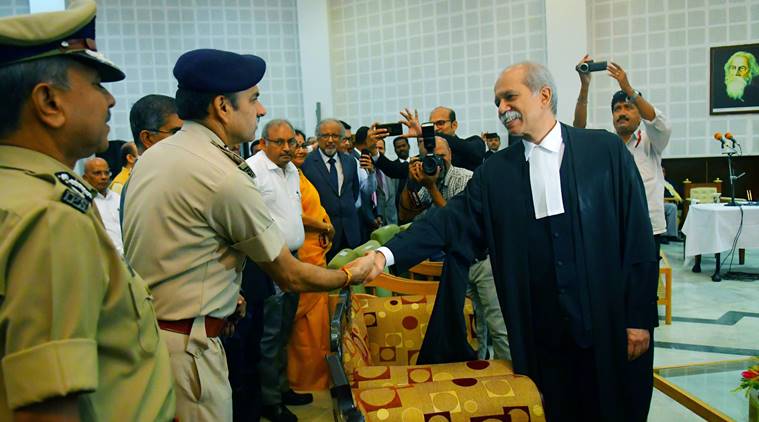
Justice Akil Abdulhamid Kureshi interacting with different officials of Tripura, during the oath-taking ceremony held at ‘Durbar Hall’ of Old Raj Bhawan in Agartala on Saturday. (ANI Photo)
In 2010, Justice Kureshi had sent incumbent Union Home Minister Amit Shah in police custody in connection with the Sohrabuddin Sheikh encounter case. A Special CBI Court had later discharged Shah from the case due to lack of evidence in 2014.
Earlier, the Supreme Court Collegium had recommended Justice Kureshi, who was the senior-most judge from Gujarat High Court, for appointment as Chief Justice of the Madhya Pradesh High Court. However, the Collegium later revised its recommendation with the modification that Justice AA Kureshi might be appointed as Chief Justice the High Court of Tripura.
The High Court of Tripura was established in 2013 with Deepak Gupta as its first Chief Justice. Previously, trials of High Court cases from the state were held at Agartala Bench of the Gauhati High Court.
source: http://www.indianexpress.com / The Indian Express / Home> North East India / by Debraj Deb / Agartala – November 16th, 2019
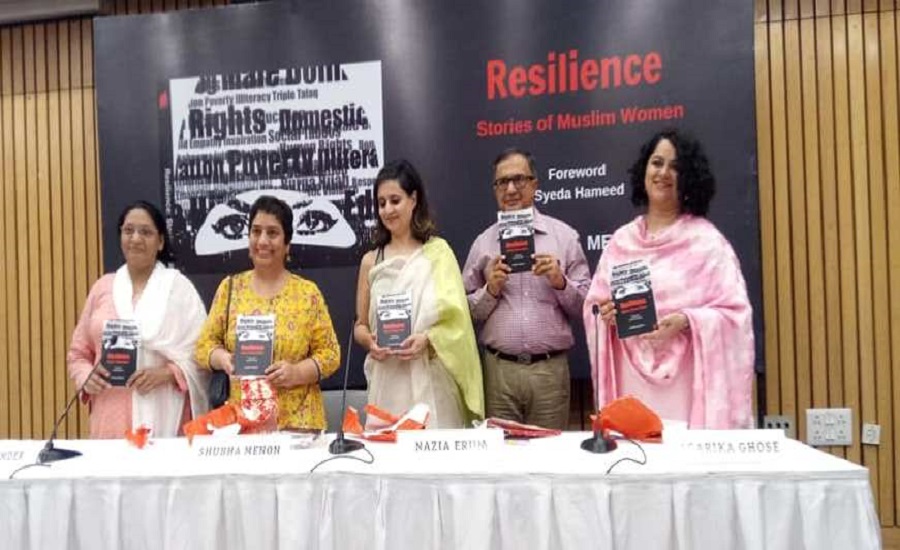
The book “Resilience: Stories of Muslim Women” was released by noted journalist and author Sagarika Ghose at a function at the India International Center, New Delhi on Wednesday. — Photo: Caravan Daily
‘Resilience: Stories of Muslim women’ released in New Delhi
New Delhi :
At a time when her stereotypes as meek and submissive entity are used by a political class to further its agenda, a new book catches Muslim woman in her multidimensional persona and in the process blasts many a myth surrounding her. In each of the varied fields of human endeavour, these Muslim women have come out in flying colours.
The book “Resilience: Stories of Muslim Women” was released by noted journalist and author Sagarika Ghose at a function at the India International Center here on Wednesday in the presence of many woman activists.
Speaking on the occasion, Ghose said the book negated the stereotype image of Muslim women as it illustrates that no matter what the economic impediments or social taboo, given the means and empathy Muslim women could also scale the height of success.
The book explores the lives of 11 resilient Muslim women who fought against all odds and got the opportunity to study in a tiny adult education centre. She congratulated these women and lamented in the scientific age woman have to face many odds and discrimination in every community.
The book release ceremony was followed by a discussion on the condition of women moderated by Nazia Erum, author and media advocacy head of Amnesty International India.
Social activist Shabnam Hashmi, the spirit behind the success of these women, said the book is like fresh air in the present political environment of the country in an oblique reference to the Modi Government’s push for enacting controversial Triple Talaq law which seeks to criminalise a civil matter like marriage.
She claimed stereotypical images of Muslim women are being used to further marginalise the minority community.
In early 1980, we started teaching the Nizamuddin Basti girls but it was a bumpy journey as girls had to struggle against severe hostility from the Basti residents whom Muslim girls going to study was “ anti-Islam or anti-Deen”, she added.
Shubha Menon, author, who documented the life of girls and women of Nizamuddin Basti, Delhi, said these were mostly dropouts or had not studied at all. She said she was touched by their stories and decided to bring the brighter side of the Muslim women.
On the occasion, many of these women narrated their stories of struggles.
Farida, who is a daughter of a Maulvi attached to Tablighi Jamaat, said she fought patriarchy, gender bias, poverty, and triple talaq to become a graduate. She said there was no discrimination on the basis of gender at home as her father loved her much but did not in favour of sending her to school. She told she was made to wear a burqa at 9, married off at 13 abandoned with two children at 16.
Farida, who now runs an NGO, has a sister Syeda whose story is also the same. “Both the sisters married to two brothers, unpaid labour in their matrimonial home, sloggers, beaten at the whims of a cruel matriarch, bearing children and hardship in one go. Their father, a Maulvi of Tablighi Jamaat, caught between the demands of his fellow Jamaatis and love for his daughters. The two sisters return home with meager belongings plus four pairs of mouths to feed. Then from rock bottom poverty, they extricate themselves. Their horizon widens and they rise and thanks to Seher Study Centre”.
Ayesha said she not only fought for her education but brought up her son to be an MBA and her daughter a Master in Science. Mussarrat, who now works for an international NGO, told that her grandmother kept her locked at home.
Other women Asma, Ishrat, Parveen, Shahjahan, Farhat, Parveen, and Najma’s stories are similar but not identical.
Shabnam said the mentors of Seher Study Centre in the Basti; teaching, counselling, chatting, encouraging the oppressed girls to break out of their fetters and manacles and ultimately from their cloisters.
From verbal threats to lathis, they not only bore them but spun them around to give great leverage to the girls they were grooming, she said.
The book, which chronicles the stories of successful women, also highlights the Markaz versus the Dargah which is another contradiction of the Basti. Stories of the Dargah dot the entire book. For example, Nizamuddin’s disdain for power is a poignant anecdote. Rulers of the Sultanate, Tughlaqs and Khiljis were not permitted to enter the Pir’s Khanqah. The Saint’s priority was not to pay obeisance to the ruler but to feed the poor and indigent no matter of what faith or of what caste while the Markaz propagates orthodox Islam. The author does not deride one practice at the cost of the other. Their parallel existence may occasionally clash but seldom becomes a major eruption.
She makes the reader a partner in her adventure as a reader is taken through the winding gulleys, narrow stairs, tottering houses, all the time surrounded by a mass of humanity; namely Muslims who live and breathe Nizamuddin. There is a constellation of girls who were transformed by the Seher Adult Education Centre. The stories unfold one by one.
The author Menon concludes that Seher comes out as a unique experiment, which not only transformed all those women who studied there but their future generations as well.
source: http://www.caravandaily.com / Caravan Daily / Home> Books / by Abdul Bari Masoud, Caravan Daily / August 29th, 2019
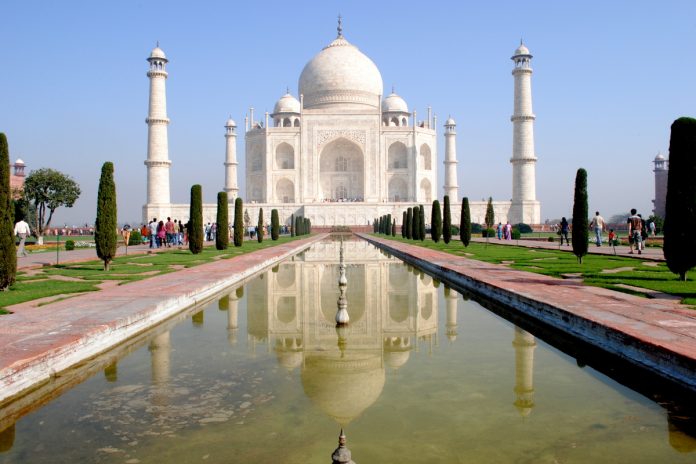
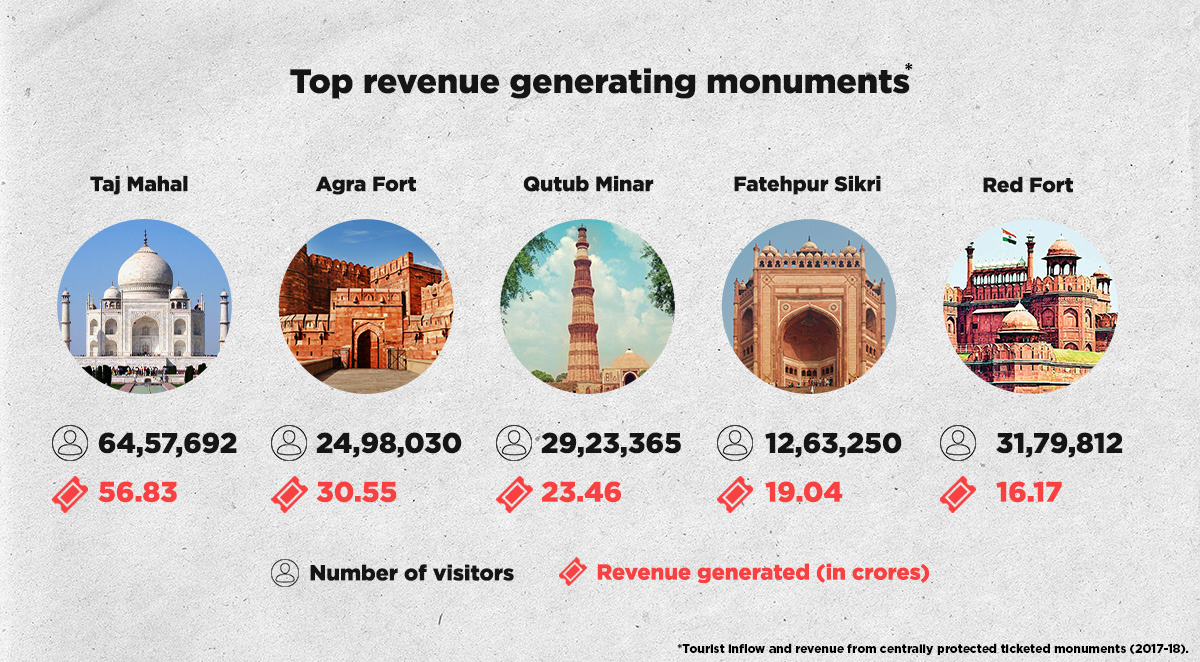
The Taj Mahal and 4 other monuments earned Rs 146.05 crore, more than half the total revenue generated by centrally-protected monuments, in 2017-18.
New Delhi:
Fringe Hindu groups and even some BJP leaders may have sought to belittle their significance but official data shows that India’s top five revenue generating monuments were all built by Muslim rulers – the Taj Mahal, Agra Fort, Qutub Minar, Fatehpur Sikri and Red Fort.
While Qutub Minar was built by rulers of the Delhi Sultanate, the rest were constructed by the Mughals.
These five monuments together earned the government Rs 146.05 crore in 2017-18, according Archaeological Survey of India (ASI) data. This is more than half the total revenue of Rs 271.8 crore generated by all centrally-protected monuments.
The Print
The Taj Mahal, which has been in the news for all the wrong reasons in recent years, with the Supreme Court last month pulling up the ASI for its poor maintenance, continued to be the highest earner at Rs 56.83 crore.
While some politicians sparked a controversy last year by arguing that the Mughal-era monument did not represent Indian culture, the number of visitors to it, both Indian and foreign, only increased since 2016-17.
A total of 64.58 lakh people visited the Taj Mahal in 2017-18 compared to 50.66 lakh in 2016-17.
Last year, the UP tourism department had even omitted the Taj Mahal, a UNESCO world heritage site, from a brochure listing the state’s principal attractions.
With total earnings of Rs 30.55 crore, Agra Fort built by Mughal emperor Akbar, another UNESCO world heritage site, was the second highest revenue generator in the last financial year.
While the Konark Sun Temple in Odisha came second after the Taj Mahal in terms of number of visitors (32.3 lakh), it generated only Rs 10.06 crore as revenue. This, officials said, is because the temple is mostly popular only with Indian tourists, with 32.21 lakh domestic visitors making the trip last year.
While Indian tourists are charged Rs 30 per head as entry fee to world heritage monuments across the country, foreign tourists have to pay Rs 500 each.
“It is impossible to communalise the entire Indian population through the meaningless political venom spewed by politicians,” said historian S. Irfan Habib, explaining the increase in visitors to the Taj.
“No matter what they say about the Taj Mahal and Red Fort, Indians will continue going there,” he added.
source: http://www.theprint.in / The Print / Home> India> Governanace / by Sanya Dhingra / June 07th, 2018
She passed away in Dhanuri village of Jhunjhunu district which has given the most number of war soldiers to the Indian army.
Saira Bano waited for six years for her husband’s return only to find out that he was martyred
Jaipur :
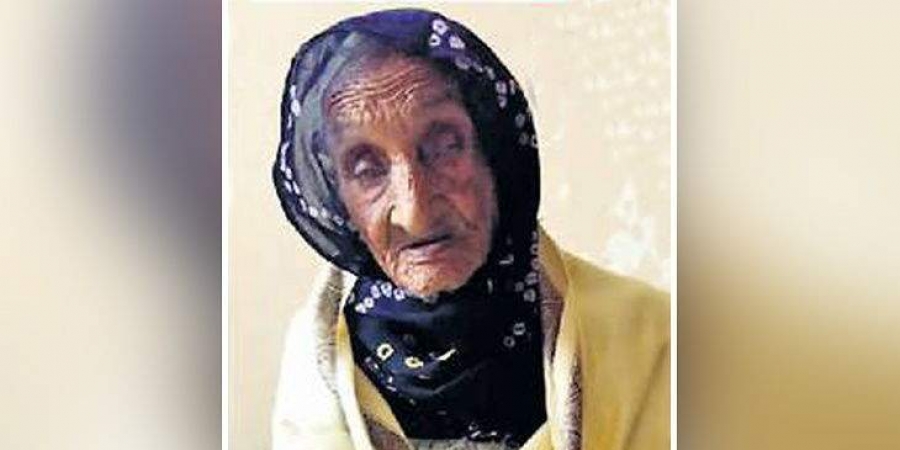
A chapter of sacrifice and dedication came to an end with the death of the country’s oldest, 103-year-old war widow, Saira Bano. She did not see the face of her husband after marriage, yet dedicated her life to him after his martyrdom.
She passed away in Dhanuri village of Jhunjhunu district which has given the most number of war soldiers to the Indian army.
District Soldier Welfare Officer Parvez Ahmed, Alsisar SDM Dr Amit Yadav arrived to pay homage to her on behalf of the administration.
Although Sair did not go to war, her fight was not less than that of a soldier’s.
Saira Bano got married to Taj Mohammad Khan during the second world war in 1939. The procession reached Dhanuri village on the day of Nikah. But Taj had to immediately go on duty which he never returned from.
After 6 years of waiting, she came to know that he was martyred. Even after this, Saira did not go to her own home. She did not marry because she loved him so much that she wanted to keep his martyrdom alive.
In an interview given a while back, she had said that her husband, Saeed Taj Mohammed, went to fight in World War II and while they were married, her ‘gauna’ did not happen.
“What did my husband’s face look like, I do not know till date, because I had never met him, had not even seen his face. After receiving the news of my husband’s death, my family and in-laws asked me to go for a second marriage, but I did not, because I wanted to remain in love with his martyrdom “, she had said.
Dhanuri village of Jhunjhunu is called the land of soldiers as there are soldiers in every household. Saira Bano was the Panch of Dhanuri village for 30 years.
The pension she received from the government was spent on teaching girls. In Dhanuri village, like Saira, there are 17 more bravehearts, whose husbands sacrificed their lives while fighting for the country.
Brigadier Ajit Singh Shekhawat, the General of the Kargil War, had recently visited Dhanuri village in Rajasthan, where he came to know about Saira’s story.
When he returned to Surat, he told his unit about her. It was then decided to honour her. In March 2019 Paramveer Shaheed Sahai Trust welcomed her. This was her first honour in Gujarat, with hundreds of people saluting her sacrifice.
source: http://www.newindianexpress.com / The New Indian Express / Home> Nation / by Rajesh Asnani / Express News Service / November 12th, 2019
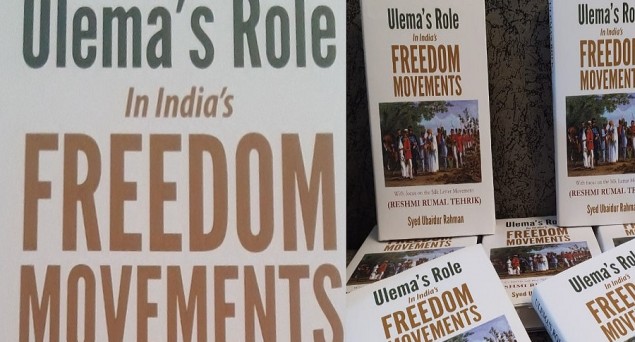
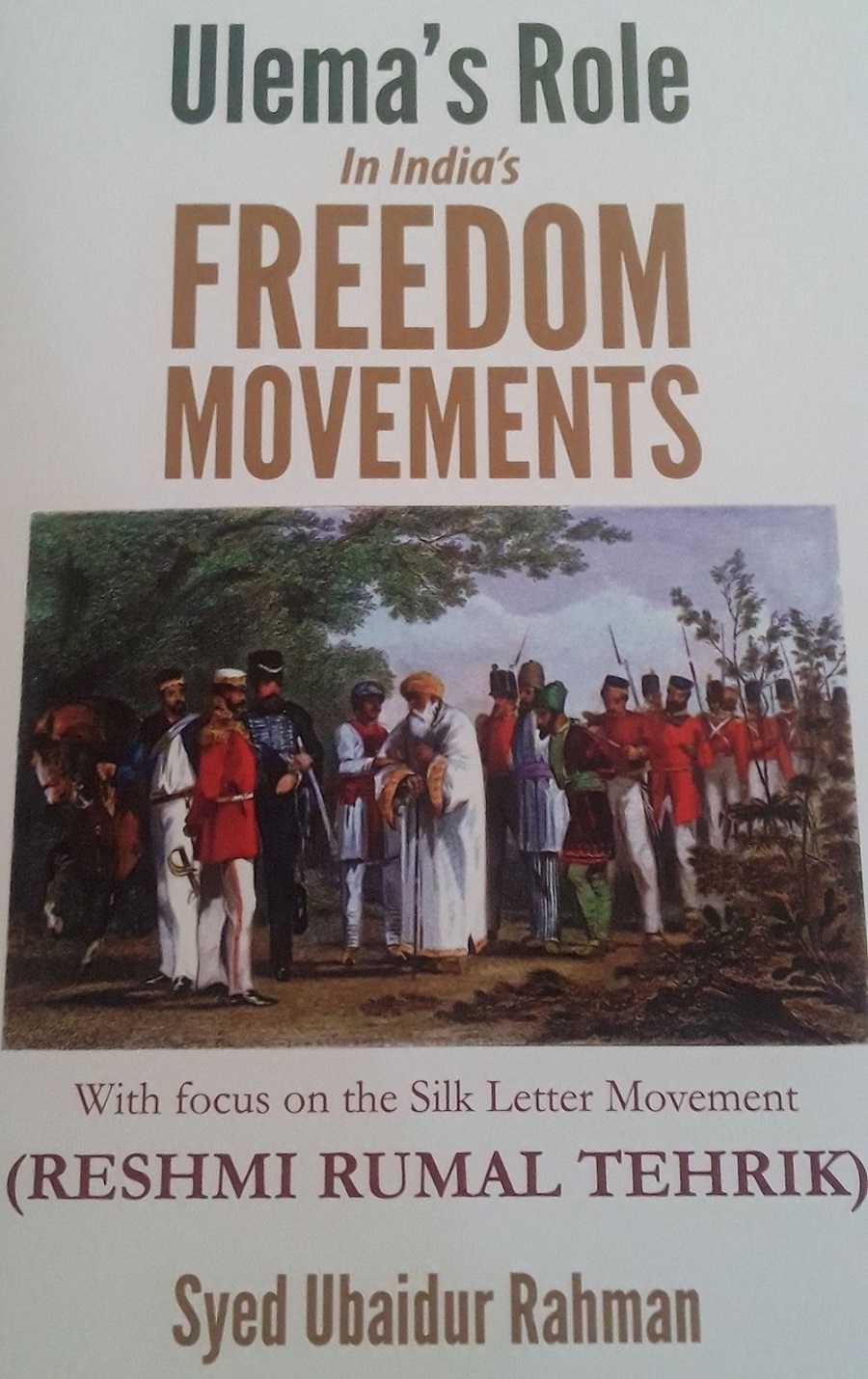
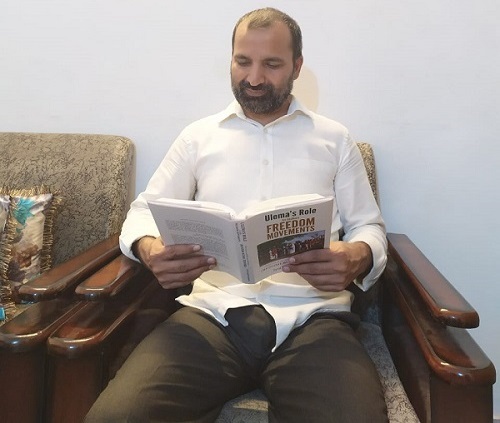
Amidst well-organized and power-backed attempts to erase M-word from the history of India’s freedom movement, has come out a humble academic bid to preserve in black and white the key role of Ulema or Muslim clerics in the ‘bloody’ freedom struggle spreading over around one century. Written by a young writer Syed Ubaidur Rahman, who is just 44, the book ‘Ulema’s Role in India’s Freedom Movements: With focus on Silk Letter Movement (Reshmi Rumal Tehrik) captures Ulema’s sacrifices in the Mutiny of 1857 and 1858, Faraizi Movement and Sayyid Ahmad Barelvi’s movement besides mainly focusing on the Silk Letter Movement as the title declares.
“The word ‘Ulema’ has become a rather very misunderstood term in the present day Indian society. Like everything Muslim, a conscious effort has been made to malign and ridicule the Muslim clergy…Over the last few centuries, the Muslim scholars have contributed immensely in seeing to it that the nation remains a single, united and cohesive unit and have made significant contributions to this end,” writes the author in the introduction of the book.
While admitting that “Ulema’s role in the society has considerably shrunk over the last several centuries,” he says that Ulema “used to have a very important place in the Indian society during Muslim rule in the country and even after the dismantling of the Mughal empire…over the centuries, on many occasions, they have led not just on spiritual front but on temporal front as well.”
“Every time in the past, when the country found itself in challenging situations, they stepped in and tried to play a much bigger role than what is usually anticipated from them. This was seen during different phases of freedom movements beginning with the first war of independence of 1857,” writes Rahman, a journalist by career who has penned several books in the last one decade, besides regularly writing articles and columns for various periodicals.
The 280-page book deals with different phases of India’s freedom struggle “with special focus on Silken Letter Conspiracy, better known as the Reshmi Rumal Tehrik.”
Highlighting the need and relevance of the book, the author says: “Not much has been written on Reshmi Rumal Tehrik or the people behind it and thus it remains shrouded in mystery. The book also discusses at length the Mutiny of 1857 and 1858, Faraizi Movement that was anti-colonial movement launched and sustained by Islamic scholars, besides Tehrik-e-Jihad of Sayyid Ahmad Barelvi in North Western Frontiers and Kashmir.”
The author says: “Despite the slide of the Muslim empire and the subsequent dismemberment, first between Muslim nawabs in the North, Deccan and South India, and later the annexation of these territories by the East India Company, Muslim scholars remained instrumental in trying to keep the Muslim empire intact. They were at the forefront in trying to stop the slide, and in posing challenges, first against those who fought the Mughals and later against the British East India Company. Shah Waliullah, the legendary Islamic scholar and reformist, did everything to stop the Mughal Empire from going to dogs. But, when despite all his efforts nothing happened, he sent a later to Ahmad Shah Abdali and also to Nawab of Oudh and Hafiz Rahmat Khan, the shrewd Ruhella chieftain. The rest is history.”
Deliberating on the core topic of the book, that is the role of Ulema in India’s freedom movement, the author writes: “Muslim ulema’s role was not limited to merely giving advice to the rulers and then become mute spectators of what was taking place. On the contrary, when they realized that there was no one coming forward to lead the masses, they took up leadership role, and fought off the invaders. From Bengal to Balakot and from Delhi to Lucknow, Muslim ulema played prominent roles in all the uprisings against the British (mis)rule. Be it Faraizi Movement, first war of independence of 1857 or the Reshmi Rumal Tehrik, they were instrumental and took leadership role. During the Mutiny of 1857, ulema were at the forefront and paid heavy price for their leadership role.”
The book highlights the contributions of some Ulema during the Mutiny of 1857 and subsequent fights.
The author says: Maulavi Ahmadullah Shah was one of the most prominent leaders of the entire freedom movement, who led on many war fronts and collaborated with all other renowned freedom fighters. Despite being among the most prominent leaders of the 1857 Mutiny, Maulavi Ahmadullah Shah remains a rather unknown figure in the country.He was a stalwart, a shrewd military planner, a great scholar of Islamic sciences and above all a unifier beyond any iota of doubt. He allied with almost all the leading actors of the 1857 revolution, be it Tantia Topi, Nana Sahib, Begum Hazrat Mahal, Bakht Khan Ruhilla, Khan Bahadur Khan Rohilla of Bareilly or any other freedom fighter of repute. It is an irony that despite his military successes against the British East India Company in 1857 from Lucknow to Bareilly and Shahjahanpur, his name is not even mentioned. His military planning unnerved the colonial rulers and his bravery won praise from the British generals like George Bruce Malleson and Thomas Seaton.
Haji Imdadullah Muhajir Makki was another alim of repute, known for his personal piety, scholarship, courage and military exploits during the Mutiny of 1857. A father figure among ulema of his time, his most renowned disciples include Maulana Qasim Nanotwi and Maulana Rasheed Ahmad Gangohi who not just fought alongside him in Thana Bhawan and Shamli but later went on to launch Darul Ulum Deoband. Maulvi Liaqat Ali, another alim was behind the uprising in Allahabad and evicting the East India Company out of the major North Indian town. It was his personal charisma and shrewd military planning that first brought together the mutineers and later successfully beat back the Company forces. Many more ulema played prominent roles during the uprising and paid dearly when the Company came back with a vengeance. Tens of thousands of ulema were hanged to death. Even those ulema who had nothing to do with the Mutiny were implicated, jailed, sent to kalapani and unceremoniously killed. However, this dance macabre didn’t stop them from taking to the same means to defeat the colonial rulers later.
Silk Letter Movement
The author says: “Reshmi Rumal Tehrik is a freedom movement that remains largely unknown. Not much has been written on it and both its top leaders, Mahmud Hasan and Ubaidullah Sindhi, despite their stellar roles and sacrifices, remain rather unknown. While Shaikhul Hind spent three years in trying circumstances in Malta, Ubaidullah Sindhi spent more than three decades in exile, first in Afghanistan and then in Turkey and Hejaz.”
Silk Letter Movement, known more widely as the Reshmi Rumal Tehrik, was launched by ulema of Deoband, particularly Mahmud Hasan and his renowned disciple Ubaidullah Sindhi, who later went on to become the Home Minister in the first provisional government established in Kabul. Raja Mahendra Pratap Singh was its President and Maulana Barkatullah Bhopali was its Prime Minister. The Reshmi Rumal Tehrik had a two-fold objective, one to incite the tribal people in North Western Frontier region and then forging alliance with other world powers including Afghanistan, Turkey and Germany. While Mahmud Hasan headed to Hijaz to seek help from Turkish officials, Ubaidullah Sindhi went to Kabul to forge alliance with Afghan amir. Both were very successful in their planning, but while Mahmud Hasan was still in Hijaz, Ottomans suffered heavy reverses against Sharif of Mecca who was being propped by Britain. At the same time, the entire planning of Ubaidullah Sindhi was discovered when the Silken Letters, sent by him to Mahmud Hasan were unearthed by the British CID. Hundreds of their supporters across Punjab, United Provinces and Delhi were arrested by British police.
In the introduction of the book, author Rahman says: “The pages that follow unravel a history that has been often suppressed and not much has been written on it. To many people, this side of the history may seem rather bewildering as I examine it and try to make sense as to what happened in our part of the world and how those brave men, despite the failure of 1857 mutiny rose repeatedly to defy the British Raj.”
How Important Is This Book when saffron eraser is moving fast on the canvas of freedom history of India?
Talking to India Tomorrow, the author responded to the question: “History needs to be preserved. It is the responsibility of the people, communities and the nations to preserve their histories and present right perspectives to what happened in the past. Indian Muslims have done precious little when it comes to presenting their perspective in right context. On the contrary, the Sangh Parivar, bent upon distorting the history of the last few centuries, has made strides in this field. Despite the fact they were never part of the freedom movement, they have claimed an important role for them, and have tried to co-opt major historic figures as part of their narrative. This began with Patel. Now they are trying to claim Gandhi and Ambedkar as their own, despite both being fiercely opposed to their ideology of hate. On the contrary, the Muslims have ignored this part completely. Hope this book serves its purpose and creates awareness among masses about what Muslim scholars and ulama did for the nation in the freedom struggle.”
The book has come out at a time when the BJP government in Karnataka has decided to scrap the state’s official celebrations around Tipu Sultan’s birth anniversary. Going one step ahead, the government announced to remove the lesson on the 18th century Mysore ruler from school history books.
Author Syed Obaidur Rahman
Given the communal hatred widening the gulf between Hindus and Muslims, the author wants the book reaches the masses.
“While this is of paramount importance to render this book in Hindi and other vernacular languages, this seems a hard nut to crack due to want of resources. God willing, I would definitely like to bring it in Urdu, Hindi and other regional languages,” says Rahman who has several other books to his credit, including Muslim Freedom Fighters: Contribution of Indian Muslims in the Freedom Movement, Understanding Muslim Leadership in India and Muslim Mujahideen e Aazadi, aur Tehrik e Azadi mein unki khidmaat (Urdu).
Book:Ulema’s Role in India’s Freedom Movements: With focus on the Silk Letter Movement (RESHMI RUMAL TEHRIK)
FPG/HULTON ARCHIVE/GETTY IMAGES
Image caption
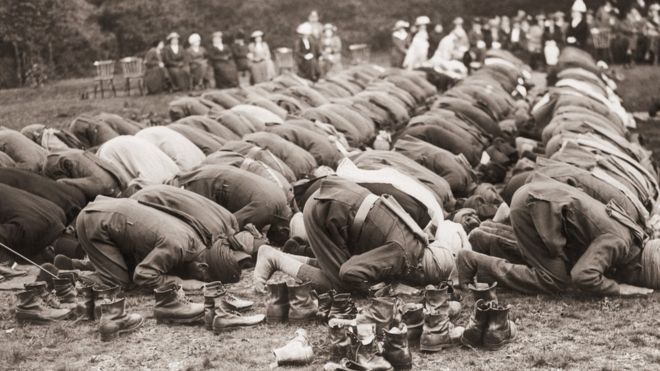
Indian troops serving with the British army pray outside the Shah Jahan Mosque in Woking, Surrey
A hundred years since the end of World War One, historians think recognising the contribution of Muslims can help tackle contemporary issues such as Islamophobia.
“Muslim soldiers have been forgotten about over time,” Hayyan Bhabha, from the Muslim Experience, says.
“The core far-right narrative is that Muslims have never done anything for us.
“Well, actually, with facts that are over 100 years old, we can say Muslims fought and died for the history and security of Europe.”
It is estimated that 1.5 million Indian troops fought to defend Britain. Of those, 400,000 were Muslim soldiers.
The Muslim Experience is working to highlight the global contribution of Muslim soldiers to World War One and says raising awareness could silence anti-Muslim rhetoric by far-right groups in Britain today.
Mr Bhabha says his team is now opening up documents and discovering new information about their role in the War.
“Accessing archives from 19 countries, we have discovered that more than four million Muslims either fought or served as labourers during the War, from around the world,” he says.
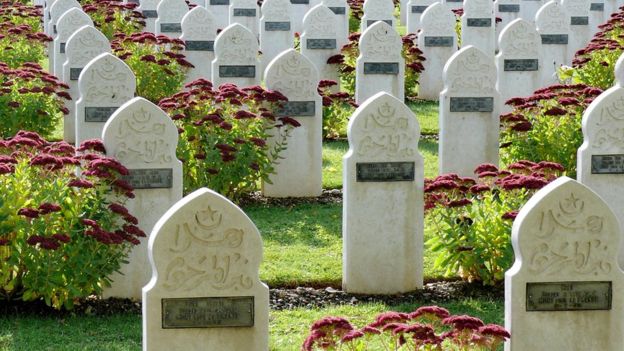
Image copyright FORGOTTEN HEROES 14-19 Image caption Muslim graves in French military cemetery Notre Dame de Lorette.
One of those was Sepoy Khudadad Khan, an Indian soldier who fought alongside British troops.
He was the sole survivor of a team assigned to defend vital ports in France and Belgium from German forces.
According to accounts, Khan managed to hold off the enemy advance long enough for British reinforcements to arrive.
On 31 October 1914, Khan, of the 129th Duke of Connaught’s Own Baluchis Regiment, became the first South Asian to receive the Victoria Cross, Britain’s highest military honour.
‘Feel more British’
Groups such as the Muslim Experience want stories of soldiers to be heard.
They also want more British Muslims to find out if they have a personal connection to World War One.
Just as a local GP in Nottingham, Dr Irfan Malik, did after he had a chance conversation with a patient that led him to discover two of his great-grandfathers had fought for Britain.
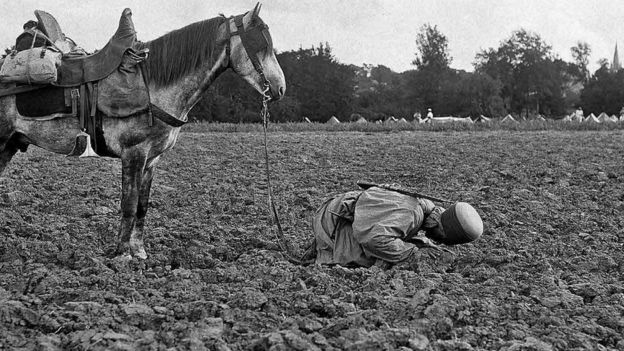
Image copyright FORGOTTEN HEROES 14-19 Image caption It is estimated that millions of Muslims fought for the Allied forces globally
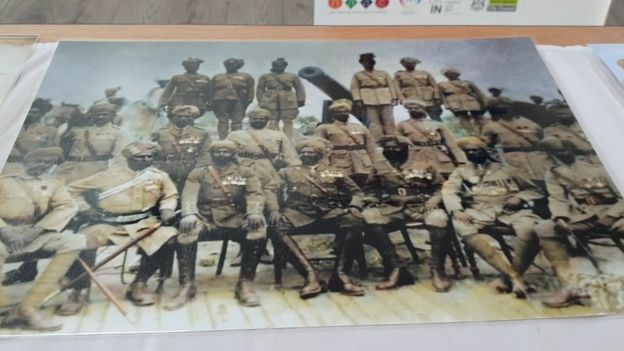
Dr Malik’s great-grandparents, Capt Ghulam Mohammad and Subedar Mohammad Khan, were two of 460 soldiers from a tiny village called Dulmial, in modern-day Pakistan, sent to fight in the 1914-18 conflict.
“One of my patients is a researcher of Commonwealth contribution to World War One and I told him about a village in modern-day Pakistan where I’m from that has a cannon commemorating the Great War,” he says.
“From that point four years ago, my journey began and I found out my two great-grandparents fought for Britain.
“I’m very fortunate to have images from 100 years ago. It means a huge amount to me. It’s made me feel more British as we have this shared history in common and I believe it helps community cohesion.”
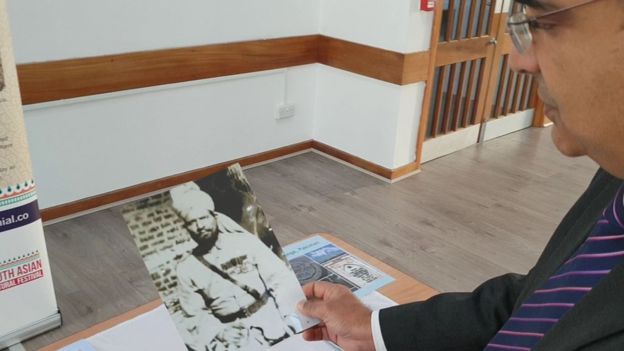
Dr Irfan Malik has collected pictures of his great-grandfather Subedar Mohammed Khan
But how connected do British Muslims feel to the War and how aware is the community itself of its links to British military history?
Mr Bhabha thinks some young Muslims in particular are not engaged with British military history.
“Most Muslims are not engaged with military history because they can’t relate to it,” he says. “The way it is taught currently is very European-centric.
“The history that is taught doesn’t show the true diversity of everyone that took part in the First World War.”
Indian Muslim soldiers in the village of Dulmial, modern-day Pakistan
So, it has launched a campaign, Remember Together, to raise awareness in schools.
Steve Ballinger, from British Future, says: “Finding out that Muslim soldiers fought and died for Britain to protect us and to protect the freedoms we enjoy today, that’s an important history for everyone to know.”
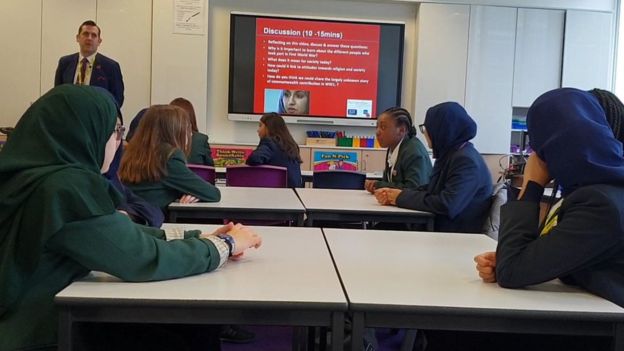
Pupils at Eden Girls School learn about the Muslim contribution to World War One
It has certainly meant a lot to Daleesha Naz, 14, of Eden Girls School, in east London.
“Today I learned that 400,000 Muslims fought in the British Indian army and it has made me feel closer and more connected to British history,” she says.
As the 100th anniversary of the end of World War One is remembered, historians, campaigners, and descendants of the soldiers are making sure the contribution of Muslims is never forgotten.
Luc Ferrier, who chairs Forgotten Heroes 14-19 – the umbrella group for the Muslim Experience – says: “If the world really wants to reach out to the international Muslim community, then they need to know the enormous contribution these people have made, fighting a war none of their making.
“Only by recognising and honouring the global Muslim sacrifices, not only these of the British colonies, we are reaching out to them and saying a genuine thank you”.
source: http://www.bbc.com / BBC News / Home> UK / by Rahil Sheikh / BBC Asian News Network / November 09th, 2018
Homeschooled for the early part of his life, Azad is considered to be the father of the Indian Institutes of Technology (IITs). Here is a look at some of the major initiatives taken by him in setting up the Indian education system.
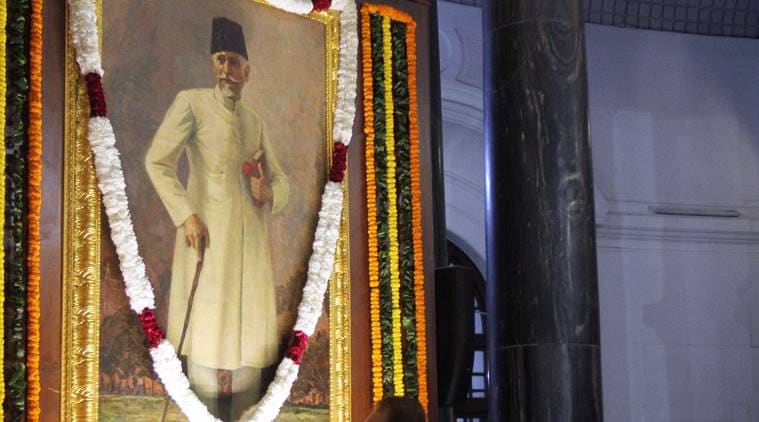
Maulana Abdul Kalam Aazad (File Photo)
Bharat Ratna awardee and India’s first Minister of Human Resource Development (HRD), Maulana Abul Kalam Azad was not only an educationalist but also a journalist. Homeschooled for the early part of his life, Azad is considered to be the father of the Indian Institutes of Technology (IITs) which are still considered among the best Indian educational institutes. Here is a look at some of the major initiatives taken by him in setting up the Indian education system.
Naming IITs – When India was looking to set up higher educational institutes which would impart knowledge in the field of science and technology, a Massachusetts Institute of Technology-like (MIT) model was thought of. The name ‘Indian Institute of Technology’ was adopted by Maulana Abul Kalam Azad before the inauguration of the institutes. The first Indian Institutes of Technology – IIT Kharagpur came into establishment in 1950.
Establishing UGC – A committee headed by S Radhakrishnan under the leadership of Azad as HRD Minister suggested extending the Universities Grant Commission (UGC)’s role to supervise work of all Indian varsities, make recommendations and grant funds. Earlier, UGC looked after three central universities, namely Aligarh, Benaras and Delhi.
DU and IISc – He laid the foundation stone of the Indian Institute of Science (IISc) in 1909, then known as the Tata Institute and granted deemed university status in 1958. Azad also oversaw the setting up of the ‘Central Institute of Education, Delhi’, which later became part of University of Delhi (DU) as the Department of Education. He was also a member of the foundation committee to establish Jamia Millia Islamia at Aligarh in UP.
Minority community – A supporter of education for poor, women and minority communities, Azad had said, “It is a birthright of every individual to receive at least the basic education without which he cannot fully discharge his duties as a citizen.”
To honour his efforts, Ministry of Minority Affairs of the Central Government of India set up the Maulana Azad Education Foundation to promote education among educationally backward sections of the society. The Ministry also provides the Maulana Abul Kalam Azad National Fellowship, an integrated five-year fellowship in the form of financial assistance to students from minority communities to pursue higher studies. The education institutes include Maulana Azad National Institute of Technology, the Maulana Azad College among others.
source: http://www.indianexpress.com / The Indian Express / Home> Education / by Education Desk , New Delhi / November 11th, 2019
Their medals ensured India secured a record 15 quota places for the 2020 Tokyo Olympics, easily surpassing the 12 for the 2016 Rio Games and 11 for London 2012.
FILE PHOTO: There was a shoot-off for the gold medal and Angad Vir Singh Bajwa prevailed 6-5 against Mairaj Ahmad Khan, after both were tied on 56 at the Lusail Shooting Complex.
Gold medallist Angad Vir Singh Bajwa and silver winner Mairaj Ahmad Khan added to India’s rich Olympic quota haul with a sensational 1-2 finish in the men’s skeet event at the 14th Asian Championships on Sunday.
Their medals ensured India secured a record 15 quota places for the 2020 Tokyo Olympics, easily surpassing the 12 for the 2016 Rio Games and 11 for London 2012.
There was a shoot-off for the gold medal and Bajwa prevailed 6-5 against his compatriot after both were tied on 56 at the Lusail Shooting Complex.
India won three quotas on Sunday, including teenager Aishwary Pratap Singh Tomar’s bronze in men’s 50m rifle 3 positions.
“15 quotas and a very special 1st & 2nd in Skeet. Angad and Mairaj – Bravo boys super proud of you two. Way to go team India you exceeded my estimate by an additional quota!” National Rifle Association of India (NRAI) president Raninder Singh tweeted.
Raninder Singh@RaninderSingh
15 quotas and a very special 1st & 2nd in Skeet. Angad and Mairaj – Bravo boys super proud of you two. Way to go team India you exceeded my estimate by an additional quota!
Meanwhile, continuing India’s impressive performance at the prestigious championships, the duo of Manu Bhaker and Abhishek Verma got the better of compatriots Saurabh Chaudhary and Yashaswini Singh Deswal 16-10 to win the gold medal in the 10m air pistol mixed team event.
Bhaker and Verma shot 577 and 387 in the two qualifications, while Chaudhary and Deswal managed 576 and 387.
Before India’s exploits in the mixed event, the 18-year-old Tomar shot 449.1 in the eight-man final to finish third on the podium, behind gold medallist Kim Jonghyun (459.9) of Korea and Chinese Zhonghao Zhao (459.1).
source: http://www.sportstar.thehindu.com / SportStar / Home> Shooting / by PTI / Doha, November 10th, 2019
Two Class-10 students, PV Nayana and Fathimathul Nafra, introduced organic sanitary napkin made from soybean
Personal hygiene concerns are behind the recent bids to promote the production and use of affordable sanitary napkins especially among underprivileged women. A 2018 Hindi film named ‘Pad Man’ is even based on a Tamil social activist who introduced low-cost sanitary pads.
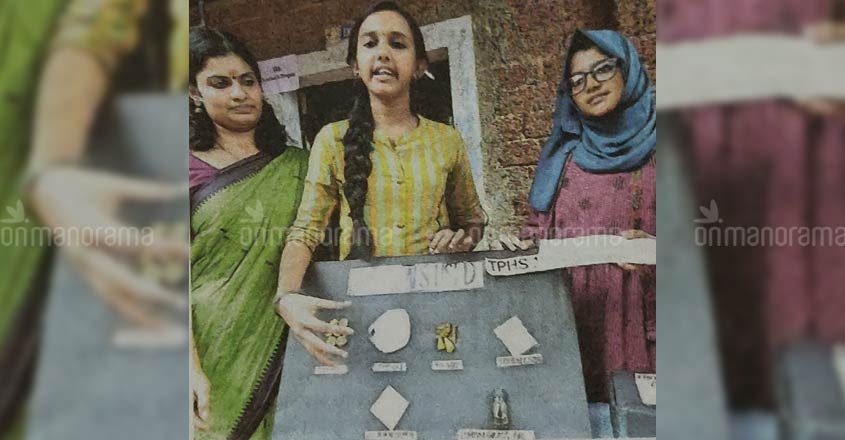
At this year’s Kerala School Science Fest, two Class-10 students — PV Nayana and Fathimathul Nafra — impressed spectators with organic sanitary napkin made from soybean.
With soybean as base for the disposable absorbent pad the duo not only introduced a unique method of making organic sanitary napkins but also pledged their commitment to nature.
Nayana and Nafra are students of the Higher Secondary School at Kadambur in Kerala’s Kannur district.
They claim that the organic napkins are safe for use as chemicals are not used in it. Besides, these biodegradable napkins pose absolutely no harm to the nature.
Napkins made using organic and biodegradable materials like coconut fibre, water hyacinth, banana stem and jute are already in the market.
Nayana and Nafra said extensive research done in this field had inspired them.
Soybean’ incredible ability to absorb water made us try out its possibilities, they added.
After making the napkins, they conducted further experiments and tests at SN College, Kannur, and also at a Bengaluru facility. The experiments there proved successful which further motivated the students to present it at this year’s School Science Fest.
Besides soybean, organic materials like beeswax and cotton too are used in this sanitary napkin. Making a single piece of this organic soybean napkin would cost Rs 3. However, the students say that it would only cost Rs 1.5 per piece if the napkins are industrially produced.
Nayana and Nafra were guided by Roshita who is a teacher at their school.
source: http://www.english.manoramaonline.com / OnManorama / Home> News> Campus Reporter / by OnManorama Staff / November 06th, 2019
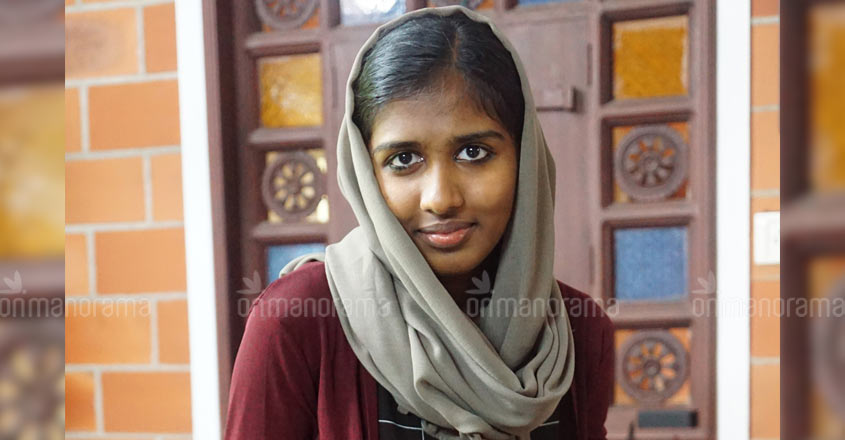
Wayanad native Anjitha K Jose and Faheema Shirin of Kozhikode do not have much in common. But what connects these two students from Kerala is their sheer willpower to fight for women rights !
Anjitha fought for freedom to travel at night for girls staying at hostels, while Faheema waged a legal battle to win the right for using mobile phones at hostels.
Both of them won favourable verdicts. But it was not an easy path to success.
What time is right for girls ?
If authorities of the college hostels were asked about by what time should the girls return to hostel, then some would say by 4.30 pm, others by 6 pm and for another one it would be 7 pm. However, boys have no such time restrictions.
Anjitha, a student of the Kerala Varma College in Thrissur, filed a legal petition against this. Girl students are allowed to go out for only three days in a week and then too, they have to return by 4.30 pm. However, this rule is not applicable for boys.
Though she questioned the inequality several times, college authorities did not take any action.
That’s when she heard about the Legal Collective for Students’ Rights. She spoke to the then executive director of the collective, P K Arjun and decided to take the legal course. Surya Binoy, daughter of senior CPI leader Binoy Viswam, represented Anjitha in court. The favourable verdict was out after 1.5 years.
The complaint was filed, while pointing out that freedom to travel was a fundamental right. When the case was filed, Anjitha was a final year degree student. When she completed her studies, another student Rinsha Thasni took over the case and won the favourable judgement.
Anjitha said that when the case was under court’s consideration and after the verdict was filed, she had to endure several problems. Several people made statements defaming her.
All that she asked was to give them the consideration of being humans, not even women.
After the court verdict, the government issued an order that girls and boys of the government college hostels can stay out till 9 pm.
Is mobile phone the villain ?
Even when we make tall claims of the digital revolution, girls are not allowed to use mobile phones at hostels. At some hostels, girls were not allowed to use to phone after 10 pm. At others, the diktat was during study time.
Though degree and PG students pointed out that smartphones and internet were vital for studying, none paid any heed. Some of the authorities asked the girls to shift the hostels if they were not ready to follow the ban on mobile use.
A second-year degree student at SN College at Chelannur in Kozhikode, Faheema also faced the same dilemma. However, when she walked out of the hostel, Faheema vowed to react against this.
Thus, she began her legal battle. Legal Collective for Students’ Rights came to her aid as well. Legith T Kottakkal agreed to represent her in court and the petition was filed.
The High Court ruled in Faheema’s favour on October 19. The court observed that the use of mobile phone was a fundamental right and nobody had the authority to stop it.
Legal protection for students
Jishnu Prannoy, a first-year engineering student, was found dead under mysterious circumstances at his college hostel in January 2017. The teenager’s death had shocked Kerala’s conscience. A bunch of law students then came together and formed the Legal Collective for Students’ Rights to give legal aid for students. The collective also started a Facebook page ‘Your Lawyer Friend.’
Fourteen law students and four advocates started the collective on February 8, 2017. The collective has helped students in 50-odd cases so far. The current executive director of the collective is J Sreenath, a fourth-year student of the National University of Advanced Legal Studies (NUALS).
source: http://www.english.manoramaonline.com / OnManorama / Home> Women / by Deepthi Pellissery / November 08th, 2019