Birds of Bengal at Sweden auction

Patna, BIHAR /  Calcutta, BENGAL :

The paintings by Zayn al-Din were commissioned by Mary Impey, an English natural historian and patron of the arts in Bengal
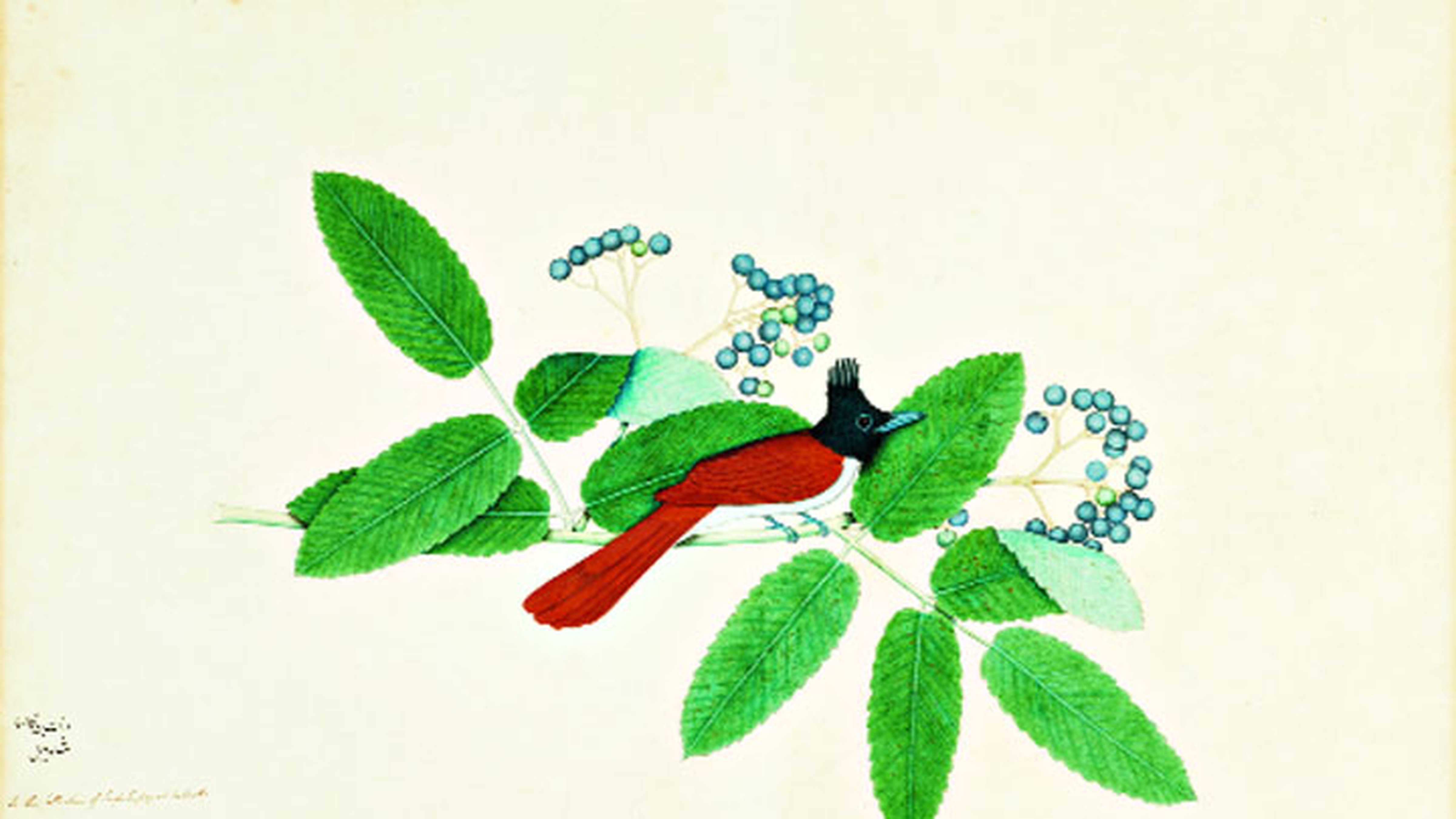
Falsa Tree with King’s Nightingale was painted on a 53.5cm x 75cm canvas by Zayn al-Din in 1782 . / Picture courtesy: Stockholm Auction House
Falsa Tree with King’s Nightingale was painted on a 53.5cm x 75cm canvas by Zayn al-Din in 1782 . /
Picture courtesy: Stockholm Auction House

Two watercolour and pencil-on-paper artworks painted in Calcutta in the late 18th century by one of the most famous exponents of the Company School of Art will go under the hammer at the world’s oldest auction house in Sweden on June 12.

The paintings by Zayn al-Din were commissioned by Mary Impey (March 2, 1749 -February 20, 1818), an English natural historian and patron of the arts in Bengal. She was the wife of Elijah Impey, the first chief justice of the Supreme Court at Calcutta (1774-82), who had infamously sent Maharaja Nandakumar — a highly-placed officer in the nawabi administration — to the gallows on charges of perjury.

Falsa Tree with King’s Nightingale, dated 1782, and Parrot in a Parkar Tree, dated 1779, have been in the possession of a Swedish family for long.

“We are immensely proud to present these rare artworks. We are not sure how they reached Sweden. They have been in the same Swedish family for a long time and this is the first time that they reach the market,” Victoria Svederberg Bojsen, a specialist in classic and modern art at the Stockholms Auktionsverk (Stockholm Auction House), founded in 1674, told Metro over phone from Stockholm.

“The estimate price is Euro 51,000 (Rs 40 lakh) to 61,500 (Rs 48 lakh). However, we believe they will reach an even higher price. Our hope is naturally that they will now be returned to India where they originated,” she said.

Birds are the subjects of both the paintings. Falsa Tree with King’s Nightingale is a 53.5cm x 75cm canvas.

The inscriptions on both pictures read: In the Collection of Lady Impey of Calcutta. Painted by Zayn al-Din Native of Patna 1782.

“Both paintings include a description of the subject in Persian — Darakht ban falsa, Shah Bulbul in the first and Madna Tota, Darkaht Pakar in the other. The artist’s name is also written in Persian,” said Nandini Chatterjee, associate professor of history at the University of Exeter in the UK.
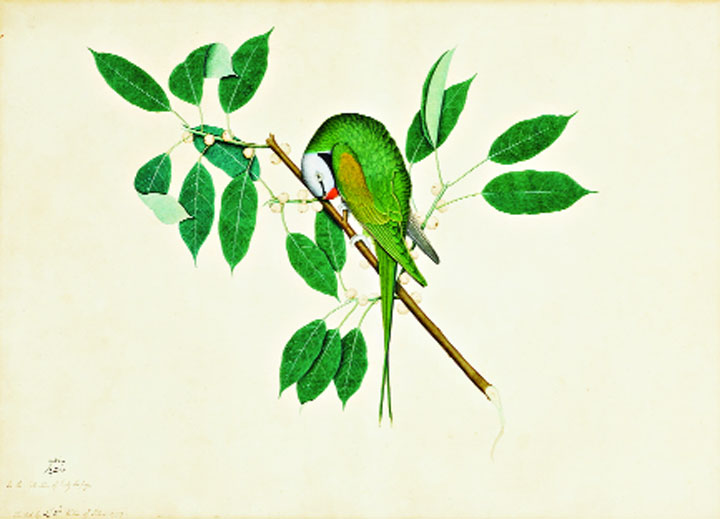
The painting (right), titled Parrot in a Parkar Tree, is signed and dated 1779. The inscriptions on both artworks read: “In the Collection of Lady Impey of Calcutta. Painted by Zayn al-Din Native of Patna 1782”. / Picture courtesy: Stockholm Auction House
The painting (right), titled Parrot in a Parkar Tree, is signed and dated 1779. The inscriptions on both artworks read: “In the Collection of Lady Impey of Calcutta. Painted by Zayn al-Din Native of Patna 1782”. /
Picture courtesy: Stockholm Auction House

Metro had sent the images to Chatterjee, who is part of a research on two sets of natural history drawings produced between the late 18th and early 19th centuries in Calcutta. The drawings are held at the Victoria Memorial Hall and the Royal Albert Memorial Museum & Art Gallery in Exeter.

The Impeys moved to India in 1773 after Elijah Impey was made the chief justice of Bengal. They set up a menagerie at their house in Calcutta’s Middleton Row. When they shifted to Fort William two years later, they started a collection of native birds and animals on the extensive gardens of the estate.

Mary Impey commissioned several local artists to paint the fauna and flora they had collected. Her three principal artists were Sheikh Zayn al-Din, and brothers Bhawani Das and Ram Das. All three had come from Patna.

Together, Zayn al-Din and the Das brothers painted more than 300 artworks, half of them of birds. The collection, often known as the Impey Album, is an important example of Company style painting.

“With the decline of the Mughal courts, the artists sought the patronage of Europeans. These artists had to change their traditional techniques to suit their new masters. These revisions included a more accurate representation of the subject and a change in perspectives,” said Jayanta Sengupta, the curator of the Victoria Memorial.

Little is known of Zayn al-Din, the artist whose works will be auctioned in Sweden next month. He is known for his extraordinarily detailed paintings for the Impey Album. His drawings of mountain rats, hanging bats, parrots and storks serve as interesting zoological studies and are now preserved at the Ashmolean Museum in Oxford.

“The artworks from the Impey Album rarely reach the international market and the few that have been sold previously at Christies, Sothebys and Bonhams have fetched between $80,000 (Rs 55.5 lakh) and $140 000 (Rs 97.7 lakh),” Bojsen said.

The real study of the Indian subcontinent’s natural history is said to have started with the Mughals. Baburnama — the memoirs of the first Mughal ruler — has beautiful illustrations of birds and animals. Shah Jahan also took a keen interest in the flora and fauna.

With the fall of the Mughals, the artists sought the patronage of Europeans. Calcutta became a thriving centre of the (East India) Company school of painting.

“India was an unknown land for Europeans and along with its indigenous archaeology and history, they also wanted to explore its abundant flora and fauna. Imperial documentation differs from its Mughal predecessor in scale and systematic approach,” Sengupta said.

“Mary Impey was part of a circuit of Europeans who commissioned paintings of Indian natural history. Apart from the pictorial documentation of flora and fauna, the extensive notes kept by her about their habitat and behaviour were of great use to later biologists,” he said.

The collection went to England with the Impeys in 1783 and were sold at a London auction in 1810. Several pieces are in various museums, including the Metropolitan Museum of Art in New York and the Victoria and Albert Museum in London.

“The style of inscription, and the handwriting is identical to other paintings all around the world. I do not believe Zayn al-Din’s name is in his own handwriting. It was probably written by a British collector, maybe Lady Impey herself. Many such British Orientalists (and perhaps some of their spouses) knew Persian,” Chatterjee said.

Some of Zayn al-Din’s works are at the Royal Albert Memorial Museum too. “But those have his name written in English and Bengali, perhaps by a collector who was interested more in the vernacular language, than Persian, which was the Mughal language of administration and courtly culture,” Chatterjee said.

source: http://www.telegraphindia.com / The Telegraph, online edition / Home> West Bengal / by Debraj Mitra in Calcutta / May 28th, 2019


Stimac names six newcomers in squad

Igor Stimac. File
Igor Stimac. File

Indian football head coach Igor Stimac on Sunday named six newcomers in the final list of 23 players for the King’s Cup, to be held in Buriram, Thailand from June 5.

The six are Rahul Bheke, Brandon Fernandes, Raynier Fernandes, Michael Soosairaj, Abdul Sahal and India U-17 World Cup team captain Amarjit Singh.

The final list: Goalkeeper: Gurpreet Singh Sandhu, Amrinder Singh, Kamaljit Singh.

Defenders: Pritam Kotal, Rahul Bheke, Sandesh Jhingan, Adil Khan, Subhasish Bose.

Midfielders: Udanta Singh, Jackichand Singh, Brandon Fernandes, Anirudh Thapa, Raynier Fernandes, Pronay Halder, Vinit Rai, Sahal Abdul, Amarjit Singh, Lallianzuala Chhangte, Michael Soosairaj.

Forwards: Balwant Singh, Sunil Chhetri, Farukh Choudhary, Manvir Singh.

source: http://www.thehindu.com / The Hindu / Home> Sport> Football / by PTI / New Delhi – June 02nd, 2019

Governor announces financial assistance of Rs 5 lakh to tourist guide Rouf’s family

Srinagar, JAMMU & KASHMIR :

Tourist Guide Who Saved Five Lives But Unfortunately Lost His Life In A Act Of Bravery

Srinagar

Governor Satya Pal Malik has saluted the bravery of Tourist Guide Rouf Ahmad Dar, who lost his life while rescuing tourists from the Lidder river in Pahalgam. He described Rouf as a real-life hero who sacrificed his life for saving the lives of others.

Governor has prayed for eternal peace to the departed soul and strength to the bereaved family in its hour of grief.

Honouring the exemplary display of selfless action, Governor has announced financial assistance of Rs 5 lakh for the family of Rouf.

Dar saved five tourists, two of them foreigners, after their boat capsized in fast flowing river Lidder near Mawoora area of Pahalgam in south Kashmir’s Anantnag district on Friday evening.

Unfortunately, Dar lost his life in an act of bravery which is being hailed by people and the administration.

source: http://www.kashmirlife.net / Kashmir Life / Home> Latest News / by KL News Network / June 01st, 2019

The Hindu lensmen bag prizes

Machilipatnam , TELANGANA :

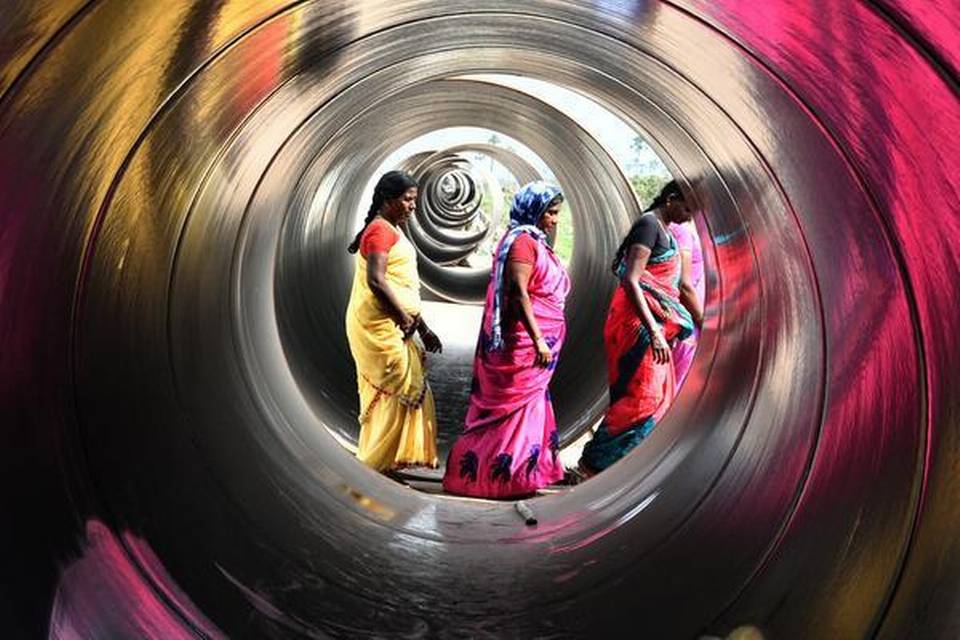
This photograph has been selected second prize in the Press Club Hyderabad Photo contest this year. Women from a nearby village walk between huge pipes used in the construction activity at Mandadam in the core capital region near Vijayawada of AP, | Photo Credit: CH_VIJAYA BHASKAR

The Hindu photographer at Vijayawada, Ch.V.S. Vijaya Bhaskara Rao, won second prize in the third edition of photo contest for photo journalists conducted by the Press Club of Hyderabad on the occasion of the club’s foundation day celebrations.

The first prize went to Sakshi Nalgonda photographer K.B. Prasad and the third to Bhaskar Reddy of V6 Velugu daily in Siddipet.

The first three prizes carry cash award of ₹ 15,000, ₹ 10,000 and ₹ 5,000 respectively.

The consolation prize winners were K.V.S. Giri (The Hindu – Hyderabad), A. Ramachandra Rao (Andhra Bhoomi – Vijayawada), V. Peddi Raju (The Hindu – Vijayawada), G. Ramu (Eenadu – Hyderabad), Gunti Vinod (Namasthe Telangana – Wanaparthy), J. Azeez (Sakshi – Machilipatnam), N. Rajesh Reddy (Sakshi – Hyderabad), K. Bajrang Prasad (Sakshi – Nalgonda), A. Yakaiah (Sakshi – Suryapet) and S. Ravinder (Eenadu – Suryapet).

All of them will get ₹ 2,000 each.

The prize distribution will be held at Press Club Hyderabad on June 9.

source: http://www.thehindu.com / The Hindu / Home> News> States> Telangana / by Special Correspondent / Hyderabad June 01st, 2019

A brush with tradition

Achampet , TELANGANA :

OxMPOs01jun2019

Exquisite detailing goes into Mohammed Osman’s renditions of Gangireddu cow and ox

Did you ever think a cow or bull could inspire an artist to such an extent, he would make it his favourite subject? “I used to see these beautifully-decorated cows and bulls being paraded during festivals in my hometown, Achchampet in Telengana and I fell in love with their form,” says artist Mohammed Osman at his ongoing exhibition at Gallery G. The visually stunning body of work “Dance with the Bulls” captures the bovine form in all their embellished glory.

Talking of his fascination for cows and bulls, Osman says, “It is a rare subject. When you see the grace with which Gangireddu animals are decked with clothes, beads, paint and bells, it is visually enriching,” says Osman, 47, who grew up in rural Achchampet, which is on the way from Hyderabad to Srisailam. “There have been times when I’ve gazed at these beautiful beasts for hours on end, when they would be part of pageants and their caretakers collected gifts for their upkeep,” he says.

Osman, after finishing a course in Fine Arts in Hyderabad in 2002, meticulously worked on his art pieces, all the while looking for the ‘right subject’ on which to pursue a full-fledged career. He zeroed in on Gangireddu or Basava (in Kannada) and the decorated bull now forms the crux of his artistic subject. “I attempt to capture the beauty of these lavishly-decorated animals in the best possible way. From 2006, I have created nearly 500 pieces and sold most of them,” says Osman, who regularly gets orders from connoisseurs.

Settling on a subject is a challenge for any artist, as according to Osman, “this is what makes an artist exclusive.” Specialisation is the key to any career, he adds. On whether he faced any difficulties on the choice of subject, Osman says, “When I started my work in 2006, I gathered reams of information from Indian mythology. I introduced Lord Krishna beside the cows as he is often depicted alongside cows and bulls. Radha Krishna and Gangireddu cows are frequently used in my canvas, as the form captures scenes from days of yore. I believe in Indian culture, in integrating myself and not in segregations such as Hindu or Muslim. I am happy that from the time I took up this work I have been flooded with orders. Khuda Ki Meharbani (god’s grace),” says Osman.

Having spent 20 years in rural landscapes outside Hyderabad, Osman’s palette is bright and brilliant, borrowing from the colourful garments and lifestyle of village folk there. His visual language is strong and his strokes are bold, using nearly 50 colours to capture a single Gangireddu. “I have done 100 variants of the subject; each one taking up to 20 days to finish given the minutiae of details I provide,” Osman explains.

The kind of ‘feats’ a Gangireddu can perform are stunning. “An ox can dance to the tune of its master’s nadaswara, it can nod at his command or shake its head to indicate no, kneel down and prostrate or bow when asked to. You can often see a Gangireddu stand on its master’s chest and bow in complete humility, appreciating a patron who has bestowed money or food on them. The ‘Dance with the Bulls’ series showcases the feats they perform,” says Osman.

(Dance With The Bulls – Gangireddu, solo by artist Mohammed Osman, is on till June 5 at Gallery G, Lavelle Road)

source: http://www.thehindu.com / The Hindu / Home> Society> History & Culture / by Ranjani Govind / May 30th, 2019

Riyadh: Malnad Gulf Association® promotes brotherhood through Iftar

Malnad, KARNATAKA , INDIA / Riyadh, SAUDI ARABIA :

Riyadh :

Malnad Gulf Association®, a prominent social and community development organization in KSA recently hosted Iftar event at Ramada Hotel Riyadh, Saudi Arabia.

The event was organized to promote the activities conducted by Malnad Gulf Association® and to spread the message of peace and brotherhood. “I believe every great community work starts with giving and the wealth is a blessing from Almighty God which must be spent on less fortunate among the people,” said Niyaz Ahmad, who headed the Iftar event.

The association has been working for the past five years with various branches in Dammam, Jubail, Khobar, Riyadh, Al Hasa, Jeddah and Madinah with over 300 active members. The association also has India branches in Chikkamagaluru, Shivamogga, Kodagu and Hassan currently focusing on uplifting the less fortunate people among the community in the region.

The Riyadh zone president Junaid Ismail Chakmakki welcomed the gathering and the emcee of the event was Irshad Ahmed Chakmakki.

The event had a special guest, Saad Abu Nahyaan, a Saudi national, who delivered an inspiring message of community and taking care of the other around us. The event was attended by over 150 people from different walks of life.

It was attended by various dignitaries including Basheer Balupete, president MGA central committee, Ismail Yousuf, president of India Fraternity Forum, Aziz Bajpe, president of Dakshina Karnataka Sunni Center, Fazalurrahman, president of Khidma Foundation, Illyas, president of Hidaya foundation and Saad Tarin, DGM of Saady Group of Companies.

The event concluded with a determined plan to increase the support to communities in different parts of the region.

source:  http://www.daijiworld.com / DaijiWorld.com / Home>  Middle East / by Media Release / May 29th, 2019

‘Siyasi Muslims’-a book on ‘story of Political Islam in India’ by Hilal Ahmed released

NEW DELHI :

The book releasing ceremony was attended by a large number of the intelligentsia, academics, scribes, and others.

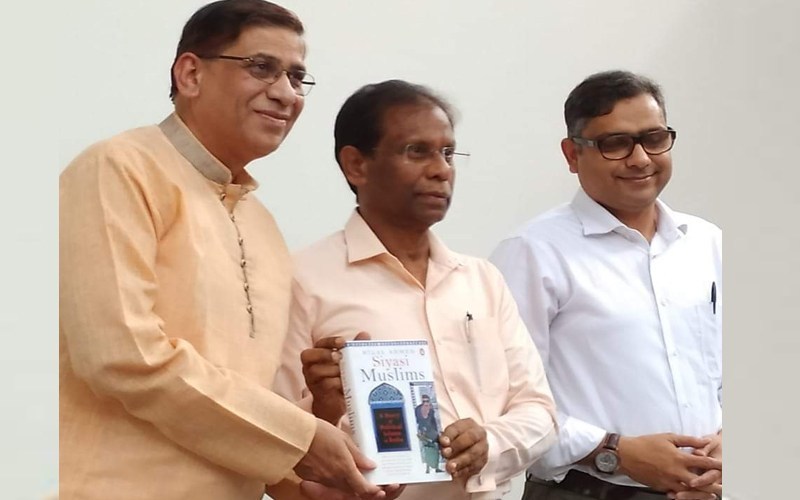
Mr. AK Khan and Prof Faizan Mustafa holding the book following its release by Mr. Khan at Lamakaan, Banjara Hills. Author of the book Dr. Hilal Ahmed looks on.

Hyderabad :

Mr. AK. Khan, advisor to the Telangana State government on Minority Affairs, released a book, Siyasi Muslims, on Thursday evening at Lamakaan, Banjara Hills, Hyderabad.

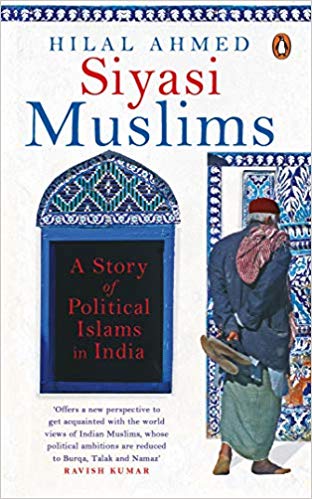
The book written by Hilal Ahmed is ‘a story of Political Islam in India.’ It is published by Penguin India.

SiyasiMuslims02MPOs30may2019Prof M Faizan Mustafa, an eminent jurist and Vice Chancellor of NALSAR, reviewed the book describing it as an important read in changing political and economic scenarios in India.

According to the author, “The book answers questions on political Islam; nationalist Islam; Good Muslim vs Bad Muslim, etc.

The other pertinent questions asked by Hilal Ahmed, Associate Professor at the Centre for the Study of Developing Societies (CSDS), New Delhi, include, “How do we make sense of the Muslims in India? Do they form a political community? Does the imagine conflict between Islam and modernity affect the Muslims’ political behavior in the country? Are the Muslim religious institutions—mosques and madrassas directly involved in politics? Do they instruct the community to vote strategically in all elections? What are Muslim issues? And finally, are Muslims in India truly nationalists?”

The book releasing ceremony was attended by a large number of the intelligentsia, academics, scribes, and others.

source: http://www.siasat.com / The Siasat Daily / Home> Hyderabad> News / by Safoora / May 03rd, 2019

Know why this haleem stall is a favourite in Visakhapatnam

Visakhapatnam, ANDHRA PRADESH :

Zubair01MPOs29may2019

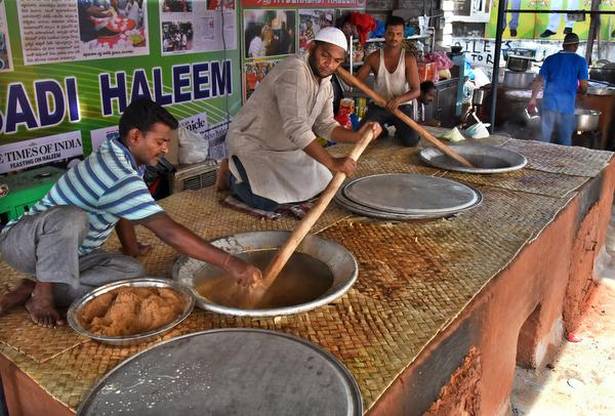
Sheikh Zuber and ‘master’ Rasool Bhai describe the Ramzan-special haleem they cook that has earned them considerable fame

Through the cacophony of Jagadamba Junction one can still hear the call to prayers from the Macca Masjid. I am standing at the ‘Dil Se Hyderabadi Haleem’ stall where Sheikh Zuber and Rasool Bhai with two big wooden ladles stir something aromatic in the two huge cauldrons. It’s the holy month of Ramzan and in less than an hour’s time this stall will be teeming with people, waiting to be served one of the the most sought after haleems in the city.

Zubair02MPOs29may2019

In the 10 years it has been here, the demand for haleem has only gone up, says stall owner Sheikh Zuber. “We make haleem with 25 kilograms of mutton and 70 kilograms of chicken every day,” he says as he prepares to ladle the creamy haleem from the cauldron into small aluminium containers.

The process of making this Ramzan special dish is laborious and time-consuming. It requires physical strength and an ability to tolerate the fiery heat generated by the cooking food .

Zubair03MPOs29may2019

When Sheikh first set up his stall, it was not even half the size of what it is today. He says, when he started, all he wanted was to bring the flavour of the authentic Hyderabadi haleem to Visakhapatnam. In the initial four years, he offered just chicken haleem as it was more economical. “I hardly used more than 20 kilograms of chicken every day. At that time the city had just about a handful of haleem stalls. But over the years more stalls came up,” he says. Today, the bylanes around Jagadamba Junction have a festive feel during Ramzan and the celebrations are centred around this delicacy.

Sheikh attributes the magic of his haleem to haleem master Rasool Bhai who always “wields his magic”. Growing up in Hyderabad, Rasool learnt to perfect this dish from an early age. Even after three decades of experience he is never complacent. His job begins at midnight once the cauldrons are cleaned and prepared for the 28-hour cooking process. Assisting him are two other junior haleem masters and a team of workers who work through the night.

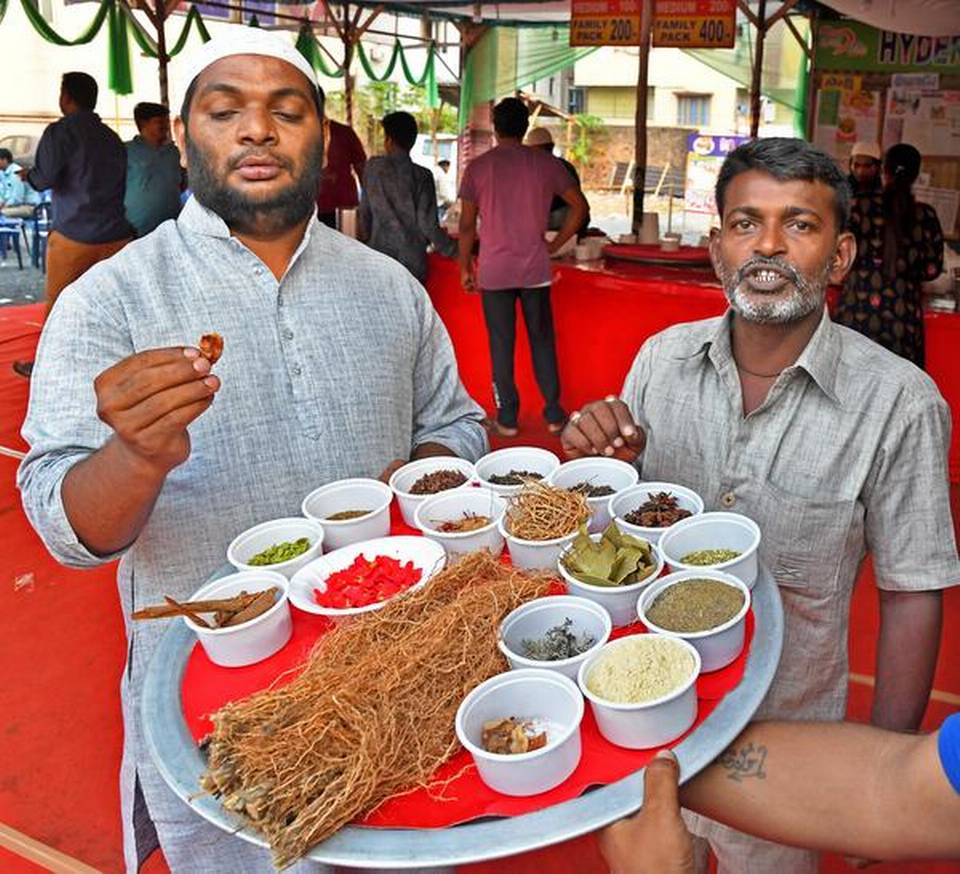
Mutton and chicken, sourced from local vendors, are put to boil with the potlimasala in the cauldrons. “The secret to the best haleem flavour is trapped in this masala,” shares Rasool. Each haleem master has a potli masala, which includes cardamom, black pepper, shah jeera, rose buds and other ingredients.

_________________________

Best flavours in town
  • Dil Se Hyderabadi Haleem – Jagadamba Junction
  • Nawabi Haleem – In front of Macca Masjid and Siripuram (opp. HSBC)
  • Nizam’s Kitchen Haleem – Jagadamba Junction
  • Ramzan Specialities – Hotel Green Park

_________________________

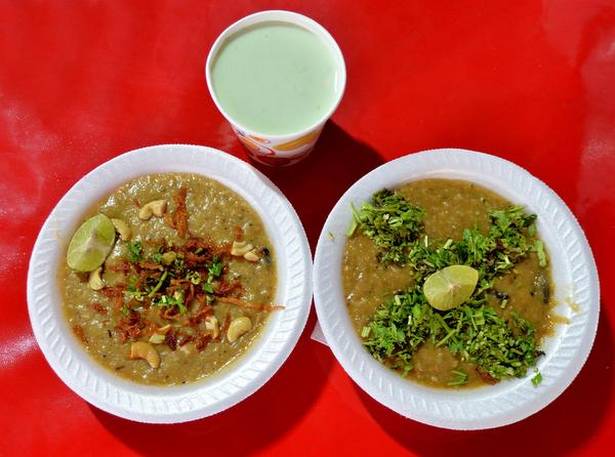
The meat is boiled for about 24 hours and then put on ‘dum’ for a couple of hours. This is accompanied by periodic rounds of breaking up the meat with the wooden ladles. Sheikh and Rasool keep a watchful eye on it and even take turns with the ladles. Once the creamy meat is ready, it is served with a garnish of caramelised onions and cashews. “It is worth all the hard work when we see the satisfied smile on our customer’s face,” says Sheikh. His stall draws people not just from across the city, but even from neighbouring districts. Krishna Chaitanya, an engineering graduate who is a regular at Sheikh’s stall describes it as a “rich and deliciously spicy dish that makes it a great evening snack.” The haleem is served from 4 pm onwards and on most days it is sold out by 7 pm.

Sheikh also serves paya roti in his month-long Ramzan menu and kaddu ka kheer.

(Living Vizag is a weekly column that profiles people who make the city special, and explore it through their eyes.)

source: http://www.thehindu.com / The Hindu / Home> Life & Style> Food / by Nivedita Ganguly / May 15th, 2019

This firm ensures you don’t step into someone else’s shoes

Bengaluru, KARNATAKA :

The startup makes bespoke shoes for customers, offering a wide array of designs to choose from

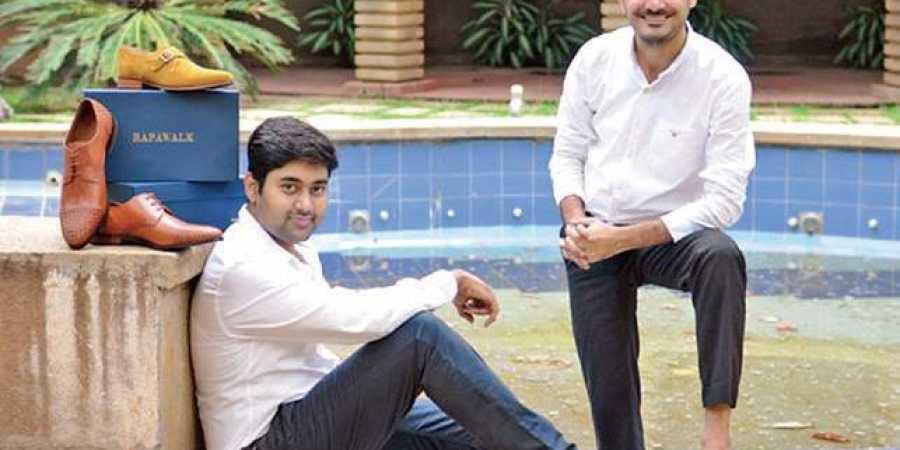
Rapawalk is an one-year-old brand launched by two 29-year-old IIM-A graduates Aravind Maddireddy (left) and Kashif Mohammad

Bengaluru :

Men, if you feel like the choices in a retail footwear store don’t match your taste, you can design your own pair of oxfords, derbys, mocassins, boots or whatever may be your style in a size that fits you perfectly. Rapawalk, a year-old brand launched by two 29-year-old IIM-A graduates Kashif Mohammad and Aravind Maddireddy, is all about giving a buyer a range of designs in shoes to choose from and customise to the required size and fit.

“In India alone, about 10 different foot profiles exist. A standard size cannot fit all,” says Mohammad, who along with Maddireddy, spent 18 months doing research on foot profiles, sizes, designs and fitting to cater to the specific needs of the Indian population. Rapawalk offers two range of shoes: An essential collection, which is priced between `2,000 and `3,500 and a premium range, which is priced above `5,000. They currently outsource material from Italy and Argentina and have set up two manufacturing units in North and South India, the principal one being located in Bengaluru.

A team of designers and artisans run the show with equipment carefully curated and accumulated from around the world. The founders are driven by the idea of providing a seamless fitting mechanism for shoes that are, according to them, an ideal part of every outfit.

“We’ve built a steady base of 1,500 customers who buy from us regularly. The response has been good after we recently launched the casual wear range. Leather sneakers customisation is on the cards next,” added Mohammad.To place your order, book an appointment at www.rapawalk.com.Alternatively, you can place your order online on the website or at Myntra, the e-commerce platform the company has recently partnered with.

Why Rapawalk?

The duo was inspired by the ‘Rapa Nui’ islands in the pacific. These islands are surrounded by many types and forms of crustaceans that change size, form and colour if under threat. Size, form and color customisation is what the brand goes by, thus the name Rapawalk.

source: http://www.newindianexpress.com / The New Indian Express / Home> Cities> Bengaluru / by Eva Mathews / Express News Service / May 28th, 2019

Dubai-based Indian boy finalist in Google Science Fair

Chennai, TAMIL NADU -INDIA / Dubai, UAE :

Shaamil Karim, a grade 11 student at the Indian High School Dubai, was selected from thousands of entries.

Dubai,Shaamil Karim,Indian High School Dubai

Karim’s project detects if a car or person is passing by and makes the next street light brighter and the previous light dimmer, saving energy.(Shaamil Karim/ facebook)

A Dubai-based Indian boy has ranked among the top 100 regional finalists for the Google Science Fair global contest for his project to make street lights smarter, the media reported.

Shaamil Karim, a grade 11 student at the Indian High School Dubai, was selected from thousands of entries, Gulf News reported on Saturday.

His project detects if a car or person is passing by and makes the next street light brighter and the previous light dimmer, saving energy.

Karim, a 15-year-old computer whizkid who originally hail from Chennai, said his father was his inspiration to come up with a solution for power wastage.

“We were at a park late at night and all the lights were switched on. My dad said, ‘Can’t we do something about this?’ I decided to do my project to make street lights smart,” he told the Gulf News.

Karim added that his project would be around 63 per cent cheaper than infrared-based sensors.

The global 20 finalists are expected to be announced this month.

source: http://www.hindustantimes.com / Hindustan Times / Home> Education / by Indo-Asian News Service, Dubai / May 26th, 2019