Tag Archives: Adil Shahi Dynasty

Safe walls of Bijapur’s past

Vijayapura (formerly) Bijapur, KARNATAKA :

A secure inn for gem traders during the Adil Shahi era, Nawab Mustafa Khan Sarai houses prisoners today.
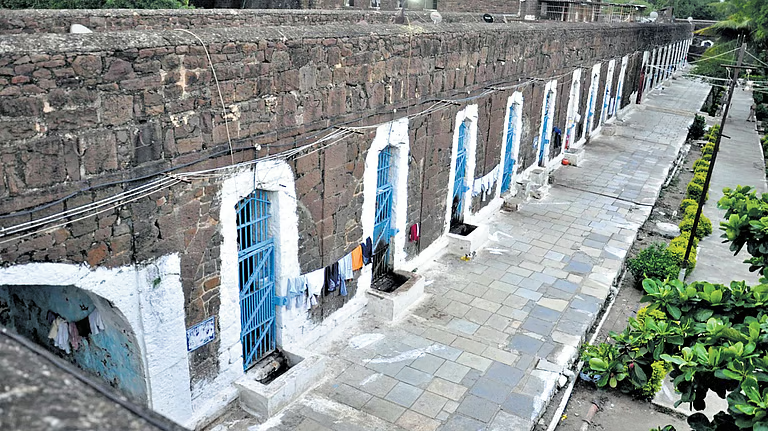
The interiors of the Nawab Mustafa Khan Sarai now known as Dargah Jail Photo | Express

Vijayapura :

Several historical remnants dot the landscape of Vijayapura, reflecting Bijapur’s glorious past. While Gol Gumbaz and Ibrahim Roza are some shining examples of Deccan Indo-Islamic architecture, there is another imposing structure of that bygone era, which is still alive and in use today.

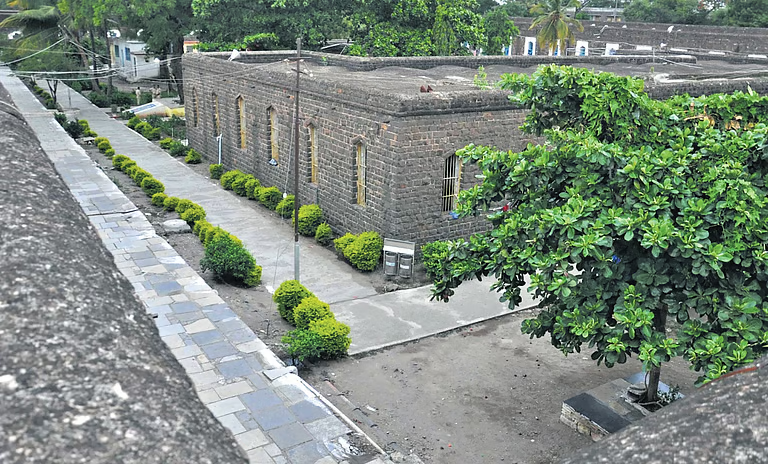
With its formidable heightened walls built with large black stone over five acres of land; a narrow arched-entrance, flanked by small rooms for guards; and a grand courtyard, surrounded by rooms for accommodation, a large kitchen, and bathrooms, Nawab Mustafa Khan Sarai served as the most secure place of stay and rest for travellers and traders in precious gems for over four decades.

Nawab Mustafa Khan Sarai, translated as Nawab Mustafa Khan Inn, continues as a secure place of boarding even today, the only difference being that it’s no longer an inn. Located around 4 km from the central bus stand in Vijayapura city, this splendid monument houses hundreds of prisoners, since being converted into a jail during the British Raj.

Dargah Jail

Popularly known as Dargah Jail, owing to its proximity to the shrine (Dargah) of Sufi saint Hazrat Khwaja Ameen Chishti, the monument is a reminder of the architectural marvels sanctioned by the Adil Shahi dynasty that ruled the South-Western part of India during 1490-1686 CE. Specifically, the Bijapur Central Prison, which is historically Nawab Mustafa Khan Sarai, was built by Nawab Mustafa Khan in 1636 CE. Khan was appointed Commander-in-Chief during the reign of Sultan Mohammed Adil Shah, and proved himself to be an astute administrator.

Elucidating the need for such an inn or boarding house, historians cite the wealth and prestige of the Sultanate of Bijapur in the 17th century that called for such structures to be built.

“Since Bijapur had gained immense prosperity during the Adil Shahi period, hundreds of domestic and international travellers and traders started visiting it. At that time, a new suburb called Shahapur was commissioned, which had all modern facilities of the time. Since travellers traded in precious stones from across the globe, they needed a safe and secure place to stay in Bijapur. Considering the need, Mustafa Khan got the inn built in 1636 CE near Vijayapura city, which was located close to Shahapur then,” explains Dr Abdul Gani Imaratwale.

A painting Nawab Mustafa Khan

The veteran historian, who has written several books on Bijapur’s history, said the inn’s tall walls were designed to prevent intruders from entering the premises, protecting the resident traders and their priceless wares.

“To instil a sense of security among traders and travellers, Khan also got a verse of the Quran inscribed on a wall of the monument. The verse means – ‘Allah is assuring all those who have entered heaven they need not to be scared or carry any fear as they are now safe and secure because they are in the custody of Allah’. This verse is meant to reassure visitors that they are in a very safe and secure place,” Dr Imaratwale elaborates.

Further, he says the sultan had appointed guards, whose job was to keep the precious items of the traders in their custody and maintain a complete record. The visitors were charged some fee for the service.

Inn becomes prison

The inn continued to function for several years until the end of the Adil Shahi dynasty, and then it was captured by Mughal Emperor Aurangzeb in 1686 CE. Soon after, the traders stopped arriving, and the once bustling structure fell to ruin and disrepair, and remained deserted for another two centuries.

In 1885, the British, under whose control Bijapur was at that time as part of the Bombay Presidency, decided to convert the Sarai into a prison. Historical records suggest that the British wanted to build a prison, but first wished to explore the possibility of converting any monument into one, with some minor changes. The colonial authorities found the inn suitable, and decided to go ahead with turning it into a jail, allocating Rs 20,000. “The British found the monument best-suited for a prison, because of the high walls surrounding it. Also, it had rooms that could be converted into barracks for inmates,” Dr Imaratwale informs.

Today, the jail has 10 barracks, with each having a capacity to house around 40 inmates. There are around 500 prisoners (male and female, and convicts and undertrials) lodged here. In due course, more amenities have been added for the inmates. Security features such as CCTV cameras too have been installed.

In 1983, the jail was converted into a District Central Prison, where convicts began to be incarcerated. But over time, the authorities found the prison proving to be small to accommodate an increasing number of prisoners, prompting the government to construct a new high-tech jail on the city’s outskirts. Officials said that work on the new building is under way. Soon, the present jail will be shifted to a new facility. Till then, Dargah Jail will remain one of the oldest prisons in the country.
A symbol of piety

Besides constructing a ‘sarai’ or inn for travellers, Nawab Mustafa Khan also got a large mosque built in the central part of old Bijapur city. Located on Bari Kamaan (large arch) Road, the mosque is said to be built in 1639 CE, and later became popular as Nawab Masjid. It is still used regularly for prayers. Though a masjid committee is taking care of the Masjid, since it is listed as a ‘protected monument’ by the Archaeological Survey of India as it is an edifice of historical importance. Historians view the Masjid as a unique monument, constructed using only large stone slabs. Another striking feature is that it has no pillars, entirely standing on huge stone walls. The design of the inner arch, where the Imam leads the namaz, is said to have been derived from the historical Jama Masjid. The inner area can accommodate at least 200 worshippers, while an equal number of people can offer prayers in the outer area. The mosque also has a tank for ablution, which used to be full of water round the year in past, since it was connected via underground pipes to the Begum Talab, almost 3 km away.

source: http://www.newindianexpress.com / The New Indian Express / Home> Good News / by Firoz Rozindar / July 21st, 2024
Maratha blood and Persian veins

KARNATAKA :

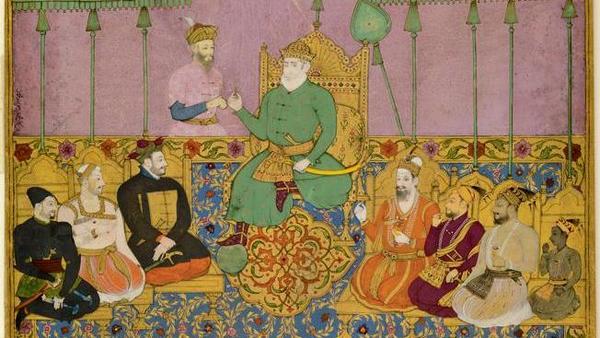
A detail of the ‘House of Bijapur’ genealogical painting depicting most of the rulers of the Adil Shahi dynasty of Bijapur. (Photo: Wikimedia Commons)

  • Although the Adil Shahi dynasty of Bijapur was formally Muslim, it was influenced by multiple religions and different identities
  • Such complicated realities were not unusual in the subcontinent, from Vijayanagar in the south to further north in Kashmir

In 1680, a few years before emperor Aurangzeb swallowed up the sultanate of Bijapur, two court artists in that city produced a striking genealogical painting. Rich in quality, with ink, watercolours, as well as gold and silver generously employed, the picture shows all the rulers of the doomed Adil Shahi dynasty, save for one who was blinded and discarded for not being up to the mark.

In the centre, on the throne, for instance, sits Yusuf, the man who sailed from Persia and founded the house with his Maratha wife in the 15th century: In a mark of the kingdom’s allegiance to the Shah of Iran (as opposed to the Mughals), Yusuf is shown receiving a key of sovereignty from the Iranian emperor. Then there is Ali, who appears in armour—a symbol of the role he played in the defeat of Vijayanagar in 1565—just as there is the boy-king Sikander, the smallest figure in the group, who would spend much of his life as Aurangzeb’s dethroned prisoner.

Created on the eve of the kingdom’s demise, the painting is at once a family tree but also, as one scholar puts it, a “painted curtain call” for the extraordinary Adil Shahi dynasty.

But the portrait is significant also in another way, in that it depicts the contrasts that can develop in the same ruling house and in interpretations of its official ideology. The Adil Shahi state was formally Muslim. From the start, however, it was influenced not only by multiple religions but also by different identities. So, for instance, Ismail (reign 1510-34) chose to highlight the family’s Persian heritage—he made his troops wear Iranian uniforms and himself adopted the 12-pointed cap, a reference, as the scholar Deborah Hutton notes, to the 12 imams of Shia Muslims.

Ibrahim II (reign 1580-1627), on the other hand, was Sunni and is depicted in a style associated with the Indian faction at court, a reflection of his own attitudes. He was, for example, not only a lover of Marathi (much to the horror of a Mughal envoy, who found Ibrahim’s Persian weak) but also a great admirer of Hindu traditions. It was he who proclaimed himself son of Saraswati and Ganapati, studied Sanskrit, and went to the extent of renaming Bijapur “Vidyapur” to honour his favourite goddess.

Only two generations divided the orthodox Shia Ismail from Sunni Ibrahim (who was rumoured to be secretly Hindu) but there was a world of difference in their outlook.

The Adil Shahs certainly presented themselves as good Muslim rulers—indeed, even Ibrahim’s grave carries an inscription denying rumours that he was an apostate, affirming that he was a true believer of the Prophet’s message. But as this column showed previously in the case of Hindu Vijayanagar, official identity and self-image did not preclude the absorption of multiple influences, or even contradictory practice. The Adil Shahs, even as Muslims, alternated between Sunnism and Shiism, and it was their latter identity that often supplied the Mughals an excuse to invade in the name of religion—this when even Aurangzeb, who led the final charge against the “heretics”, was himself the son of a Shia mother. Add to this a give and take of culture from not only the Marathas (including Shivaji’s father, who served the Adil Shahs) but also Ottomans, Europeans and African grandees at court, and Bijapur was confirmed as an eclectic, mixed universe—one where the king had a formal identity that he could interpret strictly or with deliberate laxity, depending both on his predilections and official necessities.

But in this the Adil Shahs were hardly unique. The rayas of Vijayanagar shaped their self-image in Sanskritic terms and declared themselves consciously Hindu. And yet, one of them sought a marriage alliance with Catholic Portugal; many of them used the title “sultan”; and their sartorial tastes and everyday lives were influenced visibly by Persian culture. A raya might keep the Quran in court so that his Muslim nobles could prostrate before it, even as he destroyed mosques in enemy territory—policy depended on the context in which the king found himself. Further north, in Kashmir too, as Richard Eaton shows in his India In The Persianate Age, we witness such ironies.

Sultan Sikander (reign 1389-1413), for instance, was a destroyer of Hindu shrines and burner of Sanskrit books. But his son Zain al-Abdin (reign 1420-70), officially as devout a Muslim as his father, implemented the opposite policy: Not only did he resume temple grants, but under him the court also witnessed an unprecedented production of Sanskrit literature, as well as translation of Hindu texts into Persian for the ruler’s edification.

The greatest controversy, of course, arises in understanding Tipu Sultan of Mysore. To some, he is a giver of grants to Hindu temples and a protector of his non-Muslim subjects. Others cite his cruel conquest of Malabar, where Hindus were forced to renounce their religion, their temples demolished. But, simply put, the question is not one of either/or: The same king could act in opposite ways in different settings.

In Malabar, its chiefs and people were “infidels”, but in his settled territories in Mysore, Tipu had no qualms employing “infidel” Brahmins (including the celebrated Purniah) as officials. One was a land of conquest, where destruction of significant shrines was, to him, legitimate, while forced conversions were a method of flaunting to the Islamic world his commitment to their faith; but in his home territory, he was king in a broader sense, accepting of the land’s realities as well as its people. A villain in one reading, he could be a hero in another, employing his religious identity in different degrees, determined largely by the contingencies of politics.

It was this complicated reality that the painters of that Adil Shahi family portrait inadvertently conveyed in their work: a house of Muslim kings with Maratha blood, who cheerfully switched sects as they desired, and whose dynastic roster included all types—those whose faith guided them to extremes, and others for whom religion was more a formality, engaging as they did with a land of diverse realities.

Medium Rare is a column on society, politics and history. Manu S. Pillai is the author of The Ivory Throne (2015) and Rebel Sultans (2018).

Twitter – @UnamPillai

source: http://www.livemint.com / Live Mint / Home> Explore> Medium Rare / by Manu S. Pillai / September 05th, 2019