Kutch, GUJARAT / Mumbai, MAHARASHTRA :

Infrastructure of Compassion: A Forgotten Chapter of Bombay’s Past
A story of faith, service, and a legacy that still lives
Bombay, at the turn of the 20th century, was a city in motion. Ships lined its docks, trains poured into its stations, and its markets drew traders from across the region. But alongside this restless movement of commerce was another, quieter stream of people – men and women who arrived not for trade, but for a journey of faith. They had come for Hajj.
From distant towns and villages across India, pilgrims travelled for days to reach the city. Many had never stepped beyond their regions before. They arrived with hope, with savings gathered over years, and with a deep sense of purpose. Yet, what awaited them in Bombay was not ease, but uncertainty.
By the early 20th century – around 1909, when the Musafirkhana was being conceived – Bombay had already become a major departure point for Indian pilgrims. Steamships operated by the British India Steam Navigation Company regularly carried Haj pilgrims from Bombay to Jeddah. Yet, despite the growing frequency of these voyages, space on ships was limited and uncertain. Pilgrims often had to wait in the city for days or weeks before securing passage, turning Bombay into a place of anxious waiting before a sacred journey.
Unlike today, when a pilgrim can contact an agent, arrange a visa, book accommodation, and board a flight directly to Jeddah or Madinah, the journey in those days began with waiting. There were no confirmed departures, no fixed schedules. Pilgrims first had to reach Bombay and then remain there – sometimes for days, often for weeks – until a ship became available.
In the crowded lanes near the docks, around Crawford Market and the Mandvi belt, they gathered in large numbers. Some found temporary shelter; many didn’t. Pathways became resting places. Open spaces turned into sleeping grounds. The city moved around them, but for them, time seemed to pause.
Contemporary accounts from the period speak of steamers departing from Bombay’s docks, carrying hundreds of pilgrims at a time – ships that symbolised both hope and uncertainty, as not everyone who arrived in the city could board them immediately.
Among them were the well-to-do, but also the poor, the elderly, and the vulnerable. Some had spent years saving for this journey. Others had come with the support of family and community. But once they reached Bombay, their differences faded. All of them shared the same uncertainty as well as hope.
In the language of faith, these pilgrims were known as ضیوف الرحمٰن — the Guests of Allah. Serving them was considered an honour, a noble act that carried both spiritual and social meaning. Yet here they were, waiting in conditions that did not reflect that dignity.
It was in these very streets that a man began to notice them. He was a businessman, part of Bombay’s vibrant trading world. Every day, he passed through these lanes on his way to work. At first, the sight may have seemed like a part of the city’s routine. But over time, it stayed with him – the faces, the waiting, the quiet endurance.
This was Mohammed Haji Saboo Siddique. He belonged to a family originally from Kutch, part of the Gujarati Memon community – widely known for its deep engagement in trade and its long-standing tradition of philanthropy. Like many from this community, his family had migrated to Bombay in search of opportunity, becoming part of the city’s growing commercial life while remaining rooted in a culture of giving. What he saw was not just a crowd. It was a need.
In the ethical framework of Islam, service to people is not seen as an optional virtue, but as a responsibility. The Prophet Muhammad ﷺ is reported to have said, “The best of people are those who are most beneficial to others.” This simple teaching has shaped generations of quiet, often unseen acts of service across communities.
For Saboo Siddique, the condition of these pilgrims was not just a social concern; it was a moral call. These were ضیوف الرحمٰن. To ease their hardship was not merely an act of kindness; it was a duty. And so, he chose to act.
In the early years of the 20th century, he set aside a large sum – five lakh rupees, a remarkable amount for that time – to build a facility that would offer pilgrims what they lacked: dignity. The land he selected was not by chance. Located near Crawford Market, close to railway routes and within reach of Bombay Port, it stood at the very point where the pilgrims’ journey paused.
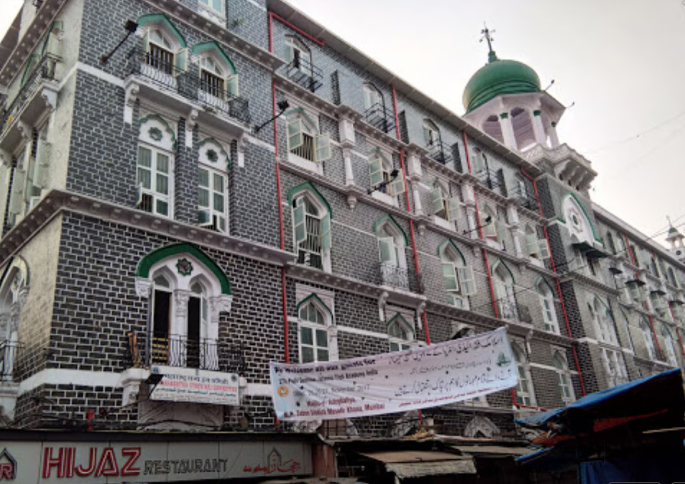
On that land Saboo Siddique built a four-storey structure – the Haji Mohammed Saboo Siddique Musafirkhana. It was not built for grandeur. It was built for purpose.
The Musafirkhana provided rooms, basic facilities, and a place to pray. For pilgrims who had spent days in uncertainty, it offered relief. It allowed them to rest, gather themselves, and prepare for the journey ahead. Over time, it became known quietly as a gateway – a place from where many took their final step towards Makkah.
But what gave this institution its strength was not only its structure. It was the spirit with which it was built.
Rooted in sincerity – Ikhlas – the Musafirkhana continued to serve pilgrims year after year, decade after decade. Long after its founder had passed, it remained a place of care. It witnessed the journeys of thousands, and over time, countless pilgrims who passed through its doors.
Saboo Siddique’s vision, however, did not end with pilgrims. He understood that service must reach beyond a single moment. It must touch different stages of life. Alongside shelter, he invested in education – establishing what would later become the M.H. Saboo Siddik Technical Institute, where young people could gain skills and build their futures.
He also turned his attention to healthcare. Historical records connected to his legacy note that he built six maternity homes across Bombay to serve poor women who had little access to medical care. At a time when safe childbirth facilities were limited, especially for the poor, this was a deeply significant intervention. It reflected a broader understanding of social responsibility – one that included not only travellers and students, but also mothers, families, and the most vulnerable.
Over time, these maternity homes became part of the city’s public health system. They were taken over and managed by the Bombay Municipal Corporation, and records continue to reflect this legacy. One such institution, the Haji Mohammad Haji Saboo Siddiqui Maternity Home, remains listed in municipal records in Prabhadevi. Another, at Imamwada, later developed into the M.H. Saboo Siddique Maternity & General Hospital, continuing to serve the public.
This continuity gives his work a rare depth. The same man who cared for pilgrims on their way to a sacred journey also cared for mothers bringing new life into the world. The same vision that built a shelter also built pathways for education and health.
As the years passed, the nature of travel changed. Ships gave way to flights. Systems became organised. Pilgrims no longer needed to wait in the same way. The long pauses that once defined the journey disappeared.
The Musafirkhana, in its original role, was no longer essential. But it did not fade away. The sincerity with which it had been built gave it a new life. The same building that once sheltered pilgrims began to host students – young men who had come to the city in search of education. Their journey was different, but their need was just as real.
In this transformation lies the true strength of Saboo Siddique’s legacy. He did not build for a moment. He built with intention.
Very little is known about his personal life. His family, his private world, remain largely absent from public records. But perhaps that absence is itself meaningful. It reflects a time when people were remembered not for what they owned, but for what they gave.
His institutions became his story. In a city where land was valuable and opportunity abundant, he chose to create something that would serve others – quietly, consistently, and without expectation.
The journeys have changed. The waiting has ended. But the intention remains. And it continues to serve.
source: http://www.radiancenews.com / Radiance News / Home> Focus / by Mohammed Talha Siddi Bapa / May 04th, 2026