Tag Archives: Positive News of Muslims of Kolkata

Football magician Mohammed Salim captured hearts of people in Scotland

Metiaburj, BENGAL Presidency / Calcutta, WEST BENGAL:
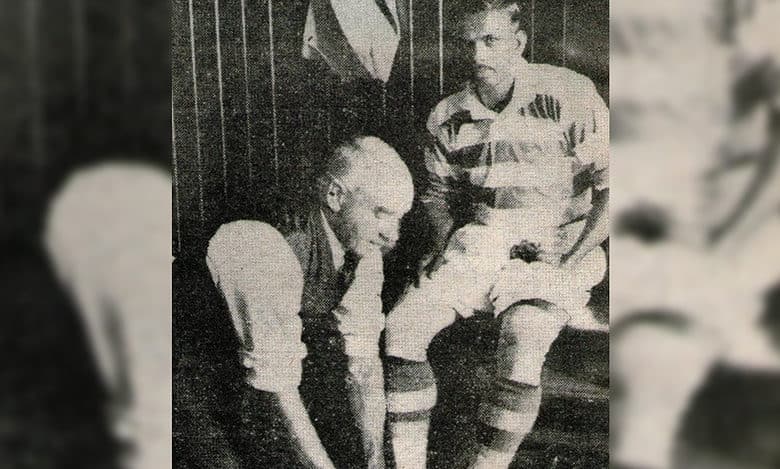
 Mohammed Salim, the first Indian footballer to play for a foreign club. In this photograph from 1936, due to playing in bare feet, he is having them bandaged by Jimmy McMenemy the Celtic FC trainer. Photo: Wikipedia

Who was the first Indian footballer to play for a European football club? Very few people in India will be able to answer this question correctly.

He was a Kolkata-based football player Mohammed Salim who was selected by the well-known Celtic Football Club in Scotland in 1936. He carved out a brief but glorious career before returning to his hometown.

An interesting story was once told by his son Rashid Ahmed. After his father had grown old, the son decided to see if the famous Celtic Club of Scotland still remembered his father. He wrote to Celtic Club introducing himself as the son of their former player Mohammed Salim and stated that his father was facing financial difficulty in his old age.

Rashid Ahmed was not really expecting any reply from the club authorities after so many years. He had simply taken a chance. However, he got the biggest surprise of his life when the Celtic football club replied with a letter of sympathy and a bank draft of 100 pounds enclosed.

“I really had no need for the money. It was just a ploy to find out if Mohammed Salim was still alive in their memory. To my amazement, I received a letter from the club. Inside was a bank draft for £100. I was delighted, not because I received the money but because my father still he had a place of pride in Celtic. I have not encashed the draft and will preserve it till I die. I just want my father’s name to be remembered as the first Indian footballer to play abroad,” Rashid told the media.

The reason why Salim returned to India was that he was uncomfortable with the food and the climate of Scotland. He had been born and brought up in Kolkata and therefore was not used to the foreign conditions. Celtic Club pleaded with him to remain in Scotland and even offered to organise a charity match on his behalf. Salim refused and asked that the money be donated to local orphans.

Thereafter German clubs also became interested in retaining Salim. He was offered a professional contract to play in Germany. But he was resolute that he would return to India. So he traveled back to India to rejoin Mohammedan Sporting Club for the beginning of the 1937 Calcutta Football League.

To trace his life back to the starting point, he was born to a middle-class family in Metiaburj in Bengal in 1904. He was studying to be a chemist but football was his first love. His skills were soon spotted by the Mohammedan Sporting club and he was recruited in 1927.

After a brief stint with other clubs, Salim rejoined Mohammedan Sporting in 1934 and ensured that it reached the very top. It was the golden period of this club with Salim spearheading the attacks. He won thousands of hearts with his ball control, dribbling and accurate passes.

A Chinese football official Dr. Chi Chao Yung who saw Salim and his teammates in action said: “Allow me to congratulate the members of the Indian team for their wonderful display. In the course of the game, they showed perfect understanding and exceptional speed. The forwards, Salim, Rahim, Bhattacharjee and Abbas were outstanding in their game.”

Soon after this, Salim departed for Scotland to try his luck there. The well-known Scottish manager Willie Mayley was surprised at the skills that Salim displayed and took him in the Celtic side. On 28 August 1936, he helped Celtic win 7–1 against Galston. The Scottish Daily Express carried the headline: “Indian Juggler – A New Style”, along with a description of Salim that read: “Ten twinkling toes of Salim, Celtic FC’s player from India, hypnotised the crowd last night. Three of Celtic’s seven goals came from his moves.”  Another newspaper, The Glasgow Observer wrote: “Salim tickled the crowd at Celtic Park on Friday with his magnificent ball manipulation despite playing barefooted.”

But even after the praise and success, Salim decided to return to India because he missed his home country. In 1940 Mohammedan Sporting became the first Indian club to win the Durand Cup in front of one lakh spectators. The British Viceroy at that time Lord Linlithgow, witnessed the match against the Royal Warwickshire regiment.

In 1980, at the age of 76, Salim passed away in Kolkata.

Before independence, challenging the might of the British rulers was a Herculean task. Salim achieved this seemingly impossible feat with his football. That was his greatest glory. He demonstrated that even barefooted Indian players, with determination and skill, could overcome the strongest of British teams.

source: http://www.siasat.com / The Siasat Daily / Home> Featured News / by Abhijit Sent Gupta / November 26th, 2022
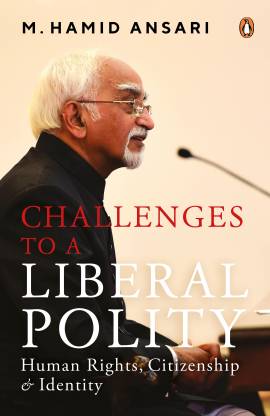
Ex-VP Hamid Ansari’s ‘Challenges to a liberal polity’ book review: The politics of being Indian

Kolkata, WEST BENGAL / NEW DELHI :

A collection of speeches and articles by former vice-president Hamid Ansari, offering engaging insights into our democracy.

Challenges to A Liberal Polity: Buy Challenges to A Liberal Polity by Ansari  M. Hamid at Low Price in India | Flipkart.com
Challenges to a Liberal Polity: Human Rights, Citizenship & Identity / by M Hamid Ansari / Publisher Penguin / Pages 277 /Price 799 INR

For the past decade, public discourse in India has remained sharply focused on challenges to the liberal polity and the threats that have grown to human rights. Issues of citizenship and identity are entwined inextricably in this. It is in this context that Challenges to a Liberal Polity: Human Rights, Citizenship & Identity assumes not only topicality but also a significance that can be overlooked only at the readers’ own peril.

Hamid Ansari is a distinguished diplomat, academic, statesman and also, the often misused word, a public intellectual. He has, in his long career, worn many hats. He has served as the Indian ambassador to Afghanistan, Vice-Chancellor of the Aligarh Muslim University (AMU), Chairman of the Minorities Commission and the Vice President of India. Throughout his life, Ansari has never shied away from speaking his mind—bluntly if need be.

The author has, at times, been exposed to unfair criticism and deliberately humiliated by persons in high office who should have known better. When bidding him farewell, PM Narendra Modi was unnecessarily sarcastic—some thought gracelessly—by mentioning that Ansari had spent most of his diplomatic career in Islamic countries and perhaps he would be more comfortable now that he was relieved of the burden of the constitutional position to freely voice criticism of whatever he didn’t agree with. The PM conveniently forgot that the former vice-president served with distinction as India’s permanent representative in the United Nations and as Chief of Protocol when Indira Gandhi was the prime minister in an era of dynamic Indian diplomacy. But, let us not digress.

This volume is a collection of speeches, forewords and articles contributed by the author on subjects that overlap and cover a vast time span from the turn of the century to the present day. The introduction is stimulating and thought-provoking. It presents a distilled essence of state-of-the-art research in political science and Indian society. This prepares the readers for what is to follow.

The book is divided into three sections. The first section deals with human rights and group rights. The subsections or mini-chapters can be read profitably as independent essays. Of particular interest are the ones titled––‘India and the Contemporary International Norms on Group Rights’, ‘Minorities and the Modern State’ and ‘Majorities and Minorities in Secular India: Sensitivity and Responsibility’.

The second section is titled ‘Indian Polity, Identity, Diversity and Citizenship’. This is more substantial than the preceding segment and covers a range of topics that should engage readers with different interests and ideological orientations. Examples include ‘Identity and Citizenship: An Indian Perspective’, ‘Religion, Religiosity and World Order’, ‘Two Obligatory -isms: Why Pluralism and Secularism is Essential to our Democracy’. There are shorter pieces like ‘The Ethics of Gandhi’ and ‘The Dead Weight of State Craft’, ‘India’s Plural Diversity is Under Threat: Some Thoughts on Contemporary Challenges in the Realm of Culture’. How one wishes that these themes had been explored in greater detail.

To some it may appear that this is nitpicking, but this is the hazard of compiling a collection of comments and observations made on commemorative occasions such as inaugurating or concluding a seminar, a workshop or writing a short preface. Ansari is primarily a scholar, who is deeply distraught by the happenings around him and is restless to share his constructive thoughts and not just the distress and despair. The tone is always cautiously optimistic.

The concluding section deals with ‘Indian-Muslim Perception and Indian Contribution to Culture of Islam’. The essays on ‘Militant Islam’, ‘Islam and Democratic Principle’ and ‘India and Islamic Civilisation: Contributions and Challenges’ deserve to be read by all Indians, particularly the young. One may disagree with the author, but it is impossible to imagine that any meaningful dialogue can take place between the majorities and minorities in India without an understanding of how the ‘other’ thinks and perceives the world.

His convocation addresses delivered at Jamia Millia Islamia (where he taught) and the AMU (his alma mater) have a different flavour. The tone is personal and evokes shared nostalgia. The final essay is a review of India and muslim world.

The book has substantial end-notes that provide useful bibliographical information. One can flip through these pages to pursue the themes dealt in the book according to one’s own inclination and at leisure.


This book is for all. The general reader, who has no scholarly pretensions, too can turn the pages of this book with great pleasure. Many a time, the author peppers the prose with Urdu couplets that hook the reader to his line of arguments. One such piece is his Fakhruddin Ali Ahmed Memorial lecture. Most people remember this vice-president as the supine individual who signed on the dotted line with dimmer when Indira Gandhi declared Emergency at midnight. Ansari, however,  has used the book brilliantly to make some hard- hitting comments that are im- possible not to take on the chin.

The chapter begins with: Yaad-e-maazi azaab hai yaa rab/ Chheen le mujhse hafiza mera (The memory of the past is torturous, O God/Take away my memory from me), and concludes with: “Can the amnesia, the compromises and the misconceptions of recent and not-so-recent past be overcome?” Yes, only if meaningful alternative is offered. We do stand at the crossroads.

source: http://www.newindianexpress.com / The New Indian Express / Home> Lifestyle> Books / by Pushpesh Pant / Express News Service / November 06th, 2022