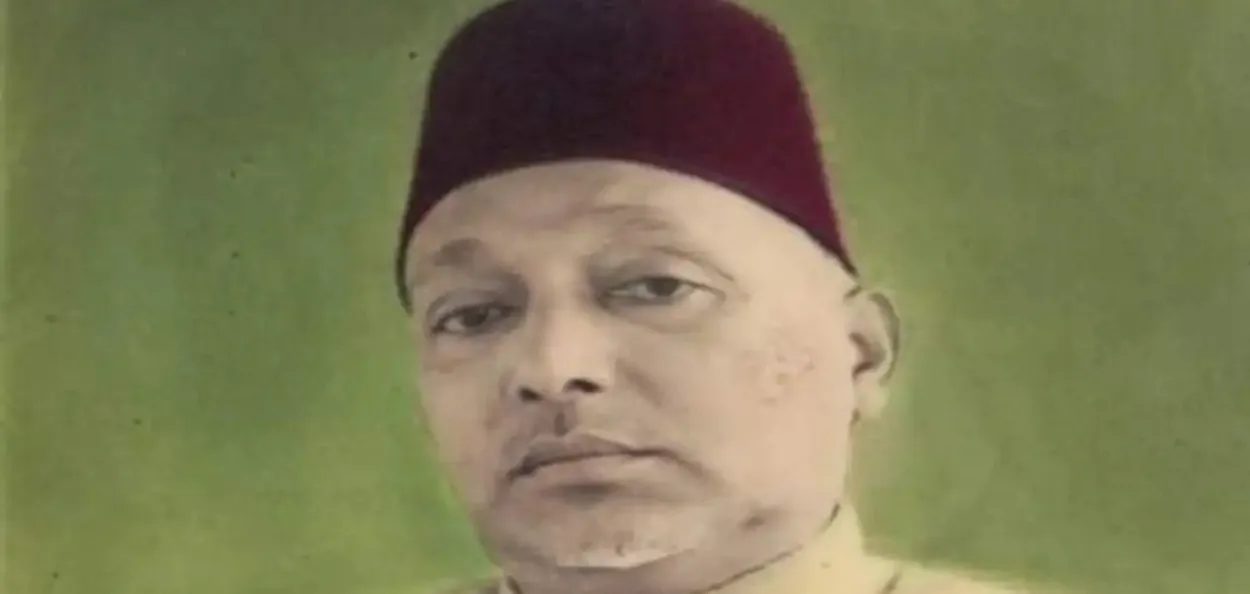
Sir Syed Muhammad Saadullah is one among the Indian Muslim leaders who made an immense contribution to shaping Independent India and yet remained unsung. He was the only Muslim among the members of the Drafting Committee for the Constitution of India, led by Dr. Babasahib Bhimrao Ambedkar.
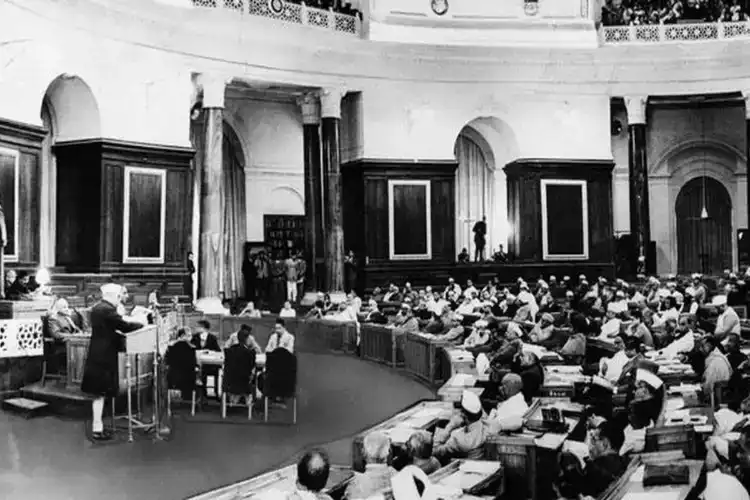
Before shedding light on Saadullah’s role in the Constitution Drafting Committee, let us know about the Assembly that drafted the Constitution of India.
On December 9, 1946, the Constituent Assembly was formed. Its meeting was boycotted by the Muslim League. Soon after, on December 11, Dr. Rajendra Prasad was elected as its chairman. It had 389 members which were reduced to 299 after the partition.
On January 22. 1947 it adopted the Objectives Resolution unanimously. In the same year, the national flag was adopted on July 22, and Independence was achieved on August 15, 1947, with the partition of the country.
On 29 August 1947, a drafting committee was appointed with Dr. BR Ambedkar as its chairman. Other members of the committee were KM Munshi, Muhammad Saadullah, Aladi Krishna Swami Iyer, Gopala Swami Iyengar, N Madhav Rao, DP Khetan, and TT Krishnamachari.
On 22nd November 1949, the ‘Constitution of India’ was passed in the assembly and the last session of the Constituent Assembly was held on 24th January 1950. On 26th January 1950, the ‘Constitution of India’ came into effect after 2 years, 11 months, and 18 days.
The Constituent Assembly in session
Who was Sir Syed Muhammad Saadullah?
Sir Syed Muhammad Saadullah was a member of the draft committee but even before that, he was a well-known leader of India. He was the Prime Minister of Assam in British India. He was also Chairman of Guwahati Municipality and Minister of Education and Agriculture of Assam from 1924 to 1934. Saadullah was a highly educated jurist.
Syed Muhammad Saadullah was born on 21 May 1885 in Guwahati into a traditional Assamese Muslim family and died in 1955. He was educated at Cotton College, Guwahati, and Presidency College, Calcutta. After receiving higher education, he started practicing law in Guwahati and soon made his mark as a lawyer. He also practiced in the Calcutta High Court for some time. He became the Chairman of the Guwahati Municipality and was nominated as a member of the Legislative Council in Shillong.
Assam became a Chief Commissioner Province in April 1912. Saadullah participated enthusiastically in the Council’s deliberations and spoke freely on matters of interest to the people of Assam.
He soon became an important figure in the province of Assam. He established his identity as a lawyer after just a decade of struggle. In later days, he also practiced in the Calcutta High Court. Among his neighbours and contemporaries, were Fazlul Haque, Nawab Attaur Rahman, and Barrister. Khuda Bakhsh and Nawabzada AFM Abdul Ali.
He was also important in British India. He was knighted in the 1928 Birthday Honors and made a Knight Commander of the Order of the Indian Empire in the 1946 Birthday Honours.
In his political life, Syed Muhammad Saadullah was closely associated with the All-India Muslim League. He attended the 10th session of the League in Calcutta in December 1917 and served as a member of the committee that negotiated the Lucknow Pact between the Muslim League and the Congress.
In 1946, he participated in the demand for Pakistan and supported the inclusion of Assam in Pakistan. However, when Assam seceded from Pakistan at the time of partition, he remained in Assam. Similarly, as the Prime Minister of Assam, he contributed to the building of a modern Assam.
He was an able parliamentarian, an eloquent orator, an experienced administrator, and a moderate and liberal leader in ideology. Saadullah is regarded as one of the architects of modern Assam. As the head of the Assam government, he planned well and developed development plans. He took a special interest in the promotion of industries. He is said to have supported and encouraged the migration of peasants from Bengal to develop agriculture in Assam and to introduce jute cultivation. His critics accuse him of deliberately settling Bengali Muslims in Assam.
Muhammad Saadullah is also known for his generosity, honesty, and competence. He also worked for the tribal people of the North Eastern region and inducted a tribal leader JJM Nicholas Roy in his first cabinet. He was considered the best person because of his experience, ability, and honesty.
source: http://www.awazthevoice.in / Awaz, The Voice / Home> Success Stories / by Ghaus Siwan, New Delhi / January 25th, 2023
Sir Syed Muhammad Saadulla was one of the foremost political leaders of modern Assam and the first Premier (also referred to as Prime Minister or Chief Minister) of the Assam province, one of the major eight provinces of British India.
The family of Saadulla hails from Sibsagar and claims to be the descendant of the famous Muslim preacher Azan Pir, who came to Assam in the early 17th century to spread the message of Islam. Syed Md. Tayebbullah, the father of Saadulla, moved to Gauhati where he served as a teacher of Arabic and Persian in Cotton Collegiate High School at Gauhati town. Saadulla was born in Gauhati on May 21, 1885. He got his early school education at Sonaram High School at Gauhati. He then joined the Cotton College, Gauhati, and took his Post-Graduation degree in Chemistry from the Presidency College, Calcutta, in 1906. Subsequently he took the Bachelor’s Degree in Law from the Earle Law College at Gauhati in 1907. Besides Assamese and Bengali he was also fluent in Arabic, Persian and Urdu.
Before Saadulla started his legal profession at Gauhati Bar, he served for a short stint as Assistant Lecturer in Chemistry at the Cotton College in 1908. He practiced at the Calcutta High Court. Within a short time, he became an eminent lawyer.
Then he joined politics and became the member of the first Legislative Council in 1913. He was re-elected in 1923. Under the system of Diarchy, he served as Minister of Education and Agriculture from 1924-29. In recognition of his public services, the British government knighted Saadulla in 1928. He, as a member of the Executive Council of the Governor of Assam, also became Minister for Law and Order and PWD from 1929-30, and again served as Minister for Finance and Law and Order from 1930-1934. He was also the Chairman of the Public Accounts Committee from 1933 to 1934.
The Government of India Act, 1935 was adopted by the British Parliament on 2nd August, 1935 and was implemented in 1937. The Government of India Act 1935 made provisions for a Legislative Assembly in each province. In 1937 Assam Legislative Assembly election was held. In the same year Saadulla formally joined the Muslim League in response to MA Jinnah’s appeal.
Saadaulla was elected to the Assam Legislative Assembly from Kamrup South and served as Premier of a coalition government from April 1, 1937 to Sept. 19, 1938. A Congress government led by Gopinath Bordoloi succeeded from Sept. 19, 1938 to Nov. 17, 1939. Saadulla was again re-elected as Premier from Nov. 17, 1939 to Dec. 24, 1941. He, for the third time, became the Premier from Aug. 25, 1942 to Feb. 11, 1946. From 1937-1946 there were 34 Muslim members in the Assam Legislative Assembly, out of the total 108 members (For the list of names see Appendix I).
Saadulla, 6th from left (standing) and his daughter Betty (extreme left, sitting) attending a wedding at Shillong in the 1930s.[Photo courtesy: www.motijan-hazarika-rahman.com]In 1946, he was re-elected to the Legislative Assembly from Kamrup South constituency and became leader of the Muslim League in the house (See Appendix-II for the list of Muslim members of Assam Legislative Assembly). He became a member of the Constituent Drafting Committee. As a member of the committee he helped in giving special financial assistance for Assam. He also took keen interest in protecting the rights of the minority communities. After the dissolution of the Constituent Assembly or the Provincial Parliament, he retired from public life and settled down in Gauhati. Later, the family of Saadulla moved to Kacharihat and established the Syedbari tea estate that is still run by his descendants.
Saadulla died on Jan. 8, 1955 at the age of 70.
In his later political life, Saadulla was closely associated with the All India Muslim League. He attended the 10th session of the League at Calcutta in Dec. 1917, and served as a member of the Committee which negotiated the Lucknow Accord between the Muslim League and the Congress. In 1946, he attended demand for Pakistan and favoured Assam’s inclusion in Pakistan. He renounced the knighthood in response to the call of the All-India Muslim League in connection with the “Direct Action” call to achieve Pakistan. However, on partition, when Assam opted out of Pakistan, he stayed in Assam and did not migrate to Pakistan.
In spite of his impressive political accomplishments Saadulla today remains the least remembered political figure of the state as he was associated with Jinnah’s All India Muslim League and supported two-nation theory. He was and still today often charged with deliberate settlement of Bengali Muslims in Assam through the scheme, introduced by him, known as the Line System. Thereby, the contributions that he had made in building a modern Assam in his capacity as Premier of Assam is today not acknowledged by the Assamese.
An article in Muslim India (Jan. 1987) sums up the contributions of Saadulla thus: “He was an able parliamentarian, an eloquent speaker, an experienced administrator, moderate and liberal in his approach. Saadulla is regarded as one of the makers of modern Assam. As head of the Assam Government, he took particular interest in planning and development, in rural uplift, in eradication of unemployment, in land reform and in promotion of cottage industries. For the development of the low-lying regions of the Brahmaputra and Barak valleys, he favoured and encouraged immigration of peasants from Bengal and should be given credit for the agricultural development of Assam, particularly the introduction of jute in the Assam valley. His critics charge him with deliberate settlement of Bengali Muslims in Assam.”
In another write-up in The Milli Gazette (16-30 Sept. 2002) Saadulla was described thus: “Saadulla was well-known for his generosity, honesty and ability. He was a matured, widely respected and accepted political leader of his time. He was a friend and guide of the tribal people of North-east India. In his first cabinet itself, he included a tribal leader, J.J.M. Nichols Roy as one of his ministers. He was regarded as an outstanding personality both on account of his experience, ability and honesty… he was in a class different from any other politician in Assam.”
Appendix-I
Muslim members of Assam Legislative Assembly – 1937-46
No.
Name of Member
Constituency
1.
Sir Syed Muhammad Saadulla
Kamrup (South)
2.
Shams-ul-Ulama Maulana Abu Nasr Muhammad Waheed
Sylhet Sadr (Central)
3
Abdul Aziz
South Syhlet (Central)
4.
Abdul Bari Chaudhury
Sunamganj(Smlth) Muhammadan
5
Abdul Hamid Khan
Dhubri (South)
6
Khan Bahadur Hazi Abdul Majid Chaudhury
Karimganj (Central)Muhammadan.
7
Abdul Matin Choudhury
Sylhet Sadar (East)
8
Abdur Rahman
Habiganj (South-East)
9
Sayed Abdul Rouf
Barpeta, Muhammadan
10
Md. Abdus Salam
Sylhet Sadar (North)
11
Dewan Muhammad Ahbab Choudhury
Sunamganj (East)
12
Dawan Ali Raja
Habiganj (North-West)
13.
Mohammad Amjad Ali
Goalpara (East)
14
Mohammad Amiruddin
Nowgong Mohhemedan (East)
15.
Ashrafuddin Md. Choudhury
Habiganj (South East)
16
Badaruddin Ahmed
Darrang Muhammedan
17.
Khan Bahadur Dewan Eclimur Roza Choudhury
Sylhet Sadar (West)
18
Fakaruddin Ali Ahmed
Kamrup North
19
Ghyasuddin Ahmed
Dhubri (West)
20
Jhanuddin Ahmed
Dhubri (North Muhammadan)
21
Khan Bahadur Keramet Ali
Sibsagar, Muhammadan
22
Matior Rahman Mia
Goalpara (West)
23.
Muhammad Maqbul Hussain Choudhury
Sunamganj (West)
24.
Khan Bahadur Maulavi Mahamud Ali
Sibsagar Muhammadan
25
Mabarak Ali
Karimganj (West) Muhammadan
26
Mudabbir Hussain Choudhury.
Habiganj (North East)
27
Khan Bahadur Maulavi Mafizur Rahman
Sylhet Sadar (South)
28
Munawwar Ali
Sunamganj (Central) Muhammadan
29
Muzarrof Ali Laskar
Hailakandi Muhammadan
30
Aanwar Ali Barbhuiya
Silchar Muhammadan
31
Naziruddin Ahmed
South Sylhet (West)
32
Sheik Osman Ali Sadagar
Sadagor Muhammadan Constituency. Nowgong.
33
Khan Sahib Maulavi Sayidur Rahman
Lakhipur Muhammadan.
34
Muhammad Ali Haidar Khan
South-Sylhet (east)
Source: assamassembly.gov.in/mla-1937-46.html
Appendix-II
Muslim Members of Assam Legislative Assembly – 1946-1952
No.
Name of Member
Constituency
1
Muhammad Abdullah
Habiganj(South-East)
2
Khan Bahadur Abdul Majid Ziaosh Shams
Dhubri (West)
3
Muhammad Abdul Kasham
Dhubri (South)
4
Abdul Bari Choudhury
Sunamganj (South)
5
Dewan Abdul Basith
South Sylhet (Central)
6
Abdul Hai
Kamrup (North)
7
Abdul Hamid
Sylhet Sadar (Central)
8
Abdul Khaleque Ahmed
Sunamganj (West)
9
Abdul Kuddus Khan
Goalpara (East)
10
Md. Abdul Latif
Karimganj (Central)
11
Abdul Matin Chaudhuri
Darrang
12
Abdul Matlib Mazumdar
Halakandi
13
Abdur Rasheed
Sylhet Sadar (East)
14
Dewan Abdur Rob Choudhury
Sylhet Sadar (South)
15
Syed Abdur Rouf
Barpeta
16
Afazuddin Ahmed
Nowgong (East)
17
Md. Ali Haidar Khan
South Sylhet (East)
18
Emran Hussain Chaudhury
Sibsagar
19
Maulana Ibrahim Ali
Sylhet, Sadar (North)
20
M. Idris Ali
Karimganj (West)
21
Md. Mafiz Choudhury
Sunamganj (West)
22
Makabbir Ali Mazumdar
Silchar
23
Mayeenud Din Ahamed Choudhury
South Sylhet (East)
24
Md. Mased Ali
Dhubri (North)
25
Khan Sahib Maulavi Mudabbir Hussain Choudhuri
Habiganj, (South- West)
26
Mumtazul Muhaddisin Moulana Md. Mufazzal Hussain
Karimganj (South)
27
Munawwar Ali
Sunamganj (Central)
28
Nasir-ud-Din Ahmed
Habiganj (South-West)
29
Md. Nazmal Haque
Goalpara (West)
30
Khan Sahib Nurul Hussain Khan
Habiganj (South-West)
31
Khan Bahadur Muhammad Roufique.
Nowgong (West).
32
Sir Syed Muhammad Saadulla
Kamrup (South)
33
Khan Bahadur Sayidur Rahman
Lakhimpur
34
Dewan Taimur Raza Choudhury
Sylhet Sadar (West)
Source: assamassembly.gov.in/mla-1946-52.html
source: http://www.twocircles.net / TwoCircles.net / Home> Articles> Indian Muslim / by Dr. Syed Ahmed for TwoCircles.net / October 10th, 2011