Monthly Archives: March 2025

Youth innovation takes wings in Tiruchi with the help of STEM programme

Tiruchi, TAMIL NADU :

Propeller Technologies’ Youth Innovator Programme is enabling children from different backgrounds to bond together over science

A student with a prototype of a robotic animal at Propeller Technologies, Tiruchi.

On this sunny Friday afternoon, the classrooms of Propeller Technologies in Tiruchi’s Karumandapam area is packed with dreamers and thinkers. Children from government and private schools are huddled around workstations, trying to create products that may one day change the world.

The Tiruchi-based edutech company has been conducting outreach programmes for school children in rural areas to increase awareness about STEM (science, technology, engineering and mathematics) concepts and their use in the real world.

Aided by the launch of Atal Tinkering Labs in schools, and a desire to make the city a hub for regional innovators, Propeller Technologies has teamed up with bigger educational and scientific institutions to actively promote STEM education through its Young Innovator Programme.

Students from private schools in Tiruchi — Montfort School, Kamala Niketan Montessori School, Sri Sivananda Balalaya, Alpha Wisdom Vidyashram and The Indian Public School — are collaborating with kids from Thiakesar Alai Higher Secondary School, Manapparai; Government Higher Secondary School, Thanjavur; Government Higher Secondary School, Manachanallur and Government Girls Higher Secondary School, Ariyalur, as part of the summer outreach programme.

“After interacting with thousands of students from government and private schools, we have realised that there is a wealth of talent among rural communities. And to ensure that promising rural candidates get an equal opportunity to grow, we have requested parents with children in city schools to sponsor them, and follow their progress alongside that of their own kids,” says Aashik Rahman, founder-CEO, Propeller Technologies. “Our in-house team of engineers will be mentoring the children in the projects.”

A student working on a project.

“I am part of a team designing robotic animals, and I got interested in this field through the Atal Tinkering Lab in our school,” says Lingesh Kumar, a 17-year-old student of Thiakesar Alai Higher Secondary School in Manapparai. The youngster, whose father runs a teashop, has been travelling 40 km from home everyday during vacations to work on creating a robotic dog.

With the extension of the programme to Saturdays, the students can keep working on their ideas on the weekends.

“Studying how animals move their limbs is crucial to understanding how they can be made mobile and agile. Our robotic dog could be a pet animal or a mechanical bodyguard for those living alone,” says Lingesh.

Eight-year-old S.N. Shayan, got inspired during the lockdown to start working on an autonomous delivery drone that could help people get medicines or food from nearby shops without human interaction.

“Our drone will be able to hold 200 grams of food and fly in the range of 25 km. We are still calculating how the load can be adjusted to the mechanism’s movement. It can be programmed for pre-set flight distance and destination, but we will also have a person monitoring the drone’s progress from the ground,” says the precocious Shayan, an alumnus of The Indian Public School.

R Boobathi Raj, 16, (Class 12, Thiakesar Alai Higher Secondary School) and A Aadhav, 13, (Class 8, Kamala Niketan Montessori School) are working on a hybrid e-bike that will run on both petrol and electrical charge. “The driver can shift fuel options according to their travel requirements on our bike. The main challenge is to find the space to fit in all the components in the chassis,” says Aadhav. “We are now actively looking for spare parts that can be used in our vehicle, on authorised online dealerships.”

Tutors at the academy say that the courses can be challenging on many levels, especially for children who have never owned or seen a computer. “The first few weeks are spent in orientation, literally from how to switch on the machine,” says Salman, one of the mentor-engineers. “Then to keep the interest levels high, we set aside some time for practicals before going on to the theoretical part of the project. The transformation you see in the students is rewarding in itself,” he adds.

source: http://www.thehindu.com / The Hindu / Home> Sci-Tech> Technology / by Nahla Nainar / June 23rd, 2022


Expatriate worker from Tiruchi finds fame as social media star in the Gulf

Woraiyur (Tiruchi) TAMIL NADU / Doha, QATAR :

Thanks to social media, former car driver Rasool Kareem has discovered a completely new calling in Qatar

Rasool Kareem (left) with Qatari cast members of Kareem Time channel. | Photo Credit: SPECIAL ARRANGEMENT

When 35-year-old Rasool Kareem set out to support his family by taking up a driver’s job in Doha, Qatar in 2007, little did he realise that his career as a social media star in the Gulf country would literally turn his life around in the most unexpected way.

With a YouTube channel called ‘Kareem Time Official’ that has 1.9 million subscribers and 537,894 followers on Facebook, besides 70,6000 more on his Instagram account, the native of Woraiyur, Tiruchi is a recognised public figure in the Arabian Gulf’s social media space.

Kareem’s work stands out because he makes videos on the life of South Asian (majorly Tamil) expatriate workers in the Gulf, with a cast that is made up of both Qatari and Indian amateur actors.

His content is available in Arabic and Tamil, and uses observational comedy to lampoon people’s foibles, while conveying an underlying serious message.

“It is not right to vilify people or countries blindly. There are good and bad persons in every community, and sometimes comedy becomes the best vehicle to spread tolerance, especially in places that rely on expatriate workers,” says Kareem over a WhatsApp interview call. “Most of my Arabic videos are uploaded on YouTube and Instagram, while the Tamil ones, which I produce with the help of a creative team in Tiruchi, are on Facebook. The comedy skits have slapstick and physical humour to appeal also to viewers who may not know either language,” says Kareem.  

A star is born

Like the millions of blue-collar workers who head out to the Arabian Gulf countries in search of work every year, Kareem had a family to support back in Tiruchi. “I haven’t studied much, and spent much of my youth working at odd jobs. Since I was the eldest in my family and needed to support my parents and siblings, my father made me learn driving and got me a visa to work as a chauffeur for a Qatari family. When I had enough in my kitty, I decided to return to Tiruchi for good in 2010,” he recalls.

Kareem’s interest in acting led him to spending a year in Chennai, struggling to get roles in Tamil cinema. “By the end of 2011, I realised that my acting career was a non-starter, so I decided to return to Qatar and become a driver again,” he says.

Migrant workers in Qatar function under the ‘kafala’ (sponsorship) system, where a resident Qatari national is made in charge of the foreign worker’s visa and legal status.

Kareem’s Qatari sponsor (and employer) Naif al-Malki got interested in the driver’s Kollywood audition clips and asked him create something for him. “I sang an Arabic song in my Tamil style, which he uploaded on his Instagram page. We did not expect it to become a viral hit all over the Gulf countries. My first real fans were Arab children, who loved my stuff,” says Kareem.

The song started off his career as a social media star in 2013, as he began to upload videos that were largely mono-acts filmed on his mobile phone, with the active encouragement of al-Malki, who is now his business manager.

Content is king

“I realised that to be taken seriously, one had to pay attention to the content, so I started looking for actors who could join me in my videos,” he says. He found them in Qatar’s amateur theatre circuit and assembled a typical Gulf ‘family’ with his actors. “Today, Khaled al-Rubya, Huda al-Malki, Zahara al- Ansari, Tamim al-Malki and Abu Vinish are all part of Kareem Time videos, along with me. Sometimes we get mistaken for a real family,” he laughs.

Kareem tends to play the driver in most of the skits, but in real life has stopped working as a chauffeur after his social media career took off. “During one vacation, I actually wanted to quit my driver’s job and stay on in India because it was getting difficult to manage content creation with my regular work. But Mr. Naif persuaded me to return to Qatar and develop my social media work, because he felt it had great potential,” says Kareem.

The team shoots three videos per week, and uploads them periodically. “None of us gets paid for the in-house productions. But we allow the actors to state their preferred salary for commercial promotions, which we have started getting from local companies. I use my savings to fund the video production costs,” says Kareem.

For the more sober Tamil content, Kareem tends to highlight the socio-economic dynamics of migrant labourers within their families and society.

The father of two has learned to take the brickbats in his stride. “Thanks to social media, strangers walk up to me and request me for a selfie with their children because they have seen my work online. It’s the best endorsement one could get,” he says.

Kareem and co-star in a scene from his YouTube channel’s skits. | Photo Credit: SPECIAL ARRANGEMENT

source: http://www.thehindu.com / The Hindu / Home> Features> Metro Plus / by Nahla Nainar / September 22nd, 2022

How sufi musicians of Nagore are taking their music beyond the dargah

Nagore, TAMIL NADU :

Artistes from the coastal town are reinventing their music with a more contemporary interpretation of Islamic and Sufi music

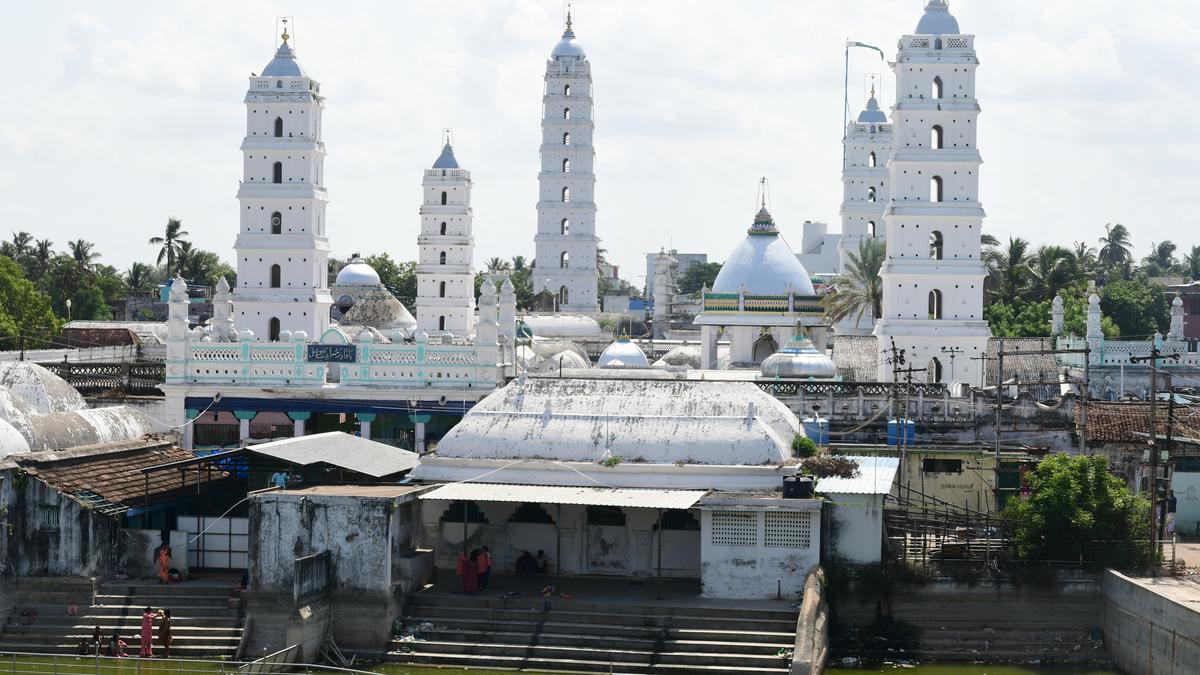
Nagore Dargah | Photo Credit: SRINATH M

M. Haja Maideen lives in Thethi village in Nagapattinam district. This third generation faqir (ascetic) of the Rifai tariqa (order) of Sufism has been singing Islamic devotional songs from the age of nine. He performs in and around his coastal village along with brother-in-law, Abdul Ghani. Together they present compositions set to the beat of the ‘dayra’. Haja’s elder brother Saburmaideen Babha Sabeer was the third member of the troupe until his demise in 2012.

The life and music of singers like Haja have been shaped by the Nagore dargah, dedicated to saint Abdul Qadir, just a few kilometres away from Thethi, and considered to be one of the biggest pilgrim centres in southern India.

During a recent visit to the dargah, the presence of music — instrumental and vocal — was as tangible as the five imposing minarets that frame the shrine. Whether as nagaswaram and thavil concerts at the nagara medai in the upper storey of the shrine, or as concerts by independent artistes and faqirs below, devotional tunes are seamlessly woven into the worship rituals.

Spotlight on talent

Haja, Abdul and Saburmaideen would have remained in the shadows but for EarthSync’s (an audio-visual production house) award-winning 2007 documentary, ‘The Laya Project’, that turned the spotlight on them.

For over two years, journeying through countries affected by the 2004 tsunami and documenting their folk music traditions, the Laya Project explored communities in India, Indonesia, Sri Lanka, Thailand, Maldives and Myanmar.

The trio became popular as ‘Nagore Boys’ with their simple rendition of ‘Ya Allah’, showcasing their ability to spin a mesmeric sonic web with their voices and tambourine-like instruments.

Later they were invited by the project’s Chennai-based Israeli music producer, Yotam Agam, to record ‘Nagore Sessions’, with a line-up of guest artistes including Zohar Fresco on Middle Eastern percussions, horns by Monks from the Tashi Lhunpo monastery, sarangi by maestro Murad Ali Khan, rhodes and programming by Patrick Sebag, harmonium by Palakkad Sreeram and bass by David Saban.

“The Laya Project made a huge difference to our lives,” says the 52-year-old Haja Maideen. “It brought us recognition from the Tamil Nadu government and social organisations, and we were invited to tour Australia, Middle Eastern countries and Israel with our songs. Up until then, going to even Chennai was a big effort.”

Most faqirs have no written song books. “We have memorised over 100 songs, taught by our forefathers, that we sing according to the occasion,” says Haja.

Nagore Boys | Photo Credit: RAVINDRAN R

Impact on popular culture

With Sufism going back to over 400 years in Tamil Nadu, Islamic devotional music in the State has become a part of popular culture. It has two distinct strains: Islamic songs that focus on the core tenets of the faith, and the Sufi genre that consists mostly of ‘Pugazh maalai’ or paeans, in praise of saints and holy men whose shrines are still revered.

Islamic music worked its way into ‘gaana’ songs, that were originally meant to commemorate the dead and was integrated into Tamil movies especially in the 1950s. Songs such as ‘Mera naam Abdul Rehman’, ‘Ondre Solvaan’ and ‘Ellorum Kondaduvom’ were picturised on leading stars M.G. Ramachandran and Sivaji Ganesan playing Muslim characters.

One of the most recognisable voices of this genre is singer Nagore E.M. Hanifa, whose baritone and style continue to influence many even seven years after his demise. “My father started singing at the age of 13 in Tiruvaluntur, Thanjavur district, on a bullock cart, which was both stage and band transport. He learned early on to throw his voice without the aid of a microphone, which shaped his distinctive vocal style,” says his son Naushad Ali, who also moonlights as a singer.

While Hanifa was not too keen to be involved in films (he did sing in a few), he became the ‘voice’ of the Dravida Munnetra Kazhagam (DMK) with his rousing political anthems that were played before party meetings.

The Laya Project’s impact can be seen in the evolution of Islamic music in Tamil films in recent times. Composers like A.R. Rahman and Ghibran have brought a more nuanced exposure to this genre.

“Sufi themes involve both self-awareness and acquired knowledge. It could be a word or an epiphany that is expressed in poetic form. When you present a song with soul-stirring lyrics, people respond to it at a deeper level,” says Mashook Rahman, the Chennai-based lyricist who wrote ‘Khwaaja enthan Khwaaja’ for the Tamil version of the 2007 magnum opus Jodhaa-Akbar. Sung by Rahman (who also composed the film’s music), the hymnal tune continues to stand out for its mellow exploration of spirituality.

Nagore Hanifa | Photo Credit: MOORTHY M

Online breakthrough

Sound recording technology, and alongside it, the market for devotional songs has progressed in many pilgrim centres like Nagore to create a thriving music scene online. Some of the more successful singers in Nagore have installed recording studios at home.

“Sufi musicians of yore used to write their own lyrics and compose the tunes, besides playing the instruments. But as they lost out on education, they started using poems written by others. For more than a decade, there seemed to be nobody to follow Nagore Hanifa. We are trying to change this with a more contemporary interpretation of Islamic and Sufi music,” says Umar Farooq, singer and proprietor of the recording studio Sufi Musix in Chennai. For his 2019 video song ‘Ya Meera-Qadar Wali’, Umar collaborated with Iranian percussionists to get a more authentic soundscape for the drums.

Interestingly, most of these productions are self-financed because the music is seen as a religious offering. “It costs around Rs. 1 lakh to produce a high quality song with video, but nobody talks about money; we all just pitch in with whatever we have,” says Umar.

“At present, Sufi music isn’t organised in Tamil Nadu. Faqirs are doing their own thing. Film composers are trying it in movies. And independent producers like us are exploring a new sound in our recording studios,” says Umar.

Rooted to Nagore

Many Sufi singers have stayed rooted to Nagore and its heritage (the saint Abdul Qadir is said to have learned music along with Hindustani prodigy Tansen from the Sufi mystic Muhammad Ghauth). “We sing at the dargah for our own happiness, and don’t expect any payment ,” says Nagore Hafil Sahib Qadiri, who has been singing for 20 years as part of the Qadiriya Qaseeda group in Nagore.

The 40-year-old has worked with companies like Sufi Musix as well, producing lyrical videos in Urdu and Tamil. With 150 songs in his repertoire, Hafil Sahib says he has curtailed singing at social occasions (for a fee) and is now concentrating on Sufi music at the dargah.

It is important to preserve the folk music traditions of the Tamil Sufi minstrels as the younger generation of faqirs prefer a more mainstream life. Haja Maideen’s son, for example, has taken up car driving for a living.

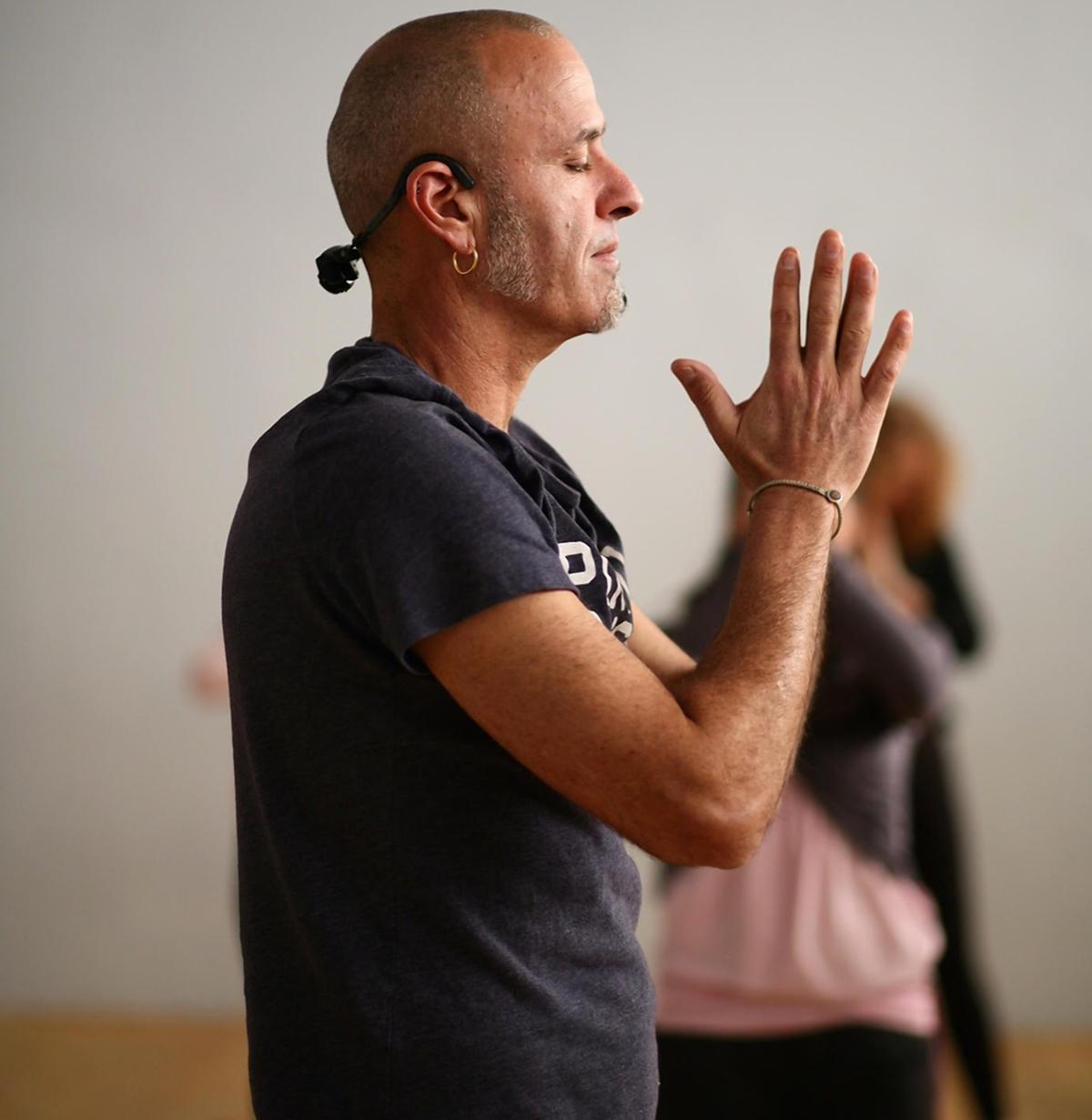
Yotam Agam | Photo Credit: Special Arrangement

Recalling the serendipitous discovery of the Nagore Boys by an Indonesian colleague, who was passing by the dargah during the Laya Project, music producer Yotam (who returned to Israel in 2020 after nearly 15 years in Chennai) says that he remains fascinated by Tamil Sufi music.

“Unlike North Indian and Pakistani Sufi groups that use big ensembles of South Asian musical instruments, Tamil Sufi singers have only the frame drum, common in Arab countries. People can go into a trance by just listening to the chant-like refrains of their songs,” says Yotam.

source: http://www.thehindu.com / The Hindu / Home> Entertainment> Music / by Nahla Nainar / October 18th, 2022

In Kerala, a dhow boat is sewn together to be showcased at the FIFA World Cup, Qatar

Kozhikode, KERALA :

India and Qatar celebrate their age-old maritime ties by showcasing a handcrafted dhow at the FIFA World Cup, as part of the Gulf Arab nation’s traditional boat festival.

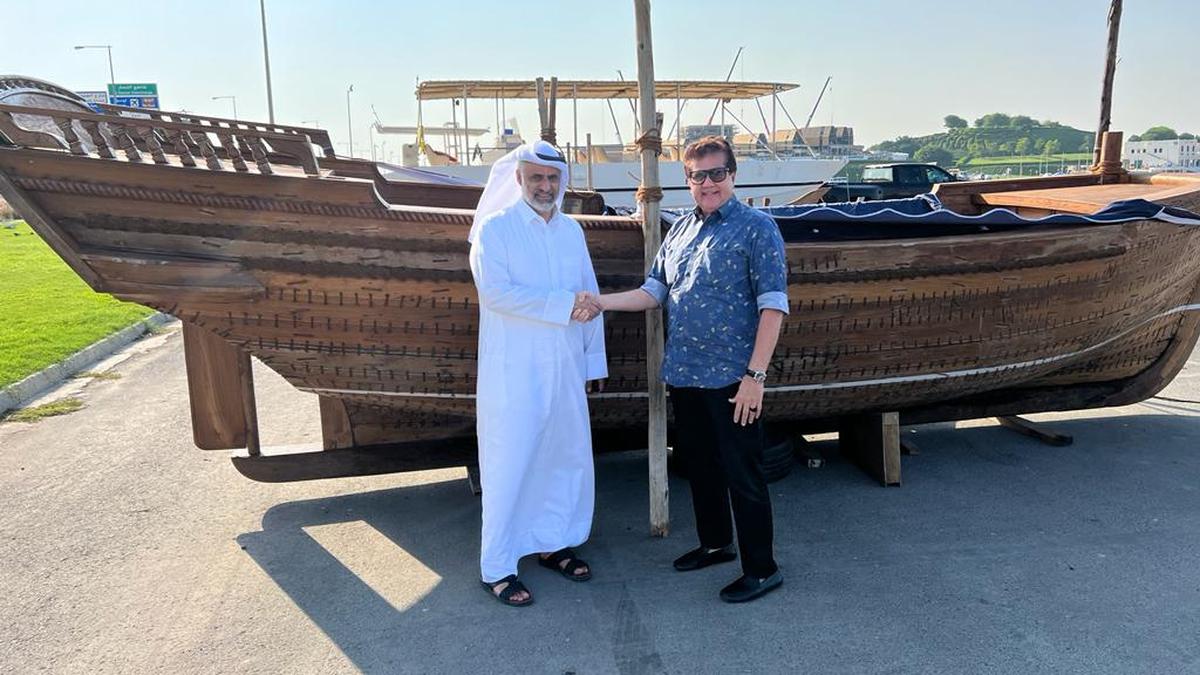
P.O. Hashim, MD, M/S Haji PI Ahmed Koya, Kozhikode, handing over the dhow made by their company to Ahmed al-Hitmi, director, Katara beach department, in Doha, Qatar. | Photo Credit: Special Arrangement

India is reiterating its age-old maritime ties with Qatar, at the ongoing FIFA World Cup 2022, through a handcrafted dhow made by M/S Haji PI Ahmed Koya, a family-run shipbuilding company in Kozhikode.

Held under the patronage of Sheikh Tamim bin Hamad al-Thani, Emir of Qatar, and organised by The Cultural Village Foundation Katara, the 12th edition of the Katara International Dhow Festival in Doha is one among the many off-field events scheduled by the FIFA World Cup. The festival, held between November 20 and December 18, features dhows — boats with a long and thin hull, and one or two masts for sails, commonly used in southern Asia and eastern Arabia — from nine countries, including India, Kuwait, Qatar, Oman, Saudi Arabia, Iraq, Greece, Zanzibar and Turkey.

The Indian pavilion is exhibiting two 20-foot long boats, in addition to displaying boat materials and models, which are for sale.

“My grandfather started this company in 1885, and we have been making boats to order for clients in the Gulf countries for over 130 years. It is a special year for us, because we have built a baghlah dhow for the Qatari government using vintage technology. It showcases our boat-building heritage on an international stage,” says PO Hashim, managing director of the firm, who is in Doha for the handover.

The company also maintains a Dhow Museum of equipment and memorabilia related to the wooden vessels in Kuttichira, Kozhikode.

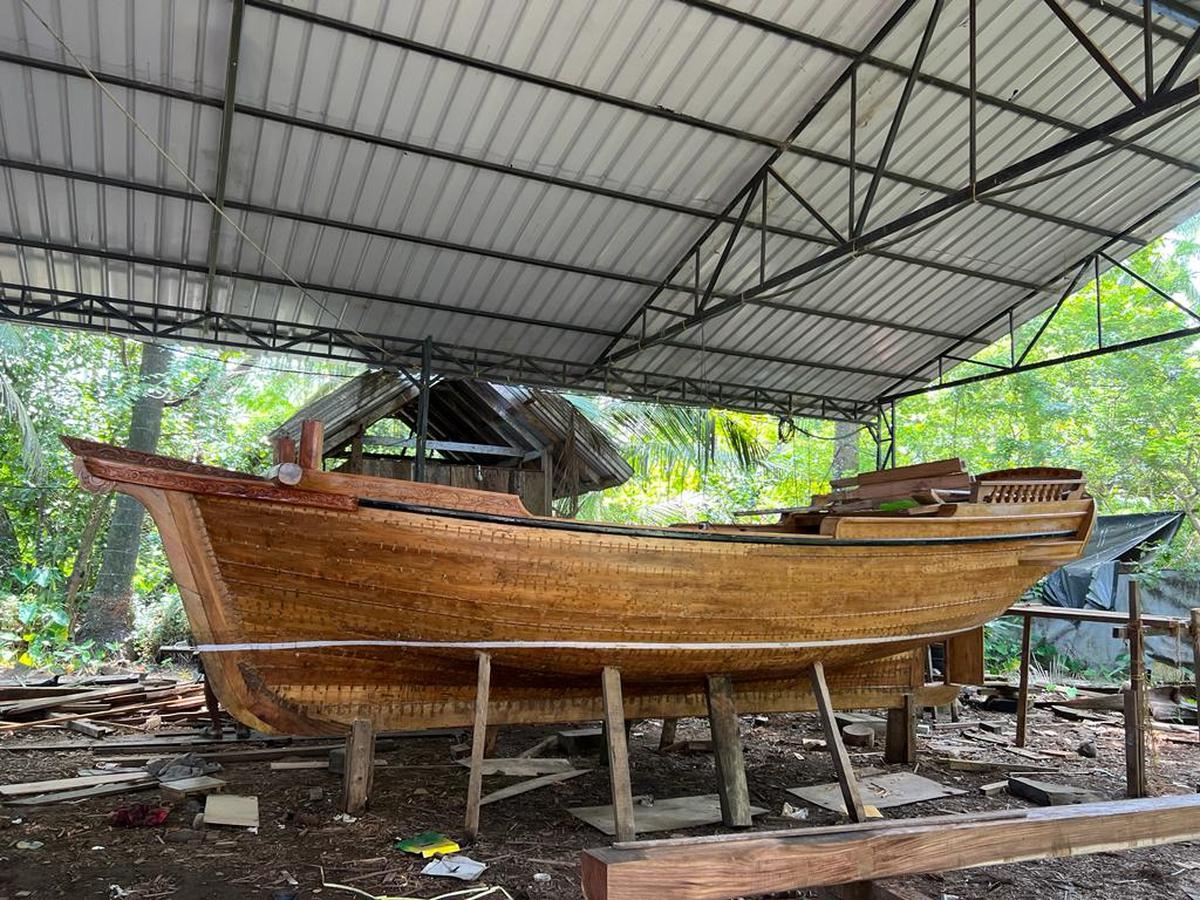
The dhow built by M/S Haji PI Ahmed Koya, Kozhikode, seen in the boatyard before despatch. | Photo Credit: Special Arrangement

How to stitch a boat

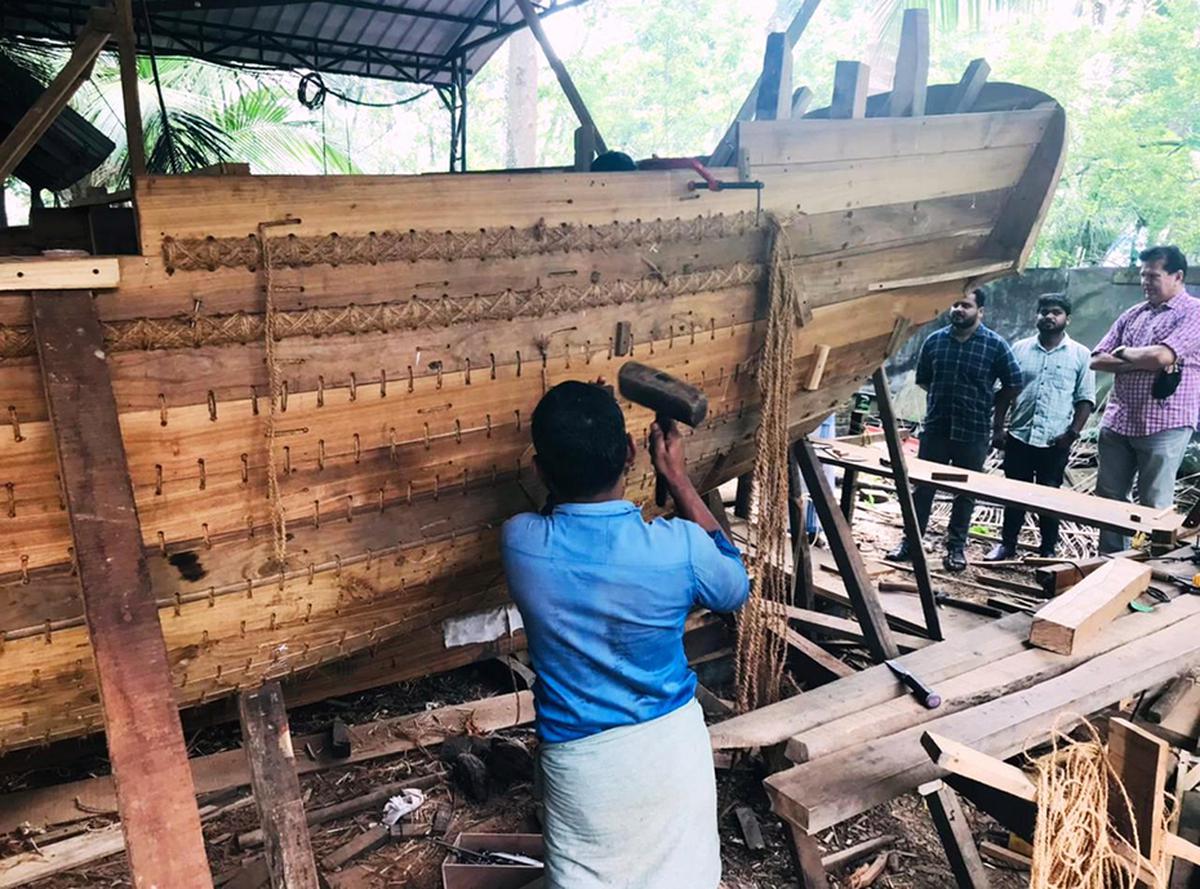
The baghlah (Arabic for mule), measuring 27 feet, is an example of a sewn boat, where craftsmen thread wooden planks together using special coconut-fibre ropes. The technique predates the era of metal fastenings, and samples of sewn boats can be seen in many ancient civilizations, each using a different methodology.

Good quality timber and skilled shipwrights made Beypore in Kerala a magnet for Arab countries, attracting craftsmen from Yemen’s Hadrami tribe and the Omanis from the 15th century. Known as uru in Malayalam, the Beypore dhow was the main form of transport along the spice routes of Malabar and Arabia.

“We were inspired to make this dhow after seeing a similar model made in Oman decades ago,” says Hashim. The Qatar-commissioned boat being displayed at the festival was manufactured at the company’s Pattermadu dhow-making unit at Chaliyam village in Kozhikode.

Over six to seven months, from November 2021, craftsman Gokul Edathumpadikkal and a team of shipwrights were busy assembling the six-foot deep and seven-foot wide vessel, using teak sourced from Nilambur. Most of the carpentry and detailed carving on the outer planks have been done manually.

A dhow is typically built from the outside hull inwards. Shaped planks of wood are connected at the edges in a clinker style, and the overlapping sections are sewn together with coir to form a flexible structure. Internal framing is provided for additional rigidity.

Hashim says that their dhow is made with 2,300 hand stitches of fibre ropes through 5,000 holes to secure the planks. It was shipped by container and handed over to Ahmed al-Hitmi, director, Katara beach department, in Doha, last week.

“Qatar has been actively promoting the dhow as a symbol of the country’s culture and economy before the oil boom. We have been participating in Qatar’s annual dhow festival for 10 years,” he says.

Sailing away

The work of the special dhow using coir rope in progress at Chaliyam. | Photo Credit: Special Arrangement

At one time, there were some 80 types of dhows in the Arabian Gulf and Oman but only about six are still in use today, albeit with engines rather than sails. “There were many types of sailing dhows, ranging from big ocean-going vessels to small inshore fishing boats. They were used for trading from the Arabian Gulf to countries as far away as China, where pearls were exchanged for silk and other luxury items. Each year, fleets of dhows set out for the pearl-fishing grounds in September, returning three months later. The last of the sailing dhows were replaced by engine-powered boats in the 1950s,” says writer Fran Gillespie, who has authored several books on Qatar’s history, culture and archaeology.

Traditionally built dhows, powered with engines, are still in use in the Arabian Gulf for fishing and tourist excursions.

Katara, a sprawling beach promenade in Doha, will be the venue for marine shows, competitions, workshops for children and craftsmen in addition to special performances and operettas by folk troupes through the month as part of the festival.

For the World Cup, flags of the nations of the 32 qualified teams will be put on dhow masts to sail past the Doha Corniche and Museum of Islamic Art (MIA) reaching there by sunset on all days.

“The dhow festival, based on Qatar’s pearl-diving, fishing and maritime history is deeply intertwined with emotion and pride in the hearts of several generations,” says Salem al-Marri, Director of public relations and communications, Katara.

source: http://www.thehindu.com / The Hindu / Home> Society / by Nahla Nainar / November 28th, 2022

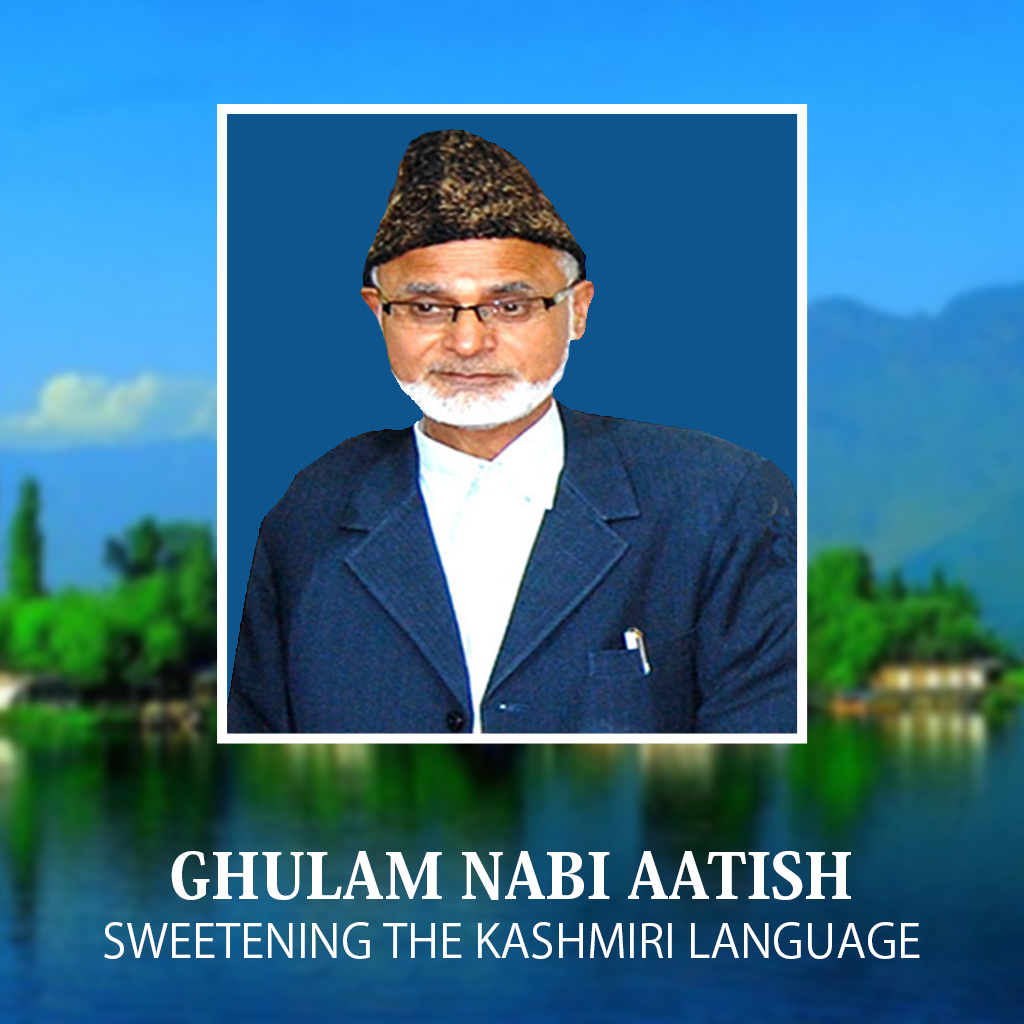
Ghulam Nabi Aatash: Sweetening the Language

Anantnag, JAMMU & KASHMIR :

Somewhere in 1951 Ghulam Nabi Pandit, a student of class 5 at a government school in Anantnag, had a daily chore of buying bread, filling…

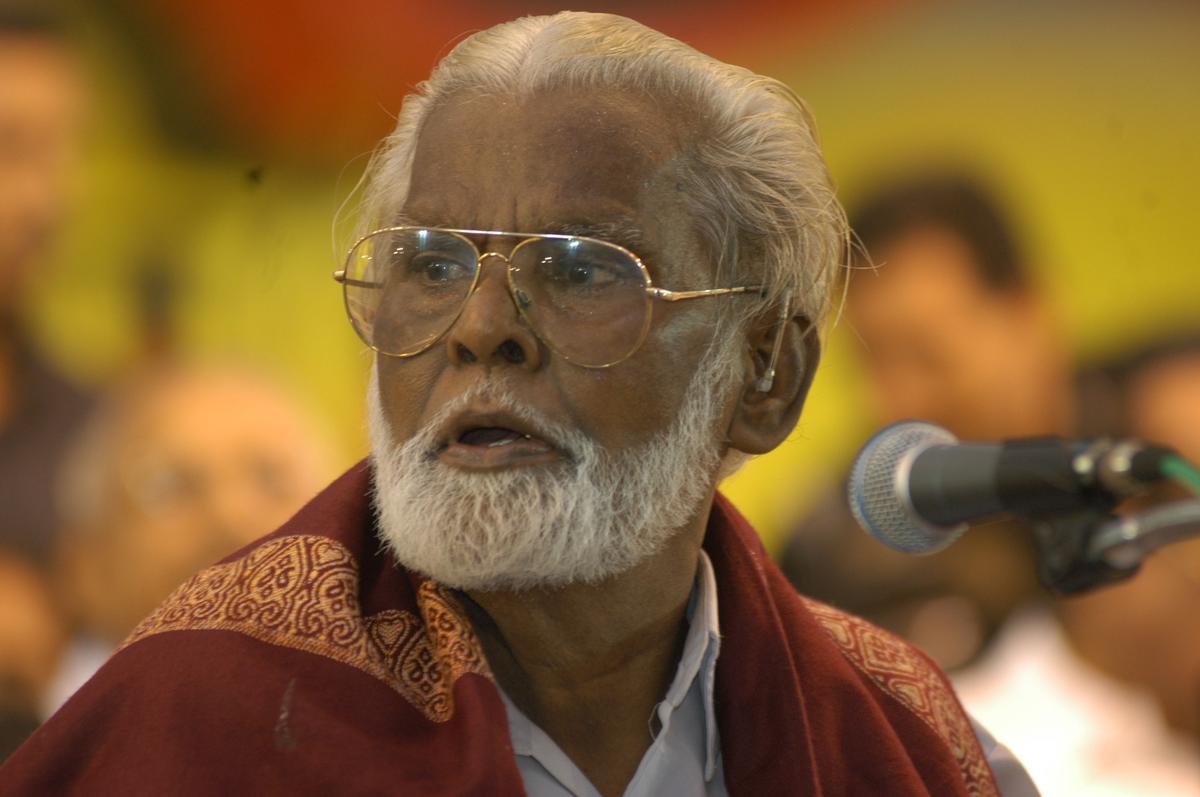
pix: facebook.com/ Mumkin hai Yeh

Somewhere in 1951 Ghulam Nabi Pandit, a student of class 5 at a government school in Anantnag, had a daily chore of buying bread, filling water in Hookah, lighting stove for tea, and other such work assigned by the teachers.

For the last five years he had never understood a word from any of the books taught in the school. Branding him as good for nothing, many a time his teachers suggested his father to put the boy in some carpet weaving shop. However that summer something stuck to a pandit teacher at his school. He asked him ‘what are you supposed to do with your life, class 5 examination is round the corner, do you have any preparation?’ The boy answered in negative. The teacher told him to come to him during recess. The boy duly followed.

The teacher started teaching him right from the begening – class Ist books. It was primarily Urdu, little bit of Maths and English. The practice remained for next four to five months till the annual examination time. During this time he was taught all the books from Class 1-5 and surprisingly the boy was actually a genius and picked up fast every word that was taught to him. 

Pandit cleared the class 5th  examination much to the shock and surprise of other teachers, and even villagers.

After that there was no looking back and he cleared all examinations with flying colours. In class 10th  he was one of the toppers in his district and he went on to have a distinguished career as an educationist and writer spanning around five decades and still going.

The transformation of  Ghulam Nabi Pandit to renowned writer Ghulam Nabi Aatash is an inspirational story which shows how a teacher can turn an ordinary student into a legend. 

“Sometimes I wonder how all this happened,” said Ghulam Nabi Aatash who was recently honoured at a function at Jammu Kashmir Academy of Art Culture and Languages. “In class 6, as if it was command of Allah to others, I was made Secretary of Bazme Adab, a literary forum. You can imagine just one year ago I was lighting stove and filling water in hookah in school and now I was writing proceedings of the elite gatherings.”

Though Aatash was lucky at many times, but it was his hard work and dedication that helped to capitalise on that luck. At the Bazme Adab, Aatash leaned towards writing, art and culture. He even became part of dramatic club. Much like other poets and writers, Kashmir and its social history attracted Aatash. Seeing his writing his Pandit teacher gave him pen name Aatash, who told him that it symbolise sour taste which has emerged after a lot of bitterness of life. 

His family situation was not good either but he picked the best out of those difficult times. 

“My mother was bedridden for seven years but she had amazing memory. She knew tonnes of folklores, phrases and traditional songs. I could connect my literary leaning and information from my mother. In addition to it my posting as a teacher in far off places and learning from their culture increased my knowledge,” said Aatash.

Known as the biggest name in Kashmiri Folklore, Aatash’s work in this genre has helped preserve a trove of knowledge for posterity. His books like Koshur Louke Shairi Vakhnay ti vetchnay (Kashmiri Folk poetry, research, analysis and its study in social perspective, Koshur Look Voture, Tahqeeq ti Tajheez (Kashmiri folklore research and analysis in historical and sociological perspective), Koshur Folklore, (Kashmiri folklore Research and analysis) and various volumes of Kashmiri folksongs, Kashmiri sayings and Kashmiri folktales indicate the amount of work Aatash has put in its endeavour.

“Folklore helps to understand the history of a nation. Its customs and working of society,” said Aatash. “Every word and phrase has sea of knowledge in it.”

In addition to the books, Aaatsh has published more than 100 entries in Kashur Encylclopedia Folklore, giving him a special name among the literary giants.

It is said that whenever JKAACL, Radio Kashmir or Doordarshan get stuck on some topic in Kashmiri and there seems to be no way out, they approach Aatish who within no time produced a quality paper based one research for them. 

Parallel to his literary career, Aatash also progressed on his academic career which started first as a private school teacher and then as a government school teacher, which ultimately ended in his retirement as a lecturer in Kashmiri language. Most of his higher studies were done after his appointment as a teacher. He did his MA in Kashmiri and B.Ed from University of Kashmir. 

Not only a folklorist, Aatash is a poet, critic, researcher, compiler and an expert on children’s literature too. His  Khencha Mencha series for children has been well received in academic circles.

In 2013 he wrote a Kashir Shur Adbich Sombran, (An anthology of Children’s literature in Kashmiri). He was awarded Bal Sahitya Puriskar for children literature in 2011. 

His expertise was utilised by Board of School Education (BOSE) roping him in as a member of expert committee for preparation of syllabus and text books of Kashmiri language from class 1st to 12. What could have taken half a decade or even a decade to complete, Aatash managed to complete the work, along with other members, in just 18 months.

“If you ask me about my pen, I would attribute a great deal of its refinement to Prof Amin Kamili and his legendary magazine Naeb. This quality magazine gave me a platform and its strict editing gave me a direction,” said Aatash. “Once Kamili saheb sent me back my draft seven times, before finding it worthy to publish. In todays time such a thing is unheard of.”

In 1978 when Aatash wrote a poetic collection Zool Amaran Huend  (Illumination of longings), he thought nobody will like it. But the book ended up winning best book award for the year 1979. “At that time I was a simpleton. I didn’t even knew that books get award too. Somebody told me that JKAACL is accepting books for award but when I went to their office they said that date is already over and we had advertised it in radio and newspapers too. I replied that I neither have newspaper of radio access and somehow they accepted my entry,” said Aatash. “And then out of sudden I got the award.”

In 1981 together with S L Pardesi he translated Russian poet Alexander Pushkin’s poems into Kashmiri. The book received Soviet Land Nehru Award for the in the same year.

In Research and Criticism, one of the best books of Aatash is his Kasheer Hazrat Sheikh Noor-u-Din Reshi sends kalamas manz, (Kashmiri compilation about Kashmir as reflected in the poetry of Hazrat Sheikh Noor-u-Din Reshi RA) published in 1994. He has also been instrumental in bringing to fore some forgotten brilliant writers of Kashmir like Shamus Din Ahmad, Iqbal Nath Vanpoh, Abdul Ghani Thokar and others. 

He has written two books in Urdu language too, Kashmiri Lok Adab (Kashmiri folk literature) and Kashmir Angrazi Sayahaon kay Safar Namoo me (Kashmir as reflected in the travelogues of British visitors). Two more books in urdu are unpublished and seven more in Kashmiri languages in different genres await publication.

A cancer survivor, Aatash is workaholic making the  most of his time. He has to his credit more than 40 books and hundreds of research articles. From 1978 on an average he has published one book every year, an astonishing achievement for anybody. Attesting to his worth, a biography titled Ghulam Nabi Aatish Shakhsiyat Te Adbi Khidmaat has been written by Gulzar Ahmad Rather. 

“I have done my work for Kashmiri language and culture now it is time for us to follow what we say” said Aatash who is pained to see the present condition of his beloved language. “People say that Kashmiri language is not under threat but look at houses only elders speak Kashmiri and not youngsters. What will happen in next 20-30 years nobody will speak Kashmiri. We demand government to preserve it but it is for us to preserve it. It pains me when I see youngsters speaking in atrocious urdu instead of natural Kashmiri.”

source: http://www.greaterkashmir.com / Greater Kashmir / Home> Opinion and Editorial / pix: edited …source: facebook.com/Mumkin Hai Yeh / May 12th, 2018

Sumaira Abdul Ali: Environmentalist behind no honking zones

Mumbai, MAHARASHTRA :

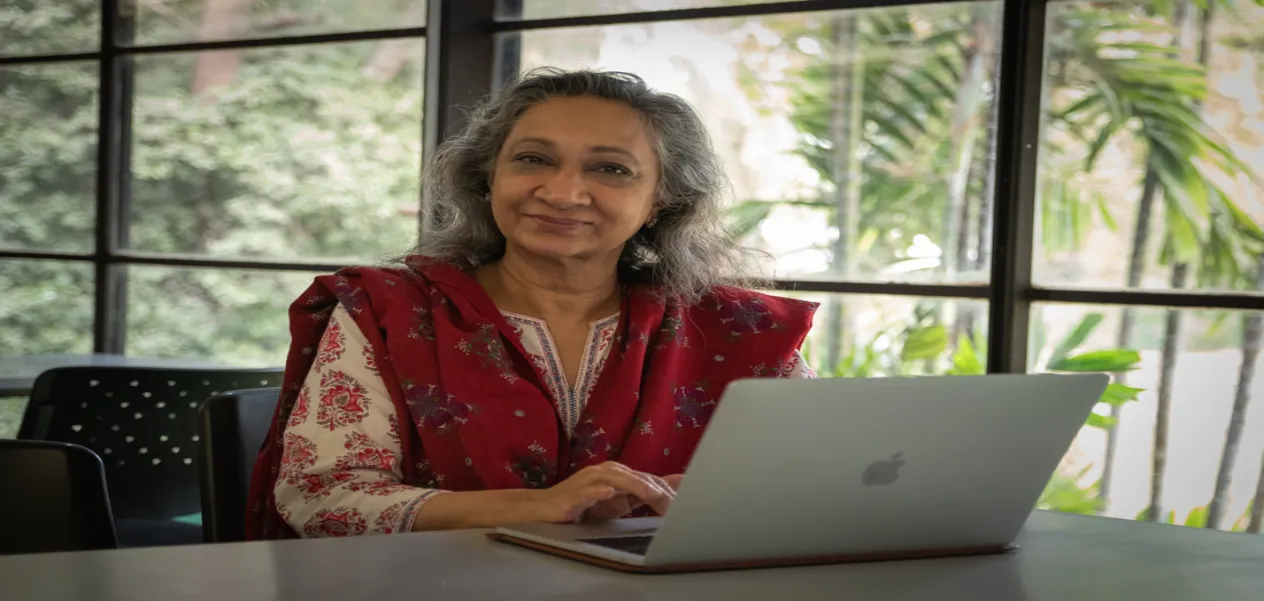
Sumaira Ali, Founder Awaaz

Some twenty years before the world knew about the Swedish environmental wunderkind Greta Thuberg, Sumaira Abdul Ali Sumaira had created ripples by taking on the system for unchecked noise pollution and cartels of illegal sand mining.

Today, Sumaira, 64, lives in Mumbai and continues to work for the environment through Awaaz Foundation which she founded.

She is also the co-chairperson of the Conversation Sub Committee and the Secretary of Asia’s oldest and largest environmental NGO – The Bombay Natural History Society. Currently, she is a member of the Society’s Governing Council.

In the year 2002, she set up her NGO and launched a campaign against noise pollution. Her initiative received widespread support from the people. Gradually, this campaign started spreading to many states of India, such as Banaras, Bangalore, and Pune.

Awaaz is the first organization in India to collect data on noise pollution.

Probably it is for Indians like Sumaira that a senior journalist Naveen Kumar said, “All the bad things in the world are because of men. War, unrest, dirty air, hatred, and all the good things in this world like clean water, greenery, love, and the desire to live, are only and only because of women.”

There are important names like Jane Goodall, Sylvia Earle, Wangari Mathai, Rachel Carson, Vandana Shiva, Isatou Ceesay, May Boeve, Marina Silva, Medha Patkar, Sunita Narayan, Radha Bhatt, Maneka Gandhi, Greta Thunberg, Sumaira Abdul Ali, whose passion, awareness, participation and fearlessness create a stir among the responsible contractors who play with the environment in the world.

When Sumaira filed a public interest litigation (PIL) in the Bombay High Court in 2002 with the Bombay Environmental Action Group, and two doctors against the relaxation of noise regulations to allow the use of loudspeakers from midnight, many stakeholders who had tunned vested interests were disturbed, for their domain was under attack.

Back then sans the internet, it must have been difficult for Sumaira to raise public awareness on such an issue. Therefore, Sumaira Abdul Ali has been given the title of Indian ‘Minister of Noise’ by government officials and the press.

In 2003, Sumaira, along with Bombay Environment Action Group’s Dr Yashwant Oke, and Dr Prabhakar Rao, filed a PIL in the Bombay High Court to seek the demarcation of areas. Seven years later, in 2009, the hard work paid off.

The Bombay High Court directed the Brihanmumbai Municipal Corporation to demarcate 2,237 silence zones extending up to 100 meters around hospitals, educational institutions, courts, and religious institutions. The Maharashtra government issued a circular in 2015 banning the use of ‘Horn OK Please’ signs on the rear of commercial vehicles across Maharashtra.

The court banned it as it encourages motorists to unnecessarily blow the horn and to noise pollution. She also organized extensive seminars against noise pollution during 2004-06.

Dr. Reshma Rehman is an Assistant Professor and researcher at USTM, Meghalaya 

source: http://www.awazthevoice.in / Awaz, The Voice / Home> Stories / by Dr Reshma Rehman / March 17th, 2025

A reception to remember: Tiruchi-born tech entrepreneur’s memorable evening as a guest of the POTUS

Tiruchi, TAMIL NADU / Algharetta (Georgia) U.S.A :

VDart founder Sidd Ahmed on attending the first Lunar New Year gathering at the White House.

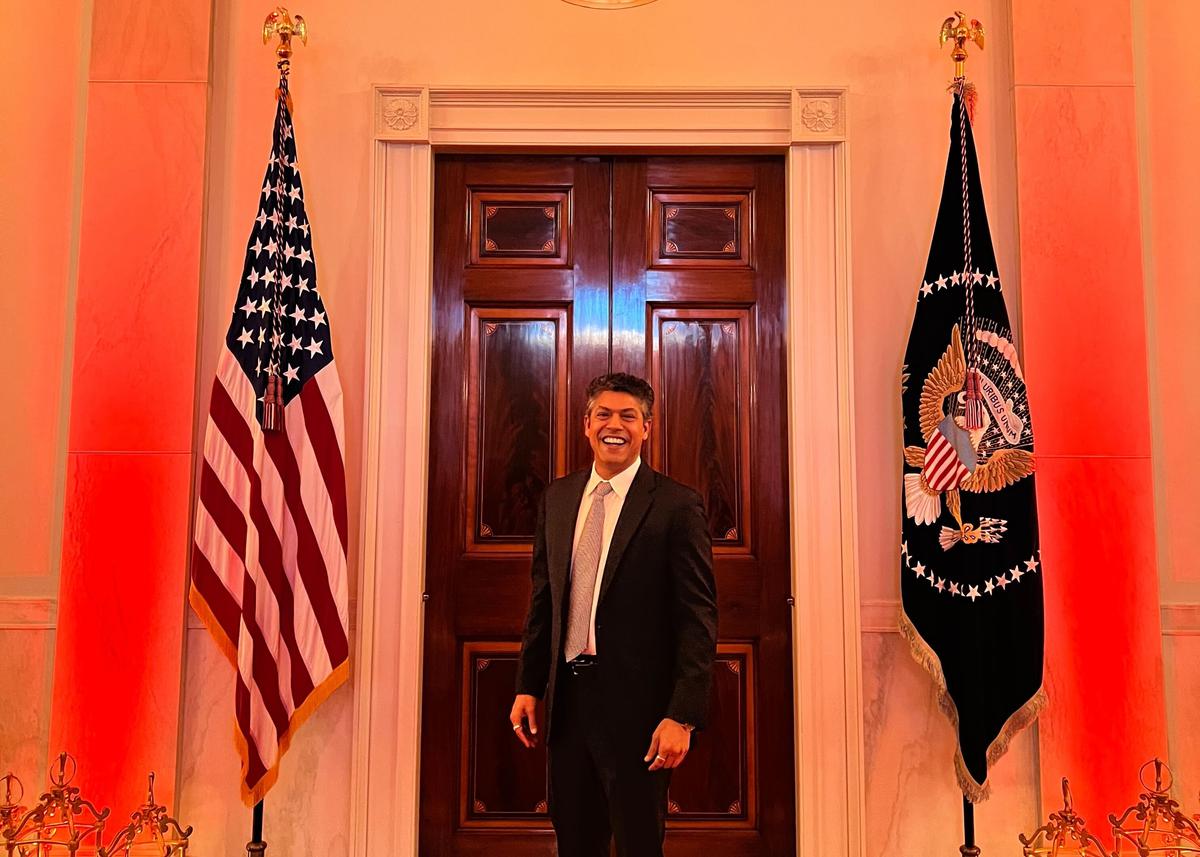
Sidd Ahmed, founder of VDart Group, seen at the first ever Lunar New Year reception hosted by the Bidens at the White House in Washington DC on January 26, 2023. | Photo Credit: SPECIAL ARRANGEMENT

The first ever Lunar New Year reception hosted by the US White House in Washington DC was a memorable occasion for Tiruchi-born Asian-American tech entrepreneur Sidd Ahmed, who was one of the 100 invitees to the formal event held on January 26.

“I’m still a little overwhelmed, because getting an invitation from the President of the United States is a big thing for an ordinary citizen,” says Ahmed over a phone interview. “The programme was meant to celebrate the New Year traditions of people from the Asian-American Pacific-Islander (AAPI) communities. This was one of the ethnic festive celebrations hosted by the White House in recent years, to emphasise the nation’s multiculturalism,” he says.

Ahmed, who founded the VDart Group, a global digital talent management and consultancy based in the US city of Alpharetta, Georgia in 2007, was a rare Indian face among the elite gathering dominated by guests from Korean, Japanese, Vietnamese and Filipino lineage.

“A majority of the invitees were non-profits [non-governmental organisations]. I represented the National Minority Supplier Development Council (NMSDC), a non-profit that connects minorities [people of African American, Hispanic, Native American, Asian Pacific, or Asian Indian ethnicity] with US corporations,” says Ahmed.

Dream come true

Along with NMSDC CEO and president Ying McGuire, Ahmed was invited as the head of VDart, one of the best-performing companies of the council’s 13,000 member firms. The company has had a significant corporate presence in Tiruchi since 2010.

“Visiting the White House and simply being in the proximity of President Joe Biden is a huge thing. It was a like a dream come true, listening to President Biden speak and interact with the guests. Imagine an ordinary man coming from Tiruchi like me going to the White House. There may have been many more companies and far more well-read people than me there, but it was such a huge honour,” says Ahmed.

Though a mass shooting incident during a Lunar New Year celebration in California a few days before the White House reception had cast a pall on the nation, the US administration decided to go ahead with the event as planned. “President Joe Biden and the First Lady Jill Biden wanted to show the country’s resilience,” says Ahmed.

He later attended a deferred Lunar New Year celebration hosted by Vice President Kamala Harris at her official residence on January 31.

The guests were free to click innumerable pictures in the grand reception rooms of the White House’s ground floor, once they had completed the mandatory security checks. “The Secret Service and US Marines manning the areas were really polite and hospitable that day, and made the evening more enjoyable,” says Ahmed.

While the excitement has still to die down at home, especially among his relatives in Tiruchi, Ahmed says his mother asked the most pertinent questions. “My family was super excited about the whole thing. But only Mom asked, ’What did the President say?’ and ‘Does he look the same in real life as on TV?’” he laughs.

source: http://www.thehindu.com / The Hindu / Home> Life & Style / by Nahla Nainar / February 22nd, 2023

Village in Tiruvarur gets a ‘Taj Mahal’ tomb as tribute to late mother

Tiruvarur Village / Chennai, TAMIL NADU :

Chennai-based businessman pays homage to his deceased mother with Mughal-style funerary complex in Tiruvarur village.

A view of the marble mausoleum resembling Agra’s Taj Mahal built at Ammaiyappan in Tiruvarur. | Photo Credit: Special Arrangement

A near-replica of Agra’s Taj Mahal has been making news this week, as reports about the marble mausoleum built in Ammaiyappan village, Tiruvarur, by a son for his mother who passed away in 2020, have been going viral online.

“My four sisters and I were very young when we lost our father, a hardware merchant in Chennai. Our mother Jailani Biwi, who was just 36 then, brought us up single-handedly, and stayed by our side through thick and thin. After her demise at the age of 68 years in December 2020, we felt her presence should be an enduring one. So with my family’s consent, I decided to build this mausoleum for her on a one-acre plot in Ammaiyappan,” Amruddin Sheikh Dawood, told The Hindu .

Constructed over two years, the complex houses a mosque and madrassa (school for religious instruction), besides the grave of the deceased on 8,000 sq ft, and was built at a budget of nearly ₹5 crore.

Intricately carved trellis panels and water tanks are part of the edifice, bringing an exotic look to the structure in this rural setting.

Mr. Dawood, who is a rice merchant based out of Chennai, said that the resemblance to Taj Mahal was almost incidental. “We simply wanted a building that used elements of Mughal architecture, but the designer we consulted in Tiruchi suggested that our idea was very similar to that used in the famed monument, so we just went ahead,” he said.

“Since Taj Mahal was the inspiration, we felt that white Indian marble rather than granite, would be ideal. We sourced 80 tonnes of marble from Rajasthani quarries,” Mr. Dawood said.

North Indian artisans worked alongside local labourers to complete the building, which was formally inaugurated last week to visitors of all faiths.

Countering critics about the scope and budget of his dream project, Mr. Dawood said that the building was a symbol of the family’s love for their matriarch. “A mother’s affection is priceless, and in our family, she was the one who held us together all her life. This mausoleum is a humble gesture to show our respect for her, and also to inspire others to cherish their parents,” he said.

source: http://www.thehindu.com / The Hindu / Home> News> India> Tamil Nadu / by Nahla Nainar / June 13th, 2023

Meet Sir Hamid Patel, first British Muslim Education Chair in UK

Bharuch, GUJARAT / London, UNITED KINGDOM :

Sir Hamid Patel, also known as Mufti Hamid Patel, has been appointed as Interim Chair of Ofsted Board in the United Kingdom

London :  

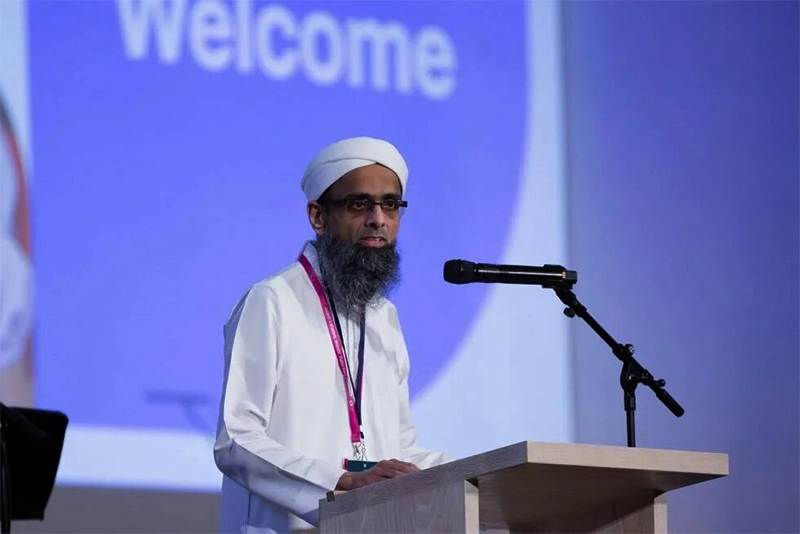
Sir Hamid Patel, also known as Mufti Hamid Patel, has been appointed as Interim Chair of Ofsted Board, short for Office for Standards in Education, in the United Kingdom.

The Ofsted Board oversee the curiculum and teaching practices in all British schools. Hamid Patel has been a member of the Ofsted Board since 2019

The Indian origin British educational and thought leader has been appointed as Education Chair in UK following the exit of Dame Christine Ryan.

Mufti Hamid will hold this position until a substantive Chair is appointed, which will take no longer than five months.

Who is Hamid Patel?

Hamid Patel was born and grown up in Britain. His parents hailed from Bharuch in Gujarat and had migrated to Britain about half a century ago, in late 70s. He comes from a family of 5 – three girls and two boys.

Sir Mufti Hamid Patel left school in Blackburn at 16, without himself excelling academically.

A qualifed Mufti and Islamic Scholar, Sir Hamid’s career began as a teacher, though he wanted to become a footballer. In 2010, he became the Chief Executive of Star Academies, formerly known as Tauheedul Education Trust.

Under his leadership, the trust expanded to manage over 34 schools, primarily serving communities in areas with high levels of social deprivation. Many of its schools are rated outstanding by Ofsted and rank high in performance tables.

In 2024, three Star Academy schools were in the top 10 Schools of UK for Progress 8. In 2023, five Star schools were in the top 10 in England for their GCSE performance.

The trust’s Tauheedul Girls’ School in Blackburn was named State Faith Secondary School of the Year 2025 by The Sunday Times.

The Olive School in Bolton ranked sixth highest among primary schools in the North West, while other top-performing schools include The Olive School in Small Heath, The Olive School in Blackburn, and Eden Girls’ Leadership Academy in Birmingham.

While ‘secular’ schools such as Michaela Community School get positive right-wing media coverage, observers have noted that Muslim-run schools — which outnumber other types of schools in the national top ten — fail to get any recognition.

Other Positions Hamid Patel hold

Sir Hamid Patel CBE also served as Vice Chair of the National Institute of Teaching, which promotes standards, innovation, and quality in education.

He is also Chair of the Education Honours Committee and the Confederation of School Trusts driving excellence and collaboration across the sector.

In addition, as an Honorary Professor of Education at Birmingham University, he connects academic research with implementation in schools.

In his early days of career, Sir Hamid also worked with taxi drivers of Asian origin to help them in getting permits and other such work.

Sir Hamid was made a Commander of the Order of the British Empire (C.B.E.) in 2015 for education services, and he was knighted in the Queen’s Birthday Honours in 2021.

Hamid Patel’s appointment as Ofsted Board Chair, though interim, is hailed. But, the right wing is fuming.

“We’re very lucky to have Sir Hamid on our board – and we’re grateful he’s stepping into this role. He runs some of the best schools in the country, is a brilliant system leader and a very good man”, Rory Gribbell, Director of Strategy and Engagement at Ofsted, wrote.

[With inputs from Islam Channel and BBC Radio]

source: http://www.ummid.com / Ummid.com / Home> United Kingdom / by ummid.com news network / March 17th, 2025

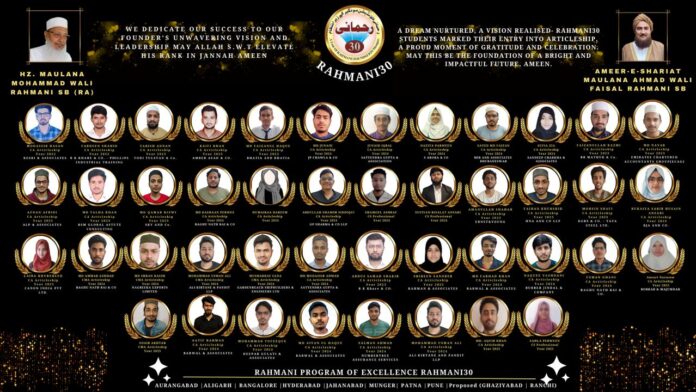
Rahmani30’s Legacy Grows: 44 students begin their CA/CS/CMA Articleship Chapter!

INDIA :

Rahmani30 proudly announces a significant milestone in its mission to empower the community through commerce education, as 44 of its students have successfully entered CA, CS, and CMA articleship programs.

This achievement marks a new chapter in the organization’s efforts to foster excellence in financial management, corporate governance, and ethical professionalism.

This result is not just a milestone but a reflection of five years of relentless hard work, immense sacrifice, and sincere ibadat by the students. It stands as a pure blessing from the Almighty, reinforcing the belief that with dedication, perseverance, and divine guidance, success is inevitable.

Rahmani30’s Contribution to Commerce Education

Since its inception, Rahmani30 has been a pioneering force in expanding access to commerce education. Traditionally, career paths in CA, CS, and CMA have remained underexplored within the community due to a lack of awareness and mentorship. By nurturing talent and providing structured guidance, Rahmani30 has bridged this gap, ensuring that students not only pursue these prestigious qualifications but also excel in them. This initiative continues to drive economic empowerment and self-reliance through professional excellence in finance, law, and business.

The results speak for themselves, year after year. In this year’s Class 12 Commerce ICAI Olympiad, an impressive 77% of all successful minority students across India are from Rahmani30. Moreover, while the national CA Foundation pass rate stands at approximately 16%, Rahmani30 maintains an exceptional 64%+ success rate. Similarly, the CS success rate reaches an outstanding 93%. Notably, in CA Intermediate, Rahmani30 students achieve an overall pass percentage of 65%, far surpassing the national average of just 15%.

These sustained achievements reaffirm Rahmani30’s unwavering commitment to academic excellence and career advancement, ensuring that the next generation of commerce professionals continues to thrive.

By inspiring students to enter CA, CS, and CMA, Rahmani30 is not just shaping careers but also revitalizing the prophetic tradition of ethical trade, financial transparency, and economic stability. These professions play a crucial role in ensuring integrity, fairness, and accountability in business and financial management—aligning perfectly with Islamic values.

A Call from Hazrat Maulana Ahmad Wali Faisal Rahmani Sb for Continued Support & Expansion

This milestone is a testament to the generous support and encouragement of well-wishers, mentors, and institutions who believed in this vision.

As Rahmani30 expands its impact, sustained backing is essential to provide scholarships, mentorship, and institutional partnerships that empower the next generation.

source: http://www.muslimmirror.com / Muslim Mirror / Home> Education> Indian Muslim> Positive Story / March 16th, 2025