Urdu-speaking Muslims in Vaniyambadi trace their roots to two historical periods: the Deccan sultanates that popularised ‘Dakhni’ and Tamil-speaking migrants who reached the town from Thanjavur, Madurai and elsewhere in present-day Tamil Nadu in the late 19th Century and took up the language for survival and prestige.
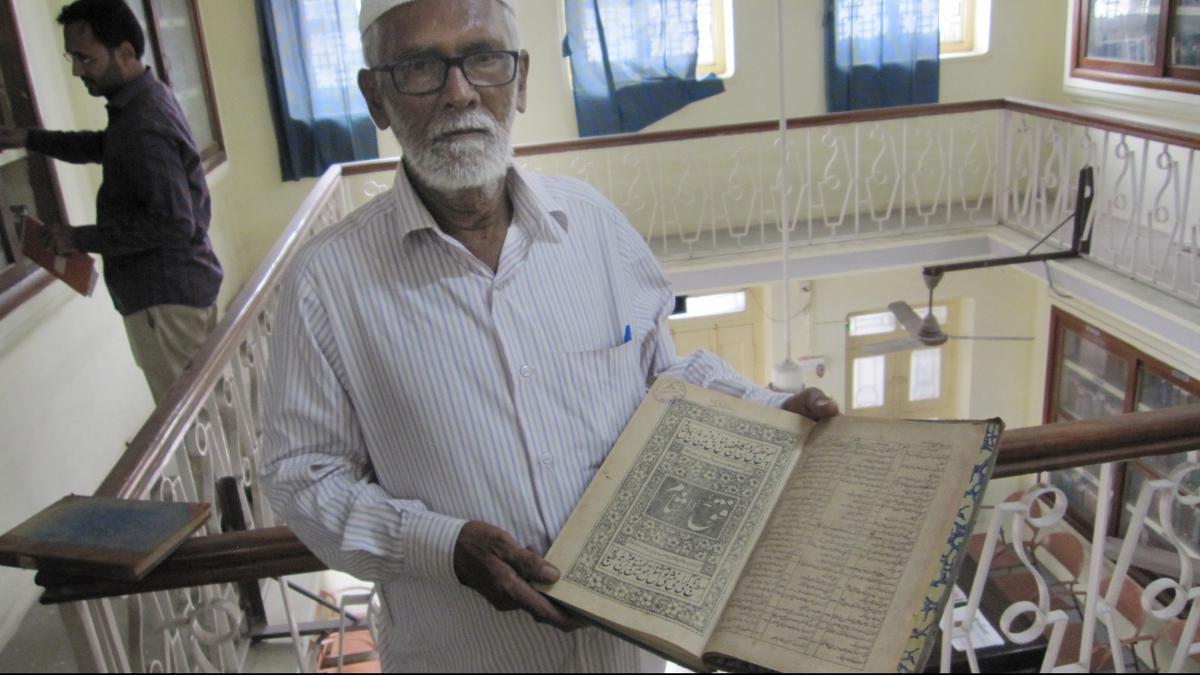
The Anjuman-e-Khuddam-ul-Islam and Islamiah Library houses over 6,000 Urdu books. | Photo Credit: Nahla Nainar
Surrounded by hill stations and on a route that puts it in close connection to Chennai, Bengaluru and the Kolar gold fields, Vaniyambadi in Tirupattur district is known as a hub of Tamil Nadu’s leather industry. It also enjoys a reputation of being ‘Aligarh of the south’, for its affinity to the Urdu language and the many educational institutions thriving here since the 19th Century.
Earlier this year, the National Council for the Promotion of Urdu Language (NCPUL) held the 25th All India Urdu Book Fair at the Islamiah College in Vaniyambadi to emphasise this inter-mingling of culture and linguistics of north India and the Deccan plateau in modern Tamil Nadu.
Urdu-speaking Muslims here trace their roots to two historical periods. First, the Deccan sultanates, notably Bijapur and Golconda in the 15th and 16th Centuries, that popularised ‘Dakhni’, an early form of Urdu of the region written in adapted Arabic script. Second, a sub-division of Tamil speaking migrants (earlier known as ‘Tamil Dakhni’) who reached Vaniyambadi from Thanjavur, Madurai and elsewhere in the present day Tamil Nadu in the late 19th Century and took up the language for both survival and prestige.
“Since Vaniyambadi was a politically vibrant place, Urdu gave people here a link to the north during the Independence movement. The leather trade took migrant Tamil leather merchants to Andhra Pradesh, Karnataka and Maharashtra, where Urdu was a necessity. Teachers from Deoband in Uttar Pradesh, at the seminaries and madrassas in this district, who spoke Urdu [with a north Indian dialect] also added to the predominance of the language,” says D. Abul Fazal, Assistant Professor, Department of History, Islamiah College.
A tool of assimilation
Urdu helped the Nawabs of Arcot make their presence felt politically with the British authorities. The Khilafat Movement (1919-1922), a campaign in India which opposed the British policy against Turkey during the First World War, also galvanised many Tamil-speaking Muslims to adopt Urdu and promote it as a pan-Indian language. “There are many families here who have a clear memory of their Tamil roots, before they ‘became’ Urdu-speakers, but most of the evidence is anecdotal. Over time, a social assimilation developed among the Dakhni Urdu speakers and Tamil Dakhnis,” explains Mr. Fazal.
In his book Dravidian Sahibs and Brahmin Maulanas-The Politics of the Muslims of Tamil Nadu, 1930-1967, S.M. Abdul Khader Fakhri notes that despite the internal tensions, “Tamil Muslims of the Arcot region were to make a major contribution to Urdu literature.” Writers such as Kaka Abdul Azeez Faheem (1898-1943), Lappai Khateeb Mohamed Azam ‘Maqbool’ (1898-1958) and Bangi Abdul Qadir Daanish Farazi (1922-1981) came up with a canon that has added heft to southern Indian Urdu literature.
Educational push
With Vaniyambadi emerging as the mercantile capital of the Arcot region during colonial times, wealthy businessmen started promoting both religious and secular education to improve social conditions. Madrasa-e-Mufeede-Aam, founded in 1887, is still functioning. The Vaniyambadi Muslim Educational Society (1901) established the Madrasa-e-Islamiah in 1903, with just three pupils. With its heritage redbrick building with vaulted arches and wrought iron spiral staircases, complemented by a new block, the school today offers classes to over 2,000 students in the Urdu, Tamil and English medium of instruction.
Islamiah College, mooted in 1916 by Vaniyambadi’s philanthropists, the Nizam of Hyderabad and the British, was founded in 1919 by local business leaders after the Nizam and the British withdrew their support. It is among the first Islamic institutions to offer “secular education” in the region.
Linguistic realities
Though Urdu swirls through conversations everywhere, with its typical Dakhni inflections playing off on Tamil (people take leave with the salutation aatun, quite similar to Tamil varen, roughly translating as ‘I will be back’), the language’s predominance is on the wane, says a section of residents. The Urdu mushaira (poetry gathering) remains a popular literary pastime in Vaniyambadi. But many Urdu speakers here do not know how to read or write the language. And a growing number has realised the importance of learning Tamil for reasons of employment and social integration.
“Until quite recently, there was a misconception in our region that only those who spoke Urdu were Muslims,” says A. Rizwana Shakil, an Urdu-speaking community activist and freelance journalist in Vaniyambadi, who writes in Tamil. A product of Tamil-medium education, Ms. Shakil says, “I have always felt Tamil, or for that matter any tongue, can be learned if one makes a sincere effort. Being bilingual has allowed me to translate manuscripts and also interact more easily with women from other communities,” she says.
“I learned Tamil after going to Chennai for my job. Everyone in Vaniyambadi, irrespective of their background, was always more comfortable speaking in Urdu,” says K. Ahmed Ehsan, who also chronicles the history of Vaniyambadi through his writings.
Literary heritage
The ‘K’ in Mr. Ehsan’s name refers to “Krishnagiri”, a nod to the migrant tradition of incorporating places or occupations in one’s official name. “You can find names prefixed with ‘Malayalam’, ‘Neyvasal’, ‘Madurai’ and ‘Cholavaram’, as also with professional labels like ‘yanaikar’ (elephant owner) or ‘kuthiraikar’ (horse owner) in the names even today,” muses Mr. Ehsan.
His great grandfather Krishnagiri Abdul Hameed was a well-known Urdu poet and one of the founders of Madrasa-e-Niswan (women’s school) in 1907.
Among Mr. Ehsan’s collection of rare books is Armaghan-e-Shaadi, (Gift from a Marriage), a travelogue compiled in 1927 by Dr. Khateeb Sir Ahmed Hussain, also known by his title Nawab Amin Jung Bahadur, originally known as Ahmed Hussain, from Vaniyambadi, who served the government of the Nizams Mahbub Ali Khan, Asaf Jah VI, and Mir Osman Ali Khan and Asaf Jah VII, of Hyderabad.
“The book describes the marriage of the Nawab’s son and the journey of the family entourage from Hyderabad to Madras for the occasion. With the dilution of Urdu learning, many such volumes that recorded social events of the time have also vanished,” he says.
The Anjuman-e-Khuddam-ul-Islam and Islamiah Library is home to over 6,000 books in Urdu on a wide range of subjects. “In its heyday, when at least 250 people used to drop by daily, we used to send back readers for want of space. But with people going online now, we hardly get 20 visitors these days,” says T.M. Abdul Ravoof Khalid, president of the library.
Established in 1939, the Anjuman used to be a popular gathering spot for political activists and students, said Mr. Khalid. “There was a craze for the Jasoosi Dunya (Detective World) novels by Ibn-e-Safi. We also have books published by Aligarh-born scholar and printer Munshi Nawal Kishore,” he adds.
With many Qalami books (manuscripts handwritten in Urdu calligraphy) beginning to show signs of age, the library has started creating a digital archive.
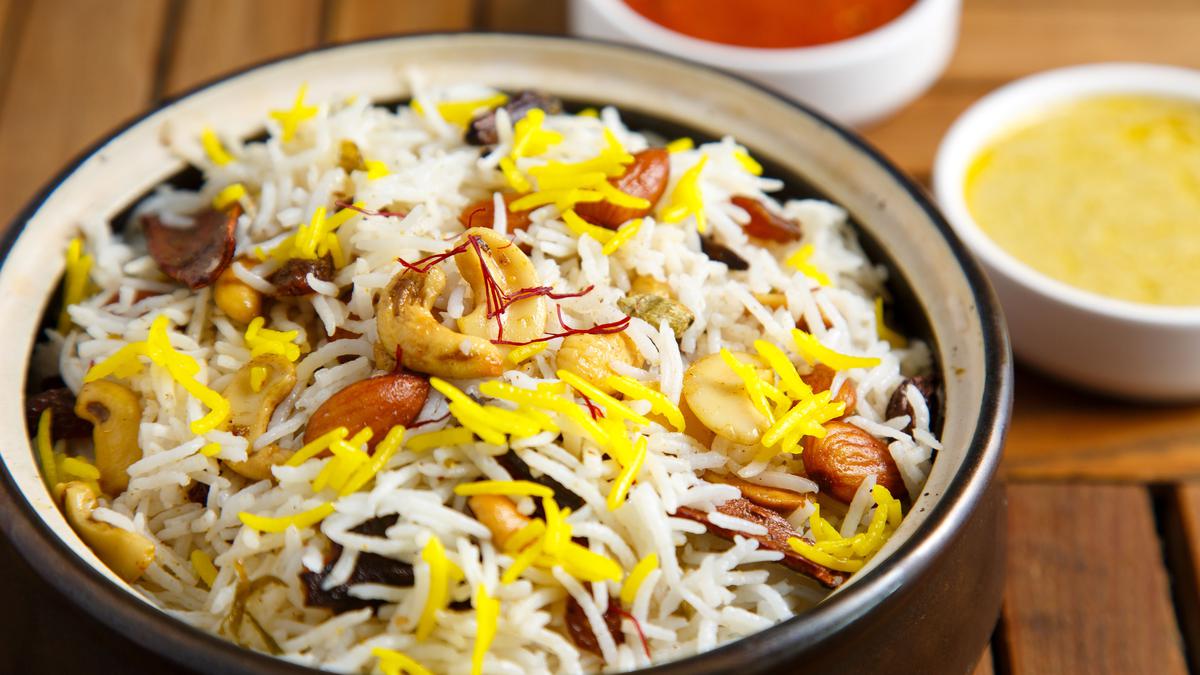
No visit to Vaniyambadi is complete without sampling its famed biryani. The delectable preparation of rice and meat cooked in a savoury confluence of flavours is irresistible. And, quite untouched by linguistics.
source: http://www.thehindu.com / The Hindu / Home> News> Tamil Nadu / by Nahla Nainar / August 18th, 2023
Nuskha-e-Shahjahani, published by the government under its Oriental Series in 1956, hopes to make readers “eat with their eyes” as there are no photographs in the book to illustrate the dishes. It contains recipes for ‘pulao’, roast meats, pottage and omelettes, puff pastry savouries, sweetmeats, and yogurts.
The unnamed author describes 56 ways of preparing ‘pulao’ in Nuskha-e-Shahjahani. | Photo Credit: Ruth Dhanaraj
Any mention of the Mughal empire would not be complete without a reference to its rich cuisines. It is interesting to note that as early as 1956, the Government of Madras had brought out a Persian compilation of recipes from the royal kitchen of Mughal Emperor Shahjahan.
Nuskha-e-Shahjahani, published by the government under its Oriental Series, is a cookbook that hopes to make readers “eat with their eyes”, though there are no photographs to illustrate the dishes. The compendium relies on word power to conjure up images of what may have transpired as expert cooks went about creating repasts fit for a king.
Nuskha-e-Shahjahani is based on two source materials. The first is a single Persian paper manuscript described under No. D.596, containing 186 pages with 11 to 14 lines on a page, dated 1263 A. H., from the Government Oriental Manuscripts Library in Madras. The other is from the India Office Library in London, which is incomplete, with nine sections that are written in the Shikista (a ‘broken’ version of the nasta’liq calligraphic script), and titled Nan-O-Namak (Bread and Salt).
Its 10 sections contain detailed recipes for ‘pulao’ (rice and meat dishes), roast meats, pottage and omelettes, puff pastry savouries, sweetmeats, and yogurts. Colouring of food and oil, with natural methods, besides the preparations of jams and condiments from fresh fruit, all find a mention in Nuskha-e-Shahjahani.
The unnamed author is a man familiar with culinary arts. He describes 56 ways of preparing ‘pulao’ and 36 recipes for ‘Qaliah’, a flavourful thin curry.
Love of display
In his introduction to the 1956 volume, editor Syed Muhammad Fazlullah writes, “Shahjahan is considered to be a lover of display in all matters compared to the other Mughal emperors. His reign was a period of peace and plenty… His table was very extensive and displayed a variety of rich dishes. The high degree of excellence of the royal kitchen can be imagined from the study of Nuskha-e-Shahjahani.”
The Mughals were known to pay considerable attention to their food and its presentation. Emperor Akbar, for instance, appointed experienced men to look after the cooking, and also devised rules for the conduct of the royal kitchen, which was administered by the Prime Minister. The officer-in-charge was called ‘Mir Bakaul’, who would oversee the work of subordinate expert cooks appointed from different countries. A separate budget was maintained for the kitchens.
Written down by scribes
“After translating a collection of ‘pulao’ recipes in 2007 from Nuskha-e-Shahjahani, I realised that there may be other manuscripts related to recipes from the Mughal era,” Gurgaon-based food historian and author Salma Yusuf Husain told The Hindu. The Persian language scholar’s English translation of Nuskha-e-Shahjahani was published in 2019 as The Mughal Feast: Recipes from the Kitchen of Emperor Shah Jahan.
Ms. Husain’s search led her to noted libraries and museums in India and abroad. “Most of the recipes were written down by the official scribe known as ‘Munshi’. Besides Nuskha-e-Shahjahani, Ain-al-Akbari, Alwan-e-Nemat and Nimatnama-i-Nasiruddin-Shahi are among the handful of food-related manuscripts from this era,” she said.
The Nawabs of Awadh followed the Mughals by opting for elaborate menus. Editor Fazlullah mentions that the food expenditure in the kitchen of Nawab Shujauddaulah came up to ₹7 lakh per year, apart from the salaries of the cooks and other staff. It is said that Nawab Salarjung’s cook earned ₹1,200 per month.
But what passes for Mughal food is just an Indianised version of the original, said Ms. Husain. “The Mughals used only three to four spices, such as cumin, coriander, and saffron, besides a variety of dry fruits in their dishes, so their dishes would have been bland. The Portuguese brought chillies to the Indian platter during the latter half of Shahjahan’s reign. Mughal food in India today tastes more of spicy gravies cooked in oil rather than the base ingredient,” she said.
Though the taste profile may have changed, some techniques have lingered. The Mughals had a penchant for slow cooking and grilling, allowing ingredients to stew in their own juices.
“‘Zer biryan’ was a technique where wooden sticks would be laid out on the base of the pan, and marinated meat would be placed on top. The pot would be heated slowly and the meat would cook without coming into contact with the vessel. When half-done, par-boiled rice would be spread over the meat, and the vessel would be sealed and cooked on dum (heat compress),” said Ms. Husain. Contrary to perception, vegetarian recipes were plentiful. Dishes like ‘navratan pulao’ and ‘pulao-e-anardana’ (made with pomegranate seeds) and gravies with chickpeas were commonly prepared.
Government initiative
Nuskha-e-Shahjahani was among the many rare manuscripts to be taken up for publication by the Government of Madras from early 1948. Lists were made from the collections of Sarasvati Mahal Library in Thanjavur and the Government Oriental Manuscripts Library in Madras and publication was overseen by expert committees drawn from the academia of the time.
The Madras Government Oriental Series published rare manuscripts in Tamil, Sanskrit, Telugu, Malayalam, Kannada, Persian, and Arabic from the Madras institution, while those in Tamil, Telugu, Marathi, and Sanskrit were selected from the Sarasvati Mahal Library. In a world where food is integral to televised entertainment, with nearly everyone a ‘master chef’, thanks to social media, Nuskha-e-Shahjahani harks back to a time when cooking was as much an art as a science.
source: http://www.thehindu.com / The Hindu / Home> News> India> Tamil Nadu / by Nahla Nainar / January 24th, 2024
The school offers short courses in making parottas and other food based on practical training by a professional for a fee and accommodation is arranged for outstation students.
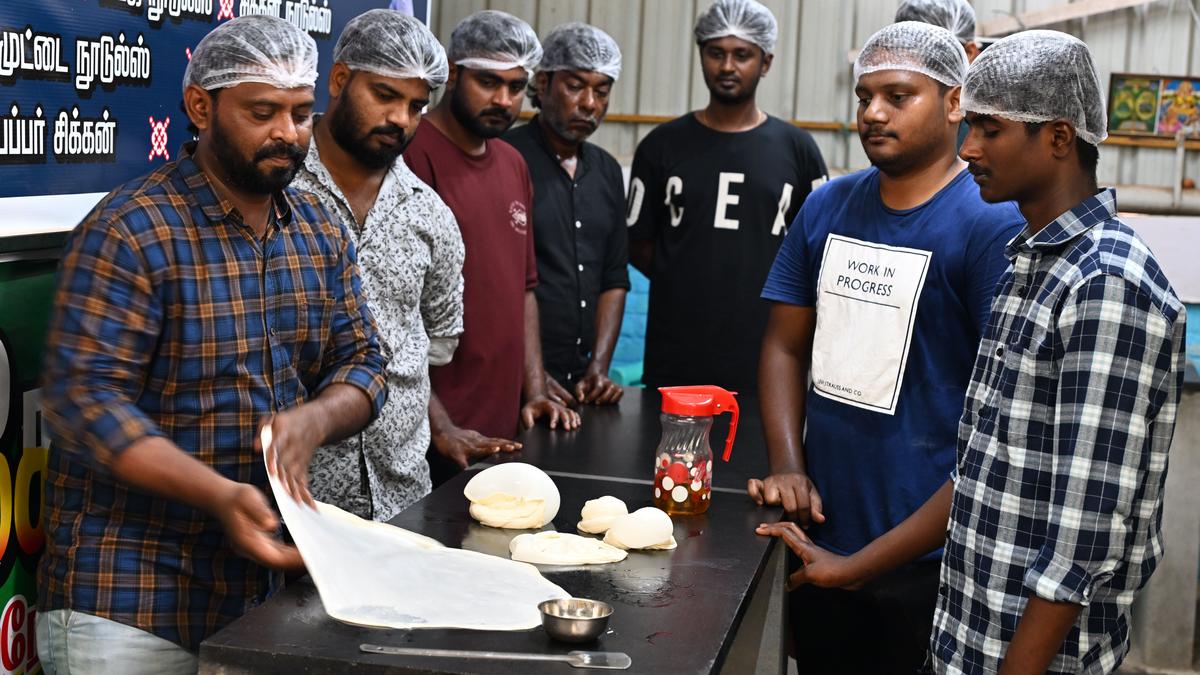
Mohamed Maideen conducting a class on making the Parotta at Success Coaching Centre in Tiruchi. | Photo Credit: M. MOORTHY
Suresh Kumar, 44, tosses and shapes a ‘parotta’ patty until the dough billows out like a large handkerchief, as master Mohamed Mohideen looks on, on the premises of Success Coaching Centre on Airport Road. At a live cooking station, another student gets to grips with a wok to cook Indo-Chinese dishes.
“Parotta stalls and noodle shops became a part of Tamil Nadu’s street food culture long ago. But there is a shortage of skilled labour in this field and many eateries have to down shutters when the master cook is unavailable. I began this coaching centre two months ago, because it can help many small businesses grow,” Mr. Mohideen told The Hindu.
For a fee, students can learn parotta making in a seven-day course or Indo-Chinese cooking over 10 days. The school provides the ingredients required for all the classes, besides accommodation for outstation students. Applicants are taught how to make dosa and idli commercially on request.
Mr. Mohideen, a graduate in business administration, comes from a family of parotta makers based near Dindigul and has spent over 15 years in the restaurant trade as a cook and trainer. “When we were growing up, parotta stalls usually functioned from the front of the chef’s homes, and there were very few of them. I used to spend all my free time training under the parotta master. Once a student develops the knack of tossing the dough, he can start learning the other techniques,” he says.
Students are first taught how to knead the dough, made with refined flour (maida), salt, and water. They then learn how to make the ‘salna’ or gravy to go with it.
Tossing the dough patty after pressing it out by hand, is essential to aerating it, said Mr. Mohideen. Students practise for two days with a cloth napkin in front of a mirror before moving on to the real thing.
For Indo-Chinese training, a wok is filled with rock salt that students roast with a heavy ladle on a high flame.
The school has trained over 100 students in the past two months with several queries coming up through social media for parotta classes. Mr. Mohideen takes online lessons. “A huge variety of parottas is made across the world and Tamil Nadu has some 10 versions in vogue,” he says.
Mr. Kumar, who works at a restaurant in Canada, is hoping to better his prospects when he returns with his new skill. “I have been a dishwasher for a long time; making parottas can open the doors for me in my own workplace,” he says.
source: http://www.thehindu.com / The Hindu / Home> News> Cities> Tiruchirapalli / by Nahla Nainar / May 17th, 2024
On February 19, 1926, A.K. Abdul Hameed Baqavi started off on a journey that would take him over two decades to complete. His translation of The Quran, which is written in classical Arabic and organised in 114 chapters, took time. But the elegant style of the work, published in 1949, has made it one of the most enduring versions.
Painstaking work: The Tamil translation of The Quran by Islamic scholar and freedom fighter A.K. Abdul Hameed. | Photo Credit: M. MOORTHY
On February 19, 1926, Tamil Islamic scholar and freedom fighter A.K. Abdul Hameed Baqavi (1876-1955) embarked on a literary journey that would take him over two decades to complete. His chosen subject: translation of the meaning of The Quran from Arabic into Tamil.
Abdul Hameed was not the first; nor was he the last to attempt the Tamil translation. But his effort, published as Tarjumat-ul-Quran bi Altaf-ilbayan (Translation of the Quran with a Glorious Exposition) in 1949, was the first complete translation of the Islamic holy book into Tamil. The Quran, written in classical Arabic, is believed by Muslims to have been revealed by God to Prophet Muhammad through the Angel Gabriel over 23 years. It is organised in 114 chapters, known as surah.
Despite the presence of a sizeable Muslim population in southern India, The Quran was translated into Tamil quite late, at least a thousand years after Islam came to the region, mostly due to opposition from the ulema or scholars of the day on account of fears that a Tamil version might be wrongly considered a substitute for the original. Ironically, it is the ulema who later entered the field of translation.
Hybrid language
The earliest translations were done in the 17th Century, in Arabu-Tamil, a hybrid language that used a modified Arabic alphabet to express ideas in Tamil. Scholars began attempting fragmentary Tamil translations (of selected sentences or verses) in the 19th Century. Abdul Hameed Baqavi’s effort was noteworthy because it made Quranic study more accessible to both lay and scholarly readers. That is probably why it has been reprinted innumerable times, despite the presence of at least 17 complete Tamil translations done by other scholars after its publication.
‘Baqavi’ is the title given to students of Madrasa Al-Baqiyat-us-Salihat, a well-regarded Islamic college in Vellore established in 1857.
Abdul Hameed was born at Attur, Salem, and showed an early interest in writing on religious subjects.
The founders of Jamal Mohamed College in Tiruchi played a key role in getting Abdul Hameed’s translation project off the ground, funding the publication of the first volume, a copy of which is available at the college’s Centre for Islamic Tamil Cultural Research. “I began the translation project on February 19, 1926, after the Friday (Juma) prayers at the bungalow of Janab Khan Sahib and N.M. Khaja Mian Rowther in Tiruchi. It has been three years since I started it,” he writes in the foreword to the first volume of the translation, published in 1929. “If the first section can take me three years, readers may have to wait longer (at least 89 years) for each of the remaining 29 sections to be completed,” he adds. Imported printing equipment was commissioned by college founder M.J. Jamal Mohamed. The press, Islamiya Nool Prasura Sangam, at Palakkarai published the first volume, priced at ₹2.
Decades of work
It is a mystery as to why the translation that began in Tiruchi with much fanfare petered out after 1929. A. Nihamathullah, retired professor of English at Sadakatullah Appa College in Tirunelveli, who has done a comparative study of 12 Tamil Quran translations (including the Abdul Hameed version) for his doctorate, said a lack of documents in the public domain had added to the blind spot.
“In 1938, scholar Abdul Qadar Hazrat introduced Abdul Hameed Baqavi to Nawab Naseer Yaar Jung Bahadur, the father-in-law of the Nizam of Hyderabad. On the recommendation of the Nawab, the translation of The Quran resumed, with financial backing from the Nizam,” Mr. Nihamathullah told The Hindu. An office was set up for the project in Karaikal and the work was eventually completed in 1942. In order to get the Ulema’s approval, Baqavi approached his Vellore alma mater to constitute a panel of theologians to check the manuscript.
In the later stages, he was helped by his son, Indian Union Muslim League leader and Tamil writer A. K. A. Abdul Samad (1926-1999). However, it took five more years for Abdul Hameed to secure funding for printing. A contribution of ₹50,000 by Ceylon-based businessman Nagore Meera Mohamed Haniffa helped to publish the two-volume translation in 1949. As the project expanded, the printing unit was shifted from Karaikal to Chennai.
A winning combination
German scholar Torsten Tschacher, a Heisenberg Fellow of the German Research Foundation (DFG) and Tamil lecturer at the University of Heidelberg, said in an email interview that the popularity of Abdul Hameed Baqavi’s translation owes much to its presentation.
“It did not have any readings of The Quran that would have made the translation appear sectarian. The fact that [Abdul Hameed] Baqavi avoided giving too much of commentary, along with the translation, may have helped in this regard,” he said. “While the style may appear somewhat clumsy and old-fashioned, I think he hit the right spot between the exact translation and the quality of language. It was also important because it made The Quran finally accessible to non-Muslims who had not been able to read the earlier translations that used the Arabic script and a lot of Arabic vocabulary,” Mr. Tschacher added.
source: http://www.thehindu.com / The Hindu / Home> News> India> Tamil Nadu / by Nahla Nainar / January 03rd, 2025
On his birth centenary, Nagore Hanifa continues to be celebrated and his timeless devotional and political numbers continue to draw in listeners.
The Hanifa fan base continues to grow, as seen by the number of cover versions of his ‘Iraivanidam Kaiyenthungal’ | Photo Credit: Special Arrangement
Of the many singers in South India with a universal appeal, ‘Isai Murasu’ Esmail Mohamed Hanifa stands tall on the pantheon of greats with origins in Tamil Nadu’s Cauvery delta region.
Hanifa, an iconic minstrel of Islamic devotional songs in Tamil had strong links with Nagore, the town in Nagapattinam that hosts the 16th century shrine to Sufi saint Syed Abdul Qadir. It eventually became the prefix to his name too.
Recently, the Tamil Nadu government kickstarted the celebration of Hanifa’s centenary year by naming a street and public children’s park in Nagore after him.
It is a fitting tribute to a man who captured the hearts of fans with his distinctive baritone from the early 1930s.
Even posthumously, the Hanifa fan base continues to grow, as seen by the number of cover versions of his ‘Iraivanidam Kaiyenthungal’ and his other songs that are available online.
Hanifa’s devotional and wedding songs continue to hold sway in Tamil Muslim social functions | Photo Credit: Special Arrangement
The youngest of three children of Mohamed Ismail, a railway worker in Malaysia, and Mariam Biwi of Ramanathapuram, Hanifa began singing mainly to support his family.
The singer spent his early childhood in Ramanathapuram, and later went to work for his paternal uncle Abu Bakr Rowther in Tiruvarur. It was here that Hanifa’s musical talent was noticed. His first professional concert at the age of 13 set him off on a trajectory no one imagined.
“My father’s rousing voice owes much to the Ghousia Bait-us-Sabha at Nagore, for whom he used to sing,” says his son Naushad Ali, based out of Chennai.
“At the time, there was a practice of taking out a pre-wedding procession to introduce the bridegroom to the families in the neighbourhood. A team of young drummers beating ‘thabs’ would head the procession, followed by the groom in a car or on horseback.
My father and his accompanists would be in the middle, with the hosts and guests making up the back of the crowd. He learned early on to beat the competition from the ‘thabs’ boys by singing loudly and in tune, without the help of a microphone. It was a skill that he developed out of necessity,” he adds.
Hanifa was a mainstay at most of the ‘Urs’ festivals held by the Sufi dargahs in the State | Photo Credit: Special Arrangement
Naushad, now in his sixties, was his father’s caregiver in his later years, and also renders vocal concerts in the Nagore Hanifa style.
Hanifa’s devotional and wedding songs continue to hold sway in Tamil Muslim social functions. His devotional songs were often based on ‘nasheed’ (Islamic chants sung a cappella or with instruments) and ‘naat’ (poetry in praise of Prophet Muhammad), referencing the Muslim faith, history, and current events. Quite a few of them were modified to suit Tamil listeners.
‘Hasbi rabbi jallalah’, for instance, has just the first stanza in Arabic; the rest of the song in Tamil adds elements from Ramanathapuram’s history. “It was first recorded in the 1970s for a school function, and I was among the children who sang the chorus,” recalls Naushad.
‘Maalai soodum manamakkale’, ‘Vazhga, vazhga, vaazhgave’ and ‘Deen kula kanne’, were among the songs that he presented at marriage concerts, usually held a day before the nuptials or after the wedding reception.
He was a mainstay at most of the ‘Urs’ festivals held by the Sufi dargahs in the State.
Nagore Hanifa married past the age of 30, and his wife A.R. Roshan Begum looked after the couple’s six children in Nagore while Hanifa built his career.
“We did not get to see our father much while growing up, because he would always be on tour. At the peak of his career, he would have at least 45 engagements in a month. He rarely declined any offer. Those were different times, with no marketing, public relations or copyright. Many songs were set to popular film tunes re-arranged by his small orchestra. I wonder how he managed his career all alone,” wonders Naushad.
Hanifa’s songs were known for their profound lyrics. He was helped in this by poets Abidin and Nagore Saleem, among others.
The self-taught maestro picked up tips on Carnatic music from S.M.A. Qadir at the Nagore dargah.
Naushad was tasked with the job of copying out the lyrics and taking care of his father’s correspondence. “Much of what I know about Tamil literary expression and pronunciation is due to my father. He would rap me on my head if I got the spelling or grammar wrong,” he laughs.
Though he had a prodigious memory for lyrics, Hanifa would always take his notebooks with him on stage. “If he noticed mistakes in the rendition, he would skillfully re-sing the portion in a way that the audience would not notice,” shares Naushad.
Nagore Hanifa performed in all kinds of venues — from five star hotels and modest homes — with the same flair, and never let his celebrity status get in the way. He would also do any number of encores — he had no ego, says his son.
Hanifa occasionally lent his voice to Tamil films — in movies such as Gulebakavali (1955), Paava mannippu (1965) and Chembaruthi (1992) — but consciously kept away from cinema because he was not open to adopting a ubiquitous name such as ‘Kumar’, which was what some composers demanded.
“My father used to say that it is more satisfying to sing four songs as Hanifa than a crore songs as Kumar. Having held the stage in live concerts that ran into hours, he did not appreciate his craft being adapted for light music,” says Naushad.
When Hanifa passed away on April 8, 2015, at the age of 96, a veil fell forever on an era of homespun superstars produced in Tamil Nadu.
Political anthem
In his heyday, Hanifa used to be known as the ‘voice’ of the Dravida Munnetra Kazhagam (DMK), because of his political anthems for the party. His warm friendship with DMK leader and former Chief Minister M. Karunanidhi began in their adolescence and stayed strong through their lifetime. Some of the songs he sang for the party are still used by the DMK to raise the morale of party cadres.
source: http://www.thehindu.com / The Hindu / Home> Entertainment> Music / by Nahla Nainar / February 06th, 2025
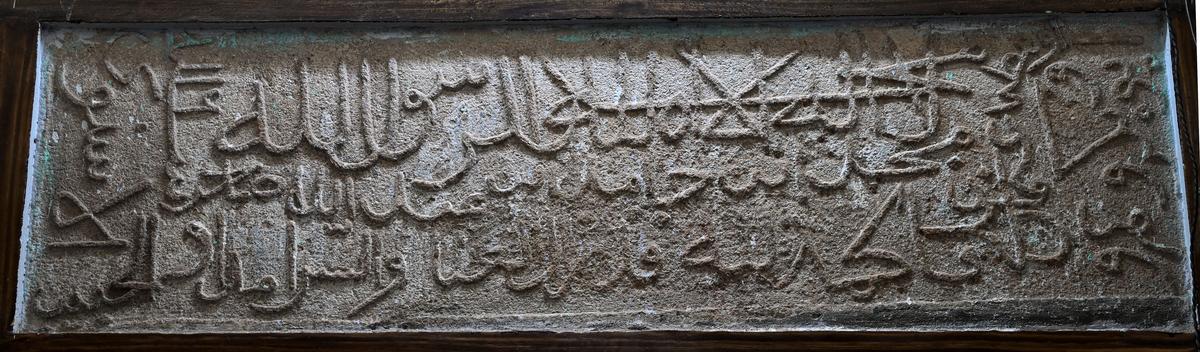
Makkah Masjid is among the oldest Islamic shrines in Tamil Nadu. An inscribed tablet dates the mosque back to the year 116 of the Al-Hijri calendar, corresponding to 734 A.D.
An inscription on the stone structure’s wall (background), dates the building to the Islamic (Hijri) year of 116, corresponding to 734 A.D. | Photo Credit: M. MOORTHY
The family of a cloth merchant has been taking care of the mosque for generations.
Tucked away next to a carpentry workshop on Tiruchi’s Fort Station Road is what is considered to be one of the oldest Islamic places of worship in Tamil Nadu: the Makkah Masjid that dates back to the year 116 of the Al-Hijri calendar, corresponding to 734 A.D.
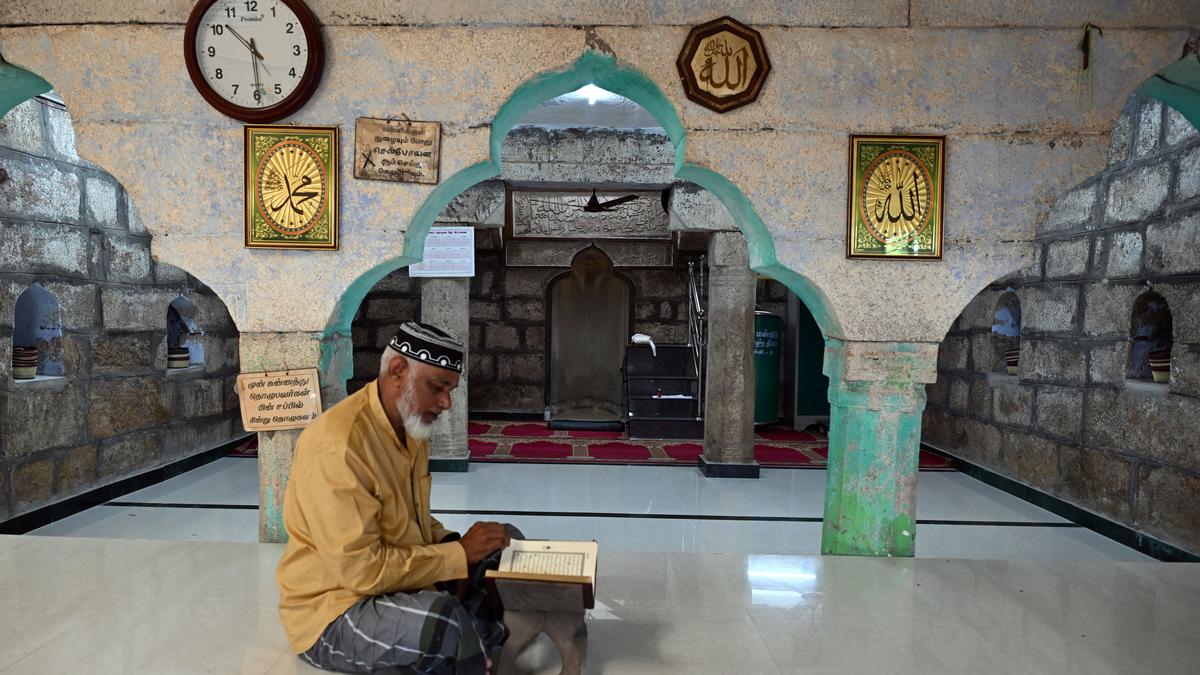
A view of the prayer hall of Makkah Masjid in Fort Station Road, Tiruchi. It is considered to be among the oldest Islamic shrines in the country. | Photo Credit: M. MOORTHY
The family of M.G.A.R. Abdul Rahman, a cloth merchant in Tiruchi, has been taking care of the property for several generations.
The mosque’s age is validated by an inscribed stone tablet in Arabic above the ‘mihrab’ (the niche that indicates the ‘qibla’ or direction of prayer). The graves of Mohamed Ibrahim, Hazrat Haji Abdullah, Hazrat Haji Mohamed Anwar, Ahmed Kabir, and Tahira Biwi, thought to be pious Muslims of yore, are also to be found here. Two recently added minarets indicate the mosque’s presence in this quiet part of town.
Surrounded by thorny bushes
“Until the 1980s, the mosque was very different from what you see today,” A.R. Mohamed Ghouse, hereditary trustee, and one of Mr. Rahman’s 12 children, told The Hindu. “When my father was bequeathed this shrine, it was surrounded by thorny bushes and palm trees. There was no road access; people would walk single-file on a narrow pathway to reach the premises. Since this is a low-lying area, the building would be flooded during the rainy season. Before we got electricity connection in the 1980s, the place used to be lit up with oil lamps and hurricane lanterns. We have been maintaining the buildings with the help of generous donors from all faiths,” he said.
The Muslim community has had a long and harmonious presence in Tiruchi since ancient times. The Makkah Masjid is a stone’s throw away from Hazrat Thable Alam Badhusa Nathervali Dargah, the mausoleum dedicated to a nobleman of Turkish-Syrian lineage born as Sultan Mutahirruddin in 927 A.D., in Suharwardy, near Samarkand, who gave up his privileged life to spread the message of Islam in southern Asia. It is said the saint stayed on the Makkah Masjid premises before he settled in the present site.
Mosques endowed by the erstwhile Nawabs of Arcot are also an indelible part of Tiruchi’s landscape. Woraiyur, the capital of the Chola dynasty from the 2nd Century (now a suburb of Tiruchi), was already known to Arab traders. After the birth of Islam, Arab-Muslim missionaries began travelling to the region. Biographies of Muslim saints and the local traditions of the period reveal that Islam spread in the southern part of India in a largely peaceful and voluntary manner.
According to J. Raja Mohamad, historian and former curator of Pudukottai Government Museum, the Makkah Masjid could have been built for the Muslim settlement that emerged in the Tamil hinterland during the Pallava rule. “When I visited the mosque in the 1970s, it was hard to spot because of the overgrown bushes. It resembled a small ‘mandapam’ (hall), built in granite, with six Dravidian style pillars that are square at the base, octagonal in the middle, and square again. The ceiling was also made of granite slabs. Though it has become more modernised now, the trustees have retained most of the old building,” he said.
While Dravidian-style granite mosques are present elsewhere in Tamil Nadu, the Makkah Masjid may be the only shrine with a contemporary dated inscription in the State as well as in southern peninsular India, he added.
Caliphs named in inscription
In his 2004 book, Islamic Architecture in Tamil Nadu, supported by the Nehru Trust for Indian Collections at Victoria and Albert Museum, London, Mr. Mohamad writes, “According to the Arabic inscription in the rectangular granite slab above the ‘mihrab’, this mosque was built by one Mohamed Ibn Hameed Ibn Abdullah in Hijri 116 corresponding to 734 AD. The names of the four Caliphs (successors to Prophet Muhammad) — Abu Bakr, Umar, Uthman, and Ali — are also mentioned in the inscription, which has been accepted by scholars as belonging to the 8th Century AD.”
Maintaining the mosque has been a labour of love for the family trustees. “The prayers have never stopped in the Makkah Masjid even though we do not have a ‘mohalla’ (a neighbourhood congregation).
Approximately, 200 people attend the Friday prayers,” said A.R. Abdul Razak, 74, the eldest son of Rahman and the imam (who leads prayers) for the past 39 years.
The annual ‘Urs’ (festival) commemorating Mohamed Ibrahim and Tahira Bibi on the 28th day of the Islamic month of Rajab (now in its 1,329th year) at the dargah on the mosque’s campus is supported by people of many faiths, who donate generously towards the public feast.
Mr. Razak gave up his job as a ship cook in Switzerland in deference to his ailing father’s wish to officiate as the chief cleric of the mosque. “I underwent training in Quranic recitation and Islamic theology from scholars in Tiruchi before taking up this position,” he said.
An antique copy of The Holy Quran is among the oldest artefacts in the mosque.
To prevent flooding, the ground level was raised with truckloads of mud after road access was granted by Southern Railway in the 1980s. As a result, five of the eight steps of the prayer hall are now permanently below the ground. Several coats of whitewash were scrubbed away to reveal the original granite walls and inscriptions. Some of the stonework also contains fragments of Tamil writing from the 10th Century. “We have tried to maintain the premises to the best of our ability. We hope succeeding generations of our family will continue to take care of the Makkah Masjid,” said Mr. Ghouse.
source: http://www.thehindu.com / The Hindu / Home> News> India> Tamil Nadu / by Nahla Nainar / June 28th, 2024
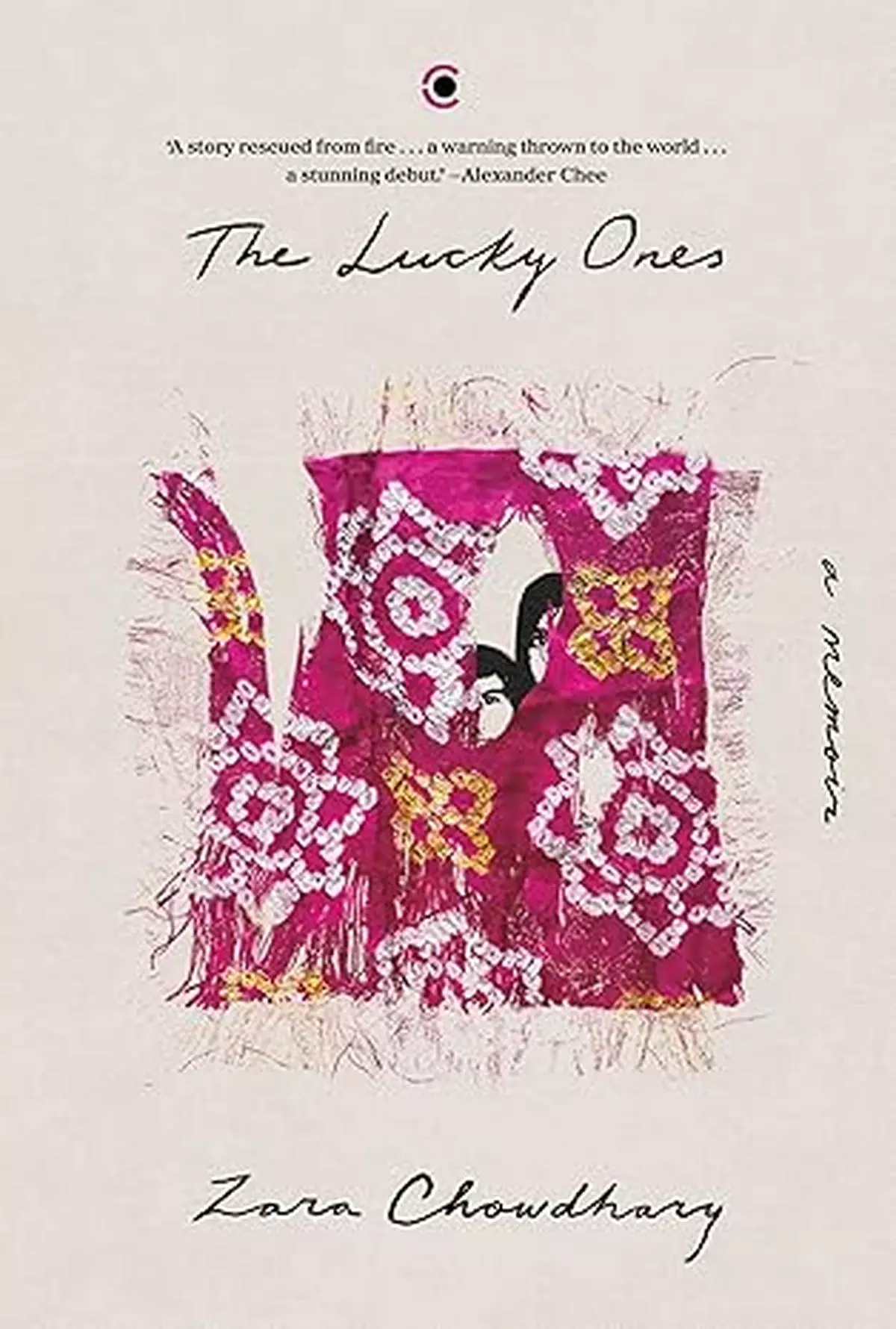
In ‘The Lucky Ones’, Zara Chowdhary, who survived the 2002 Gujarat riots, recasts her memories into a bold assertion of identity beyond trauma.
the 2002 riots. | Photo Credit: JANAK PATEL
Most of us suck at telling the truth. We would rather dress up facts into stories, tie them up with a neat disclaimer: this is a work of fiction. A memoirist is a person so caught in the nuclear fallout of overpowering, unspeakable facts that she must set aside the pretense of fiction and simply assert, this happened. Saying “I lived through this” becomes a way to unpin the self from the yoke of a toxic and restrictive past. Calling things by their name frees the soul.
But writing a memoir is a tricky terrain to navigate. Why should the world be concerned with what happened to someone? How is anyone to know if the person is telling the truth? They may simply be begging for cheap pity by recounting some traumatic truth. Even when a memoir is truthful, trauma tends to constitute a totalising identity, says the literary critic Parul Sehgal of The New Yorker, by making a singular event the whole story, the definitive story. From this point of view, the very claim of truth a trauma narrative makes is suspect.
Most of us suck at telling the truth. We would rather dress up facts into stories, tie them up with a neat disclaimer: this is a work of fiction. A memoirist is a person so caught in the nuclear fallout of overpowering, unspeakable facts that she must set aside the pretense of fiction and simply assert, this happened. Saying “I lived through this” becomes a way to unpin the self from the yoke of a toxic and restrictive past. Calling things by their name frees the soul.
But writing a memoir is a tricky terrain to navigate. Why should the world be concerned with what happened to someone? How is anyone to know if the person is telling the truth? They may simply be begging for cheap pity by recounting some traumatic truth. Even when a memoir is truthful, trauma tends to constitute a totalising identity, says the literary critic Parul Sehgal of The New Yorker, by making a singular event the whole story, the definitive story. From this point of view, the very claim of truth a trauma narrative makes is suspect.
The Lucky Ones: A Memoir / By Zara Chowdhary
Context / Pages: 342 / Price: Rs.699
Zara Chowdhary’s memoir of coming of age in 2002 Ahmedabad incinerates all such reservations in the first few pages. The title sets the tone by making the point that it was her family’s great fortune to have survived “those days” physically unscathed. The narrative begins with the terrible feeling of being a marked people, of living holed up in a flat “waiting for the mob to find us” in a city where laws and rules have ceased to exist, closeted with a dysfunctional family. Around them, headlines spew hate, rumours fly, and black smoke fills up the sky and the television screen. The narrative moves inward and holds to light multiple threads of identity that bind her people in one family, her family to the city and its society, and the citizens to a nation. This brings a deep awareness of how violence within the family or outside unravels the most essential, joyful aspects of any identity whether one is a victim or the perpetrator.
The facts around which the narrative unfolds have been so extensively documented, written about, probed by courts, parliaments, tribunals, and fact-finding missions that they constitute the nation’s subterranean truth. The author intersperses reportage with lived experience, weaves Gujarat’s history with her own family’s past, to provide context to her endeavour of processing the anger at what she experienced and helplessness with her father’s denial and minimising of it, which was the only way he knew to cope.
Curfewed terror
Early on, Zara came to the realisation that no strongman could save them.
“…The madness in our home, like in the rest of this country lay in our search for a strongman. In our home no man is strong enough. Dada is haunted by how he failed. Papa withers under the burden of his own mistakes. The women become dictators….”
In the city that is the only home she knows, Zara is preparing for her board exams in the cramped and dark family home while “history is happening on the streets”. For the next three months as the city burns, the eighth-floor family home, C-8 Jasmine, in a 40-year-old building in a Muslim area, will be their prison. Zara approaches the task of reliving those days by opening the door on the othering and suffocation experienced within the four walls of her own home. Her Gujarati-speaking Dadi considers her south Indian mother an outsider. Proud of her anglicised antecedents, her college-educated Dadi—who came of age in the pre-Independence years when her elite family were people of consequence in the city—holds sway over the household. She grew up playing badminton and dancing at the club and even now wears chiffons and pearls.
Disgruntled with the gradual lowering of their status and circumstances, Dadi kept her Punjabi Muslim “peasant” husband on a tight leash until he passed away and hates her dusky south Indian daughter-in-law. Both her granddaughters are terrified of her. Zara’s father, a pampered, educated-in-the-US son, is now a mid-level employee in the electricity board who faces daily humiliation in the office because he is a Muslim. Unable to either assert himself or to take the microaggressions in his stride, he copes by drinking heavily and bullying his wife, often encouraged in this by his mother. In view of the deteriorating situation, her father’s younger sister phupo, an imperious college professor and a divorcee who lives on “the other (Hindu) side of the city”, also moves into their flat with her daughter, who is a superior and disdainful apa to Zara and Misba.
Struggling to make sense of her family is a part of her struggle to process the curfewed terror of those three months. Why was her father so easily bullied by the world? Why was he so willing to undermine his wife all the time? Why did her intelligent, honey-eyed mother submit so willingly? Zara’s prose carries the weight of every question and reveals that belonging and unbelonging are not givens but manufactured prejudices “that offer security but in return [for] your unquestioning loyalty”. Whether in families or in nations.
Everyone in her family has a past made of things that make them less hateful. Dadi—who loves to spread disinformation about her daughter-in-law, which Zara’s father is only too ready to believe—is at her best when dancing the garba. The only time she is proud of her twinkle-toed granddaughters is when they are doing the bhangra or the garba. Just as flying kites during Uttarayan is her father’s secret superpower.
Denial, diminishment, erasure
To understand why her family is the way they are, Zara gently probes the past of each family member—which is also her past. Thus, she can look at what they do without losing the gifts that her diverse heritage brings. Examining the fault lines within her own house enables her to ask the question of home and belongingness at multiple levels. This question that simmers inside chants and slogans hurled from across the dry riverbed also lurks in the animosities in her own house. The denial, diminishment, erasure practised within the family as on the streets is a game of numbers and power. The excavation of family politics lends great moral clarity to Zara’s examination of other alienations inflicted upon them, and gratitude for the things that sustain them. What sustains the girls is their mother’s love, the hope inspired by the kindnesses of their Hindu friends, and above all their ability to dance to Bollywood numbers even in terrible times, because what is the alternative?
When the curfew is partially let up, it is time for Zara to write the now meaningless examinations in centres located (deliberately) in Hindu localities. Some even inside temples. Her rattled family steps out for the first time, and more than the exams her focus is on trying to look like a non-Muslim. She thanks her mother’s wisdom in giving her a neutral sounding name. Once the exams end, her rich Hindu classmates, who never once called up to check on her all through the terrible months of March and April, blithely propose an outing. Zara declines, citing the situation. Her friend counters by scoffing: “What rubbish yaar, there’s been no curfew for months.”
This heart-wrenching moment stays with the reader. In this moment, the young Zara registers the difference between herself and “them”—whose cushy lives never stopped in the tracks because of unremitting violence. Who never experienced the terror that reduced her family, her building, her Muslim neighbourhood to a bundle of nerves.
“Our loss doesn’t exist. Our pain isn’t real, it never happened. Their malls still brim, their restaurants fill with chatter… while we live hunkered in our own homes…. We live in two different Ahmedabads, two different Gujarats, two different Indias.”
All these experiences sharpen her ability “to distinguish between the oppressed and the oppressor” and bring in her “a refusal to live life as either”. This clarity enables her to wrest back the agency denied to her by her city. Her need to be not defined by trauma shines throughout the book. She has taken her lessons but also come to the realisation that her faith and belongingness as an Indian Muslim are not what others get to define. Her unique identity comes to her through the Punjabi, Gujarati, south Indian Islamic strands of her family, and no one else’s definitions can wrest this away from her. A text of such radical empathy can emerge only when the author has unflinchingly held the sharp blade of memory, of times unspeakable and times happy, in her bare hands and stayed with them until out of the silence emerges her truth, her belongingness story, her way out of the dungeon of erasure.
Varsha Tiwary is a Delhi-based writer and translator. She recently published 1990, Aramganj, a translation of the bestselling Hindi novel Rambhakt Rangbaz.
source: http://www.frontline.thehindu.com / Frontline / Home> Books> Book Review / by Varsha Tiwary / January 14th, 2025
S.M. Munawwar Nainar learnt the language at Cairo University (1955-59) and did his M.A. and Ph.D at Delhi University and JNU respectively. His command of the language led him to serve as the Indian government’s official interpreter in the 1970s. He recalls the most memorable meetings of Indian and Arab leaders at which he was the interpreter.
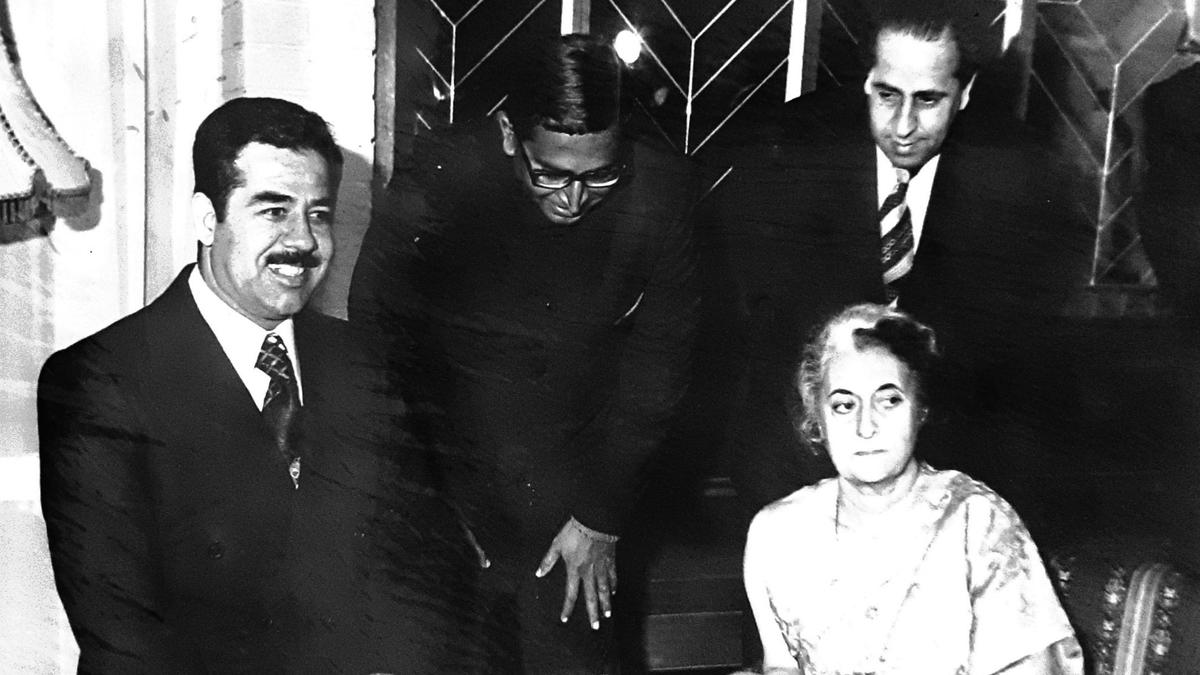
S. M. Munawwar Nainar (second left, standing) with Prime Minister Indira Gandhi and Iraqi leader Saddam Hussein in Baghdad in 1975. The meeting helped to cement the bilateral ties. | Photo Credit: Special Arrangement
My journey with Arabic began in the 1950s, when my father, Syed Mohamed Husain Nainar, professor and head of the Arabic, Urdu and Persian Department at the University of Madras (1927-1954), wished at least one of his sons to study Arabic in depth. I was drafted to the cause, though my general academic performance was middling. Eventually, I did four years of immersive language training in Arabic at Cairo University (1955-59), where I got my B.A. ‘Licence’ (degree) with a ‘Jayyid’ (good) grade. I followed it up with M.A. Arabic at Delhi University, and a Ph.D (on Arabic loan words in Hindi, Urdu, and Tamil) at Jawaharlal Nehru University, Delhi.
Arabic has led me to many interesting destinations, from diplomatic service and teaching to radio broadcasting and literary translation. But, to me, the most memorable of these are the occasions when I served as the Indian government’s official interpreter in the 1970s. I had been appointed as one of the Arabic teachers at JNU’s School of Languages at the time. The interpreter’s assignment was an honorary posting, and I was recommended for the job by our Vice-Chancellor G. Parthasarathy, based on my previous experience as the press secretary at the Indian Embassy in Jeddah, Saudi Arabia (1969-72).
A visit to remember
Prime Minister Indira Gandhi’s state visit to Iraq from January 18 to 21, 1975, was a much-covered event, because of the charisma that the Indian and Iraqi leaders projected in public. It is also considered a visit that cemented friendly ties between the two countries.
Saddam Hussein was at the Baghdad airport to receive her and the Indian delegation. He invited Mrs. Gandhi to the waiting limousine and boarded it after her. I was seated behind them. As we were proceeding, he asked the driver to slow down near a mosque and said, “This is where we had a crucial meeting of our Ba’ath Party after which I took over the reins of power.”
Official parleys were held the next day, after which Mrs. Gandhi wanted to have a private discussion with the Iraqi leader. When she asked him whether he wanted his interpreter to be present too, he declined. Pointing to me, he said, “Your translator is enough”.
We were received by Saddam seated on a chair with a hard wooden backrest (to deal with a spinal problem, he explained). As the two leaders spoke for about an hour, the Iraqi strongman’s trademark stern demeanour relaxed. (Earlier, on March 25, 1974, Hussein was on an official visit to India, where he was received by the then Prime Minister, Indira Gandhi.)
Rousing reception at Baghdad University
The Indian Prime Minister received a rousing reception at Baghdad University on January 20, where around 5,000 students had assembled in the large auditorium. The programme began with a welcome address in Arabic by the Vice-Chancellor, which I translated simultaneously to the Prime Minister in a low voice as I was seated behind her.
Mrs. Gandhi spoke extempore for about 15 minutes, during which there was pin-drop silence. I scribbled down notes. My translated version drew a big cheer from the audience that lasted for five minutes, a testimony to her popularity. The function also included the conferring of an honorary law degree on Mrs. Gandhi. However, as the students swarmed around the leaders after the event, I got lost in the melee. The security officers quickly conducted Mrs. Gandhi to the official motorcade; but when she noticed I was missing, she sent them back to find me. “Kahaan reh gaye aap? [Where were you?],” she asked me as I joined her in her car. To me, Mrs. Gandhi’s concern for her team members, irrespective of their rank, was one of her most admirable traits.
The 1970s were an important period for West Asia, where countries of the Persian/Arabian Gulf were declaring their independence from British rule. In 1971, the former ‘Trucial States’ — Abu Dhabi, Ajman, Dubai, Fujairah, Ras Al Khaimah, Sharjah, and Umm Al Quwain — decided to form the United Arab Emirates (UAE). Their neighbours — Qatar, Kuwait, Bahrain, and Oman — also became independent that year. As India was keen on evolving a rapport with these oil-rich countries, many official visits were made to and from the Gulf countries.
A dragging flight
I was part of the delegation accompanying former Minister for External Affairs Sardar Swaran Singh on a tour of Oman, Abu Dhabi, Dubai, and Qatar in the mid 1972. We boarded a Fokker Friendship plane in Delhi and, after about four hours, landed at the Jamnagar Air Force Station for re-fuelling. Then we resumed our journey towards Muscat, our first port of call, which we reached after seven hours of flying. “It was like walking from Jamnagar to Muscat,” Sardar Sahib said jokingly.
In Oman, Sultan Qaboos bin Said had recently deposed his father Sultan Said bin Taimur. The luncheon banquet was sumptuous: stuffed lambs and rice, followed by Omani halwa, carried on large platters by six persons (three on each side).
In the Qatari capital Doha, Emir Sheikh Khalifa bin Hamad al-Thani spread out a huge blueprint and explained his nation’s development plans. Years later, when I worked in Qatar’s Education Ministry from 1983 until the 2000s, I saw that most of them had been implemented. Early Gulf leaders, in keeping with their nomadic Bedouin culture, would avoid venturing into the harsh sunlight. Thus, it happened that we had to meet Sheikh Zayed bin Sultan al-Nahyan, the first President of the UAE and the ruler of Abu Dhabi, at midnight. Dubai already had started its course towards developing the tourism and hospitality sectors. I was in my thirties during these official engagements; today I am 87.
In 1975, when I was part of President Fakhruddin Ali Ahmed’s visit to Egypt and Sudan, I had an opportunity to mention to Egyptian President Anwar el-Sadat that I had graduated from Cairo University. He was pleasantly surprised and wished me well. Arabic brought a boy from Palani to the corridors of power for a while and left behind a cornucopia of memories.
(The author had also served as the official interpreter for the Indian government during other high-level meetings with leaders from Middle East and North Africa countries. He is based in Tiruchi.)
source: http://www.frontline.thehindu.com / Frontline / Home> News> India> Tamil Nadu / by S M Munawwar Nainar / December 08th, 2023
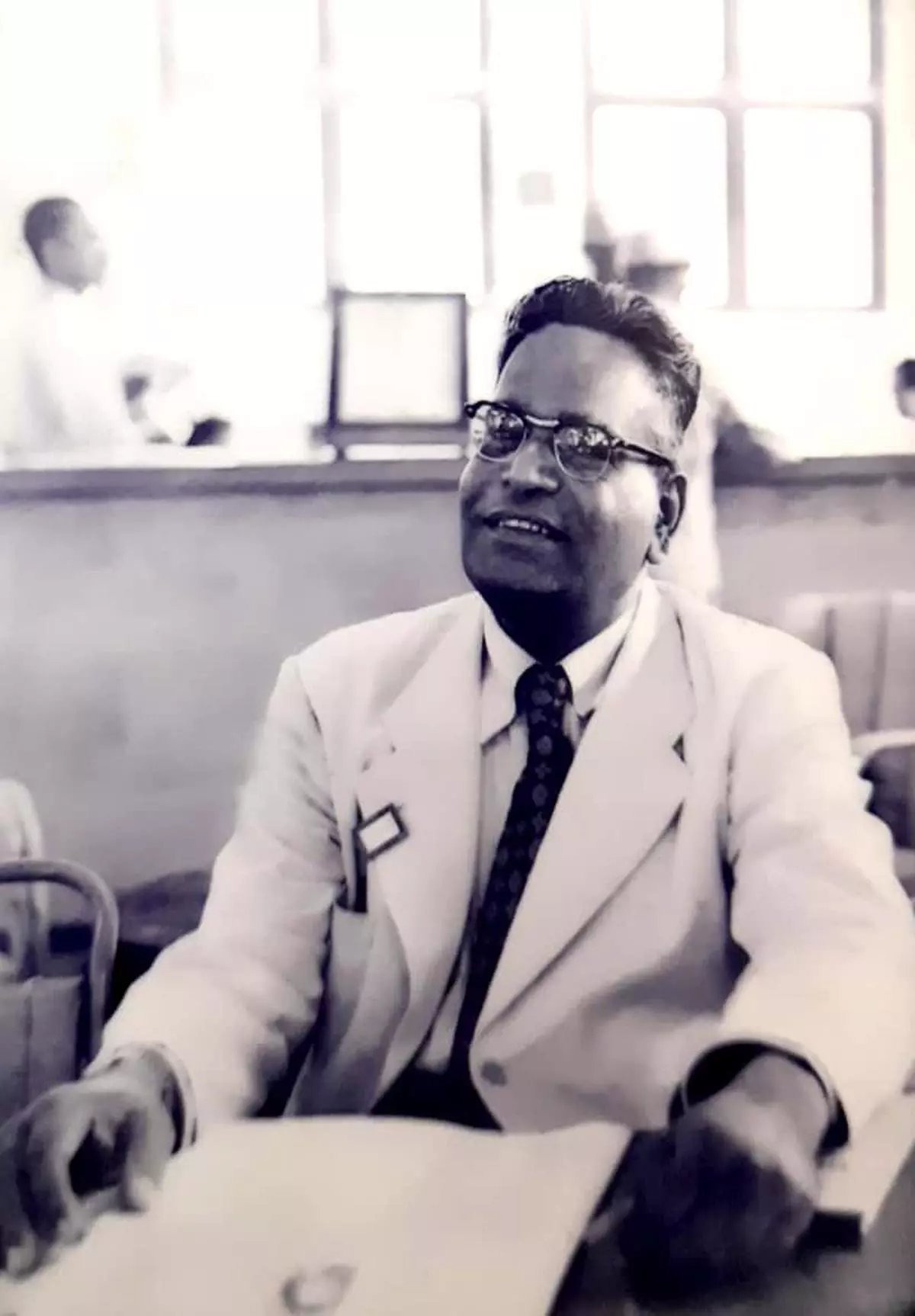
S.M. Husain Nainar in his later years | Photo Credit: Special Arrangement
A termite-infested trove of papers unveils the extraordinary life and scholarly legacy of a Tamil Muslim academic who bridged civilisations.
This would perhaps be a good time to thank the termites: for their help in reconstructing the jigsaw puzzle that is my paternal grandfather Syed Mohamed Husain Nainar’s legacy. If they had not been so keen on chewing through the wooden cabinets of our house in Salem, Tamil Nadu, we may have never found it necessary to finally dig into the mountain of paper that had built up from the 1800s till date, hoarded for the rainy day that never came. As Nainar’s 125th birth anniversary approaches (May 25, 2024), this account of a search for a patriarch’s profile(s) would resonate with those trying to figure out how their ancestors lived.
Contemporary fact-seekers may often come across the name of S.M. Husain (also sometimes spelt Husayn) Nainar, (1899-1963), when they study Tamil country’s history before the British Raj, or look into the influence of Islam and Arab travellers in this region from the 7th to 13th centuries. As a senior reader and later head, of the Department of Arabic, Persian and Urdu at Madras University, from 1927-1954, Nainar wrote, edited and translated over 20 works about South Indian antiquity that are considered an important repository of knowledge gleaned from rare, archival documents in multiple languages.
He wrote in English and Tamil; he was proficient in Arabic, Urdu, Persian, and Malayalam; could read and understand Dutch and French, and also learned Malayan and Bahasa Indonesia in the later part of his career. Among Nainar’s publications are Arab Geographers’ Knowledge of South India, originally written as his PhD thesis for the School of Oriental Studies (now known as the School of Oriental and African Studies or SOAS), University of London, in the 1930s; the English translation of ‘Tuhfat-al-Mujahidin (A Gift to the Holy Fighters), a historical work in Arabic by Zainuddin Makhdoom II, about Portuguese colonialism in 16th century Kerala (1942), and five volumes of Sources of the History of the Nawabs of the Carnatic edited based on Persian manuscripts Tuzak-i-Walajahi by Burhan Ibn Hasan; Sawanihat-i-Mumtaz by Muhammad Karim Zamin; and Bahar-i-Azamjahi by Ghulam Abdul Qadir Nazir, about the princely state in the erstwhile Madras Presidency.
In 1948 he mobilised public support and published a daily newspaper in Tamil called Swatandira Nadu. It was printed and published by Nuri Press, established by my grandfather and his elder brother with funds raised by well-wishers in Malaysia, Singapore and Burma. However, the daily could not survive beyond two years.
Shortly before his retirement, he was deputed as a research scholar to Indonesia by the Indian Council for Cultural Relations (ICCR), Ministry of Education in 1952, to study relations between India and Indonesia. After the ICCR’s contract ended, he stayed on to complete the research at his own expense, and worked as a professor at the Government Institute of Islamic Studies in Yogyakarta from 1957 to 1960.
When he returned to India, after a short stint at the Indonesian section of All India Radio’s External Services Division, he joined the Department of Arabic, Persian and Urdu at Sri Venkateswara University, Tirupati in 1961. Nainar passed away due to liver failure in 1963, while still in service.
This is my grandfather’s story in a very crowded nutshell, gleaned from the papers and documentation that survived the termite infestation. A more detailed version can be found at www.smhnainar.com, a website I compiled with the help of some patient family members and web developers in Salem and Tiruchi.
An educational pioneer
Arabic, Persian and Urdu were, at different times, widely used in India, in the courts of kingdoms and revenue offices before the British Raj brought English into vogue. Tamil was influenced by Arabic from the 7th century, even before the birth of Islam in Arabia, and as Nainar’s research indicates, contains a significant number of loan words which are still in use. How did a boy from the temple town of Palni, Tamil Nadu, born into a family of ‘olai’ (palm fronds processed into writing material) merchants, farmers and ‘munsiffs’ (local magistrates), choose to study Arabic, and its sister languages of the South and West Asia, and then use his learning to decipher the history of South India?
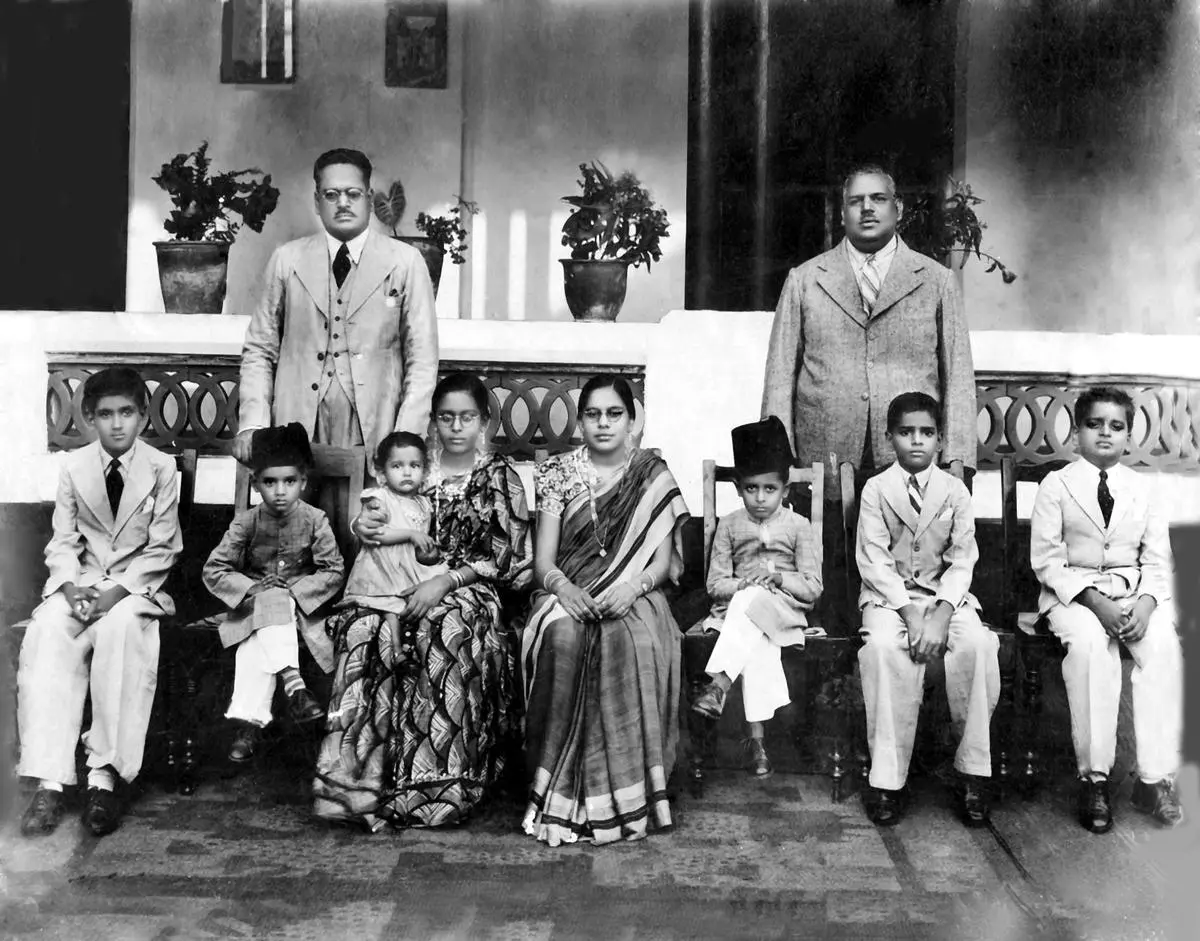
S.M. Husain Nainar and his brother S. Kadir Mohamed Nainar with their children, circa 1940s. | Photo Credit: Special Arrangement
Nainar grew up at a time when Tamil Muslims were resistant to the idea of any kind of non-religious education. His father, N. Syed Bawa Rowther, was convinced that Western education would reduce his sons’ marriage ‘market value’. His three daughters possibly never attended school.
But the winds of change had begun to blow in Nainar’s part of the world. Like his elder brother Syed Kadir Mohamed Nainar, former district judge and public prosecutor, Nainar excelled in his studies. He studied Arabic at the madrasa (Islamic school) in Podakkudi, Thiruvarur district, and later at the Madrasa Jamaliya in Perambur, Madras, according to family sources.
A detailed eight-page résumé prepared by him, possibly while he was in between jobs in the 1960s, traces his progress from senior school in Victoria Memorial High School, Bodinayakanur (1918-1921), and Intermediate at American Mission College, Madurai (1921-1923), to BA in Arabic at Government Mohammedan College, Madras (1923-1925) that would eventually lead him to Aligarh Muslim University (AMU).
Here too, he was a bit of an over-achiever, as he simultaneously pursued Bachelor of Laws (LLB) and a Masters in arts in Arabic, from 1925 to 1927. Our discovery of his exam hall tickets confirms that.
At AMU, Nainar was a student of renowned scholar Abdul Aziz Maimani, who was known for his mastery over Arabic. Nainar also studied Arabic, Hebrew and Aramaic under the tutelage of British Arabist A.S. Tritton, who served at the AMU from 1921 to 1931.
Linguistic bridges
In 1927, Nainar was appointed as senior lecturer of the Islamic section of the Institute of Oriental Studies and Research at the University of Madras, which was later re-constituted as the Department of Arabic, Persian and Urdu in 1930. Much of his work began with authorising ‘true copies’ to be made by professional scribes that did not deviate in any way from the original, down to the number of lines on a page. Among such true copies that have survived in his collection, is a version of Kerala Pazhama, in Malayalam, meant to be a companion volume to Tuhfat-ul-Mujahidin, for which Nainar collaborated with his colleague C. Achutha Menon.
Despite studying Arabic under notable tutors in India, and his fluency in it, Nainar still felt that his expertise was limited, and his sons could perhaps fill this lacuna by studying the language in an Arab country. When his elder son Anwar chose to study Economics, he sent my father, Munawwar, to pursue his BA in Arabic at Cairo University in Egypt. Rescued from a loft full of paper bundles, we found all the correspondence from this period.
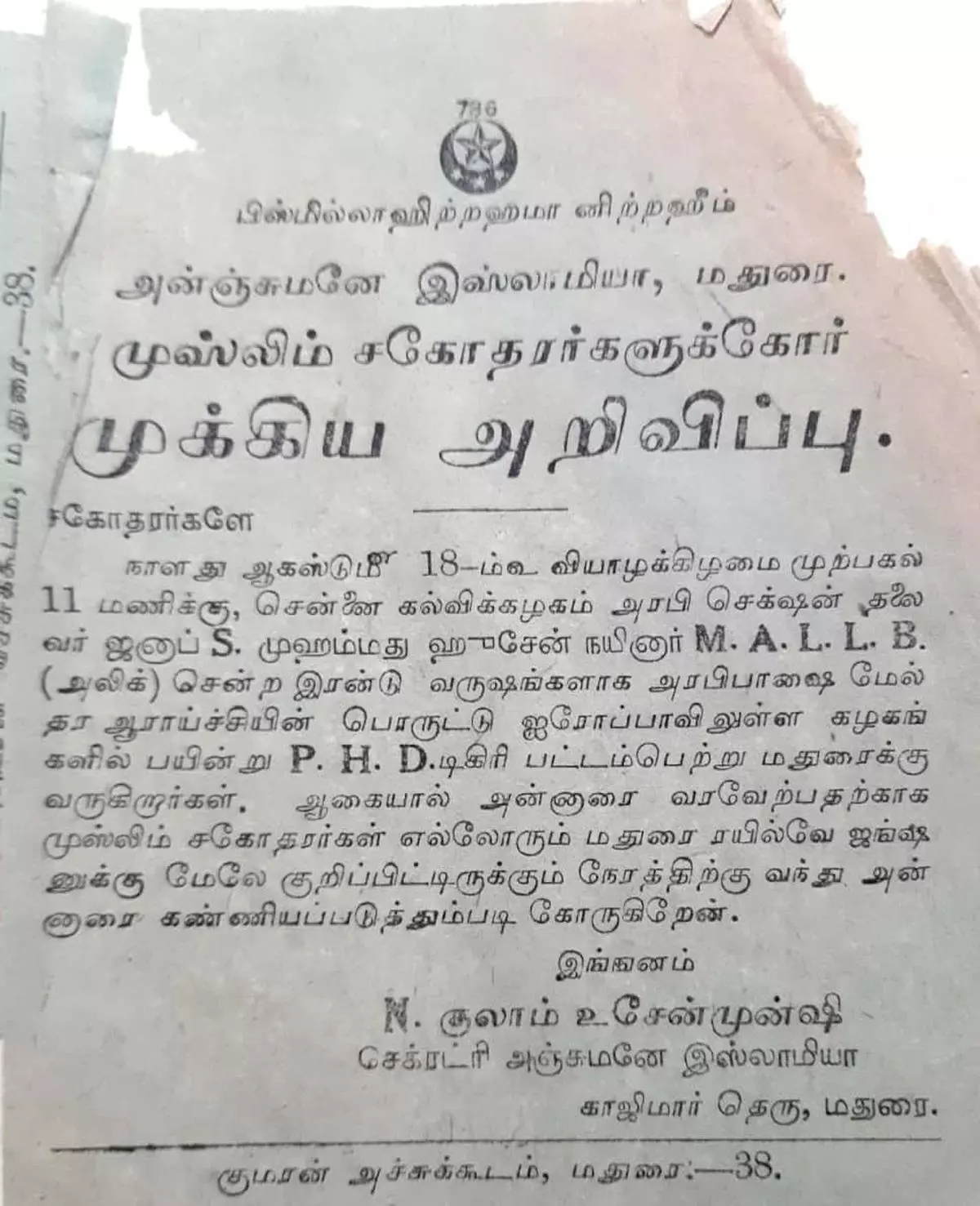
A flyer issued in 1938 by N. Ghulam Hussain Munshi, secretary, Anjuman-e-Islamiya in Madurai, asking Muslims in the city to gather at the railway station to welcome Nainar after he completed his doctoral studies at SOAS, London. | Photo Credit: Special Arrangement
My father’s time in Cairo University was completely overseen through letters from 1955-1960, because Nainar was on deputation in Indonesia when he was sent off to Egypt at the age of 19. One personal favourite is a trilingual true copy made by Nainar, of three letters written by my father in Arabic, Tamil and English, informing him that he had passed his first year BA exams.
A man of letters
Family history can be a touchy subject, with each person having their own spin on events. In my case, having a stockpile of at least 10,000 documents from the 1800s kept me going, and helped to dispel the myths that had built up around my grandfather. There are flashes of humanity amid the academic studies: letters from his children (he had three daughters and two sons) written from India, when he was in the UK, reporting faithfully, the antics of my father, then just a three-month-old infant, and the periodic health checks by the doctor, besides requests for books, umbrellas and toys.
The letters grow more serious as the children walk into adulthood, and the subject of marriage proposals gets a few wires crossed between the senior Nainar brothers. One wonders how he navigated life as a student, scholar and family man across two World Wars and later, a complete change of government. At work, he seemed to be always in demand, seguing from professor to orator and in Indonesia, a representative of the Indian government, with ease.
In 1952, Dr. Nainar was chosen to head the Indian History Association’s 15th session in Gwalior, a rare honour for a language professor. In his presidential address, he spoke on early medieval Indian history, suggesting that the study of the Muslim period in India needed to be re-assessed, and indexed especially in the Deccan and the south with the help of inscriptions and letters in local languages.
It is sobering to know that my grandfather has no claim on public memory today; of the institutions he studied in only the SOAS archivist was able to provide a copy of his admission form and course details, within a day. Like many scholars, his work is valuable, but not, apparently, glamorous enough in a country where history is easily rewritten. Had he stayed with us longer, he may perhaps have written his autobiography, and guided his family through yet another idea of India.
source: http://www.frontline.thehindu.com / Frontline / Home> Society> Profile / by Nahla Nainar / May 24th, 2025
The author explores the significance of critical relationships between the powerful Mughal court culture and various strands of Islamic mysticism.
W ITH nearly 50 years of research and teaching experience in the best of universities in India and the United States, Muzaffar Alam has offered a work that has the quality of a swan song, the culmination of a life-long intellectual activity to produce a book on a theme that was long waiting to be written and one that only he could have done on a such a majestic scale. With a style marked by reticence, hedging and evasion, much needed to survive in the dirty waters of medieval Indian history, Alam taught for many years at Jawaharlal Nehru University in New Delhi before leaving two decades ago to serve as the George V. Bobrinskoy Professor in South Asian Languages and Civilizations at the University of Chicago.
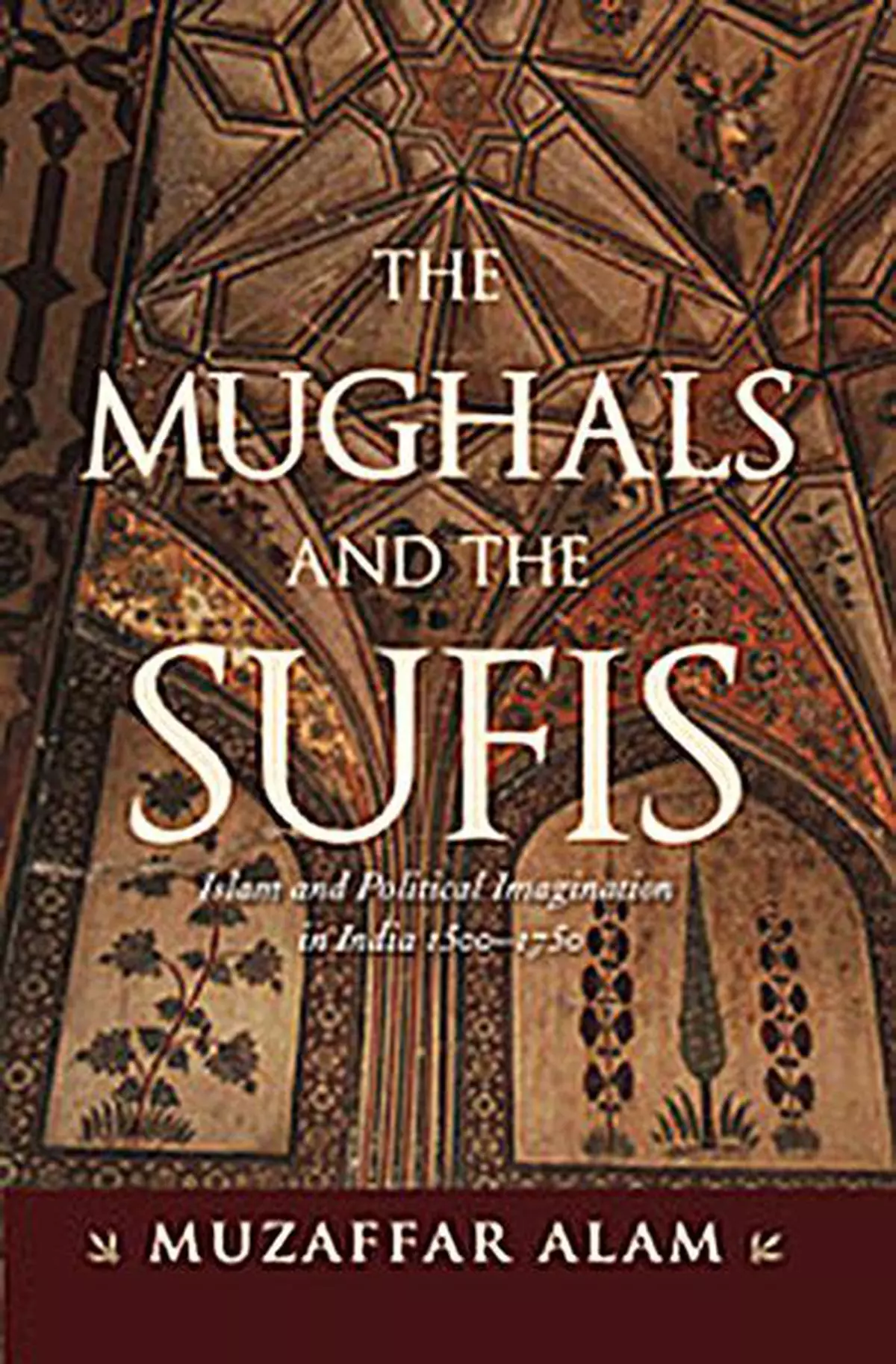
Besides his lasting collaborative research of much value, the distinguished scholar’s previous books have broken new ground. Beginning with an important intervention in the form of The Crisis of Empire in Mughal North India, 1707-48 (1986), Alam went on to write his equally famous book, The Languages of Political Islam in India, c.1200-1800 (2004). He has now come up with this substantial piece of work, The Mughals and the Sufis: Islam and Political Imagination in India, 1500-1750.
Moving away from what he calls the traditional paradigm that champions political and fiscal history over other equally important dimensions, Alam explores in the present book the significance of critical relationships between the powerful Mughal court culture and various strands of Islamic mysticism by deploying a wide range of source material, mainly in Persian but also in Urdu and Arabic. Some of the key texts used to write the book are still unpublished, but the author has the enviable expertise to read manuscripts—an ability gained from his early education in the Islamic seminary at Deoband in western Uttar Pradesh, which is often in the news for its regressive stand on social and cultural issues affecting Muslim communities.
The author takes a secular position on matters political much as he seems to keep critical distance from the dominant secular historiography. The central concerns of the book and the broad conclusions remain within the ambit of the consensus in academic history, dominated by secularists, on what the Mughal political idioms were like. Yet, the details the author has offered are awe-inspiring. As the saying goes, the devil lies in the details.
In keeping with his approach of avoiding a head-long conflict with the entrenched orthodoxies in related fields of Mughal history and yet attempting to offer something different, especially on religion and political culture, which are generally studied with the felt need to emphasise religious tolerance and communal harmony, Alam’s detailed introductory discussion (listed as Chapter One) does away with any systematic historiographical analysis of existing scholarship. In the process, the usual meaningful exercise of stock-taking of the field that would set the agenda for the author has been abandoned.
Long view of Sufism
Instead, the introduction offers what has been termed as a long view of Sufism and political culture in India, within Muslim intellectual traditions, from the time of the later Mughals down to the 19th and 20th centuries. The key figures include Shah Waliullah (died 1762) and Saiyid Ahmad Shahid (died 1831) at one end of the spectrum, and Shibli Nu‘mani (died 1914) and Muhammad Iqbal (died 1938) at the other. In Alam’s considered opinion, studying these later stalwarts’ understanding of Islam and political imagination in the heyday of Mughal power can offer a better and informed long-term perspective than anachronistic readings of texts and historical situations, which are often the case in politically charged histories of the public domain. Academic histories are not free from these blemishes either.
Alam has thus sought to steer clear of some of the hotly debated issues such as questions of conversion and Islamisation, grievances relating to cases of demolition of temples, cow slaughter and frequent rhetoric on collection of the discriminatory tax called jizya, etc. Instead, a focussed reading of some interesting sets of sources has been offered to show a complex picture of complicated relationships between the rulers and the Sufis—important for far-reaching consequences to Mughal politics and society. This is specially so when the author takes the reader deep into the underbelly of the 17th century Mughal empire, with a fascinating set of material known to experts but never properly used.
Starting with the shaky foundations in the early 16th century, under Zahiruddin Muhammad Babur and Nasiruddin Muhammad Humayun, who were no less formidable in their own distinct ways, the Mughal empire was firmly established by the end of the century by Emperor Jalaluddin Muhammad Akbar (Chapter Two).
With a long history of large-scale empire building in India, the Mughals were quick to grasp the norms of governance and indeed the political theory required to manage and control the vast subcontinental diversity. Given the fact that religion and politics get entangled in India with terrible consequences even in the 21st century, religious justification of political power in Indian history has been a fait accompli for long. Men of religion needed political patronage and protection, and rulers needed legitimacy from the former on account of their popular appeal. The intercession by holy men also meant divine blessings procured directly from God and His Prophets and other representatives on earth, in this case important figures and shrines of the popular saints such as Khwaja Gharib Nawaz Moinuddin Chishti of Ajmer.
Living legends from a variety of Sufi lineages such as the Chishti, Suhrawardi, Firdausi, Shattari and Qadiri were active in India with a long history behind them. They were known for being committed to what is professed as the Shariat, or Muslim law, and yet free from the bigotry or fanaticism that is generally associated with custodians of Islam, the theologians, or ulama. They were also free from communal biases in relation to non-Muslims, identifiable as Hindus, and sectarianism of the kind that sought to vilify communities of Muslims such as Shias. The Mughals realised the value of this approach quickly. They needed to maintain a critical distance from the Naqshbandis, the Central Asian strand of Sufism that came in the wake of the conquest. Naqshbandis combined their mysticism with aggressive accumulation of wealth and assertion of uncompromising commitment to Sunni Hanafi interpretation of Islamic principles.
Inclusive culture
The struggle between the two strands of Sufism—accommodation and compromises in the given situation of the Indian environment and extraordinary emphasis on Islamic piety bordering on Sunni fanaticism—marks the defining feature of Mughal-Sufi relations from the late 16th century. The inclusive Mughal imperial culture privileged Indian Rajputs and Iranian Shias, identified itself as part of a broad and liberal Islamic political and cultural tradition, and understood the value of devotional practices of the kind the Chishtis and the Qadiris upheld.
Shaikh Abdur Rahman Chishti (died 1683), the 17th century Sufi scholar belonging to the Chishti-Sabiri order and hailing from Awadh, articulated the latter position powerfully in his voluminous writings. A set of his compositions titled Mir’atul Asrar, which is a huge collection of Sufi biographies prefaced with a detailed exposition of some of the important features of Sufism, has been used by Alam in Chapter Three to show how it was possible to remain within the fold of Islam and yet be eclectic like Indian Sufism. Sufis were not bound by any narrow interpretation of Islam and so they could be free from the kind of biases betrayed by Sunni theologians and Naqshbandi Sufis.
The author has pitted the more acceptable Chishti position in Mughal India quoting Abdur Rahman as writing that Sufis have no mazhab, or commitment, to any juridical school of Sunni Islam, against a rhetorical statement of the leading Naqshbandi Sufi Shaikh Ahmad Sirhindi (died 1624), who is also styled and venerated in some strands of Islamic traditions as Mujaddid Alf-i Sani, or renovator of Islam, in the second millennium of the Hijri calendar. Sirhindi had remarked that if a prophet were sent among Muslims of his time, he would have practised the Hanafi interpretation of Islam.
There were few takers for this kind of assertion in the Mughal system, and yet the sons and grandsons of Sirhindi were able to make considerable inroads to the extent that they were much privileged by the time Aurangzeb took reins in the middle of the 17th century. It served both—Aurangzeb needed legitimacy for his horrible butchery inside the imperial household and the Naqshbandis coveted power and prestige, which the early ancestors of their spiritual lineage enjoyed in Central Asia.
This is to the extent that Shaikh Muhammad Ma‘sum (died 1669), son and leading successor of Sirhindi in his Naqshbandi-Mujaddidi order, sought to own responsibility for the execution of the saintly prince and Shah Jahan’s heir-apparent, Dara Shikoh (died 1656), with his own hands, with reference to a dream in which he received a sword from God to do away with the latter. In the last chapter, Alam narrates the horrendous bloodshed and transformation of Mughal polity under Aurangzeb, with the Naqshbandis getting entrenched in the Mughal court and outside.
This was at the cost of a huge investment in what is identified as cultural synthesis relevant to sustain the empire. The result was a complete mayhem by the end of Aurangzeb’s reign. His immediate successors, who were nominated and backed by the Naqshbandi-Mujaddidi Sufis, made a mess of it. The more eclectic approach of the kind Sufis of the Chishti and Qadiri orders proposed and important figures such as Dara Shikoh and his equally accomplished sister Jahanara (died 1681) adopted as social and political ideologies relevant for the time have been brought out in interesting detail. Besides the hagiography and defence of Indian Sufism in his Mira’tul Asrar, Abdur Rahman Chishti composed a few other powerful treatises aimed at transcending differences between religious beliefs and communities.
One of the texts, Mira’t-I Madariya (studied in Chapter Four), appropriated the popular mystic figure of the 15th century, Shah Badiuddin Madar, whose extraordinary career began as a prodigious Jewish child in Syria and whose shrine, dargah , is located in Kanpur, Uttar Pradesh. Tradition claimed that he was directly guided by God, the prophets (Moses, Jesus and Muhammad), celestial beings and the leading saint of India, Moinuddin Chishti. Thus, he was identified as part of the Chishti tradition even though many of his practices appeared heretical, or outside the pale of Islam, with his close disciples styling themselves as yogi s or dashnami sanyasi s, sunk in artificially created ecstasy with the help of intoxicants such as hashish and ganja, and puffing with chants of Dam Madar.
Translation of ‘Puranas’
Abdur Rahman also composed a brilliantly imagined text called Mira’tul Makhluqaat (analysed in chapter five), claiming it to be a translation of an ancient Indian Sanskrit textual genre known in Mughal intellectual circles as Puranas. The translations of the Ramayana and the Mahabharata were already known since the time of Akbar. Abdur Rahman had himself translated the Bhagavad Gita into Persian. These were done with the dual process of their interpretations, oral or written, in Awadhi and Braj versions of medieval Hindi, before they were put into writing in Persian.
Mira’tul Makhluqaat is extraordinary in the sense that it showcased how the Brahmanical Hindu mythical time of ancient Gods were very much part of the Islamic notion of time since the arrival of Adam on earth. Ancient Gods belonged to the people of jinn s, made of fire, and descendants of Adam, including Hindus, are human beings, made of soil.
The jinn s were ordered to withdraw to mountains, giving space to humans, but they could also be deployed to take care of injustices in the world, as in the case of the battle of Mahabharata. This being kaliyuga, it can also witness the horrendous violence on the family of the Prophet, especially the martyrdom of his grandson, Husain, by miscreants identified as apostates ( murtadd ) and barbarians ( malechh ).
These condemnations are attributed by Abdur Rahman Chishti to Mahadeva (Siva), who in turn is supposedly narrating these episodes to his wife Parvati, who is shown as being keen to know about Adam and Prophet Muhammad (Mahamat).
Alam’s details from this work are blended equally interestingly in the next chapter (six), in which Dara Shikoh works with a battery of pundits on a new translation in Persian of Yogavasistha . Whereas until the time of Akbar, the Hindu traditions were beginning to be known through translations in line with the policy of sulh-i kull , peace with all, by Dara Shikoh’s time in the middle of the 17th century it was possible to imagine that the powerful Mughal prince could style himself after the ideal Hindu king, Rama of Ayodhya. This was the aim behind Dara’s preparation of Yogavasistha , mentioned in the beginning of the text itself about the prince seeing a dream in which he was seeking blessings from the sage Vasistha, in front of Rama who is placed on a higher pedestal and styled as an elder brother.
On Vasistha’s advice Rama embraced him with great love, and passed on the sweetmeat given by the former. This was taken as the sign for getting a new translation of the text done, which was in line with translations and studies of other texts seeking common ground for Islam and Hindu traditions, symbolically referred to as the merging of the two oceans, in a text with the title Majma-ul-Bahrain.
Pretext to remove Dara Shikoh
None of these were found to be contradictory to Dara Shikoh’s commitment to Sufism and Sufi figures from the past, and attachment to Qadiri Sufi saints of his own time. That there was no difference between Hindus and Muslims was also supported by the doctrine of wahdatul wujud, unity of being, which was similar to Advaita Vedanta. But the no-holds-barred emphasis on these ideas for a common and harmonious public culture was used by Aurangzeb as a pretext to remove Dara in his bid to capture the Mughal throne.
Mughal princesses
This violent move created a huge difficulty within the Mughal household as well. Alam has discussed this in his penultimate and detailed 72-page chapter (seven), pointing to the contested loyalties of Mughal princesses, but focussing on their remarkable devotional and intellectual investments. This is especially with reference to three of them—Aurangzeb’s sisters Jahanara and Raushanara (died 1671), and his genius daughter Zebun Nisa (died 1701).
Jahanara was close to her father Shah Jahan and her elder brother Dara Shikoh and, following the latter, was heavily devoted to Sufism, with deep attachment to Moinuddin Chishti and his shrine. She also became a disciple of the leading Qadiri Sufi in Kashmir, Mulla Shah Badakhshi (died 1661), and had a couple of books on Sufism to her credit. In the war of succession, she had sided with Dara Shikoh and tried to reason with Aurangzeb for sanity without success.
Aurangzeb did not create any difficulties for her subsequently, but he did not follow her will to be fully implemented. As the richest Mughal princess of the time, she had left behind a sum of three crore rupees to be distributed among the attendants of the Chishti shrines, but Aurangzeb allowed only a third of it to be distributed as per some reading of the Shariat that he adhered to.
Jahanara’s less accomplished sister, Raushanara, had sided with Aurangzeb in the struggle for power. He pampered her with some independence and creature comforts with a mansion outside the fort. Her love life was a matter of gossip, and this was blamed for her untimely demise at the age of 53, with people even suspecting that Aurangzeb ordered her to be poisoned to death.
Alam has given details of her long correspondence with Shaikh Saifuddin, the young Naqshbandi-Mujaddidi Sufi operating from the Mughal court with access to ladies of the harem. The letters, the ones written by the Sufi, have survived. They refer to the princess cultivating mystical whispers of the heart, zikr-i dil. Saifuddin was convinced that Raushanara had reached the stage where she could be recognised as an accomplished Sufi in her own right. From there she could have only grown as a Sufi teacher, poet and writer, but that was not to be, whatever the truth relating to her death.
Aurangzeb doted on Zebun Nisa, exposing her to the best teachers of the time. But as it happens, involvement in politics proved to be her nemesis. She had the guts to support a brother who had rebelled against their father for whom ruthless power was beyond all bonds. She was promptly put under arrest, with some freedom to continue her scholarly pursuits, mainly reading works of poetry and composing some of her own, published under an apt pen name, Makhfi, the hidden one. Among the people she was allowed to correspond with was a Naqshbandi old man and grandson of Shaikh Ahmad Sirhindi, Shaikh Abdul Ahad Wahdat (died 1713).
Wahdat is known in posterity as a fine poet who wrote under the pen name Gul (rose). One of his letters to Zebun Nisa, includes this couplet in Persian:
Bas kunam gar in sukhan afzun shawad
Khwud jigar chi bud ke khara khun shawad
I should stop, for if I speak further
Not just the liver, even a stone will bleed.
According to reports, mentioned by Alam, Aurangzeb cried on hearing the news of Zebun Nisa’s death and ordered a tomb to be built over her grave. Though privileging the puritanical Naqshbandis all his life, Aurangzeb himself was buried at the Chishti centre of Khuldabad in the Deccan (1707). By then, the Mughal state was in a terrible crisis, but its foundations were deeply embedded in the country’s composite culture. It took 150 years to decline and fall with a final and vengeful push from the British in 1857. The last Mughal emperor, Bahadur Shah Zafar, died reciting some painful Sufi poetry in faraway Rangoon.
The author and publisher deserve to be commended for bringing out this magnificent piece of work.
Raziuddin Aquil is Professor of History, University of Delhi.
source: http://www.frontline.thehindu.com / Frontline / Home> Books> Book Review / by Raziuddin Aquil / January 23rd, 2022