Their work focused on Muslim women writers and their contributions to magazines in Kerala during the period.
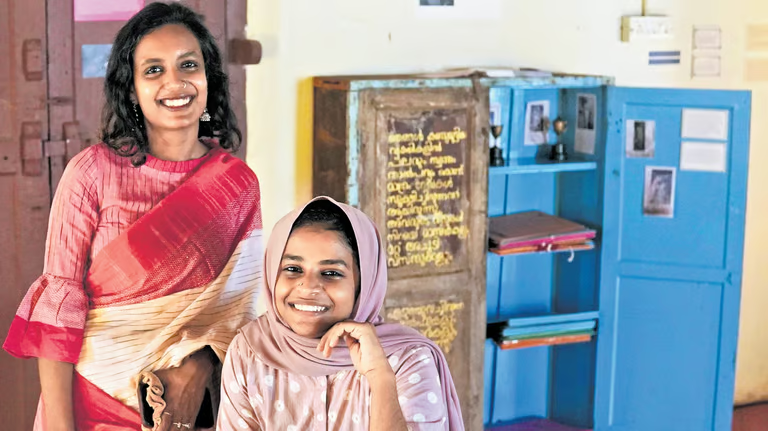
Reading Rumours curators Haneena P A and Jazeela Basheer
Kozhikode :
Victorian-era English novelist and poet Mary Ann Evans famously adopted the pseudonym George Eliot to escape the constraints of social norms and patriarchy.
As times changed, female writers increasingly gained the courage to publish under their own names. However, in Kerala – a region still grappling with significant gender disparities – women defied the odds and entered the publishing industry as early as the 1900s. Yet, tracing the contributions of some, particularly Mappila women, proves challenging.
The exhibition titled Reading Rumours, held at Silk Street in Kozhikode, shed light on the hidden history of women’s involvement in Kerala’s print culture between 1900 and the 1950s. Curated by research scholar Haneena P A and exhibition designer Jazeela Basheer, the event is the result of two years of research by the collective Around The Sufrah. Their work focused on Muslim women writers and their contributions to magazines in Kerala during the period.
“Print culture flourished in Kerala from 1900 to 1950, and readership grew. But the contributions of women writers from this era have largely been overlooked,” Haneena told TNIE.
“Reading Rumours brings together the micro-histories of these women writers, encouraging visitors to engage with their stories and legacies.” The title, Reading Rumours, symbolises women’s quest for knowledge and their fight for recognition.
“Rumours are often seen as statements without a reliable source of truth, frequently associated with women. Much of women’s knowledge, history, and experiences are dismissed as mere gossip. The title is also a play on the traditional vayanashaala, or reading rooms, where men would gather to read and discuss,” Haneena explained.
The idea for Reading Rumours originated from a desire to present Haseena’s postgraduate thesis in a more accessible, popular format.
“This exhibition is an extension of my thesis, which focused on Mappila women in print. We are generally aware of only a handful of female writers from the early 1900s, but my research uncovered around 25 Muslim women who were actively involved in writing for magazines and other publications,” she said.
The three-day exhibition, which began on October 4, received enthusiastic support from the public. “The response has been overwhelming,” Haneena noted.
“Many visitors expressed surprise at discovering the significant role Muslim women played in Kerala’s early print culture,” she said.
source: http://www.newindianexpress.com / The New Indian Express / Home> Kerala / by Lakshmi Athira / October 07th, 2024
Udupi district Muslim Okkoota (R) will host an award ceremony to recognize individuals who have made significant contribution to society and various communities meeting at Basel Missionaries Memorial auditorium on November 10.
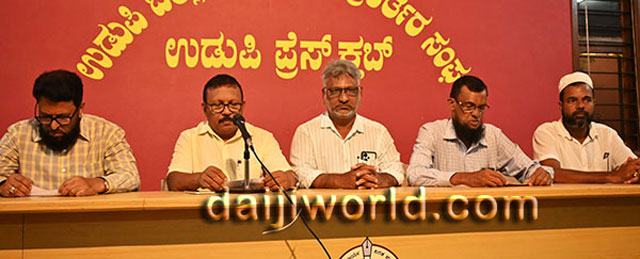
Mohammed Idrees, general secretary Udupi district Muslim Okkoota, addressing the media in the press meet held on October 14 said, “The awards include the ‘Manava Ratna’ for those who have upheld human values and the ‘Seva Ratna’ for social service, and also introduced a new award this year the ‘Souharda Ratna,’ aimed at honouring those who work towards communal harmony.”
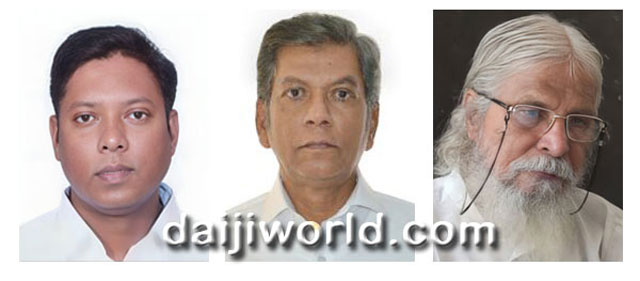
Sasikanth Senthil, a former deputy commissioner of Dakshina Kannada and current member ofparliament, has been selected for the ‘Manava Ratna’ award. The ‘Seva Ratna’ will be awarded to K S Nisar Ahmed, a businessman originally from Karkala who has made his mark in Dubai. Additionally, Fr William Martis, a Christian clergyman and social activist from Udupi, will be the first-ever recipient of the ‘Souharda Ratna’ award.
In addition to the awards, six individuals who have made outstanding contributions in various fields such as education, literature, folklore, organization, and social service will be honored. Among them are a distinguished writer and speaker Dr Gananath Ekkar, political leaders Saraswati D Bangera and Sarala Kanchan, a Dalit leader and social activist Annappa Nakre, and social workers Nityananda Olakadu and Haseenaru Kodi Kundapura, who have dedicated their lives to serving the marginalized.
The awards will be presented by Karnataka’s minister for women and child development and Udupi district in-charge minister Lakshmi Hebbalkar. The keynote address will be delivered by a folk scholar and chairman of the Kannada Development Authority Dr Purushotham Bilimale. The event will be inaugurated by chancellor of Yenepoya University Abdulla Kunhi, president of the Udupi District Muslim Federation Yaseen Malpe will deliver a vote of thanks. Principal of Baraka International School and College B S Sharafuddin, will preside over the ceremony. The event will be coordinated by S K Iqbal Katapadi, with Iqbal Manna as co-coordinator and Ismail Hussain overseeing the programme.
Notable guests include former ministers Vinay Kumar Sorake and Jayaprakash Hegde, alongside other dignitaries such as honorary president Udupi district Muslim Okkoota Haji Abdulla Parkala, president Karnataka Allied Health Council Dr U T Iftikhar, businessman Prasad Raj Kanchan, Afroze Assadi Dubai, president Sahabalve K Phaniraj, organization secretary Karnataka state Dalith Sangharsh Committee Sundar Master, president Sugamya district women’s federation Gracy Coellho, and principal of Kodi BEd College Dr Firdose.
Treasurer Udupi district Muslim Okkoota Sayyad Farid, secretary Ismail Sheik, vice president Salauddin Abdula, member Daffrulla, event coordinator Iqbal Manna and zilla panchayath member Abdul hajid Udyavara, were present in the press meet.
source: http://www.daijiworld.com / Daijiworld.com / Home>Karnataka / by Daijiworld Media Network – Udupi (TP) / October 14th, 2024
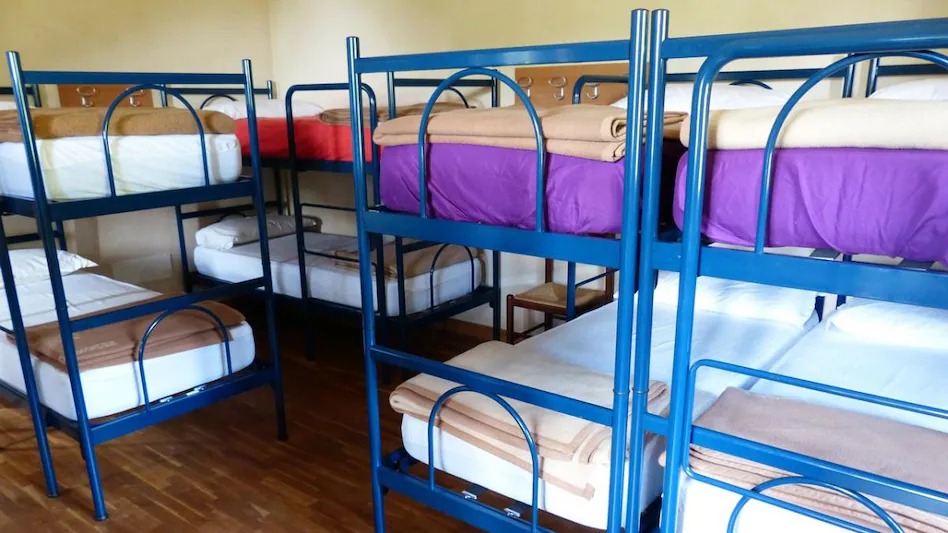
The deadline to submit applications for entry into the post-matriculation boys’ and girls’ hostels under the Minority Welfare Department for the current academic year (2024-25) has been extended to November 11.
Pre-university (PUC), parallel course, professional course, graduation and post-graduation students may apply for accommodation at the hostels, under the State Scholarship Programme, the authorities have said in a press release, adding that the applications are provided on the State Hostel Portal (SHP) site.
Additional information on applying for accommodation at the hostels is available on the SHP site. The applicants may also approach the government personnel at the district and taluk offices of the Minority Welfare Department, the press release has stated.
source: http://www.english.varthabharati.in / Vartha Bharati / Home> Karnataka / by Vartha Bharati / October 15th, 2024
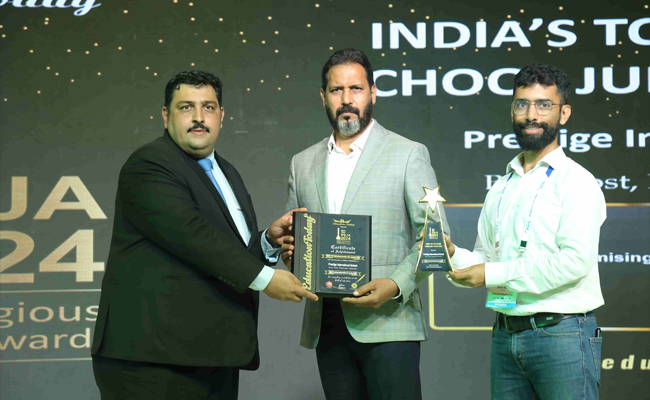
Prestige International School & PU College has been recognized for its excellence in education, winning the Most Promising Implementation of Learning Tools award at the India’s Top Prestigious School Jury Awards 2024.
The award was presented during the educators’ summit organised by Education Today on 4th October 2024 at The Lalit, Mumbai.
Hyder Ali, Chairman of Prestige International School & PU College, received the award on behalf of the institution.
Education Today, one of India’s leading education magazines, is known for providing valuable insights for students, teachers, and parents across the country.
source: http://www.english.varthabharati.in / Vartha Bharati / Home> Karavali / by Vartha Bharati / October 14th, 2024
Oral historian Sohail Hashmi into a new wave of dissent in Urdu poetry at a Delhi workshop earlier this month. ‘It’s asking important questions, raising serious issues.’
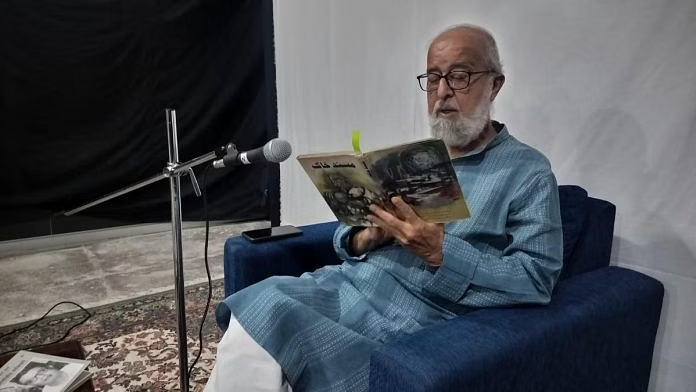
Heritage conservationist Sohail Hashmi reading out poems by contemporary Muslim writers at his Urdu poetry workshop earlier this month | Photo: Heena Fatima | ThePrint
New Delhi:
In a quiet corner of Delhi’s Neb Sarai, a small band of Urdu poetry lovers gathered for an evening of verse. But this time, it wasn’t love or heartbreak in the air—it was words of protest, identity, and defiance.
At his Urdu poetry workshop at the NIV Art Centre on a September Sunday, oral historian and heritage conservationist Sohail Hashmi skipped nostalgic classics by the likes of Rahat Indori, Parveen Shakir, and Munawwar Rana. Instead, he chose hard-hitting political poems by contemporary Muslim poets to demonstrate how modern Urdu poetry is changing.
“After the 1992 Babri Masjid incident, there was a major shift in Urdu poems. Urdu poets are now questioning the dominant narrative constructed in the society about minority communities,” Hashmi told ThePrint.
Seated on a plush blue chair placed on a Persian rug, Hashmi explained to the audience that Urdu nazms (poems) have become a space for protest. He said there are two broad streams of Urdu poetry.
The first category includes poetry with beautiful rhymes and words, making it easy for readers to remember. Its main themes revolve around love and the pain of separation.
The second category, which he called “poetry of thought”, tackles deeper, more serious issues.
“This poetry is asking important questions, raising serious issues,” Hashmi said. “And it’s the kind of poetry that the mainstream does not acknowledge.”
Throughout the workshop, Hashmi let the poetry speak for itself by reciting works from several contemporary poets, including Ibn-e-Insha, Gauhar Raza, Nomaan Shauque, and Ikram Khawar.
‘Blunt and merciless’
New Urdu poetry is more about thought than pure emotion. This poetry, said Hashmi, is both a political commentary and a snapshot of “new India” through Muslim eyes. And many poems address the “Muslim identity crisis”.
One such poem, by Ikram Khawar, is titled Haan Main Musalmaan Hoon (Yes, I am a Muslim). Hashmi picked up a volume from the table and read aloud:
Haan main musalmaan hoon
Nahi kahoonga main, jaise tum insaan ho
Bagair kisi sharm ya duhai ke,
Bagair kisi safai ke
Main khud ko dekhne se inkaar karta hoon, tumhari aankh se
(Yes, I am a Muslim
I won’t say, like you, that I am human
Without shame or plea,
Without any justification,
I refuse to see myself through your eyes).
After finishing the poem, Hashmi explained that it rejects the imposed, stereotypical image of Muslims and challenges the dominant narrative. The refusal to see oneself through the lens of others, he said, is an act of defiance.
One woman in the audience expressed concern: “That’s the protest in the poem, but this kind of poetry is being pushed out of the mainstream.”
Hashmi, however, countered that while this poetry may not be amplified in popular culture, it has become the dominant voice in contemporary Urdu literature.
“Genuine poetry rarely reaches mainstream platforms—it doesn’t appear on news or TV channels. Instead, it finds its place in literary magazines and circles, and thrives in poet gatherings,” he said.
He added that much of what gets wider exposure is often confined to superficial themes, while deeper, uncomfortable subjects in Urdu and Hindi are pushed into niches where they are appreciated only by a few.
Hashmi then recited Nomaan Shauque’s Lakshman Rekha, a poem that asserts free will in a time when even personal choices—like diet—are policed. It strikes a rebellious note:
Nahi, aap nahi samjha sakte mujhe jeene ka maqsad
Nahi bata sakte, kitni door tehelna
Kitni der kasrat karna zaroori hai, tandrust rehne ke liye
Khane ke liye, gosht munasib hai,
Ya saag, sabziyan
Rone ke liye munasib jagah, daftar hai ya bathroom,
Mujhe samjhana mushkil hai
(No, you cannot explain the purpose of my life to me.
You cannot tell me how far to wander
Or how long to exercise to stay healthy.
Whether meat is suitable for eating,
Or if vegetables are better.
Where it’s appropriate to cry, whether an office or a bathroom.
It’s difficult to explain these things to me).
Hashmi pointed out that poems on victimhood and oppression are becoming less common in Urdu. While these performed a cathartic role for those feeling helpless due to the “government’s marginalisation of minorities”, there’s a new trend now.
“Urdu poetry is moving away from generality toward specificity,” he said. “These questions (in poems) are very direct, addressing the issue bluntly and absolutely mercilessly.”
Shrinking spaces, empty chairs
The COVID-19 lockdown, the Citizenship Amendment Act (CAA), and the rise of religion-based politics have given poets new urgency. Across languages, from Urdu and Hindi to Oriya, poetry has become a space for asking hard questions, according to Hashmi.
Hashmi recited Darsgah (Academy), a poem by scientist Gauhar Raza, which addresses the 2020 attack on JNU students during the anti-CAA protests:
Darsgahon pe hamle naye to nahin
In kitabon pe hamle naye to nahin
In sawaalon pe hamle naye to nahin
In khayalon pe hamle naye to nahin
Gar, naya hai kahin kuch, to itna hi hai
tum mere des mein laut kar aaye ho
par hai surat wahi, aur seerat wahi
sari vehshat wahi, sari nafrat wahi
kis tarha chupaoge pehchan ko?
gerue rang mein chup nahi paoge
(Attacks on colleges are not new, Attacks on books are not new, Attacks on questions are not new, Attacks on ideas are not new. If something is new, it is only this:
You have returned to my country, But the appearance and character remain the same, The same savagery, the same hatred. How will you hide your identity? You cannot conceal it in the colour saffron).
Hashmi then criticised Hindi kavi sammelans (poetry conventions), for promoting misogyny. He said many of these events focus more on storytelling than actual poetry.
“They mock overweight, bald, and dark-skinned people. The audience claps along claps and enjoys it without questioning,” he said.
He also weighed in on the erosion of literary spaces— Hindi and Urdu poets are emerging and voicing dissent but they struggle to find a platform. Because many publishing houses are shutting down or playing it safe, and demand for books is low, many new writers have to pay to get their work published.
Ironically, Hashmi’s event had a low turnout, with only five attendees—something that surprised the organisers. Aruna Anand, co-founder of the NIV Art Centre, told ThePrint that their monthly art sessions are usually full, attributing the empty chairs to the wider crisis confronting the Urdu language.
But Hashmi was not overly perturbed. He argued that poetry that addresses deep social questions will ultimately prevail and even revive the language.
“The poetry of thought is the poetry that eventually survives,” he said.
(Edited by Asavari Singh)
source: http://www.theprint.in / The Print / Home> Features> Around Town / by Heena Fatima / September 28th, 2024
Meet 25-year-old specially-abled girl, who plays basketball, does motivational speaking and drives a car.
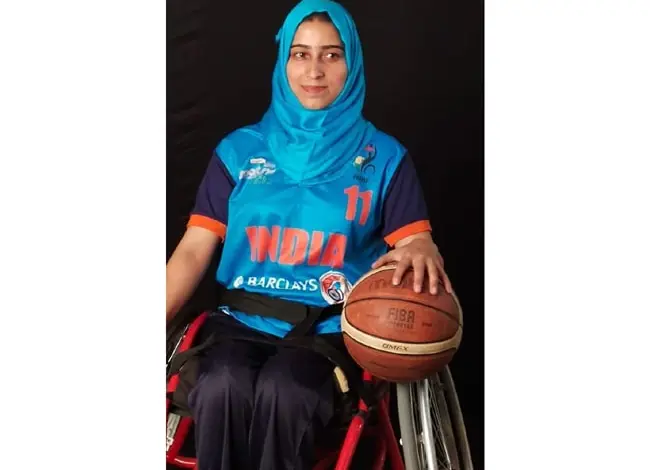
Ishrat Akhter in Team India jersey | eNewsroom India
Delhi:
Ishrat Akther from Baramulla in Jammu and Kashmir is a multi-faceted personality. She is an international wheelchair basketball player, a motivational speaker, Kashmir’s young leader and an achiever’s award-winner. Indeed, six years back, Ishrat’s life had no meaning — but an incident changed it all.
Now, Ishrat has become an inspiration for all those individuals who set limitations for themselves. Who refuse to dream and achieve their ambitions.
The girl next door
Ishrat was born in a village where women did not participate in sports. Like any other girl, she believed whatever her family taught her and did not dare to dream big. However, her life changed on August 24, 2016, when she fell from the balcony of her house. The injury was serious, it damaged her spinal cord – making her physically challenged.
Life changed for the good when the 25-year-old girl from the Authoora area in north Kashmir’s Baramulla district started her basketball career in 2018. For her, playing basketball was not just a love for the sport but a passion for standing against all odds, come what may.
“I never played any sport before 2016, not even in school, but in 2016 when I was just 18 years old, I met with an accident. I fell off from the balcony of my house and this made me bedridden for two long years,” recalls Ishrat.
Did not surrender to fate
A brave and resilient girl, she developed the will power to transform adversity into hope. Certainly, she did not wish to live a life of hopelessness and despair.
“After that accident, I was a patient at the Voluntary Medicare Society. I saw some boys coming to play basketball on the court which was in the society and all of them were in wheelchairs! Seeing them play, I was deeply influenced. I was inspired. I thought, “I don’t want to sit idle. Let people form their own, biased opinions,” she says and continues:
I, therefore, decided to play basketball. I remember that when the selection process for the Indian team started, police and army people came to my home and informed me that my name was in the list and if I wanted to attend the three-day selection process for the Indian team, I must leave for Chennai within a day. For me, this was a golden opportunity, so I left for Chennai all alone, and participated in the selection process. Luckily, and to my great joy, I got selected. Since then, I have been determined to live a life based on self-conviction, will power and courage.
At the Medicare Society, I joined the Wheelchair Basketball Team and got selected for the ‘nationals’ in Tamil Nadu, representing Delhi. Jammu and Kashmir did not have a team at that time. I was part of a team of good players. Eventually, a team for the state was conceived. I played the second national game at Mohali, representing J&K.
Ishrat Akhter receiving an award by the Lieutenant Governor of Jammu and Kashmir, Manoj Sinha | eNewsroom India
Conquering world
“I was selected to represent India at the Asia Oceania Wheelchair Basketball Championship at Pattaya, Thailand in 2019. I am the only girl from my state who has represented India at the international level. Besides, I have participated in a Boys’ Wheelchair Race, I being the only girl in the race. Happily, I secured the first position. I also play Wheelchair Table Tennis,” says Ishrat, with great pride.
Among others, Colonel Isenhower has been a constant support for Ishrat. He has been her guide, mentor and guru. And she is full of praise for him.
“When the selection process for the Indian team was going on, communication services were suspended in Kashmir. Hence, Colonel Isenhower, who was in Kochi, traced me out in two days and arranged everything. Since then, he has been an inspiration for me. He has always been motivating me to do much, much more. He always says that I have to make my name and thus refuse to be restrained — because I am a wheelchair-bound person,” says Ishrat.
Ishrat’s family has always acted with amazing positivity and magnanimity, giving her optimism and courage. She feels that, undoubtedly, it is due to the support of her family that she has reached the international forum, something impossible to conceive for a girl with the kind of difficulties she had faced in her life.
On the flip side, she believes that her life has completely changed because of the accident which resulted in her opting for basketball.
Indeed, after four years of the accident, Ishrat has resumed her academic life, and is currently pursuing a diploma in the Women’s Polytechnic College, Srinagar.
Truly, she represents the eternal metaphor of hope. For her, sky is the limit.
“Not just an international recognition but after 4 years of my accident, I resumed my studies. I passed my Class 10 and also appeared for my Class 12 exams. Now, I’m also pursuing my Diploma,” she says.
Controls her life
The specially-abled Ishrat, braving all odds drives a car, all by herself without anyone’s support.
“In the beginning, it was very difficult, but I wanted to drive by myself. If one has courage and willpower – one can achieve anything in life,” she adds.
“I remember, I used to feel scared even if I had to go some miles away from my home but today I travel alone, even when I have to go to some places outside Kashmir. There are instances when I observe people looking at me and seeing how I manage things but at the same time I’m proud of the fact that today, I get invited to speak as a motivational speaker across India,” she points out.
In 2019, she was also selected for a Sports Visitors Program- Wheelchair Basketball and Accessibility in the USA but because of personal issues she was not able to attend it.
Ishrat is also a motivational speaker and has delivered many talks in Kashmir and other states. She was presented the Kashmir Young leadership award and Kashmir Young Achievers Award 2021 by the Lieutenant Governor of Jammu and Kashmir, Manoj Sinha.
She has also received the Women Steel award 2022 from JKPCC.
source: http://www.enewsroom.in / eNews Room India / Home> Play On> She / by Varalika Mishra / May 08th, 2022
Inside Kolkata’s hidden gem of education; how Ijma International is shaping tomorrow’s leaders
Kolkata:
When you first see 8-year-old Mohammed Ashfaque or 7-year-old Mariam Adil, along with other students assembling robotic cars, understanding the processes to build them, and participating in races to see how they work practically, you might think the students are from one of the top-notch schools in the city. But in reality, they study at Ijma International Model School, which is not only small but also situated in the lanes of Topsia, a Muslim ghetto in Kolkata.
However, meeting experts from different fields of international repute to learn new technology at a tender age has become a routine for them.
The boys wearing skull caps and the girls wearing hijab speak fluent English. They were seen listening to the administrators during this weekend..
“As you have learned to assemble robotic cars and tried to understand their engineering, we will also give you an idea of how cars move without drivers and how WiFi-enabled cars function,” said Nafis Ahmed Khan to the excited children. Khan added, “The purpose of the workshop was to give them an insight into robotic cars, how their connections work, and how to make battery connections so that they have a better understanding of how controlled cars work.”
The pupils not only took part in the two-hour-long robotics workshop but their curriculum follows CBSE (Central Board of Secondary Education) Board too. They learn mathematics, science, and computers as well as the Arabic language and Deeniyat. Every classroom has air conditioners, and there is a smart big screen for students. The school not only holds workshops on the latest technologies but also brings experts from different fields to interact with curious young minds.
Experts visit
There is a long list of experts from different fields from India and abroad, including Professor Ewaz Al-Jum’aa Al-Laila from King Saud University, Riyadh, Saudi Arabia; Mufti Obaidulla Asadi, Chairman of the Jurisprudence Committee, Islami Fiqh Academy; Muhammad Mushtaque Nadwi, Judge in the lower court, Doha, Qatar; Maulana Jaafar Hasani Nadwi, Deputy General Secretary, Nadwatul Ulama, Lucknow; Wing Commander (Retd) Shamim Akhtar; NUJS Dean Sarfaraz Ahmed Khan; Advocate Khurshid Alam; Mamoon Akhtar, Founder and Chairman of Samaritan Group; Wali Rahmani, Founder of Umeed Academy; Chartered Accountants Faiz Anwar and Asif Ali; NEET Basket Founder Noor Alam; and social activists Manzar Jameel, Athar Firdausi, Umar Owais, Abu Talha Jamal Qasmi, Manzar Imam, and Alam Jamshed, who have met the kids from time to time over the last two years.
“Our students will compete with any other school’s children. We are preparing them so they can remain ahead in every aspect. The future belongs to Artificial Intelligence (AI), so these kids, when they grow up, will not only be well-versed with the latest technology but will also be able to think beyond it and may contribute something new to mankind,” the director, Dr Sarfaraz Adil, told eNewsroom. Dr Sarfaraz revealed the school’s plan to have a robotics lab in the school.
Role of Ijma Charitable Trust
Starting in the year 2023, the classes range from Nursery to 3rd grade. It has around 100 students. Run under the Izma Charitable Trust, it also has a provision for giving scholarships to 20 percent of the total students for each session. Ten percent can get a half-freeship in the fees, and the other ten percent can get a full freeship. “We have a plan to run the senior secondary school, and we have got land for this as well,” added the director.
Message for Parents
Mariam Adil is the daughter of the director. Her presence, according to the director, gives a message that unlike other small schools, the sons and daughters of the faculty also study here. This move will make parents confident about the fact that there will be no compromise in the education imparted at the school.
source: http://www.enewsroom.in / eNews Room India / Home> Education / by Shanawaz Akhtar / July 15th, 2024
Ellen Barry of the New York Times walked into my study and, wasting no time, came straight to the point. What did I know about the last “Begum of Oudh”? She had a quizzical, amused look like she knew what the answer would be but would still like to see my expression. The abruptness of the query was her way to establish a point of departure on the theme.
After reading Ellen’s evocative masterpiece on the Oudh (Awadh) Royals in the NYT, I am chastising myself for poor judgment. I dismissed Ellen’s pursuit as a “foreigner’s” quest for the exotic. This was months ago. The story titled “The Jungle Prince of Delhi” appeared last week.
Only after reading the lengthy piece which, in parts, reads like a poem in prose, did I, Google Ellen, out. She had been the paper’s bureau chief in New Delhi, Moscow, winner of the Pulitzer Prize and so on.
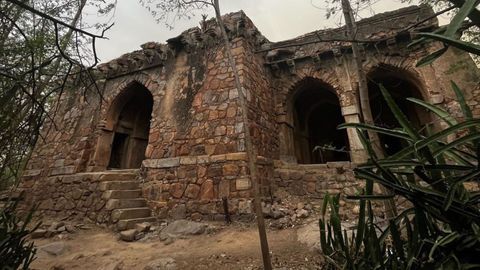
The story of the “Begum”, Princess and the jungle Prince, is a classic case of “news” which, when neither confirmed nor denied, takes root in the popular imagination. Public opinion then drives the government into action to minimize criticism. That is why Indira Gandhi in the early 80s agreed to transfer the “Royals” to a medieval hunting lodge on the ridge. It is known as Malcha Mahal.
Ali Raza, Prince
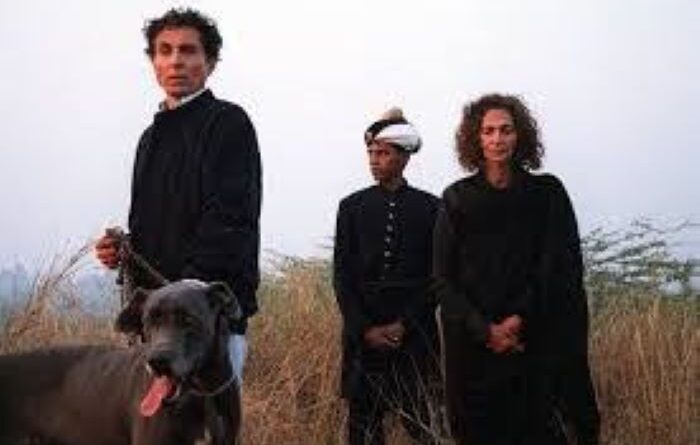
In the early 70s, a woman with sharp aristocratic features took up residence on platform number one of New Delhi Railway station and proclaimed herself the last Begum of Oudh. For greater credibility, she had in her entourage, two children, a handsome dog, and a liveried servant.
The mainstream media took a perfunctory interest but the Urdu press amplified the fall of the House of Oudh and readers, in enclaves like Jama Masjid, saw it as part of a continuing story of victimhood. Here was tear-jerking melodrama: “our royals betrayed”.
It says something of our journalism that a story laden with so much possibility waited unexplored for 40 years until Ellen Barry appeared. She tied up all the loose ends – the railway station Lucknow, Bradford, Texas, Lahore: and what a story she has delivered, a story under our noses but which we failed to see. This is not surprising because even our archaeology was excavated by Europeans. Why, even the Last Moghul, is something of a masterpiece by William Dalrymple. While Dalrymple diligently scoured archives in the fashion of scholarly investigation, the Oudh story was there for all newspapers and channels to see.
True, the story was, on the face of it, “fake” from the beginning. But what shames us, this hack included, is the fact that it required an outsider to tell up why the “fake” was being played out – across the subcontinent and two generations?
Toba Tek Singh in Manto’s story cannot understand how a place, which was in India, can “go” to Pakistan. Like Toba Tek Singh, Begum Wilayat of Oudh also spent time in an asylum for her grand delusion. She had to live with women who were “tied in chains”, Ellen’s investigations reveal for the first time.
Trust Saiyyid Ammar Rizvi, Lucknow’s omnipresent Shia (and gourmet in the classical Awadh mould) to has become something of an intermediary between the Royals and the UP Chief Minister. He must surely know about the other Royal in that splendid city – Prince Moinuddin, who also addresses himself as Bahadur Shah III. The last Moghul Emperor was his great, great grandfather: that is his story. His great grandfather escaped to Kerala. But why did Bahadur Shah III materialize in Lucknow?
Malcha-Mahal-Wilayat-Mahal
The Bahadur Shah story has remained unnoticed because the claimant to the title never made a nuisance of himself. Begum Wilayat Mahal did. When the New Delhi station master requested her to vacate the platform, she threw a fit. She would commit suicide by drinking some exotic poison. In fact, when she did die in 1993, her progeny tutored by her for decades, put out the story that, for a decorative expiry, she had swallowed “crushed diamonds”. Her daughter, Sakina’s death was presumably caused by neglect because there were stories of her unwashed hair dropping in matted locks. It was with the “Prince”, variously named as Prince Ali Reza, or Cyrus, who spent his last years in Malcha Mahal, that Ellen struck an equation of tenderness mingled with curiosity. Google her NYT piece titled “The Jungle Prince of Delhi”.
The yarn begins in Lucknow where Wilayat was happily married to the registrar of Lucknow University, Inayatullah Butt. The name itself is a give-away: it is a Sunni name whereas anybody claiming lineage from the Nawabs of Oudh would have to be Shia. A similar story of dubious veracity explains why the Butt’s left for Pakistan. During the high tension of Partition in 1947, Hindus armed with hockey sticks beat Butt up. I can bet my last rupee that the story is false. Yes, there was small-scale stone-throwing between Shias and Sunnis on appointed days annually. But Hindu-Muslim violence? Never – until caste politics reared its head in the late 80s.
The last king of Oudh (Awadh), Wajid Ali Shah’s exile to Matia Burj near Kolkata or the more recent Partition of India are disorienting events for those in the thick of it, by historical memory or raw experience. In minds like Wilayat Butt’s historical memory and immediate experience are all jumbled up in knots.
Is Malcha Mahal Really Haunted ?
Ellen believes that disruptions caused by a change (Partition for instance) had a great deal to do with the Butt tragedy. A grievance “unaddressed, had metastasized” to become an epic tragedy.
Wilayat was a “mental” as one of her relatives in Lahore said. Ellen has explored the story backward after she got to know the recluse “Prince Cyrus” in his Malcha Marg hideout. In the end, he turned out to be no more than Micky Butt. She writes of their sad delusion:
“It is impossible to know, now that he and his sister are dead, whether they even knew it wasn’t all true.”
Curated and Compiled by Humra Kidwai
source: http://www.theindiaobserver.com / The India Observer / Home> Diaspora> Editorial> India> Interface> Lifestyle / by Saeed Naqvi / edited by Adam Rizvi / Curated and Compiled by Humra Kidwai / November 29th, 2019
Dr Shahana A K, Ayurvedic expert in anorectal disease
The disease can mean pain as much as shame. This is especially so when it comes to anorectal diseases. Remedies are available in Allopathy but these are expensive and do not guarantee non-recurrence.
Piles free for five rupees….read the headline in a Malayalam daily recently. This claim was made not by an Allopath but by an Ayurveda practitioner in the Ksharasootra clinic of the Government Ayurveda Hospital in Chelakkara in Thrissur district.
The clinic and its head Dr Shahana A. K. have been attracting patients from different parts of the state and even from outside for treatment of anorectal diseases like fistula, hemorrhoids, anal fissures, and rectal prolapse. She treats them with an ancient method of ksharasootra which involves insertion of a medicated thread through the affected area or fistula.
The practice called Ksharasootra takes very little time and the patient need not even be admitted. The thread is replaced by fresh ones a few times till the patient is healed. It is simple, non-invasive, with no side effects, cost-effective, and leads to no recurrence of the problem unlike in surgery.
Dr Shahana doing a surgical procedure in her clinic
Sushruta is considered the “Father of Plastic Surgery” and lived in India sometime between 1000 and 800 BC. He is the author of the treatise The Suśrutasaṃhitā which includes unique chapters describing surgical training, instruments, and procedures in ancient India. One of the oldest Sushrutasamhita palm-leaf manuscripts is preserved at the Kaiser Library of Nepal.
Dr Shahana has been practicing this ancient Ayurvedic para-surgical process in the government clinic for the past few decades and her name has come to be attached to Ksharasootra. The success stories have been traveling through the state by sheer word of mouth, says the doctor. No one has tried to publicize it. People come here after hearing about it from people who have healed, she says.
Speaking of the recent item in a newspaper, she said: I want more people to know of the treatment so that they don’t fall victim to quacks, who spoil their cases forever and charge them huge sums.
After her BAMS (Bachelor of Ayurvedic Medicine and Surgery) she went on to do her master’s in surgery or Shalya tantra which had just three seats in the state colleges then. In Ayurveda surgery has many para-surgical procedures including Ksharasootra, rakthamoksham, ksharakarmamand so on.
Ksharasootra though devised by the father of Ayurveda Susruta centuries ago, the procedure has evolved over the years, she points out to this scribe.
As for why she opted for Ksharasootra, she says, “I wanted to use my education to help the maximum number of people.”
The world of anorectal diseases is a dark, quiet, and obscure one where patients suffer silently in fear and shame to disclose their suffering as it concerns their private parts. If the patients are women, then it is even more shameful to discuss this with doctors.
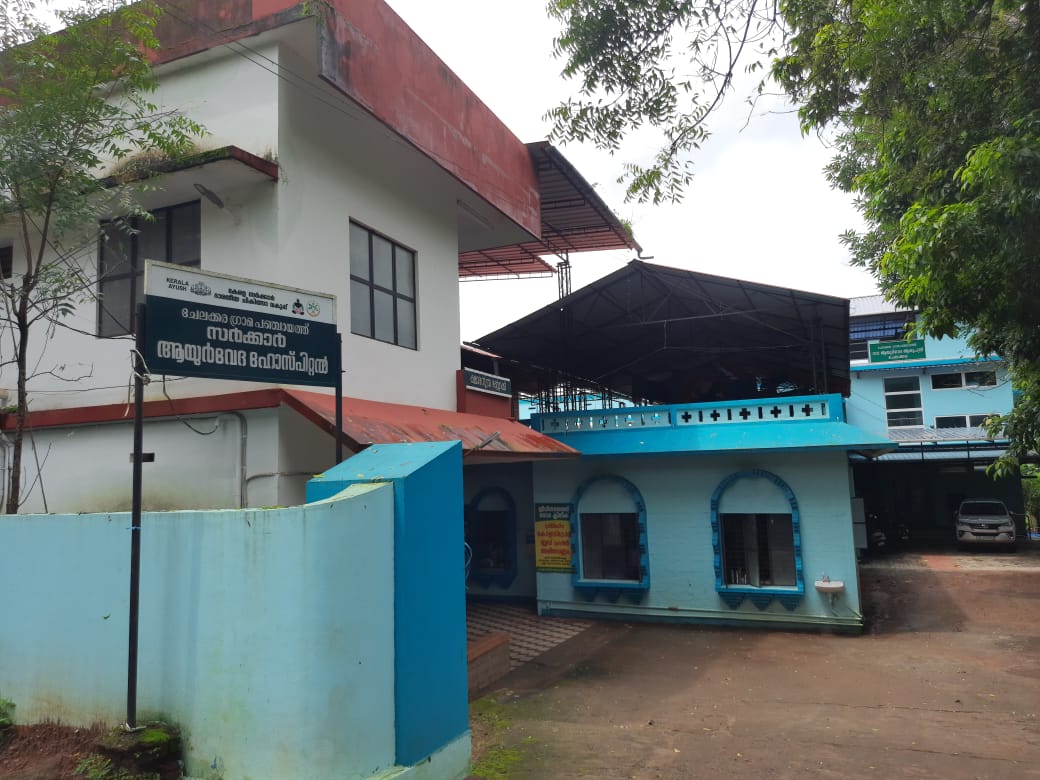
Chelakkara Gram Panchayat Government Ayurveda Hospital in Thrissur
Patients do get treatment in Allopathy and go through multiple surgeries as the piles or fissures recur. So they are drained of money by the time they turn to Ayurveda with a recurrent condition, she says.
“When I started working quacks ruled the roost, as they promoted themselves as experts in this ancient method and offered treatment for piles, fissures, and fistula without surgery. Patients still fall for their hype and lose a lot of money and their health,” she says.
The treatment for diseases like piles, fistula, or fissures is free in her clinic, while other government Ayurveda hospitals in Kerala charge a token fee. In private Ayurveda clinics, it can cost a lot.
The main advantage she says it does not cause incontinence. Since it is a treatment in the anal region, patients often lose control over their bowel movements after surgery in Allopathy.
The profile of patients suffering anorectal disorders has been changing dramatically she says. “Earlier there were mostly middle-aged people. Today there is no age difference. They come from every age group including youth and children. Poor toilet habits, stress, junk food, and lack of physical activity all lead to anorectal diseases in children even below the age of ten,” she says.
Dr. Shahana spreading awareness about rectal disease
These diseases are also occurring in pregnant women mainly because of the traditional food supplements they take for a healthy child. These days, women don’t have the digestive capacity and are still given meat supplements. So women who are already suffering from constipation get even worse and develop anorectal complications and come here,” she says.
Patients cut across caste and community and ironically every religious festival leads to a spike in the number of patients in her clinic.
Onam, Easter, Christmas, and Eid all cause a spurt in cases and aggravate of old cases. During the fasting month of Ramzan, patients suffer a lot as they eat very spicy and oily food to break a day’s fast. It aggravates these disorders, she says. In some festivals drinking of alcohol leads to a spike.
Her clinic is gearing up to observe World Piles Day on November 20 with awareness camps and posters. “We are trying our best to reach out to more and more people so that they are saved from quacks, she says. Often people go for self-medication, to avoid medical examination of their private parts. Or they go to quacks to avoid surgery. They don’t realize that often rectal cancer and piles show the same symptoms which only a good doctor can detect,” she says.
A bust of Sage Sushrut
The Ksharasootra clinic run single-handedly by her for the past few decades is to be declared a centre of excellence by the Kerala Government. This would mean more doctors and more funds. “Of course, I would have retired by then but the treatment facilities would improve,’’ she says.
Asked if there was a stigma attached to practicing Ksharasootra she agrees that the number of Ksharasootra practitioners is very few in the state. But she feels it is because very few seats are available for surgery or Shalyatantra. “Not everyone who does the course may get the opportunity or have the mental willingness to pursue this line. It’s not possible for everyone,” she adds quoting Susruta on the qualities required by a surgeon… shauryamashukriyataishyam…. meaning courage, fast and unfearing while being insightful of the patient’s condition.…
“As for me, I feel it is an opportunity to do some good. People come to me after two or three allopathic surgeries. Just recently I had a patient who had been operated on for piles and fistula eight times. He was mentally and physically shattered and hopeless. I’m able to bring these people, many of whom are on the verge of suicide, back to hope and normalcy, ‘’ she says.
She says her religion Islam or her gender does not discourage the work she is doing.
“Being a woman has been an advantage I feel as I can empathise with their suffering and approach patients with maternal affection and concern. As a Muslim the work I do is considered equivalent to devotion. Islam considers all good deeds done with good intentions as ibadat or devotion. These are considered superior to prayers or reading of scriptures,’’ she says.
Dr Shahana believes that if one has a job that allows doing good to the masses then one should do the maximum possible. “That is my policy. Often people ask me why I take so much trouble to reach out to these patients. I feel that for anyone like doctors or politicians who are in a position to do work for the wellbeing of the public and do not do it, then it is not appropriate for them to be in that position.”
The author is a former social-editor of Business Standard and is teaching in a alternative school in Andhra Pradesh
source: http://www.awazthevoice.in / Awaz, The Voice / Home> Story / by Sreelatha Menon, Thrissur / October 15th, 2024
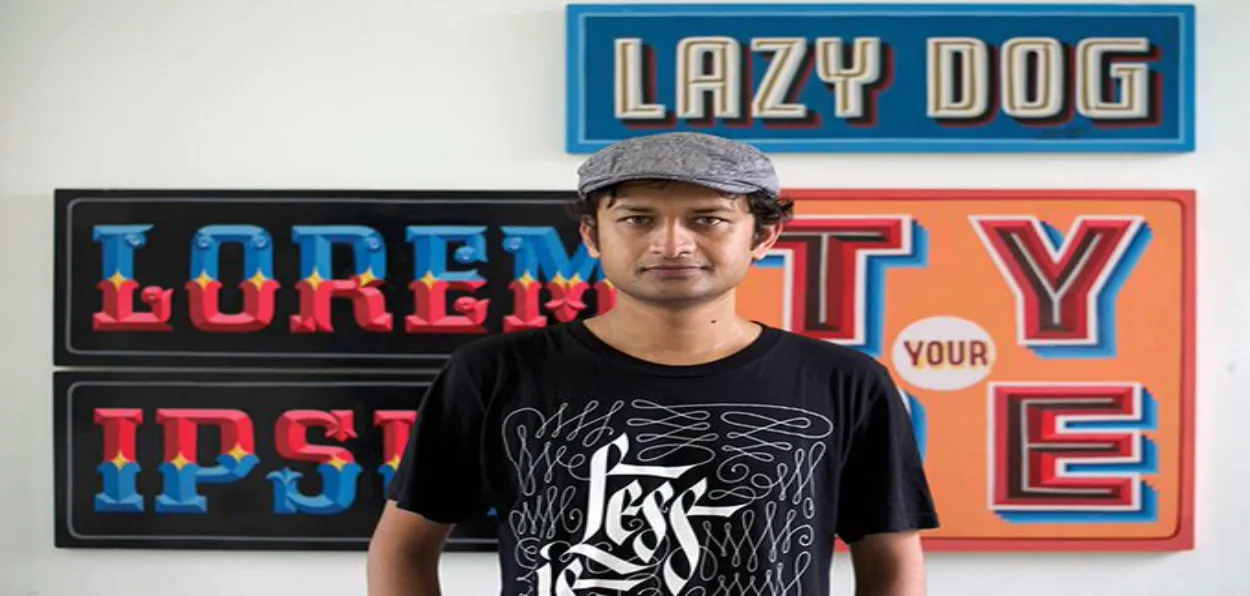
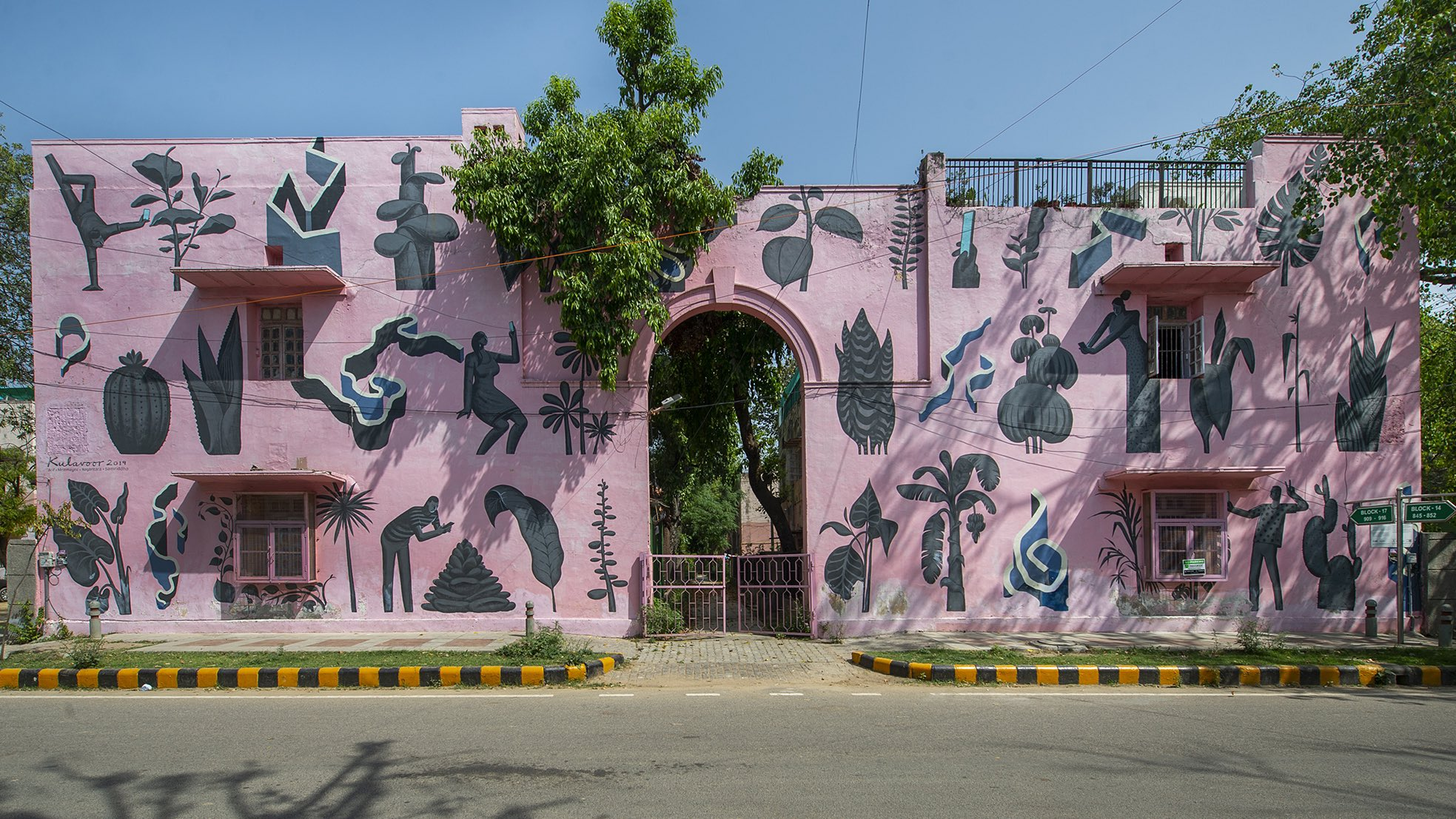
Have you walked through India’s first art district of Lodhi Colony in South Delhi where high walls along streets come across as vibrant art works? The man behind this and the street art movement of India Hanif Kureshi is no more; he passed away on Sunday at 41.
Hanif, an alumnus of the Baroda Art College died of cancer leaving behind a culture of vibrant public spaces and colourful neighbourhoods across India.
A wall in South Delhi’s Lodhi Road created by Kureshi
Kureshi’s quest for vibrant neighborhoods brought him to Lodhi Colony in Delhi in 2013, where the high walls and pedestrian-friendly lanes became a canvas for murals that quickly captured the community’s attention.
His death was announced on Instagram. The post read: “Hanif Kureshi, the man behind the Amazing street art you see across India has passed away…”
“Hanif Kureshi (@hanifkureshi) will forever be remembered as a visionary artist who transformed the urban landscape, one wall at a time.
After transitioning from advertising, Kureshi took the lead in shaping India’s modern street art movement and reviving the fading art of hand-painted typography.
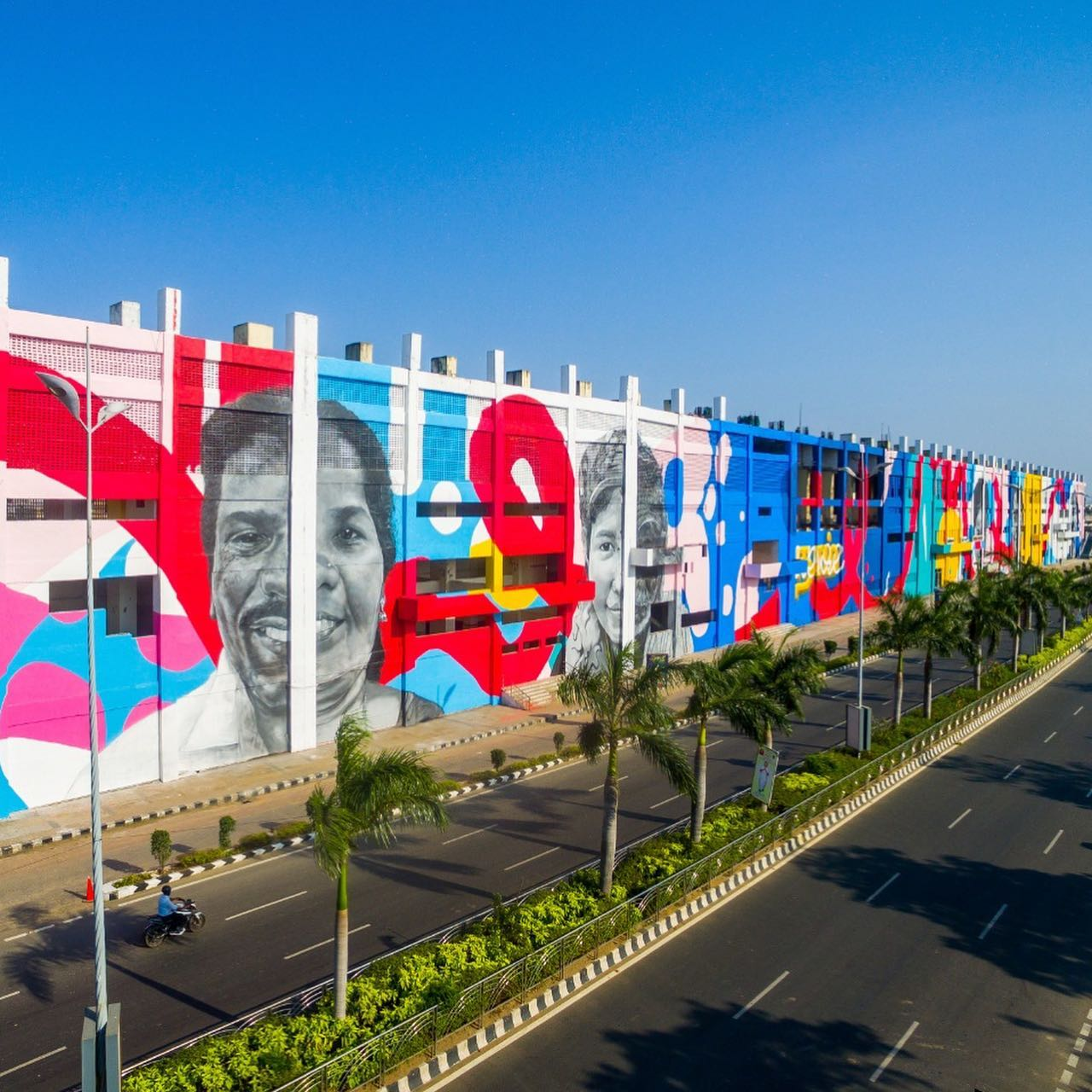
An art work created by HanifHanif Kureshi in Chennai
Through St+art India (@startindia), Kureshi and his co-founders built a community of urban artists whose projects have revitalized cities across India, turning public spaces into cultural landmarks. From the vibrant Sassoon Docks in Mumbai and the iconic Lodhi Art District in Delhi to Kannagi Nagar in Chennai, the Serendipity Arts Festival in Goa, and international showcases like the London Design Biennale, Venice Biennale, and Centre Pompidou, Kureshi’s artistic imprint is unmistakable.
In light of his untimely passing, we reflect on the enduring legacy Kureshi leaves behind—on walls, in typographic art, and throughout neighborhoods and communities nationwide.”
Hanif Kureshi co-founded St+art India and started giving shape to his vision in 2013. When he started transforming public spaces into vibrant canvases, he could not have anticipated the profound impact it would have across the nation.
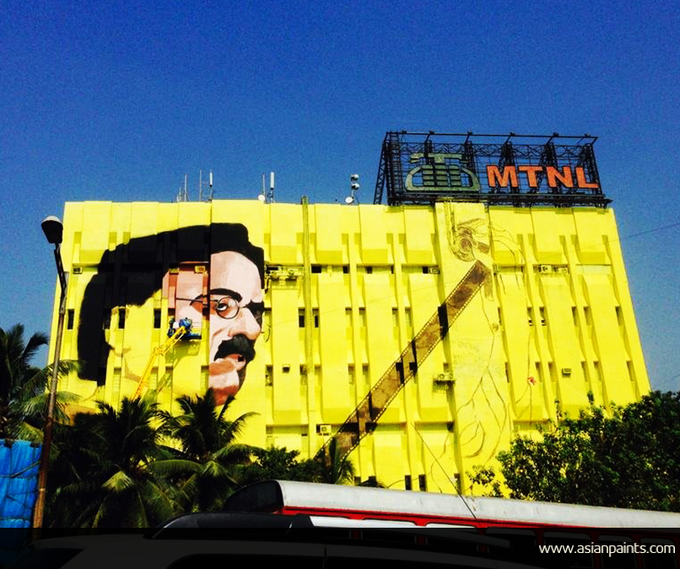
Asian Paints posted this image of Kureshi’s work on X:
@asianpaints / The MTNL building in Bandra has a shiny new coat of paint. Love the work by @StartMumbai / December 09, 2014 / 4.55 pm
This young visionary artist devoted his life to making art accessible to everyone. “Our aim is to make art more accessible. When you are working in an art gallery, your concerns are different, but this is art on the streets for everyone,” he said in an interview.
Kureshi was behind popularizing street art in India and setting up a model that has inspired countless artists.
According to Storyboard 18, art curator Rahul Bhattacharya, a close friend and former classmate at Maharaja Sayajirao University in Baroda, reflects on Kureshi’s unconventional approach: “He was constantly exploring new avenues.”
His journey began with an interest in sign-board painting and hand-lettering, leading him to seek out local sign painters and eventually digitzing their unique styles under the banner of HandpaintedType.
He launched St+art India as a not-for-profit organization dedicated to creating public art projects.
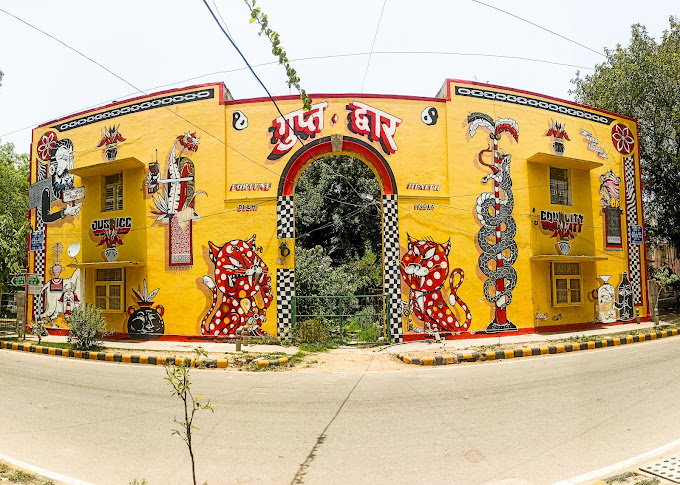
Kureshi’s first project was Lodhi Colony in Delhi where the high walls and pedestrian-friendly lanes became a canvas for murals that quickly captured the community’s attention.
Gupt Dwar by Kureshi’s NGO in Lodhi Colony
Gond artist Bhajju Shyam, who collaborated with Kureshi in Lodhi Colony, remembered him as modest and patient. “He was extremely sincere and listened to constructive feedback during our discussions,” Shyam noted, highlighting Kureshi’s collaborative spirit.
Kureshi’s St+art India has since organized numerous art festivals and painted murals across cities like Mumbai, Hyderabad, and Chennai, inviting both local and international artists to contribute. Kureshi was actively involved in his project including the installation at the Sassoon Dock Art Project in Mumbai.
Kureshi’s influence extended beyond borders afters he showcased his work at prestigious venues including the London Design Biennale and the Venice Biennale-. His recent solo exhibition at Wildstyle Gallery in Sweden in June 2023 impacted the world of art globally.
source: http://www.awazthevoice.in / Awaz, The Voice / Home / posted by Aasha Khosa, ATV / September 26th, 2024