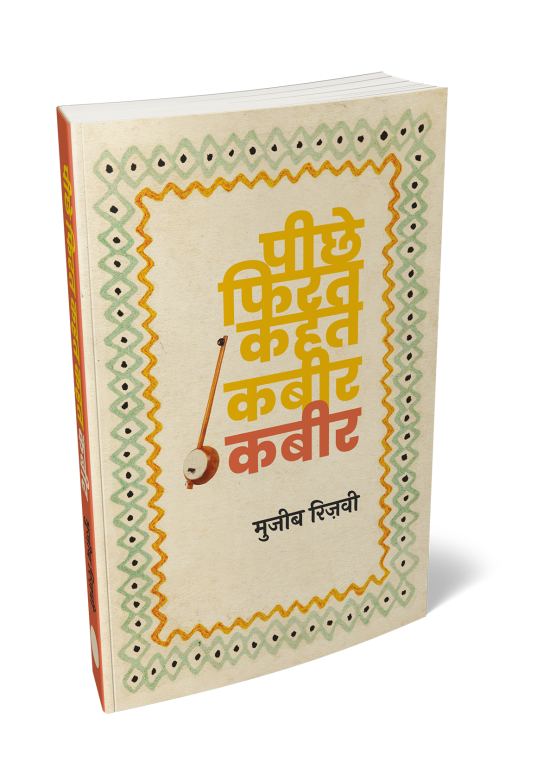
This essay, occasioned by the launch of a new collection by Mujeeb Rizvi, briefly presents his life before discussing the world of pre-modern Sufis and their poetry through the latest book by his favourite and foremost disciple Muzaffar Alam and Mujeeb Rizvi’s own forthcoming collection ‘Peechhe Peeche Phirat Kahat Kabir Kabir’. I have also drawn on the works of their common friend Professor Iqtidar Alam Khan, and on works by other scholars such as Allison Busch, Manan Ahmed and others.
The Poets, the Sufis and Jamia: On Mujeeb Rizvi via Muzaffar Alam
Jamia Millia Islamia Campus
Professor Mujeeb Rizvi came to Jamia in 1960 or 1961. It is typical of his style that we don’t know the exact date on which he joined Jamia. He did not often speak of himself. I don’t mean to say that he never related anecdotes from his life, which he did aplenty. He was full of stories about the old Jamia, about characters from Allahabad, about the teeming world of pre-modern saint-poets which he had made his own. But he spoke without boastfulness. He could do so because he was not egotistic, which saved him from the tyranny of seeking praise. Freed of that dependence on admiration, in other words on the desire for fame, he could be himself without ado. What he was is difficult to precisely define. He was a scholar who showed no eagerness to display his knowledge, a writer who picked up his pen with great reluctance, an ardent conversationalist who never sought anyone out, a man of action who spent his retirement confined virtually to his chowki. For someone who was often unkempt in appearance, he was remarkably suave.
The historian Muzaffar Alam says he was a kind of a Marxian Darvesh. But he was never eager to convert anyone to his Marxism or to his Darveshi. There was that lack of neediness, whether of company, comfort, or enjoyment, which is the hallmark of a Darvesh. There was certainly a continued critique of feudalism, from which he sprang but which he forever studied. There was a praxis without shrillness right through, without subjugation to party politics and its arbitrary dictates. There was an authority without a lust for power. There was a life of service without subservience. There was a sense of devotion without worship. There was love without attachment. Withal, there was contentment with being where he was and with what he had, even long into his retirement when the world had almost wholly stopped seeking him. He was there though, in a way I have seen few being there.
His self-containment did not come from a lack of attachment. He was quite attached to the Jamia as it was when he first wandered here. He would speak at length about Mohammed Mujib and other founding fathers of Jamia. His namesake Mohammed Mujib, the author of the famous classic–Indian Muslims, became Jamia’s second Vice-Chancellor after Zakir Husain moved to Aligarh to salvage the university from the tatters of Partition and all the ill-repute it had gathered because of that. Mujib saheb, like Zakir saheb before him, had been trained in Germany but both, like myriad other founding fathers, had given up lucrative offers to devote themselves to Jamia.
As is well known, Jamia Millia Islamia was founded in 1920, in a tent, by breakaway students of Aligarh Muslim University in the wake of Mahatma Gandhi’s Non-Cooperation Movement.
Jamia Millia Islamia in 1945
It aspired to be a Nationalist Muslim institution but sought to mould its anti-colonialism into a new vision of education. Zakir Husain was of course the architect of the Gandhian Wardha scheme of Basic Education in 1937 which promised a more holistic and desi approach to education. Under the scheme, a new pedagogical practice was envisaged where vocational training, adult education, agricultural knowledge, crafts, and the Arts were to receive as much importance in the curriculum as classroom learning. Even the classroom didactic was to be imparted in what was then called the vernacular languages. Despite its humble beginnings Jamia, which received no government funding or recognition in its early years, quickly achieved a reputation for its innovative approach and the sense of service exuded by its committed staff.
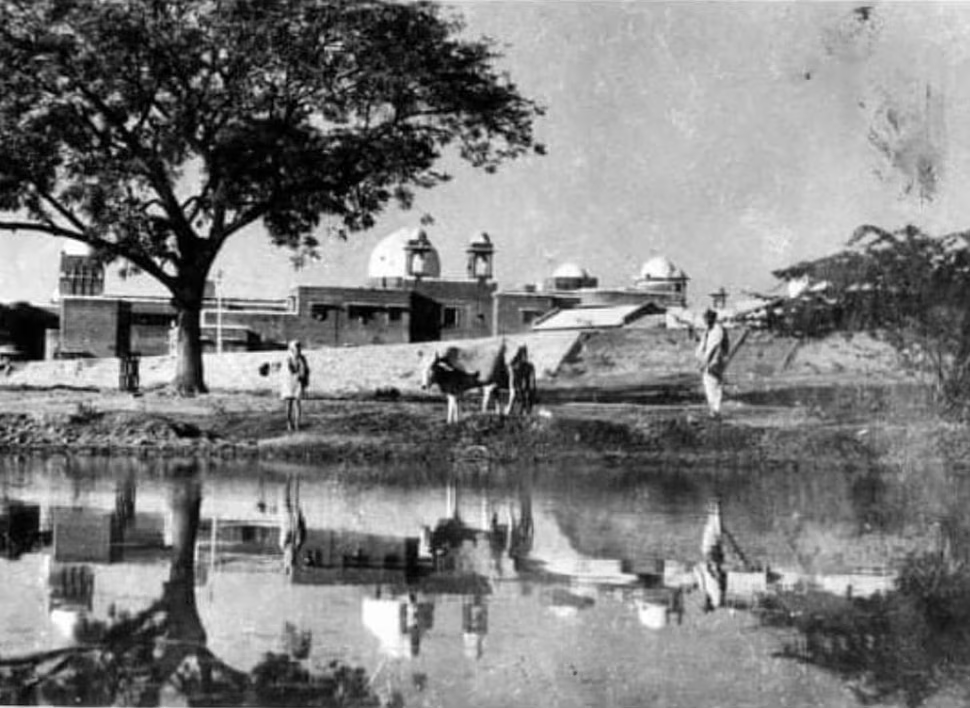
An old image of Okhla village.(PHOTO: WIKI COMMONS)
The first building of the university in Okhla (where the university is currently based) was a school which was established on 1 March 1935.
The riots of 1947, which destroyed much of its property, forced the move to the then village of Okhla. Since Zakir Husain and Mohammed Mujib were both accomplished writers of stories and plays, drama was an important part of the Jamia tradition long before Habib Tanvir first staged his Agra Bazar at Jamia’s Fine Arts Open Theatre in the early 1950s. Its education department also became famous because of its outreach program in the nearby villages of Julena, Jaitpur, Badarpur and Surajkund.
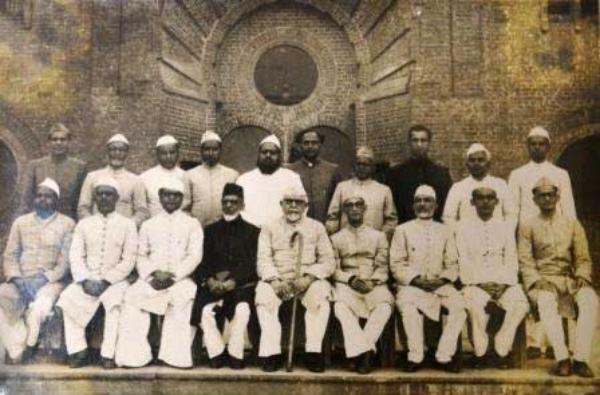
Faculty members of Jamia during the founders day celebration on 29 october 1957
It was here that he came in contact with freedom fighters of many different kinds including Mahatma Gandhi’s Hindi teacher Manzar Ali Sokhta and the august residents of Anand Bhawan which he frequented. I have heard him speak about Sokhta and his argumentative relationship with Gandhi, as well as relatively unknown anecdotes about the latter. One of them described the meeting of a top communist thinker who met the Mahatma and wanted to explain Marxism to him but was unable to do so because Gandhi forbade him from using any theoretical terms. Most importantly though it was here that he met the Gandhian Pandit Sunder Lal, a unique organic intellectual whose monumental two volume Bharat Mein Angrezi Raj , written at the same time as R. P. Dutt’s India Today, remains an undervalued tour de force. The story goes that when he first met Pandit Sunderlal, the latter asked him what he was up to and he said he was doing his BA. Upon hearing this Panditji’s dismissive riposte was that, ‘of course there is nothing better to do these days.’ Apparently the next day Mujeeb Rizvi visited him and tore all his educational certificates and said now tell me what to do. Pandit Sunderlal then said come work with me. His years and wanderings with Sunder Lal included a trip to Hyderabad to conduct an independent inquiry into excesses committed during the ‘Police Action’ of 1948 (the report of that inquiry is ‘missing’) as well as a trip to China as part of a delegation. Once at Sunderlal’s behest he had tried to render the Constitution in the speech of the common man and would test it with the coolies at the Railway station before earning Panditji’s approval.
The years between Allahabad and Aligarh, which he joined as a Master’s student in Hindi had also made him a leftist. By that time he had lost his father, and had given up his Zamindari and had turned his back on his village, never to return. He had come to Hindi too because of an exhortation by Pandit Sunderlal for Muslims to study it. In Aligarh he became great friends with a young historian Iqtidar Alam Khan who too was making rapid strides in Marxism and history writing along with another young man called Irfan Habib. Under Professor Noor ul Hasan, the writer of one of the most famous unpublished D Phil dissertations in Indian history, Mohammed Habib and K. A. Nizami, the Aligarh school of Indian history was already under formation. But Mujeeb Rizvi, long used to practical politics, was after more than class room education. He got involved in student politics and began to take out a handwritten magazine called Dost which conducted polemics against various kinds of orthodoxies and took on conservative Islamic groups in campus.
His best friend Iqtidar Alam Khan had inherited his leftism in some measure. His father was a famous poet called Ghulam Rabbani Taaban, a leading light of the Progressive movement who had caused consternation among the Pathans of Qaimganj in Farrukhabad by renouncing his Zamindari and by becoming a Communist. After he gave up his patrimony and disgraced his pro-British family by going to jail, organising peasants to revolt against Zamindars, and then by joining a party which openly denounced Nehru’s government, his search for livelihood took him first to Bombay and then to Jamia. There he came to head the Maktaba Jamia, one of the earliest, and longest-running, serious publishing houses in Urdu. Iqtidar Alam’s younger brother Iftikhar Alam and sister Azra Taban too were students at Aligarh and under Azra’s mischievous and irreverent gaze Mujeeb Rizvi, given his unorthodox views and ways, was quickly rechristened as Ajeeb Rizvi. However, during his frequent visits to Delhi with friend Iqtidar, Mujeeb Rizvi grew close to Taban Saheb and his redoubtable wife, and partner, Habiba. They both virtually adopted each other and in spite of Mujeeb Rizvi’s lack of concern with appearance, clothes, and other social proprieties, the bond became unbreakable after Azra and Mujeeb got married.
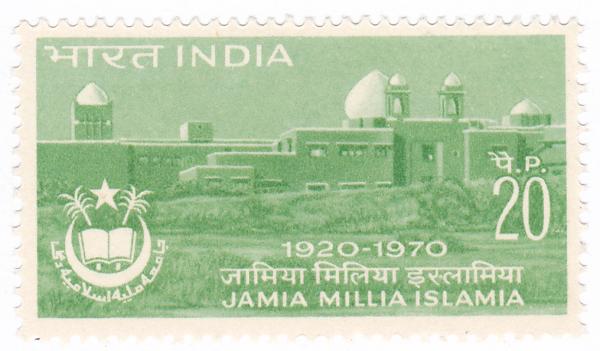
The Government of India issued a stamp on 29 October 1970, in commemoration of university’s golden jubilee.
Jamia was then a small but tightly knit community. The teachers were wholly devoted to the students and often even their meals were supplied by the university kitchen called the Matbakh. From the very beginning it laid a strong emphasis on co-education and its girl students quickly became famous for their style of dressing and their boldness. In her fine memoir Sughra Mehdi, long-time Jamia teacher and the best friend of Azra and Mujeeb Rizvi reminisces about living with her mamu the famous educationist and writer Abid Husain, whose wife Saleha Abid Husain was herself a notable writer. The fun, the learning, and the everyday leg-pulling she describes is touching. She writes about the thrill of being neighbors with Ghulamus Sayidain, the one-time Education Secretary (the brother of writer and filmmaker Khwaja Ahmed Abbas) whom Nehru often visited. Other famous houses included Zakir Husain’s son in law Khurshid Alam Khan (Taban saheb’s brother), Colonel B H Zaidi, the one time Prime Minister of Rampur, and former Vice-Chancellor of Aligarh, whose wife Qudsia Zaidi virtually founded the modern Hindustani theatre in the capital, and other famous administrators and professionals. Women who could speak with authority about literature and the Arts were conspicuous. Being at Jamia was to be more than a teacher or a student: it was to be involved with a mission, a vocation, a commitment. Jamia itself was a cause that its denizens passionately practiced.
It was in this milieu that Mujeeb Rizvi came to found the Hindi department at the university, while still completinghis Ph.D. under Professor Harbanslal Sharma at Aligarh on the medieval poet Malik Mohammed Jayasi and his magnum opus Padmavat. It was here that the famous historian Muzaffar Alam first encountered him as a Hindi teacher when he joined Jamia straight from a Madarsa in 1962. Mujeeb Rizvi befriended and groomed this young boy as he did countless others. His students were always to have the first call on his time, salary and attention. My mother-in-law Azra Rizvi often related tales about the familiarity with which the students would feel his pockets and take whatever cash they needed. But in these, and in many others matters, he was an otherworldly man. Muzaffar Alam recalls how he became a member of the Rizvi-Taban family, followed by innumerable others from several generations. Mujeeb Rizvi persuaded him to focus on History rather than English which he wanted to study for his MA at Aligarh. He has a vivid memory of meeting Iqtidar Alam Khan at Aligarh who looked like a firangi because of his fair complexion and who used to keep a portrait of Che Guevara in his room! Eventually, Muzaffar Alam did study History at Aligarh and also followed Mujeeb Rizvi’s advice to not work under Irfan Habib because he feared too many clashes between two strong personalities. Later it was Azra and Mujeeb who not only fixed a match for him but also acted as in loco parentis for his baraat. It was Mujeeb Rizvi who introduced Muzaffar Alam to the world of medieval Sufism, especially to the Sufi Premakhyans such as Jayasi’s Padmavat which he was then mastering. They would have discussions running into hours, often indulgently allowed by Azra, which ranged from history to literature, to politics. Mujeeb Rizvi remained a man of the oral tradition who always preferred to speak and discourse rather than write. It didn’t matter to him whether he was speaking to somebody important or not. He spoke always with the same earnestness and passion irrespective of the status of his listeners. He also never minced his words, nor did he doctor them to suit his audience. He was, therefore, free of dissimulation, as also of hypocrisy. Alam recalls that their conversations ranged from Persian poets such as Rumi to the past and present of the Indo-Muslim, of which they were both outstanding exponents.
There were other students and colleagues who attest to his selflessness. In his little book on Jamia, Hindi’s leading playwright Asghar Wajahat, who was also appointed to Jamia and mentored by Mujeeb Rizvi, devotes more than half of his reminiscences to the latter whose towering personality he brings alive with great felicity. Wajahat writes about his selfless devotion to his students and about his unconcern with fame. Mujeeb Rizvi’s collection of short stories in Hindi Ganga Se Gomti Tak had been quite celebrated and had contained blurbs by such luminaries as Bhairav Prasad Gupt and Amarkant. Wajahat who joined Jamia in the early ’70s mentions his frustration that not many in the Hindi world then knew about Mujeeb Saheb.
He describes an incident where he took Mujeeb saheb for a meeting with Raghuvir Sahay, one of the greatest living Hindi writers and the then editor of Dinman which was making waves as a high-quality Hindi literary magazine. Sahay was immensely impressed with him and offered him a regular space in the periodical but by then Mujeeb saheb was completely immersed in his teaching and with his expanding role in the University administration, so he remained indifferent to this opportunity. Wajahat’s tribute, which forms a part of the forthcoming book, contains many anecdotes about his refusal to engage in anything for personal advancement. He was offered teaching assignments abroad by the ICCR which he never took up. Once he took Wajahat to meet a top official in the education Ministry whom he knew from his Allahabad days. Seeing their closeness Wajahat was sure that had he wanted Mujeeb saheb could easily have become the Vice-Chancellor of any University he chose, but he never aspired for such posts. He even gave up the chairmanship of the department he had founded, despite knowing that the incumbent was not favorably inclined towards him. He despised flattery and was unafraid to express unorthodox views, for instance his low opinion about the Chhayavad poets in Hindi whom he found affected and lacking in poetic merit.
Like Azra, and like many before and after, Wajahat was keen that Mujeeb saheb should write more, or at least complete his pending Ph.D. thesis on Jayasi. Excuses piled up, one of them being the paucity of the particular German paper that he was used to writing on. Wajahat describes numerous trips to Chawri Bazar, and to factories and godowns, in search of that paper. Finally, the thesis was completed and he was awarded a Ph.D. in 1979 but resisted its publication. This resistance continued lifelong. He always had more manuscripts to look up—particularly one in Lahore museum—more compilations were needed, more research, more writing, more finishing to do before he would allow its publication.
Many maintain that had this thesis been published earlier, the field of medieval Hindi poetry may have been vastly transformed. Through his knowledge of Persian and its literary culture, he opened many vistas of study in what he called the poets of Bhakha, or Bhasha, the term often used by medieval chroniclers to designate North Indian languages or dialects other than Persian and Sanskrit. This allowed him to show how Persianised Jayasi’s overtly Sanskritised vocabulary actually was. Through this work, he opened up a new window into the pre-modern literary culture by showing the close interaction between the Persian and Sanskrit traditions in the works of the Premakhyan poets. I am not competent to assess the caliber of his scholarships but I will give a few vignettes from the forthcoming collection to illustrate the depth of his understanding of the interactions that shaped the complex literary and cultural world of the Indo-Muslim. Here he compares a Sufi’s beloved to Radha-Krishna love–
“The Sufi beloved is formless, does not manifest itself whereas Radha’s beloved has a material form, is of this world, therefore wasl’smamlabandi has a crucial role to play here. Sufi’s union is an act of imagination, yet to take place whereas Radha’s experience of union is an earthly fact, a truth. The emphasis on separation, pining, suffering as exemplifying love in Radha Bhakti tradition is a kind of novelty in Indian literary traditions because after the Sufi influence it became the predominant mode of worship.”
While discussing the aesthetics of an ideal beloved he takes us to Sanskrit poetry and tells us that,
“Valmiki and Kalidas compare women to forests. The beloved’s gait is a winding river, its waves are the cutting brows, the waves of the hair/braids are the waves of the Jamna, hair is peacock’s feathers, voice is cuckoo’s, waist is lion’s, breasts are snow-capped peaks, the walk is crane’s or elephant’s, hanging braids are cobras, eyes and mouth are lotus-like, the body is plaits of hair, the delicacy of the walk is wafts of breeze…the flowers of the forest such as Basant, chameli, jasmine flowers abound as similes for her…Parvati after her bath is like kanis flowers are blooming, her fair complexion, her comely body.” Altogether, ‘a woman’s body is like a forest in bloom for Kalidasa. Complete with rivers, mountains, creepers, birds, animals, clouds, the changing sky all are simultaneously present…Later on, the woman’s beauty is compared to a well-kempt forest…flowers and fruits become the tropes of imagery for her body part.’ He then shows how Khusrau retains some of these imageries and how flowers like Lala, Susan, Seb, Nar etc have been used by Khusrau. Apart from his work on Jayasi, and the collection that is now being launched in Hindi, he had produced a vital tract on Khusrau entitled Khusraunama for Maktaba Jamia and so he often spoke with authority about him. The convention is somewhat maintained by Jayasi because in his Padmavat and in folk songs to hibiscus, narangi, barhal etc flowers used as metaphors for beauty. Kabir also says teri kaya men guljar, using words from two different traditions.
However, Mujeeb saheb demonstrates that there was a fundamental change in the depiction and ideal of feminine beauty after the Persian-informed Bhakha poets came on the scene. Before the influence of Persian poetry, ‘ in the Indian aesthetic feminine beauty was praised as moon like visage, braids falling to heels, conch like necks, kumbh or kalash like breasts, wide waist, full and prominent buttocks, legs like banana trees, parrot like nose, elephantine gait, big and red lips.’ However, the Bhakha poets radically overhauled this aesthetics as ‘‘bookish face, thin, aquiline nose, sharp eyes, measured breasts—like golden orbs, a thin, lion-like waist, a doe like gait, these then became the standards to define beauty, and this was a huge cultural transformation.’’
n elaborating for us the world of the Sufis he opens up for us the vantage points through which they viewed Indian traditions and religiosity. For the Sufis Diwali Holi etc stand for the pleasure and joy flowing from the beloved’s pleasure or grace. Barkha is a sign of Ishq and marfat and Badri is a sign of the first manifestation of divine presence, before the world was created and secondary realities came into being. Just as Kari Zulmat stands for hijr i.e. black, that which cannot be apprehended. For Sufis there are three states of hijr: Neglect of God for the common seekers, for the special ones, consciousness of khudi, for the Sufis who have reached Baqa Billah, their body is a state of Hijr. Now if one listens to the famous qawwali Maula Saleem Chishti, the terminology makes much more sense.
In discussing Kabir he emphasises that Kabir’s language is not Saddhukari. He shows how it is deeply informed by Persian and also shows us for the first time Kabir’s mastery of technical Sufi vocabulary and how he changes his vocabulary depending on who his addressee is. When Kabir addresses Hindus he uses words like Yog, Brahmani mat, Vishnu mat etc. But there are a whole host of other Sufic terms that Kabir uses aptly and Mujeeb saheb provides us with a list:
He demonstrates how Kabir consciously translates Farsi compounds such as Sada kardan, bang dadan, bismil kardan, haramkari kardan, paimal kardan. Kabir’s familiarity with Farsi is also evidenced by such verses as Kabir panah-e khudai ki rah, digar dava neest and Purja purja hau pare tau na chhare khet.
Mujeeb sahebs’ major contribution was to establish how the Premakhyan poets such as Jayasi, Kutban, Manjhan etc translated Persian terminologies, compounds and expressions into Bhakha and coloured it in Farsi, so to say. They also used imagery from Puranas, Ramayana and Mahabharat, as also other new kinds of imagery which is not witnessed in Hindi poetry before that. In this language Qurani verses were translated, versified hadeeth translations were created, Sufi sayings were compiled, and the verses and couplets of such widely read poets as Rumi, Sadi, Firdausi, Nizami etc were so transcreated as to be rendered ‘at home’ in Bhakha/Hindav/Awadhi. Indic ideas about devotion, worship, poetry, aesthetics, the beauty of the beloved and the nature of union, were all mutually transformed in this new literary culture. Their works show how earthly beauty was exalted to a divine one. Anukampa or the search for divine grace, says Mujeeb Saheb, is the gift of Sufism to Bhakti. When Rumi says that,
Khud kuza o khud kuzagar o khud gil-e kuza khud rind sabukash
Khud bar sar-e aan kuza kharidar bar amad beshkast o ravan shud
Himself the vessel and the maker
Himself the clay from which it’s made
Himself is he that drinks from it
That breaks and spills it after he has paid
Rumi is actually echoing a line from the Gita which says that everything is actually Brahm–
Havan ki samagri bhi brahm hai, ghi bhi brahm hai, aag bhi brahm hai, havan karne vala bhi brahm hai, aur jo aadmi is brahm karm men laga hua hai vo bhi brahm ko hi pahunchta hai-Gita
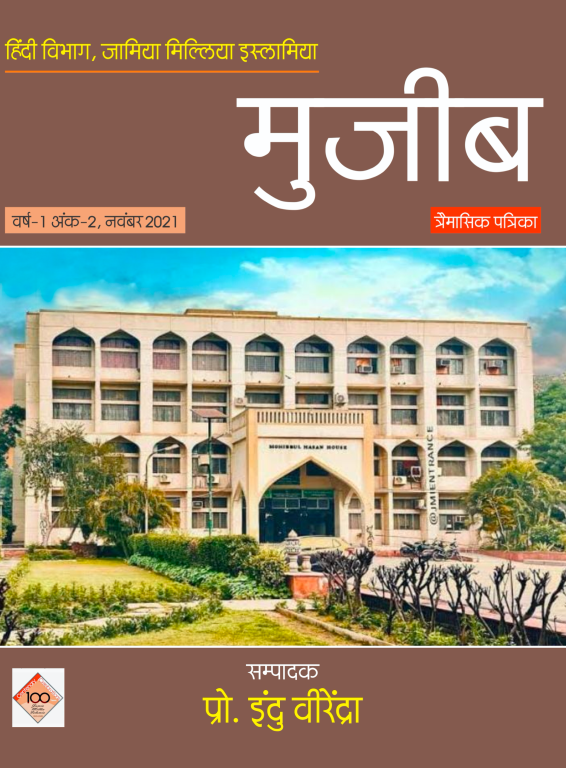
I write more about his book in the latter part of the essay. Both his lately published works are full of such profound insights about poetry, aesthetics and civilisational interactions. He always preferred to speak about these things rather than write. On occasion where he was forced to write a lecture he often didn’t remember to bring the paper back. Jamia was his life. He nurtured and built its Hindi department over decades. At his instance the department made many innovations in its curriculum including courses on journalism, communication, media and creative writing and the department has recently repaid its debt by naming a newly launched literary periodical after him, a rare honour.
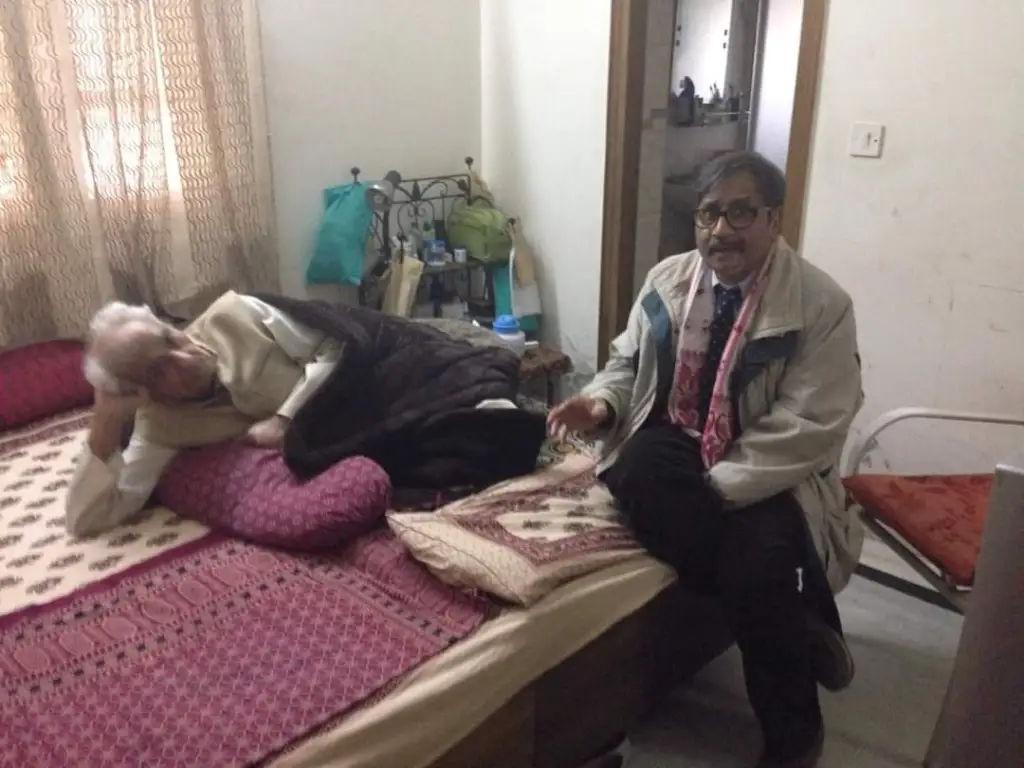
He worked here as the Dean, the Proctor, the Pro-Vice Chancellor and even as the Acting Vice Chancellor. He was an important, even influential, person at Jamia but even while holding immense power he somehow remained aloof from it. He was as comfortable at a board meeting with the elites as he was with a coolie or a house help. He strove to remake the world and to shake up the fundamentalists of all kinds, and ran a lifelong feud with orthodoxy of all hues, including the leftist ones. After his retirement he did not hanker for any extension or perks. He settled down in his corner, first at Zakirnagar in Jamia, and then at Sukhdev Vihar. He owed nothing to the world, and owned nothing except for a few books and a silver glass from childhood. He did not want anything from the world either. He was content to spend his time watching television, delivering the occasional lecture, and in being the beloved of his extended family. He was fond of arhar ki daal, ghee and sweets, but was content to eat whatever was presented to him, just as he wore whatever was at hand and met whoever chanced to come by.
I have written about those aspects of his life and personality here
The book we have in hand is owed substantially to my mother in law who collected these diverse essays, compiled them, had them edited, and then finally they were published as a book. We dearly wanted to bring this Hindi edition out for her, as much as for him, but it was not to be. The pandemic delayed its publication and then took her away before she could see its publication. We are sure that somewhere Aapa is saying to Abbu, look Mujeeb finally your second book is also out in Hindi and Abbu is faintly smiling, not with pride but with some amusement at all this vanity, which was never his style. He never yearned for fame, which made him truly self-contained. In what follows I present his world of the Indo-Muslim, its Sufis and the poets and how they have been written about, and how they are being written off!
Faham Agar Nabood Shunidan Ham Ghanimat Gir o Bas
Naghma Ha Bisyar Darad Taar e Mauhoom-e Nafas
Even if you don’t understand take hearing alone as prize
There are so many melodies bound up in these made up strings of breath
In his latest book Muzaffar Alam, the foremost historian of Mughal India, attempts to map the diverse nature of interactions between the Mughals and the Sufis, and the changing place of Sufism in Indian life over the last few centuries. Professor Alam has been associated with the Universities of Jamia, Aligarh, and JNU, but over the past quarter-century or so, he has trained a new generation of Mughal historians in the US from his position as the George V. Bobrinskoy Professor in South Asian Languages and Civilizations at the University of Chicago. Here he continues with some of the themes that he had expounded in his acclaimed monograph The Languages of Political Islam in Indiahttps://www.google.co.in/books/edition/The_Languages_of_Political_Islam/2ScgM07WiaAC?hl=en&gbpv=1&printsec=frontcover.
The Sufis are normally seen as otherworldly, or far removed from power, however powerful their own orders or Silsilas may have been. In his new book, which is a collection of different papers that he has written or delivered on related themes, Professor Alam offers a revisionist perspective and provides a comprehensive review of the many different kinds of interactions between monarchs, Sufis, political ideology and religious contestation. In this essay, I shall present and summarise the main themes discussed in Professor Alam’s work and in the works of his teacher and mentor Professor Mujeeb Rizvi, before I veer off into broader generalizations, some of which may be anathema to a scholar with the subtlety and sophistication of Professor Alam. I apologize in advance for that. But at a time when all Muslim legacy in the subcontinent, including figures like Akbar and the Sufi saints who made India home and created sacred geography in and of Hindustan Jannat Nishan, face hideous assaults, it would perhaps do to be a little unsubtle. But all of that is later. First his book.
The Chishtis were the dominant Sufi Silsila in North India before Babar’s conquest and were intimately associated with the Lodhis. Sheikh Abdul Quddus Gangohi, the leading Chishti Sufi acted as a Pir to the Lodhi monarchs and had a very wide following among the Lodhi nobles. Early in his career, he had to leave his native place Rudauli because of the dominance of local Rajputs who allowed ‘pork to be openly sold in the market’ and their other profane deeds.
A Hindavi poet sometimes known as Alakh Das, Sheikh Abdul Quddus also compiled a work called Rushdnama which employed Krishna and Vaishnav Bhakti themes as Sufi tropes for his disciples. He was asked to be present in Ibrahim Lodhi’s battle against Babar to pray for the Lodhis and after their defeat, he faced humiliation and punishment: Sheikh Quddus and his son had to walk all the way from Panipat to Agra as prisoners. He achieved some rehabilitation in Humayun’s time though and the Chishtis made a major comeback thereafter. We know about Akbar’s deep devotion to Muinuddin Chishti of Ajmer and to Shaikh Salim Chishti of Sikri.
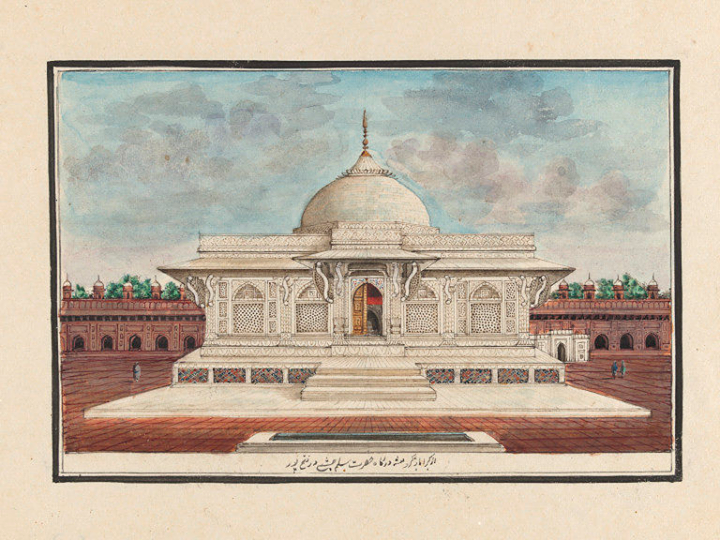
The tomb of Sufi Salim Chishti at Fatehpir Sikri, built in 1580, by Emperor Akbar
Akbar first learnt about the former when he was out hunting one night and heard some villagers singing Hindavi songs praising the saint. Akbar remained deeply interested in the achievements and miraculous powers of the saint. When he met the Chishti saint Sheikh Jalaluddin at Thanesar Akbar expressed his desire to renounce the throne and to become a Sufi. The Sheikh dissuaded him by saying that the justice that Akbar dispensed in one hour was equal to the prayers of a thousand Sufis.
Jehangir inherited Akbar’s bent and his association with Sufis and Jogis including Jadrup Gosain is well known. The latter was powerful enough to intercede for Jehangir’s rebellious son (Akbar’s favorite) Khusrau and to bring rapprochement between them. Abdur Rahim Khan-e Khanan the powerful Noble of the Akbari and Jehangiri eras used to even prostrate himself before the Gosain. Apart from his interaction with Sufis, Jahangir often expressed the desire to acquire knowledge of Hindu religion and mystic philosophy from the yogis who lived in his time. He was close to the noted Hindu saint Mehr Chand, a disciple of Akam Nath. Other Hindu mystics such as Kalyan Bharti at Kiratpur in Punjab, Mahadev, Sadanand and Trilochan Pal also find mention as mentoring different Mughal Nobles in this period. Shah Jahan too used to interact with different Sufis in order to study their path more deeply and to study specific Sufi texts with them.
Alam maintains that the policy of Sulh-e Kull, roughly peace with all, that Akbar enunciated as the reigning ideology of his Empire, found powerful support from many Sufis who were happy to legitimize Mughal rule. There had always been tension between Sufism and the formal Islam of jurisprudence, and some of that remained unresolved with an uneasy coexistence between adherents of both. But the dividing line between court and khanqah was not too hard. Sufi orders maintained close links with courts and nobles and some asserted that if the rulers showed an inclination towards Sufi beliefs then the populace would follow suit. Many Sufis also insisted on following the norms of the Sharia, on not deviating from fiqh, the religious laws, while still legitimizingSama, listening to music. Sufis such as Abdur Rahman Chishti from Rudauli, and Sheikh Mohibillah Qadri of Allahabad not only espoused the ideology of Wahdat ul Wujud, the oneness of all existence but also referred to Akbar and his descendants with veneration and used terms like Rahima Allahu, which are normally reserved for saints. This is underscored by the fact that Ibn-al Arabi, the great philosopher and theologian who first propounded the theory of Wahdat ul Wujud remained an anathema to many traditional theologians. However, many Sufis questioned the Sharia and opened the concept of Sunnat, the Prophet’s traditions, to include in it the Sufi masters’ way of life too. They also eschewed jurisprudential schools which dominated Islamic law, and went so far as to proclaim Muinuddin Chishti as a Prophet of India, and a friend of God and the Prophet. Some crossed the ultimate taboo and questioned the superiority of Islam itself. They maintained that for a seeker, a Salik, the model should be his pir, without much regard for schools of jurisprudence (fiqh) or dogmatics and scholasticism (kalam). Abdul Wahid Bilgrami, the author of the oft-read and quoted Haqaiq-I Hindavi, an important work of Hind-Islamic Krishnaite devotion, wrote in his Sab’ Sanabil—
“the whole world is a manifestation of love (ishq), and we see everything as perfect…As you begin iradat, (become a murid and join the order) you stop quarrelling over kufr and iman. There is no precedence of one religion over the other. After you experience the listlessness of unbounded Beauty you can see His grace present both in a kafir and a Muslim.’’
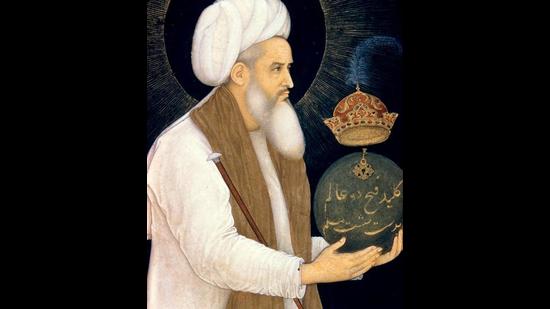
Moinuddin Chishti holding a globe; detail of a miniature from the Minto Album, c 1610-18. (Bichitr via Wikimedia Commons)
Abdur Rahman Chishti, a writer and Sufi who lived in the 17th century, was among the most outstanding Sufi scholars and ideologues of his time and Alam resurrects his vast gamut of writings to accord for us the full range of his engagements. Chishti energetically legitimised the ideological underpinning of Mughal rule through a variety of treatises. He knew Sanskrit, translated the Gita, wrote a history of the Sufis originating with Prophet Mohammed and wrote on two popular saints Shah Madar of Mankapur and Ghazi Miyan of Bahraich (made famous in the academic world by Shahid Amin in his outstanding monograph Conquest and Community.
“” Abdurrahman Chishti also created a work based, roughly, on the Bhavishya Purana, which tried to combine the Hindu and Islamic ideas of genesis. Alam discusses three of Chishti’s works in great detail, and thereby illustrates for us the variegated world of Indian Sufism.
Abdur Rahman Chishti grew of age after the Mughal and Chishti ideologies had come under severe attack from the newly arrived Naqshbandi Sufis from Central Asia. Powerful Central Asian Sufi saints such as Obaidullah Ahrar, had exercised immense influence on Babar’s ancestors, among other contemporary dynasts and had explicitly tried to train the monarch towards a stricter implementation of the Sharia. One of their descendants was Baqi Billah, whose disciple Shaikh Yahya Ahmed Sirhindi had openly castigated Akbar’s policies and his transgression of the Sharia, and had even been imprisoned by Jahangir for it. Chishti sought to rehabilitate the Chishtis and to demonstrate a close link between the Chishti’s spiritual conquest of India, via Muinuudin Chishti, and the Mughal political dispensation. Exemplifying this ecumenism is the Sufi emphasis that “we should appropriate the good thing and the good word (sukhan I nik) from each community. This is the message in the hadith of the prophet, take what is good and pure, reject what is dirty and impure: khuz ma safa da’ ma kadir.” (As an aside, this finds some equivalence in the Vedic mantra Aano Bhadra Krtavo Yantu Vishwatah “Let noble thoughts come to me from all directions” Rig_Veda 1.89.1) Chishti maintained that while Mohammed was a Nabi i.e a Prophet of God, who conveyed God’s words to the world, he was also a Wali, a friend of God, and he passed on this aspect of his Prophethood to Ali and through him to the Sufis who came after him. The Sufis therefore were themselves autonomous exemplars of religious practice, whether in the domain of laws, conduct or practice. It was owing to the Chishti Sufi endorsement and exposition that the Mughal policy of Sulh I kull was not confined to the court alone but actually influenced the thought and practice of wider range of actors in Mughal India.
Chishti’s biography of Shah Madar, a Syrian jew convert to Islam, narrates how Shah Madar received direct instructions in faith from the Prophet, from Ali and from Muinuddin Chishti when he arrived in India.
Shah Madar became a Samad, someone who was above the need to eat or bathe, whose face was so refulgent that he kept himself hidden. Several stories relate to his supreme prowess including how it was only after the Prophet said Dam Madar that he was able to enter heaven during his ascension and tour of the universe. His followers consumed bhang, did not pray, kept matted locks and included many Hindus. One memorable anecdote describes the Prophet Mohammed meeting a group of 40 naked ascetics who ignore him until they require his turban for their bhang preparation. The turban becomes green after bhang is sieved through it, and Mohammed learns the divine secrets after he consumes that bhang. Shah Madar’s followers were bi-shara’, outside the boundaries of sharia but for Abdur Rahman Chishti his ecumenism followed the practice (suluk) of the companions and the followers of the Prophet of the very first Islamic community. This is why the ulama I zahir, the theologians obsessed with outward reality (as opposed to the Sufis who pursued the hidden, or the batini truths), were prejudiced against him and condemned him. Some called him kafir, some shia, some renegade, eventually they were all shamed into submission, as maintained by his followers. Anyway their condemnation didn’t seem to affect his popularity, then or now.
As Alam writes in his earlier treatise The Languages of Political Islam in India, there were other heterodox Sufi sects too–
“The Gurzmars, a branch of the Rifa’is, carried maces, and with them inflicted wounds upon themselves; the Jalalis took hashish, ate snakes and scorpions, and allowed their leaders’ sexual promiscuity with female members of the order. The Qalandars shaved their heads and facial hair, used intoxicants, and sometimes roamed naked; the Madaris consumed hashish, rubbed ash on their bodies, and wandered naked. The Haidaris adorned themselves with iron necklaces and bracelets and wore a ring attached to a lead bar piercing their sexual organs, thereby eliminating the possibility of sexual intercourse.”
The author of Dabistan-e Mazahib, a 17th century compendium on different kinds of religious practices in North India writes about a group among Hindus who call themselves Musalman Sufis and they share several beliefs and customs with Sufis–
“foremost among them are the Madaris, who like the avadhuta have long matted hair, smear their bodies with bhabhut, wear chains around their necks and heads, wear black turbans, and carry black standards..they don’t recognise the value of namaz and roza, sit on front of fire and drink copious amount of bhang…the most exteme among them don’t wear any clothing even in extreme winter in Kabul and Kashmir”
Some of these practices continue. I have seen some black turbaned, bhabhoot wearing Madaris go house to house on Eid in Batla House for several years. In Pakistan dhamal, an ecstatic dance, remains an important part of rituals associated with Sufi shrines. The Pakistani radical poet Sarmad Sehbai remembers interviewing some hashish smoking truck drivers outside one such shrine who said that while namaz is farz, an obligation, their obeisance at the Sufi’s shrine was ishq, love.
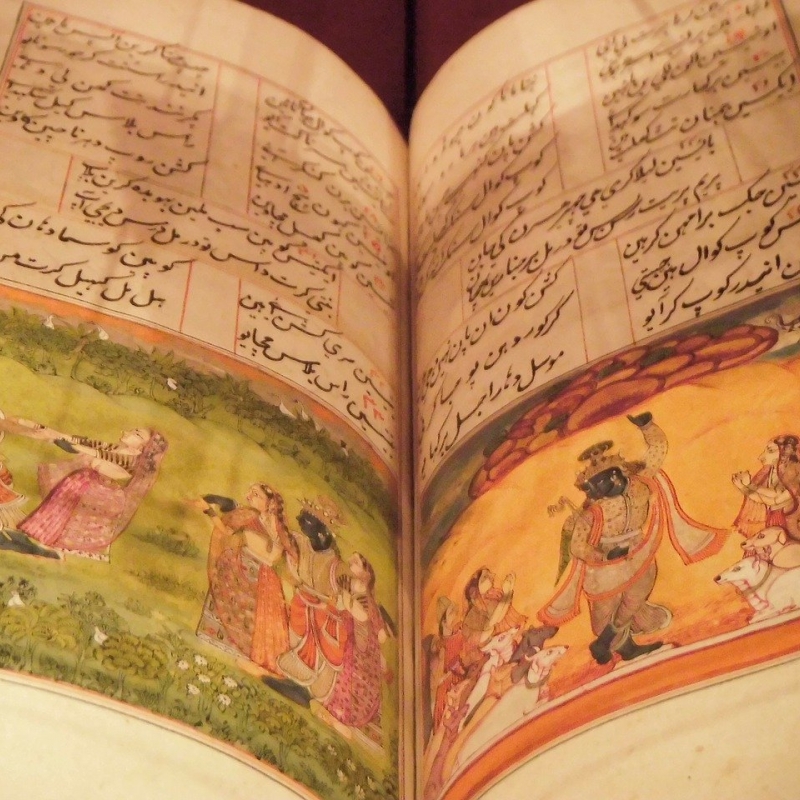
Bhagwatgita in persian
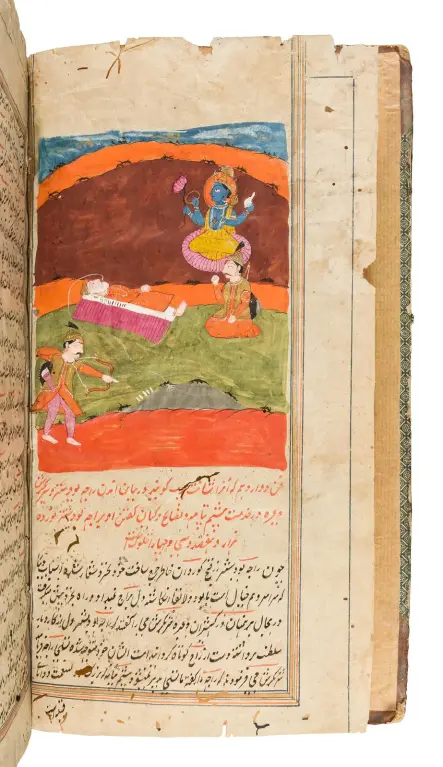
Abdur Rahman Chishti showed considerable familiarity with the Sanskrit philosophical canon too. By the 17th century, a vast corpus of Sanskrit texts were available in Persian translations. These included epics, stories, philosophical works and literary criticism. The growth and dominance of Braj in the 17th century, which owed much to Mughal patronage, also ensured a transference of substantial Sanskritic learning to Mughal courts. Amir Khusrau, who claimed to know Sanskrit, had benefited tremendously from his close association with Vishwanath Shastri, a polymath associated with the Khilji court. Hitopdesha, Katha Saritsagar, Shaptasatak, and several other works of stories were already available in Persian translations before Akbar had the Mahabharata and the Ramayana rendered in Persian. These enabled Abdur Rahman Chishti to not only translate the Gita but also to mine other ancient texts when he came to compose Mirat-I Makhluqat, a very unusual account of the origin of the world which combines Islamic and Hindu cosmogonies.
Chishti presents Mirat I Makhluqat as a dialogue between Mahadev and Parvati which is overheard by Vashisht. He claimed that his work was a Persian translation of a Sanskrit original by the sage Vashistha, the Malfuz-e Biashisht although no such work exists. Chishi maintained that he had read several well-known Indian history books and scriptures written in antiquity in search of an account of Adam, the father of humankind. He found the Malfuz I Bashisht which outlines the births of Adam and Muhammed along with others such as Mahadeva and Krishna. He says,
“Bashisht was an accomplished member of the community of the jinns and had a position of muni. Muni in their terminology is used for Prophet. Bashist communicated the knowledge to that community having received it from Mahadeva, Mahadeva was Abul jinn, father of the Jinns and he was the principal Prophet Rusul i Mursil of the jinns. Tabari and other historians agree that there were Prophets amongst the jinns for their guidance and education…The quran says, ‘and the jinns we had created before from the fire of a scorching wind’…the author of Rauzat al safa reports from Ibn Abbas a cousin of the Prophet that the name of Abul Jinn was soma with the title of jann and that in the book of Adam it is written that jann’s name was tamus, they have all mentioned the four ages or zama as four cycles of the stars.”
According to Islamic time, Adam was born some 8000 years ago, but Hindu mythology centers around the concept of Yugas, which are cyclical and run for hundreds of thousands of years. Chishti mines Islamic traditions to show that there has been more than one Adam, and that there were many eons of jinns before the birth of Adam. In this cosmogony, Allah the Qadir-e Mutlaq creates Brahm, who then creates Mahadev and other jinns and after they became wayward in the Dwapar Yuga, Mahadev retreats to Kailasha and Krishna helps Mohammed re-establish the righteous path on earth. Hindus are descendants of the jinns and are therefore cognate with Muslims. Alam shows us Chishti’s extraordinary familiarity with some key aspects of Hindu scholasticism. Udayancharya, a major early philosopher who composed by Nyaykusumanjali, is regarded as the first systematic account of Nyaya theism and Udayana develops arguments against the epistemology of the Mimamsa tradition, the founder of which is said to be Jaimini. These nuances have been captured by Chishti.
“the second ashlok in the treatise Kusmanjali of Udayancharij refutes the position of Jamin. Jamin says “I do not accept the argument of creation (khalq), the soul is eternal (azali) and no one created it; it comes into existence and goes off on its own (khud ba khud). Shankaracharya refutes this. He says ‘your yourself admit of the atman and parmatman, these mean soul and eternal God.’
Chishti regards Vyasa and Jabal as supreme theologians and Gautam and Jaimini as mere philosophers who have gone astray. He summaries Shankaracharya and rebuts reincarnation and asserts that Plato too was Gautama’s pupil. This is not entirely fictitious for Alam glosses that there is a fragment from antiquity that claims that Indian philosophers taught Plato some theological truths, via Socrates. He adds that
“ Islamic philosophers have also noticed the similarity of the Indian and Greek ideas of transmigration and in some cases sought to show a diffusion of ideas. For example, Suhrawardi in his ‘Philosophy of Illumination’ places the doctrine of the Pythagoreans and Plato on re-incarnation in the mouth of BODASAF, the Buddha—some historians and philosophers traced the Indian idea of reincarnation to Pythagoras, via his disciples who are said to have visited India.”
Buddhist Shamans were known to early Muslims and some have surmised that the word but for idol could have come from the Budhha himself. Some modern Islamic scholars also aver that the mythical figure Zul Kifl, mentioned in the Quran could be a reference to the Budhha, and the invocation to the one associated with the fig tree in the Quran (Watteen 95.1) is possibly the Budhha himself. (Dr Mohammed Hamidullah Khutbat-e Bahawalpuri) In a similar vein, in the introduction to his translation of the Gita, Chishti maintains that,
“I call this treatise Mirat Al Haqaiq, which is known in Hindawi as the Gita, in which Krishna explained to Arjuna, by means of examples, the secrets of Tauhid. Byas collected and put together that explanation in order to instruct people. All the learned Hindus agree that Krishna has taken the secrets of knowledge of the unification of god from the four Beds and has revealed this explanation in the Gita. So just as the enlightened shaykh Sufi Qutub Jahani once wrote a commentary on the Kashf Al Kunuz, also known as Yog Vasishta, so I am doing this translation in Persian.’’
Alam reckons that since Chishti’s milieu presented him with conflicting cosmologies and theological principles therefore he wanted to craft something that could bring the Hindu and Muslim cosmogonies together. In the process of picking up strands from pluralistic traditions within each faith, he broke down the monolith of each and tried to bring them together without conceding the superiority of Islamic belief. In his world God manifests Himself in Krishna, comes down to earth to fight the forces of evil, but Krishna is not God himself. Indic Gods and sages are depicted as Prophets, but Islam remains the superior truth, one which is known to Hindu scholars who have however concealed it from the world.
We all know about Dara Shukoh’s penchant for the Upanishads and Vedantic thought which according to him shared similarities with Wahdat Ul Wujud orientations. Dara was very close to the Hindu saint Babalal and had already commissioned and created translations of the Upanishads known as Sirr-e Akbar. His comparative study of religions Majma Ul Bahrain had also been translated back into Sanskrit as Samudra Sangam. Dara says that one day he had a dream in which Vashisht appeared along with Rama where he introduced Dara to Rama as his younger brother and bade him share sweets with the former. It was then that Dara decided to translate Yoga Vashishta, a philosophical appendage to the Ramayana into Persian, although it already existed in Persian. One of those earlier translators Nizami Panipati had written about how the work was commissioned–
“Prince Salim is inclined towards tasawwuf despite mulkdari duties. Scholars of Arabic, Persian poetry and prose, Historians, and Hindu pandits all assemble at his evening gatherings…Important works such as Rumi’s Masnavi, Zafarnamah, Waqiat i Babar [etc] are discussed. He desired Yog Vashishta translation so I took charge…the contents of this book were obtained from Patahan Mishra Jaipuri, and Jagannat Mishra Banarasi without any addition or interpolation.”
At the core of this philosophical dialogue between Vashishta and Rama is the struggle to gain liberation in life i.e. jivanamukti. One could attain enlightenment by thought alone, and without renouncing the world. It stresses that a “non-ascetic freedom in action is not only possible but desirable on the basis of thought, and on the kind of rational inquiry exemplified in the work. It is not spiritual praxis, or ritual, or even meditation that promotes freedom, but thought, which can in principle be engaged in by anyone, irrespective of social status, eligibility or entitlement to Brahmanical norms.” The text particularly appealed to rulers who were caught between the demands of vairagya i.e. detachment from power and the need for power to propagate these very values. Their dilemma was celebrated as vichara, an achievement, and not a symptom of confusion.
Anecdotes about the text abounded, especially about how it bolstered medieval rulers like Yashovarman and Zainul Abidin of Kashmir to others. So why did Dara commission a new translation of it? Alam convincingly shows that he did so because he wanted to present a new model of Kingship, a new ideal that could combine Sufistic principles with the responsibilities of running a kingdom. Where Akbar had been content to learn from the Mahabharata or the Ramayana, Dara was willing to go much further and present himself as a successor to those traditions. His translation brought to bear other texts, commentaries on the Gita, Yogasastra, and even the Puranas.
Several scholars were involved, including many pandits who dictated the text to others who in turn transcribed it. One of the translators, Banwali Das Wali also known as Baba Wali Ram was also the Persian translator of Prabodha Chandroday, the great Sanskrit play by Krishna Mishra. Dara sought to present the text as an account of an exemplary Royal figure who could combine reflection and detachment alongside fulfilling his royal duties. Rama is presented as an ideal spiritual master and an ideal king. The translation showed that Dara intended to model his future kingship on Rama. The work found a ready ecology in Sufi doctrines since it had affinities with Ibn Al Arabi’s philosophy, and was therefore immediately at home. The conversations, says Alam, often seem to be a dialogue between Sufis where words like fana, baqa, wujud abound. Here is an example–
“O Ramchand, when you are in the company of the people of the Sufi path (suluk) and struggle to study the books of the science of the sufiya that is when you quickly achieve knowledge of the self, ma’arifat i nafs, which is the prime objective, and which you can never achieve through ages of hard work. O Ramchand the survival and annihilation of the world, which means eternity (baqa) and transience/morality fana and the qiyamat and ba’s are because of your ignorance. When you discover haq the world disappears and you see absolute nothingness, thus the source of wujud of alam is ignorance and its annihilation is the fruit of gnosis.”
Another translation of the Yog Vashishta was contemporaneously done by an Iranian poet Findriski who learnt Sanskrit and directly translated from a precis of the text also known as Mokshopaya or Mokshopayasar. In his prefatory praise of God he describes Brahm as ‘absolute light, pure reason, joy embodied, which descended and thus left its Absolute position to create the world of duality and plurality. ’ Findriski compared the text to the Quran in the following verse–—
” Hamchu aab ast in sukhan bi Jahan
Pak o Danish fazai chun quran
Chun zi quran guzashti o akhbar
Nist kas ra bi din namat guftar
This book/speech (sukhan) is for the world like water
Pure and wisdom giving like the Quran
When you have passed through the quran and the traditions of the prophet
From no one else is a speech of this nature
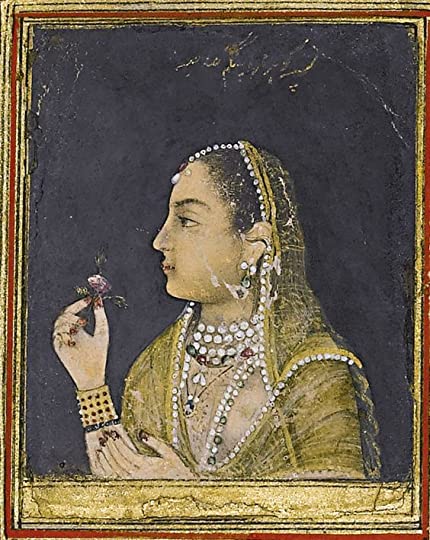
In an essay on three Mughal princesses who were closely related to Aurangzeb, Alam writes about the important role played by women in the Mughal court and society. They interceded with emperors, arbitrated in conflicts, negotiated between opposing parties, and mediated a relationship between temporal and sacred order. Shahjahan’s two accomplished daughters Jahanara and Roshanara were aligned respectively around Dara and Aurangzeb. The third woman under discussion here is Zebunnisa, Aurangzeb’s daughter, who was also an accomplished and oft-cited poem with the pen name Makhfi. All three conducted extensive correspondences with Sufi saints of different orders. Jahanara who was the elder, and was very close to Shahjahan, enjoyed considerable clout at court and traveled extensively. She was passionately attached to Muinuddin Chishti whose shrine she often visited and where she also built several structures. She searched high and wide for a Pir of her own, and eventually exercised her own judgment in choosing Mulla Shah Badakhshi in Kashmir. Jahanara was highly educated and wrote two works, a Tazkirah of Sufi saints called Munis ul Arwah, and Risala-e Sahibiya which is partly about her Pir Mulla Badakhshi and partly an insight into Jahanara’s spiritual views and practices, i.e. zikr-e ahwal e in zaifa.
Jahanara begum, eldest daughter of Shahjahaan
Jahanara was a public figure in every sense of the term. She gave endowments to charities, constructed mosques and other public buildings, amassed libraries, invested in ships, conducted her own businesses, and interceded in public affairs. Aurangzeb allowed her to stay with Shahjahan after he had imprisoned the latter in the Agra fort and despite her support for Dara allowed her the most important ceremonial role in public affairs. According to some accounts she advised Aurangzeb against the imposition of Jaziya. She was allowed to build her own palace in Delhi and had willed her very substantial income, valued up to 3 crores, to charity. She is quite explicit that her gender was no bar to her spiritual status. As a poet, an intellectual, a scholar, and a salik, or Sufi, one’s gender didn’t matter. She maintained that women too could become an embodiment of perfection despite their gender, insan-e kamil agarchi zan ast. In this state both men and women, chi zan wa chi mard, may be graced with spiritual boons, for God does not discriminate between His friends along with gender. She quoted the great Persian poet Attar on Rabia, one of the earliest Sufis and one of the most renowned mystics of Islam:
An na yak zan bud bal sad mard bud
Pay tu sar jumla gharqi dard bud
She was not a single woman but was equal to a hundred men.
From head to toe she was totally immersed in pain [of love of god
Jahanara’s role as an intellectual is well established in contemporary Sufi accounts and literary works. European travelers who picked up the gossip in the bazar also attribute to her important political roles. She was unhappy with Shivaji after he sacked the port of Surat where she had her own ships, but bazar gossip also attributed Mughal women’s infatuation with Shivaji and how they helped him escape his confinement in Agra. Other kinds of gossip prevailed about illicit sexual relations between Shahjahan and his daughters and even the love between several Mughal princesses and Shivaji. These myths persisted till as late as the 1920s when Kalicharan Sharma published his Shivaji Va Roshanara in Hindi. A similar story persisted about Aurangzeb’s daughter Zebunnisa.
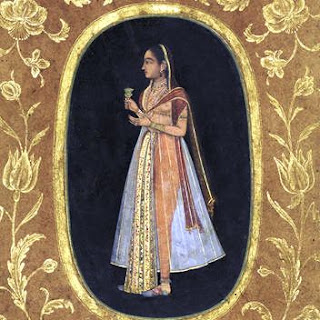
RoshanAra begum
Roshanara, Shahjahan’s other daughter, who was closer to Aurangzeb also maintained an extensive correspondence with Sufi shaikhs, in particular the descendants of Shaikh Sirhindi who were hardliners compared to the Chishtis. Zebunnisa, Aurangzeb’s favorite daughter too conducted detailed conversations on Sufi thought and philosophy with her perceptors. Despite his love for her Aurangzeb had her imprisoned after she supported his son Akbar’s rebellion. Letters by her Sufi teachers emphasize the importance of pain, suffering, and lamentation, even going so far as to say that mourning invites blessings from the Prophet and by God. Zebunnisa was a well-regarded poet and participated in and shaped the literary culture of her times. All three had enjoyed extended education in Arabic and Persian classics and all of them had also been exposed to ‘a variety of secular and religious influences within the broad framework of the Sunni Islam which dominated the Mughal court.’ Alam shows that
‘for elite women in Mughal India family was not destiny. Women neither mentally secluded within harem nor insulated from the world nor devoid of literary training and education.’
The fact that Sufis took considerable care to correspond with these Royal women, to guide and instruct them, and even to treat them sometimes as equals show not only their importance in court but also the Sufi interest in maintaining influence in the Royal household with both women and men. That they took their spiritual journeys seriously and were accomplished enough to discuss abstruse technicalities and complex philosophical ideas on equal terms also show the seriousness with which they were treated by their contemporaries. Even the normally paranoid Aurangzeb shows a gentler side in terms of his relationship with the women who surrounded him. After Zebunnisa’s death, Aurangzeb cried copiously and had a mausoleum constructed for her. Despite his vindictiveness he treated Jahan Ara with tremendous deference even after she supported Dara and in fact, says Alam, even modeled his epitaph after her.
Roshanara was also closely in touch with the Sufis associated with Sheikh Ahmed Sirhindi, also known sometimes as the ‘reviver’ of traditional Islam. Just as Akbar had conceived of himself as a millennial sovereign since his reign coincided with the completion of the first millennium in Islam, Sheikh Sirhindi saw himself as Islam’s religious reviver and in fact was given the epithet Mujaddid-e Alf e Sani, the Reviver of the second Millenium (after Mohammed). Therefore his order came to be known as the Mujaddidis. Sirhindi bemoaned the Mughal policy of treating Hindus and Muslims as equal which he saw as heresy, regarded Akbar as an apostate, and castigated the Sufis of his time for transgressing the boundaries of the Sharia and treating different faiths as the same. He wrote letters to many Mughal nobles which so exasperated Jehangir that he had him imprisoned for some time. After Shahjahan’s death, his order came to acquire dominance in court through their influence over Aurangzeb and his nobles, despite their grandiose, and sometimes transgressive claims. His extensive family network helped extend his order manifold in the decades after his death. His sons, grandsons and great-grandsons continued to propagate, defend and exalt his ideas. As many as 68 thesis were written by his descendants defending and explaining his ideas within a few years of his passing. They exalted him as the greatest figure in the history of Islam after the Prophet, a Qaiyum, who was greater than any Sufi known to the world and his hometown Sirhind was described as a place partaking of heavenly qualities. His son Sheikh Masum energetically wrote letters to defend his father and to attack other Sufis, especially the Chishtis. In a letter to a Mughal Noble, he attacks the Chishti and Mughal policy of tolerance viz. live and let live,
“Makdhuma, it is commonly said that the way of the Sufi is not to infringe(ta’arruz) upon the creatures of God or to treat anyone badly. This is not true and contains much that is evil. I don’t know the people who believe this to be the way of the Sufi. Which Sufis do they mean? Our pirs, the Naqshbandi shaikhs follow sunna, refrain from bida’ and enjoin what is right and forbid what is wrong (al amr bil maruf wa an nahy anil munkar—3.104) they hate the others and fight against them jihad for the sake of Allah and his prophet, these are the wajib ad ad din, the basic obligations of faith”
He continues his attack in letters to other important functionaries of the realm—
“Do those who advocate non-infringement in the religious affairs of others believe in rewards and punishments in the life hereafter? Why should they not correct the wrongs that others do? If they don’t they obviously deny the life hereafter? Do we not warn a blind person if we see him approach a well or if we notice a poisonous snake in his path? Had God wanted non-infringement, why would He have sent the prophets with Sharia and punished people who did not follow it? How can Islam claim to be the final religion, having annulled all the other religious traditions? If non-infringement were correct practice then the Prophet of Islam would not have waged jihad against infidels. Weren’t infidels his enemies and God’s?”
He quotes many Quranic verses in favor of his doctrine of discrimination. ‘O ye who believe take not my enemies and yours as friends (60.1)’. ‘O ye who believe turn not for friendship to people on whom is the wrath of Allah (60.13)’. ‘O prophet strive hard against the unbelievers and the hypocrites and be firm against them (66/9)’. ‘Let not believers take for protectors unbelievers rather than believers, if any of them do that, there will be no help from Allah except by way of precaution, that ye guard yourselves from them (3/28).’
Citing the Quran, the hadith and the example of the Caliphs, the Mujaddidis sought to, unsuccessfully, bar Hindus from state service and to impose discrimination against them. They seem to particularly target Dara and the policies he was espousing through statements such as these:
“most false Sufis these days have no hesitation allying with and befriending unbelievers and claim that the way of the devout faqir is to be bad to no one. Glory be to god. The head of all the Prophets and the chief all the faqihs and the Walis who took pride in his being a faqir [i.e. The Prophet] was commanded by God and chose to be harsh to unbelievers and hypocrites and fought against unbelievers. They on the other hand have gone astray.”
Apart from attacking the Chishtis and the Mughal policies the Mujaddidis also made extravagant claims about their own lineage. So Ahmed Sirhindi was supposed to have been composed of the clay that was leftover after the creation of the Prophet and his son in turn was made of the clay left over after the creation of Sirhindi. When Sheikh Masum went to visit Medina, he claimed that the Prophet came out of his grave with a sword in his hands and presented it to him and told him to go to Hindustan, which foretold the end of Dara. Sheikh Sirhindi and his descendants enjoyed the status of being Qaiyums. Qaiyum was not simply a deputy or khalifa of God “but rather one who sustains the manifestations of all the attributes of God in the world. Qaiumiyat was thus an attribute of God and the Qaiyums deputise for God in their world. In a sense, the world exists because of him, and no one attains qaiummiyat without accessing the zat the very presence of God.”
In spite of these tall claims and despite vociferous attacks from all sides against them the Mujaddidis rose to great prominence in Aurangzeb’s India and their influence spread across the country. Aurangzeb himself became a disciple of Sheikh Masum and also often received instruction from his son Sheikh Safiuddin. On occasion, they managed to obstruct many pre-existing Sufi practices such as Sama or loud chanting. At their behest on one occasion, Aurangzeb sent the Moral inspector to stop a Sama practice at the shrine of Bakhtiyar Kaki in Mehrauli in 1681. The Chishti saint presiding over it chose just the moment of their entrance to go into an enchanted dance, perhaps to provoke and dazzle them. When Aurangzeb had him exiled from Delhi this Sheikh cursed him and said he too would have to leave Delhi and as a matter of historical fact Aurangzeb never returned to Delhi after that year. Another contemporary Chishti saint in Lahore was known as Khudabin because he used to give a sighting of God to his followers. Sirhindi’s disciples tried to proscribe the practice but apparently, his curses, as maintained in Chishti accounts, prevented them. Aurangzeb also wrote to admonish the Qadiri saint of Allahabad Sheikh Mohibullah for his defense of Ibn Al Arabi and had copies of his treatise burnt.
The Mujaddidis were dominant in 18th century Delhi. Shah Waliullah, one of the greatest theologians of Indian Islam tried to bring the two paths of the Shariat and the Tariqat, the law and the Sufi way together. He maintained that the day-to-day conduct and political affairs of the community, their muamlat should be guided by the law i.e. the fiqh, which is Sharia. But he maintained that there was the other part, the purification of one’s soul, the tazkiya-i nafs where Sufis excelled. Even among the Mujaddidis the attitude was much more flexible till the end of the 18th century. Mirza Mazhar Jan-e Janan, one of Delhi’s leading Sufis and a prominent Urdu poet wrote a long letter to a disciple explaining how close Hinduism was to Islam, which is worth quoting in some detail.
“What we know from the ancient books of the people of India is that at the time when the human world was created, Divine Mercy revealed the book called the Veda through Brahma, an angel, who is the root cause of the creation of the world. The book is divided into four parts, comprising the commandments regarding obligatory and prohibited acts as well as stories of the past and forecasts about the future. The sages of ancient times derived from Book Six separate dharmas, which they called Dharma Shastra, on the lines of our ‘ilm-i kalam. Their religious leaders have similarly divided mankind into four groups; and fixed one of these for every group. The branch of science, similar to our ‘ilm-i-fiqh (jurisprudence) which delineates the details of these systems, is called Karma Shastra. This defines the scope of human acts. There is no scope for the abrogation of commandments, but there is space for modification in the law, to suit the changes that occur from time to time. Again, time in their dharma is divided into four ages (yugas), with a definite pattern of life for each yuga. The later leaders’ interpretations are interpolations and are not reliable. All these groups believe in the Vedas and in the oneness of God; they believe in the end of this world and reward and retribution for good and bad deeds on the day of Resurrection. Their religious leaders are masters of their own religions and rational sciences, methods of self-discipline, and sublimation of the human soul. The practice of idol-worship among them is for different reasons; it is not polytheism (shirk). They have divided the span of human life into four parts; the first to acquire learning and etiquette, the second dedicated for children and earning a livelihood, the third for correction of the self and pious deeds, and the fourth for renunciation, which they regard as the zenith of human accomplishments.
This according to them depends on the final deliverance (najat-i kubra, maha-mukt). The rules and regulations of their religion were highly developed and are now abrogated. In our books, there is little mention of the ancient abrogated religions other than Judaism and Christianity. According to the Qur’an, each community had a prophet, God has not left India without Prophets. An account of them together with details of their piety is available in their books. One could estimate the level of their accomplishments from the cultural legacy of this land. Divine Mercy did not ignore the requirements of the people of this country. Obedience to the Prophets who came before our Prophet was obligatory for their communities, without any concern for Opposition and Reaffirmation of the Prophets of other communities. In succession to our Prophet, no other Prophet will have to be followed till the end of this world, all over in the East and the West.
Those who refused to obey our Prophet during the one thousand and eighty years that have elapsed since his advent were infidels, but not those who had lived earlier. Since the Qur’ an is silent about many Prophets, it is better if we adopt a liberal view of the Prophets and religions of India. The same should be our attitude with regard to the people of ancient Persia, and for that matter of all other countries. No one should be called a kafir without a definite reason. The underlying idea behind the idolatry of the people of India is that some of the angels to whom God has given some kind of control over the world, or some of the past saints who still exert influence over this world after their deaths or even some living sages who are immortal like Khizr [Elias], are represented in the idols towards whom they turn with reverence. Through meditation, they establish an association with the original persons, and thus seek succour in the resolution of their needs, in this world, and in the life hereafter. [Now] this act of theirs resembles the Sufi practice tasawwur-i shaikh, in which the disciple concentrates in meditation on the visage of his pir (preceptor) and thus draws inspiration from him. The only difference between these two practices is that the Sufis do not make a physical image of the pir. At any rate, idolatry in India has no connection whatsoever with the idolatry of pre-Islamic Arab infidels, who believed the idols were not mere agents of God; they had power in their own rights, were gods on earth while God (Khuda) in heaven was the god of heaven alone. This was shirk (polytheism). The prostration of Indians before idols is a form of salutation (tahniyat), which they call dandawat and is performed in place of routine salutation (salam) in their tradition [mazhab] before father, mother, teacher and spiritual preceptor as well. This is’ not done by way of worship [and is not thus shirk]. As for belief in the transmigration of soul (tanasukh), it does not imply infidelity.”
However, by the 19th century the Sufi doctrines lost popularity with the leading intellectuals of the time, and espousing conformity with the sharia became the dominant strain of thought for the new revivers such as Syed Ahmed Shahid and for the founders of Deoband. Modernizing reformers such as Syed Ahmed Khan, the founder of Aligarh University, also condemned Sufis and the popular practices at their shrines. Whereas Shah Waliullah and even the Sirhindi family, despite their discriminatory proclivities had lain much stress upon the barkat of the shrines, the 19th-century reformers condemned visits to Sufi shrines and advocated a stricter adherence to the Prophet’s sunnah. Many of them were also in favor of Jihad and for a more active fight against the infidels. As Alam shows, Haji Imdadullah who emerged as the ‘pir of all the notable late 19th c and early 20th c Deobandi scholars and Sufis was connected to Syid Ahmed Shahid’s movement and also advocated and participated in jihad against East India Company.’ Other influential thinkers and reformers such as Maulana Hali, Shibli Nomani and Allama Iqbal all looked askance at the Sufi legacy. In his treatise The Reconstruction of Islamic Thought, Iqbal went so far as to say,
“ foreign influences and platonic philosophy, and Vedantic philosophy have destroyed the soul of Islamic philosophy. The fundamental principle of Islam is tauhid while tasawwuf is based on hama ust, which is negative…Tasawwuf was produced during the political decline of Muslims.”
In popular practice though, despite the reformers, the Sufis remained significant even in the 19th century, and many continued to have Hindu disciples. There were also several Hindu Sufis. Shah Fazl-e Rahman of Ganj Muradabad and Shah Kazim Ali Qalandar of Kakori were among the prominent Pirs who continued with the Sufi ecumenical tradition even in the 19th century. The former published his translations of the Quran as Manmohan Ki Baatein while the latter was known for his devotion to Krishna whose descendants continued with this vein. However, Sufism was on its way out and while Sufi shrines still draw thousands they no longer enjoy the dominance they once did as fiqh and Hadith have become the dominant idiom of devotion for Muslims in South Asia. Although scholars such as Nile Green complain that it is the scholarly attitude itself which has served to make the reformist, ‘Puritanical’ formulation of Islam the “familiar face of the Muslim nineteenth century,” and has rendered invisible the ‘common believer’ that these movements targeted, still it is difficult to deny the prominence of the Sharia as a guiding principle for modern Muslims in South Asia. I have written here about a certain hollowing out of the sacred Islamic calendar in the 20th century https://www.hindustantimes.com/books/review-the-last-gathering-by-munshi-faizuddin-translated-by-ather-farouqui-101625234870613.html However, the popular South Asian Islam of our times is now represented by the Tableeghi Jamat and its literal interpretation of many traditions, about which I have written here https://www.hindustantimes.com/books/review-inside-the-tablighi-jamaat-by-zia-us-salam/story-kVexgI9JudNy3ABDnoVwKO.html
Professor Alam convincingly shows us that the Mughals continued to search for ideals of Kingship far beyond the sharia and that Sufism was not simply an esoteric doctrine but also a social force deeply connected with everyday life. By closely analyzing hagiographies and religious disputations he has brought together debates that were hitherto compartmentalized between historians, on the one hand, the scholars of religion on the other. In doing so he has presented us a rich and intoxicating world of inter-religious dialogue, disputations, and collaboration which highlight co-existence and mutual participation more than divisiveness. Read together with his earlier treatise The Languages of Political Islam the book elaborates for us the complex intellectual and cultural accommodations that Muslim thinkers and rulers had to (sometimes perforce) make in order to expand the stakeholders of their kingdom and to strengthen its roots in Indian society.
From the Sufis, let us now move to the world of the poets, and to saints who combined the two roles. Some saints write poetry while some poets are elevated to the status of sainthood. Poetry and sainthood are deeply intertwined, as they must be in a predominantly oral culture with a predilection for poetry. Premodern India sometimes appears as a kind of Republic of Religious Men where all sorts of beliefs, claims and miscegenation seem possible. Hindu and Muslim saints make tall claims, often to divinity, and their followers exaggerate those claims further. Some religious leaders were certainly put to death by rulers, but many more, with even taller claims, remained at large, as long as they didn’t threaten the power base of the rulers. When Ahmed Sirhindi’s disciple Sheikh Adam Binori began to draw really large crowds Jehangir had him forcibly sent to Hajj. Perhaps it was the license provided by this Republic of Religiosity which allowed Mahamamati Prannath from Gujarat to claim that he was both the Kalki Avatar as well as the Mahdi Imam whom Hindus and Muslims had been waiting for and therefore he wanted to teach the Quran to Aurangzeb.
Professor Alam has kept his ambit firmly to the Sufis in around the Mughal Empire. But if one were to expand the inquiry beyond its territories, and to other kinds of intellectuals, the results might surprise us more. The senior Mughal historian and one of Professor Alam’s teachers at Aligarh, Iqtidar Alam Khan has recently written about the restraints and compulsions faced by medieval Sultanates.( https://www.hindustantimes.com/books/review-two-books-by-medieval-historian-iqtidar-alam-khan-101630674220373.html)
The so-called regional kingdoms of the 15th and 16th centuries were perhaps, for want of a better word, even more, indigenized than the Mughals. We have heard of the Saraswati worshipping Sultan Ibrahim Shah of Bijapur. The poetry around the Dakani courts which we now know as Gurjari or Dakani, often also the language of the administration, is exhilarating in its willingness to mold Tadbhav and Tatsama words and employ modified Persian words at will.
Within a century and half of the establishment of the Delhi Sultanate, Mulla Daud had already written his Chandayan, the founding text of Awadhi language and a possible model for Tulsidas’ Ramcharit Manas. Mulla Daud presents a Sufi tale as a Hindavi romance, replete with references to Hinduism and his command of Hindu mythology is impressive. How did this Awadhi noble, a relative of Sheikh Naseeruddin Chiragh Dehlavi, the successor to Hazrat Nizamuddin Auliya, become so knowledgeable about Hinduism? There were perhaps deeper interactions between Sufis, poets, and writers than we are aware of. A Sanskrit-Persian dictionary had also been compiled by about this time. We are aware too of Sanskrit translations of Persian works and stories such as Suleiman Charitra (https://madrascourier.com/books-and-films/suleiman-charitra-the-15th-century-sanskrit-biblical-text/).
In this atmosphere, it is not surprising to find Jayasi employing Hindu doctrines and practices to such spectacular effect in his Padmavat.
With Jayasi as a point of departure, I am now going to talk about the writings of Professor Mujeeb Rizvi, one of the earliest and longest-lasting teachers of Professor Muzaffar Alam. I will use Professor Rizvi’s writings to dwell on the Padmavat and its ecology and to use that to illustrate the complexity of early modern literary culture. Apart from Dakani and Telugu (which also finds early poetic expression with the rulers of the Qutubshahi dynasty in Golkunda), we know that some of the earliest poets of other North Indian languages, such as Shah Abdul Latif Bhitai in Sindhi, Bulle Shah, and Waris Shah in Punjabi, and Alaul in Bengali also sprang from Sufi traditions. It is commonly understood that lack of patronage, among other reasons, led to the decline of Sanskrit in India in the second millenia. Kabir had said Sanskrit hai koop jal aur Bhasha Bahta Neer, i.e Sanskrit is stagnant water whereas Bhasha or the vernacular is a flowing river. However, as we know, many medieval poets including Tulsidas were not untouched by Sanskrit, but rather so deeply informed by it that they re-fashioned Sanskrit poetics and themes in a new style. This myth of the stagnancy and decline of Sanskrit persists in spite of scholars such as Sheldon Pollock, who have shown the existence of a robust Sanskritic tradition, in India and in South East Asia, in the second Millenium, including the rise of a ‘cosmopolitan vernacular.’ In North India, as has been recently demonstrated, even as there was substantial Mughal patronage accorded to Sanskrit, Sanskrit itself was refashioned in Braj and in Bhakha poetry. The century after Tulsidas produced thousands of critical works and style manuals which derived from Sanskrit theorists, but in the Braj language, the language of music par excellence.
As he makes clear in Padmavat itself, Jayasi was working in a specific poetic tradition, a tradition which is now called Sufi Premakhyans, or Sufi Love Poems. His predecessors, whom he extols, included Mulla Daud’s Chandayan, Qutban’s Mrigavati and Manjhan’s Madhu Malati. All of these were Muslim poets associated with courts where Persian was the hegemonic language. So how did they end up writing such long poems in Hindavi, even in Sanskritised Hindavi, which they themselves called Bhakha or Bhasha? These poems were often transcribed in the Persian script (as were works by master Braj poets such as Keshav, Surdas, and Bihari). How come these supposedly Sufi poems were full of erotic themes and conventions derived from Sanskrit poetry? And how did their creators acquire such deep knowledge of the Vedas, the Puranas the Ramayana, and the Mahabharata, as is shown in their poems? How did these poems become so immensely popular as to leave behind dozens of manuscripts, illustrated manuscripts at that, including translations in Persian? The Padmavat, for instance, was translated into Persian no less than twelve different times. Its verses were inscribed on buildings and ceramic vases, as far as the Deccan. Later, it had multiple Bengali and Urdu translations. One of the great Persianists of the 18th century, Anand Ram Mukhlis, made a Persian translation after he heard the tale orally recited by his Deccani servant! In his history of the reign of Akbar, Badauni writes about a preacher called Mulla Taqi who used to recite the Chandayan from the pulpit of a mosque. A tale in difficult Hindavi, ostensibly extolling Hindu Gods, and full of explicit and erotic references to a woman’s body, being recited from the pulpit of a mosque! Clearly, our understanding of cultural and religious practices in early modern India needs some revision.
Padmavat has, of course, enjoyed a long afterlife. Apart from the twelve Persian retellings I mentioned above, it has had numerous Urdu tellings before emerging as a highly popular story in Bangla in the 19th century, where it was used, vicariously, to excite nationalist passions. Thereafter, it became a staple of Parsi theatre and now has been turned into a Bollywood film. In the last hundred years alone, it has inspired several studies in Hindavi, three different PhDs in prestigious Western Universities, and two English translations to boot. Yet, in spite of its vaunted status for academics, it has slipped out of the popular mind. Few read it for pleasure, fewer still for spirituality. Unlike his other contemporaries, say Tulsi or Kabir, I have never met anyone quoting Jayasi. Most know the epic for the story of Padmini and Alauddin, a minor episode in the work itself, as has been demonstrated by Ramya Sreenivasan’s study of the ‘uses’ of Padmini in The Many Lives of a Rajput Queen: Heroic Pasts in India c. 1500–1900 (https://www.jstor.org/stable/j.ctvcwn22m )
The beauty of Padmavat, and the Premakhyana tradition it emerged from, is that it is possible to read these stories both as a courtly romance as well as an allegory for a journey of inner transformation. As Professor Mujeeb Rizvi shows in his study of Padmavt Sab Likhin Kai LIkhe Sansara: Padmavat Aur Jayasi Ki Duniya (https://www.goodreads.com/book/show/46142671 and in his new collection Peeche Peeche Phirat Kahat Kabir Kabir ) and as other scholars of the genre such as (another one of Professor Rizvi’s shagird-a manavi i.e an informal student) Aditya Behl
(https://oxford.universitypressscholarship.com/view/10.1093/acprof:oso/9780195146707.001.0001/acprof-9780195146707 ), Shantanu Phukan (Through a Persian Prism: Hindavi and Padmavat in the Mughal Imagination), Simon Digby (Before Timure Came) have repeated, there are many aspects of Padmavat that are indisputably related to the spiritual quests of medieval Sufis. Prof Rizvi shows that the particular Sufi lineage that Jayasi belonged to had a tradition, lasting nearly two centuries, of deep interaction with Nathpanthi Yogis, followers of Machhinder Nath and his disciple Guru Gorakhnath.
He also demonstrates that the seven seas of the story can be seen as the seven Chakras of the human body according to Tantric thought, the glimpse of Padmavati as divine light, the Haqiqat ul Muhammadiya, the symbolism of annihilation in a fire can be taken to depict the stage of Fana, the annihilation of self in union with the divine, Hiraman’s role as the indispensable Pir or teacher; this tradition is littered with Sufi motifs. The lover is an Aashiq, no doubt, but is also a Salik and a Sadhak, a spiritual seeker and an ascetic. Like the Persian long poems, the masnavis, and the love poetry which inspired these poems, earthly carnal love often leads to divine love, and the lover’s quest for his heroine often parallels or leads to a transcendental journey.
Professor Mujeeb Rizvi is the first scholar to conclusively show that it is difficult to fully decode the Padmavat without knowing the Quran, as it is difficult to read it without knowing the great foundational Sufi authors such as Ibn ul Arabi, Ali Hujwiri and Al Ghazali but also without Rumi, Jami, Sadi and Hafiz. Quranic verses, Sufi sayings, Hadith and Persian poetry are all poured into this poetry in a Hindavi garb.
While its Sufi provenance and the message that Jayasi is trying to convey in the poem to the initiates is important, the medium itself is no less significant. Professor Rizvi demonstrates that Jayasi and his predecessors took a spoken language Awadhi, with few literary models, and created in it great epics by relying heavily on their knowledge of Persian, Arabic and of Sanskritic literature. They drew on the Sufi writings and translated copiously from Persian and the Quran, finding and creating equivalents of Islamic figures and concepts in local terms. Figures like Brahma (Adam), Hiraman (Qutub, Ghaus), Parmatma/Kartar (Allah), Hanuman (Jibreel) Mahadev (Muhammed) provided equivalence between Islam and Hinduism. Other Sufi terms like Batin, Zahir and Qalb became Gupt, Pragat and Man. As Rizvi notes,
‘Hindavi Muslim poets, Sufis, not only crafted a new literary language but also lent it a new depth by coining Hindavi words which created new meanings and nuance, they constructed nouns and verbs: hundreds of Persian verb forms, proverbs and compounds were poured in and created in this Hindavi.’
The result was a highly sophisticated and complex poem that could please connoisseurs and commoners alike. It is an incredible and astounding synthesis of Islam and Hindusim, of the Sanskritic and the Persianate. Indeed, the Padmavat contained such reminiscences of Persian that many scribes, as Phukan shows, while copying the Hindavi text, wrote innumerable Persian and the Quranic verses in the margins as an echo. Phukan rightly concludes,
‘Thus, the original Indic idiom is not only Persianized, it is also Islamicized by being contained within an intertextual network of Quranic quotations. In such work, the Indic, Persianate, and Islamic textures are simultaneously present.’
If I could take the liberty to present it like this I would say that the Padmavat presents to us an Islam which dazzles us because it appears in the garb of Hinduism. That this was not regarded as heresy is proved by its immense popularity with Sufis and Mughal literati alike. I will come to its ecology a little later, but just to illustrate how ‘at home’ it makes Islam here is an example from Professor Purushottam Agarwal’s book about Kabir, whom Jayasi praises much. ‘Kabir,’ writes Professor Agarwal, ‘wanted to turn the water of all the ‘seven seas’ into ink in order to write the praises of Ram, but given his divine grandeur, found the exercise inadequate.’
Here now is a verse from the Quran-
“And if all the trees on earth were pens and the Ocean ink, with seven Oceans behind it to add to its supply, yet would not be the Words of Allah be exhausted in writing” [31:28]
Notice the exactitude of reference. Here too is a Persian couplet by Bu Ali Shah Qalandar of Panipat,
Man Shunidam Yar-e Man farda ravad Rah-e Shitab
Ya Ilahi ta qayamat bar na aayad aaftab
I have heard that my beloved will make a speedy move tomorrow
I pray, Oh God, that the Sun may not rise till doomsday arrives
Professor Mujeeb Rizvi then digs out this famous Doha which is a literal translation-
Sajan Sikare Jayenge, Nain Marenge Roye
Bidhna Aisi Keejiye ki Bhor Kabu na Hoye
In Peeche Peeche Phirat Kahat Kabir Kabir consisting of essays on Tulsi, Kabir, Vaishnava Bhakti and Sufi Premakhyans, Professor Rizvi notes,
“There is a fundamental change in the nature of Hindu worship thanks to the Sufis. Before their arrival, Yagya, Vrata, Mantroccharans etc assumed a direct, individual relationship with deities and divinities where the latter were often forced to yield to the ascetic, devotional power of the followers. After the Sufi influence, worship became communal (assemblies of kirtan) rather than based solely on gifts and bounties at Yagya, also Mokhsha came to depend entirely on Reza-i-ilahi, God’s will or grace, on His anukampa and was sought through love and devotion rather than action, not mediated through purohits as in Brahmanism. Tulsi and Surdas maintain that riyazat, asecticism and abstinence, were no guarantors of salvation: moksha comes through His anukampa”
Farsiyat in Hindavi, claims Rizvi, rested on a process that was much deeper than lexical borrowing. The earliest Persian dictionaries produced in India included Hindavi words and in the following centuries, their numbers grew substantially. This back and forth between Hindavi and Persian went on for centuries and deeply affected not only the currency of our words and the valence of our thoughts but also our cosmology of love and devotion. Padmavat and other Premakyans have left a profound influence on our cultural inheritance. It led to a transformation in the understanding and description of love. Barahmasa is more concerned with separation or her whereas Sanskrit traditions were more to do with union and congress. Both Kabir and, this may surprise some, Tulsi show deep familiarity with Sufi terminology. As Rizvi shows us in the case of Tulsi there are Persian/Arabic words that recur in his poetry. Mind you, these are not colloquial words. Tulsi, he claims, has used these words according to their esoteric terminology:
Ram ki Rajai (Rezai Ilahi), Sahebo Deen Duni (Malik-e Deen o Duniya) Deen (akhrat), Ghani, karamat, manshaa-e ilahi, jamat, khalq, haram, raham, qahar, muqam, itaa’at, qism, baghban, bakhshish, bakhshna, saza, daya dariya, gunah
Similarly, Kabir’s poetry is also full of references to Sufi terminology. Consider, Kutub for Quran, also compounds such as Ved-Puran, Ram-Rahim, Keshav-Karim, Khaliq-Hari, Yam-Izrael. There is a famous verse in the Quran-
La Ikraha Fid Deen
There is no compulsion in faith
Here is Kabir-
Allah awwal din ka jor nahi pharmaya
We could find other transformations in Kabir. The famous Naqshbandi-Mujaddidi saying, a farsi compound, Khalwat dar anjuman, of being in full company while being alone, (which Alam also discusses in his book) and vice versa is, as mele mein akela, a common trope in Bhakti poetry, as is the concept of a journey, of this world being a transitory station, like a Sarai.
Kabir Sarir Sarai hai kya sovat din rain
Kabir, the body is just a passage, why while away this time
Just as there were many oral-literate people who were familiar with Persian and with Sufi thought and practice, the knowledge of Sanskrit in medieval India was more widespread than we believe. Writers and poets knew Sanskrit texts and literary theory directly but were also familiar with it indirectly, through the medium of Braj, or through osmosis at courts. Amir Khusrau claimed in Nuh Sipihr, his great ode to India, that he knew Sanskrit. We know that Acharya Vishwanath, who was a great and renowned scholar of Sanskrit and the author of the famous text Ratnavali, was Amir Khusau’s companion in the Khalji court. Abul Fazal knew the Sanskrit Rasamanjari ofBhanudatta, he may also have had some familiarity with the Sringardarpana by the Jain monk Padmasundara, as the passage on Nayikabhed in the Ain-e Akbari shows. We know of the importance of Pandita Jagannath, the last of the great Sanskrit theorists, in Shah Jahan’s court. He wrote in a tract,
‘I have articulated in Bhasha all of the components of poetry discussed by Mammata, compiling them in ‘The Secret of Literary Emotion’’
Those who didn’t directly know Sanskrit knew it via Braj. Besides, there were Persian works devoted to Hindusim such as Mir Abdul Wahid Bilgrami’s Haqaiq-e Hindavi and Braj/Sanskrit poetry such as Mirza Khan’s Tuhfat ul Hind, composed at Aurangzeb’s behest for his son’s education. Mirza Raja Jai Singh, the highest-ranking Noble in Aurangzeb’s court himself composed in Braj and patronized many Sanskrit and Bhakha poets. Ang Darpan by Ghulam Nabi Raslin (the poetic master of Aurangzeb’s son Prince Azam) and Shringar Shatak by Abdur Rahim Khan-e Khana (who knew Sanskrit and was the subject of more than one Sanskrit ode) are texts that indicate widespread knowledge of older aesthetic forms, so much so that Tajuddin, the author of Mirat ul Muluk, an 18th century manual for Princes, mentions on two occasions that knowledge of Hindavi poetry is necessary for Mughal royalty. Inevitably, knowledge of Hindavi meant an indirect knowledge of Sanskrit.
So what uses were made of poems like the Padmavat? They were read in the Sufi hospices or Khanqahs of course, where the initiates enjoyed their esoteric allusions. They were also composed and sung to music. As attested by the autobiography of the 17th-century Jain merchant Banarsi Das, titled the Ardhkathanak, the oral performances of these poems were quite popular. It was also a favorite poem in courts across India, where the Mughal Persian literati enjoyed its dense inter-textuality. Mughal courtly culture shared a vital characteristic with Ancient Indian courtly norm-in India, from antiquity, the poets were Kings but the Kings were also poets. Rulers were expected to be connoisseurs of poetry and, preferably, poets themselves. Allison Busch shows that the patronage of Braj poetry by the Mughals shows that Royalty was supposed to provide not just a military but also aesthetic leadership. Whether drawing on the older Sanskrit idiom or the newer Persian one, literature was one of the cornerstones of Indian court culture in the early modern period. ‘South Asian Kings,’ she says,’ moonlighted as poets and theoreticians of literature to a degree unprecedented in world history.’
Padmavat and its diverse performances fit right into this mould. It provided an aesthetic pleasure to the elite aesthete or Rasik, who might enjoy its performances in pavilions and arcades, such as in Mandu, designed specifically to hold mehfils for Rasiks. These poems were also important musically-by indicating the Raga for different sections they provided rich material for musicians. Indeed Vaishnava Bhakti in Sufi hospices was a major source of musical production. (https://eprints.soas.ac.uk/8578/1/Krishna_is_the_Truth_of_Man.pdf )When these hospices turned from Dhrupad to Khyal in the 18th century, the latter became the dominant singing form in the courts as well. We must also remember that many musicians were also poets and their Hindavi compositions still resonate in our classical repertoire. Many qauls and taranas contain Persian words and echo Sufi thought. It is not surprising that apart from Braj, Purab the land of the East, bordering Awadh is the main source of lyrics for classical music.
Hindavi poetry of this kind was also a favourite hunting ground for painters. There were Intimate connections between Pahari and Rajput paintings and the world of Riti poetry with its recently imbued ideas of Bhakti, Krishna, and Radha as Nayak and Nayika which often blurred the line between Shringar and Bhakti. Riti Braj poets such as Keshav and Bihari, of course, form the staple of Rangmahal, Barahmasa, and Radha Krishna paintings of the 18th century which often inscribe their verses in the paintings. The Awadhi poems, including the Padmavat and the Madhu Malti, were also beautifully illustrated indicating their demand in elite quarters.
It is often maintained that the Sufis composed Hindavi verses in order to better communicate with Indian masses i.e. Hindavi poetry was a tool to converse and to convert. There is no doubt that a very large number of Sufi saints composed poetry in Hindavi. Beginning with Masud Sad Salman, a contemporary of Mahmud Ghazni, and Amir Khusrau, there were several prominent Sufi Hindavi poets. The more famous of them include Abdul Quddus Gangohi or Alakh Das, Abdur Rahman Chishti and Shah Barkatullah Premi. Altogether, Sufi Hindavi poets numbered in hundreds. They often composed verses in praise of Krishna because he presented the figure of an ideal lover designed to produce feelings of soz, burning and softness, gudaz in disciples. It is pertinent here to remember that Jayasi’s other celebrated work is the Kanhavat, a celebration of the life of Krishna.
Jayasi’s Kanhavat depicts Krishna, says Professor Rizvi, as a combination of the Krishnas of Mahabharat, Purans and Gita, while presenting him as an Insan ul Kamil, the perfect man as the avtari becomes vidhata ka doot, i.e. a Prophet. There were other Hindavi poets of course, Rahim Das, Raskhan and innumerable Braj poets in the Riti tradition such as Rasleen, Nyaz and others. However, Hindavi was important for the Sufis because it allowed them an aesthetic option of a dialogue with themselves, not with outsiders. Hindavi poetry was used to illustrate the finer points of Sufi practice to the initiates. As Phukan shows, Hindavi was important because its appeal was considerd to be more visceral than Persian, it was deemed more natural, it lacked artifice but it led to a form of gnosis, a knowledge that appealed directly to the heart rather than to a trained mind. Ilm, formal knowledge was acquired via formal training, and the court Ulemas were its repository, whereas marifat, the intuitive knowledge came from the heart where Hindavi excelled. Hence Kabir,
Pothi parhi parhi jag mua pandit bhaya na koi
The dominance of Braj under Mughals in the 17th and 18th centuries definitely led to a decline in patronage for the Awadhi poets. This was followed by the rise of Urdu in the eighteenth century, and thus five centuries of Awadhi poetry, as also Braj poetry, were gradually sidelined from the canon. As modern Hindavi became institutionalised, Awadhi and Braj poetry came to be seen as its domain, although in historical practice its ecology and habitat was Persian as much as Hindavi. We must be grateful, however, to present-day Hindi departments that continue to teach Padmavat even though it has been marginalized from popular memory and usage.
What this tradition accomplished was to create a popular Hindusim that spoke, literally, in Persian and often in the language of Islam, and vice versa. This transformation occurred at the level of discourse, language and emotion. Love and devotion rather than sacrifice or Yagna-Havana came to form the core of our worship. The language in which this was cast in Northern India was deeply Persianised, in The Persianate Age as Eaton calls it
The language Bhakha or Hindavi, itself a Persian word, is also a product of Persian as much as it of Apbhransha or Sanskrit. Sanskrit and its poetics got a new lease of life and lived on, as demonstrated by Shamsur Rahman Faruqi, in conventions of Urdu poetry. The love poem or love lyric became the definite form across our languages and enjoys contemporary popularity as Hindavi film music. Hindavi qawwalis such as Chhap Tilak or Aaj Rang Hai, provide us with clues to a time when it was possible to remember an Arabic God in a deeply local language without offending anyone. Therefore when Abu Farid Ayaz sings,
Kanhaiyya yaad hai kuchh bhi hamari
O Kanhaiyya, do you remember us at all
he is perhaps also asking a question that hundreds of medieval Sufis and their descendants would like to ask of Krishna today.
We live at a time when faux historians present India’s medieval past as a Manichean struggle between Hinduism and Islam. They do so with the zeal of radicals questioning powerful hegemons known as ‘left historians.’ The historical truth is that the ‘left’ historians arrived on the scene only after the 1920s, and the much-maligned NCERT textbooks, taught only in a great minority of schools in India, and that too only after independence, actually only reaches a very small proportion of students. Even more importantly, their teachers themselves largely remain unaffected by leftist ethos. By the time these textbooks were created, we had already seen two hundred years of modern history writing. This history writing proliferated in immense works, created first by the British, and later inherited and internalized by Indians, who sought desperately to find History. The idea of Muslim tyranny over Hindus who lacked a sense of History had long become a common-sensical understanding of India. One of the earliest such works was by a British soldier called Alexander Dow. I have written about it here. https://www.indiatoday.in/magazine/leisure/story/20201130-making-history-1742575-2020-11-20
Alexander Dow, a soldier in the East India Company who published his History of Hindustan translated from the Persian History of Ferishta in 1768. Dow also had a thesis on Indian history and on the sources that he used which framed his translations, a thesis shared by his fellow Orientalists such as William James, Alexander Scott, Warren Hastings and others. Muslim rule in India, he claimed, was utterly despotic, which oppressed the original inhabitants of India, the Hindus, who had a glorious past but who entirely lacked a sense of history, and that Muslim histories were a mostly useless compilation of facts and conquests. Manan shows how Dow’s ideas were picked up by other influential thinkers in Europe. Dow, who was from Scotland, was a close correspondent of David Hume. Hume introduced Dow’s text to Voltaire and to Immanuel Kant. Voltaire, Kant, Hegel, Schlegel, Herder all of whom gave lectures on the spirit and philosophy of history internalised and propagated these ideas of Indians, that is Hindus as original inhabitants who lacked all sense of history and outsider Muslim invaders who initiated an era of despotism. In his famous tract of 1784 titled ‘Idea for a Universal History‘, Kant asserted that the inhabitants of India did possess a five-thousand-year-old past, but they were, “repeatedly “interrupted” by foreign invaders, and hence were one of the many nations whose past belongs to the terra incognita,” the unknown land of history. Supine Hindus lacking any sense of history, despotic Muslims and both their salvation in British justice, these ‘truths’ became a common-sensical understanding of India. They were also used by these philosophers of history to justify the forcible admission of India, and other colonised spaces, into the march of History.
These ideas were adopted wholesale by Indian writers and intellectuals of the 19th century and they continue to dominate commonsensical understandings of Indian history. To that extent, the NCERT project has been an enormous failure. Forget about dislodging, it has hardly even dented the older understanding of Indian history. In this knowledge, certain ‘facts’ have become naturalised, as if they have existed since eternity. For instance, the related ideas of a Hindu “Golden Age,” featuring a majestic and quietist Hindu polity with its monumental Sanskrit epics, and the barbaric Muslim “invader” kings, who pushed India into darkness by their forced conversions, temple destructions and pillage. These facts have acquired an incantatory power, where the mere mention of one implies the other. As Manan Ahmed says in his The Idea of Hindustan quoted above, “the five thousand years, the Golden Age of Ashoka, the seventeen raids of Mahmud Ghazni, and Muslim despotism, this is the central logic in the philosophy of history that has organized the colonized historiography of Hindustan.”
In the 1820s James Mill wrote a multi-volume history of India without ever setting foot here, and he was followed by Montstuarte Elphinstone whose immensely popular History of India (divided into Hindu and Mohammedan periods) set the template for much of history writing in India in the second half of the nineteenth century through its many translations into Indian languages. These efforts were crowned by Henry Elliot’s posthumous 8 volume The History of India as Told by Its Own Historians in the 1860s, who chose some 231 Persian histories as representative histories out of the extant 15000 or so, even while being highly contemptuous of their efforts. These works entrenched the idea of a timeless Hindu past and a ceaseless Muslim despotism. This colonial framing of Indian history in turn came to inform our own understanding of our past. It has, in turn, compelled many shades of Indians to seek a more muscular present.
The image of the medieval Muslim tyrant who ‘enslaved millions of Hindus, raped millions of women and destroyed lakhs of temples’ enjoys near-universal acceptance among the elite and subaltern alike. It is also equally universal to think of India as naturally a country of Hindus and Muslims as a foreign presence. Many within the so-called secular political parties share these underlying assumptions with their right-wing counterparts. The assumption of India belonging to Hindus, and vice versa, is shared by secularists and Hindu right-wing alike, except that many among the former like to advocate a more tolerant attitude towards present-day Muslims. Some among them also have a genuine affection for the Muslim presence in their past and present. In general, however, history writing in modern India, from the moment of it being first compiled, has given short shrift to the Hindustan Jannat Nishan of writers like Chishti. In fact, it is this changed and charged history, not the short-lived ‘leftist’ history, which has created our present summers of discontent. The secular and left historians are used as strawmen to stoke this angst. It is true that they used to once dominate a handful of universities in India but their dominance was far from hegemonic.
Professor Alam is quite candid about the fact that he focuses on aspects of conciliation, harmony, and tolerance in the Indo-Islamic tradition. He describes it as his own historical Samjhauta Express, after the famous train that sporadically connects India and Pakistan. But the writings of Professor Alam and his sometime mentor the late Professor Mujeeb Rizvi show that in early modern India, Hindus and Muslims were not always monolithic blocks. There were dividers and unifiers of many different shades in many different communities. Muslims were not uniformly the ruling class even in North India during the last millennium. Hindu kingdoms and principalities of different strengths dominated the landscape for long periods of time and sometimes Muslim subjects were the worse for it, as the examples of Abdul Quddus Gangohvi and Ahmed Sirhindi above show. Some might even say that the British conquered India from the Hindus as much as they did from Muslim rulers. It is also true that for hundreds of years some Muslims have venerated Hindu divinities and some Hindus have venerated Muslim saints. Professor Alam’s book, as also Professor Rizvi’s, is a potent reminder of the complexities of India’s past, which ratifies the Sufi saying that
Kufr o islam kunun aayad o Ishq az Azal Ast
Infidelity and Islam have just arrived while Love has been here since eternity
Abu Hanifa, one of the most venerated lawgivers of Islam, whose dictates are still followed, has also been denigrated in a Persian saying ‘Ishq Ra Bu Hanifa Dars Naguft—Bu Hanifa did not teach us how to love.’ It is important therefore to excavate and extol those who did teach us to love, a task that the two writers discussed here accomplish with great distinction. In present-day India they also exhort us to ask, as the unnamed medieval poet asked of Rama,
Hinduan Ke Nath Ho To Hamara Kuchh Dawa Nahi
Jagat Ke Nath Ho To Hamari Sudh Leejiye
If you are only a God of the Hindus then we have nothing to say to you, But if you are a everyone’s God then take care of us
Indeed.
Mahmood Farooqui | Delhi / 10 December 2021
source: http://www.womendastangos.wordpress.com / Women Dastangos of India / Home> Tribute / by Mahmood Farooqui / December 13th, 2021
Fifteen years of dedication, resilience, and hope led to a school that uplifts underprivileged children and their families in Karnataka.
New Delhi:
In the heart of Bijapur in Karnataka, one woman’s belief in the transformative power of education has changed the lives of countless children and their families. Saira Bano Khan, who started the New National High School 15 years ago, remains unwavering in her mission to offer children from slum areas a brighter future through learning.
Bijapur city is well known for its historical monuments of architectural importance built during the rule of the Adil Shahi dynasty.
“It all started when I saw the children around my neighbourhood,” Saira Bano said. “Most of them were school dropouts, working odd jobs like selling flowers or working in garages. It pained me to see them wasting their potential,” Sanmarg Hindi newspaper cited her as saying.
With the support of her husband, Saira Bano began a small school in a room of her own house, with only four students and one teacher. Today, New National High School serves 200 students and offers education up to the 12th grade. The school has become a beacon of hope for children from the local slums, particularly those from marginalised communities.
New Path
When Saira Bano started the school, many of the students had no basic manners or discipline. “The children used foul language and had difficulty sitting still,” she recalls. “It took months of patience and guidance to help them change. But now, they are polite, well-mannered, and eager to learn. It’s our greatest success.”
Parents have also become part of the process. Saira Bano organises regular meetings to educate them on their role in shaping their children’s behaviour. “We tell them that building a good life starts with teaching good values at home,” the report quoted her as saying.
Despite these successes, the school faces numerous challenges, especially when it comes to finances. “We struggle with funding,” Saira Bano said. “I dream of building a proper school with a laboratory, library, and playground, but for now, we make do with what we have.”
Commitment to Community
Beyond the classroom, Saira Bano has committed her resources to support the school. She and her husband donated their old family home, consisting of seven rooms, to be used as classrooms. She has also invested her savings in buying land for future school expansion. “I didn’t save much for my children. Instead, I saved to build a wall around the land, hoping one day to construct a proper school,” she said.
Her involvement doesn’t stop at education. During the Muslim fasting month of Ramadan, she and her husband distribute groceries and clothes to the students’ families. “Around 40% of the children in our school are orphans or come from extremely disadvantaged backgrounds. My dream is to open a hostel for them.”
Hope Amid Hardship
The COVID-19 pandemic added extra difficulties, with several boys dropping out of school to support their families. “We found some of them working odd jobs during school hours,” Saira Bano recalled. “Our headmistress spoke to their parents and told them they didn’t have to pay any fees, just send their children back to school.” The boys returned, excelled in their studies, and some even achieved distinctions in their exams.
Saira Bano’s work has touched many lives, including a student named Misbah, who was diagnosed with a serious health condition. With no money for surgery, Saira Bano and her headmistress paid for the procedure. “Now, she’s doing well and studying in college,” Saira Bano said with pride.
Instilling Values
Saira Bano’s vision for her students extends beyond academics. She emphasises respect for all religions and cultures. “I teach them about the Gita, Quran, Bible, and other holy books,” she said. “We encourage them to participate in each other’s festivals and to spread love and tolerance. This is how we build a harmonious society.”
The school also focuses on life skills. “We teach boys to respect women, and girls to maintain their dignity,” Saira Bano noted. Her influence on the students’ moral development is reflected in the way older students now correct younger ones when they use inappropriate language. “When I see that, I feel like my work is bearing fruit,” she said.
Looking to the Future
Despite all the challenges, Saira Bano remains hopeful for the future of her school and her students. “I want at least four students from this school to become IAS officers,” she said with a smile. “In sha Allah (God willing), my daughter might also become an IAS officer soon, as she has cleared her CSE exams.”
For Saira Bano Khan, the journey has been one of sacrifice, perseverance, and a deep belief in the power of education. “Our work is rewarding. I love my students, and they love me. Watching them grow into disciplined, responsible individuals is the greatest joy of my life.”
As she continues to nurture the school and its students, Saira Bano’s dream remains clear: to see the children she’s helped grow into adults who will change not only their destinies but that of their entire community.
source: http://www.clarionindia.net / Clarion India / Home> Editor’s Pick> Indian Muslims / by Mohammad Alamullah, Clarion India / September 19th, 2024
Mufti Ismail Menk is a renowned Islamic scholar, preacher, and motivational speaker from Zimbabwe. He is known for his lectures on various Islamic topics, including the importance of understanding the Quran and the Hadith, and how to apply Islamic teachings in daily life.
Early Life and Education
Mufti Menk was born in Harare, Zimbabwe, in 1975. He comes from a family of Islamic scholars, with his grandfather and father both serving as imams. From a young age, Menk had a strong interest in Islamic studies and began studying the Quran and Hadith under the guidance of his father and other scholars in his community.
In 1992, Menk traveled to Saudi Arabia to further his studies in Islamic theology and jurisprudence. He studied at the Islamic University of Madinah, where he earned a degree in Islamic studies.
Personal Life
Mufti Menk is married and has children. He is known for leading a simple and humble lifestyle, and is dedicated to spreading the teachings of Islam to as many people as possible.
Career
After completing his studies in Saudi Arabia, Menk returned to Zimbabwe, where he began giving lectures and leading Friday prayers at the mosque in his hometown of Harare. He quickly gained a reputation as an inspiring and knowledgeable speaker, and began giving lectures and leading workshops across the country.
In addition to his work in Zimbabwe, Menk is also a popular speaker at Islamic conferences and events around the world. He has delivered lectures and led workshops in countries such as the United Kingdom, the United States, South Africa, and Australia. He has also been invited to speak at many universities and Islamic institutions worldwide.
Mufti Menk is also active on social media and has a large following on platforms such as Twitter, Facebook, and YouTube. He regularly posts videos and articles on various Islamic topics, and is known for his concise and easy-to-understand explanations of complex concepts.
Mufti Menk is also the director of the Daarul Ilm of Zimbabwe, a non-profit organization that runs madrasahs, orphanages and schools in Zimbabwe.
Overall, Mufti Menk is a respected and influential Islamic scholar and preacher, known for his ability to make Islamic teachings accessible and relevant to people of all backgrounds. His work has helped to promote understanding and harmony within the Muslim community, and his lectures and writings continue to inspire and guide people on their spiritual journey.
Mufti Menk on Social Media
source: http://www.thecognate.com / The Cognate / Home> Business / by The Cognate News Desk / January 12th, 2023
Syed Iqbal Zaheer was born in 1944 in India. He is an Indian Islamic scholar, writer, and engineer. He received his Islamic training from traditional scholars and has proficiency in English, Arabic, and Urdu.
As a polymath and prolific writer, Zaheer has a wide range of interests and writes journalistically on advanced scientific topics such as cellular biology, quantum physics, and astrophysics. He adopts a new writing style in each of his books, making his works unique and engaging.
Zaheer has been editing the monthly magazine “Young Muslim Digest” for 35 years, which is issued from Bangalore. His editorials and answers to readers’ letters are widely followed in several countries.
Books
Zaheer is the author of several books, including “Islam: The Religion You Can No Longer Ignore,” “Fake Pearls,” “A Short History of Israel,” “Bilal, the Abyssinian Out runner,” “Muhammad the Unlettered Prophet Who Changed the World in 23 Years,” “An Educational Encyclopedia of Islam,” “Abul Hasan Ali Nadwi,” “Fundamentals of the Islamic Creed,” “A Voice to Hear,” and “Tafsir Ishraq al-Maani.”
In addition to his writing, Zaheer is known for his weekly Quranic Dars and lectures, which are well attended by the educated class. However, he follows the fatwa of classical Deoband scholars and does not allow filming of his talks, does not believe in globe-trotting, and strongly objects to any praise directed at him.
Zaheer runs an Islamic Institute for Girls, in the town of Hassan near Bangalore, that emphasises the Arabic language. The institute’s syllabus is designed for teenage girls and older.
Overall, Syed Iqbal Zaheer is a well-respected Islamic scholar and writer who has made significant contributions to the Islamic community through his works, lectures, and social work.
source: http://www.thecognate.com / The Cognate / Home> Business / by The Cognate News Desk / February 02nd, 2003
Ahmeda Calcuttawala’s son in their manufacturing unit.
For Abdul Tayeb Saifee, a 58-year-old Bengaluru-based industrial adhesive manufacturer, surviving and supporting his family was the only priority after a major economic setback. During this trying time, when he could not get sufficient financial help from friends and family, Qardan Hasana helped him sustain and rebuild his life.
Qardan Hasana, literally translated as ‘the good loan’, is a Dawoodi Bohra institution that offers interest-free loans in keeping with the Islamic injunction to refrain from all forms of interest. The objective of this institution is to assist community members in improving housing and quality of life, supporting education and enabling business growth. Over the last 45 years, hundreds of Qardan Hasana branches have been set up throughout South Asia, where the majority of the Dawoodi Bohra community resides, and across the rest of the world.
Abdul Tayeb from Bengaluru
“The timely loan was like an elixir, a single drop of water that revived me and gave me a new lease on life,” says Saifee. He adds that choosing to repay the loan instalments on time has instilled a sense of responsibility in him and motivated him to push beyond his comfort zone to work harder. He expresses gratitude to the late 52nd leader of the Dawoodi Bohra community Syedna Mohammed Burhanuddin, on his 11th death anniversary, for having established the Qardan Hasana institution in 1979.
The Working Mechanism
The primary contribution to any Qardan corpus is provided by Syedna of the time, currently by Syedna Mufaddal Saifuddin (the leader of the Dawoodi Bohra community), along with secondary contributions from local community members. The Syedna continues to infuse new funds, especially on important anniversaries or celebrations. His efforts to promote and implement the concept of Qardan Hasana inspire his followers to emulate him. There are no limitations to contribution; members can give as little or as much as they like according to their capacity. As a result, these organisations are well equipped to cater to the socio-economic needs of any community member.
Interest Loans – A slow death
Every other day we read stories about interest-bearing loans that resulted in unpayable debts and bankruptcy or people feeling buried, almost as long as they live while paying off their interest on housing or education loans. The economic effects of the pandemic and period of extreme global banking systems have exacerbated the lives and livelihoods of millions across the globe. However, studies have shown how important cash reserves are in times of uncertainty, as well as for fostering future growth
Qardan Hasana – Fuelling entrepreneurship and growth
Ahmed Calcuttawala, 94, owns a marine supplies business in Kolkata. For his capital-intensive nature of the business, he requires a regular infusion of cash which he avails from the Kolkata Qardan Hasana office. This, he says, “proved highly beneficial for my working capital especially during and post pandemic business recovery.”
Three generations of Calcuttawala family
He recalled a recent incident while bidding for an order from the Ministry of Defence for which heavy investment was required. They were offered loan options from the bank however, Ahmed chose to raise money from Qardan Hasana to fulfil his order.
Ranging from large-scale amounts for industrial and commercial growth, to small-scale amounts to venture into businesses, Qardan Hasana has provided aspiring entrepreneurs with the financial wings they need to soar. “With the support of money I received, I was able to turn my dream into reality,” shares 32-year-old Zahra Aliasgar, a teacher from Coimbatore who transitioned from working in a private school to starting her own kindergarten. “The institution’s assistance gave me the confidence and resources to pursue my ambitions without the burden of interest.”
source: http://www.thecognate.com / The Cognate / Home> Business / by The Cognate News Desk / September 18th, 2024
Major Mustafa Bohara, an esteemed officer of the Indian Army Aviation Corps, was posthumously awarded the Shaurya Chakra at a solemn ceremony held at Rashtrapati Bhavan on July 5, 2024. President Draupadi Murmu presented the prestigious award to Major Mustafa’s grieving parents, Fatima and Zakiuddin Bohara, recognizing their son’s exceptional courage and sacrifice.
Major Mustafa Bohara SC / pix: honourpoint.in
Born on May 14, 1995, in Kheroda village, Udaipur district, Rajasthan, Major Mustafa Bohara’s journey was defined by unwavering dedication to his country. Educated at Uday Shiksha Mandir Higher Secondary School in Kheroda and later at St. Paul’s School in Udaipur, he harboured a childhood dream of serving in the armed forces. His ambition led him to the National Defence Academy (NDA), where he excelled in the 128th course and was part of the distinguished November Squadron. Graduating from the Indian Military Academy (IMA) in Dehradun, he was commissioned as a lieutenant before specializing as a helicopter pilot in the Army Aviation Corps.
Major Mustafa’s mother, Fatima Bohara, spoke with both pride and sorrow, saying, “Martyrdom is not just a word but a true testament. Mustafa always aimed for excellence and believed in swiftly moving forward towards success.”
On October 21, 2022, Major Mustafa and Major Vikas Bhambhu, alongside three crew members, undertook a mission in Arunachal Pradesh’s challenging terrain. Unfortunately, their helicopter encountered an emergency near Mugung in Upper Siang district, known for its hostile weather and difficult conditions. Despite their extensive training and experience, the helicopter caught fire, compelling Major Mustafa and Major Vikas to manoeuvre the aircraft away from populated areas and ammunition depots. Their valiant effort to land safely ended tragically at 10:43 am, claiming their lives.m,
The ceremony at Rashtrapati Bhavan, attended by Vice President Jagdeep Dhankhar, Prime Minister Narendra Modi, Defence Minister Rajnath Singh, and Opposition Leader Rahul Gandhi, honoured both Major Mustafa and Major Vikas Bhambhu with the Shaurya Chakra. Their exemplary bravery in the face of grave danger was acknowledged, underscoring their selfless dedication to duty.
Deputy Secretary of the Shaheed Major Mustafa Trust, Virender Singh Solanki, announced that Major Mustafa’s family would return to Udaipur on July 7, 2024. They will receive a heartfelt welcome at Dabok Airport from Vallabhnagar MLA Uday Lal Dangi, political dignitaries, members of the Bohra community, and various social and religious organizations.
Major Mustafa Bohara’s legacy remains an enduring symbol of courage, dedication, and sacrifice. His heroic actions serve as a profound inspiration, embodying the unwavering spirit of India’s armed forces.
source: http://www.clarionindia.net / Clarion India / Home> Editor’s Pick / by Mohammad Alamullah, Clarion India / pix source: replaced with (Photo: X/@rashtrapatibhvn) (2) pix added source: honourpoint.in / July 07th, 2024
CIVILIZATIONS thrive on foundations crafted by unassuming individuals devoted to their communities. Often overlooked, these selfless souls, akin to the bricks in a foundation, play a crucial role. Emulating their courage and sincerity is essential for sustaining a just and morally upright society.
Twenty-two years ago, on 5 February 2002, Indian Muslims lost a brave and selfless activist, fine writer, author and lawyer, but an enviably humble and reticent man who never wanted to hog the limelight and always shied away from publicity. Sadly, his paramount legacy has started fading from public memory. This writeup is a respectful tribute to Syed Ameenul Hasan Rizvi on his death anniversary.
Seven years ago, when I was sifting through archives and collecting material for my book Muslim Majlis-e-Mushawrat: Ak MukhtasarTareekh (published by Pharos Media & Publications, Delhi), I came across several articles and analytical pieces penned by Rizvi Saheb published in the Radiance Views Weekly and Urdu monthly Afkar-e-Milli.
These eye-opening and informative pieces gave me some idea of Rizvi Saheb’s love for Islam and his uncompromising stand on Islamic principles enshrined in Shariah. He wrote fearlessly, and judiciously. These writings left me with awe and after reading each piece I would ask myself: “Where have these gems disappeared who dedicated their lives to the service of this community, shattered and almost uprooted in post-independent India?”
Although I had heard a lot about Rizvi Sahab through Dr Zafar-ul-Islam Khan (editor Milli Gazette), Syed Nooruzzaman (former senior editor at The Tribune) and London-based journalist Mohammad Ghazali Khan, I came across even rarer treasure of information about him after talking to his sons Syed Athar Rizvi and Syed Amir Rizvi. Most of this article is based on documented information provided by them and some of the old boys of Aligarh Muslim University (AMU) who knew Rizvi Saheb very well.
I fail to understand why rare information about such a humble-natured and great man has not been published yet. The documents I have seen include his correspondence, articles and translations. While sifting through these unpublished documents I came across many letters that reveal Rizvi Saheb’s good command not only of Urdu and English but his deep taste for Persian and Arabic languages too.
Rizvi Saheb was born in the small town of Raichur, Karnataka, on 12 February 1925. He was merely 23 years when India achieved independence and, therefore, had witnessed the country putting away foreign slavery as well as the tragedy of the partition. He saw the partly forced and partly self-inflicted uprooting of the community. Although a pragmatist by nature, perhaps this is why at times one feels the reflection of his pain and sharpness in his writings.
He was closely associated with a number of Muslim organisations like the All India Muslim Personal Law Board, Muslim Majlis-e-Mushawrat, All India Council for Muslim Economic Upliftment, Peoples Movement of India, Institute of Objective Studies and Milli Council. Despite not being a member of Jamat-e-Islami, he served the organisation more loyally and with more dedication than a formal member. On one hand, he worked on the writing front and at the same time helped the poor and needy people by providing free legal services and representing them in the high court and Supreme Court pro bono.
Second of the nine siblings, Rizvi Saheb got his early education in Raichur and joined AMU for graduation moving to Osmania University in Hyderabad to complete his LL.B. After obtaining the law degree he joined his elder brother, a lawyer himself, and started practicing in the courts of Raichur and adjoining districts.
In 1965 he came into contact with Syed Abul A’laMaududi and was imprisoned for his association with the famous Islamic thinker. He was again arrested and sent behind bars in 1975 during Indira Gandhi’s emergency, three times under the ignoble Defence of India Rules (DIR). Despite these hardships, he remained steadfast, never showing any trace of losing his courage and forbearance. After emergency was lifted in 1977 and the dark period of persecution ended, in view of his God-gifted talents Rizvi Sahab was entrusted with the responsibility of editing Radiance Views Weekly, published by Ishate-e-Islam Trust, a role which he performed with unmatchable dedication making the weekly a reputable publication. In 1985, due to ideological differences, he parted ways with Radiance and upon the request of late Hakeem Abdul Hameed, the founder of Hamdard, he accepted the position of publication officer at Jamia Hamdard’s Institute of Islamic Studies.
Rizvi Saheb penned thousands of essays and research papers and published several books including Supreme Court and the Muslim Personal Law, Dialogue Between Hindus and Muslims, Battles by the Prophet in the Light of Qur’anand Three Major Errors in 12 English Translations of the Qur’an. He also started translating into English Syed Abul A’laMaududi’s seminal translation and interpretation of Holy Qur’an—the famous Tafheemul Qur’an—into English and had completed a large part of Surah Baqarah but his ill health did not let him continue and complete this important project he had taken upon himself. Rizvi Saheb has talked about it in his book, “Maulana Maududi Ke Khutoot”. Based on his correspondence with the great Islamic thinker, this book is a masterpiece and proof of Rizvi Saheb’s deep love for Islam and respect for Maulana Maududi.
By profession, Rizvi Saheb was a lawyer and also took to journalism, but did not stop practicing law altogether. For many years he served Jamat-e-Islami Hind as legal advisor and also represented the All India Muslim Personal Law Board in the Shah Bano case explaining fearlessly Islamic point of view before the apex court. He actively participated in the movement for the restoration of the minority character of Aligarh Muslim University (AMU) and also played a prominent role in the commission constituted to probe the 1989 Bhagalpur anti-Muslim riots. He did not only fight his own lawsuit after the lifting of emergency imposed by Indira Gandhi in 1970 but represented many others detained and implicated in fabricated cases and got them released.
Very few people know that Muslim youths arrested for their association with the Students Islamic Movement of India (SIMI) had no means to hire lawyers and represent them. At this juncture, Rizvi Saheb offered his services pro bono and travelled to Madras at that old age. It was during this journey that he had a massive heart attack and he departed for his heavenly abode on 5 February 2002 and Indian Muslims were deprived of a selfless and dedicated individual.
After his death his children — Syed Amir Rizvi, Syeda Farhat Jahan Rizvi and Syeda Talat Jahan Rizvi — published their memories in a diary entitled: Woh ek dil jo damakrahathakhuloos-o-Iman ki tabishon se (The radiant heart that glittered with the light of sincerity and Iman). In her tribute to Rizvi Saheb, his daughter Farhat Rizvi writes: “All of us had gathered for our evening meal and sat around the Dastarkhwan. Addressing our dad, our grandfather, whom we used to call Mianjan, said: ‘You look very happy today.’ To this, Dad answered: ‘Yes. By the grace of Allah and as a result of your prayers today I got a huge success as I have won three cases.’ Hearing this Mianjan and Dadi [paternal grandmother], both of whom were very pleased, exclaimed: ‘Masha Allah! Masha Allah! ‘Then Mianjan asked him: ‘But how much fee were you paid?’ Dad just smiled and lowered his gaze. Repeating his question Mianjan asked again: ‘You have not told us how much you were paid?’ Dad paused a bit and replied: ‘These were the cases of very poor people. They could not afford to pay any fee. That they have got their properties back is a big thing.’ Hearing his response Mianjan laughed and [jokingly] said: ‘Now you should hang a signboard outside your office with a message: We fight cases free of cost.’ Then Dadi interjected: ‘You talk strange! Good deeds should be encouraged. Now that you are advising him to hang a signboard, add a sentence in it saying: we only accept prayers.’ Hearing this Mianjan was very pleased and added: ‘You have done a very good thing. I am very pleased. Remember, this is how you pay the zakah [charity] on your knowledge and skills.’”
This diary is full of such incidents and one is tempted to copy all of these but space constraints won’t allow this. However, some of his experiences deserve to be quoted and recalled.
When Rizvi Saheb was arrested under DIR his mother wrote him a letter. Here is an excerpt from that letter which is a testimony to the greatness of a great mother. “Listen! And convey this to your mates too on my behalf.” She wrote, “We do not wish your freedom at the cost of shackling your pen and silencing your tongue. Although I am sure none of you will do so [and compromise on your principles], I am fearful lest Satan puts cowardly thoughts in your minds, using your love for those whom you have left behind. Although you are not here, Allah T’ala has arranged sustenance for your households. There may be times when we are helpless, but His power is not helpless. Have faith in Allah and do not seek mercy from anyone.”
What a great mother indeed! Those who have read the life history of Maulana Mohammad Ali Jauhar must have been reminded of his great mother who told the English police officer that if any of her two sons showed signs of cowardice she would strangulate him with her own hands. Surely great mothers like these give birth to great sons. May Allah SWT reward them hugely.
To quote another incident from this book: “One night Mom saw Dad sitting very concerned and dejected. ‘Is everything fine?’ She asked. Dad replied: ‘I am upset with myself. One week ago I gave a friend, who works for a bank, Rs 1000 to get me new notes of Rs 10. About three or four days ago he came and handed me a bundle of 20 rupee notes. I took it from him without paying attention that these were 20 rupee notes. As I was about to retire for the day, I remembered that these were 20 rupee notes. I wonder what he must be thinking about me. And out of respect, he did not say anything. Until I return him one thousand rupees, I will keep feeling embarrassed.’ With these thoughts, he could not go to sleep. In the morning when my elder brother went to the mosque for Fajr prayer, he sent the money for his friend with a written apology. Anyway, only after sending the money back was he able to have some rest.”
Several of the articles written after his death by his well-wishers are testimonies of his self-respect and selflessness. Writing about his father in Saudi Gazette, his son Athar Rizvi says that once he wrote a critical article on Fakhruddin Ali Ahmad, President of India, for RSS’ weekly organ Organiser. The article was widely read and appreciated. However, he refused to accept any remuneration saying that he could not accept anything from an organisation opposed to his ideology and thinking.
According to his younger son Amir Rizvi in the last decade of the 1990s, Janata Dal Prime Minister Devi Goda, through his minister C.M. Ibrahim, and several AMU alumni, offered Rizvi Saheb Rajya Sabha membership. But Rizvi Saheb refused saying that having to tow the party line on the floor of parliament and not being able to express his views freely was not acceptable to him.
I must also cite an incident relating to Rizvi Saheb’s courage and boldness, as narrated to me by M Ghazali Khan. Says he: “During the vice chancellorship of late Sayyid Hamid Saheb, the students’ union launched an agitation against Prof. Irfan Habib for his controversial and defamatory comments on AMU and its students in a local Hindi newspaper. This movement dragged on. During the agitation some untoward and undesirable incidents also took place. On the other hand, despite his love, dedication and zeal to serve the community and work for its welfare, Hamid Saheb behaved and acted like a district magistrate trying to control a riot-torn city. He acted in a fashion typical of Indian bureaucracy and did not hesitate in repeatedly calling the police on the campus, so much so that despite the fresh tragedy of the Moradabad anti-Muslim riots, in which the notoriously Islamophobic Provincial Armed Constabulary (PAC) had massacred hundreds of Muslims returning after Eid prayers in 1980, he called it on the campus and gave it a free hand. True to its notoriety, as a brute anti-Muslim force, one of its officers opened fire and killed a student, Aftab, from Meerut, the only son of his elderly parents and only brother of four sisters, who had nothing to do with the agitation and just happened at the wrong place at a wrong time. As someone who held the welfare of his community and his alma mater close to his heart, Rizvi Saheb was one of those Aligs who always instantly reached Aligarh whenever any untoward incident took place. Hearing about the shooting and the death of Aftab, he rushed to Aligarh and went straight to the Vice Chancellor’s lodge where Hamid Saheb was holding a meeting with some senior members of the community of his liking. Outside the lodge, there was a heavy police presence. Rizvi Saheb showed them his journalist pass and barged into the meeting room. Perhaps Hamid Saheb and Rizvi Saheb were contemporaries and had known each other since their student days. Seeing Rizvi Saheb, Hamid Saheb stood up and came forward to shake hands with him. But, despite his known soft and courteous nature and cool temperament, Rizvi Saheb pulled his hands back and said: ‘You have the blood of an innocent boy on your hands. I cannot shake hands with you. I have come just to request you to have some mercy on this institution and the millat and resign immediately.”
Another AMU alumnus and Kashmiri academic Dr Sheikh Showkat Hussain
testifies the incident saying: “This happened the same day when Aftab was martyred. A notice was also circulated that Hamid Saheb was resigning. But it was followed by another note saying that upon Indira Gandhi’s and Maulana Ali Mian’s insistence his resignation had been withdrawn.”
That was one of the most testing times faced by AMU and it is better not to go into its details here.
Usually, those in public life get addicted to publicity and self-projection but Rizvi Saheb had treated himself with some special vaccine against this disease. He hated publicity and hardly talked about himself and his work. So much so that it is difficult to find a photograph of the man who was actively involved in public service.
I have refrained from including several incidents of his life. It is really hard to include all the details in a few pages of a man who served the community selflessly and impressed thousands of his readers.
I also avail this opportunity to request Rizvi Saheb’s survivors, especially his sons, who are well educated and well-resourced to make public all of Rizvi Saheb’s work and publish a book on his life and contributions. I am saddened to learn that much of his written work has got damaged. Whatever has survived it is better to publish and save it for future generations.
The author is a research scholar in Dr. K.R. Narayanan Center for Dalit and Minority Studies at Jamia Millia Islamia in New Delhi.
source: http://www.clarionindia.net / Clarion India / Home> Culture> Editors Pick> India / by Mohammad Alamullah, Clarion India / February 04th, 2024
Book: Baa Izzat Bari / Written by Manisha Bhalla and Dr. Aleemullah Khan. Published by: Bharat Pustak Bhandar
“Baa Izzat Bari” by Manisha Bhalla and Dr. Aleemullah Khan is a compelling non-fiction account that explores real-life stories of individuals falsely accused in terror related cases in India, only to be acquitted after long legal battles. The title, which translates to “Honorably Acquitted,” captures the essence of the work—justice being served after a grueling fight, though often at the cost of the individuals’ dignity, time, and peace of mind.
This book sheds light on the flaws within the Indian legal system, particularly highlighting cases of wrongful accusations and the traumatic experiences of the innocent individuals who are caught up in these legal nightmares. Through detailed case studies, the authors offer an insightful look into the personal struggles of those who have been falsely implicated and their journey toward proving their innocence.
Judicial Delays and Systemic Flaws:
The delves into the chronic delays that plague the Indian judiciary. The individuals portrayed in the book endure years, sometimes decades, of legal proceedings before their names are cleared. This is a strong commentary on the systemic inefficiencies that prolong suffering for those falsely accused.
Emotional and Social Impact:
One of the most powerful aspects of “Ba Izzat Bari” is how it focuses on the emotional toll these accusations take. The accused face not only the trauma of legal battles but also the stigma of being labeled criminals in the eyes of society. The book captures how families are torn apart, careers destroyed, and reputations permanently damaged, even after an acquittal.
Resilience and Perseverance:
Amidst the grim reality of these stories, it highlights the resilience of those who continue to fight for justice. Their perseverance, often in the face of hopelessness, serves as a testament to human strength and the will to restore one’s dignity.
Questioning Legal and Ethical Norms:
Through these cases, it raises critical questions about the functioning of the police, judiciary, and society at large. How can the system be reformed to prevent such wrongful accusations? What mechanisms should be put in place to compensate those who are falsely accused? Bhalla leaves these questions open for debate, encouraging readers to think critically about justice in a democratic society.
The is journalistic yet empathetic, balancing factual accuracy with emotional depth. Writers provide meticulous details about each case, using interviews and official records to paint a full picture of the victims’ plight. The narrative style is engaging, keeping readers invested in the personal stories while also provoking thought on larger legal and societal issues.
While the book does an excellent job of bringing attention to the individuals who have suffered, it sometimes lacks a more in-depth exploration of potential legal reforms. The authors could have dedicated more space to discussing solutions or outlining actionable steps that could help prevent future cases of wrongful accusations.
However “Ba Izzat Bari” is a poignant and necessary examination of the human cost of wrongful accusations in India’s justice system. It is both a critique of the systemic flaws and a tribute to the individuals who have suffered under its weight. For readers interested in law, social justice, or human rights, this book offers an eye-opening look at the harsh realities faced by those who are wrongfully accused and ultimately “honorably acquitted.”
source: http://www.muslimmirror.com / Muslim Mirror / Home> Books> Human Rights> Indian Muslims / September 18th,2024
When Muslims first arrived on the Indian coast 1400 years ago, the land embraced them with the same grace bestowed on the Aryans, Africans, Zoroastrians, Tibetians, and others. These arrivals have uniquely imprinted their gems on our nation’s social, cultural, and architectural heritage. One such gem is the Zeenath Baksh Masjid built in wood.
The exquisite and ornate wooden sanctum of Zeenath Baksh Masjid | Source: Wikimedia
History has proven time and again that old is gold, both figuratively for its preciousness and literally for the permanence of the shelf life of gold counted over centuries. But if something that is the oldest, counted over centuries, is in wood, wouldn’t it be more precious and rare? When wood that decays and crumbles away naturally survives the burn of time and political upheavals, then it becomes the golden grace of heritage. The Zeenath Baksh Masjid in Mangalore, Karnataka, is one such gem of Indian historical treasures. It has survived for centuries and is not just the only Masjid made of wood but also the oldest in Karnataka and the third oldest in India.
In the seventh century, Hazarath Mohammed Malik Bin Deenar and his small group arrived at the Malabar coast of Kodungallur, with a letter written by the former Cheruman Perumal, who passed away while returning from Mecca. The letter instructed his son, the contemporary raja (king), to provide every kind of hospitality and permission to preach the faith of Islam in the kingdom. After observing the pious and honest nature of the guests, the king granted lands and other amenities within his kingdom. Malik Deenar, the first-generation disciple of Prophet Mohammed, with his group, established ten masjids after the first in Kodungallur. Zeenath Baksh is the second out of the ten and was constructed in 643 AD, currently located in the Bunder area of Mangalore city. It was earlier referred to as Beliye Palli or Malik Dinar Valya Juma-ath Masjidand was built by the kith and kin of Malik Deenar, who continued preaching the tenets after the sahaba (companion) departed from our coast.
The carved wooden pillars attest that old can be golden in wood | Source: Wikimedia
The nayaab nature of the original structure is that, all those centuries ago, it was entirely made of wood. The pristine glory of the wooden sanctum is still maintained by the local people and sponsors. Owing to the historical nature of the religious site, the caretakers of the masjid hope to get the site its due recognition and funding for maintenance from the administration. As the Secretary of the Central Muslim Committee, Mr Hanif Ali, informs,
“We have written to the tourism department and the Wakf Board to develop the mosque into a tourist spot. They have shown interest, but nothing concrete is being done.”
Though the original structure, which now acts like the inner sanctum, is enclosed within stone walls after renovation, the ceiling of this part is also made of wood and protected with a brass sheet.
As Mr Ali states, “Even if the stone walls were removed, the structure would still stand.”
The water tank is ubiquitous to all religious sites in the region | Source: Wikimedia
The present structure holds the legacy of the Tiger of Mysore, Tipu Sultan, who renovated the medieval Masjid during the second half of the 18th century. Though he enhanced the serenity and aesthetics of the heritage, the original model was kept intact. He then renamed the structure after his daughter Zeenath Baksh, and for the past 400 years, it has retained the name. In the 19th century, it was given a new look by adding four minarets while earlier with its tiled roof it used to resemble the Malabar-styled mansion of a local chieftain.
The new look of the Masjid with the outer walls enclosing the original | Source: Deccan Herald
The sanctum is designed with typical Indian architectural blends with the tank within its grounds, keeping in sync with the traditional style of the nearby temples. The carvings on the sixteen pillars that form the perimeter of the prayer hall depict flowers, bells, and Arabic texts narrating anecdotes from the life of the Prophet. The art etched into the wood encapsulates the cultural blends of the region, and each pillar is made of a single block of wood. Despite the rain and humid conditions typical of the belt, the intricacy of the wooden designs has not faded into blurred lines, as usually expected. Even the floor, walls, and doors are adorned with teak wood and rosewood. As the manager of the Masjid shares,
“Every couple of years, we spend more than Rs. 1 lakh to rub in oil to preserve it. Apart from fixing small scratches, we have not modified or replaced any part of the structure.”
Where wooden art is revered in prayers | Source: Mangalore online
Records prove that this house for prayers was established in the Islamic month on the twenty-second day of Jumada al-awwal and approximately on 18 April 643 AD, with Moosa Bin Malik, the son of Malik Bin Abdullah, as the first Qazi (magistrate of the shari’a court). The site is not known just for its worthy heritage, but also for its community activities, which keep the people around bonded in gratitude and harmony. Attesting to the shared communal brotherhood is the Sharavu Ganapathi Temple. Contrary to propagated accusations, the well-known historian, A M Prabhu (who wrote a well-researched history of Tipu Sultan), recorded that the temple was developed by the Sultan, as a tribute to the local Tuluvas, who for centuries, protected the mediaeval Arabs and the Muslims.
The Shrine overlooking the Malabar-style verandah | Source: Mangalore Online
The Masjid is a hub of charitable activities with its sponsored yateemkhana (orphanage), funding the destitute during marriage ceremonies and even conducting funerals free of cost for the ones who cannot afford it. The wide verandah for the past eighty-seven years has also cradled the sacred shrine of the revered Qazi Hazrath Sheikuna Muhammed Moula Jalal Masthan Al Bhukhari.
All in all, the Zeenath Baksh Masjid is one of the gems that adorn our heritage of cultural blends and is a cocoon of brotherhood, serene piety, and harmony in diversity. A site that is the zenith of the glorious South Indian history.
source: http://www.thisday.app / Home / by Waheeda Bi Khan (headline edited)
There once lived a woman who epitomised the saying, ‘courage lies in compassion.’ Though born into the creamy tier of society, Bilkees Latif exemplified ‘living life large’ with regal grace, compassion, humility, and service to the downtrodden.
Bilkees Latif – The Enigma of Versatility | Source: You & I
Born to Nawab Ali Yawar Jung of Hyderabad and Alys Iffring from France, Bilkees grew up with a silver spoon that never got to her head or turned her into another conceited, snobbish socialite of the affluent society. Instead, she carved the path for her own legacy, decking it with added laurels for an already illustrious family that graced the halls of fame in professional careers and philanthropy alike.
The happily married couple whom even death could not keep apart for more than a few months | Source: You & I
Bilkees was married off in her early teens, as per norms of those times, to the son of another Nawabi family, the former Air Chief Marshall Idris Hasan Latif. Fortunately, she embarked on a happy marriage where the couple reached new heights of their family legacy, giving back to society with sophistication and empathy. He was one of the rare commissioned Air Force officers under the British Raj when she married him. Down the lane, Bilkees captured his illustrious life in her words, in a book titled The Ladder of His Life, an apt title, because he was the perfect stairwell through which she reached amazing feats*.*
They say greatness is not in lending help; it is in giving the downtrodden the best chance to lift themselves out of their howls. Tapping into the networking skills inherited from her family and her role in the Raj Bhavan as the wife of an Air Chief Marshall and the Governor of Maharashtra, she initiated her most lauded mission of improvising the largest slum of Asia, the Dharavi region in Bombay (now Mumbai). Among the many charitable and rehabilitator organisations she founded, The Society of Human Environmental Development (SHED), was the first. Embedded amongst the Godrej, Wadias, along with personalities like Sarojini Naidu, and Mahalaqa Bai Chanda of the society, she channelled their resources to the best purpose of giving hope of self-reliance to the helpless and discriminated.
A smile that never wavered along the slum dwellers or through the dignitaries | Source: You & I
Her life was a slide ranging from a diplomatic hostess for the likes of President Mitter as the wife of the Indian Ambassador in Paris or when Queen Elizabeth visited Hyderabad, with dexterous flair and culinary delights, to squatting with the slum children during her drive for hygiene or to understand the core issues of almost nil literacy rate, unemployment, drug addiction, etc. She has journaled her experience, which not only involved persistence to gain the dwellers’ trust but also a consistent tussle with the mafia and other powerlords, in her book O Dharavi.
Receiving Padma Shri from the President | Source: You & I
Today, the tourists who throng Dharavi do not go to witness the squalor of the slums. They visit to admire the very source of the largest economy of Maharashtra, generated from the 99 per cent of the hygienic houses that own some kind of home industry, may it be food, crafts, or hundreds of other options in the legitimate market. Her selfless strife to accomplish her solutions to the innate problems of the slums and not just hear them and forget once out of sight won her the much-deserving Padma Shri in 2008.
Cover pages of two of her books | Source: Penguin, Amazon
Mere words fail to encompass the versatility of Bilkees, as a seamstress of her enigmatic chiffon sarees with Banarasi borders. She was an exceptional artist, attested through one of her works, which was an 8-foot mural exhibited in Osaka, at the Japan Aero Exposition. Her elegance mirrored in her words as an author to her culinary skills and deep insight into the Deccan culture capsuled into “Essential of Andhra cookbook” apart from her other books like The Fragrance of Forgotten Years. She was the Founder member, Board member, President, and Trustee of many organisations like INTACT, the Indian Council for Child Welfare, Anjuman-e-Khawateen, the Board of Air India, and many others. She was the lamp of the literacy drive for children and had helped open 107 Bal Bhavans affiliated with the National Bal Bhavan as the Chairperson and Children’s Museum that organised creative activities for children all over India.
Just like her active life, she faced cancer in her painful last years with equal courage, poise, and humility, before she passed away in October 2017. Some people achieve so much and touch so many hearts that it becomes impossible to encapsulate their lives in just a few lines. Bilkees was one of them, her lifespan must have ended at eighty-six, but her legacy will be carried on, in each breath of Dharavi who are reaping the valorous efforts of her compassion, and in the memories of each of those whose lives she touched, one way or the other. She left behind two sons and a daughter.
Her lovely family of ‘hum do hamare teen’ | Source: You & I
Bilkees Latif was a woman who amalgamated an unaffected natural charm, grit, down-to-earth versatility, and kindness, into such a perfect blend, that it is seldom found in aristocracy. The words from her own pen in her book seem to resonate with the prayers of all those hearts she had touched with her kindness – “Keep her happy wherever she is, please.”
source: http://www.thisday.app / Home / by Waheeda Bi Khan