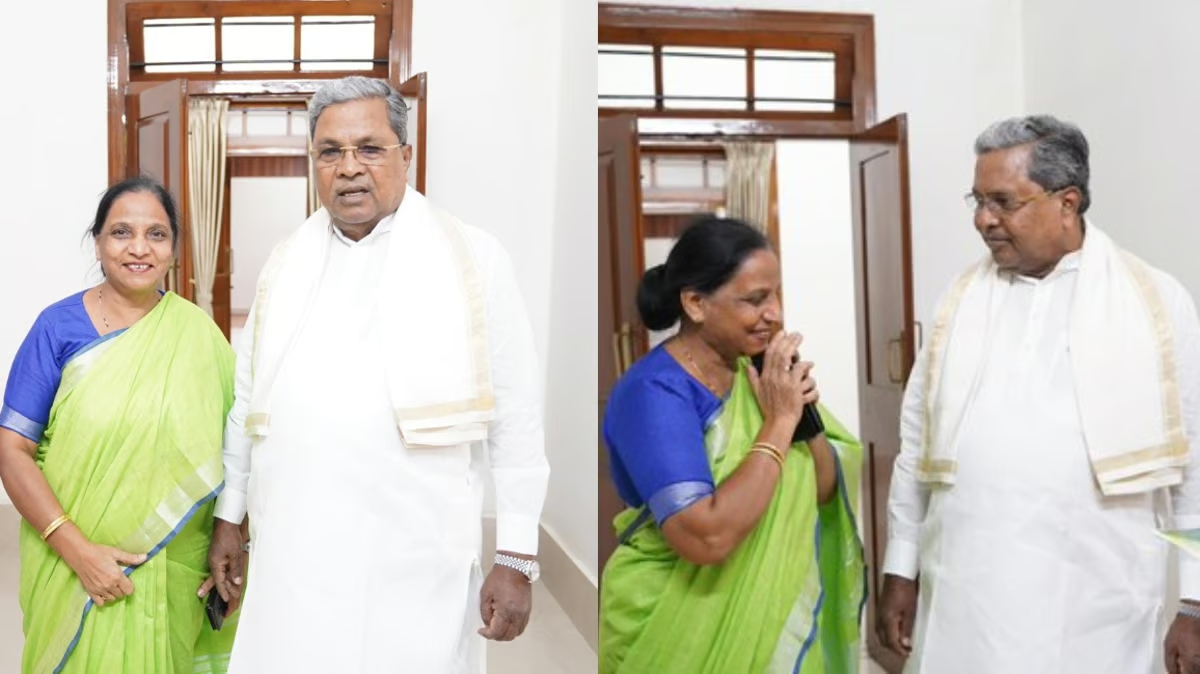
For the uninitiated, Bilkis Bano has no connection to Gujarat. She is a KPCC general secretary from Bhadravathi in Shivamogga, who once used to work closely with the Janata Parivar and has known Chief Minister Siddaramaiah from those days.
Bilkis Bano is KPCC general secretary from Bhadravathi in Shivamogga. Photo | X
Bengaluru :
With a certain Bilkis Bano figuring in the list of Congress nominees, the question on everyone’s mind is: Who on earth is she?
For the uninitiated, Bilkis Bano has no connection to Gujarat. She is a KPCC general secretary from Bhadravathi in Shivamogga, who once used to work closely with the Janata Parivar and has known Chief Minister Siddaramaiah from those days.
Sources said she is Siddaramaiah’s candidate while his’s son Yathindra, who sacrificed his Varuna seat for his father, is the high command nominee.
Other Siddaramaiah MLC nominees are minister NS Boseraju and K Govindraj. Vasanth Kumar and Basanagouda Badarli are AICC president Mallikarjun Kharge’s candidates while Ivan D’souza is said to be Krishna Byre Gowda’s man although he is said to be close to Siddaramaiah too.
It was a surprise that Deputy CM DK Shivakumar’s two nominees, Vijay Mulgund, who was also raided due to his closeness to the KPCC chief, and Vinay Karthik, who is an office bearer in the KPCC, did not make it to the final list.
The 10 Congress MLAs necessary for nomination of Bilkis Bano signed on her nomination and the proposer and seconders will be on Monday.
Sources said Bilkis Bano is respected as a loyal party worker. She is quite close to Bhadravathi MLA Sangamesh for whom she campaigned vigorously and personally led the canvassing in 2023. She has served formerly as the chairman of the Minorities Development Corporation during the previous tenure of Siddaramaiah as CM for about 18 months.
When TNIE tried to reach her on Sunday evening, all three of her numbers were either switched off or not reachable.
source: http://www.newindianexpress.com / The New Indian Express / Home> Karnataka / by Bansy Kalappa / June 03rd, 2024
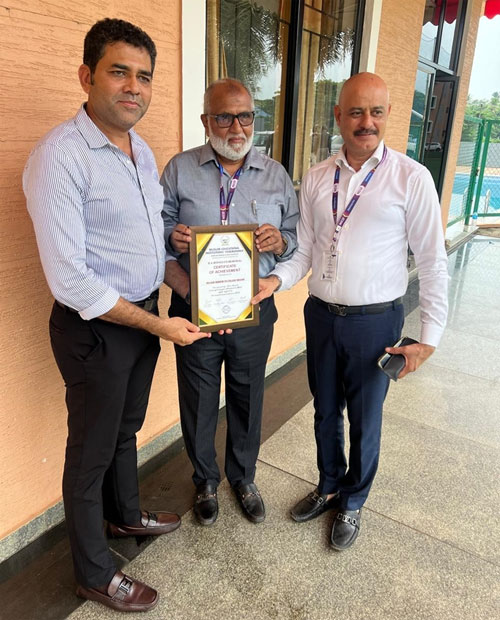
Melkar Women’s PU College, Marnabail, has been awarded with ‘Excellence Award’ by Muslim Educational Institutions Federation (MEIF) for achieving cent percent results in 2nd PUC in science, commerce and arts for the academic year 2024.
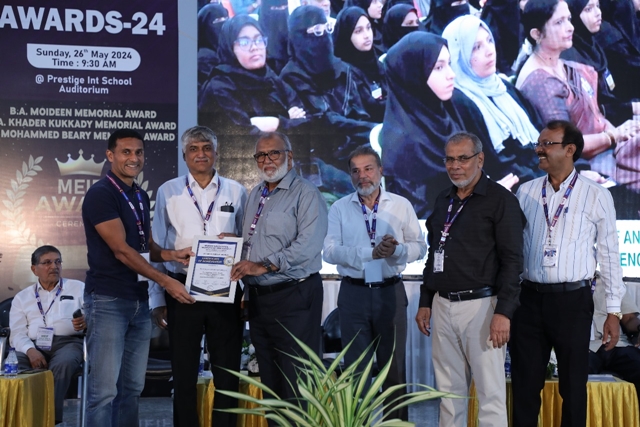
S M Rashid Hanji, chairman of Mangaluru Education Enhancement Trust (MEET) received the award on behalf of the management committee of the college during the recent MEIF annual conference held in Mangaluru.
Mohammed Farhaad, pro chancellor of Yenepoya University; Nisar Ahmed, chancellor of Presidency University; Syed Mohammad Beary, chairman of Bearys Group of Institution; Musabba Beary, chairman of MEIF; Iqbal Ahmed, Umar Teekay and others were present.
source: http://www.daijiworld.com / Daiji World / Home> Karnataka / by Daijiworld Media Network – Bantwal (VP) / June 03rd, 2024
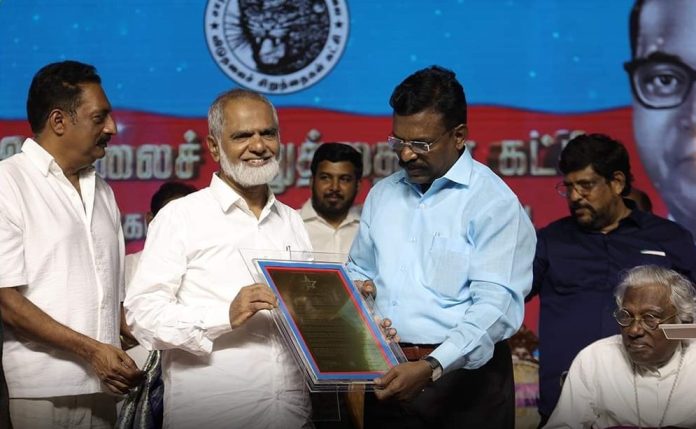
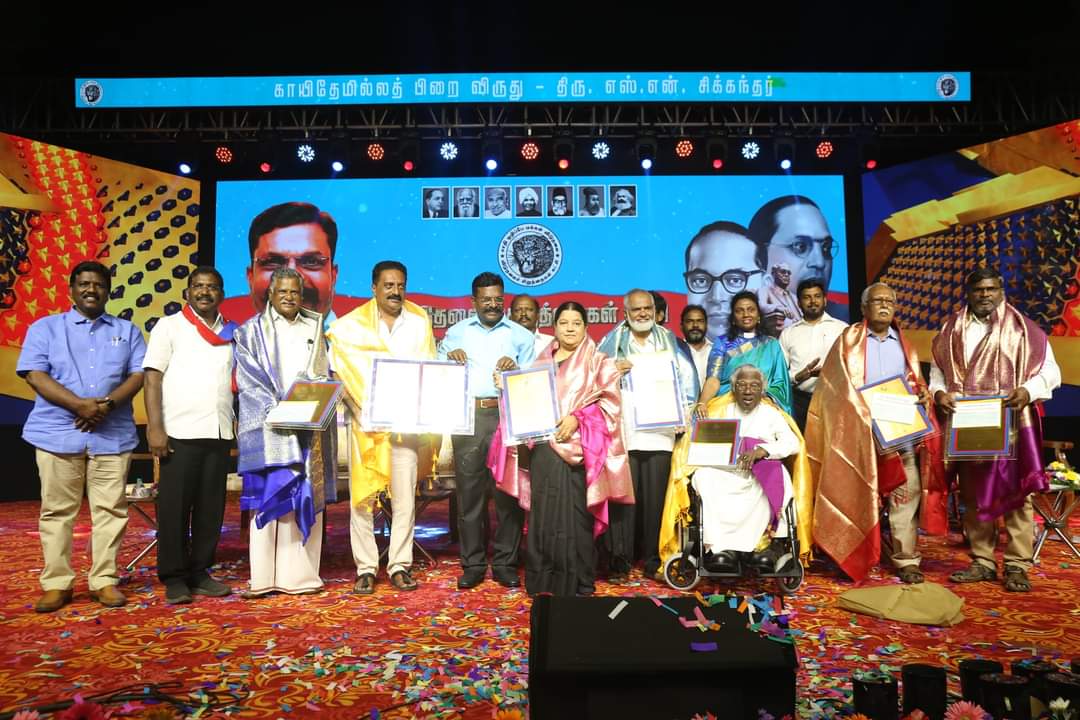
S.N. Sikkander (second from Left) receiving the award
Chennai :
Viduthalai Chiruthaigal Katchi (VCK), a Dalit social movement and political party committed to combating caste-based discrimination and actively participating in Tamil Nadu’s politics, held an awards ceremony, on Saturday last, to honor prominent state leaders for their exemplary service to society.
VCK, currently represented by two MPs in the Lok Sabha, recognized seven individuals for their decades of selfless dedication to various social causes, ranging from political activism to fostering communal harmony
One of the distinguished awardees was S.N. Sikkander, State Secretary of Jamaat-e-Islami Hind, Tamil Nadu, former State President of Welfare Party of India, and editorial board member of Samarasam Magazine. He was awarded the ‘Qaid-e-Millath Crescent Award’ for his significant contributions to communal harmony, disaster relief efforts, and political activism.
Other notable awardees included Mr. R. Mutharasan, State Secretary of CPI; Advocate Arulmozhi, Secretary of Dravidar Kazhagam; actor Prakash Raj; Bishop Esra Sargunam; Mr. A. Subbarayulu, an epigrapher; and Professor Raj Gowthaman.
The award ceremony, held in Chennai, attracted thousands of spectators who echoed the importance of nurturing harmony, peace, and mutual respect among communities.
source: http://www.radiancenews.com / Radiance News / Home> Pride of the Nation> Awards / by Radiance News Bureau / June 01st, 2024
Karate player Zabir Ansari has won a gold medal in the tenth international championship named Mayor Cup 2024 organized at Kakarvitta Meshinagar Jhapa, Nepal. The two-day championship held on May 31 had India, Pakistan, Sri Lanka, Bangladesh, Bhutan, Afghanistan and Nepal as participating countries.
Zabir Ansari’s victory is being celebrated at Patna University, where he is enrolled for a post-graduate degree in the Urdu department.
Earlier, Zabir had won medals in international Karate events in Sri Lanka, Thailand, China, Turkey, and Egypt.
Zabir won the gold medal by defeating Nepal and Bhutan in the 75 kg category.
pix: x.com
Interestingly, Zabir was short of money for participating in this international meet when a Pasmanda leader Dr Faiyaz Ahmad Fyzie ran a social media campaign asking Indians to help this promising Karate player. He posted this on social media after Zabir’s vioctory on X:
Giving the credit for his success to his coach Rahul Kumar, Jabir told Awaz-the Voice on the phone from Nepal that ‘Rahul Sir’ made him practice hard for 6 to 8 hours every day.
Rahul said that he was hopeful that just like Zabir’s gold medal in the All India University competition where 188 universities were participating he would win the gold this time.
Zabir played his first match in 2015 where he won a silver medal.
Zabir Ansari’s achievement is all the more impressive given his background. He hails from a remote and naxal-affected area of Bihar.
His father Imtiaz Ansari is a teacher in a school in his native Tumbapahar village of Jhajha block of Jamui district.
Zabir is the eldest of four siblings. Mother Fahima Khatoon has received the Rashtra Veermata Jijabai Samman-2018.
Zabir has represented the country five times. In 2017, he won a silver medal for the country in the South Asian Karate Competition held in Sri Lanka. He represented India in China, Thailand in 2018, and Turkey in 2019. He was included among the potential Karate players of India in the Asian Games held in Indonesia in 2018 and participated in the training camp.
Zabir has won the gold medal six times in a row in the state-level Karate Championship, while he won the silver and bronze medals in 2017 and 2019. Last year, Jabir Ansari won the bronze medal by securing third place in the All India Inter-University Karate Championship. Jabir Ansari also secured fourth place in the Khelo India University Game 2022.
Zabir has received the State government’s Sports Award in 2018, 2021 and 2022.
Zabir said that as a child he always dreamed of doing action. Also, he would sneak out and watch action movies of actors like Akshay Kumar. After watching a film, he always felt a strong urge to learn action. However, only after came to Patna for admission in the 12th class did he join a Karate class. In 2015, he played a match at the national level for the first time.
Initially, his family wanted him to focus on studies. However, sensing his inclination for Karate, his parents gave him a go-ahead.
Shahab Zafar Azmi, Chairman of the Urdu Department of Patna University, says that Zabir Ansari’s success is the success of the Urdu Department and Patna University. “I congratulate our promising student, may he get more success.”
Zabir also says that the college gave him confidence as a sportsperson.
“I will always be grateful for the honour of being a student of Patna University and above all for the guidance and support I received.”
Bihar Governor Rajendra Vishwanath Arlekar has honoured Jabir for encouraging him.
source: http://www.awazthevoice.in / Awaz, The Voice / Home> Story / by Seraj Anwar, Patna / June 03rd, 2024
Despite the impressive show by the secular parties in the 2024 Parliamentary Elections, number of Muslim MPs in the new Lok Sabha has gone down by 04 as compared to their tally in the last house.
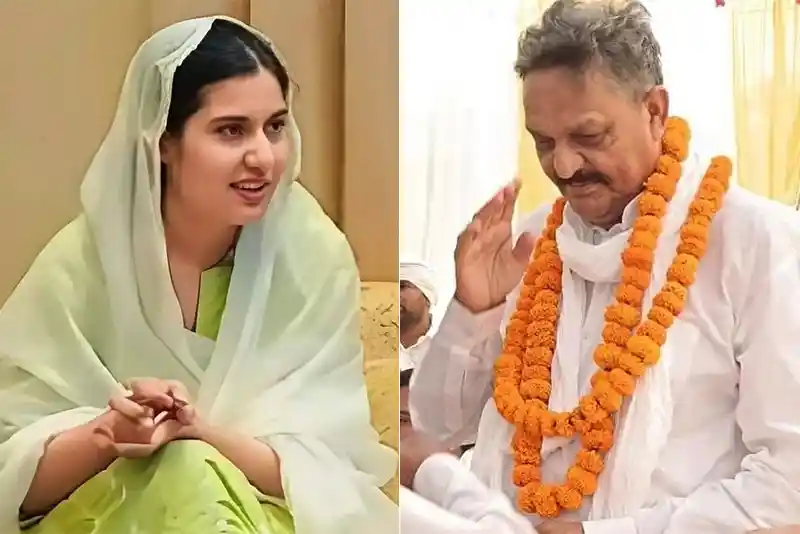
Iqra Hasan and Afzal Ansari – both have won from Uttar Pradesh
LS Election Result 2024:
Lok Sabha 2024 to have 23 Muslim MPs New Delhi: Despite the impressive show by the secular parties in the 2024 Parliamentary Elections, number of Muslim MPs in the new Lok Sabha has gone down by 04 as compared to their tally in the last house.
According to the final result released by the Election Commission of India (ECI), the 18th Lok Sabha will have a total of 23 Muslim MPs from different states of the country.
Of them a maximum 07 are from the Congress Party followed by 05 of the Trinamool Congress Party (TMC), 04 are of the Samajwadi Party (SP), 02 of the Indian Union Muslim League (IUML), 02 of the Jammu Kashmir National Conference, 01 of the All India Majlis e Ittehadul Muslimeen (AIMIM) and 02 Independents.
List of Muslims in 18th Lok Sabha
Congress
Rakibul Hussain Congress Dhubri, Assam
Mohammad Jawed Congress Kishanganj, Bihar
Tariq Anwar Congress Kathiar Bihar
Shafi Parambil Congress Vadakara, Kerala
Imran Masood Cngr Saharanpur, Uttar Pradesh
Isha Khan Choudhury Maldaha Dakshin, West Bengal
Muhammed Hamdullah Sayeed Lakshadweep
Samajwadi Party (SP)
Iqra Choudhary Kairna, Uttar Pradesh
Mohibbullah Rampur, Uttar Pradesh
Zia Ur Rehman Sambhal, Uttar Pradesh
Afzal Ansari Ghazipur, Uttar Pradesh
Trinamool Congress Party (TMC)
Khalilur Rahaman Jangipur, West Bengal
Yusuf Pathan Baharampu, West Bengal
Abu Taher Khan Murshidabad, West Bengal
Sk Nurul Islam Basirhat, West Bengal
Sajda Ahmed Uluberia, West Bengal
Indian Union Muslim League (IUML)
E.T. Mohammed Basheer Malappuram, Kerala
Dr. M.P Abdussamad Samadani, Ponnani, Kerala
Jammu Kashmir National Conference (JKNC)
Aga Syed Ruhullah Mehdi Srinagar, Jammu Kashmir
Mian Altaf Ahmad Anantnag-Rajouri. Jammu Kashmir
All India Majlis e Ittehadul Muslimeen (AIMIM)
Asaduddin Owaisi Hyderabad, Telangana
Independent
Abdul Rashid Sheikh Baramulla, Kashmir
Mohmad Haneefa Ladakh
Prominent losers
Kanwar Danish Ali Amroha, Uttar Pradesh
Badruddin Ajmal Qasmi, Dhubri, Assam
Omar Abdullah, Jammu Kashmir
Mehbooba Mufti, Jammu Kashmir
Imtiaz Jaleel, Aurangabad Maharashtra
Hena Shahab, Siwan, Bihar
Mohd Salim CPI(M) West Bengal
None of the Muslim MPs are from the ruling BJP. The party had fielded Dr Abdul Salam from Malappuram Parliamentary seat in Kerala. He however lost the election to the IUML candidate.
Rakibul Hussain of the Congress won the 2024 Lok Sabha elections by more than 10 lakh votes which is the highest victory margin in India.
The number of Muslim MPs in 2014 was 23. However, Muslims improved their tally in 2019 by 04 despite a huge Modi wave.
LS Election 2024 Final Result
The Election Commission of India announced the final result late in the night Tuesday. According to which, the BJP led NDA alliance has won a total of 292 seats which include a total of 240 seats won by the BJP.
According to the ECI final data, the Congress led INDIA alliance has won a total of 234 seats which include 99 seats won by the Congress, 37 won by SP, 29 won by TMC and 22 won by DMK Tamil Nadu.
source: http://www.ummid.com / Ummid.com / Home / by Ummid.com News Network / June 05th, 2024
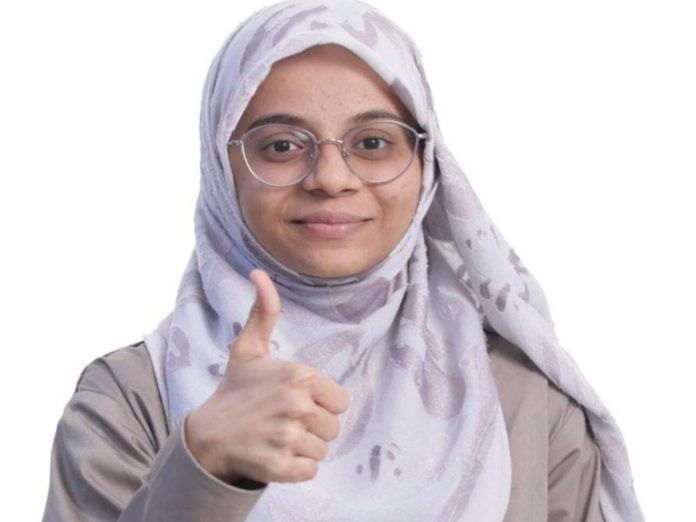
Amina Arif Kadiwala, an Urdu medium student, has achieved an extraordinary feat by securing the first position in the All India NEET UG 2024 examination. Hailing from Madni High School in Jogeshwari, Mumbai, Amina outshone approximately 25 lakh students across India to claim the top spot. Her success is particularly remarkable given the competitive nature of the exam and the high level of preparation required.
Amina’s journey to the pinnacle of NEET UG 2024 is a testament to her dedication, hard work, and perseverance. As an SSC student from an Urdu medium background, she faced numerous challenges but remained steadfast in her pursuit of excellence. Her achievement has not only brought pride to her family and school but also serves as an inspiration to countless other students from similar backgrounds.
Madni High School, known for its commitment to providing quality education, played a significant role in nurturing Amina’s talent. The school’s supportive environment and dedicated teachers provided her with the guidance and resources needed to excel in her studies. Amina’s accomplishment underscores the importance of providing equal educational opportunities to students from all linguistic and socio-economic backgrounds.
Aspiring to study MBBS, Kadiwala has studied till class 10 in Urdu and then took admission into SVKM’s Mithibai College. She completed her schooling at Madni High School, Jogeshwari.
She revealed that initially, it was a challenge for her as she was weak in English, but slowly she learned the language and aced the exam
Amina’s success story has garnered widespread acclaim and admiration. Her exceptional performance in the NEET UG 2024 has opened doors to some of the best medical colleges in the country, paving the way for a promising career in medicine. As she embarks on this new journey, Amina is determined to continue working hard and making a positive impact in the field of healthcare.
In an era where the importance of education cannot be overstated, Amina Arif Kadiwala’s achievement stands as a beacon of hope and motivation for aspiring students across India, demonstrating that with determination and hard work, any obstacle can be overcome.
source: http://www.muslimmirror.com / Muslim Mirror / Home> Indian Muslim> Positive Story / by Muslim Mirror Staff / June 05th, 2024
It is rarely that a person becomes the Vice Chancellor of four universities. Professor Qamar Ahsan, who was born into a middle-class family and started his education in Madrasa, is one such person.
Professor Qamar Ahsan is a top-ranking educationist and economist, who holds the distinction of being the vice chancellor of four universities. Speaking to Awaz-The Voice, Professor Qamar Ahsan said that he not only brought changes in the educational system but also started new courses, especially job-oriented ones for the benefit of students in all the four universities.
Qamar Ahsan became the Vice-Chancellor of Maulana Mazharul Haq University, Patna at its inception stage. He played an important role in shaping the University campus, curriculum, and ethos. Generally, it was believed that the path to education in a University or seminary is linear, but I believe, it should be dynamic and both the curriculum and pedagogy should change periodically. This will make the students ready for jobs and thereby increase their employability.
Speaking about his early life, Qamar Ahsan said he was an ordinary student but quite active. “I always worked with complete confidence, even today my method is the same,” he said.
Prof Qamar Ahsan with President Ram Nath Kovind
Qamar Ahsan says that self-confidence is an emotion that gives a person the courage to succeed in the environment of a comprehensive culture. “My father was in the police and he often said that everyone should live and work together. At my home, I was raised in an environment where there was no scope for hatred or negativity. We were brought up in an inclusive culture and in later days not only fostered mutual brotherhood and goodwill but also studied and grew up living with people of different religions.”
He said that it helped him as his friends (from other religions) also supported him. Prof. Qamar Ahsan has worked with many governors and is familiar with the Madrasa, School, and College education system and has worked on improving these institutions.
“When I was the Vice-Chancellor of Maulana Mazharul Haq University, I tried my best to implement modern science in madrasas, although I was not fully successful, we connected hundreds of madrasas with the university and it improved the standards of education there. I succeeded in changing the environment in the madrasa.”
Professor Qamar Ahsan was born in April 1952 in Patna. He is the fourth among seven brothers and sisters. His father Syed Muzaffar Ahsan was in police service and he retired as an Additional SP.
Prof Qamar Ahsan with his parents and siblings
According to Qamar Ahsan, their father also received a medal for his good service in the police service. “We belong to a village in Siwan district of Bihar. When my father was in the police service, he was constantly transferred and I could not study in one place. I studied in different cities and schools,”
Qamar Ahsan says that at the time he was in primary, his father was posted in Ranchi where he was admitted into Madrasa Islamia. Thus his formal education started from a seminary. Next, his father was posted to Muzaffarpur CBI, so he joined a Pathshala. He then joined an English medium school and later the famous Miller School This trend continued and finally, Qamar Ahsan joined Patna College for higher education.
Prof Qamar Ahsan says Patna, the city of his birth, was quite famous for its educational institutions. “One of these was the Patna University. At that time this university was well respected. I was admitted into the Patna College.”
According to Qamar Ahsan, when he reached Patna College and Patna University, he could understand life from a different perspective. “I did my BA and MA in Economics. I was an average student but very sensitive about my course and my studies.”
The Patna University, education was quite good; it charged a nominal fee and the University Library was a treasure trove. “I used to read non-syllabus books more than my course books. My father also encouraged me in this regard and I started reading a lot of novels and story books. I read Premchand and Ismat Chaghatai and in between I also read a lot of English novels. This broadened my horizons of thinking and understanding.”
He said that at that time JP (Jay Prakash Narayan) Moment was at its peak and he too joined it. He earned her doctorate from Ranchi University. “In the meantime, after MA, I got a job at Magadh University in 1977. Although my father had wanted me to join the civil services, I always wanted to be a teacher. So when I joined the college as a teacher, my dream had come true. I was quite happy and excited. I wanted to share my experiences with students and take practical steps to improve the system.”
Prof Qamar Ahsan with his wife, children and grandchildren parents and siblings
Interestingly, Qamar Ahsan’s grandfather was the Head Maulvi at Chapra District School. ‘I had the experience of studying in different schools and mentally I was passionate about teaching. When my dream became a reality, I turned my full focus to teaching students and improving their academic standards. Then I got transferred to AN College, Patna, and was promoted as a Reader. Since then I never looked back and received promotions regularly.”
He first was appointed the registrar of Nalanda Open University, then Veer Kaur Singh University, and Maulana Mazharul Haq University of Bihar
Given his excellent educational experience, the government appointed him the Vice Chancellor of the BN Mandal University, Madhapura. He remained in the post from 2006 to 2008.
During this period he made the university clear a huge backlog of examinations and corrected the system. He tried to improve the attendance of teachers, and students; establish an educational environment, and promote curricular and extra-curricular activities in the campus and colleges under its jurisdiction. He introduced job-oriented courses in the university as well as improved the financial condition of the institution.
Prof Qamar Ahsan says,” I was given an opportunity to become the vice chancellor of various universities and in the meantime, I tried to provide job-oriented courses to the students so that their migration could also be stopped. Bihar students usually go abroad for job-oriented courses, I tried to start the same courses for which they would go abroad.”
In 2008, Professor Qamar Ahsan was made the Vice Chancellor of Maulana Mazharul Haq University, Patna. When he came to take charge, the University was in a small government building on Bailey Road, Patna. The Maulana Mazharul Haq Arabic and Persian University was established in 1998 and despite the appointment of three Vice-Chancellors, it did not take off till 2008. It was a University on the papers.
Prof Qamar Ahsan with Sushil Modi while inaugurating a University
Qamar Ahsan says, “I formulated a plan of action and the university was functional within three months. Today, more than 20,000 students are studying in different departments at this university.”
He said that the University has more than four dozen Knowledge Resource Centers throughout Bihar and arrangements have been made to provide regular education to 116 higher education institutions near Madrasas and Fazil.
The university has a strong management of teaching as well as training. Professor Qamar Ahsan was the Vice-Chancellor of Maulana Mazharul Haq University till 2011.
Mazharul Haq University started various courses at that time, in which BBA, BCA, BJMC, MBA, B.Ed, etc. are noteworthy. He said that this university was also related to madrasas, so in the meantime, I tried to correct the higher education system of madrasas, but some people did not approve of it.
Professor Qamar Ahsan says that my experience with madrasas is that there are two types of madrasa, one is a madrasa where religious education is given and the other is the one where all subjects are taught. I believe that normal education should also be introduced in the former while in the latter category, the curriculum needs to be modernized to make the alumni job worthy.”
He said that the curriculum and teaching method should be changed from time to time.
“When I was the VC of Maulana Mazharul Haq University and during my visits to the madrasas, I noticed that students showed up only on the day I visited these. That too only 50 percent of the students were present.”
Prof Qamar Ahsan delivering a lecture
This would change if the curriculum included research. “If there is a research curriculum then the students will benefit and the subject should be taught as per the demand of the market.”
After Maulana Mazharul Haq University, Prof. Qamar Ahsan became the Vice Chancellor of Sidhu Kanhu Murmu University, Dumka, Jharkhand and then of Magadh University.
Meanwhile, according to his vision, he continued to solve the problem of education quality of students, better university system and teachers. Qamar Ahsan is the author of about 9 books and more than 30 of his papers have been published in major journals of the country. He has been a member of the editorial board of NCERT, IGNOU and various journals. Professor Qamar Ahsan says that whether a student is successful or reaches a position, he should not forget honesty and hard work. Only those people who have the confidence and passion to do something achieve success in life.
Prof. Qamar Ahsan was born and brought up in Patna, son of Syed Muzaffar Ahsan and Nafis Fatima Naqvi. He has distinguished himself as an educator, educational administrator and educational innovator. He said that by the 10th class, every child should make his own goal of what he wants to do in his life. “People who do not fix their goal often fail,” Qamar Ahsan says.
He says he had made his goal clear as soon as he passed matriculation and it was he wanted to become a teacher.
Professor Qamar Ahsan got married in 1980, he has two children and his wife is also a school teacher. The elder of the two children, the daughter has shifted to the Netherlands and the son lives with them. He said that they are seven brothers and sisters. Four are in the US, and one is in England.
According to Qamar Ahsan, he had also shifted to the USA and had obtained a green card. However, due to his mother’s health, so returned and then decided to continue his services for the country.
Although most of his family has shifted abroad, Qamar Ahsan says he is satisfied with his life.
source: http://www.awazthevoice.in / Awaz, The Voice / Home> Story / by Mehfuz Alam, Patna / May 30th, 2024
Hamid Iqbal Siddiqui And his wife Zahida with students during a quiz programme
Hamid Iqbal Siddiqui, founder and chairman of Quiz Time, Mumbai, has organized more than 275 general knowledge quiz shows to promote the Urdu language across the megacity of Mumbai.
Committed to the promotion of the Urdu language and education in Mumbai, Siddiqui has been holding general knowledge quiz competitions in modern style for more than three decades.
He is so popular among students who are learning Urdu that as soon as he reaches a school, children gheroa him. They run towards him chanting “Uncle Hamid Iqbal aa gaye…”
Iqbal Siddiqui received the title of “Superstar of Urdu Students” long ago. besides, The Times of India publication has also honoured him with the title of “City Angel.”
Hamid Iqbal Siddiqui delivering a motivational lecture
Siddiqui told Awaz-the Voice that apart from their syllabi, today’s children must have a good knowledge of arts, science, sports, technology, politics, civilization and culture, film, medicine, history, mathematics, current affairs (current affairs), etc.
“It plays an important role in a child’s success in life. If we look at our education and job entry examinations, it cannot be denied that questions in general knowledge are asked in almost every examination and this percentage is quite high. If attention is paid to this aspect from the early stage of children, the preparation process for any competitive exam can be started from the primary school.”
Hamid Iqbal Siddiqui said that it was during 1992-93 that he and some of his close friends decided to do something for the youth. “I was given the responsibility of teaching General Knowledge. I used to conduct Islamic quiz competitions in madrasas during my student days. I also used to make Islamic quiz programs on the streets by putting up a stage in a street, However, those programs were also quite popular among the students. Therefore, I did not face any particular difficulty in organizing the General Knowledge Quiz competitions.”
Siddiqui says that even before the advent of quiz shows on television, he had been conducting general knowledge quiz competitions with music, and full pomp and show. At the end of the program, children are awarded prizes, and Siddiqui also presented gifts to their parents and their teachers.
“We presented a gift to each participant in the general knowledge competition. We value his hard work more than winning and losing,” Siddiqui said.
Hamid Iqbal the presentation of prizes to all participants made him quite popular. He says once he distributes prizes worth rs one lakh.
Hamid Iqbal Siddiqui with teachers of urdu school
Quizmaster Hamid Iqbal says that it has been wrongly projected that there are no employment opportunities for those studying the Urdu language.
“Those who follow the outdated way of thinking and feel inferior are the ones. They are harming Urdu. Even today, Urdu is the source of livelihood for millions of people in our country. Urdu culture is still very attractive.”
He said that when Urdu is connected with modern technology, higher education, fashion, and entertainment many new opportunities of jobs will flow.
Hamid Iqbal has been working on sustaining and improving the quality of Urdu schools for years. “When the era of e-learning came, he introduced it in Urdu schools. We are continuing with that project without charging the school fees,” he said.
While visiting a school, he always carried chocolates and small gifts for the students. He asks the students questions during his lecture and gives away chocolates and gifts to those who reply or even attempt to reply correctly.
He however regrets the fact that there is no significant change in their condition. “In these schools, no special attention is paid to general knowledge.”
He narrates an incident. During his visit, he asked students the name of the President of the country and the reply was Narendra Modi. They didn’t know who the chief minister of the State was. “I realized that despite conducting General Knowledge Quiz competitions for 26-27 years, there is still a lot of work to be done. That’s why I am paying special attention and giving lectures in Urdu schools to change the mindset and trigger their minds to seek information and knowledge.”
In 1999, Quiztime Mumbai organized the first Inter-School General Knowledge Quiz Competition. The success of this large-scale program encouraged them to continue the trend in 2024 with the 23rd Annual General Knowledge Quiz Competition ‘Dhamal’. 2024′ was successfully organized in February. Fifty schools participated in this competition. A team of three students from each school participated.
A special feature of Dhamal 2024 was that not four but six teams were selected for the competition and they were awarded with trophies and prizes.
Siddiqui’s wife Zahida is the backbone of his operation. Zahida is a teacher in a government school and she spends a part of her salary on Urdu General Knowledge Quiz competitions.
Hamid Iqbal Siddiqui with award winners
“She is also my like-minded friend and a friend of Urdu. Ever since she joined us, the quality of our quiz competitions has improved even more. Acknowledging his wife’s talent,” Hamid Iqbal says that Zahida is the best organizer.
Born in 1958 in Mumbai, Hamid Iqbal Siddiqui is the grandson of Allama Seemab Akbarabadi. His family has been serving the Urdu language for more than a hundred years. He has been working as an assistant editor of the 93-year magazine Shayar published in Mumbai.
This literary magazine has been banned for some time now. However, he writes a column for the Urdu newspaper Daily Inquilab. Interestingly, Hamid Iqbal Siddiqui is a trained designer; he is also fond of poetry.
Siddiqui continues to participate in national and international Mushairas. Hamid Iqbal says there have been occasions when he had to choose between attending a Mushaira and children’s quiz competition, he settled in favour of children.
Siddiqui commands an interesting personality, has a charming voice, and speaks polished Urdu. When he picks the mike, the audience is smitten by his way of speaking. He does not let his words burden the environment. The children who participate in Hamid Iqbal’s programs remember him forever. He is very happy. “when I go out, many people coFlecme and greet me. Students who are under study meet me as well as those who are now holding high positions when they mention me.”
Siddiqui has no children and he keeps showering his love, compassion, and sincerity on children.
A few years ago, he wanted to expand his work. he decided to find scribes in the Urdu educational institutions.
Apart from this, he organizes the program ‘Urdu ki Mohabbat Mein‘ every year under the banner of Quiz Time Mumbai. he awards a person who has worked selflessly for the promotion of the language. The award is called ‘Mohab Urdu Honour‘ He has seven books on General Knowledge to his credit so far.
Hamid Iqbal Siddiqui says that Urdu is a complete, modern, and living language. Like all the living languages of the world, science, history, geography, and other modern sciences should be taught in Urdu. However, he says, a lot of hard work, effort, and struggle is needed to improve the quality of the education at these schools.
source: http://www.awazthevoice.in / Awaz, The Voice / Home> Stories / by Shah Taj Khan, Pune / May 31st, 2024
Cover page of Ebrahim Alkazi: Holding Time Captive
Ebrahim Alkazi’s father Hamed Alkazi was an immigrant businessman in India. He came from Nejd in Saudi Arabia as a young man to Calcutta and then to Bombay. Through hard work and honesty, he established himself in the export business. He raised his family in India. The children stayed back in India when he left the country in 1948 after Gandhi’s assassination, first for Karachi, then London, and to Beirut. Hamed while providing for their Western education in Poona saw to it that they were taught Arabic and also the Quran. Ebrahim and his siblings retained their parents’ values of etiquette and social conservatism.
Ebrahim grabbed the opportunities his education provided him of plunging into literature, music, art of times that India was exposed to during the colonial period. The politics of the period had a different impact on Hamed and Ebrahim. The father was apprehensive of the political volatility, but the son was electrified.
Amal Allana, the daughter, theatre personality in her own right and biographer, captures the magical moment of Ebrahim’s indirect baptism. He is pulled into the Congress session of August 8, 1942, when the Quit India movement was announced. Ebrahim was on his way to Sophia College for a debate at 9 am and reach St Xavier’s for an audition for the college drama at 2 pm. The streets were crowded and people were rushing in one direction. He goes to the meeting and he is mesmerised by Gandhi’s simple words. Amal recounts the episode intertwining it with that of his elder brother Ali going off to join the army even before Ebrahim came to Bombay.
If business was what engaged Hamed Alkazi, it was the arts, especially theatre, that absorbed the full attention of Ebrahim. His burning passion was to do something in the theatre and Bombay provided the door to enter upon his lifelong vocation. He had ready entry to a group of young men led by Sultan Padamsee, known to the social group as Bobby, who belonged to a well-off Khoja family, and the upper social circle of Bombay. Ebrahim became a natural member of the group. It was here that he met Roshen Padamsee, whom he will marry when he barely 21. But before that Bobby commits suicide. Amal handles his sexuality issue in the most natural manner, which any other biographer would have made into a major talking point of the 1940s Bombay.
Ebrahim, like many young men and women of the time in urban India, was consumed by the passion for radical modernism that was unfolding all over Europe in the arts and in literature. It was this mission that drove Ebrahim to go to England, and he sought his father for financial help, to pursue first painting and then theatre at the Royal Academy of Dramatic Art (RADA) in London. Despite his hunger for all that is modern, Ebrahim was not a bohemian. He remained an Arab at heart, simple, reserved and taciturn. He had studied deeply the issues of theatre but he was not loquacious. He could explain his point of view emphatically, and this is what carries the day for him when he attends the theatre seminar in Delhi to which he is invited in the early 1950s, and which leads to the government appointing him the director of the National School of Drama in Delhi in the early 1960s.
At one level, Ebrahim’s and Roshen’s life is a swirl of celebrities in the art circle of Bombay, and later in Delhi. But the relations between Ebrahim and Roshen were strained. At one point, Ebrahim was drawn to Uma, the first wife of Chetan Anand, and after her divorce from Chetan, she was keen to be with Ebrahim. But Ebrahim decides to hold back. The Arab sense of duty remains ingrained in him. When he is facing an internal crisis, he returns to his family, to the Arab lands, to recover his sense of balance. Here is the strange case for today’s India, which is turning ominously xenophobic. Ebrahim, the Arab at heart, was passionately devoted to create a vibrant contemporary, modern theatre in independent India, and he showed how to do it when he turned from the production of plays in English in Bombay to producing Mohan Rakesh’s Aashaadh ka Ek Din and Dharamvir Bharati’s Andha Yug in Hindi. He was an Indian with an Arab’s inner reserves. It is something that will beat the understanding of many in today’s India.
Ebrahim Alkazi: Holding Time Captive
Amal Allana / Penguin Vintage / pp. 647; Rs 1,299
source: http://www.deccanchronicle.com / Deccan Chronicle / Home> Lifestyle> Books and Art / by Parsa Venkateshwar Rao Jr / May 25th, 2024
Dakhni is not central to local identity in Bengaluru the way it is in Hyderabad, but it is still a fixture of everyday life in the city’s linguistic landscape.
Banglori Dakhni: How a language associated with Hyderabad thrives in Bengaluru too
Dakhni, a non-literary Indo Aryan language usually seen as “Southern Urdu”, is spoken across the entire Deccan and beyond, and is primarily associated with the city of Hyderabad. However, the language is widely spoken across Namma Bengaluru as well, even if it isn’t necessarily part of most portrayals or depictions of the city, or even popular local consciousness.
While around half of what can roughly be called Hyderabad’s core city (i.e. Hyderabad district) speaks Dakhni natively as per Census data (at 43.5%), non-native speakers use the language as a lingua franca as well, forming a cornerstone of local Hyderabadi identity.
In highlighting the language’s ties to Hyderabad, however, there is a tendency to view Dakhni as having a unique base in the city. In doing so, Dakhni’s other major urban varieties, varieties with their own urban presence, history, and patterns of usage, are overlooked.
Dakhni’s urban presence in Bengaluru
Hundreds of kilometres from Hyderabad lies the Deccan’s largest urban centre – Bengaluru, the capital of Karnataka. 12% of the city identified as Urdu speaking in the 2011 Census, and the Urdu most speak is a local variety of Dakhni, often called Banglori Urdu.
Banglori Urdu differs significantly from the variant popularised through Hyderabadi media and pop culture. Dakhni is not central to local identity in Bengaluru the way it is in Hyderabad, nor does it serve the role of lingua franca throughout the city, but it is still a fixture of everyday life and has a prominent place in the city’s linguistic landscape.
Bengaluru’s Cantonment, originally a military township established by the British in 1806, has an especially large concentration of Dakhni speakers, a presence that dates back to the early days of the Cantonment itself. In fact, the township was long referred to by its own name in local Dakhni – lashker, or “army camp”, a literal translation of the word “cantonment”, a name still used by many older speakers. Both Dakhni and Tamil are the most common languages spoken in the Cantonment, with Dakhni especially prominent in the Cantonment’s many bazaars. The “Hindi” many local Tamil speakers know and use is often essentially the Dakhni of their neighbours, picked up just from living in the Cantonment.
Dakhni is also spoken in South Bengaluru, by communities who live alongside Kannada speakers. In this part of the city, the language is primarily only used by its native speakers, since Kannada functions as a lingua franca. Many of these families trace their roots back to across erstwhile Mysore State, from Chikmagalur to Davangere, and their speech is influenced by Kannada. Dakhni’s demographic presence here is quite limited in comparison to in the Cantonment. Famous Kannada poet KS Nissar Ahmed, RJ Danish Sait, and singer Lucky Ali are some well-known speakers of Bengaluru Dakhni. Sait’s popular series of prank calls features many sketches in what is essentially thick Bengaluru Dakhni.
Image credit: Professor Walter Hakala of SUNY Buffalo
Interestingly, Bengaluru’s urban landscape also features a handful of Urdu inscriptions, some with a noticeably Dakhni touch. The 19th century Tawakkal Mastan dargah in Chickpet, for example, one of the city’s oldest dargahs, features a slab with an Urdu inscription recording the death of one Murad Bibi. The inscription features the word form ku instead of Standard Urdu ko, a distinctively Dakhni trait found in both Dakhni classical poetry as well as the speech of modern speakers.
Some features of Banglori Dakhni
Varieties of Dakhni maintain a high level of mutual intelligibility across the wide geographic distribution of the language, and this applies to basic vocabulary, grammar, prosody, pronunciation, and more. Distinctively Dakhni features – ones that set it apart from north Indian Urdu – are generally common across these varieties too: function words like ku, the –ān plural marker, the usage of nako for negation, framing reported speech with kate, the pronunciation of Arabic and Persian q as kh, and more, feature across the Deccan. That said, regional dialects can be quite distinct.
A characteristic feature of Banglori Dakhni is the high frequency of the word particle so, used at the end of sentences. The word is meaningless by itself and is primarily used to add emphasis. Another feature, this one clearly an influence from local languages, is the usage of mā and bā as an expression of familiarity which can also intensify a command or question. The dialect also features distinctive word forms like manje corresponding to Standard Urdu mujhe, as well as tumnā and āpe corresponding to Standard Urdu tumko and āp.
Dakhni’s linguistic diversity is, to a large extent, influenced by the different languages its speakers are surrounded by, languages part of their daily social environment. In Bengaluru, these languages are, as we’ve seen, Tamil in the Cantonment, Kannada elsewhere. These languages have also influenced the prosody of local Dakhni, lending it a certain rhythm and cadence. This adds a fascinating extra layer to Dakhni’s existing linguistic variation, as exploring its dialects necessarily involves looking deeper into each speaker community’s own language contact dynamics with its neighbours.
Dakhni’s prestige in Bengaluru
All Dakhni speaking communities across the Deccan are characterised by their usage of Standard Urdu, based on north Indian literary varieties, as their written and formal language. This binds them to the larger Urdu literary sphere and its developments, centered firmly in far off north India. In addition to not being a lingua franca in the city, Dakhni in Bengaluru also lacks the prestige it does in Hyderabad, something that has a direct, conspicuous effect on the way Dakhni speakers choose to use their language in public.
Urdu was a key element in the formation of Hyderabad’s urban culture and Dakhni became central to the city’s very identity; the language never played play a similar role in Bengaluru’s own development. Speakers in Bengaluru often choose to moderate the “thickness” of their Dakhni, adapting it to a form closer to Standard Urdu while interacting with people from other communities, often subconsciously. This is especially pronounced in commercial interactions with north Indian speakers of Hindi, where Dakhni speakers accommodate their speech variety to be more intelligible.
In many ways, this serves to further reduce the presence of Dakhni in the city, diminishing its visibility while reinforcing the common assumption that Dakhni is “just broken Urdu”. This is in stark contrast to the situation in Hyderabad, where Dakhni is used freely in public, even among non-native speakers; Standard Urdu is only resorted to when the other party doesn’t understand uniquely Dakhni word forms and sentence patterns.
In the Cantonment however, with its distinct settlement history and demographics, Dakhni can be widely heard in public communication, and the language enjoys a higher level of prestige. Speakers in the Cantonment do not see as much need to adapt to Standard Urdu in public communication as elsewhere in the city, and Dakhni, even its thicker versions, can easily be heard.
Unfortunately, speakers of Banglori Urdu are often ridiculed by speakers of Hyderabadi Urdu for the many characteristically Bangalori features of their Dakhni, a good example of how linguistic hierarchies of prestige can – and do – exist even within non-literary languages.
Institutional support for Dakhni in Bengaluru
In addition to its presence in the city, Dakhni also enjoys support from various local institutions. While admittedly, most of them primarily focus on the growth and study of Standard Urdu, they also do their part for Dakhni. One institution is the Karnataka Urdu Academy, whose mandate includes the promotion of Dakhni Urdu. The Academy gives cultural events featuring Dakhni some backing.
The Academy also publishes Standard Urdu and Kannada editions of classical Dakhni literature to bring these works to a wider audience. Notable among these is the Kannada translation of Ibrahim Adil Shah II of Bijapur’s Dakhni masterpiece, Kitāb-e-Nauras.
Another important institution is Bangalore University. Its Department of Urdu has been carrying out important research on Dakhni, most notably under its former Head of Department Professor MN Sayeed, a prominent scholar of Dakhni who personally initiated many students – many of whom are now professors of Urdu specialising in Dakhni in their own right – into the field of Dakhni research. Classical Dakhni literature is even taught in the University’s MA Urdu course. Prof Sayeed, now retired, also runs his own dedicated centre for Dakhni research, the Centre for Daccani Studies. Even now, at the age of 79, he continues to do important research on classical Dakhni poetry.
In associating Dakhni with Hyderabad, a lot of the valuable work and research being done on the language in Bengaluru at these institutions and more, particularly relating to developments in Karnataka, is overlooked.
Dakhni as part of Bengaluru’s urban fabric
It’s easy to forget that south India’s cultural diversity – and by extension, its linguistic diversity – applies to its urban centres as well. Most residents of Bengaluru know of the city’s multilingualism, as a city with a shared Kannada, Tamil, Telugu, and Urdu heritage; Bengaluru’s multilingualism is an integral part of their lived experience in the city. However, in defining local Dakhni in relation to Standard Urdu, the unique features that make the Bengaluru dialect what it is as well, as its own history, are ignored. This is even if they know of Hyderabadi Urdu and acknowledge it as distinct from Standard Urdu.
Appreciating Bengaluru’s variant of Dakhni for its place in the city’s urban fabric, for its history in the city, and its patterns of usage, can offer Bengalureans deeper insights into their own city’s rich diversity, how the city – especially the Cantonment – developed over the centuries, and how different communities navigate communication in Bengaluru. Doing so can also help Bengalureans develop a broader awareness of their own city and the various facets of its very identity. Plus, as translation efforts have shown us, understanding modern Dakhni can serve as a link to understanding the courtly Dakhni poetic tradition of the Deccan Sultanates better.
Karthik Malli is a Bengaluru-based communications professional with a keen interest in language, history, and travel. He tweets at @SandalBurn, and posts on Indian languages at @TianChengWen.
source: http://www.thenewsminute.com / The News Minute / Home> Karnataka / by Karthik Malli / September 13th, 2019